Category: Banking & Finance

  • How to Setup Alipay Singapore for China Travel: Top Up Guide (No Bank Account Needed)

    How to Setup Alipay Singapore for China Travel: Top Up Guide (No Bank Account Needed)

    [SUMMARIES]

    No China Bank Account Needed: You can now connect your Singapore-issued credit or debit cards (Visa, Mastercard, Amex, Diners Club, JCB, UnionPay) directly to the international version of Alipay.

    Identity Verification is Mandatory: You must complete “Real-name Verification” using your Singapore passport to activate the payment features.

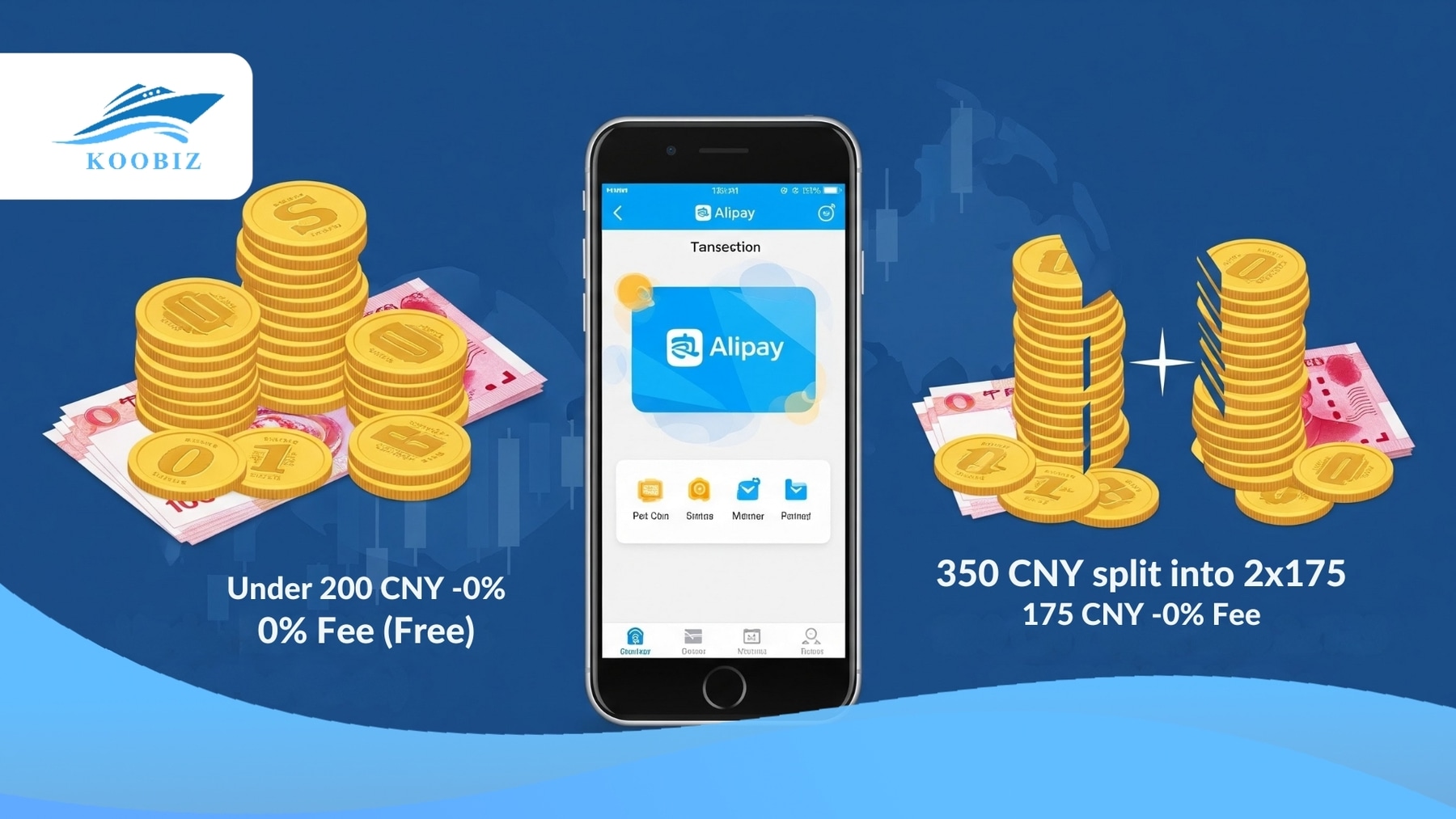
    The 200 RMB Rule: Alipay does not charge a fee for single transactions under 200 Chinese Yuan (CNY). A 3% fee is applied to the entire amount of any single transaction over 200 CNY.

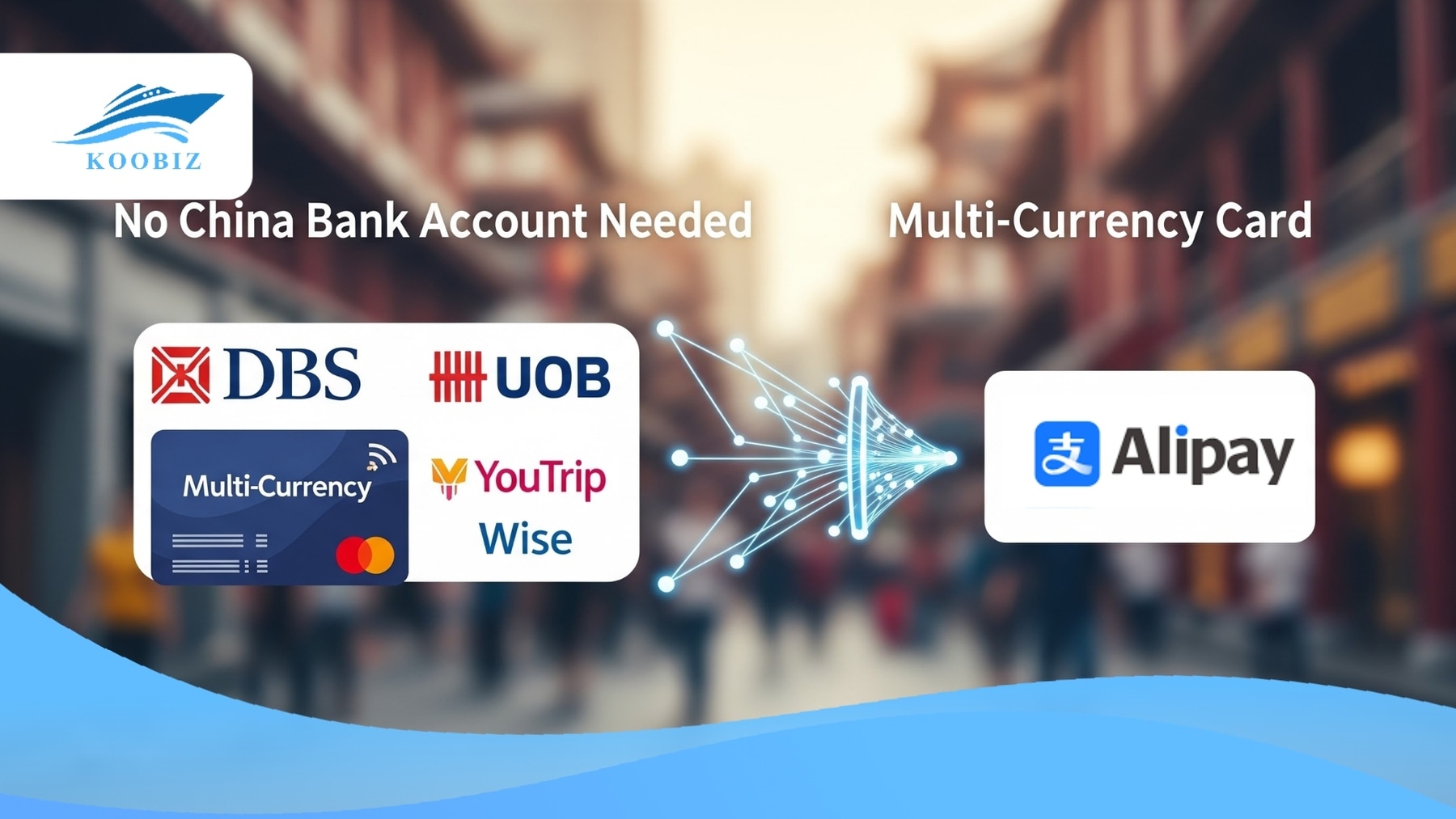
    Best Cards to Use: Using multi-currency cards like YouTrip or Wise is advised to get better exchange rates and avoid additional bank fees.

    Payment Method: You do not need to pre-load money into an Alipay wallet. Funds are deducted directly from your linked card at the time of payment.

    [/SUMMARIES]

    Planning a trip to China can feel overwhelming for Singaporeans, especially when you discover that cash is rarely used. If you’re worried about how to pay for things without a local bank account, this guide is for you.

    The good news is that you no longer need a Chinese bank account or to carry large amounts of cash. This guide will clearly explain how to set up Alipay from Singapore, verify your identity, and link your cards. We’ll also cover important tips on fees and limits to help you manage your spending efficiently.

    Can Singaporeans Use Alipay Without a China Bank Account?

    Yes, Singaporeans can absolutely use Alipay in China without a China bank account thanks to the “International Version” update that allows direct linking of foreign credit cards.

    To clarify this significant change, specifically for our clients at Koobiz who travel for business, Alipay has evolved from a closed-loop system to an open platform for international travelers. Previously, foreigners had to rely on a “Tour Pass” (a temporary prepaid card), but now the system supports “Direct Binding.” This means you can pay for things in China, and the app will charge your Singapore card directly for each transaction—no Chinese bank account is necessary.

    Step-by-Step: How to Register and Verify Alipay Singapore

    It’s best to get the app ready before your trip to avoid any connectivity issues when you arrive.

    Phase 1: Download the International Version

    1. Search: Search for “Alipay” in your phone’s app store (Apple App Store or Google Play Store).
    2. Identify: Look for the app with a blue icon featuring the Chinese character ‘支’. There is only one main Alipay app.
    3. Download and install it: The app will automatically detect your Singapore (+65) number and show the international interface in English.

    Phase 2: Register Account

    1. Open the app and sign up using your Singapore mobile number.
    2. Verify your number with the one-time password (OTP) sent via SMS.

    Phase 3: Verify Identity (Real-name Verification)

    To make payments, you must complete “Real-name Verification.”

    1. Navigate: Go to “Account” or “Me” settings in the bottom right corner.
    2. Select Region: Find the verification section and select Singapore as your region.
    3. Face & Passport Scan: Follow the instructions to scan the photo page of your Singapore passport and complete a quick facial recognition scan.
    4. Wait for Approval: Approval is usually instant or within 24 hours

    You cannot pay merchants until this step is done.

    How to Top Up Alipay: Linking Singapore Credit & Debit Cards

    There are two primary ways to fund your spending: linking standard Singapore bank cards (DBS/POSB, OCBC, UOB) or using multi-currency travel wallets like YouTrip and Wise.

    Think of this as “linking” rather than “topping up.” Your card is charged directly during payment.

    Adding Local Bank Cards (DBS, OCBC, UOB)

    You can easily add your everyday Singapore credit or debit cards to the platform.

    1. Open Alipay and tap on “Bank Cards” or “Add Card”.
    2. Enter the details of your Singapore-issued Visa, Mastercard, Amex, etc.
    3. Authorize the link with an OTP from your bank.
    4. Note: Your bank will convert CNY to SGD and may add a foreign transaction fee (often around 3.25%) and a less favourable exchange rate.

    Using Multi-Currency Cards (YouTrip, Wise, Revolut)

    To save on the bank fees mentioned above, Koobiz strongly recommends using multi-currency cards like YouTrip, Wise, or Revolut.

    • Why use them? These cards typically offer much better exchange rates and lower fees.
    • How to setup: The process is identical to adding a bank card. Enter your YouTrip/Wise card number.
    • Strategic Tip: Just ensure you have enough SGD in the wallet to cover your spending.
    • Pro Tip (Fee Hack): Also check the “Changi Pay” option within the iChangi app, which uses the Alipay+ network and sometimes waives the 3% fee even for larger transactions.

    How to Make Payments in China Using Alipay?

    Making payments in China involves two distinct methods: “Merchant Scans You” (for large stores) and “You Scan Merchant” (for small vendors/taxis).

    Understanding the difference between these two modes is vital for a seamless checkout experience. Critical: Ensure you have an active internet connection (Roaming or eSIM) as “You Scan Merchant” requires data to load the payment page.

    Merchant Scans You vs. You Scan Merchant

    Feature Merchant Scans You (B-Scan-C) You Scan Merchant (C-Scan-B)
    Typical Locations Supermarkets, convenience stores (FamilyMart, 7-Eleven), subway stations. Street food stalls, wet markets, taxis.
    How to Pay Tap “Pay/Receive” to generate your personal QR code. Tap “Scan” and point camera at the merchant’s printed QR code.
    The Process The cashier scans your phone screen with their gun scanner. You enter the amount in RMB yourself and confirm the payment.
    Requirements No PIN is usually required for small amounts. Requires an active internet connection on your phone.

    Contextual Border:

    Now that you have successfully set up your account and linked your cards, you are ready to spend. However, being a smart traveler means understanding the hidden costs. The next section details the fees, limits, and potential issues you might face, ensuring you don’t get caught off guard by unexpected charges.

    Understanding Fees, Limits, and Exchange Rates

    Financial management on Alipay revolves around the critical “200 RMB Rule” and understanding the specific yearly transaction limits imposed on international users.

    At Koobiz, where we handle corporate finance and tax services, we emphasize cost efficiency. For personal travel, the same principle applies—avoiding unnecessary transaction fees.

    What is the 3% Transaction Fee Rule?

    Alipay charges a 3% transaction fee on international cards for single transactions exceeding 200 CNY (approx. 37 SGD).

    • Below 200 CNY: Free
    • Above 200 CNY: You pay a 3% fee on the entire amount. For example, if you pay 201 CNY, the fee is applied to the full 201 CNY, not just the excess 1 CNY.
    • Strategy: For a purchase of, say, 350 CNY, you can ask the merchant to split it into two separate payments (e.g., 175 CNY each) to avoid the fee.

    Payment Limits for International Users

    Great news for travelers: In March 2024, China significantly increased transaction limits for international travelers.

    • Single Transaction Limit: Raised to approx. 36,000 CNY (USD $5,000).
    • Annual Cumulative Limit: Raised to approx. 360,000 CNY (USD $50,000).
    • Note: While Alipay allows these high limits, your Singapore bank or card issuer (e.g., YouTrip, Wise) may still have its own daily overseas spending limits. Check your banking app settings before you travel.
    • TourCard (Last Resort): The “TourCard” mini-app (prepaid Bank of Shanghai card) is now considered a Plan B or last resort. It has a much lower lifetime limit of 10,000 CNY and charges a 5% top-up fee. Only use this if direct card linking fails completely.

    Real-Life Case Study: Alex’s Trip to Shanghai

    To illustrate how these rules affect your wallet, let’s look at a hypothetical spending diary of “Alex,” a Singaporean traveler using a linked YouTrip card.

    Scenario A: The Morning Coffee Run

    • Transaction: Alex buys a coffee and a sandwich at a FamilyMart.
    • Cost: 45 CNY.
    • Outcome: Since 45 CNY is under the 200 CNY threshold, Alipay charges 0% fee.
    • Total Cost: His YouTrip card is deducted exactly 45 CNY worth of SGD (at YouTrip’s exchange rate).

    Scenario B: The Business Dinner

    • Transaction: Alex treats his team to a hotpot dinner.
    • Cost: 500 CNY.
    • Outcome: This exceeds the 200 CNY limit. Alipay applies a 3% fee on the full amount.
    • Calculation: 500 CNY x 3% = 15 CNY fee.
    • Total Cost: His card is charged 515 CNY (500 for the merchant + 15 for Alipay).

    Scenario C: The “Smart” Souvenir Purchase

    • Transaction: Alex buys gifts at a shop totaling 350 CNY.
    • Smart Move: Instead of paying 350 CNY at once (which would incur a 10.5 CNY fee), Alex asks the merchant to scan his QR code twice.
    • Split Payment: He pays 175 CNY first, then another 175 CNY.
    • Outcome: Both transactions are individually under 200 CNY.
    • Total Cost: 350 CNY. Fee: 0 CNY.

    Troubleshooting and Alternatives

    While Alipay is robust, it is wise to prepare for refunds, consider backup apps like WeChat Pay, and know what to do if your account freezes.

    Technology can fail, and having a contingency plan is the hallmark of a seasoned traveler.

    How to Process Refunds to Singapore Cards?

    Refunds on Alipay are reliable but not instant for international cards.

    If you request a refund (e.g., for a cancelled Didi ride or returned goods), the RMB amount is credited back to Alipay instantly, but the transfer back to your Singapore credit card takes 7 to 14 business days. The exchange rate used for the refund might differ slightly from the purchase rate due to currency fluctuations.

    Alipay vs. WeChat Pay: Do You Need Both?

    Alipay wins on user-friendliness for foreigners, but WeChat Pay is superior in social integration. While having both is the optimal strategy, here is how they compare:

    Feature Alipay WeChat Pay
    Best For International travelers & Foreigners Social interaction & Communication with vendors
    Interface Better English support, user-friendly Integrated with chat, essential for local life
    Card Acceptance Higher acceptance rate for international cards Widely accepted, but specific small merchants prefer it
    Koobiz Strategy Use as your Primary Driver Keep as a Backup (“Spare Tyre”)

    What to Do If Your Account Is Frozen?

    In rare cases, Alipay’s risk system might flag a transaction as suspicious and temporarily freeze your payment ability. If this happens, follow these steps to restore access:

    • Stay Calm & Check Status: Go to “Me” > “Settings” > “Account and Security” > “Security Center” > “Restrictions” to see the specific reason.
    • Use the “Help Center”: Navigate to the in-app Customer Service. You can type “Human” or “Live Chat” to request an English-speaking agent (usually available 8 AM – 12 AM UTC+8).
    • Prepare Documents: Be ready to upload a clear photo of the credit card used for the transaction and a bank statement proving ownership.
    • Hotline Alternative: If the app is inaccessible, you can call the Alipay international hotline at +86 571 2688 6000.

    Frequently Asked Questions (FAQ)

    Can I use my American Express (Amex) card?

    Yes! Alipay now officially supports Amex, so you can link it directly and earn rewards points.

    Do I need a VPN to use Alipay in China?

    No. Alipay works perfectly in China without a VPN. You only need a VPN if you want to access certain Singapore-based apps or websites that are restricted.

    Is “TourCard” the same as direct card linking?

    Generally, no. Since you can now link cards directly with high limits, the TourCard (which has a 5% top-up fee) is considered a last-resort option if direct linking fails for some reason.

    Navigating the financial landscape of a foreign country requires preparation and the right knowledge. Just as Koobiz simplifies the complex world of Singapore company incorporation, accounting, and tax filing for businesses, we hope this guide simplifies your travel payments in China.

    Whether you are a business owner looking to expand into Singapore or an individual managing cross-border assets, Koobiz provides professional support for opening Singapore bank accounts, corporate secretary services, and tax compliance.

    Visit Koobiz.com to learn more about our comprehensive corporate services.

  • Calculate Singapore EP Qualifying Salary: A 2025 Benchmark Guide for Employers

    Calculate Singapore EP Qualifying Salary: A 2025 Benchmark Guide for Employers

    [SUMMARIES]

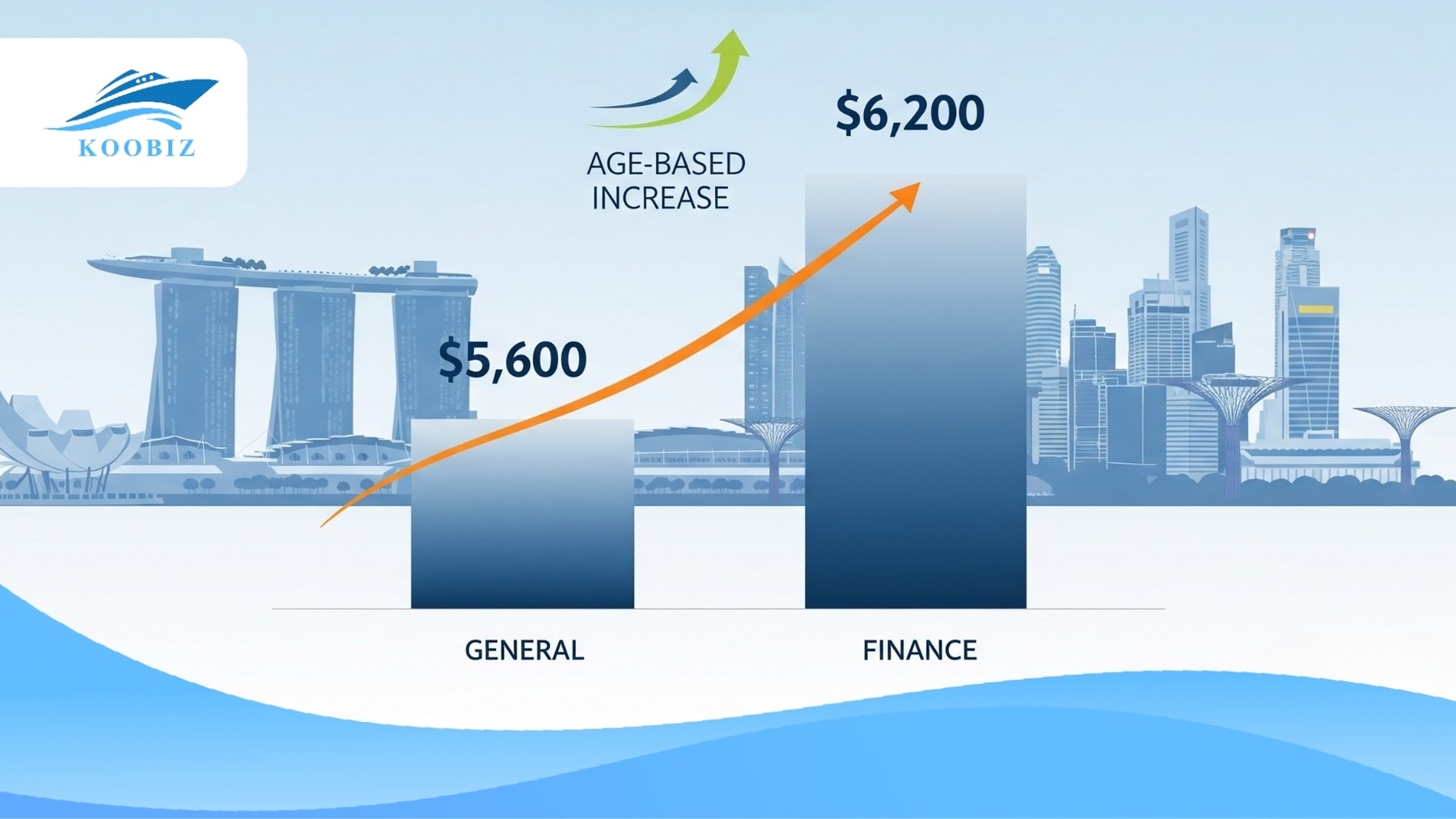
    New Base Thresholds: The minimum qualifying salary is $5,600 for all sectors, rising to $6,200 for Financial Services (effective for all new applications and renewals expiring from Jan 1, 2026).

    Age Matters: The requirement increases progressively with age; a 45-year-old candidate now requires $10,700+ (General) or $11,800+ (Finance).

    COMPASS Integration: Meeting the minimum only qualifies the candidate to apply; earning points under the COMPASS C1 attribute requires meeting local PMET salary benchmarks (65th and 90th percentiles).

    Fixed Components: Only “fixed monthly salary” counts towards the threshold, variable bonuses and overtime pay are excluded.

    [/SUMMARIES]

    For employers and HR leaders, obtaining an Employment Pass (EP) in Singapore has shifted from a straightforward salary benchmark to a more nuanced, multi-factor assessment. Meeting a single minimum threshold is no longer sufficient; today, the EP qualifying salary is assessed dynamically, taking into account the applicant’s age, industry sector, and performance under the COMPASS framework. These evolving requirements mean that workforce planning now requires greater precision and foresight At Koobiz, we frequently assist businesses in navigating these complexities to ensure their talent acquisition strategies remain compliant and efficient. This guide will help you accurately calculate the required salary to meet the new 2025/2026 standards.

    What is the Minimum Qualifying Salary for EP in 2025?

    As of 2025, the Ministry of Manpower (MOM) has raised the baseline monthly wage required to secure an Employment Pass to $5,600 for most industries.

    This figure is benchmarked against the top one-third of local PMET wages. For all new applications (and renewals expiring from 1 January 2026 onwards), the baseline thresholds are:

    • Non-Financial Sectors: $5,600 per month (up from $5,000).
    • Financial Services: $6,200 per month (up from $5,500).

    Note on Renewals: The previous lower rates ($5,000/$5,500) applied only to passes expiring before 31 December 2025. Moving forward into 2026, all candidates must meet these higher thresholds. Any EP application submitted with a fixed monthly salary below these amounts will be rejected automatically, regardless of the employer’s size, reputation, or business profile.

    Singapore EP salary 2025: $5,600 - $6,200
    Singapore EP salary 2025: $5,600 – $6,200

    How Does Age Affect the EP Salary Threshold?

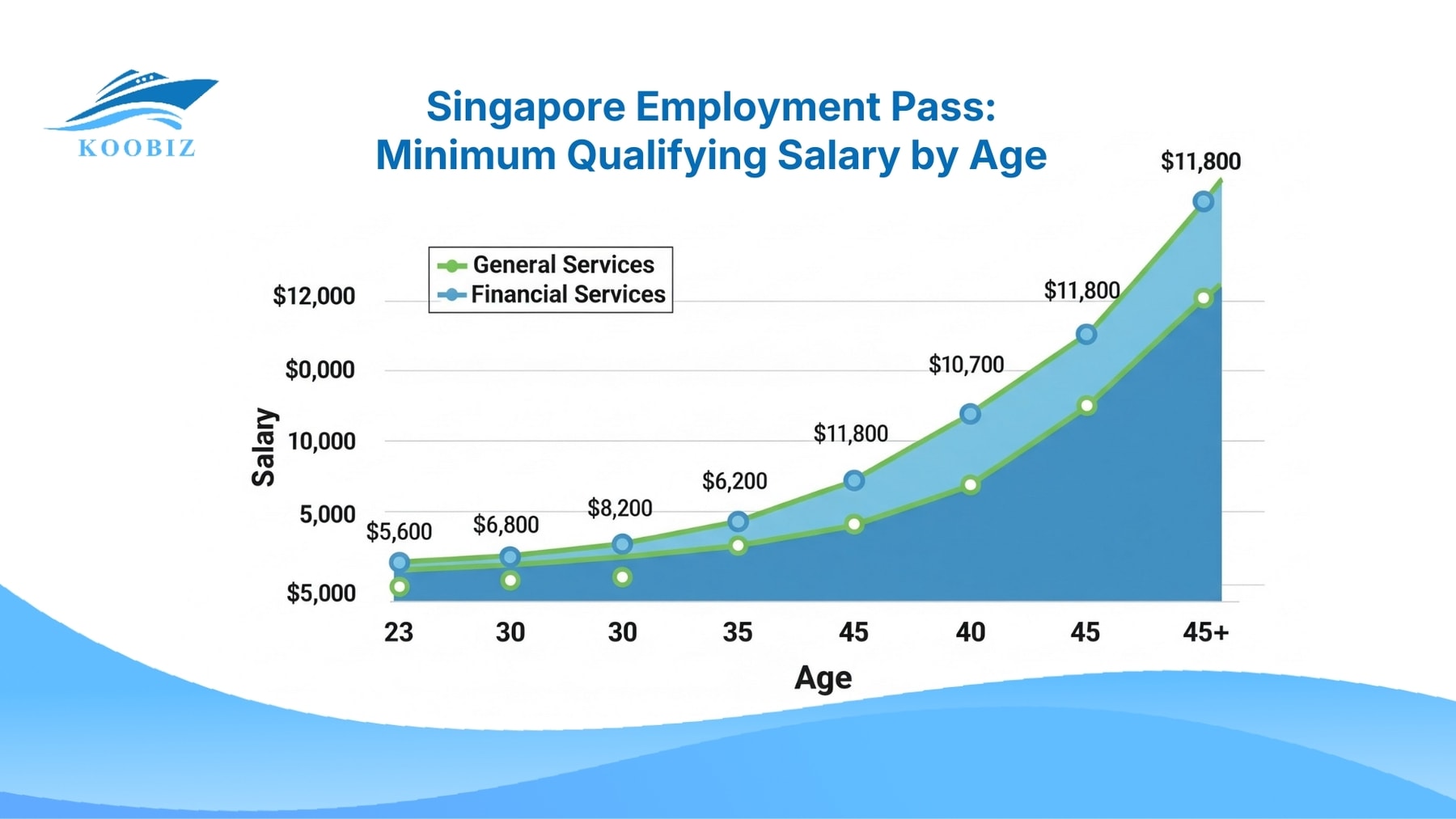
    The EP qualifying salary increases progressively with age, starting at the baseline for a 23-year-old and rising to nearly double for candidates aged 45 and above.

    EP salary increases by age: 23t: $5,600. 45t+: $10,700
    EP salary increases by age: 23t: $5,600. 45t+: $10,700

    MOM structures this increase to ensure foreign talent competes fairly with locals at a similar career stage. The 2025 age curve is significantly steeper than previous years:

    • Entry Level (Age 23): Candidates qualify at the absolute minimum ($5,600 General / $6,200 Finance).
    • Progressive Increase (Age 23 to 45): The salary requirement rises steadily. For example, a 30-year-old in a general sector now requires approximately $7,223.
    • Senior Level (Age 45 and above): The threshold peaks at $10,700 (General) and $11,800 (Financial Services).

    In practice, this “experience premium” is often the most underestimated cost in EP planning. As many employers working with Koobiz discover, hiring senior expatriates requires budgeting well above the headline minimum salary, especially when aligning compensation with COMPASS and renewal expectations.

    Financial Services vs. Non-Financial Sectors: The Salary Gap

    Financial services require a higher baseline compared to general industries, reflecting the premium wage norms within Singapore’s banking sector.

    The Ministry of Manpower recognizes that salaries in this sector are naturally inflated due to the high demand for specialized skills. Consequently, the bar is set higher across the board.

    Here is a detailed comparison of the 2025/2026 requirements:

    Comparison Factor Non-Financial Sectors Financial Services
    Base Salary (Age 23) $5,600 $6,200
    Mid-Career (Age ~35) ~$8,382 ~$9,000+
    Senior (Age 45+) $10,700 $11,800
    Target Industries Retail, Tech, Manufacturing, etc. Banking, Insurance, Asset Mgmt.

    This gap widens significantly as age increases. Failing to account for this sector-specific premium is a common reason for application rejections in the Central Business District.

    The COMPASS Framework: Calculating C1 Salary Points

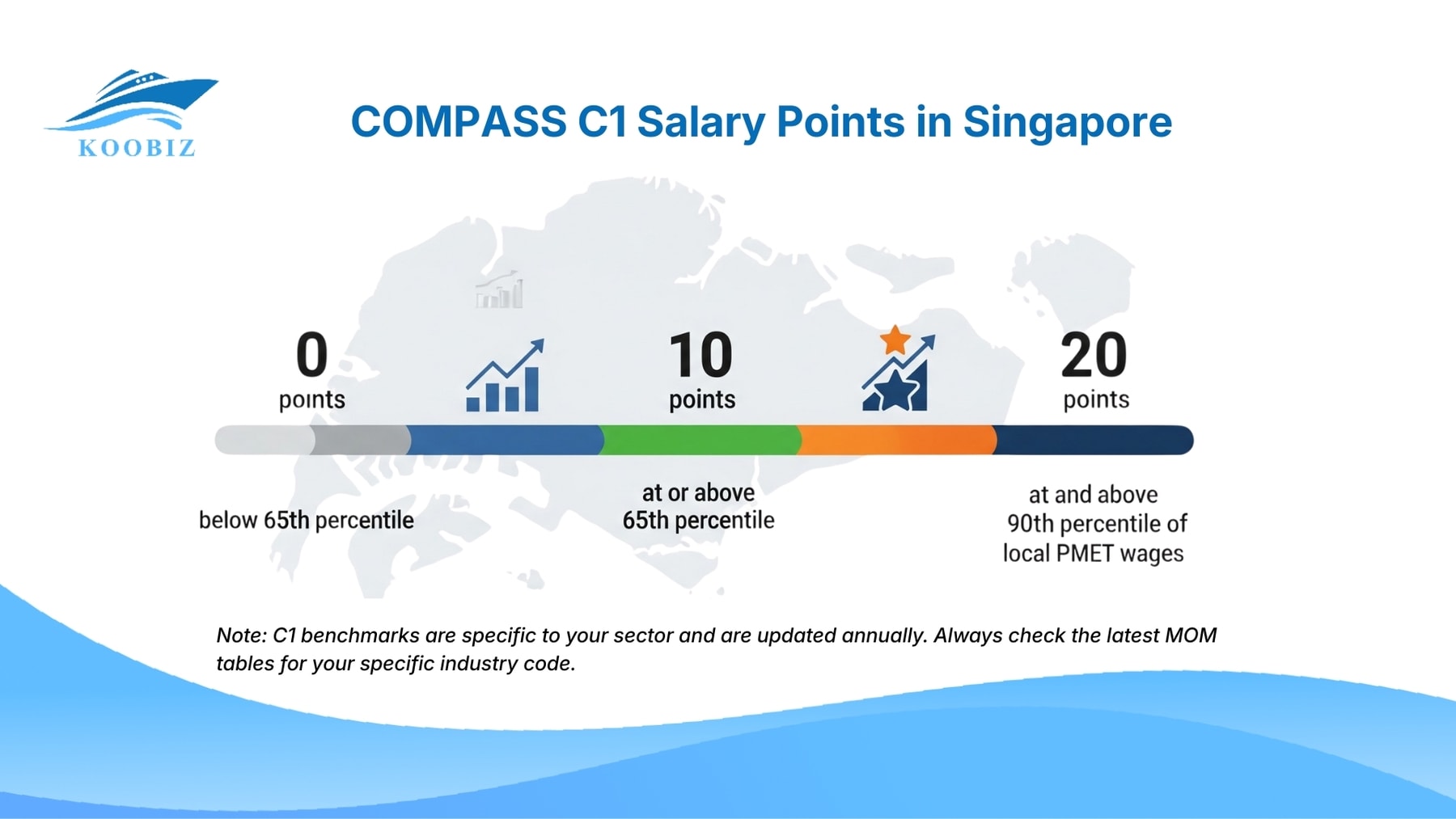
    The COMPASS Framework calculates C1 Salary Points based on two benchmarks: meeting the 65th percentile of local PMET wages earns 10 points, while meeting the 90th percentile earns 20 points.

    COMPASS C1 Salary Points: 0, 10 (≥65th percentile), 20 (≥90th percentile)
    COMPASS C1 Salary Points: 0, 10 (≥65th percentile), 20 (≥90th percentile)

    Importantly, meeting the EP qualifying salary is only the entry requirement, it does not earn points by itself. To pass COMPASS, an application must score at least 40 points, and C1 is the most straightforward lever employers can use to boost the total score.

    • 0 Points: Salary meets the EP minimum but is below the 65th percentile of local peers.
    • 10 Points: Salary is at or above the 65th percentile.
    • 20 Points: Salary is at or above the 90th percentile.

    Note: C1 benchmarks are specific to your sector and are updated annually. Always check the latest MOM tables for your specific industry code.

    Case Studies: Calculating EP Eligibility in Real Scenarios

    To demonstrate how the new 2025 rates apply, we have compiled three scenarios. These highlight the stricter requirements compared to previous years.

    Scenario 1: The “Age Trap” (Tech Sector)

    Candidate: Software Engineer, Age 38.

    Offer: $8,000 Fixed Monthly Salary.

    Outcome: REJECTED.

    • Analysis: While $8,000 seems high, the new 2025 benchmark for a 38-year-old in general sectors is approximately $9,077. The offer falls short by over $1,000.
    • Lesson: Mid-career hires face the steepest increases. You must check the specific age benchmark before making an offer.

    Scenario 2: The “Sector Premium” (Finance vs. Retail)

    Candidate: Marketing Manager, Age 30.

    Offer: $7,000 Fixed Monthly Salary.

    Outcome: AT RISK (Both Sectors).

    • In a Retail Company: REJECTED. The new general benchmark for Age 30 is roughly $7,223. An offer of $7,000 is no longer sufficient (unlike in 2024).
    • In an Investment Bank: REJECTED. The Finance benchmark for Age 30 is approximately $7,982.
    • Lesson: Salaries that were “safe” last year may now be insufficient.

    Scenario 3: The “COMPASS Save” (Using Salary to Pass)

    Candidate: Operations Director, Age 45.

    Challenge: The company has low diversity (0 points). They need 40 points solely from the candidate.

    Strategy: Offer a salary in the 90th percentile (e.g., $18,000+).

    • Result:
      • C1 (Salary): 20 Points (90th percentile).
      • C2 (Qualifications): 20 Points (Top-tier University degree).
      • Total: 40 Points -> PASSED.
    • Lesson: For senior roles, aiming for the 90th percentile can “save” an application even if the firm scores poorly on diversity.

    How to Use the MOM Self-Assessment Tool (SAT) for Verification

    The Self-Assessment Tool (SAT) is MOM’s official online calculator that predicts application outcomes.

    Before submitting any application, using the SAT is mandatory to avoid rejection fees and records.

    Step 1: Access and Login

    Navigate to the MOM SAT page. Koobiz strongly recommends logging in via Singpass to see your specific Firm-Level COMPASS scores (C3 Diversity and C4 Support for Local Employment).

    Step 2: Input Candidate Data

    Enter the candidate’s personal details accurately. Nationality & Date of Birth are critical for the age-based salary curve.

    Step 3: Input Job & Salary Details

    Enter only the fixed monthly salary. Do not include variable bonuses. If the result is “Not Eligible,” try adjusting the salary upward to find the passing threshold for that specific profile.

    Step 4: Interpret the Result

    • Green (Eligible): ~90% chance of approval.
    • Red (Not Eligible): Do not proceed. The salary likely fails the new 2025 age-based benchmarks.

    Understanding “Fixed Monthly Salary” Components

    Fixed Monthly Salary is the guaranteed amount paid every month. MOM assesses EP eligibility strictly based on this figure, not total compensation.

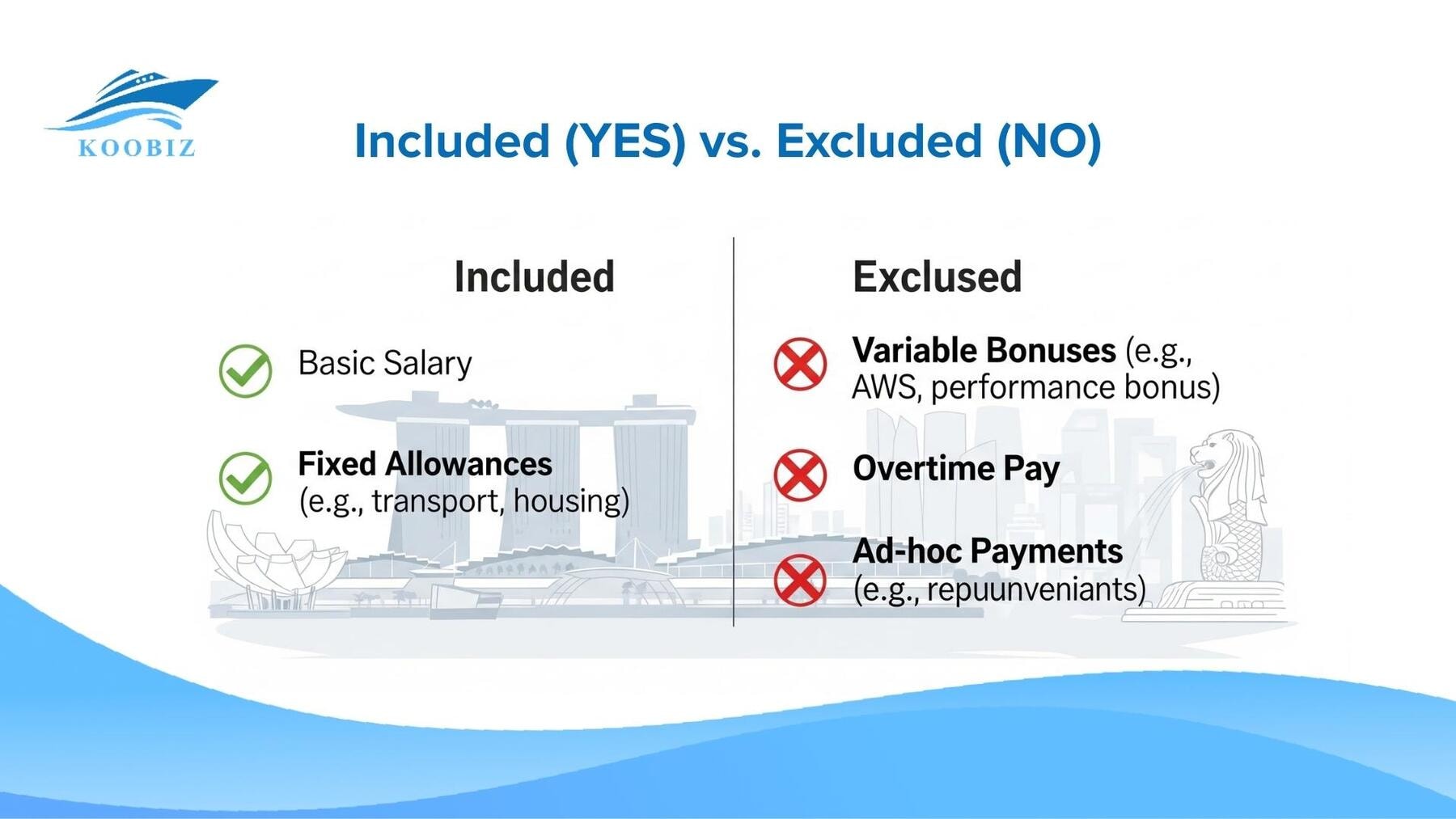
    Included (YES) vs. Excluded (NO)
    Included (YES) vs. Excluded (NO)

    Included (YES) vs. Excluded (NO)

    • YES: Basic monthly salary and fixed allowances (e.g., fixed transport/housing/meal allowances stipulated in the contract).
    • NO: Variable bonuses (AWS, performance bonus), overtime pay, reimbursements, and in-kind benefits (direct housing or car provided).

    Special Cases and Exemptions

    Renewals vs. New Applications

    While the 2025 increase applies fully to new EP applications, employers should plan early for renewals expiring in 2026. These renewals must meet the new higher baselines ($5,600 / $6,200), and many existing EP holders may need salary adjustments to remain eligible.

    Overseas Intra-Corporate Transferees (ICT)

    Intra-Corporate Transferees (ICTs) are senior employees transferred from an overseas branch. While they must still meet the age-tiered qualifying salary (Age 45+ ~$10,700), ICTs are exempt from the COMPASS framework (no C1 salary points needed).

    Frequently Asked Questions (FAQs)

    Can I use my “13th-month bonus” (AWS) to meet the $5,600 threshold?

    No. The Annual Wage Supplement (AWS) is not considered part of the “fixed monthly salary” because it is a one-time annual payment. You must meet the minimum threshold using strictly monthly guaranteed income.

    What is the salary requirement to bring my family (Dependants)?

    To sponsor a Dependant’s Pass for your spouse or children, you must earn a fixed monthly salary of at least $6,000. To sponsor a Long-Term Visit Pass for your parents, the threshold is significantly higher at $12,000.

    Can EP holders work part-time or start a side business?

    Generally, no. An Employment Pass is tied to a specific employer. You cannot engage in moonlighting or freelance work without explicit approval (e.g., a “Letter of Consent”) or holding a specific pass like the ONE Pass.

    How long is the Employment Pass valid for?

    For first-time applicants, the pass is typically granted for up to 2 years. For renewals, it can be granted for up to 3 years, provided the passport validity allows.

    My company is overseas without a Singapore branch. Can we still apply?

    Yes. Applications can be made via a local sponsor (a registered Singapore entity), though processing is longer (around 8 weeks). For smoother processing (about 10 business days) and better long-term compliance, Koobiz typically recommends incorporating a local Singapore entity.

    About Koobiz

    Navigating Singapore’s employment regulations, whether it’s determining the correct EP qualifying salary or managing corporate tax and accounting, can be challenging for international businesses.

    Koobiz helps simplify your market entry and ongoing compliance in Singapore. From company incorporation and corporate bank account opening to payroll setup and tax filings aligned with the latest MOM and IRAS requirements, our experienced team provides end-to-end support.

    Let us manage the regulatory details, so you can stay focused on scaling your business with confidence.

    Visit us at: Koobiz.com to learn more about our corporate services.

  • Social Enterprise Singapore: Strategizing for Profit and Social Impact

    Social Enterprise Singapore: Strategizing for Profit and Social Impact

    [SUMMARIES]

    Practical Definition: An SE is a financially self-sustaining entity where business operations are driven by a core social or environmental mission.

    Differentiation: Unlike charities that rely on donations, SEs generate revenue. Unlike pure commercial businesses, SEs prioritize social impact alongside profits (The Double Bottom Line).

    Strategic Structural Choice: Register as a Private Limited (Pte Ltd) for scalability or a Company Limited by Guarantee (CLG) to maximize community trust.

    Validation: Registration with the Singapore Centre for Social Enterprise (raiSE) is crucial for accessing grants like “Venture for Good.”

    Measurement: Success is measured not just by financial ROI, but by Social Return on Investment (SROI) and impact assessment frameworks.

    [/SUMMARIES]

    For many aspiring changemakers, the traditional dichotomy between “doing good” (charity) and “doing well” (business) is no longer sufficient. In Singapore’s evolving economic landscape, a new hybrid model is gaining traction: the Social Enterprise. This model offers a sustainable path for entrepreneurs who wish to address critical social gaps without relying solely on philanthropic donations.

    The sector is growing rapidly. Since 2015, raiSE Singapore has disbursed millions in funding and empowered over 1,200 social enterprises to achieve sustainable growth.

    At Koobiz, we have observed a significant rise in inquiries regarding this unique business structure. Whether you are looking to support marginalized communities, promote environmental sustainability, or preserve cultural heritage, establishing a social enterprise requires a precise balance of mission and margin. This guide serves as your comprehensive roadmap to understanding, establishing, and scaling a social enterprise in Singapore.

    What Defines a Social Enterprise in Singapore?

    A Social Enterprise (SE) in Singapore is a business entity that uses commercial strategies to maximize improvements in human and environmental well-being, rather than maximizing profits for external shareholders. Unlike a conventional company where profit is the end goal, for an SE, profit is a means to an end—that end being a specific social outcome.

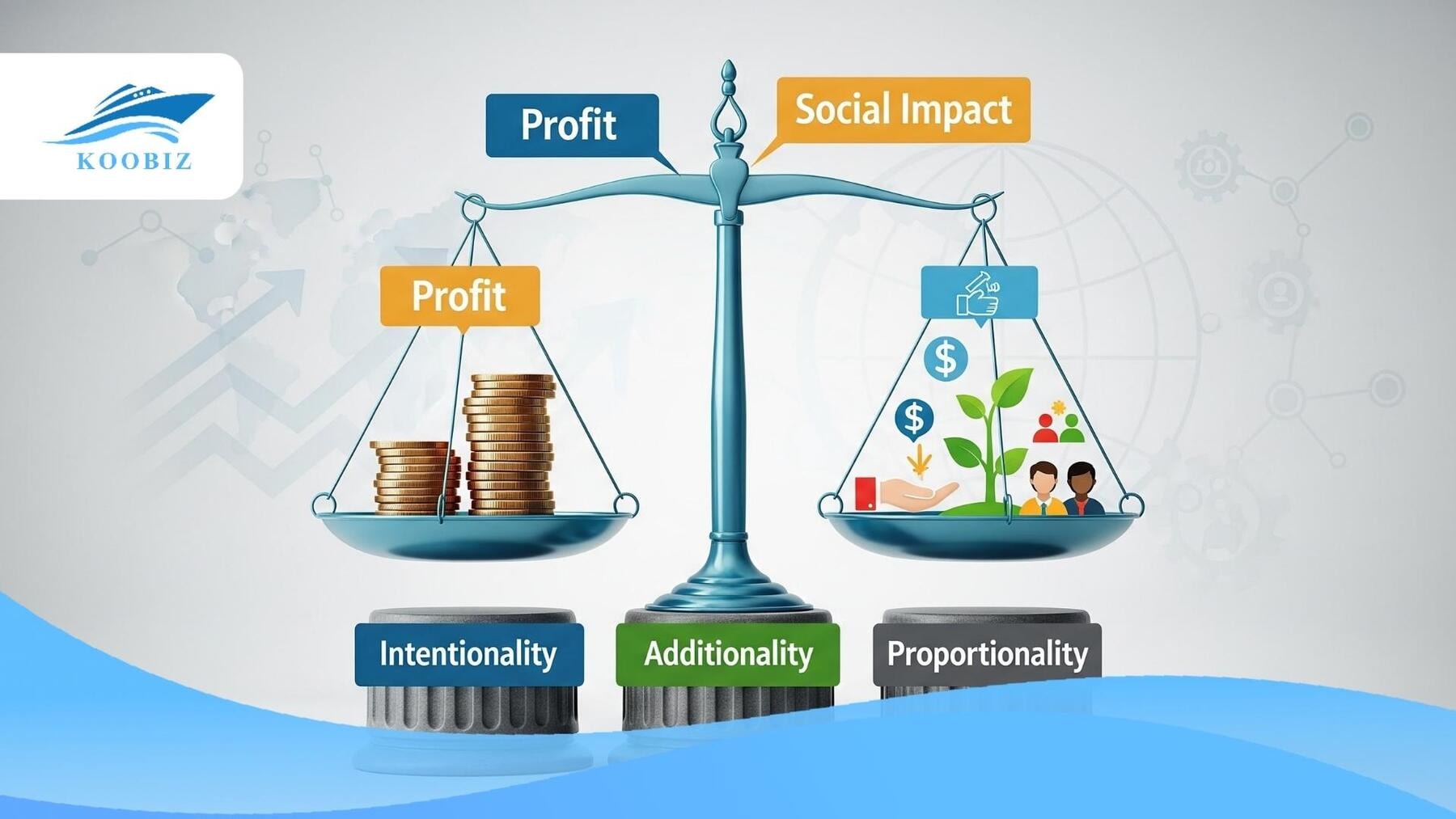
    3 raiSE Pillars: Intentionality, Additionality, Proportionality
    3 raiSE Pillars: Intentionality, Additionality, Proportionality

    To understand this deeply, we must look at the framework provided by the Singapore Centre for Social Enterprise (raiSE). A legitimate SE is defined by three Core Evaluation Pillars: Intentionality, Additionality, and Proportionality.

    1. Intentionality: The social mission is not incidental; it is formally codified in the corporate constitution and operational strategy from inception.
    2. Additionality: The business provides specific value to a beneficiary group that would not otherwise exist.
    3. Proportionality: Resources and profits are allocated fairly between business growth and social impact.

    Differentiating Social Enterprises (SE) from Non-Profit Organizations (NPO)

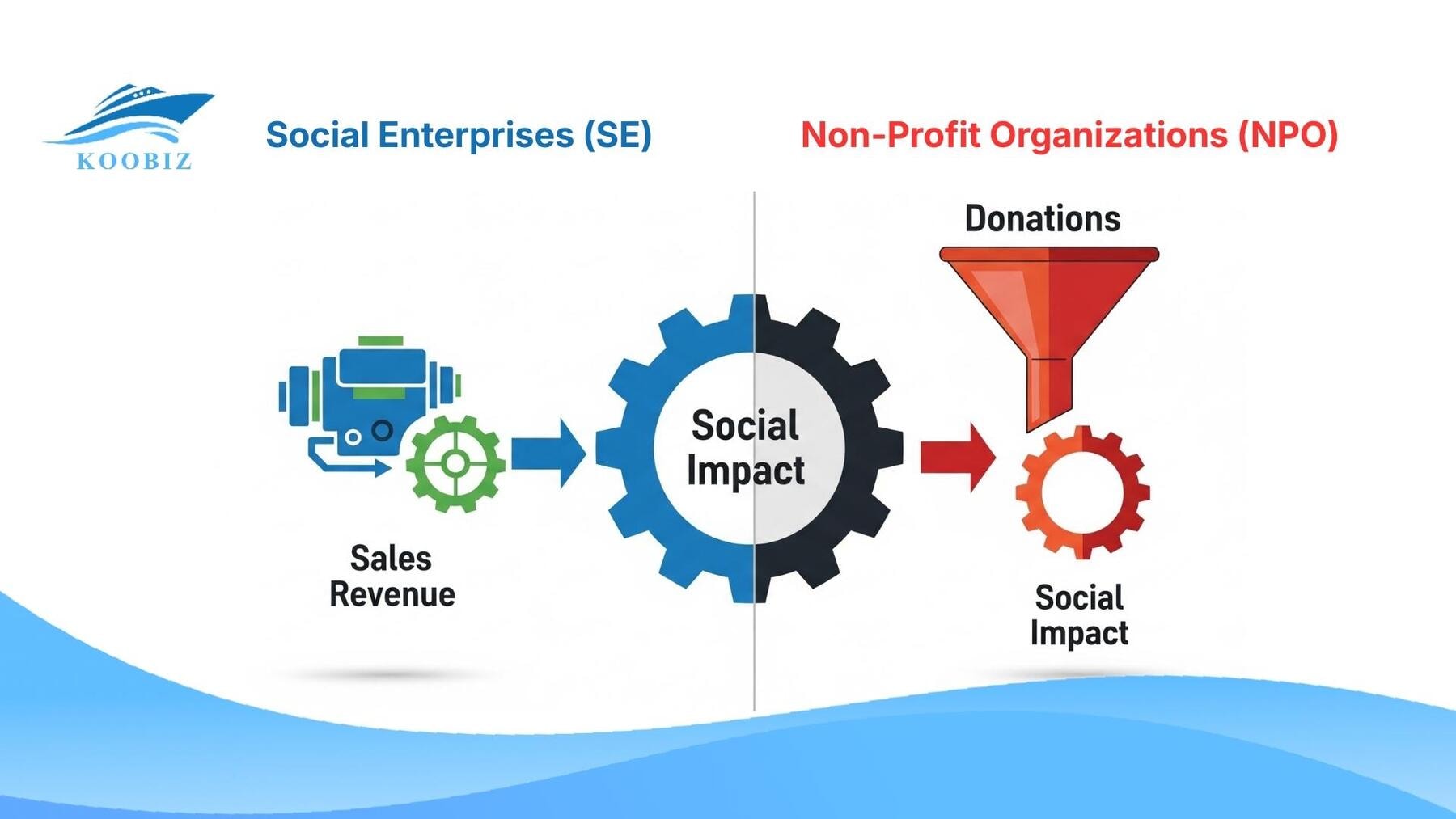
    Differentiating Social Enterprises (SE) from Non-Profit Organizations (NPO)
    Differentiating Social Enterprises (SE) from Non-Profit Organizations (NPO)

    No, a social enterprise is distinct from a non-profit organization (NPO). While both aim to do good, they differ fundamentally in how they sustain themselves.

    • Financial Sustainability: Unlike NPOs, which are often vulnerable to donor fatigue, SEs utilize a revenue-centric model by trading goods and services in the competitive market.
    • Operational Mindset: An NPO focuses on fundraising to fund programs. An SE operates with a business mindset, competing in the open market (e.g., a cafe hiring youth-at-risk) to fund its social mission.
    • Resilience: This financial independence allows SEs to be more sustainable in the long run, whereas charities may struggle during economic downturns when donations dry up.

    Social Enterprise vs. Charity vs. Commercial Business

    Social Enterprises (SEs) operate at the intersection of philanthropic impact and commercial viability, while traditional charities rely on philanthropic capital to drive their social mandates.

    To visualize where a social enterprise sits in the ecosystem, it is helpful to compare these three entities across key operational metrics.

    Feature Social Enterprise Charity / Non-Profit Commercial Business
    Primary Goal Social Impact + Financial Sustainability Social Impact Financial Profit
    Funding Source Sales Revenue, Grants, Investment Donations, Grants Sales Revenue, Investment
    Surplus Allocation Reinvested into scaling operations and amplifying social impact. 100% Reinvested/Spent on Cause Distributed to Shareholders
    Fiscal Obligations Subject to corporate tax, with eligibility for Tax-Exempt status upon fulfilling specific IPC/Charity criteria. Tax-Exempt (usually) Taxable

    Koobiz often advises clients that while SEs function like commercial businesses in terms of operations—needing marketing, sales, and HR strategies—their decision-making process is fundamentally different. In a commercial business, a decision is made if it increases profit. In an SE, a decision is made if it increases profit without compromising the social mission, or ideally, while enhancing it.

    How to Set Up a Social Enterprise in Singapore?

    Establishing a Social Enterprise (SE) requires a strategic two-tier approach: formal legal incorporation followed by sector-specific accreditation.

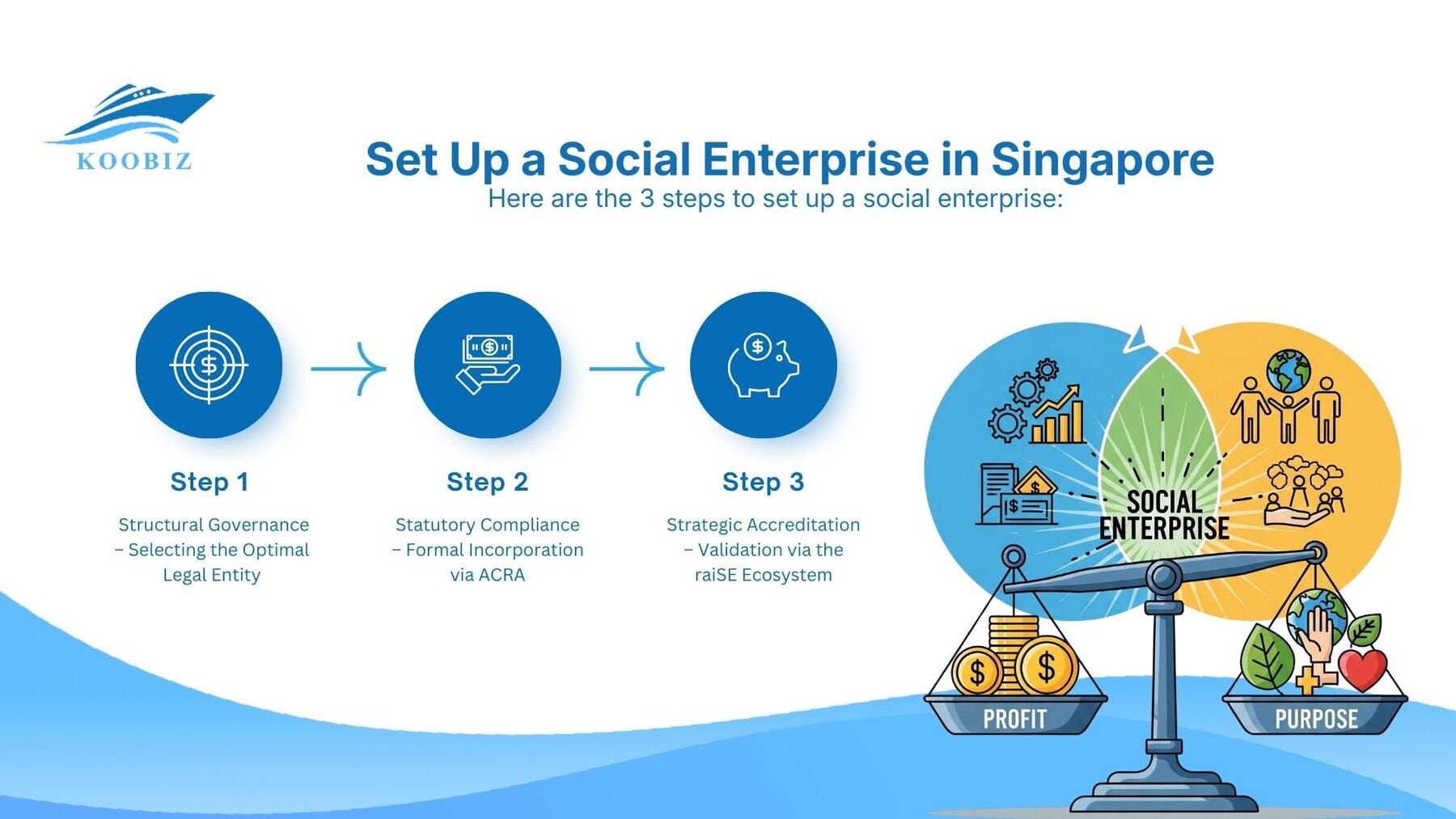
    Set Up a Social Enterprise in Singapore
    Set Up a Social Enterprise in Singapore

    Step 1: Structural Governance – Selecting the Optimal Legal Entity

    There are two primary legal structures adopted by social enterprises in Singapore: the Private Limited Company (Pte Ltd) and the Company Limited by Guarantee (CLG). Your choice depends on your vision for ownership and funding.

    Private Limited Company (Pte Ltd): This is the most common structure for SEs (shares limited by liability).

    • Pros: Enables a share-based capital structure, significantly lowering the barrier for impact investors and VC participation.
    • Cons: It is a taxable entity, and there can be public skepticism about “profiting from a cause.”
    • Best for: SEs that have a strong product/service to sell and aim for rapid growth (e.g., an eco-tech startup).

    Company Limited by Guarantee (CLG): This is a non-profit entity classification often used for charities, but also for SEs. It has members instead of shareholders.

    • Pros: Commands high public and donor trust due to its non-distribution constraint, ensuring all surpluses are locked for social mandates.
    • Cons: Cannot raise capital by selling shares; administrative compliance can be stricter.
    • Best for: SEs focused heavily on community building where profit is purely incidental.

    Koobiz Pro Tip: If you intend to raise private capital (VC or Angel investment) later, a Pte Ltd is almost always the required structure. Investors cannot take equity in a CLG.

    Step 2: Statutory Compliance – Formal Incorporation via ACRA

    Once you have decided on your structure, you must formally incorporate your entity with the Accounting and Corporate Regulatory Authority (ACRA).

    This is the standard business registration process in Singapore. Whether you chose Pte Ltd or CLG in Step 1, you will receive a Unique Entity Number (UEN). The Unique Entity Number (UEN) acts as your corporate identity, essential for establishing banking relationships and executing commercial contracts.

    Step 3: Strategic Accreditation – Validation via the raiSE Ecosystem

    Registering with raiSE is the definitive step that validates your business as a recognized Social Enterprise in the Singapore ecosystem.

    raiSE was set up to develop the social enterprise sector in Singapore. Membership is not automatic; applicants must submit a proposal detailing their social objectives and business model. Being a raiSE member provides credibility. It signals to consumers and partners that your claim of “doing good” has been vetted by a third-party authority. Furthermore, membership unlocks access to mentorship, business clinics, and crucial funding schemes.

    Key Grants and Funding Schemes for Social Enterprises

    There are several key funding avenues available for Singapore-based social enterprises, primarily anchored by the Venture for Good (VFG) grant and private impact investing networks.

    Capital Strategy: Leveraging Grants and Impact Investment. While commercial startups focus on exponential ROI, SEs prioritize long-term systemic impact to attract targeted impact capital. Singapore’s government and private sectors have bridged this gap with specific schemes.

    Venture for Good and Other raiSE Grants

    Venture for Good (VFG): A cornerstone funding mechanism designed for capacity scaling, infrastructure procurement, and strategic marketing.

    • Venture For Good (New & Existing): This grant supports the setup and expansion of SEs. Historically, it has provided capital (e.g., up to SGD 300,000 depending on the tranche and impact potential) to cover manpower, equipment, and marketing.
    • Capacity Building Grants: These are smaller grants aimed at helping SEs improve operational efficiency, such as adopting new technology or training staff.

    Important Note: Grant amounts and eligibility criteria are subject to change. Always verify the latest tranches and application windows on the official raiSE website.

    To secure these grants, the SE must demonstrate a viable business model. The Singapore government seeks to invest in fiscally resilient models rather than subsidizing non-viable projects. This is where professional financial projection—a service Koobiz specializes in—becomes vital for the application.

    We have established the “what” (Definition) and the “how” (Setup and Funding) of a Social Enterprise. However, to truly succeed, one must navigate the operational complexities that arise after the company is formed. The following section delves into the micro-semantics of sustainability, measurement, and advanced strategic challenges.

    Measuring Success: The Concept of the Double Bottom Line

    The Double Bottom Line is a business metric that measures fiscal performance alongside positive social impact, ensuring that the enterprise remains sustainable on both financial and humanitarian fronts.

    While traditional firms focus on fiscal solvency, SEs adopt a Double Bottom Line framework to balance net profit with verified social dividends. Conversely, if you help thousands but go bankrupt, the mission dies. Success necessitates an Integrated Reporting dashboard where Social Impact KPIs are audited with the same rigor as financial statements.

    Tools for Social Impact Measurement

    Social impact measurement tools involve frameworks like the Theory of Change and Social Return on Investment (SROI), which help quantify the qualitative changes an enterprise creates.

    • Theory of Change (ToC): A causal framework mapping the trajectory from Resource Inputs to Systemic Social Transformation.
    • Social Return on Investment (SROI): A methodology that monetizes qualitative social value, providing stakeholders with a tangible ratio of impact-per-dollar spent.For example, “For every $1 invested in this program, $3 of social value is created in the community.” Using these tools is essential when reporting to stakeholders and grantmakers.

    Advanced Challenges for Social Entrepreneurs in Singapore

    Social entrepreneurs must navigate a complex risk landscape, characterized by institutional skepticism and operational friction inherent in hybrid models. To navigate this landscape, it is vital to understand the following distinct challenges:

    The “Purity Test” and Public Skepticism

    One major challenge is the perception of “profiting from a cause.” To mitigate reputational risk, SEs must articulate a narrative where profitability is a proxy for impact scalability, rather than a sign of mission dilution. Entrepreneurs must communicate transparently that profit is the fuel for the mission, not a sign of greed.

    Balancing Impact Scale vs. Mission Drift

    Strategic Integrity vs. Mission Drift: Scaling necessitates a delicate equilibrium to prevent mission-atrophy, where commercial imperatives overshadow social mandates. For example, a cafe set up to train youth-at-risk might be tempted to hire experienced baristas to speed up service and increase sales, thereby neglecting its original training mission.

    Talent Acquisition and Retention

    The Talent Paradox: SEs must attract high-caliber professionals by offering a Value Proposition centered on ‘Social ROI’ to bridge the gap in financial compensation.Retaining this talent requires building a strong culture where the “social ROI” compensates for the gap in financial compensation.

    Financial Governance: Managing Hybrid Cash Flows

    SEs navigate a multifaceted fiscal environment, balancing taxable commercial revenue with restricted-use grant funding. Managing this requires sophisticated accounting to ensure compliance with both tax authorities and grant providers.

    Comparison: B Corp Certification vs. Social Enterprise Status

    B Corp Certification is a global standard for high levels of social and environmental performance, while raiSE Social Enterprise status serves as the foundational local credential for navigating the Singapore ecosystem.

    Feature B Corp Certification raiSE Social Enterprise Status
    Geographic Scope Global

    Recognized worldwide; beneficial for exporting products.

    Singapore-Centric

    Local validation; key for navigating the SG ecosystem.

    Rigor Comprehensive Audit

    A data-intensive evaluation across ESG parameters: Governance, Workers, Community, and Environment.

    Mission-Centric Vetting

    A proposal-driven evaluation focused on the triad of Intentionality, Additionality, and Proportionality.”

    Primary Benefit International Prestige

    Builds trust with global consumers and investors.

    Grant Access

    Unlock national funding (Venture for Good) and incubation support.

    Necessity Optional

    A powerful value-add but not required to operate.

    Essential

    The standard validation for operating as an SE in Singapore.

    Can a Social Enterprise Distribute Dividends to Shareholders?

    Yes, a social enterprise can distribute dividends, but it is often governed by a Dividend Cap or Asset Lock mechanism to preserve mission integrity.

    While a Private Limited (Pte Ltd) entity has the legal autonomy to distribute 100% of dividends, raiSE compliance often mandates a surplus reinvestment threshold.However, to maintain raiSE membership or qualify for certain tax exemptions (if applicable to specific charitable arms), you may need to commit to reinvesting a significant percentage (e.g., 50% or more) of profits back into the company or the cause. This fiscal discipline is the key differentiator between a dedicated Social Enterprise and a traditional firm practicing Corporate Social Responsibility (CSR).

    Examples of Successful Social Enterprises in Singapore

    Case Studies: Exemplifying the Double Bottom Line in Singapore.

    1. The Social Space

    • The Mission: Providing employment to individuals who face higher barriers to employment (e.g., ex-offenders, persons with disabilities).
    • The Business: A multi-concept lifestyle store featuring a cafe, a fair-trade retail area, and a nail salon.
    • Strategic Success Factor: Leveraging a premium, ‘lifestyle-centric’ brand to ensure operational self-sufficiency.

    2. Edible Garden City

    • The Mission: Improving Singapore’s food resilience and promoting environmental sustainability.
    • The Business: Designing, building, and maintaining urban farms for hotels, schools, and residences.
    • Why it works: They tapped into the national “30 by 30” food security goal, securing government and corporate contracts while educating the public.

    3. Foreword Coffee

    • The Mission: Empowering persons with disabilities and special needs by providing training and employment in the specialty coffee industry.
    • The Business: A chain of specialty coffee outlets.
    • Why it works: They focus on ability, not disability, proving that an inclusive workforce can deliver top-tier service and product quality.

    Frequently Asked Questions (FAQs)

    Onboarding Timeline: Navigating the raiSE Registration Cycle

    Typically, the process takes 2 to 4 weeks after submitting your application, provided all required documents (business plan, impact proposal) are in order.

    Foreign Founders: Eligibility and Residency Requirements

    Yes, foreigners can start an SE, but they must adhere to standard ACRA requirements, which usually involves appointing a local resident director or obtaining an EntrePass.

    Is there a minimum capital requirement to start an SE?

    If registering as a Pte Ltd, the minimum paid-up capital is just SGD 1. However, to be taken seriously for grants and by stakeholders, a higher initial capital is often recommended.

    Do Social Enterprises get tax exemptions?

    Generally, no. SEs registered as Pte Ltd companies are subject to the standard corporate tax rate (17%). However, if the entity obtains “Charity” status (which is harder for commercial SEs), it may be tax-exempt.

    Conclusion

    Closing Insights: Architecting a Legacy of Impact and Profit. Building an SE requires navigating the technicalities of ACRA registration, understanding the nuances of the Pte Ltd vs. CLG structure, and rigorously measuring your Double Bottom Line. However, for those who succeed, the reward is the creation of a legacy that offers both economic value and positive societal change.

    The Koobiz Advantage: Your Institutional Partner in Social Innovation. We understand the challenges you face, and that is why we offer specialized services to handle the backend of your social enterprise. From Singapore company formation and ensuring your M&A aligns with social enterprise requirements, to opening corporate bank accounts and managing tax, accounting, and audit compliance, Koobiz is your trusted partner. We help you build a compliant, efficient foundation so you can focus on balancing profit with purpose.

    Visit Koobiz.com today to start your journey of impact.

  • Best business banking accounts in Singapore (2025): Features, fees, and reviews

    Best business banking accounts in Singapore (2025): Features, fees, and reviews

    [SUMMARIES]

    Best for Local SMEs: OCBC Business Growth Account offers the most balanced features with instant setup for eligible local companies.

    Best for Digital Startups: Aspire serves as an all-in-one financial operating system, ideal for companies needing speed and integrated corporate cards.

    Best for Global Trade: Wise Business and Airwallex provide superior exchange rates (mid-market) compared to traditional banks.

    Best Licensed Digital Bank: ANEXT Bank offers a middle ground with digital-first speed and SDIC insurance protection.

    Key Decision Factor: Choose traditional banks (DBS, UOB) for safety and cash facilities, or fintechs for lower fees and ease of use.

    Koobiz Tip: Foreign owners can open accounts remotely with fintechs, but traditional banks may require a physical presence or specific nominee director arrangements.

    [/SUMMARIES]

    Choosing a financial partner goes far beyond simply holding funds – it’s about managing cash flow efficiently, keeping operating costs low, and gaining access to the right business tools. In Singapore’s competitive 2025 landscape, business owners must weigh the reliability of traditional local banks against the flexibility of modern fintech platforms. Whether your focus is on lower fees, multi-currency support, or smooth Xero integration, this guide breaks down the leading options to help you decide with confidence. As a corporate services provider, Koobiz has guided hundreds of local and foreign founders through this exact decision as part of their company incorporation journey.

    Quick verdict: Top business accounts by category

    In Singapore’s 2025 landscape, a few clear leaders stand out – Aspire, OCBC, Wise, and DBS – each excelling in a different business use case. Before diving into the details, we’ve grouped these options by the practical needs of modern companies, because not all business accounts serve the same purpose. A high-transaction trading firm, for example, requires very different features from a lean, digital-first consultancy.

    1. Best for New Startups & Digital Nomads: Aspire

    Aspire isn’t a traditional bank but rather a financial operating system. It leads this category thanks to its smooth incorporation process, zero minimum balance requirements, and an interface designed specifically for digital-first founders.

    2. Best for Established SMEs: OCBC

    The OCBC Business Growth Account continues to be the benchmark for Singapore-registered companies seeking a full-service bank account, without the steep initial deposit thresholds that were once the norm.

    3. Best for Global Trade & E-commerce: Wise Business / Airwallex

    If your business pays suppliers in China or serves clients in the US, traditional bank FX spreads can quickly erode your margins. Platforms like Wise and Airwallex use mid-market exchange rates, helping you save up to 3% on each transaction.

    4. Best for Cash- Heavy Businesses: DBS / UOB

    For retail or F&B businesses that regularly deal with physical cash, the wide network of ATMs and cash deposit machines offered by DBS and UOB clearly sets them apart as the leading choice.

    Best Traditional Business Bank Accounts: The “Big Three” Reviewed

    There are three major local banks in Singapore:DBS, OCBC, and UOB that offer the highest level of security, regulatory protection, and comprehensive lending facilities.

    Despite the rapid growth of fintech platforms, these “Big Three” banks remain the most trusted options for safeguarding corporate funds, backed by strong balance sheets and full MAS regulation. At Koobiz, we typically advise clients to use fintech solutions for day-to-day transactions while maintaining a traditional bank account for long-term reserves and added credibility.

    OCBC Business Growth Account

    The OCBC Business Growth Account is a go-to option for SMEs as it removes many of the traditional entry hurdles of corporate banking. Eligible Singapore-registered companies – usually those with only local directors and shareholders – can benefit from instant online account opening.

    • Key feature: Low initial deposit of just SGD 500, often waived for the first six months under promotional offers.
    • Fees: No monthly fee initially, with a standard charge of around SGD 10 per month if requirements are not met thereafter.
    • Best for: Newly incorporated companies with local directors seeking a fast, reputable banking solution.

    DBS Business Multi-Currency Account

    Previously branded as the Digital Account, the DBS Business Multi-Currency Account stands out for its advanced digital integration through the DBS IDEAL platform. As Southeast Asia’s largest bank, DBS also offers exceptional network reliability and strong ecosystem connections.

    • Key feature: The IDEAL mobile app is highly robust, enabling biometric authorization for transactions.
    • Fees: Generally subject to an annual fee, with tiered pricing options available.
    • Best for: Companies looking to automate back-office operations and connect banking data directly to ERP systems via APIs.

    UOB eBusiness Account

    The UOB eBusiness Account is built to keep transaction costs low, making it a compelling option for businesses that process a high volume of local payments. Beyond cost efficiency, UOB’s strong footprint across ASEAN is a major advantage for companies expanding into markets like Malaysia, Thailand, or Vietnam.

    • Key feature: Generous free FAST/GIRO transaction limits designed for day-to-day operational efficiency.
    • Fees: A competitive fee structure that offers rebates as transaction volumes increase.
    • Best for: Trade and manufacturing businesses that rely on frequent local transfers and dependable regional banking connectivity.

    Best Digital & Fintech Business Accounts for Startups

    A new wave of challengers – Aspire, Wise, Airwallex, and licensed digital bank ANEXT – has reshaped business banking by cutting out paperwork and significantly reducing FX costs. Built with a digital-first approach, these platforms offer fully online account opening that can take just days, or even hours. For this reason, Koobiz frequently helps foreign founders set up these accounts as their main operational solution while their traditional bank applications are still in progress.

    Aspire Business Account

    Aspire positions itself as a full finance operating system rather than just a bank account, combining banking, expense management, and invoicing in one platform. What sets it apart is the issuance of corporate cards that offer cashback on digital advertising spend, such as Facebook or Google Ads.

    • Pros: No minimum balance requirements, free local transfers, and built-in corporate card controls.
    • Cons: Not a licensed bank — funds are held in safeguarded trust accounts and are not SDIC insured, and chequebooks are not available.
    • Ideal user: Tech startups and digital agencies with significant online advertising spend.

    Wise Business

    Wise Business is the undisputed leader for international transfers, offering the mid-market exchange rate without hidden markups.

    For companies with remote teams or overseas suppliers, Wise serves as a multi-currency wallet that holds 50+ currencies simultaneously.

    • Pros: Transparent fees (usually 0.5% – 1%), local account details for receiving USD, GBP, EUR, and AUD like a local.
    • Cons: Does not offer business loans or credit facilities.
    • Ideal User: Freelancers, exporters, and companies with a distributed global workforce.

    ANEXT Bank (Licensed Digital Bank)

    Unlike Aspire or Wise, ANEXT is a fully licensed digital bank regulated by MAS, meaning it offers deposit insurance.

    It bridges the gap between fintech speed and bank-grade security.

    • Pros: SDIC insured up to SGD 100k, remote opening for foreigners, no minimum balance.
    • Cons: Newer player with fewer integrated software features compared to Aspire.
    • Ideal User: SMEs who want the safety of a licensed bank but the ease of a digital interface.

    Traditional Banks vs. Digital Banks: Which Should You Choose?

    To help you decide between the stability of a traditional bank and the speed of a digital challenger, we have compared them side-by-side based on the factors that matter most to Singapore business owners.

    Feature Traditional Banks (DBS, UOB, OCBC) Digital Banks/Fintechs (Aspire, Wise, ANEXT) Winner
    Account Opening Slower (1-4 weeks, often requires physical presence/interview) Instant (1-3 days, 100% online verification) Digital Banks
    Minimum Balance High (SGD 5,000 – 10,000 typically required to waive fees) None ($0 minimum balance required) Digital Banks
    Fees & FX Rates Higher (Admin fees + FX markup of 1-3%) Lowest (Transparent fees + Mid-market rates) Digital Banks
    Safety & Insurance High (Fully MAS licensed & SDIC insured up to SGD 100k) Varied (ANEXT is SDIC insured; others safeguard funds but lack SDIC) Traditional Banks / ANEXT
    Product Range Complete (Cheques, Business Loans, Gov Grants, Cash Deposit) Limited (Transfers, Cards; ANEXT offers loans) Traditional Banks
    Integration Basic (Direct feeds often cost extra or require forms) Seamless (Native integration with Xero, Slack, Google Pay) Digital Banks

    The Koobiz Recommendation:

    You often do not have to choose just one. At Koobiz, we advise a hybrid approach: open a traditional account (like OCBC) for your main capital reserves and business loans, and open a fintech account (like Aspire or Wise) for daily operational expenses and foreign transactions to save on fees.

    Critical Fee Comparison: Minimum Balance & Transaction Costs

    The biggest cost drains for small businesses are usually fall-below fees for not maintaining the required balance and charges on outgoing transactions. These are often overlooked by new founders, yet they can quietly add up to hundreds of dollars in avoidable costs each year.

    1. Minimum Balance & Fall-below Fees:
      • Traditional Banks: Typically require a minimum daily average balance ranging from SGD 5,000 to SGD 10,000. If you fall below this, you are charged ~SGD 35/month. However, starter accounts (like OCBC Business Growth) waive this for the first 6 months.
      • Fintechs/Digital Banks: Aspire, Airwallex, and ANEXT generally have $0 minimum balance requirements and no fall-below fees, making them risk-free for early-stage startups.
    2. Transaction Costs:
      • Local Transfers (FAST): Most digital accounts offer these for free. Traditional banks may charge small fees after a certain number of free transactions.
      • International Transfers: This is the biggest differentiator. Traditional banks often charge a cable fee (SGD 20-30) plus an FX markup (1-3%). Fintechs usually charge no cable fee and a much lower markup (0.4-1%).

    Understanding Hidden Costs and Banking Limitations

    Hidden banking costs are the charges rarely highlighted in brochures, including early account closure penalties, foreign transaction admin fees, and cheque processing charges. Understanding these finer details in banking terms is essential to avoid unexpected deductions from your company funds, as banks often generate revenue well beyond the headline monthly fees through these operational charges.

    Are Multi-Currency Accounts Worth the Conversion Fee?

    Yes, multi-currency accounts are absolutely worth the conversion fee if your business handles more than SGD 5,000/month in foreign transactions.

    Specifically, using a single-currency (SGD) account for foreign trade forces a double conversion (Foreign Currency -> SGD -> Foreign Currency) every time you pay and receive, leading to losses of 3-5% on the spread.

    • Detail: A multi-currency account (like DBS Business Multi-Currency or Wise) allows you to hold USD or EUR directly. You can receive payment in USD, hold it, and pay a US supplier later without ever converting to SGD.
    • Evidence: For a business with $100,000 annual foreign turnover, avoiding a 2% spread saves $2,000 in pure profit.

    Can You Open a Business Account Online Without Visiting Singapore?

    Yes, for fintech accounts like Aspire and Wise; however, for traditional banks, it depends heavily on the bank’s policy and the nationality of the directors.

    While the “Big Three” have introduced remote opening capabilities, they often require a video interview or the physical presence of the authorized signatory, especially for foreign-owned companies.

    • The Nuance: Fintechs use e-KYC (electronic Know Your Customer) technology to verify passports and proof of address remotely. Traditional banks are stricter due to anti-money laundering (AML) regulations.
    • Koobiz Solution: For our foreign clients, we often facilitate the necessary resolutions and act as the local liaison to smooth out the remote opening process where possible.

    What Happens if Your Business Account Application is Rejected?

    If your application is declined, the first step is to pinpoint the underlying red flag – most commonly an unclear business plan, a high-risk industry classification, or a complex ownership structure. Singapore banks are highly risk-averse, but a rejection is not final; it simply means you need to adjust your approach.

    1. Step 1: Reassess your stated business activities and SSIC code to ensure they accurately reflect how you operate.
    2. Step 2: Apply to a fintech platform such as Aspire or Wise right away to keep your business running, as their risk framework differs from traditional banks.
    3. Step 3: Engage a corporate services provider. At Koobiz, we help refine your application by clearly presenting your source of funds and business model in a way that meets bank compliance expectations.

    FAQ: Frequently Asked Questions

    Which bank is best for foreigners opening a company in Singapore?

    Fintechs like Aspire and Wise are the easiest for foreigners as they support 100% remote opening. For traditional banks, OCBC and DBS are popular but may require a nominee director or a visit to Singapore.

    Is my money safe with fintechs like Aspire?

    Aspire safeguards funds in a dedicated trust account with a Tier-1 bank (like DBS), so your money is kept separate from their company funds. However, unlike traditional banks and ANEXT, these funds are not insured by SDIC.

    What is the minimum balance for a business account in Singapore?

    It varies. Digital banks usually have $0 minimum balance. Traditional banks like DBS and UOB typically require SGD 5,000 to SGD 10,000, though initial waivers are often available for startups.

    About Koobiz

    Navigating the banking landscape in Singapore can be complex, especially with the strict compliance requirements of 2025. Koobiz is your trusted partner for Singapore corporate services.

    We specialize in:

    • Company Incorporation: Setting up your Pte Ltd correctly from day one.
    • Bank Account Opening Support: Advising on the best bank for your needs and assisting with the document preparation to maximize approval chances.
    • Compliance & Accounting: Handling your annual filing, tax, and bookkeeping so you can focus on growth.

    Ready to launch your business in Singapore? [Visit Koobiz.com today for a free consultation].

  • Top 10 Neobanks for Business in Singapore (2025): Digital Banks vs Fintechs

    Top 10 Neobanks for Business in Singapore (2025): Digital Banks vs Fintechs

    [SUMMARIES]

    Two Main Categories: Understand the critical difference between MAS-licensed Digital Wholesale Banks (like ANEXT, GLDB, MariBank) and Fintech Payment Institutions (like Aspire, Wise).

    Top Picks for SMEs: Aspire remains the top “All-in-One” Finance OS, while Wise dominates for international transfers and ANEXT/MariBank are best for loans and interest.

    Eligibility: Most neobanks allow remote opening for foreigners, though requirements for directors vary.

    Safety: Digital banks have SDIC protection (up to SGD 100k), while major fintechs use strict safeguarding measures under MAS regulations.

    [/SUMMARIES]

    Opening a business bank account in Singapore has historically been a hurdle for startups and foreign entrepreneurs due to strict compliance checks by traditional banks. However, the rise of Neobanks for business in Singapore has revolutionized the landscape, offering faster approval times, lower fees, and seamless digital interfaces. Whether you are looking for a comprehensive Digital Bank with a full banking license or a flexible Fintech solution for global payments, navigating the top options is crucial for your financial efficiency. At Koobiz, we help clients navigate these options during the incorporation process, and this guide compares the top 10 players to help you decide.

    What defines a Business Neobank in Singapore?

    A Business Neobank in Singapore is a digital-first financial service provider that operates without physical branches, offering banking services primarily through mobile apps or web platforms.

    To understand the landscape correctly, you must distinguish between two regulatory categories defined by the Monetary Authority of Singapore (MAS). Specifically, there are Digital Wholesale Banks (DWB), such as ANEXT, GLDB, and MariBank, which hold full banking licenses to serve non-retail customers (SMEs), offering deposit insurance and loans. In contrast, Major Payment Institutions (MPI), like Aspire, Wise, and Airwallex, are fintech companies licensed to handle payments, e-money issuance, and cross-border transfers but do not lend money directly from deposits. Understanding this distinction is the first step to choosing the right partner for your new entity.

    The Best Neobanks for Business in Singapore: Grouping & List

    There are two main groups of neobanking solutions available to Singapore businesses: the versatile Fintech Payment Institutions and the fully licensed Digital Wholesale Banks.

    Below is the detailed breakdown of the top 10 players dominating the market in 2025.

    1. Aspire (Best for SMEs & Startups)

    Aspire is currently the leading all-in-one finance operating system for modern businesses in Southeast Asia. It stands out by combining a business account with corporate cards, expense management, and payable management in one interface. For many startups, Aspire is the go-to choice because of its high approval rate and seamless digital onboarding.

    2. Wise Business (Best for International Transfers)

    Wise Business is the optimal choice for companies that frequently pay overseas suppliers or receive foreign currency. It offers mid-market exchange rate without hidden markups making it 3-5 times cheaper than traditional banks. Also providing local account details for over nine major currencies, allowing Singapore to receive payments globally.

    3. Airwallex (Best for E-commerce & Global Scale)

    Airwallex creates a powerful ecosystem for e-commerce businesses and tech companies scaling globally. Airwallex offers a payment gateway on your website, combined with high-limit corporate cards and efficient FX services, making it particularly strong for Amazon or Shopify sellers that need to repatriate funds to Singapore.

    4. Revolut Business (Best for Forex & Team Cards)

    Revolut Business excels with granular control over team spending. It allows companies to hold and exchange 25+ currencies and issue physical or virtual cards with preset spending limits, operating as a licensed payment institution in Singapore and well-suited for frequent-travel teams.

    5. ANEXT Bank (by Ant Group)

    ANEXT Bank is a Digital Wholesale Bank licensed by MAS, focusing specifically on serving SMEs with accessible financing. ANEXT offers dual-currency (SGD/USD) accounts and the unique ability to offer financing options to small businesses based on alternative data, not just financial history.

    6. Green Link Digital Bank (GLDB)

    Green Link Digital Bank (GLDB) focuses on supply chain finance within the B2B segment.It leverages technology to provide efficiency and digital onboarding to MSMEs, particularly those involved in supply chain and trade.

    7. MariBank (Best for Shopee Sellers & Interest)

    MariBank, a licensed Digital Bank, backed by Sea Group (Shopee), offers competitive interest rates on business deposits (often credited daily) and integrates seamlessly with the Shopee ecosystem, making it a top contender for e-commerce merchants.

    8. Volopay (Best for Expense Management)

    Volopay focuses primarily on spend management software attached to a corporate fund. Its primary value proposition is the software that automates expense approvals, receipt matching, and reimbursement workflows, making it ideal for larger SMEs with complex spending patterns.

    9. Statrys (Best for Personalized Support)

    Statrys is a robust alternative for SMEs that require a more personalized touch. While digital-first, they are known for having dedicated account managers. They offer multi-currency business accounts and are particularly friendly to companies with Hong Kong and Singapore links.

    10. Wallex (Best for B2B FX & High Volume)

    Wallex is a B2B-focused fintech specializing in cross-border payments and FX, supporting 40+ currencies and offering customized rates for high-volume transactions, making them a strong alternative to traditional bank FX desks.

    Comparison: Fees, FX Rates, and Minimum Balance

    Feature Aspire Wise Business Airwallex ANEXT Bank Traditional Banks (e.g. DBS)
    Account Type Fintech (MPI) Fintech (MPI) Fintech (MPI) Digital Wholesale Bank Traditional Bank
    Monthly Fee Free Free Free Free SGD 18 – 40 (waived with min balance)
    Min. Balance $0 $0 $0 $0 SGD 3,000 – 10,000
    FX Rate Mid-market + ~0.7% Mid-market + ~0.43% Interbank + 0.2% – 0.6% Competitive Market Rate Spread of ~1.5% – 2.5%
    Opening Fee Free ~SGD 54 (One-time) Free Free Free

    Most traditional banks require an initial deposit of SGD 3,000 to SGD 10,000 and charge fall-below fees. In contrast, neobanks like Aspire and Wise typically have no minimum deposit requirement and no monthly maintenance fees, making them highly cost-effective for new companies. Regarding FX rates, Wise and Airwallex charge a transparent fee (usually 0.4% – 0.6%) above the mid-market rate, whereas banks may include a spread of 1% – 2.5%.

    Is a Neobank Safe? Understanding MAS Protection

    Yes, using a Neobank in Singapore is generally safe, provided you understand the specific regulatory protections applicable to each type of institution.

    Digital Wholesale Banks like ANEXT, GLDB, and MariBank are members of the Deposit Insurance Scheme, meaning SGD deposits are insured by SDIC for up to SGD 100,000 per depositor.

    However, Fintechs like Aspire and Wise are not banks; they operate under the Payment Services Act. They safeguard user funds by segregating them in trust accounts at tier-1 banks (like DBS or UOB). This ensures your funds are segregated from the fintech’s operating money, protecting them even if the fintech becomes insolvent.

    Neobanks vs. Traditional Banks (DBS/OCBC/UOB): Which Should You Choose?

    How to Choose: A Simple Decision Framework

    To make the right decision, compare your business requirements against the strengths of each banking type:

    Choose a Neobank (e.g., Aspire, Wise, ANEXT) if:

    • Speed is critical: Start invoicing in 1-3 days.
    • You are a Foreigner: Fully remote opening process without flying to Singapore.
    • You run an Online Business: Multi-currency accounts to transact globally (e.g., E-commerce).
    • Cost Efficiency: No monthly fees and minimum deposit requirements.

    Choose a Traditional Bank (e.g., DBS, UOB, OCBC) if:

    • You handle Cash: Requiring physical branches or ATMs to deposit daily cash earnings.
    • You need Credit Facilities: Requiring Letters of Credit, overdrafts, or complex trade financing.
    • You need Cheques: Strictly required payment via cheque.
    • Reputation Matters: A “Big Three” bank for trust and credibility in order to transact.

    Pro Tip / Recommendation:

    For most new startups, we recommend a hybrid approach: Open a Neobank account immediately to get operations running. Then, once your business has 6 months of transaction history, apply for a traditional bank account to access deeper financial products.

    Critical Features to Consider for Singapore SMEs

    Beyond basic transfers, there are three critical features that modern Singapore SMEs must evaluate to ensure operational efficiency.

    Multi-Currency Accounts for Cross-Border Trade

    For Singapore businesses, holding USD, EUR, and regional currencies is vital. A multi-currency account prevents forced conversion (double FX loss) when receiving payments from clients and paying suppliers in their local currency.

    Integration with Xero and Accounting Software

    Seamless integration with accounting software like Xero or QuickBooks is a unique attribute of top neobanks, allowing transactions to flow automatically into your accounting books, saving hours of manual data entry.

    Corporate Cards and Expense Management

    Issuing virtual cards instantly for software subscriptions (SaaS) or marketing ads is a game-changer, separating business expenses from personal credit cards and allowing business owners to set strict budget limits per card.

    Can Foreigners Open a Business Neobank Account in Singapore?

    Yes, foreigners can open business neobank accounts in Singapore thanks to advanced remote verification technology.

    However, the process requires a registered Singapore entity. Most neobanks will require the company’s ACRA Business Profile and identity verification of the directors and Ultimate Beneficial Owners (UBOs). If you are a foreign entrepreneur, Koobiz can assist not only with the Singapore company incorporation but also in providing a Nominee Director if required to meet statutory compliance, thereby smoothing the banking application process.

    How to Open a Business Account: Step-by-Step

    Opening a business account involves a standardized digital process that generally consists of 3 to 4 key steps ensuring compliance with Anti-Money Laundering (AML) regulations.

    Let’s explore the process:

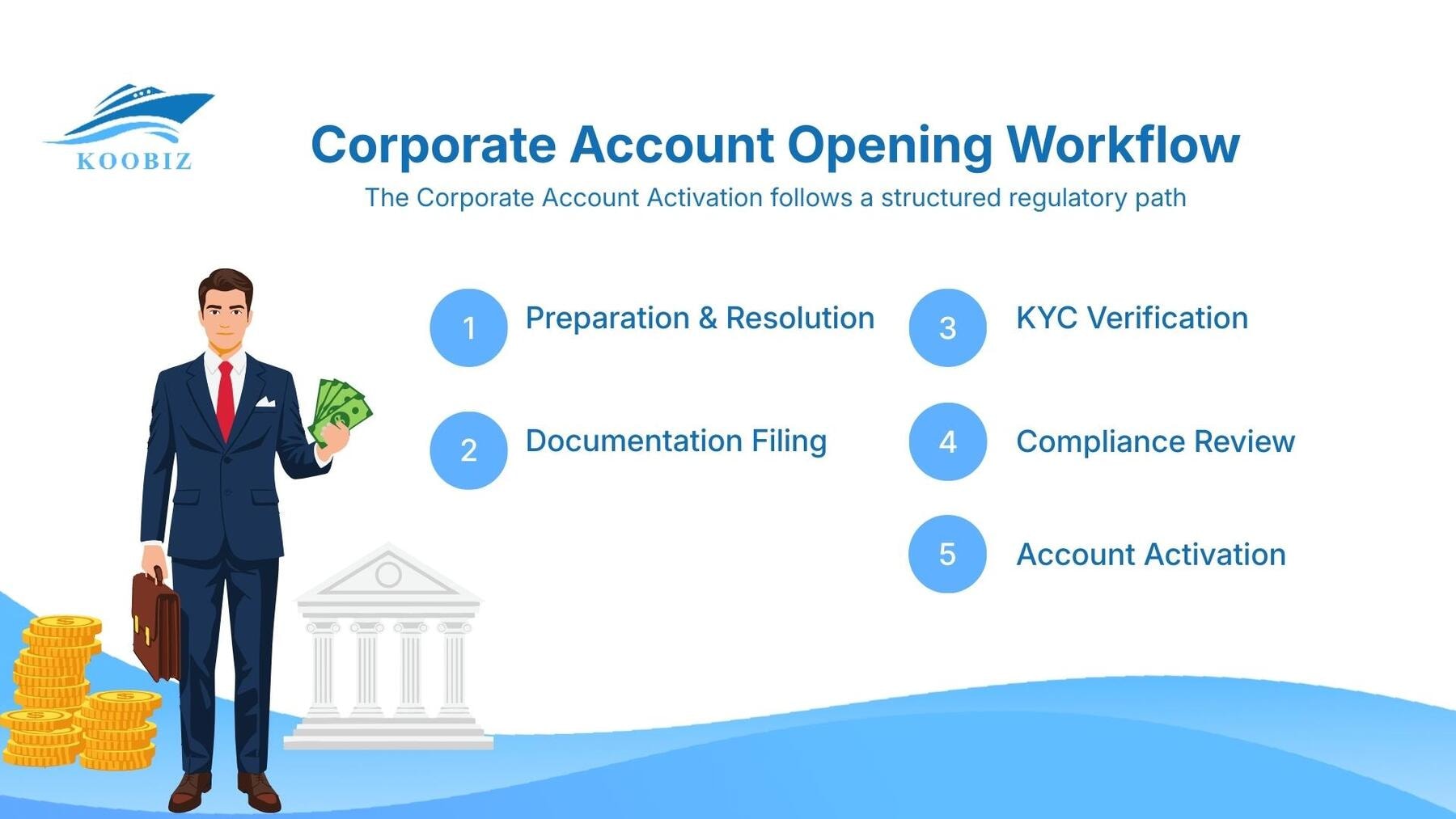
    1. Preparation of Documents: Ensure you have your latest ACRA Business Profile (bizfile), Constitution (M&A), and passports/ID of all directors and shareholders.
    2. Digital Application: Visit the website (e.g., Aspire, Wise, ANEXT) and register using Corppass (if available) or via manual email entry.
    3. e-KYC Verification: Directors will need to perform identity verification, often via a live selfie check or by uploading proof of address (utility bills/bank statements from their home country).
    4. Business Activity Review: You may need to provide a website, invoices, or contracts to prove the legitimacy of your business. Once approved, your account details are generated instantly.

    About Koobiz

    Navigating the financial landscape of a new market can be daunting. Koobiz is your trusted partner for doing business in Singapore. We specialize in company incorporation, accounting, tax filing, and audit services. Beyond compliance, we offer strategic consultancy to help you successfully open bank accounts with both top-tier traditional banks and flexible neobanks.

    Ready to launch your business in Singapore? Visit koobiz.com to consult with our experts today.