Category: Corporate Secretarial

  • Learn Corporate Secretary Duties & ACRA Filings for SG SMEs

    Learn Corporate Secretary Duties & ACRA Filings for SG SMEs

    Disclaimer: This guide provides general information based on the Companies Act and ACRA guidelines as of 2026. It is not legal advice — always verify with ACRA or your professional advisor.

    [SUMMARIES]

    Mandatory Requirement: Under the Companies Act, every Singapore company must appoint a qualified corporate secretary within six months of being incorporated.

    Core Duties: The role involves more than basic paperwork. It includes managing statutory records, preparing board resolutions, and ensuring all ACRA filings are submitted on time.

    Severe Penalties: Missing ACRA filing deadlines can result in late fees ranging from $300 to $600, court summons for directors, or even the company being struck off the register.

    Smart Solution: Outsourcing secretarial tasks to experts like Koobiz is a cost-effective way for SME owners to stay compliant and enjoy peace of mind.

    [/SUMMARIES]

    Navigating Singapore’s regulatory requirements can feel overwhelming for small and medium-sized enterprises (SMEs). While the term “secretary” might sound like an administrative role, a corporate secretary is actually a legally recognized position that plays a key part in keeping your company compliant. At Koobiz, we specialise in helping business owners manage the complex requirements of the Accounting and Corporate Regulatory Authority (ACRA). This guide explains what a corporate secretary is, whether the role is legally required, and what the main duties involve. We will also cover the penalties for non-compliance and why many smart SMEs choose to outsource this function to professionals. Let’s get started.

    What Is a Corporate Secretary in Singapore?

    A Corporate Secretary connects the business with ACRA IRAS
    A Corporate Secretary connects the business with ACRA IRAS

    A corporate secretary in Singapore is a senior compliance officer required by the Companies Act. The role exists to support good corporate governance and involves legal responsibilities related to statutory administration—not general clerical work.

    To better understand this role and how it differs from that of a typical administrative assistant, it helps to look at three key aspects:

    • Who they are: A corporate secretary acts as the main link between your SME, its directors and shareholders, and government agencies such as ACRA and the Inland Revenue Authority of Singapore (IRAS). They help protect your company’s legal standing.
    • What they do: Rather than handling daily office tasks, they focus on advising the board of directors on their legal duties. They also ensure the company follows its own constitution and help maintain the legal separation between the business and its shareholders.
    • Why you need one: When you work with a professional service like Koobiz, you gain access to a compliance expert who understands Singapore’s corporate laws in detail—helping you avoid costly mistakes before they happen.

    By maintaining strong corporate governance, companies can reduce the risk of legal disputes and internal issues related to compliance.

    Is Appointing a Company Secretary Mandatory for SG SMEs?
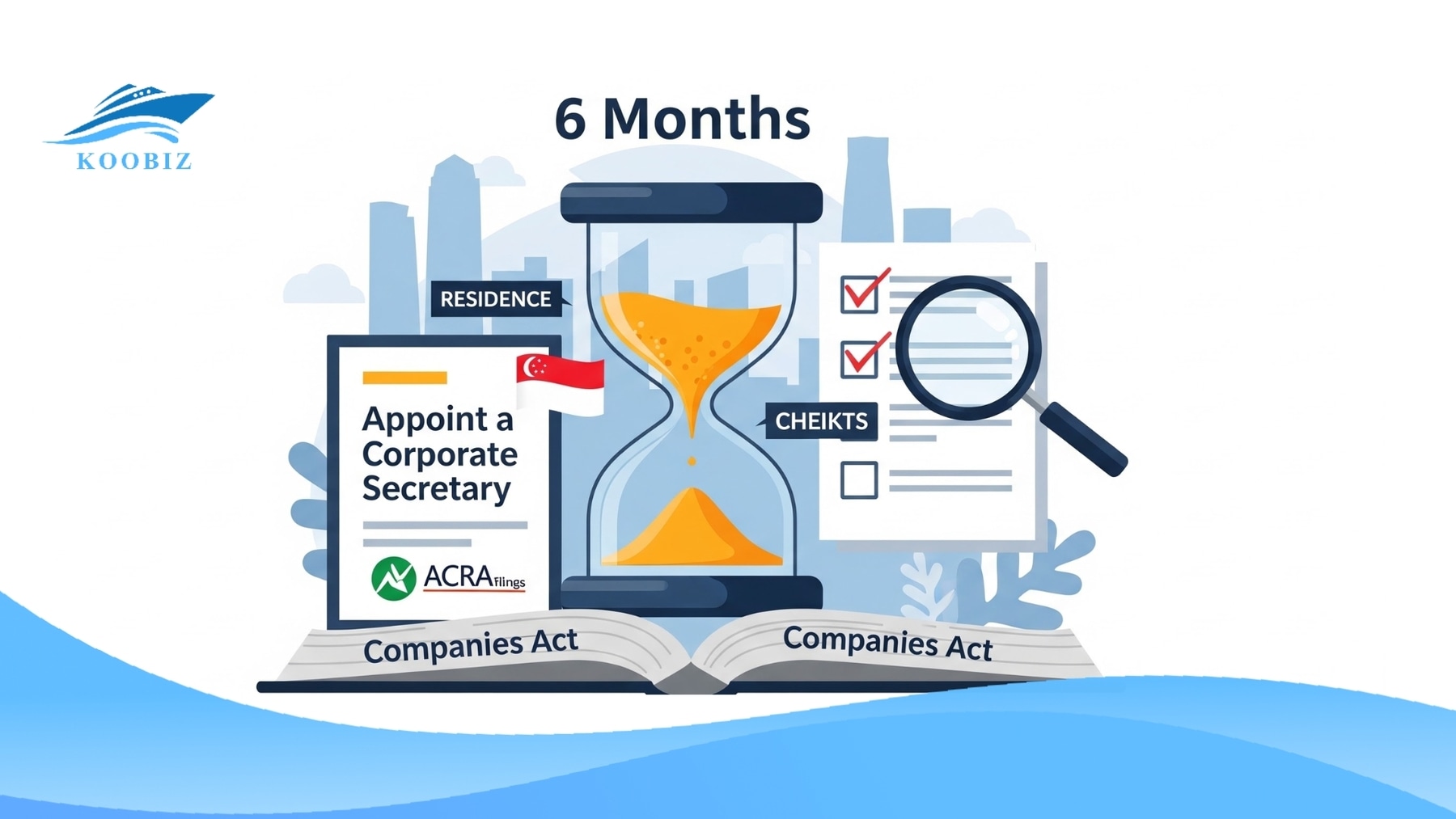
    Mandatory Corporate Secretary Requirement for Singapore SMEs
    Mandatory Corporate Secretary Requirement for Singapore SMEs

    Yes, appointing a corporate secretary is a legal requirement for all Singapore SMEs. To ensure proper governance and accurate ACRA filings, Section 171 of the Companies Act sets out the following rules:

    • The 6-Month Deadline: Once your company is incorporated, you have exactly six months to appoint a qualified company secretary.
    • Residency Requirements: The person appointed must live in Singapore—this includes Singapore Citizens, Permanent Residents, or holders of an EntrePass or Employment Pass.
    • The Sole-Director Restriction: If your SME has only one director, that individual is not allowed to also serve as the company secretary. This rule helps avoid conflicts of interest and ensures a system of checks and balances.

    Failing to appoint a secretary within the required timeframe—or leaving the position vacant for more than six months—will likely attract attention from ACRA and may result in penalties.

    In practice, most active and compliant SMEs choose to work with third-party professional firms to meet this requirement effectively and avoid structural issues.

    What Are the Core Duties of a Corporate Secretary?
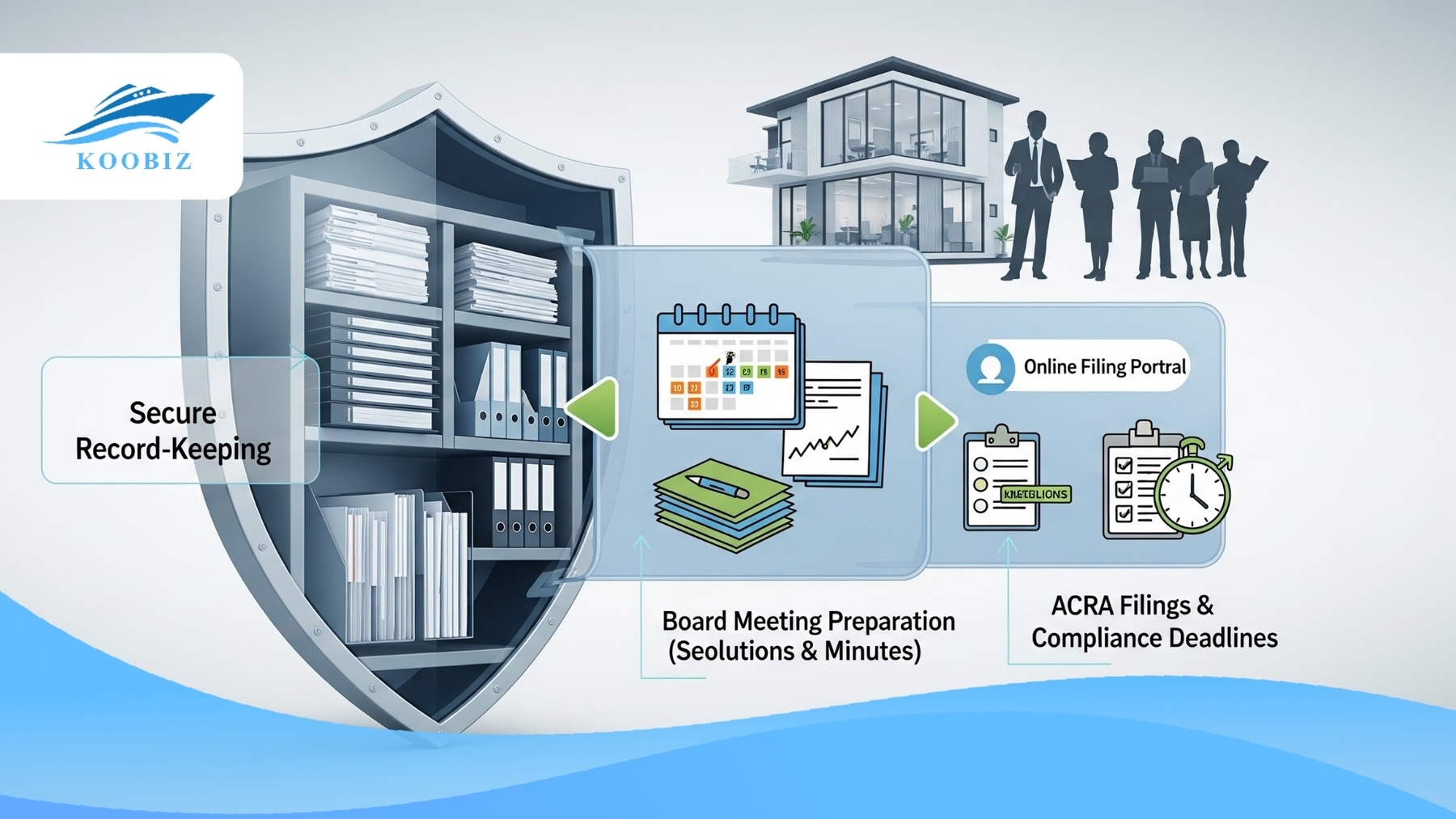
    Core duties of a corporate secretary
    Core duties of a corporate secretary

    The main duties of a corporate secretary fall into three categories: administrative record-keeping, preparation for board meetings, and handling mandatory ACRA filings—all of which are required for statutory compliance.

    To understand the importance of these duties, it helps to see the corporate secretary as someone who builds a safety net for the business. Rather than just responding to government requests, they actively manage the company’s corporate calendar to ensure no legal deadlines are missed. This proactive approach helps maintain the company’s “Good Standing” with the Singapore government—a status that can affect your ability to secure bank loans, attract investors, and hold operating licenses. Let’s take a closer look at each of these responsibilities.

    Administrative and Statutory Record-Keeping

    • The Task: Create, update, and securely store the company’s statutory records. These include the Register of Directors, Register of Shareholders, and the Register of Registrable Controllers (RORC).
    • The Impact: Proper record-keeping ensures your SME has a clear and auditable history at all times. This helps protect your business from compliance issues and anti-money laundering inquiries whenever internal changes occur.

    Board Meetings and AGM Preparations

    • The Task: Support strategic decision-making by preparing meeting agendas, ensuring legal requirements are met, and recording minutes and resolutions—such as a Directors’ Resolution to open a corporate bank account.
    • The Impact: This ensures that your Annual General Meeting (AGM) and board meetings follow the timelines and rules set out in the Companies Act. (Note: Private companies may choose not to hold AGMs if all members pass a unanimous resolution—your corporate secretary can guide you through this process if it applies.)

    Mandatory ACRA Filings and Annual Compliance

    • The Task: Submit required documents through ACRA’s BizFile+ portal, including the company’s Annual Return. Also report any major changes—such as updates to the registered address, changes in directors, or share allotments—within 14 days.
    • The Impact: A Koobiz secretary acts as your compliance partner, making sure the public record always reflects the current state of your SME. This helps you meet your annual obligations without the worry of missed deadlines.

    In-House vs. Outsourced Corporate Secretary: Which is Better for SMEs?

    An outsourced corporate secretary is generally more cost-effective and offers broader expertise, while an in-house secretary may be suitable for large corporations that require someone physically present full-time.

    To compare these two options, it’s useful to look at the financial and operational realities of running an SME in Singapore:

    Comparison Criteria In-House Secretary Outsourced Firm (e.g., Koobiz)
    Cost & Overhead Highly expensive. Requires full-time salary, benefits, and office space. Incredibly cost-effective. You pay a fractional cost for expert services.
    Level of Expertise Limited to the knowledge of one single internal employee. Access to an entire team of highly trained compliance specialists.
    Resource Efficiency Often inefficient, as SMEs rarely have 40 hours of secretarial work weekly. Highly efficient. Services scale seamlessly with your SME’s actual needs.
    Key Person Risk High risk. If they resign or fall ill, your compliance is severely compromised. Zero risk. Services continue seamlessly without any interruption.

    Based on current trends among corporate service providers, most newly formed SMEs choose outsourced secretarial services in their first year to keep costs low and reduce compliance risks.

    What is the Role of a Nominee Secretary for Foreign-Owned SMEs?
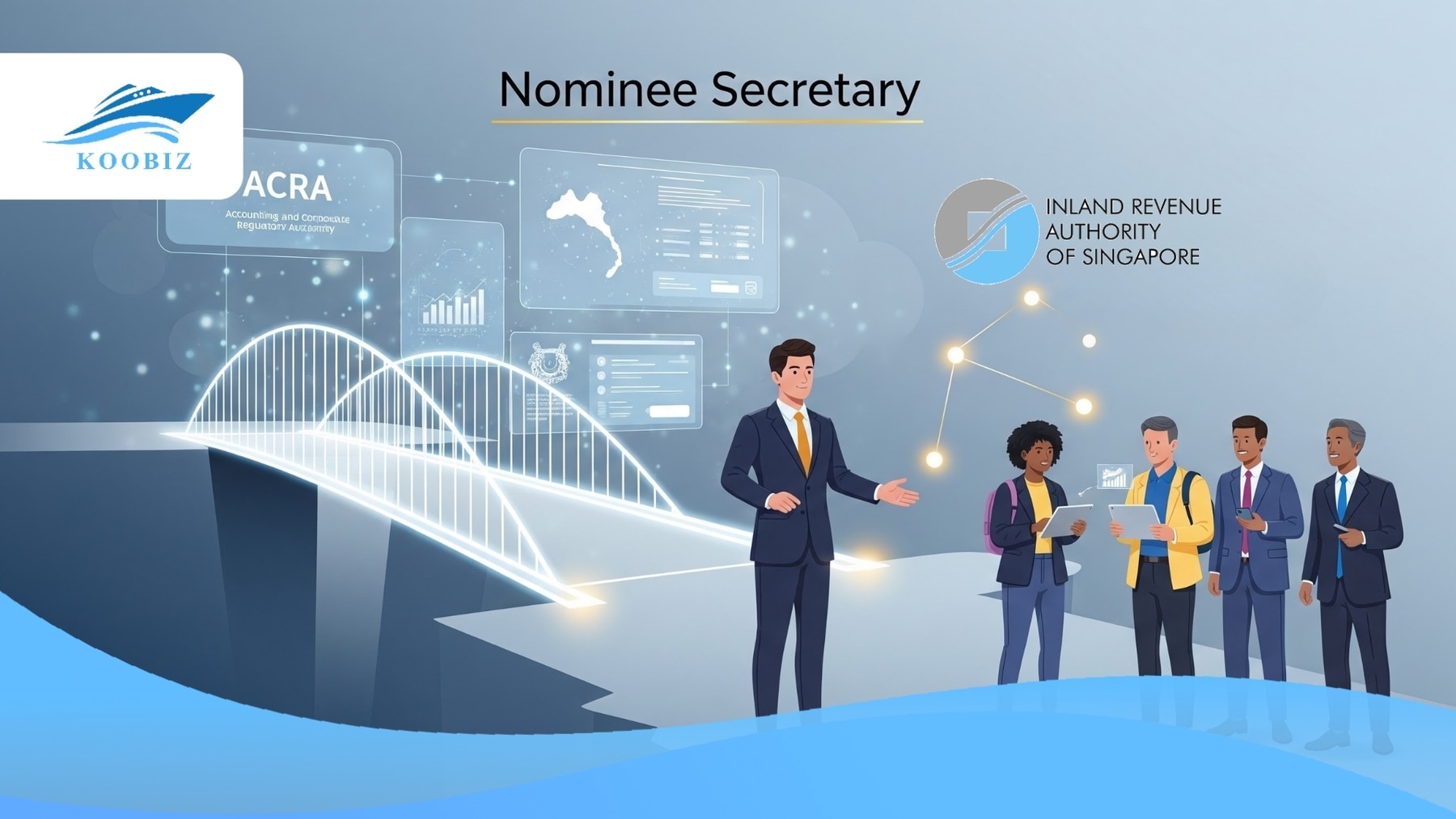
    Role of a Nominee Secretary for Foreign-Owned SMEs
    Role of a Nominee Secretary for Foreign-Owned SMEs

    A Nominee Secretary is a locally based representative appointed to meet the residency requirement under the Companies Act. This role allows foreign entrepreneurs to operate legally in Singapore.

    Here’s how this service works and the specific challenge it addresses:

    • The Legal Hurdle: The law requires that a company secretary must live in Singapore. This creates a challenge for SMEs founded by overseas investors or digital nomads who do not hold a local pass or citizenship.
    • The Koobiz Solution: We offer a Nominee Secretary service. A qualified local professional from our team is officially registered with ACRA as your company secretary.
    • The Strategic Benefit: This arrangement bridges the geographic gap. It ensures your foreign-owned business remains fully compliant with local rules, allowing you to focus on growing your company globally.

    Using a nominee secretary is a common and safe practice that supports foreign investment into the Southeast Asian market.

    What Happens If Your SME Misses ACRA Filing Deadlines?

    There are three possible consequences if your SME misses ACRA filing deadlines: financial penalties, legal action against directors, and—in serious cases—the company being struck off the register.

    It’s important to understand that ACRA enforces strict rules around late filings, especially for the Annual Return and AGM. Here is how penalties typically escalate:

    • 1. Strict Financial Penalties: Missing an Annual Return deadline incurs an immediate late lodging fee imposed by ACRA. The penalties are exact: you will be fined $300 if the lodgment is filed up to 3 months late, and $600 if it is filed more than 3 months late.
    • 2. Direct Legal Action: ACRA can issue court summons to company directors. Directors may face personal fines or be disqualified from holding directorships in the future.
    • 3. Ultimate Striking Off: If a company repeatedly fails to file its returns, ACRA may assume the business is no longer operating and begin the process of striking it off. This removes the company from the official register, freezes its bank accounts, and effectively ends its operations.

    Each year, ACRA takes action against thousands of non-compliant companies, resulting in significant fines for late or missed filings.

    How to Change Your Company Secretary in Singapore?

    Changing your company secretary involves three steps: securing a resignation, passing a board resolution, and updating the appointment via BizFile+ to ensure a smooth legal transition.

    To complete the process without any compliance gaps, follow these steps in order:

    • Step 1: Secure the Formal Resignation: The current company secretary must submit a written notice of resignation to the board of directors.
    • Step 2: Pass a Board Resolution: The directors meet and pass a resolution to formally accept the resignation and appoint the new secretary—for example, transferring the role to the team at Koobiz.
    • Step 3: Execute the BizFile+ Update: This step is time-sensitive. The new secretary or a company director must log into ACRA’s BizFile+ system and file the change within 14 days of the effective date.

    A smooth transition ensures your company’s compliance record remains intact. Following a clear handover process helps reduce the risk of errors after the change.

    Case Study: Escaping ACRA Penalties Through Expert Outsourcing

    Illustrative example based on typical client scenarios.

    A local tech startup was facing thousands of dollars in ACRA fines and possible court action due to missed Annual Returns. They resolved the situation by urgently outsourcing their compliance to Koobiz’s corporate secretarial team.

    Here’s how the situation unfolded:

    • The Problem: The foreign founders focused entirely on product development and missed the 6-month deadline to appoint a secretary. As a result, they also missed their first AGM and Annual Return filing.
    • The Escalation: Twelve months later, ACRA imposed late fees and sent a warning letter threatening court action against the directors. Their corporate bank account was also frozen during a compliance review.
    • The Koobiz Intervention: The startup reached out to Koobiz. Within 48 hours, our team stepped in as the official outsourced corporate secretary. We prepared the required resolutions, reconstructed their statutory records (including the RORC), and filed the overdue returns.
    • The Result: We helped the company return to “Good Standing” in under a week. They avoided court action, regained access to their bank account, and were able to move forward with their next round of funding.

    Reliable Corporate Secretarial Services for Singapore SMEs by Koobiz

    Navigating the requirements of the Singapore Companies Act shouldn’t distract you from running and growing your business. As this guide has shown, the role of a corporate secretary is legally required, involves real responsibility, and carries significant risk if not handled properly. That’s where Koobiz comes in.

    At Koobiz, we offer more than just basic ACRA filings. We provide a full range of corporate services designed specifically for SMEs, including:

    • 🔹 Seamless Incorporation & Banking: Getting your company registered and helping secure your local corporate bank accounts from day one.
    • 🔹 Comprehensive Tax & Accounting: Keeping your finances optimized and structurally sound with expert tax, accounting, and auditing services.
    • 🔹 Expert Secretarial & ACRA Compliance: Guaranteeing your statutory registers are impeccably maintained, AGMs are organized on time (or legally dispensed with), and every single ACRA deadline is met well in advance.

    Don’t leave your company’s legal standing to chance. Ready to streamline your corporate compliance and focus on growth? Discover how Koobiz’s Corporate Secretarial Services can protect and elevate your SME today.

  • Singapore Companies Act 1967: The Complete Guide to ACRA Corporate Compliance

    Singapore Companies Act 1967: The Complete Guide to ACRA Corporate Compliance

    [SUMMARIES]

    The Singapore Companies Act 1967 sets out the legal framework governing company incorporation, governance, and ongoing statutory compliance.

    It defines key obligations such as appointing resident directors and company secretaries, maintaining statutory registers, and filing Annual Returns with Accounting and Corporate Regulatory Authority (ACRA).

    Directors carry personal fiduciary duties and may face fines, disqualification, or prosecution for non-compliance.

    Common breaches arise from missed filings, outdated records, and failures to disclose interests or beneficial ownership.

    Understanding and following these requirements helps businesses remain “In Good Standing” and avoid regulatory and reputational risk in Singapore.

    [/SUMMARIES]

    The Singapore Companies Act 1967 is the fundamental legal framework governing every business entity in the Lion City. In 2026, staying compliant with ACRA is more critical than ever, as non-compliance can trigger severe penalties and director liabilities of up to S$20,000. This guide provides a clear roadmap to mastering statutory requirements, from director duties to annual filings. By following these essential provisions, you can safeguard your business and maintain a status of “In Good Standing” in Singapore’s transparent regulatory environment.

    What is the Companies Act in Singapore?

    The Singapore Companies Act 1967 is the primary legislation governing the lifecycle and operations of all companies incorporated in the Lion City. It establishes the comprehensive legal framework for company formation, corporate governance, financial reporting, and strict regulatory compliance.

    Managed and enforced by the Accounting and Corporate Regulatory Authority (ACRA), the Act serves as the “rulebook” for:

    • Incorporation & Structure: How a company is legally birthed and organized.
    • Governance: The fiduciary duties of directors and the statutory rights of shareholders.
    • Transparency: Mandatory financial disclosures and reporting obligations to authorities.

    Compliance under the Act is a continuous statutory obligation, not a one-off task. From day-to-day administration to the eventual strike-off or winding up, the Act ensures corporate transparency while protecting the interests of creditors and the public. Failure to adhere to these regulations can lead to heavy composition fines, director disqualification, or criminal prosecution.

    Types of Companies Governed by the Companies Act

    Select the right legal structure for your Singapore business success
    Select the right legal structure for your Singapore business success

    The Singapore Companies Act 1967 provides for various business structures tailored to different commercial needs. While there are several options, more than 90% of businesses in Singapore are incorporated as Private Limited Companies due to their robust liability protection and tax efficiency.

    Private Limited Company (Pte Ltd)

    A Private Limited Company is the most versatile and common structure. Under the Act, it is limited to a maximum of 50 shareholders. Key characteristics include:

    • Separate Legal Entity: The company is a distinct legal person from its directors and shareholders.
    • Limited Liability: Shareholders’ financial exposure is limited to their invested capital.
    • Tax Optimization: Access to attractive corporate tax incentives and the Exempt Private Company (EPC) status, which simplifies compliance for small-to-medium enterprises (SMEs).

    Public Company

    A Public Company can have more than 50 shareholders and is permitted to raise capital by offering shares or debentures to the public. These entities are subject to more stringent statutory disclosure and financial reporting standards to protect public investors. This structure is typically reserved for large-scale enterprises or those seeking a listing on the Singapore Exchange (SGX).

    Company Limited by Guarantee

    Commonly used for non-profit purposes (charities, trade associations, or religious bodies), this entity has no share capital. Instead, members provide a “guarantee” to pay a nominal fixed amount in the event of winding up. All surplus profits are reinvested into the organisation’s mission rather than distributed as dividends.

    Foreign Companies (Branch Offices vs. Subsidiaries)

    Foreign entities looking to establish a presence must register under the Act. While a Branch Office is considered an extension of the foreign parent company, most international entrepreneurs opt to incorporate a Subsidiary (Pte Ltd). A subsidiary offers stronger ring-fencing of liabilities and is considered a Singapore tax resident, making it eligible for local tax treaties.

    How the Companies Act Affects Foreign Entrepreneurs

    Compliance with the Companies Act ensures seamless operations
    Compliance with the Companies Act ensures seamless operations

    The Singapore Companies Act 1967 provides a clear legal framework for foreign investors but imposes a mandatory requirement: every company must appoint at least one Resident Director under Section 145.

    This director must be:

    • A Singapore Citizen or Permanent Resident; or
    • A valid Employment Pass (EP) or EntrePass holder with a local address, subject to approval by the Ministry of Manpower (MOM).

    As a result, foreign founders cannot manage a Singapore company entirely from overseas without a qualified local director. In the 2026 regulatory environment, companies must disclose any Nominee Director arrangement to ACRA, and this information appears on the public Business Profile.

    To ensure full compliance, many founders use professional Nominee Director services. Professional corporate service providers such as Koobiz allow foreign entrepreneurs to meet the local director requirement without affecting ownership or operational control, while reducing exposure to regulatory penalties of up to S$20,000 (effective April 2026).

    The Act therefore sets strict conditions for foreign entrepreneurs, but also offers a lawful pathway to establish and operate a business in Singapore when properly structured.

    Key Provisions of the Companies Act 1967

    Essential statutory framework governing all Singapore-incorporated companies
    Essential statutory framework governing all Singapore-incorporated companies

    The Singapore Companies Act 1967 sets out the statutory framework companies must comply with to remain in good standing with ACRA.

    1. Company Incorporation Requirements

    To obtain separate legal personality, a company must appoint at least one shareholder and one locally resident director, maintain a registered office in Singapore, and appoint a qualified company secretary within six months of incorporation.

    2. Statutory Registers and Records

    Companies must maintain accurate and up-to-date statutory registers at their registered office. Under the current 2026 enforcement framework, this includes the Registers of Nominee Directors and Nominee Shareholders (ROND/RONS) – a mandatory requirement introduced to enhance corporate transparency.

    Key maintenance requirements include:

    • General Registers: Accurate records of members, directors, and secretaries.
    • Corporate Actions: Proper records of all board and shareholder resolutions (Minutes).
    • ROND/RONS & RORC: Companies must maintain registers of Nominee Directors, Nominee Shareholders, and Registrable Controllers.
    • Filing Deadlines: Updates to the Register of Registrable Controllers (RORC) and Nominee registers must be filed with ACRA within two business days to avoid immediate statutory penalties.

    3. Financial Reporting and Filing Obligations

    Companies must keep proper accounting records in compliance with Singapore Financial Reporting Standards (SFRS), hold Annual General Meetings unless exempted, and lodge Annual Returns within the prescribed deadlines. Failure to comply may result in fines or regulatory action.

    4. Disclosure of Interests

    Directors are required to disclose any personal interests in company transactions, and companies must identify individuals exercising significant control to ensure transparency and prevent misuse of corporate structures.

    Director Fiduciary Duties and Personal Liabilities

    Protect your leadership with expert guidance on director liabilities
    Protect your leadership with expert guidance on director liabilities

    Under the Singapore Companies Act 1967 (especially Section 157), a director holds a position of legal trust. These duties are personal and cannot be fully transferred or ignored, even when daily tasks are delegated.

    Directors must:

    • Act honestly and in good faith in the company’s best interests,
    • Exercise reasonable care, skill, and diligence, and
    • Avoid conflicts between personal interests and company obligations.

    They must also disclose any interest in company transactions (Section 156). Misuse of company information or failure to declare interests is a serious breach of the law.

    Personal liability for non-compliance includes:

    • Filing failures: late or incorrect submission of Annual Returns or Financial Statements,
    • Record-keeping failures: improper maintenance of statutory registers (including the Register of Registrable Controllers), and
    • Regulatory breaches: allowing the company to fall out of “In Good Standing” with ACRA.

    Possible sanctions (2026):

    • Fines of up to S$20,000 per offence,
    • Disqualification from acting as a director for up to five years, and
    • Criminal prosecution for serious cases involving fraud, dishonesty, or gross negligence.

    In short, company compliance is not merely administrative—it is a personal legal responsibility of every director.

    Rights and Powers of Shareholders

    Under the Singapore Companies Act 1967, shareholders are the legal owners of the company. Although they do not manage daily operations, the Act gives them clear statutory rights to protect their investment and influence how the company is governed.

    Core statutory rights

    Shareholders mainly exercise their powers through General Meetings. Their key rights include:

    • Voting rights: approving major decisions such as the appointment or removal of directors and auditors.
    • Constitutional changes: passing Special Resolutions to amend the company’s Constitution or change the company’s name.
    • Economic rights: receiving dividends when declared and a share of assets if the company is wound up.
    • Information rights: receiving notices of meetings and access to audited financial statements and certain statutory registers.

    Checks and balances

    The Act draws a clear line between ownership and management. Directors run the business, but shareholders retain control through specific “residual powers” if governance breaks down:

    • Calling meetings: shareholders holding at least 10% of voting rights may requisition a General Meeting.
    • Removing directors: shareholders can vote to replace directors who breach their duties.
    • Minority protection: under Section 216, shareholders may seek court relief against “oppressive” or unfair conduct by the board or majority owners.

    The Companies Act allows directors to manage the company, while ensuring shareholders keep the ultimate authority to supervise and hold them accountable.

    Common Compliance Mistakes Businesses Make

    Most breaches of the Singapore Companies Act 1967 are caused by weak internal controls or misunderstanding of statutory deadlines. These “administrative errors” can quickly turn into fines and personal liability for directors. Top compliance pitfalls include:

    • Confusing tax with statutory filings: Filing taxes with Inland Revenue Authority of Singapore (IRAS) does not replace the duty to file Annual Returns with ACRA. Missing ACRA filings is a separate offence.
    • Outdated statutory records: Delays in updating changes to directors, shareholders, or the registered office (usually within 14 days) can trigger automatic penalties.
    • Neglecting the RORC: Failure to keep the Register of Registrable Controllers up to date or to report changes to ACRA within two business days.
    • AGM and resolution failures: Not holding an AGM within the required timeframe or failing to properly record Board and Shareholder resolutions.
    • Director disclosure omissions: Not declaring a director’s interest in contracts or transactions (Section 156).

    These problems usually arise from the absence of proper corporate secretarial support. Without professional oversight, small and foreign-owned companies often miss complex and changing requirements, leading to avoidable enforcement action.

    Common Offences and Penalties under the Companies Act

    Understanding statutory obligations to avoid ACRA enforcement actions
    Understanding statutory obligations to avoid ACRA enforcement actions

    In Singapore, corporate compliance operates under a strict liability regime. Under the Companies Act 1967, “administrative oversight” is rarely accepted as a defence. Both the company and its officers may be held liable for statutory breaches.

    Common prosecutable offences include

    • AGM and filing failures: failure to hold an AGM or file Annual Returns within statutory deadlines.
    • Director duty breaches: failure to exercise reasonable care and diligence in overseeing compliance.
    • False or misleading information: providing inaccurate data to ACRA.
    • Transparency failures: neglecting to maintain or update the Register of Registrable Controllers (RORC).

    Penalties under the Companies Act

    • Late filing penalties: S$300 to S$600 late lodgement fees plus composition fines (typically around S$500) for missing AR deadlines.
    • Serious offences: Fines up to S$20,000 for false statements (Section 401) or severe breaches of director fiduciary duties.

    Sanctions and consequences (2026)

    • Court prosecution: serious or persistent breaches may result in proceedings before the State Courts of Singapore.
    • Director debarment: directors responsible for multiple non-compliant companies may be barred from taking on new appointments.
    • Disqualification: prohibition from acting in management roles for up to five years.
    • Reputational damage: enforcement records appear on public company profiles (BizFile), visible to banks, investors, and business partners.

    Most penalties arise from avoidable administrative lapses, but the legal and reputational impact can be severe. Proactive and continuous compliance is essential to protect a company’s long-term position in Singapore.

    Practical ACRA Compliance Checklist for Businesses

    Below is a practical checklist to help Singapore companies meet their key obligations under the Companies Act and remain compliant with ACRA.

    Compliance Area Key Statutory Requirement Statutory Deadline
    Company Officers Maintain Resident Director & Company Secretary Ongoing
    Registered Address Must be a physical, reachable local address Ongoing
    Statutory Registers Update registers of members, directors, and charges Within prescribed timelines
    RORC Filing Lodge beneficial ownership data (Register of Controllers) Promptly as per ACRA rules
    Financial Records Maintain records & prepare SFRS financial statements Annually
    Annual Meetings Hold AGM or pass resolutions for financial approval Within required period after FYE
    Annual Returns File Annual Return (AR) via BizFile+ Annually by statutory deadline
    Disclosures Directors disclose interests in transactions Upon occurrence of conflict

    This checklist covers the most common compliance duties but is not exhaustive. Actual obligations may vary depending on a company’s size, structure, and business activities.

    Using a structured compliance checklist helps businesses avoid missed deadlines, reduce director liability, and demonstrate sound corporate governance under Singapore law.

    How Koobiz Corporate Secretarial Services Keep You 100% Compliant

    Under the Singapore Companies Act 1967, appointing a qualified Company Secretary within six months of incorporation is a mandatory statutory requirement. Failure to comply is an offence that triggers penalties from ACRA for both the entity and its directors.

    This is where Koobiz Corporate Secretarial Services provide a critical safety net. By appointing Koobiz as your Company Secretary, your business ensures:

    • Immediate Statutory Compliance: We ensure a qualified professional is appointed within the mandatory 6-month window, satisfying all ACRA requirements from day one.
    • Automated Filing Management: Koobiz proactively manages your AGMs, Annual Returns, and necessary lodgements, effectively eliminating the risk of late-filing penalties or regulatory actions.
    • Robust Record-Keeping: We maintain your statutory registers and corporate records with precision, enabling directors to fulfill their fiduciary duties and significantly reducing personal liability risks.
    • Professional Oversight: For foreign founders, a corporate secretary is not just a legal mandate—it is your local compliance partner.

    With Koobiz, you secure continuous professional oversight, ensuring your company remains “In Good Standing” while you focus on scaling your business.

  • Termination Letter in Singapore: Guidelines, MOM Requirements & Free Templates

    Termination Letter in Singapore: Guidelines, MOM Requirements & Free Templates

    [SUMMARIES]

    A termination letter is a mandatory written document in Singapore for ending an employment relationship under MOM regulations.

    It must clearly state the notice period, last day of service, and final salary arrangements, including unused leave and salary in lieu of notice.

    Employers must comply with Employment Act requirements to avoid wrongful dismissal claims handled by TADM and ECT.

    Special rules apply to foreign employees, including IR21 tax clearance and withholding of final pay until approval from IRAS.

    Using a properly drafted termination letter ensures legal compliance, protects both parties, and reduces dispute risks.

    [/SUMMARIES]

    A termination letter is a critical document for ending an employment relationship in Singapore. Employers and employees must comply with MOM regulations on notice periods, final salary payments, and fair termination practices. This guide provides a practical overview of termination letters, explains when they are required, and shows how to draft them correctly under Singapore employment law, with ready-to-use templates for common termination scenarios.

    What is a Termination Letter?

    Basic meaning of a termination letter
    Basic meaning of a termination letter

    A termination letter is a formal written notice issued by an employer or an employee to officially end an employment relationship. In Singapore, it serves as a key employment record confirming important details such as the last day of service, notice period, and final compensation arrangements.

    For employers, issuing a termination letter helps ensure compliance with the employment contract and the Employment Act administered by the Ministry of Manpower (MOM). For employees, it provides written proof of their employment history, which may be required for future job applications, work pass cancellations (for foreign employees), or references to the Tripartite Alliance for Dispute Management (TADM) if a dispute arises.

    Termination Letter vs Resignation Letter vs Dismissal Letter

    Criteria Termination Letter Resignation Letter Dismissal Letter (Summary)
    Initiated by Employer or employee Employee Employer
    Purpose To formally end employment To notify voluntary departure To end employment due to misconduct
    Notice period Required (unless paid in lieu) Required under contract or law Not required
    MOM compliance Must align with the Employment Act Must meet contractual notice terms Requires formal inquiry (due process)
    Legal risk Moderate Low High (if misconduct is not proven)

    Summary

    • A resignation letter is submitted by the employee to leave voluntarily.
    • A dismissal letter is issued by the employer, usually for serious misconduct (summary dismissal), and often takes effect immediately without notice.
    • A termination letter is an umbrella term covering all formal ways of ending an employment relationship, including termination by notice, mutual agreement, or contract expiry.

    Is a Termination Letter Required in Singapore?

    Legal need for a termination letter
    Legal need for a termination letter

    Yes. Under the latest Ministry of Manpower (MOM) regulations, a termination letter is mandatory.

    Any notice to end an employment relationship whether initiated by the employer (dismissal) or the employee (resignation) must be given in writing. A verbal notice is not legally sufficient. Without a written letter, the employment relationship may be treated as still ongoing. As a result, the employer may remain liable for salary and CPF contributions, while the employee remains bound by contractual duties.

    Beyond legal compliance, a formal termination letter serves three key purposes:

    • Legal protection: It provides definitive evidence of the last day of service and the official reason for termination.
    • Financial record: It confirms the final payout, including salary in lieu of notice and encashment of unused annual leave.
    • Welfare access: Under the SkillsFuture Jobseeker Support (SJS) Scheme, displaced workers must present an official termination letter to apply for financial assistance of up to $6,000.

    MOM’s Employment Act on Termination Notices

    The Employment Act sets out a clear framework for ending an employment contract. Either party may terminate the contract by serving the notice period stated in the employment agreement.

    If the contract is silent on notice duration, the following statutory minimum notice periods apply based on length of service:

    Length of Service Minimum Notice Period
    Less than 26 weeks 1 day
    26 weeks to < 2 years 1 week
    2 years to < 5 years 2 weeks
    5 years and above 4 weeks

    Risks of Wrongful Dismissal Claims (TADM & ECT)

    Issuing a termination letter without just cause or without following due process may expose employers to wrongful dismissal claims. Such cases are first handled by the Tripartite Alliance for Dispute Management (TADM) and may be escalated to the Employment Claims Tribunals (ECT).

    Common high-risk scenarios include:

    • Discrimination: Termination based on age, race, gender, religion, or pregnancy.
    • Deprivation of benefits: Dismissing an employee to avoid paying maternity benefits, bonuses, or retrenchment compensation.
    • Retaliation: Termination following complaints about unpaid salary or unsafe working conditions.
    • Lack of inquiry: For summary dismissal due to misconduct, employers must conduct a formal inquiry. During this period, the employee may be suspended for up to one week with at least half pay. Immediate dismissal without inquiry or written explanation is a major trigger for TADM claims.

    If the Employment Claims Tribunals (ECT) determines that a dismissal is wrongful, the employer may be ordered to either reinstate the employee with back pay or pay financial compensation.

    To avoid these risks, businesses in Singapore should always issue a formal termination letter that clearly states and supports the reason for dismissal such as misconduct, poor performance, or redundancy and strictly complies with the required notice period. Doing so helps protect the company from legal disputes, financial penalties, and reputational damage.

    Understanding Notice Period and Salary in Lieu

    Key terms on notice and pay in lieu
    Key terms on notice and pay in lieu

    In Singapore, the notice period is the advance notice required before an employment contract ends. It is usually stated in the employment contract; if not, the statutory minimum under the Employment Act applies. The notice period allows both parties to prepare for termination, such as handing over duties and arranging replacements.

    Salary in lieu of notice allows either party to terminate employment immediately without serving the notice period, by paying the equivalent salary for that period.

    • Employee-initiated: An employee who leaves immediately without serving notice must pay the employer the equivalent salary.
    • Employer-initiated: An employer may terminate employment immediately by paying the required salary in lieu of notice.

    Key financial points:

    • Gross rate of pay: Calculated based on gross salary, excluding bonuses and variable allowances.
    • CPF contributions: Not required for salary in lieu of notice.
    • Unused leave: Any unused annual leave must be encashed separately and included in the final payment.

    A termination letter should clearly state whether the notice period will be served or salary in lieu will be paid. This ensures clarity on the last working day and compliance with Singapore employment laws.

    What Should Be Included in a Termination Letter?

    To be legally robust, a termination letter in Singapore must be clear, professional, and compliant with the Employment Act. It serves as a formal record of the cessation of employment and the fulfilment of contractual obligations.

    Essential Elements

    A standard, professional termination letter should include:

    • Personal Particulars: Employee’s full name, NRIC/FIN, and job title
    • Key Dates: Date of issuance, last day of service, and official termination date
    • Notice Terms: Whether the contractual notice period is served or salary in lieu of notice is paid
    • Return of Company Assets: Requirement to return laptops, access cards, and confidential documents
    • Final Compensation: Breakdown of final salary, overtime, commissions, and unconsumed annual leave encashment
    • Authorised Signature: Signed by HR or an authorised management representative

    Final Salary Payment & Tax Clearance (IR21)

    • MOM Salary Payment Deadline: In cases of dismissal, the final salary must be paid on the last day of service or within 3 working days thereafter.
    • Unconsumed Leave Encashment: Any outstanding annual leave must be encashed and included in the final payment.
    • Withholding Salary for IR21 (Tax Clearance): For non-Singapore Citizen or non-PR employees, employers must submit Form IR21 to IRAS at least one month before the employee’s departure. The employer is legally required to withhold the employee’s final salary until tax clearance is issued by IRAS.

    Optional but Recommended Clauses

    • Confidentiality & Non-Compete Obligations
    • Return of Documents and Company Equipment
    • Full and Final Settlement of All Claims
    • Reference or Certificate of Service (if applicable)
    • SkillsFuture Support Contact: Provide a contact point to assist displaced employees with support scheme applications

    Including these clauses helps reduce legal risk, prevent disputes, and ensure a smooth and compliant exit process.

    Common Types of Termination Letters in Singapore

    Typical termination letter types in Singapore
    Typical termination letter types in Singapore

    Different termination scenarios require different types of termination letters. In Singapore, the most common forms are classified based on how and why the employment relationship ends.

    Termination with Notice (Contractual Termination)

    This letter is issued when either party terminates the employment contract by serving the required notice period stated in the contract or by paying salary in lieu of notice. It confirms the last day of service and the applicable notice arrangement. This is the most common and lowest-risk form of termination when properly executed.

    Summary Dismissal (Misconduct)

    This letter is used when an employee is dismissed with immediate effect due to serious misconduct, such as theft, fraud, or dishonesty. It must only be issued after a proper inquiry and sufficient evidence has been established. Improper use of summary dismissal carries a high risk of wrongful dismissal claims.

    Acceptance of Resignation Letter

    This letter is issued by the employer to formally acknowledge and accept an employee’s resignation. It confirms the notice period served and the employee’s last working day. It helps formalise the resignation process and reduces the risk of future disputes.

    Termination by Mutual Agreement

    This letter is used when both the employer and employee agree to end the employment relationship amicably. It records the agreed termination date and any settlement terms. This method is commonly adopted during restructuring exercises or negotiated exits.

    Downloadable Termination Letter Templates (Singapore)

    Using standardised templates ensures legal clarity and consistent documentation. Each template below is tailored to a specific termination scenario under Singapore employment practice.

    Employer-Initiated Termination Letter

    Employer-Initiated Termination Letter is used when the employer terminates employment by serving notice or paying salary in lieu of notice.

    It typically includes:

    • Termination date and last day of service
    • Notice period served or salary in lieu of notice
    • Final salary and unconsumed annual leave encashment
    • Instructions for the return of company property

    This template is suitable for contractual termination and redundancy situations.

    [Company Letterhead]

    Date: [DD/MM/YYYY]

    To: [Employee’s Full Name] NRIC/FIN No.: [SXXXXXXX] Job Title: [Designation]

    RE: NOTICE OF TERMINATION OF EMPLOYMENT

    Dear [Employee’s Name],

    We regret to inform you that [Company Name] has decided to terminate your employment as [Job Title], effective from [Date of Issuance].

    1. Last Day of Service

    Your final day of employment with the Company will be [Last Working Day, DD/MM/YYYY].

    2. Notice Period and Compensation

    • [Option A: If serving notice] You are required to serve a notice period of [Number] weeks/months. Your last day of service will remain as stated above.
    • [Option B: If paying in lieu] The Company has decided to terminate your services with immediate effect. In lieu of the notice period, you will be paid a sum of S$[Amount], equivalent to [Number] months of your gross rate of pay. Please note that CPF contributions are not applicable to this payment in lieu of notice.

    3. Final Salary and Benefits

    Your final salary payment will be processed by [Date – must be within 3 days of last day]. This payment will include:

    • Your prorated salary for the current month.
    • Encashment of [Number] days of unconsumed annual leave.
    • Any outstanding eligible expenses or reimbursements.

    [For Foreign Employees] Please note that as per IRAS regulations, the Company will withhold your final payment pending Tax Clearance (Form IR21).

    4. Return of Company Property

    By your last day of service, please return all company property, including but not limited to:

    • Company laptop and accessories.
    • Office keys and security access cards.
    • Corporate credit cards and confidential documents.

    5. Post-Employment Obligations

    We would like to remind you of your ongoing obligations regarding Confidentiality and Non-Disclosure, as stipulated in your employment contract signed on [Date].

    6. Support and Inquiries

    If you have any questions regarding your final settlement, please contact [Name/Department] at [Email/Phone]. For assistance with job transition or support applications such as the SkillsFuture Jobseeker Support (SJS) Scheme, you may reach out to our HR point of contact: [HR Contact Name].

    We thank you for your contributions to [Company Name] and wish you the best in your future endeavors.

    Yours sincerely,

    [Signature]

    [Name of Authorized Representative] [Job Title] [Company Name]

    Employee Resignation Acceptance Letter

    Employee Resignation Acceptance Letter is used to formally acknowledge and accept an employee’s resignation.It typically confirms:

    • Acceptance of the resignation
    • Last day of service
    • Notice period served
    • Final salary payment arrangements

    It provides written evidence that the resignation has been properly recorded and accepted by the employer.

    [Company Letterhead]

    Date: [DD/MM/YYYY]

    To: [Employee’s Full Name] Job Title: [Designation]

    RE: ACCEPTANCE OF RESIGNATION

    Dear [Employee’s Name],

    We acknowledge receipt of your resignation letter dated [Date of Resignation Letter], notifying us of your intention to resign from your position as [Job Title].

    We wish to inform you that your resignation has been formally accepted.

    1. Last Day of Service

    In accordance with your contractual notice period of [Number] weeks/months, your last day of employment with [Company Name] will be [Last Working Day, DD/MM/YYYY].

    2. Handover of Responsibilities

    To ensure a smooth transition, you are expected to complete the handover of all your current projects and responsibilities to [Name of Successor/Manager] by your last working day. Please ensure that all company files, passwords, and documents are properly organized and transferred.

    3. Final Settlement and Benefits

    Your final salary, including encashment of any unconsumed annual leave (if applicable), will be paid on [Date – within 7 days of last day as per MOM]. [For Foreign Employees] As a reminder, the Company will withhold your final payment pending Tax Clearance (Form IR21) as required by IRAS.

    4. Return of Company Property

    Please arrange to return all company-issued items, such as your laptop, access card, and corporate credit cards, to the HR Department on or before your last day.

    5. Post-Employment Obligations

    We would like to remind you that certain contractual obligations, specifically regarding Confidentiality, Non-Solicitation, and Intellectual Property, remain in effect after your departure.

    On behalf of [Company Name], I would like to thank you for your service and contributions during your time with us. We wish you every success in your future career.

    Yours sincerely,

    [Signature]

    [Name of Authorized Representative] [Job Title] [Company Name]

    Common Mistakes When Issuing a Termination Letter

    Frequent errors in termination letters
    Frequent errors in termination letters

    Even when a termination is legally valid, errors in the termination letter can lead to disputes and regulatory non-compliance. Employers should avoid common mistakes that affect an employee’s final entitlements and increase legal exposure.

    Failing to Encash Unconsumed Annual Leave

    One of the most frequent mistakes is failing to encash an employee’s unconsumed annual leave upon termination. In Singapore, unused annual leave must be encashed unless the employment contract expressly provides otherwise.

    If this item is omitted from the termination letter, disputes may arise over the final salary amount and outstanding benefits. This may result in complaints to MOM or claims for unpaid wages. To mitigate this risk, the termination letter should clearly state:

    • Whether unconsumed annual leave will be encashed
    • How the encashment will be calculated as part of the final salary payment.

    Missing Payment Deadlines

    Failing to pay the final salary within MOM’s prescribed timeline within 3 working days for dismissal, or on the last day of service for resignation with notice.

    Incorrect CPF Application

    Wrongly making CPF contributions on salary in lieu of notice, which is legally exempt from CPF contributions.

    Overlooking Tax Clearance (IR21)

    Failing to withhold the final salary of foreign employees until IRAS tax clearance is issued, exposing the employer to liability for unpaid taxes.

    Vague Post-Employment Obligations

    Failing to remind the employee of ongoing confidentiality and non-compete obligations, increasing the risk of data leakage and intellectual property misuse.

    Get Professional Support from Koobiz for Termination Letters in Singapore

    Koobiz supports employers at every stage of the termination process by ensuring:

    • Full compliance with MOM and IRAS requirements
    • Accurate application of notice periods and final salary payments
    • Proper handling of IR21 tax clearance for foreign employees
    • Reduced exposure to disputes and wrongful dismissal claims

    This gives businesses a reliable and compliant way to issue termination letters in Singapore with confidence.

  • Track Singapore Work Pass Application Status: EP & S Pass Processing Guide

    Track Singapore Work Pass Application Status: EP & S Pass Processing Guide

    [SUMMARIES]

    Multiple Verification Channels: You can track your application instantly on the Ministry of Manpower (MOM) website or the SGWorkPass mobile app using your FIN or Passport number.

    Decoding Statuses: Knowing what terms like “Pending Input,” “IPA (Approved),” and “Rejected” mean is key to knowing what to do next.

    Variable Timelines: Employment Pass (EP) applications typically take 10 business days to 8 weeks, while S Pass applications usually take 3 to 8 weeks.

    Appeal Strategy: A rejection isn’t final. You have a 3-month window to appeal with new information.

    Koobiz Support: As your corporate services partner, Koobiz helps with company incorporation and provides advice on navigating complex work pass regulations.

    [/SUMMARIES]

    For both companies and foreign professionals, waiting for a work visa can be a time of uncertainty. Whether you’re starting a new company in Singapore with Koobiz or hiring international talent, knowing how to track Singapore Work Pass application status accurately is essential for your business plans. This guide explains step-by-step how to check your status, understand the results from the Ministry of Manpower (MOM), know the processing times for EP and S Pass, and what to do if an application is delayed or rejected.

    How to Check Singapore Work Pass Application Status?

    2 ways to check Singapore Work Pass
    2 ways to check Singapore Work Pass

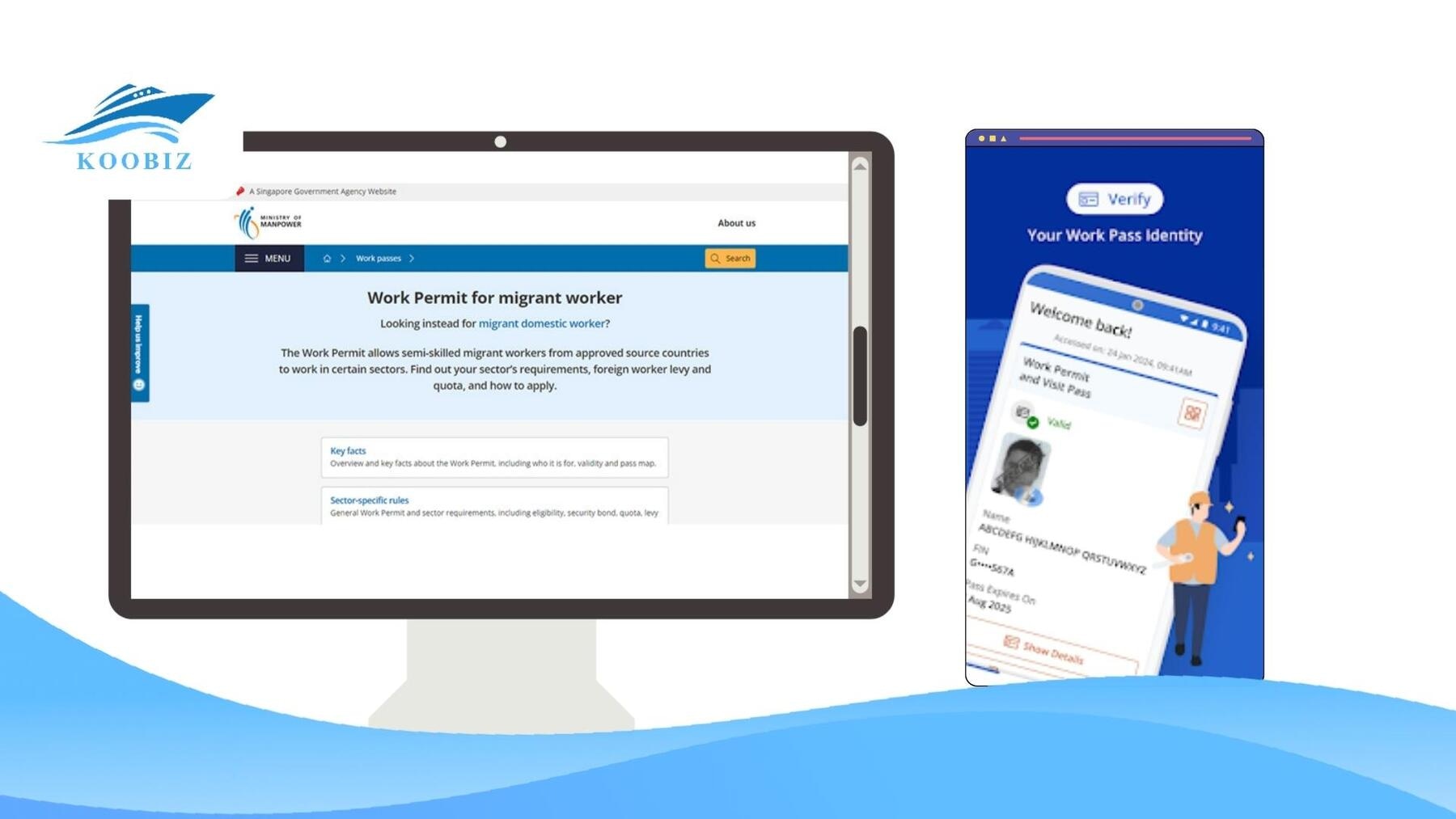
    There are two main official ways to check your work pass status: using the Ministry of Manpower (MOM) online portal or the SGWorkPass mobile app.

    For the most current information, it’s best to use these digital tools instead of calling MOM, as the systems are updated in real-time. Both employers and candidates can use these platforms 24/7 to monitor an application’s progress.

    Checking via MOM Online Website (EP Online)

    The most direct method is through the MOM “Check work pass and application status” e-service. This tool only needs specific identification details and does not require a Singpass login.

    Follow these steps to check online:

    1. Access the Portal: Visit the official MOM [Check work pass and application status] page.
    2. Enter Personal Details: Input the candidate’s Date of Birth.
    3. Provide Identification: Enter either the Foreign Identification Number (FIN) or the Passport Number used in the application.
    4. View Results: Click “Submit” to see the current status, expiry date (if the pass is issued), and pass type.

    Using the SGWorkPass Mobile App

    For those who need to check status often or verify a physical card’s validity, the SGWorkPass app is the ideal tool. This is especially useful for landlords or telecom companies checking a tenant’s or customer’s status.

    How to use the app:

    1. Download: Install SGWorkPass from the Apple App Store or Google Play Store.
    2. Setup: Open the app. You can set it up by scanning the QR code on the back of a work pass card or by entering details manually.
    3. Verify: Use the “Scan QR Code” feature to scan a physical card to see if it is still valid.
    4. Check Status: You can also search using the FIN and Date of Birth to see the latest status from MOM’s database.

    Checking Status for Dependents (DP & LTVP)

    It’s important to know that the status of Dependant’s Passes (DP) and Long-Term Visit Passes (LTVP) is directly connected to the main work pass holder.

    You check their status the same way – use the main applicant’s details or the dependent’s passport details in the MOM online tool (Method 1). Typically, when the main EP or S Pass is approved, the dependent passes will start processing or be approved soon after. So, monitoring the main pass is the best way to track overall progress.

    What Do the Application Status Codes Mean?

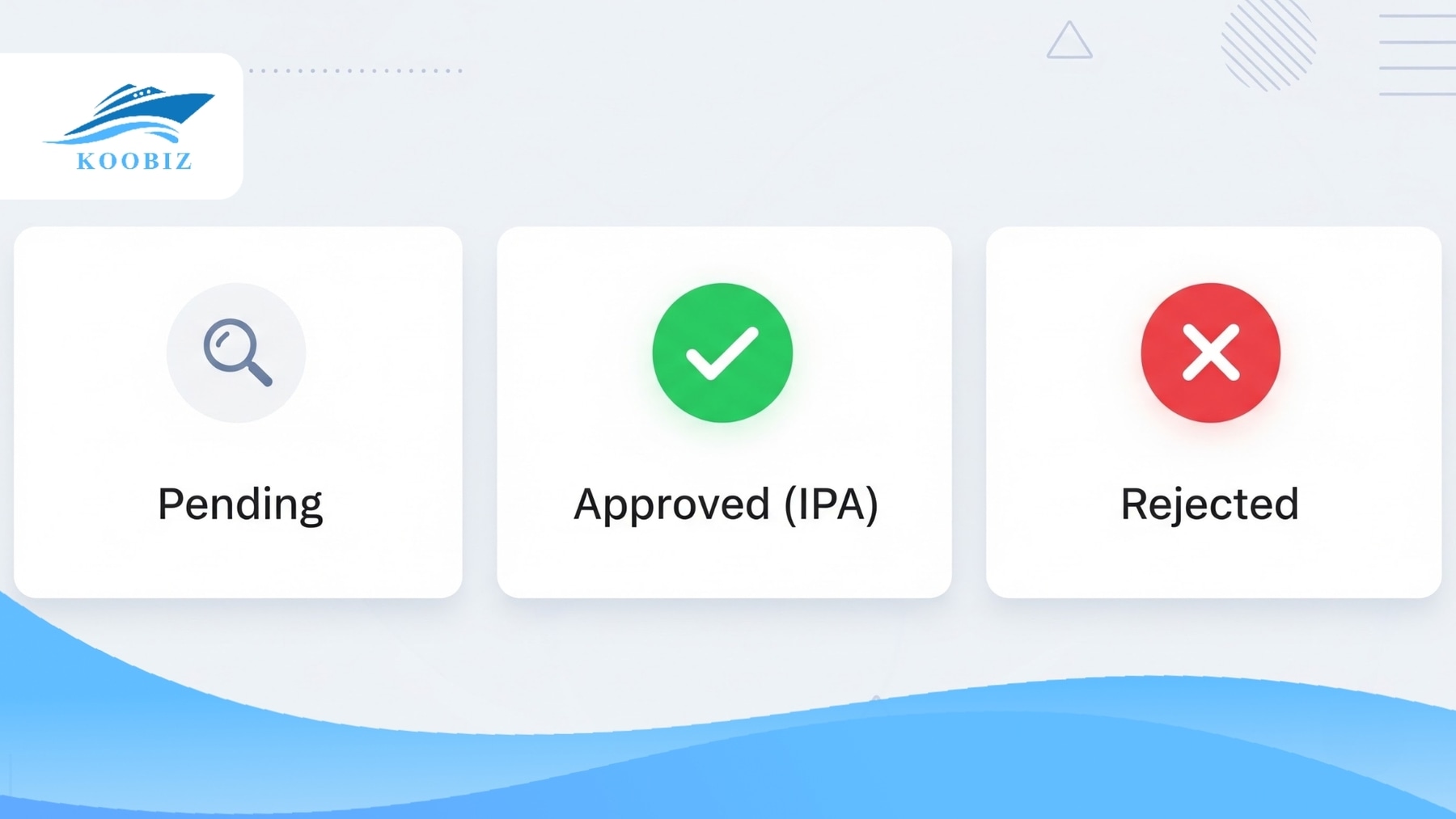
    These are standard terms used by MOM to show the current stage or final result of a work pass application. Understanding them is important because they tell you what action is needed next. For example, mistaking a “Pending Input” status for a simple “Pending” status could cause unnecessary delays.

    The meaning of MOM's Work Pass application status codes
    The meaning of MOM’s Work Pass application status codes

    Pending and Pending Input

    • What it means:
      • Pending: Your application is being reviewed by MOM officers. This is a waiting period while they check documents and qualifications.
      • Pending Input: This is an important alert. It means MOM has paused processing because they need more documents or clarification from you – for example, to verify educational certificates or salary details.
    • Koobiz Advice:If you see “Pending Input,” the processing clock has stopped. You must respond to these requests immediately. We strongly advise responding within 7 days to avoid your application being automatically cancelled.

    Approved (In-Principle Approval – IPA)

    • What it means:Success! An “Approved” status means an In-Principle Approval (IPA) letter will be issued. This letter serves as a temporary entry visa and signals that the relocation process can begin.
    • Koobiz Advice:The IPA is valid for a set period (usually 6 months for an EP). Use this time to bring the candidate to Singapore and complete any required medical checks. Remember, the IPA is not the final pass; it’s the approval to come and complete the final formalities.

    Rejected or Unsuccessful

    • What it means:The application did not meet the qualifying criteria, which are based on the COMPASS framework or other MOM requirements. Due to privacy policies, MOM typically does not give the specific reason for rejection directly to the candidate.
    • Koobiz Advice:Don’t panic. The reason is only available to the employer or authorised agent via EP Online. Common issues include salary problems or not meeting the Singaporean Core requirements. Do not simply re-apply immediately; a well-planned appeal is often the better approach.

    Withdrawn or Invalid

    • What it means:
      • Withdrawn: The employer has voluntarily cancelled the application.
      • Invalid: The pass has expired or has been cancelled by MOM.
    • Koobiz Advice:This status is final. Unlike a rejection, which can be appealed, a withdrawn application cannot be reactivated. If you still want to hire the person, you must submit a completely new application.

    EP and S Pass Processing Time: How Long Does it Take?

    Processing times vary depending on the pass type and if extra checks are needed. Here is a comparison of typical and extended timelines to help you plan.

    Pass Type Standard Processing Complex Case (Vetting) Key Delay Factors
    Employment Pass (EP) 10 Business Days Up to 8 Weeks Education Verification, COMPASS Scoring, Background Checks
    S Pass 3 Weeks Up to 8 Weeks Employer’s Quota Balance, Levy Eligibility, Verification of Qualifications

    These are official guidelines, but actual timeframes can change based on application volume and how complete your submitted documents are.

    EP and S Pass processing time, delay factors
    EP and S Pass processing time, delay factors

    Understanding the Timelines

    For Employment Pass (EP):

    Most online EP applications are processed within 10 business days. However, since the COMPASS framework was introduced, MOM scrutinises educational qualifications and company-related attributes more closely. This detailed checking, which may involve third-party screening agencies, is why a simple 10-day process can sometimes take months.

    For S Pass:

    S Pass applications generally take about 3 weeks. Unlike the EP, the S Pass is strictly limited by a quota based on the company’s industry and its number of local employees. MOM needs time to confirm the employer has enough “quota” available before approving the pass.

    Why Is My Application Delayed?

    Delays usually happen because of specific checks or inconsistencies in the data. If your application takes longer than the standard time, it’s likely due to one of these reasons:

    • Verification Checks: MOM is verifying educational qualifications with overseas institutions or background screening agencies.
    • Inconsistent Data: There are mismatches between the details in the application form and the supporting documents provided.
    • Security Vetting: The application is going through additional security vetting by other government agencies.
    • Missed Requests: The employer may have missed an email from MOM asking for more information.

    Koobiz Pro Tip: Is your application stuck?

    First, check your Spam/Junk folder for missed emails from MOM—this is the #1 cause of “stalled” applications. Second, log in to EP Online to ensure the status isn’t “Pending Input”, which means MOM is waiting for you to take action.

    What to Do If Your Work Pass Application Is Rejected?

    Getting a rejection can be stressful, but it’s not necessarily the final outcome.Yes, you can appeal, but only if you can address the specific reasons MOM gave for the rejection.

    Instead of rushing to submit a new application, follow this step-by-step plan to improve your chances of success.

    Step-by-Step Recovery Plan

    1. Log in to EP Online: The specific reason for rejection is not sent to the candidate. The employer or authorised agent must log in to the MOM portal to read the official rejection letter.
    2. Analyze the Gap: Identify the specific reason for rejection. Was the salary too low? Does the company need more local employees? Or were the qualifications not verifiable?
    3. Gather New Information: This is the most important step. You must provide new evidence to address the reason for rejection. Using the same documents will not work.
    4. Submit the Appeal: You have a strict 3-month window from the date of rejection to file an appeal. Once submitted, processing typically takes at least 3 weeks.

    The Golden Rule of Appeals

    Never appeal without new information.

    Simply asking MOM to “reconsider” with the same documents will likely lead to another rejection. If the rejection was due to salary, you must submit a revised contract with a higher salary. If it was due to qualifications, you need to provide independent verification of the degree.

    Common Reasons for EP and S Pass Rejection

    To fix the issue, you must first understand the root cause. The most frequent grounds for rejection include:

    • Failed COMPASS Framework (EP): The candidate did not score the required 40 points on the Complementarity Assessment Framework. Fix: Improve firm-level attributes or increase salary.
    • Weak Singapore Core (S Pass): The company does not have enough local employees to support the S Pass quota. Fix: Hire more locals before re-applying.
    • Unverified Qualifications: The educational institution is not on MOM’s standard list. Fix: Use a background screening agency to verify the degree.

    For new companies, rejection can also happen if the paid-up capital seems too low to support the promised salary, or if there’s no clear proof of active business operations. Koobiz often advises clients on setting up their company correctly from the beginning – with sufficient capital and clear business plans – to reduce these risks when they start hiring.

    Is Your Work Pass Valid? Understanding Pass Validity

    “Pass validity” refers to the current status of an issued work pass. It confirms that the holder is legally allowed to work and live in Singapore at this moment.

    This is different from “Application Status.” Validity is about ensuring current employees remain compliant and are not working illegally.

    Difference Between Active and Cancelled Status

    Employers must verify the specific validity status of their foreign employees to avoid severe penalties under the Employment of Foreign Manpower Act (EFMA).

    Status Can they work? Employer Action Required
    Active YES Continue paying salary & CPF (if applicable). Ensure medical insurance is valid.
    Cancelled NO Stop work immediately. The employee is effectively on a Short Term Visit Pass (STVP) and must prepare to leave Singapore.
    Expired NO This is a serious offense. You may face fines or be barred from hiring foreign workers.

    Koobiz Critical Compliance Alert

    • The “Payroll Rule”: Always check a worker’s pass validity before processing your monthly payroll. Paying someone with a cancelled pass is a punishable offence.
    • The “6-Month Rule”: Don’t wait for MOM’s reminder. Apply for a pass renewal as early as 6 months before it expires. This ensures continuous validity and prevents accidental overstaying.

    About Koobiz

    Navigating Singapore’s regulatory landscape requires more than just filling out forms; it demands a strategic partner. Koobiz specializes in comprehensive corporate services, from Singapore company incorporation to ongoing company secretarial support, tax filing, and accounting.

    While we ensure your business entity is compliant and optimized for growth, we also provide essential guidance on manpower regulations. Whether you are a foreign entrepreneur seeking an Employment Pass to run your new Singapore company, or a local firm struggling with S Pass quotas, Koobiz offers the expertise to streamline your operations.

    Visit Koobiz.com today to start your business journey in Singapore with confidence.

  • How to Renew Work Permit in Singapore: Complete MOM Process & Requirements

    How to Renew Work Permit in Singapore: Complete MOM Process & Requirements

    [SUMMARIES]

    Eligibility Check: Ensure the worker’s passport is valid for at least 25 months for a full renewal.

    The Golden Window: Always renew between 7 to 12 weeks before the permit expires to avoid penalties.

    Mandatory Requirements: You must purchase a Security Bond and Medical Insurance (min. $60,000 coverage with new 2025 standards) before logging in.

    Processing Time: Most online renewals are approved immediately or within 1 working day.

    Late Renewal: Missing the deadline incurs overstaying fines ($100/day) and requires a valid reason for a short-term extension.

    2026 Update: The maximum employment period limit has been removed. Workers can now generally be employed up to age 63, provided they meet quota and levy requirements.

    [/SUMMARIES]

    Full compliance with Ministry of Manpower (MOM) regulations is essential. Missing a work permit renewal deadline can result in additional levies, penalties, or even the repatriation of workers. At Koobiz, we know that managing Singapore’s regulatory requirements, from company incorporation to employment compliance, demands careful attention to detail. This guide simplifies the entire MOM process, covering everything from the crucial 7–12 week timeline to using WP Online effectively, so you can steer clear of common mistakes and keep your business fully compliant.

    Is Your Worker Eligible for Work Permit Renewal?

    Checklist for Singapore Work Permit Renewal
    Checklist for Singapore Work Permit Renewal

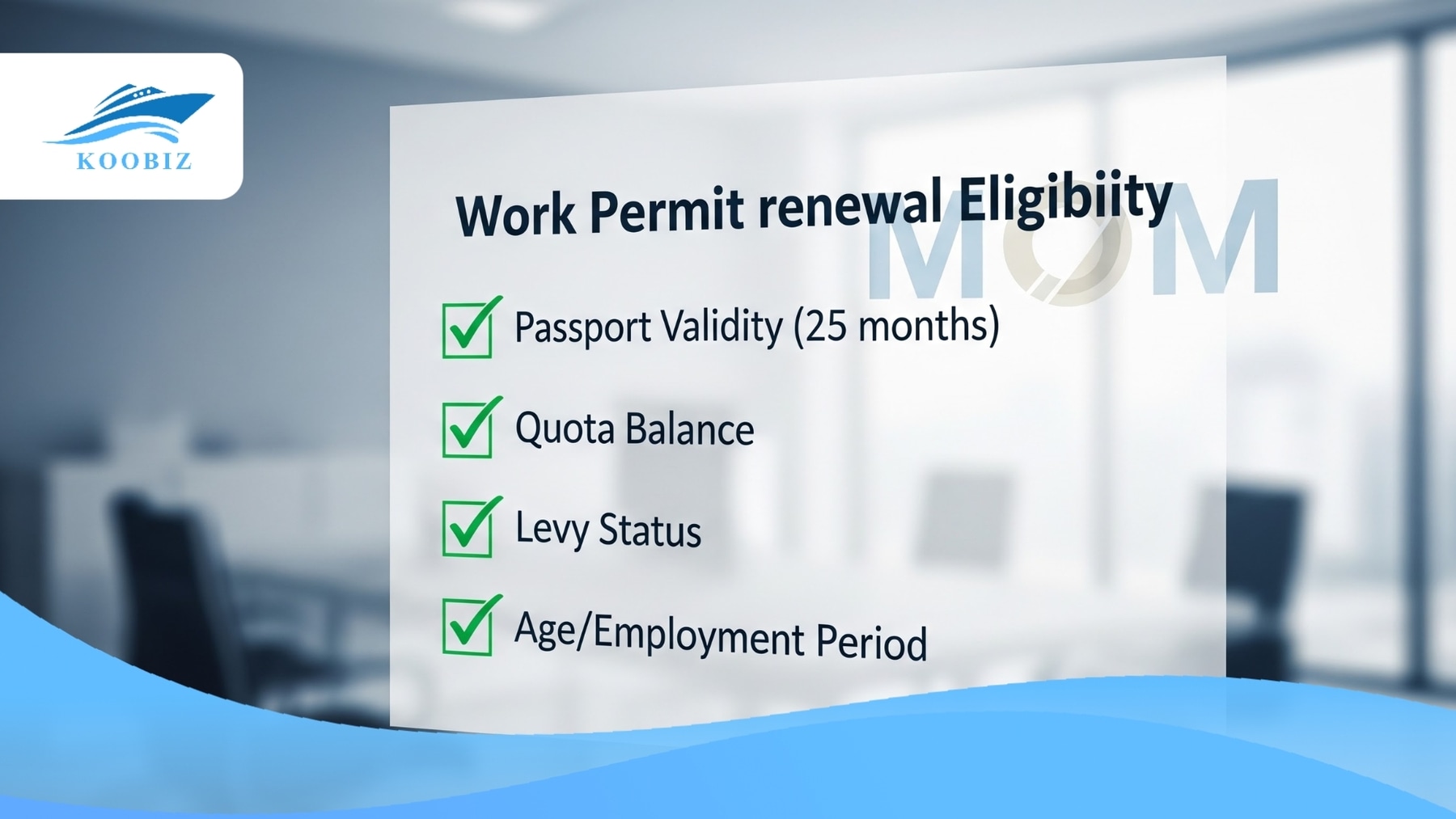
    Yes, a foreign worker is eligible for renewal if they have a valid passport, the employer has sufficient quota, and there are no compliance breaches.

    Before purchasing insurance or security bonds, it’s best to run through this quick checklist to confirm eligibility. The MOM requires all of the following conditions to be met:

    • Passport Validity: Ideally, the passport should be valid for at least 25 months.
      • Note: If validity is less than 25 months (but at least 7 months), you can still renew, but the Work Permit duration will be capped at 1 month before the passport expiry date, rather than the full 2 years.
    • Quota Balance: Your company must have sufficient Foreign Worker Quota (Dependency Ratio Ceiling).
    • Levy Status: You must have no outstanding Foreign Worker Levy payments or fines. The renewal button will be disabled if levies are in default.
    • Age & Employment Period: The worker must be below 60 years old (or 63 years old for renewals in specific sectors effective 2026). The previous maximum employment period limits (14–26 years) have been removed.

    In addition, MOM regulations require employers to ensure that the worker remains medically fit and has complied with all work pass conditions throughout the previous employment period.

    When Should You Start the Renewal Process?

    Checklist for Singapore Work Permit Renewal timeline: Green (7-12), Yellow (3-6), Red (<2 weeks)
    Checklist for Singapore Work Permit Renewal timeline: Green (7-12), Yellow (3-6), Red (<2 weeks)

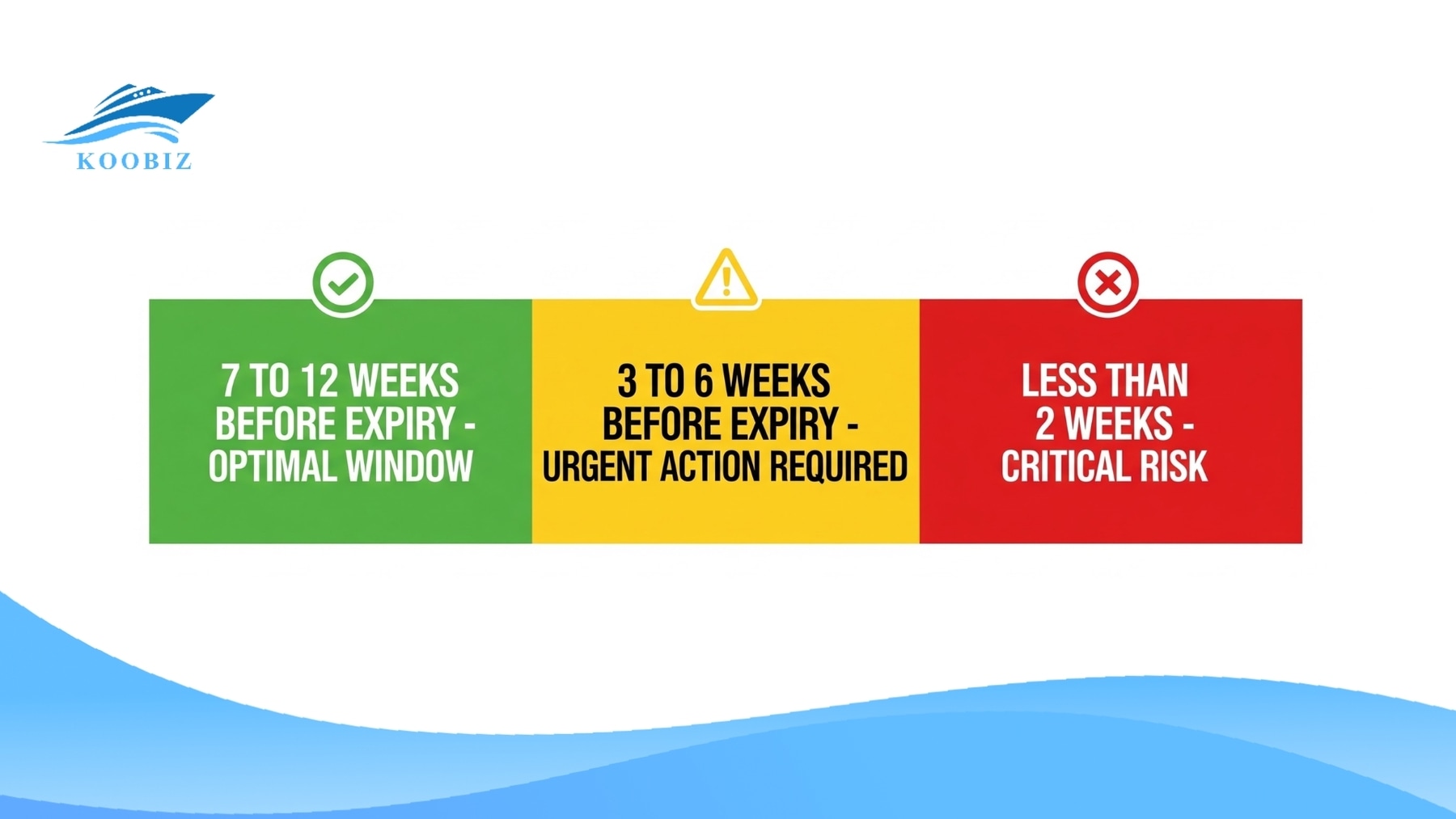
    The recommended and required period to begin a Work Permit renewal is 7 to 12 weeks before the permit’s expiry date.

    In Singapore, compliance hinges heavily on timing. MOM typically permits renewals only after the official renewal notice is issued, making it essential to follow the “Traffic Light” timeline below to prevent delays, penalties, or compliance issues.

    • Green Zone (7 to 12 Weeks Before Expiry): Optimal Window. This is the safest time to act. You have ample time to resolve discrepancies (e.g., passport details) and ensure the Security Bond is processed by the bank.
    • Yellow Zone (3 to 6 Weeks Before Expiry): Urgent Action Required. You risk delays if the bank takes longer than 3 days to transmit bond data or if MOM requires additional manual verification.
    • Red Zone (Less than 2 Weeks): Critical Risk. You are in the danger zone. There is a high chance the permit will expire before approval, resulting in “overstaying” status, fines, and potential repatriation.

    Renewal applications submitted earlier than 12 weeks are typically rejected unless there are exceptional circumstances. On the other hand, allowing the Work Permit to lapse exposes employers to overstaying penalties, while foreign worker levies will continue to accrue.

    Compliance data indicates that employers who begin the renewal process within the Green Zone are 95% more likely to resolve documentation issues without incurring late fees, compared to those who delay until the final weeks before expiry.

    What Documents and Requirements are Needed?

    Three key requirements must be in place before you log in: a valid passport, medical insurance, and a security bond.

    Even before accessing the WP Online portal, these external documents need to be obtained and digitised. This preparatory stage is where many employers encounter delays. Refer to the table below to confirm that all required actions for each document have been completed.

    Document Requirement Critical Action
    Passport Valid for at least 25 months (recommended) Update details in MOM system first if recently renewed. Scan the bio-data page clearly. If <25 months, permit duration will be shorter.
    Medical Insurance Min. SGD 60,000/year Must meet July 2025 enhanced standards: standardized exclusions, age-differentiated premiums, and direct insurer payments. Co-pay applies for claims >$15k.
    Security Bond SGD 5,000 Guarantee (Non-Malaysians) Buy 3 days in advance. Must be valid for at least 26 months for a full 2-year permit.
    Primary Care Plan (PCP) For CMP sectors or Dorm Residents Must be purchased and declared on WP Online before renewal.

    Step-by-Step Guide: How to Renew Work Permit via WP Online

    The renewal process consists of three main steps: accessing WP Online through Singpass, uploading the necessary scanned documents, and paying the $35 processing fee.

    With all prerequisites in place, the online submission is straightforward. Follow the standard operating procedure (SOP) below to complete the renewal successfully.

    Step 0: Pre-Renewal Actions (Mandatory)

    • Register Address: Use the Online Foreign Workers Address Service (OFWAS) to register the worker’s mobile number and residential address at least 1 hour before logging in to renew.
    • Update Passport: If the worker has a new passport, update the details in MOM’s system before starting the renewal.

    Step 1: Log in via Singpass

    • Access the MOM Work Permit (WP) Online portal using your corporate Singpass.
    • Navigate to the “Renew” function on the left-hand menu.
    • The system will display a list of workers eligible for renewal. Select the specific worker you wish to process.

    Step 2: Verification & Upload

    • Verify Data: Check that the Security Bond and Medical Insurance details are reflected correctly in the system. Note: If the bond status is not “Transmitted,” the system will block you from proceeding.
    • Upload Documents: If prompted, upload scanned copies of the worker’s passport (bio-data page).
    • Format Check: Ensure the file size is within the limit (usually <2MB) and the image is clear.

    Step 3: Declaration & Payment

    • Declarations: Confirm details regarding the worker’s health, conduct, and PCP purchase (if applicable).
    • Payment: Pay the SGD 35 fee via GIRO, VISA, MasterCard, or eNETS.
    • Koobiz Tip: Print the “Acknowledgement Letter” immediately after payment. This serves as proof that the renewal is in process, which is vital if the permit expires while you are waiting for the card.

    Upon successful submission, the status usually changes to “Approved” almost instantly or within one working day.

    What are the Renewal Fees and Processing Time?

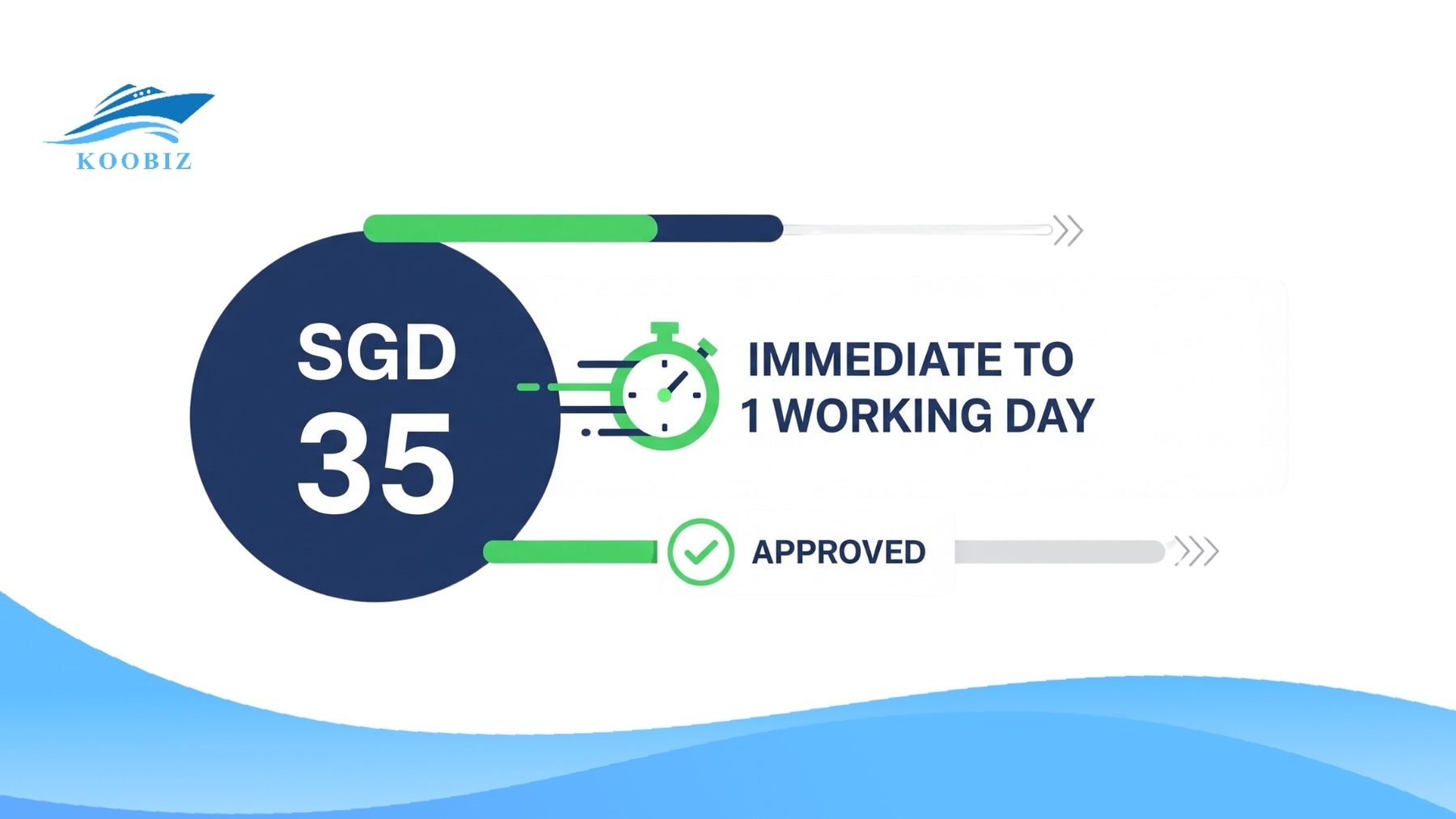
    WP Renewal Fee: SGD 35, processed immediately or within 1 working day
    WP Renewal Fee: SGD 35, processed immediately or within 1 working day

    The renewal fee is set at SGD 35 per Work Permit, with processing usually completed immediately or within one working day.

    To assist with budgeting and planning, the cost structure and expected timeline for the renewal process are outlined below.

    The Cost

    • Fee: SGD 35 per renewal application.
    • Payment Methods: GIRO, VISA, MasterCard, or eNETS.
    • Important Note: This administrative fee is strictly non-refundable, even if you withdraw the application or if the renewal is rejected.

    The Speed

    MOM’s digital system is designed for efficiency, resulting in one of the fastest processing times in the region.

    • Scenario A (Standard): Immediate Approval. If your Security Bond is transmitted and Quota is clear, the system usually auto-approves the application instantly.
    • Scenario B (Manual): 1 Working Day. If the system flags the passport or photo for manual verification, the outcome will be ready the next working day.

    Upon approval, an in-principle approval (IPA) notification will be issued. In most cases, there is no need to request a new Work Permit card unless the worker is changing job roles or the existing card is damaged or lost, as the renewal automatically updates the expiry date in the backend system reflected in the SGWorkPass app.

    Troubleshooting Common Renewal Issues and Errors

    Even with a well-structured process, exceptions can still arise. The section below highlights the most common challenges Koobiz clients face when managing foreign worker renewals.

    Typical issues include missed expiry deadlines, delays in Security Bond submission, and inadequate insurance coverage.

    While the “Happy Path” outlined earlier applies to around 90% of renewals, the remaining 10% involve issues that require prompt action. Refer to the matrix below to pinpoint the specific problem and apply the appropriate immediate solution.

    Issue / Error Message Likely Cause Immediate Solution
    “Renew” button is disabled Outstanding Levy or Fines Pay immediately via CPF EZPay. The system updates within 1 working day.
    “Quota not available” Dependency Ratio Ceiling reached You cannot renew. You must increase your local workforce or cancel the permit.
    “Security Bond not found” Bank transmission delay Wait. Do not panic. It takes up to 3 working days for the bank to update MOM.
    “Passport expiry date invalid” Passport < 7 months validity Renew passport first, then update details in MOM system via “Update Worker Details”.
    System Error / Technical Glitch Browser issue Clear cache or try Incognito mode. If persistent, contact MOM technical support.

    What Happens if You Miss the Renewal Deadline?

    If you miss the deadline, the worker is considered an overstayer, attracting fines, levy penalties, and potential prosecution.

    This is a critical situation. If a Work Permit expires, the worker is technically in Singapore illegally. Do not attempt to renew as normal; follow this recovery plan:

    The Consequences

    • Status: Illegal Overstayer.
    • Financial: Overstaying fines are imposed immediately (approx. $100 per day). The Foreign Worker Levy continues to accumulate until the worker is repatriated or the pass is regularized.

    The Recovery Plan

    • Immediate Action: Apply for a Special Pass to legalize the worker’s stay while the permit is sorted.
    • Next Step: Submit an appeal for reinstatement via MOM’s portal. Note that reinstatement is subject to MOM’s strict discretion and valid reasons.

    How to Request a Short-Term Extension?

    To get an extension, you must submit a specific request via WP Online explaining valid reasons like passport renewal delays or travel restrictions.

    Sometimes, you cannot renew on time due to external factors. In this case, use the extension feature rather than letting the pass expire.

    Use this when: You are waiting for a new passport, need time to cancel the permit, or have travel complications.

    The Process:

    1. Log in: Access WP Online and select “Request for Extension” on the left menu.
    2. Upload: Attach proof (e.g., Embassy receipt for passport renewal or flight ticket).
    3. Outcome: If successful, you receive a 1-month validity extension to finalize the main renewal.

    Understanding the Security Bond and Medical Insurance Requirements

    The Security Bond is a binding pledge of SGD 5,000, while Medical Insurance must cover at least SGD 60,000 per year for inpatient bills.

    Many employers confuse these two financial instruments. Use this table to understand the critical differences.

    Feature Security Bond ($5,000) Medical Insurance ($60k+)
    Purpose Guarantees that you will repatriate the worker and ensure they do not break the law. Covers the worker’s hospital bills and day surgery costs.
    Critical Rule Must be valid until after the work permit expiry date (typically 26 months total). Must cover the full renewal duration.
    Result of Failure Bond is forfeited ($5,000 loss). Employer is liable for unlimited medical bills.

    Comparison: Renewing Work Permit vs. S Pass

    Work Permit renewal relies heavily on quotas and security bonds, whereas S Pass renewal focuses on meeting the qualifying salary threshold.

    For companies managed by Koobiz that employ a mix of staff, understanding the difference is vital for planning.

    Feature Work Permit (WP) S Pass
    Key Requirement Security Bond (Essential) Fixed Monthly Salary
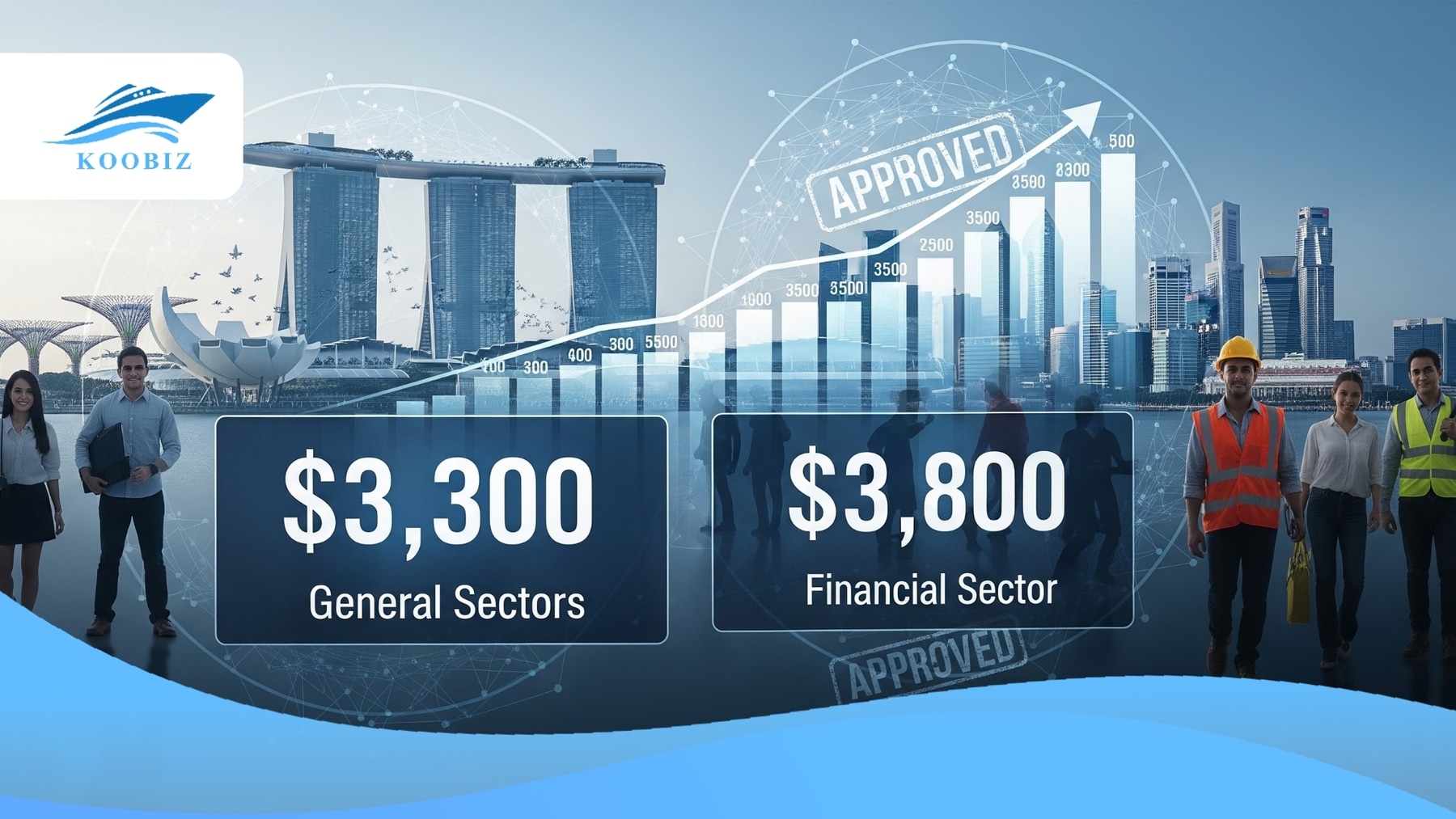
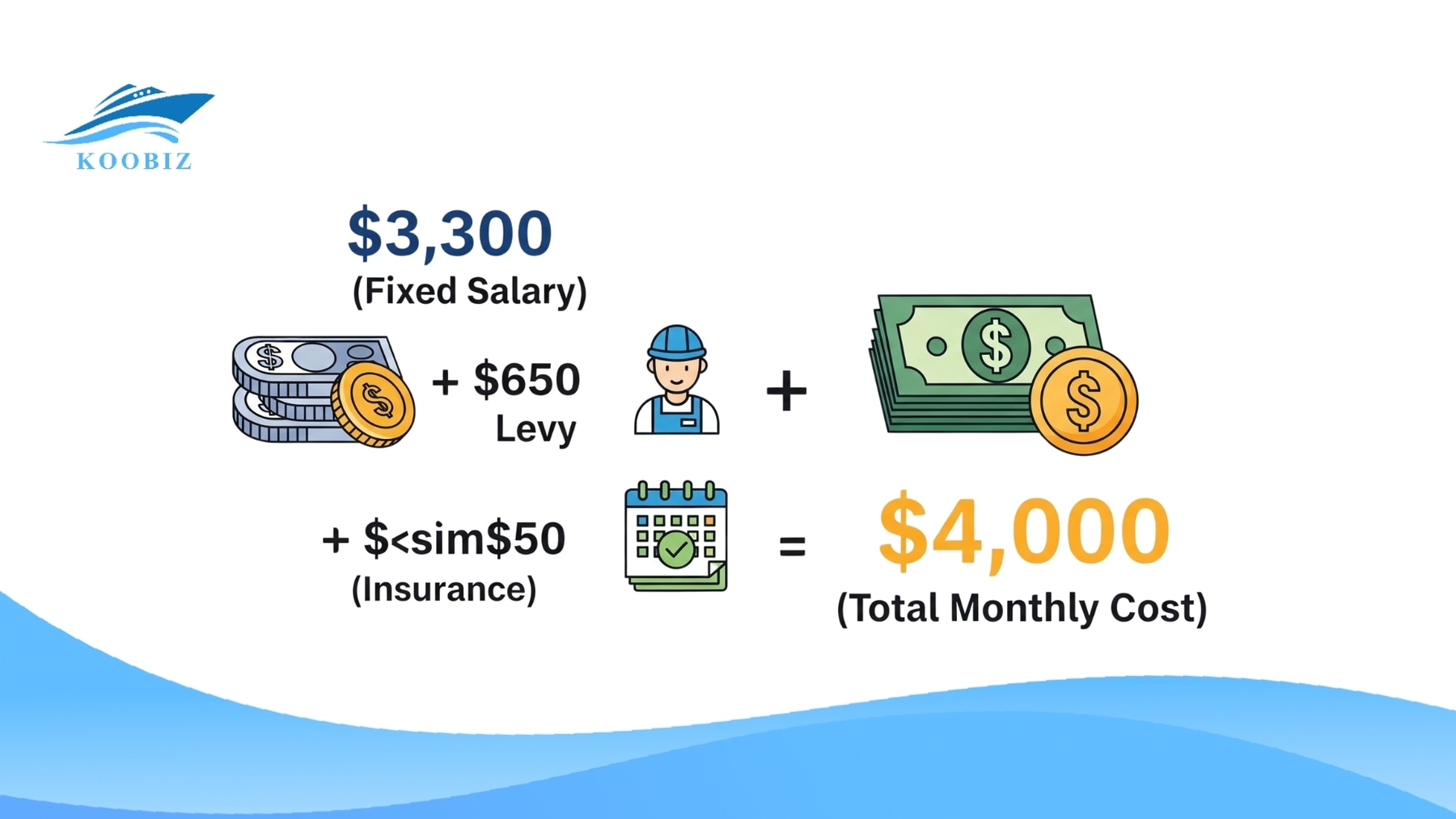
    Salary Threshold N/A Min SGD 3,300+ (renewals expiring from Sep 2026)
    Levy & Quota Sector-specific Dependency Ratio Sub-Quota (Much tighter limits)
    Processing Time Fast (Immediate – 1 Day) Slower (~3 Weeks due to assessment)
    Duration Up to 2 years Up to 3 years

    Real-World Scenarios: Renewal Success vs. Failure

    To understand the importance of the 7-12 week window, here are three real-world case studies based on common client experiences.

    These scenarios highlight how small administrative decisions can lead to vastly different outcomes for your business.

    Case Study 1: The “Smooth Operator” (Construction Sector)

    • Situation: ABC Construction Pte Ltd receives a renewal notice for 5 workers. The HR Manager logs in 10 weeks before expiry (Green Zone).
    • Action: She verifies the quota and notices one worker’s passport is expiring in 8 months. She instructs the worker to renew the passport immediately. Once the new passport arrives (2 weeks later), she updates MOM, purchases the Security Bonds, and waits 3 days for bank transmission.
    • Outcome: All 5 renewals are submitted and approved instantly. No stress, no penalties.

    Case Study 2: The “Overlooked Deadline” (F&B Sector)

    • Situation: A restaurant owner is busy with daily operations and misses the renewal notice email. He realizes the permit for his head chef expires in 2 days (Red Zone).
    • The Mistake: He rushes to buy the Security Bond but forgets that banks take 3 working days to transmit the data to MOM.
    • Outcome: The permit expires before the bond data reaches MOM. The worker becomes an overstayer. The owner has to pay a $500 fine (5 days x $100), apply for a Special Pass, and appeal for reinstatement, disrupting kitchen operations for 2 weeks.

    Case Study 3: The “Passport Trap” (Marine Sector)

    • Situation: A shipyard wants to renew a welder’s permit for 2 years. The worker’s passport is valid for only 18 months.
    • The Issue: The employer proceeds without checking validity rules.
    • Outcome: MOM approves the renewal, but only grants validity up to 1 month before the passport expiry (approx. 17 months total), not the full 2 years. The employer now has to track a non-standard expiry date, increasing administrative risk for the next cycle.

    Conclusion

    Successfully navigating the renew work permit process in Singapore is a fundamental responsibility for any business employing foreign staff. By adhering to the 7 to 12-week timeline, ensuring your Security Bond and Medical Insurance are active, and utilizing the WP Online portal correctly, you can ensure business continuity and avoid costly penalties.

    At Koobiz, we specialize in supporting businesses entering and operating in the Singapore market. From company incorporation and opening corporate bank accounts to handling complex tax, accounting, and audit requirements, our team ensures your back-office operations are compliant and efficient. If you are struggling with manpower regulations or need assistance setting up your business infrastructure in Singapore to hire foreign talent, connect with us today.

    Visit us at Koobiz.com for expert corporate services in Singapore.

  • S Pass Salary Singapore 2026: Current $3,300 Minimum & Levy Guide

    S Pass Salary Singapore 2026: Current $3,300 Minimum & Levy Guide

    [SUMMARIES]

    Current Minimum: The qualifying salary for new S Pass applications in 2026 is $3,300 per month.

    Financial Sector: Candidates in Financial Services must earn at least $3,800 per month.

    Renewal Rule: Existing passes expiring on or after 1 September 2026 must meet the new $3,300 threshold.

    Levy Costs: Employers must pay a monthly levy (standardized at $650) in addition to the salary.

    Quota Limits: S Pass holders are capped at 10% (Services) or 15% (Manufacturing/Construction/Marine/Process) of the total workforce.

    [/SUMMARIES]

    Staying compliant with manpower regulations in Singapore equals keeping up with the Ministry of Manpower’s (MOM) shifting benchmarks-particularly as we move further into 2026. For employers and HR managers, the critical figure to note is the $3,300 minimum qualifying salary, a standard that is now fully effective for all new applications. However, salary is just one component of a complex equation that includes rising levy rates, strict quota caps, and specific renewal timelines that could catch businesses off guard later this year. At Koobiz, we understand that hiring foreign talent is integral to your business growth, which is why we have compiled this essential guide to help you manage compliance and costs effectively.

    What is the current S Pass Qualifying Salary in 2026?

    The S Pass qualifying salary is a variable benchmark currently set at a minimum of $3,300 per month for new candidates in most sectors, effective from September 2025 .

    To understand the full scope of this requirement, we must look beyond the base figure, as the actual required salary often exceeds this minimum depending on the candidate’s profile. The Ministry of Manpower (MOM) applies this threshold to ensure that S Pass holders are comparable in quality to the top one-third of the local Associate Professionals and Technicians (APT) workforce. As such, meeting the minimum salary of $3,300 does not guarantee approval if the candidate possesses significant experience.

    S Pass Singapore 2026: Minimum Salary 3,300 SGD
    S Pass Singapore 2026: Minimum Salary 3,300 SGD

    Does the salary threshold differ by sector?

    Yes, the Financial Services sector commands a higher qualifying salary of $3,800 per month due to the higher prevailing wage norms in that industry.

    While the general sector baseline sits at $3,300, the MOM acknowledges that salaries in banking, insurance, and asset management are consistently higher. Consequently, businesses incorporated under these Standard Industrial Classification (SIC) codes must budget for this premium. For incoming foreign business owners, it is crucial to factor in this higher operational cost when planning your initial headcount.

    How does age and experience impact the salary requirement?

    The qualifying salary increases progressively with age, reaching up to $4,800 (General) or $5,650 (Financial Services) for candidates in their mid-40s to match local peer income levels.

    The “Age-Wage” Trap:

    MOM applies a strict “age-wage” curve. A fresh graduate aged 23 might qualify at the base $3,300. However, a 35-year-old applicant with ten years of experience cannot be hired at the minimum floor. They must be paid a salary commensurate with their seniority to be approved.

    If an employer submits an application for an experienced professional at the minimum wage, it will likely be rejected on the grounds that the candidate does not command a market rate, implying they may not be a true “mid-skilled” talent.

    According to MOM regulations: The specific salary required for each candidate can be checked using the MOM Self-Assessment Tool (SAT), which serves as the definitive calculator for eligibility.

    Does the salary threshold differ for renewals in 2026?

    Yes, the salary threshold for renewals differs based on the specific expiry date of the pass, especially for passes expiring on or after 1 September 2026.

    This creates a “two-tier” renewal system operating throughout 2026. The government provides this buffer to prevent sudden business disruptions, but businesses must act now to review their payroll structures for employees whose passes are due for renewal in the latter half of the year.

    Renewal Timelines & Salary Requirements

    Pass Expiry Date Sector Minimum Qualifying Salary
    Before 1 Sep 2026 All Sectors (except Finance) $3,150
    Financial Services $3,650
    On or After 1 Sep 2026 All Sectors (except Finance) $3,300
    Financial Services $3,800

    Koobiz Strategy: If you have valuable staff members whose passes are expiring between January and August 2026, we recommend proceeding with the renewal process as early as possible (up to 6 months in advance). This allows you to lock in the validity under the lower salary criteria ($3,150) for another tenure, buying time for future salary adjustments.

    What are the S Pass Levy Rates and Quotas for Employers?

    There are two primary S Pass Levy tiers—Tier 1 and Tier 2—which are determined by the percentage of S Pass holders within your total workforce, alongside specific industry quotas.

    The levy is a monthly cost mechanism designed to regulate the foreign employment in Singapore. In reality, it acts as a “tax” on hiring foreigners, reinforcing the policy of prioritizing local employment. Understanding the interplay between your quota (Dependency Ratio Ceiling – DRC) and the levy tier is essential for accurate financial forecasting.

    S Pass 2026: Levy $650, Quota 10% (Services) - 15% (Manufacturing)
    S Pass 2026: Levy $650, Quota 10% (Services) – 15% (Manufacturing)

    What are the current Levy Rates?

    The levy rates for 2026 have been harmonized to $650 for all S Pass holders. The distinction between Tier 1 and Tier 2 now primarily serves to indicate how close you are to your quota limit, rather than a price difference.

    Levy Tier Allowable Workforce % Monthly Rate (2026)
    Tier 1 (Standard) Up to 10% of total workforce $650
    Tier 2 Above 10% to max cap (15%) $650

    Note: Levy rates are subject to periodic review by the government. Always verify the exact figure on the MOM website as minor adjustments can occur during the annual Budget announcement.

    How is the S Pass Quota calculated?

    The S Pass quota is capped at 10% for the Services sector and 15% for Manufacturing, Construction, Marine Shipyard, and Process sectors of the total workforce.

    To hire one S Pass holder in the Services sector (where most Koobiz clients in consultancy and trading operate), you need a specific number of local employees earning the Local Qualifying Salary (LQS – currently $1,600).

    • Services Sector: You need roughly 9 local employees to hire 1 S Pass holder (Total workforce = 10; 10% of 10 = 1).
    • Manufacturing/Process/Other Sectors: You need roughly 6 local employees to hire 1 S Pass holder (Total workforce = 7; ~15% of 7 = 1.05).

    Important Calculation: The quota is calculated based on the CPF contributions made to local staff. Without consistent CPF contributions, your local headcount does not count toward the quota.

    How to Calculate the Total Cost of Hiring an S Pass Holder?

    The total cost involves summing four distinct components: Fixed Monthly Salary + Monthly Foreign Worker Levy + Medical Insurance + Administrative Overheads.

    Many new business owners make the mistake of looking only at the $3,300 salary. In reality, the “Total Cost of Employment” is significantly higher.

    S Pass: $3300 Salary + $650 Levy = $4000 Total Cost
    S Pass: $3300 Salary + $650 Levy = $4000 Total Cost

    The 2026 Cost Formula (Services Sector Example):

    $3,300 (Base Salary) + $650 (Foreign Worker Levy) + ~$50 (Mandatory Medical Insurance) = $4,000 (Total Monthly Cost)

    (Excluding recruitment fees or bonuses)

    Is the “Fixed Monthly Salary” defined differently by MOM?

    The MOM defines “Fixed Monthly Salary” strictly as the sum of Basic Monthly Salary andFixed Monthly Allowances, excluding any variable components. To meet the $3,300 threshold, the amount must be guaranteed and recurring.

    INCLUDED in Qualifying Salary:

    • Basic Monthly Pay
    • Fixed Food Allowance
    • Fixed Transport Allowance

    EXCLUDED from Qualifying Salary:

    • Overtime (OT) Pay
    • Bonuses or Annual Wage Supplement (AWS)
    • Sales Commissions
    • Variable Incentives
    • Reimbursement for expenses

    At Koobiz, when we assist clients with payroll setup and tax structuring, we emphasize that the employment contract must clearly stipulate this fixed amount. If a candidate’s basic pay is $2,500 and they earn $1,000 in commissions, they do not qualify for the S Pass because the fixed component ($2,500) is below the $3,300 threshold.

    Real-World Case Studies: Applying the 2026 Rules

    To visualize how these numbers impact your business, let’s look at three storytelling scenarios based on common client situations we handle at Koobiz.

    Scenario 1: The “Fresh Grad” Hire (Services Sector)

    The Story: CreativePulse, a boutique marketing consultancy with 10 local staff, wants to hire Jun, a 24-year-old Data Analyst from Malaysia. To manage costs, they offer him the exact minimum qualifying salary of $3,300.

    • Salary Check: Since Jun is 24 and fresh out of university, the base $3,300 fits the age-wage curve.
    • Quota Check: With 10 locals, the company has exactly 1 S Pass slot (10% cap).

    Verdict: LIKELY APPROVED

    Why: The salary matches the candidate’s lack of experience.

    Cost Impact: CreativePulse must budget a total of $3,950/month ($3,300 Salary + $650 Levy).

    Scenario 2: The Fintech Miscalculation (Financial Sector)

    The Story: AssetFlow, a growing fintech startup, identifies Mark (28) for a Compliance Officer role. They offer him $3,500, thinking it is generous since it is above the national $3,300 minimum.

    • The Mistake: They forgot they are classified under “Financial Services.”
    • The Gap: Mark is 28 (mid-career). The base floor is $3,800, but his age likely commands $4,200+.

    Verdict: REJECTED

    Why: The offer is below the $3,800 sector floor and too low for his age.

    The Fix: AssetFlow must raise the offer to at least $4,200 to match market norms before appealing.

    Scenario 3: The Renewal “Trap” (Manufacturing)

    The Story: LogiTrans Pte Ltd has a loyal warehouse supervisor, Kumar (32), who has been with them for 4 years earning $3,150. His pass expires on 15 October 2026. The HR manager plans to just click “Renew” in September.

    • The Hidden Danger: Because the pass expires after 1 September 2026, the new rules apply.
    • The Shortfall: Kumar’s $3,150 salary is now illegal for an S Pass renewal (Minimum is $3,300).

    Verdict: RENEWAL AT RISK

    Why: The system will auto-reject the renewal due to insufficient salary.

    The Fix: LogiTrans must formally increase Kumar’s basic salary to $3,300 immediately to reflect in the CPF records before the renewal application.

    Strategic Planning: S Pass vs EP & PR

    S Pass vs Employment Pass (EP): Key Salary & Benefit Differences

    The S Pass is designed formid-skilled technical staff with a $3,300+ salary floor and quota restrictions. In contrast, the Employment Pass (EP) is intended for professionals with a significantly higher $5,600+ salary benchmark and no levy or quota.

    Use this comparison matrix to decide which pass fits your candidate best.

    S Pass vs EP Comparison Matrix

    Feature S Pass Employment Pass (EP)
    Target Audience Mid-skilled technical staff Professionals, Managers & Executives
    Min. Salary (2026) $3,300 ($3,800 Finance) $5,600 ($6,200 Finance)
    Foreign Worker Levy Yes (Standardized at $650) No (Levy-free)
    Quota Cap Yes (Subject to 10-15% limit) No (No quota limit)
    Key Assessment Salary + Quota availability COMPASS Scoring Framework

    While the EP is often more desirable because it saves the employer the monthly levy cost, the barrier to entry is much higher, especially with the COMPASS scoring framework now fully matured in 2026.

    Can S Pass holders apply for Permanent Residency (PR)?

    Yes, S Pass holders are eligible to apply for Singapore Permanent Residency (PR); however, approval rates are typically lower compared to EP holders unless they possess specific high-demand skills.

    Eligibility does not guarantee approval. The Immigration and Checkpoints Authority (ICA) assesses applicants based on their economic contribution, integration into society, and family profile. Generally, an S Pass holder earning close to the minimum $3,300 may find it challenging to obtain PR. That said, individuals who have accumulated several years of work in Singapore, progressed through salary increments, and are employed in niche industries, may still have a fair chance. Koobiz advises clients to maintain a clean tax record and robust employment history to support their employees’ future PR applications.

    What happens if the S Pass application is rejected due to salary?

    If an application is rejected, employers can file an appeal within 3 months, provided they can address the specific gap—usually by increasing the offered salary or correcting the experience declaration.

    The offered salary is one of the common reasons. While it meets the $3,300 minimum, this level remains too low for the candidate’s university degree and ten years of experience. In this case, the employer must review the Self-Assessment Tool (SAT), determine the correct market rate for that specific profile (e.g., adjusting the offer to $4,200), and submit an appeal with the revised employment contract.

    Comparison of S Pass Salary Requirements (2024 vs 2025 vs 2026)

    Tracking the historical data helps HR managers forecast future trends.

    • 2024: Minimum qualifying salary was $3,150 ($3,650 for Finance).
    • Late 2025 (Sep): Increased to $3,300 ($3,800 for Finance).
    • 2026: Full implementation of the Sep 2025 rates for all new passes and renewals (from Sep 1).

    This trajectory clearly shows the Singapore government’s intent to continually raise the quality and cost of foreign labor. Businesses must be prepared to pay a premium for global talent.

    About Koobiz

    Navigating Singapore’s employment laws, tax structures, and corporate compliance can be daunting for international entrepreneurs. Koobiz specializes in simplifying this process. Whether you need assistance with Singapore company incorporation, advice on opening corporate bank accounts, or professional tax, accounting, and auditing services.

    Our team provides the expert groundwork so you can focus on building your business. We ensure your hiring strategies align perfectly with MOM regulations and financial planning.

    Visit Koobiz.com to learn more about our corporate services packages.

  • Secure Your Growth: Best Business Insurance Singapore for SMEs (WICA & Liability Included)

    Secure Your Growth: Best Business Insurance Singapore for SMEs (WICA & Liability Included)

    [SUMMARIES]

    Mandatory Compliance: Business insurance in Singapore is not optional for all. WICA is a must-have if you employ manual workers or staff earning SGD 2,600 or less per month.

    Bundled Efficiency: SME insurance packages bundle key covers like Public Liability and property insurance, often saving money compared to buying separate policies.

    Industry Specifics: Different industries need different coverage. For example, retailers should protect their stock, while tech firms often need cyber liability insurance.

    Strategic Growth: The right insurance is an investment. It protects your finances from unexpected events like lawsuits or property damage, securing your business’s future.

    Expert Support: Getting compliant and setting up your company is simpler with professional support from a provider like Koobiz.

    [/SUMMARIES]

    Launching your business in Singapore is full of potential, but it also involves risks—from workplace accidents to customer disputes. For small and medium enterprises (SMEs), choosing the right Business Insurance Singapore package is a crucial first step to secure your progress and keep your operations running smoothly. While you concentrate on strategy and growth, a solid insurance plan acts as your safety net, ensuring a single unexpected event doesn’t undo all your hard work.

    At Koobiz, we know that whether you’re forming a company, opening a bank account, or handling taxes, compliance and protection are equally important. This guide will walk you through the essentials of SME insurance, from mandatory WICA rules to choosing the best bundled plans for your industry.

    What is an SME Business Insurance Package?

    Think of an SME Business Insurance Package as a convenient, all-in-one policy made for small to medium businesses. It combines important protections—like coverage for public accidents, property damage, and employee injuries—into a single, often more affordable contract.

    To see why these bundles are more efficient than buying separate policies, let’s compare the two approaches. Companies like AIG, Chubb, and NTUC Income offer these ready-made solutions to cover the most common risks businesses face.

    Feature SME Package (Bundled) Standalone Policies (Individual)
    Cost Efficiency High (Often 20-30% cheaper) Low (Full premium for each risk)
    Administration Simple (Single policy & renewal date) Complex (Multiple policies & dates)
    Coverage Scope Covers core operational risks comprehensively Highly customizable but fragmented
    Best For Startups & SMEs Large Corporations & MNCs

    Instead of managing several different policies for fire, theft, and liability, you manage just one. For new businesses using Koobiz‘s incorporation services, choosing a package means getting essential protection from day one without a complicated process.

    Is Business Insurance Mandatory for SMEs in Singapore?

    WICA insurance is mandatory for SME employees
    WICA insurance is mandatory for SME employees

    Yes, business insurance is mandatory for SMEs in Singapore, specifically regarding the Work Injury Compensation Act (WICA).

    To check if your business must buy this cover by law, use this simple checklist based on official regulations:

    You are legally required to buy WICA if:

    • You employ manual workers, regardless of their salary level.
    • You employ non-manual workers earning a monthly salary of SGD 2,600 or less (excluding overtime, bonuses, etc.).

    Penalty Alert: Non-compliance is a serious offense. Failure to maintain adequate insurance for these employees is punishable by a fine of up to SGD 10,000 or imprisonment for up to 12 months, or both.

    While other types like Public Liability insurance aren’t required by the government, they are often required by your landlord or in client contracts. So for most operating businesses, having insurance is practically essential.

    Key Coverage Types in a Standard SME Package

    A good SME package usually includes three core protections: Work Injury Compensation (WICA), Public Liability, and Property All Risks Insurance. Here’s how each one protects your business:

    Coverage Type What it Protects Real-Life Scenario
    Work Injury Compensation (WICA) Employees: Covers medical bills & lost wages for work-related injuries or illnesses. A chef slips in your kitchen and fractures a wrist, requiring surgery and 2 weeks of medical leave.
    Public Liability Insurance Third Parties: Covers legal costs & damages for injury or property damage to others. A customer trips over a loose cable in your office and sues your company for medical expenses.
    Property All Risks Assets: Covers loss or damage to inventory, equipment, furniture, and renovations. A fire caused by a faulty socket destroys $20,000 worth of laptops and office furniture overnight.

    Let’s look at why each of these is vital for your business security.

    Three main SME insurance types: WICA, Public Liability, Property
    Three main SME insurance types: WICA, Public Liability, Property

    Work Injury Compensation (WICA)

    This coverage handles the costs if an employee gets injured or sick because of their work. In Singapore, employers must pay compensation even if the accident wasn’t their fault. Note: Updated limits apply from November 1, 2025.

    • Medical Expenses: Covers hospital bills and treatment costs up to SGD 53,000 (or expenses incurred within one year of the accident, whichever is reached first).
    • Lost Wages: Reimburses medical leave wages for days the employee is unfit for work due to the injury.
    • Death & Permanent Incapacity: Provides statutory lump-sum payouts calculated based on age and average monthly earnings.
      • Death: Minimum SGD 91,000 to Maximum SGD 269,000.
      • Permanent Incapacity: Minimum SGD 116,000 to Maximum SGD 346,000.

    For Koobiz clients hiring their first team, we stress that WICA is a legal necessity that also protects your company’s finances from large, unexpected claims.

    Public Liability Insurance

    This protects your business if a client, supplier, or member of the public sues you for injury or property damage caused by your operations.

    • Legal Defense Costs: Covers lawyer fees to defend your company in court.
    • Third-Party Injury: Pays damages if, for example, a customer falls in your premises.
    • Property Damage: Covers repairs if your business accidentally damages someone else’s property.

    In today’s world, this coverage is key to protecting your finances from potentially devastating lawsuits.

    Property All Risks & Fire Insurance

    This safeguards your physical business assets from unexpected events. “All Risks” is broader than basic “Fire” insurance.

    • Physical Assets: Protects office equipment, inventory, furniture, and renovations.
    • Broad Perils: Covers fire, theft, water damage, vandalism, and accidental damage (like dropping a laptop).
    • Business Continuity: Ensures that a physical disaster doesn’t lead to bankruptcy by covering the replacement cost of essential items.

    If you have a lot of money tied up in stock or equipment, this coverage is crucial for a quick recovery.

    Real-World Case Studies: Why You Can’t Afford to Go Without

    Understanding the value of an insurance premium (which can start from around $300/year) is easier with real scenarios. Insurance moves the financial risk from your business to the insurer.

    Case 1: The “Minor” Kitchen Accident (F&B Sector)

    Scenario: A kitchen assistant in a busy cafe slips on a wet floor, fracturing an ankle. They require surgery and are given 2 months of medical leave.

    • Cost Without Insurance:
      • Medical Surgery & Hospital Stay: $12,000
      • 2 Months Wages (Medical Leave): $4,000
      • Total Loss: $16,000 (A direct hit to your monthly cash flow)
    • Cost With WICA Policy:
      • Insurer Pays: $16,000
      • Your Cost: $0 (Fully Protected)

    Case 2: The Client Laptop Mishap (Professional Services)

    Scenario: During a presentation at a client’s office, your marketing executive accidentally knocks a pitcher of water over the client’s high-end laptop, destroying it.

    • Cost Without Insurance:
      • Laptop Replacement: $3,500
      • Total Loss: $3,500
    • Cost With Public Liability:
      • Insurer Pays: $3,500
      • Less Policy Excess (Deductible): $250
      • Your Cost: $250

    Insight: A single moderate incident can cost 10x to 50x the price of your annual premium. For a small business operating on tight margins, this protection is not a luxury—it is survival.

    Top Business Insurance Plans in Singapore: A Comparison

    When comparing top providers, AIG, Chubb, and NTUC Income lead the market, each catering to different business needs. Use the comparison table below to identify which provider aligns with your operational scale.

    Insurer Best For Key Strength Ideal Business Type
    AIG Customization Modular “Top-up” options for specific risks Retail & Professional Services
    Chubb Premium Coverage High sub-limits for stock & financial strength F&B & Manufacturing
    NTUC Income Cost-Efficiency Affordable baseline protection Startups & Micro-SMEs
    MSIG Niche Protection Includes Fidelity Guarantee (Employee Theft) Retail with cash handling

    The “best” plan isn’t the cheapest;it’s the one that reliably supports you when you need to make a claim. At Koobiz, we help clients review these options during company setup to budget correctly from the start.

    How to Choose the Right Plan for Your Specific Industry

    Insurance tailored to each business type
    Insurance tailored to each business type

    Selecting the right insurance means matching coverage to your main business activities. A generic package might not cover your specific risks.

    Find your business profile below for tailored advice:

    Profile A: The “Brick & Mortar” (F&B / Retail)

    Who you are: Cafes, Restaurants, Boutiques, Salons.

    Your Primary Risk: Physical Assets & Foot Traffic.

    If you hold inventory or welcome customers into a shop, standard office insurance isn’t enough. You need specific add-ons:

    • Deterioration of Stock: Vital for F&B. If a freezer fails and $5,000 of wagyu beef spoils, a standard fire policy won’t pay. This clause does.
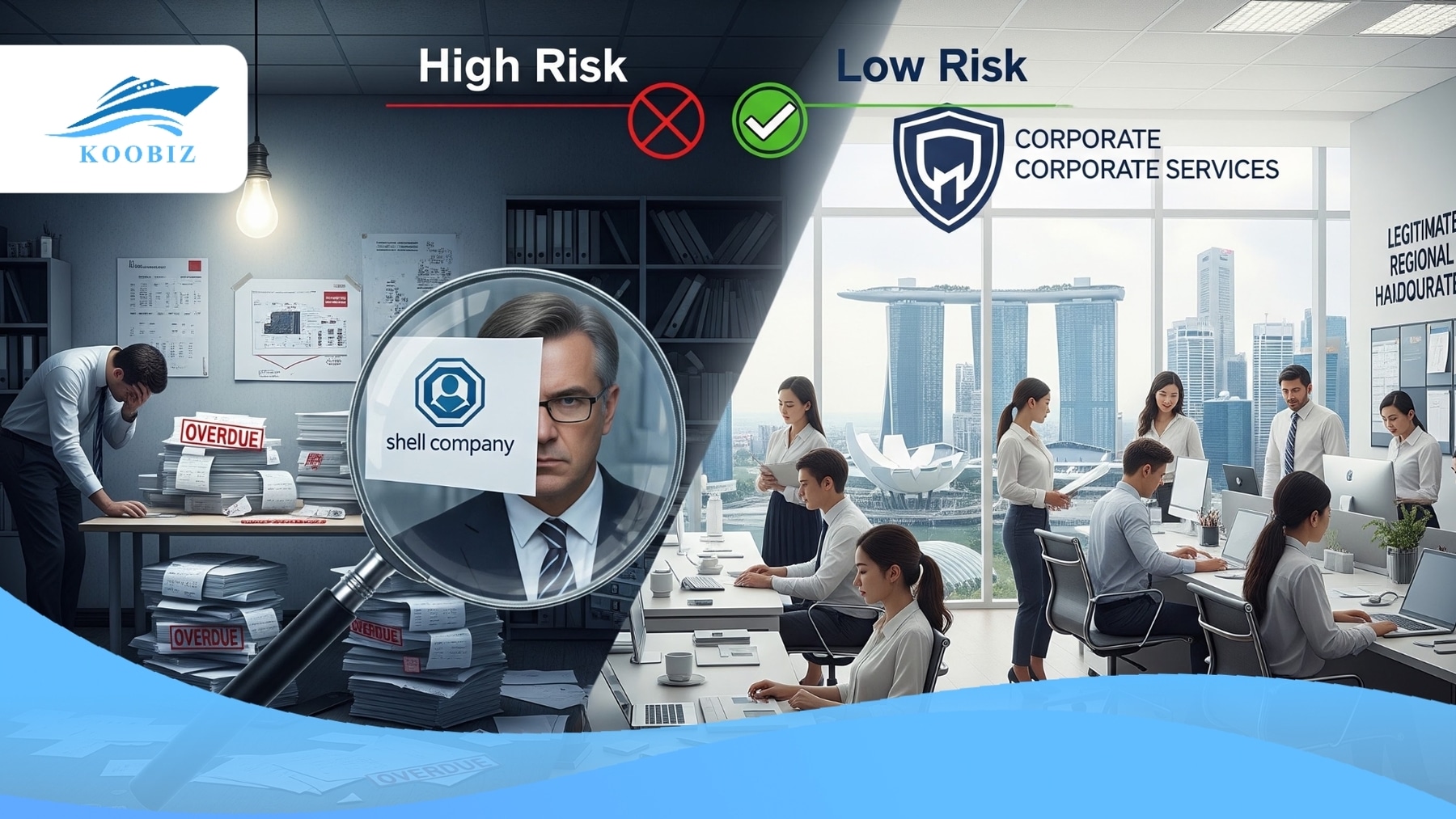
    • Money in Premises/Transit: Protects cash revenue from theft while it’s in the register or being carried to the bank.
    • Plate Glass: Covers the replacement of expensive shopfront windows if shattered.

    Profile B: The “Digital & Professional” (Tech / Consultancy)

    Who you are: Software Startups, Accountants, Marketing Agencies, Consultants.

    Your Primary Risk: Intangible Errors & Data Liability.
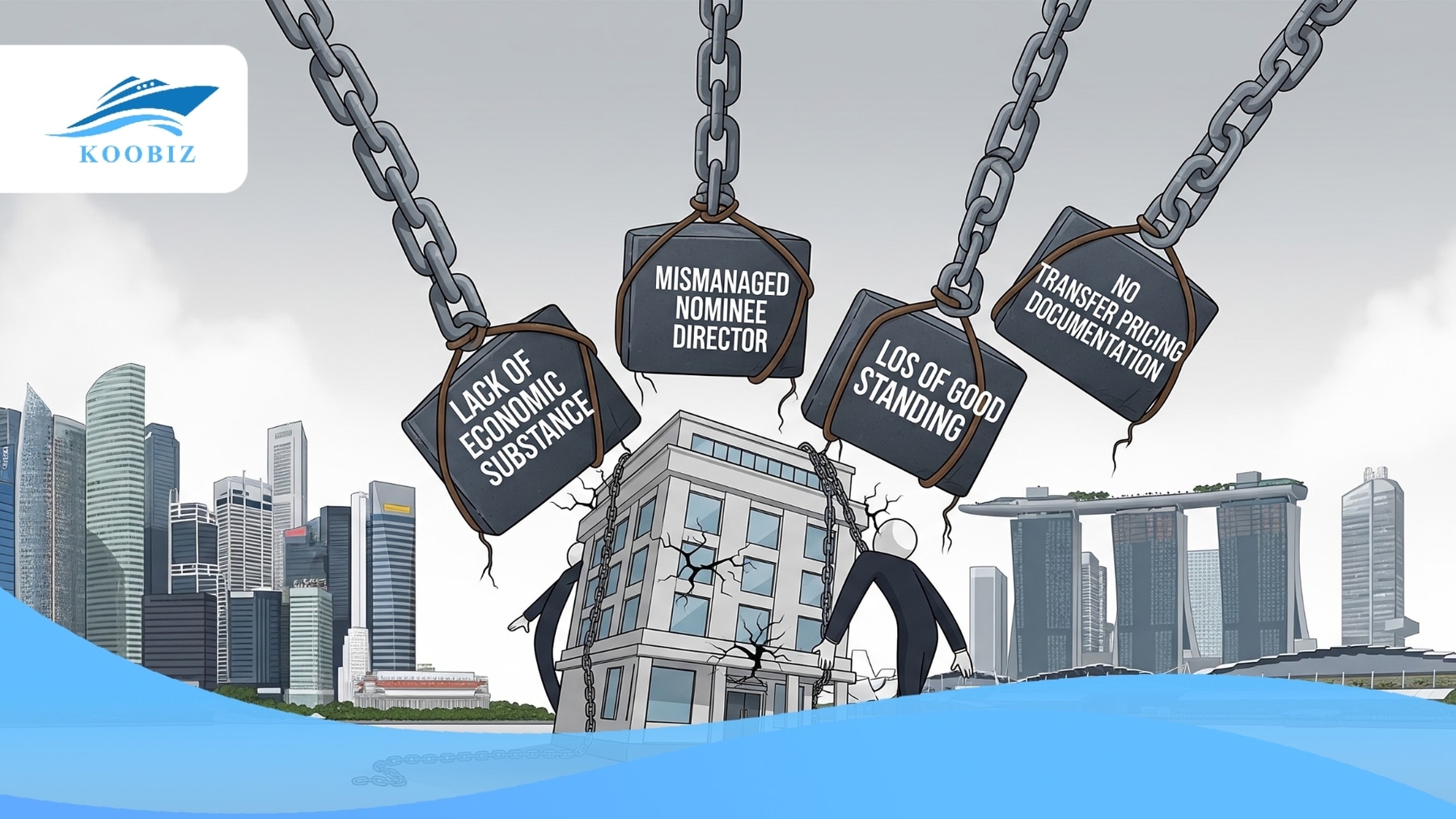
    Your assets are your code and your advice, not furniture. Standard property insurance is less critical than liability protection:
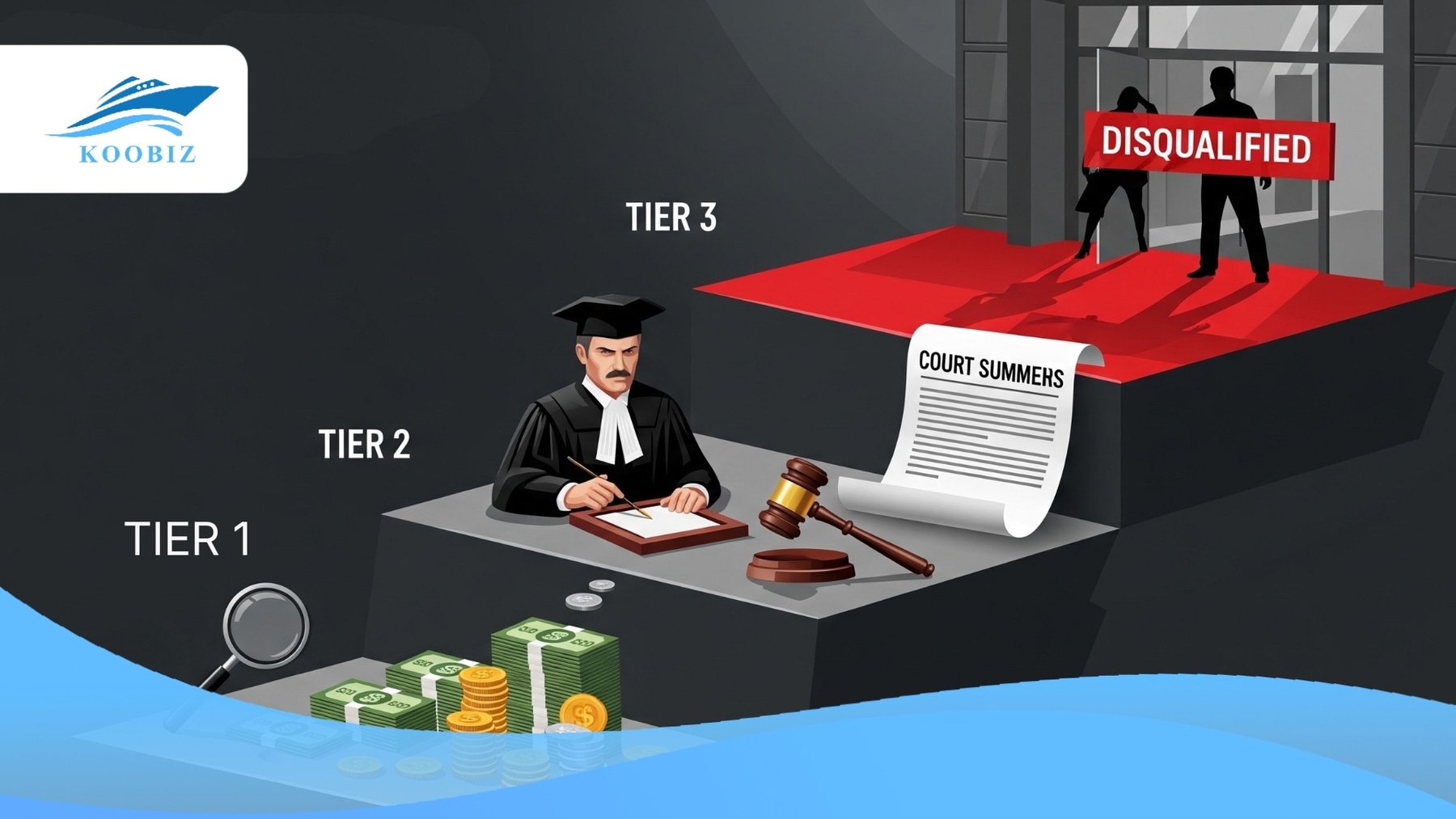
    • Professional Indemnity (PI): The most critical cover. It protects you if a client sues for financial loss caused by your advice, code bugs, or service failure.
    • Cyber Liability Insurance: Essential if you collect user data. It covers costs related to data breaches, ransomware investigations, and PDPA regulatory fines.
    • Defamation: Covers legal costs if you are sued for libel or slander arising from your media content.

    Profile C: The “Hands-On” (Construction / Renovation)

    Who you are: Contractors, Interior Designers, Handyman Services.

    Your Primary Risk: Third-Party Damage & Machinery.

    Working on client sites increases the risk of damaging their property or your own tools:

    • Contractors’ All Risks (CAR): Covers damage to the renovation works in progress (e.g., new flooring ruined by a pipe burst before handover).
    • Machinery Breakdown: Covers the cost of repairing expensive drills, saws, or specialized equipment if they fail internally.

    Profile D: The “Online Seller” (E-commerce)

    Who you are: Lazada/Shopee Sellers, Dropshippers.

    Your Primary Risk: Supply Chain & Product Safety.

    Even without a physical shop, you face liability for the goods you sell:

    • Product Liability: Critical if you import goods. If a battery pack you sold catches fire in a customer’s home, you can be held liable as the importer.
    • Marine Cargo: Protects your stock while it is being shipped from overseas suppliers to your warehouse.

    Understanding Premiums and Exclusions

    Your premium is the price you pay for insurance, based on your risk level. Exclusions are things the policy definitely does not cover.

    What Drives Your Premium Up?

    Your insurance cost isn’t random; it’s calculated based on probability and severity.

    • Nature of Business (Risk Level): A construction company typically pays more than an office-based firm due to higher injury risks.
    • Annual Revenue & Payroll:Premiums often relate to your annual revenue and total employee wages.
    • Claims History: A history of many claims can lead to higher costs.
    • Location: Premises in areas with higher risks (e.g., flood-prone) may have higher premiums.

    What Voids Your Coverage? (Exclusions)

    Insurance costs, risks, exclusions, and fraud
    Insurance costs, risks, exclusions, and fraud

    Exclusions are the “red lines” in your contract. If a claim falls under these categories, it will be rejected immediately.

    • Wear and Tear: Gradual deterioration of machinery or property is considered “maintenance,” not an accident. Old rusty pipes bursting are rarely covered.
    • Willful Acts: Damage caused intentionally by the business owner or senior management to claim money (fraud) voids the entire policy.
    • War and Terrorism: Standard policies exclude acts of war, terrorism, and pandemics, though these can sometimes be bought back as specific extensions.
    • Known Circumstances: Claims arising from situations you were aware of before the policy started (e.g., a pending lawsuit you didn’t disclose).

    Step-by-Step Guide to Filing a Business Insurance Claim

    Knowing this process beforehand ensures you don’t panic when an actual incident occurs, allowing Koobiz clients to focus on business recovery while the insurance handles the financial hit. Avoid common pitfalls by following the protocol below.

    Stage DO THIS NEVER DO THIS
    1. Immediate Response Notify your agent instantly. Speed is key to a valid claim. Never admit liability. Do not say “It was my fault” or apologize to third parties, as this voids legal defense.
    2. Damage Control Mitigate further loss. e.g., turn off the water main or board up a broken window. Do not dispose of damaged items. Keep burnt or broken assets for the loss adjuster to inspect.
    3. Evidence Gathering Document everything. Take wide and close-up photos, save CCTV footage, and keep police/medical reports. Do not clean up too early. Do not alter the scene significantly before documenting the initial state.
    4. Submission Be factual. Submit the claim form with all invoices within the deadline (usually 30 days). Do not speculate. If you don’t know the cause of fire, say “Unknown.” Do not guess.

    About Koobiz

    Navigating the business landscape in Singapore requires more than just insurance; it requires a solid corporate foundation. Koobiz is your trusted partner for seamless market entry and operation. We specialize in Company Incorporation services, helping you set up your Singapore entity strictly adhering to ACRA regulations.

    Beyond setup, we assist with Opening Corporate Bank Accounts with top Singaporean banks, ensuring your financial infrastructure is ready for business. Our comprehensive suite of services also includes Tax, Accounting, and Auditing, ensuring that as you grow, your compliance remains impeccable. Secure your business structure with Koobiz today, so you can focus on what you do best—growing your empire.

    Visit us at koobiz.com to learn more.

  • Public Liability Insurance in Singapore – Essential Protection for SMEs & Tenants

    Public Liability Insurance in Singapore – Essential Protection for SMEs & Tenants

    [SUMMARIES]

    Public Liability Insurance (PLI) protects Singapore businesses against third-party injury and property damage claims arising from daily operations.

    It covers compensation, legal defence, and settlement costs, but excludes employee injuries, which fall under WICA.

    PLI is especially important for SMEs, retailers, F&B outlets, and on-site service providers.

    Many landlords and contracts require minimum coverage, commonly S$500,000 or S$1 million.

    Choosing the right PLI policy helps businesses manage financial risk while meeting contractual and operational requirements.

    [/SUMMARIES]

    Public Liability Insurance in Singapore protects businesses against third-party injury and property damage claims arising from daily operations. It is essential for SMEs and tenants who deal with customers or operate in physical locations. With proper coverage, businesses can meet landlord and contract requirements while reducing financial risk from unexpected incidents.

    What is Public Liability Insurance (PLI)?

    Public Liability Insurance (PLI) protects your business against legal and compensation claims from third parties who suffer injury or property damage as a result of your business activities.

    It applies when your company is held legally responsible for harm caused to people outside your organisation, whether at your premises, at a client’s site, or during business operations and events.

    In Singapore, PLI is essential for businesses that deal with the public, operate physical locations, or provide on-site services. It typically covers:

    • Medical and compensation costs
    • Legal defence expenses
    • Court-awarded or settlement damages

    For example, if a customer is injured on your premises or your employee damages a client’s property while working on-site, PLI helps cover the resulting financial losses.

    Although PLI is not always legally required in Singapore, many landlords, clients, and government contracts require businesses to hold this insurance before operating or starting a project.

    What Does Public Liability Insurance Cover?

    Scope of public liability protection
    Scope of public liability protection

    In Singapore, a standard Public Liability Insurance (PLI) policy provides financial protection against third-party claims arising from your business activities. Coverage generally falls into two key areas: bodily injury and property damage, and legal defence and settlement costs.

    Bodily Injury & Property Damage

    This coverage applies when third parties (excluding employees) suffer injury or property damage due to your business operations. It typically covers medical expenses, compensation payments, and the repair or replacement of damaged property.

    Common examples include customers being injured on your premises or contractors accidentally damaging a client’s property while working on-site.

    Legal Defence Costs & Settlements

    PLI also covers the legal costs of defending your business against third-party claims, including lawyer fees, court expenses, and settlement or court-awarded damages.

    Even if a claim is disputed or unfounded, legal defence can be costly. PLI helps manage these expenses within your policy limits, reducing financial exposure and allowing you to focus on business operations.

    What Public Liability Insurance Does NOT Cover

    Common exclusions in liability insurance
    Common exclusions in liability insurance

    While Public Liability Insurance (PLI) provides broad protection against third-party claims, it is not a catch-all policy. Certain risks are excluded because they are better covered by other types of insurance.

    Employee Injuries (Covered by WICA)

    The most significant exclusion under a PLI policy is injury or illness suffered by your own employees. In Singapore, such claims are governed by the Work Injury Compensation Act (WICA), which is mandatory for most employers.

    • Why it is excluded: PLI is designed to protect against third-party (non-employee) claims only.
    • Coverage gap: If an employee is injured at work, your PLI policy will not respond. You must hold a separate WICA policy to cover medical expenses and compensation.

    Most standard PLI policies also exclude:

    • Professional Errors or Negligence: Financial losses caused by incorrect advice or professional mistakes (requires Professional Indemnity Insurance).
    • Property Under Your Care, Custody, or Control: Damage to items you are repairing, servicing, or storing for a client.
    • Intentional Acts: Injury or damage caused deliberately by your business or employees.

    Who Needs Public Liability Insurance the Most?

    Businesses that need liability protection most
    Businesses that need liability protection most

    While any business that interacts with the public faces liability risks, certain industries in Singapore have higher exposure due to strict regulations, high foot traffic, and on-site operations.

    Retail Shops & Showrooms (High Footfall)

    Retailers are particularly exposed to slip-and-fall incidents. In Singapore’s busy malls, even minor hazards can result in legal claims.

    Common risk scenarios include:

    • Customers slipping on wet or uneven floors
    • Injuries caused by unstable or collapsing display racks
    • Damage to customers’ personal belongings (e.g. spilling coffee on a designer bag)

    Landlord requirement:

    Most commercial landlords (such as CapitaLand and Mapletree) require tenants to maintain a minimum level of PLI coverage before handing over the premises.

    Renovation Contractors & Handymen (On-site Risks)

    Contractors working at client premises are responsible for accidental property damage and third-party injuries arising from their work.

    Key risks include:

    • Damage to fire sprinkler systems causing flooding
    • Tools or materials falling from height and injuring passers-by

    Contractual necessity:

    Management corporations (MCST) commonly deny site access to contractors who cannot provide a valid Certificate of Insurance (COI).

    Food & Beverage (F&B) Businesses

    In addition to physical accidents, F&B operators face health-related liability risks.

    Food poisoning coverage:Often required to meet Singapore Food Agency (SFA) licensing conditions, this extension covers claims from customers who fall ill after consuming contaminated food.

    Common claims include:

    • Severe allergic reactions due to undeclared ingredients
    • Burns or injuries caused by hot food and beverage spills

    Real-Life Claim Examples – Why This Insurance Matters

    Real F&B claims showing the value of insurance coverage
    Real F&B claims showing the value of insurance coverage

    Real-life incidents show how quickly unexpected accidents can turn into costly legal claims. For many SMEs in Singapore, a single liability claim can be financially damaging without proper insurance protection.

    Retail Shop Slip-and-Fall

    A customer slipped on a wet floor in a retail store after a spill was not cleaned up promptly. The customer suffered a back injury and filed a claim for medical expenses and loss of income. Public Liability Insurance covered the legal defence costs and compensation payout, preventing the business owner from paying out of pocket.

    Contractor Damaging Client Property

    A renovation contractor accidentally drilled into a concealed water pipe, causing flooding and damage to a client’s flooring and furniture. The client claimed for repair costs and business interruption losses. The contractor’s Public Liability Insurance paid for the property damage and settlement costs.

    Food Poisoning Incident at an F&B OutletSeveral customers reported food poisoning after dining at a small restaurant. They demanded compensation for medical treatment and emotional distress. The restaurant’s Public Liability Insurance helped cover the legal expenses and compensation claims, allowing the business to continue operating without severe financial strain.

    These examples highlight that accidents can happen even in well-managed businesses. Public Liability Insurance acts as a financial safety net, protecting business owners from sudden and potentially overwhelming liability claims.

    How Much Does Public Liability Insurance Cost in Singapore?

    The cost of Public Liability Insurance (PLI) in Singapore is not fixed. Instead, it is calculated based on your business risk profile, industry type, annual turnover, and the specific scope of activities insured.

    As a general estimate:

    • Low-risk businesses (small offices, consultancies, home-based businesses): S$150 – S$300 per year
    • Medium-risk businesses (retail shops, small service providers): S$300 – S$600 per year
    • Higher-risk businesses (F&B outlets, renovation contractors): S$600 – S$1,500+ per year, depending on coverage limits and risk exposure

    Note: These figures are indicative and subject to the insurer’s underwriting criteria, chosen limits, and prevailing GST.

    Factors: Limit of Indemnity ($500k vs $1M)

    The most significant factor affecting your premium is the Limit of Indemnity the maximum amount the insurer will pay for a single claim or within the policy period. In Singapore, the choice usually comes down to two standard tiers:

    • S$500,000 Limit: This is typically the entry-level coverage. It comes with a more affordable premium and is often sufficient for home-based businesses or small offices with minimal public visitors.
    • S$1,000,000 Limit: This is widely considered the “Gold Standard.” Most major landlords (such as CapitaLand or Mapletree), property managers, and government bodies through GeBIZ tenders mandate a minimum of S$1 million in coverage before a contract can be signed.

    For businesses in high-risk sectors like F&B or renovation, opting for a higher limit is crucial. A single serious injury or major fire could easily exceed a lower cap, leaving your business to pay the difference out-of-pocket. When choosing your policy, it is vital to prioritize a limit that meets your contractual obligations and realistic risk exposure over simply picking the cheapest premium.

    Public Liability Insurance vs Other Business Insurance

    Public Liability Insurance is frequently confused with other business covers. However, each serves a distinct purpose. In Singapore, a “one-size-fits-all” approach often leaves businesses exposed to costly gaps.

    Below is a comparison to help you identify the right combination for your business:

    Type of Insurance What It Covers Who It Protects Is It Mandatory in Singapore?
    Public Liability (PLI) Third-party bodily injury & property damage from business operations. Customers, visitors, and the general public. Contractual. Required by most landlords and clients.
    Professional Indemnity (PI) Financial loss arising from errors, omissions, or negligent advice. Clients receiving your professional services. Professional Requirement. Mandatory for lawyers, auditors, and doctors.
    Work Injury Compensation (WICA) Medical expenses and loss of wages for work-related injuries/illness. Your employees (Local & Foreign). Legal Mandate. Compulsory for most employees under MOM law.

    How They Work Together (Examples):

    • PLI: A client slips in your office and sues for medical bills.
    • PI: You provide a tax consulting report with an error that costs your client S$50,000 in fines.
    • WICA: Your office manager develops carpal tunnel syndrome or trips over a cable while working.

    Most Singapore SMEs opt for an “SME Package” which bundles PLI and WICA together. However, if your business involves advisory or specialized services (IT, Design, Consulting), adding a PI policy is essential to protect your professional reputation.

    How to Choose the Right Public Liability Insurance Policy

    Tips for selecting suitable liability coverage
    Tips for selecting suitable liability coverage

    Choosing the right Public Liability Insurance policy is about matching coverage to your business risks and operational needs in Singapore not simply selecting the cheapest option.

    • Assess your public exposure: Businesses with high customer traffic, on-site work, or physical products face higher risks and usually need higher limits of indemnity.
    • Check contractual and regulatory requirements: Many landlords, property managers, and government projects require a minimum coverage level (commonly S$1 million) before operations can begin.
    • Review the scope of insured activities: Ensure all your business activities are properly declared and covered, especially if you provide multiple services.
    • Evaluate claims handling and legal support: Look for clear claims procedures, reliable legal defence, and prompt handling of third-party claims.

    By selecting coverage based on risk exposure, required limits, and business needs rather than price alone, you secure meaningful protection instead of basic compliance.

    Common Mistakes Businesses Make with Public Liability Insurance

    Many SMEs in Singapore buy Public Liability Insurance for compliance, not protection only to discover coverage gaps when claims are rejected. The most common mistakes include:

    • Low indemnity limits: Choosing S$500,000 to save costs may be risky. A serious accident or disability claim can easily exceed this amount, leaving the business to pay the difference.
    • Incorrect business descriptions: If your policy states “general retail” but the incident happens during an undeclared activity (e.g. outdoor events), the insurer may deny the claim.
    • Confusing PLI with WICA: PLI covers the public, not employees. Staff injuries must be insured under WICA. Using PLI instead breaches MOM regulations and exposes your business financially.
    • Ignoring excess and deductibles: A low premium with a high excess means frequent small claims will still come out of your own pocket.
    • Late claim reporting: Insurers require immediate notification of any incident that may lead to a claim. Delayed reporting can invalidate coverage.

    Koobiz Will Help You Find the Right Public Liability Insurance

    Koobiz helps Singapore businesses choose the right Public Liability Insurance based on their industry, risk exposure, and contractual requirements. Instead of one-size-fits-all policies, Koobiz recommends coverage that reflects your actual business activities.

    With Koobiz, you can:

    • Choose an appropriate limit of indemnity
    • Ensure all business activities are properly covered
    • Comply with landlord and contract insurance requirements
    • Avoid coverage gaps that could lead to claim rejection

    Koobiz simplifies the process, helping SMEs secure reliable protection without unnecessary complexity.

  • When Setting Up a Singapore Company Actually Increases Compliance Risk

    When Setting Up a Singapore Company Actually Increases Compliance Risk

    [SUMMARIES]

    Not Always Low-Risk: While Singapore offers tax efficiency, it is a strictly regulated financial hub, not a loose tax haven, meaning “shell” companies face high scrutiny.

    4 Critical Danger Zones: Operating without economic substance, mismanaging nominee directors, failing “good standing” maintenance, and lacking transfer pricing documentation significantly increase legal exposure.

    Severe Consequences: Non-compliance leads to escalating composition fines, court prosecution, director disqualification, and unilateral bank account closures.

    Hidden Micro-Risks: Foreign entrepreneurs face specific threats regarding Automatic Exchange of Information (CRS) and “De Facto” director liabilities.

    The Koobiz Solution: Professional corporate secretarial services are not just administrative but a critical risk management layer to ensure statutory compliance.

    [/SUMMARIES]

    Singapore is often marketed as a tax haven, but in reality, it is a compliance fortress. Setting up a Singapore company actually increases compliance risk when foreign investors treat it like a loose offshore jurisdiction—ignoring strict statutory demands. At Koobiz, we have extensive experience rescuing businesses facing penalties for this exact error. This guide analyzes the four critical scenarios where burdens outweigh benefits, compares Singapore’s stringency to traditional havens, and uncovers hidden risks like de-banking and director liability.

    Is Singapore Company Incorporation Always a Low-Risk Strategy?

    High-risk shell company versus legitimate headquarters
    High-risk shell company versus legitimate headquarters

    No, Singapore company incorporation is not inherently low-risk; rather the risk depends entirely on whether you treat the jurisdiction as a substantive business hub or a passive tax conduit.

    Although the World Bank consistently ranks Singapore highly for its “Ease of Doing Business,” this refers to the speed of setup rather than the leniency of maintenance. The risk profile of your company is not fixed—it fluctuates based on your operational behavior.

    • High Risk Scenario: You are a foreign investor using Singapore solely for invoicing, with no local employees, no physical office, and a “cheap” nominee director. In this case, you are a prime target for tax audits and de-banking.
    • Low Risk Scenario: You treat Singapore as a legitimate regional headquarters, employing local staff, maintaining accurate financial records, and engaging a professional Corporate Service Provider like Koobiz. In this case, the regulatory framework protects your assets and reputation.

    The danger lies in the gap between expectation and reality. If you implement an “off-shore mindset” (anonymity, zero reporting) to Singapore, you are essentially setting yourself up for failure before signing the first contract.

    4 Scenarios Where Compliance Burdens Outweigh Tax Benefits

    4 Singapore company compliance pitfalls
    4 Singapore company compliance pitfalls

    There are four primary scenarios where the compliance burdens of a Singapore company outweigh the intended tax benefits: operating as a “shell company” without substance, mismanaging the local nominee director requirement, failing to maintain “good standing,” and operating complex cross-border structures without transfer pricing documentation.

    These scenarios represent the most common pitfalls where the cost of compliance—or the cost of failing it—erodes the value of the Singapore structure.

    Operating as a “Shell Company” without Economic Substance

    The Scenario: You establish a Singapore entity purely for invoicing purposes. The company has no local employees, no physical office (only a virtual address), and all management decisions are clearly made in another country.

    The Risk: Singapore adheres to the OECD’s Base Erosion and Profit Shifting (BEPS) framework.

    • Certificate of Residence Denied: IRAS will likely deny your Certificate of Residence (COR), resulting in blocking access to Double Taxation Agreements (DTAs). Without DTA benefits, your foreign income may be taxed at the full 17% rate or higher abroad.
    • Bank Account Freezing: Lack of substance often triggers internal risk controls, leading to sudden account closures.

    Mismanagement of the Local Nominee Director Requirement

    The Scenario: To save costs, you appoint a “cheap,” unresponsive nominee director who provides no oversight, or you appoint a friend/relative in Singapore who lacks professional qualifications.

    The Risk: Under the Companies Act, every director has certain fiduciary duties.

    • Breach of Law: If a nominee resigns suddenly or refuses to sign documents due to a lack of professional agreement, your company is immediately in breach of the statutory requirement to have a resident director.
    • Personal Liability: If you appoint an unqualified friend, they (and you) face personal liability and potential prosecution for the company’s statutory breaches. Professional indemnity is non-existent in casual arrangements.

    Failing to maintain “Good Standing” with ACRA and IRAS

    The Scenario: The company habitually misses deadlines for Annual General Meetings (AGMs), Annual Returns (AR), or tax filings as “optional” administrative tasks.

    The Risk: In Singapore, compliance dates are rigid.

    • Commercial Paralysis: A company without a Certificate of Good Standing cannot open foreign bank accounts, apply for loans, or sign major partnerships.
    • Strike Off: In severe cases of dormancy or non-filing, ACRA has the power to strike the company off the register. This effectively dissolves your legal entity and can lead to asset seizure.

    Complex Cross-Border Structures without Transfer Pricing Documentation

    The Scenario: Your Singapore entity engages in significant related-party transactions (e.g., buying goods from a parent company or selling services to a subsidiary) yet lacking formal Transfer Pricing (TP) documentation.

    The Risk: IRAS requires all related-party transactions to be at “arm’s length.”

    • Tax Adjustments: Without TP documentation, IRAS can arbitrarily adjust your pricing to reflect market rates, resulting in a higher tax bill.
    • 5% Surcharge: On top of the adjustment, IRAS imposes a 5% surcharge on the adjusted amount, regardless of whether there was an intent to evade tax.

    Singapore vs. Traditional Tax Havens: Comparing Regulatory Stringency

    Singapore stands out decisively regarding regulatory stringency and global reputation, whereas traditional tax havens like the BVI or Seychelles prioritize anonymity and deregulation.

    However, many investors mistakenly assume that all “low tax” jurisdictions operate the same way. This table illustrates why Singapore’s compliance burden is significantly higher—but also why it offers superior commercial advantages.

    Feature Traditional Tax Haven (e.g., BVI, Seychelles) Singapore
    Primary Goal Anonymity & Deregulation Reputation & Global Connectivity
    Financial Reporting Minimal: often no filing required Strict: compliance with SFRS & Annual Returns
    Beneficial Ownership Often non-transparent or private Transparent: Mandatory Register of Controllers
    Audit Requirement Rare Mandatory for companies > SGD 10M turnover
    Banking Access Difficult: perceived as “High Risk” Excellent: Access to Tier-1 global banks
    Tax Treaties (DTAs) Limited network Extensive: Over 90+ comprehensive DTAs

    If you treat a Singapore company like a BVI company (i.e., ignoring bookkeeping), you will inevitably breach the law. The rigorous framework is the price you pay for legitimacy.

    What Are the Consequences of Non-Compliance in Singapore?

    Escalating consequences of non-compliance in Singapore
    Escalating consequences of non-compliance in Singapore

    The consequences of non-compliance in Singapore are structured as an “Escalation Ladder.” Penalties increase exponentially based on the duration of the default and the intent.

    The “risk” mentioned in the title equals direct prosecution from ACRA and IRAS.

    Tier 1: Escalating Financial Penalties

    ACRA imposes “composition fines” for late lodgment as the first financial consequence which accumulates per offense.

    • Late Filing Fees: Filing an Annual Return late can incur a penalty of up to SGD 600 per offense.
    • The Cumulative Trap: If you are late on your AGM, Annual Return, and Tax Filing simultaneously, you can rack up thousands of dollars in fines within a single month.
    • Tax Penalties: IRAS imposes separate penalties up to SGD 1,000 for late filing, plus significantly higher penalties (up to 400%) for underpayment or tax evasion.

    Tier 2: Court Summons and Prosecution

    If financial penalties are ignored, the risk escalates to criminal liability. ACRA will issue a court summons to the directors personally.

    • Personal Attendance: Directors will be required to attend court in Singapore.
    • Criminal Record: Non-compliance is an offense under the Companies Act. A conviction results in a criminal record, not just a civil fine.

    Tier 3: Director Disqualification (The “Nuclear” Option)

    This is the ultimate penalty for persistent non-compliance.

    • The 3-Strike Rule: Under the Companies Act, a director who has been convicted of three or more filing-related offenses within five years would be disqualified for the position.
    • The Ban: A disqualified director cannot take part in the management of any local or foreign company in Singapore for five years.
    • Impact: For a foreign entrepreneur, this effectively ends your legal ability to do business in Singapore and destroys your reputation globally.

    Hidden Micro-Risks for Foreign Entrepreneurs

    Hidden micro-risks for foreign entrepreneurs
    Hidden micro-risks for foreign entrepreneurs

    There are invisible risks during the incorporation phase which can emerge unexpectedly to disrupt business continuity. These “hidden” dangers have been categorized below.

    For the “Hands-Off” Investor: The De-Banking Risk

    If you are the type of investor who prefers to set up the company and “leave it running” without active oversight, you are at high risk of unilateral account closure.

    • The Trigger: Singapore banks conduct periodic “Know Your Customer” (KYC) reviews. They send physical letters or secure emails requesting updated documents.
    • The Fallout: “Hands-off” investors often miss these requests. The bank interprets silence as a risk, triggering an immediate account closure (De-banking). Once de-banked, you are flagged on inter-bank risk lists, making it nearly impossible to open an account elsewhere.

    For the “Tax Optimizer”: The CRS Data Exchange Risk

    If your primary goal is to use Singapore to legally optimize taxes while living elsewhere, you must understand the Common Reporting Standard (CRS).

    • The Trigger: Assuming that your Singapore assets are private.
    • The Fallout: Singapore is a signatory to CRS. IRAS automatically exchanges financial account information with tax authorities in over 100 jurisdictions. If you are a tax resident of other countries, your home tax authority will receive a report on your Singapore bank balance. If it was undeclared, you face tax evasion charges at home, turning your Singapore asset into a domestic liability.

    For the “Shadow Boss”: The De Facto Director Trap

    If you are an owner who appoints a nominee but continues to make all executive decisions from the shadows to avoid legal visibility, you are walking into a legal trap.

    • The Trigger: Pulling the strings without being on the ACRA register.
    • The Fallout: Under Singapore law, a “De Facto” director (someone who acts as a director in practice) has the same legal liabilities as a formally appointed director which means the “shadow boss” also holds liability for debts and compliance failures despite the missing name from the official papers.

    How Professional Corporate Services Mitigate These Risks

    Professional corporate services mitigate these risks by transforming compliance from a manual burden into a strategic shield. At Koobiz, we act as your regulatory bodyguard.

    The table below illustrates exactly how a professional partner defends your business against the vulnerabilities discussed in this article.

    The Vulnerability (The Risk) The Koobiz Shield (The Solution)
    Missed Statutory Deadlines

    (Leads to fines & court summons)

    Automated Compliance Calendar: We track your Financial Year End (FYE) and AGM dates and send reminders months in advance to ensure zero penalties.
    Nominee Director Liability

    (Leads to “De Facto” risks & disputes)

    Professional Nominee Services: Provision of qualified, indemnified nominees with clear legal agreements, protecting your beneficial ownership rights.
    Lack of Economic Substance

    (Leads to tax residency denial)

    Substance Advisory: Provision of registered office services, employment pass applications, and local payroll to prove genuine business activity to IRAS.
    Bank Account Closure (De-banking)

    (Leads to business freeze)

    Banking Continuity Support: Maintenance of corporate records in “Good Standing” and assist with periodic bank reviews to prevent red flags.
    Complex Tax/Transfer Pricing

    (Leads to audits & surcharges)

    Expert Tax Planning: Cross-border transactions to be reviewed with a view to meeting “arm’s length” standards and preparing necessary documentation.

    Why “Cheap” Incorporation Packages Are Dangerous

    There is a direct correlation between price and safety. “Cheap” packages often strip away the crucial protective layers you need. Many foreign entrepreneurs mistakenly view incorporation as a commodity, choosing the lowest bidder (often SGD 300 – SGD 600) without realizing the “Quality Gap.”

    When you purchase a budget package, you are paying for automation. When you partner with Koobiz, you are paying for legal oversight and defense.

    • The Budget Provider Approach:
      • Automation: Uses bots to generate standard constitution forms with no human review of your specific business structure.
      • Liability: Provides “bare-bones” nominee directors who often refuse to sign extra documents during banking reviews or audits.
      • Support: Relies on chatbots or generic support tickets with no accountability for advice given.
      • The Outcome: You save money upfront but face a high risk of fines, audit failures, and operational paralysis when complex issues arise.
    • The Professional Partner (Koobiz) Approach:
      • Oversight: Strategic review of your business model before filing to ensure correct classification (SSIC codes).
      • Security: Indemnified professional nominees who act under a strict legal deed to protect your interests.
      • Defense: Proactive advisory on tax queries and direct assistance with bank compliance letters.
      • The Outcome: You pay a premium for peace of mind, knowing that a team of experts is watching your blind spots.

    Investing in a service that includes tax, accounting, and legal advisory is not an expense—it is an investment in foresight. It ensures that you can focus on business growth rather than worrying about going to jail for a missed filing.

    From Singapore company incorporation to opening bank accounts, and providing ongoing tax, accounting, and audit services, Koobiz is your dedicated partner in compliance.

    Ensure your expansion into Singapore is a step toward growth, not risk. Contact Koobiz today for a comprehensive compliance health check or to start your incorporation journey on the right foot. Visit us at koobiz.com.

  • Mastering CorpPass Singapore: A Step-by-Step Registration Guide for New Business Owners

    Mastering CorpPass Singapore: A Step-by-Step Registration Guide for New Business Owners

    [SUMMARIES]

    Single Gateway: CorpPass is the mandatory digital identity for accessing over 300 Singapore government services (G2B).

    Prerequisites: Registration requires a valid UEN and an appointed Registered Officer (RO) with an active Singpass or Singpass Foreign user Account (SFA).

    Role Management: Distinct roles (Admin, Sub-Admin, User) ensure data security, with specific account limits to maintain control.

    Foreign Access: Foreign directors without a standard Singpass can now register for an SFA to access CorpPass securely via the Singpass app.

    Expert Support: Services like Koobiz can assist with third-party authorizations for tax and secretarial matters.

    [/SUMMARIES]

    Navigating the regulatory landscape of Singapore is the first step for any entrepreneur, but incorporation is just the beginning. To truly operate your business, from filing taxes with IRAS to managing employee work passes with MOM, you must master CorpPass Singapore (Singapore Corporate Access). This digital infrastructure serves as the heartbeat of your company’s interactions with the government. Whether you are looking to understand the registration requirements, follow a step-by-step setup guide, or manage complex scenarios like foreign director access, this article covers it all. With the expertise of Koobiz in Singapore incorporation and corporate services, we will guide you through establishing your corporate digital identity smoothly.

    What is CorpPass Singapore?

    Unified CorpPass gateway for Singapore government services
    Unified CorpPass gateway for Singapore government services

    CorpPass (Singapore Corporate Access) is the official corporate digital identity for Singapore entities, serving as a single, unified gateway for secure access to over 300 government digital services.

    Let’s look at its core function within the business ecosystem. Before CorpPass, business owners had to use multiple login methods or personal credentials to access different government portals. CorpPass consolidates all procedures into one secure interface. It allows entities—including private limited companies, non-profits, and associations—to verify who they are acting on behalf of and what specific transactions they are authorized to perform.

    CorpPass is the key to accessing mandatory platforms such as the Inland Revenue Authority of Singapore (IRAS) for tax filing, the Accounting and Corporate Regulatory Authority (ACRA) for business profile updates, Enterprise Singapore (ESG) for grants, and the Ministry of Manpower (MOM) for employment matters. By centralizing access, the government ensures a smoother, more efficient digital experience for businesses.

    Why is CorpPass Mandatory for Business Transactions?

    Separating personal corporate identity, securing G2B transactions
    Separating personal corporate identity, securing G2B transactions

    CorpPass is mandatory to enforce a strict separation between personal and corporate digital identities, ensuring that all business transactions are secure, private, and accurately traceable for compliance purposes.

    Beyond simple compliance, there are critical security reasons for this mandate. Since September 2018, CorpPass has replaced Singpass as the sole login method for Government-to-Business (G2B) transactions. This shift addresses a fundamental privacy concern: previously, employees often used their personal Singpass for company work, which blurred the lines between personal privacy and corporate responsibility.

    Furthermore, the system provides business owners absolute control. If an employee leaves the company, the CorpPass Admin can immediately revoke their access rights without compromising the company’s account security. This creates a clear digital footprint, allowing auditors and authorities to trace exactly which individual performed a specific transaction, thereby enhancing corporate governance.

    Requirements Before Registering CorpPass

    To register successfully, your business must have a valid Unique Entity Number (UEN) with a “Live” status and be initiated by an ACRA-listed Registered Officer with an active Singpass or SFA.

    Before starting the technical steps, it is essential to verify these prerequisites to avoid system rejection. The eligibility criteria act as a gatekeeper to ensure only authorized individuals can claim a digital identity for a company.

    • Valid Entity Status (UEN): Your entity must be registered withACRA. The UEN must be active; if you have just incorporated, it may take up to 2 working days for the profile to sync with the CorpPass system.
    • Registered Officer (RO) Status: Only a person officially listed as an officer in your business profile (BizFile+) can activate the account. This typically includes the Company Director, Company Secretary, or an Authorized Representative.
    • A Valid Singpass or SFA Account:
      • Locals & Residents: The RO needs their own personal Singpass (for Citizens, PRs, and FIN holders) to log in and verify their identity.
      • Foreigners: Foreign directors without a FIN must ensure they have registered for a Singpass Foreign user Account (SFA) to proceed.

    Step-by-Step Guide: How to Register for CorpPass

    The registration process involves three main phases: verifying your RO status, registering the CorpPass Administrator, and creating user accounts to fully activate the system for daily operations.

    Let’s break down this procedure into actionable steps to ensure you can get your account running without technical hiccups.

    Step 1: Verify Your Registered Officer (RO) Status

    Before attempting to log in, you must ensure ACRA recognizes you as the rightful representative. Visit the ACRA BizFile+ portal and purchase a Business Profile extract if necessary. Check that your name and ID number match your Singpass/SFA details exactly. If you are a foreign director engaging a nominee director service by Koobiz, ensure the nominee assists with this initial verification or provides the necessary authorization.

    Step 2: Log in and Register the CorpPass Admin

    Once verified, go to the official CorpPass website and follow this workflow:

    1. Click “Register as a CorpPass Admin”.
    2. Log in securely: Use your personal Singpass (or SFA) credentials. Note that CorpPass does not have its own username/password; it relies on your Singpass identity for authentication.
    3. The system will automatically detect the UENs associated with your ID. Select the correct UEN for your new company.
    4. Confirm the appointment of the CorpPass Admin. In most small businesses, the Director (RO) appoints themselves as the Admin.
    5. Review the details and submit. Approval is often immediate for standard cases.

    Step 3: Create User Accounts and Assign Digital Services

    The Admin account alone is not enough for operations; you need to assign roles.

    1. Log in to the CorpPass portal using the Admin’s Singpass credentials.
    2. Navigate to “Create New Users”. Here, you can create accounts for your staff (e.g., HR Manager, Accountant).
    3. Crucial Step: Go to “Assign e-Services”. You must explicitly grant access to specific services. For example, assign “IRAS (Corporate Tax)” to your accountant’s account and “MOM (Work Pass)” to your HR staff. Without this assignment, the user accounts are empty shells.

    CorpPass Roles Explained: Admin vs. Sub-Admin vs. Enquiry User

    The Admin holds full control over the account and user management, the Sub-Admin assists in managing specific groups, while the Enquiry User is restricted to viewing information without transaction rights.

    Role Description & Permissions Account Limits Ideal For
    CorpPass Admin The “Super User” with full control. Can create accounts, terminate access, and assign services. At least 1 is required to avoid suspension. Max 2 Admins per UEN. Business Owners, Directors.
    CorpPass Sub-Admin Assists in managing users but cannot modify the main Admin’s settings. Useful for delegation in larger teams. Max 25 Sub-Admins. Department Heads, HR Managers.
    CorpPass User The standard operational role. Can only perform transactions on the specific digital services assigned to them. No limit for local UENs. Operational Staff (Accountants, HR Execs).
    Enquiry User A view-only role for verifying data. No transaction or filing capabilities. N/A External Auditors, Shareholders.

    Note: For foreign-registered entities (without a local UEN), the total number of user accounts is capped at 30.

    Managing Complex Scenarios: Foreigners and Third-Party Agents

    SFA for foreigners and Third-Party Authorisation
    SFA for foreigners and Third-Party Authorisation

    There are specific solutions for non-standard cases, including SFA access for non-residents and third-party authorization for professional service providers.

    However, not all businesses fit the standard “local director with Singpass” model. Many international clients of Koobiz face unique challenges that require navigating the “Micro Semantics” of the CorpPass system.

    How Foreign Directors Can Use CorpPass Without Singpass?

    Foreign directors who do not reside in Singapore and do not have a Foreign Identification Number (FIN) cannot use a standard Singpass. Instead, the modern approach uses the Singpass Foreign user Account (SFA).

    • Register for SFA: You must first apply for an SFA with the relevant government agency (e.g., apply via IRAS if you need tax access, or ACRA for filing returns). This replaces the older “CorpPass Foreign ID” system.
    • Activate 2FA: Once approved, download the Singpass App on your mobile device. You will use this app to scan QR codes or generate 2FA codes to log in to CorpPass.
    • Usage: While SFA grants access, many foreign owners still find it more efficient to appoint a local resident director or use a professional nominee service to handle the primary Admin duties to bypass potential technical hurdles.

    Setting Up Third-Party Authorisation for Corporate Service Providers

    Most SMEs outsource their compliance work. You do not need to share your Admin password with your accountant. Instead, use the “Third-Party Authorisation” feature.

    • Log in as Admin.
    • Select “Authorise Third Party”.
    • Enter the UEN of your service provider (e.g., your tax agent or corporate secretary firm).
    • Select the specific services (e.g., IRAS Form C-S) you want them to handle.This ensures that Koobiz or your appointed agent can file taxes on your behalf legally and securely, without having full access to your company’s other sensitive data.

    Troubleshooting: Common CorpPass Login Errors and Solutions

    Even with a perfect setup, issues arise.

    • “Entity Status Not Live”: This usually happens immediately after incorporation. Wait 24-48 hours for ACRA data to update.
    • “User Not Authorized”: This means the Admin created the user account but forgot Step 3 (Assigning e-Services). A user cannot access IRAS until the Admin explicitly ticks that box.
    • Singpass App Issues: If you cannot log in, ensure your Singpass app is updated and biometric authentication is enabled. Switching devices often requires re-setting up the app for security.

    Conclusion

    Mastering CorpPass is not just a regulatory hurdle; it is the foundation of your business’s digital life in Singapore. From the initial registration by the Registered Officer to the granular management of user roles and third-party authorizations, understanding this system ensures your company remains compliant and operational.

    At Koobiz, we understand that navigating Singapore’s corporate systems can be daunting for new business owners, especially those from overseas. We offer a comprehensive suite of services to support your journey:

    • Singapore Company Incorporation: We handle the ACRA registration and ensure your UEN is generated quickly.
    • Bank Account Opening: Guidance on opening corporate accounts with top Singaporean banks.
    • Tax, Accounting, and Audit: As your authorized third-party agent, we manage your financial compliance through CorpPass, ensuring you never miss a deadline.

    Ready to start your business in Singapore? Visit Koobiz.com today for expert consultation.