Category: Visa & Work Pass

  • Long-Term Visit Pass (LTVP Singapore): Requirements, Benefits & How to Apply (2026)

    Long-Term Visit Pass (LTVP Singapore): Requirements, Benefits & How to Apply (2026)

    [SUMMARIES]

    The Long-Term Visit Pass (LTVP) allows eligible foreigners, such as family members of Singapore Citizens, PRs, or work pass holders, to reside in Singapore for an extended period.

    LTVP holders do not have automatic work rights but can legally work by obtaining a Pre-Approved Letter of Consent (PLOC) or a specific Letter of Consent (LOC).

    Applications are assessed by either ICA or MOM depending on the sponsor, with the LTVP+ offering enhanced benefits like healthcare subsidies and longer validity for spouses of Singapore Citizens.

    [/SUMMARIES]

    The Long-Term Visit Pass (LTVP) allows eligible foreigners to stay in Singapore on a long-term basis, mainly to live with family members or for approved residency-related purposes. Depending on the applicant’s profile, the pass is issued by either the Immigration & Checkpoints Authority (ICA) or the Ministry of Manpower (MOM).

    In 2026, LTVP applications are assessed carefully based on family ties, eligibility criteria, and the applicant’s ability to integrate into Singapore. Understanding the correct LTVP type, authority, and application process is essential to avoid delays or rejection. This guide explains who can apply for an LTVP in Singapore, the key requirements and benefits, and how to apply correctly under the latest regulations.

    What Is the Long-Term Visit Pass (LTVP) in Singapore?

    The Long-Term Visit Pass (LTVP) is a residence pass that allows eligible foreigners to remain in Singapore for an extended period for family-related or other approved purposes. It is intended for individuals who do not qualify for permanent residence or a standard work pass, but who have a legitimate basis to stay in Singapore long term.

    The LTVP framework is administered by two government authorities. Applications linked to Singapore Citizens or Permanent Residents and certain special residency cases are handled by the Immigration & Checkpoints Authority (ICA), while applications for eligible family members of Employment Pass or S Pass holders fall under the Ministry of Manpower (MOM).

    While the LTVP itself does not automatically grant the right to work, some holders may be permitted to work in Singapore with additional approval from MOM. LTVPs are typically issued for a limited validity period and may be renewed subject to continued eligibility and assessment by the relevant authority.

    Types of Long-Term Visit Pass in Singapore

    Singapore offers two main types of Long-Term Visit Pass, depending on the applicant’s relationship to a sponsor, study background, and long-term stay needs.

    Standard Long-Term Visit Pass (LTVP)

    The Standard Long-Term Visit Pass (LTVP) supports eligible foreigners who require a long-term stay in Singapore for approved family, study, or personal reasons. It is commonly issued to:

    • Family members of Singapore Citizens, Permanent Residents, or eligible work pass holders
    • Graduates from Singapore institutions who are seeking employment
    • Parents or grandparents of children studying in Singapore
    • Other special cases assessed by ICA on a discretionary basis

    The pass is typically granted for a shorter validity period and may be renewed subject to eligibility.

    Long-Term Visit Pass Plus (LTVP+)

    The LTVP+ is an enhanced pass designed specifically for foreign spouses of Singapore Citizens who meet additional criteria.

    It offers longer residency validity, access to public healthcare subsidies, and easier access to employment through a Letter of Consent (LOC), providing greater stability for Singaporean families.

    LTVP vs LTVP+: Key Differences You Should Know

    Criteria Standard LTVP LTVP+
    Target applicants Spouses of PRs, Children of SC/PRs, parents, graduates, or newlywed spouses of SCs. Foreign spouses of Singapore Citizens (subject to qualifying criteria).
    Length of stay Typically 1–2 years Up to 3 years, renewable for up to 5 years
    Right to work No automatic work rights; requires LOC/PLOC (for spouses/children) or a separate work pass. Enhanced access: Comes with Pre-approved LOC (PLOC); no job offer required at application stage.
    Employer quota & levy May apply (Waived if on LOC/PLOC; Applies if on Work Permit). Not subject to quota or foreign worker levy.
    Healthcare benefits No public healthcare subsidies Eligible for subsidised inpatient care at public hospitals.
    Overall stability Moderate High, suitable for long-term family settlement

    Who Can Apply for a Long-Term Visit Pass in Singapore?

    Eligible Applicants for LTVP Singapore
    Eligible Applicants for LTVP Singapore

    Eligibility for the Long-Term Visit Pass (LTVP) varies depending on the applicant’s relationship to Singapore, residency purpose, and sponsorship profile. In practice, LTVP applications generally fall into the following main categories.

    Family Members of Singapore Citizens or Permanent Residents (PRs)

    Foreigners with immediate family ties to a Singapore Citizen or Permanent Resident may be eligible for an LTVP. This commonly includes:

    • Spouses of Singapore Citizens or PRs
    • Unmarried children under 21, born within a legal marriage or legally adopted
    • Parents of Singapore Citizens or PRs

    Applications in this category are assessed based on factors such as family relationship, length of marriage, household stability, and the sponsor’s profile.

    Graduates from Singapore Institutions Seeking Employment

    Foreign graduates from recognised institutions in Singapore who wish to remain in the country to seek employment may apply for an LTVP.

    This option allows graduates to stay legally in Singapore while exploring job opportunities, subject to ICA’s approval and prevailing eligibility criteria.

    Parents or Grandparents of Children Studying in Singapore

    Parents or grandparents of children holding a Student’s Pass in Singapore may be eligible for an LTVP, provided:

    • Only one applicant (either a parent or grandparent) applies at any one time
    • A local sponsor who is a Singapore Citizen or PR is appointed, where required

    This category supports families who wish to accompany and care for their children during their studies in Singapore.

    Employment Pass or S Pass Holders Sponsoring Family Members

    Eligible Employment Pass (EP) or S Pass holders may sponsor certain family members for an LTVP if they meet MOM’s sponsorship requirements, including minimum salary thresholds.

    Family members who may qualify under this category include:

    • Common-law spouses
    • Unmarried step-children under 21
    • Unmarried handicapped children aged 21 and above
    • Parents (for EP/S Pass holders earning at least SGD 12,000 per month)

    Visitors Seeking Permission to Give Birth in Singapore

    Foreign visitors who wish to give birth in Singapore may apply for a Long-Term Visit Pass (LTVP), subject to approval by the Immigration & Checkpoints Authority (ICA).

    Applications under this category require:

    • A local sponsor who is a Singapore Citizen or Permanent Resident aged 21 and above
    • Submission via ICA e-Service by the sponsor using Singpass

    Approval is assessed by ICA on a case-by-case basis, taking into account the applicant’s circumstances and supporting documentation.

    Pre-Marriage Assessment (PMLA) for Prospective Spouses

    The Pre-Marriage Long-Term Visit Pass Assessment (PMLA) is an optional assessment conducted by ICA for Singapore Citizens and their foreign partners before marriage.

    By completing the PMLA prior to marriage, couples can receive an early indication of the foreign spouse’s likelihood of being granted an LTVP after marriage. Applications submitted following a completed PMLA are typically processed within 6 weeks, compared to the usual processing time of up to 6 months.

    The PMLA is free of charge and is strongly recommended for couples who wish to plan their residency arrangements in Singapore with greater certainty.

    Benefits of Holding a Long-Term Visit Pass (LTVP) in Singapore

    The Long-Term Visit Pass (LTVP) is an immigration pass granted to eligible foreigners for an approved period of residence in Singapore.

    Key benefits include:

    • Longer stay duration compared to short-term visit passes, reducing the need for frequent exits and re-entries
    • Stability for family life, especially for spouses or family members of Singapore Citizens or Permanent Residents
    • Eligibility to apply for additional passes, such as a Letter of Consent (LOC), Pre-approved Letter of Consent (PLOC), subject to ICA and MOM approval
    • Access to essential services in Singapore, including housing arrangements, banking, and healthcare, depending on individual circumstances
    • Clear residency status, helping families plan long-term living arrangements with greater certainty

    Overall, the LTVP provides a more secure and flexible stay option for foreigners with strong family or personal ties to Singapore.

    LTVP Singapore Requirements

    Long-Term Visit Pass (LTVP) applications in Singapore are assessed by different authorities depending on the applicant’s profile and purpose of stay. In general, ICA oversees immigration eligibility and residency matters, while MOM is involved when the application relates to employment eligibility or work authorization.

    Eligibility Criteria for LTVP Singapore

    Eligibility for the Long-Term Visit Pass (LTVP) is assessed based on the applicant’s individual circumstances and the purpose of stay. Depending on the case, the assessment may involve either the Immigration & Checkpoints Authority (ICA) or the Ministry of Manpower (MOM).

    Key factors typically considered include the applicant’s relationship with a Singapore-based sponsor, the intended duration and purpose of stay, and the sponsor’s residency or employment status in Singapore. Where employment-related permissions are involved, additional requirements under MOM regulations may also apply.

    Final approval is granted on a case-by-case basis and remains subject to the relevant authority’s prevailing policies and discretionary assessment.

    Documents Required for LTVP Application

    Supporting documents for an LTVP application depend on the applicant’s profile and the assessing authority. Applications involving family ties to Singapore Citizens or Permanent Residents are typically assessed by the Immigration & Checkpoints Authority (ICA), while applications sponsored by Employment Pass or S Pass holders fall under the Ministry of Manpower (MOM). Applicants should always refer to the latest official document checklists issued by ICA and MOM to ensure their submissions meet current requirements.

    How to Apply for an LTVP in Singapore

    Step-by-Step LTVP Application
    Step-by-Step LTVP Application

    The application process for a Long-Term Visit Pass (LTVP) depends on the applicant’s profile and the relevant authority. ICA handles cases for Singapore Citizens and Permanent Residents, as well as certain special or discretionary situations, while MOM handles cases assessed under Employment Pass (EP) and S Pass regulations. Applying through the correct channel ensures smoother processing and faster approval.

    For ICA-Assessed Applicants

    Who this applies to:

    • Spouses of Singapore Citizens or Permanent Residents
    • Unmarried children or step-children of SC/PRs
    • Parents or grandparents of Student Pass holders
    • Visitors seeking permission to give birth in Singapore
    • Other discretionary cases assessed by ICA

    Steps to apply:

    1. The sponsor (SC or PR aged 21+) submits the application via ICA e-Service using Singpass
    2. ICA reviews the application based on family ties, residency, and eligibility
    3. The outcome is communicated once ICA completes its assessment

    For MOM-Assessed Applicants

    Who this applies to:

    • Parents or other eligible family members of Employment Pass (EP) or S Pass holders

    Steps to apply:

    1. The EP or S Pass holder acts as the main sponsor and submits the application via myMOM Portal
    2. MOM reviews employment-related eligibility, such as sponsor’s salary and company registration
    3. Approval is granted once MOM completes its assessment

    LTVP Processing Time and Application Fees

    Aspect MOM-Assessed Applications ICA-Assessed Applications
    Processing Time Typically 3 weeks, up to 8 weeks for some cases Up to 6 months; ~6 weeks if PMLA completed before marriage
    Submission Fee $105 per pass S$45 per application
    Issuance Fee $225 per pass S$60 per pass
    Multiple Journey Visa (if applicable) S$30 S$30
    Refund Policy Non-refundable Non-refundable

    Applicants can pay online via:

    • Credit/debit cards (Visa, MasterCard, AMEX)
    • Internet banking (DBS/POSB, OCBC, UOB, Standard Chartered)
    • PayNow (ICA and some MOM cases)
    • GIRO or bank transfer (MOM only, if required)

    Can LTVP Holders Work in Singapore?

    Holding a Long-Term Visit Pass (LTVP or LTVP+) does not automatically grant the right to work in Singapore. Eligible holders must obtain either a Pre-Approved Letter of Consent (PLOC) or a Letter of Consent (LOC) before starting employment. These passes make it easier for certain family members of Singapore Citizens (SC) or Permanent Residents (PR) to work legally without needing a full Employment Pass or S Pass.

    Pre-Approved Letter of Consent (PLOC)

    The Pre-Approved Letter of Consent (PLOC) is a work authorization for eligible LTVP/LTVP+ holders that allows them to start working in Singapore without securing a job first. It simplifies the process for spouses or unmarried children under 21 of Singapore Citizens or Permanent Residents, providing a smooth path to employment once the pass is approved.

    Letter of Consent (LOC)

    The Letter of Consent (LOC) is another type of work authorization for LTVP/LTVP+ holders, but it is tied to a specific job offer. It allows eligible family members to work legally in Singapore once their prospective employer has obtained approval. LOC ensures compliance with employment regulations while enabling work for those who already have an offer.

    PLOC vs LOC Comparison

    Aspect Pre-Approved Letter of Consent (PLOC) Letter of Consent (LOC)
    Who Can Apply LTVP/LTVP+ holders who are spouse or unmarried child under 21 of a Singapore Citizen or PR LTVP/LTVP+ holders who are spouse or unmarried child under 21 of a Singapore Citizen or PR and have a job offer
    Job Requirement No job offer needed Must have a job offer from a Singapore employer
    Application Submitted By The LTVP/LTVP+ holder applies directly to ICA The employer or appointed agent applies to MOM
    Start Work Immediately after PLOC is approved Only after LOC is issued
    Pass Validity Tied to the expiry of current LTVP/LTVP+ Tied to earlier of LTVP/LTVP+ expiry or employer-indicated duration
    Occupation Restrictions None (subject to normal employment regulations) Cannot work in objectionable occupations (e.g., dance hostess)
    Best For Those eligible and without a job offer yet Those with job offer but cannot get PLOC

    Note: If you are a Dependant’s Pass holder seeking employment in Singapore, you will need to apply for a Work Permit, S Pass or Employment Pass instead.

    LTVP vs Dependant Pass (DP): Which Pass Is More Suitable?

    Choosing the right pass for your family in Singapore depends on your situation.

    Dependant Pass (DP) is for spouses and children under 21 of Employment Pass (EP) or S Pass holders. DP holders can stay with the main pass holder, and children can attend school, but to work, they generally need to obtain a Work Permit, S Pass, or Employment Pass (LOC is no longer available for most DP holders)

    Long-Term Visit Pass (LTVP) is primarily issued to family members of Singapore Citizens (SCs) or Permanent Residents (PRs).

    In addition, Employment Pass (EP) and S Pass holders may also sponsor certain eligible family members under the LTVP scheme – such as parents (subject to a minimum monthly salary of S$12,000), common-law spouses, step-children, or handicapped children, depending on MOM eligibility criteria.

    Can an LTVP Lead to Singapore Permanent Residence (PR)?

    LTVP to PR Pathway
    LTVP to PR Pathway

    Many foreigners wonder if holding a Long-Term Visit Pass (LTVP) can be a pathway to Singapore Permanent Residence (PR). While an LTVP allows you to live in Singapore legally, it does not automatically lead to PR.

    Eligibility for PR is assessed separately by the Immigration and Checkpoints Authority (ICA), based on factors such as:

    • Your family ties to a Singapore Citizen or PR
    • Employment history and economic contributions (if applicable)
    • Duration of stay in Singapore
    • Stability of your household and personal profile

    In practice, having an LTVP can strengthen your PR application if you have been living in Singapore for several years and have strong family connections or a stable lifestyle. For example, LTVP holders who are spouses of Singapore Citizens may have a higher chance of approval.

    Common Reasons Why LTVP Applications Are Rejected

    While the Long-Term Visit Pass (LTVP) provides a way for family members to stay in Singapore, not every application is approved. Understanding common reasons for rejection can help you prepare a stronger application.

    1. Weak family ties or relationship concernsLTVP applications are assessed based on family relationships and household stability. Applications may be rejected if the marriage is very recent, if there is insufficient proof of relationship, or if the sponsor’s family background raises concerns.

    2. Insufficient supporting documentsIncomplete or inconsistent documents—such as marriage certificates, birth certificates, or proof of adoption—are a frequent reason for rejection. All documents must be official, translated into English (if needed), and properly certified.

    3. Sponsor does not meet eligibility criteriaThe sponsor’s profile is important. Applications may be rejected if the Singapore Citizen or PR sponsor does not meet income, stability, or residency requirements to support the applicant.

    4. Past immigration or visa issuesApplicants with a history of overstaying, visa violations, or previous rejected applications may face higher scrutiny, which can result in rejection.

    5. Lack of financial stabilityThe ICA may reject applications if it feels the applicant or sponsor cannot support the living expenses in Singapore, especially for dependents without a work pass.

    Professional Assistance for Your LTVP Singapore Application – Koobiz Can Help!

    Applying for an LTVP can be complex, with specific requirements and document needs. Koobiz provides comprehensive, step-by-step support to help families navigate the process efficiently. From assessing eligibility, organizing documents, to guiding application submission, we aim to make the process clear and manageable, tailored to your needs.

    Frequently Asked Questions About LTVP Singapore

    What is the approval rate for LTVP?

    Approval is case-by-case by ICA and MOM, depending on family ties, sponsor eligibility, and documents.

    How long is LTVP in Singapore?

    Typically 1–2 years, depending on the sponsor and relationship.

    Is the LTVP renewable?

    Yes, it can be renewed with updated documents and proof of continued eligibility.

    What is the difference between PR and LTVP?

    LTVP allows temporary stay in Singapore, while PR provides long-term residence, more work options, and social benefits. Holding an LTVP may support a future PR application but does not guarantee approval.

  • Calculate Singapore EP Qualifying Salary: A 2025 Benchmark Guide for Employers

    Calculate Singapore EP Qualifying Salary: A 2025 Benchmark Guide for Employers

    [SUMMARIES]

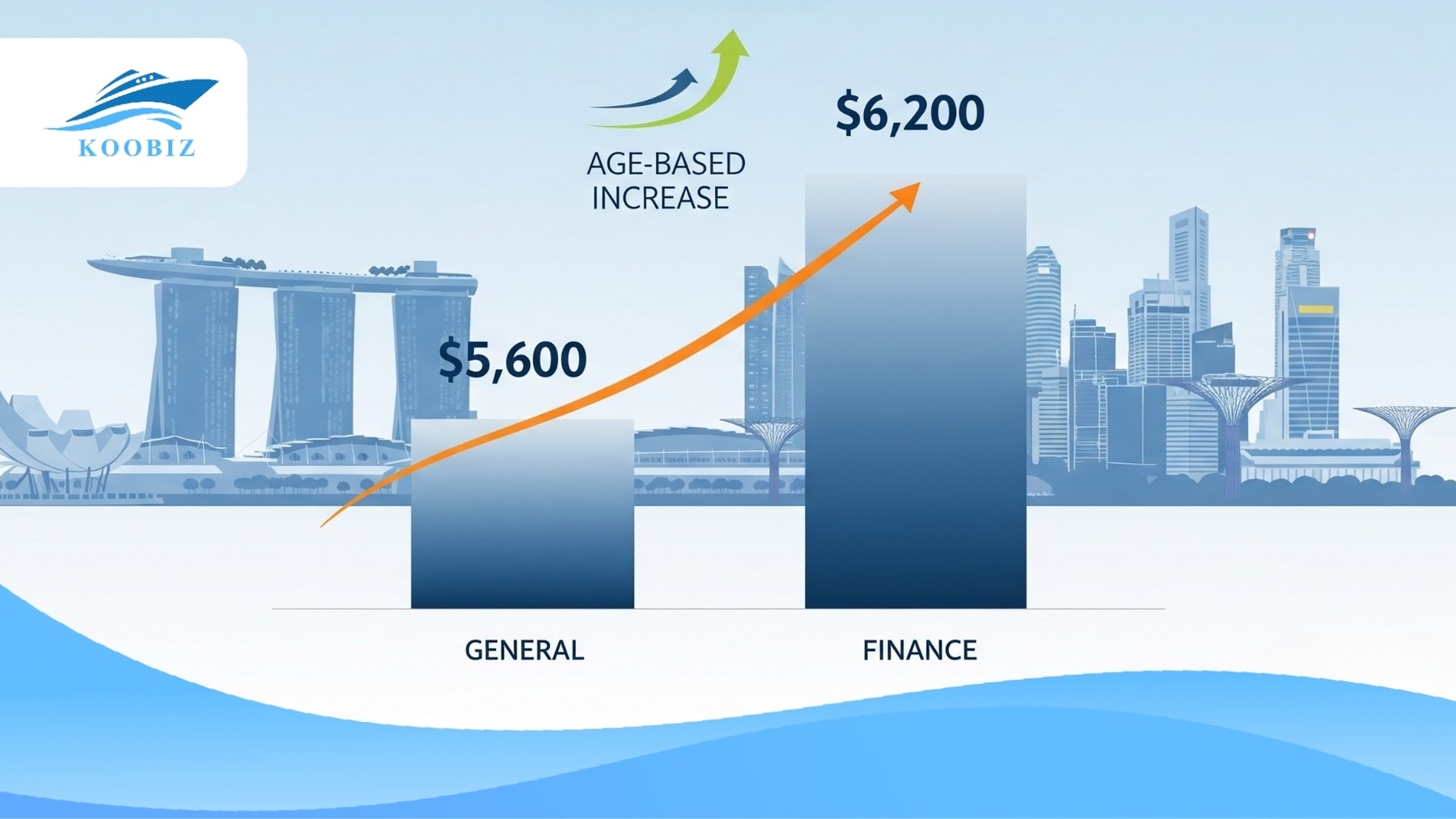
    New Base Thresholds: The minimum qualifying salary is $5,600 for all sectors, rising to $6,200 for Financial Services (effective for all new applications and renewals expiring from Jan 1, 2026).

    Age Matters: The requirement increases progressively with age; a 45-year-old candidate now requires $10,700+ (General) or $11,800+ (Finance).

    COMPASS Integration: Meeting the minimum only qualifies the candidate to apply; earning points under the COMPASS C1 attribute requires meeting local PMET salary benchmarks (65th and 90th percentiles).

    Fixed Components: Only “fixed monthly salary” counts towards the threshold, variable bonuses and overtime pay are excluded.

    [/SUMMARIES]

    For employers and HR leaders, obtaining an Employment Pass (EP) in Singapore has shifted from a straightforward salary benchmark to a more nuanced, multi-factor assessment. Meeting a single minimum threshold is no longer sufficient; today, the EP qualifying salary is assessed dynamically, taking into account the applicant’s age, industry sector, and performance under the COMPASS framework. These evolving requirements mean that workforce planning now requires greater precision and foresight At Koobiz, we frequently assist businesses in navigating these complexities to ensure their talent acquisition strategies remain compliant and efficient. This guide will help you accurately calculate the required salary to meet the new 2025/2026 standards.

    What is the Minimum Qualifying Salary for EP in 2025?

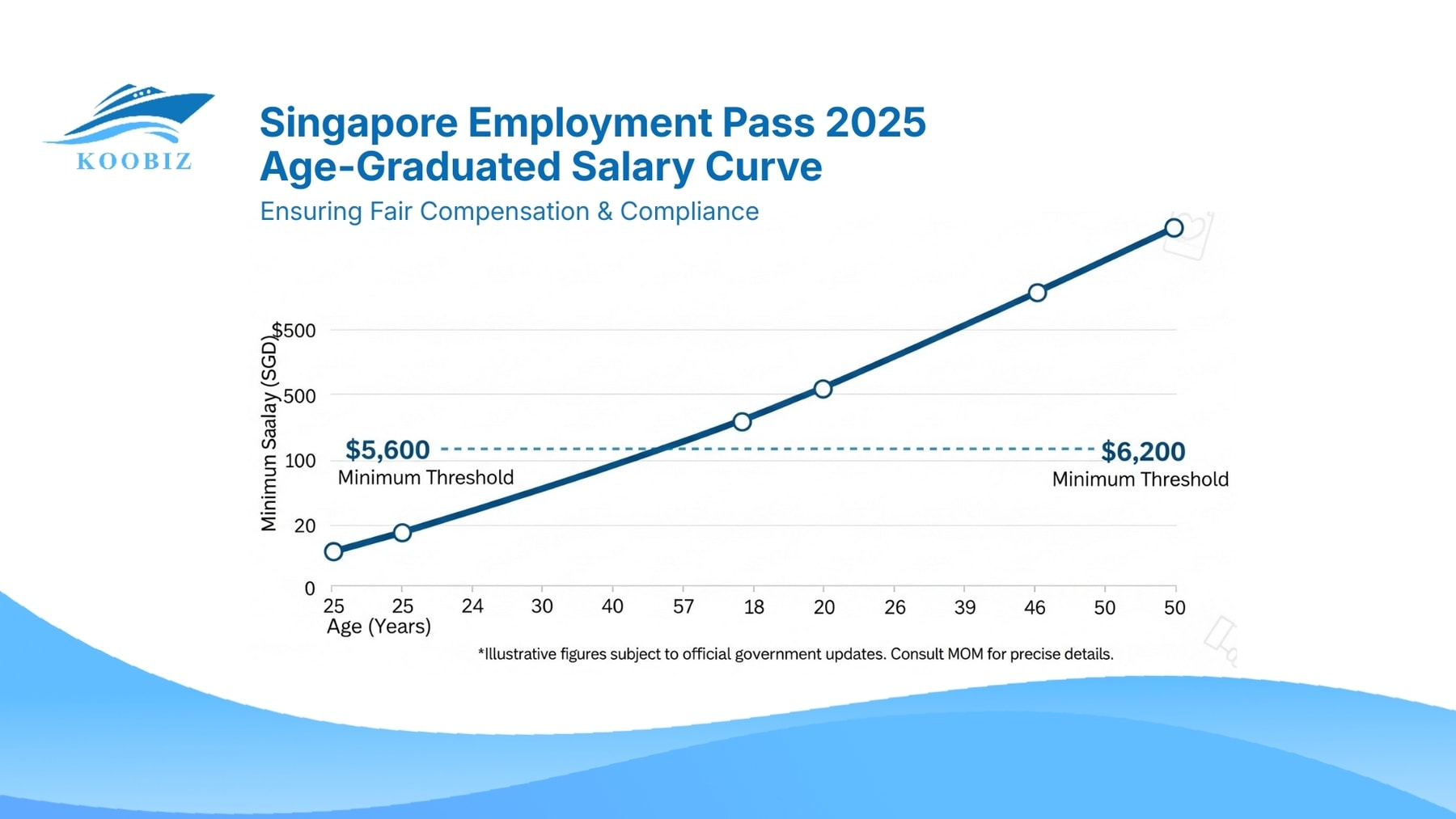
    As of 2025, the Ministry of Manpower (MOM) has raised the baseline monthly wage required to secure an Employment Pass to $5,600 for most industries.

    This figure is benchmarked against the top one-third of local PMET wages. For all new applications (and renewals expiring from 1 January 2026 onwards), the baseline thresholds are:

    • Non-Financial Sectors: $5,600 per month (up from $5,000).
    • Financial Services: $6,200 per month (up from $5,500).

    Note on Renewals: The previous lower rates ($5,000/$5,500) applied only to passes expiring before 31 December 2025. Moving forward into 2026, all candidates must meet these higher thresholds. Any EP application submitted with a fixed monthly salary below these amounts will be rejected automatically, regardless of the employer’s size, reputation, or business profile.

    Singapore EP salary 2025: $5,600 - $6,200
    Singapore EP salary 2025: $5,600 – $6,200

    How Does Age Affect the EP Salary Threshold?

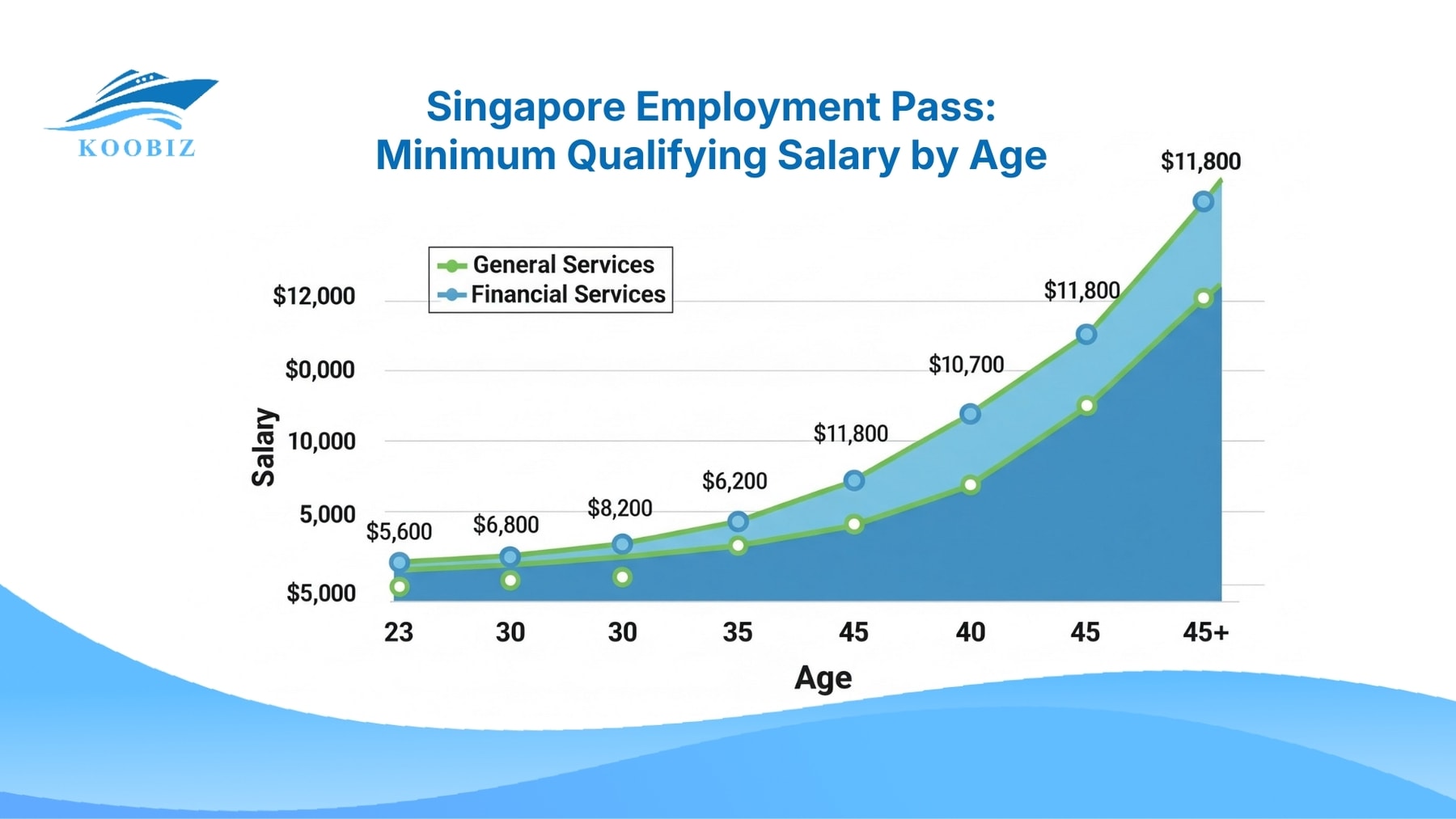
    The EP qualifying salary increases progressively with age, starting at the baseline for a 23-year-old and rising to nearly double for candidates aged 45 and above.

    EP salary increases by age: 23t: $5,600. 45t+: $10,700
    EP salary increases by age: 23t: $5,600. 45t+: $10,700

    MOM structures this increase to ensure foreign talent competes fairly with locals at a similar career stage. The 2025 age curve is significantly steeper than previous years:

    • Entry Level (Age 23): Candidates qualify at the absolute minimum ($5,600 General / $6,200 Finance).
    • Progressive Increase (Age 23 to 45): The salary requirement rises steadily. For example, a 30-year-old in a general sector now requires approximately $7,223.
    • Senior Level (Age 45 and above): The threshold peaks at $10,700 (General) and $11,800 (Financial Services).

    In practice, this “experience premium” is often the most underestimated cost in EP planning. As many employers working with Koobiz discover, hiring senior expatriates requires budgeting well above the headline minimum salary, especially when aligning compensation with COMPASS and renewal expectations.

    Financial Services vs. Non-Financial Sectors: The Salary Gap

    Financial services require a higher baseline compared to general industries, reflecting the premium wage norms within Singapore’s banking sector.

    The Ministry of Manpower recognizes that salaries in this sector are naturally inflated due to the high demand for specialized skills. Consequently, the bar is set higher across the board.

    Here is a detailed comparison of the 2025/2026 requirements:

    Comparison Factor Non-Financial Sectors Financial Services
    Base Salary (Age 23) $5,600 $6,200
    Mid-Career (Age ~35) ~$8,382 ~$9,000+
    Senior (Age 45+) $10,700 $11,800
    Target Industries Retail, Tech, Manufacturing, etc. Banking, Insurance, Asset Mgmt.

    This gap widens significantly as age increases. Failing to account for this sector-specific premium is a common reason for application rejections in the Central Business District.

    The COMPASS Framework: Calculating C1 Salary Points

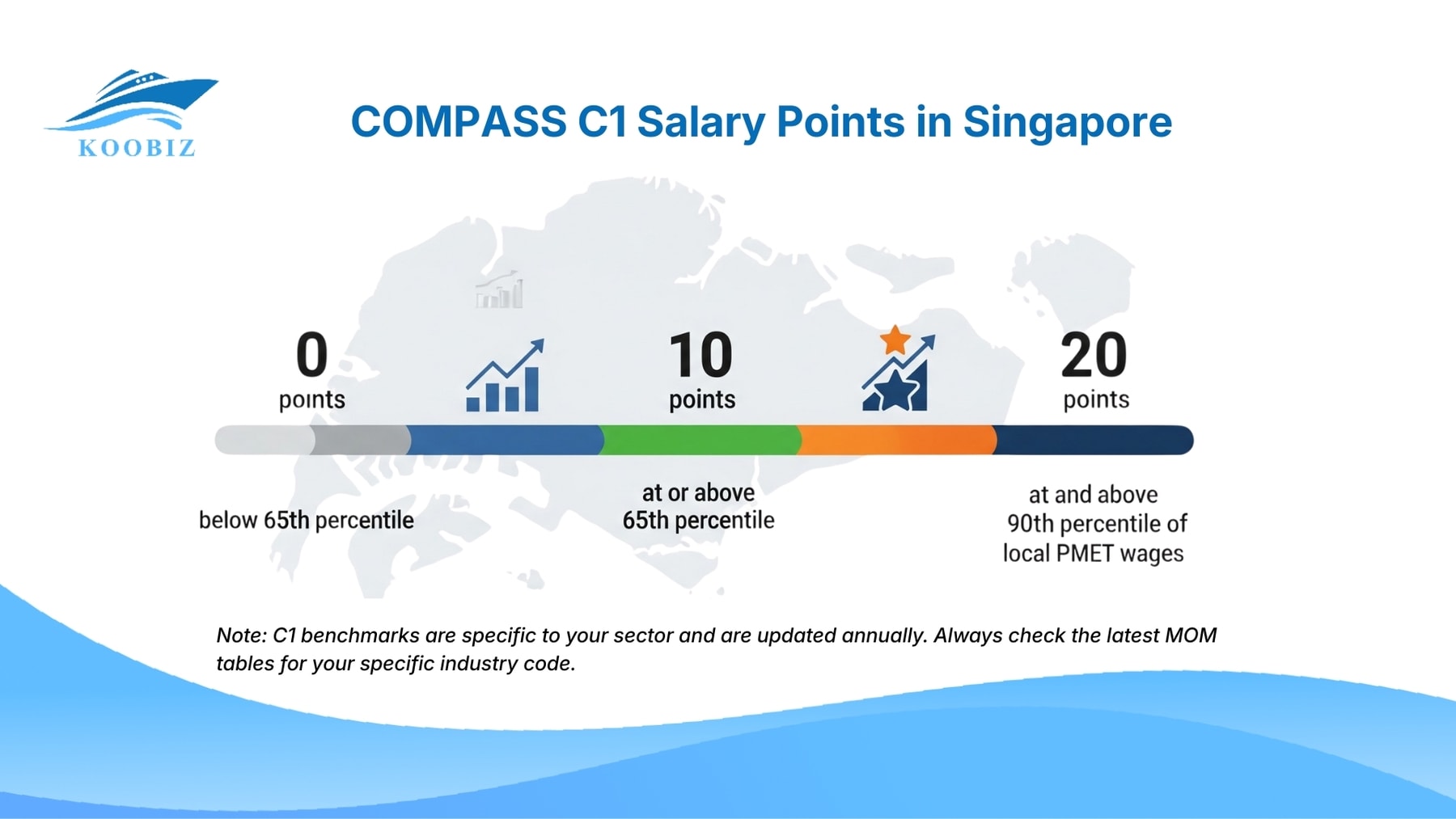
    The COMPASS Framework calculates C1 Salary Points based on two benchmarks: meeting the 65th percentile of local PMET wages earns 10 points, while meeting the 90th percentile earns 20 points.

    COMPASS C1 Salary Points: 0, 10 (≥65th percentile), 20 (≥90th percentile)
    COMPASS C1 Salary Points: 0, 10 (≥65th percentile), 20 (≥90th percentile)

    Importantly, meeting the EP qualifying salary is only the entry requirement, it does not earn points by itself. To pass COMPASS, an application must score at least 40 points, and C1 is the most straightforward lever employers can use to boost the total score.

    • 0 Points: Salary meets the EP minimum but is below the 65th percentile of local peers.
    • 10 Points: Salary is at or above the 65th percentile.
    • 20 Points: Salary is at or above the 90th percentile.

    Note: C1 benchmarks are specific to your sector and are updated annually. Always check the latest MOM tables for your specific industry code.

    Case Studies: Calculating EP Eligibility in Real Scenarios

    To demonstrate how the new 2025 rates apply, we have compiled three scenarios. These highlight the stricter requirements compared to previous years.

    Scenario 1: The “Age Trap” (Tech Sector)

    Candidate: Software Engineer, Age 38.

    Offer: $8,000 Fixed Monthly Salary.

    Outcome: REJECTED.

    • Analysis: While $8,000 seems high, the new 2025 benchmark for a 38-year-old in general sectors is approximately $9,077. The offer falls short by over $1,000.
    • Lesson: Mid-career hires face the steepest increases. You must check the specific age benchmark before making an offer.

    Scenario 2: The “Sector Premium” (Finance vs. Retail)

    Candidate: Marketing Manager, Age 30.

    Offer: $7,000 Fixed Monthly Salary.

    Outcome: AT RISK (Both Sectors).

    • In a Retail Company: REJECTED. The new general benchmark for Age 30 is roughly $7,223. An offer of $7,000 is no longer sufficient (unlike in 2024).
    • In an Investment Bank: REJECTED. The Finance benchmark for Age 30 is approximately $7,982.
    • Lesson: Salaries that were “safe” last year may now be insufficient.

    Scenario 3: The “COMPASS Save” (Using Salary to Pass)

    Candidate: Operations Director, Age 45.

    Challenge: The company has low diversity (0 points). They need 40 points solely from the candidate.

    Strategy: Offer a salary in the 90th percentile (e.g., $18,000+).

    • Result:
      • C1 (Salary): 20 Points (90th percentile).
      • C2 (Qualifications): 20 Points (Top-tier University degree).
      • Total: 40 Points -> PASSED.
    • Lesson: For senior roles, aiming for the 90th percentile can “save” an application even if the firm scores poorly on diversity.

    How to Use the MOM Self-Assessment Tool (SAT) for Verification

    The Self-Assessment Tool (SAT) is MOM’s official online calculator that predicts application outcomes.

    Before submitting any application, using the SAT is mandatory to avoid rejection fees and records.

    Step 1: Access and Login

    Navigate to the MOM SAT page. Koobiz strongly recommends logging in via Singpass to see your specific Firm-Level COMPASS scores (C3 Diversity and C4 Support for Local Employment).

    Step 2: Input Candidate Data

    Enter the candidate’s personal details accurately. Nationality & Date of Birth are critical for the age-based salary curve.

    Step 3: Input Job & Salary Details

    Enter only the fixed monthly salary. Do not include variable bonuses. If the result is “Not Eligible,” try adjusting the salary upward to find the passing threshold for that specific profile.

    Step 4: Interpret the Result

    • Green (Eligible): ~90% chance of approval.
    • Red (Not Eligible): Do not proceed. The salary likely fails the new 2025 age-based benchmarks.

    Understanding “Fixed Monthly Salary” Components

    Fixed Monthly Salary is the guaranteed amount paid every month. MOM assesses EP eligibility strictly based on this figure, not total compensation.

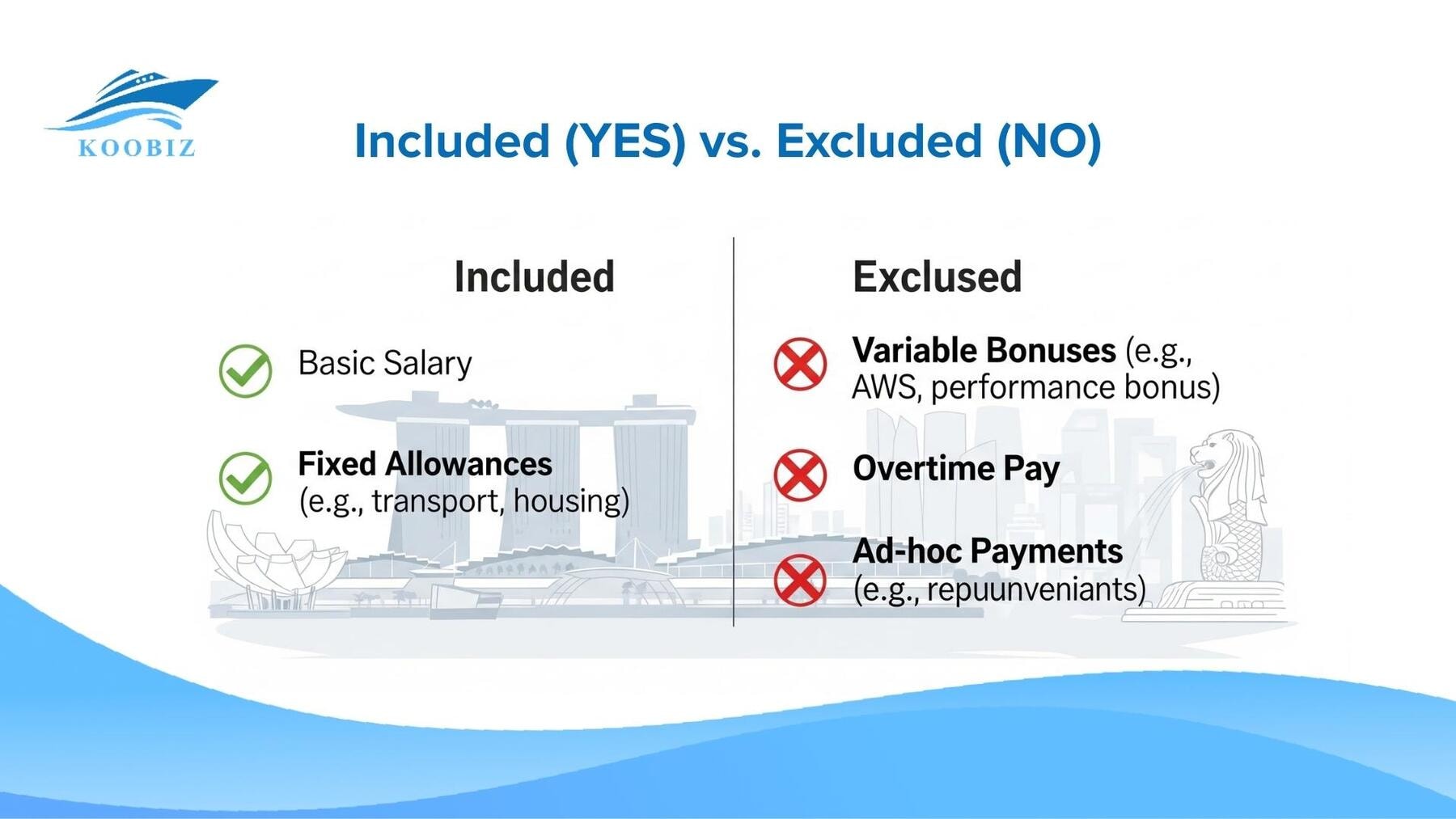
    Included (YES) vs. Excluded (NO)
    Included (YES) vs. Excluded (NO)

    Included (YES) vs. Excluded (NO)

    • YES: Basic monthly salary and fixed allowances (e.g., fixed transport/housing/meal allowances stipulated in the contract).
    • NO: Variable bonuses (AWS, performance bonus), overtime pay, reimbursements, and in-kind benefits (direct housing or car provided).

    Special Cases and Exemptions

    Renewals vs. New Applications

    While the 2025 increase applies fully to new EP applications, employers should plan early for renewals expiring in 2026. These renewals must meet the new higher baselines ($5,600 / $6,200), and many existing EP holders may need salary adjustments to remain eligible.

    Overseas Intra-Corporate Transferees (ICT)

    Intra-Corporate Transferees (ICTs) are senior employees transferred from an overseas branch. While they must still meet the age-tiered qualifying salary (Age 45+ ~$10,700), ICTs are exempt from the COMPASS framework (no C1 salary points needed).

    Frequently Asked Questions (FAQs)

    Can I use my “13th-month bonus” (AWS) to meet the $5,600 threshold?

    No. The Annual Wage Supplement (AWS) is not considered part of the “fixed monthly salary” because it is a one-time annual payment. You must meet the minimum threshold using strictly monthly guaranteed income.

    What is the salary requirement to bring my family (Dependants)?

    To sponsor a Dependant’s Pass for your spouse or children, you must earn a fixed monthly salary of at least $6,000. To sponsor a Long-Term Visit Pass for your parents, the threshold is significantly higher at $12,000.

    Can EP holders work part-time or start a side business?

    Generally, no. An Employment Pass is tied to a specific employer. You cannot engage in moonlighting or freelance work without explicit approval (e.g., a “Letter of Consent”) or holding a specific pass like the ONE Pass.

    How long is the Employment Pass valid for?

    For first-time applicants, the pass is typically granted for up to 2 years. For renewals, it can be granted for up to 3 years, provided the passport validity allows.

    My company is overseas without a Singapore branch. Can we still apply?

    Yes. Applications can be made via a local sponsor (a registered Singapore entity), though processing is longer (around 8 weeks). For smoother processing (about 10 business days) and better long-term compliance, Koobiz typically recommends incorporating a local Singapore entity.

    About Koobiz

    Navigating Singapore’s employment regulations, whether it’s determining the correct EP qualifying salary or managing corporate tax and accounting, can be challenging for international businesses.

    Koobiz helps simplify your market entry and ongoing compliance in Singapore. From company incorporation and corporate bank account opening to payroll setup and tax filings aligned with the latest MOM and IRAS requirements, our experienced team provides end-to-end support.

    Let us manage the regulatory details, so you can stay focused on scaling your business with confidence.

    Visit us at: Koobiz.com to learn more about our corporate services.

  • Can Sole Proprietorship have employees? The complete hiring guide for Singapore

    Can Sole Proprietorship have employees? The complete hiring guide for Singapore

    [SUMMARIES]

    Sole Proprietors in Singapore are legally permitted to hire employees but must strictly adhere to statutory obligations, including mandatory Central Provident Fund (CPF) contributions, issuing Key Employment Terms (KETs), and paying the Skills Development Levy (SDL).

    Hiring foreign staff faces significant constraints as Sole Proprietors are subject to sector-specific quotas and Dependency Ratio Ceilings (DRC), where the owner does not count as a local employee for quota calculation purposes.

    The structure carries significant risk due to unlimited liability, meaning owners are personally responsible for employment disputes and workplace accidents, prompting many to incorporate as a Private Limited Company (Pte Ltd) for better asset protection and scalability.

    [/SUMMARIES]

    Yes, a Sole Proprietorship in Singapore can hire employees. Hiring can unlock growth, but owners must follow Ministry of Manpower (MOM) rules, meet Central Provident Fund (CPF) obligations, and comply with employment law. This guide explains what to do (and what to watch out for), with practical tips and where Koobiz can help – from payroll & CPF filing to work-pass applications and incorporation services.

    Can Sole Proprietors in Singapore legally hire employees?

    Yes. A sole proprietor with a current ACRA registration may employ staff. Legally, the owner (or the registered business name) is the employer and enters into contracts of service directly. That means you don’t need board resolutions (as you would for a company), but you are personally responsible for employer obligations – so correct registration and timely compliance are essential.

    If your ACRA registration is expired or inaccurate, employment contracts may be disputed and you risk penalties from MOM.

    Koobiz helps clients set up compliant payroll systems, register for a CPF Submission Number (CSN), and issue correct employment documents so hiring starts on solid ground.

    According to the Ministry of Manpower (MOM), all employers, regardless of size or entity type, are legally bound by the Employment Act once they engage an employee under a contract of service.

    What are the Mandatory Requirements for hiring local staff?

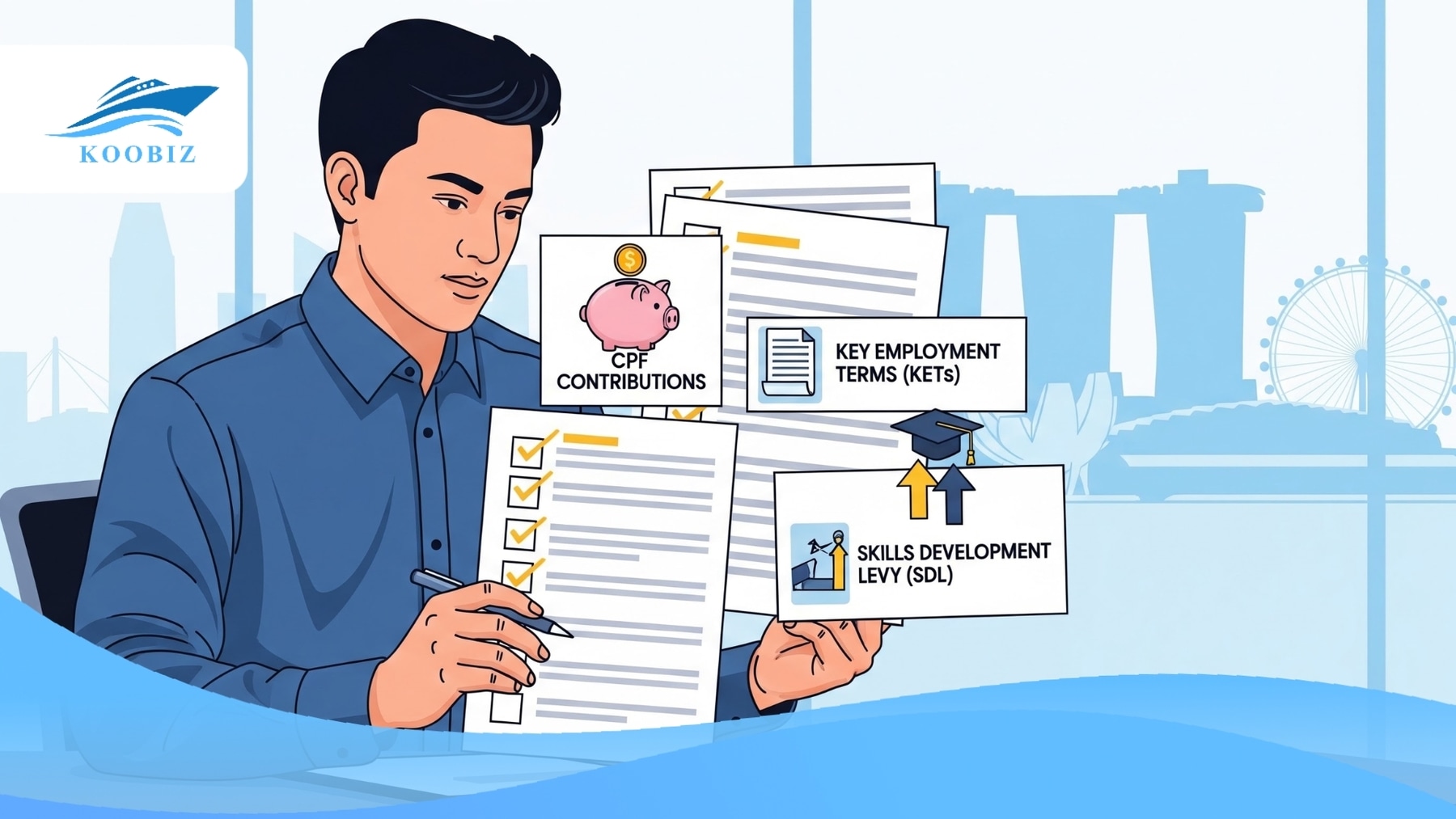
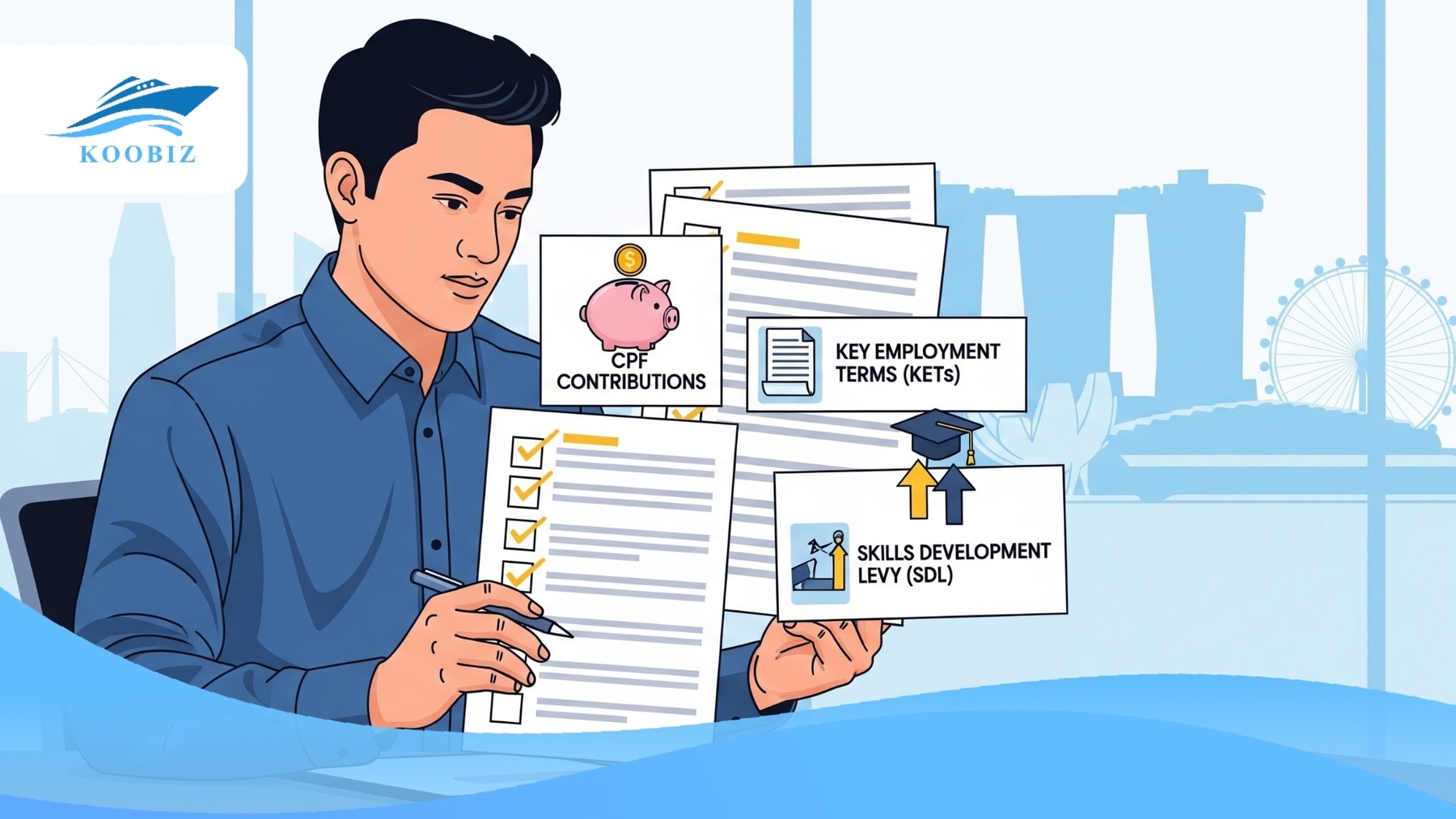
    When you hire local employees, the core obligations are simple to list but important to get right: CPF contributions, Key Employment Terms (KETs), Skills Development Levy (SDL), and fair hiring practices. Failure to comply can lead to fines and enforcement action.

    1. Central Provident Fund (CPF) Contributions

    You must register as an employer and obtain a CPF Submission Number (CSN) to submit CPF contributions. Employer and employee CPF contribution rates vary by the employee’s age (e.g., for employees 55 and below, employer share 17% and employee share 20% as at 1 Jan 2025). Contributions are normally due monthly, with statutory deadlines and penalties for late payment.

    2. Key Employment Terms (KETs)

    Employers must provide written Key Employment Terms to employees who are employed for 14 days or more, and these should be issued within 14 days of the start of employment. KETs list the essentials (names, job title, start date, salary, working hours, notice, etc.). You can include KETs within the employment contract.

    3. Skills Development Levy (SDL)

    SDL is payable for each employee at 0.25% of monthly wages, with a minimum of S$2 and a maximum of S$11.25 (SDL is capped on the first S$4,500 of wages). Don’t forget to include SDL in your payroll calculations.

    4. Fair Hiring Practices

    Data from the CPF Board indicates that late payment of CPF contributions is one of the most common offenses among small business owners, punishable by fines of up to SGD 10,000.

    Can a Sole Proprietor employ foreign workers in Singapore?

    Yes – but this is subject to strict conditions regarding approved source countries, sector-specific quotas. Hiring foreign workers requires appropriate work passes (Work Permit, S Pass), adherence to the sector’s Dependency Ratio Ceiling (DRC), and payment of foreign worker levies. For many sole proprietors, these rules are a practical constraint on scaling with foreign labour.

    • Work passes (S Pass / Work Permit): You must apply to MOM for the correct pass. S Pass eligibility includes a qualifying salary threshold that has been adjusted recently; note MOM’s staged increases to the S Pass qualifying salary (policy changed in 2025/2026).
    • Dependency Ratio Ceiling (DRC): The DRC limits the share of Work Permit + S Pass holders a business can employ. For the services sector the DRC is 35%, and within that the maximum share of S Pass holders is typically 10% – these quotas are enforced based on CPF-declared local staff numbers. If you have zero local employees who count toward quota, your foreign worker quota will be effectively zero.

    Practical implication for sole proprietors: Business owners of sole proprietorships do not count as local employees for quota calculations (only employees on CPF who meet the Local Qualifying Salary count), so a sole proprietor often needs to hire a local employee first (and contribute CPF) to create quota headroom.

    Koobiz can help with S Pass/Work Permit applications, quota planning, and payroll reporting so you don’t accidentally lose quota or face higher levies.

    Eligibility: You cannot just hire anyone. The worker must come from an approved source country (e.g., Malaysia, PRC, NAS countries) depending on your industry sector.

    What Insurance and Benefits must Sole Proprietors provide?

    Employers must secure Work Injury Compensation Insurance and meet statutory leave entitlements for qualifying staff. These are not optional protections.

    1. Work Injury Compensation Insurance (WICA)

    Employers must buy WIC insurance for all employees doing manual work and for non-manual employees earning S$2,600 or less per month (thresholds aligned with Employment Act provisions). If you fail to insure eligible staff, you remain personally liable for compensation and face penalties.

    2. Statutory Leave & Other Protections

    Under the Employment Act, employees who have worked for at least 3 months are entitled to statutory annual leave, sick leave, and other protections. Part-timers and contract status affect entitlements – check specifics before classifying workers as contractors.

    How does unlimited liability affect hiring for Sole Proprietorships?

    A sole proprietor has unlimited personal liability. Employment disputes, wrongful acts by employees, or large compensation orders can put personal assets at risk. This is the key reason many business owners choose to incorporate as a Private Limited (Pte Ltd) when they plan to grow headcount or hire foreign workers.

    Koobiz recommendation: if you plan to hire multiple staff or foreign workers, consider incorporating – Koobiz offers end-to-end company incorporation and migration of payroll/CPF filings so liabilities sit with the company, not your personal estate.

    Case Studies: Hiring in Action

    To better understand the practical implications of hiring as a sole proprietor, consider these two real-world scenarios illustrating compliance success and liability risk.

    Real-world examples clarify how these rules apply to daily operations.

    Scenario A: The Compliant Expansion (Success)

    Context: Jane owns “Jane’s Bakes,” a home-based bakery registered as a Sole Proprietorship. She wants to hire her first full-time assistant, a Singaporean Citizen.

    Action:

    1. Registration: Jane logs into the CPF website with her Singpass and applies for a CPF Submission Number (CSN).
    2. Contract: She drafts a Key Employment Terms (KETs) contract stating a salary of $2,000, working hours, and 7 days of annual leave.
    3. Insurance: Even though the salary is below the WICA mandatory limit for non-manual work, she buys WICA insurance because kitchen work involves physical risks (burns, slips).Result: Jane successfully scales her business. Her employee is protected, and she avoids any fines during MOM inspections.

    Scenario B: The Liability Trap (Risk)

    Context: Mark runs “Mark’s Reno,” a renovation sole proprietorship. He hires a delivery driver but decides to skip buying comprehensive insurance to save money.

    Incident: The driver accidentally reverses the company van into a client’s luxury gate, causing $15,000 in damages.

    Consequence:

    1. Direct Liability: The client sues Mark. Because it is a sole proprietorship, Mark is personally liable.
    2. Financial Hit: The business account only has $5,000. Mark is forced to use $10,000 from his personal family savings to pay the damages.Lesson: If Mark had incorporated a Private Limited Company, his personal savings would likely have been protected from this business liability.

    Frequently Asked Questions (FAQs)

    Sole Proprietorship vs. Private Limited: Which Structure is Better for Hiring?

    Private Limited wins on liability protection and foreign quotas, while Sole Proprietorship is better for administrative simplicity and lower initial costs.

    When comparing these structures for growth, business owners often reach a tipping point where the risks of the sole proprietorship outweigh its simplicity.

    Aspect Sole Proprietorship Private Limited (Pte Ltd)
    Liability Unlimited. Owner’s personal assets are at risk if sued. Limited. Company is a separate entity; personal assets are protected.
    Hiring Foreign Workers Difficult. Strict quotas; owner does not count as local staff. Scalable. Easier to access quotas and secure work passes.
    Initial Costs Low. Simple registration process. Higher. Incorporation fees and corporate secretarial costs.
    Tax Personal Income Tax (0% to 24%). No deduction on owner’s salary. Corporate Tax (Flat 17% with exemptions). Tax-efficient.
    Grants Limited. Harder to access major government grants. Accessible. Eligible for PSG, EDG, and other hiring subsidies.

    Ready to Scale? Upgrade to a Private Limited Company

    If you are planning to hire significant headcount or want to protect your personal assets from employment risks, incorporating a Private Limited company is the smartest move.

    Koobiz specializes in seamless company incorporation in Singapore. We handle the paperwork so you can focus on building your team.

    👉 Get a Free Consultation on Incorporating Your Business

    Do You Need to Pay CPF When Hiring Family Members?

    Yes, you generally need to pay CPF for family members if they are employed under a contract of service and receive wages, contrary to common misconception.

    To clarify, the CPF Board stipulates that if a family member (including spouse or children) is working for your business and receiving a salary, they are treated as an employee. Therefore, CPF contributions are mandatory.

    • The Exemption: CPF exemption only applies if the family member is a partner in the business (and thus self-employed) or if they are purely helping out without a formal employment contract or salary.
    • The Risk: If you pay them a “allowance” that functions as a salary but fail to pay CPF, you may be liable for late payment penalties. Always consult the CPF Board or a professional service if you are unsure about your specific family arrangement.

    How to Handle Part-Time Employees and Freelancers?

    Part-timers (work <35 hours/week) are employees with pro-rated entitlements; freelancers on a “contract for service” are not employees (no CPF/SDL) — but misclassification risk is high if you control hours and outcomes.

    Part-Time Employees:

    • Definition: Under the Employment Act, a part-time employee is one who works less than 35 hours a week.
    • Benefits: They are entitled to CPF (if earning >$50/month) and pro-rated annual and sick leave. You cannot deny them these benefits just because they are not “full-time.”

    Freelancers (Contract for Service):

    • Definition: These are independent contractors. They are not your employees.
    • Benefits: You do not pay CPF, SDL, or provide leave. You pay them a fee for a completed project.
    • Risk: Do not treat a full-timer as a freelancer to avoid CPF. If MOM investigates and finds they work fixed hours under your control, you will be forced to backpay CPF with interest.

    What Happens to Employees if the Sole Proprietorship Closes?

    If the business closes, employment is deemed terminated, requiring the immediate payment of all outstanding salaries and, for foreign staff, tax clearance via Form IR21.

    To understand the closure process, “cessation of business” is considered a valid reason for termination, but it does not absolve the owner of financial duties.

    • Notice Period: You must give the notice period stated in the contract or pay salary in lieu of notice.
    • Salary Payment: All outstanding salary must be paid on the last day of employment.
    • Retrenchment Benefits: Sole proprietorships are generally not legally mandated to pay retrenchment benefits unless it is stated in the employment contract, but it is encouraged by MOM for long-serving staff.
    • Foreign Workers: You must cancel their work passes and buy their air ticket home. Importantly, you must file Form IR21 with IRAS to withhold their last month’s salary for tax clearance purposes before releasing any remaining money to them.

    Summary

    Hiring as a sole proprietor in Singapore is a powerful way to grow, but it requires strict adherence to MOM and CPF regulations. From mandatory insurance to liability risks, every step matters. If you are ready to scale up and minimize risk, consider incorporating with Koobiz to separate your personal assets from your business obligations.

    Disclaimer: The information provided in this article is accurate as of December 2025. Regulations regarding CPF, foreign worker quotas, and levies are subject to change by the Ministry of Manpower (MOM) and other government agencies. Business owners are advised to verify the latest requirements on official government websites.