Blog

  • What Business to Start in Singapore? (10 Profitable Ideas)

    What Business to Start in Singapore? (10 Profitable Ideas)

    [/SUMMARIES]

    Prime Location: Singapore remains a top global hub for startups due to its pro-business policies, 100% foreign ownership allowance, and attractive tax exemptions.

    Top Profitable Sectors: High-yield industries include FinTech, E-commerce, Health & Wellness, F&B (Cloud Kitchens), and specialized B2B Consulting.

    Seamless Setup Process: Legally starting a business requires choosing an entity, ACRA registration, opening a bank account, and appointing a corporate secretary.

    Koobiz Support: Koobiz provides end-to-end solutions, from company incorporation and nominee director services to corporate bank account advisory, tax, and accounting.

    [/SUMMARIES]

    Choosing the right business to start in Singapore is not just about having a good idea. Long-term profitability depends on selecting a scalable model, complying with local regulations, and having reliable corporate support such as Koobiz to handle incorporation and compliance. This guide outlines the 10 most profitable business ideas in Singapore for 2026, along with practical incorporation steps and key considerations for both foreign and local founders.

    Is Singapore Still a Good Place to Start a Business?
    Singapore - the most attractive jurisdiction to start a business
    Singapore – the most attractive jurisdiction to start a business

    Yes, Singapore remains one of the most attractive jurisdictions to start a business, supported by competitive tax rates, a strategic geographic location, and strong government-backed startup initiatives.

    The following factors explain why Singapore continues to rank as a leading global business hub:

    • Highly Favorable Tax System: Singapore applies a flat corporate tax rate of 17%, with no capital gains tax and no tax on dividends. The Start-Up Tax Exemption (SUTE) scheme further reduces taxable income during the first three years of assessment for qualifying companies. Additionally, companies can take advantage of the new 40% Corporate Income Tax (CIT) Rebate for YA 2026 (capped at S$30,000, with a possible cash grant), making it incredibly cost-effective to scale right now.
    • 100% Foreign Ownership: Foreign investors may own 100% of a Singapore company’s shares without a local equity partner, provided they appoint at least one locally resident director, as required by Singapore law.
    • Strategic Global Location: Located in the heart of Southeast Asia, Singapore offers direct access to fast-growing regional markets like Malaysia, Indonesia, Vietnam, and Thailand.
    • World-Class Infrastructure & IP Protection: Singapore also benefits from strong intellectual property protection, political stability, and a highly skilled workforce. The ecosystem allows innovative tech and creative ideas to scale rapidly and safely.

    Singapore ranks #1 globally in the World Bank’s Business Ready (B-READY) 2025 report for overall business readiness and operational efficiency, proving its unparalleled regulatory environment.

    What Are the Top 10 Profitable Business Ideas in Singapore?

    Based on current market demand, the 10 most profitable business ideas in Singapore include E-commerce, FinTech, Health and Wellness, F&B, Corporate Services, EdTech, Digital Marketing, Green Tech, Cleaning Services, and Professional Consulting.

    These sectors deliver strong return on investment (ROI) driven by changing consumer behaviour, targeted government initiatives, and rapid technological adoption. Below is a practical breakdown of each business idea to help you assess alignment with your capital structure and operational expertise.
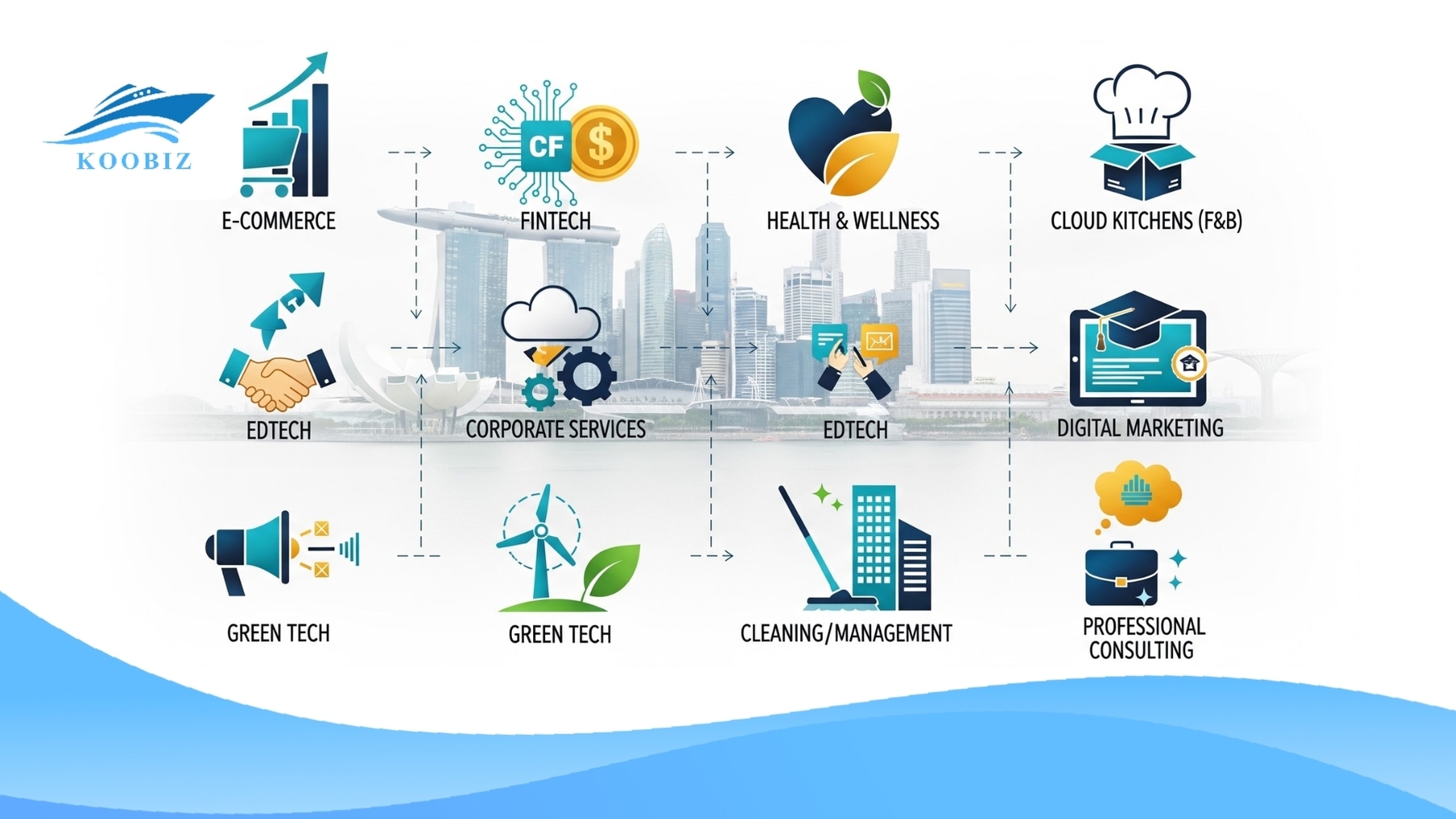
    10 profitable business ideas Singapore
    10 profitable business ideas Singapore

    1. E-commerce and Cross-Border Retail

    Singapore’s digital retail sector continues to expand, positioning e-commerce as one of the most accessible and scalable business models. Singapore’s excellent logistics infrastructure, anchored by Changi Airport and the Port of Singapore, makes it the perfect base to sell to the broader ASEAN market.

    • Pros: Lower upfront capital requirements, reduced inventory risk through dropshipping models, and strong regional logistics connectivity.
    • Cons/Challenges: High market competition and compliance with cross-border tax and customs regulations.
    • The Koobiz Advantage: We support e-commerce founders by structuring entities for tax efficiency and managing ongoing corporate tax compliance to ensure you remain compliant while scaling globally.

    2. FinTech and Web3 Solutions

    Singapore is recognised as one of Asia’s leading FinTech hubs. With active regulatory oversight and innovation support from the Monetary Authority of Singapore (MAS), starting a business in blockchain tech, digital payments, or WealthTech offers strong long-term commercial potential.

    • Pros: High scalability, access to institutional funding, and government-backed innovation programmes.
    • Cons/Challenges: Strict regulatory compliance and complex initial entity setups.
    • The Koobiz Advantage: We manage the complex incorporation requirements and provide expert corporate secretarial services, ensuring your FinTech startup meets all rigorous local governance standards from day one.

    3. Health and Wellness Services

    Singapore has a rapidly aging population and a highly stressed corporate workforce, driving sustained demand for health and wellness services like boutique fitness studios, mental health apps, and specialized nutrition consulting.

    • Pros: Year-over-year revenue growth, diverse profitable niches, and high consumer willingness to spend on self-care.
    • Cons/Challenges: Stringent licensing requirements for health products and high physical space rental costs.
    • The Koobiz Advantage: We streamline your business registration and provide accurate financial reporting to help you keep your operational overheads and rental costs strictly in check.

    4. F&B (Food and Beverage) and Cloud Kitchens

    The modern “Cloud Kitchen” (or ghost kitchen) model has significantly improved cost efficiency within the traditional F&B sector by operating as a delivery-only food business tailored to health-conscious demographics.

    • Pros: Reduces fixed overheads such as prime retail rental and front-of-house staffing.
    • Cons/Challenges: Managing tight profit margins on delivery apps and complying with the National Environment Agency (NEA) licensing.
    • The Koobiz Advantage: Our precise accounting services help you track your food costs and platform margins meticulously, ensuring your cloud kitchen remains consistently cash-flow positive.

    5. Corporate and Accounting Services

    With thousands of new companies registering in Singapore every month, B2B services (like corporate secretaries, tax consultants, and HR recruiters) highlight the sustained and recurring demand for corporate compliance and advisory services.

    • Pros: High-margin, low-overhead business model with recurring revenue streams.
    • Cons/Challenges: Requires deep local legal and financial expertise.
    • The Koobiz Advantage: While this is our core area of expertise, we also support independent consultants and professional service agencies. We can serve as your reliable backend corporate secretary, allowing you to deliver incorporation and compliance services to your own clients without maintaining an in-house corporate team.

    6. Education and EdTech

    Education is a top priority for both individuals and employers in Singapore. Starting an enrichment center, offering specialized tutoring, or developing an EdTech platform can generate strong and predictable returns, especially with the modern shift toward lifelong learning.

    • Pros: Stable recurring revenue and access to government-supported adult upskilling initiatives.
    • Cons/Challenges: High customer acquisition costs and the need to hire accredited professionals.
    • The Koobiz Advantage: We help EdTech startups structure their companies to be attractive to venture capital, and we manage the well-maintained financial records required for government grant applications.

    7. Digital Marketing and Creative Agencies

    As more businesses migrate online, specialized digital marketing agencies focusing on specific niches—such as TikTok marketing for F&B or SEO for corporate services—can command premium monthly retainers.

    • Pros: High profit margins, minimal physical infrastructure requirements, and strong scalability.
    • Cons/Challenges: Managing erratic cash flows from clients and scaling talent.
    • The Koobiz Advantage: Our dedicated tax and accounting experts ensure your agency’s cash flow is properly tracked, invoiced, and tax-optimized, supporting long-term profitability and tax efficiency.

    8. Green Tech and Sustainability Solutions

    The Singapore Green Plan 2030 has created significant commercial opportunities for sustainability-focused businesses. Ideas include renewable energy consulting, sustainable packaging, and carbon footprint tracking software.

    • Pros: Government incentives, access to sustainability-focused funding, and rising corporate ESG requirements.
    • Cons/Challenges: High initial R&D costs and long sales cycles for B2B enterprise contracts.
    • The Koobiz Advantage: We maintain the impeccable financial records and compliance standards you absolutely need to qualify for funding programmes administered by Enterprise Singapore and other green technology grant bodies.

    9. Cleaning and Facility Management

    Commercial cleaning and facility management is a stable business model with predictable cash flow. Corporate offices, retail malls, and high-end residential condos require constant, reliable maintenance.

    • Pros: High-value, long-term corporate contracts and the ability to differentiate your brand using smart/IoT cleaning tech.
    • Cons/Challenges: Highly labour-intensive and requires managing complex payrolls for hourly workers.
    • The Koobiz Advantage: Outsourcing administrative and accounting functions helps operators focus on operational scaling. Our accounting services ensure your finances are organized, allowing you to scale your workforce without operational bottlenecks.

    10. Specialized Consulting (HR, IT, Legal)

    If you have years of corporate experience, monetizing your knowledge through a specialized consulting firm (such as cybersecurity advisory or D&I HR training) can be a highly profitable and scalable business model.

    • Pros: High margins, low overhead costs, and flexibility to operate as a solo or boutique consultancy.
    • Cons/Challenges: Personal liability risks if operating as a sole proprietor instead of a properly incorporated entity.
    • The Koobiz Advantage: We assist with incorporating your consulting firm as a Private Limited (Pte Ltd) company, protecting your personal assets, maximizing your tax benefits, and boosting your professional credibility.

    How to Setup Your New Business in Singapore?

    Setting up a business in Singapore typically involves four essential legal and operational steps: choosing your entity, registering with ACRA, opening a corporate bank account, and appointing a qualified corporate secretary for compliance.

    Following these steps ensures your business operates legally, efficiently, and benefits from Singapore’s tax framework from the outset. Below is a practical step-by-step overview of how to convert your business idea into a legally incorporated Singapore company.

    Step 1: Choose Your Business Entity

    Before registering, you must decide on the legal structure, with the Private Limited Company (Pte Ltd) as it is the most commonly adopted structure for growth-oriented businesses.

    • The Standard Process: Requires deep research into liability, tax implications, and corporate structures to ensure you don’t accidentally choose an entity (like a Sole Proprietorship) that puts your personal assets at risk if the business fails.
    • The Koobiz Solution: Our consultants evaluate your specific business model and expertly structure your Pte Ltd to maximize liability protection and ensure you qualify for the 17% corporate tax cap and startup exemptions.

    Step 2: Register with ACRA

    Accounting and Corporate Regulatory Authority (ACRA) is Singapore’s national company registrar and regulator. You must submit your official incorporation application via the BizFile+ portal.

    • The Standard Process: Involves preparing the company constitution, drafting shareholder agreements, and requires a local Singpass. Foreign entrepreneurs cannot legally self-register without a resident partner.
    • The Koobiz Solution: As a registered filing agent, we manage the entire incorporation process on your behalf. We prepare all necessary legal documents and handle the entire ACRA submission on your behalf, often incorporating your company in just 1-2 days.

    Step 3: Open a Corporate Bank Account

    Once incorporated, opening a corporate bank account is crucial for managing your capital, receiving client payments, and paying employees.

    • The Standard Process: Involves navigating strict Anti-Money Laundering (AML) laws, preparing extensive KYC (Know Your Customer) documentation, and frequently encountering delays or rejections
    • The Koobiz Solution: We work closely with major Singapore banks (including DBS Bank, OCBC Bank, and UOB) to provide expert advisory. We prepare your exact documents and liaise directly with bankers to to improve approval efficiency and success rates.

    Step 4: Appoint a Corporate Secretary

    Under the Singapore Companies Act, every company must legally appoint a qualified Company Secretary within six months of incorporation.

    • The Standard Process: Hiring an in-house secretary is an expensive overhead. Trying to manage ACRA and IRAS statutory filings yourself often results in missed statutory deadlines, financial penalties, or director disqualification risks.
    • The Koobiz Solution: We provide professional, outsourced Corporate Secretary services. We ensure your business remains 100% compliant year-round, allowing you to focus entirely on growing your profits without the administrative stress.

    Professional secretarial support significantly improves compliance rates and makes companies much more attractive to investors (per industry benchmarks), compared to self-managed entities.

    Advanced Considerations for Entrepreneurs in Singapore

    Beyond incorporation, entrepreneurs should assess four additional strategic considerations: foreign ownership viability, entity structure comparison, common failure risks, and access to government startup grants based on compliance.

    Beyond the basics, addressing these complex queries will safeguard your investment, mitigate legal risks, and unlock additional financial resources from the government.

    4 advanced considerations for starting a business in Singapore
    4 advanced considerations for starting a business in Singapore

    Can a Foreigner Start a Business Without Relocating to Singapore?

    The Short Answer: Yes, absolutely. You can own 100% of a Singapore company without ever physically relocating to the country.

    The Details: However, the law mandates that every company must have at least one ordinarily resident Director (a Singapore Citizen, Permanent Resident, or EntrePass holder). If you wish to remain overseas, you must utilize a Nominee Director service. Koobiz provides Nominee Director services to meet this statutory requirement while preserving full operational control for foreign owners.

    Private Limited vs. Sole Proprietorship: Which Entity is Best?

    The Short Answer: The Private Limited (Pte Ltd) definitely wins on liability protection and tax efficiency, while the Sole Proprietorship is only optimal for extremely simple, low-risk setups.

    The Details: In a Sole Proprietorship, the owner and the business are the same legal entity, meaning personal assets are at risk if the business is sued or goes bankrupt. Conversely, a Pte Ltd limits your liability to your share capital. Furthermore, Sole Proprietors are taxed at personal income tax rates (which can go up to 24%), whereas Pte Ltd companies benefit from corporate tax rates (capped at 17%) and generous startup exemptions. For any serious entrepreneur, a Pte Ltd is the definitive choice.

    What Are the Most Common Reasons Businesses Fail in Singapore?

    The Short Answer: The most common reasons businesses fail in Singapore are poor cash flow management, lack of market differentiation, and failure to comply with statutory tax regulations.

    The Details: Cash flow management is a critical factor for startup survival. Additionally, ignoring tax filings with the Inland Revenue Authority of Singapore (IRAS) leads to compounding penalties that can cripple a new venture. By utilizing Koobiz’s professional accounting, auditing, and tax services, founders can maintain clear financial visibility and significantly reduce compliance-related risks.

    Are There Government Grants Available for New Startups?

    The Short Answer: Yes, the Singapore government offers a wealth of financial grants and incentives to foster innovation and business growth.

    The Details: Programs such as the Startup SG Founder grant provide capital matching for first-time entrepreneurs, while the Enterprise Development Grant (EDG) supports businesses upgrading their technology or expanding overseas. However, to qualify for these grants, companies must maintain impeccable financial records and demonstrate strong corporate governance. Having a professional accounting firm like Koobiz manage your books drastically increases your chances of successful grant applications.

    Ready to Launch Your Profitable Business in Singapore?

    Knowing what business to start in Singapore is only the beginning of your entrepreneurial journey. Executing that idea flawlessly requires a solid legal foundation, meticulous financial management, and a trusted corporate partner.

    At Koobiz, we specialize in turning your profitable ideas into fully compliant, operational businesses. From seamless Company Incorporation and Nominee Director Services to expert Corporate Bank Account Advisory, Tax, Accounting, and Auditing, we handle the bureaucratic heavy lifting so you can focus on what you do best: growing your business.

    Avoid regulatory and compliance delays that can impact early-stage growth. Visit Koobiz.com today and consult with our experts to kickstart your Singapore business journey with confidence.
  • Track Singapore Work Pass Application Status: EP & S Pass Processing Guide

    Track Singapore Work Pass Application Status: EP & S Pass Processing Guide

    [SUMMARIES]

    Multiple Verification Channels: You can track your application instantly on the Ministry of Manpower (MOM) website or the SGWorkPass mobile app using your FIN or Passport number.

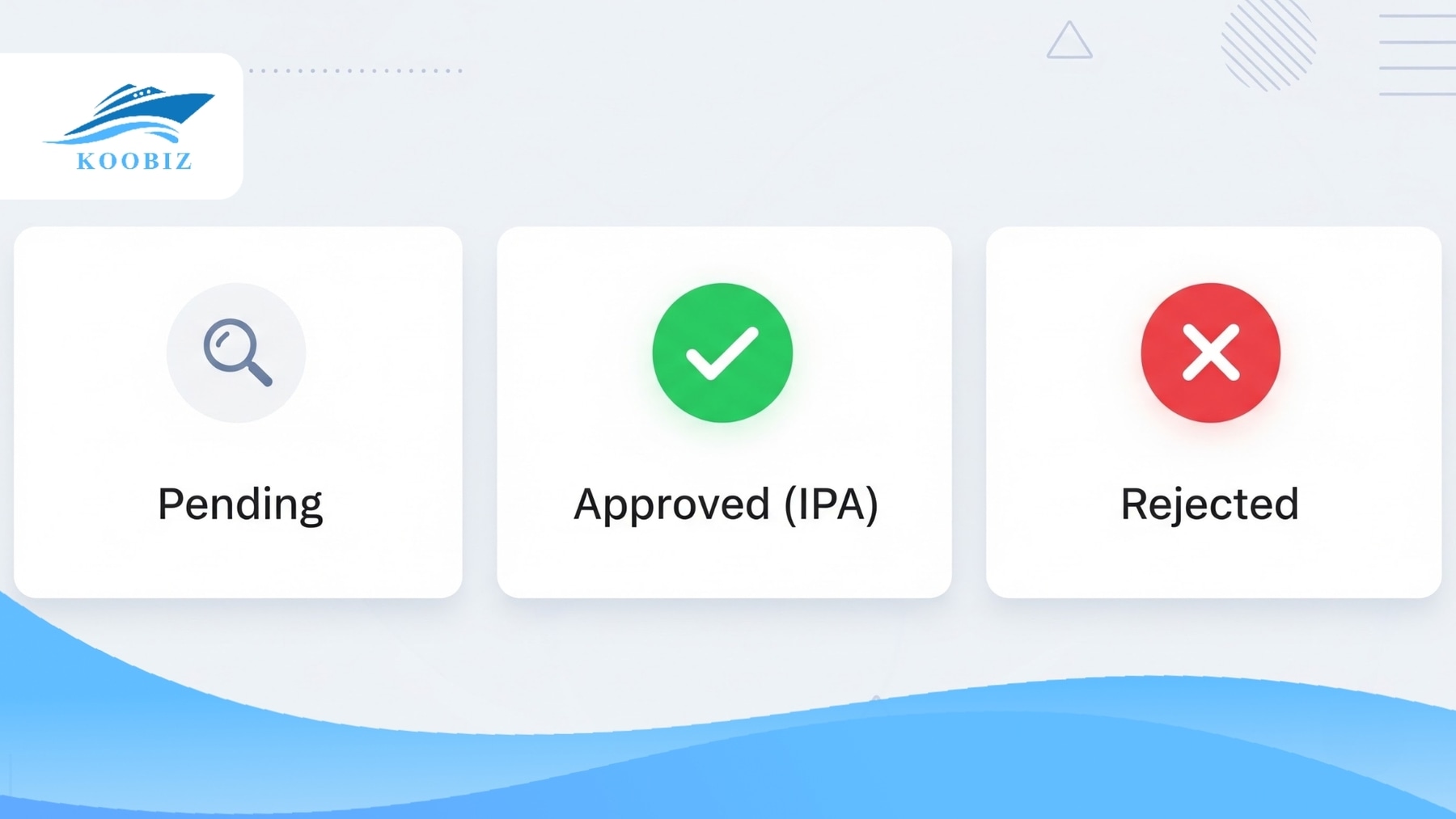
    Decoding Statuses: Knowing what terms like “Pending Input,” “IPA (Approved),” and “Rejected” mean is key to knowing what to do next.

    Variable Timelines: Employment Pass (EP) applications typically take 10 business days to 8 weeks, while S Pass applications usually take 3 to 8 weeks.

    Appeal Strategy: A rejection isn’t final. You have a 3-month window to appeal with new information.

    Koobiz Support: As your corporate services partner, Koobiz helps with company incorporation and provides advice on navigating complex work pass regulations.

    [/SUMMARIES]

    For both companies and foreign professionals, waiting for a work visa can be a time of uncertainty. Whether you’re starting a new company in Singapore with Koobiz or hiring international talent, knowing how to track Singapore Work Pass application status accurately is essential for your business plans. This guide explains step-by-step how to check your status, understand the results from the Ministry of Manpower (MOM), know the processing times for EP and S Pass, and what to do if an application is delayed or rejected.

    How to Check Singapore Work Pass Application Status?

    2 ways to check Singapore Work Pass
    2 ways to check Singapore Work Pass

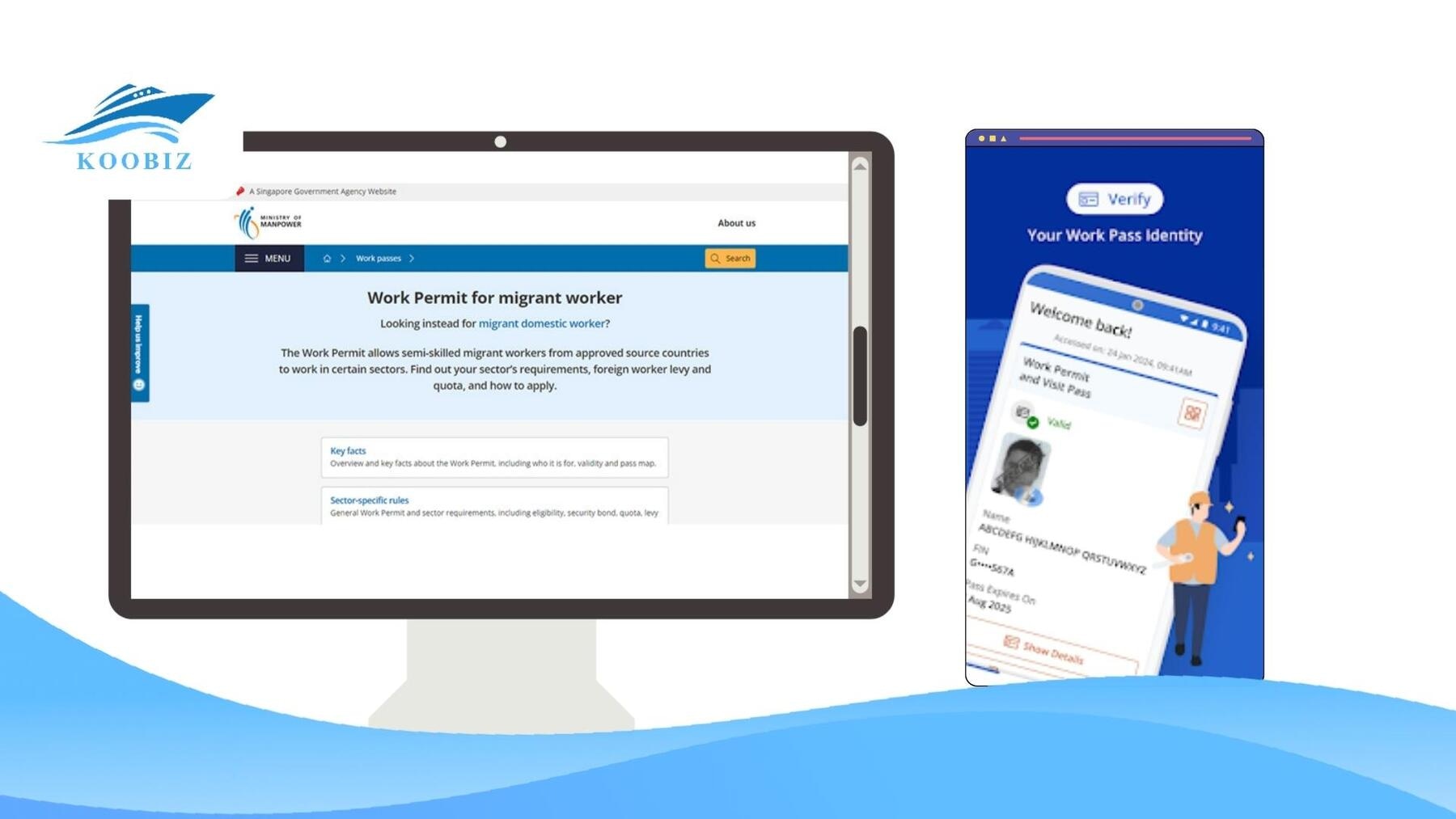
    There are two main official ways to check your work pass status: using the Ministry of Manpower (MOM) online portal or the SGWorkPass mobile app.

    For the most current information, it’s best to use these digital tools instead of calling MOM, as the systems are updated in real-time. Both employers and candidates can use these platforms 24/7 to monitor an application’s progress.

    Checking via MOM Online Website (EP Online)

    The most direct method is through the MOM “Check work pass and application status” e-service. This tool only needs specific identification details and does not require a Singpass login.

    Follow these steps to check online:

    1. Access the Portal: Visit the official MOM [Check work pass and application status] page.
    2. Enter Personal Details: Input the candidate’s Date of Birth.
    3. Provide Identification: Enter either the Foreign Identification Number (FIN) or the Passport Number used in the application.
    4. View Results: Click “Submit” to see the current status, expiry date (if the pass is issued), and pass type.

    Using the SGWorkPass Mobile App

    For those who need to check status often or verify a physical card’s validity, the SGWorkPass app is the ideal tool. This is especially useful for landlords or telecom companies checking a tenant’s or customer’s status.

    How to use the app:

    1. Download: Install SGWorkPass from the Apple App Store or Google Play Store.
    2. Setup: Open the app. You can set it up by scanning the QR code on the back of a work pass card or by entering details manually.
    3. Verify: Use the “Scan QR Code” feature to scan a physical card to see if it is still valid.
    4. Check Status: You can also search using the FIN and Date of Birth to see the latest status from MOM’s database.

    Checking Status for Dependents (DP & LTVP)

    It’s important to know that the status of Dependant’s Passes (DP) and Long-Term Visit Passes (LTVP) is directly connected to the main work pass holder.

    You check their status the same way – use the main applicant’s details or the dependent’s passport details in the MOM online tool (Method 1). Typically, when the main EP or S Pass is approved, the dependent passes will start processing or be approved soon after. So, monitoring the main pass is the best way to track overall progress.

    What Do the Application Status Codes Mean?

    These are standard terms used by MOM to show the current stage or final result of a work pass application. Understanding them is important because they tell you what action is needed next. For example, mistaking a “Pending Input” status for a simple “Pending” status could cause unnecessary delays.

    The meaning of MOM's Work Pass application status codes
    The meaning of MOM’s Work Pass application status codes

    Pending and Pending Input

    • What it means:
      • Pending: Your application is being reviewed by MOM officers. This is a waiting period while they check documents and qualifications.
      • Pending Input: This is an important alert. It means MOM has paused processing because they need more documents or clarification from you – for example, to verify educational certificates or salary details.
    • Koobiz Advice:If you see “Pending Input,” the processing clock has stopped. You must respond to these requests immediately. We strongly advise responding within 7 days to avoid your application being automatically cancelled.

    Approved (In-Principle Approval – IPA)

    • What it means:Success! An “Approved” status means an In-Principle Approval (IPA) letter will be issued. This letter serves as a temporary entry visa and signals that the relocation process can begin.
    • Koobiz Advice:The IPA is valid for a set period (usually 6 months for an EP). Use this time to bring the candidate to Singapore and complete any required medical checks. Remember, the IPA is not the final pass; it’s the approval to come and complete the final formalities.

    Rejected or Unsuccessful

    • What it means:The application did not meet the qualifying criteria, which are based on the COMPASS framework or other MOM requirements. Due to privacy policies, MOM typically does not give the specific reason for rejection directly to the candidate.
    • Koobiz Advice:Don’t panic. The reason is only available to the employer or authorised agent via EP Online. Common issues include salary problems or not meeting the Singaporean Core requirements. Do not simply re-apply immediately; a well-planned appeal is often the better approach.

    Withdrawn or Invalid

    • What it means:
      • Withdrawn: The employer has voluntarily cancelled the application.
      • Invalid: The pass has expired or has been cancelled by MOM.
    • Koobiz Advice:This status is final. Unlike a rejection, which can be appealed, a withdrawn application cannot be reactivated. If you still want to hire the person, you must submit a completely new application.

    EP and S Pass Processing Time: How Long Does it Take?

    Processing times vary depending on the pass type and if extra checks are needed. Here is a comparison of typical and extended timelines to help you plan.

    Pass Type Standard Processing Complex Case (Vetting) Key Delay Factors
    Employment Pass (EP) 10 Business Days Up to 8 Weeks Education Verification, COMPASS Scoring, Background Checks
    S Pass 3 Weeks Up to 8 Weeks Employer’s Quota Balance, Levy Eligibility, Verification of Qualifications

    These are official guidelines, but actual timeframes can change based on application volume and how complete your submitted documents are.

    EP and S Pass processing time, delay factors
    EP and S Pass processing time, delay factors

    Understanding the Timelines

    For Employment Pass (EP):

    Most online EP applications are processed within 10 business days. However, since the COMPASS framework was introduced, MOM scrutinises educational qualifications and company-related attributes more closely. This detailed checking, which may involve third-party screening agencies, is why a simple 10-day process can sometimes take months.

    For S Pass:

    S Pass applications generally take about 3 weeks. Unlike the EP, the S Pass is strictly limited by a quota based on the company’s industry and its number of local employees. MOM needs time to confirm the employer has enough “quota” available before approving the pass.

    Why Is My Application Delayed?

    Delays usually happen because of specific checks or inconsistencies in the data. If your application takes longer than the standard time, it’s likely due to one of these reasons:

    • Verification Checks: MOM is verifying educational qualifications with overseas institutions or background screening agencies.
    • Inconsistent Data: There are mismatches between the details in the application form and the supporting documents provided.
    • Security Vetting: The application is going through additional security vetting by other government agencies.
    • Missed Requests: The employer may have missed an email from MOM asking for more information.

    Koobiz Pro Tip: Is your application stuck?

    First, check your Spam/Junk folder for missed emails from MOM—this is the #1 cause of “stalled” applications. Second, log in to EP Online to ensure the status isn’t “Pending Input”, which means MOM is waiting for you to take action.

    What to Do If Your Work Pass Application Is Rejected?

    Getting a rejection can be stressful, but it’s not necessarily the final outcome.Yes, you can appeal, but only if you can address the specific reasons MOM gave for the rejection.

    Instead of rushing to submit a new application, follow this step-by-step plan to improve your chances of success.

    Step-by-Step Recovery Plan

    1. Log in to EP Online: The specific reason for rejection is not sent to the candidate. The employer or authorised agent must log in to the MOM portal to read the official rejection letter.
    2. Analyze the Gap: Identify the specific reason for rejection. Was the salary too low? Does the company need more local employees? Or were the qualifications not verifiable?
    3. Gather New Information: This is the most important step. You must provide new evidence to address the reason for rejection. Using the same documents will not work.
    4. Submit the Appeal: You have a strict 3-month window from the date of rejection to file an appeal. Once submitted, processing typically takes at least 3 weeks.

    The Golden Rule of Appeals

    Never appeal without new information.

    Simply asking MOM to “reconsider” with the same documents will likely lead to another rejection. If the rejection was due to salary, you must submit a revised contract with a higher salary. If it was due to qualifications, you need to provide independent verification of the degree.

    Common Reasons for EP and S Pass Rejection

    To fix the issue, you must first understand the root cause. The most frequent grounds for rejection include:

    • Failed COMPASS Framework (EP): The candidate did not score the required 40 points on the Complementarity Assessment Framework. Fix: Improve firm-level attributes or increase salary.
    • Weak Singapore Core (S Pass): The company does not have enough local employees to support the S Pass quota. Fix: Hire more locals before re-applying.
    • Unverified Qualifications: The educational institution is not on MOM’s standard list. Fix: Use a background screening agency to verify the degree.

    For new companies, rejection can also happen if the paid-up capital seems too low to support the promised salary, or if there’s no clear proof of active business operations. Koobiz often advises clients on setting up their company correctly from the beginning – with sufficient capital and clear business plans – to reduce these risks when they start hiring.

    Is Your Work Pass Valid? Understanding Pass Validity

    “Pass validity” refers to the current status of an issued work pass. It confirms that the holder is legally allowed to work and live in Singapore at this moment.

    This is different from “Application Status.” Validity is about ensuring current employees remain compliant and are not working illegally.

    Difference Between Active and Cancelled Status

    Employers must verify the specific validity status of their foreign employees to avoid severe penalties under the Employment of Foreign Manpower Act (EFMA).

    Status Can they work? Employer Action Required
    Active YES Continue paying salary & CPF (if applicable). Ensure medical insurance is valid.
    Cancelled NO Stop work immediately. The employee is effectively on a Short Term Visit Pass (STVP) and must prepare to leave Singapore.
    Expired NO This is a serious offense. You may face fines or be barred from hiring foreign workers.

    Koobiz Critical Compliance Alert

    • The “Payroll Rule”: Always check a worker’s pass validity before processing your monthly payroll. Paying someone with a cancelled pass is a punishable offence.
    • The “6-Month Rule”: Don’t wait for MOM’s reminder. Apply for a pass renewal as early as 6 months before it expires. This ensures continuous validity and prevents accidental overstaying.

    About Koobiz

    Navigating Singapore’s regulatory landscape requires more than just filling out forms; it demands a strategic partner. Koobiz specializes in comprehensive corporate services, from Singapore company incorporation to ongoing company secretarial support, tax filing, and accounting.

    While we ensure your business entity is compliant and optimized for growth, we also provide essential guidance on manpower regulations. Whether you are a foreign entrepreneur seeking an Employment Pass to run your new Singapore company, or a local firm struggling with S Pass quotas, Koobiz offers the expertise to streamline your operations.

    Visit Koobiz.com today to start your business journey in Singapore with confidence.
  • How to Register a Trademark in Singapore: Step-by-Step Guide for Businesses

    How to Register a Trademark in Singapore: Step-by-Step Guide for Businesses

    [SUMMARIES]

    Definition: A trademark distinguishes your goods or services and is separate from your ACRA business registration.

    Eligibility: Your mark must be distinctive and not descriptive to pass the IPOS examination.

    Process: The 5-step trademark registration process includes Priority Search, Classification, Filing (Form TM4), Examination, and Certification.

    Timeline & Cost: Expect a 9-12 month process with fees starting around S$280 per class for online filing.

    Global Reach: You can use the Madrid Protocol to extend trademark protection from Singapore to over 130 countries.

    [/SUMMARIES]

    Incorporating a company does not automatically protect your brand name, a common misconception we often see at Koobiz. To legally protect your brand and prevent misuse, you must register a trademark with the Intellectual Property Office of Singapore (IPOS). This guide explains how to register a trademark in Singapore, including the 5-step registration process, expected costs, timelines, and options for international trademark protection.

    What Is a Trademark in Singapore? (IPOS Definition)

    In Singapore, a trademark is a “sign” used in the course of trade to distinguish your goods or services from those of other traders. It may consist of a letter, word, name, signature, numeral, logo, label, shape, colour, aspect of packaging, or any combination of these elements.

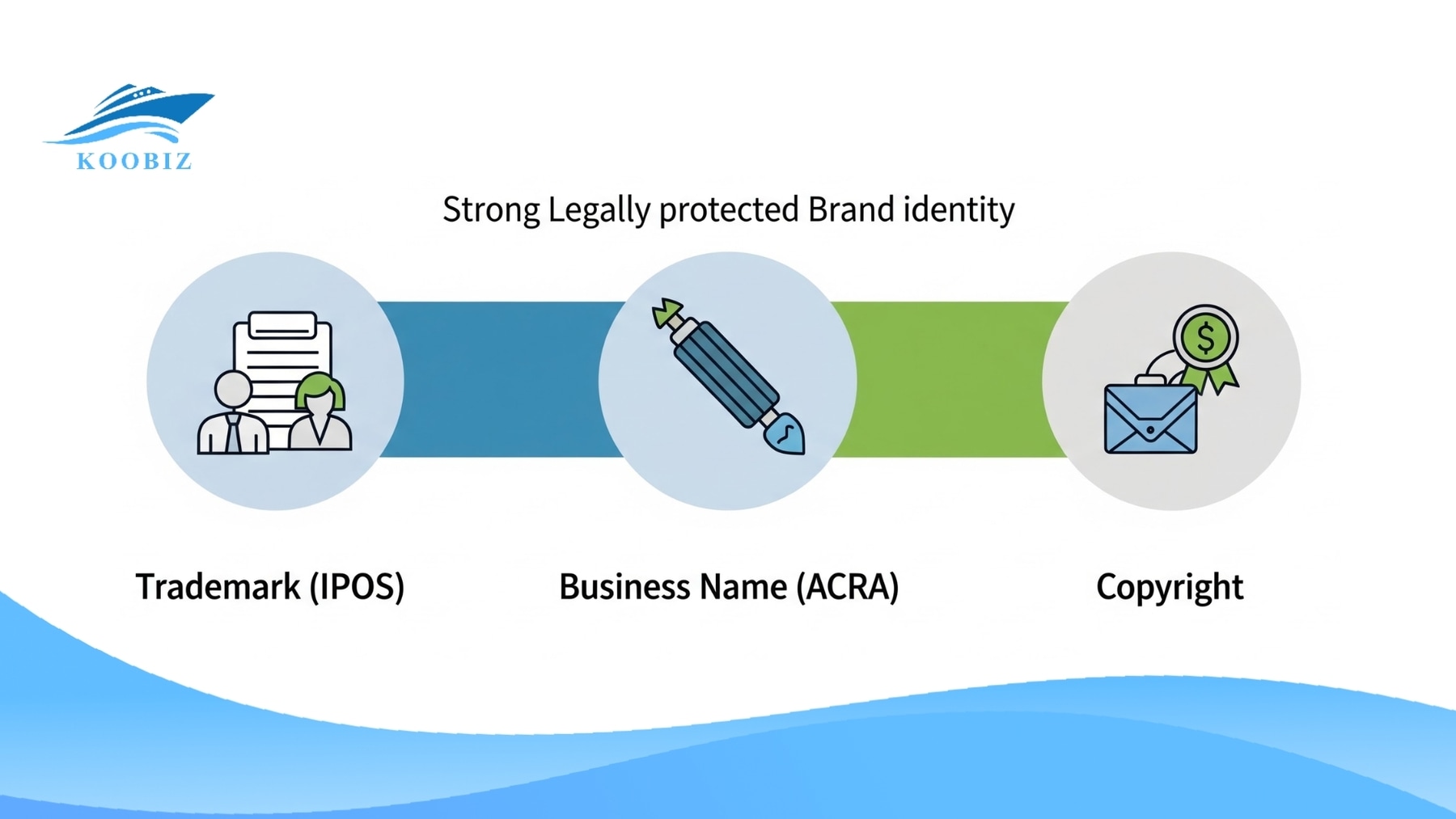
    Differentiating IPOS Trademark, ACRA Business Name, and Copyright
    Differentiating IPOS Trademark, ACRA Business Name, and Copyright

    To better understand the value of a trademark, it is helpful to compare it with other common business identifiers used in Singapore.

    Feature Business Name (ACRA) Trademark (IPOS) Copyright
    Primary Purpose Identifies the brand of goods or services to distinguish them from competitors. Identifies the brand of goods/services to distinguish from competitors. Protects original creative works (art, literature, code).
    Registration Authority Accounting & Corporate Regulatory Authority (ACRA). Intellectual Property Office of Singapore (IPOS). No formal registration required (automatic protection upon creation).
    Protection Scope Prevents others from registering the exact same company name. Prevents others from using identical or confusingly similar marks in the same or related industries. Prevents unauthorized copying of the work.

    Common Misconception: Business Name (ACRA) vs. Trademark (IPOS)

    As we regularly advise our clients at Koobiz, registering your business name with ACRA does NOT give you ownership of the brand.

    • ACRA Registration: Allows you to legally operate under the name “Koobiz Pte Ltd”.
    • IPOS Registration: Gives you the legal right to stop others from using the brand “Koobiz” on similar goods or services.

    Without a trademark, you have limited recourse if a competitor copies your brand name.

    Is Your Trademark Eligible for Registration in Singapore?

    A trademark may be eligible for registration in Singapore if it meets the requirement of distinctiveness and does not conflict with existing registered marks.

    However, not every brand name or logo can be registered as a trademark. To be accepted by IPOS, your mark must pass the “distinctiveness” test.

    A mark that is purely descriptive or generic will be rejected.

    Use this “Dos and Don’ts” table to quickly assess your brand name:

    Eligible (Strong Marks) Not Eligible (Weak Marks)
    Invented Words: Unique names with no prior meaning.

    (e.g., “Kodak”, “Xerox”)

    Descriptive Terms: Words describing the product’s quality, quantity, or function.

    (e.g., “Super Fast” for delivery, “Best Apple” for fruit)

    Arbitrary Words: Common words used in an unrelated context.

    (e.g., “Apple” for computers, “Shell” for petrol)

    Generic Terms: Common names for the product itself.

    (e.g., “Computer” for selling laptops, “Cafe” for a coffee shop)

    Unique Logos: Stylized graphics designed specifically for the brand. Deceptive Marks: Marks that mislead consumers about the nature of the goods.

    (e.g., “Organic” for 100% synthetic products)

    In addition, the mark must not be identical or confusingly similar to an existing registered trademark. This is why the preliminary search step is critical.

    Real-World Trademark Case Studies in Singapore: Success vs. Failure

    Singapore Trademark Case Studies
    Singapore Trademark Case Studies

    To illustrate the legal concepts above, let’s examine three hypothetical scenarios commonly seen in the Singapore market. These examples illustrate why applications pass or fail during the IPOS examination.

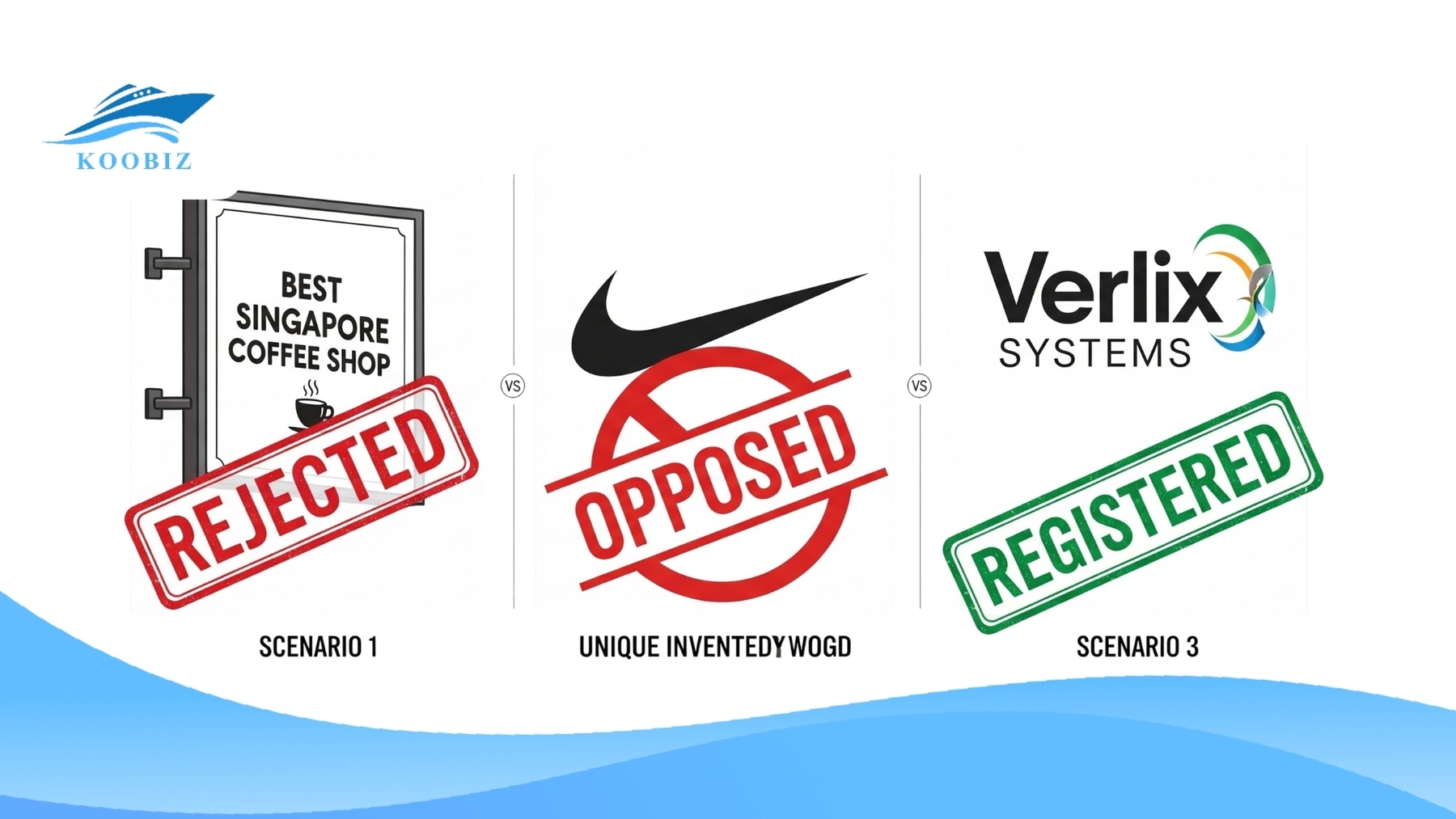
    Case Study 1: The “Descriptive” Trap (Failure)

    • Business: A new cafe opening in Bugis.
    • Proposed Mark: “Best Singapore Coffee Shop”.
    • Outcome: Rejected by IPOS.
    • Why? The name is purely descriptive of the goods (“Coffee Shop”), the location (“Singapore”), and the quality (“Best”). If IPOS granted this, it would unfairly stop other cafes in Singapore from using these common words to describe their business.
    • Lesson: Avoid names that merely describe what you sell.

    Case Study 2: The “Look-Alike” Problem (Conflict)

    • Business: A sportswear retailer.
    • Proposed Mark: “Adidazz” (used together with a three-stripe logo).
    • Outcome: Opposed by Adidas and likely rejected.
    • Why? Although the spelling is different, the mark is phonetically similar and visually confusing when compared to a well-known existing brand. This falls under “Relative Grounds for Refusal.”
    • Lesson: A “Priority Search” (Step 1 below) would have revealed this conflict, saving the business the application fee.

    Case Study 3: The “Invented Word” Strategy (Success)

    • Business: A software consulting firm, similar to many technology clients served by Koobiz.
    • Proposed Mark: “Verlix Systems”.
    • Outcome: Registered Successfully.
    • Why? “Verlix” is an invented word with no dictionary meaning. It is highly distinctive, does not describe the software, and does not clash with existing marks.
    • Lesson: Creating a unique, made-up name is the safest and fastest route to registration.

    5 Steps to Register a Trademark in Singapore

    The trademark registration process consists of five sequential steps mandated by IPOS to ensure legal clarity and fairness.

    Below is an overview of the key actions involved and the estimated timeline for each step:

    Step Action Required Estimated Timeline
    1. Search Check IPOS database for conflicting marks 1 Day
    2. Classify Select goods/services category (Nice Class) 1 Day
    3. File Submit Form TM4 & pay fees via SingPass ~1 Hour
    4. Process IPOS Examination & Public Journal Publication 4-6 Months
    5. Result Issuance of Registration Certificate Total estimated timeline: 9–12 months

    Navigating the IPOS trademark system can be challenging for first-time applicants. Below is a detailed breakdown of the procedure to help you secure your intellectual property rights efficiently.

    Step 1: Conduct a Priority Search

    Before filing, you must determine if a similar mark already exists. You can do this via the IPOS Digital Hub. This step is non-negotiable; filing an application for a mark that conflicts with an existing one will result in rejection and the forfeiture of your application fees. A thorough search should cover similar phonetics and visual elements, not just identical spellings.

    Step 2: Classify Your Goods/Services

    You must categorize your goods or services according to the International Classification of Goods and Services (Nice Classification). There are 45 classes in total (Classes 1-34 for goods, Classes 35-45 for services). For instance, if you are a Koobiz client running a coffee shop that also sells branded t-shirts, you might need to register under Class 43 (Food and Drink Services) and Class 25 (Clothing). Correct classification is vital because your trademark is only protected within the classes you register.

    Step 3: File the Application (Form TM4)

    Once searched and classified, submit your application online via the IPOS Digital Hub using Form TM4. You will need a SingPass account to access the portal. The application requires:

    • Your personal/company details.
    • A clear graphical representation of the mark.
    • The list of goods/services and designated classes.
    • Payment of the application fee.

    Step 4: Examination & Publication

    After filing, IPOS examiners will review your application to ensure it meets legal requirements. If there are no objections (or if you resolve them), your trademark will be published in the Trade Marks Journal for two months. During this period, third parties (e.g., competitors) can oppose your registration if they believe it infringes on their rights.

    Step 5: Registration Certificate

    If there is no opposition after the two-month publication period, IPOS will issue a Certificate of Registration. Once registered, your trademark is protected for 10 years from the date of application.

    How Much Does It Cost to Register a Trademark in Singapore?

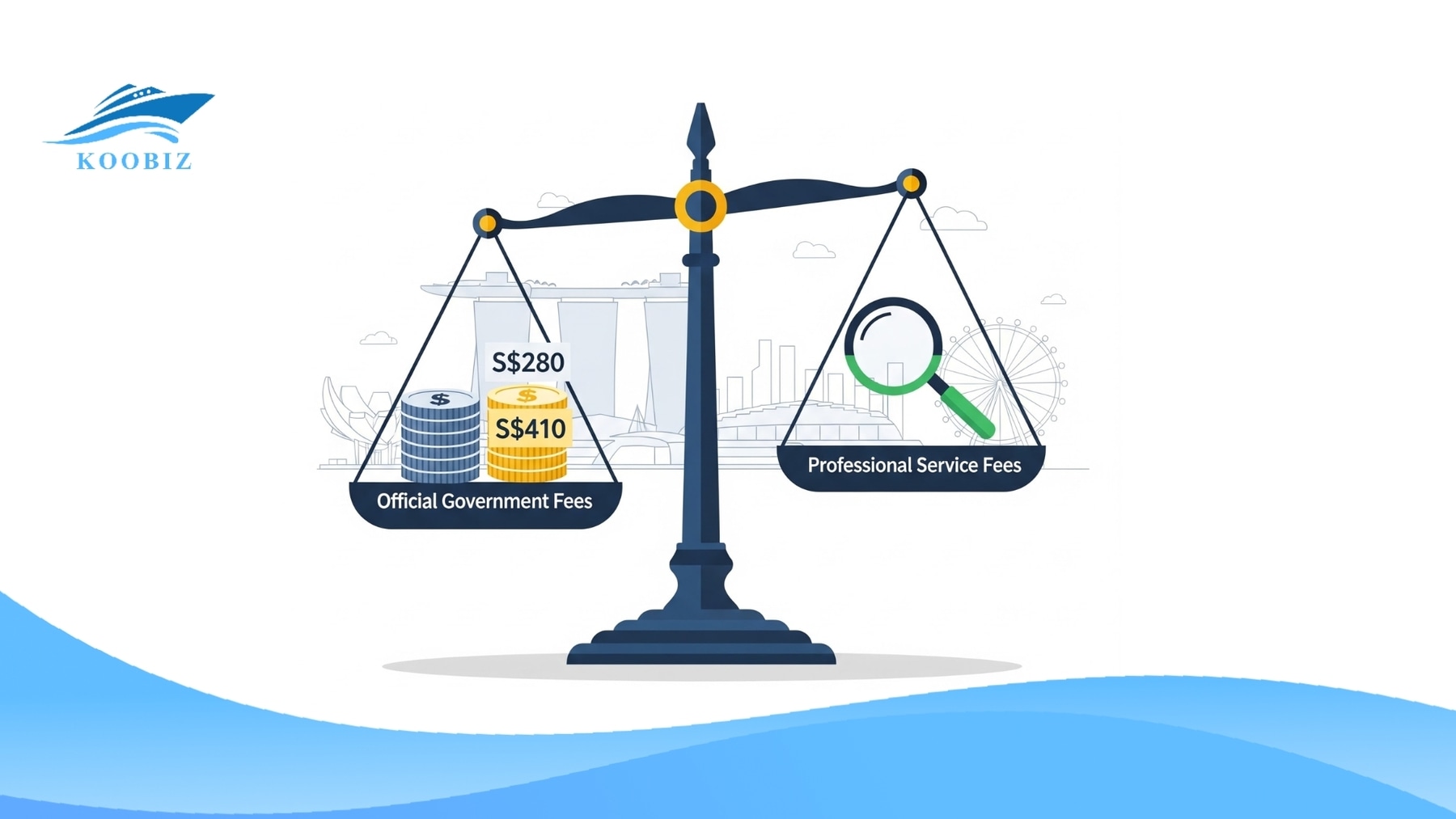
    There are two main categories of costs involved: the official government fees and potential professional service fees.

    Understanding these costs is essential for proper budgeting. The fees payable to IPOS depend on whether you file online via the IPOS Digital Hub and whether you select items from the pre-approved database.

    Cost of Trademark Registration in Singapore
    Cost of Trademark Registration in Singapore

    1. Official Government Fees (Payable to IPOS)

    Fees are subject to change. Always refer to the IPOS Digital Hub for the latest rates.

    Filing Method Condition Fee (per class)
    Online (IPOS Digital Hub) Description selected from pre-approved database S$280
    Online (IPOS Digital Hub) Description entered manually (non-standard) S$410

    Note: Manual (paper) filing is no longer encouraged, as IPOS has largely shifted to digital services.

    2. Professional Service Fees (Optional but Recommended)

    While you can file yourself to save money, it comes with risks.

    • Government fees are non-refundable. If your application is rejected due to incorrect classification or an undiscovered conflict, you lose the S$280+ immediately.
    • Correction costs can also arise, as fixing errors after submission often costs more than getting it right the first time.

    Koobiz Insight: Many businesses attempt DIY filing to reduce upfront costs, only to discover their application is rejected several months later. IPOS strongly encourages using their pre-approved database to minimize objections. Engaging a professional helps ensure your trademark search is thorough and your classifications are accurate, protecting your investment.

    How Long Is the Trademark Registration Process?

    The trademark registration process in Singapore typically takes approximately 9 to 12 months from the application date to the issuance of the certificate.

    To help you manage your expectations, here is the estimated timeline for each stage of the process:

    Stage Estimated Duration What Happens?
    1. Examination 4 – 6 Months IPOS checks if your mark complies with the Trade Marks Act.
    2. Publication 2 Months (Fixed) Your mark is published in the Trade Marks Journal for public scrutiny.
    3. Certification 1 – 2 Months If no opposition arises, the registration certificate is issued.
    Total ~ 9 – 12 Months Assuming a straightforward application.

    The “Bumpy Road” Scenario (18+ Months)

    If your application faces an objection (from IPOS examiners regarding distinctiveness) or an opposition (from a competitor), the timeline can extend significantly. This highlights why thorough preparation in the Search and Classification steps is crucial to avoid delays.

    Once your trademark is successfully registered and the certificate is issued, the journey does not end there. A trademark is a living asset that requires active management to maintain its validity and value.

    Managing Your Trademark in Singapore: Maintenance, Growth & Risk Management

    Securing the certificate is just the beginning. To maximise the value of your intellectual property, business owners should focus on three strategic pillars: maintenance, growth, and risk management.

    Neglecting these post-registration duties can lead to the loss of your rights or missed opportunities for expansion.

    Pillar 1: Maintenance – Renewing Your Rights

    A Singapore trademark is valid for 10 years from the date of filing. It is not a “register once, keep forever” asset and requires active maintenance.

    • The Process: You can renew your mark indefinitely for subsequent periods of 10 years.
    • The Fees (Updated 2026):
      • On-time Renewal: S$480 per class (filed within 6 months before expiry).
      • Late Renewal: S$700 per class (filed within 6 months after expiry).
      • Restoration: S$770 per class (after the grace period; approval is not guaranteed).
    • Critical Deadline: Always mark your calendar for the 10-year mark to avoid hefty penalty fees.

    Pillar 2: Growth – Expanding Globally (Madrid Protocol)

    Your Singapore trademark is territorial—it only protects you within Singapore. If your business plans to export or expand, you need a global strategy.

    • The Solution: Singapore is a member of the Madrid Protocol, managed by WIPO.
    • The Benefit: Instead of filing separate applications in each country (which is costly and administratively complex), you can file a single international application via IPOS.
    • The Cost:
      • IPOS Handling Fee: S$250.
      • WIPO Fees: Variable (payable in Swiss francs), depending on the countries designated.
    • The Reach: This allows you to designate protection in over 130 countries (including the US, EU, China, Australia, and Vietnam) based on your Singapore registration.

    Note: In practice, international trademark filings are often coordinated alongside regional expansion to ensure brands enter new markets with adequate protection.

    Pillar 3: Risk Management – Handling Rejections & Oppositions

    Even with a registered mark, you may face challenges. Understanding common pitfalls helps you mitigate risks early.

    1. Dealing with Rejections (Objections) If IPOS examiners refuse your application, it is usually due to:

    • Descriptiveness: Trying to trademark generic terms like “Super Fast Delivery”.
    • Deceptiveness: Using a mark that implies a quality the product doesn’t have (e.g., “Organic” for synthetic goods).
    • Similarity: Clashing with an existing mark on the register.

    2. Dealing with Oppositions Opposition occurs during the 2-month publication stage when a third party (usually a competitor) formally objects.

    • Why it happens: They believe your mark is too similar to theirs and will cause market confusion.
    • What to do: Opposition proceedings are formal legal processes. You must file a Counter-Statement to defend your rights. This requires professional legal assistance.

    Conclusion

    Registering a trademark in Singapore is a strategic step that transforms your brand from a mere logo into a legally protected asset. By following the 5-step process—Search, Classify, File, Examine, and Register—you ensure that the goodwill you build belongs exclusively to you.

    At Koobiz, we understand that building a business involves many moving parts, from Singapore company incorporation and corporate banking to ongoing tax and accounting compliance. While you focus on growing your business and brand value, let us handle the foundational corporate services to ensure your entity is compliant and ready for success.

    Visit Koobiz.com today to learn how we can support your business journey in Singapore.

  • How to Renew Work Permit in Singapore: Complete MOM Process & Requirements

    How to Renew Work Permit in Singapore: Complete MOM Process & Requirements

    [SUMMARIES]

    Eligibility Check: Ensure the worker’s passport is valid for at least 25 months for a full renewal.

    The Golden Window: Always renew between 7 to 12 weeks before the permit expires to avoid penalties.

    Mandatory Requirements: You must purchase a Security Bond and Medical Insurance (min. $60,000 coverage with new 2025 standards) before logging in.

    Processing Time: Most online renewals are approved immediately or within 1 working day.

    Late Renewal: Missing the deadline incurs overstaying fines ($100/day) and requires a valid reason for a short-term extension.

    2026 Update: The maximum employment period limit has been removed. Workers can now generally be employed up to age 63, provided they meet quota and levy requirements.

    [/SUMMARIES]

    Full compliance with Ministry of Manpower (MOM) regulations is essential. Missing a work permit renewal deadline can result in additional levies, penalties, or even the repatriation of workers. At Koobiz, we know that managing Singapore’s regulatory requirements, from company incorporation to employment compliance, demands careful attention to detail. This guide simplifies the entire MOM process, covering everything from the crucial 7–12 week timeline to using WP Online effectively, so you can steer clear of common mistakes and keep your business fully compliant.

    Is Your Worker Eligible for Work Permit Renewal?

    Checklist for Singapore Work Permit Renewal
    Checklist for Singapore Work Permit Renewal

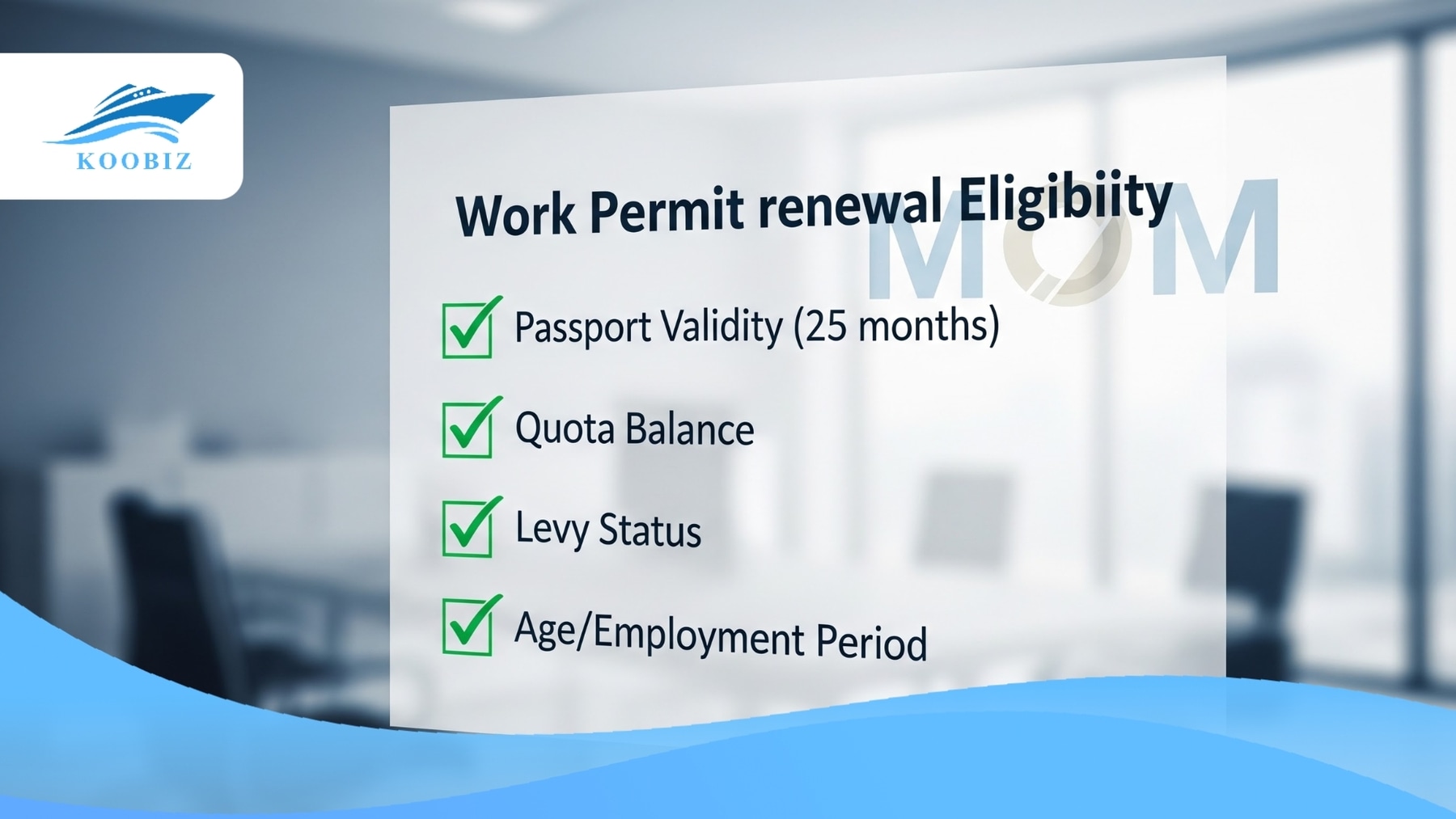
    Yes, a foreign worker is eligible for renewal if they have a valid passport, the employer has sufficient quota, and there are no compliance breaches.

    Before purchasing insurance or security bonds, it’s best to run through this quick checklist to confirm eligibility. The MOM requires all of the following conditions to be met:

    • Passport Validity: Ideally, the passport should be valid for at least 25 months.
      • Note: If validity is less than 25 months (but at least 7 months), you can still renew, but the Work Permit duration will be capped at 1 month before the passport expiry date, rather than the full 2 years.
    • Quota Balance: Your company must have sufficient Foreign Worker Quota (Dependency Ratio Ceiling).
    • Levy Status: You must have no outstanding Foreign Worker Levy payments or fines. The renewal button will be disabled if levies are in default.
    • Age & Employment Period: The worker must be below 60 years old (or 63 years old for renewals in specific sectors effective 2026). The previous maximum employment period limits (14–26 years) have been removed.

    In addition, MOM regulations require employers to ensure that the worker remains medically fit and has complied with all work pass conditions throughout the previous employment period.

    When Should You Start the Renewal Process?

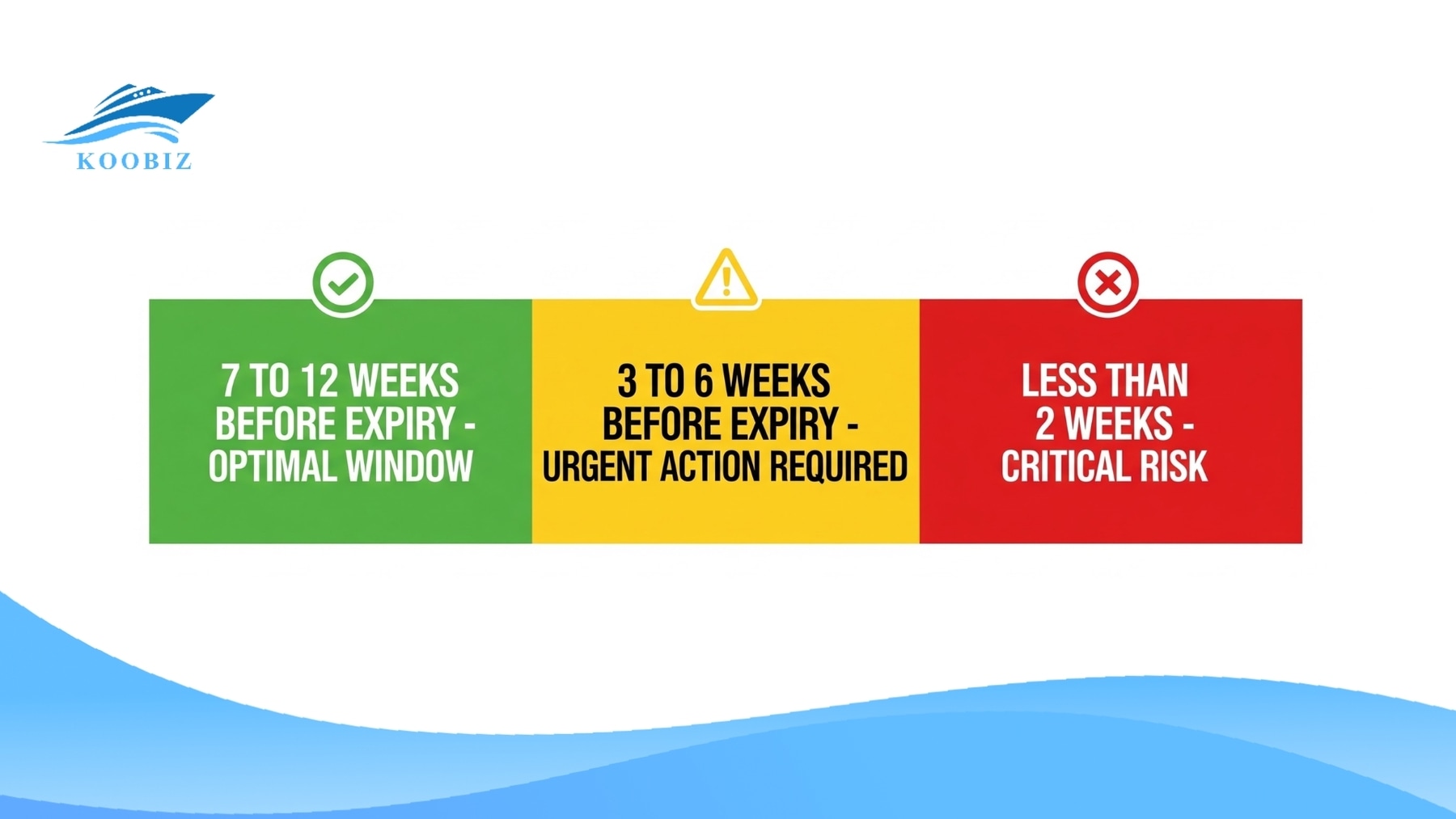
    Checklist for Singapore Work Permit Renewal timeline: Green (7-12), Yellow (3-6), Red (<2 weeks)
    Checklist for Singapore Work Permit Renewal timeline: Green (7-12), Yellow (3-6), Red (<2 weeks)

    The recommended and required period to begin a Work Permit renewal is 7 to 12 weeks before the permit’s expiry date.

    In Singapore, compliance hinges heavily on timing. MOM typically permits renewals only after the official renewal notice is issued, making it essential to follow the “Traffic Light” timeline below to prevent delays, penalties, or compliance issues.

    • Green Zone (7 to 12 Weeks Before Expiry): Optimal Window. This is the safest time to act. You have ample time to resolve discrepancies (e.g., passport details) and ensure the Security Bond is processed by the bank.
    • Yellow Zone (3 to 6 Weeks Before Expiry): Urgent Action Required. You risk delays if the bank takes longer than 3 days to transmit bond data or if MOM requires additional manual verification.
    • Red Zone (Less than 2 Weeks): Critical Risk. You are in the danger zone. There is a high chance the permit will expire before approval, resulting in “overstaying” status, fines, and potential repatriation.

    Renewal applications submitted earlier than 12 weeks are typically rejected unless there are exceptional circumstances. On the other hand, allowing the Work Permit to lapse exposes employers to overstaying penalties, while foreign worker levies will continue to accrue.

    Compliance data indicates that employers who begin the renewal process within the Green Zone are 95% more likely to resolve documentation issues without incurring late fees, compared to those who delay until the final weeks before expiry.

    What Documents and Requirements are Needed?

    Three key requirements must be in place before you log in: a valid passport, medical insurance, and a security bond.

    Even before accessing the WP Online portal, these external documents need to be obtained and digitised. This preparatory stage is where many employers encounter delays. Refer to the table below to confirm that all required actions for each document have been completed.

    Document Requirement Critical Action
    Passport Valid for at least 25 months (recommended) Update details in MOM system first if recently renewed. Scan the bio-data page clearly. If <25 months, permit duration will be shorter.
    Medical Insurance Min. SGD 60,000/year Must meet July 2025 enhanced standards: standardized exclusions, age-differentiated premiums, and direct insurer payments. Co-pay applies for claims >$15k.
    Security Bond SGD 5,000 Guarantee (Non-Malaysians) Buy 3 days in advance. Must be valid for at least 26 months for a full 2-year permit.
    Primary Care Plan (PCP) For CMP sectors or Dorm Residents Must be purchased and declared on WP Online before renewal.

    Step-by-Step Guide: How to Renew Work Permit via WP Online

    The renewal process consists of three main steps: accessing WP Online through Singpass, uploading the necessary scanned documents, and paying the $35 processing fee.

    With all prerequisites in place, the online submission is straightforward. Follow the standard operating procedure (SOP) below to complete the renewal successfully.

    Step 0: Pre-Renewal Actions (Mandatory)

    • Register Address: Use the Online Foreign Workers Address Service (OFWAS) to register the worker’s mobile number and residential address at least 1 hour before logging in to renew.
    • Update Passport: If the worker has a new passport, update the details in MOM’s system before starting the renewal.

    Step 1: Log in via Singpass

    • Access the MOM Work Permit (WP) Online portal using your corporate Singpass.
    • Navigate to the “Renew” function on the left-hand menu.
    • The system will display a list of workers eligible for renewal. Select the specific worker you wish to process.

    Step 2: Verification & Upload

    • Verify Data: Check that the Security Bond and Medical Insurance details are reflected correctly in the system. Note: If the bond status is not “Transmitted,” the system will block you from proceeding.
    • Upload Documents: If prompted, upload scanned copies of the worker’s passport (bio-data page).
    • Format Check: Ensure the file size is within the limit (usually <2MB) and the image is clear.

    Step 3: Declaration & Payment

    • Declarations: Confirm details regarding the worker’s health, conduct, and PCP purchase (if applicable).
    • Payment: Pay the SGD 35 fee via GIRO, VISA, MasterCard, or eNETS.
    • Koobiz Tip: Print the “Acknowledgement Letter” immediately after payment. This serves as proof that the renewal is in process, which is vital if the permit expires while you are waiting for the card.

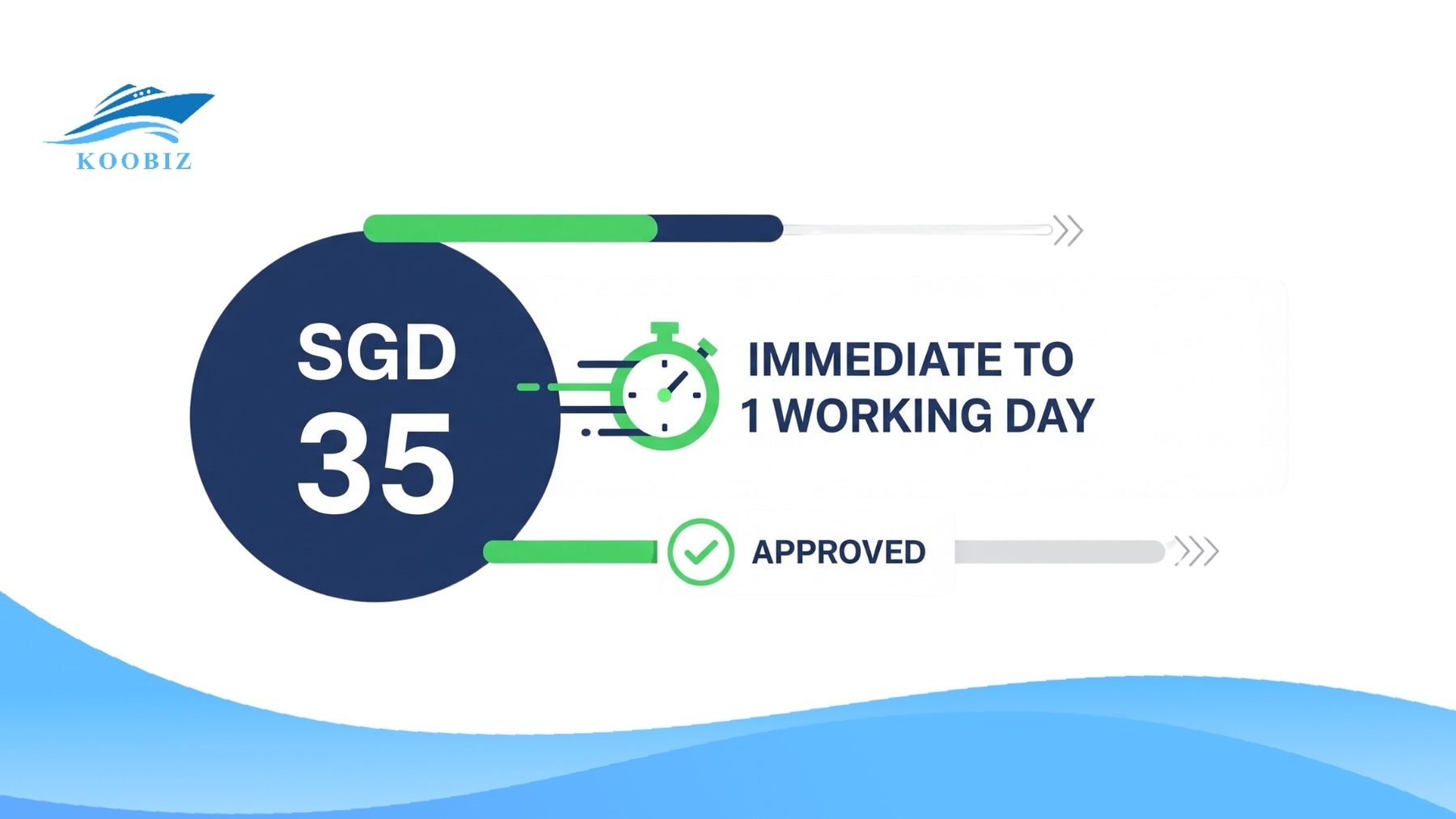
    Upon successful submission, the status usually changes to “Approved” almost instantly or within one working day.

    What are the Renewal Fees and Processing Time?

    WP Renewal Fee: SGD 35, processed immediately or within 1 working day
    WP Renewal Fee: SGD 35, processed immediately or within 1 working day

    The renewal fee is set at SGD 35 per Work Permit, with processing usually completed immediately or within one working day.

    To assist with budgeting and planning, the cost structure and expected timeline for the renewal process are outlined below.

    The Cost

    • Fee: SGD 35 per renewal application.
    • Payment Methods: GIRO, VISA, MasterCard, or eNETS.
    • Important Note: This administrative fee is strictly non-refundable, even if you withdraw the application or if the renewal is rejected.

    The Speed

    MOM’s digital system is designed for efficiency, resulting in one of the fastest processing times in the region.

    • Scenario A (Standard): Immediate Approval. If your Security Bond is transmitted and Quota is clear, the system usually auto-approves the application instantly.
    • Scenario B (Manual): 1 Working Day. If the system flags the passport or photo for manual verification, the outcome will be ready the next working day.

    Upon approval, an in-principle approval (IPA) notification will be issued. In most cases, there is no need to request a new Work Permit card unless the worker is changing job roles or the existing card is damaged or lost, as the renewal automatically updates the expiry date in the backend system reflected in the SGWorkPass app.

    Troubleshooting Common Renewal Issues and Errors

    Even with a well-structured process, exceptions can still arise. The section below highlights the most common challenges Koobiz clients face when managing foreign worker renewals.

    Typical issues include missed expiry deadlines, delays in Security Bond submission, and inadequate insurance coverage.

    While the “Happy Path” outlined earlier applies to around 90% of renewals, the remaining 10% involve issues that require prompt action. Refer to the matrix below to pinpoint the specific problem and apply the appropriate immediate solution.

    Issue / Error Message Likely Cause Immediate Solution
    “Renew” button is disabled Outstanding Levy or Fines Pay immediately via CPF EZPay. The system updates within 1 working day.
    “Quota not available” Dependency Ratio Ceiling reached You cannot renew. You must increase your local workforce or cancel the permit.
    “Security Bond not found” Bank transmission delay Wait. Do not panic. It takes up to 3 working days for the bank to update MOM.
    “Passport expiry date invalid” Passport < 7 months validity Renew passport first, then update details in MOM system via “Update Worker Details”.
    System Error / Technical Glitch Browser issue Clear cache or try Incognito mode. If persistent, contact MOM technical support.

    What Happens if You Miss the Renewal Deadline?

    If you miss the deadline, the worker is considered an overstayer, attracting fines, levy penalties, and potential prosecution.

    This is a critical situation. If a Work Permit expires, the worker is technically in Singapore illegally. Do not attempt to renew as normal; follow this recovery plan:

    The Consequences

    • Status: Illegal Overstayer.
    • Financial: Overstaying fines are imposed immediately (approx. $100 per day). The Foreign Worker Levy continues to accumulate until the worker is repatriated or the pass is regularized.

    The Recovery Plan

    • Immediate Action: Apply for a Special Pass to legalize the worker’s stay while the permit is sorted.
    • Next Step: Submit an appeal for reinstatement via MOM’s portal. Note that reinstatement is subject to MOM’s strict discretion and valid reasons.

    How to Request a Short-Term Extension?

    To get an extension, you must submit a specific request via WP Online explaining valid reasons like passport renewal delays or travel restrictions.

    Sometimes, you cannot renew on time due to external factors. In this case, use the extension feature rather than letting the pass expire.

    Use this when: You are waiting for a new passport, need time to cancel the permit, or have travel complications.

    The Process:

    1. Log in: Access WP Online and select “Request for Extension” on the left menu.
    2. Upload: Attach proof (e.g., Embassy receipt for passport renewal or flight ticket).
    3. Outcome: If successful, you receive a 1-month validity extension to finalize the main renewal.

    Understanding the Security Bond and Medical Insurance Requirements

    The Security Bond is a binding pledge of SGD 5,000, while Medical Insurance must cover at least SGD 60,000 per year for inpatient bills.

    Many employers confuse these two financial instruments. Use this table to understand the critical differences.

    Feature Security Bond ($5,000) Medical Insurance ($60k+)
    Purpose Guarantees that you will repatriate the worker and ensure they do not break the law. Covers the worker’s hospital bills and day surgery costs.
    Critical Rule Must be valid until after the work permit expiry date (typically 26 months total). Must cover the full renewal duration.
    Result of Failure Bond is forfeited ($5,000 loss). Employer is liable for unlimited medical bills.

    Comparison: Renewing Work Permit vs. S Pass

    Work Permit renewal relies heavily on quotas and security bonds, whereas S Pass renewal focuses on meeting the qualifying salary threshold.

    For companies managed by Koobiz that employ a mix of staff, understanding the difference is vital for planning.

    Feature Work Permit (WP) S Pass
    Key Requirement Security Bond (Essential) Fixed Monthly Salary
    Salary Threshold N/A Min SGD 3,300+ (renewals expiring from Sep 2026)
    Levy & Quota Sector-specific Dependency Ratio Sub-Quota (Much tighter limits)
    Processing Time Fast (Immediate – 1 Day) Slower (~3 Weeks due to assessment)
    Duration Up to 2 years Up to 3 years

    Real-World Scenarios: Renewal Success vs. Failure

    To understand the importance of the 7-12 week window, here are three real-world case studies based on common client experiences.

    These scenarios highlight how small administrative decisions can lead to vastly different outcomes for your business.

    Case Study 1: The “Smooth Operator” (Construction Sector)

    • Situation: ABC Construction Pte Ltd receives a renewal notice for 5 workers. The HR Manager logs in 10 weeks before expiry (Green Zone).
    • Action: She verifies the quota and notices one worker’s passport is expiring in 8 months. She instructs the worker to renew the passport immediately. Once the new passport arrives (2 weeks later), she updates MOM, purchases the Security Bonds, and waits 3 days for bank transmission.
    • Outcome: All 5 renewals are submitted and approved instantly. No stress, no penalties.

    Case Study 2: The “Overlooked Deadline” (F&B Sector)

    • Situation: A restaurant owner is busy with daily operations and misses the renewal notice email. He realizes the permit for his head chef expires in 2 days (Red Zone).
    • The Mistake: He rushes to buy the Security Bond but forgets that banks take 3 working days to transmit the data to MOM.
    • Outcome: The permit expires before the bond data reaches MOM. The worker becomes an overstayer. The owner has to pay a $500 fine (5 days x $100), apply for a Special Pass, and appeal for reinstatement, disrupting kitchen operations for 2 weeks.

    Case Study 3: The “Passport Trap” (Marine Sector)

    • Situation: A shipyard wants to renew a welder’s permit for 2 years. The worker’s passport is valid for only 18 months.
    • The Issue: The employer proceeds without checking validity rules.
    • Outcome: MOM approves the renewal, but only grants validity up to 1 month before the passport expiry (approx. 17 months total), not the full 2 years. The employer now has to track a non-standard expiry date, increasing administrative risk for the next cycle.

    Conclusion

    Successfully navigating the renew work permit process in Singapore is a fundamental responsibility for any business employing foreign staff. By adhering to the 7 to 12-week timeline, ensuring your Security Bond and Medical Insurance are active, and utilizing the WP Online portal correctly, you can ensure business continuity and avoid costly penalties.

    At Koobiz, we specialize in supporting businesses entering and operating in the Singapore market. From company incorporation and opening corporate bank accounts to handling complex tax, accounting, and audit requirements, our team ensures your back-office operations are compliant and efficient. If you are struggling with manpower regulations or need assistance setting up your business infrastructure in Singapore to hire foreign talent, connect with us today.

    Visit us at Koobiz.com for expert corporate services in Singapore.

  • S Pass Salary Singapore 2026: Current $3,300 Minimum & Levy Guide

    S Pass Salary Singapore 2026: Current $3,300 Minimum & Levy Guide

    [SUMMARIES]

    Current Minimum: The qualifying salary for new S Pass applications in 2026 is $3,300 per month.

    Financial Sector: Candidates in Financial Services must earn at least $3,800 per month.

    Renewal Rule: Existing passes expiring on or after 1 September 2026 must meet the new $3,300 threshold.

    Levy Costs: Employers must pay a monthly levy (standardized at $650) in addition to the salary.

    Quota Limits: S Pass holders are capped at 10% (Services) or 15% (Manufacturing/Construction/Marine/Process) of the total workforce.

    [/SUMMARIES]

    Staying compliant with manpower regulations in Singapore equals keeping up with the Ministry of Manpower’s (MOM) shifting benchmarks-particularly as we move further into 2026. For employers and HR managers, the critical figure to note is the $3,300 minimum qualifying salary, a standard that is now fully effective for all new applications. However, salary is just one component of a complex equation that includes rising levy rates, strict quota caps, and specific renewal timelines that could catch businesses off guard later this year. At Koobiz, we understand that hiring foreign talent is integral to your business growth, which is why we have compiled this essential guide to help you manage compliance and costs effectively.

    What is the current S Pass Qualifying Salary in 2026?

    The S Pass qualifying salary is a variable benchmark currently set at a minimum of $3,300 per month for new candidates in most sectors, effective from September 2025 .

    To understand the full scope of this requirement, we must look beyond the base figure, as the actual required salary often exceeds this minimum depending on the candidate’s profile. The Ministry of Manpower (MOM) applies this threshold to ensure that S Pass holders are comparable in quality to the top one-third of the local Associate Professionals and Technicians (APT) workforce. As such, meeting the minimum salary of $3,300 does not guarantee approval if the candidate possesses significant experience.
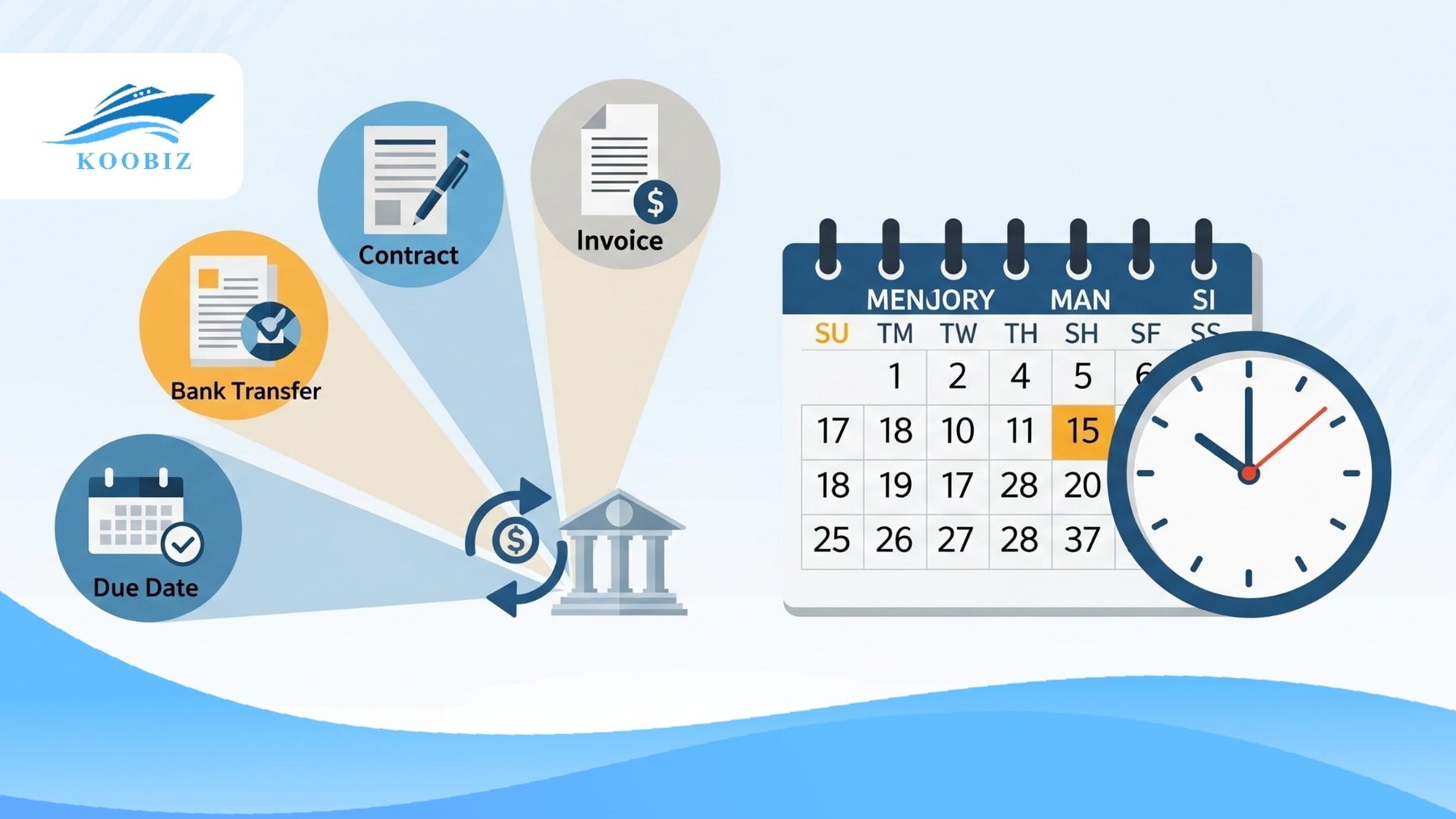
    S Pass Singapore 2026: Minimum Salary 3,300 SGD
    S Pass Singapore 2026: Minimum Salary 3,300 SGD

    Does the salary threshold differ by sector?

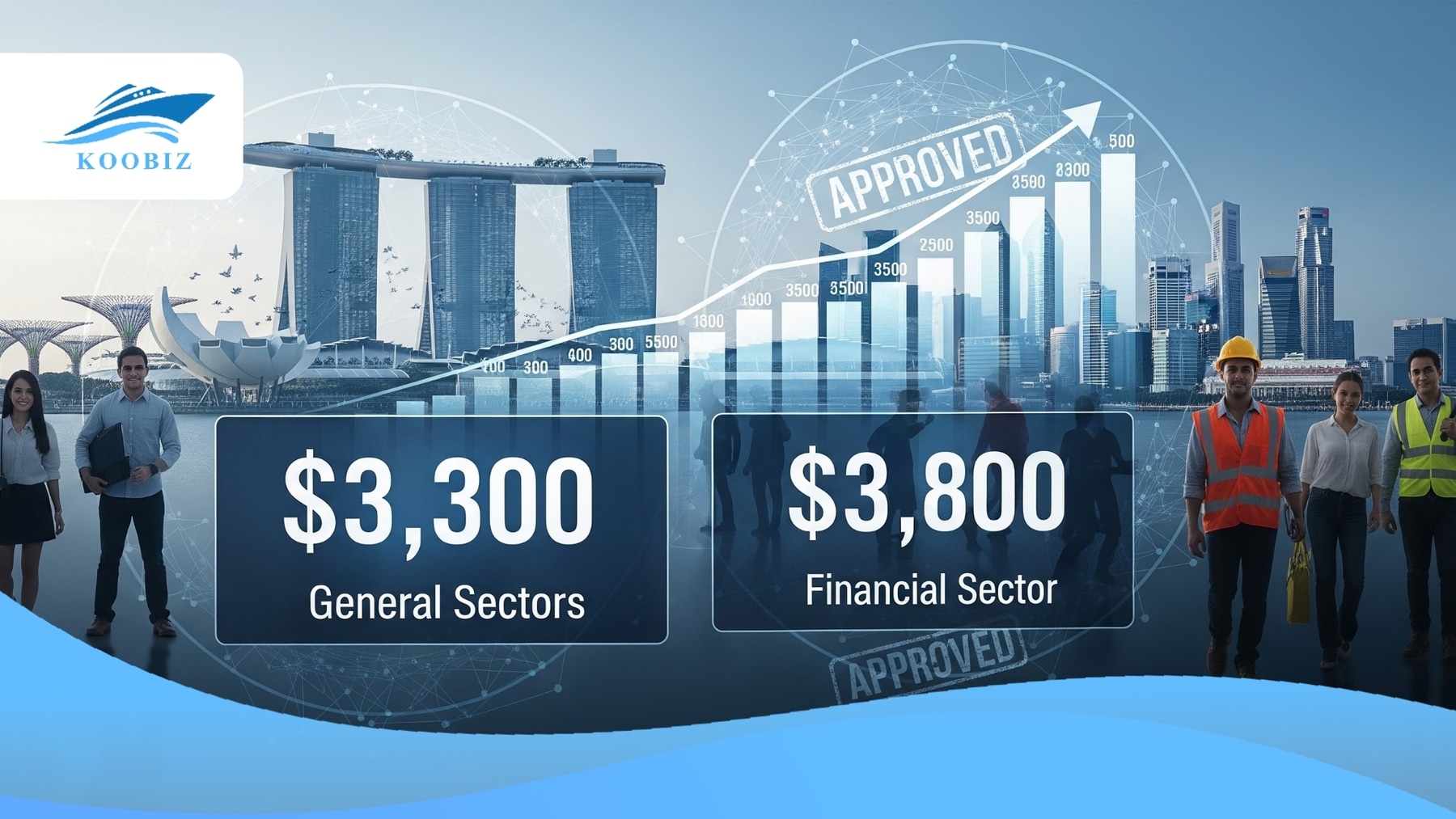
    Yes, the Financial Services sector commands a higher qualifying salary of $3,800 per month due to the higher prevailing wage norms in that industry.

    While the general sector baseline sits at $3,300, the MOM acknowledges that salaries in banking, insurance, and asset management are consistently higher. Consequently, businesses incorporated under these Standard Industrial Classification (SIC) codes must budget for this premium. For incoming foreign business owners, it is crucial to factor in this higher operational cost when planning your initial headcount.

    How does age and experience impact the salary requirement?

    The qualifying salary increases progressively with age, reaching up to $4,800 (General) or $5,650 (Financial Services) for candidates in their mid-40s to match local peer income levels.

    The “Age-Wage” Trap:

    MOM applies a strict “age-wage” curve. A fresh graduate aged 23 might qualify at the base $3,300. However, a 35-year-old applicant with ten years of experience cannot be hired at the minimum floor. They must be paid a salary commensurate with their seniority to be approved.

    If an employer submits an application for an experienced professional at the minimum wage, it will likely be rejected on the grounds that the candidate does not command a market rate, implying they may not be a true “mid-skilled” talent.

    According to MOM regulations: The specific salary required for each candidate can be checked using the MOM Self-Assessment Tool (SAT), which serves as the definitive calculator for eligibility.

    Does the salary threshold differ for renewals in 2026?

    Yes, the salary threshold for renewals differs based on the specific expiry date of the pass, especially for passes expiring on or after 1 September 2026.

    This creates a “two-tier” renewal system operating throughout 2026. The government provides this buffer to prevent sudden business disruptions, but businesses must act now to review their payroll structures for employees whose passes are due for renewal in the latter half of the year.

    Renewal Timelines & Salary Requirements

    Pass Expiry Date Sector Minimum Qualifying Salary
    Before 1 Sep 2026 All Sectors (except Finance) $3,150
    Financial Services $3,650
    On or After 1 Sep 2026 All Sectors (except Finance) $3,300
    Financial Services $3,800

    Koobiz Strategy: If you have valuable staff members whose passes are expiring between January and August 2026, we recommend proceeding with the renewal process as early as possible (up to 6 months in advance). This allows you to lock in the validity under the lower salary criteria ($3,150) for another tenure, buying time for future salary adjustments.

    What are the S Pass Levy Rates and Quotas for Employers?

    There are two primary S Pass Levy tiers—Tier 1 and Tier 2—which are determined by the percentage of S Pass holders within your total workforce, alongside specific industry quotas.

    The levy is a monthly cost mechanism designed to regulate the foreign employment in Singapore. In reality, it acts as a “tax” on hiring foreigners, reinforcing the policy of prioritizing local employment. Understanding the interplay between your quota (Dependency Ratio Ceiling – DRC) and the levy tier is essential for accurate financial forecasting.

    S Pass 2026: Levy $650, Quota 10% (Services) - 15% (Manufacturing)
    S Pass 2026: Levy $650, Quota 10% (Services) – 15% (Manufacturing)

    What are the current Levy Rates?

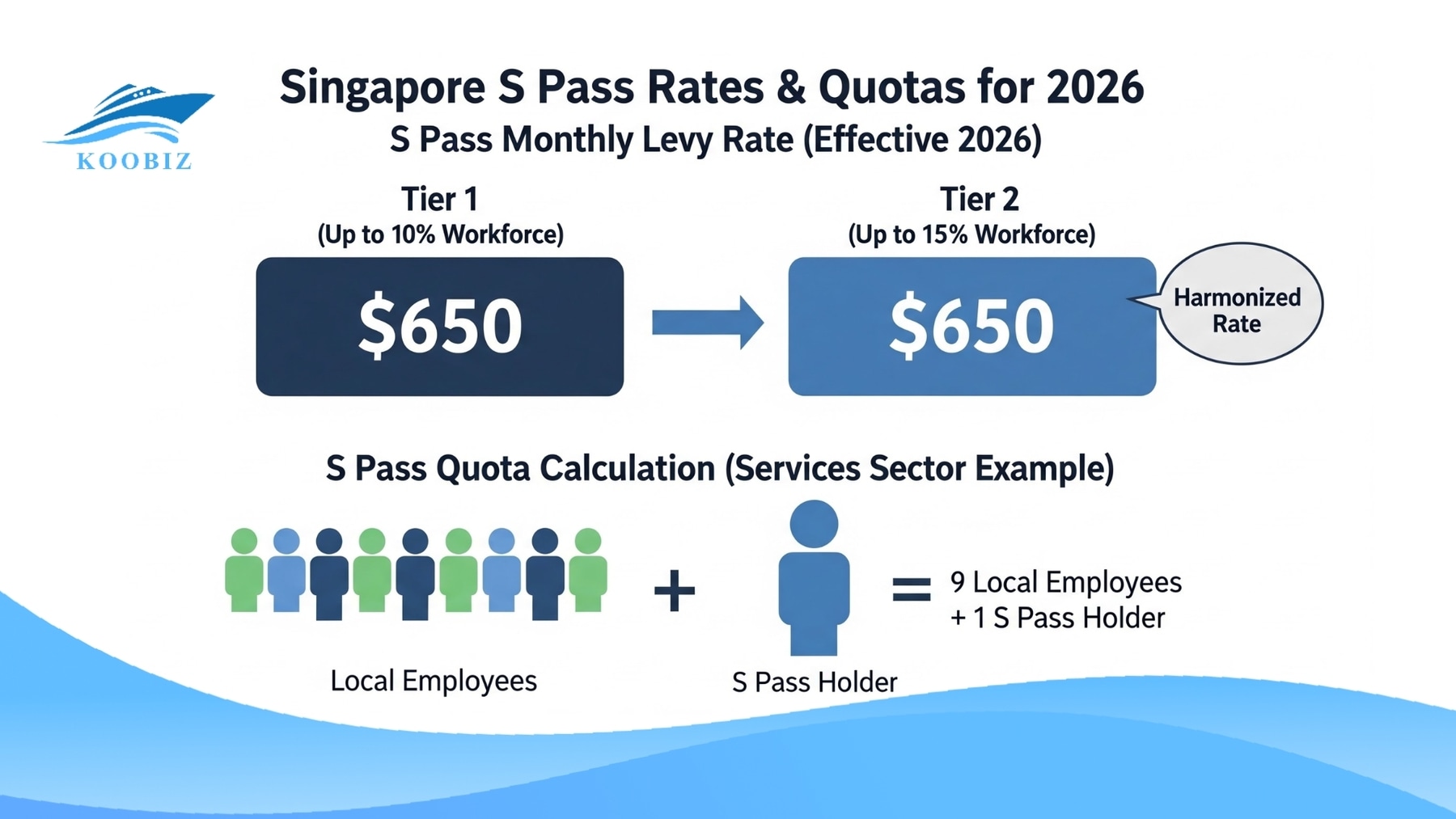
    The levy rates for 2026 have been harmonized to $650 for all S Pass holders. The distinction between Tier 1 and Tier 2 now primarily serves to indicate how close you are to your quota limit, rather than a price difference.
    Levy Tier Allowable Workforce % Monthly Rate (2026)
    Tier 1 (Standard) Up to 10% of total workforce $650
    Tier 2 Above 10% to max cap (15%) $650

    Note: Levy rates are subject to periodic review by the government. Always verify the exact figure on the MOM website as minor adjustments can occur during the annual Budget announcement.

    How is the S Pass Quota calculated?

    The S Pass quota is capped at 10% for the Services sector and 15% for Manufacturing, Construction, Marine Shipyard, and Process sectors of the total workforce.

    To hire one S Pass holder in the Services sector (where most Koobiz clients in consultancy and trading operate), you need a specific number of local employees earning the Local Qualifying Salary (LQS – currently $1,600).

    • Services Sector: You need roughly 9 local employees to hire 1 S Pass holder (Total workforce = 10; 10% of 10 = 1).
    • Manufacturing/Process/Other Sectors: You need roughly 6 local employees to hire 1 S Pass holder (Total workforce = 7; ~15% of 7 = 1.05).

    Important Calculation: The quota is calculated based on the CPF contributions made to local staff. Without consistent CPF contributions, your local headcount does not count toward the quota.

    How to Calculate the Total Cost of Hiring an S Pass Holder?

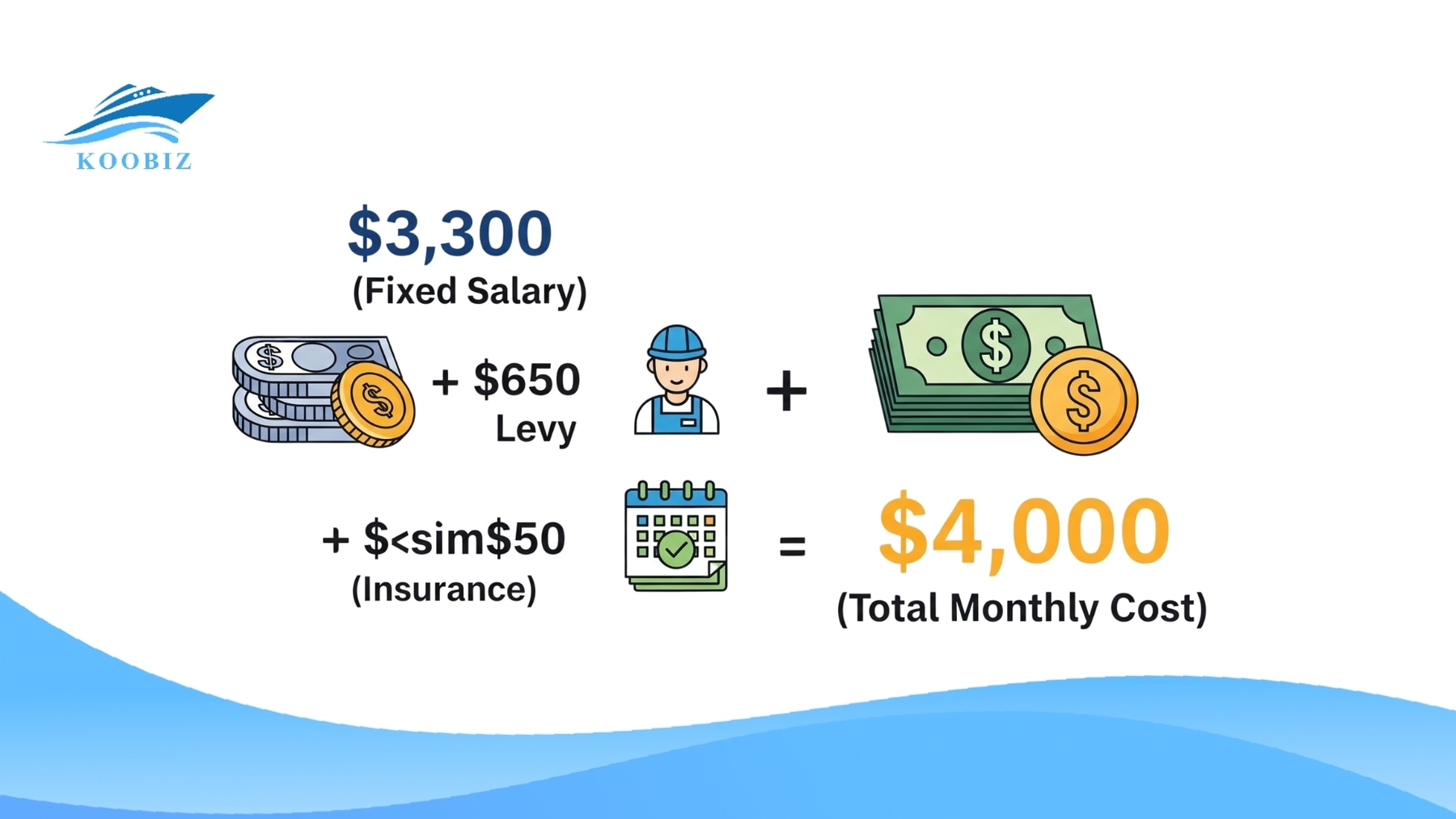
    The total cost involves summing four distinct components: Fixed Monthly Salary + Monthly Foreign Worker Levy + Medical Insurance + Administrative Overheads.

    Many new business owners make the mistake of looking only at the $3,300 salary. In reality, the “Total Cost of Employment” is significantly higher.

    S Pass: $3300 Salary + $650 Levy = $4000 Total Cost
    S Pass: $3300 Salary + $650 Levy = $4000 Total Cost

    The 2026 Cost Formula (Services Sector Example):

    $3,300 (Base Salary) + $650 (Foreign Worker Levy) + ~$50 (Mandatory Medical Insurance) = $4,000 (Total Monthly Cost)

    (Excluding recruitment fees or bonuses)

    Is the “Fixed Monthly Salary” defined differently by MOM?

    The MOM defines “Fixed Monthly Salary” strictly as the sum of Basic Monthly Salary andFixed Monthly Allowances, excluding any variable components. To meet the $3,300 threshold, the amount must be guaranteed and recurring.

    INCLUDED in Qualifying Salary:

    • Basic Monthly Pay
    • Fixed Food Allowance
    • Fixed Transport Allowance

    EXCLUDED from Qualifying Salary:

    • Overtime (OT) Pay
    • Bonuses or Annual Wage Supplement (AWS)
    • Sales Commissions
    • Variable Incentives
    • Reimbursement for expenses

    At Koobiz, when we assist clients with payroll setup and tax structuring, we emphasize that the employment contract must clearly stipulate this fixed amount. If a candidate’s basic pay is $2,500 and they earn $1,000 in commissions, they do not qualify for the S Pass because the fixed component ($2,500) is below the $3,300 threshold.

    Real-World Case Studies: Applying the 2026 Rules

    To visualize how these numbers impact your business, let’s look at three storytelling scenarios based on common client situations we handle at Koobiz.

    Scenario 1: The “Fresh Grad” Hire (Services Sector)

    The Story: CreativePulse, a boutique marketing consultancy with 10 local staff, wants to hire Jun, a 24-year-old Data Analyst from Malaysia. To manage costs, they offer him the exact minimum qualifying salary of $3,300.

    • Salary Check: Since Jun is 24 and fresh out of university, the base $3,300 fits the age-wage curve.
    • Quota Check: With 10 locals, the company has exactly 1 S Pass slot (10% cap).

    Verdict: LIKELY APPROVED

    Why: The salary matches the candidate’s lack of experience.

    Cost Impact: CreativePulse must budget a total of $3,950/month ($3,300 Salary + $650 Levy).

    Scenario 2: The Fintech Miscalculation (Financial Sector)

    The Story: AssetFlow, a growing fintech startup, identifies Mark (28) for a Compliance Officer role. They offer him $3,500, thinking it is generous since it is above the national $3,300 minimum.

    • The Mistake: They forgot they are classified under “Financial Services.”
    • The Gap: Mark is 28 (mid-career). The base floor is $3,800, but his age likely commands $4,200+.

    Verdict: REJECTED

    Why: The offer is below the $3,800 sector floor and too low for his age.

    The Fix: AssetFlow must raise the offer to at least $4,200 to match market norms before appealing.

    Scenario 3: The Renewal “Trap” (Manufacturing)

    The Story: LogiTrans Pte Ltd has a loyal warehouse supervisor, Kumar (32), who has been with them for 4 years earning $3,150. His pass expires on 15 October 2026. The HR manager plans to just click “Renew” in September.

    • The Hidden Danger: Because the pass expires after 1 September 2026, the new rules apply.
    • The Shortfall: Kumar’s $3,150 salary is now illegal for an S Pass renewal (Minimum is $3,300).

    Verdict: RENEWAL AT RISK

    Why: The system will auto-reject the renewal due to insufficient salary.

    The Fix: LogiTrans must formally increase Kumar’s basic salary to $3,300 immediately to reflect in the CPF records before the renewal application.

    Strategic Planning: S Pass vs EP & PR

    S Pass vs Employment Pass (EP): Key Salary & Benefit Differences

    The S Pass is designed formid-skilled technical staff with a $3,300+ salary floor and quota restrictions. In contrast, the Employment Pass (EP) is intended for professionals with a significantly higher $5,600+ salary benchmark and no levy or quota.

    Use this comparison matrix to decide which pass fits your candidate best.

    S Pass vs EP Comparison Matrix

    Feature S Pass Employment Pass (EP)
    Target Audience Mid-skilled technical staff Professionals, Managers & Executives
    Min. Salary (2026) $3,300 ($3,800 Finance) $5,600 ($6,200 Finance)
    Foreign Worker Levy Yes (Standardized at $650) No (Levy-free)
    Quota Cap Yes (Subject to 10-15% limit) No (No quota limit)
    Key Assessment Salary + Quota availability COMPASS Scoring Framework

    While the EP is often more desirable because it saves the employer the monthly levy cost, the barrier to entry is much higher, especially with the COMPASS scoring framework now fully matured in 2026.

    Can S Pass holders apply for Permanent Residency (PR)?

    Yes, S Pass holders are eligible to apply for Singapore Permanent Residency (PR); however, approval rates are typically lower compared to EP holders unless they possess specific high-demand skills.

    Eligibility does not guarantee approval. The Immigration and Checkpoints Authority (ICA) assesses applicants based on their economic contribution, integration into society, and family profile. Generally, an S Pass holder earning close to the minimum $3,300 may find it challenging to obtain PR. That said, individuals who have accumulated several years of work in Singapore, progressed through salary increments, and are employed in niche industries, may still have a fair chance. Koobiz advises clients to maintain a clean tax record and robust employment history to support their employees’ future PR applications.

    What happens if the S Pass application is rejected due to salary?

    If an application is rejected, employers can file an appeal within 3 months, provided they can address the specific gap—usually by increasing the offered salary or correcting the experience declaration.

    The offered salary is one of the common reasons. While it meets the $3,300 minimum, this level remains too low for the candidate’s university degree and ten years of experience. In this case, the employer must review the Self-Assessment Tool (SAT), determine the correct market rate for that specific profile (e.g., adjusting the offer to $4,200), and submit an appeal with the revised employment contract.

    Comparison of S Pass Salary Requirements (2024 vs 2025 vs 2026)

    Tracking the historical data helps HR managers forecast future trends.

    • 2024: Minimum qualifying salary was $3,150 ($3,650 for Finance).
    • Late 2025 (Sep): Increased to $3,300 ($3,800 for Finance).
    • 2026: Full implementation of the Sep 2025 rates for all new passes and renewals (from Sep 1).

    This trajectory clearly shows the Singapore government’s intent to continually raise the quality and cost of foreign labor. Businesses must be prepared to pay a premium for global talent.

    About Koobiz

    Navigating Singapore’s employment laws, tax structures, and corporate compliance can be daunting for international entrepreneurs. Koobiz specializes in simplifying this process. Whether you need assistance with Singapore company incorporation, advice on opening corporate bank accounts, or professional tax, accounting, and auditing services.

    Our team provides the expert groundwork so you can focus on building your business. We ensure your hiring strategies align perfectly with MOM regulations and financial planning.

    Visit Koobiz.com to learn more about our corporate services packages.

  • Review: Is QuickBooks Online the Best Accounting Software for SG Entrepreneurs?

    Review: Is QuickBooks Online the Best Accounting Software for SG Entrepreneurs?

    [SUMMARIES]

    Best For: Singapore-based micro-SMEs, solopreneurs, and retail businesses that require robust inventory tracking on a controlled budget.

    Compliance: Fully compliant with IRAS, supports Singapore’s 9% GST, and integrates with InvoiceNow (via the LinkFor partner app).

    Financial Aid: Eligible for up to 50% PSG Grant support when purchased through pre-approved vendors (not via the official website).

    Main Limitation: Standard plans are capped at five users. Teams with more than five users must upgrade to the Advanced plan (S$124/month) or consider Xero for unlimited users.

    Koobiz Verdict: A strong value option for startups prioritizing cost and inventory, but Xero remains the winner for large-scale agencies.

    [/SUMMARIES]

    Singapore’s 9% GST regime and local compliance requirements mean spreadsheets are no longer sufficient for most growing businesses. As a Singapore-based corporate services firm, Koobiz is frequently asked: Is QuickBooks Online Singapore truly the best option for local entrepreneurs? In this review, we assess its GST compliance, compare it directly with Xero, and explain how eligible businesses can offset costs through the 50% Productivity Solutions Grant (PSG).

    Is QuickBooks Online the Right Choice for Your Singapore Business?

    Comparison of QBO and Xero for Singapore SMEs
    Comparison of QBO and Xero for Singapore SMEs

    Yes, QuickBooks Online is the right choice for Micro-SMEs, product-based retail businesses, and solopreneurs. However, it is not a one-size-fits-all solution.

    ✅ Best For ❌ Better Alternatives Exists For
    Micro-SMEs & Solopreneurs

    Ideal for those prioritizing cash flow and “plug-and-play” simplicity.

    Cost-Conscious Large Agencies

    Xero allows unlimited users on all plans; QBO requires the S$124/mo “Advanced” plan for >5 users.

    Retail/E-commerce (Shopee/Lazada)

    Includes built-in inventory tracking in mid-tier plans.

    Construction Companies

    Standard invoicing lacks complex progress claims and retention sums.

    Non-Accountants

    Intuitive dashboard using plain English.

    Complex Manufacturing

    Lacks advanced WIP (Work In Progress) tracking capabilities.

    To understand this distinction, it is important to examine how QuickBooks Online balances functionality against cost for Singapore businesses. For a newly incorporated company in Singapore, preserving cash flow is paramount. At Koobiz, we have observed that Singapore business owners who manage their own books often prefer QBO’s intuitive dashboard over traditional accounting-heavy interfaces.

    However, if you run a large marketing agency where 15 staff members need access to raise invoices, QBO’s strict user limits on standard plans might force you onto the “Advanced” tier, which is significantly more expensive. Conversely, for a trading company, QBO’s native inventory tracking (on the Plus plan) makes it a superior “all-in-one” choice compared to Xero, which often requires paid add-ons for similar stock management features.

    How Does QuickBooks Online Handle Singapore GST and Compliance?

    QBO handles GST and IRAS Compliance in Singapore
    QBO handles GST and IRAS Compliance in Singapore

    QuickBooks Online Singapore is a fully IRAS-compliant cloud accounting solution designed to automate 9% GST calculations and generate audit files that meet IRAS requirements.

    Compliance is non-negotiable in Singapore. To put your mind at ease, here is exactly how the software addresses the strictest requirements set by the Inland Revenue Authority of Singapore (IRAS):

    Singapore Compliance Requirement How QuickBooks Online Solves It
    GST Filing (Form F5) Auto-Generated Reports: Automatically categorizes inputs/outputs (Box 1 vs Box 2) and generates figures that mirror the IRAS F5 form.
    IRAS Audit Trail “Always-On” Activity Log: Tracks every edit or deletion by user and timestamp, meeting strict IRAS audit standards.
    E-Invoicing (InvoiceNow) Partner Integration (LinkFor): Connects to the Peppol network via the LinkFor app. Note: This is not native; it requires setup and potential additional subscription fees.

    A common concern among Koobiz clients is that using non-local accounting software may lead to GST or tax filing errors. Fortunately, the Singapore edition of QuickBooks is not just a clone of the US version; it has been significantly localized with these technical capabilities:

    IRAS Compliance and Audit Trail

    While the audit log tracks user activity, the most critical compliance feature is the IAF Export. QBO allows you to generate the IRAS Audit File (IAF)—a specific text file format mandated by tax authorities for auditing purposes. Note: This requires proper Chart of Accounts mapping during initial setup to ensure the IAF export is accepted by IRAS.

    GST F5 Return Automation

    QBO automates GST reporting by mapping transactions directly to the GST F5 return boxes. For example, it distinguishes between standard-rated supplies (Box 1) and zero-rated supplies (Box 2). At the end of each GST quarter, you can generate a GST report with figures ready for submission via the IRAS myTax Portal.

    InvoiceNow (Peppol) Integration

    QuickBooks connects to the InvoiceNow network via third-party access points, most notably LinkFor. This allows businesses to remain compliant and send e-invoices to government agencies (B2G), but it is an integrated solution rather than a native QuickBooks feature. You will need to register a LinkFor account and connect it to your QuickBooks file.

    QuickBooks Online vs Xero: Which One Should You Choose?

    QuickBooks wins on entry-level pricing and built-in inventory management, while Xero wins on unlimited user access for growing teams.

    Choosing between these two giants is the most common dilemma Koobiz clients face. Both are excellent, cloud-based, and bank-compliant. Here is a head-to-head comparison of the critical differences:

    Feature QuickBooks Online (SG) Xero (SG)
    Starting Price (Regular) S$31/mo (Simple Start)

    (Often ~S$15.50 on promo)

    S$39/mo (Starter)

    (Often ~S$50 for Standard)

    User Limits 1–5 users (Standard plans)

    Up to 25 users (Advanced – S$124/mo)

    Unlimited Users (All Plans)
    Inventory Built-in Robust Tracking (Plus Plan) Basic (Often needs paid Add-ons)
    Support Live Chat & Phone Callback Email / Ticket System Only
    Ease of Use High (Non-accountant friendly) Medium (Accountant preferred)

    Pricing Structure

    QuickBooks Online is generally more competitively priced for small businesses in Singapore. Their “Simple Start” plan (Regular: S$31/mo) is cheaper than Xero’s “Starter” plan (Regular: ~S$39/mo). Crucially, QBO allows unlimited invoices on all plans, whereas Xero’s entry-level Starter plan limits invoice volumes compared to QuickBooks. For a freelancer or a consultant just starting out, QBO offers a lower barrier to entry.

    Inventory Management

    Inventory management is a key differentiator between the two platforms. QuickBooks Online includes robust inventory tracking in its “Plus” plan. It calculates Weighted Average Cost, tracks quantity on hand, and alerts you when stock is low. In contrast, Xero’s built-in inventory is basic. Heavy inventory users on Xero often have to subscribe to third-party apps like CIN7 or Unleashed, which can cost hundreds of dollars extra per month.

    User Limits & Scalability

    This is where QuickBooks Online shows a key limitation in scalability. Standard plans cap users (Simple Start: 1, Essentials: 3, Plus: 5). If your team grows beyond 5 people, you must upgrade to the Advanced Plan (S$124/mo). Xero, on the other hand, allows unlimited users on all plans. For rapidly scaling agencies where 10+ staff require system access, Xero is often more cost-efficient over time due to unlimited users.

    What Are the Pricing Plans and PSG Grant Eligibility?

    QBO Pricing & PSG Grant (50% Support)
    QBO Pricing & PSG Grant (50% Support)

    There are four main pricing tiers—Simple Start, Essentials, Plus, and Advanced. Eligible Singaporean SMEs can claim up to 50% funding via the Productivity Solutions Grant (PSG) to cover these costs.

    Beyond the monthly subscription fee, the government subsidy significantly changes the total cost of ownership.

    PSG Grant (50% Support)

    ⚠️ CRITICAL KOOBIZ TIP: You cannot claim the 50% PSG Grant if you buy directly from the QuickBooks website. You must purchase via a pre-approved vendor (like an accounting firm or reseller) to qualify for the subsidy.

    The Productivity Solutions Grant (PSG) is a Singapore government initiative designed to help local SMEs adopt approved IT solutions. To be eligible, you must purchase the software package through a pre-approved vendor. These packages usually bundle the software subscription with setup, training, and data migration.

    Pricing Tiers

    Here is a quick breakdown of the Regular Monthly Prices (Note: QuickBooks often runs ~50-70% off promos for the first 3 months):

    Plan Regular Price User Limit Best For
    Simple Start S$31/mo 1 User Solopreneurs & Freelancers
    Essentials S$57/mo 3 Users Service Businesses (Multi-currency)
    Plus S$78.99/mo 5 Users Retailers (Inventory Tracking)
    Advanced S$124/mo 25 Users Growing Teams (Custom Roles, Workflow Automation)

    Simple Start is ideal if you are just starting out. Essentials becomes necessary if you deal with foreign suppliers (requiring Multi-currency). Plus is the default choice for anyone selling physical goods. Advanced is the solution for larger teams needing up to 25 seats.

    We have established that QuickBooks Online is a compliant, cost-effective, and grant-eligible option for many Singaporean businesses. However, to provide a balanced and authoritative review, it is important to move beyond feature lists and examine the technical limitations and real-world challenges users face after implementation.

    Detailed Analysis of QuickBooks Online Features and Limitations

    To ensure you make an informed decision, we need to dig deeper into less obvious aspects of the software—migration challenges, mobile usability, and support quality—that often frustrate users post-implementation.

    Feature Tested Rating Koobiz Verdict
    Data Migration ⚠️ Complex Hard to move historical data; starting fresh is recommended.
    Mobile App ⭐ Excellent Best-in-class for snapping receipts on the go.
    Local Support ✅ Good Phone callback feature beats email tickets.
    Scalability ⚠️ Fair Scalable to 25 users only on expensive “Advanced” plan.

    Can You Migrate Data from Excel or Desktop to QuickBooks Online?

    Yes, you can migrate data using built-in import tools for Excel, but moving from QuickBooks Desktop to Online often requires professional assistance due to database structure differences.

    While QBO supports CSV-based imports, data migration is not always straightforward.

    At Koobiz, we categorize the migration process as follows to help you manage expectations:

    What You Can Import Yourself (Easy & Low-Risk Data) What Requires Professional Migration Support (High-Risk Data)
    Customer & Supplier Lists 3+ Years of Past Invoices
    Chart of Accounts Custom Invoice Templates
    Product/Service Item Lists Complex Multi-currency History

    Recommendation: Rather than forcing 10 years of historical data into QuickBooks Online (which often leads to data integrity and GST reconciliation risks), we recommend setting a clear cut-off date (e.g. the start of the Singapore financial year) and migrating forward cleanly.

    How Effective is the Mobile App for Singaporean Entrepreneurs?

    The QuickBooks Online mobile app is highly effective for Singapore-based entrepreneurs, functioning as a true “pocket accountant” for receipt capture, invoicing, and mileage tracking.

    In Singapore’s fast-paced business environment—whether you’re in a Grab, a co-working space, or a café—the QBO mobile app stands out as one of the most robust accounting apps compared to competitors.

    Top 3 Mobile Features:

    • Receipt Capture (OCR): Simply snap a photo of a local receipt (e.g. café or transport expenses). The app automatically extracts the date, amount, and vendor, then matches it to your bank feed. The app reads the date, amount, and vendor, then matches it to your bank feed automatically.
    • Instant Invoicing: Create and send professional invoices via WhatsApp or email immediately after leaving a client meeting.
    • Mileage Tracking: Automatically track your business trips using your phone’s GPS to claim tax deductions later.

    Is QuickBooks Support Reliable for Local Users?

    Yes, QuickBooks Online support is generally reliable for Singapore users, offering live chat and phone callback options that are often faster than email-based ticket systems.

    When your payroll is stuck or GST figures don’t match, you need immediate help. Here is how the support channels stack up for Singaporean users:

    Support Channel Response Speed Best Used For
    “Call Me Back” Fast Urgent technical issues or payroll blocks
    Live Chat Medium Quick navigation or feature questions
    Community Forum Slow Non-urgent how-to guidance

    Note: While support teams are regional (typically Malaysia or the Philippines), they are well-trained on the Singapore edition of QuickBooks, unlike generic US-based support lines.

    Who Should Avoid QuickBooks Online?

    Businesses requiring complex construction progress claims, large agencies needing many user seats on a limited budget, or companies with highly specialized ERP requirements may find QuickBooks Online unsuitable.

    While we rate QBO highly overall, it is not a one-size-fits-all solution. If you fall into the categories below, consider these alternatives:

    Industry Why Avoid QBO? Recommended Alternative
    Construction Standard invoicing lacks progress billing and retention sums. Xero + WorkflowMax
    Large Agencies The 25-user Advanced plan is S$124/mo, which is pricey. Xero (Unlimited Users)
    Manufacturing Cannot track “Raw Materials” vs “Work in Progress” effectively. NetSuite or SAP Business One

    Conclusion

    In summary, QuickBooks Online Singapore is a powerful accounting solution for micro-SMEs, retail startups, and service providers looking to automate compliance without high cost. Its ability to handle 9% GST, coupled with the 50% PSG Grant, makes it an incredibly attractive financial proposition. While large teams might find Xero more cost-effective for scaling, QBO’s inventory capabilities and ease of use make it the superior choice for product-based businesses.

    At Koobiz, we believe that the best software is the one you actually use. QuickBooks Online makes accounting accessible enough that you will stay on top of your numbers.

    Need help setting up your Singapore business foundation? Beyond just choosing software, Koobiz is your trusted partner for Singapore company incorporation, corporate secretary services, and opening corporate bank accounts. We can help you structure your business correctly from Day 1, ensuring you are ready to plug into QuickBooks and start trading immediately.

    Visit Koobiz.com today to schedule a consultation with our experts.

  • Contract Law Singapore: A Complete Guide for Businesses

    Contract Law Singapore: A Complete Guide for Businesses

    [SUMMARIES]

    Foundation: Singapore contract law is primarily based on English Common Law, ensuring a robust and predictable legal framework for businesses.

    Validity:A binding contract needs just four things: a clear Offer, a matching Acceptance, an exchange of something valuable (Consideration), and the intention to be legally bound.

    Enforcement: Breaking a major term (Condition) lets you walk away. Breaking a minor one (Warranty) usually just means asking for compensation.

    [/SUMMARIES]

    Think of Contract Law Singapore as the rulebook for every business deal in Singapore. It’s what makes promises enforceable and keeps relationships fair. Yet, many business owners only think about it when something goes wrong.

    At Koobiz, while helping clients with Singapore company incorporation and bank account opening, we see how a solid understanding of contracts is key to long-term stability. This guide breaks down the legal jargon into plain English, covering everything from making a valid agreement to fixing problems when they arise.

    What Governs Contract Law in Singapore?

    Contract Law
    Contract Law

    Singapore Contract Law is a hybrid system characterized by its pro-business stance and predictability. It relies on two main pillars:

    • English Common Law: A system built on court decisions over centuries, which makes it very predictable
    • Singapore Statutes: To address specific modern needs, the Parliament has enacted key written laws that override or supplement the common law, such as:
      • Unfair Contract Terms Act
      • Electronic Transactions Act

    For you, this means your agreements must play by both the established “judge-made” rules and these specific written laws.

    The 4 Key Elements of a Valid Contract

    There are four fundamental elements required to form a legally binding contract in Singapore: Offer, Acceptance, Consideration, and Intention to Create Legal Relations.

    For any agreement to be legally binding in Singapore, it must have these four ingredients. Miss one, and it’s not a real contract—just a discussion.

    1. Offer

    This is a clear, definite proposal to do something (like sell goods or provide a service) on specific terms. It’s more than just an advertisement or price inquiry; it’s the starting point.

    2. Acceptance

    This is a clear and unconditional “yes” to all the terms of the offer. If you say “I accept, but only if…”, you’ve actually made a new offer. In today’s fast email world, a simple “Confirmed” or “Okay” can legally seal the deal.

    3. Consideration (Exchange of Value)

    This is what each side brings to the table—the value exchanged. It could be money, a service, a product, or a promise. The law doesn’t check if it’s a “good” deal, just that something of value is swapped. Selling a factory for $1? Strange, but legally valid.

    4. Intention to Create Legal Relations

    Both parties must intend for the agreement to be legally binding. In business deals, the law always assumes you do. With friends or family, it’s the opposite. The safest bet? Put it in writing to avoid any “I was just joking” moments.

    In a commercial context—such as signing a service agreement with Koobiz for tax and accounting services—the law presumes that the parties intend to be legally bound. The burden of proof falls heavily on anyone arguing otherwise. Conversely, in social or domestic arrangements, the presumption is that there is no legal intent. However, lines can blur in family businesses or partnerships between friends. Therefore, explicitly stating the intent in a written document is the best safeguard against ambiguity.

    Types of Contract Terms: Conditions vs. Warranties

    In the hierarchy of contractual terms, “Conditions” are vital terms going to the root of the contract, while “Warranties” are secondary terms, and the distinction determines your rights upon a breach.

    After a contract is created, the real work is deciphering what it says. Not every promise has the same significance. Identifying which terms are binding and which aren’t is crucial: it determines whether you can exit the agreement or remain obligated to a non-performing partner, potentially only seeking monetary remedies.

    Express Terms vs. Implied Terms

    Explicit terms are those the parties clearly agree to, whether in writing or spoken. These are the clauses you negotiate—price, timeline, deliverables. But you also need to be mindful of implied terms. Implied terms aren’t written down but are read into the contract by a court or statute. For example, under the Sale of Goods Act, goods sold are assumed to be of “satisfactory quality.” Even if your sales contract doesn’t mention quality, the law imposes this obligation. For Koobiz—especially in trading—overlooking implied terms can lead to unexpected liabilities.

    Conditions, Warranties, and Innominate Terms

    Classifying terms correctly is essential for dispute resolution:

    Term Type Definition Remedy for Breach
    Condition A fundamental term going to the root of the contract (e.g., delivery date for perishable goods). Terminate Contract + Claim Damages.
    Warranty A minor term or secondary obligation (e.g., packaging material). Claim Damages Only (Contract continues).
    Innominate An intermediate term. Depends on severity: Terminate if benefit is substantially lost, otherwise damages.

    What Happens When a Contract is Breached?

    A breach of contract occurs when a party fails to perform their obligations without lawful excuse. The legal response should follow a calculated workflow to restore the innocent party to the position they would have been in had the contract been performed.

    When the other party doesn’t hold up their end, don’t panic. Follow this logical approach:

    Step 1: Identify the Type of Breach

    Before taking action, determine when the breach occurred.

    • Actual Breach: They failed to perform on the due date (didn’t deliver, didn’t pay).
    • Anticipatory Breach: They tell you in advance they won’t fulfill the contract. You don’t have to wait—you can act immediately.

    Step 2: Pursue the Right Remedy

    Once a breach is confirmed, you must choose the appropriate legal remedy.

    • Damages (Default Remedy): Financial compensation to put you in the position you’d be in if the contract had been fulfilled.
    • Specific Performance (Forcing Action): A court order forcing the party to actually do what they promised (used for unique items like property).
    • Injunction (Stopping Action): A court order to stop someone from doing something (like sharing your trade secrets).

    For most commercial services, such as the audit services Koobiz facilitates, seeking Damages is the standard and most practical path.

    Conclusion

    Understanding the basics of Singapore Contract Law isn’t about being a lawyer—it’s about being a savvy business owner. It transforms agreements from potential risks into tools for clear communication and security.

    A well-made contract is an investment that prevents costly disputes and builds stronger partnerships.

    At Koobiz, we understand that legal compliance is just one piece of the puzzle. As your trusted partner in Singapore, we offer a comprehensive ecosystem for your business success:

    • Company Incorporation: Seamless setup for local and foreign entrepreneurs.
    • Bank Account Opening: Expert guidance to navigate Singapore’s banking regulations.
    • Tax, Accounting, and Audit: ensuring you remain compliant with IRAS and ACRA while optimizing your tax position.

    Don’t let legal complexities slow down your growth. Visit Koobiz.com today to establish a solid foundation for your business in Singapore.

    (Note: This article is for informational purposes only and does not constitute legal advice. For specific legal matters, always consult with a qualified Singapore lawyer.)

  • Secure Your Growth: Best Business Insurance Singapore for SMEs (WICA & Liability Included)

    Secure Your Growth: Best Business Insurance Singapore for SMEs (WICA & Liability Included)

    [SUMMARIES]

    Mandatory Compliance: Business insurance in Singapore is not optional for all. WICA is a must-have if you employ manual workers or staff earning SGD 2,600 or less per month.

    Bundled Efficiency: SME insurance packages bundle key covers like Public Liability and property insurance, often saving money compared to buying separate policies.

    Industry Specifics: Different industries need different coverage. For example, retailers should protect their stock, while tech firms often need cyber liability insurance.

    Strategic Growth: The right insurance is an investment. It protects your finances from unexpected events like lawsuits or property damage, securing your business’s future.

    Expert Support: Getting compliant and setting up your company is simpler with professional support from a provider like Koobiz.

    [/SUMMARIES]

    Launching your business in Singapore is full of potential, but it also involves risks—from workplace accidents to customer disputes. For small and medium enterprises (SMEs), choosing the right Business Insurance Singapore package is a crucial first step to secure your progress and keep your operations running smoothly. While you concentrate on strategy and growth, a solid insurance plan acts as your safety net, ensuring a single unexpected event doesn’t undo all your hard work.

    At Koobiz, we know that whether you’re forming a company, opening a bank account, or handling taxes, compliance and protection are equally important. This guide will walk you through the essentials of SME insurance, from mandatory WICA rules to choosing the best bundled plans for your industry.

    What is an SME Business Insurance Package?

    Think of an SME Business Insurance Package as a convenient, all-in-one policy made for small to medium businesses. It combines important protections—like coverage for public accidents, property damage, and employee injuries—into a single, often more affordable contract.

    To see why these bundles are more efficient than buying separate policies, let’s compare the two approaches. Companies like AIG, Chubb, and NTUC Income offer these ready-made solutions to cover the most common risks businesses face.

    Feature SME Package (Bundled) Standalone Policies (Individual)
    Cost Efficiency High (Often 20-30% cheaper) Low (Full premium for each risk)
    Administration Simple (Single policy & renewal date) Complex (Multiple policies & dates)
    Coverage Scope Covers core operational risks comprehensively Highly customizable but fragmented
    Best For Startups & SMEs Large Corporations & MNCs

    Instead of managing several different policies for fire, theft, and liability, you manage just one. For new businesses using Koobiz‘s incorporation services, choosing a package means getting essential protection from day one without a complicated process.

    Is Business Insurance Mandatory for SMEs in Singapore?

    WICA insurance is mandatory for SME employees
    WICA insurance is mandatory for SME employees

    Yes, business insurance is mandatory for SMEs in Singapore, specifically regarding the Work Injury Compensation Act (WICA).

    To check if your business must buy this cover by law, use this simple checklist based on official regulations:

    You are legally required to buy WICA if:

    • You employ manual workers, regardless of their salary level.
    • You employ non-manual workers earning a monthly salary of SGD 2,600 or less (excluding overtime, bonuses, etc.).

    Penalty Alert: Non-compliance is a serious offense. Failure to maintain adequate insurance for these employees is punishable by a fine of up to SGD 10,000 or imprisonment for up to 12 months, or both.

    While other types like Public Liability insurance aren’t required by the government, they are often required by your landlord or in client contracts. So for most operating businesses, having insurance is practically essential.

    Key Coverage Types in a Standard SME Package

    A good SME package usually includes three core protections: Work Injury Compensation (WICA), Public Liability, and Property All Risks Insurance. Here’s how each one protects your business:

    Coverage Type What it Protects Real-Life Scenario
    Work Injury Compensation (WICA) Employees: Covers medical bills & lost wages for work-related injuries or illnesses. A chef slips in your kitchen and fractures a wrist, requiring surgery and 2 weeks of medical leave.
    Public Liability Insurance Third Parties: Covers legal costs & damages for injury or property damage to others. A customer trips over a loose cable in your office and sues your company for medical expenses.
    Property All Risks Assets: Covers loss or damage to inventory, equipment, furniture, and renovations. A fire caused by a faulty socket destroys $20,000 worth of laptops and office furniture overnight.

    Let’s look at why each of these is vital for your business security.

    Three main SME insurance types: WICA, Public Liability, Property
    Three main SME insurance types: WICA, Public Liability, Property

    Work Injury Compensation (WICA)

    This coverage handles the costs if an employee gets injured or sick because of their work. In Singapore, employers must pay compensation even if the accident wasn’t their fault. Note: Updated limits apply from November 1, 2025.

    • Medical Expenses: Covers hospital bills and treatment costs up to SGD 53,000 (or expenses incurred within one year of the accident, whichever is reached first).
    • Lost Wages: Reimburses medical leave wages for days the employee is unfit for work due to the injury.
    • Death & Permanent Incapacity: Provides statutory lump-sum payouts calculated based on age and average monthly earnings.
      • Death: Minimum SGD 91,000 to Maximum SGD 269,000.
      • Permanent Incapacity: Minimum SGD 116,000 to Maximum SGD 346,000.

    For Koobiz clients hiring their first team, we stress that WICA is a legal necessity that also protects your company’s finances from large, unexpected claims.

    Public Liability Insurance

    This protects your business if a client, supplier, or member of the public sues you for injury or property damage caused by your operations.

    • Legal Defense Costs: Covers lawyer fees to defend your company in court.
    • Third-Party Injury: Pays damages if, for example, a customer falls in your premises.
    • Property Damage: Covers repairs if your business accidentally damages someone else’s property.

    In today’s world, this coverage is key to protecting your finances from potentially devastating lawsuits.

    Property All Risks & Fire Insurance

    This safeguards your physical business assets from unexpected events. “All Risks” is broader than basic “Fire” insurance.

    • Physical Assets: Protects office equipment, inventory, furniture, and renovations.
    • Broad Perils: Covers fire, theft, water damage, vandalism, and accidental damage (like dropping a laptop).
    • Business Continuity: Ensures that a physical disaster doesn’t lead to bankruptcy by covering the replacement cost of essential items.

    If you have a lot of money tied up in stock or equipment, this coverage is crucial for a quick recovery.

    Real-World Case Studies: Why You Can’t Afford to Go Without

    Understanding the value of an insurance premium (which can start from around $300/year) is easier with real scenarios. Insurance moves the financial risk from your business to the insurer.

    Case 1: The “Minor” Kitchen Accident (F&B Sector)

    Scenario: A kitchen assistant in a busy cafe slips on a wet floor, fracturing an ankle. They require surgery and are given 2 months of medical leave.

    • Cost Without Insurance:
      • Medical Surgery & Hospital Stay: $12,000
      • 2 Months Wages (Medical Leave): $4,000
      • Total Loss: $16,000 (A direct hit to your monthly cash flow)
    • Cost With WICA Policy:
      • Insurer Pays: $16,000
      • Your Cost: $0 (Fully Protected)

    Case 2: The Client Laptop Mishap (Professional Services)

    Scenario: During a presentation at a client’s office, your marketing executive accidentally knocks a pitcher of water over the client’s high-end laptop, destroying it.

    • Cost Without Insurance:
      • Laptop Replacement: $3,500
      • Total Loss: $3,500
    • Cost With Public Liability:
      • Insurer Pays: $3,500
      • Less Policy Excess (Deductible): $250
      • Your Cost: $250

    Insight: A single moderate incident can cost 10x to 50x the price of your annual premium. For a small business operating on tight margins, this protection is not a luxury—it is survival.

    Top Business Insurance Plans in Singapore: A Comparison

    When comparing top providers, AIG, Chubb, and NTUC Income lead the market, each catering to different business needs. Use the comparison table below to identify which provider aligns with your operational scale.

    Insurer Best For Key Strength Ideal Business Type
    AIG Customization Modular “Top-up” options for specific risks Retail & Professional Services
    Chubb Premium Coverage High sub-limits for stock & financial strength F&B & Manufacturing
    NTUC Income Cost-Efficiency Affordable baseline protection Startups & Micro-SMEs
    MSIG Niche Protection Includes Fidelity Guarantee (Employee Theft) Retail with cash handling

    The “best” plan isn’t the cheapest;it’s the one that reliably supports you when you need to make a claim. At Koobiz, we help clients review these options during company setup to budget correctly from the start.

    How to Choose the Right Plan for Your Specific Industry

    Insurance tailored to each business type
    Insurance tailored to each business type

    Selecting the right insurance means matching coverage to your main business activities. A generic package might not cover your specific risks.

    Find your business profile below for tailored advice:

    Profile A: The “Brick & Mortar” (F&B / Retail)

    Who you are: Cafes, Restaurants, Boutiques, Salons.

    Your Primary Risk: Physical Assets & Foot Traffic.

    If you hold inventory or welcome customers into a shop, standard office insurance isn’t enough. You need specific add-ons:

    • Deterioration of Stock: Vital for F&B. If a freezer fails and $5,000 of wagyu beef spoils, a standard fire policy won’t pay. This clause does.
    • Money in Premises/Transit: Protects cash revenue from theft while it’s in the register or being carried to the bank.
    • Plate Glass: Covers the replacement of expensive shopfront windows if shattered.

    Profile B: The “Digital & Professional” (Tech / Consultancy)

    Who you are: Software Startups, Accountants, Marketing Agencies, Consultants.

    Your Primary Risk: Intangible Errors & Data Liability.

    Your assets are your code and your advice, not furniture. Standard property insurance is less critical than liability protection:

    • Professional Indemnity (PI): The most critical cover. It protects you if a client sues for financial loss caused by your advice, code bugs, or service failure.
    • Cyber Liability Insurance: Essential if you collect user data. It covers costs related to data breaches, ransomware investigations, and PDPA regulatory fines.
    • Defamation: Covers legal costs if you are sued for libel or slander arising from your media content.

    Profile C: The “Hands-On” (Construction / Renovation)

    Who you are: Contractors, Interior Designers, Handyman Services.

    Your Primary Risk: Third-Party Damage & Machinery.

    Working on client sites increases the risk of damaging their property or your own tools:

    • Contractors’ All Risks (CAR): Covers damage to the renovation works in progress (e.g., new flooring ruined by a pipe burst before handover).
    • Machinery Breakdown: Covers the cost of repairing expensive drills, saws, or specialized equipment if they fail internally.

    Profile D: The “Online Seller” (E-commerce)

    Who you are: Lazada/Shopee Sellers, Dropshippers.

    Your Primary Risk: Supply Chain & Product Safety.

    Even without a physical shop, you face liability for the goods you sell:

    • Product Liability: Critical if you import goods. If a battery pack you sold catches fire in a customer’s home, you can be held liable as the importer.
    • Marine Cargo: Protects your stock while it is being shipped from overseas suppliers to your warehouse.

    Understanding Premiums and Exclusions

    Your premium is the price you pay for insurance, based on your risk level. Exclusions are things the policy definitely does not cover.

    What Drives Your Premium Up?

    Your insurance cost isn’t random; it’s calculated based on probability and severity.

    • Nature of Business (Risk Level): A construction company typically pays more than an office-based firm due to higher injury risks.
    • Annual Revenue & Payroll:Premiums often relate to your annual revenue and total employee wages.
    • Claims History: A history of many claims can lead to higher costs.
    • Location: Premises in areas with higher risks (e.g., flood-prone) may have higher premiums.

    What Voids Your Coverage? (Exclusions)

    Insurance costs, risks, exclusions, and fraud
    Insurance costs, risks, exclusions, and fraud

    Exclusions are the “red lines” in your contract. If a claim falls under these categories, it will be rejected immediately.

    • Wear and Tear: Gradual deterioration of machinery or property is considered “maintenance,” not an accident. Old rusty pipes bursting are rarely covered.
    • Willful Acts: Damage caused intentionally by the business owner or senior management to claim money (fraud) voids the entire policy.
    • War and Terrorism: Standard policies exclude acts of war, terrorism, and pandemics, though these can sometimes be bought back as specific extensions.
    • Known Circumstances: Claims arising from situations you were aware of before the policy started (e.g., a pending lawsuit you didn’t disclose).

    Step-by-Step Guide to Filing a Business Insurance Claim

    Knowing this process beforehand ensures you don’t panic when an actual incident occurs, allowing Koobiz clients to focus on business recovery while the insurance handles the financial hit. Avoid common pitfalls by following the protocol below.

    Stage DO THIS NEVER DO THIS
    1. Immediate Response Notify your agent instantly. Speed is key to a valid claim. Never admit liability. Do not say “It was my fault” or apologize to third parties, as this voids legal defense.
    2. Damage Control Mitigate further loss. e.g., turn off the water main or board up a broken window. Do not dispose of damaged items. Keep burnt or broken assets for the loss adjuster to inspect.
    3. Evidence Gathering Document everything. Take wide and close-up photos, save CCTV footage, and keep police/medical reports. Do not clean up too early. Do not alter the scene significantly before documenting the initial state.
    4. Submission Be factual. Submit the claim form with all invoices within the deadline (usually 30 days). Do not speculate. If you don’t know the cause of fire, say “Unknown.” Do not guess.

    About Koobiz

    Navigating the business landscape in Singapore requires more than just insurance; it requires a solid corporate foundation. Koobiz is your trusted partner for seamless market entry and operation. We specialize in Company Incorporation services, helping you set up your Singapore entity strictly adhering to ACRA regulations.

    Beyond setup, we assist with Opening Corporate Bank Accounts with top Singaporean banks, ensuring your financial infrastructure is ready for business. Our comprehensive suite of services also includes Tax, Accounting, and Auditing, ensuring that as you grow, your compliance remains impeccable. Secure your business structure with Koobiz today, so you can focus on what you do best—growing your empire.

    Visit us at koobiz.com to learn more.

  • Search SSIC Code: Find Your Correct Singapore Business Activity (ACRA 2026)

    Search SSIC Code: Find Your Correct Singapore Business Activity (ACRA 2026)

    [SUMMARIES]

    Definition: The Singapore Standard Industrial Classification (SSIC) is a required 5-digit code that classifies your main business activity for official registration (ACRA).

    Importance: The right code decides your tax duties, necessary business licenses, and access to government support (e.g., grants).

    Search Method: Use the official SingStat online search tool or check the latest PDF directory. Focus on keywords that best describe what your business does to earn money.

    Dual Activities: You can register a Primary and a Secondary SSIC code. The Primary must be for the activity that brings in most of your income.

    Banking Impact: Some SSIC codes (e.g., for cryptocurrency or precious stones) are seen as higher risk and may make opening a corporate bank account more difficult.

    [/SUMMARIES]

    Every entrepreneur registering a company in Singapore must navigate the crucial step of defining their business activity through the Singapore Standard Industrial Classification (SSIC).This isn’t just a box to tick. The code you choose affects your legal rules, tax benefits, and even your chances of getting a business bank account. At Koobiz, we often help clients who feel overwhelmed by the many code options, guiding them to a choice that matches their real operations.

    This guide will explain what an SSIC code is, show you a reliable way to search SSIC code lists, and share common codes for popular industries. We’ll also cover rules for businesses with more than one activity and why getting this right is crucial for smooth operations in 2026 and beyond.

    What is the SSIC Code?

    The Singapore Standard Industrial Classification (SSIC) is a mandatory 5-digit numerical code that categorizes economic activities for all business entities in Singapore.

    It’s the national standard used for statistics and, most importantly, is required by ACRA when you incorporate your company to state your main income-generating activity.

    How to Search and Find Your SSIC Code?

    5-digit SSIC code on a map of Singapore and business industries
    5-digit SSIC code on a map of Singapore and business industries

    The best way is to use the official online tools. Follow these steps to find the right 5-digit code for your business.

    1. Access the Search Tool: Visit the Singapore Department of Statistics (SingStat) website or the ACRA BizFile+ portal.
    2. Use Specific Keywords: Don’t use broad terms. Be precise. For example, search “import of electronics components” instead of just “trading.” The tool will show you matching codes.
    3. Verify with the PDF Directory: For a comprehensive view, download the latest SSIC 2025/2026 PDF. This gives you all the details to ensure your chosen code is legally accurate, not just one that seems close.
    4. Consult a Professional: If your business does a mix of things (like both education and tech), it can be hard to pick the main code. Services like Koobiz can help you decide correctly, saving you from fees to change it later.

    List of Common SSIC Codes by Industry

    While there are many categories, most new businesses fall into areas like Tech, Retail, or Services. Here are some frequently used codes for 2025-2026.

    SSIC Codes for Technology and Software Development

    The technology sector is one of the most active in Singapore. If you are launching a startup, you will likely use one of the following:

    • 62011 (Development of software and applications): This is the standard code for software companies, app developers, and SaaS providers (except games).
    • 62019 (Development of other software and programming activities): Use this if your activity doesn’t fit strictly into app development, such as database logic or specialized coding services.
    • 62021 (Information technology consultancy): Ideal for businesses that advise others on IT architecture but do not necessarily build the software themselves.

    SSIC Codes for E-commerce and Retail

    With the rise of digital storefronts, selecting the right retail code is essential to distinguish between physical and online operations:

    • 47910 (Retail sale via internet): This is the definitive code for E-commerce businesses selling products purely online (e.g., Shopify, Amazon sellers).
    • 47711 (Retail sale of clothing, footwear, and leather articles): Applicable for physical boutiques.
    • 46900 (General wholesale trade): Often used by trading companies that import and export a variety of goods without specialization.

    SSIC Codes for Investment Holding and Consultancy

    Many foreign investors set up companies in Singapore for asset management or professional services:

    • 64202 (Other holding companies): Used for entities set up primarily to hold shares in other companies or assets.
    • 70201 (Management consultancy services): A very common code for freelancers or firms providing general business advice.
    • 69201 (Accounting and auditing services): Specific to registered accounting firms.

    Is Choosing the Correct SSIC Code Critical for Compliance?

    Risks: Bank, License, Tax Audit
    Risks: Bank, License, Tax Audit

    Critical Compliance Alert:

    Yes, it is critical. Picking the wrong code is a compliance mistake that can cause serious problems.

    3 Key Risks of Misclassification:

    1. Bank Account Rejection: Banks may reject applications from companies with vague or high-risk codes (like some for holding companies).
    2. License Mismatch: If you run a café but register as a “trading” company, you won’t be able to get the necessary food shop license.
    3. Tax Audit Triggers: The tax authority (IRAS) uses this code to check your filings. A mismatch can lead to an audit.

    Advanced SSIC Rules: Primary vs. Secondary Activities

    Many companies do more than one thing. ACRA allows you to register two codes: a Primary (main) and a Secondary one.

    Comparison: Primary vs. Secondary SSIC Code

    Here is how to distinguish between the two classifications:

    Feature Primary SSIC Code Secondary SSIC Code
    Definition The core business activity. Supplementary or minor activity.
    Revenue Share Must generate the majority (>50%) of revenue. Generates a smaller portion of revenue.
    Resource Usage Consumes the most manpower/capital. Uses shared or minor resources.
    Priority Used for public listing and categorization. Optional, but recommended for clarity.

    Example Scenario:

    If Koobiz mostly provides corporate secretarial services (70% income) but also sells some software (30% income), the Primary code should be for corporate services, and the Secondary for software development.

    Restricted SSIC Codes That Require Licenses

    Some codes mean your business needs a special license before you can operate. Picking these codes triggers a review by specific government bodies.

    Industry SSIC Prefix/Code Regulatory Authority Requirement
    Food & Beverage 56xxxx SFA (Singapore Food Agency) Food Shop License
    Real Estate 68201 CEA (Council for Estate Agencies) KEO/Salesperson License
    Architecture 71111 BOA (Board of Architects) Practising Certificate
    Employment 78104 MOM (Ministry of Manpower) EA License

    If you choose one of these codes but don’t have or plan to get the required license, your ACRA application may be delayed, or you could operate illegally.

    Can You Change Your SSIC Code After Incorporation?

    Yes, you can. Business models evolve, and ACRA allows you to update your activities at any time.

    How to Change Your SSIC Code (4 Steps):

    1. Pass a Board Resolution: The directors must formally approve the change in business activity in writing.
    2. Log into BizFile+: Access the ACRA portal using CorpPass.
    3. File “Change in Company Information”: Update the Primary/Secondary code fields.
    4. Pay the Fee: The standard filing fee is SGD 15. The update is usually immediate.

    Does SSIC Code Affect Government Grants and Banking?

    SSIC code affects grants and bank financing
    SSIC code affects grants and bank financing

    Yes, it impacts both your funding and your financial access. This is often an overlooked aspect that financial consultants at Koobiz emphasize to clients ensuring a smooth operational start.

    1. Impact on Government Grants

    AAgencies like Enterprise Singapore use SSIC codes to check if you qualify for grants (like the Productivity Solutions Grant).

    • The Risk: If you apply for a manufacturing grant but your code is for general trading, you might be automatically disqualified.
    • The Fix: Make sure your code matches the industry of the grant you want.

    2. Impact on Banking (AML Checks)

    Banks check your SSIC code as part of their safety (AML) checks. Some codes are flagged as higher risk.

    • High Risk Codes: Codes for cryptocurrency, money-changing, or generic wholesale trade.).
    • Consequence: Choosing these codes may lead to more questions, requests for extra documents, or even account rejection. A clear, standard code (like for consultancy) usually makes the process faster and easier.

    Conclusion

    Choosing the right SSIC code sets up your Singapore business for correct reporting and smooth growth. It’s more than a quick search; it’s about truly understanding your main business, its future needs, and how banks see you. Accuracy here saves you from legal and administrative troubles later.

    At Koobiz, we help entrepreneurs with every step of starting a business in Singapore. . From helping you search SSIC code databases to managing your company formation, tax, accounting, and audit requirements, our team ensures your business is set up for success from day one. If you need assistance opening a bank account in Singapore or clarifying your business activity, contact Koobiz today for expert support.

  • Singapore Withholding Tax (WHT): Rates & Rules 2026

    Singapore Withholding Tax (WHT): Rates & Rules 2026

    [SUMMARIES]

    Definition & Scope: WHT is a tax collected at source on payments made to non-resident companies or individuals for services derived in Singapore.

    Current Rates (2026): Rates vary by payment type, typically 15% for interest, 10% for royalties, and prevailing corporate rates (17%) for technical services.

    Filing Deadline: Returns must be filed and paid by the 15th of the month following the date of payment to avoid penalties.

    Legal Obligation: Section 45 of the Income Tax Act mandates the payer to withhold a percentage of the payment and remit it to IRAS.

    Optimization: Tax liability can often be reduced or exempted through Singapore’s extensive network of Double Taxation Agreements (DTAs).

    [/SUMMARIES]

    Paying overseas vendors is common for businesses operating in Singapore, but it often triggers Withholding Tax (WHT) obligations that companies only realise when penalties arise. WHT is the mechanism used to tax non-residents on income sourced from Singapore. At Koobiz, we regularly support businesses in managing these cross-border payments, whether for loan interest, software royalties, or management fees to a foreign parent company, ensuring compliance while keeping costs under control. A clear understanding of the applicable WHT rates, filing requirements, and available tax treaty relief for 2026 is essential. This guide outlines the key rules, rates, filing process, and practical considerations for businesses making overseas payments.

    What Is Withholding Tax in Singapore?

    Withholding Tax in Singapore
    Withholding Tax in Singapore

    Singapore Withholding Tax (WHT) requires a payer to deduct a prescribed percentage from certain payments made to non-resident individuals or companies and remit that amount to the Inland Revenue Authority of Singapore (IRAS).

    The purpose is to ensure tax is collected on income sourced in Singapore, even if the recipient has no physical presence here. As IRAS has limited enforcement over foreign entities, the legal obligation falls on the payer.

    • The Payer (Liable Party): The Singapore tax resident (company or individual) utilizing the service or rights.
    • The Payee (Recipient): The non-resident entity or individual receiving the income.
    • The Trigger: Payments for specific categories such as interest, royalties, rent, or technical assistance fees.

    In practice, when a Singapore tax resident makes specified payments to a non-resident, part of the payment must be withheld and paid to IRAS. This applies whether or not the recipient has a permanent establishment in Singapore, although the applicable tax rate may vary.

    According to IRAS data, Withholding Tax collections contribute significantly to national revenue, underscoring the authority’s strict enforcement of Section 45 compliance.

    Withholding Tax Rates by Payment Type 2026

    Singapore WHT Rates 2026 Table by Payment Type
    Singapore WHT Rates 2026 Table by Payment Type

    Singapore applies different WHT rates depending on the nature of the payment, ranging from 10% to 24%.

    To ensure accuracy in your filings, you must first classify the payment correctly. The table below summarizes the key rates applicable for the Year of Assessment 2026.

    Nature of Payment WHT Rate (2026) Key Notes
    Interest, Commissions, Loan Fees 15% Applies to interest related to any loan or indebtedness.
    Royalties & Rights of Use 10% Reduced rate for intellectual property and movable property usage.
    Technical Assistance & Management Fees 17% (Prevailing Corp Rate). Only applies to services performed in Singapore.
    Non-Resident Director’s Remuneration 24% Applies to salary, bonus, and directors’ fees.
    Rent (Movable Property) 15% Rent for use of equipment, machinery, etc.

    Below is a detailed breakdown of the nuances within these categories, as applying the wrong classification is a common compliance error.

    Interest, Commissions, and Loan Fees

    Although the 15% withholding rate on interest appears straightforward, the key issue is whether the income falls under “deemed source” rules or is attributable to a permanent establishment (PE) in Singapore. The 15% rate is a final tax on gross interest paid to non-residents with no PE in Singapore. However, if the interest is effectively connected to the non-resident’s Singapore branch or office, it is treated as business income and taxed at the prevailing corporate rate of 17% on a net basis. In such cases, the non-resident must file a full tax return instead of relying on a simple Section 45 withholding.

    Royalties and Rights of Use

    A 10% concessionary rate generally applies to payments for the use of intellectual property. However, under IRAS’ “Rights-Based Approach,” certain software payments may be exempt.

    If the payment is for a copyrighted article—such as off-the-shelf software, downloadable applications for internal use, or site licences—and no rights to modify, reproduce, or sublicense are granted, IRAS treats it as a purchase of goods rather than a royalty. In these cases, no Withholding Tax applies, provided the non-resident does not have a permanent establishment in Singapore.

    Technical Assistance and Management Fees

    For service fees subject to 17% tax, the key consideration is where the services are performed. Withholding Tax applies only if the services are physically carried out in Singapore. If a non-resident consultant provides advice, management input, or technical support entirely from overseas—without entering Singapore—the payment is generally not subject to WHT. To support this position, businesses should keep clear documentation showing the services were performed outside Singapore (e.g. travel records confirming no entry).

    Director’s Remuneration

    The 24% rate for non-resident directors applies broadly to all remuneration received in their capacity as directors—not just board fees, but also salaries, bonuses, and stock option gains. The rate aligns with Singapore’s top marginal personal income tax rate of 24%.

    Unlike other payments where the place of performance may be relevant, directors’ fees are taxable in Singapore if the company is tax resident here, regardless of where board meetings take place.

    Does Your Payment Require Withholding Tax?

    Yes, your payment requires Withholding Tax if the income is deemed to be sourced in Singapore and is paid to a non-resident for specific services or assets.

    Determining liability relies heavily on the concept of “Source of Income” as defined under the Income Tax Act. Simply having a contract isn’t enough; the key is where the work is performed or where the asset is used.

    The table below contrasts common business scenarios to help you determine if you must answer “Yes” to WHT liability.

    Scenario WHT Applicable? Reasoning (The “Source” Rule)
    Paying a German firm for software development done entirely in Berlin NO The service is performed physically outside Singapore. The income is not sourced here.
    Paying the same German firm to send engineers to your SG office YES The service is performed physically in Singapore. WHT applies to the portion of work done locally.
    Paying a US consultant for market research via email/Zoom NO No physical presence in Singapore. The advice is given from abroad, so it is not subject to WHT.
    Paying for rental of industrial machinery used in your Tuas factory YES The income is derived from the use of movable property located in Singapore.
    Reimbursing a vendor for hotel costs incurred in Singapore YES IRAS generally treats reimbursements as part of the gross service fee, which is taxable.

    If your situation matches the “YES” column, you are legally obligated to withhold the tax before releasing the net amount to your vendor.

    IRAS states that the burden of proof regarding where services are performed lies with the Singapore payer. You must maintain flight tickets, passport pages, or detailed work logs to prove work was done overseas.

    Filing Deadlines and Payment Methods

    Deadline and rules for Withholding Tax Payment Date
    Deadline and rules for Withholding Tax Payment Date

    Strict adherence to the WHT filing timeline is critical as IRAS imposes immediate penalties for late submissions.

    Unlike GST which is quarterly, Withholding Tax is transactional. The golden rule for compliance is that you must file and pay by the 15th of the second month from the date of payment.

    The Deadline Calculator (15th of the Second Month Rule)

    Use this table to determine your exact filing deadline based on when the payment liability arose.

    If the “Date of Payment” falls in… Your Filing & Payment Deadline is…
    January (1st – 31st) 15th March
    February (1st – 28th/29th) 15th April
    March (1st – 31st) 15th May
    December (1st – 31st) 15th February (of the following year)

    Note on GIRO: If you are on a GIRO payment plan, the deduction date is typically the 25th of the month the tax is due (e.g., 25th March for a January payment), giving you an additional 10 days of cash flow.

    How to Determine the “Date of Payment”

    A common mistake is assuming the “Date of Payment” is simply the day you transfer cash. Under IRAS rules, the “Date of Payment” is the earliest of the following four dates. Whichever happens first triggers the deadline clock:

    1. Contractual Due Date: The date the payment is legally due according to your written agreement (even if you haven’t paid it yet).
    2. Invoice Date: In the absence of a written contract, the date printed on the invoice is deemed the payment date. (Note: Credit terms like “30 days” are ignored; the invoice date stands).
    3. Crediting Date: The date the income is credited to the non-resident’s account or reinvested/offset on their behalf (common in intercompany netting).
    4. Actual Payment Date: The date the cash or cheque is physically transferred.

    Example: If you receive an invoice dated 25th January but only pay the vendor on 10th March, your “Date of Payment” is 25th January. Consequently, your tax filing deadline is 15th March. If you wait until the actual payment in March to file, you will already be late and subject to penalties.

    How to File Withholding Tax (Section 45)

    Filing via the IRAS myTax Portal is mandatory, but session timeouts are a common frustration. To ensure a smooth process, follow this “Prep & Execute” protocol.

    Since 2020, paper filings are no longer accepted. The digital process is fast, provided you have the right data on hand before you log in.

    Phase 1: Preparation Checklist (Do this BEFORE logging in)

    The portal may time out if you spend too long searching for data. Ensure you have these four items ready:

    • Payee’s Tax Reference ID: If available (or their full registered name and address).
    • Exact Date of Payment: Determined using the rules above (Earliest of Invoice/Contract/Payment).
    • Nature of Payment: Know exactly which tax rate applies (e.g., “Royalties” vs “Technical Fees”).
    • COR File (Optional): If claiming DTA relief, have the scanned Certificate of Residence ready to upload if requested.

    Phase 2: Execution (The 3-Step Filing)

    myTax Portal
    myTax Portal

    Step 1: Authorization and Login

    Ensure your staff (or Corporate Secretary) has the appropriate Corppass authorization for “Withholding Tax (Filing/Applications)”. Log in to the myTax Portal using your Singpass.

    Step 2: Submission of S45 Form

    1. Navigate to “Business Tax” > “Withholding Tax” > “File S45”.
    2. Enter the Payee’s details. If you have paid them before, the system might auto-populate.
    3. Select the Nature of Payment. Enter the Gross Amount and the Date of Payment.
    4. Crucial Check: The system often auto-calculates the tax at the standard rate (e.g., 17%). If you are applying a lower DTA rate (e.g., 10%), you must manually override the tax amount and indicate the treaty country.

    Step 3: Payment & Acknowledgement

    Once submitted, you will receive an Acknowledgement Page.

    • GIRO: If you have GIRO set up, the deduction will happen automatically on the 25th.
    • PayNow/Bank Transfer: If not on GIRO, use the Payment Reference Number generated on the screen to pay immediately via PayNow Corporate to avoid late penalties.

    How to Reduce WHT with Double Taxation Agreements (DTA)

    Double Taxation Agreements (DTAs) can substantially reduce withholding tax exposure, but proper documentation is essential.

    Singapore has an extensive DTA network covering more than 90 jurisdictions. At Koobiz, we assist clients in applying treaty benefits correctly to improve cash flow and avoid overpayment.

    The Savings Matrix (Standard vs. Treaty Rates)

    Many businesses default to domestic rates and end up paying more than necessary. The table below highlights the potential savings when treaty rates are properly applied (illustrative only and subject to treaty conditions):

    Treaty Country Payment Type Standard Rate DTA Rate (Typical) Potential Savings
    Japan Royalties 10% 5% (or lower) 50% Reduction
    Malaysia Technical Fees 17% 5% (often) ~12% Reduction
    United Kingdom Royalties 10% 8% 2% Reduction
    Australia Interest 15% 10% 5% Reduction
    Vietnam Technical Fees 17% 5% – 10% Significant Savings

    Note: Treaty rates vary by specific clauses. Always consult a tax professional at Koobiz to verify the exact rate for your contract.

    Mandatory Requirement: The Certificate of Residence (COR)

    To legally claim these lower rates, you cannot simply select the option in the portal. You must meet a critical condition.

    CRITICAL WARNING: No COR = No Discount

    If you apply a reduced DTA tax rate, you MUST hold a valid Certificate of Residence (COR) from the payee for the relevant financial year.

    • The Risk: If IRAS conducts an audit and you cannot produce the COR, they will revoke the treaty benefit. You will be liable for the back taxes (the difference between the reduced rate and standard rate) plus penalties.
    • The Best Practice: Make it a company policy to request the COR from your overseas vendor before processing their first payment of the year.

    Real-World Case Studies: WHT in Action

    To bridge the gap between complex tax rules and daily operations, let’s explore three practical scenarios that Singapore companies often face.

    Case Study 1: Buying Software (Royalties vs. Goods)

    The Scenario:

    TechFlow Pte Ltd, a Singapore software company, purchases 50 licenses of design software from CreativeCorp, a US-based vendor. The total invoice is $20,000.

    The Question: Is this a royalty payment subject to 10% WHT?

    The Analysis:

    Since TechFlow is buying standard “off-the-shelf” licenses (copyrighted articles) for internal use and does not acquire rights to reproduce, modify, or sub-license the source code, IRAS views this as a purchase of goods.

    The Verdict: 0% Withholding Tax. TechFlow pays the full $20,000 to CreativeCorp without deduction.

    Case Study 2: The Remote Consultant (Place of Performance)

    The Scenario:

    BizSolutions Pte Ltd hires a UK-based marketing expert to develop a strategy for their Singapore launch. The fee is $10,000. The expert does all the work from London via Zoom and email.

    The Question: Is this a technical service fee subject to 17% WHT?

    The Analysis:

    Technical service fees are only taxable if the work is performed physically in Singapore. Since the consultant never entered Singapore, the income is not sourced here.

    The Verdict: 0% Withholding Tax. However, BizSolutions must keep flight records or a declaration proving the consultant did not travel to Singapore.

    Case Study 3: The “Net of Tax” Contract (Re-grossing)

    The Scenario:

    GlobalTrade SG borrows funds from an Indonesian lender. The contract states: “Interest of $1,000 is payable net of all taxes.” (i.e., the lender wants $1,000 in their pocket).

    The Question: How much WHT does GlobalTrade pay?

    The Analysis:

    Since the lender refuses to suffer the tax deduction, GlobalTrade must bear it. The tax base isn’t $1,000; it must be “re-grossed.”

    Formula: $1,000 / (1 – 15%) = $1,176.47 (Gross Interest).

    The Verdict:

    • Pay to Lender: $1,000
    • Pay to IRAS: $176.47 (15% of $1,176.47)
    • Total Cost: $1,176.47.

    Common Mistakes and Penalties

    Even experienced finance teams can stumble on the technical nuances of Withholding Tax, leading to unnecessary fines.

    To keep your record clean with IRAS, review this “Pitfall & Prevention” guide before filing.

    The “Pitfall & Prevention” Table

    The Common Mistake Why it’s Wrong The Correct Action
    Reimbursing Hotel/Airfare without WHT IRAS generally views reimbursements as part of the total service fee, not a separate non-taxable item. Withhold on the Gross: Calculate tax on the total invoice value (Service Fee + Reimbursements).
    Not “Regrossing” the Tax If your contract states the payment is “Net of Tax” (you pay the tax for them), the tax itself is a benefit. Calculate on Regrossed Amount: Use the formula: (Net Payment / (1 – Tax Rate)) x Tax Rate.
    Using the Invoice Date only The liability arises on the earliest of four dates (Contract, Invoice, Credit, Payment). Check All Dates: Verify if the contract specified an earlier due date than the invoice.

    The Penalty Ladder (Consequences of Non-Compliance)

    IRAS enforcement is automated and strict. Penalties escalate rapidly if the 15th-of-the-month deadline is missed.

    • Level 1 (Immediate): 5% Late Payment Penalty
      • Applied the moment the deadline passes. Even being one day late triggers this on the unpaid tax amount.
    • Level 2 (Escalating): 1% Additional Penalty
      • If the tax remains unpaid, an additional 1% is added for every completed month, up to a maximum of 15% of the unpaid tax.
    • Level 3 (Severe): Appointment of Agents
      • For persistent non-payment, IRAS can appoint your bank, tenant, or lawyer as an agent to recover the money directly from your funds.

    Frequently Asked Questions about Singapore WHT

    Is software payment always subject to withholding tax?

    It depends on the rights transferred.

    In general, payments for the right to use software are treated as royalties and subject to 10% WHT. However, under the Rights-Based Approach, if you are merely purchasing a copyrighted article—such as off-the-shelf or shrink-wrap software—without any rights to reproduce or modify it, the payment is not subject to WHT, provided the vendor has no permanent establishment in Singapore.

    Can I claim a refund if I overpaid WHT?

    Yes, but it requires documentation.

    If WHT was applied incorrectly, or if a Certificate of Residence (COR) is obtained after filing, a refund may be claimed. The refund application must be submitted to IRAS within four years from the date of payment, together with the COR and proof of the original tax remittance.

    What exchange rate should I use if I pay in USD?

    Use the spot rate on the date of remittance.

    If you pay your vendor in a foreign currency (e.g., USD or EUR), the withholding tax must still be filed in Singapore Dollars (SGD). You should use the exchange rate prevailing on the date of payment to the non-resident. If the exact rate is unavailable, IRAS generally accepts the MAS exchange rate or the internal bank rate used for the transaction.

    Who is responsible for paying the tax: Me or the Vendor?

    Legally, the Vendor (Payee); Practically, often You (Payer).

    Under the law, WHT is a tax on the non-resident’s income, so you should deduct it from their fee (e.g., pay them $85 instead of $100). However, many commercial contracts are signed “Net of Tax,” meaning the vendor expects the full $100. In this case, you must bear the tax cost yourself by re-grossing the amount (paying tax on top of the fee), effectively increasing your cost of business.

    Navigating Singapore’s tax landscape requires precision and foresight. Whether you are dealing with complex Section 45 filings, interpreting “Deemed Date of Payment,” or seeking to optimize your cross-border payments through Double Taxation Agreements, Koobiz is here to support you. We specialize in corporate services for the Singapore market, ranging from company incorporation and banking to specialized tax and accounting solutions. Don’t let Withholding Tax become a liability for your business.

    Visit Koobiz.com today to consult with our experts and ensure your Singapore operations are fully compliant and tax-efficient.