Blog

  • Accounting vs. Bookkeeping: Roles, Salaries & Compliance (SG Guide)

    Accounting vs. Bookkeeping: Roles, Salaries & Compliance (SG Guide)

    [SUMMARIES]

    Distinct Roles: Bookkeeping focuses on the daily recording of financial data, while accounting focuses on interpreting that data for strategic growth.

    Interdependence: You cannot have effective accounting without accurate bookkeeping; they form a “Records to Strategy” chain essential for business health.

    Compliance Necessity: Both functions are critical for meeting Singapore’s strict ACRA and IRAS regulations, including Annual Returns and Tax Filing.

    Modern Solutions: Leveraging cloud software and professional services like Koobiz can streamline these processes for Singapore SMEs.

    [/SUMMARIES]

    Many Singapore entrepreneurs confuse Accounting vs. Bookkeeping, yet the distinction is vital: bookkeeping records history (Data Entry), while accounting plans your future (Financial Strategy). Correctly managing both ensures accurate ledgers and full compliance with ACRA and IRAS. At Koobiz, we help SMEs master these roles for long-term stability. This guide breaks down the key differences, salaries, and compliance impacts to help you make informed business decisions.

    What is Bookkeeping?

    Bookkeeping is the systematic recording and organization of daily financial transactions, serving as the essential “Data Entry” phase of the business cycle.

    Recording and organizing daily financial transactions
    Recording and organizing daily financial transactions

    Ideally, this foundational work ensures that every dollar entering or leaving the company is accounted for accurately. It is administrative and transactional in nature, acting as the bedrock of business data. Without this accuracy, a company lacks a reliable history of its operations, making future analysis impossible.

    What is Accounting?

    Accounting is the analysis, summarization, and interpretation of financial data, representing the “Financial Strategy” phase that aids in decision-making and regulatory compliance.

    Analysis, summarization, and interpretation of financial data
    Analysis, summarization, and interpretation of financial data

    Once the data is recorded by bookkeepers, accounting transforms it into financial statements, tax returns, and actionable business insights. This function is advisory and analytical, focusing on the “why” and “how” behind the numbers. Accounting takes the raw inputs to ensure the business meets ACRA standards, optimizes its tax position with IRAS, and assesses overall financial health for future growth.

    Key Differences Between Accounting and Bookkeeping

    Both are crucial for financial integrity, their operational differences become clearer when we compare their nature, scope, and ultimate goals. The “Records to Strategy” concept illustrates this shift perfectly. Bookkeeping is objective; 100 SGD spent on office supplies is a fact that must be recorded. Accounting is often subjective and analytical; it asks why 100 SGD was spent, whether it is tax-deductible under Singapore law, and how it affects the company’s bottom line.

    Aspect Bookkeeping (Data Entry) Accounting (Financial Strategy)
    Nature Administrative & Transactional Advisory & Analytical
    Scope Focuses on details (Receipts, Invoices, Ledgers) Focuses on the big picture (P&L, Balance Sheets)
    Goal Balanced Books & Accuracy Tax Optimization, Profitability & Growth

    Clients at Koobiz often realize that while they can perform basic bookkeeping themselves, the strategic oversight of accounting requires professional expertise.

    Professional Comparison: Education, Salary & Career Outlook

    Beyond the daily tasks, the educational background, required credentials, and career trajectories for bookkeepers and accountants in Singapore differ significantly.Understanding these professional differences helps business owners gauge the level of expertise they are paying for.

    Feature Bookkeeper Accountant
    Education Diploma (Polytechnic), LCCI (Level 1-3), or CAT (Certified Accounting Technician). Bachelor’s Degree in Accountancy or Professional Qualification (ACCA).
    Credentials No mandatory license to practice basic bookkeeping. CA (Singapore) via ISCA, CPA, or ACCA Member. Often required for signing off audits.
    Key Skills Attention to detail, data entry speed, organization, software proficiency. Financial analysis, tax law (SFRS), strategic planning, critical thinking.
    Avg. Salary (SG) S$2,800 – S$4,500 per month (Entry to Senior level). S$4,500 – S$8,500+ per month (Associate to Manager level).

    Note: Salaries are estimated based on Singapore market standards (2024/2025) and vary by industry.

    Roles and Responsibilities of Bookkeepers vs. Accountants

    Roles and Responsibilities of Bookkeepers vs. Accountants
    Roles and Responsibilities of Bookkeepers vs. Accountants

    To ensure your business runs smoothly and remains compliant with Singapore regulations, it is essential to assign the right tasks to the right professionals. Mixing these roles can lead to inefficiencies or compliance errors.

    Bookkeeper Roles

    • Invoicing & Billing: issuing invoices to clients and recording payments received.
    • Expense Management: Tracking receipts and categorizing daily expenses.
    • Payroll: Calculating employee salaries and CPF contributions.
    • Bank Reconciliation: Ensuring the company ledger matches the bank statement.

    Accountant Roles

    • Financial Reporting: Preparing statutory financial statements for ACRA.
    • Tax Planning: optimizing corporate tax positions and filing ECI/Form C-S with IRAS.
    • Auditing: Reviewing financial systems for accuracy and fraud prevention.
    • Advisory: Analyzing costs and revenue to suggest growth strategies.

    Do Singapore SMEs Need Both Functions?

    Bookkeeping & Accounting: Foundation for compliance and growth strategy
    Bookkeeping & Accounting: Foundation for compliance and growth strategy

    Yes, Singapore SMEs need both functions because bookkeeping ensures accurate data foundation for legal compliance, while accounting provides the financial roadmap and strategic oversight necessary for sustainable growth and tax optimization.

    Many business owners wonder if they can cut costs by eliminating one, but understanding the chain of value reveals why they are inseparable. If bookkeeping is neglected, the accountant receives inaccurate data , which leads to flawed financial reports and potential penalties from IRAS for incorrect tax filings . Conversely, if a business has perfect bookkeeping but no accounting, they have data but no insight—they know how much money they have, but not how to make it grow.

    For Koobiz clients, we emphasize that bookkeeping keeps you out of trouble, while accounting helps you get ahead.

    How Accounting and Bookkeeping Impact Singapore Compliance (ACRA & IRAS)

    Proper financial management impacts Singapore compliance in three key areas: Annual Return filing with ACRA, Estimated Chargeable Income (ECI) submission, and the accurate preparation of Corporate Income Tax returns for IRAS.

    In Singapore, the regulatory framework is strict. ACRA requires companies to maintain proper accounts and records for at least 5 years. Failure to do so can result in fines or disqualification for directors..

    • ACRA Compliance: Your bookkeeping feeds directly into the financial statements required for the Annual General Meeting (AGM) and Annual Return (AR).
    • IRAS Compliance: Accountants use bookkeeper records to calculate taxable income and file Form C-S/C.

    What is the Role of SFRS in Your Accounts?

    Singapore Financial Reporting Standards (SFRS) is a set of accounting standards based on IFRS that defines how financial transactions and events should be recognized, measured, and presented in financial statements.

    To ensure your financial statements are globally comparable and locally compliant, adherence to SFRS is mandatory for most Singapore companies. While bookkeepers do not need to be experts in SFRS, the data they record must be categorized correctly so that the accountant can apply these standards. For example, how revenue is recognized or how leases are treated under SFRS can significantly impact your reported profit. Koobiz accountants ensure that your transition from raw data to final report strictly adheres to these standards, protecting your company’s reputation.

    Can Cloud Software Replace a Human Accountant?

    Cloud software like Xero or QuickBooks excels at automating the manual data entry of bookkeeping, but it cannot replace the strategic judgment, tax expertise, and complex problem-solving capabilities of a human accountant.

    Software is fantastic for the “Records” part of our title—it automates bank feeds, invoices, and basic categorization. However, for the “Strategy” part, you need a human. Software can tell you that your profit dropped by 10%, but only an accountant can explain why (e.g., pricing strategy vs. cost of goods) and advise on how to fix it within the context of the Singapore market.

    When Should You Outsource vs. Hire In-House?

    This decision is often a tipping point for growing businesses.

    • Outsourcing (The Koobiz Model): You pay a monthly fee for a team that handles everything from bookkeeping to tax. You get continuity (no staff turnover issues) and expert compliance knowledge without paying CPF or office rental for an employee.
    • In-House: You have immediate access to a staff member, but you bear the full cost of employment and software licenses. Unless your business requires a bookkeeper on-site to handle physical cash or daily inventory continuously, outsourcing remains the most strategic choice for Singapore SMEs.

    Is “Catch-up Bookkeeping” Necessary Before Tax Season?

    Yes, “Catch-up Bookkeeping” is absolutely necessary before tax season because IRAS requires tax filings to be based on accurate, reconciled financial records, and filing based on estimates or disorganized data can lead to severe penalties and audits.

    Attempting to file taxes without first cleaning up the books is dangerous. Catch-up services involve going back through months (or years) of bank statements to reconstruct the financial history. This ensures that every deductible expense is claimed—saving you tax money—and that every dollar of revenue is reported. For Koobiz’s clients, we often perform catch-up bookkeeping to bring them into compliance before tackling their strategic accounting needs.

    With Koobiz

    Navigating the regulatory landscape of Singapore doesn’t have to be a solo journey. We specialize in comprehensive corporate services, from Singapore company incorporation and opening corporate bank accounts to ongoing tax, accounting, and auditing support. Bridging the gap between meticulous record-keeping and high-level financial strategy, ensuring your business is not just compliant, but competitive.

    Visit koobiz.com today to streamline your financial operations.

  • Small Business Accounting Guide: 6 Steps to Setup, Costs & IRAS Filing

    Small Business Accounting Guide: 6 Steps to Setup, Costs & IRAS Filing

    [SUMMARIES]

    Compliance is Mandatory: Singapore SMEs must strictly adhere to ACRA and IRAS filing timelines (ECI, Form C-S, Annual Returns) to avoid penalties.
    Process Simplification: Following a structured 6-step cycle—from separating bank accounts to monthly reconciliation—ensures accuracy and audit-readiness.

    Cost Management: Leveraging cloud software like Xero and outsourcing to firms like Koobiz can be more cost-effective ($300-$800/mo) than hiring in-house.

    Government Support: New companies can utilize the Start-Up Tax Exemption (SUTE) and Productivity Solutions Grant (PSG) to lower tax bills and software costs.

    [/SUMMARIES]

    Navigating the regulatory landscape of Small Business Accounting in Singapore might seem complex at first, but it’s the foundation of a successful, sustainable company . From From laying down your first chart of accounts to submitting your annual filings, each step requires careful attention. . This comprehensive guide will walk you through the essential steps to set up your financial systems, break down the costs involved in DIY versus outsourced approaches, and highlight the best cloud software options available. At Koobiz, we understand these challenges and provide expert guidance to help your business thrive while ensuring full regulatory compliance.

    What is Small Business Accounting in Singapore?

    Small Business Accounting in Singapore
    Small Business Accounting in Singapore

    Small business accounting in Singapore is more than just bookkeeping. It’s the essential practice of organizing, understanding, and reporting your company’s financial story to meet the requirements of national regulators like ACRA and IRAS.

    To truly grasp what this involves, it’s helpful to think of three foundational pillars that support sound financial management for any business here.It is not merely about tracking expenses; it is about creating a transparent financial narrative that satisfies both government authorities and stakeholders.

    Detailed Explanation:

    The ecosystem of accounting for Singaporean SMEs revolves around maintaining accurate Financial Records and preparing statutory filings. Unlike personal finance, corporate accounting requires strict adherence to the Singapore Financial Reporting Standards (SFRS).

    To ensure you remain in good standing with the Accounting and Corporate Regulatory Authority (ACRA) and the Inland Revenue Authority of Singapore (IRAS), you must focus on:

    • Daily Bookkeeping: The diligent recording of all sales and purchase transactions.
    • General Ledger Preparation: Organizing these transactions into a structured format.
    • Unaudited Financial Statements: Finalizing accounts at the end of the financial year (mandatory for filing).
    • Record Retention: Keeping records for at least five years to avoid fines and legal complications.

    How to Do Small Business Accounting in 6 Steps

    How to Do Small Business Accounting
    How to Do Small Business Accounting

    A robust accounting system can be established through a structured 6-step method that ensures data accuracy, regulatory compliance, and streamlined financial reporting.

    Let’s explore this step-by-step process, which transforms a chaotic pile of receipts into a set of financial statements ready for tax season.

    Step 1: Open a Separate Business Bank Account

    Keeping your personal and business money separate is the most important first step you can take. It’s the foundation of a legitimate business. Mixing funds—a common mistake for new entrepreneurs—creates messy bookkeeping and can even weaken the legal protection a company provides for your personal assets. The simplest solution? Open a dedicated corporate bank account with a trusted local bank like OCBC, DBS, or UOB. This instantly ensures that every transaction you record is purely for business, making your accounts clearer and your legal position stronger. At Koobiz, we help our clients smoothly navigate the account opening process, including all required KYC checks, so you can get this essential setup done without the hassle.

    Step 2: Choose Your Accounting Method (Cash vs. Accrual)

    You must decide between the Cash basis, which records revenue when money is received, and the Accrual basis, which records revenue when it is earned. While sole proprietorships might opt for cash accounting for simplicity, most Singapore Private Limited companies choose the Accrual Method. This method provides a more accurate picture of financial health by matching revenues and expenses to the period in which they occurred, a requirement for complying with SFRS.

    Step 3: Select Accounting Software (Xero/Excel)

    Choosing the right accounting tool is a key decision for your business efficiency. For the very smallest operations, a simple spreadsheet might work at the start. However, to truly automate your finances and keep up with best practices, most businesses quickly graduate to modern cloud-based accounting software. Platforms like Xero are highly recommended because they integrate directly with Singapore bank feeds and support e-invoicing (InvoiceNow). Using compliant software reduces manual entry errors and ensures that your data is secure and accessible from anywhere, facilitating easier collaboration with your accountant.

    Step 4: Establish a Chart of Accounts

    The Chart of Accounts (COA) is the backbone of your accounting system, categorizing every transaction into specific buckets such as Assets, Liabilities, Equity, Revenue, and Expenses. A well-structured COA allows for granular reporting. For instance, instead of a generic “Office Expenses” category, you might split it into “Rent,” “Utilities,” and “Supplies.” This setup is crucial for generating meaningful management reports that help you analyze profitability.

    Step 5: Record Transactions & Capture Receipts

    Discipline in recording daily transactions and digitizing receipts ensures that you never miss a tax deduction. Modern accounting relies on “scan and snap” technology. Every time you incur a business expense, take a photo of the receipt and upload it to your software immediately. This habit prevents the “shoebox of receipts” syndrome at year-end and ensures you have the necessary documentation to substantiate your claims during an IRAS audit.

    Step 6: Perform Monthly Bank Reconciliation

    Monthly bank reconciliation involves comparing your internal accounting records with your bank statement to identify and rectify discrepancies. This is the final quality control check. It highlights missing transactions, duplicate entries, or bank errors. By reconciling monthly, you ensure that your financial statements are accurate month-over-month, making the final year-end closing process significantly faster and less stressful.

    How Much Does Small Business Accounting Cost?

    When budgeting for your business accounting, you’ll find costs can range from very modest to several thousand dollars per year, depending on whether you manage it yourself or hire experts.

    The key is to understand what you’re paying for. A solution that seems inexpensive upfront may not cover everything you need, potentially leading to costly penalties or administrative headaches later. A clear breakdown helps you make a smart, sustainable choice for your business.

    DIY Costs (Software) vs. Outsourcing Fees

    SME accounting costs: DIY and outsourcing
    SME accounting costs: DIY and outsourcing

    If you choose the DIY route, your primary cost will be the software subscription. Prices have recently adjusted, with Xero starting around SGD 39 per month and QuickBooks around SGD 38 per month. While affordable, this route demands your time and expertise.

    Alternatively, many businesses choose to outsource. A professional firm like Koobiz typically charges between SGD 300 to SGD 800 per month for bookkeeping, or SGD 600 to SGD 1,500 per year for annual compilation and tax services. While outsourcing has a higher sticker price, it eliminates the salary cost of an in-house accountant (which averages SGD 3,500/month) and guarantees compliance.

    Understanding Hidden Compliance Fees

    When planning your business accounting budget, remember to account for the occasional “extra” compliance fees beyond your usual bookkeeping. These include the cost of converting financial statements into XBRL format (required by ACRA for insolvent or complex companies), which can cost SGD 300-500. Additionally, there are filing fees for the Annual Return (SGD 60) and potential software setup or data migration fees. Budgeting for these ensures you aren’t caught off guard during the filing season.

    What Are the Key IRAS and ACRA Filing Obligations?

    IRAS & ACRA main tax filing obligations (ECI, AR)
    IRAS & ACRA main tax filing obligations (ECI, AR)

    Singapore companies have three primary filing obligations: the Estimated Chargeable Income (ECI), the Corporate Tax Return (Form C-S/C), and the Annual Return (AR).

    Adhering to this timeline is non-negotiable, as late filings attract strict enforcement actions and composition fines.

    Estimated Chargeable Income (ECI) Timeline

    ECI is an estimate of your company’s taxable income for a Year of Assessment (YA), which must be filed within three months from the end of your financial year. For example, if your financial year ends on 31 December, you must file ECI by 31 March the following year. However, companies are exempted from filing ECI if their annual revenue is not more than SGD 5 million and their ECI is nil. Filing early can also offer the benefit of paying taxes in installments.

    Form C-S vs. Form C Corporate Tax Return

    The Corporate Tax Return is the final declaration of your actual taxable income, due by 30 November annually. Most small businesses qualify to file Form C-S, a simplified 3-page return for qualifying companies with annual revenue of SGD 5 million or less. For even smaller companies (revenue under SGD 200k), there is Form C-S (Lite). Companies that do not qualify for these simplified versions must file the detailed Form C alongside financial statements and tax computations. Koobiz specializes in helping SMEs identify the correct form to maximize efficiency.

    Annual Return (AR) Requirements for ACRA

    The Annual Return is a separate filing submitted to ACRA to verify that the company’s particulars and financial status are up to date. It must be filed within seven months after the financial year-end (for private companies). The AR submission includes the company’s financial statements (unless exempted) and details of company officers. Importantly, you must hold an Annual General Meeting (AGM) or pass a written resolution before filing the AR.

    Top Cloud Accounting Software for Singapore SMEs

    Each platform has its own strengths. Xero is excellent for its seamless bank connections, QuickBooks is known for its powerful reporting features, and Wave is a great free option for very small businesses just starting out.

    The best choice for your company isn’t one-size-fits-all. It really depends on factors like the size of your business, your budget, and how important local banking and tax integrations are for your daily operations.

    Xero vs. QuickBooks vs. Wave: A Quick Comparison

    Feature Xero (Recommended) QuickBooks Online Wave
    Best For Scaling SMEs & Service Businesses Retailers & Wholesalers Freelancers & Micro-biz
    SG Bank Feeds Seamless (Direct DBS/OCBC/UOB) Supported Not Supported (Manual)
    IRAS Compliance High (ASR+ Tier 1) High (ASR+ Tier 1) Low (Manual filing)
    Inventory Basic (Great App Ecosystem) Advanced Built-in Very Basic
    Cost (Est.) From ~SGD 39/mo From ~SGD 38/mo Free (Basic features)
    User Ratings Excellent (4.5/5) Very Good (4.3/5) Good (4.0/5)

    Why You Need IRAS-Compliant Software

    Opting for accounting software that is listed on the IRAS Accounting Software Register (ASR+) is a strategic step towards simpler and more reliable compliance. This certification means the software is built to meet the specific technical standards of Singapore’s tax authority, allowing you to prepare and file your corporate tax return (Form C-S) seamlessly. An added advantage is its ability to generate the IRAS Audit File (IAF), a standardized digital file you can provide if your records are ever reviewed, making the audit process much smoother.. Furthermore, ASR+ software is often pre-configured for Singapore’s Goods and Services Tax (GST) logic, reducing the risk of calculation errors in your quarterly GST F5 returns.

    Government Grants & Tax Exemptions for New Companies

    Singapore encourages new businesses with practical financial support designed to ease your start-up phase. The key initiatives are the Productivity Solutions Grant (PSG) and the Start-Up Tax Exemption (SUTE), both aimed at reducing your initial costs and tax burden.

    Productivity Solutions Grant (PSG) for Accounting Software

    This grant can cover up to 50% of the cost for approved IT solutions, including popular accounting software like Xero. To qualify, your business must be registered and operating in Singapore. The key is to select a pre-approved package from the official government directory. By effectively halving the software cost, the PSG makes professional tools accessible from day one.

    Start-Up Tax Exemption (SUTE) Scheme

    The SUTE scheme is a major incentive that offers tax exemption on the first SGD 100,000 of normal chargeable income for the first three consecutive YAs. Specifically, new companies enjoy a 75% exemption on the first SGD 100,000.

    Additionally, there is a 50% exemption on the next SGD 100,000 of chargeable income. This means tax savings extend up to the first SGD 200,000 of income, significantly lowering the effective tax rate and allowing you to reinvest profits into growth. Koobiz helps clients structure their first financial years to maximize these benefits.

    Common Accounting Questions & Edge Cases

    Navigating the nuances of accounting often leads to specific questions regarding audit exemptions, GST registration, and technical filing formats.

    Below, we clarify some of the most frequent “gray area” queries we receive from business owners.

    What is the “Small Company Concept” for Audit Exemption?

    In Singapore, a company is exempted from having its accounts audited if it qualifies as a “Small Company.” To qualify, it must meet at least two of the following three criteria for the immediate past two financial years: (1) Total annual revenue does not exceed SGD 10 million; (2) Total assets do not exceed SGD 10 million; (3) Total number of employees does not exceed 50. This exemption saves SMEs thousands of dollars in audit fees annually.

    Do I Need to Register for GST?

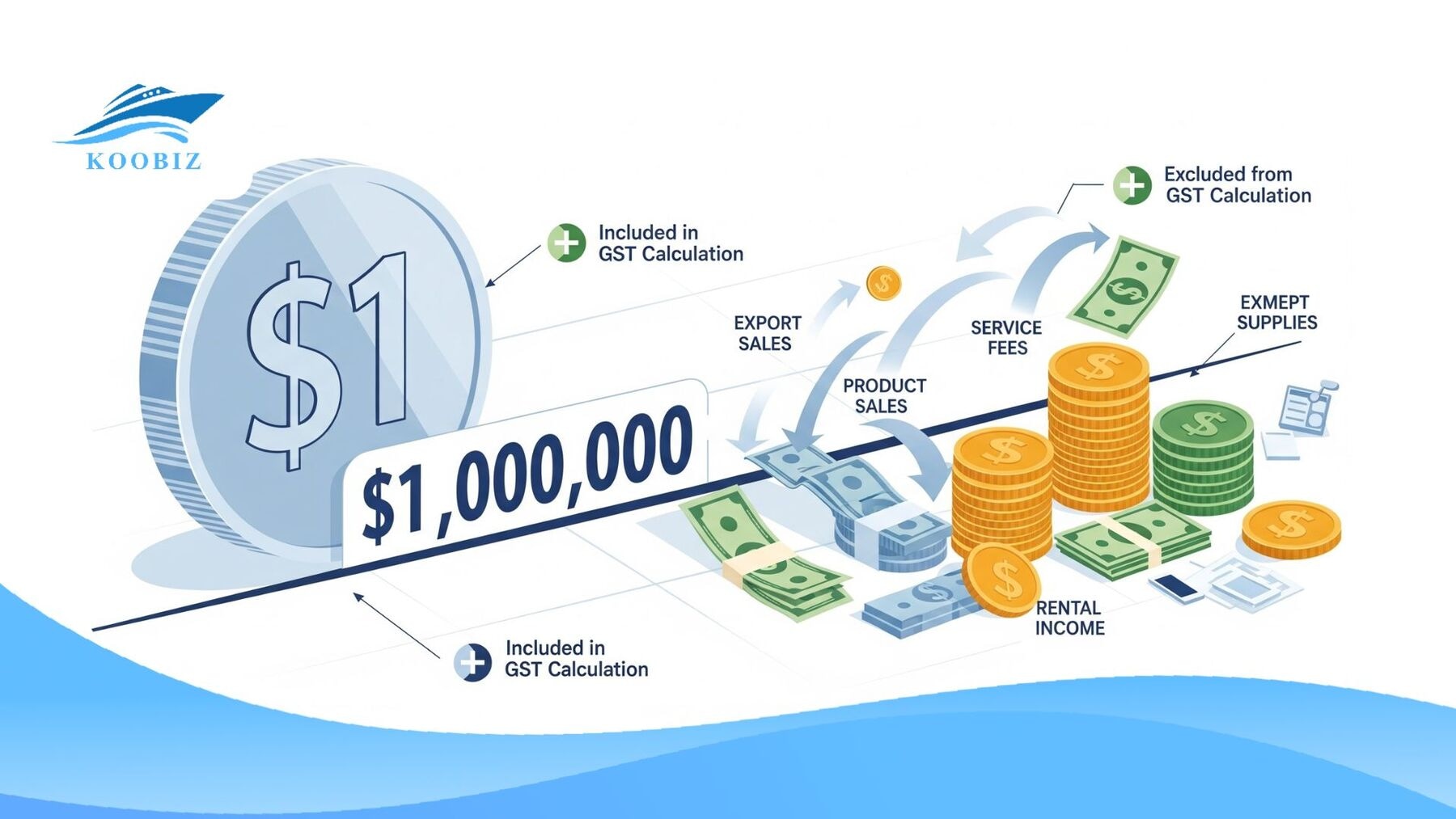
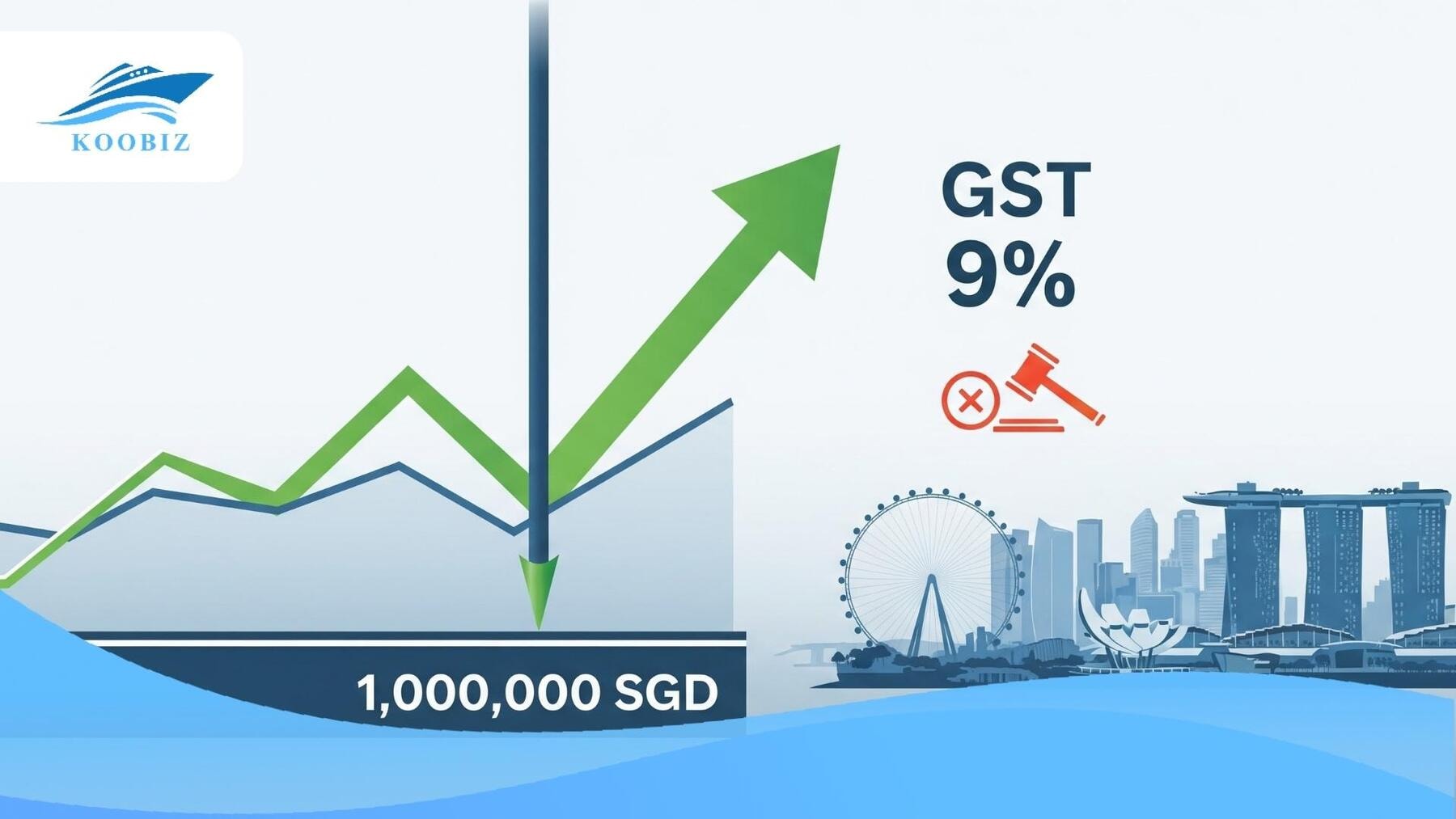
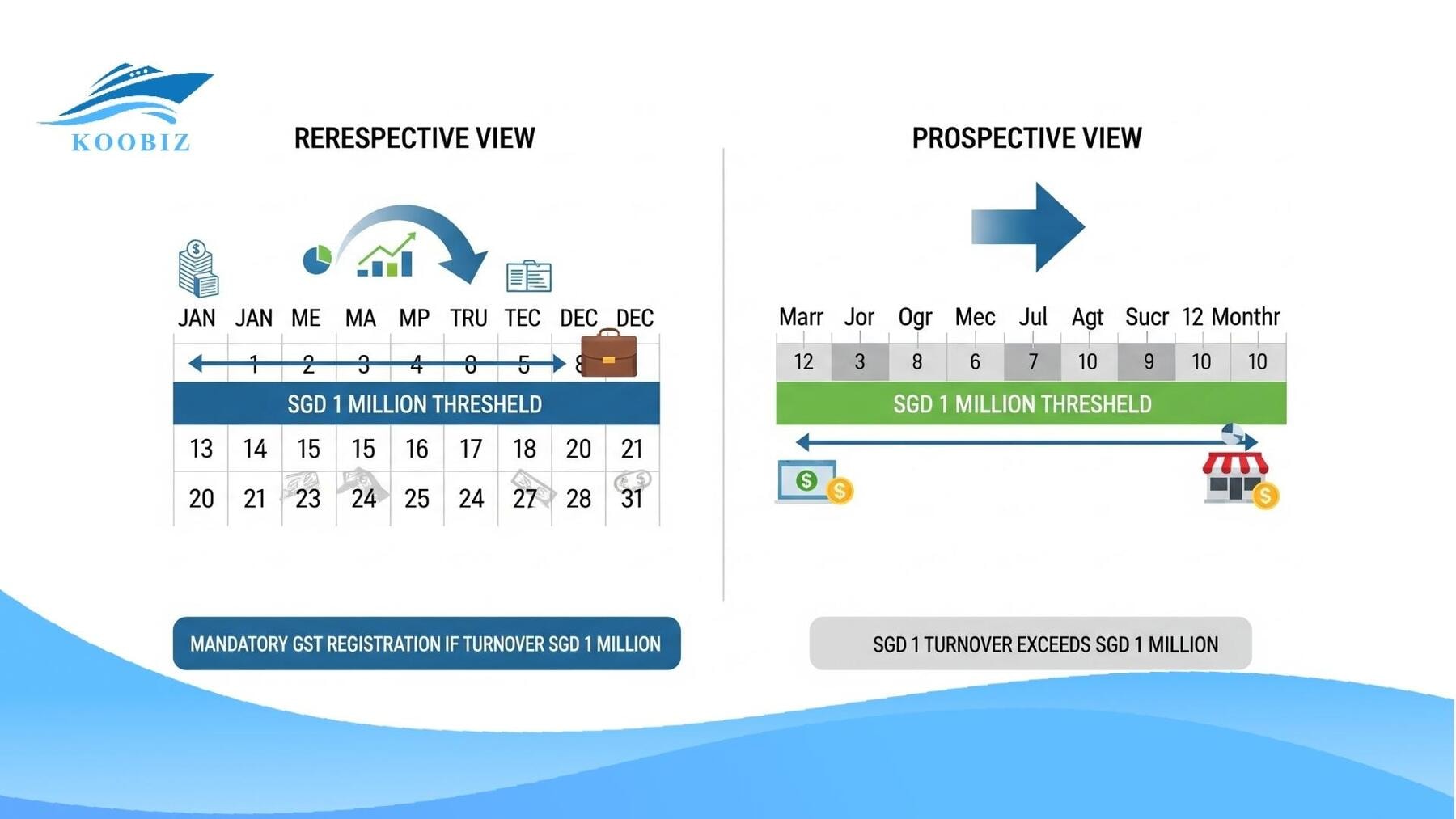
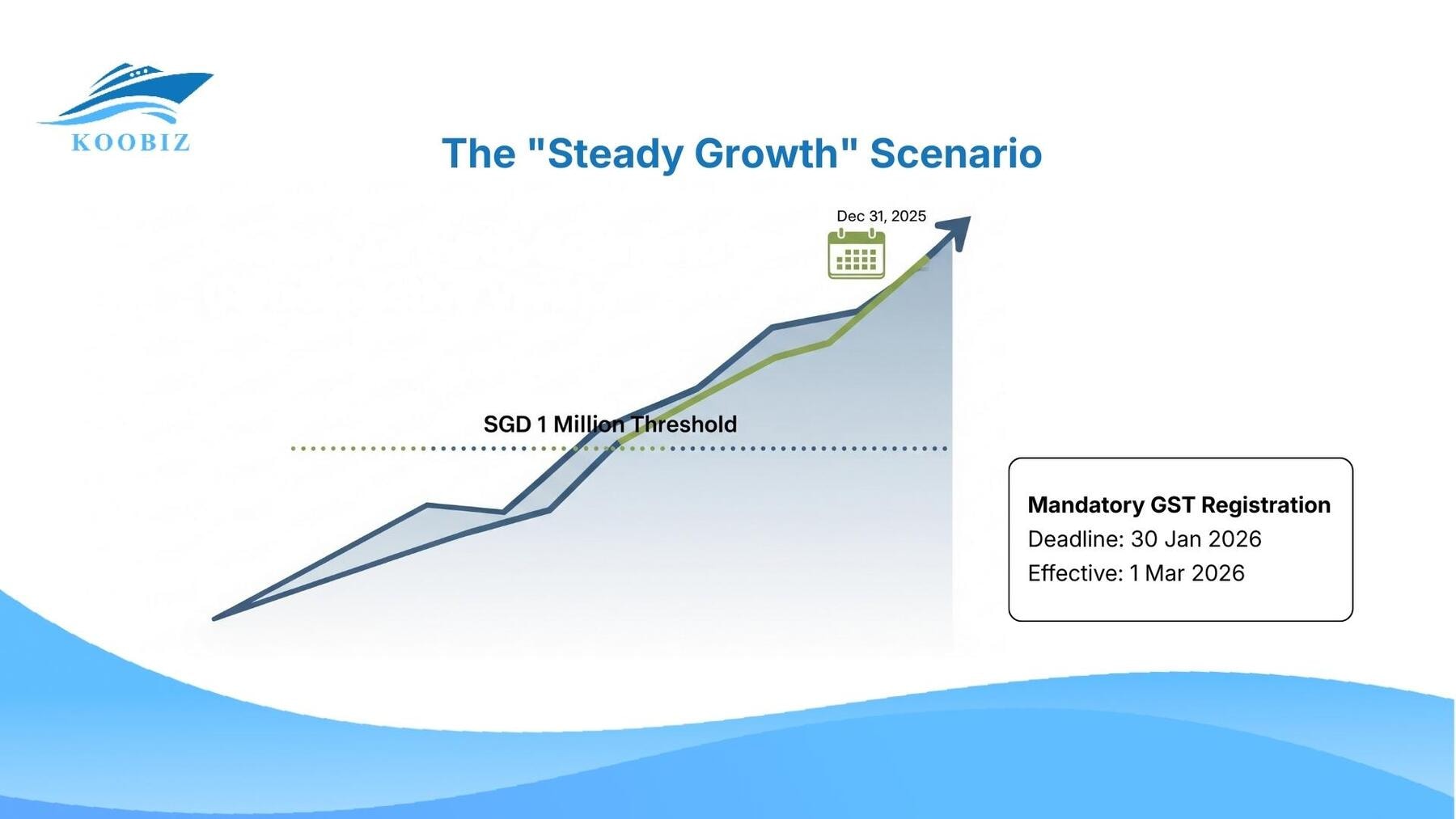
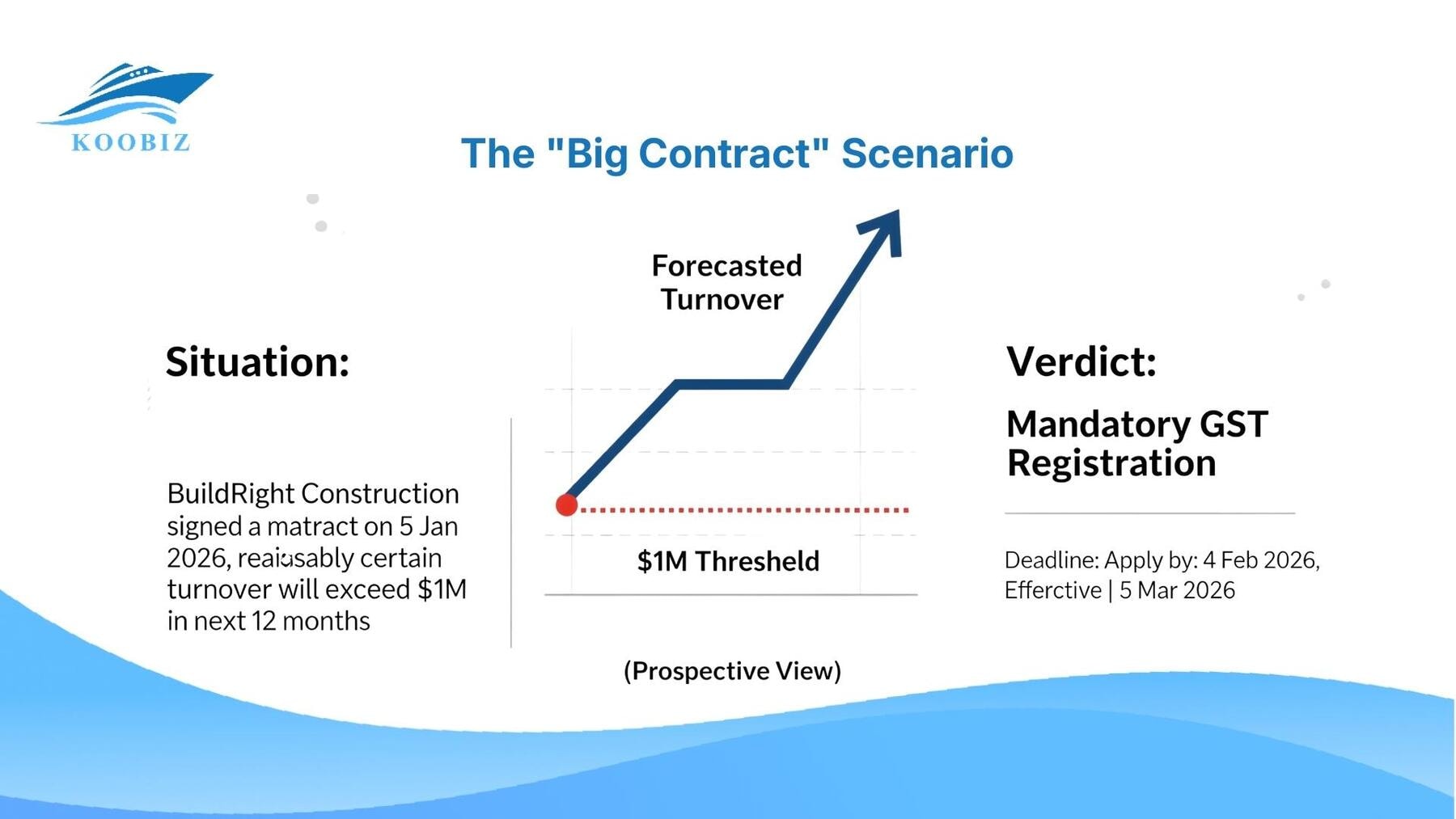
    Registration is mandatory only if your annual taxable turnover exceeds SGD 1 million. If you’re below this threshold, you can choose to register voluntarily to claim back GST on your business purchases, but this comes with the responsibility of filing quarterly returns. It’s a strategic decision worth careful consideration.

    What is XBRL Filing and Who Needs It?

    XBRL is a digital format for financial statements required by ACRA. Most companies need to file a full XBRL report. However, small, solvent private companies often have simpler options, like filing a PDF or a less detailed XBRL format. Preparing these filings typically requires specific software or professional help.

    How Do I Handle Multi-Currency Transactions?

    All transactions must be recorded in Singapore Dollars (SGD). Use the exchange rate on the date of each transaction. At year-end, any foreign currency held in your accounts must be revalued to reflect the current rate, with the difference recorded as a gain or loss. Modern cloud accounting software automates this entire process. .

    Does My Financial Year End (FYE) Have to Be 31 December?

    No, Singapore companies can choose any date as their Financial Year End (e.g., 31 March, 30 June). It does not have to align with the calendar year. However, choosing a date other than 31 December is often strategic. For example, ending your FYE early in the year might give you more time to prepare for tax season, or help you maximize tax exemptions if your first “year” is slightly shorter or longer (up to 18 months).

    About Koobiz

    Managing the complexities of accounting, tax, and compliance in Singapore requires more than just software; it requires a partner who understands the local regulatory framework. At Koobiz, we specialize in comprehensive corporate services, from Singapore company incorporation and opening corporate bank accounts to handling your monthly bookkeeping, tax filing, and auditing needs. Let us handle the numbers so you can focus on growing your business.

    Visit us at koobiz.com to schedule a consultation with our experts today.

  • What Do Accountants Do for Singapore SMEs? From Tax Compliance to Strategic Growth

    What Do Accountants Do for Singapore SMEs? From Tax Compliance to Strategic Growth

    [SUMMARIES]

    Beyond Bookkeeping: Modern accountants in Singapore act as strategic business partners, not just data recorders, helping SMEs navigate complex financial landscapes.

    Strict Compliance: Their core role involves adhering to rigorous IRAS tax regulations (GST, ECI, Form C-S) and ACRA statutory filings (Annual Returns, XBRL) to avoid costly penalties.
    Strategic Growth: Accountants drive expansion through precise cash flow management, budgeting, and acting as Virtual CFOs to interpret financial data for better decision-making.

    Outsourcing Advantage: For most SMEs, outsourcing accounting to Corporate Service Provider (CSP) offers a cost-effective alternative to hiring in-house, providing access to expert teams and specialized software.

    Tech-Driven Efficiency: The profession now relies heavily on cloud technology and AI automation to provide real-time financial insights and sustainability reporting.

    [/SUMMARIES]

    Accountants are the architects of financial stability who navigate complex IRAS and ACRA compliance while acting as strategic advisors for growth. Whether you are a startup founder or an established SME owner, understanding this multifaceted role is crucial.

    This article delves into the operational, compliance, and strategic functions of modern accountants, helping you decide whether to hire in-house or leverage professional experts.

    What is the Role of an Accountant in a Singapore SME?

    An accountant for a Singapore SME is a financial professional responsible for interpreting, recording, and analyzing financial data to ensure regulatory compliance and facilitate strategic decision-making.

    Financial expert responsible for analyzing and recording data
    Financial expert responsible for analyzing and recording data

    To understand this role more deeply, we must look beyond the stereotype of data entry. In the modern business context, specifically within Singapore’s framework, an accountant serves as a vital bridge between the company’s operational activities and its financial health.This critical function involves:

    • Maintaining the integrity of financial records (bookkeeping) and ensuring that every dollar is accounted for.
    • Providing financial visibility required to secure loans, attract investors, or simply manage cash flow effectively.
    • “Business integrity,” drives Koobiz experts to ensure your company remains in good standing with Singaporean authorities while maximizing operational efficiency.

    Core Responsibilities: Ensuring Compliance with IRAS (Inland Revenue Authority of Singapore) and ACRA (Accounting and Corporate Regulatory Authority)

    Singapore enforces rigorous adherence to laws, where errors can lead to stiff penalties or company striking-off. A competent accountant safeguards your business by managing complex deadlines and forms, allowing you to focus on core operations without the anxiety of non-compliance.

    Managing Tax Obligations (GST, ECI, and Form C-S)

    Singapore tax compliance: GST, ECI, Form C-S
    Singapore tax compliance: GST, ECI, Form C-S

    Navigating Singapore’s tax system requires precision regarding strict IRAS timelines and specific criteria for GST, Estimated Chargeable Income (ECI), and Corporate Income Tax (Form C-S/C).

    • Estimated Chargeable Income (ECI): Accountants must calculate and file the ECI within three months from the end of the financial year – A mandatory estimate of the company’s taxable income.

    Pro Tip: Companies with a financial year that have annual revenue of less than SGD 5 million AND predicted zero chargeable income , are exempt from filing ECI. Your accountant will verify if you qualify for this administrative waiver.

    • Depending on the company’s annual revenue, the accountant determines which form to file.
      • Form C-S Lite: For the simplest companies with revenue ≤ SGD 5 million and straightforward tax matters.
      • Form C-S: For qualifying small companies with revenue ≤ SGD 5 million.
      • Form C: For larger companies or those claiming complex deductions.

    GST Registration and Filing: If a company’s taxable turnover exceeds SGD 1 million, mandatory GST registration is triggered. Accountants manage the quarterly GST F5 filings, ensuring that output tax collected and input tax paid are reconciled accurately. Koobiz specialists ensure optimizing the tax position with sensible advisory based on the newest update.

    Financial Reporting and ACRA Annual Returns

    Every Singapore company must hold an Annual General Meeting (AGM) and file Annual Returns with ACRA, adhering to Singapore Financial Reporting Standards (SFRS). The accountant prepares the necessary unaudited or audited financial statements and converts them into the mandatory XBRL (eXtensible Business Reporting Language) format for the BizFile+ portal—a technical requirement that often trips up business owners attempting DIY filings.

    Note: Solvent Exempt Private Companies (EPCs) with revenue ≤ SGD 5 million may be eligible to file a simplified XBRL set or be exempt from filing financial statements with ACRA entirely, though they must still prepare them.

    How Do Accountants Drive Business Growth for SMEs?

    Accounting advising SME viewing financial dashboard
    Accounting advising SME viewing financial dashboard

    Accountants drive business growth by transforming historical data into future-focused strategies, utilizing cash flow forecasting and advisory services to improve profitability.

    Transitioning from “defense” (compliance) to “offense” (growth), the modern accountant becomes a strategic partner. While compliance keeps the business safe, strategic accounting propels it forward. By analyzing trends in the financial data, our team can identify which product lines are most profitable, where unnecessary costs are hemorrhaging cash, and when the business has enough liquidity to invest in expansion. This shift from reactive reporting to proactive advising is what separates a standard bookkeeper from a value-adding accountant.

    Cash Flow Management and Budgeting

    Effective cash flow management involves monitoring the timing of cash inflows and outflows to ensure the business always has the liquidity to operate.

    Cash is the oxygen of any SME. An accountant creates detailed cash flow forecasts that predict potential shortages before they happen. Instead of spending blindly, an accountant helps the business owner set realistic spending limits for marketing, hiring, and operations. This discipline ensures that the company creates a sustainable “burn rate,” vital for startups and growing SMEs in Singapore’s high-cost environment.

    Acting as a Strategic Advisor (Virtual CFO Services)

    A Virtual CFO provides high-level financial strategy, performance analysis, and decision support without the cost of a full-time executive.

    Many SMEs cannot afford a full-time Chief Financial Officer (CFO), yet they face complex financial decisions. This is where the “Virtual CFO” service comes into play. In this capacity, the accountant interprets financial ratios (like Return on Investment or Gross Margin) to guide data-driven decisions. Should the company lease or buy equipment? Is it financially viable to open a new branch? Is the business valuation ready for potential investors?.

    Case Study: From Chaos to Clarity for a Singapore Retailer

    Let’s look at a practical example involving a typical Singapore SME scenario.

    The Challenge: “TechGadget SG,” a growing electronics retailer, faced a common dilemma: sales were hitting record highs, yet their bank balance remained dangerously low. The owner was overwhelmed by manual data entry, had missed a GST filing deadline resulting in penalties, and was unsure which product lines were actually profitable.

    The Accountant’s Intervention:

    1. Immediate Compliance Fix: Koobiz experts stepped in to perform a “financial health check.” We immediately rectified the missed GST returns and successfully negotiated a waiver for the penalty with IRAS by demonstrating the company’s otherwise clean track record.
    2. Digital Integration: We migrated their messy spreadsheets to a cloud accounting system , integrating it directly with their Shopify store and POS system. This eliminated over 80% of manual data entry per week using OCR tools.
    3. Strategic Pivot: Through detailed financial analysis, we discovered that while high-end laptops generated high revenue, the profit margins were razor-thin due to shipping and warranty costs. Conversely, accessories and cables had 60% margins but were being under-marketed.

    The Result: Guided by these insights, the business shifted its marketing budget to focus on high-margin accessories. Within six months, net profit increased by 20%, and cash flow stabilized, giving the owner the confidence and capital to open a second outlet. This case study demonstrates that an accountant provides the roadmap for survival and expansion, not just tax filing.

    Outsourced Accounting Services in Singapore: In-House vs. Outsourced

    Outsourcing accounting services is often the superior choice for SMEs, offering cost savings, access to a wider range of expertise, and greater scalability compared to hiring in-house.

    Deciding between an in-house team and an outsourced provider is a pivotal choice for Singapore business owners. The table below highlights the key differences:

    Aspect In-House Accountant Outsourced (e.g., Koobiz)
    Cost High fixed cost (SGD 4,000–6,000/mth + CPF/Benefits) Variable, often starting from SGD 300/mth
    Expertise Limited to one person’s experience Team with industry-wide knowledge & regulatory updates
    Continuity Risk of gaps due to leave or resignation Guaranteed coverage via Service Level Agreements (SLAs)
    Scalability Difficult to scale up/down quickly Flexible scaling based on transaction volume
    Software Company bears full cost of software Access to enterprise-grade tools often included

    We have established the fundamental roles of an accountant: keeping the business legal through compliance and making it profitable through strategy.. As we look toward the future of accounting for Singapore SMEs, we must cross the boundary into the realm of technology and specialized micro-niche functions.

    How Modern Technology is Changing What Accountants Do

    There are three main technology trends reshaping accounting: Cloud Computing, Automation, and Artificial Intelligence, all of which enhance speed and accuracy.

    Technology has revolutionized the “how” of accounting, allowing professionals to deliver value faster. Implemented systems that talk to each other—connecting the Point of Sale (POS) system directly to the accounting software, and linking bank feeds for automatic reconciliation. This allows accountants from Koobiz provide real-time dashboards rather than month-old reports.

    Cloud Accounting Software: Xero, QuickBooks, and Myr

    Cloud accounting platforms like Xero and QuickBooks allow for real-time collaboration, accessible data from anywhere, and seamless integration with other business apps.

    • Accessibility: Business owners can view their P&L on their phone while traveling.
    • Integration: These platforms integrate with payroll software (like Talenox or HReasily) and e-commerce platforms (Shopify), creating a unified data environment.
    • Security: Cloud providers offer bank-level security. Our team specializes in migrating SMEs to these platforms to ensure data is secure and accessible.

    Automating Routine Tasks and AI Analytics

    Automation tools use Optical Character Recognition (OCR) and AI to process invoices and expenses, while predictive analytics forecast future trends.

    Modern accountants utilize tools (like Dext or Hubdoc) that allow clients to simply snap a photo of a receipt. The software automatically extracts the data (date, amount, vendor, GST) and pushes it to the accounting system. Beyond basic automation, AI in accounting is now enabling predictive analytics. By analyzing historical data, AI tools can help accountants forecast cash flow trends with greater accuracy, predicting potential shortfalls months in advance.

    Specialized Accounting Functions You Might Need

    Beyond general practice, there are specialized accounting branches like Forensic Accounting and ESG Reporting that address specific risks and emerging global standards.

    Forensic Accounting and Fraud Prevention

    Forensic accounting involves the investigation of financial records to detect fraud, embezzlement, or financial discrepancies, often for legal proceedings.

    While we hope to never need them, forensic accountants are crucial when internal controls fail. If an SME suspects employee theft or needs to settle a partnership dispute, a forensic accountant dives deep into the digital trail. They reconstruct financial events to find missing funds. This is a specialized service that adds a layer of security to the business assets.

    Sustainability Reporting and Green Finance

    Sustainability reporting is the practice of measuring and disclosing a company’s Environmental, Social, and Governance (ESG) performance to attract green investment and meet evolving regulatory expectations.

    Singapore is positioning itself as a hub for green finance. While currently mandatory mostly for listed companies, ESG reporting is trickling down to the SME sector. Banks are increasingly offering “Green Loans” with better interest rates to companies that can prove their sustainability. Accountants are now tasked with measuring non-financial metrics—such as carbon footprint or waste management costs—and integrating them into the company’s reporting structure. This emerging role positions the accountant as a guardian of the company’s long-term sustainability and social license to operate.

    Why Choose Koobiz?

    At Koobiz, we don’t just file your taxes; we fuel your growth.

    • Comprehensive Support: From incorporation to Virtual CFO services, we handle the entire financial lifecycle.
    • Compliance Guarantee: Our deep knowledge of IRAS and ACRA regulations ensures you never miss a deadline.
    • Transparent Pricing: No hidden fees—just clear, value-driven packages tailored to your business size.

    Conclusion

    Koobiz accountants specialize in empowering businesses to thrive in the competitive Singaporean market. From Singapore company incorporation to ongoing tax, accounting, and audit services, our team acts as your dedicated financial partner, ensuring a seamless start for your venture.

    Schedule a free consultation at Koobiz.com today and unlock your SME’s growth potential—don’t wait for the next filing deadline!

  • What Is Bookkeeping? Mastering Financial Records vs Accounting for Singapore SMEs

    What Is Bookkeeping? Mastering Financial Records vs Accounting for Singapore SMEs

    [SUMMARIES]

    Foundation vs. Analysis: Bookkeeping is the daily recording of financial data, while accounting is the high-level analysis of that data.

    Mandatory Compliance: All Singapore companies must maintain proper books of accounts for at least 5 years under ACRA regulations.

    Modern Efficiency: Cloud-based software is superior to manual entry for accuracy and real-time tracking.

    Tax Implications: Accurate bookkeeping is critical for correct GST filing and ECI submission to IRAS.

    Strategic Growth: Separating bookkeeping from accounting helps SMEs manage cash flow and plan for expansion effectively.

    [/SUMMARIES]

    “What is bookkeeping?” is often the first and most critical question new business owners ask when establishing a company in Singapore. It serves as the bedrock of financial health, yet it is frequently confused with the broader practice of accounting.

    At Koobiz, we understand that for Singapore SMEs, distinguishing between mastering daily financial records and high-level accounting strategy is not just about terminology—it is essential for ACRA compliance and avoiding costly penalties.

    What Is Bookkeeping?

    Bookkeeping is the systematic process of recording, organizing, and tracking every financial transaction of a business on a day-to-day basis.

    For Singapore businesses bookkeeping is a statutory requirement therefore, functions as the administrative phase of accounting. It involves the documentation of revenue and expenses. A bookkeeper ensures that every invoice, receipt, and payment is logged into the company’s ledgers. This creates a clear financial trail that allows business owners to see exactly where their money is going, serving as the raw data upon which all financial reports and tax filings are built.

    Bookkeeping: Recording financial transactions
    Bookkeeping: Recording financial transactions

    What Are the Key Responsibilities of a Bookkeeper?

    A professional bookkeeper handles three core categories of responsibilities: data entry, reconciliation, and accounts management.

    Key Responsibilities of a Bookkeeper
    Key Responsibilities of a Bookkeeper

    These tasks ensure the accuracy and integrity of financial data before it reaches an accountant.

    • Data Entry and General Ledger: Daily sales and expenses will be recorded in the General Ledger. This includes verifying source documents like receipts and invoices to ensure they are valid business expenses.
    • Bank Reconciliation: Comparison between the company’s internal records with the bank statement to ensure they match. It identifies discrepancies, missing entries, or potential fraud.
    • Accounts Management: Management of Accounts Receivable (tracking who owes the business money and sending invoices) and Accounts Payable (tracking what the business owes to suppliers and ensuring timely payments).

    Bookkeeping vs. Accounting: What Is the Difference?

    Bookkeeping excels at accumulating accurate data, while accounting focuses on analyzing that data for strategic decision-making and tax planning.

    They have both distinctive and interdependent functions within the financial cycle. Bookkeeping is objective and administrative; it focuses on the “what” and “when” of transactions. In contrast, accounting is subjective and analytical; it focuses on the “why” and “how” the business is performing.

    The table below outlines the key differences between the two roles:

    Feature Bookkeeping Accounting
    Primary Goal Recording financial transactions faithfully. Analyzing financial data for growth & compliance.
    Nature of Work Administrative & Objective (Data Entry). Analytical & Subjective (Strategy).
    Focus The “What” and “When” (Daily records). The “Why” and “How” (Business health).
    Key Output General Ledger, Trial Balance. Financial Statements (P&L), Tax Returns.
    Frequency Daily or Weekly. Monthly, Quarterly, or Annually.
    Tools Used Cloud Bookkeeping programs (Data Input). Financial models, Tax software (Analysis).

    Case Study: Bookkeeping vs. Accounting in Action

    To clearly illustrate the distinction in the case of a fictional Singapore cafe, “Merlion Coffee.”

    Merlion Coffee's Financial Process
    Merlion Coffee’s Financial Process
    • The Scenario: The cafe purchases $1,000 worth of premium coffee beans from a supplier.
    • The Bookkeeper’s Role: They record the transaction date, vendor, and amount ($1,000) into the accounting software . They categorize the expense under “Cost of Goods Sold” and file the digital invoice for future reference. Their job is done once the data is accurately captured.
    • The Accountant’s Role: At the end of the quarter, the accountant reviews the reports generated from the bookkeeper’s data. They notice that the “Cost of Goods Sold” has increased by 15% compared to the previous quarter. The accountant then advises the cafe owner to either renegotiate prices with the supplier or adjust the menu pricing to maintain profit margins.

    This demonstrates how bookkeeping provides the necessary data, while accounting provides the strategy based on that data.

    Is Bookkeeping Mandatory for Singapore Companies?

    Yes, bookkeeping is mandatory for all Singapore companies under the Singapore Companies Act to ensure transparency and accurate tax assessment according to ACRA (Accounting and Corporate Regulatory Authority) regulations.

    The law requires companies to maintain “proper books of accounts” that sufficiently explain the transactions and financial position of the company.

    • Record Retention: According to IRAS and ACRA regulations, companies must retain all financial records and source documents for at least 5 years. You can refer to the official IRAS Record Keeping Guide for specific requirements.
    • Proper Accounts: Failure to keep proper records can result in penalties, fines, or even disqualification of directors. These records are crucial when IRAS conducts a tax audit.

    What Are the Different Methods of Bookkeeping?

    There are two primary methods of bookkeeping: the Single-entry system for simple businesses and the Double-entry system for corporations.

    Single-entry vs. Double-entry System

    • Single-entry System: This is similar to a checkbook register. It is simple but does not track assets or liabilities effectively, making it suitable only for very small sole proprietorships.
    • Double-entry System: This is the standard for Pte Ltd companies in Singapore. Every transaction affects at least two accounts (a debit and a credit), satisfying the accounting equation: Assets = Liabilities + Equity. This method provides a self-balancing mechanism that reduces errors and detects fraud.

    Manual vs. Cloud Bookkeeping Software: Which Is Better?

    Cloud software outperforms manual methods through superior automation, accessibility, and security.

    In the modern Singapore business landscape, cloud accounting software allows for direct bank feeds, automated invoice chasing, and real-time visibility.

    • Automation: Cloud software can automatically categorize transactions and scan receipts via OCR technology.
    • Compliance: Most localized software is updated with the latest Singapore GST and tax rates, reducing compliance risk.

    How Does Bookkeeping Affect GST and Tax Filing?

    Accurate bookkeeping ensures precise Input and Output tax calculations, preventing costly penalties during quarterly GST filing.

    • ECI Filing: Bookkeeping records allow for the estimation of the company’s taxable income. This is required for filing the Estimated Chargeable Income (ECI) within 3 months of the financial year-end.
    • Audit Trail: Without clear bookkeeping, claiming tax deductions or GST refunds becomes impossible as there is no valid audit trail for IRAS to verify.

    Common Bookkeeping Mistakes Singapore SMEs Make

    Common errors include mixing up between personal and business funds, losing physical receipts, and failing to reconcile accounts monthly.

    • Commingling Funds: Using a business account for personal expenses violates the separate legal entity concept of a Pte Ltd company.
    • Irregular Reconciliation: Waiting until the end of the year to reconcile bank statements often leads to forgotten transactions and unfixable errors.

    When Should You Outsource Bookkeeping Services?

    You should outsource when transaction volume exceeds your internal capacity or when you lack the technical knowledge of Singapore’s evolving tax laws.

    For many SMEs, hiring a full-time in-house accountant is too expensive. Outsourcing to a Corporate Service Provider (CSP) offers a cost-effective solution. You gain access to a team of experts who ensure your financial records are compliant under the Singapore Law , allowing you to focus on growing your business rather than stressing over data entry.

    About Koobiz

    Koobiz is your trusted partner for navigating the Singapore business landscape. We specialize in comprehensive corporate services, including Company Incorporation, Bank Account Opening, Tax, Accounting, and Auditing. Our team ensures your bookkeeping is not just a compliance task, but a strategic asset.


  • Preparing Unaudited Financial Statements for Singapore SMEs: A Complete ACRA Compliance Guide

    Preparing Unaudited Financial Statements for Singapore SMEs: A Complete ACRA Compliance Guide

    [SUMMARIES]

    Cost-Efficiency: Unaudited financial statements allow eligible Singapore SMEs to comply with ACRA regulations without the high cost of an external audit.

    Eligibility Rules: Your company likely qualifies if it meets the “Small Company” criteria (Revenue <$10M, Assets <$10M, Employees <50).

    Mandatory Compliance: Even without an audit, statements must strictly adhere to Singapore Financial Reporting Standards (SFRS).

    Filing Format: Most companies must convert these statements into XBRL format for submission to ACRA.

    Timeline: Financial Year End (FYE) + 6 months for AGM (if held), + 7 months for Annual Return (AR) filing.

    Value of Professional Compilation: While “unaudited,” utilizing a professional compilation service like Koobiz ensures accuracy and banking credibility.

    [/SUMMARIES]

    Navigating the regulatory landscape of Singapore can be daunting for small business owners, especially when the Annual General Meeting (AGM) season approaches. Preparing unaudited financial statements is a critical obligation for Singapore SMEs that qualify for audit exemptions, offering a streamlined path to ACRA compliance without the heavy financial burden of a full statutory audit. However, “unaudited” does not mean “unregulated”; these reports must still adhere rigorously to the Singapore Financial Reporting Standards (SFRS) to avoid penalties and maintain good standing. Whether you are determining your eligibility for the “Small Company” exemption, distinguishing between audited and unaudited reports, or looking for a step-by-step preparation guide, this article covers every essential detail. At Koobiz, we understand that accurate financial reporting is the backbone of your business credibility, and we are here to guide you through the complexities of Singapore’s corporate compliance.

    [Note: This guide is current as of December 2025. Always refer to ACRA’s latest guidelines for specific amendments.]

    What Are Unaudited Financial Statements in Singapore?

    Unaudited financial statements are comprehensive financial reports prepared by a company’s management or external accountants that strictly follow the Singapore Financial Reporting Standards (SFRS) but do not undergo independent verification by an external auditor.

    The key distinction from audited financial statements lies in the absence of an external auditor’s opinion. Audited accounts include a professional assurance confirming that the financial statements present a true and fair view of the company’s financial position. Unaudited financial statements, by contrast, are supported by the directors’ responsibility and declaration that the accounts are accurate and properly prepared.

    Importantly, for regulatory and tax authorities such as the Accounting and Corporate Regulatory Authority (ACRA) and the Inland Revenue Authority of Singapore (IRAS), unaudited financial statements carry full legal significance. They form the basis for corporate tax assessments, statutory filings, and regulatory reviews of solvency and compliance. As a result, audit exemption does not reduce the standard of accuracy or compliance required. These financial statements must still be prepared with the same level of care, consistency, and adherence to SFRS as audited accounts.

    Is Your Company Eligible for Audit Exemption?

    Yes, your company is eligible for audit exemption if it qualifies as a “Small Company” under the rigorous criteria set forth by ACRA in the Companies Act.

    The “Small Company” concept was introduced to reduce regulatory costs for smaller entities. To qualify, a private company must meet at least two of the following three quantitative criteria for the immediate past two consecutive financial years:

    1. Total Annual Revenue: Less than or equal to SGD 10 million.
    2. Total Assets: Less than or equal to SGD 10 million.
    3. Number of Employees: Less than or equal to 50 employees.

    If your company is part of a group, the entire group must collectively meet these criteria on a consolidated basis to qualify.

    Eligibility is not permanent and must be reviewed annually. If a company exceeds the prescribed thresholds as its operations expand, it will be required to appoint a statutory auditor and transition to audited financial statements in the subsequent financial year.

    At Koobiz, we assist directors in conducting year-end eligibility assessments to determine whether audit exemption can be maintained or whether a statutory audit will be required, ensuring timely compliance and avoiding regulatory breaches.

    Unaudited vs. Audited Financial Statements: What is the Difference?

    Audited and unaudited financial statements serve distinct regulatory and business purposes. Audited financial statements are primarily intended to provide independent assurance to external stakeholders, while unaudited financial statements are designed to meet statutory filing requirements in a more cost-efficient and timely manner.

    Although both sets of financial statements present the same underlying financial information, the critical distinction lies in the degree of independent verification, regulatory requirement, and intended users. The comparison below highlights these differences.

    Feature Unaudited Financial Statements Audited Financial Statements
    Validation Compiled based on information provided by management. No independent verification or assurance opinion. Systematically reviewed by an independent Public Accountant who tests the validity of transactions.
    Legal Basis Must follow SFRS; Directors’ declaration (Sec 201). Must follow SFRS; Auditor’s opinion (Sec 207).
    Cost & Time Low Cost, Fast Turnaround. Ideal for SMEs operating on tight budgets; can be prepared quickly. High Cost, Time-Consuming. Process often takes weeks to complete due to rigorous testing standards.
    Purpose Sufficient for tax filing (IRAS), ACRA annual returns (for small private companies), and internal management. Required for stock exchange listings, large venture capital funding, or soliciting significant loans.
    Assurance Level Relies on Directors’ declaration of accuracy. Carries a positive assurance opinion from a licensed auditor.

    Key Components of a Complete Unaudited Financial Report

    A standard unaudited financial report comprises five essential components: the Statement of Financial Position, Statement of Comprehensive Income, Statement of Changes in Equity, Statement of Cash Flows, and the Directors’ Statement.

    To ensure your report is accepted by ACRA, it must be holistic and tell the complete story of your financial year. Missing any of these sections can lead to rejection or queries from authorities.

    Statement of Financial Position (Balance Sheet)

    The Statement of Financial Position presents the company’s financial standing at a specific point in time. It sets out the company’s assets, liabilities, and shareholders’ equity, typically classified into current and non-current categories.

    Within an unaudited financial report, this statement plays a critical compliance role. It enables ACRA and other stakeholders to assess the company’s solvency, demonstrating whether the company is able to meet its short- and long-term obligations as they fall due.

    Statement of Comprehensive Income (Profit & Loss)

    The Statement of Comprehensive Income summarises the company’s revenue, expenses, and costs over the financial period, culminating in the net profit or loss for the year.

    From a regulatory and tax perspective, this statement forms the primary basis for corporate tax computation. The net results disclosed here are used to derive the company’s Chargeable Income for submission to IRAS under Form C or Form C-S, making accuracy and proper classification of income and expenses essential.

    Statement of Changes in Equity

    The Statement of Changes in Equity explains how the shareholders’ equity has changed over the financial year. It captures movements arising from share issuances, dividend distributions, and retained earnings generated from the company’s operations.

    From a governance perspective, this statement allows shareholders and regulators to clearly understand how the company’s profits have been allocated and how the owners’ residual interest in the company has increased or decreased during the reporting period.

    Statement of Cash Flows

    Often overlooked in internal reports but mandatory for SFRS compliance, this statement shows the inflow and outflow of cash. It categorizes cash flow into operating, investing, and financing activities, providing a clear picture of the company’s liquidity that a P&L statement alone cannot offer.

    Notes to the Financial Statements

    These are detailed disclosures that explain the accounting policies used to prepare the statements (e.g., depreciation methods, currency translation). Under SFRS, the notes form an integral part of the financial statements. Without adequate disclosure, the financial statements may be considered incomplete or potentially misleading, even if the numerical figures are accurate.

    How to Prepare and File Unaudited Financial Statements with ACRA

    Preparing and filing unaudited financial statements with ACRA follows a structured, four-stage process: maintaining proper bookkeeping, preparing SFRS-compliant financial statements, obtaining shareholder approval, and lodging the Annual Return with ACRA.

    Bookkeeping and Trial Balance

    The foundation of any financial statement is accurate bookkeeping. You must record every transaction, sales invoices, expense receipts, bank statements, into your accounting ledger. At the end of the financial year, these records are summarized into a Trial Balance. Without a balanced and accurate Trial Balance, preparing the subsequent financial statements is impossible. Koobiz recommends using cloud accounting software (like Xero or QuickBooks) to automate this process throughout the year.

    Drafting the Financial Statements

    Once the figures are finalized, they must be formatted into the formal financial statements described in the previous section. This is where knowledge of SFRS is essential. You cannot simply submit a spreadsheet; the document must include the Directors’ Statement (replacing the Auditor’s Report) where directors formally declare the accounts are true and fair.

    AGM and Authorization

    Before filing, the unaudited financial statements must be approved by the shareholders. This is typically done at the Annual General Meeting (AGM), which must be held within 6 months of the financial year-end.

    • AGM Dispensation: Private companies can dispense with holding a physical AGM by passing a resolution or if permitted by their constitution. In this case, the financial statements must still be sent to shareholders within 5 months of the financial year-end.

    Filing the Annual Return

    The final step is filing the Annual Return (AR) via ACRA’s BizFile+ portal. As part of this process, companies are required to submit their financial statements, typically in XBRL format, depending on the filing requirements. The deadline for filing is within 7 months after the financial year-end.

    Real-World Scenarios: Who Qualifies? (Case Studies)

    To illustrate how the “Small Company” and “Small Group” audit exemption rules apply in practice, below are three representative case studies commonly encountered by Singapore businesses:

    Case Study 1: The Standalone Retailer (Eligible)

    Company: Orchard Boutique Pte. Ltd.

    Financial Metrics:

    • FY 2023: Revenue $1.2M | Assets $400k | Employees 8
    • FY 2024: Revenue $1.5M | Assets $500k | Employees 10

    Conclusion: Eligible for audit exemption

    Since the company is a private entity and meets all three criteria (well below the $10M/50 employee thresholds) for two consecutive years, it can file unaudited financial statements.

    Practical Impact: Estimated annual savings of S$2,000–S$4,000 in statutory audit fees.

    Case Study 2: The “Small Group” Structure (Eligible)

    Structure:

    TechHoldings Pte. Ltd. (Parent – 100% ownership)

    AppDev Pte. Ltd. (Subsidiary)

    Individual Entity Metrics:

    • TechHoldings (Parent): Revenue $0 | Assets $5M | Employees 2
    • AppDev (Sub): Revenue $8M | Assets $2M | Employees 20

    Consolidated Group Figures:

    • Total Revenue: $8M (Under $10M)
    • Total Assets: $7M (Under $10M)
    • Total Employees: 22 (Under 50)

    Conclusion: Eligible for audit exemption

    Even though there are multiple entities, the consolidated figures remain under the thresholds. Both the parent and the subsidiary can file unaudited statements.

    Case Study 3: The Disqualified Subsidiary (Not Eligible)

    Structure:

    Global Logistics Pte. Ltd. (Singapore subsidiary)

    MegaCorp Inc. (Foreign parent company)

    Financial Metrics:

    • Global Logistics (SG Sub): Revenue $2M (Small)
    • MegaCorp (Foreign Parent): Revenue $100M (Large)

    Conclusion: Not eligible for audit exemption

    While the Singapore subsidiary itself is “small,” it is part of a group that is “large” (consolidated revenue >$10M). Therefore, the Singapore subsidiary cannot claim audit exemption and must submit audited financial statements, unless it obtains a specific exemption or the parent has specific provisions.

    Lesson: Always look at the entire corporate family tree, not just the local entity.

    Unsure about your eligibility? Regulations can be complex, especially for group structures. Contact Koobiz for a free eligibility check to ensure you are on the right side of ACRA compliance.

    Advanced Filing Requirements and Common Mistakes

    There are specific technical pitfalls and formatting rules, particularly regarding digital data standards, that can cause compliance failures for unwary SMEs.

    Beyond the basic preparation, companies often stumble on the specific digital requirements of the Singapore government. ACRA is one of the most digitally advanced registries globally, and simply uploading a PDF is rarely sufficient.

    Understanding XBRL Filing Format for Unaudited Accounts

    XBRL (eXtensible Business Reporting Language) is an international standard used for the electronic communication of financial data. In Singapore, ACRA requires most companies to lodge their financial statements in XBRL format as part of the Annual Return filing process.

    Most SMEs are unaware that they cannot simply upload a PDF of their unaudited accounts. Depending on your company size, you will need to prepare the file in either “Full XBRL” or “Simplified XBRL.”

    • Simplified XBRL: Generally applicable for smaller, non-publicly accountable companies (Revenue <$500k and Assets <$500k).
    • Full XBRL: Required for larger companies.

    Preparing this file requires specialized software or the use of the BizFinx preparation tool provided by ACRA. Errors in mapping your financial data to the XBRL taxonomy are common and can result in the rejection of your Annual Return. This is a technical step where professional assistance from Koobiz is highly recommended to ensure data integrity.

    Does a Dormant Company Need to File Unaudited Financial Statements?

    No, a “dormant relevant company” is generally exempt from both preparing and filing financial statements if its total assets are SGD 500,000 or less at any time during the financial year.

    For ACRA purposes, a dormant relevant company is one that is unlisted, not a subsidiary of a listed company, and has no accounting transactions since incorporation or since the end of the previous financial year. Where a dormant company’s total assets exceed SGD 500,000, unaudited financial statements must still be prepared and lodged in XBRL format, despite the absence of trading activity.

    Regardless of asset size, all dormant companies are required to file an Annual Return (AR) each year to formally confirm their dormant status with ACRA.

    Compilation vs. Preparation: Is a Chartered Accountant Necessary?

    A “Compilation Report” offers a higher degree of credibility than self-prepared accounts because it involves a Chartered Accountant arranging your financial data in compliance with SSRS 4410 (Singapore Standard on Related Services).

    While you are legally allowed to prepare unaudited statements yourself (as a director), banks and potential partners often view self-prepared documents with skepticism. A Compilation Report serves as a middle ground. It is not an audit (no assurance opinion is given), but it carries the letterhead and professional signature of a qualified accounting firm like Koobiz, signaling that the information is presented correctly and professionally. This is often the “sweet spot” for SMEs—gaining professional credibility without the cost of a full audit.

    Conclusion

    Preparing unaudited financial statements is a core compliance obligation for Singapore SMEs, offering a practical balance between regulatory transparency and cost efficiency. By accurately assessing audit exemption eligibility, complying fully with SFRS requirements, and meeting ACRA’s XBRL filing standards, businesses can maintain both statutory compliance and stakeholder confidence.

    At Koobiz, we specialize in simplifying corporate compliance for businesses in Singapore. Whether you need assistance with company incorporation, opening a corporate bank account, or require professional accounting and tax services to prepare your unaudited financial statements, our team of experts is ready to assist. Don’t let compliance worries slow down your business growth.

    Contact Koobiz today for a consultation on your financial reporting needs.

    • Website: koobiz.com
    • Services: Singapore Company Incorporation, Bank Account Opening, Tax, Accounting, and Audit Services.
  • Preparing a Cash Flow Statement for Singapore SMEs to Monitor Liquidity (vs Profit)

    Preparing a Cash Flow Statement for Singapore SMEs to Monitor Liquidity (vs Profit)

    [SUMMARIES]

    Mandatory Compliance: Under SFRS(I) 7, most Singapore companies must prepare a Statement of Cash Flows; Exempt Private Companies (EPCs) that are solvent may be exempt from filing full XBRL statements but should still prepare the statement for governance and audit readiness.

    Profit ≠ Cash: A profitable P&L can coincide with cash shortages – liquidity, not profit, pays the bills.

    Three Pillars: The statement tracks money moving through Operating (CFO), Investing (CFI), and Financing (CFF) activities.

    Preparation Methods: The Indirect Method is the practical standard for most SMEs (easier to produce from accrual accounts and software like Xero).

    Local Nuances: GST timing (9%) and reimbursement-based grants (PSG/EDG) can create large timing gaps that hurt liquidity.

    [/SUMMARIES]

    What is a Cash Flow Statement?

    The Cash Flow Statement records actual cash movements – when money hits or leaves the bank. Unlike the Income Statement (accrual-based), the cash flow report answers: Can we pay payroll and suppliers tomorrow? Banks and investors use it to assess the quality of earnings: high profit with negative operating cash flow signals earnings tied up in receivables or inventory.

    Is a Cash Flow Statement Mandatory for Singapore SMEs?

    Yes, preparing a cash flow statement is required under Singapore’s financial reporting framework (SFRS(I) 7). Filing obligations with ACRA differ by company type:

    • Publicly Listed Companies: Must file full financial statements including cash flows.
    • Non-Publicly Accountable Entities: Generally must include a cash flow statement in the annual financials.

    Exempt Private Companies (EPCs): Solvent EPCs may be exempt from filing full XBRL financials with ACRA but still should prepare full statements for internal control, bank lending, and potential IRAS audits; insolvent EPCs must file full statements. Koobiz recommends all EPCs prepare a cash flow statement regardless of filing exemption – banks and grant assessors expect it.

    Cash Flow vs. Net Profit: The “Gap”

    • Timing: Profit is recognised when earned; cash is recorded when received.
    • Non-cash items: Depreciation reduces profit but not cash — it’s added back in the cash-flow reconciliation.
    • CapEx: Equipment purchases reduce cash immediately but are expensed over time in P&L.

    Example: Invoice S$50,000 in Jan, 60-day credit. P&L shows revenue in Jan; cash arrives in Mar. If payroll and rent fall due before collection, the company can be unable to pay despite showing profit.

    The Three Key Components

    To monitor liquidity accurately, cash movements are separated into three “buckets”:

    1. Cash Flow from Operating Activities (CFO)

    Cash generated from core business operations.

    • Inflows: Customer receipts.
    • Outflows: Payments to suppliers, employees, and IRAS.

    Insight: A consistently negative CFO indicates the business model is not self-sustaining and relies on external funding.

    2. Cash Flow from Investing Activities (CFI)

    Cash used for buying or selling long-term assets (Capital Expenditure).

    • Outflows: Buying computers, machinery, or software.
    • Inflows: Selling old equipment.

    Insight: Negative CFI often signals a growing company investing in its future capacity.

    3. Cash Flow from Financing Activities (CFF)

    Cash flow between the company, its owners, and creditors.

    • Inflows: Issuing shares or taking bank loans.
    • Outflows: Paying dividends or repaying loan principals.

    Insight: High inflows mean the company is raising capital; high outflows mean it is servicing debt.

    Preparation: Direct vs. Indirect Method

    While SFRS(I) 7 encourages the Direct Method, the Indirect Method is standard for Singapore SMEs due to its simplicity and integration with software like Xero.

    • Direct method: Lists cash receipts and payments. Readable but hard to compile from accrual-ledgers.
    • Indirect method (recommended for SMEs): Start with Net Profit, add back non-cash items (e.g., depreciation), then adjust for working capital changes (Δ receivables, payables, inventory). It maps cleanly from the P&L and balance sheet. Koobiz’s accounting services can automate this reconciliation from Xero/QuickBooks exports.

    Case Study: The “Profitable but Poor” Dilemma

    Scenario: SingaTrading Pte Ltd closes January 2025 with a fantastic Income Statement but struggles to pay February rent.

    Financial Snapshot (January 2025):

    Metric Income Statement (Accrual) Cash Flow Statement (Actual)
    Revenue / Inflow S$100,000 (Invoiced) S$70,000 (Collected)
    Expenses / Outflow (S$80,000) (Incurred) (S$95,000) (Paid)
    Bottom Line + S$20,000 (Profit) – S$25,000 (Cash Drain)

    The Diagnosis:

    1. Operating (Root Cause): Customers haven’t paid S$30,000 yet (Accounts Receivable), while SingaTrading paid suppliers immediately.
    2. Investing: They spent S$5,000 upfront on software.
    3. Result: Despite S$20,000 profit, they are S$25,000 poorer in cash.

    The Fix: The Director must chase debt collection or negotiate 30-day credit terms with suppliers. Profit is an opinion; Cash is a fact.

    Practical Example: Sample Cash Flow Statement (Indirect Method)

    Here is a simplified standard format for a Singapore SME.

    Line Item Amount (SGD) Category
    Net Profit (from P&L) $50,000 Starting Point
    Adjustments:
    (+) Depreciation $5,000 Non-cash expense
    Working Capital Changes:
    (-) Increase in Receivables ($20,000) Cash not yet collected
    (+) Increase in Payables $10,000 Cash preserved (bills unpaid)
    (-) Tax Paid to IRAS ($5,000) Actual outflow
    Net Cash from Operating (A) $40,000 Actual Business Cash
    Investing Activities:
    (-) Purchase of Computers ($15,000) CapEx
    Net Cash used in Investing (B) ($15,000) Growth Spend
    Financing Activities:
    (+) Bank Loan Proceeds $50,000 Inflow
    (-) Loan Repayment ($8,000) Outflow
    Net Cash from Financing (C) $42,000 Funding
    Net Increase in Cash (A+B+C) $67,000 Total Movement

    Singapore Strategic Context: Grants and GST

    Beyond standard preparation, local factors significantly impact cash flow timing.

    1. The “Valley of Death” in Government Grants

    Grants like the Productivity Solutions Grant (PSG) and Enterprise Development Grant (EDG) are vital for SMEs, but they operate on a reimbursement basis.

    • The Trap: You must pay the vendor 100% upfront.
    • The Lag: Reimbursement (up to 50-70%) takes 1–3 months (or longer) after the claim is approved via the Business Grants Portal.
    • Impact: Your cash flow takes a massive hit in the month of purchase. Without bridge financing, a “grant-supported” project can cause a liquidity crisis.

    2. GST Impact (9% Rate)

    For GST-registered businesses, GST collected is a liability, not revenue.

    • Flow: You collect 9% GST on sales (increasing cash balance) but must pay it to IRAS quarterly.
    • Risk: If you spend this “extra” cash, you will face a shortfall when tax filing is due.

    Koobiz Tip: Consider the Major Exporter Scheme (MES) if you are a significant exporter. It allows you to import non-dutiable goods with GST suspended, significantly easing cash flow pressure.

    Common Warning Signs

    • If CFO is consistently negative, you are burning cash to sustain operations. You are surviving only by selling assets or borrowing.
    • A company can be solvent (Assets > Liabilities) but illiquid (Cash tied up in stock). If you cannot pay debts as they fall due, creditors can wind you up.
    • If it takes 90 days to sell and collect, but you pay suppliers in 30 days, you have a 60-day funding gap.

    Frequently Asked Questions (FAQ)

    Can a profitable company go bankrupt?

    Yes, “technical insolvency” occurs when a company can’t meet immediate debts despite positive equity or paper profit.

    Do I need to submit the Cash Flow Statement with Form C-S?

    Companies that file Form C-S (revenue ≤ S$5M) generally do not have to submit full financial statements with the tax return, but they must prepare and retain them for audits and lender/grant requests. Koobiz helps SMEs prepare filing-ready statements even when submission isn’t required.

    How do I handle Foreign Currency (FX)?

    Unrealized FX gains/losses in the P&L are non-cash items and must be adjusted out in the Operating section. However, actual foreign currency cash balances at year-end must be revalued at the closing rate to reflect the true SGD value.

    Conclusion

    Preparing a Cash Flow Statement under SFRS(I) 7 is not just a compliance exercise; it is a survival tool. By separating paper profit from actual liquidity and navigating Singapore’s specific grant and tax lags, you secure your business’s future.

    At Koobiz, we simplify Singapore’s financial reporting standards for you. Whether you need help with incorporation, corporate bank account opening, or accounting services to maintain healthy cash flow, our team is ready to assist.

    Visit Koobiz.com to optimize your financial strategy today.

  • Understanding the SPV Company: A Special Purpose Vehicle Guide for Singapore Investors

    Understanding the SPV Company: A Special Purpose Vehicle Guide for Singapore Investors

    [SUMMARIES]

    Risk Isolation: An SPV acts as a legal firewall, ensuring asset ring-fencing and bankruptcy remoteness from the parent entity’s liabilities

    Strategic Flexibility: Ideally used for securitization, real estate holdings, and joint ventures in Singapore.

    Distinct Structure: Unlike a general subsidiary, an SPV engineered for off-balance sheet financing and orphan structures.

    Regulatory Framework: Supported by ACRA and advanced structures like the VCC for fund management.

    Professional Setup: Requires precise incorporation steps where Koobiz can assist with compliance and administration.

    [/SUMMARIES]

    At Koobiz, we frequently guide clients through the nuances of establishing SPV companies with a view to optimizing tax efficiency while mitigating cross-contamination of risks.. This guide will walk you through the definition, primary uses, comparisons with standard subsidiaries, and the procedural steps to set up an SPV in Singapore.

    What is a Special Purpose Vehicle (SPV) in Singapore?

    SPV: Subsidiary isolating assets from parent's risk
    SPV: Subsidiary isolating assets from parent’s risk

    An SPV (Special Purpose Vehicle) is a fiscally distinct subsidiary engineered to facilitate asset securitization, risk isolation and insulate specific assets from the parent entity’s insolvency risks.

    To fully grasp why this structure is favored in Singapore, we must look beyond the basic definition and examine its core operational characteristics.

    Typically, an SPV is established as a separate legal entity. In Singapore, this often takes the form of a Private Limited Company registered with ACRA. Its “special purpose” implies that its activity is limited to the acquisition and financing of specific assets.This structure establishes a legal ring-fencing mechanism, ensuring that the SPV’s balance sheet remains autonomous. For instance, if the parent company collapses, the assets held within the SPV are generally safe from the parent’s creditors. However, if the SPV fails, the parent company’s liability is usually limited to its equity investment in the SPV. This bi-directional liability shield is the cornerstone of contemporary corporate financial engineering.

    What are the Primary Uses of an SPV Company?

    Primary uses of SPV: finance, real estate, joint ventures
    Primary uses of SPV: finance, real estate, joint ventures

    SPVs in Singapore serve as versatile financial instruments, primarily utilized for structured finance, real estate portfolio management, and risk-ringfenced joint ventures.

    Let’s explore how these specific applications function in practice to deliver tangible business value.

    Asset Transfer and Risk Isolation

    Balance Sheet Deconsolidation: Moving volatile assets—such as distressed loans or IP—into an SPV to ensure operational insulation. By moving assets—such as loans, receivables, or intellectual property—into an SPV, the parent company isolates the risk associated with those assets. If the assets underperform, the impact on the parent company is minimized. For example, a construction firm might set up an SPV for a specific hazardous build; if the project faces litigation, the main construction firm’s assets remain protected.

    Project Finance and Fundraising

    SPVs are instrumental in project finance. When a company wants to launch a new project but facilitates non-recourse or limited-recourse financing, where lenders’ claims are confined to the SPV’s cash flows rather than the parent’s core assets., it is recommended to create an SPV. The SPV can then raise capital or take loans based solely on the projected cash flows of that specific project, rather than the creditworthiness of the parent company. This allows for cleaner accounting and often secures better financing terms for the specific venture.

    Real-World Examples: SPV Structures in Action

    Strategic Application: From Real Estate Syndication to Tech Ventures.

    Case Study 1: The Property Developer

    Scenario A: Asset Ring-Fencing in Real Estate Development

    The project carries significant risk due to exposure to macroeconomic volatility and construction liability. Instead of developing the condo under the main brand, Summit Holdings incorporates a Singapore SPV named “Summit Project A Pte. Ltd.” The land and construction loans are held strictly within this SPV.

    • Outcome: If the condo project fails or faces lawsuits from contractors, the assets of the main parent company, “Summit Holdings,” are protected. Creditors can only claim against the assets in the SPV.

    Case Study 2: The Angel Investment Syndicate

    A syndicate of 15 individual investors intends to provide capital to a promising Singaporean Fintech startup. However, the startup seeks to maintain a streamlined cap table by avoiding the administrative complexity of managing 15 separate shareholders.

    • Solution: The investors establish a Special Purpose Vehicle as a Nominee Entity to streamline governance and facilitate pass-through tax efficiency.
    • Outcome: The startup deals with only one shareholder (the SPV), simplifying governance. The 15 investors hold shares in the SPV, which acts solely as a pass-through vehicle for their investment returns.

    Structural Comparison: Assessing Liability and Bankruptcy Remoteness across Legal Entities

    While the distinction between these entities is often subtle, it lies fundamentally in their legal scope and “bankruptcy remoteness.” The table below outlines the key differences to help you choose the right structure.

    Feature SPV Company Holding Company General Subsidiary
    Primary Purpose Risk isolation, securitization, and specific project finance. Owning shares and controlling interest in other companies. Conducting regular operational business activities (sales, services).
    Operational Scope Strictly Limited. Operates as a fenced entity with Restricted Object Clauses in its Constitution to ensure transaction integrity. Governance Focused. A strategic vehicle for Equity Consolidation and Group-wide Governance. Broad. Deeply integrated with the parent’s brand and daily operations.
    Bankruptcy Remoteness High. Engineered via non-petition clauses and asset ring-fencing to survive parent-level insolvency. Moderate. Offers liability protection but is often tied to group performance. Low. Usually financially and operationally linked to the parent.
    Debt Liability Lenders’ claims are covenanted solely against the SPV’s specific collateral. Can guarantee debt for subsidiaries. Debts can often impact the group’s reputation/operations.

    The Concept of “Bankruptcy Remoteness”

    Bankruptcy Remoteness: The Core Value Proposition of an SPV. Bankruptcy remoteness means that the SPV is structured in a way that makes it minimizes the risk of substantive consolidation during the parent company’s insolvency. Under Singaporean Law, SPV is viewed as a separate legal unit, such legal separation is achieved through independent directorships and strict governing constitutions. Singapore courts strictly uphold the Doctrine of Separate Legal Entity, reinforcing the corporate veil to insulate the SPV—a service Koobiz specializes in ensuring for our clients.

    Is an SPV Structure Necessary for Your Investment?

    SPV structure is necessary for high-risk investment
    SPV structure is necessary for high-risk investment

    Yes, an SPV structure is necessary if your investment involves high-risk assets, requires ring-fenced financing, or necessitates absolute liability segregation from core operating entities. No, standard operational SMEs with low-risk liability profiles may find the administrative overhead of an SPV unnecessary.

    If you are a property developer in Singapore acquiring a new plot of land, using an SPV is almost mandatory to insulate stabilized assets from development-phase liabilities against contingent risks and site-specific operational volatility. Similarly, if you are an investor engaging in capital syndication for a specific startup investment, an SPV facilitates cap table optimization and governance streamlining.

    How to Incorporate an SPV in Singapore?

    Phase 3: Procedural Execution – Incorporating a Strategic SPV via ACRA, appoint at least one resident director, and define the company’s constitution to reflect its specific limited purpose.

    While the process mirrors standard incorporation, complexity arises from the meticulous calibration of the Constitution to preserve structural integrity.

    1. Name Reservation: Select a unique name for the SPV.
    2. Define Constitution: Unlike a standard company with broad powers, An SPV’s constitution incorporates Restrictive Covenants and Specific Object Clauses to ensure regulatory compliance.
    3. Appoint Officers: You need a resident director and a company secretary.
    4. Share Capital: Determine the shareholding structure.
    5. Filing: Submit the application via BizFile+ (ACRA’s portal).

    The Koobiz Advantage: Ensuring End-to-End Structural Integrity

    According to ACRA statistics, the processing time for a new company registration can be as fast as 15 minutes if all documents are in order.

    Advanced Regulatory Considerations for Singapore SPVs

    Advanced Regulatory Framework: Navigating the Micro-Semantics of SPV Governance

    These factors move beyond basic incorporation and touch upon the micro-semantics of financial engineering and fund management in Singapore.

    What is the Variable Capital Company (VCC) Relation to SPVs?

    The Singapore VCC serves as a robust alternative to Segregated Portfolio Companies (SPCs) found in offshore jurisdictions.A VCC can consist of multiple sub-funds. Within a VCC, each sub-fund operates as a statutory SPV, leveraging asset-liability compartmentalization to eliminate cross-contamination. This allows fund managers to operate multiple investment strategies under one corporate umbrella without incorporating separate private limited companies for each strategy.

    How Does “Off-Balance Sheet” Financing Work?

    Balance Sheet Optimization: Utilizing SPVs for Deconsolidation and improved Gearing Ratios.By placing certain debt in an SPV which, under certain accounting standards, is not fully recorded in the parent company’s account – the parent company can improve its gearing ratios (debt-to-equity). This makes the parent company look more attractive to investors.

    What are the Tax Implications for SPVs in Singapore?

    Tax Governance: Leveraging Singapore’s Tax-Neutral Framework for SPVs

    • Tax Exemptions: Schemes like 13O and 13U allow for tax exemption on specified income from designated investments, which is essential for Family Offices seeking fiscal optimization through consolidated investment vehicles.
    • Double Taxation Agreements (DTAs): An SPV incorporated in Singapore can benefit from Singapore’s extensive DTA network, mitigating withholding tax leakages through Singapore’s extensive Double Taxation Agreement (DTA) network.

    Can an SPV be Used for Intellectual Property (IP) Holding?

    Strategic IP Asset Protection: The Role of Intellectual Property SPVs.Companies often set up an SPV specifically to own valuable patents or trademarks. The operating company then pays royalties to the SPV for the use of the IP. This protects the IP assets from lawsuits that might target the operating company (e.g., product liability claims). If the operating company is sued, the core IP remains safe within the SPV.

    Conclusion

    Conclusion: Future-Proofing Investments through Structural Resilience Establishing an SPV company in Singapore is a powerful strategy for risk management and financial efficiency.

    At Koobiz, we specialize in empowering businesses to expand into Singapore. From SPV setup to corporate services, tax accounting, and audit assistance, our team provides the expertise required for efficient and compliant operation. If you are ready to structure your next investment vehicle, visit koobiz.com to connect with our experts today.

  • Maximize Tax Benefits for Your Private Limited Company (Pte Ltd) in Singapore: A Corporate Tax Guide

    Maximize Tax Benefits for Your Private Limited Company (Pte Ltd) in Singapore: A Corporate Tax Guide

    [SUMMARIES]

    The Start-Up Tax Exemption (SUTE) scheme drastically reduces the effective tax rate for qualifying new companies during their first three years by exempting 75% of the first S$100,000 and 50% of the next S$100,000 of chargeable income.

    Established entities benefit from the Partial Tax Exemption (PTE) scheme, which exempts 75% of the first S$10,000 and 50% of the next S$190,000, alongside a single-tier tax system that ensures dividend distributions to shareholders are completely tax-free.

    Companies can further optimize their tax liability by claiming deductible business expenses-including wages subject to new 2025 S Pass thresholds-and leveraging the Foreign-Sourced Income Exemption (FSIE) and Double Taxation Agreements (DTAs) for cross-border trade.

    [/SUMMARIES]

    Maximizing tax benefits for your Private Limited Company (Pte Ltd) in Singapore involves strategically leveraging Singapore’s corporate tax incentives. Key schemes include the Start-Up Tax Exemption (SUTE) and Partial Tax Exemption (PTE), which can reduce your effective tax rate well below the headline 17%. While Singapore is globally renowned for its pro-business environment, simply incorporating is not enough; business owners must actively understand how chargeable income is calculated and which specific exemptions apply to their company’s lifecycle stage.

    To fully grasp the potential savings, one must first look beyond the headline figure and understand the distinction between the statutory corporate income tax rate and the effective tax rate that most companies actually pay. This distinction is crucial for foreign investors and local entrepreneurs alike who are planning their financial projections.

    For new businesses, the government offers generous support through the SUTE scheme, which provides a substantial partial exemption scheme for the first three consecutive Years of Assessment. This initiative is designed to support entrepreneurship and cash flow during the critical early years of operation.

    However, the benefits do not end once the startup phase is over; established companies, as well as foreign shareholders, can utilize deductions, the single-tier tax system, and international treaties to to minimise corporate tax liability and maximise after-tax profits. . The sections below explain how companies can legally optimise their corporate tax obligations.

    What Is the Corporate Income Tax Rate for a Singapore Private Limited Company (Pte Ltd) ?

    The Corporate Income Tax (CIT) rate in Singapore is a flat 17% levied on chargeable income, renowned for being one of the most competitive statutory rate in the Asia-Pacific region. This single rate applies to both local and foreign companies doing business in Singapore, providing a predictable fiscal environment.

    To understand how this impacts your bottom line, we must look beyond the headline figure. In reality, due to various tax incentives, rebates, and exemption schemes, the effective tax rate for many small-to-medium enterprises (SMEs) is often significantly lower than 17%.The Inland Revenue Authority of Singapore (IRAS) calculates tax based on the preceding financial year’s income, known as the Year of Assessment (YA). For example, income earned in 2024 is taxed in YA 2025.

    Understanding this baseline is essential before diving into the specific mechanisms that can reduce your liability.

    According to the Inland Revenue Authority of Singapore (IRAS), most Singapore companies achieve an effective tax rate significantly lower than 17% through government exemption schemes.

    What Are the Key Tax Exemption Schemes for New Startups?

    There is one primary scheme for new companies for new companies: the Start-Up Tax Exemption (SUTE) scheme, designed to reduce the effective tax rate significantly for the first three consecutive Years of Assessment (YAs). This scheme was introduced to encourage entrepreneurship and help local enterprises grow by exempting a large portion of their initial income from taxation.

    The mechanics of this incentive are outlined below to show how much tax savings are available.

    How Does the Start-Up Tax Exemption (SUTE) Scheme Work?

    The SUTE scheme offers a significant tax break by exempting 75% of the first SGD 100,000 of normal chargeable income from tax, and subsequently, a 50% exemption on the next SGD 100,000.

    Specifically, for the first three YAs where the company falls within the qualifying period:

    • First SGD 100,000: 75% exempt (You only pay tax on 25%).
    • Next SGD 100,000: 50% exempt (You only pay tax on 50%).

    What does this mean for your business? If your startup earns SGD 200,000 in profit, your effective tax payable is drastically reduced compared to the standard 17% calculation. This massive cash flow saving is absolutely vital for reinvestment into key business operations during the critical early stages.

    Does Your Private Limited Company (Pte Ltd) Qualify for the SUTE Scheme?

    Yes, your Private Limited Company (Pte Ltd) is generally eligible for the SUTE scheme, provided it meets three specific criteria related to shareholder structure and company type defined by IRAS.

    However, eligibility is not automatic. To benefit, you must ensure your company strictly complies with the following conditions:

    1. Incorporation Status: The company must be a Singapore-incorporated company.
    2. Tax Residency: The company must be a tax resident in Singapore for that YA (Year of Assessment).
    3. Shareholder Structure: The company must have no more than 20 shareholders throughout the basis period for that YA, where:
      • All shareholders are individuals; OR
      • At least one shareholder is an individual holding at least 10% of the issued ordinary shares.

    Important Note: Companies that are Investment Holding Companies or those undertaking Property Development (for sale, investment, or both) are STRICTLY EXCLUDED from the SUTE scheme. If you are unsure about your eligibility or shareholder structure, services like Koobiz can assist in structuring your incorporation correctly from day one to ensure you don’t miss out on these valuable benefits.

    How Can Established Private Limited Company (Pte Ltd) Benefit from the Partial Tax Exemption (PTE)?

    Established Private Limited Company (Pte Ltd) benefit from the Partial Tax Exemption (PTE) scheme by automatically applying a 75% exemption on the first SGD 10,000 of chargeable income and 50% on the next SGD 190,000.

    This scheme guarantees that even mature companies—or startups that have successfully passed their first three YAs—will still enjoy a significantly reduced tax burden. Importantly, unlike SUTE, the eligibility for PTE is much broader and applies to almost all companies.

    Specifically, the calculation for PTE is as follows:

    • First SGD 10,000: 75% exempt.
    • Next SGD 190,000: 50% exempt.

    In practice, this means the first $200,000 of your chargeable income will always enjoy reduced tax rates. This crucial mechanism ensures that the initial $200,000 of company income is NEVER taxed at the full 17% rate, acting as a permanent tax buffer for SMEs and allowing them to retain more earnings for expansion or dividends.

    CASE STUDY: Comparing Tax Benefits (SUTE vs. PTE)

    To clearly illustrate the tangible benefits of these tax schemes, let’s compare two hypothetical companies with the same chargeable income of SGD 200,000:

    Scenario A: New Startup (SUTE Benefits)

    • Total Income: SGD 200,000
    • Exemption on First $100k (75%): SGD 75,000 exempt
    • Exemption on Next $100k (50%): SGD 50,000 exempt
    • Total Tax Exempt: SGD 125,000
    • Taxable Income: SGD 75,000
    • Tax Payable (17% of $75k): SGD 12,750
    • Effective Tax Rate: 6.38%

    Scenario B: Established Company (STABLE PTE Benefits)

    • Total Income: SGD 200,000
    • Exemption on First $10k (75%): SGD 7,500 exempt
    • Exemption on Next $190k (50%): SGD 95,000 exempt
    • Total Tax Exempt: SGD 102,500
    • Taxable Income: SGD 97,500
    • Tax Payable (17% of $97.5k): SGD 16,575
    • Effective Tax Rate: 8.29%

    The Savings: Even without the startup status, MatureCorp pays an effective tax rate of only 8.29%less than half the headline rate of 17%! However, TechStart saves an additional SGD 3,825 purely due to the startup scheme, which underscores the CRITICAL IMPORTANCE of correct initial structuring.

    Tax Optimisation: What Business Expenses Are Deductible?

    There are two main categories of deductible business expenses: revenue expenses incurred in generating income and specific statutory deductions allowed by IRAS.

    Properly claiming these deductions is CRUCIAL for minimising your “Chargeable Income”—the figure your tax rate is actually applied to. The Golden Rule is that expenses must be “wholly and exclusively” incurred in generating that income.

    Key Deductible Expenses Include:

    • Employee Wages & CPF: Mandatory contributions and salaries for both local and foreign staff are fully deductible.
    • Rent & Utilities: Costs associated with your office or facility (e.g., rent, electricity, water, internet) are deductible.
    • Renovation & Refurbishment (R&R): Qualifying R&R costs can be claimed over three years (capped at SGD 300,000).
    • Capital Allowances: This refers to deductions for the wear and tear of fixed assets (such as machinery or office equipment)—claimed instead of depreciation, which is generally not tax-deductible.

    Important Update: 2025 S Pass Salary Thresholds

    When budgeting for foreign employee wages (which are deductible), companies must strictly adhere to Ministry of Manpower (MOM) standards to ensure work passes are approved. Effective 1 September 2025, the minimum qualifying salary for new S Pass applications will increase to:

    • All Sectors (except Financial): SGD 3,300 (increasing progressively with age up to SGD 4,800).
    • Financial Services Sector: SGD 3,800 (increasing progressively with age up to SGD 5,650).

    Ensuring your stated salaries meet these new benchmarks is ESSENTIAL for both legal compliance and ensuring your wage deductions remain valid.

    Conversely, private expenses of the business owner, potential losses, and capital expenses (like the costs to incorporate or acquire new assets) are generally NOT deductible. Ensuring your bookkeeping clearly separates these is a vital part of effective tax optimization.

    How Does Singapore’s Single-Tier Tax System Benefit Shareholders?

    The Single-Tier Tax System is a mechanism where tax is paid only at the corporate level, meaning dividends distributed to shareholders are exempt from further taxation.

    This eliminates the “double taxation” burden common in other jurisdictions, where profit is taxed once at the company level and again when distributed to shareholders. This system is a major pull factor for investors using Koobiz to set up their holding companies in Singapore.

    Is Dividend Income Taxable for Foreign Shareholders?

    No, dividend income is NOT taxable for foreign shareholders in Singapore, regardless of whether they are tax residents or non-residents.

    This policy significantly simplifies the tax obligations for international investors. Once the Singapore Private Limited Company (Pte Ltd) has paid its corporate tax (or enjoyed its exemptions), the remaining profit can be distributed to you anywhere in the world without withholding tax. This facilitates cleaner capital repatriation.

    What Is the Foreign-Sourced Income Exemption (FSIE) Scheme?

    The Foreign-Sourced Income Exemption (FSIE) scheme is a crucial relief scheme that allows Singapore tax residents to enjoy full tax exemption on foreign-sourced dividends, branch profits, and service income remitted into Singapore.

    To qualify, the foreign income MUST meet three specific conditions:

    1. The income has been subject to tax in the foreign jurisdiction.
    2. The headline tax rate of that foreign jurisdiction is at least 15%.
    3. The Comptroller of Income Tax is satisfied that the tax exemption would benefit the resident company.

    How Do Double Taxation Agreements (DTAs) Minimise Corporate Tax Liability and Maximise After-Tax Profits?

    Double Taxation Agreements (DTAs) are vital tools that minimise corporate tax liability and maximise after-tax profits by allowing companies to claim tax credits or exemptions for taxes paid in foreign jurisdictions, effectively preventing the same income from being taxed twice.

    Singapore has an extensive network of over 90 DTAs. If your Private Limited Company (Pte Ltd) trades cross-border, these agreements ENSURE that you are not paying full tax in both the partner country and Singapore. Leveraging these treaties requires careful documentationand proof of tax residency, which is a standard part of corporate compliance.

    Ready to incorporate and optimize your tax structure?

    Navigating the complexities of SUTE, PTE, and compliance can be daunting. At Koobiz, we specialize in seamless company incorporation and corporate secretarial services. We ensure your business is structured correctly from day one to qualify for maximum tax benefits.

    Contact Koobiz Today for a Consultation

  • Can Sole Proprietorship have employees? The complete hiring guide for Singapore

    Can Sole Proprietorship have employees? The complete hiring guide for Singapore

    [SUMMARIES]

    Sole Proprietors in Singapore are legally permitted to hire employees but must strictly adhere to statutory obligations, including mandatory Central Provident Fund (CPF) contributions, issuing Key Employment Terms (KETs), and paying the Skills Development Levy (SDL).

    Hiring foreign staff faces significant constraints as Sole Proprietors are subject to sector-specific quotas and Dependency Ratio Ceilings (DRC), where the owner does not count as a local employee for quota calculation purposes.

    The structure carries significant risk due to unlimited liability, meaning owners are personally responsible for employment disputes and workplace accidents, prompting many to incorporate as a Private Limited Company (Pte Ltd) for better asset protection and scalability.

    [/SUMMARIES]

    Yes, a Sole Proprietorship in Singapore can hire employees. Hiring can unlock growth, but owners must follow Ministry of Manpower (MOM) rules, meet Central Provident Fund (CPF) obligations, and comply with employment law. This guide explains what to do (and what to watch out for), with practical tips and where Koobiz can help – from payroll & CPF filing to work-pass applications and incorporation services.

    Can Sole Proprietors in Singapore legally hire employees?

    Yes. A sole proprietor with a current ACRA registration may employ staff. Legally, the owner (or the registered business name) is the employer and enters into contracts of service directly. That means you don’t need board resolutions (as you would for a company), but you are personally responsible for employer obligations – so correct registration and timely compliance are essential.

    If your ACRA registration is expired or inaccurate, employment contracts may be disputed and you risk penalties from MOM.

    Koobiz helps clients set up compliant payroll systems, register for a CPF Submission Number (CSN), and issue correct employment documents so hiring starts on solid ground.

    According to the Ministry of Manpower (MOM), all employers, regardless of size or entity type, are legally bound by the Employment Act once they engage an employee under a contract of service.

    What are the Mandatory Requirements for hiring local staff?

    When you hire local employees, the core obligations are simple to list but important to get right: CPF contributions, Key Employment Terms (KETs), Skills Development Levy (SDL), and fair hiring practices. Failure to comply can lead to fines and enforcement action.

    1. Central Provident Fund (CPF) Contributions

    You must register as an employer and obtain a CPF Submission Number (CSN) to submit CPF contributions. Employer and employee CPF contribution rates vary by the employee’s age (e.g., for employees 55 and below, employer share 17% and employee share 20% as at 1 Jan 2025). Contributions are normally due monthly, with statutory deadlines and penalties for late payment.

    2. Key Employment Terms (KETs)

    Employers must provide written Key Employment Terms to employees who are employed for 14 days or more, and these should be issued within 14 days of the start of employment. KETs list the essentials (names, job title, start date, salary, working hours, notice, etc.). You can include KETs within the employment contract.

    3. Skills Development Levy (SDL)

    SDL is payable for each employee at 0.25% of monthly wages, with a minimum of S$2 and a maximum of S$11.25 (SDL is capped on the first S$4,500 of wages). Don’t forget to include SDL in your payroll calculations.

    4. Fair Hiring Practices

    Data from the CPF Board indicates that late payment of CPF contributions is one of the most common offenses among small business owners, punishable by fines of up to SGD 10,000.

    Can a Sole Proprietor employ foreign workers in Singapore?

    Yes – but this is subject to strict conditions regarding approved source countries, sector-specific quotas. Hiring foreign workers requires appropriate work passes (Work Permit, S Pass), adherence to the sector’s Dependency Ratio Ceiling (DRC), and payment of foreign worker levies. For many sole proprietors, these rules are a practical constraint on scaling with foreign labour.

    • Work passes (S Pass / Work Permit): You must apply to MOM for the correct pass. S Pass eligibility includes a qualifying salary threshold that has been adjusted recently; note MOM’s staged increases to the S Pass qualifying salary (policy changed in 2025/2026).
    • Dependency Ratio Ceiling (DRC): The DRC limits the share of Work Permit + S Pass holders a business can employ. For the services sector the DRC is 35%, and within that the maximum share of S Pass holders is typically 10% – these quotas are enforced based on CPF-declared local staff numbers. If you have zero local employees who count toward quota, your foreign worker quota will be effectively zero.

    Practical implication for sole proprietors: Business owners of sole proprietorships do not count as local employees for quota calculations (only employees on CPF who meet the Local Qualifying Salary count), so a sole proprietor often needs to hire a local employee first (and contribute CPF) to create quota headroom.

    Koobiz can help with S Pass/Work Permit applications, quota planning, and payroll reporting so you don’t accidentally lose quota or face higher levies.

    Eligibility: You cannot just hire anyone. The worker must come from an approved source country (e.g., Malaysia, PRC, NAS countries) depending on your industry sector.

    What Insurance and Benefits must Sole Proprietors provide?

    Employers must secure Work Injury Compensation Insurance and meet statutory leave entitlements for qualifying staff. These are not optional protections.

    1. Work Injury Compensation Insurance (WICA)

    Employers must buy WIC insurance for all employees doing manual work and for non-manual employees earning S$2,600 or less per month (thresholds aligned with Employment Act provisions). If you fail to insure eligible staff, you remain personally liable for compensation and face penalties.
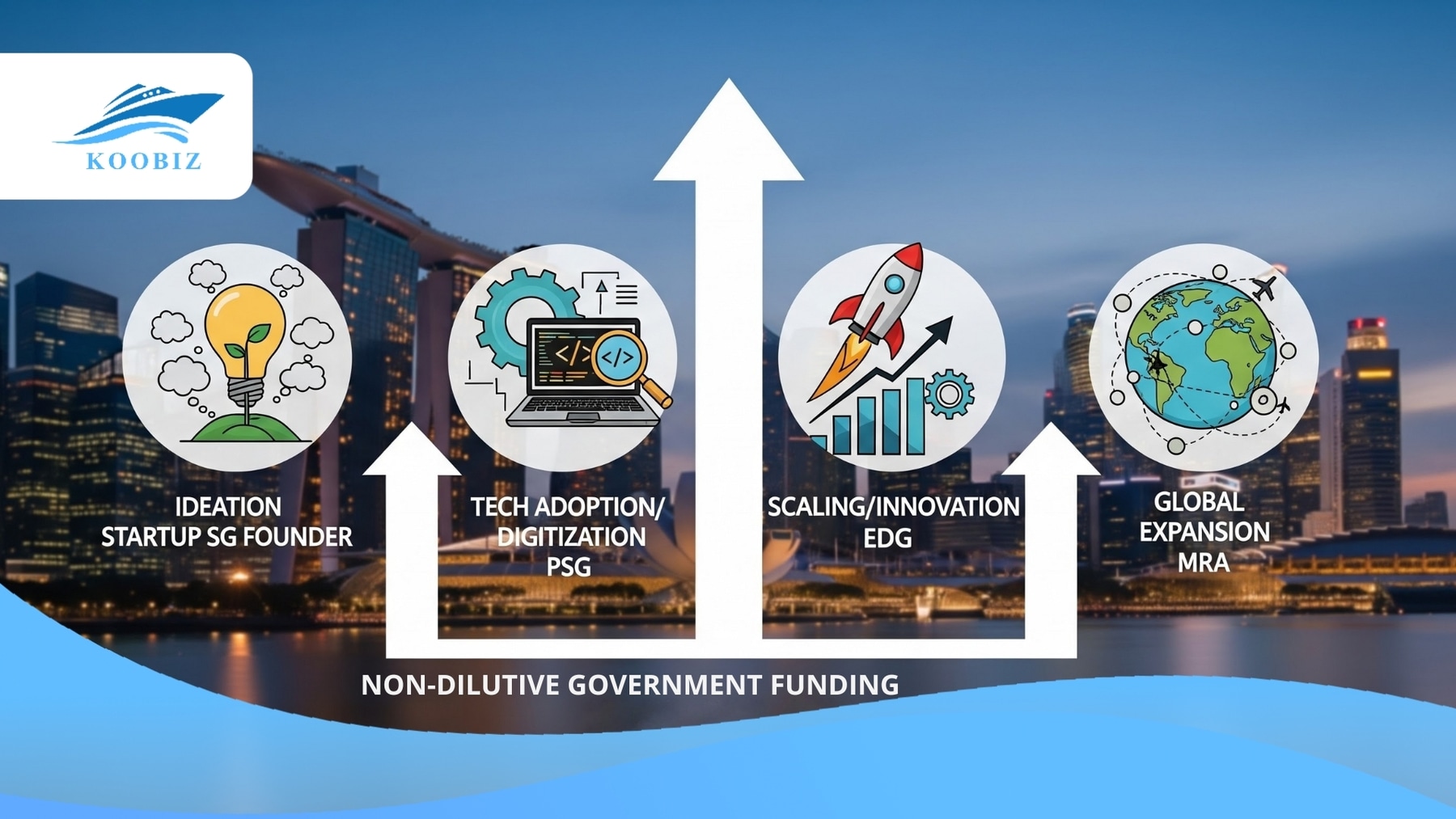
    2. Statutory Leave & Other Protections

    Under the Employment Act, employees who have worked for at least 3 months are entitled to statutory annual leave, sick leave, and other protections. Part-timers and contract status affect entitlements – check specifics before classifying workers as contractors.

    How does unlimited liability affect hiring for Sole Proprietorships?

    A sole proprietor has unlimited personal liability. Employment disputes, wrongful acts by employees, or large compensation orders can put personal assets at risk. This is the key reason many business owners choose to incorporate as a Private Limited (Pte Ltd) when they plan to grow headcount or hire foreign workers.

    Koobiz recommendation: if you plan to hire multiple staff or foreign workers, consider incorporating – Koobiz offers end-to-end company incorporation and migration of payroll/CPF filings so liabilities sit with the company, not your personal estate.

    Case Studies: Hiring in Action

    To better understand the practical implications of hiring as a sole proprietor, consider these two real-world scenarios illustrating compliance success and liability risk.

    Real-world examples clarify how these rules apply to daily operations.

    Scenario A: The Compliant Expansion (Success)

    Context: Jane owns “Jane’s Bakes,” a home-based bakery registered as a Sole Proprietorship. She wants to hire her first full-time assistant, a Singaporean Citizen.

    Action:

    1. Registration: Jane logs into the CPF website with her Singpass and applies for a CPF Submission Number (CSN).
    2. Contract: She drafts a Key Employment Terms (KETs) contract stating a salary of $2,000, working hours, and 7 days of annual leave.
    3. Insurance: Even though the salary is below the WICA mandatory limit for non-manual work, she buys WICA insurance because kitchen work involves physical risks (burns, slips).Result: Jane successfully scales her business. Her employee is protected, and she avoids any fines during MOM inspections.

    Scenario B: The Liability Trap (Risk)

    Context: Mark runs “Mark’s Reno,” a renovation sole proprietorship. He hires a delivery driver but decides to skip buying comprehensive insurance to save money.

    Incident: The driver accidentally reverses the company van into a client’s luxury gate, causing $15,000 in damages.

    Consequence:

    1. Direct Liability: The client sues Mark. Because it is a sole proprietorship, Mark is personally liable.
    2. Financial Hit: The business account only has $5,000. Mark is forced to use $10,000 from his personal family savings to pay the damages.Lesson: If Mark had incorporated a Private Limited Company, his personal savings would likely have been protected from this business liability.

    Frequently Asked Questions (FAQs)

    Sole Proprietorship vs. Private Limited: Which Structure is Better for Hiring?

    Private Limited wins on liability protection and foreign quotas, while Sole Proprietorship is better for administrative simplicity and lower initial costs.

    When comparing these structures for growth, business owners often reach a tipping point where the risks of the sole proprietorship outweigh its simplicity.

    Aspect Sole Proprietorship Private Limited (Pte Ltd)
    Liability Unlimited. Owner’s personal assets are at risk if sued. Limited. Company is a separate entity; personal assets are protected.
    Hiring Foreign Workers Difficult. Strict quotas; owner does not count as local staff. Scalable. Easier to access quotas and secure work passes.
    Initial Costs Low. Simple registration process. Higher. Incorporation fees and corporate secretarial costs.
    Tax Personal Income Tax (0% to 24%). No deduction on owner’s salary. Corporate Tax (Flat 17% with exemptions). Tax-efficient.
    Grants Limited. Harder to access major government grants. Accessible. Eligible for PSG, EDG, and other hiring subsidies.

    Ready to Scale? Upgrade to a Private Limited Company

    If you are planning to hire significant headcount or want to protect your personal assets from employment risks, incorporating a Private Limited company is the smartest move.

    Koobiz specializes in seamless company incorporation in Singapore. We handle the paperwork so you can focus on building your team.

    👉 Get a Free Consultation on Incorporating Your Business

    Do You Need to Pay CPF When Hiring Family Members?

    Yes, you generally need to pay CPF for family members if they are employed under a contract of service and receive wages, contrary to common misconception.

    To clarify, the CPF Board stipulates that if a family member (including spouse or children) is working for your business and receiving a salary, they are treated as an employee. Therefore, CPF contributions are mandatory.

    • The Exemption: CPF exemption only applies if the family member is a partner in the business (and thus self-employed) or if they are purely helping out without a formal employment contract or salary.
    • The Risk: If you pay them a “allowance” that functions as a salary but fail to pay CPF, you may be liable for late payment penalties. Always consult the CPF Board or a professional service if you are unsure about your specific family arrangement.
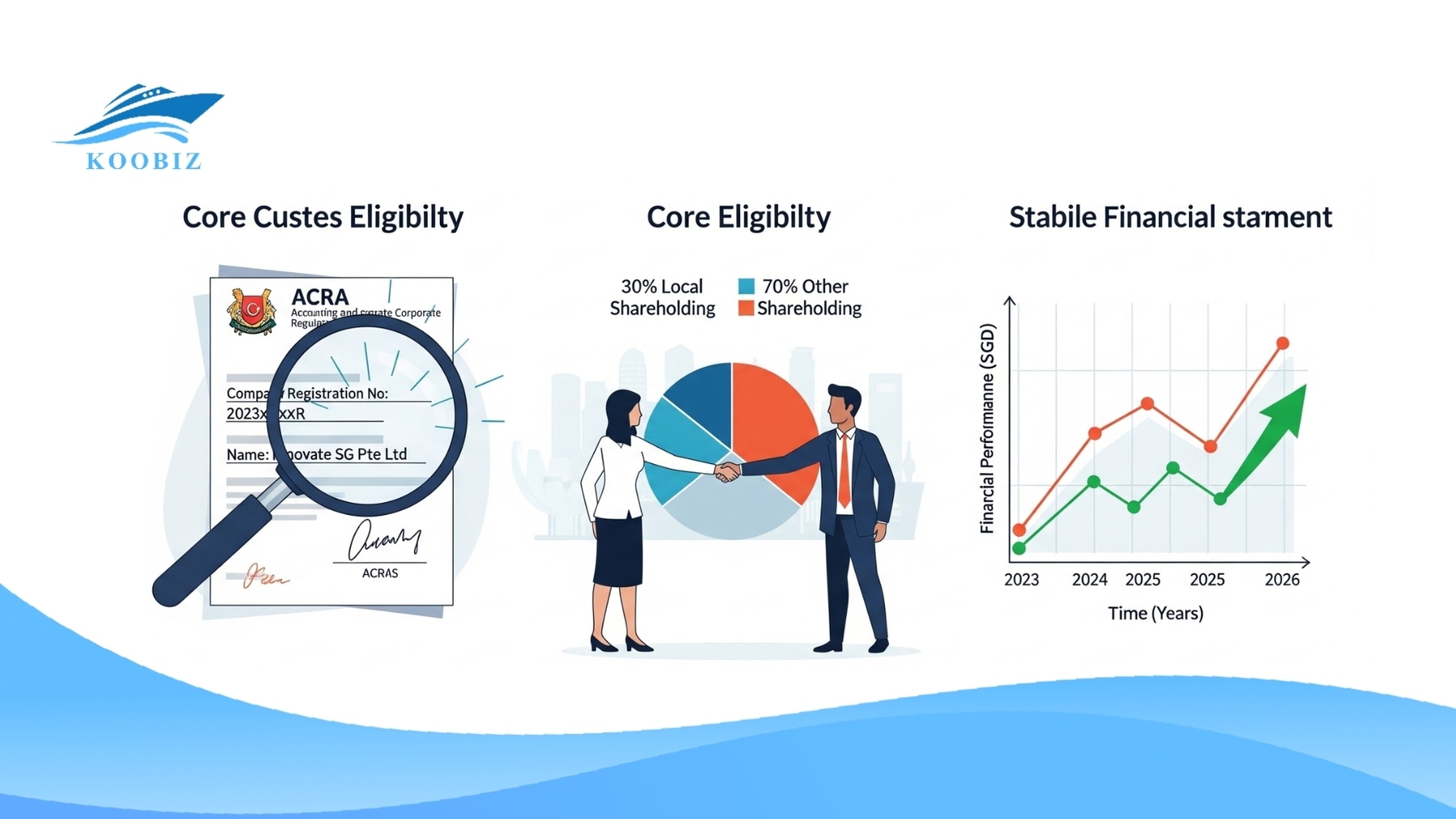
    How to Handle Part-Time Employees and Freelancers?

    Part-timers (work <35 hours/week) are employees with pro-rated entitlements; freelancers on a “contract for service” are not employees (no CPF/SDL) — but misclassification risk is high if you control hours and outcomes.

    Part-Time Employees:

    • Definition: Under the Employment Act, a part-time employee is one who works less than 35 hours a week.
    • Benefits: They are entitled to CPF (if earning >$50/month) and pro-rated annual and sick leave. You cannot deny them these benefits just because they are not “full-time.”

    Freelancers (Contract for Service):

    • Definition: These are independent contractors. They are not your employees.
    • Benefits: You do not pay CPF, SDL, or provide leave. You pay them a fee for a completed project.
    • Risk: Do not treat a full-timer as a freelancer to avoid CPF. If MOM investigates and finds they work fixed hours under your control, you will be forced to backpay CPF with interest.

    What Happens to Employees if the Sole Proprietorship Closes?

    If the business closes, employment is deemed terminated, requiring the immediate payment of all outstanding salaries and, for foreign staff, tax clearance via Form IR21.

    To understand the closure process, “cessation of business” is considered a valid reason for termination, but it does not absolve the owner of financial duties.

    • Notice Period: You must give the notice period stated in the contract or pay salary in lieu of notice.
    • Salary Payment: All outstanding salary must be paid on the last day of employment.
    • Retrenchment Benefits: Sole proprietorships are generally not legally mandated to pay retrenchment benefits unless it is stated in the employment contract, but it is encouraged by MOM for long-serving staff.
    • Foreign Workers: You must cancel their work passes and buy their air ticket home. Importantly, you must file Form IR21 with IRAS to withhold their last month’s salary for tax clearance purposes before releasing any remaining money to them.

    Summary

    Hiring as a sole proprietor in Singapore is a powerful way to grow, but it requires strict adherence to MOM and CPF regulations. From mandatory insurance to liability risks, every step matters. If you are ready to scale up and minimize risk, consider incorporating with Koobiz to separate your personal assets from your business obligations.

    Disclaimer: The information provided in this article is accurate as of December 2025. Regulations regarding CPF, foreign worker quotas, and levies are subject to change by the Ministry of Manpower (MOM) and other government agencies. Business owners are advised to verify the latest requirements on official government websites.
  • What Is UEN Number in Singapore? The Complete ACRA Registration & Business ID Guide

    What Is UEN Number in Singapore? The Complete ACRA Registration & Business ID Guide

    [SUMMARIES]

    The Unique Entity Number (UEN) is the mandatory standard identification code assigned to all Singapore-registered businesses for official government interactions, tax filings, and regulatory compliance.

    This permanent ID is automatically generated upon incorporation with ACRA, utilizing specific alphanumeric formats that allow stakeholders to instantly identify the entity type and year of registration.

    Businesses are legally required to display their UEN on all official documents such as invoices and websites, serving as a critical verification tool distinct from personal NRICs or optional GST registrations.
    [/SUMMARIES]

    The Unique Entity Number (UEN) is the universal identification number assigned by the Singapore government to all registered business entities for use in official dealings with government agencies. Understanding this mandatory identification is crucial for compliance. The UEN applies to a vast range of entities, including local companies, Limited Liability Partnerships (LLPs), and registered societies. Whether you are a local entrepreneur or a foreign investor, knowing your entity type determines the specific regulations and requirements you must follow to operate legally within the city-state.

    Furthermore, the structure of the UEN itself is not random; it follows specific formats that reveal information about the entity type and year of issuance. Navigating these formats and knowing how to search for them via portals like BizFile+ is a fundamental skill for due diligence and business verification in Singapore’s transparent corporate ecosystem. For entrepreneurs looking to simplify the process of establishing their entity and obtaining this number, securing your UEN is the critical first step. Let’s explore the details below to master everything about the UEN number in Singapore.

    What Is a Unique Entity Number (UEN) in Singapore?

    The Unique Entity Number (UEN) is the single, standard identification number issued by the Singapore government to all registered business entities to streamline interaction with government agencies. Notably, the UEN is mandatory for any entity that interacts with the government. It replaces the previous ACRA Registration Number and makes the administrative process significantly more efficient. Once issued, this number remains with the entity throughout its lifespan, unless the entity changes its business constitution significantly (e.g., converting from a Sole Proprietorship to a Private Limited Company), in which case a new UEN might be issued.

    Singapore UEN Number (Source: BizFile)
    Singapore UEN Number (Source: BizFile)

    According to the Accounting and Corporate Regulatory Authority (ACRA), the implementation of UEN has reduced the need for multiple agency-specific numbers, streamlining over 80% of government interactions for businesses.

    Which Entities Are Required to Have a UEN?

    There are four primary categories of entities legally required to possess a UEN. This requirement ensures that every organization operating within Singapore’s legal framework can be accurately tracked, taxed, and regulated by the relevant authorities.

    To illustrate, here is a breakdown of the specific entities that must hold a UEN:

    • Businesses and Local Companies: This includes Sole Proprietorships, Partnerships, and Private Limited companies registered with ACRA.
    • Limited Liability Partnerships (LLPs): Professional partnerships that combine elements of partnerships and corporations.
    • Societies and Non-Profits: Organizations registered with the Registry of Societies (ROS) or Charities under the Ministry of Culture, Community and Youth (MCCY).
    • Representative Offices: Foreign entities establishing a temporary presence in Singapore for market research. Note: They are not issued a UEN because they are not legal entities in Singapore.

    However, it is important to note who does not need a UEN. Individuals interacting with the government continue to use their NRIC or FIN. Additionally, sub-units or branches of an entity that already has a UEN generally do not get a separate UEN; they utilize the parent entity’s number, sometimes with a branch code extension for internal tracking, though the UEN itself remains the core identifier.

    What Do the Different UEN Formats Mean?

    UEN formats are structured alphanumeric codes that vary based on the entity type and issuance date. Unlike a random string of numbers, these formats allow anyone reading the number to immediately discern whether the entity is a local company, a business firm, or a specialized body like a trade union.

    The table below outlines the three main UEN structures you will encounter:

    Entity Type Format Structure Example Description
    Businesses registered with ACRA nnnnnnnnX 52812345A 8 digits followed by 1 check letter (Total 9 chars).
    Local Companies registered with ACRA YYYYnnnnnX 202412345M Year of incorporation (4 digits) + 5 digits + 1 check letter (Total 10 chars).
    Other Entities (e.g., LLPs, Societies) TyyPQnnnnX T24LL0001A T: Century (T for 2000s, S for 1900s).

    yy: Last 2 digits of year.

    PQ: Entity type code (e.g., LL for LLP).

    nnnn: Sequence no.

    X: Check letter.

    For instance, a Limited Liability Partnership registered in 2024 will follow the “Other Entities” format (T24LL…), whereas a Private Limited Company registered in the same year will typically follow the “Local Companies” format (2024…). This structured approach ensures that despite the growing number of businesses, every entity retains a distinct digital identity.

    How Can I Search for a Company’s UEN?

    Searching for a company’s UEN is a crucial step in due diligence. You can instantly verify an entity’s registration status and details using the ACRA-managed BizFile+ portal or valid business directories. This public process provides essential information such as the entity’s registered name, status (Live or Struck Off), and address.

    To verify a business, follow these steps:

    1. Visit the Directory: Go to the ACRA BizFile+ website or the official UEN website (uen.gov.sg).
    2. Enter Information: Type the name of the company or the UEN (if you are verifying the name) into the search bar.
    3. Analyze Results: The system will display the registered name, UEN, and status.
    Search for UEN on BizFile+
    Search for UEN on BizFile+

    If you are planning to sign a contract with a partner, checking their UEN status is a mandatory due diligence step. A “Live” status confirms the company is active. If you find the process confusing or need detailed business profiles, Koobiz can assist in retrieving comprehensive business extracts for your potential partners.

    How Do You Register and Obtain a UEN?

    Obtaining a UEN involves registering your business entity with ACRA or the relevant issuance agency. The UEN is automatically generated upon successful incorporation; there is no separate application form. It is an inherent outcome of the entity formation process.

    For most commercial entities like Private Limited companies, the process is handled via ACRA:

    The process of registering and obtaining a UEN
    The process of registering and obtaining a UEN
    1. Name Reservation: You must first approve your business name with ACRA.
    2. Incorporation: Submit the incorporation details, including shareholder and director information.
    3. Issuance: Once ACRA approves the incorporation, an email notification containing the UEN is sent immediately (usually within hours).

    For other entities, such as societies, the UEN is issued after approval by the Registry of Societies. Navigating the incorporation requirements can be complex for new entrepreneurs. Koobiz specializes in streamlining this process. When you choose our incorporation package, we handle all ACRA liaising, ensuring your UEN is issued correctly and quickly, so you can open your corporate bank account without delay.

    Ready to start your business in Singapore? Contact Koobiz today for a seamless incorporation experience and get your UEN fast!

    Can You Customise Your Business ID with Special UEN (SUN)?

    Yes, businesses can customize their ID through the Special UEN (SUN) service by paying a fee to select a preferred number from reserved tiers. Similar to buying a “golden” mobile number or car plate, ACRA allows business owners to choose a UEN that is easy to remember or holds auspicious value.

    Specifically, there are two tiers available during the registration process:

    • Tier 1 ($3,000): These are numbers with consecutive identical digits or specific patterns (e.g., ending in 8888, 12345).
    • Tier 2 ($1,000): These numbers have repetitive patterns but are less exclusive than Tier 1 (e.g., ending in 88, 66, or repetitive pairs like 2323).

    While not mandatory, investing in a Special UEN can be beneficial for branding, making it easier for clients and partners to recall your business ID for PayNow transactions or invoicing.

    What Is the Difference Between UEN and NRIC?

    The UEN identifies business entities for corporate transactions, whereas the NRIC (or FIN) identifies individuals for personal legal matters within Singapore. This distinction is vital because a business is a separate legal person from its owner, and confusing the two can lead to invalid contracts.

    UEN (Unique Entity Number) VS. NRIC (National Registration Identity Card)
    UEN (Unique Entity Number) VS. NRIC (National Registration Identity Card)
    Feature UEN (Unique Entity Number) NRIC (National Registration Identity Card)
    Target Identity Business Entities (Companies, LLPs, Societies) Individuals (Citizens, PRs)
    Primary Use Corporate transactions, B2B contracts, Government filing Personal legal matters, Employment, Banking
    Legal Status Identifies the “Company” as a legal person Identifies the “Individual” owner/director
    Data Tracked Financial year-end, Registered address, BizFile status Citizenship, Residence address, Date of Birth

    To illustrate, when you sign a contract for your company, you enter the company’s UEN, not your personal NRIC. The NRIC tracks personal data like citizenship and residence, while the UEN tracks corporate data.

    What Is the Difference Between UEN and GST Registration Number?

    The UEN is the mandatory business ID for all, while the GST Registration Number is usually the same UEN but specifically activated for tax collection when revenue exceeds $1 million.

    It is important to understand that simply having a UEN does not mean you are GST-registered. You must apply for GST registration separately with IRAS. Once registered, your UEN typically serves as your GST identifier. You will then be required to print “GST Reg No: [Your UEN]” on all tax invoices.

    While most local companies use their UEN as their GST number, distinct entities (like joint ventures or GST groups) may be issued a separate GST group registration number. However, for 99% of SMEs, they are identical identifiers with different functional statuses.

    Where Must the UEN Be Displayed on Official Documents?

    The UEN must be displayed on all official correspondence, including invoices, receipts, brochures, and websites, to comply with the Companies Act. Failure to display this number can result in penalties, as it denies stakeholders the ability to verify the entity they are dealing with.

    You must include the UEN on:

    • Business Letters and Statements of Account.
    • Invoices and Official Receipts.
    • Notices and Publications (including websites and email signatures).
    • Bills of Exchange and Promissory Notes.

    Ensuring your Koobiz incorporated company complies with these disclosure requirements is part of building a trustworthy brand reputation in Singapore.

    Frequently Asked Questions (FAQ)

    Is the UEN number the same as the Tax Identification Number (TIN)?

    Yes, in Singapore, the UEN serves as the Tax Identification Number (TIN) for corporate entities when dealing with the Inland Revenue Authority of Singapore (IRAS).

    Do I need to renew my UEN?

    For local companies (Pte Ltd) and LLPs, the UEN is permanent and does not need renewal as long as the entity exists. However, for Sole Proprietorships and Partnerships, you must renew your business registration periodically to keep your UEN active.

    Is applying for a UEN free?

    The UEN itself is issued automatically upon registration. The cost involved is the registration or incorporation fee paid to ACRA (e.g., $315 for a Private Limited Company). If you opt for a Special UEN (SUN), additional fees apply.

    Simplify Your Singapore Incorporation with Koobiz

    Understanding the UEN is just the first step in establishing a successful business in Singapore. Navigating the full spectrum of ACRA regulations, from initial name reservation to final UEN issuance and tax compliance, requires expertise and precision.

    Koobiz is your trusted partner for seamless company incorporation in Singapore. We move beyond simple registration; we provide a comprehensive suite of corporate services designed to get your business operational quickly. With our expert guidance, you can secure your UEN, open your corporate bank account, and ensure full compliance without the administrative headache.

    Ready to launch your business? Visit koobiz.com today to start your incorporation journey!