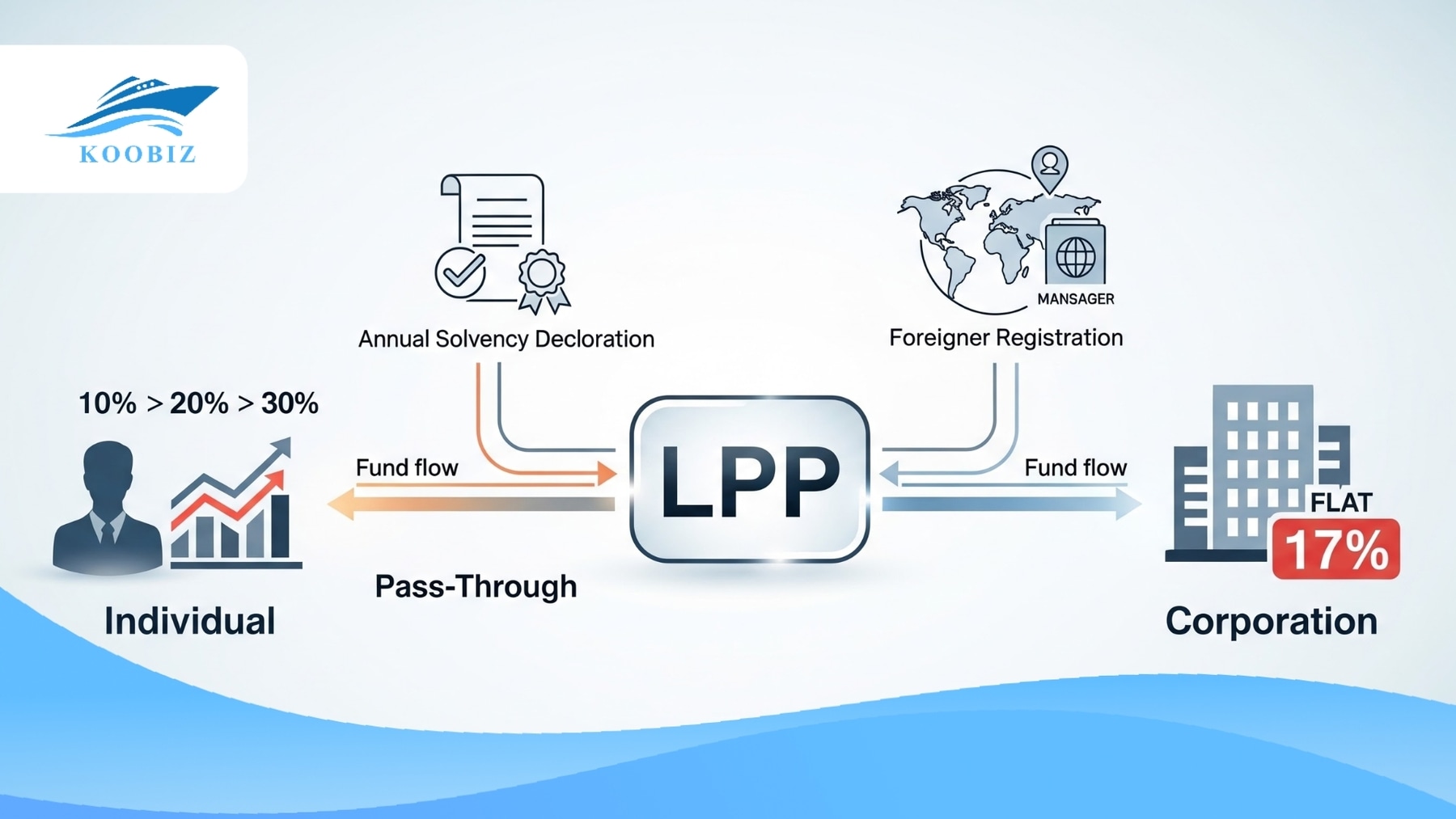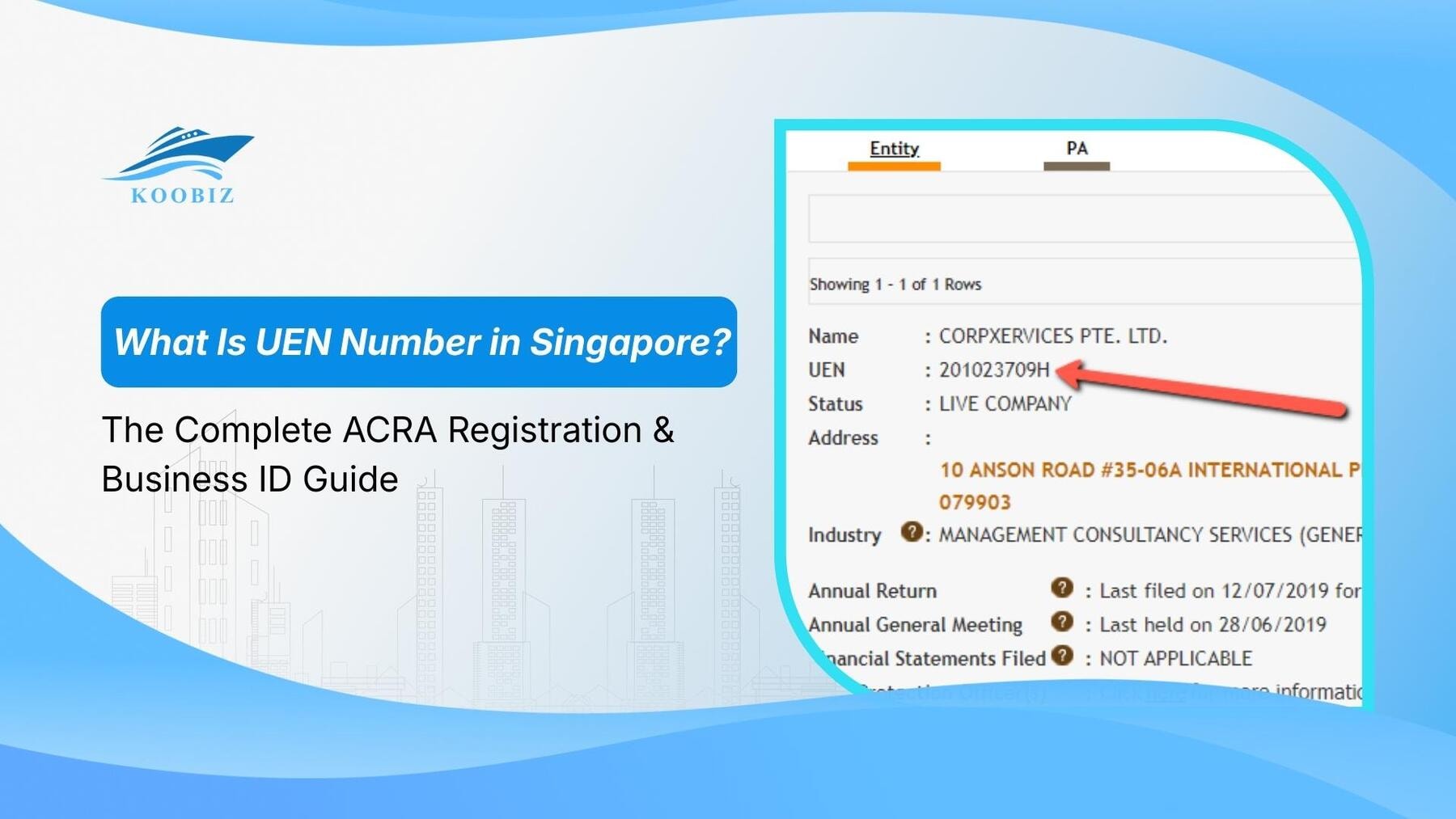
Tag: ACRA Registration

  • What Is UEN Number in Singapore? The Complete ACRA Registration & Business ID Guide

    What Is UEN Number in Singapore? The Complete ACRA Registration & Business ID Guide

    [SUMMARIES]

    The Unique Entity Number (UEN) is the mandatory standard identification code assigned to all Singapore-registered businesses for official government interactions, tax filings, and regulatory compliance.

    This permanent ID is automatically generated upon incorporation with ACRA, utilizing specific alphanumeric formats that allow stakeholders to instantly identify the entity type and year of registration.

    Businesses are legally required to display their UEN on all official documents such as invoices and websites, serving as a critical verification tool distinct from personal NRICs or optional GST registrations.

    [/SUMMARIES]

    The Unique Entity Number (UEN) is the universal identification number assigned by the Singapore government to all registered business entities for use in official dealings with government agencies. Understanding this mandatory identification is crucial for compliance. The UEN applies to a vast range of entities, including local companies, Limited Liability Partnerships (LLPs), and registered societies. Whether you are a local entrepreneur or a foreign investor, knowing your entity type determines the specific regulations and requirements you must follow to operate legally within the city-state.

    Furthermore, the structure of the UEN itself is not random; it follows specific formats that reveal information about the entity type and year of issuance. Navigating these formats and knowing how to search for them via portals like BizFile+ is a fundamental skill for due diligence and business verification in Singapore’s transparent corporate ecosystem. For entrepreneurs looking to simplify the process of establishing their entity and obtaining this number, securing your UEN is the critical first step. Let’s explore the details below to master everything about the UEN number in Singapore.

    What Is a Unique Entity Number (UEN) in Singapore?

    The Unique Entity Number (UEN) is the single, standard identification number issued by the Singapore government to all registered business entities to streamline interaction with government agencies. Notably, the UEN is mandatory for any entity that interacts with the government. It replaces the previous ACRA Registration Number and makes the administrative process significantly more efficient. Once issued, this number remains with the entity throughout its lifespan, unless the entity changes its business constitution significantly (e.g., converting from a Sole Proprietorship to a Private Limited Company), in which case a new UEN might be issued.
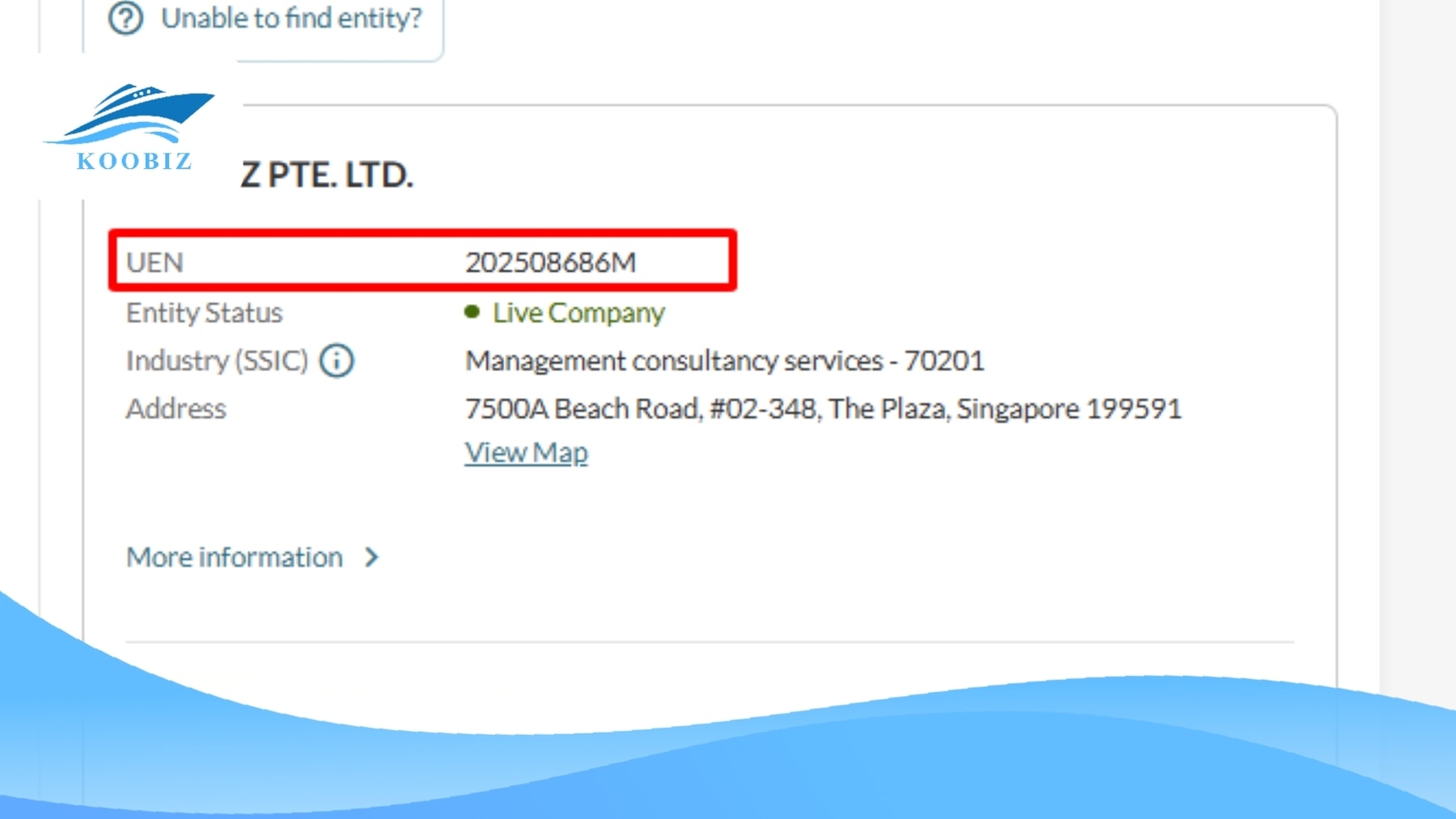
    Singapore UEN Number (Source: BizFile)
    Singapore UEN Number (Source: BizFile)

    According to the Accounting and Corporate Regulatory Authority (ACRA), the implementation of UEN has reduced the need for multiple agency-specific numbers, streamlining over 80% of government interactions for businesses.

    Which Entities Are Required to Have a UEN?

    There are four primary categories of entities legally required to possess a UEN. This requirement ensures that every organization operating within Singapore’s legal framework can be accurately tracked, taxed, and regulated by the relevant authorities.

    To illustrate, here is a breakdown of the specific entities that must hold a UEN:

    • Businesses and Local Companies: This includes Sole Proprietorships, Partnerships, and Private Limited companies registered with ACRA.
    • Limited Liability Partnerships (LLPs): Professional partnerships that combine elements of partnerships and corporations.
    • Societies and Non-Profits: Organizations registered with the Registry of Societies (ROS) or Charities under the Ministry of Culture, Community and Youth (MCCY).
    • Representative Offices: Foreign entities establishing a temporary presence in Singapore for market research. Note: They are not issued a UEN because they are not legal entities in Singapore.

    However, it is important to note who does not need a UEN. Individuals interacting with the government continue to use their NRIC or FIN. Additionally, sub-units or branches of an entity that already has a UEN generally do not get a separate UEN; they utilize the parent entity’s number, sometimes with a branch code extension for internal tracking, though the UEN itself remains the core identifier.

    What Do the Different UEN Formats Mean?

    UEN formats are structured alphanumeric codes that vary based on the entity type and issuance date. Unlike a random string of numbers, these formats allow anyone reading the number to immediately discern whether the entity is a local company, a business firm, or a specialized body like a trade union.

    The table below outlines the three main UEN structures you will encounter:

    Entity Type Format Structure Example Description
    Businesses registered with ACRA nnnnnnnnX 52812345A 8 digits followed by 1 check letter (Total 9 chars).
    Local Companies registered with ACRA YYYYnnnnnX 202412345M Year of incorporation (4 digits) + 5 digits + 1 check letter (Total 10 chars).
    Other Entities (e.g., LLPs, Societies) TyyPQnnnnX T24LL0001A T: Century (T for 2000s, S for 1900s).

    yy: Last 2 digits of year.

    PQ: Entity type code (e.g., LL for LLP).

    nnnn: Sequence no.

    X: Check letter.

    For instance, a Limited Liability Partnership registered in 2024 will follow the “Other Entities” format (T24LL…), whereas a Private Limited Company registered in the same year will typically follow the “Local Companies” format (2024…). This structured approach ensures that despite the growing number of businesses, every entity retains a distinct digital identity.

    How Can I Search for a Company’s UEN?

    Searching for a company’s UEN is a crucial step in due diligence. You can instantly verify an entity’s registration status and details using the ACRA-managed BizFile+ portal or valid business directories. This public process provides essential information such as the entity’s registered name, status (Live or Struck Off), and address.

    To verify a business, follow these steps:

    1. Visit the Directory: Go to the ACRA BizFile+ website or the official UEN website (uen.gov.sg).
    2. Enter Information: Type the name of the company or the UEN (if you are verifying the name) into the search bar.
    3. Analyze Results: The system will display the registered name, UEN, and status.
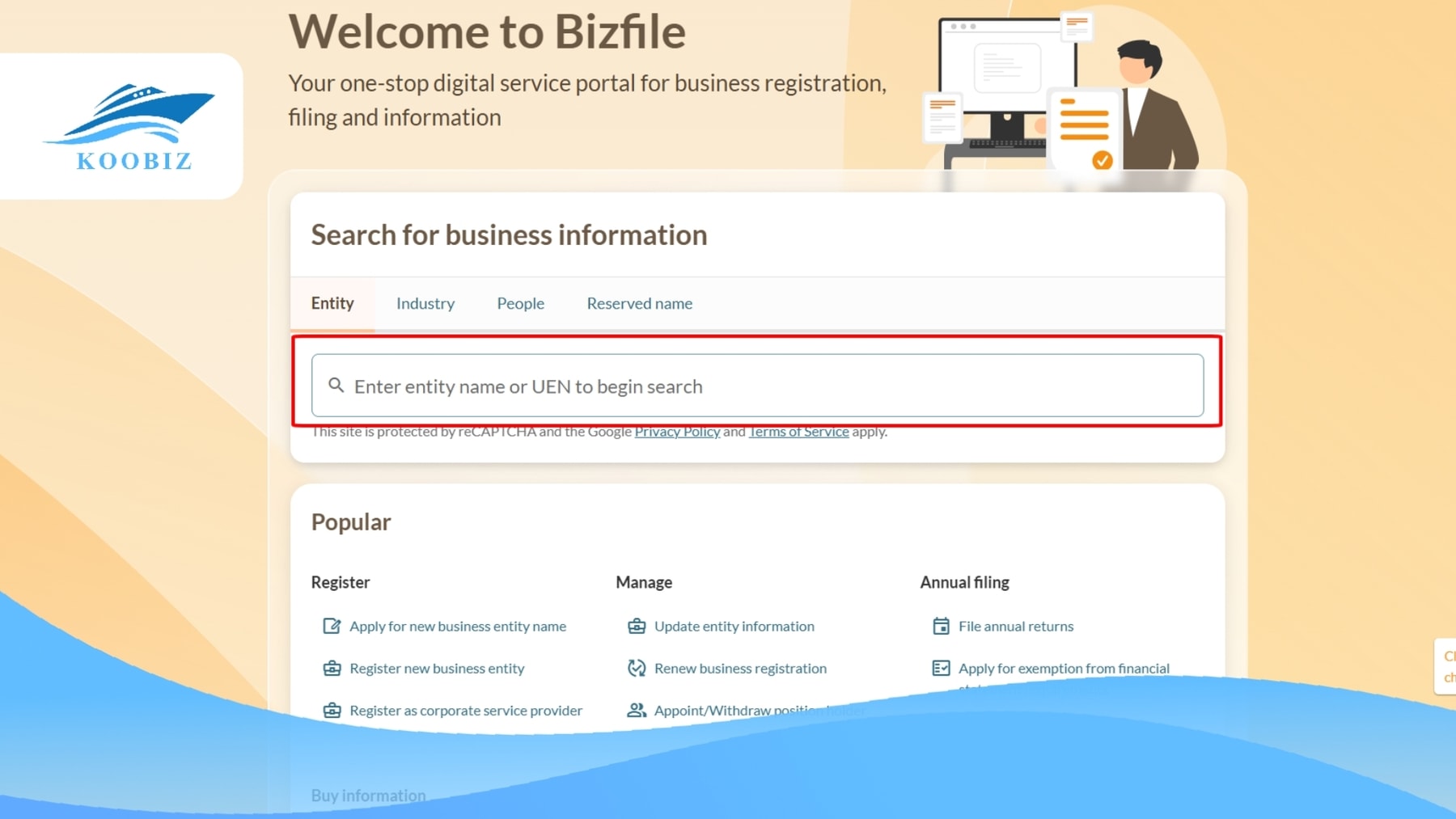
    Search for UEN on BizFile+
    Search for UEN on BizFile+

    If you are planning to sign a contract with a partner, checking their UEN status is a mandatory due diligence step. A “Live” status confirms the company is active. If you find the process confusing or need detailed business profiles, Koobiz can assist in retrieving comprehensive business extracts for your potential partners.

    How Do You Register and Obtain a UEN?

    Obtaining a UEN involves registering your business entity with ACRA or the relevant issuance agency. The UEN is automatically generated upon successful incorporation; there is no separate application form. It is an inherent outcome of the entity formation process.

    For most commercial entities like Private Limited companies, the process is handled via ACRA:
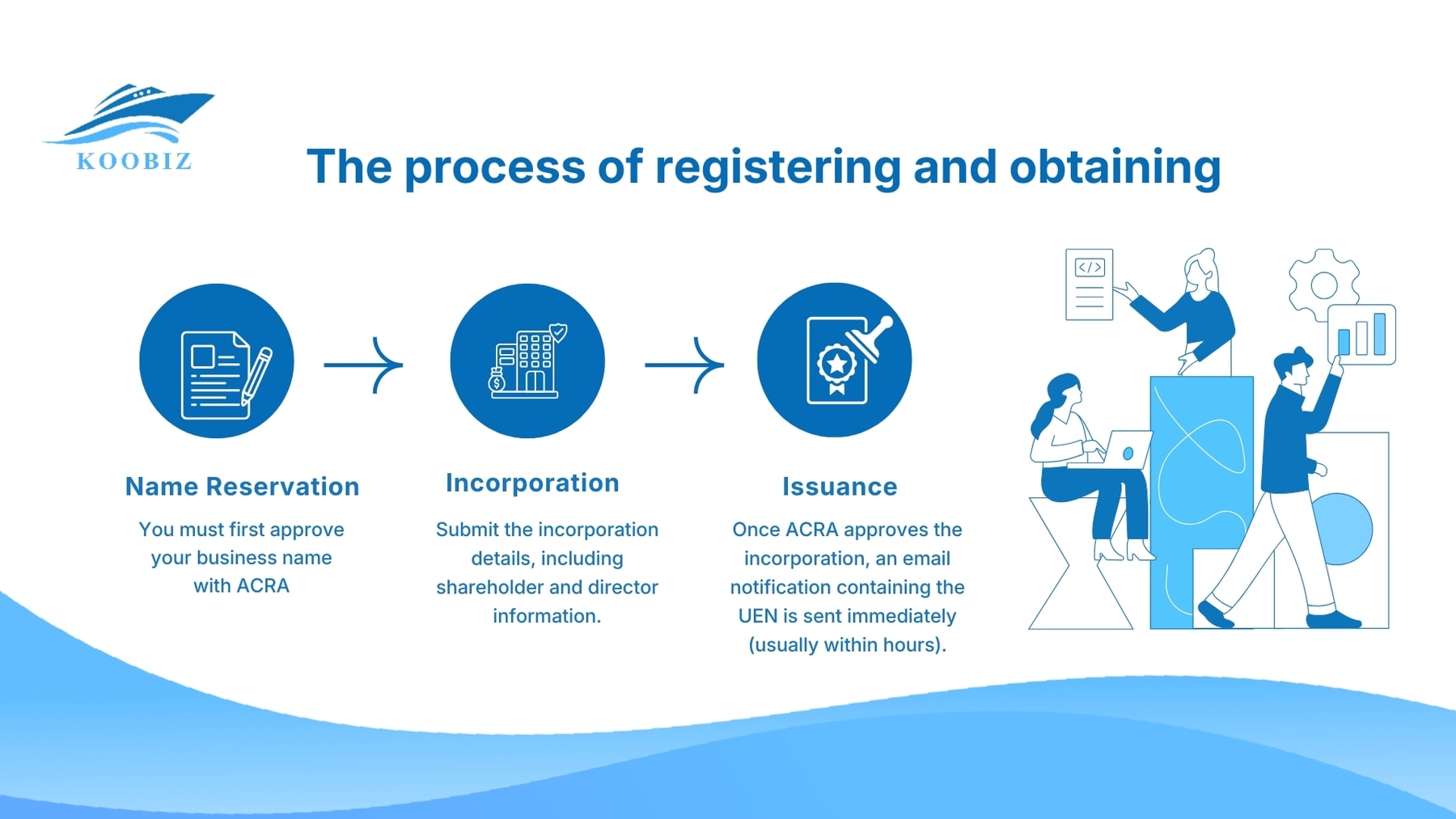
    The process of registering and obtaining a UEN
    The process of registering and obtaining a UEN
    1. Name Reservation: You must first approve your business name with ACRA.
    2. Incorporation: Submit the incorporation details, including shareholder and director information.
    3. Issuance: Once ACRA approves the incorporation, an email notification containing the UEN is sent immediately (usually within hours).

    For other entities, such as societies, the UEN is issued after approval by the Registry of Societies. Navigating the incorporation requirements can be complex for new entrepreneurs. Koobiz specializes in streamlining this process. When you choose our incorporation package, we handle all ACRA liaising, ensuring your UEN is issued correctly and quickly, so you can open your corporate bank account without delay.

    Ready to start your business in Singapore? Contact Koobiz today for a seamless incorporation experience and get your UEN fast!

    Can You Customise Your Business ID with Special UEN (SUN)?

    Yes, businesses can customize their ID through the Special UEN (SUN) service by paying a fee to select a preferred number from reserved tiers. Similar to buying a “golden” mobile number or car plate, ACRA allows business owners to choose a UEN that is easy to remember or holds auspicious value.

    Specifically, there are two tiers available during the registration process:

    • Tier 1 ($3,000): These are numbers with consecutive identical digits or specific patterns (e.g., ending in 8888, 12345).
    • Tier 2 ($1,000): These numbers have repetitive patterns but are less exclusive than Tier 1 (e.g., ending in 88, 66, or repetitive pairs like 2323).

    While not mandatory, investing in a Special UEN can be beneficial for branding, making it easier for clients and partners to recall your business ID for PayNow transactions or invoicing.

    What Is the Difference Between UEN and NRIC?

    The UEN identifies business entities for corporate transactions, whereas the NRIC (or FIN) identifies individuals for personal legal matters within Singapore. This distinction is vital because a business is a separate legal person from its owner, and confusing the two can lead to invalid contracts.
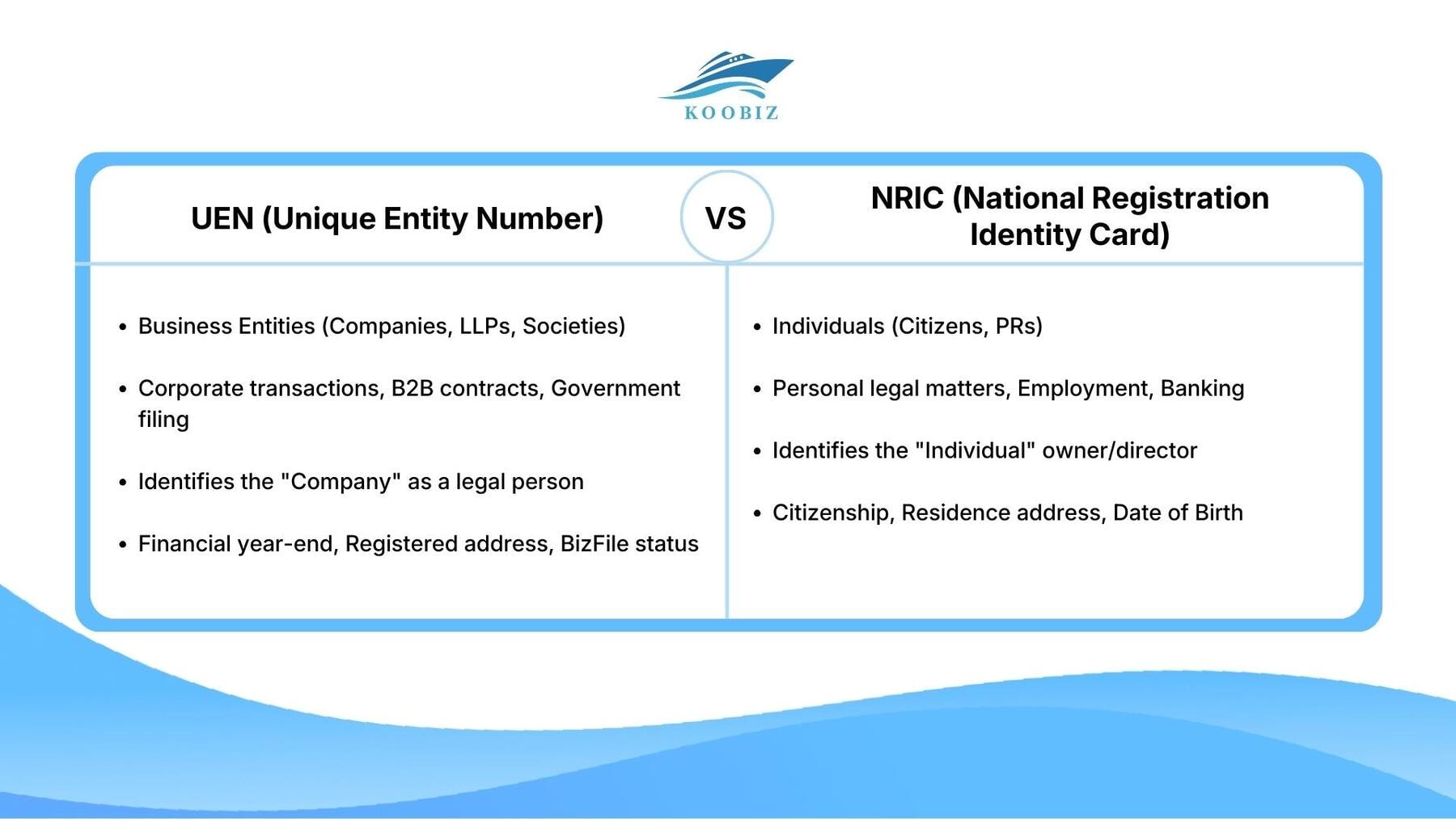
    UEN (Unique Entity Number) VS. NRIC (National Registration Identity Card)
    UEN (Unique Entity Number) VS. NRIC (National Registration Identity Card)
    Feature UEN (Unique Entity Number) NRIC (National Registration Identity Card)
    Target Identity Business Entities (Companies, LLPs, Societies) Individuals (Citizens, PRs)
    Primary Use Corporate transactions, B2B contracts, Government filing Personal legal matters, Employment, Banking
    Legal Status Identifies the “Company” as a legal person Identifies the “Individual” owner/director
    Data Tracked Financial year-end, Registered address, BizFile status Citizenship, Residence address, Date of Birth

    To illustrate, when you sign a contract for your company, you enter the company’s UEN, not your personal NRIC. The NRIC tracks personal data like citizenship and residence, while the UEN tracks corporate data.

    What Is the Difference Between UEN and GST Registration Number?

    The UEN is the mandatory business ID for all, while the GST Registration Number is usually the same UEN but specifically activated for tax collection when revenue exceeds $1 million.

    It is important to understand that simply having a UEN does not mean you are GST-registered. You must apply for GST registration separately with IRAS. Once registered, your UEN typically serves as your GST identifier. You will then be required to print “GST Reg No: [Your UEN]” on all tax invoices.

    While most local companies use their UEN as their GST number, distinct entities (like joint ventures or GST groups) may be issued a separate GST group registration number. However, for 99% of SMEs, they are identical identifiers with different functional statuses.

    Where Must the UEN Be Displayed on Official Documents?

    The UEN must be displayed on all official correspondence, including invoices, receipts, brochures, and websites, to comply with the Companies Act. Failure to display this number can result in penalties, as it denies stakeholders the ability to verify the entity they are dealing with.

    You must include the UEN on:

    • Business Letters and Statements of Account.
    • Invoices and Official Receipts.
    • Notices and Publications (including websites and email signatures).
    • Bills of Exchange and Promissory Notes.

    Ensuring your Koobiz incorporated company complies with these disclosure requirements is part of building a trustworthy brand reputation in Singapore.

    Frequently Asked Questions (FAQ)

    Is the UEN number the same as the Tax Identification Number (TIN)?

    Yes, in Singapore, the UEN serves as the Tax Identification Number (TIN) for corporate entities when dealing with the Inland Revenue Authority of Singapore (IRAS).

    Do I need to renew my UEN?

    For local companies (Pte Ltd) and LLPs, the UEN is permanent and does not need renewal as long as the entity exists. However, for Sole Proprietorships and Partnerships, you must renew your business registration periodically to keep your UEN active.

    Is applying for a UEN free?

    The UEN itself is issued automatically upon registration. The cost involved is the registration or incorporation fee paid to ACRA (e.g., $315 for a Private Limited Company). If you opt for a Special UEN (SUN), additional fees apply.

    Simplify Your Singapore Incorporation with Koobiz

    Understanding the UEN is just the first step in establishing a successful business in Singapore. Navigating the full spectrum of ACRA regulations, from initial name reservation to final UEN issuance and tax compliance, requires expertise and precision.

    Koobiz is your trusted partner for seamless company incorporation in Singapore. We move beyond simple registration; we provide a comprehensive suite of corporate services designed to get your business operational quickly. With our expert guidance, you can secure your UEN, open your corporate bank account, and ensure full compliance without the administrative headache.

    Ready to launch your business? Visit koobiz.com today to start your incorporation journey!
  • Singapore Investment Holding Company: Complete Setup Guide

    Singapore Investment Holding Company: Complete Setup Guide

    [SUMMARIES]

    A Singapore Investment Holding Company (IHC) is a specialized entity designed solely to hold passive assets like shares and real estate, effectively isolating wealth from operational business risks.

    Investors benefit from Singapore’s territorial tax system and Double Taxation Agreements (DTAs), though IHCs are ineligible for Start-Up Tax Exemptions (SUTE) and have strictly limited expense deductibility compared to trading companies.

    Incorporation requires adhering to strict statutory mandates, including the appointment of a local resident director, a requirement foreign investors often meet through professional nominee services.

    [/SUMMARIES]

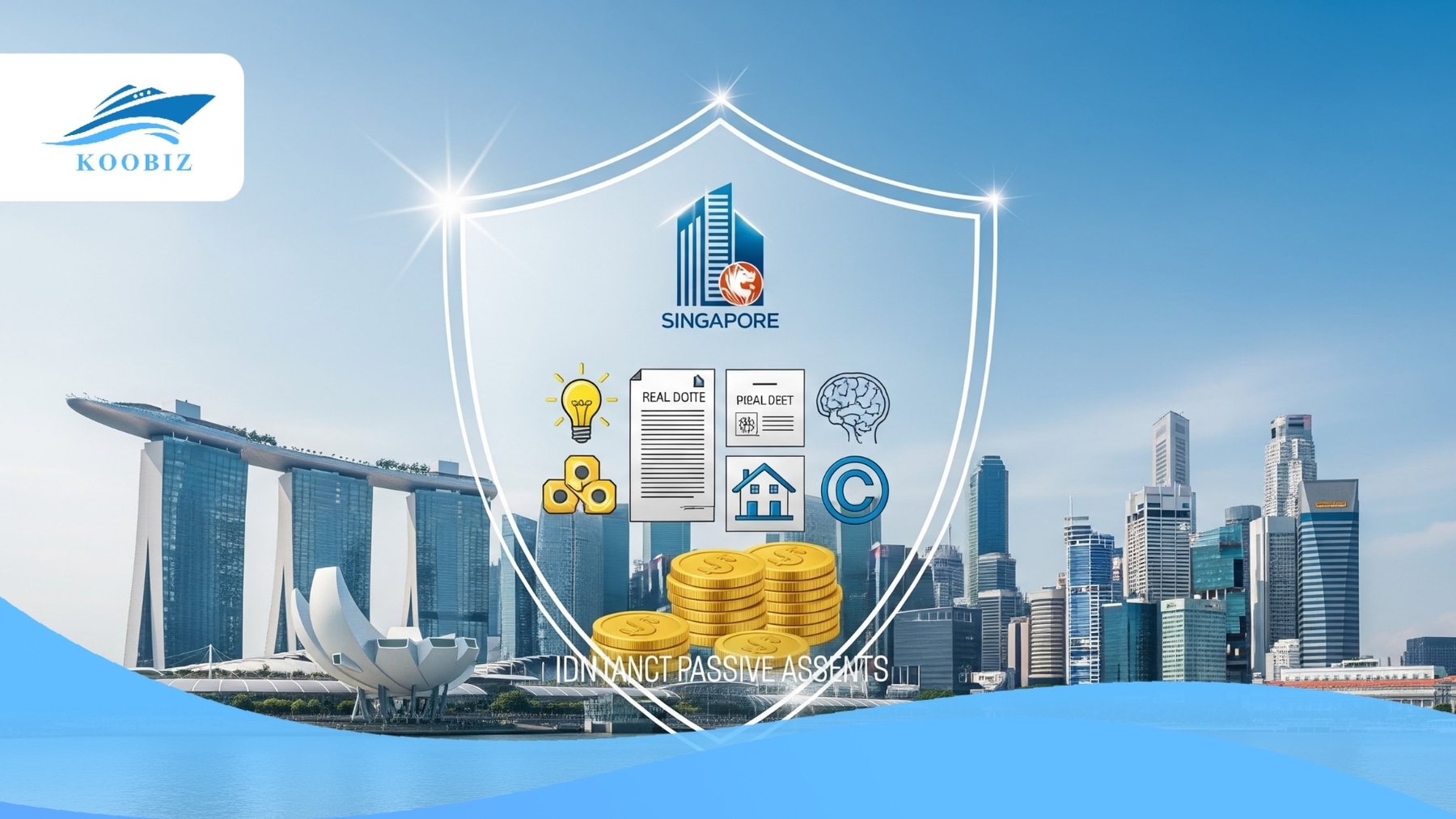
    Setting up a Singapore Investment Holding Company (IHC) creates a legal entity specifically designed to hold assets rather than conduct active trade. This guide serves as a roadmap for investors looking to leverage Singapore’s framework for asset protection and tax efficiency.

    Unlike trading companies, an IHC derives income primarily from passive sources such as dividends, interest, and rentals. Its main function is to act as a vehicle for holding investments like shares, real estate, or intellectual property.

    Foreign investors favor Singapore for its political stability, reputation as a financial hub, and territorial tax system. It is the ideal location for managing regional wealth and consolidating global assets.

    This guide covers strategic benefits, legal definitions, and a step-by-step registration process to ensure long-term success. Koobiz is here to assist you with every regulatory requirement.

    What Is a Singapore Investment Holding Company?

    Singapore Investment Holding Company (IHC)
    Singapore Investment Holding Company (IHC)

    A Singapore Investment Holding Company (IHC) is a limited liability company restricted to holding distinct assets—such as shares, property, or intellectual property—rather than producing goods or services. Specifically, it is a corporate structure where the company’s income is derived primarily from passive investment sources.

    To elaborate, the primary characteristic of an IHC is its “passive” nature. Unlike a trading company that interacts with customers to sell products, an IHC exists to own. It serves as a parent entity that owns shares in subsidiaries or holds physical assets like real estate. This structure is often used to protect valuable assets, by keeping them separate from business risks derived from day-to-day operations.

    According to the Inland Revenue Authority of Singapore (IRAS), an investment holding company is defined strictly by its income source, which must be primarily investment-based rather than trade-based.

    Is Singapore the Best Jurisdiction for an Investment Holding Company?

    Yes, Singapore is widely considered the premier jurisdiction for investment holding companies due to its political neutrality, extensive Double Taxation Agreements (DTAs), and transparent legal system. Investors choose Singapore not just for tax reasons, but for the certainty and rule of law it provides.

    Furthermore, incorporating in Singapore goes beyond simple ease of business; it is a strategic move for asset security. Unlike traditional tax havens, which may offer low taxes but lack international credibility. Singapore provides both competitive tax rates and a trusted global reputation. This ensures your banking transactions are smooth and your entity is respected worldwide.

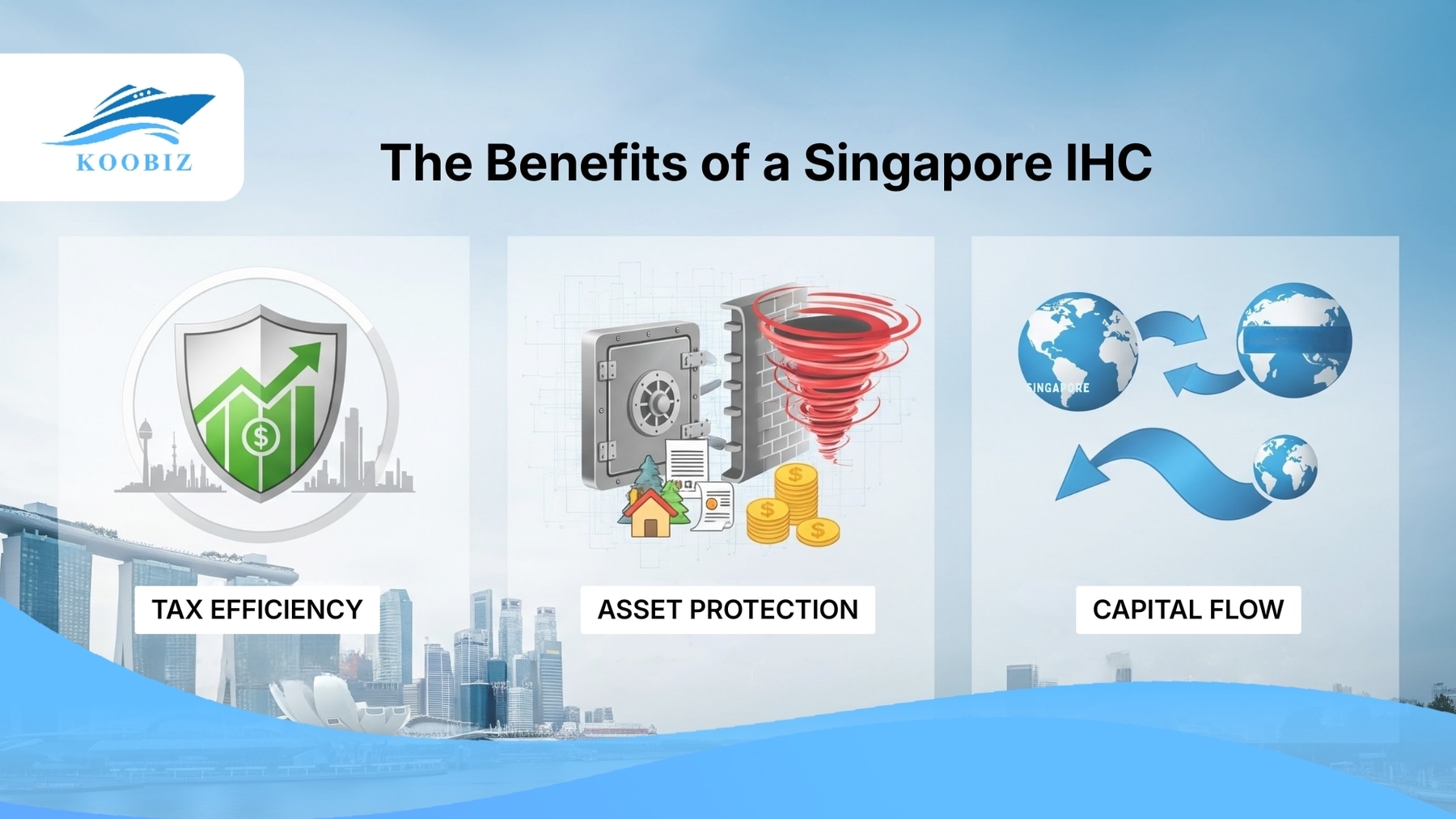
    What Are the Key Benefits of a Singapore IHC?

    The Benefits of a Singapore IHC
    The Benefits of a Singapore IHC

    There are three primary benefits to setting up a Singapore IHC: tax efficiency, asset protection, and ease of capital flow.

    • Tax Efficiency: Singapore operates on a territorial tax system. Foreign-sourced income is often tax-exempt if headline tax conditions are met.
    • Asset Protection: By holding assets in a separate legal entity, you insulate them from the liabilities of your operating companies.
    • Capital Flow: Singapore does not impose capital gains and no limit on sending the profits out of the country allowing for fluid movement of funds.

    What Is the Difference Between an Investment Holding Company and a Trading Company?

    The Investment Holding Company excels in asset preservation, whereas the Trading Company is optimized for active revenue generation. The distinction lies heavily in tax treatment and allowable deductions, as outlined below:

    Feature Investment Holding Company (IHC) Trading Company
    Primary Function Asset Holding & Passive Income Active Trading & Operations
    Income Source Dividends, Rentals, Interest Sales of Goods & Services
    Expense Deductibility Strictly Limited. Only direct investment costs (e.g., statutory fees) are deductible. Broad. Marketing, salaries, rent, and general overheads are deductible against revenue.
    Capital Allowances Generally Not Allowed on assets not used for trade. Allowed on plant and machinery used in the business.
    Start-Up Tax Exemption (SUTE) Not Eligible. Only eligible for Partial Tax Exemption (PTE). Eligible (if conditions met) for tax breaks on the first SGD 100k income.

    Specifically, the most critical difference is the deductibility of expenses. Choosing the right structure depends entirely on whether your primary goal is active business or passive holding.

    What Are the Requirements to Set Up a Singapore Holding Company?

    These are the non-negotiable statutory pillars mandated by the Accounting and Corporate Regulatory Authority (ACRA).

    • Resident Director: You must have at least one director who is “ordinarily resident” in Singapore (a Citizen, Permanent Resident, or EntrePass holder). If you are a foreign investor, you will need a Nominee Director service.Shareholders: Can be individuals or corporate entities, up to a maximum of 50 for a private limited company. 100% foreign ownership is allowed.
    • Paid-up Capital: The minimum paid-up capital is SGD 1.
    • Company Secretary: Must be appointed within 6 months of incorporation.

    How to Register an Investment Holding Company in Singapore?

    Registration involves a streamlined three-step process. With the right guidance, this entire process can be completed digitally within a few days.

    Step 1: Name Reservation and Approval

    The first step is to propose a unique company name and submit it to ACRA for approval. The name must not be identical to an existing entity, nor should it contain undesirable or prohibited words. Once approved, the name is reserved for 60 days (extendable), giving you time to prepare the necessary filings.

    Step 2: Preparing Incorporation Documents

    Next, you must prepare and sign the company’s constitution and the consent forms for directors and shareholders. This stage involves Know-Your-Customer (KYC) due diligence, which is mandatory for all corporate service providers in Singapore.

    • Constitution: Outlines the rules and regulations of the company.
    • Consent to Act: Directors and Company Secretaries must sign forms confirming their willingness to serve.

    Step 3: Filing with ACRA and Receiving UEN

    Once all documents are signed, the formal application is lodged with ACRA via the BizFile+ portal. Upon successful registration, ACRA issues an electronic Notice of Incorporation and a Unique Entity Number (UEN). This serves as your official business certificate.

    Need assistance with registration? Koobiz offers comprehensive incorporation packages that handle Name Reservation, Document Preparation, and ACRA Filing on your behalf, ensuring a hassle-free setup.

    Practical Case Studies: How Investors Use Singapore Holding Companies

    By examining real-world applications, we can see exactly how a Singapore Investment Holding Company creates value through risk mitigation and tax optimization.

    Let’s examine two distinct case studies that illustrate the power of this structure.

    Case Study 1: The “Risk Firewall” Strategy (Asset Protection)

    In this scenario, a successful trading business uses a Holding Company to protect its assets from operational risks.

    • The Situation: “TechGlobal Trading,” a software distributor, owns a valuable commercial office and several software patents. They are worried that a client lawsuit could bankrupt the company and force the sale of these assets.
    • The Solution: The owners set up “TechGlobal Holdings Pte Ltd.” They transfer the office title and patents to this new Holding Company. TechGlobal Holdings then licenses the IP and rents the office back to the trading entity.
    • The Outcome: If the trading business is sued, the assets are safe because they are owned by the Holding Company, which is a separate legal entity not involved in the dispute.

    Case Study 2: The “Tax-Efficient Gateway” (Cross-Border Expansion)

    This scenario demonstrates how foreign investors use Singapore to minimize tax leakage when investing in the ASEAN region.

    • The Situation: Mr. Smith, a UK investor, wants to acquire manufacturing plants in Vietnam and Indonesia. He is concerned about the high withholding taxes on dividends when profits are sent back to the UK.
    • The Solution: Mr. Smith incorporates “Smith Asia Holdings” in Singapore. This Singapore company acquires the shares of the Vietnamese and Indonesian manufacturers.
    • The Outcome: Due to Singapore’s strong Double Taxation Agreements (DTAs), the withholding tax on dividends flowing from Vietnam/Indonesia to Singapore is significantly reduced. Furthermore, Singapore does not tax these foreign-sourced dividends (under specific exemptions), and there is 0% withholding tax when Singapore sends the money to Mr. Smith in the UK.

    How Does the Singapore Tax Regime Benefit Holding Companies?

    Singapore holding company tax benefits
    Singapore holding company tax benefits

    Singapore’s single-tier corporate tax system is a major advantage. Profits are taxed only once at the corporate level, meaning dividends distributed to shareholders are tax-free.

    While the corporate tax rate is capped at 17%, effective rates are often lower due to exemptions. However, it is important to note that Investment Holding Companies do not qualify for the Start-Up Tax Exemption (SUTE) because their primary activity is passive investment. Instead, they are generally eligible for the Partial Tax Exemption (PTE) scheme.

    Are Dividends Taxed in Singapore?

    No. Dividends paid by a Singapore tax-resident company are completely tax-exempt for shareholders, whether local or foreign. This eliminates double taxation on profit withdrawals.

    What Are the Double Taxation Agreements (DTAs)?

    Singapore has signed DTAs with over 90 jurisdictions to prevent income from being taxed twice. For a holding company, this significantly reduces withholding taxes on interest or royalties earned from foreign subsidiaries, maximizing retained income.

    What Are the Ongoing Compliance and Maintenance Costs?

    To maintain good standing and avoid penalties, companies must meet annual obligations:

    • AGM: Hold within 6 months of the financial year-end.
    • Annual Return: File with ACRA within 7 months of the financial year-end.
    • Tax Filing: File Estimated Chargeable Income (ECI) within 3 months of year-end, and the final Tax Return (Form C-S/C) by November 30th (for paper filing) or December 15th (for electronic filing). Even dormant IHCs must file specific returns.

    How Does a Holding Company Compare to Other Structures?

    Choosing the right structure depends heavily on your investment scale, need for segregation, and banking requirements.

    Feature Singapore Investment Holding Co. (IHC) Variable Capital Company (VCC) BVI / Cayman Offshore Co.
    Best For Single-family offices, small investor groups, holding static assets (property/shares). Large investment funds needing multiple sub-funds and segregated liabilities. Investors seeking maximum privacy and zero tax (but willing to face high scrutiny).
    Asset Segregation No. Assets and liabilities are pooled in one entity. Yes. Assets and liabilities can be legally segregated between sub-funds. No. Standard companies do not offer ring-fencing without complex structuring.
    Reputation & Banking High. Regarded as a legitimate onshore business. High. Regulated by MAS, offering strong credibility for fund managers. Low/Mixed. High scrutiny from banks (“High Risk”).
    Cost & Compliance Moderate. Standard ACRA filing fees and annual maintenance. High. Higher setup costs, strict MAS oversight, and mandatory fund administrator. Low Setup / High Maintenance. Cheap to start, but “Economic Substance” rules are increasing ongoing costs.

    What Is the “Economic Substance” Requirement?

    To prove it is not a tax-avoidance shell, an IHC must demonstrate management and control in Singapore. This includes holding Board meetings and maintaining records locally.

    Ready to Incorporate Your Investment Holding Company?

    Setting up a Singapore Investment Holding Company is a powerful strategic move for asset protection. However, the process requires precise adherence to ACRA regulations.

    Koobiz specializes in helping foreign and local investors navigate this journey. From providing Nominee Director to handling your Annual Filings, we provide the infrastructure required for success.

    Contact Koobiz today for a free consultation on your Holding Company Setup

  • What is an LLP? Meaning, Benefits, and Registration for Singapore Businesses

    What is an LLP? Meaning, Benefits, and Registration for Singapore Businesses

    [SUMMARIES]

    A Limited Liability Partnership (LLP) is a hybrid business structure that combines the operational flexibility of a partnership with the legal protection of a separate corporate personality, effectively shielding partners from personal liability for the negligence of their colleagues.

    Taxation is applied on a “pass-through” basis where the entity itself is not taxed; instead, profits are distributed to partners and subject to their personal progressive income tax rates, unlike the flat corporate rates and exemptions available to Private Limited companies.

    While LLPs offer lower compliance costs by requiring only an annual declaration of solvency rather than complex audits, they are unsuitable for scalable startups seeking Venture Capital, as the inability to issue shares makes raising external funding difficult.

    [/SUMMARIES]

    A Limited Liability Partnership (LLP) in Singapore is a hybrid business structure that combines the operational flexibility of a general partnership with the legal protection of a private limited company. It is an ideal entity for professionals and small business owners who seek to limit their personal liability without the administrative burden of a corporation.

    Specifically, unlike a sole proprietorship where the owner and business are one, an LLP possesses a separate legal personality, meaning partners are not personally liable for the business’s debts or the negligence of other partners. This structure is governed by the Limited Liability Partnerships Act 2005 and is regulated by the Accounting and Corporate Regulatory Authority (ACRA).

    To navigate the business landscape effectively, it is crucial to compare the LLP against other common structures like Private Limited (Pte Ltd) companies and Sole Proprietorships. While an LLP offers tax transparency and lower compliance costs, a Pte Ltd might be superior for raising capital. Understanding these nuances is key to making an informed decision.

    In the following sections, we will provide a comprehensive guide covering the detailed meaning, distinct benefits, tax implications, and a step-by-step registration process for setting up an LLP in Singapore. Whether you are a local entrepreneur or a foreign professional, this guide will clarify the path to incorporation.

    What is a Limited Liability Partnership (LLP) in Singapore?

    LLP - separate legal personality and the ability to own property in its own name
    LLP – separate legal personality and the ability to own property in its own name

    A Limited Liability Partnership (LLP) is a corporate body formed by being registered under the LLP Act, characterized by its separate legal personality and the ability to own property in its own name. It essentially serves as a “middle ground” between a partnership and a company, offering the best of both worlds for specific professional groups.

    To understand this structure more deeply, we must look at its core legal foundation. An LLP is capable of suing and being sued in its own name, acquiring, owning, holding, and developing property, and having a common seal. This distinction is vital because, in a traditional general partnership, the partners are the firm. In an LLP, the firm exists independently of its partners.

    This structure is particularly popular among chartered professions—such as lawyers, accountants, and architects—where partners want to work together but do not want to be held personally responsible for the professional malpractice or negligence of their colleagues. The liability of a partner is limited to their agreed contribution to the LLP, shielding their personal assets (like their home or personal savings) from business claims, provided they were not the ones directly at fault.

    What are the Key Features and Benefits of an LLP Structure?

    Key features that define the LLP structure
    Key features that define the LLP structure

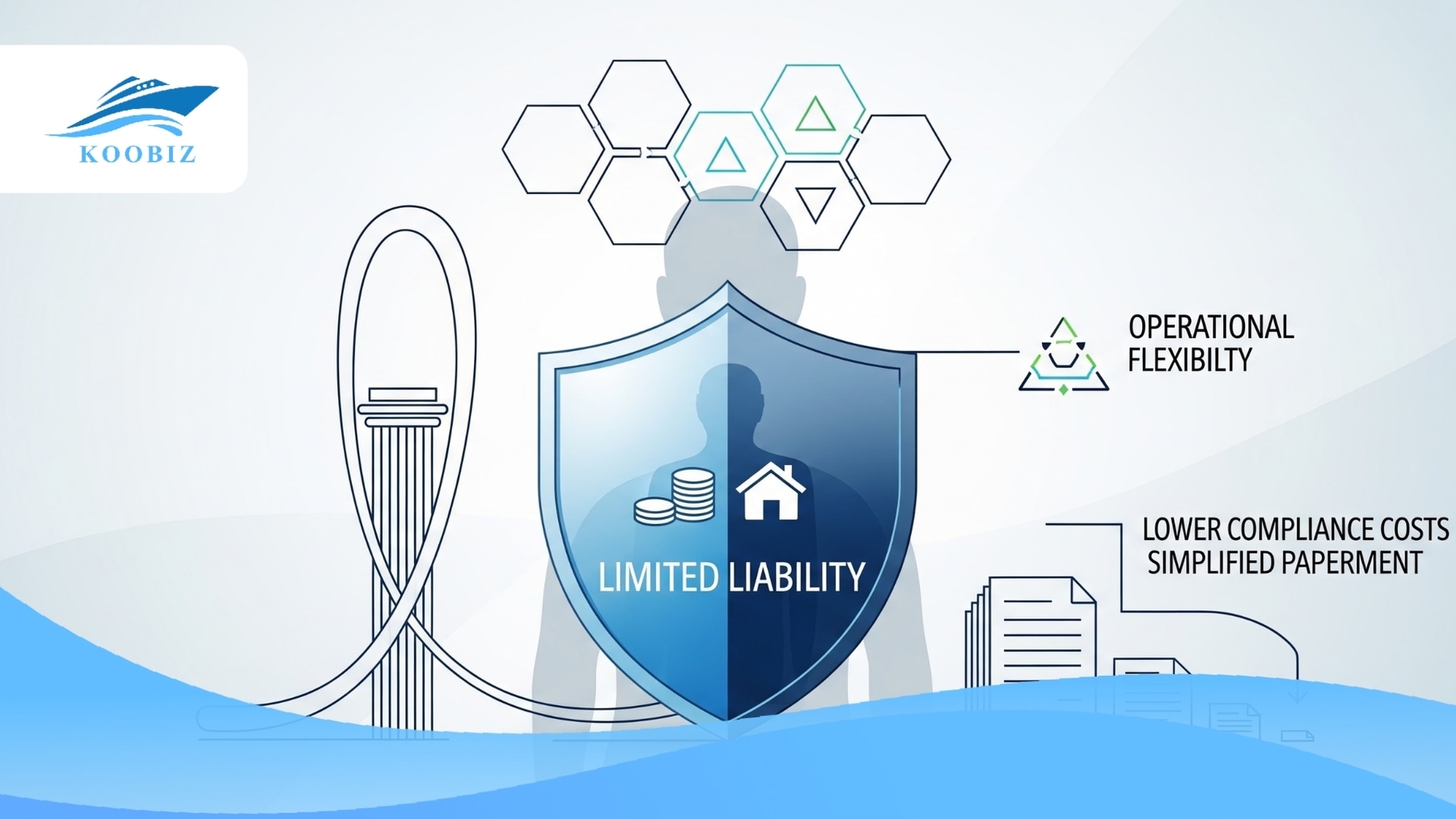
    There are three primary features that define the LLP structure: separate legal personality, perpetual succession, and operational flexibility combined with limited liability. These attributes make the LLP a compelling choice for small teams and professional services.

    • Separate Legal Identity: As mentioned, the LLP is a body corporate. This means the LLP is liable for its own debts and obligations. A partner’s personal assets are protected from the liabilities of the LLP. This is a significant upgrade from a Sole Proprietorship.
    • Perpetual Succession: The existence of the LLP is not dependent on its partners. Any change in the partners (due to resignation, death, or bankruptcy) does not affect the existence, rights, or liabilities of the LLP. This ensures business continuity and stability for clients and stakeholders.
    • Lower Compliance Costs: A LLP has fewer statutory requirements. They simply need to lodge an annual declaration of solvency.
    • Operational Flexibility: The internal governance of an LLP is typically determined by the LLP agreement between partners. This allows the partners to create a management structure tailored to their needs, rather than follow the rigid hierarchy of a corporation.

    LLP vs. Pte Ltd vs. Sole Proprietorship: Which Structure is Right for You?

    The LLP wins on flexibility and lower compliance costs, the Private Limited (Pte Ltd) company is superior for scalability and tax incentives, while the Sole Proprietorship is optimal for simplicity and zero setup cost but carries the highest risk. Choosing the right structure depends entirely on your business goals, risk appetite, and capital needs.

    To help you make an informed decision, let’s analyze the critical differences between these entities in the table below.

    Feature Sole Proprietorship Limited Liability Partnership (LLP) Private Limited (Pte Ltd)
    Liability Unlimited. The owner is personally liable for all debts and losses. Limited. Partners are protected from the firm’s debts and other partners’ negligence. Limited. Shareholders are only liable up to the amount of their share capital.
    Taxation Personal Income Tax (0% – 24%). No corporate exemptions. Personal Income Tax (0% – 24%). No corporate exemptions. Corporate Tax (Flat 17%). Eligible for significant tax exemptions (e.g., SUTE).
    Scalability Limited to personal savings or loans. Hard to scale. Difficult to raise external capital (investors usually want shares). Easy to raise capital by issuing new shares to investors.
    Credibility Low perception of scale. Professional image, suitable for service firms (lawyers, architects). High credibility, preferred by banks and large suppliers.

    Koobiz Insight: If you are planning to raise Venture Capital or sell shares in the future, a Pte Ltd is the standard requirement. However, if you are a group of lawyers or consultants keeping profits within the team, an LLP is often more tax-efficient and easier to manage. Koobiz can assist you in evaluating these options based on your specific financial projections.

    What are the Requirements to Register an LLP in Singapore?

    Registering an LLP requires four fundamental components: a minimum of two partners, at least one locally resident manager, a registered local address, and a unique business name. These are the statutory minimums mandated by ACRA to ensure the entity has a legal footing and accountability in Singapore.

    Specifically, ensuring you meet these criteria beforehand will prevent delays during the application process.

    • Partners: An LLP is required to have at least two partners. These can be individuals (min. 18 years old) or corporate bodies (other companies). There is no cap on the maximum number of partners.
    • Managers: at least one manager is an “ordinarily resident” in Singapore. This person must be a Singapore Citizen, Permanent Resident, or an EntrePass/Employment Pass holder. The manager is responsible for statutory compliance. Note that a partner can also be a manager.
    • Registered Address: A P.O. Box is not accepted. A physical address in Singapore is mandatory. This can be a commercial office or a residential home (under the Home Office Scheme).
    • Compliance Declaration: All partners have to be included in a statement of non-disqualification (e.g., not an undischarged bankrupt) and consent to act as managers/partners.

    How to Register an LLP with ACRA? (Step-by-Step Guide)

    The registration process involves three main steps: Name Reservation, Registration Filing via BizFile+, and Payment of Fees, resulting in the issuance of a Unique Entity Number (UEN). The entire process is digital and can typically be completed within 15 to 30 minutes if all documents are in order.

    Let’s break down the execution of these steps to ensure a smooth incorporation experience.

    Step 1: Reserve the LLP Name:

    Log in to ACRA’s BizFile+ portal using your Singpass. Submit your proposed LLP name. The name will be rejected if it is identical to an existing entity, undesirable (vulgar), or similar to reserved names. Once approved, the name is reserved for 120 days.

    Step 2: Submit Registration Details:

    Registration of the new business entity:

    • Details of partners and managers (ID numbers, addresses).
    • The registered office address.
    • The nature of business activities (SSIC Codes).
    • Endorsements from the appointed partners/managers (they will receive an email to accept their appointment via BizFile+).

    Step 3: Pay the Registration Fee:

    The registration fee for an LLP is SGD 100. After payment and endorsement, ACRA will issue an email notification confirming the registration – this serves as your official Certificate of Incorporation. You will also receive your Business Profile, which acts as the firm’s “birth certificate.”

    Need Professional Help? Koobiz offers comprehensive incorporation services to handle the entire ACRA registration process for you, ensuring you start your business on the right legal footing without the hassle.

    What are the Tax Implications and Compliance Requirements for an LLP?

    Managing an Limited Liability Partnership (LLP)
    Managing an Limited Liability Partnership (LLP)

    Managing an LLP involves understanding tax transparency principles and adhering to the annual declaration of solvency to avoid penalties. Unlike a company that pays tax on its own profits, an LLP functions as a “pass-through” entity for tax purposes.

    To clarify the ongoing obligations of an LLP owner, we must look at how taxation and reporting differ from other structures.

    Is an LLP subject to Corporate Income Tax in Singapore?

    No, an LLP is not a separate taxable entity and is not subject to corporate income tax; instead, it is treated as a tax-transparent entity where partners are taxed on their share of the income.

    Specifically, the LLP itself does not file a Corporate Tax Return (Form C-S/C).

    • Individual Partners: Will be taxed at personal income tax rates, which are progressive from 0% to 24%.
    • Corporate Partners: Will be taxed at the corporate tax rate (17%).
    • Note: Since the LLP is not a taxable entity, it cannot claim tax incentives available to Pte Ltd companies

    What is the Annual Declaration of Solvency?

    The Annual Declaration of Solvency is a mandatory statement lodged by the managers stating whether the LLP is able to pay its debts as they fall due during the normal course of business.

    Specifically, this is the primary compliance requirement for LLPs, replacing the complex financial filing required for companies.

    • Procedure: Managers must lodge this declaration via BizFile+ annually.
    • Timeline: It must be lodged within 15 months from the date of registration, and subsequently once every calendar year (not exceeding 15 months from the last lodgement).
    • Penalty: Failure to lodge this declaration is an offense under the LLP Act and can result in late filing penalties or prosecution.

    Can Foreigners Register an LLP in Singapore Without Relocating?

    Yes, foreigners can register an LLP in Singapore without relocating, provided they appoint at least one locally resident manager to meet the statutory requirement.

    This structure allows foreign investors to maintain ownership without physically residing in the country.

    • The Challenge: ACRA requires one manager to be “ordinarily resident” (Citizen, PR, or EP holder). A foreigner living overseas cannot fulfill this role alone.
    • The Solution: Foreigners must engage a Corporate Service Provider (like Koobiz) to provide a Nominee Manager service. This Nominee Manager fulfills the statutory requirement but typically does not have executive power over the business.
    • Visa Implications: Registering an LLP does not automatically grant a work visa. If the foreign partner wishes to move to Singapore to run the business, they must apply for an Employment Pass (EP) or EntrePass, though approval for LLP owners can be stricter than for Pte Ltd shareholders.

    How to Convert a Sole Proprietorship or Partnership to an LLP?

    Converting involves a process of registering a new LLP, transferring the business assets and undertakings to it, and then terminating the old business entity.

    There is no direct “convert button” in the ACRA system; it is a legal transition process.

    1. Register the New LLP: Follow the standard registration steps mentioned above. You can often retain the same business name if the old entity consents to it.
    2. Transfer Assets: Execute a business transfer agreement to move assets, contracts, and client lists from the Sole Proprietorship/Partnership to the new LLP.
    3. Novate Contracts: Ensure existing contracts with suppliers or landlords are updated to reflect the new LLP entity (since the LLP is a separate legal person).
    4. Cessation: Once the transfer is complete, file a “Cessation of Business” for the old Sole Proprietorship or Partnership via BizFile+ to close it formally.

    Ready to Incorporate? Start Your Journey with Koobiz

    Navigating the legalities of partnership agreements, tax compliance, and ACRA regulations can be complex for new business owners. Koobiz specializes in simplifying company incorporation in Singapore, ensuring your business starts on the right legal footing.

    Whether you need assistance with registering your LLP, finding a Nominee Manager, or managing annual compliance, our team provides expert guidance tailored to your needs.

    Visit Koobiz.com to Incorporate Your Company Today

    Frequently Asked Questions (FAQs)

    What is the minimum capital requirement for an LLP?

    Unlike a Private Limited Company which typically has a minimum paid-up capital of SGD 1, an LLP does not have a statutory minimum capital requirement. Partners contribute capital based on their mutual agreement outlined in the LLP agreement.

    Do I need to audit the accounts of an LLP?

    Generally, no. Most LLPs are not required to audit their accounts. However, an audit is mandatory if the LLP has corporate partners (companies) or if the LLP is large (e.g., significant revenue or assets). For the majority of small professional LLPs, a simple solvency declaration is sufficient.

    Can a single person register an LLP in Singapore?

    No, a single individual cannot register an LLP alone. The LLP Act requires a minimum of two partners to register. If the number of partners falls below two for more than two years, the remaining partner may become personally liable for the LLP’s obligations.

    Is an LLP suitable for a startup planning to raise Venture Capital?

    No, an LLP is generally not suitable for startups seeking Venture Capital (VC) funding. Investors typically require equity (shares) in exchange for their capital, and an LLP does not issue shares. A Private Limited Company (Pte Ltd) is the preferred structure for raising investment.