Tag: BizFile+

  • Understanding ACRA: The Complete Guide to Singapore’s Corporate Regulator for Startups

    Understanding ACRA: The Complete Guide to Singapore’s Corporate Regulator for Startups

    [SUMMARIES]

    Definition: ACRA is the national regulator for business entities and public accountants in Singapore.

    Mandate: Registration with ACRA is mandatory for all profit-generating businesses (with minor exceptions).

    Platform: All transactions are conducted via BizFile+, the central online filing portal.

    Compliance: Key ongoing requirements include holding AGMs and filing Annual Returns.

    Consequences: Non-compliance leads to penalties, summons, or the striking off of the company.

    [/SUMMARIES]

    For any entrepreneur looking to establish a foothold in Southeast Asia’s business hub, navigating the regulatory landscape is the first crucial step. At the heart of this ecosystem lies an acronym that every business owner will encounter repeatedly: ACRA. Whether you are registering a new company, updating your office address, or filing annual financial reports, your interactions with the Accounting and Corporate Regulatory Authority define your business’s legal standing.

    At Koobiz,we work closely with local and international clients to incorporate and manage Singapore companies, and we consistently see that businesses with a clear understanding of ACRA’s role face fewer compliance challenges over time. This guide aims to clearly explain what ACRA does, outline its key responsibilities, highlight essential compliance requirements, and clarify how it differs from other authorities such as IRAS, helping you navigate Singapore’s corporate landscape with confidence.

    What is ACRA in Singapore?

    ACRA is the national regulator of business entities, public accountants, and corporate service providers in Singapore, operating as a statutory board under the Ministry of Finance.

    To understand the full scope of this entity, it is helpful to look at its origins. Formed on April 1, 2004, ACRA was created through the merger of the Registry of Companies and Businesses (RCB) and the Public Accountants Board (PAB). This merger aimed to synergize the monitoring of corporate compliance with the oversight of public accountants.

    As a statutory board, ACRA functions differently from a typical government department. It has the authority to administer and enforce the Companies Act, impose regulatory penalties, maintain national business registers, and continuously upgrade digital systems such as BizFile+ to support a pro-business yet highly transparent environment.

    For startup founders and business owners, ACRA represents more than a compliance authority, it is the legal starting point of the company’s existence. ACRA is the body that incorporates your entity and issues the Unique Entity Number (UEN), which serves as the official identifier for all dealings with government agencies, banks, and commercial counterparties. Without registration and recognition by ACRA, a business has no legal standing in Singapore.

    What are the Key Functions of ACRA?

    ACRA acts as both a gatekeeper and a guardian for Singapore’s business ecosystem. Its role goes beyond just paperwork; it ensures that Singapore remains a trusted place to do business.

    Although ACRA’s scope of authority is extensive, from a practical perspective, its functions can be distilled into four core responsibilities that are most relevant to startup founders and business owners:

    1. Registering Business Entities

    ACRA is the starting point for every business in Singapore. It administers the Companies Act and the Business Names Registration Act, overseeing the incorporation of all legal entities, including Private Limited Companies, Sole Proprietorships, and Limited Liability Partnerships (LLPs).

    During incorporation, ACRA reviews and approves company names, verifies compliance with statutory requirements, and ensures that the chosen business structure aligns with Singapore law. Only after these checks are completed will ACRA issue the Certificate of Incorporation, formally bringing the company into legal existence.

    When clients appoint Koobiz to assist with incorporation, we liaise directly with ACRA’s systems to reserve company names, submit incorporation documents, and complete the registration process accurately and efficiently, ensuring full compliance from day one.

    2. Enforcing Corporate Compliance

    Once a business is live, ACRA shifts to its role as an enforcer. It monitors companies to ensure they remain active, transparent, and compliant with statutory laws. This includes monitoring key statutory obligations such as the timely filing of Annual Returns and the holding of Annual General Meetings (AGMs). Where these requirements are not met, ACRA has the authority to impose late filing penalties, issue composition fines, or take enforcement action against directors. These measures help maintain the integrity and reliability of Singapore’s corporate registry.

    3. Regulating Public Accountants and Service Providers

    ACRA does not just regulate businesses; it also regulates the professionals who serve them. This includes registering Public Accountants (auditors) and Corporate Service Providers (CSPs). By maintaining strict standards for these professionals, ACRA ensures that the financial statements and statutory advice you receive are of high quality. This gives business owners confidence when hiring licensed agents to handle their affairs.

    > 2025 Regulatory Update: Under the Corporate Service Providers Act 2024, ACRA has introduced tighter registration and reporting requirements for CSPs, including enhanced disclosures for nominee arrangements, as part of Singapore’s strengthened AML framework.

    4. Facilitating Information and Transparency

    ACRA serves as the central authority responsible for maintaining Singapore’s official corporate registry. It ensures that key information relating to every registered entity, such as its registered address, directors, and shareholders, is kept accurate, up to date, and publicly accessible.

    Through platforms such as BizFile+ iShop and its open data services, ACRA enables third parties to purchase official business profiles and extracts. This accessibility supports a transparent business environment, allowing investors, banks, and counterparties to perform due diligence efficiently and with confidence.

    Is Registration with ACRA Mandatory for Startups?

    Yes, registration with ACRA is mandatory for any individual or group intending to carry out a business activity for profit in Singapore on an ongoing basis.

    ACRA registration for startups in Singapore 2025 remains a critical first step. This requirement is strictly enforced under the Business Names Registration Act. The definition of “business activity” is broad, covering any trade, commerce, craftsmanship, profession, or any other activity carried on for the purpose of gain. Whether you are opening a cafe, launching a tech startup, or running a consultancy firm, you must register before you commence operations.

    There are very limited exceptions to this rule. You do not need to register if you are:

    • Doing business under your full name as reflected in your NRIC (National Registration Identity Card) regarding a sole proprietorship.
    • A hawker with a license from the Singapore Food Agency (SFA).
    • A craftsman working from home (subject to specific HDB schemes).

    (Note: These exemptions are subject to ACRA’s latest guidelines—always verify on their official site before proceeding.)

    For most professional ventures and foreign founders, incorporating a Private Limited Company (Pte Ltd) with ACRA is the preferred and standard approach. This registration provides a Unique Entity Number (UEN), which is essential for opening a corporate bank account, hiring employees, and applying for government grants, processes that Koobiz routinely assists clients with. Operating a business without proper ACRA registration constitutes an offence and may result in fines or criminal liability..

    BizFile+: The Digital Gateway to ACRA

    BizFile+ is ACRA’s integrated online portal that enables business owners to complete more than 400 corporate filings and information requests through a single digital system..

    Previously, dealing with regulatory matters involved physical forms and in-person submissions. Today, BizFile+ reflects Singapore’s Smart Nation approach by acting as the primary digital interface between businesses and the regulator. The platform is fully paperless, accessible 24/7, and designed to allow companies to manage statutory obligations efficiently and at their own convenience.

    Accessing BizFile+ requires a SingPass (Singapore Personal Access) ID for locals, or a Corppass for corporate entities. Through this portal, you will conduct almost every administrative interaction with ACRA, including:

    • Incorporating a new company.
    • Updating registered office addresses or officers’ details.
    • Filing annual returns.
    • Applying to strike off a company.

    For first-time founders, the breadth of available functions can feel complex, particularly given the number of filing options and regulatory pathways.

    • Internal Link: For a step-by-step walkthrough on using the portal efficiently, read our detailed guide: [Navigate the BizFile Portal: A Guide for Singapore Business Owners to Manage ACRA Compliance].

    What are the Ongoing Compliance Requirements?

    To remain compliant, Singapore companies must fulfill two key annual obligations: holding an Annual General Meeting (AGM) and filing Annual Returns (AR).

    A company’s “Live” status depends on timely compliance with these statutory requirements. Missing ACRA filing deadlines in 2025 and beyond may result in late penalties, enforcement actions, or further compliance complications.

    Holding the Annual General Meeting (AGM)

    The AGM is a mandatory session where directors present financial statements to shareholders for review.

    • Listed Companies: Must hold within 4 months of Financial Year End (FYE).
    • Non-Listed Companies: Must hold within 6 months of FYE.
    • Exemption: Private companies may skip the AGM if they distribute financial statements to all members within 5 months of FYE, or if all members pass a resolution to dispense with it.

    Filing Annual Returns (AR)

    After the AGM, you must file an Annual Return via BizFile+. This submission updates your company particulars and lodges your financial statements.

    • Deadline: Non-listed companies must file within 1 month after the AGM (typically resulting in a 7-month window from FYE).

    At Koobiz, our corporate secretarial team tracks these timelines for you, ensuring every filing is accurate and on time.

    BEYOND THE BASICS: TRANSPARENCY, RISKS, AND COMPARISONS

    With the core compliance framework established, it is equally important to understand the broader regulatory context. This includes the high level of market transparency in Singapore, the potential consequences of non-compliance, and how ACRA’s role differs from that of other authorities within the financial and regulatory ecosystem.

    Public Access to Corporate Data and Transparency

    Singapore maintains a transparent business environment where corporate data is treated as public record, accessible to anyone through ACRA’s iShop and open data portals.

    This commitment to transparency is a fundamental pillar of Singapore’s strong pro-business reputation. ACRA operates on the principle that a company’s ownership structure, management details, and core registration information should be independently verifiable. Such openness significantly reduces fraud risk and enhances confidence among investors and commercial counterparties. Unlike jurisdictions where corporate ownership can remain largely opaque, Singapore ensures that essential company data is publicly available.

    As a result, any party, including potential investors, business partners, or even competitors, can legally obtain a company’s Business Profile. This document typically includes the UEN, incorporation date, registered address, principal business activities, paid-up capital, and particulars of directors and shareholders. At the same time, this transparency works both ways, enabling you to conduct proper due diligence on counterparties before entering into commercial arrangements.

    • Internal Link: Need to check a competitor or partner? Learn how to download reports in our guide: [Conduct ACRA Company Search: Buy Business Profiles & UEN Reports].

    What Happens If You Non-Comply with ACRA Regulations?

    Failure to comply with ACRA regulations results in a tiered system of enforcement actions, ranging from financial composition sums to court prosecution and company striking off.

    ACRA is known for being efficient but also strict. Ignorance of the law is not a valid defense in Singapore. Non-compliance usually stems from missing filing deadlines or failing to update changes in company particulars.

    Understanding Late Lodgement Fees and Penalties

    For minor breaches, such as filing the Annual Return late, ACRA usually issues a Late Lodgement Fee. This acts as a penalty to encourage timely compliance.

    • The fee typically starts at SGD 300 and can go up to SGD 600 per breach depending on the length of the delay.
    • If the breach continues, ACRA may issue a Composition Sum, which is an offer to settle the offense out of court by paying a fine.
    • Failure to pay the composition sum can lead to the issuance of a Summons, requiring the company director to attend court (with potential fines up to S$5,000 per charge).

    Can ACRA Strike Off Your Company?

    In severe cases, or where there is reasonable cause to believe that a company is not carrying on business (e.g., failure to file ARs for multiple years), ACRA has the power to strike off the company from the register.

    A company that is struck off is effectively extinguished as a legal entity. Its corporate bank accounts are frozen, control over remaining assets may pass to the state, and it loses all capacity to conduct business. In addition, directors linked to a strike-off caused by regulatory breaches may face future restrictions, including disqualification from holding directorships in other Singapore companies.

    ACRA vs. IRAS: What is the Difference?

    While ACRA governs the legal existence and compliance of a business entity, IRAS (Inland Revenue Authority of Singapore) focuses exclusively on tax administration and revenue collection.

    New business owners often confuse the two because both require annual filings. However, they serve distinct purposes and operate on different timelines. The table below outlines the key differences:

    Feature ACRA (The Registrar) IRAS (The Taxman)
    Primary Focus Corporate Governance & Legal Existence Tax Administration & Revenue Collection
    What You Report Ownership, officers, and financial position Taxable income, expenses, and deductions
    Key Filing Annual Return (via BizFile+) Corporate Income Tax Returns (Form C-S/C)
    Core Objective Transparency & Companies Act compliance Collecting the correct amount of tax for the state

    A company can be compliant with ACRA (filing ARs on time) but non-compliant with IRAS (failing to file tax returns), and vice versa. Successful business management requires satisfying both authorities simultaneously. Koobiz provides integrated accounting and tax services to ensure that information submitted to ACRA aligns perfectly with declarations made to IRAS, preventing discrepancies that could trigger audits.

    Conclusion

    Understanding ACRA is the first step toward building a sustainable and legally robust business in Singapore. From the moment of incorporation via BizFile+ to the annual rhythm of AGMs and filing returns, ACRA is the regulatory companion that ensures the integrity of Singapore’s world-class business environment. While the regulations may seem stringent, they are designed to protect you and your stakeholders.

    That said, staying on top of regulatory updates, filing timelines, and compliance obligations can divert attention away from growing your business. This is where Koobiz adds value. As a trusted corporate services partner, we manage the full spectrum of ACRA-related matters, ranging from incorporation and corporate secretarial support to annual compliance and tax planning.

    Ready to start your Singapore business journey without the regulatory headache?

    Visit Koobiz.com today to explore our incorporation packages and let us handle the paperwork while you focus on growth.

    Disclaimer: The information provided in this guide is for general informational purposes only and does not constitute legal or professional advice. Regulations and fees are subject to change. Please consult with a qualified corporate service provider or refer to official ACRA resources for the most up-to-date information.
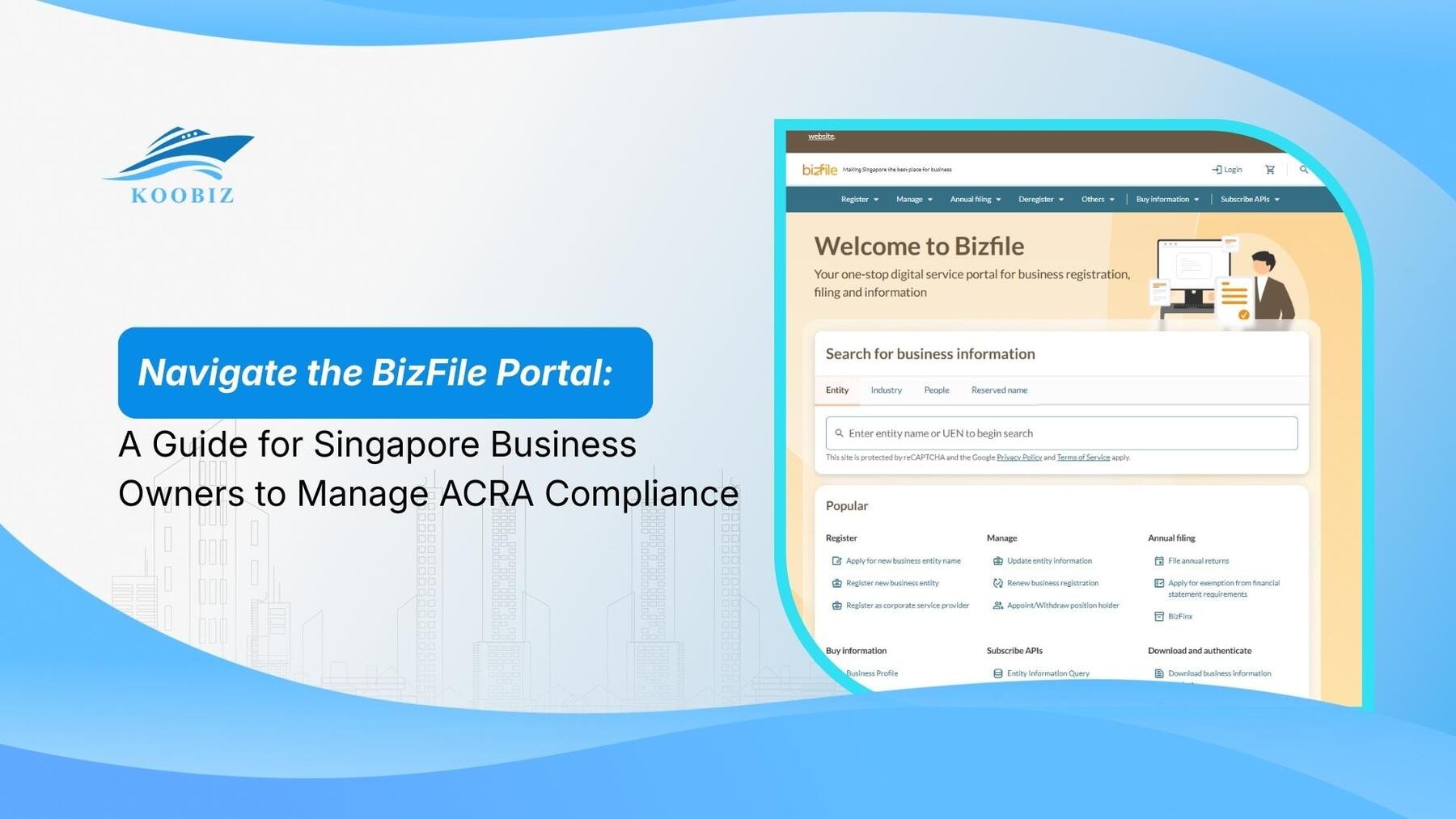
  • Navigate the BizFile Portal: A Guide for Singapore Business Owners to Manage ACRA Compliance

    Navigate the BizFile Portal: A Guide for Singapore Business Owners to Manage ACRA Compliance

    [SUMMARIES]

    Central Hub: BizFile+ is the mandatory electronic portal for all Singapore business entities to lodge statutory documents with ACRA.

    Access Requirements: Access requires a valid Singpass and authorization via CorpPass; direct username logins are not supported.

    Core Functions: The portal handles Annual Returns, changes in company address or officers, and the purchase of business profiles.

    Filing Strategy: Business owners must decide between self-filing to save costs or using a Registered Filing Agent like Koobiz to ensure accuracy and avoid penalties.

    Advanced Features: The platform also manages complex tasks like XBRL financial reporting, error rectification, and penalty payments.

    [/SUMMARIES]

    Navigating the regulatory landscape is a critical aspect of running a successful company in Singapore, and the BizFile Portal (BizFile+) sits at the very heart of this process. As the designated interface for the Accounting and Corporate Regulatory Authority (ACRA), this portal is not merely a website but the central nervous system for corporate compliance, where every statutory change, annual return, and financial statement must be recorded. Whether you are a new entrepreneur trying to understand access requirements or an experienced director managing complex filings, mastering this platform is non-negotiable.

    At Koobiz, we understand that while the interface is robust, the specific procedures for logging in via Singpass, managing CorpPass roles, and executing transactions can be daunting for foreign investors and busy business owners alike. This guide serves as your comprehensive roadmap, moving from the basic “what and how” of accessing the system to the strategic comparison of self-filing versus professional delegation, ensuring your business remains compliant and penalty-free.

    What is the BizFile+ Portal?

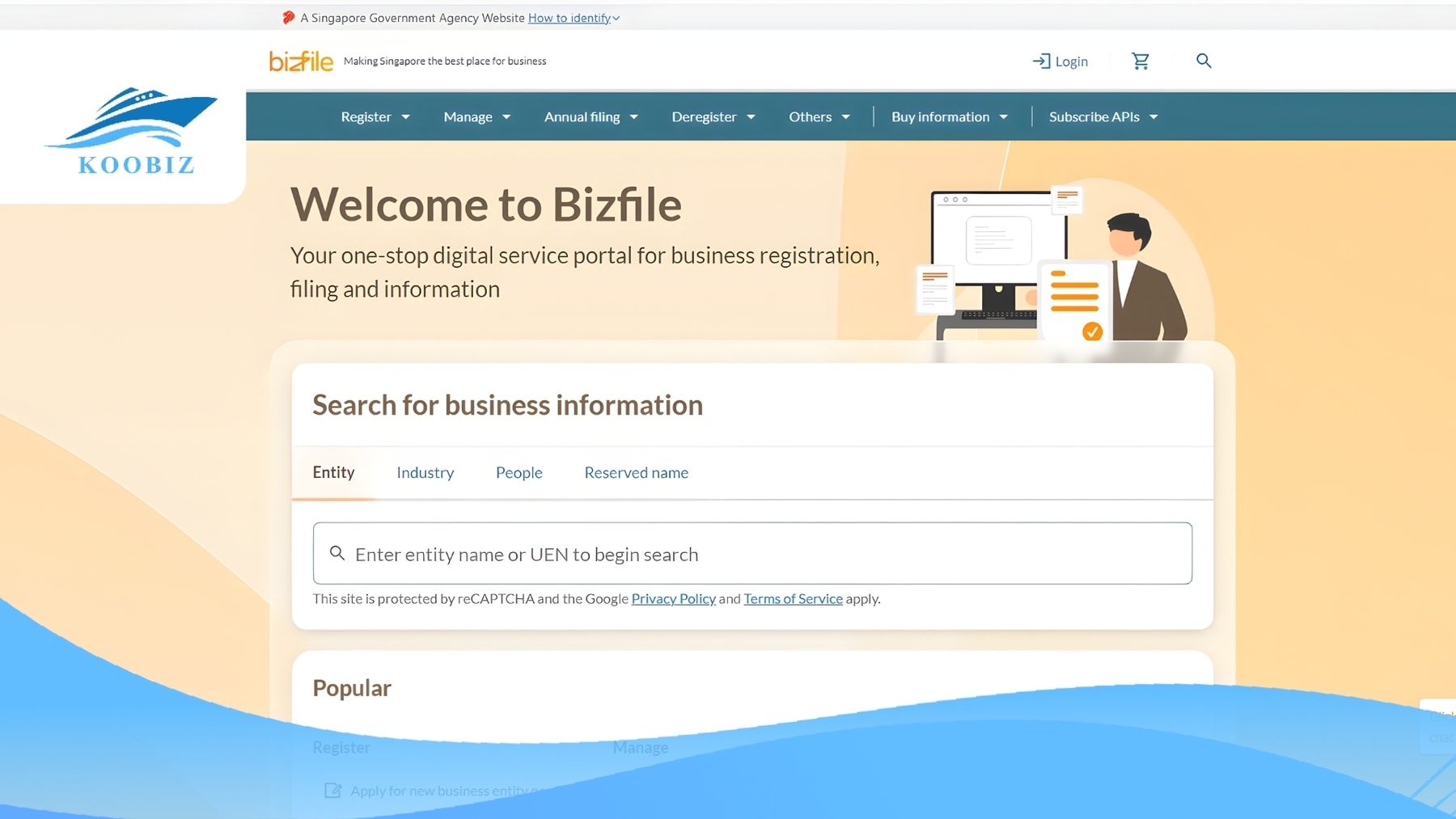
    BizFile+ is ACRA’s designated electronic filing and information retrieval system serving as the central repository for all Singapore business entities to submit statutory documents and update corporate records.

    BizFile+ replaces the need for physical paperwork, allowing business owners to interact directly with the government to manage their corporate entity’s lifecycle from incorporation to cessation.

    Bizfile Portal
    Bizfile Portal

    Why is Using BizFile+ Mandatory for Singapore Companies?

    Compliance via BizFile+ is mandatory under the Companies Act because it serves as the legally binding “single point of truth” for the public and government regarding a company’s status.

    To understand its importance, we must look at its role in the broader ecosystem of Singapore’s corporate governance. Manual submissions are largely obsolete. Every time a company changes its address, appoints a new director, or declares its financial solvency, it must be reflected here. For clients at Koobiz, we often emphasize that the data on BizFile+ constitutes the legal standing of your company—if it is not on the portal, legally speaking, it hasn’t happened.

    Necessary Credentials to Login to BizFile+

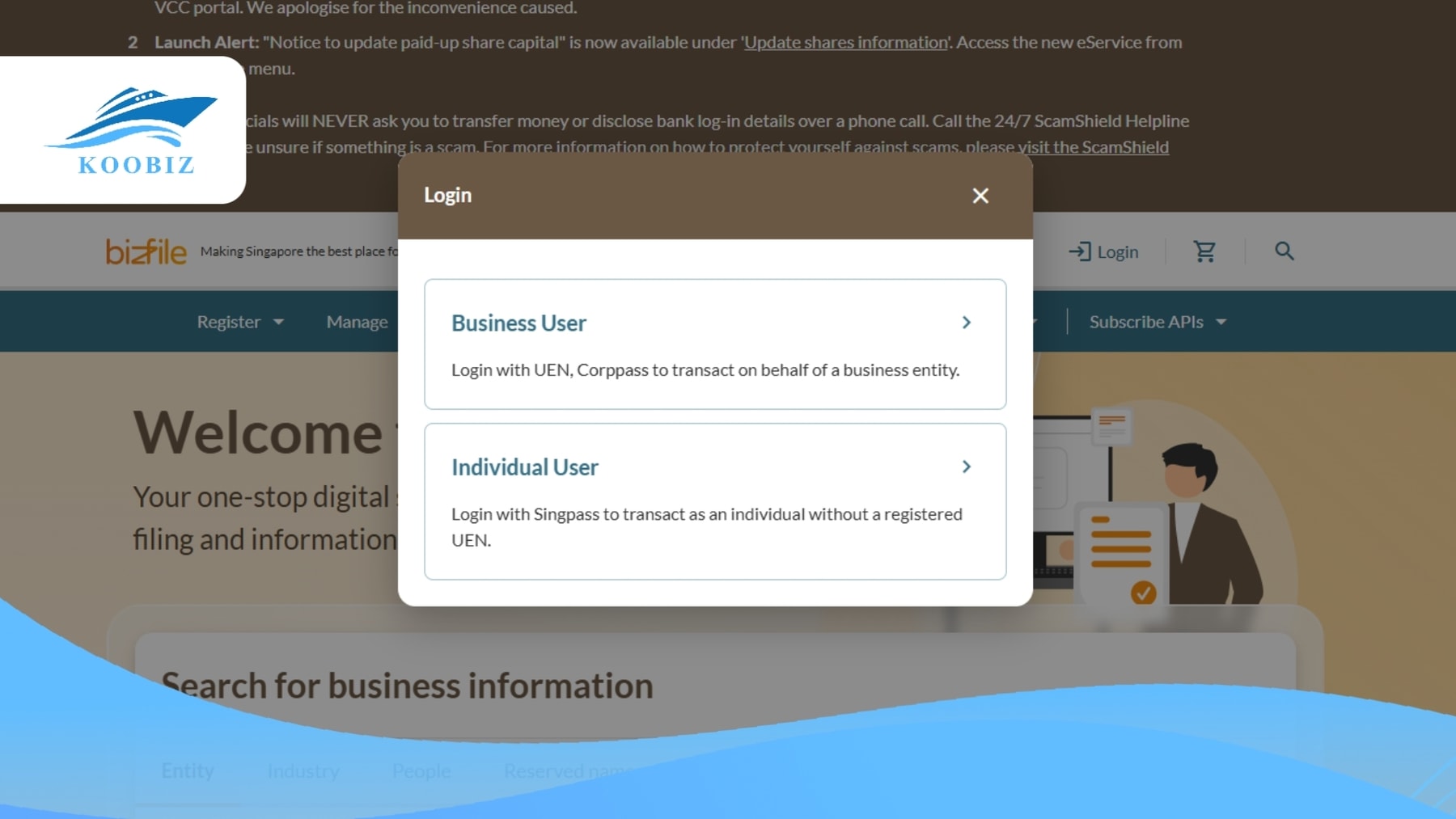
    To access the BizFile+ portal, you must possess a valid Singpass ID and have proper authorization via CorpPass, as the system does not support direct username logins.

    The system utilizes strict authentication protocols to verify that the person making changes is authorized. Specifically, you require the following credentials:

    BizFile Portal Login Details Required
    BizFile Portal Login Details Required
    • Singpass ID: Singapore’s National Digital Identity, required for all individual logins.
    • CorpPass Authorization: A digital authorization granting your Singpass account permission to act for the specific entity.
    • Unique Entity Number (UEN): The identification number of the business you intend to manage.

    Consequently, if you are a foreign director without a Singpass, you generally cannot log in personally and must rely on a Registered Filing Agent like Koobiz to act on your behalf.

    Setting Up CorpPass for Admin and Staff Access

    Setting up CorpPass involves three distinct steps: registering a CorpPass Administrator account, creating user accounts for staff, and assigning specific “ACRA E-Services” roles to those users.

    Even if you have a personal Singpass, you cannot access your company’s records unless the company’s CorpPass Admin has authorized you.

    • Identify the Admin: Usually the Company Secretary or a Director.
    • Select Services: The Admin must log in to the CorpPass portal and select “ACRA” from the list of e-services.
    • Assign Roles: Assign “Filer” or “Viewer” rights to specific employees. Without this assignment, a staff member logging in with their Singpass will see a “No Access” error.

    Key Compliance Transactions Available on the BizFile Dashboard

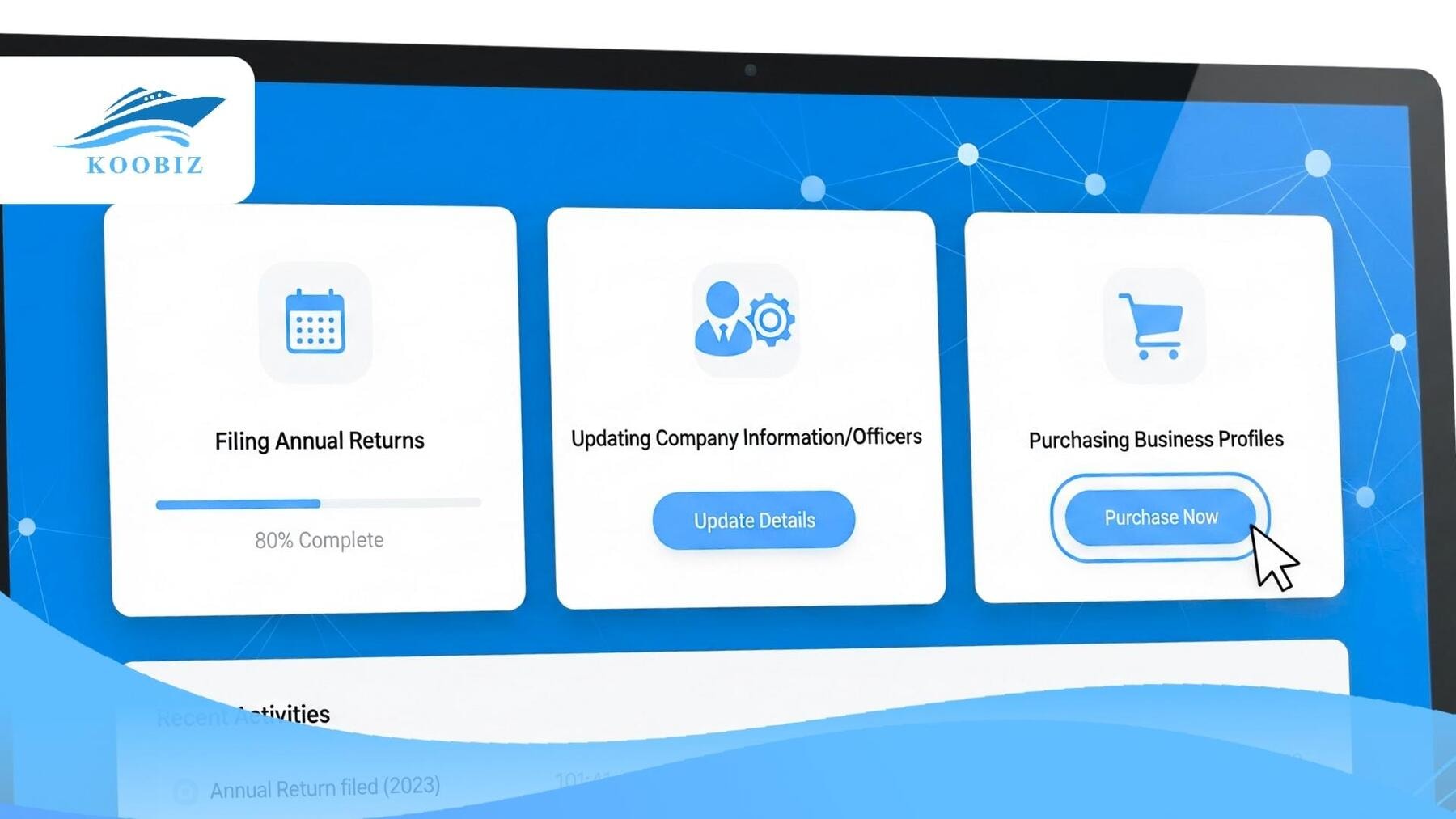
    Business owners primarily use the dashboard for three critical functions: filing annual returns, updating company particulars, and purchasing business profiles.

    Submit AR, Update Information, Purchase Business Profile
    Submit AR, Update Information, Purchase Business Profile

    Located primarily under the “Local Company” section of the dashboard, mastering these three areas ensures you meet statutory deadlines and maintain accurate public records.

    1. Filing Annual Returns (AR) and Annual General Meetings (AGM)

    Filing an Annual Return requires confirming the company’s details, AGM date, and attaching financial statements within 30 days of the Annual General Meeting.

    This is the most critical event on the portal. You must verify that your financial statements are prepared before navigating to the “File Annual Return” tab. For solvent exempt private companies (EPCs), the process is simplified, but for others, accurate financial data input is crucial to avoid penalties.

    2. Updating Company Information and Officers

    Updating company information involves selecting “Change in Company Information” for addresses or “Change in Officers” for appointments and resignations.

    By law, changes must be lodged within 14 days. Whether you are moving offices or accepting a director’s resignation, the update is not legally effective until the transaction fee is paid and recorded here. Koobiz advises immediate updates to prevent discrepancies between internal records and public data.

    3. Buying Business Profiles and Other Information

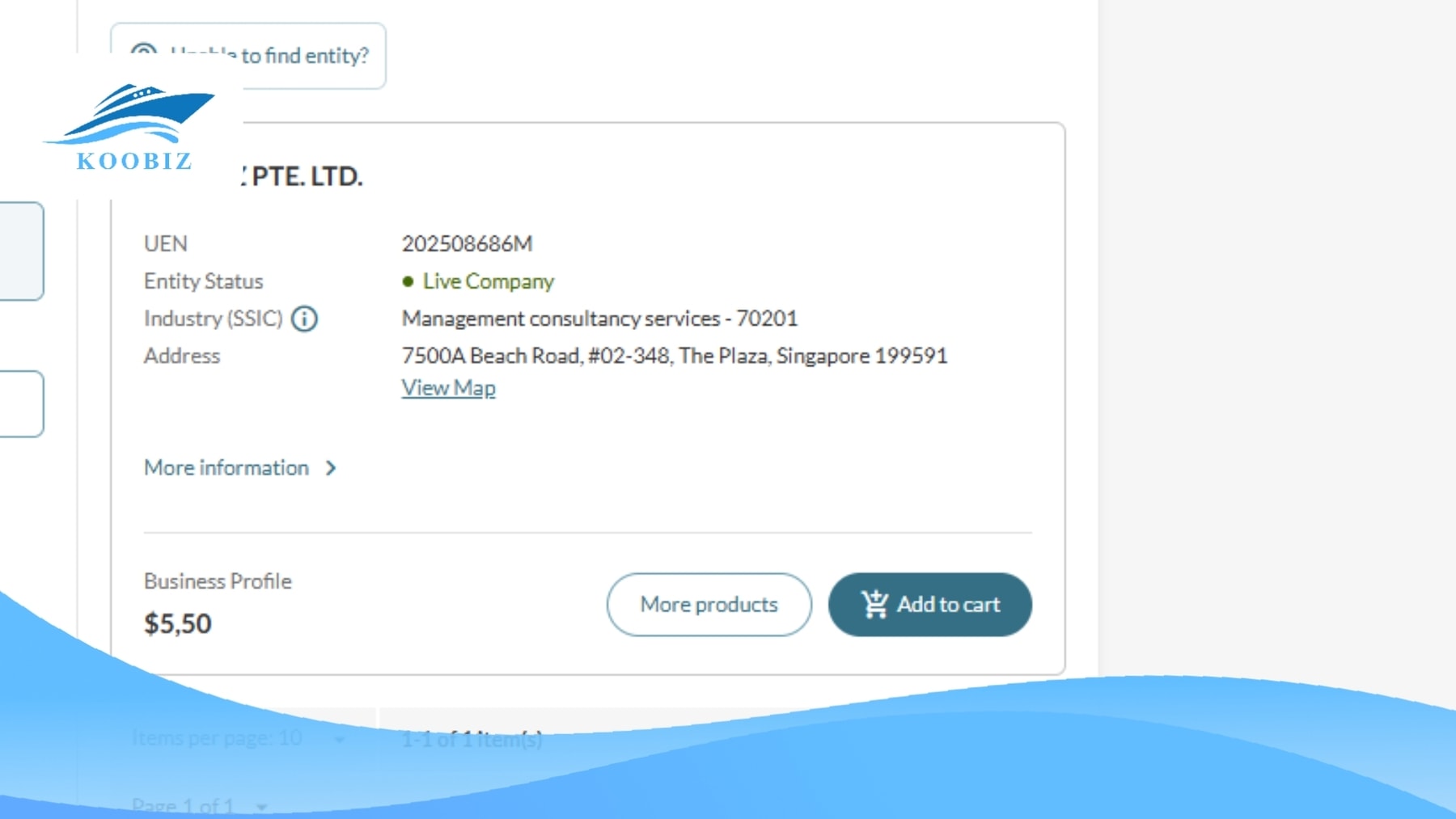
    Buying a Business Profile involves searching for the entity by UEN, selecting the “Business Profile” product, and paying for an instant PDF download.

    This document is essential for opening bank accounts or signing contracts. For a nominal fee (usually SGD 5.50), it provides a verified snapshot of the company’s existence, directors, and shareholders at that exact moment.

    Self-Filing vs. Engaging a Registered Filing Agent: Which Approach Suits You?

    Self-filing wins on cost efficiency for simple structures with local directors, while engaging a Registered Filing Agent excels in compliance accuracy and liability management for complex entities.

    . The table below outlines the key differences to help you decide:

    Feature Self-Filing Registered Filing Agent (RFA)
    Best Suited For Small, dormant, or exempt private companies with local directors. Companies with foreign directors, complex structures, or those subject to audit.
    Primary Benefit Cost efficiency (saves on service fees). Compliance accuracy and reduced administrative burden.
    Responsibility The director bears the entire burden of accuracy. Professionals (like Koobiz) manage semantic and legal requirements.
    Access Requires personal Singpass and CorpPass setup. Agents use their own accredited access to file on your behalf.

    Agents like Koobiz are accredited by ACRA to access the portal on your behalf. We carry professional liability and ensure that filings meet the strict requirements of the Companies Act, effectively outsourcing the stress of compliance.

    How to Manage Advanced Administrative Functions in BizFile+

    Beyond basic filings, the portal handles advanced administrative functions ranging from rectifying errors in previous submissions to managing complex financial reporting formats like XBRL.

    While most users stick to the basics, the BizFile portal contains powerful tools for handling “edge cases” or non-standard situations. Understanding these capabilities distinguishes a novice user from a proficient administrator.

    Understanding XBRL Filing Requirements for Solvent Companies

    XBRL (eXtensible Business Reporting Language) is a mandatory financial reporting format for Singapore companies (unless exempted) that requires financial statements to be tagged with specific data elements for machine reading.

    Specifically, while small EPCs might file simplified returns, larger companies must upload their financials in XBRL format. This is not a simple PDF upload; it requires preparing the data using ACRA’s BizFinx preparation tool before logging into BizFile+. The portal will reject filings that do not meet the validation logic of the XBRL taxonomy. This is a common stumbling block where Koobiz often steps in to assist clients in converting their standard accounts into this compliant digital language.

    How to Rectify Errors in Submitted Filings?

    Rectifying errors requires lodging a “Notice of Error” or applying for a Court Order under Section 402, depending on whether the mistake is clerical or substantive.

    If you accidentally typed the wrong address or date, you cannot simply “delete” the old filing. For minor typographical errors, BizFile+ offers a rectification transaction. However, for substantive errors that affect the company’s legal status, the process is more rigorous and may require an explanation or a court order. This feature ensures the integrity of the register, preventing companies from quietly altering historical records without a trail.

    Handling Late Lodgment Fees and Composition Sums

    Handling penalties involves accessing the “Compliance” section to view outstanding enforcement actions and paying the Composition Sum to resolve the breach without court prosecution.

    If a filing is late, ACRA automatically imposes a late lodgment penalty. These will appear in the dashboard. Users can pay these fines directly through the portal using credit card or GIRO. Prompt payment is crucial because ignoring these notifications can escalate to court summonses for the directors.

    BizFile+ vs. GoBusiness: What is the Difference?

    BizFile+ is the repository for corporate registration and regulatory compliance, whereas GoBusiness is the integrated platform for licensing, grants, and government permits.

    It is easy to confuse the two government portals. The table below clarifies their distinct roles:

    Feature BizFile+ (ACRA) GoBusiness
    Core Purpose Existence: Establishes and maintains the legal entity. Operation: Manages permissions to run specific activities.
    Primary Function Corporate Registration & Regulatory Compliance. Licensing, Grants, and Government Permits.
    Key Transactions Incorporation, Director updates, Annual Returns. Food Shop License, Productivity Grants, SME assistance.
    Relationship Generates the UEN (Unique Entity Number). Uses the UEN to apply for operational needs.

    While they are linked—you often need your BizFile+ UEN to login to GoBusiness—their functions are distinct. You register your entity on BizFile+, but you apply for the permission to run specific business activities on GoBusiness.

    About Koobiz

    Navigating the BizFile portal effectively is just one component of maintaining a successful business in Singapore. At Koobiz, we specialize in simplifying this process for you. From Singapore company incorporation to providing Registered Filing Agent services, we handle the technicalities so you can focus on growth. Additionally, we offer comprehensive support for opening corporate bank accounts in Singapore, along with tax, accounting, and audit services.

    Ensure your compliance is in safe hands. Visit us at koobiz.com to learn how we can assist your business today.

  • Conduct ACRA Company Search: Buy Business Profiles & UEN Reports

    Conduct ACRA Company Search: Buy Business Profiles & UEN Reports

    [SUMMARIES]

    Official Access: Conduct searches via the ACRA BizFile+ portal to retrieve verified corporate data.

    Essential Documents: Buy Business Profiles for legal, banking, and due diligence requirements.

    UEN Identification: Use the Unique Entity Number (UEN) to accurately track any registered entity in Singapore.

    Legitimacy Verification: Ensure business partners are “Live” and compliant with Singapore’s regulatory standards.

    Expert Support: Koobiz provides end-to-end assistance for incorporation and ongoing compliance management.

    [/SUMMARIES]

    Navigating the corporate landscape in Singapore requires transparency and accurate data. Whether you are an investor conducting due diligence or a business owner looking to verify a partner, a Conduct ACRA Company Search is your first step. At Koobiz, we understand that accessing official records like Business Profiles and performing a Basic UEN Search is critical for making informed decisions.

    In the following sections, we will guide you through the official BizFile+ portal, compare different document types, and explain how to interpret entity statuses. By the end of this guide, you will have a clear roadmap for obtaining the corporate intelligence you need to succeed in the Singaporean market.

    What is an ACRA Business Profile and Why Do You Need It?

    An ACRA Business Profile is a primary electronic document originated from the Accounting and Corporate Regulatory Authority (ACRA) that provides a comprehensive snapshot of a business entity’s current information and compliance status.

    Often described as a company’s “corporate ID,” this document underpins virtually all legal, regulatory, and financial transactions. It is routinely required for key activities such as opening a corporate bank account, conducting due diligence, entering into commercial contracts, and fulfilling tax and regulatory filings. At Koobiz, we regularly assist clients in obtaining and interpreting their ACRA Business Profiles as part of incorporation, banking, and ongoing compliance processes.

    Business Entity Name, UEN, and Registered Office Address

    These details establish the official legal identity of the company in Singapore.

    Establish the official legal identity of the company in Singapore
    Establish the official legal identity of the company in Singapore
    • Entity Name: The official name registered and approved by ACRA.
    • Unique Entity Number(UEN): A unique 9 or 10-digit universal identifier used across all government agencies
    • Registered Office: The physical location where legal documents can be served.

    The UEN, in particular, is essential for all interactions with authorities such as ACRA, IRAS, and CPF Board.

    Paid-up Capital and Shareholder Details

    This section outlines the company’s ownership and capital structure, providing insight into its financial standing and governance.

    • Paid-up Capital: The actual amount of money the shareholders have contributed.
    • Shareholder List: Names of shareholders and their respective shareholdings.

    Paid-up capital is often reviewed by banks, counterparties, and regulators when assessing a company’s credibility, financial commitment, and risk profile.

    According to the 2024 World Bank Business Ready (B-READY) report, transparent access to corporate registries like Singapore’s ACRA significantly reduces transaction costs and improves market trust, with Singapore ranking among the top globally and #1 in operational efficiency for business regulations.

    Can Anyone Conduct an ACRA Company Search in Singapore?

    Yes, anyone can conduct an ACRA Company Search because Singapore maintains a public register to ensure corporate transparency, provided the searcher pays the prescribed fee and follows the official portal guidelines.

    While basic information such as a company’s name can be viewed without charge, accessing a full ACRA Business Profile requires a nominal fee via ACRA’s authorised portal. This framework promotes transparency while ensuring the proper use of corporate data. At Koobiz ensures that our clients understand the public nature of their data when we assist them with Singapore company incorporation.

    Public Access vs. Corporate Privacy

    In Singapore, the balance between transparency and privacy is managed by making “Public Registers” available while protecting sensitive personal data like home addresses of directors (which are often masked if an alternate address is provided).

    BizFile+ Availability and Global Accessibility

    The BizFile+ portal is generally available 24/7, allowing users from anywhere in the world to perform a lookup. However, users should be aware of occasional scheduled maintenance windows (typically on weekends or late nights Singapore time). This global accessibility makes Singapore one of the most business-friendly hubs globally.

    ACRA Search: Global corporate transparency
    ACRA Search: Global corporate transparency

    Step-by-Step Guide: How to Buy Business Profiles & UEN Reports

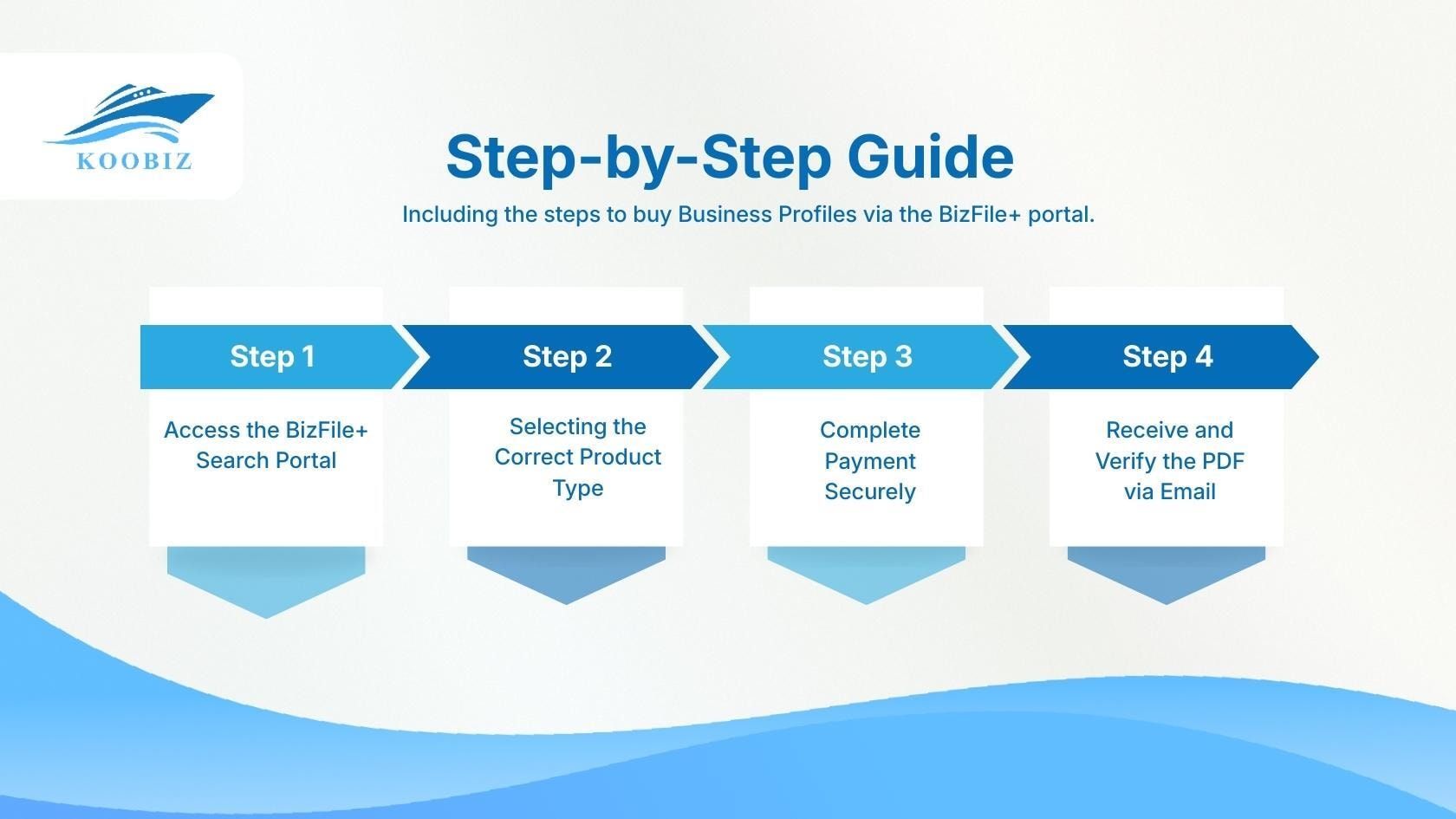
    Buying ACRA reports involves a digital transaction method consisting of four distinct steps that result in the immediate delivery of a PDF document to your registered email address.

    Following this process ensures you receive the most up-to-date information directly from ACRA’s database. For a smooth transaction, Koobiz recommends keeping your credit card or PayNow app ready for a seamless experience.

    How to Buy Business Profiles & UEN Reports
    How to Buy Business Profiles & UEN Reports

    Step 1: Access the BizFile+ Search Portal

    To begin, visit the official BizFile+ website. Use the “Search” function and enter either the Company Name or the UEN.

    • Search by Name: Useful if you don’t have the UEN.
    • Search by UEN: The most accurate method, especially when dealing with similar company names.

    Step 2: Selecting the Correct Product Type

    Once the entity is found, you must choose what to purchase. The most common choice is the “Business Profile (Standard),” but there are other options like financial statements.

    • Standard Business Profile: Most commonly used for due diligence and verification.
    • Business Profile with Certificate of Production: Typically required for official submissions to government agencies or legal purposes.

    Step 3: Complete Payment Securely

    Payment is processed through ACRA’s secure payment gateway. The standard Business Profile generally costs around S$5.50.

    • Credit Cards: Visa and Mastercard are widely accepted.
    • PayNow: Convenient for those with Singaporean bank accounts.

    Step 4: Receive and Verify the PDF via Email

    Once payment is successful, ACRA will email a download link to the provided address. This link is usually valid for up to 7 days.

    • Download: Save the PDF immediately.
    • Verify: Use the embedded QR code or link to authenticate the document via ACRA’s trustBar system.

    ACRA’s digital infrastructure ensures that the vast majority of corporate document requests are fulfilled instantly, allowing you to receive your official files within minutes of payment.

    Comparing Basic UEN Search vs. Certified Extracts

    Choosing the right document depends entirely on your end goal. For daily operations, a standard profile is usually sufficient; however, for complex legal disputes or formal administrative requirements, a certified extract is mandatory.

    The table below highlights the key distinctions between a basic UEN search and a certified extract, helping you determine which option best suits your specific requirements when working with Koobiz.

    Feature Basic UEN Search Business Profile (Standard) Certified Extract
    Primary Purpose Quick identification General due diligence & KYC Legal & official submissions
    Information Depth Basic (Name, UEN, Status) Comprehensive (Directors, Capital) Deep (Historical changes)
    Legal Weight Informational only Standard operational document Admissible in a court of law
    Authentication Web View only QR Code protected Signed by Assistant Registrar
    Cost* Free S$5.50 Starting from S$16.50 (e.g., with Certificate of Production)

    *Costs as of December 2025; subject to GST and ACRA updates.

    Legal Weight and Evidentiary Value

    Certified extracts are signed by the Assistant Registrar of ACRA, making them admissible as evidence in a court of law. A standard PDF download does not carry this same weight without a specific certificate.

    Cost Structure and Information Scope

    While a basic UEN check is free via the directory, a full certified extract can cost significantly more depending on the depth of information required (e.g., historical extracts).

    Identifying Non-Active Entities: Struck Off vs. Dissolved Status

    Understanding non-active statuses is a critical due diligence skill involving the differentiation between administrative removal (Struck Off) and formal liquidation (Dissolved).

    When a company search shows a status other than “Live”, it signals that the entity has lost its normal legal standing. Such statuses indicate that the company is no longer operating as a valid commercial counterpart. Koobiz often helps clients investigate these statuses to ensure they aren’t entering contracts with defunct entities.

    What Does it Mean if a Company is “Struck Off”?

    “Struck Off” is an administrative action where ACRA removes a company from the register, most commonly due to prolonged non-compliance (e.g. failure to file Annual Returns) or confirmation that the company has ceased business activities..

    • Implication: The company no longer has the power to trade or own property.
    • Reversibility: It is possible to restore a struck-off company via a court order, typically within 6 years of the striking off date.

    How to Retrieve Records for Liquidated or Dissolved Businesses

    “Dissolved” is the final stage of a company’s life cycle, usually following a formal liquidation process (winding up).

    • Rare Attribute: Retrieving records for dissolved companies often requires searching the historical archives, as they may not appear in the primary “Live” search results.

    The Role of the Authenticity QR Code on Official ACRA Downloads

    In 2024, ACRA enhanced security by adding a Unique QR Code to every downloaded Business Profile. This unique attribute allows any third party to scan the document and verify its authenticity directly against ACRA’s database, preventing the use of forged PDF documents in bank account applications.

    When to Use a Business Profile vs. a Certificate of Good Standing

    These two documents serve different compliance objectives and are not interchangeable.

    A Business Profile provides factual information about the company’s structure, officers, and registration details at a specific point in time.

    A Certificate of Good Standing (CGS), on the other hand, is a formal certification issued by ACRA confirming that the company is active (“Live”) and fully compliant with all statutory filing obligations.

    Typical Use Cases for CGS:

    • Cross-border transactions and overseas business registrations
    • Foreign bank account openings
    • Work visa or regulatory applications for directors in other jurisdictions

    Because of its legal weight, the CGS is generally requested only in international or high-level regulatory contexts, rather than for routine domestic operations.

    Can You Search for Sole Proprietorships and Partnerships?

    Yes, ACRA search is not limited to Private Limited companies. You can also search for:

    • Sole Proprietorships: Businesses owned by one person.
    • Partnerships: Entities with two or more partners.
    • LLPs: Limited Liability Partnerships.

    Each of these entity types will have a different UEN format and different levels of disclosure in their Business Profiles.

    About Koobiz

    Koobiz is your premier partner for navigating the complex regulatory environment of Singapore. We specialize in providing high-end corporate services designed to help global entrepreneurs thrive in Asia’s most dynamic business hub.

    Our core services include:

    • Singapore Company Incorporation: Fast, reliable, and compliant setup.
    • Bank Account Opening Assistance: Leveraging our network of local and international banks.
    • Tax and Accounting Services: Ensuring your business meets all IRAS and ACRA requirements.
    • Audit and Compliance: Maintaining your “Good Standing” status with the Singapore government.

    Visit us at koobiz.com to start your Singapore business journey today.

    Disclaimer: This information is based on ACRA guidelines as of December 2025. Always verify on the official BizFile+ portal for the latest details.

  • What Is UEN Number in Singapore? The Complete ACRA Registration & Business ID Guide

    What Is UEN Number in Singapore? The Complete ACRA Registration & Business ID Guide

    [SUMMARIES]

    The Unique Entity Number (UEN) is the mandatory standard identification code assigned to all Singapore-registered businesses for official government interactions, tax filings, and regulatory compliance.

    This permanent ID is automatically generated upon incorporation with ACRA, utilizing specific alphanumeric formats that allow stakeholders to instantly identify the entity type and year of registration.

    Businesses are legally required to display their UEN on all official documents such as invoices and websites, serving as a critical verification tool distinct from personal NRICs or optional GST registrations.

    [/SUMMARIES]

    The Unique Entity Number (UEN) is the universal identification number assigned by the Singapore government to all registered business entities for use in official dealings with government agencies. Understanding this mandatory identification is crucial for compliance. The UEN applies to a vast range of entities, including local companies, Limited Liability Partnerships (LLPs), and registered societies. Whether you are a local entrepreneur or a foreign investor, knowing your entity type determines the specific regulations and requirements you must follow to operate legally within the city-state.

    Furthermore, the structure of the UEN itself is not random; it follows specific formats that reveal information about the entity type and year of issuance. Navigating these formats and knowing how to search for them via portals like BizFile+ is a fundamental skill for due diligence and business verification in Singapore’s transparent corporate ecosystem. For entrepreneurs looking to simplify the process of establishing their entity and obtaining this number, securing your UEN is the critical first step. Let’s explore the details below to master everything about the UEN number in Singapore.

    What Is a Unique Entity Number (UEN) in Singapore?

    The Unique Entity Number (UEN) is the single, standard identification number issued by the Singapore government to all registered business entities to streamline interaction with government agencies. Notably, the UEN is mandatory for any entity that interacts with the government. It replaces the previous ACRA Registration Number and makes the administrative process significantly more efficient. Once issued, this number remains with the entity throughout its lifespan, unless the entity changes its business constitution significantly (e.g., converting from a Sole Proprietorship to a Private Limited Company), in which case a new UEN might be issued.

    Singapore UEN Number (Source: BizFile)
    Singapore UEN Number (Source: BizFile)

    According to the Accounting and Corporate Regulatory Authority (ACRA), the implementation of UEN has reduced the need for multiple agency-specific numbers, streamlining over 80% of government interactions for businesses.

    Which Entities Are Required to Have a UEN?

    There are four primary categories of entities legally required to possess a UEN. This requirement ensures that every organization operating within Singapore’s legal framework can be accurately tracked, taxed, and regulated by the relevant authorities.

    To illustrate, here is a breakdown of the specific entities that must hold a UEN:

    • Businesses and Local Companies: This includes Sole Proprietorships, Partnerships, and Private Limited companies registered with ACRA.
    • Limited Liability Partnerships (LLPs): Professional partnerships that combine elements of partnerships and corporations.
    • Societies and Non-Profits: Organizations registered with the Registry of Societies (ROS) or Charities under the Ministry of Culture, Community and Youth (MCCY).
    • Representative Offices: Foreign entities establishing a temporary presence in Singapore for market research. Note: They are not issued a UEN because they are not legal entities in Singapore.

    However, it is important to note who does not need a UEN. Individuals interacting with the government continue to use their NRIC or FIN. Additionally, sub-units or branches of an entity that already has a UEN generally do not get a separate UEN; they utilize the parent entity’s number, sometimes with a branch code extension for internal tracking, though the UEN itself remains the core identifier.

    What Do the Different UEN Formats Mean?

    UEN formats are structured alphanumeric codes that vary based on the entity type and issuance date. Unlike a random string of numbers, these formats allow anyone reading the number to immediately discern whether the entity is a local company, a business firm, or a specialized body like a trade union.

    The table below outlines the three main UEN structures you will encounter:

    Entity Type Format Structure Example Description
    Businesses registered with ACRA nnnnnnnnX 52812345A 8 digits followed by 1 check letter (Total 9 chars).
    Local Companies registered with ACRA YYYYnnnnnX 202412345M Year of incorporation (4 digits) + 5 digits + 1 check letter (Total 10 chars).
    Other Entities (e.g., LLPs, Societies) TyyPQnnnnX T24LL0001A T: Century (T for 2000s, S for 1900s).

    yy: Last 2 digits of year.

    PQ: Entity type code (e.g., LL for LLP).

    nnnn: Sequence no.

    X: Check letter.

    For instance, a Limited Liability Partnership registered in 2024 will follow the “Other Entities” format (T24LL…), whereas a Private Limited Company registered in the same year will typically follow the “Local Companies” format (2024…). This structured approach ensures that despite the growing number of businesses, every entity retains a distinct digital identity.

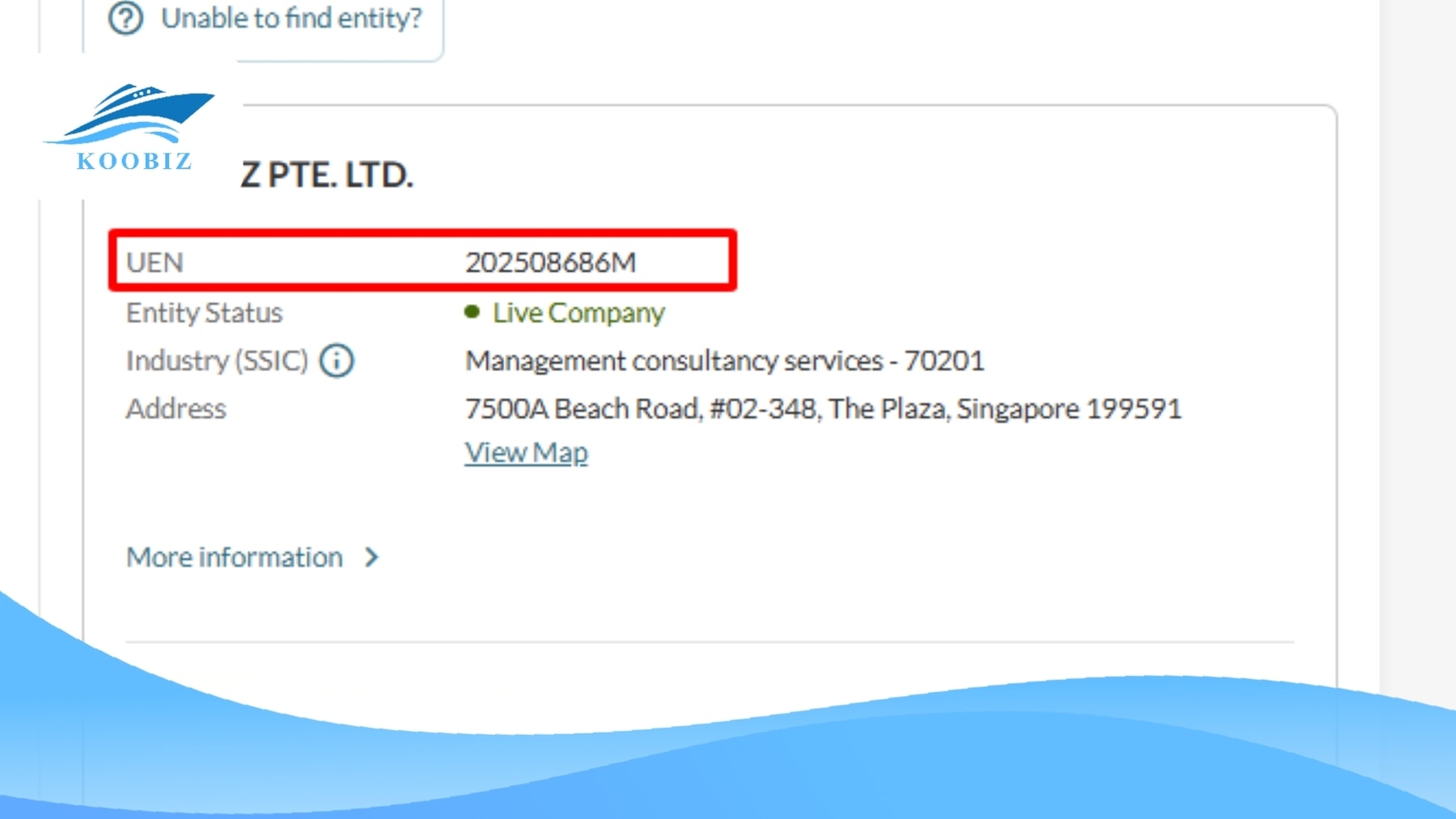
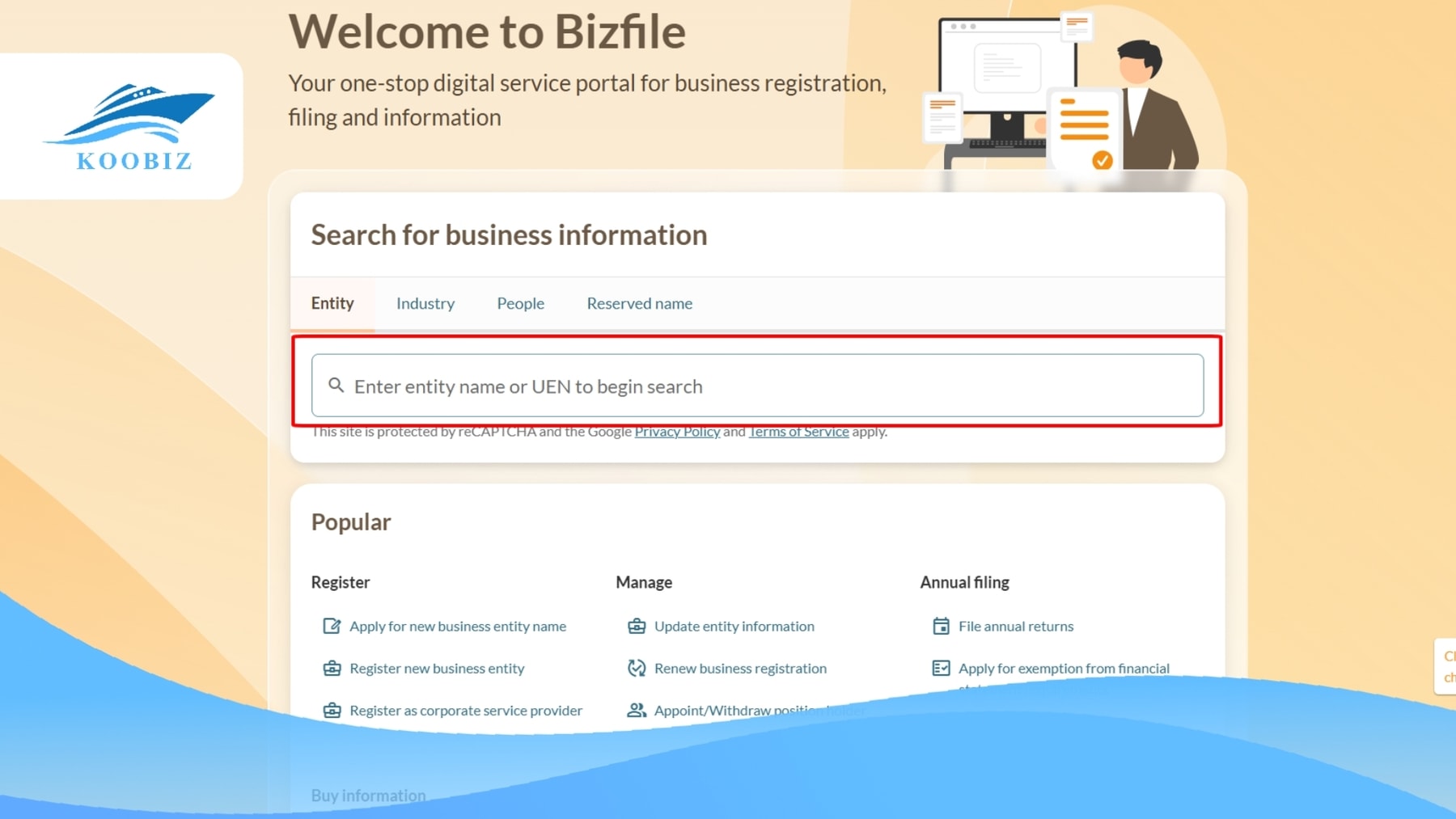
    How Can I Search for a Company’s UEN?

    Searching for a company’s UEN is a crucial step in due diligence. You can instantly verify an entity’s registration status and details using the ACRA-managed BizFile+ portal or valid business directories. This public process provides essential information such as the entity’s registered name, status (Live or Struck Off), and address.

    To verify a business, follow these steps:

    1. Visit the Directory: Go to the ACRA BizFile+ website or the official UEN website (uen.gov.sg).
    2. Enter Information: Type the name of the company or the UEN (if you are verifying the name) into the search bar.
    3. Analyze Results: The system will display the registered name, UEN, and status.
    Search for UEN on BizFile+
    Search for UEN on BizFile+

    If you are planning to sign a contract with a partner, checking their UEN status is a mandatory due diligence step. A “Live” status confirms the company is active. If you find the process confusing or need detailed business profiles, Koobiz can assist in retrieving comprehensive business extracts for your potential partners.

    How Do You Register and Obtain a UEN?

    Obtaining a UEN involves registering your business entity with ACRA or the relevant issuance agency. The UEN is automatically generated upon successful incorporation; there is no separate application form. It is an inherent outcome of the entity formation process.

    For most commercial entities like Private Limited companies, the process is handled via ACRA:

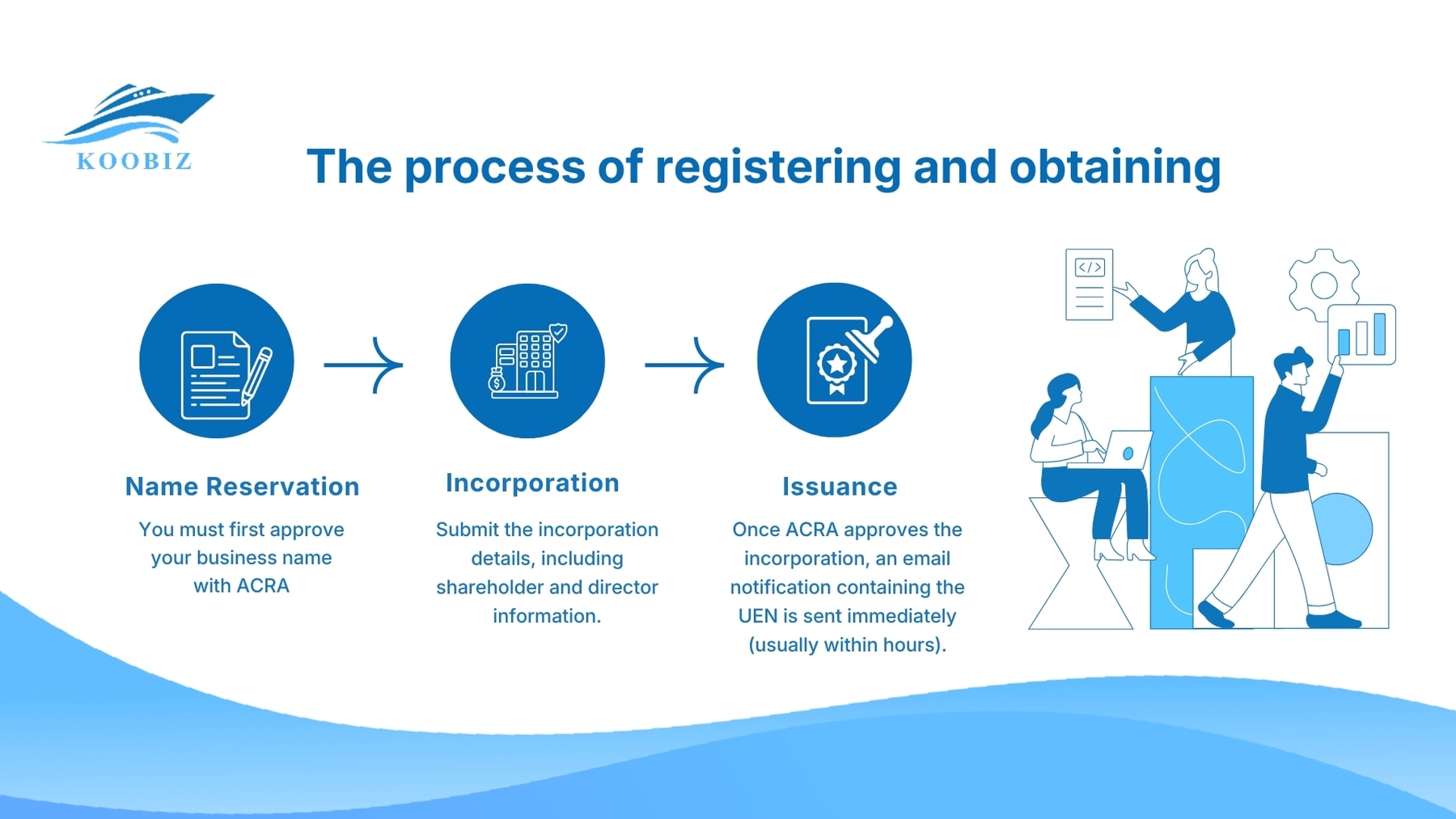
    The process of registering and obtaining a UEN
    The process of registering and obtaining a UEN
    1. Name Reservation: You must first approve your business name with ACRA.
    2. Incorporation: Submit the incorporation details, including shareholder and director information.
    3. Issuance: Once ACRA approves the incorporation, an email notification containing the UEN is sent immediately (usually within hours).

    For other entities, such as societies, the UEN is issued after approval by the Registry of Societies. Navigating the incorporation requirements can be complex for new entrepreneurs. Koobiz specializes in streamlining this process. When you choose our incorporation package, we handle all ACRA liaising, ensuring your UEN is issued correctly and quickly, so you can open your corporate bank account without delay.

    Ready to start your business in Singapore? Contact Koobiz today for a seamless incorporation experience and get your UEN fast!

    Can You Customise Your Business ID with Special UEN (SUN)?

    Yes, businesses can customize their ID through the Special UEN (SUN) service by paying a fee to select a preferred number from reserved tiers. Similar to buying a “golden” mobile number or car plate, ACRA allows business owners to choose a UEN that is easy to remember or holds auspicious value.

    Specifically, there are two tiers available during the registration process:

    • Tier 1 ($3,000): These are numbers with consecutive identical digits or specific patterns (e.g., ending in 8888, 12345).
    • Tier 2 ($1,000): These numbers have repetitive patterns but are less exclusive than Tier 1 (e.g., ending in 88, 66, or repetitive pairs like 2323).

    While not mandatory, investing in a Special UEN can be beneficial for branding, making it easier for clients and partners to recall your business ID for PayNow transactions or invoicing.

    What Is the Difference Between UEN and NRIC?

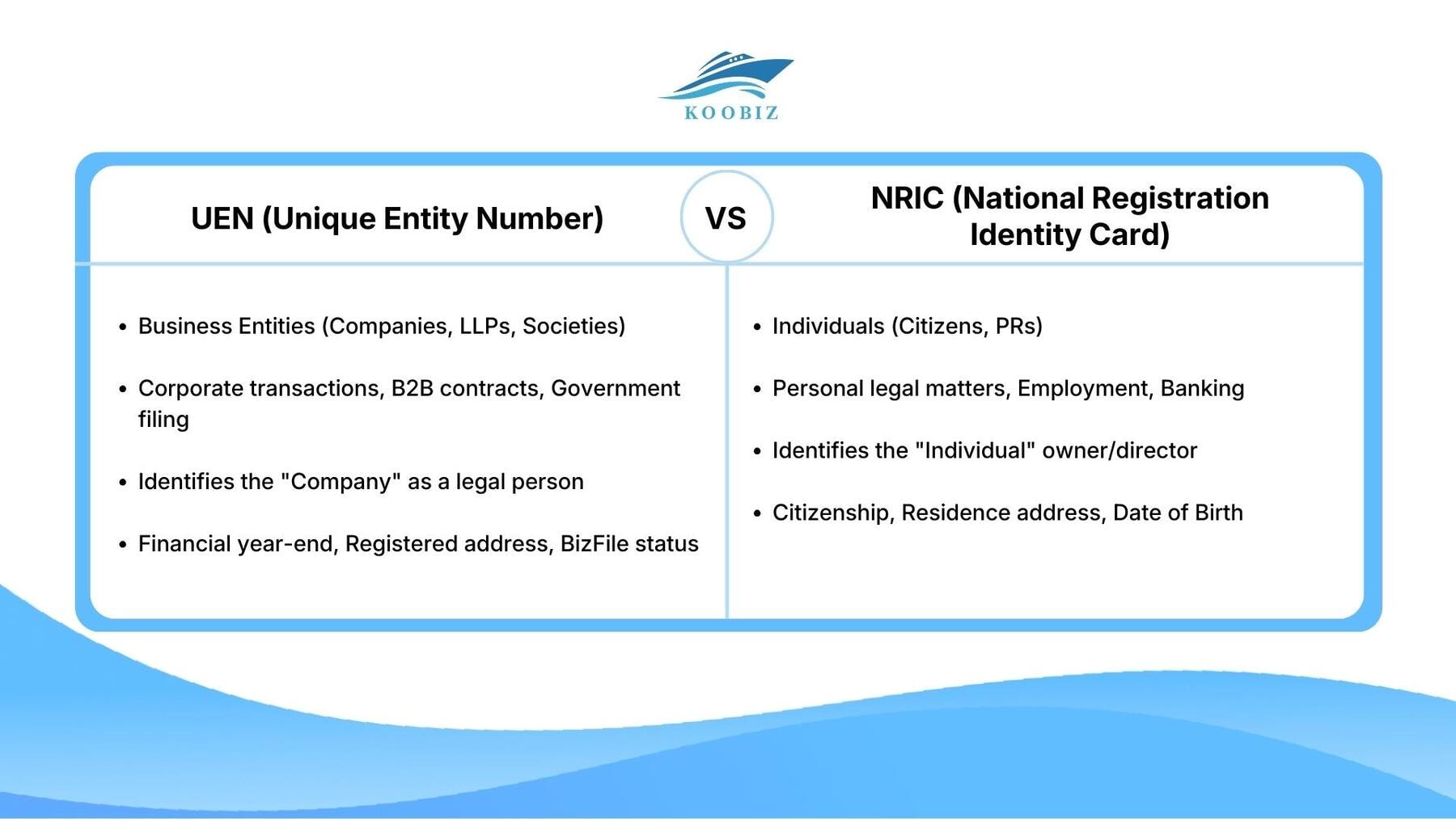
    The UEN identifies business entities for corporate transactions, whereas the NRIC (or FIN) identifies individuals for personal legal matters within Singapore. This distinction is vital because a business is a separate legal person from its owner, and confusing the two can lead to invalid contracts.

    UEN (Unique Entity Number) VS. NRIC (National Registration Identity Card)
    UEN (Unique Entity Number) VS. NRIC (National Registration Identity Card)
    Feature UEN (Unique Entity Number) NRIC (National Registration Identity Card)
    Target Identity Business Entities (Companies, LLPs, Societies) Individuals (Citizens, PRs)
    Primary Use Corporate transactions, B2B contracts, Government filing Personal legal matters, Employment, Banking
    Legal Status Identifies the “Company” as a legal person Identifies the “Individual” owner/director
    Data Tracked Financial year-end, Registered address, BizFile status Citizenship, Residence address, Date of Birth

    To illustrate, when you sign a contract for your company, you enter the company’s UEN, not your personal NRIC. The NRIC tracks personal data like citizenship and residence, while the UEN tracks corporate data.

    What Is the Difference Between UEN and GST Registration Number?

    The UEN is the mandatory business ID for all, while the GST Registration Number is usually the same UEN but specifically activated for tax collection when revenue exceeds $1 million.

    It is important to understand that simply having a UEN does not mean you are GST-registered. You must apply for GST registration separately with IRAS. Once registered, your UEN typically serves as your GST identifier. You will then be required to print “GST Reg No: [Your UEN]” on all tax invoices.

    While most local companies use their UEN as their GST number, distinct entities (like joint ventures or GST groups) may be issued a separate GST group registration number. However, for 99% of SMEs, they are identical identifiers with different functional statuses.

    Where Must the UEN Be Displayed on Official Documents?

    The UEN must be displayed on all official correspondence, including invoices, receipts, brochures, and websites, to comply with the Companies Act. Failure to display this number can result in penalties, as it denies stakeholders the ability to verify the entity they are dealing with.

    You must include the UEN on:

    • Business Letters and Statements of Account.
    • Invoices and Official Receipts.
    • Notices and Publications (including websites and email signatures).
    • Bills of Exchange and Promissory Notes.

    Ensuring your Koobiz incorporated company complies with these disclosure requirements is part of building a trustworthy brand reputation in Singapore.

    Frequently Asked Questions (FAQ)

    Is the UEN number the same as the Tax Identification Number (TIN)?

    Yes, in Singapore, the UEN serves as the Tax Identification Number (TIN) for corporate entities when dealing with the Inland Revenue Authority of Singapore (IRAS).

    Do I need to renew my UEN?

    For local companies (Pte Ltd) and LLPs, the UEN is permanent and does not need renewal as long as the entity exists. However, for Sole Proprietorships and Partnerships, you must renew your business registration periodically to keep your UEN active.

    Is applying for a UEN free?

    The UEN itself is issued automatically upon registration. The cost involved is the registration or incorporation fee paid to ACRA (e.g., $315 for a Private Limited Company). If you opt for a Special UEN (SUN), additional fees apply.

    Simplify Your Singapore Incorporation with Koobiz

    Understanding the UEN is just the first step in establishing a successful business in Singapore. Navigating the full spectrum of ACRA regulations, from initial name reservation to final UEN issuance and tax compliance, requires expertise and precision.

    Koobiz is your trusted partner for seamless company incorporation in Singapore. We move beyond simple registration; we provide a comprehensive suite of corporate services designed to get your business operational quickly. With our expert guidance, you can secure your UEN, open your corporate bank account, and ensure full compliance without the administrative headache.

    Ready to launch your business? Visit koobiz.com today to start your incorporation journey!