Tag: Corporate Compliance

  • What Is a Non-Executive Director? Complete Guide to Roles, Duties, and Board Governance

    What Is a Non-Executive Director? Complete Guide to Roles, Duties, and Board Governance

    [SUMMARIES]

    A Non-Executive Director (NED) in Singapore provides independent oversight and strategic guidance without participating in daily business operations. While they do not manage the company, NEDs share the same legal and fiduciary liabilities as executive directors under the Singapore Companies Act.

    [/SUMMARIES]

    Understanding the role of a Non-Executive Director is vital for robust corporate governance in Singapore. In this guide, Koobiz simplifies the complexities of board leadership, breaking down the essential duties, legal liabilities, and qualifications you need to know. We provide a clear, detailed roadmap to help you navigate the distinction between executive and non-executive functions with confidence.

    What Is a Non-Executive Director?

    A Non-Executive Director (NED) is a member of a company’s board of directors who is not part of the executive management team and does not engage in the day-to-day operations of the business. Their primary purpose is to provide independent oversight, objective strategic guidance, and constructive challenges to the executive directors. By operating outside of daily management, NEDs play a crucial role in corporate governance, helping to monitor performance, manage risk, and safeguard the interests of shareholders and stakeholders.

    Key Responsibilities and Duties

    While their specific mandate may vary by organization, Non-Executive Directors generally balance strategic oversight with legal compliance to ensure sustainable long-term value.

    Responsibilities

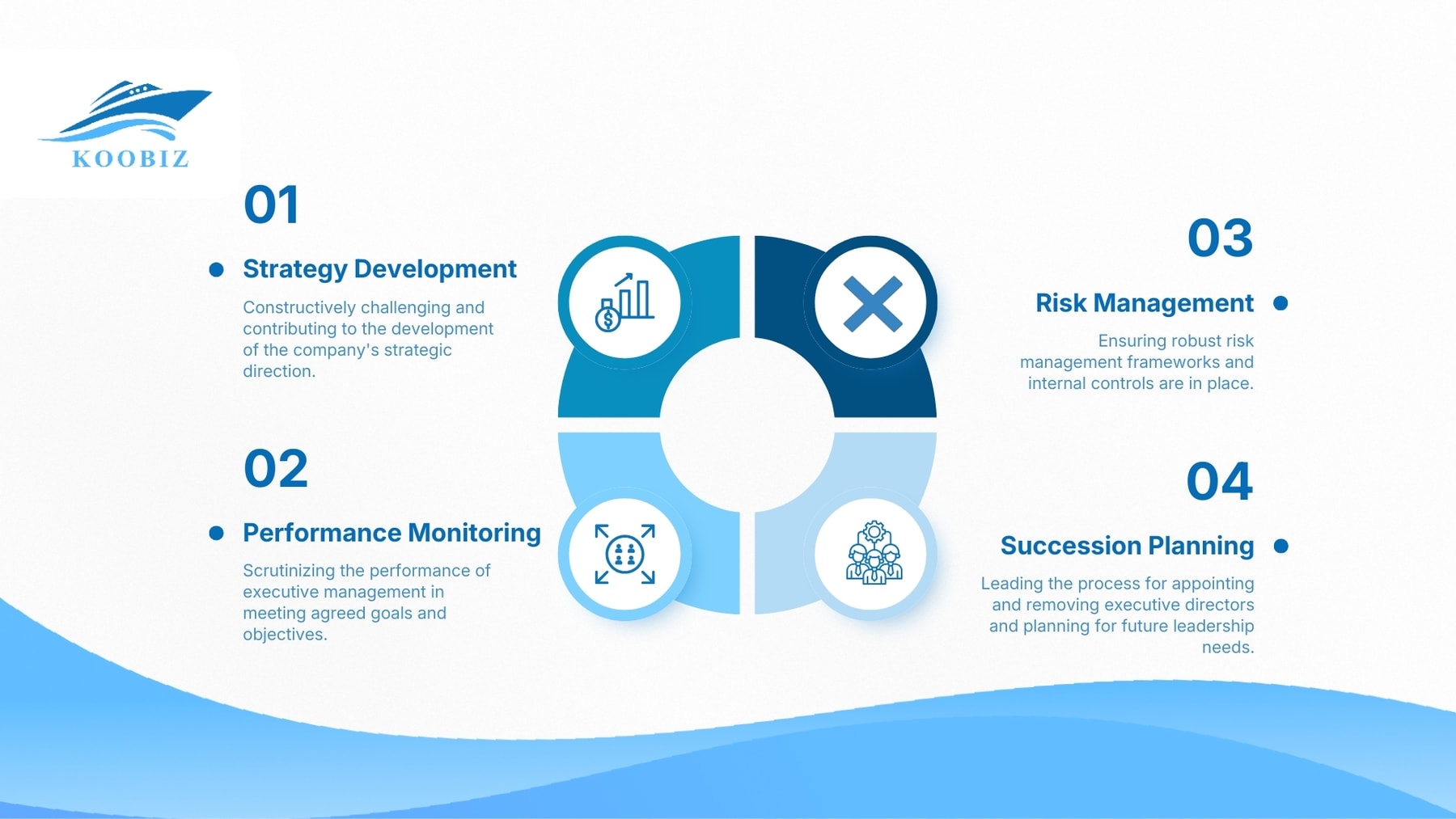
    The broader strategic and oversight roles of a Non-Executive Director include:

    • Strategy Development: Constructively challenging and contributing to the development of the company’s strategic direction.
    • Performance Monitoring: Scrutinizing the performance of executive management in meeting agreed goals and objectives.
    • Risk Management: Ensuring robust risk management frameworks and internal controls are in place.
    • Succession Planning: Leading the process for appointing and removing executive directors and planning for future leadership needs.

    Duties

    The specific legal and fiduciary obligations required of the role include:

    • Fiduciary Duty: Acting in the best long-term interests of the company and its shareholders.
    • Financial Integrity: Ensuring the accuracy of financial information and systems of risk management are robust and defensible.
    • Compliance: Overseeing compliance with statutory obligations and relevant laws.
    • Remuneration: Determining appropriate levels of executive remuneration and compensation structures.
    The 4 Pillars of a Non-Executive Director
    The 4 Pillars of a Non-Executive Director

    [IMAGE: Đồ họa Infographic hình tròn hoặc sơ đồ tư duy (Mind map) tóm tắt 4 trụ cột trách nhiệm chính của NED: Strategy (Chiến lược), Performance (Hiệu suất), Risk (Rủi ro), và People (Nhân sự/Kế nhiệm). Giúp người đọc hình dung tổng quan công việc.]

    Why Companies Appoint Non-Executive Directors

    At its core, companies appoint Non-Executive Directors to bring independent objectivity to the boardroom. Business leaders often get “tunnel vision” from focusing on daily operations; a NED provides a fresh, unbiased perspective to spot risks and opportunities that insiders might miss.

    Beyond general oversight, companies specifically seek NEDs for these critical scenarios:

    • Bridging Skills Gaps: Bringing specialized expertise (e.g., cybersecurity, ESG, or market expansion) that the current executive team lacks.
    • Enhancing Credibility & Investment: Investors and banks often require an experienced board before providing capital or supporting an IPO.
    • Crisis Management: Providing steady guidance during turbulent times, such as regulatory scrutiny or reputational damage.
    • Succession Planning: Managing the sensitive transition of leadership, particularly in family-owned businesses or when a CEO departs.
    • Mediating Conflicts: Acting as a neutral party to resolve disputes between shareholders and management.

    Executive vs. Non-Executive Directors: What’s the Difference?

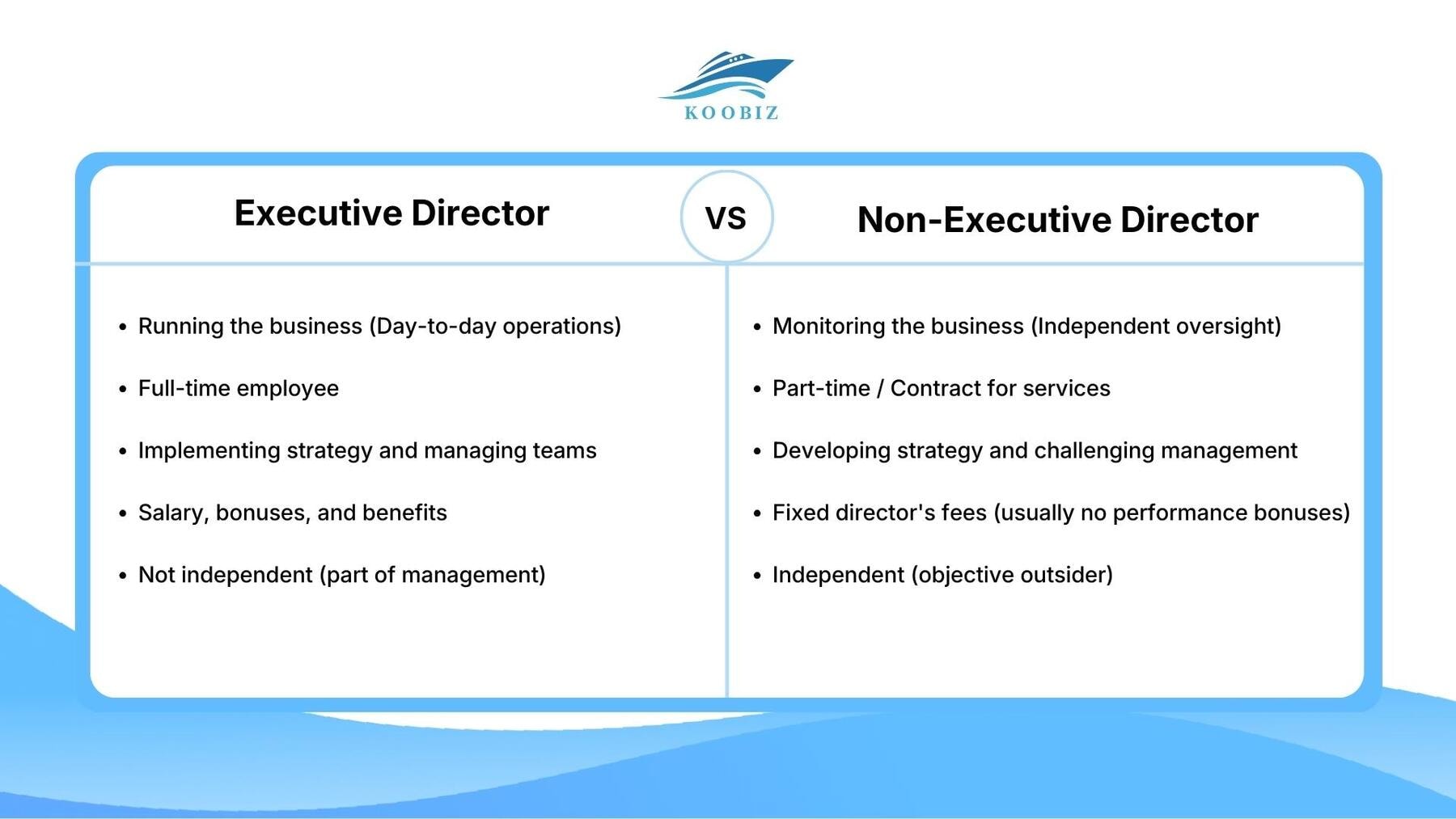
    While both sit on the same board of directors and share equal legal liabilities, their roles differ fundamentally in focus and engagement. The Executive Director is the “doer” managing the company, while the Non-Executive Director is the “monitor” ensuring it is managed correctly.

    [IMAGE: Bảng so sánh trực quan, Bên trái là “Executive Director”, bên phải là “Non-Executive Director”]
    Comparison Table: Executive vs. Non-Executive Directors
    Comparison Table: Executive vs. Non-Executive Directors
    Feature Executive Director Non-Executive Director
    Primary Focus Running the business (Day-to-day operations) Monitoring the business (Independent oversight)
    Employment Status Full-time employee Part-time / Contract for services
    Key Responsibility Implementing strategy and managing teams Developing strategy and challenging management
    Remuneration Salary, bonuses, and benefits Fixed director’s fees (usually no performance bonuses)
    Independence Not independent (part of management) Independent (objective outsider)

    Legal Duties and Liabilities in Singapore

    In Singapore, the law does not distinguish between Executive and Non-Executive Directors; both bear the same fiduciary duties and legal responsibilities under the Companies Act and common law.

    Legal Duties

    Key obligations every NED must uphold include:

    • Duty of Good Faith: You must act honestly and in the best interests of the company, ensuring personal interests do not conflict with business decisions.
    • Duty of Care and Diligence: You are expected to exercise reasonable diligence and skill, monitoring the company’s affairs rather than being a “sleeping director.”
    • Duty of Disclosure: Under Section 156 of the Companies Act, you must disclose any conflicts of interest or property holdings that might compete with the company.
    • Statutory Compliance: Ensuring the company complies with statutory requirements, such as filing annual returns, holding AGMs, and maintaining accurate financial records.

    Liabilities

    Failure to discharge these duties can lead to severe consequences:

    [IMAGE: Hình ảnh minh họa ]

    Legal Responsibility and Penalties
    Legal Responsibility and Penalties
    • Civil Liability: The company or shareholders can sue you for damages to recover losses caused by negligence or breach of trust.
    • Criminal Penalties: Breaching statutory duties is a criminal offense punishable by fines (up to SGD 5,000) or imprisonment (up to 12 months).
    • Disqualification: You may be disqualified from acting as a director for up to 5 years if convicted of serious offenses or for persistent default in filing requirements.
    • Personal Liability: If the company continues trading while insolvent, you may be held personally liable for the debts incurred.

    How to Become a Non-Executive Director in Singapore

    Becoming a NED requires a transition from “operational leadership” to “strategic oversight,” often necessitating a build-up of specific credentials and networks within Singapore’s corporate ecosystem.

    Qualifications and Skills Required

    While there is no single statutory qualification, the following are standard benchmarks for aspiring NEDs:

    • Relevant Experience: A strong track record in C-suite roles or senior management is essential to command respect.
    • Mandatory Training (for Listed Companies): First-time directors of SGX-listed companies must undergo training in the Listed Entity Director (LED) Programme by the Singapore Institute of Directors (SID).
    • Financial Literacy: The ability to read and scrutinize financial statements is non-negotiable for all board members.
    • Specialized Expertise: Modern boards actively seek skills in ESG (Environmental, Social, and Governance), Cybersecurity, Digital Transformation, and Legal/Compliance.
    • Soft Skills: High emotional intelligence (EQ), independence of mind, and the ability to influence without authority.

    The role comes with unique hurdles that differ significantly from executive management:

    • Information Asymmetry: NEDs rely on management for data; they often have less information than executives but share the same legal liability.
    • “Noses In, Fingers Out”: Striking the delicate balance of providing deep oversight (“noses in”) without micromanaging daily operations (“fingers out”).
    • Time Commitment: The role is increasingly demanding, requiring significant time for board preparation, committee meetings (Audit, Remuneration), and crisis management.
    • Liability vs. Control: Bearing full personal liability for company failures (e.g., data breaches, financial fraud) despite having limited control over daily execution.

    Best Practices for Success & Real-World Examples

    To succeed as a Non-Executive Director, one must move beyond simply attending meetings to becoming a proactive “Critical Friend” to the business.

    Best Practices for Success

    • Continuous Education: Regulations change rapidly. Successful NEDs consistently upgrade their skills through SID courses, focusing on emerging risks like ESG and Cybersecurity.
    • The “Critical Friend” Mindset: The ability to challenge management’s assumptions constructively without being adversarial is the hallmark of a great NED.
    • Deep-Dive Diligence: Do not rely solely on board papers. Effective NEDs visit company sites, speak to employees, and understand the “ground reality” of the business.
    • Active Listening: In the boardroom, the power of a NED often lies in asking the right question rather than giving the right answer.

    Real-World Examples & Archetypes

    • The “Industry Titan” (e.g., Mr. Koh Boon Hwee): A prominent figure in Singapore (serving on boards like SGX, GIC, and Agilent), he exemplifies the Strategic NED who brings immense credibility, networks, and high-level vision to multiple diverse organizations.
    • The “Governance Guardian” (e.g., Tan Huay Lim): Often a former audit partner or CFO, this NED archetype chairs Audit Committees (like at Sheng Siong or REIT managers), ensuring that financial reporting is rigorous and minority shareholders are protected.
    • The “Transformation Specialist”: A modern archetype where a tech veteran joins the board of a traditional bank or retailer specifically to guide digital transformation and challenge legacy thinking.

    Independent Directors vs. Non-Executive Directors

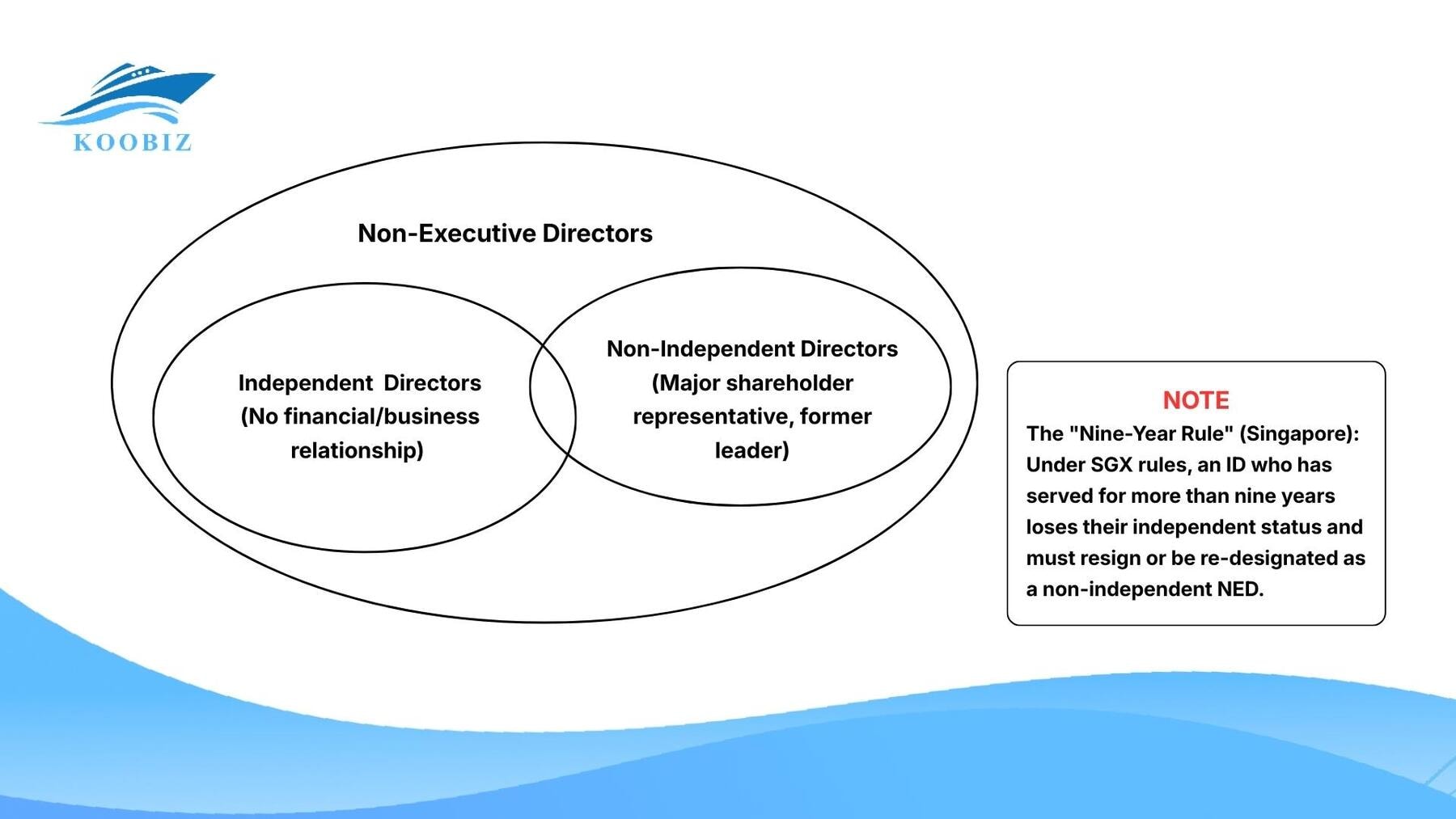
    It is a common misconception that these terms are interchangeable. While all Independent Directors are Non-Executive Directors, not all Non-Executive Directors are Independent.
    Independent Directors vs. Non-Executive Directors
    Independent Directors vs. Non-Executive Directors

    [IMAGE: Biểu đồ Venn hoặc sơ đồ phân loại (Classification Diagram). Vòng tròn lớn là “Non-Executive Directors”, bên trong chia thành 2 nhóm: “Independent” (Không có quan hệ tài chính/kinh doanh) và “Non-Independent” (Đại diện cổ đông lớn, cựu lãnh đạo). Ghi chú thêm quy tắc “9 năm” (9-Year Rule) tại Singapore để làm rõ ranh giới độc lập.]

    Independent Directors (IDs)

    An Independent Director is a NED who has no material relationship with the company, its related corporations, 10% shareholders, or its officers that could interfere with their exercise of independent business judgment.

    • Key Requirement: They must be free from any business or financial connection (other than board fees and shareholdings).
    • The “Nine-Year Rule” (Singapore): Under SGX rules, an ID who has served for more than nine years loses their independent status and must resign or be re-designated as a non-independent NED.
    • Role: Critical for protecting minority shareholders and staffing key committees (Audit, Nominating, Remuneration).

    Non-Independent Non-Executive Directors (NI-NEDs)

    A Non-Independent NED is a director who does not work in the company (is “Non-Executive”) but has a relationship that compromises their independence.

    • Scenario 1: The Major Shareholder. A significant investor (or their representative) sits on the board to monitor their personal investment. They are non-executive but lack independence due to financial bias.
    • Scenario 2: The Former Insider. A former CEO stays on the board after retirement to provide continuity. They are non-executive but lack independence due to their historical ties and relationships with current management.
    • Role: They provide oversight and strategic input but cannot be counted towards the “independent” quota required by corporate governance codes.
    FAQs About Non-Executive Directors in Singapore

    Can a foreigner be a Non-Executive Director in Singapore?

    Yes, a foreigner can act as a NED. However, under the Companies Act, every Singapore company must have at least one director who is “ordinarily resident” in Singapore. Foreigners typically serve as additional directors alongside a local resident director.

    Is there a limit to the number of directorships one can hold?

    There is no statutory “hard cap” in the Companies Act. However, for SGX-listed companies, the Nominating Committee must assess whether a director with multiple board representations is able to adequately discharge their duties. If a director holds a significant number of directorships, they must convince the board they have sufficient time and capacity.

    Do Non-Executive Directors have less liability than Executive Directors?

    No. In Singapore law, all directors have the same fiduciary duties and liabilities. A NED can be sued or criminally charged just like an Executive Director if they fail to exercise reasonable diligence. The law does not accept “I was just a non-executive” as a valid defense for negligence.

    How much are Non-Executive Directors paid in Singapore?

    Remuneration varies widely by company size and industry. For small-to-mid-cap listed companies, fees often range from SGD 40,000 to SGD 80,000 annually. For large-cap companies or banks, fees can exceed SGD 100,000 to SGD 200,000+. Unlike executives, NEDs typically receive fixed fees and do not get performance bonuses to preserve their independence.

  • Singapore Investment Holding Company: Complete Setup Guide

    Singapore Investment Holding Company: Complete Setup Guide

    [SUMMARIES]

    A Singapore Investment Holding Company (IHC) is a specialized entity designed solely to hold passive assets like shares and real estate, effectively isolating wealth from operational business risks.

    Investors benefit from Singapore’s territorial tax system and Double Taxation Agreements (DTAs), though IHCs are ineligible for Start-Up Tax Exemptions (SUTE) and have strictly limited expense deductibility compared to trading companies.

    Incorporation requires adhering to strict statutory mandates, including the appointment of a local resident director, a requirement foreign investors often meet through professional nominee services.

    [/SUMMARIES]

    Setting up a Singapore Investment Holding Company (IHC) creates a legal entity specifically designed to hold assets rather than conduct active trade. This guide serves as a roadmap for investors looking to leverage Singapore’s framework for asset protection and tax efficiency.

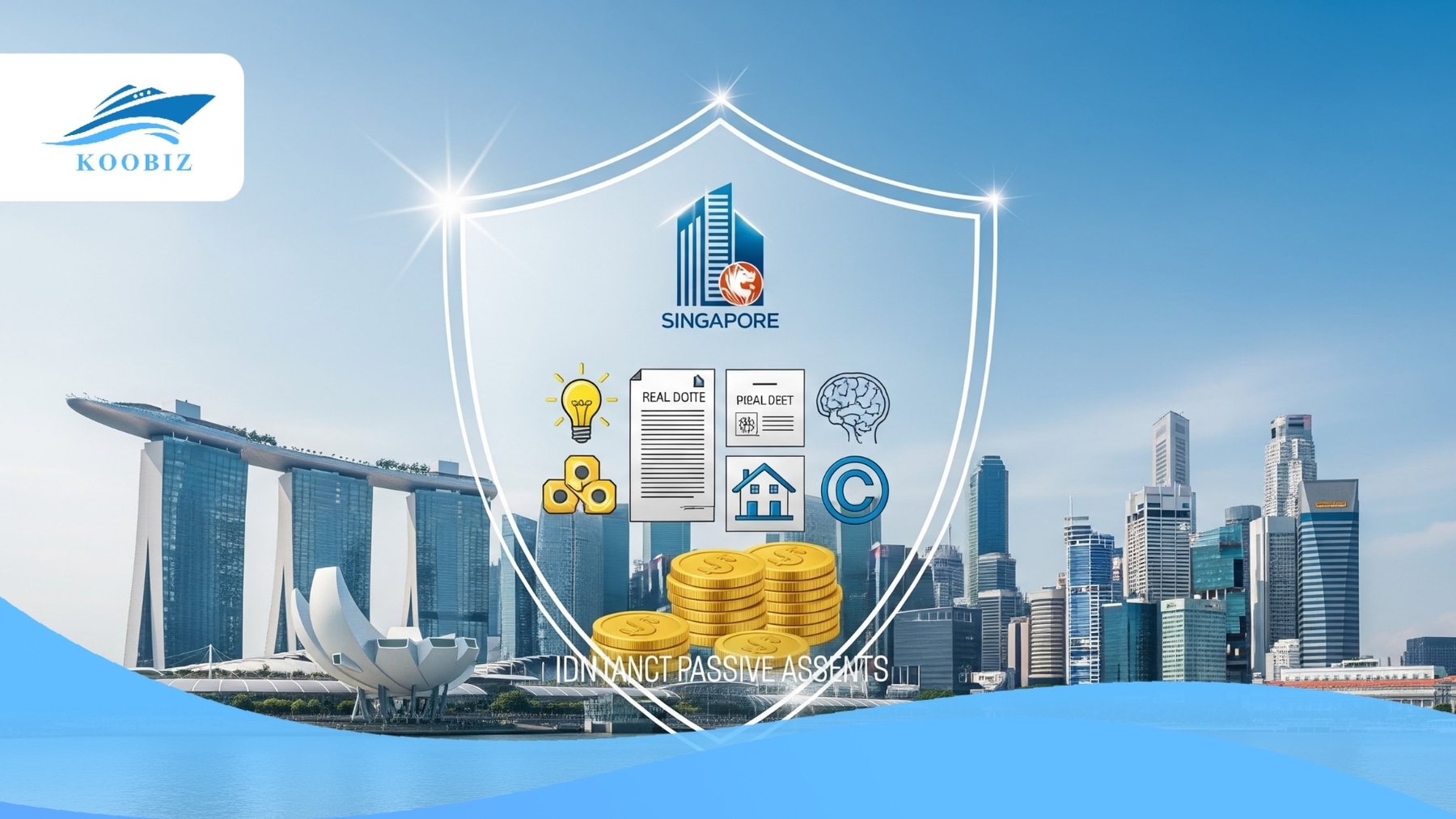
    Unlike trading companies, an IHC derives income primarily from passive sources such as dividends, interest, and rentals. Its main function is to act as a vehicle for holding investments like shares, real estate, or intellectual property.

    Foreign investors favor Singapore for its political stability, reputation as a financial hub, and territorial tax system. It is the ideal location for managing regional wealth and consolidating global assets.

    This guide covers strategic benefits, legal definitions, and a step-by-step registration process to ensure long-term success. Koobiz is here to assist you with every regulatory requirement.

    What Is a Singapore Investment Holding Company?

    Singapore Investment Holding Company (IHC)
    Singapore Investment Holding Company (IHC)

    A Singapore Investment Holding Company (IHC) is a limited liability company restricted to holding distinct assets—such as shares, property, or intellectual property—rather than producing goods or services. Specifically, it is a corporate structure where the company’s income is derived primarily from passive investment sources.

    To elaborate, the primary characteristic of an IHC is its “passive” nature. Unlike a trading company that interacts with customers to sell products, an IHC exists to own. It serves as a parent entity that owns shares in subsidiaries or holds physical assets like real estate. This structure is often used to protect valuable assets, by keeping them separate from business risks derived from day-to-day operations.

    According to the Inland Revenue Authority of Singapore (IRAS), an investment holding company is defined strictly by its income source, which must be primarily investment-based rather than trade-based.

    Is Singapore the Best Jurisdiction for an Investment Holding Company?

    Yes, Singapore is widely considered the premier jurisdiction for investment holding companies due to its political neutrality, extensive Double Taxation Agreements (DTAs), and transparent legal system. Investors choose Singapore not just for tax reasons, but for the certainty and rule of law it provides.

    Furthermore, incorporating in Singapore goes beyond simple ease of business; it is a strategic move for asset security. Unlike traditional tax havens, which may offer low taxes but lack international credibility. Singapore provides both competitive tax rates and a trusted global reputation. This ensures your banking transactions are smooth and your entity is respected worldwide.

    What Are the Key Benefits of a Singapore IHC?

    The Benefits of a Singapore IHC
    The Benefits of a Singapore IHC

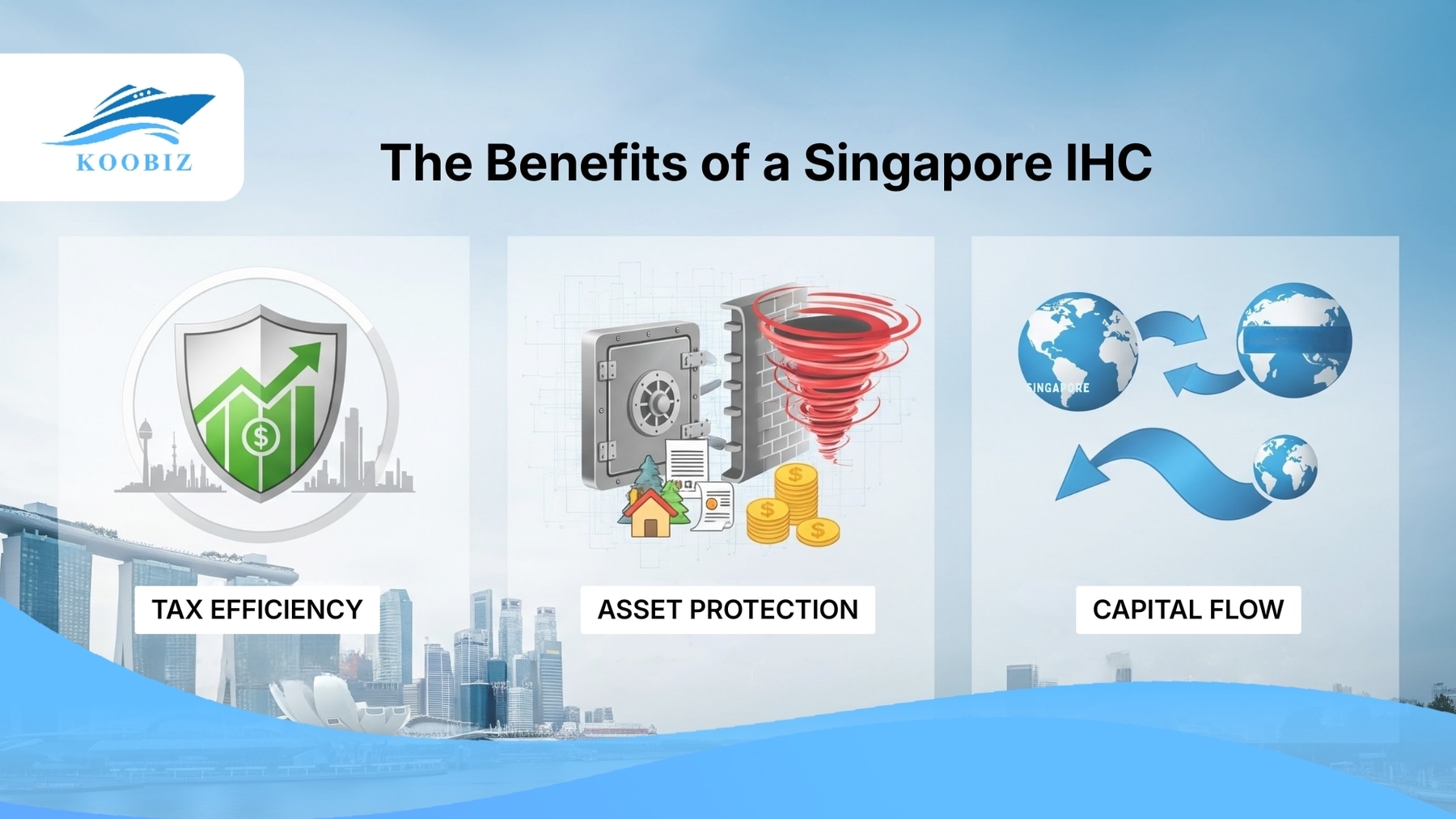
    There are three primary benefits to setting up a Singapore IHC: tax efficiency, asset protection, and ease of capital flow.

    • Tax Efficiency: Singapore operates on a territorial tax system. Foreign-sourced income is often tax-exempt if headline tax conditions are met.
    • Asset Protection: By holding assets in a separate legal entity, you insulate them from the liabilities of your operating companies.
    • Capital Flow: Singapore does not impose capital gains and no limit on sending the profits out of the country allowing for fluid movement of funds.

    What Is the Difference Between an Investment Holding Company and a Trading Company?

    The Investment Holding Company excels in asset preservation, whereas the Trading Company is optimized for active revenue generation. The distinction lies heavily in tax treatment and allowable deductions, as outlined below:

    Feature Investment Holding Company (IHC) Trading Company
    Primary Function Asset Holding & Passive Income Active Trading & Operations
    Income Source Dividends, Rentals, Interest Sales of Goods & Services
    Expense Deductibility Strictly Limited. Only direct investment costs (e.g., statutory fees) are deductible. Broad. Marketing, salaries, rent, and general overheads are deductible against revenue.
    Capital Allowances Generally Not Allowed on assets not used for trade. Allowed on plant and machinery used in the business.
    Start-Up Tax Exemption (SUTE) Not Eligible. Only eligible for Partial Tax Exemption (PTE). Eligible (if conditions met) for tax breaks on the first SGD 100k income.

    Specifically, the most critical difference is the deductibility of expenses. Choosing the right structure depends entirely on whether your primary goal is active business or passive holding.

    What Are the Requirements to Set Up a Singapore Holding Company?

    These are the non-negotiable statutory pillars mandated by the Accounting and Corporate Regulatory Authority (ACRA).

    • Resident Director: You must have at least one director who is “ordinarily resident” in Singapore (a Citizen, Permanent Resident, or EntrePass holder). If you are a foreign investor, you will need a Nominee Director service.Shareholders: Can be individuals or corporate entities, up to a maximum of 50 for a private limited company. 100% foreign ownership is allowed.
    • Paid-up Capital: The minimum paid-up capital is SGD 1.
    • Company Secretary: Must be appointed within 6 months of incorporation.

    How to Register an Investment Holding Company in Singapore?

    Registration involves a streamlined three-step process. With the right guidance, this entire process can be completed digitally within a few days.

    Step 1: Name Reservation and Approval

    The first step is to propose a unique company name and submit it to ACRA for approval. The name must not be identical to an existing entity, nor should it contain undesirable or prohibited words. Once approved, the name is reserved for 60 days (extendable), giving you time to prepare the necessary filings.

    Step 2: Preparing Incorporation Documents

    Next, you must prepare and sign the company’s constitution and the consent forms for directors and shareholders. This stage involves Know-Your-Customer (KYC) due diligence, which is mandatory for all corporate service providers in Singapore.

    • Constitution: Outlines the rules and regulations of the company.
    • Consent to Act: Directors and Company Secretaries must sign forms confirming their willingness to serve.

    Step 3: Filing with ACRA and Receiving UEN

    Once all documents are signed, the formal application is lodged with ACRA via the BizFile+ portal. Upon successful registration, ACRA issues an electronic Notice of Incorporation and a Unique Entity Number (UEN). This serves as your official business certificate.

    Need assistance with registration? Koobiz offers comprehensive incorporation packages that handle Name Reservation, Document Preparation, and ACRA Filing on your behalf, ensuring a hassle-free setup.

    Practical Case Studies: How Investors Use Singapore Holding Companies

    By examining real-world applications, we can see exactly how a Singapore Investment Holding Company creates value through risk mitigation and tax optimization.

    Let’s examine two distinct case studies that illustrate the power of this structure.

    Case Study 1: The “Risk Firewall” Strategy (Asset Protection)

    In this scenario, a successful trading business uses a Holding Company to protect its assets from operational risks.

    • The Situation: “TechGlobal Trading,” a software distributor, owns a valuable commercial office and several software patents. They are worried that a client lawsuit could bankrupt the company and force the sale of these assets.
    • The Solution: The owners set up “TechGlobal Holdings Pte Ltd.” They transfer the office title and patents to this new Holding Company. TechGlobal Holdings then licenses the IP and rents the office back to the trading entity.
    • The Outcome: If the trading business is sued, the assets are safe because they are owned by the Holding Company, which is a separate legal entity not involved in the dispute.

    Case Study 2: The “Tax-Efficient Gateway” (Cross-Border Expansion)

    This scenario demonstrates how foreign investors use Singapore to minimize tax leakage when investing in the ASEAN region.

    • The Situation: Mr. Smith, a UK investor, wants to acquire manufacturing plants in Vietnam and Indonesia. He is concerned about the high withholding taxes on dividends when profits are sent back to the UK.
    • The Solution: Mr. Smith incorporates “Smith Asia Holdings” in Singapore. This Singapore company acquires the shares of the Vietnamese and Indonesian manufacturers.
    • The Outcome: Due to Singapore’s strong Double Taxation Agreements (DTAs), the withholding tax on dividends flowing from Vietnam/Indonesia to Singapore is significantly reduced. Furthermore, Singapore does not tax these foreign-sourced dividends (under specific exemptions), and there is 0% withholding tax when Singapore sends the money to Mr. Smith in the UK.

    How Does the Singapore Tax Regime Benefit Holding Companies?

    Singapore holding company tax benefits
    Singapore holding company tax benefits

    Singapore’s single-tier corporate tax system is a major advantage. Profits are taxed only once at the corporate level, meaning dividends distributed to shareholders are tax-free.

    While the corporate tax rate is capped at 17%, effective rates are often lower due to exemptions. However, it is important to note that Investment Holding Companies do not qualify for the Start-Up Tax Exemption (SUTE) because their primary activity is passive investment. Instead, they are generally eligible for the Partial Tax Exemption (PTE) scheme.

    Are Dividends Taxed in Singapore?

    No. Dividends paid by a Singapore tax-resident company are completely tax-exempt for shareholders, whether local or foreign. This eliminates double taxation on profit withdrawals.

    What Are the Double Taxation Agreements (DTAs)?

    Singapore has signed DTAs with over 90 jurisdictions to prevent income from being taxed twice. For a holding company, this significantly reduces withholding taxes on interest or royalties earned from foreign subsidiaries, maximizing retained income.

    What Are the Ongoing Compliance and Maintenance Costs?

    To maintain good standing and avoid penalties, companies must meet annual obligations:

    • AGM: Hold within 6 months of the financial year-end.
    • Annual Return: File with ACRA within 7 months of the financial year-end.
    • Tax Filing: File Estimated Chargeable Income (ECI) within 3 months of year-end, and the final Tax Return (Form C-S/C) by November 30th (for paper filing) or December 15th (for electronic filing). Even dormant IHCs must file specific returns.

    How Does a Holding Company Compare to Other Structures?

    Choosing the right structure depends heavily on your investment scale, need for segregation, and banking requirements.

    Feature Singapore Investment Holding Co. (IHC) Variable Capital Company (VCC) BVI / Cayman Offshore Co.
    Best For Single-family offices, small investor groups, holding static assets (property/shares). Large investment funds needing multiple sub-funds and segregated liabilities. Investors seeking maximum privacy and zero tax (but willing to face high scrutiny).
    Asset Segregation No. Assets and liabilities are pooled in one entity. Yes. Assets and liabilities can be legally segregated between sub-funds. No. Standard companies do not offer ring-fencing without complex structuring.
    Reputation & Banking High. Regarded as a legitimate onshore business. High. Regulated by MAS, offering strong credibility for fund managers. Low/Mixed. High scrutiny from banks (“High Risk”).
    Cost & Compliance Moderate. Standard ACRA filing fees and annual maintenance. High. Higher setup costs, strict MAS oversight, and mandatory fund administrator. Low Setup / High Maintenance. Cheap to start, but “Economic Substance” rules are increasing ongoing costs.

    What Is the “Economic Substance” Requirement?

    To prove it is not a tax-avoidance shell, an IHC must demonstrate management and control in Singapore. This includes holding Board meetings and maintaining records locally.

    Ready to Incorporate Your Investment Holding Company?

    Setting up a Singapore Investment Holding Company is a powerful strategic move for asset protection. However, the process requires precise adherence to ACRA regulations.

    Koobiz specializes in helping foreign and local investors navigate this journey. From providing Nominee Director to handling your Annual Filings, we provide the infrastructure required for success.

    Contact Koobiz today for a free consultation on your Holding Company Setup