Tag: Double Taxation Agreements

  • Maximize Tax Benefits for Your Private Limited Company (Pte Ltd) in Singapore: A Corporate Tax Guide

    Maximize Tax Benefits for Your Private Limited Company (Pte Ltd) in Singapore: A Corporate Tax Guide

    [SUMMARIES]

    The Start-Up Tax Exemption (SUTE) scheme drastically reduces the effective tax rate for qualifying new companies during their first three years by exempting 75% of the first S$100,000 and 50% of the next S$100,000 of chargeable income.

    Established entities benefit from the Partial Tax Exemption (PTE) scheme, which exempts 75% of the first S$10,000 and 50% of the next S$190,000, alongside a single-tier tax system that ensures dividend distributions to shareholders are completely tax-free.

    Companies can further optimize their tax liability by claiming deductible business expenses-including wages subject to new 2025 S Pass thresholds-and leveraging the Foreign-Sourced Income Exemption (FSIE) and Double Taxation Agreements (DTAs) for cross-border trade.

    [/SUMMARIES]

    Maximizing tax benefits for your Private Limited Company (Pte Ltd) in Singapore involves strategically leveraging Singapore’s corporate tax incentives. Key schemes include the Start-Up Tax Exemption (SUTE) and Partial Tax Exemption (PTE), which can reduce your effective tax rate well below the headline 17%. While Singapore is globally renowned for its pro-business environment, simply incorporating is not enough; business owners must actively understand how chargeable income is calculated and which specific exemptions apply to their company’s lifecycle stage.

    To fully grasp the potential savings, one must first look beyond the headline figure and understand the distinction between the statutory corporate income tax rate and the effective tax rate that most companies actually pay. This distinction is crucial for foreign investors and local entrepreneurs alike who are planning their financial projections.

    For new businesses, the government offers generous support through the SUTE scheme, which provides a substantial partial exemption scheme for the first three consecutive Years of Assessment. This initiative is designed to support entrepreneurship and cash flow during the critical early years of operation.

    However, the benefits do not end once the startup phase is over; established companies, as well as foreign shareholders, can utilize deductions, the single-tier tax system, and international treaties to to minimise corporate tax liability and maximise after-tax profits. . The sections below explain how companies can legally optimise their corporate tax obligations.

    What Is the Corporate Income Tax Rate for a Singapore Private Limited Company (Pte Ltd) ?
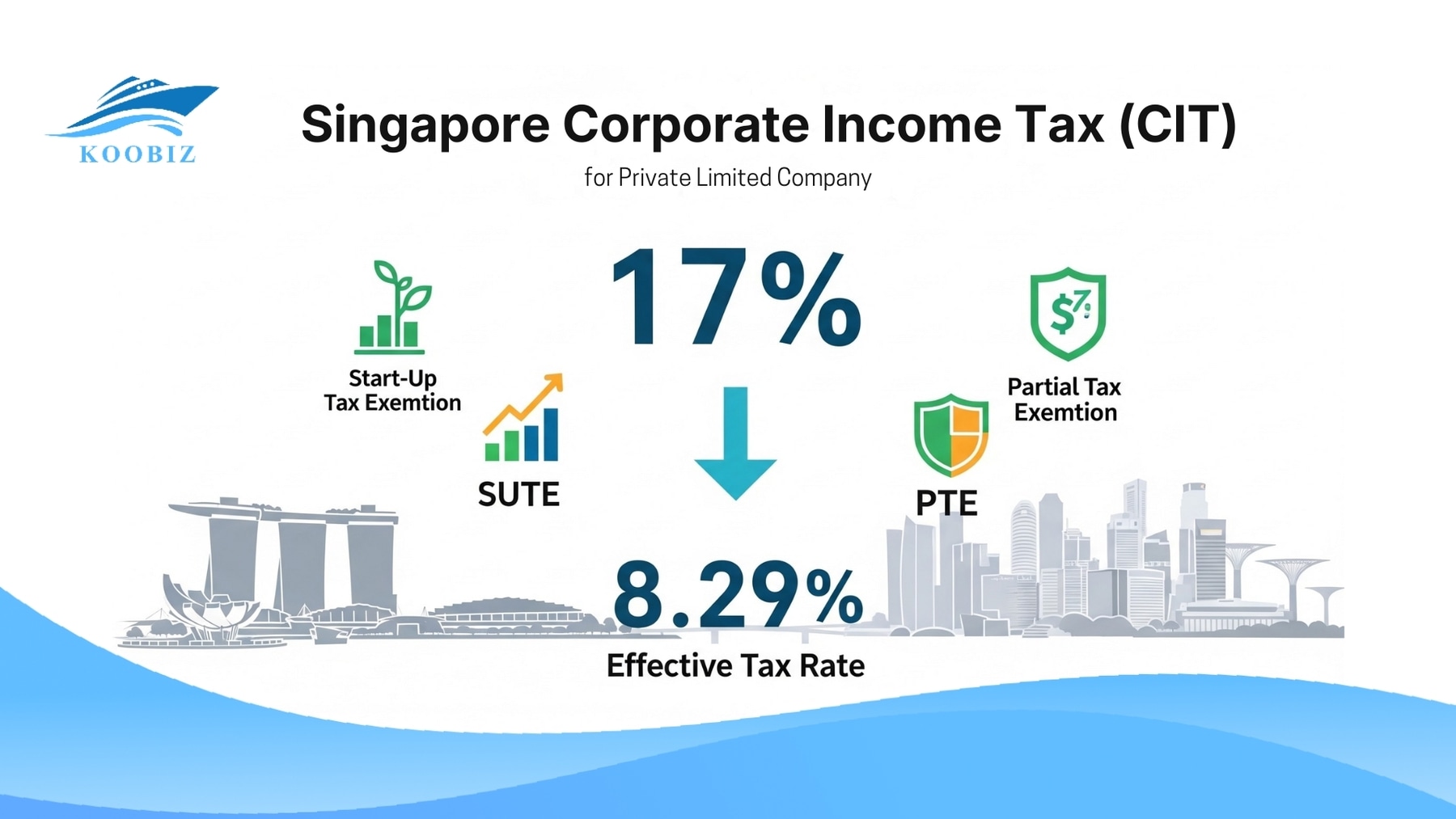
    The Corporate Income Tax (CIT) rate in Singapore is a flat 17% levied on chargeable income, renowned for being one of the most competitive statutory rate in the Asia-Pacific region. This single rate applies to both local and foreign companies doing business in Singapore, providing a predictable fiscal environment.

    To understand how this impacts your bottom line, we must look beyond the headline figure. In reality, due to various tax incentives, rebates, and exemption schemes, the effective tax rate for many small-to-medium enterprises (SMEs) is often significantly lower than 17%.The Inland Revenue Authority of Singapore (IRAS) calculates tax based on the preceding financial year’s income, known as the Year of Assessment (YA). For example, income earned in 2024 is taxed in YA 2025.

    Understanding this baseline is essential before diving into the specific mechanisms that can reduce your liability.

    According to the Inland Revenue Authority of Singapore (IRAS), most Singapore companies achieve an effective tax rate significantly lower than 17% through government exemption schemes.

    What Are the Key Tax Exemption Schemes for New Startups?
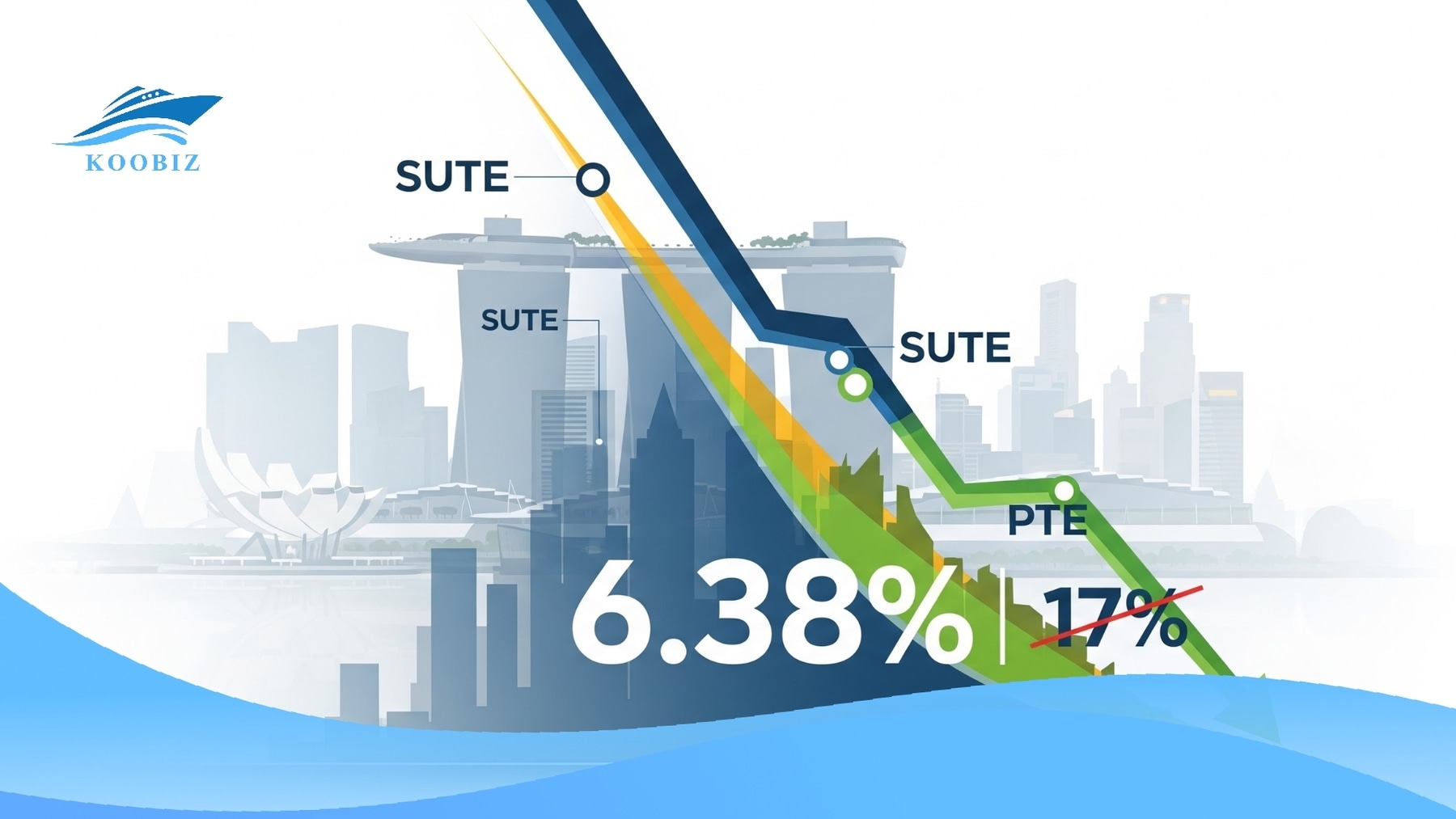
    There is one primary scheme for new companies for new companies: the Start-Up Tax Exemption (SUTE) scheme, designed to reduce the effective tax rate significantly for the first three consecutive Years of Assessment (YAs). This scheme was introduced to encourage entrepreneurship and help local enterprises grow by exempting a large portion of their initial income from taxation.

    The mechanics of this incentive are outlined below to show how much tax savings are available.

    How Does the Start-Up Tax Exemption (SUTE) Scheme Work?

    The SUTE scheme offers a significant tax break by exempting 75% of the first SGD 100,000 of normal chargeable income from tax, and subsequently, a 50% exemption on the next SGD 100,000.

    Specifically, for the first three YAs where the company falls within the qualifying period:

    • First SGD 100,000: 75% exempt (You only pay tax on 25%).
    • Next SGD 100,000: 50% exempt (You only pay tax on 50%).

    What does this mean for your business? If your startup earns SGD 200,000 in profit, your effective tax payable is drastically reduced compared to the standard 17% calculation. This massive cash flow saving is absolutely vital for reinvestment into key business operations during the critical early stages.

    Does Your Private Limited Company (Pte Ltd) Qualify for the SUTE Scheme?

    Yes, your Private Limited Company (Pte Ltd) is generally eligible for the SUTE scheme, provided it meets three specific criteria related to shareholder structure and company type defined by IRAS.

    However, eligibility is not automatic. To benefit, you must ensure your company strictly complies with the following conditions:

    1. Incorporation Status: The company must be a Singapore-incorporated company.
    2. Tax Residency: The company must be a tax resident in Singapore for that YA (Year of Assessment).
    3. Shareholder Structure: The company must have no more than 20 shareholders throughout the basis period for that YA, where:
      • All shareholders are individuals; OR
      • At least one shareholder is an individual holding at least 10% of the issued ordinary shares.

    Important Note: Companies that are Investment Holding Companies or those undertaking Property Development (for sale, investment, or both) are STRICTLY EXCLUDED from the SUTE scheme. If you are unsure about your eligibility or shareholder structure, services like Koobiz can assist in structuring your incorporation correctly from day one to ensure you don’t miss out on these valuable benefits.

    How Can Established Private Limited Company (Pte Ltd) Benefit from the Partial Tax Exemption (PTE)?
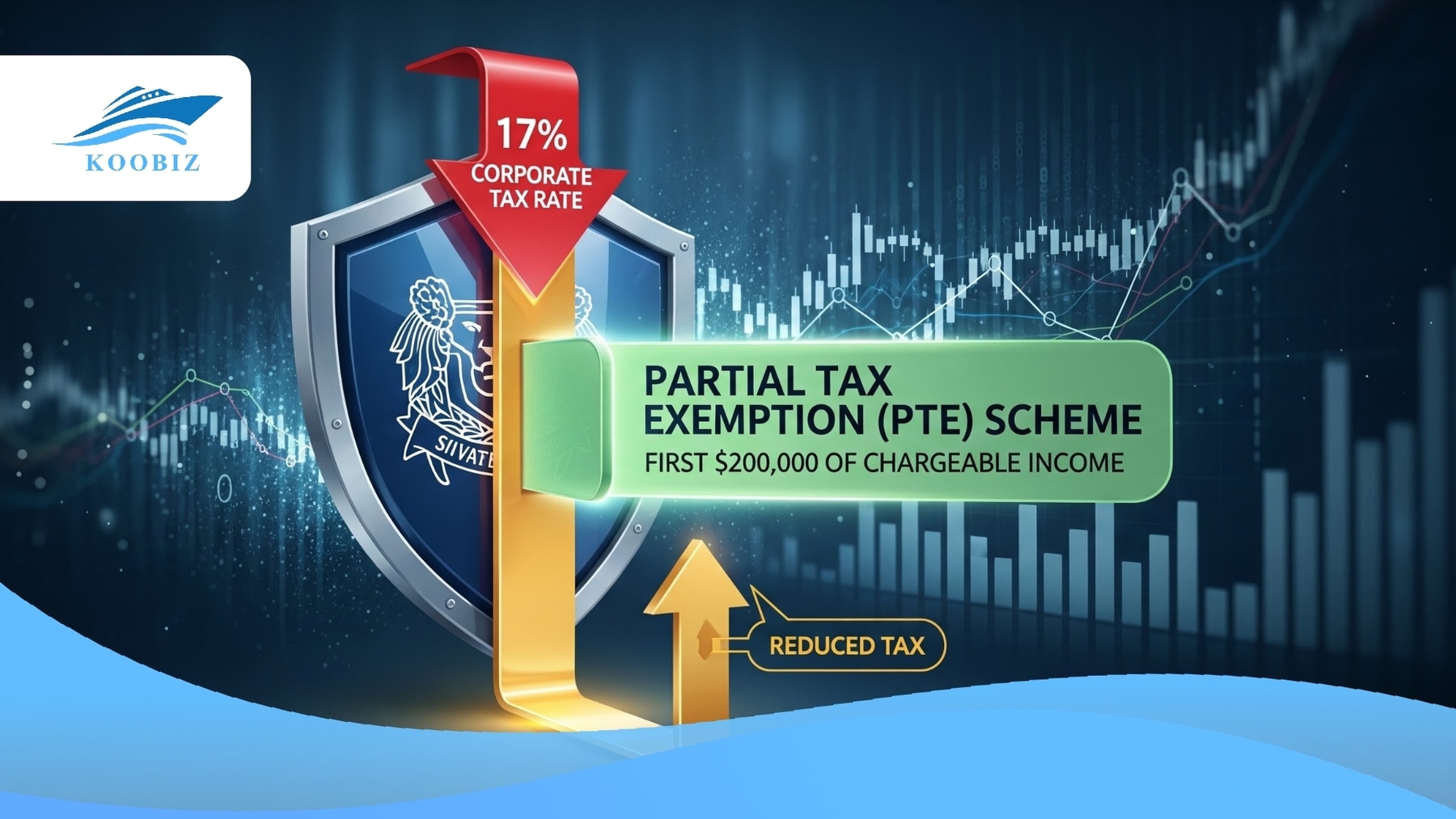
    Established Private Limited Company (Pte Ltd) benefit from the Partial Tax Exemption (PTE) scheme by automatically applying a 75% exemption on the first SGD 10,000 of chargeable income and 50% on the next SGD 190,000.

    This scheme guarantees that even mature companies—or startups that have successfully passed their first three YAs—will still enjoy a significantly reduced tax burden. Importantly, unlike SUTE, the eligibility for PTE is much broader and applies to almost all companies.

    Specifically, the calculation for PTE is as follows:

    • First SGD 10,000: 75% exempt.
    • Next SGD 190,000: 50% exempt.

    In practice, this means the first $200,000 of your chargeable income will always enjoy reduced tax rates. This crucial mechanism ensures that the initial $200,000 of company income is NEVER taxed at the full 17% rate, acting as a permanent tax buffer for SMEs and allowing them to retain more earnings for expansion or dividends.

    CASE STUDY: Comparing Tax Benefits (SUTE vs. PTE)

    To clearly illustrate the tangible benefits of these tax schemes, let’s compare two hypothetical companies with the same chargeable income of SGD 200,000:

    Scenario A: New Startup (SUTE Benefits)

    • Total Income: SGD 200,000
    • Exemption on First $100k (75%): SGD 75,000 exempt
    • Exemption on Next $100k (50%): SGD 50,000 exempt
    • Total Tax Exempt: SGD 125,000
    • Taxable Income: SGD 75,000
    • Tax Payable (17% of $75k): SGD 12,750
    • Effective Tax Rate: 6.38%

    Scenario B: Established Company (STABLE PTE Benefits)

    • Total Income: SGD 200,000
    • Exemption on First $10k (75%): SGD 7,500 exempt
    • Exemption on Next $190k (50%): SGD 95,000 exempt
    • Total Tax Exempt: SGD 102,500
    • Taxable Income: SGD 97,500
    • Tax Payable (17% of $97.5k): SGD 16,575
    • Effective Tax Rate: 8.29%

    The Savings: Even without the startup status, MatureCorp pays an effective tax rate of only 8.29%less than half the headline rate of 17%! However, TechStart saves an additional SGD 3,825 purely due to the startup scheme, which underscores the CRITICAL IMPORTANCE of correct initial structuring.

    Tax Optimisation: What Business Expenses Are Deductible?
    There are two main categories of deductible business expenses: revenue expenses incurred in generating income and specific statutory deductions allowed by IRAS.

    Properly claiming these deductions is CRUCIAL for minimising your “Chargeable Income”—the figure your tax rate is actually applied to. The Golden Rule is that expenses must be “wholly and exclusively” incurred in generating that income.

    Key Deductible Expenses Include:

    • Employee Wages & CPF: Mandatory contributions and salaries for both local and foreign staff are fully deductible.
    • Rent & Utilities: Costs associated with your office or facility (e.g., rent, electricity, water, internet) are deductible.
    • Renovation & Refurbishment (R&R): Qualifying R&R costs can be claimed over three years (capped at SGD 300,000).
    • Capital Allowances: This refers to deductions for the wear and tear of fixed assets (such as machinery or office equipment)—claimed instead of depreciation, which is generally not tax-deductible.

    Important Update: 2025 S Pass Salary Thresholds

    When budgeting for foreign employee wages (which are deductible), companies must strictly adhere to Ministry of Manpower (MOM) standards to ensure work passes are approved. Effective 1 September 2025, the minimum qualifying salary for new S Pass applications will increase to:

    • All Sectors (except Financial): SGD 3,300 (increasing progressively with age up to SGD 4,800).
    • Financial Services Sector: SGD 3,800 (increasing progressively with age up to SGD 5,650).

    Ensuring your stated salaries meet these new benchmarks is ESSENTIAL for both legal compliance and ensuring your wage deductions remain valid.

    Conversely, private expenses of the business owner, potential losses, and capital expenses (like the costs to incorporate or acquire new assets) are generally NOT deductible. Ensuring your bookkeeping clearly separates these is a vital part of effective tax optimization.

    How Does Singapore’s Single-Tier Tax System Benefit Shareholders?

    The Single-Tier Tax System is a mechanism where tax is paid only at the corporate level, meaning dividends distributed to shareholders are exempt from further taxation.

    This eliminates the “double taxation” burden common in other jurisdictions, where profit is taxed once at the company level and again when distributed to shareholders. This system is a major pull factor for investors using Koobiz to set up their holding companies in Singapore.

    Is Dividend Income Taxable for Foreign Shareholders?

    No, dividend income is NOT taxable for foreign shareholders in Singapore, regardless of whether they are tax residents or non-residents.

    This policy significantly simplifies the tax obligations for international investors. Once the Singapore Private Limited Company (Pte Ltd) has paid its corporate tax (or enjoyed its exemptions), the remaining profit can be distributed to you anywhere in the world without withholding tax. This facilitates cleaner capital repatriation.

    What Is the Foreign-Sourced Income Exemption (FSIE) Scheme?

    The Foreign-Sourced Income Exemption (FSIE) scheme is a crucial relief scheme that allows Singapore tax residents to enjoy full tax exemption on foreign-sourced dividends, branch profits, and service income remitted into Singapore.

    To qualify, the foreign income MUST meet three specific conditions:

    1. The income has been subject to tax in the foreign jurisdiction.
    2. The headline tax rate of that foreign jurisdiction is at least 15%.
    3. The Comptroller of Income Tax is satisfied that the tax exemption would benefit the resident company.

    How Do Double Taxation Agreements (DTAs) Minimise Corporate Tax Liability and Maximise After-Tax Profits?

    Double Taxation Agreements (DTAs) are vital tools that minimise corporate tax liability and maximise after-tax profits by allowing companies to claim tax credits or exemptions for taxes paid in foreign jurisdictions, effectively preventing the same income from being taxed twice.

    Singapore has an extensive network of over 90 DTAs. If your Private Limited Company (Pte Ltd) trades cross-border, these agreements ENSURE that you are not paying full tax in both the partner country and Singapore. Leveraging these treaties requires careful documentationand proof of tax residency, which is a standard part of corporate compliance.

    Ready to incorporate and optimize your tax structure?

    Navigating the complexities of SUTE, PTE, and compliance can be daunting. At Koobiz, we specialize in seamless company incorporation and corporate secretarial services. We ensure your business is structured correctly from day one to qualify for maximum tax benefits.

    Contact Koobiz Today for a Consultation
  • Singapore Investment Holding Company: Complete Setup Guide

    Singapore Investment Holding Company: Complete Setup Guide

    [SUMMARIES]

    A Singapore Investment Holding Company (IHC) is a specialized entity designed solely to hold passive assets like shares and real estate, effectively isolating wealth from operational business risks.

    Investors benefit from Singapore’s territorial tax system and Double Taxation Agreements (DTAs), though IHCs are ineligible for Start-Up Tax Exemptions (SUTE) and have strictly limited expense deductibility compared to trading companies.

    Incorporation requires adhering to strict statutory mandates, including the appointment of a local resident director, a requirement foreign investors often meet through professional nominee services.

    [/SUMMARIES]

    Setting up a Singapore Investment Holding Company (IHC) creates a legal entity specifically designed to hold assets rather than conduct active trade. This guide serves as a roadmap for investors looking to leverage Singapore’s framework for asset protection and tax efficiency.

    Unlike trading companies, an IHC derives income primarily from passive sources such as dividends, interest, and rentals. Its main function is to act as a vehicle for holding investments like shares, real estate, or intellectual property.

    Foreign investors favor Singapore for its political stability, reputation as a financial hub, and territorial tax system. It is the ideal location for managing regional wealth and consolidating global assets.

    This guide covers strategic benefits, legal definitions, and a step-by-step registration process to ensure long-term success. Koobiz is here to assist you with every regulatory requirement.

    What Is a Singapore Investment Holding Company?

    Singapore Investment Holding Company (IHC)
    Singapore Investment Holding Company (IHC)

    A Singapore Investment Holding Company (IHC) is a limited liability company restricted to holding distinct assets—such as shares, property, or intellectual property—rather than producing goods or services. Specifically, it is a corporate structure where the company’s income is derived primarily from passive investment sources.

    To elaborate, the primary characteristic of an IHC is its “passive” nature. Unlike a trading company that interacts with customers to sell products, an IHC exists to own. It serves as a parent entity that owns shares in subsidiaries or holds physical assets like real estate. This structure is often used to protect valuable assets, by keeping them separate from business risks derived from day-to-day operations.

    According to the Inland Revenue Authority of Singapore (IRAS), an investment holding company is defined strictly by its income source, which must be primarily investment-based rather than trade-based.

    Is Singapore the Best Jurisdiction for an Investment Holding Company?

    Yes, Singapore is widely considered the premier jurisdiction for investment holding companies due to its political neutrality, extensive Double Taxation Agreements (DTAs), and transparent legal system. Investors choose Singapore not just for tax reasons, but for the certainty and rule of law it provides.

    Furthermore, incorporating in Singapore goes beyond simple ease of business; it is a strategic move for asset security. Unlike traditional tax havens, which may offer low taxes but lack international credibility. Singapore provides both competitive tax rates and a trusted global reputation. This ensures your banking transactions are smooth and your entity is respected worldwide.

    What Are the Key Benefits of a Singapore IHC?

    The Benefits of a Singapore IHC
    The Benefits of a Singapore IHC

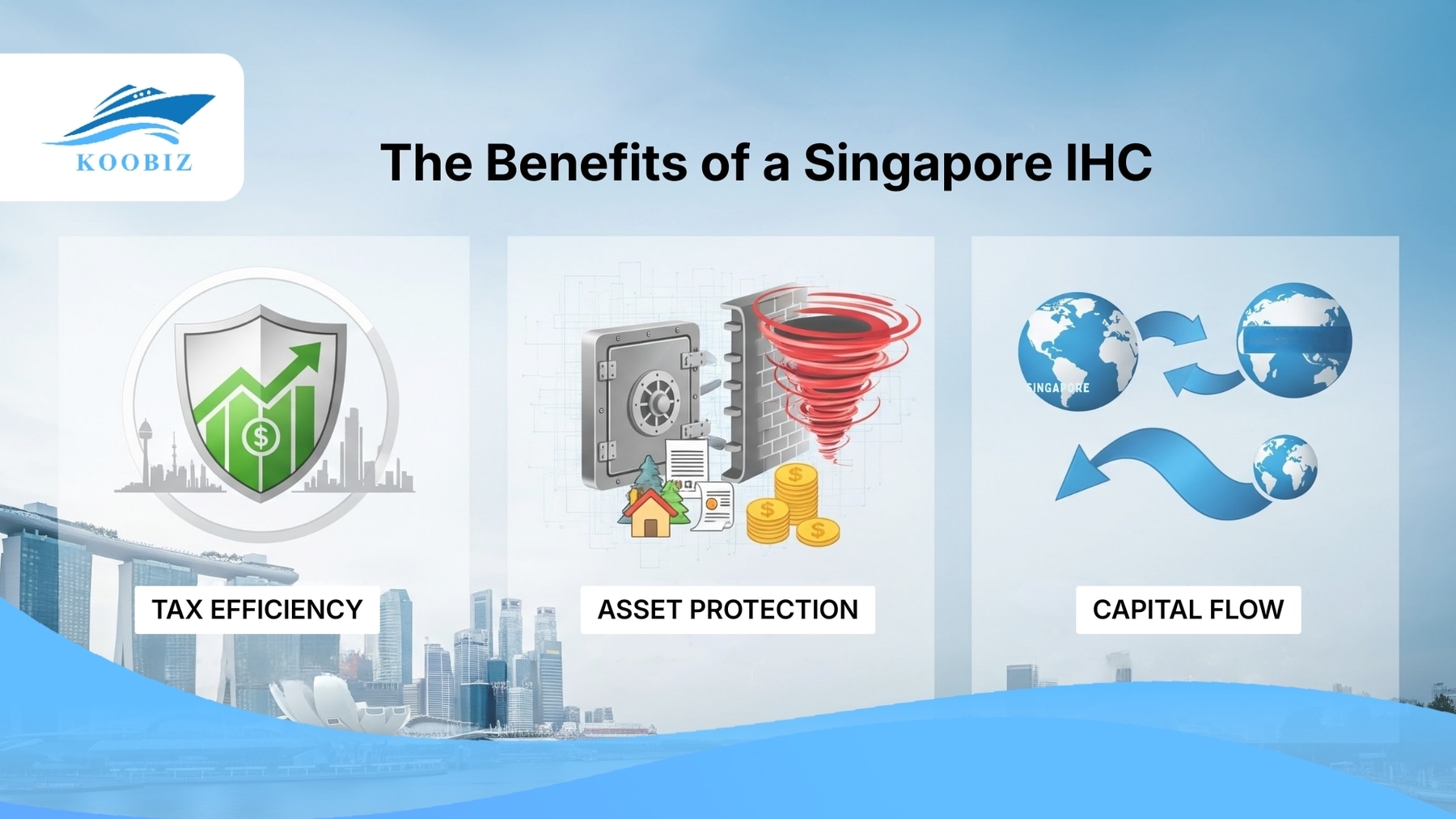
    There are three primary benefits to setting up a Singapore IHC: tax efficiency, asset protection, and ease of capital flow.

    • Tax Efficiency: Singapore operates on a territorial tax system. Foreign-sourced income is often tax-exempt if headline tax conditions are met.
    • Asset Protection: By holding assets in a separate legal entity, you insulate them from the liabilities of your operating companies.
    • Capital Flow: Singapore does not impose capital gains and no limit on sending the profits out of the country allowing for fluid movement of funds.

    What Is the Difference Between an Investment Holding Company and a Trading Company?

    The Investment Holding Company excels in asset preservation, whereas the Trading Company is optimized for active revenue generation. The distinction lies heavily in tax treatment and allowable deductions, as outlined below:

    Feature Investment Holding Company (IHC) Trading Company
    Primary Function Asset Holding & Passive Income Active Trading & Operations
    Income Source Dividends, Rentals, Interest Sales of Goods & Services
    Expense Deductibility Strictly Limited. Only direct investment costs (e.g., statutory fees) are deductible. Broad. Marketing, salaries, rent, and general overheads are deductible against revenue.
    Capital Allowances Generally Not Allowed on assets not used for trade. Allowed on plant and machinery used in the business.
    Start-Up Tax Exemption (SUTE) Not Eligible. Only eligible for Partial Tax Exemption (PTE). Eligible (if conditions met) for tax breaks on the first SGD 100k income.

    Specifically, the most critical difference is the deductibility of expenses. Choosing the right structure depends entirely on whether your primary goal is active business or passive holding.

    What Are the Requirements to Set Up a Singapore Holding Company?

    These are the non-negotiable statutory pillars mandated by the Accounting and Corporate Regulatory Authority (ACRA).

    • Resident Director: You must have at least one director who is “ordinarily resident” in Singapore (a Citizen, Permanent Resident, or EntrePass holder). If you are a foreign investor, you will need a Nominee Director service.Shareholders: Can be individuals or corporate entities, up to a maximum of 50 for a private limited company. 100% foreign ownership is allowed.
    • Paid-up Capital: The minimum paid-up capital is SGD 1.
    • Company Secretary: Must be appointed within 6 months of incorporation.

    How to Register an Investment Holding Company in Singapore?

    Registration involves a streamlined three-step process. With the right guidance, this entire process can be completed digitally within a few days.

    Step 1: Name Reservation and Approval

    The first step is to propose a unique company name and submit it to ACRA for approval. The name must not be identical to an existing entity, nor should it contain undesirable or prohibited words. Once approved, the name is reserved for 60 days (extendable), giving you time to prepare the necessary filings.

    Step 2: Preparing Incorporation Documents

    Next, you must prepare and sign the company’s constitution and the consent forms for directors and shareholders. This stage involves Know-Your-Customer (KYC) due diligence, which is mandatory for all corporate service providers in Singapore.

    • Constitution: Outlines the rules and regulations of the company.
    • Consent to Act: Directors and Company Secretaries must sign forms confirming their willingness to serve.

    Step 3: Filing with ACRA and Receiving UEN

    Once all documents are signed, the formal application is lodged with ACRA via the BizFile+ portal. Upon successful registration, ACRA issues an electronic Notice of Incorporation and a Unique Entity Number (UEN). This serves as your official business certificate.

    Need assistance with registration? Koobiz offers comprehensive incorporation packages that handle Name Reservation, Document Preparation, and ACRA Filing on your behalf, ensuring a hassle-free setup.

    Practical Case Studies: How Investors Use Singapore Holding Companies

    By examining real-world applications, we can see exactly how a Singapore Investment Holding Company creates value through risk mitigation and tax optimization.

    Let’s examine two distinct case studies that illustrate the power of this structure.

    Case Study 1: The “Risk Firewall” Strategy (Asset Protection)

    In this scenario, a successful trading business uses a Holding Company to protect its assets from operational risks.

    • The Situation: “TechGlobal Trading,” a software distributor, owns a valuable commercial office and several software patents. They are worried that a client lawsuit could bankrupt the company and force the sale of these assets.
    • The Solution: The owners set up “TechGlobal Holdings Pte Ltd.” They transfer the office title and patents to this new Holding Company. TechGlobal Holdings then licenses the IP and rents the office back to the trading entity.
    • The Outcome: If the trading business is sued, the assets are safe because they are owned by the Holding Company, which is a separate legal entity not involved in the dispute.

    Case Study 2: The “Tax-Efficient Gateway” (Cross-Border Expansion)

    This scenario demonstrates how foreign investors use Singapore to minimize tax leakage when investing in the ASEAN region.

    • The Situation: Mr. Smith, a UK investor, wants to acquire manufacturing plants in Vietnam and Indonesia. He is concerned about the high withholding taxes on dividends when profits are sent back to the UK.
    • The Solution: Mr. Smith incorporates “Smith Asia Holdings” in Singapore. This Singapore company acquires the shares of the Vietnamese and Indonesian manufacturers.
    • The Outcome: Due to Singapore’s strong Double Taxation Agreements (DTAs), the withholding tax on dividends flowing from Vietnam/Indonesia to Singapore is significantly reduced. Furthermore, Singapore does not tax these foreign-sourced dividends (under specific exemptions), and there is 0% withholding tax when Singapore sends the money to Mr. Smith in the UK.

    How Does the Singapore Tax Regime Benefit Holding Companies?

    Singapore holding company tax benefits
    Singapore holding company tax benefits

    Singapore’s single-tier corporate tax system is a major advantage. Profits are taxed only once at the corporate level, meaning dividends distributed to shareholders are tax-free.

    While the corporate tax rate is capped at 17%, effective rates are often lower due to exemptions. However, it is important to note that Investment Holding Companies do not qualify for the Start-Up Tax Exemption (SUTE) because their primary activity is passive investment. Instead, they are generally eligible for the Partial Tax Exemption (PTE) scheme.

    Are Dividends Taxed in Singapore?

    No. Dividends paid by a Singapore tax-resident company are completely tax-exempt for shareholders, whether local or foreign. This eliminates double taxation on profit withdrawals.

    What Are the Double Taxation Agreements (DTAs)?

    Singapore has signed DTAs with over 90 jurisdictions to prevent income from being taxed twice. For a holding company, this significantly reduces withholding taxes on interest or royalties earned from foreign subsidiaries, maximizing retained income.

    What Are the Ongoing Compliance and Maintenance Costs?

    To maintain good standing and avoid penalties, companies must meet annual obligations:

    • AGM: Hold within 6 months of the financial year-end.
    • Annual Return: File with ACRA within 7 months of the financial year-end.
    • Tax Filing: File Estimated Chargeable Income (ECI) within 3 months of year-end, and the final Tax Return (Form C-S/C) by November 30th (for paper filing) or December 15th (for electronic filing). Even dormant IHCs must file specific returns.

    How Does a Holding Company Compare to Other Structures?

    Choosing the right structure depends heavily on your investment scale, need for segregation, and banking requirements.

    Feature Singapore Investment Holding Co. (IHC) Variable Capital Company (VCC) BVI / Cayman Offshore Co.
    Best For Single-family offices, small investor groups, holding static assets (property/shares). Large investment funds needing multiple sub-funds and segregated liabilities. Investors seeking maximum privacy and zero tax (but willing to face high scrutiny).
    Asset Segregation No. Assets and liabilities are pooled in one entity. Yes. Assets and liabilities can be legally segregated between sub-funds. No. Standard companies do not offer ring-fencing without complex structuring.
    Reputation & Banking High. Regarded as a legitimate onshore business. High. Regulated by MAS, offering strong credibility for fund managers. Low/Mixed. High scrutiny from banks (“High Risk”).
    Cost & Compliance Moderate. Standard ACRA filing fees and annual maintenance. High. Higher setup costs, strict MAS oversight, and mandatory fund administrator. Low Setup / High Maintenance. Cheap to start, but “Economic Substance” rules are increasing ongoing costs.

    What Is the “Economic Substance” Requirement?

    To prove it is not a tax-avoidance shell, an IHC must demonstrate management and control in Singapore. This includes holding Board meetings and maintaining records locally.

    Ready to Incorporate Your Investment Holding Company?

    Setting up a Singapore Investment Holding Company is a powerful strategic move for asset protection. However, the process requires precise adherence to ACRA regulations.

    Koobiz specializes in helping foreign and local investors navigate this journey. From providing Nominee Director to handling your Annual Filings, we provide the infrastructure required for success.

    Contact Koobiz today for a free consultation on your Holding Company Setup