Tag: Singapore Companies Act

  • What Is a Non-Executive Director? Complete Guide to Roles, Duties, and Board Governance

    What Is a Non-Executive Director? Complete Guide to Roles, Duties, and Board Governance

    [SUMMARIES]

    A Non-Executive Director (NED) in Singapore provides independent oversight and strategic guidance without participating in daily business operations. While they do not manage the company, NEDs share the same legal and fiduciary liabilities as executive directors under the Singapore Companies Act.

    [/SUMMARIES]

    Understanding the role of a Non-Executive Director is vital for robust corporate governance in Singapore. In this guide, Koobiz simplifies the complexities of board leadership, breaking down the essential duties, legal liabilities, and qualifications you need to know. We provide a clear, detailed roadmap to help you navigate the distinction between executive and non-executive functions with confidence.

    What Is a Non-Executive Director?

    A Non-Executive Director (NED) is a member of a company’s board of directors who is not part of the executive management team and does not engage in the day-to-day operations of the business. Their primary purpose is to provide independent oversight, objective strategic guidance, and constructive challenges to the executive directors. By operating outside of daily management, NEDs play a crucial role in corporate governance, helping to monitor performance, manage risk, and safeguard the interests of shareholders and stakeholders.

    Key Responsibilities and Duties

    While their specific mandate may vary by organization, Non-Executive Directors generally balance strategic oversight with legal compliance to ensure sustainable long-term value.

    Responsibilities

    The broader strategic and oversight roles of a Non-Executive Director include:

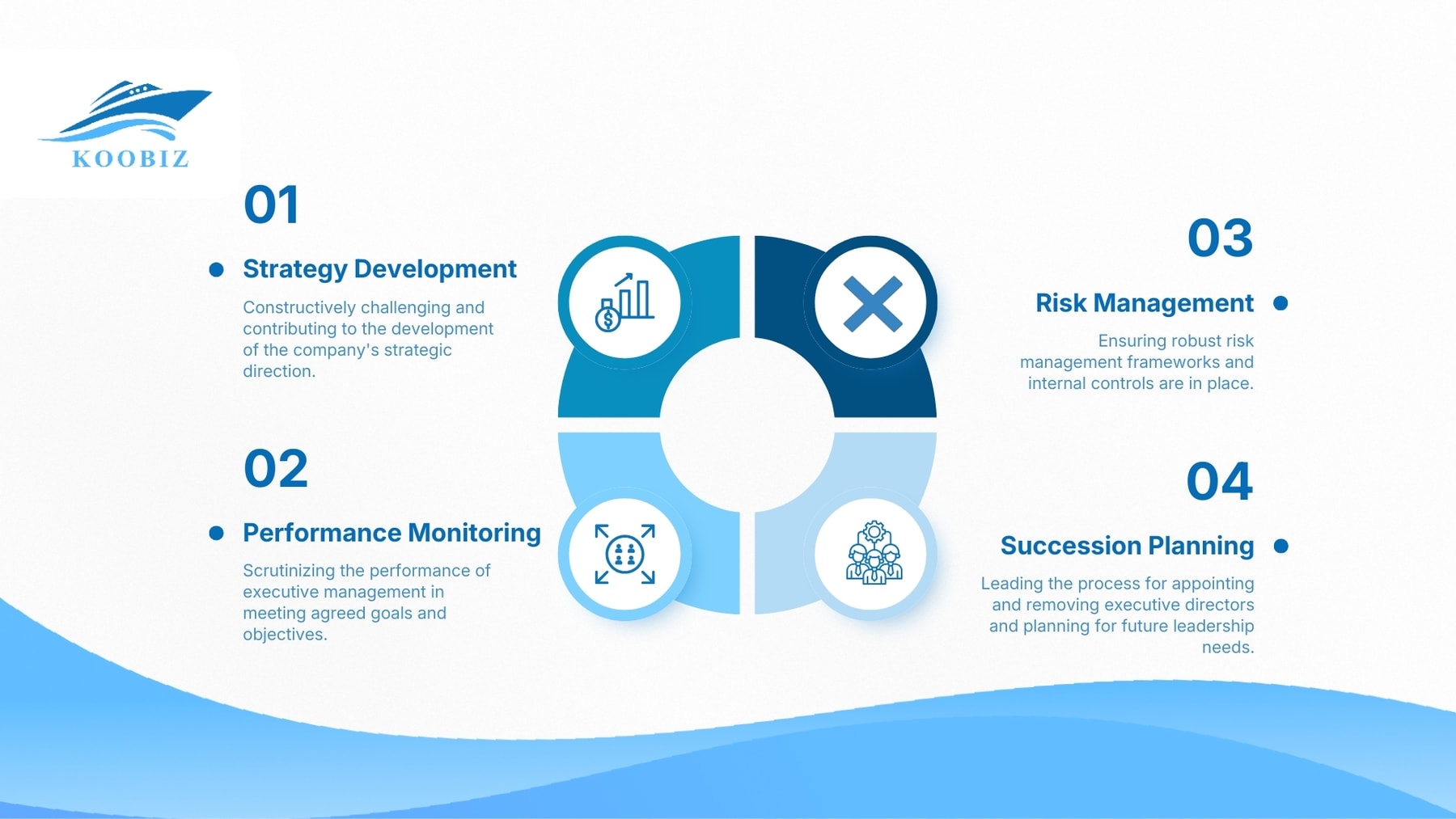
    • Strategy Development: Constructively challenging and contributing to the development of the company’s strategic direction.
    • Performance Monitoring: Scrutinizing the performance of executive management in meeting agreed goals and objectives.
    • Risk Management: Ensuring robust risk management frameworks and internal controls are in place.
    • Succession Planning: Leading the process for appointing and removing executive directors and planning for future leadership needs.

    Duties

    The specific legal and fiduciary obligations required of the role include:

    • Fiduciary Duty: Acting in the best long-term interests of the company and its shareholders.
    • Financial Integrity: Ensuring the accuracy of financial information and systems of risk management are robust and defensible.
    • Compliance: Overseeing compliance with statutory obligations and relevant laws.
    • Remuneration: Determining appropriate levels of executive remuneration and compensation structures.
    The 4 Pillars of a Non-Executive Director
    The 4 Pillars of a Non-Executive Director

    [IMAGE: Đồ họa Infographic hình tròn hoặc sơ đồ tư duy (Mind map) tóm tắt 4 trụ cột trách nhiệm chính của NED: Strategy (Chiến lược), Performance (Hiệu suất), Risk (Rủi ro), và People (Nhân sự/Kế nhiệm). Giúp người đọc hình dung tổng quan công việc.]

    Why Companies Appoint Non-Executive Directors

    At its core, companies appoint Non-Executive Directors to bring independent objectivity to the boardroom. Business leaders often get “tunnel vision” from focusing on daily operations; a NED provides a fresh, unbiased perspective to spot risks and opportunities that insiders might miss.

    Beyond general oversight, companies specifically seek NEDs for these critical scenarios:

    • Bridging Skills Gaps: Bringing specialized expertise (e.g., cybersecurity, ESG, or market expansion) that the current executive team lacks.
    • Enhancing Credibility & Investment: Investors and banks often require an experienced board before providing capital or supporting an IPO.
    • Crisis Management: Providing steady guidance during turbulent times, such as regulatory scrutiny or reputational damage.
    • Succession Planning: Managing the sensitive transition of leadership, particularly in family-owned businesses or when a CEO departs.
    • Mediating Conflicts: Acting as a neutral party to resolve disputes between shareholders and management.

    Executive vs. Non-Executive Directors: What’s the Difference?

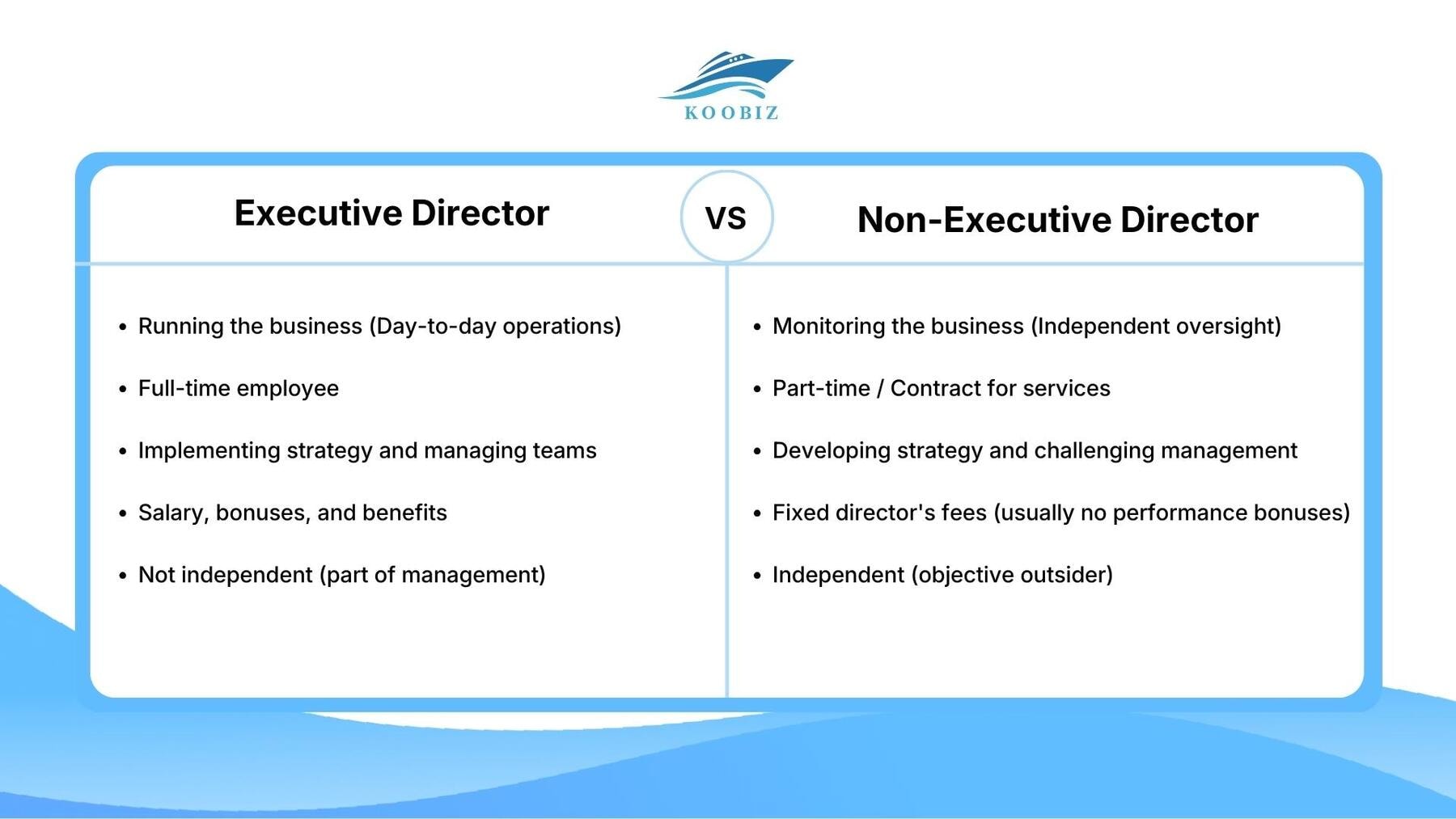
    While both sit on the same board of directors and share equal legal liabilities, their roles differ fundamentally in focus and engagement. The Executive Director is the “doer” managing the company, while the Non-Executive Director is the “monitor” ensuring it is managed correctly.

    [IMAGE: Bảng so sánh trực quan, Bên trái là “Executive Director”, bên phải là “Non-Executive Director”]
    Comparison Table: Executive vs. Non-Executive Directors
    Comparison Table: Executive vs. Non-Executive Directors
    Feature Executive Director Non-Executive Director
    Primary Focus Running the business (Day-to-day operations) Monitoring the business (Independent oversight)
    Employment Status Full-time employee Part-time / Contract for services
    Key Responsibility Implementing strategy and managing teams Developing strategy and challenging management
    Remuneration Salary, bonuses, and benefits Fixed director’s fees (usually no performance bonuses)
    Independence Not independent (part of management) Independent (objective outsider)

    Legal Duties and Liabilities in Singapore

    In Singapore, the law does not distinguish between Executive and Non-Executive Directors; both bear the same fiduciary duties and legal responsibilities under the Companies Act and common law.

    Legal Duties

    Key obligations every NED must uphold include:

    • Duty of Good Faith: You must act honestly and in the best interests of the company, ensuring personal interests do not conflict with business decisions.
    • Duty of Care and Diligence: You are expected to exercise reasonable diligence and skill, monitoring the company’s affairs rather than being a “sleeping director.”
    • Duty of Disclosure: Under Section 156 of the Companies Act, you must disclose any conflicts of interest or property holdings that might compete with the company.
    • Statutory Compliance: Ensuring the company complies with statutory requirements, such as filing annual returns, holding AGMs, and maintaining accurate financial records.

    Liabilities

    Failure to discharge these duties can lead to severe consequences:

    [IMAGE: Hình ảnh minh họa ]

    Legal Responsibility and Penalties
    Legal Responsibility and Penalties
    • Civil Liability: The company or shareholders can sue you for damages to recover losses caused by negligence or breach of trust.
    • Criminal Penalties: Breaching statutory duties is a criminal offense punishable by fines (up to SGD 5,000) or imprisonment (up to 12 months).
    • Disqualification: You may be disqualified from acting as a director for up to 5 years if convicted of serious offenses or for persistent default in filing requirements.
    • Personal Liability: If the company continues trading while insolvent, you may be held personally liable for the debts incurred.

    How to Become a Non-Executive Director in Singapore

    Becoming a NED requires a transition from “operational leadership” to “strategic oversight,” often necessitating a build-up of specific credentials and networks within Singapore’s corporate ecosystem.

    Qualifications and Skills Required

    While there is no single statutory qualification, the following are standard benchmarks for aspiring NEDs:

    • Relevant Experience: A strong track record in C-suite roles or senior management is essential to command respect.
    • Mandatory Training (for Listed Companies): First-time directors of SGX-listed companies must undergo training in the Listed Entity Director (LED) Programme by the Singapore Institute of Directors (SID).
    • Financial Literacy: The ability to read and scrutinize financial statements is non-negotiable for all board members.
    • Specialized Expertise: Modern boards actively seek skills in ESG (Environmental, Social, and Governance), Cybersecurity, Digital Transformation, and Legal/Compliance.
    • Soft Skills: High emotional intelligence (EQ), independence of mind, and the ability to influence without authority.

    The role comes with unique hurdles that differ significantly from executive management:

    • Information Asymmetry: NEDs rely on management for data; they often have less information than executives but share the same legal liability.
    • “Noses In, Fingers Out”: Striking the delicate balance of providing deep oversight (“noses in”) without micromanaging daily operations (“fingers out”).
    • Time Commitment: The role is increasingly demanding, requiring significant time for board preparation, committee meetings (Audit, Remuneration), and crisis management.
    • Liability vs. Control: Bearing full personal liability for company failures (e.g., data breaches, financial fraud) despite having limited control over daily execution.

    Best Practices for Success & Real-World Examples

    To succeed as a Non-Executive Director, one must move beyond simply attending meetings to becoming a proactive “Critical Friend” to the business.

    Best Practices for Success

    • Continuous Education: Regulations change rapidly. Successful NEDs consistently upgrade their skills through SID courses, focusing on emerging risks like ESG and Cybersecurity.
    • The “Critical Friend” Mindset: The ability to challenge management’s assumptions constructively without being adversarial is the hallmark of a great NED.
    • Deep-Dive Diligence: Do not rely solely on board papers. Effective NEDs visit company sites, speak to employees, and understand the “ground reality” of the business.
    • Active Listening: In the boardroom, the power of a NED often lies in asking the right question rather than giving the right answer.

    Real-World Examples & Archetypes

    • The “Industry Titan” (e.g., Mr. Koh Boon Hwee): A prominent figure in Singapore (serving on boards like SGX, GIC, and Agilent), he exemplifies the Strategic NED who brings immense credibility, networks, and high-level vision to multiple diverse organizations.
    • The “Governance Guardian” (e.g., Tan Huay Lim): Often a former audit partner or CFO, this NED archetype chairs Audit Committees (like at Sheng Siong or REIT managers), ensuring that financial reporting is rigorous and minority shareholders are protected.
    • The “Transformation Specialist”: A modern archetype where a tech veteran joins the board of a traditional bank or retailer specifically to guide digital transformation and challenge legacy thinking.

    Independent Directors vs. Non-Executive Directors

    It is a common misconception that these terms are interchangeable. While all Independent Directors are Non-Executive Directors, not all Non-Executive Directors are Independent.
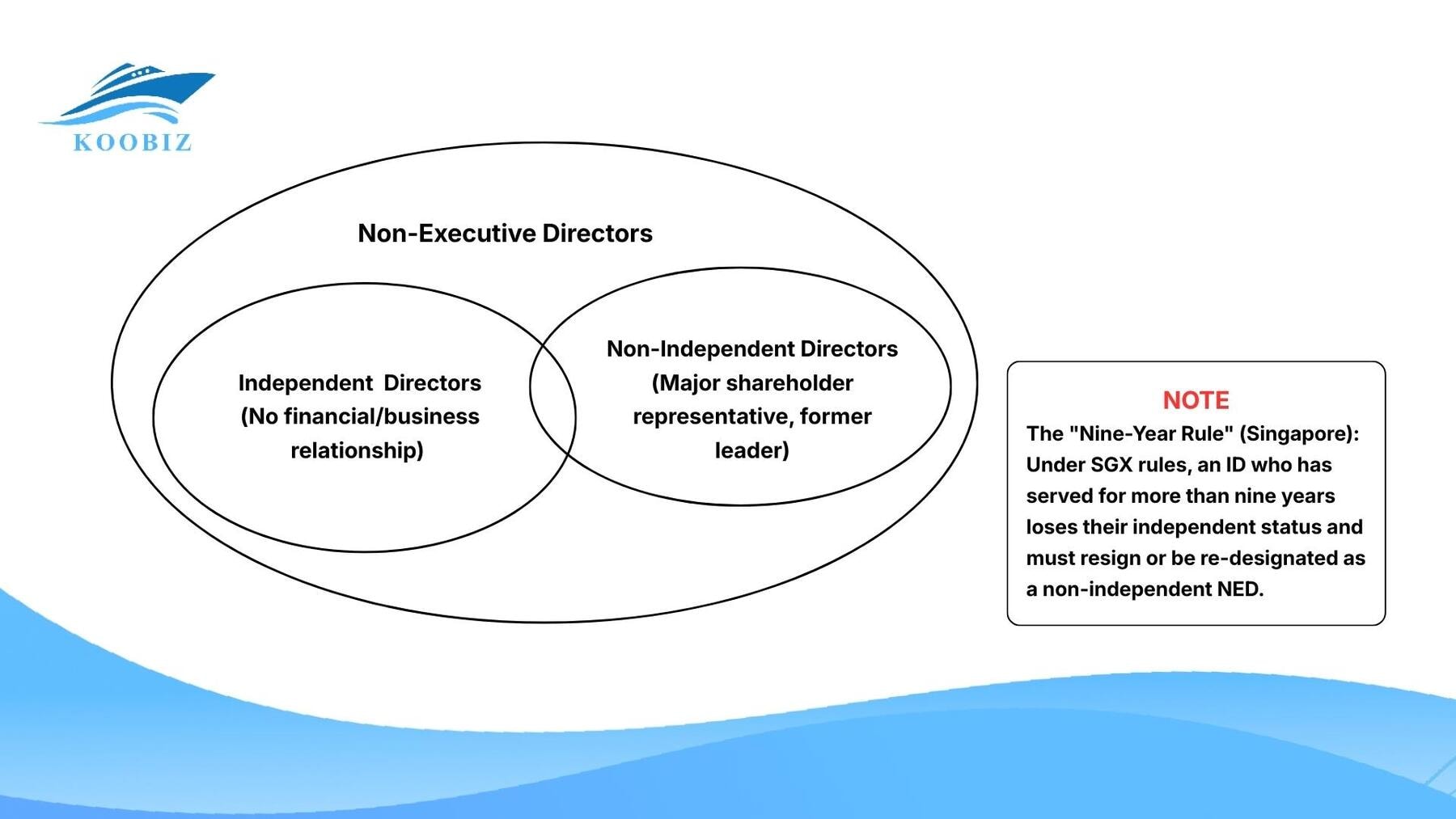
    Independent Directors vs. Non-Executive Directors
    Independent Directors vs. Non-Executive Directors

    [IMAGE: Biểu đồ Venn hoặc sơ đồ phân loại (Classification Diagram). Vòng tròn lớn là “Non-Executive Directors”, bên trong chia thành 2 nhóm: “Independent” (Không có quan hệ tài chính/kinh doanh) và “Non-Independent” (Đại diện cổ đông lớn, cựu lãnh đạo). Ghi chú thêm quy tắc “9 năm” (9-Year Rule) tại Singapore để làm rõ ranh giới độc lập.]

    Independent Directors (IDs)

    An Independent Director is a NED who has no material relationship with the company, its related corporations, 10% shareholders, or its officers that could interfere with their exercise of independent business judgment.

    • Key Requirement: They must be free from any business or financial connection (other than board fees and shareholdings).
    • The “Nine-Year Rule” (Singapore): Under SGX rules, an ID who has served for more than nine years loses their independent status and must resign or be re-designated as a non-independent NED.
    • Role: Critical for protecting minority shareholders and staffing key committees (Audit, Nominating, Remuneration).

    Non-Independent Non-Executive Directors (NI-NEDs)

    A Non-Independent NED is a director who does not work in the company (is “Non-Executive”) but has a relationship that compromises their independence.

    • Scenario 1: The Major Shareholder. A significant investor (or their representative) sits on the board to monitor their personal investment. They are non-executive but lack independence due to financial bias.
    • Scenario 2: The Former Insider. A former CEO stays on the board after retirement to provide continuity. They are non-executive but lack independence due to their historical ties and relationships with current management.
    • Role: They provide oversight and strategic input but cannot be counted towards the “independent” quota required by corporate governance codes.
    FAQs About Non-Executive Directors in Singapore

    Can a foreigner be a Non-Executive Director in Singapore?

    Yes, a foreigner can act as a NED. However, under the Companies Act, every Singapore company must have at least one director who is “ordinarily resident” in Singapore. Foreigners typically serve as additional directors alongside a local resident director.

    Is there a limit to the number of directorships one can hold?

    There is no statutory “hard cap” in the Companies Act. However, for SGX-listed companies, the Nominating Committee must assess whether a director with multiple board representations is able to adequately discharge their duties. If a director holds a significant number of directorships, they must convince the board they have sufficient time and capacity.

    Do Non-Executive Directors have less liability than Executive Directors?

    No. In Singapore law, all directors have the same fiduciary duties and liabilities. A NED can be sued or criminally charged just like an Executive Director if they fail to exercise reasonable diligence. The law does not accept “I was just a non-executive” as a valid defense for negligence.

    How much are Non-Executive Directors paid in Singapore?

    Remuneration varies widely by company size and industry. For small-to-mid-cap listed companies, fees often range from SGD 40,000 to SGD 80,000 annually. For large-cap companies or banks, fees can exceed SGD 100,000 to SGD 200,000+. Unlike executives, NEDs typically receive fixed fees and do not get performance bonuses to preserve their independence.

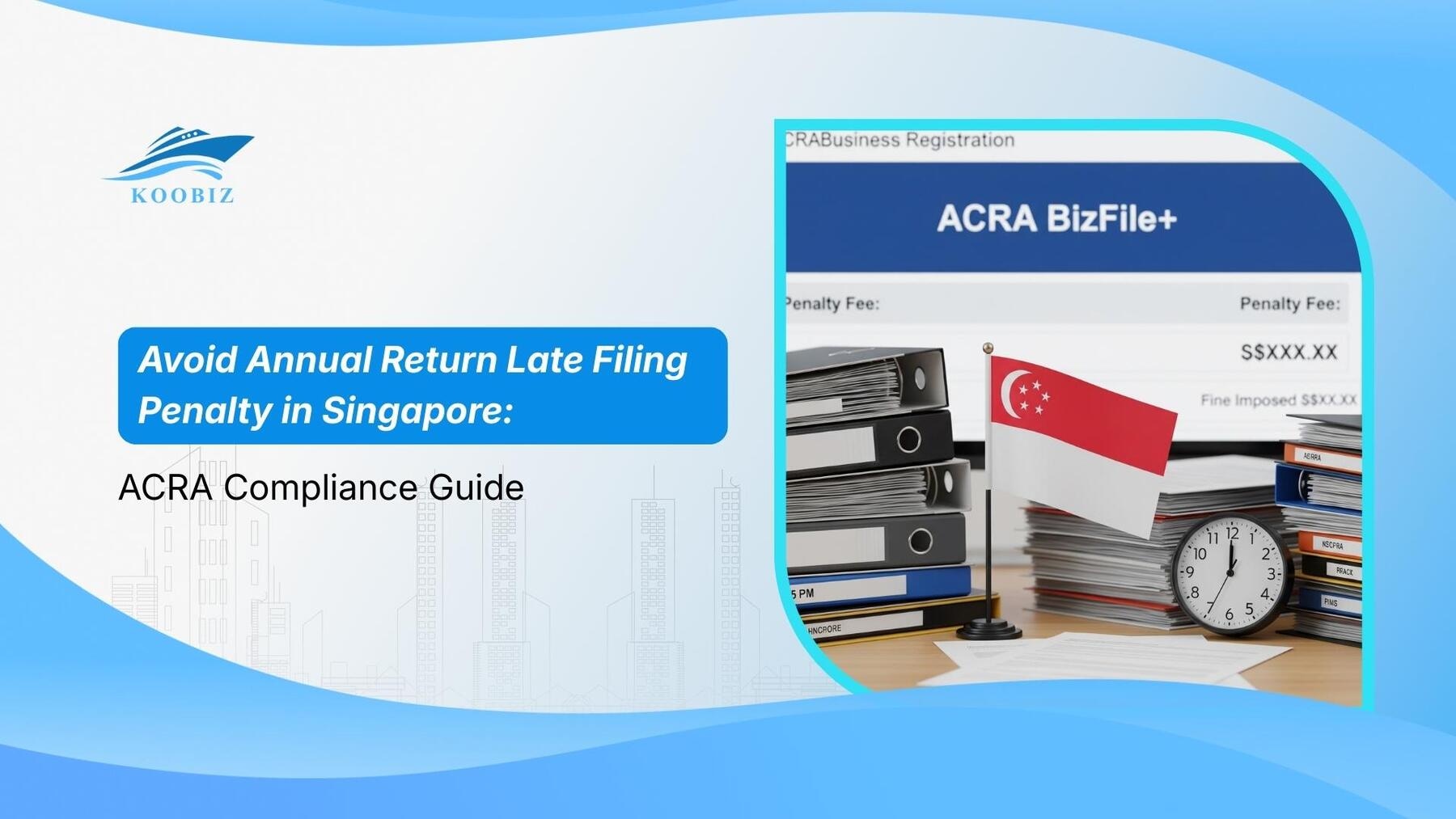
  • Avoid Annual Return Late Filing Penalty in Singapore: ACRA Compliance Guide

    Avoid Annual Return Late Filing Penalty in Singapore: ACRA Compliance Guide

    [SUMMARIES]

    Penalty Tiers: A fixed $300 fine applies if your filing is up to 3 months late, rising to $600 for delays beyond that.

    Deadlines: For most private companies, the Annual Return must be filed within 7 months after your company’s financial year ends.

    Director Liability: This isn’t just a company fee. Directors may be summoned to court or disqualified if non-compliance persists.

    Immediate Action: The penalty must be paid immediately via BizFile+ at the point of filing to prevent escalation.

    Appeals: Getting a penalty waived is very uncommon. ACRA typically only considers requests in cases of proven system errors, not simple oversight or a busy schedule.

    [/SUMMARIES]

    For business owners in Singapore, receiving a notification about an Annual Return late filing penalty can be a source of significant anxiety. It’s not just about the fee—it’s a compliance issue that, if ignored, can lead to court action and affect a director’s ability to serve.

    At Koobiz, we understand that ACRA requirements can feel overwhelming, especially for new founders or overseas business owners. Whether you operate a local startup or an international subsidiary, understanding your filing deadlines and penalty exposure is essential to keeping your company in good standing.

    This guide is your straightforward resource for fixing and avoiding these penalties. We’ll explain the exact fines, how the system works, the deadlines based on your company’s financial year, and what happens if these legal duties are overlooked. We’ll also clear up the common mix-up between ACRA and tax filings, giving you a clear path to staying compliant.

    What is the ACRA Annual Return Late Filing Penalty?

    The ACRA Annual Return late filing penalty is a statutory fine imposed on companies that fail to lodge their Annual Return (AR) within the prescribed timeline. Think of it this way:

    • Statutory Mandate: Under Section 197 of the Companies Act, every company is legally required to file an AR to confirm its particulars (officers, address, financial status) are up to date.
    • Automatic Enforcement: The system flags a late filing immediately; no manual review is needed to issue the initial fine.
    • Public Register Integrity: The penalty ensures public records are timely and reliable for anyone checking a company’s status.
    • Distinct from Tax: Unlike IRAS tax returns which focus on income, the Annual Return focuses on corporate governance and solvency. Many Koobiz clients often confuse the two, leading to accidental non-compliance.
    • Director Responsibility: While the fine is charged to the company, the legal duty to ensure it’s filed and paid falls on the directors.

    How Much is the Late Lodgement Fee and Composition Sum?

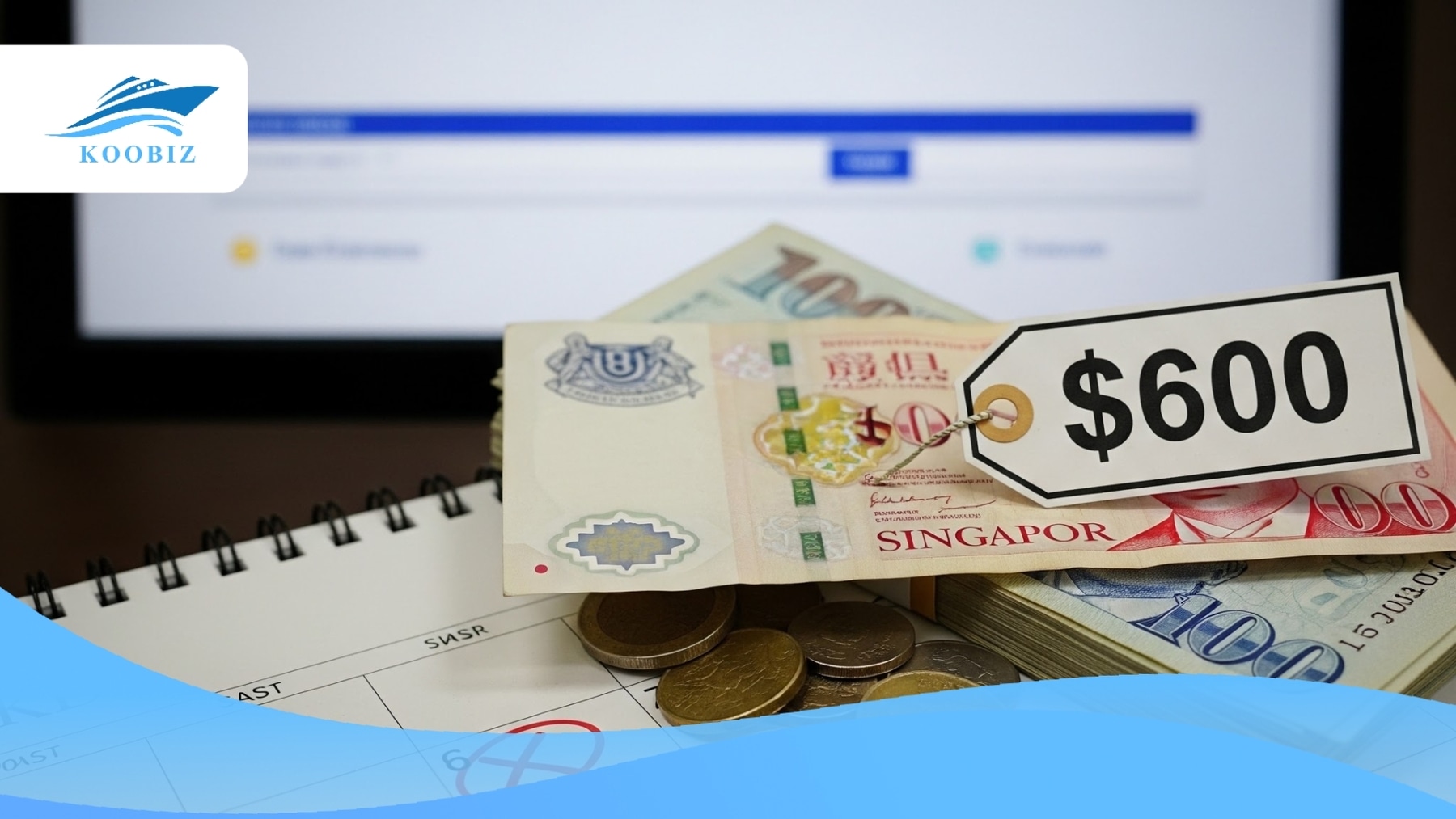
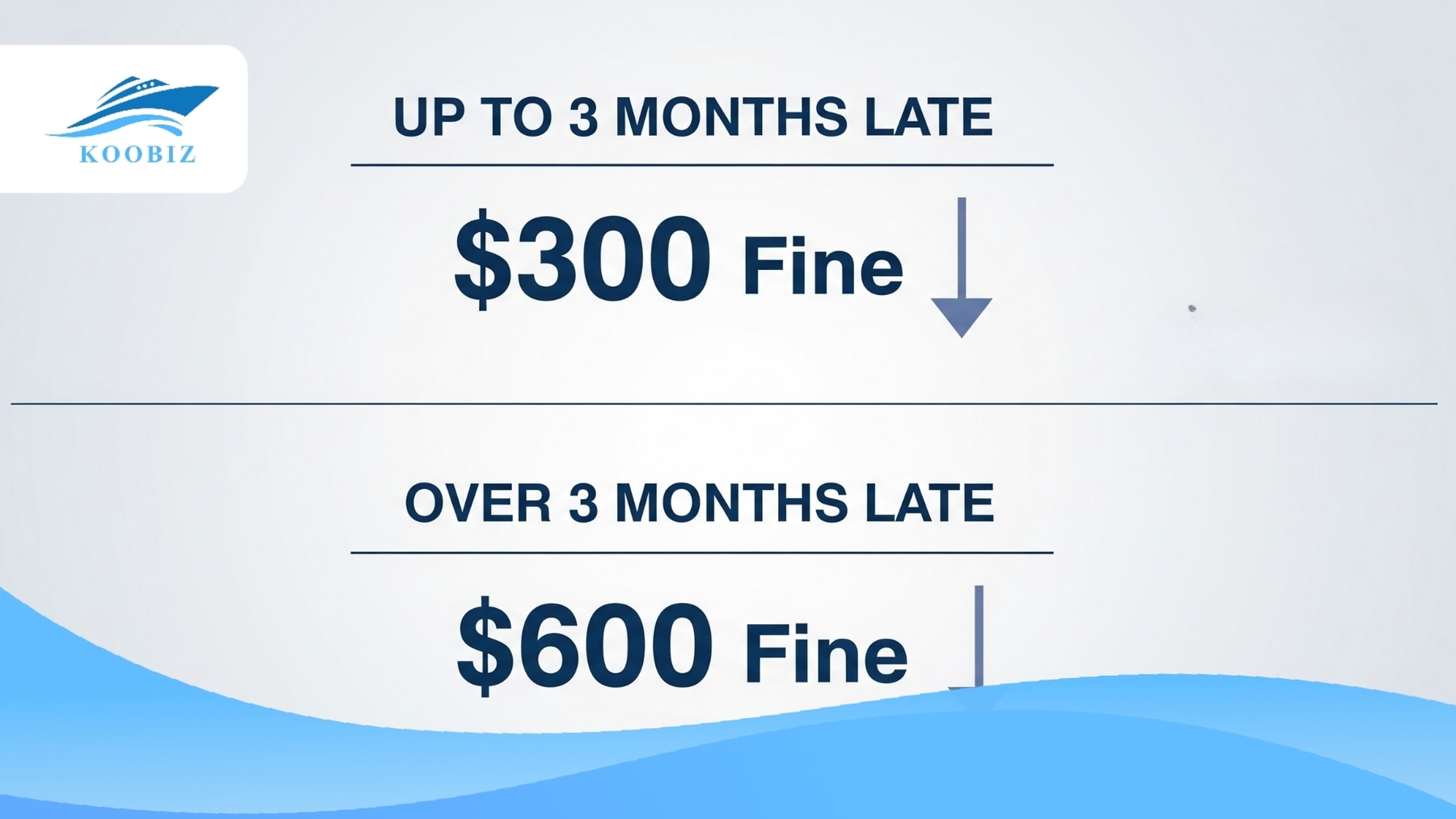
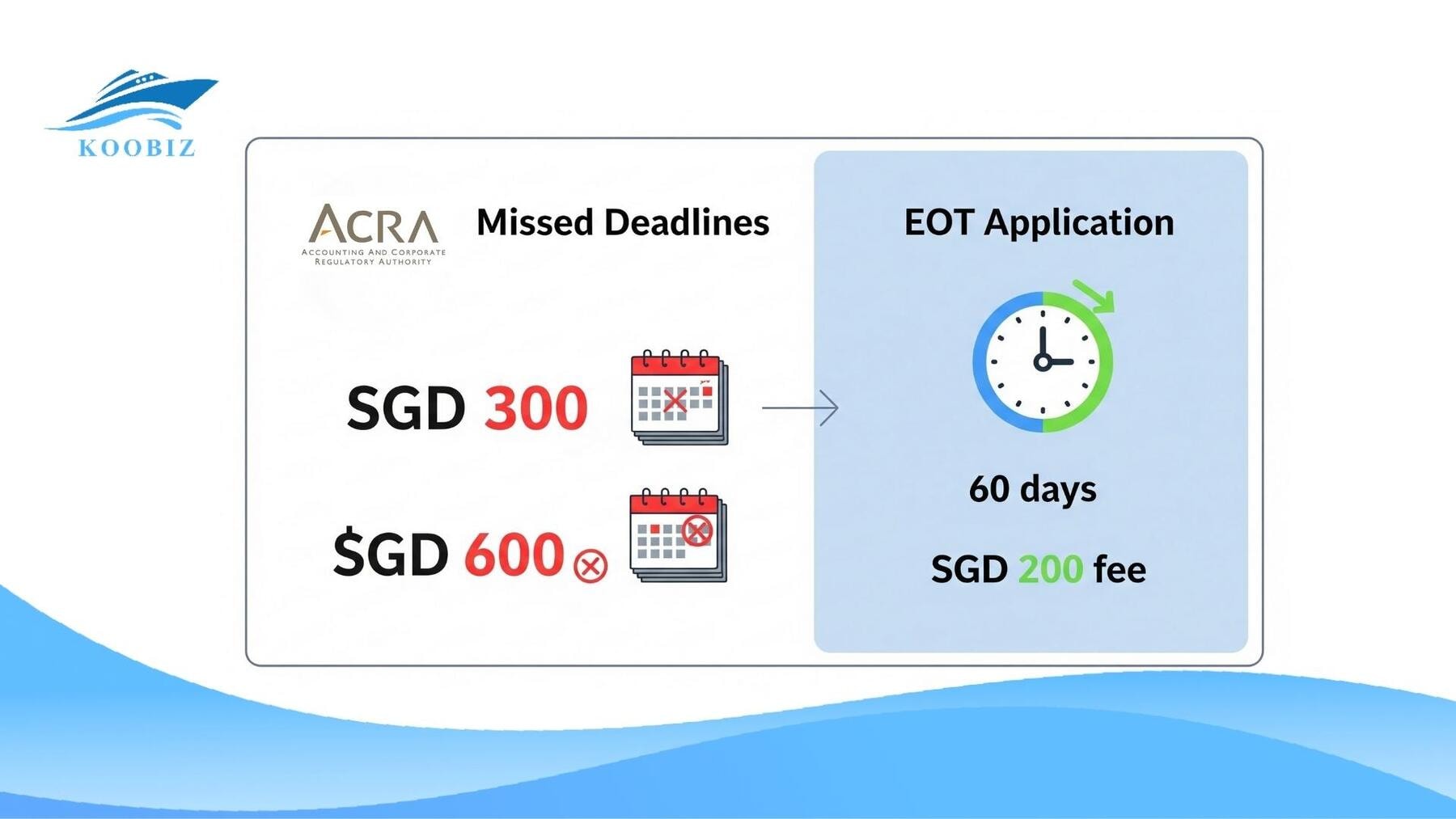
    There are two primary tiers for the late lodgement penalty: a $300 flat fee for filings made within 3 months of the deadline, and a $600 flat fee for filings made after 3 months.

    Specifically, the cost depends on the duration of the delay. ACRA simplified this framework effective April 30, 2021, to encourage quicker rectification of breaches. Previously, penalties accumulated on a monthly basis, which could lead to confusion. The current 2-tier system is straightforward but punitive enough to discourage negligence.

    • Tier 1 ($300): If you miss your deadline but file the Annual Return within 3 months (90 days) of the due date, the penalty is capped at $300. This is legally referred to as a “Composition Sum”, essentially an offer to settle the offense out of court by paying a fixed amount.
    • Tier 2 ($600): If the delay exceeds 3 months, the penalty doubles to $600. This is the maximum administrative penalty ACRA will impose via the BizFile+ system before potentially escalating the matter to prosecution.

    Importantly, penalties are imposed per breach. In many cases, companies that miss their Annual Return deadline have also failed to hold their Annual General Meeting (AGM) on time. Each breach can attract a separate composition sum. As a result, directors may face up to $1,200 in total penalties, $600 for the AGM breach and $600 for the AR breach. Koobiz advises clients to view the $600 cap not as a safety net, but rather as ACRA’s final administrativewarning before court action is initiated.

    Note: As of late 2025, ACRA continues to enforce this 2-tier framework strictly. Ignoring the Tier 2 penalty often results in a summons to court.

    When is the Annual Return Deadline Due?

    Your deadline isn’t a fixed calendar date. It’s calculated from your company’s own Financial Year End (FYE).

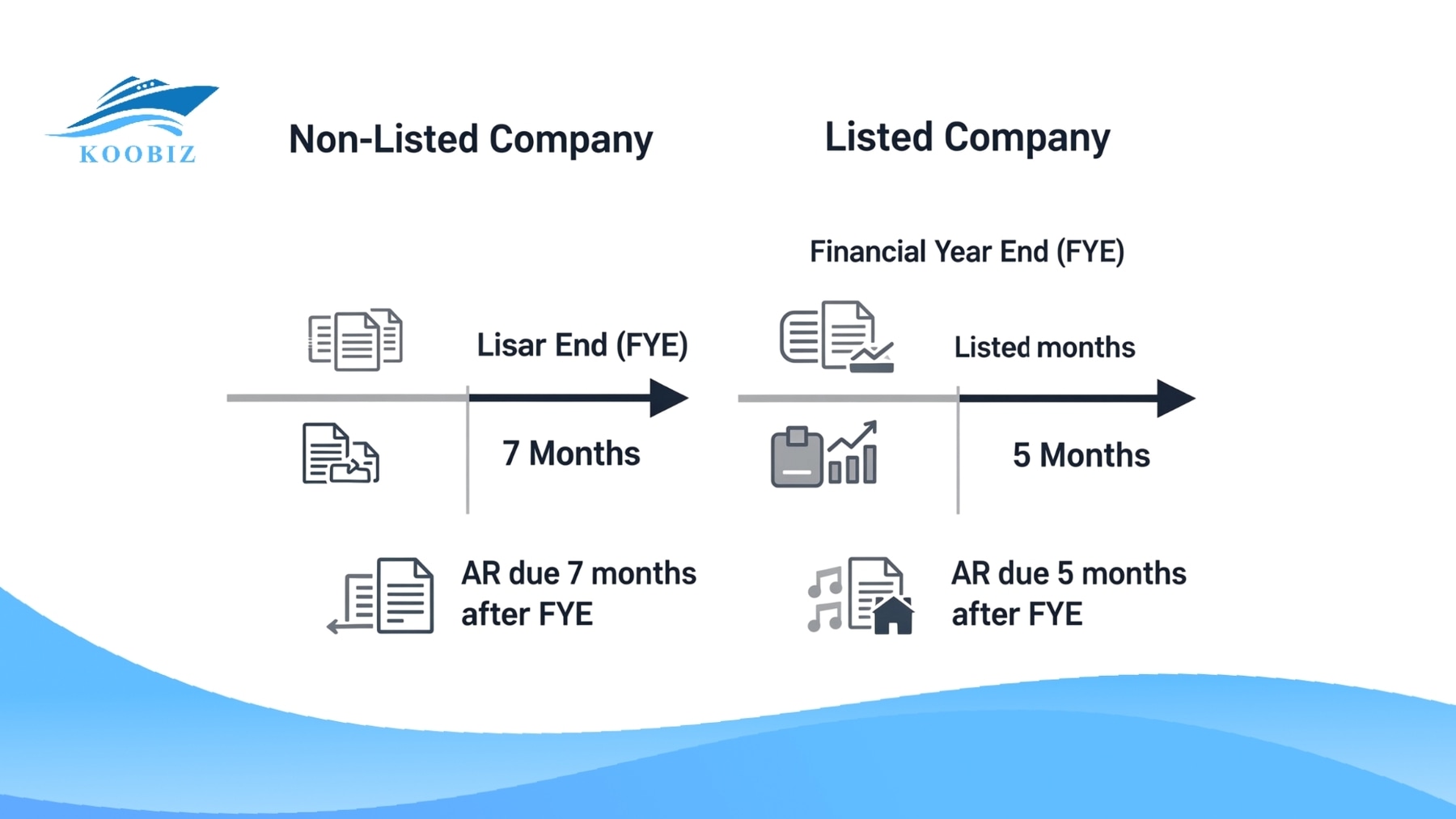
    • For Non-Listed Companies (Private Limited): You must file your Annual Return within 7 months after your FYE. For example, if your FYE is 31 December, your Annual Return is due by 31 July of the following year.
    • For Listed Companies: The timeline is tighter. You must file within 5 months after your FYE.

    Key Detail: The 7-month AR deadline assumes you have complied with AGM requirements. For most private companies, the AGM must be held within 6 months after the FYE. If the AGM is delayed (or forgotten), the AR filing will almost certainly become late as well, triggering penalties for both breaches.

    Real-World Scenarios: Calculating Deadlines and Penalties

    To make these rules easier to digest, let’s look at three common scenarios we encounter at Koobiz. These examples illustrate how the Financial Year End (FYE) dictates the deadline and how the penalty tiers are applied in practice for a standard Private Limited Company.

    Scenario 1: The “Just Missed It” Startup (Tier 1 Penalty)

    • Company: TechStart Solutions Pte. Ltd.
    • Financial Year End (FYE): 31 December 2023.
    • Correct Deadline: 31 July 2024 (7 months after FYE).
    • Actual Filing Date: 15 August 2024.
    • The Breach: The filing is 15 days late.
    • The Penalty: $300.
    • Koobiz Insight: Even a short delay counts. Once the deadline is missed, even by a single day, the filing automatically falls into the “within 3 months” penalty tier. ACRA does not calculate penalties by the number of days late; the full $300 applies immediately.

    Scenario 2: The Major Oversight (Tier 2 Penalty)

    • Company: Global Trade Holdings Pte. Ltd.
    • Financial Year End (FYE): 31 March 2023.
    • Correct Deadline: 31 October 2023.
    • Actual Filing Date: 5 February 2024.
    • The Breach: The filing is over 3 months late (approx. 95 days late).
    • The Penalty: $600.
    • Koobiz Insight:Once the delay crosses the 3-month mark, the penalty automatically increases to $600. More importantly, leaving the breach unresolved for an extended period significantly raises the risk of a court summons, exposing directors to prosecution and potential disqualification.

    Scenario 3: The “Tax vs. ACRA” Confusion

    • Company: Creative Design Agency Pte. Ltd.
    • The Situation: The foreign director successfully filed the Corporate Tax Return (Form C-S) with IRAS by the 30 November deadline and assumed all government compliance was complete.
    • The Mistake: They neglected the ACRA Annual Return, which was due earlier on 31 July.
    • The Outcome: Despite paying their taxes on time, the company was flagged as “Non-Compliant” by ACRA and incurred a $600 late filing penalty because the error was only discovered 5 months later.
    • Lesson: IRAS tax filing and ACRA Annual Return filing are separate obligations with different deadlines. Being compliant with IRAS does not mean you are compliant with ACRA.

    Steps to File Late Annual Return and Pay Penalties via BizFile+

    Follow these three key steps to resolve the issue:

    Step 1: Log in to BizFile+

    Access the BizFile+ portal using your Corppass login. You must be an authorized director, company secretary, or a registered filing agent.

    Step 2: Navigate to Annual Return

    Select “File Annual Return by Local Company” and complete all the required information accurately.

    Step 3: Acknowledge and Pay

    The system will auto-calculate the late fee ($300 or $600). Acknowledge and pay immediately via card or GIRO to complete the filing. Once payment is made, your company’s compliance status will be updated.

    What are the Consequences of Ignoring the ACRA Penalty?

    Ignoring the penalty escalates the issue from a simple fine to a serious legal problem for the company’s directors.

    Can Directors Face Court Prosecution and Disqualification?

    Yes, directors can face personal court prosecution and, upon conviction, may be disqualified or debarred from acting as a director in Singapore. There are two main risks for directors:

    Under the Companies Act, if a director fails to comply with the requirement to file Annual Returns, ACRA can issue a summons to attend court. The specific consequences include:

    • Court Fines: The court can impose fines significantly higher than the $600 composition sum, potentially up to $5,000 per offense.
    • Disqualification (Section 155): A director faces disqualification for “persistent default.” This occurs if you are convicted of three or more filing offenses within a 5-year period, or have three or more enforcement orders made against you.
    • Debarment (Section 155B): This is a swifter enforcement tool. The Registrar can debar a director if they fail to lodge any document for at least 3 months after the deadline. Unlike disqualification, you do not need multiple convictions; a single prolonged default can trigger this, preventing you from taking on new appointments as a director or secretary.
    • Section 155A: Additionally, a director can be disqualified if they were a director of at least three companies which were struck off within a 5-year period (where the striking off was initiated by ACRA).

    At Koobiz, we stress that director enforcement records are publicly accessible. A disqualification is not a private administrative matter, it permanently damages your professional standing. Such records are routinely reviewed during bank due diligence and compliance checks, making it extremely difficult to open corporate bank accounts or conduct regulated business in Singapore and other major financial centres.

    Will the Company Be Struck Off for Non-Filing?

    • Yes. Where a company repeatedly fails to file its statutory returns, ACRA may presume that the company is no longer carrying on business and initiate strike-off proceedings. Once struck off, the company ceases to exist as a legal entity. All bank accounts are frozen, contractual rights lapse, and remaining assets may vest in the state. Restoring a struck-off company is possible only through a court-led reinstatement process, which is time-consuming, costly, and subject to judicial discretion.

    Can You Appeal for a Waiver of the Late Filing Penalty?

    Yes, but only under extremely specific and rare conditions, such as a proven technical glitch in the ACRA system or a court order extending the deadline.

    While penalties are strict, there is a narrow window for appeal, though “forgetfulness” or “not knowing the law” are never accepted as valid reasons.

    • Invalid Reasons: “My accountant resigned,” “I was overseas,” “I didn’t receive the reminder email,” or “The company made no profit.” These are considered management failures, not valid excuses.
    • Valid Reasons: Proven system failure of BizFile+ (requires screenshots/logs), loss of essential records due to fire or theft (requires police report), or critical illness of the sole director (requires medical evidence).

    Appeals must be lodged via BizFile+ or written to ACRA directly. However, based on Koobiz‘s experience, the success rate for waivers is very low unless the evidence is irrefutable. It is often more cost-effective to pay the composition sum and move on.

    Difference Between ACRA Annual Return and IRAS Tax Filing Penalties

    ACRA penalties target the governance and structural reporting of the entity, whereas IRAS penalties strictly target the reporting of taxable income and corporate tax liability. It is crucial not to conflate the two.

    Feature ACRA (Annual Return) IRAS (Tax Filing – Form C-S/C)
    Primary Focus Governance, shareholders, officers, and solvent financial status. Reporting of taxable income and corporate tax liability.
    Enforcement Authority Accounting and Corporate Regulatory Authority (ACRA). Inland Revenue Authority of Singapore (IRAS).
    Deadline Depends on FYE (e.g., 7 months after FYE for non-listed). Fixed deadline (typically 30 November).
    Late Penalty Fixed tiers: $300 (Tier 1) or $600 (Tier 2). Varies: Composition fines to court prosecution under tax evasion laws.
    Relationship Filing here does not satisfy IRAS requirements. Filing here does not satisfy ACRA requirements.

    According to Singapore regulatory data, a significant portion of compliance breaches involving foreign-owned companies stem from confusing the Annual Return with the Tax Return.

    Frequently Asked Questions (FAQs)

    1. Can I apply for an extension of time (EOT) to file my Annual Return?

    Yes, you can apply for a 60-day Extension of Time (EOT) on BizFile+ before your original deadline, for a fee of $200. An EOT applied for after the deadline will not cancel an already-incurred late filing penalty.

    2. Does paying the composition sum remove the breach from my record?

    Paying the fee settles that specific offense and stops court action. However, ACRA’s system will still show that the filing was submitted late. Multiple late filings can label a director as a “persistent defaulter.”

    3. What if my company is dormant? Do I still need to file?

    Yes, even dormant companies must file an Annual Return, though they may qualify for a simpler process. Not filing will still result in the same late penalties.

    Conclusion

    Staying compliant in Singapore’s business environment requires attention to detail. The Annual Return late filing penalty is a sign that your company’s administrative health needs a check-up. Whether it’s a $300 fee or the risk of director disqualification, the consequences of inaction are far greater than the effort of staying organized.

    At Koobiz, we help business owners stay fully compliant so they can focus on growth with confidence. From company incorporation and corporate bank account opening to ongoing tax, accounting, audit, and company secretarial services, our team ensures that no deadline is missed. If you are currently facing a late filing issue or require a professional Company Secretary to manage your Annual Returns, contact Koobiz today for a complimentary compliance health check. Avoid unnecessary penalties, let us handle the paperwork for you.

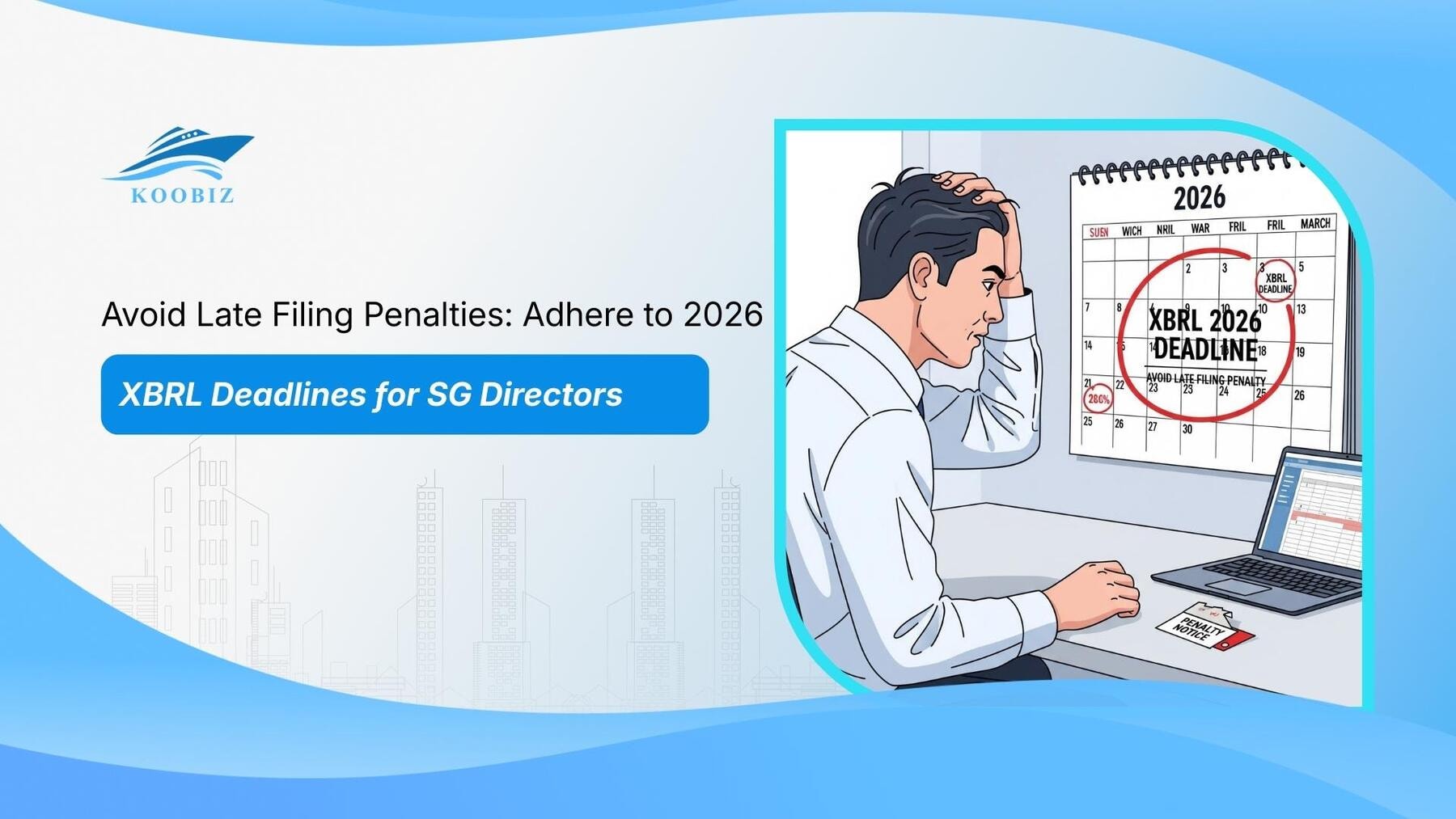
  • Avoid Late Filing Penalties: Adhere to 2026 XBRL Deadlines for SG Directors

    Avoid Late Filing Penalties: Adhere to 2026 XBRL Deadlines for SG Directors

    [SUMMARIES]

    Mandatory Compliance: Most Singapore companies must file financial statements in XBRL format via BizFile+ in 2026 based on their FYE.

    The 7-Month Rule: Private Limited companies generally have 7 months from their Financial Year End to file Annual Returns.

    High Stakes: Late filing results in escalating fees ($300–$600) and potential director debarment for chronic non-compliance.

    Exemptions Exist: Solvent Exempt Private Companies (EPCs) and Dormant companies have simplified filing options.

    Recovery Options: Extensions of Time (EOT) can be applied for before the deadline to avoid immediate penalties.

    [/SUMMARIES]

    In 2026, Singapore’s regulatory regime remains strict, with ACRA enforcing firm deadlines for Annual Return and XBRL filings. For directors, meeting these timelines is not merely administrative – it is essential to avoid penalties and preserve a strong compliance record. Whether you operate a Private Limited Company or a Solvent EPC, missed deadlines can result in substantial financial consequences.

    At Koobiz, we’ve prepared this practical guide to help you determine your exact filing deadline, understand applicable fines, and assess available exemptions.

    Is XBRL filing mandatory for Singapore Companies in 2026?

    Yes. In 2026, most Singapore-incorporated companies are required to file financial statements in XBRL format unless they qualify for a specific exemption. ACRA mandates XBRL to enhance transparency and enable efficient financial analysis.

    This requirement applies to both unlimited and limited-by-shares companies. If your company is insolvent or does not qualify as a Solvent Exempt Private Company (EPC), a full set of XBRL financial statements must be lodged via ACRA BizFile+ portal. Even where the FYE falls in late 2025, the filing obligation typically arises in 2026. Failure to submit the correct XBRL file with the Annual Return will result in immediate rejection and non-compliance.

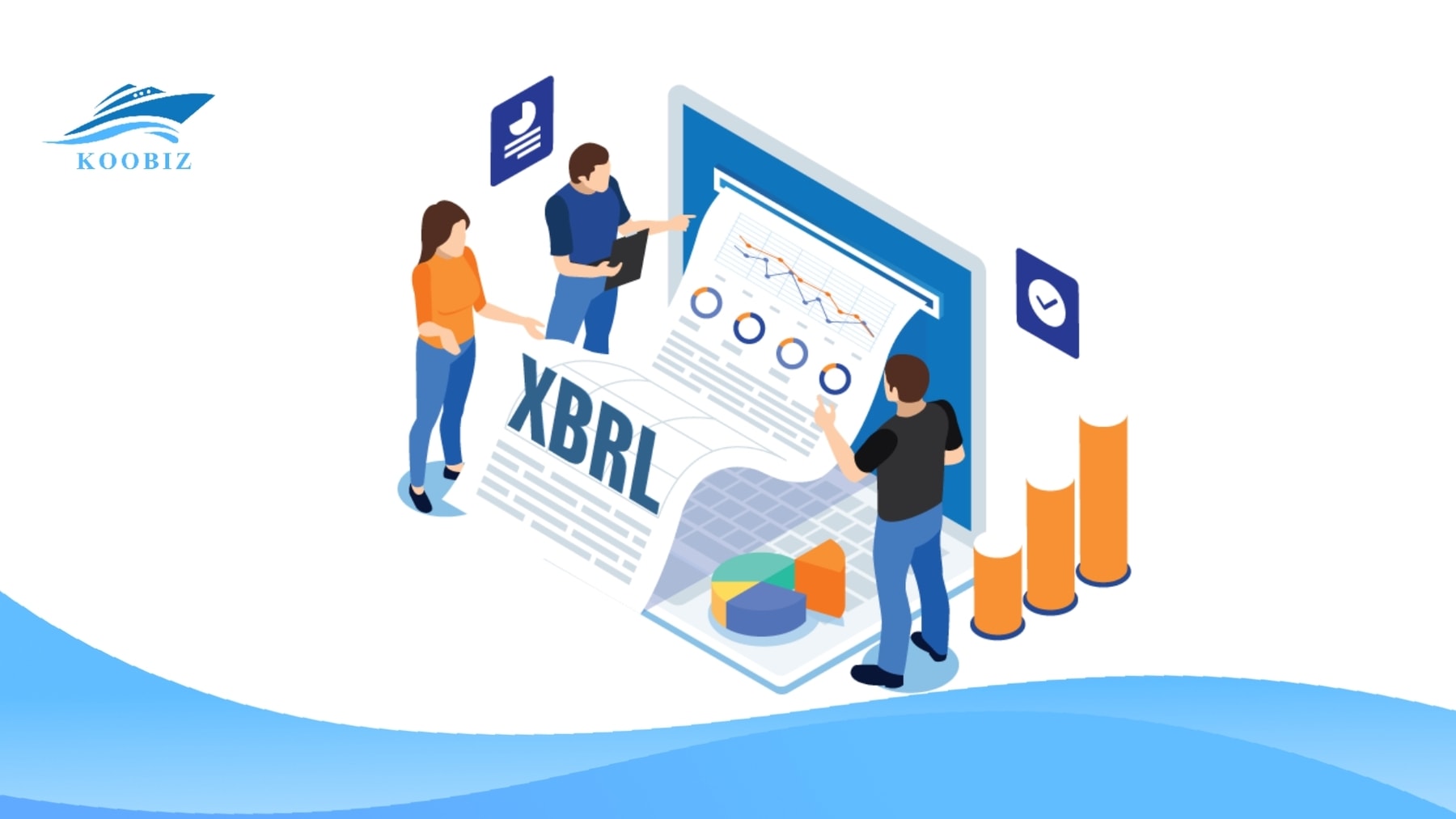
    XBRL filing
    XBRL filing

    2026 XBRL Filing Schedule: Deadlines Based on FYE

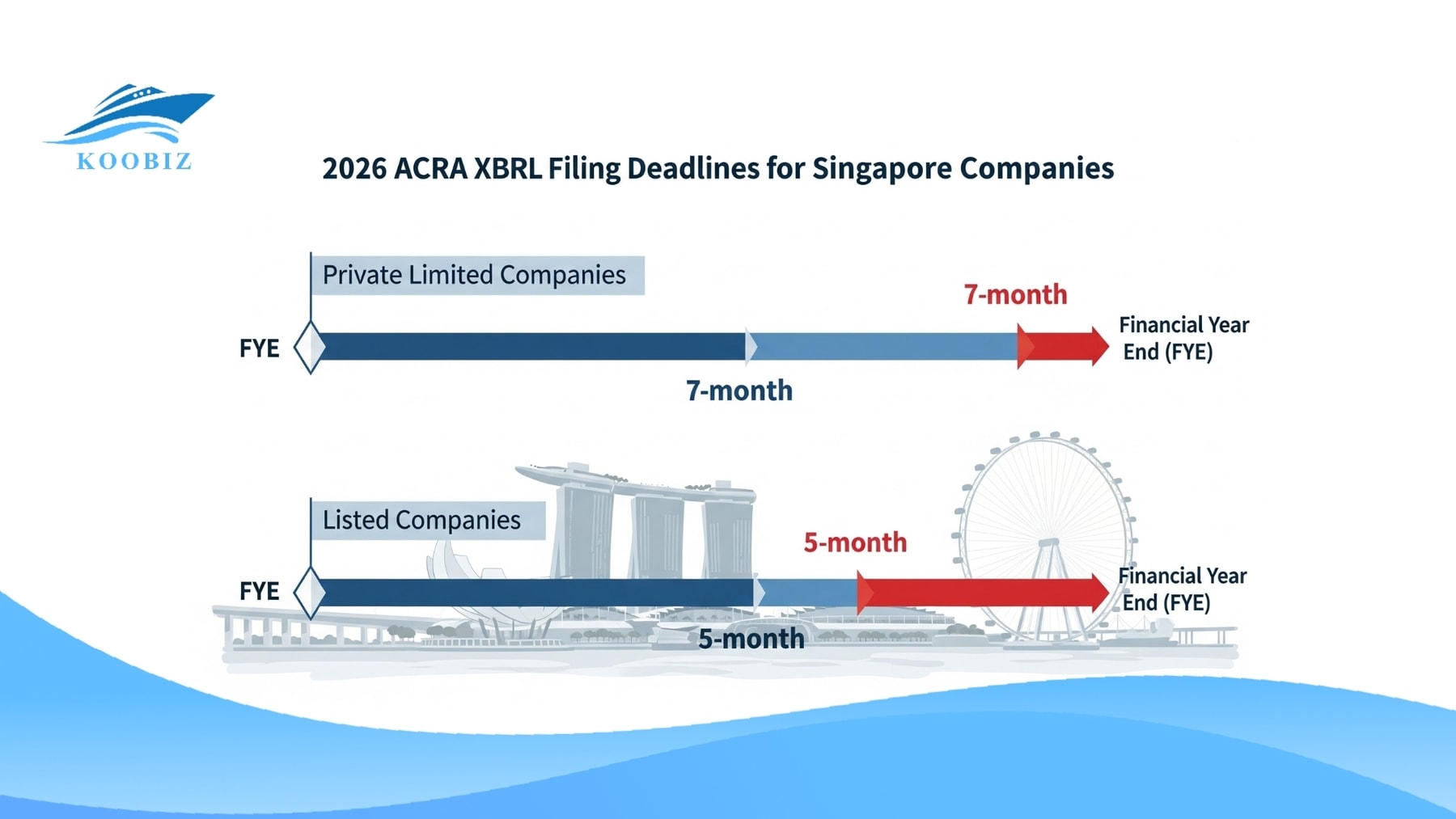
    In 2026, Annual Return filing deadlines (including XBRL) fall into two separate timelines, depending on whether the company is listed or non-listed.

    To avoid missing the deadline, directors must determine the filing date based on the company’s Financial Year End (FYE), applying the standard rule that combines the permitted AGM period with the statutory filing window.

    Deadlines Based on FYE
    Deadlines Based on FYE
    Company Type AGM Deadline (from FYE) Annual Return Deadline (from FYE) Example (FYE 31 Dec 2025)
    Private Limited (Non-listed) 6 months 7 months AGM by 30 Jun 2026

    File by 30 Jul 2026

    Listed Company 4 months 5 months AGM by 30 Apr 2026

    File by 30 May 2026

    Private Limited Companies: The 7-Month Rule Explained

    Private Limited Companies must complete their Annual Return filing within 7 months from the Financial Year End. This period covers two statutory steps: holding the AGM within 6 months of the FYE, followed by filing the Annual Return (including XBRL) within 30 days after the AGM.

    For instance, with an FYE of 31 December 2025, the AGM must be held by 30 June 2026, and the final filing deadline falls on 30 July 2026. Koobiz recommends preparing the XBRL conversion at least one month before the AGM to ensure accuracy ahead of directors’ approval.

    Listed Companies: Stricter timelines for 2026

    Listed companies in Singapore operate under a shorter timeline, with only 5 months from the Financial Year End to complete their filings. They must hold the AGM within 4 months of the FYE and lodge the Annual Return, including XBRL, within 30 days thereafter.

    For example, with an FYE of 31 December 2025, the AGM must be held by 30 April 2026 and the XBRL filing completed by 30 May 2026. This compressed timeline requires efficient reporting processes to meet the heightened compliance expectations of public entities.

    Updated ACRA penalties for late lodgment in 2026

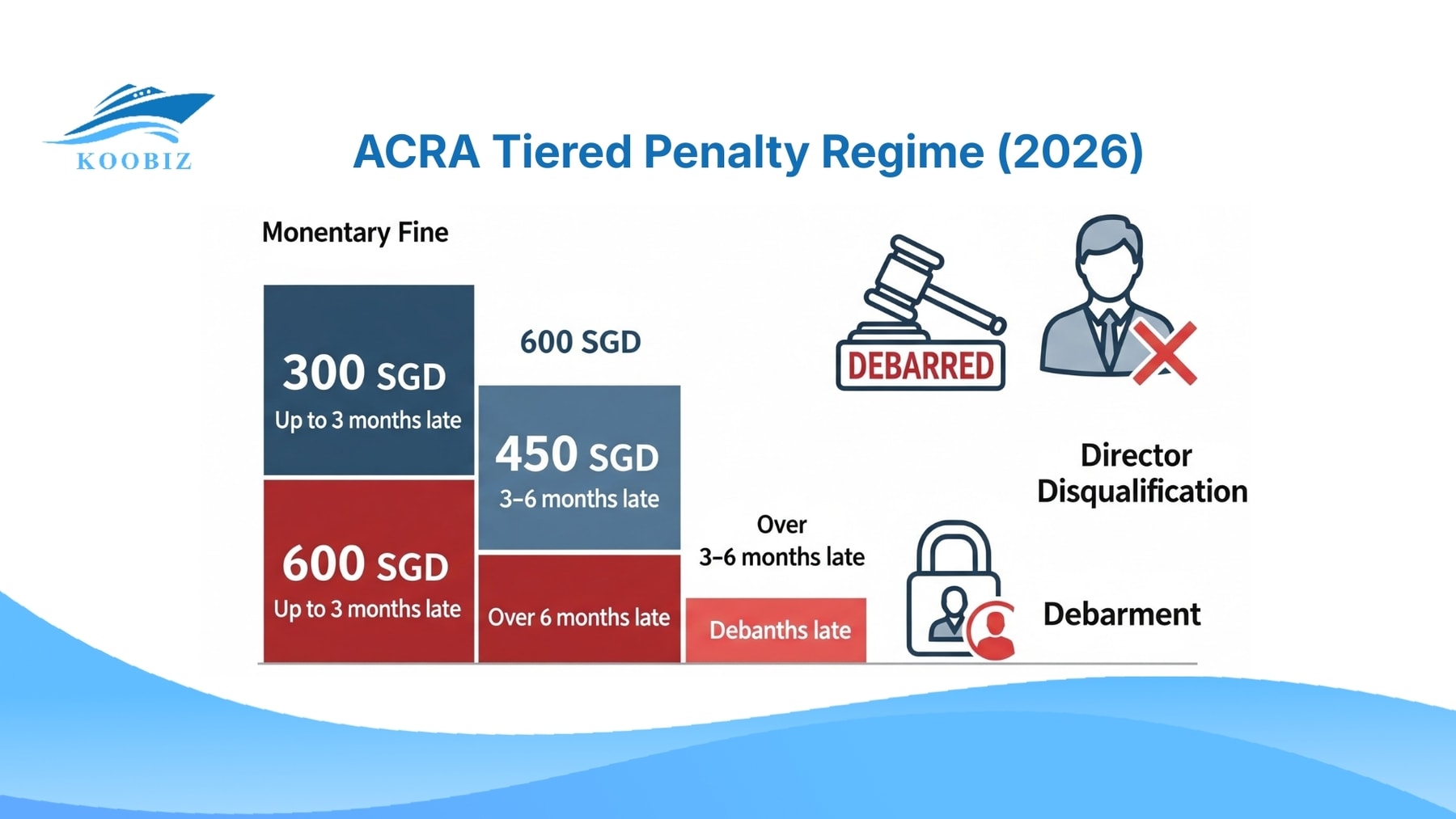
    In 2026, ACRA enforces a tiered penalty regime for late filings, ranging from monetary fines to serious administrative sanctions on directors. While an initial late fee may appear minor, repeated non-compliance can severely damage a company’s compliance record and reputation. Notably, these penalties are automatically triggered by the BizFile+ system upon late submission.

    ACRA Tiered Penalty Regime (2026)
    ACRA Tiered Penalty Regime (2026)

    How late fees accumulate: Tiered penalty Structure

    Late lodgment fees are capped based on the length of the delay, typically ranging from $300 to $600 per statutory breach. Filing the Annual Return within three months of the deadline usually incurs a $300 penalty, increasing to $600 if the delay exceeds three months.

    Importantly, penalties are imposed separately for the AGM and the Annual Return. Missing both deadlines can therefore double the total fines – an avoidable cost that services like Koobiz help mitigate through proactive compliance reminders.

    Directors’ Liability: Can you be disqualified?

    Yes. Directors may be disqualified or debarred for persistent breaches of the Companies Act. Under the enhanced enforcement regime, a director with three or more companies struck off by ACRA within five years may be barred from holding directorships. In addition, ACRA now displays a public compliance rating on the Business Profile, meaning repeated late XBRL filings can directly undermine a company’s credibility with banks and investors.

    Real-World Scenarios: 2026 compliance in action

    To put these deadlines into perspective, the following three scenarios for the 2025/2026 financial year show how the rules apply across different business structures and the real cost of missing them.

    Scenario 1: The Standard Private Company

    Company Profile: TechStart Pte. Ltd. (Private Company)

    • FYE: 31 December 2025.
    • Deadline Calculation:
      • AGM: Must be held by 30 June 2026 (within 6 months).
      • Filing: Must file Annual Return by 30 July 2026 (within 7 months).
    • Outcome: The director approves the Financial Statements in June, and the Corporate Secretary files the XBRL via BizFile+ in July. The company remains compliant with zero penalties.

    Scenario 2: The Listed Entity

    Company Profile: Global Trade Holdings Ltd (Public Listed)

    • FYE: 31 March 2026.
    • Deadline Calculation:
      • AGM: Must be held by 31 July 2026 (within 4 months).
      • Filing: Must file Annual Return by 31 August 2026 (within 5 months).
    • Outcome: Due to the tighter timeline, the company completes its audit by early July to meet the accelerated deadline.

    Scenario 3: The Cost of Delay

    Company Profile: LateBloomer Services Pte. Ltd.

    • FYE: 31 December 2025.
    • Filing Date: The company misses the 30 July 2026 deadline and finally files on 15 November 2026 (3.5 months late).
    • Consequence:
      • Late Lodgment Fee: $600 (imposed immediately because the delay exceeded 3 months).
      • Composition Sum: ACRA may also offer a separate composition sum (minimum $500) for the breach of Section 197 (Annual Return) or Section 175 (AGM).
      • Total Risk: The company faces a potential total of $1,100+ in fines and a permanent “Late” remark on the director’s compliance history for that year.

    With the key deadlines and penalties established, we now turn to the finer details of the filing requirements. Not all companies are subject to the same obligations, and understanding the applicable exemptions and variations can save substantial time and resources in 2026.

    Understanding Revisions: Revised XBRL Requirements in 2026

    The Revised XBRL Filing Requirements are now the authoritative standard for financial reporting in Singapore. Designed to streamline data elements, this framework reduces compliance burden while still capturing the key financial information required by ACRA.

    To navigate these requirements effectively in 2026, directors should note the following key changes:

    • Elimination of Old Options: Companies are no longer permitted to use the obsolete “Option A” or “Option B” formats, which have been fully phased out.
    • The Single Template Approach: Most companies must now file using the Revised XBRL Filing Requirements template. This unified template focuses on capturing approximately 100+ data elements that allow ACRA to benchmark industry performance.
    • Simplified vs. Full IFRS: While less exhaustive than the full IFRS taxonomy, the revised template still requires precise mapping of financial line items to ensure accuracy.

    Understanding these specific data entry points is where the professional corporate secretaries at Koobiz add immense value, ensuring your financial mapping complies strictly with the latest taxonomy revisions.

    Exemptions and Special Cases for 2026 Filing

    Certain categories of companies are exempted from filing a full set of XBRL financial statements based on their solvency or level of activity. Determining whether your entity falls within these “unique” or “rare” classifications is key to optimizing your compliance approach.

    Solvent EPCs: Do you need to convert financials to XBRL?

    No. Solvent Exempt Private Companies (EPCs) are not required to file financial statements in XBRL, provided they make the necessary solvency declarations. An EPC is a private company with no more than 20 shareholders and no corporate shareholders. If solvent, it may file a simplified Annual Return without financial statements or attach them in PDF format. While XBRL filing is optional, voluntary submission may enhance the company’s credit profile. By contrast, insolvent EPCs must file a full set of XBRL financial statements.

    Filing for dormant companies: Simplified process

    Dormant companies enjoy a much simpler filing regime than active entities. A company is considered dormant if it has no accounting transactions during the financial year. In 2026, a dormant non-listed company that meets the substantial assets test (total assets ≤ S$500,000) is exempt from preparing financial statements and filing XBRL.

    Such companies may submit a simplified Annual Return via BizFile+ to confirm their dormant status. While this exemption can significantly reduce compliance costs, directors must ensure no unintended transactions (such as bank charges) have occurred that would negate dormancy.

    What to Do If You Miss the 2026 Deadline?

    If your company is unable to meet the XBRL filing deadline, the appropriate step is to apply for an Extension of Time (EOT) instead of filing late. Proactive action signals to ACRA that the board is managing the issue responsibly.

    Step-by-Step Guide to Applying for an Extension of Time (EOT)

    Applying for an EOT involves a formal request via the BizFile+ portal, which must be submitted before the statutory deadline expires.

    1. Log in to BizFile+: Use your Corppass to access the portal at www.bizfile.gov.sg.
    2. Select EOT Service: Navigate to “Annual Filing” and select “Application for Extension of Time for Holding AGM/Filing AR”.
    3. Provide Justification: You must state a valid reason (e.g., delay in audit, change of financial year).
    4. Pay the Fee: The fee is $200 per application (covering up to 60 days extension).

    Approvals are generally granted if the application is made early. However, relying on EOTs annually is not sustainable. For a long-term solution, partnering with a corporate service provider like Koobiz ensures that your accounts are prepared and converted to XBRL well ahead of schedule, keeping your company in good standing.

    Frequently Asked Questions (FAQ)

    Can I file my XBRL after the AGM date?

    Yes, the Annual Return (which includes the XBRL) is typically filed after the AGM. You have 30 days after the AGM to complete this filing.

    What if I have zero income but expenses? Am I dormant?

    Not necessarily. If you have administrative expenses (like paying a secretary or audit fees), the company may be considered “active” for filing purposes. Dormancy usually requires no accounting transactions other than compliance costs or maintenance of statutory records.

    Does ACRA waive late penalties for first-time offenders?

    Generally, no. Penalties are automated. However, you can submit an appeal via BizFile+ if you have a strong, valid reason (e.g., medical emergency), though waivers are rare.

    About Koobiz

    Navigating Singapore’s corporate regulations requires precision and expertise. Koobiz specializes in helping international and local entrepreneurs establish and manage their businesses in Singapore. From Company Incorporation and Bank Account Opening to Tax, Accounting, and XBRL Filing, our expert team ensures you remain compliant while you focus on business growth.

    Need help with your 2026 Annual Return?

    Contact Koobiz today for a consultation

    Disclaimer: This article is for general informational purposes only and does not constitute legal or professional financial advice. All ACRA regulations, fees, and deadlines are subject to change. Readers should consult the official ACRA website or a qualified corporate secretary for the most current information specific to their business situation.

  • Understanding EGM Meaning: A Guide to Convening Extraordinary General Meetings vs. AGMs for Singapore Companies

    Understanding EGM Meaning: A Guide to Convening Extraordinary General Meetings vs. AGMs for Singapore Companies

    [SUMMARIES]

    Definition: An EGM is any shareholder meeting other than the mandatory Annual General Meeting (AGM), used for urgent or special business.

    Key Difference: While AGMs are routine and held annually, EGMs are ad-hoc and convened only when specific, urgent decisions are required.

    Procedure: Convening an EGM requires strict adherence to notice periods (14 or 21 days), quorum requirements, and proper voting protocols under the Companies Act.

    Shareholder Rights: Shareholders holding at least 10% of voting rights have the legal power to requisition an EGM if the board refuses to do so.

    Compliance: Failure to follow proper EGM procedures can render resolutions invalid; Koobiz recommends professional secretarial oversight for all corporate proceedings.

    [/SUMMARIES]

    In the dynamic corporate landscape of Singapore, business agility often requires swift decision-making that cannot wait for the annual review cycle. While most business owners are familiar with the Annual General Meeting (AGM), the Extraordinary General Meeting (EGM) plays an equally critical role in corporate governance. The purpose of an EGM goes beyond a simple definition; it involves mastering the strategic legal mechanisms required to approve major transactions, amend constitutions, or restructure leadership.

    For Singapore companies, navigating the procedural nuances of an EGM—from drafting notices to ensuring a valid quorum—is essential to prevent legal disputes. At Koobiz, where we specialize in Singapore company incorporation and corporate secretarial services, we frequently guide clients through the complexities of convening valid meetings. Whether you are a director who needs to approve an urgent decision or a shareholder looking to exercise your rights, this guide will explain the EGM process, showing how it differs from the AGM, and ensure your company remains compliant with the Singapore Companies Act.

    What is an Extraordinary General Meeting (EGM) in Singapore?

    Emergency shareholders' meeting in a corporate setting
    Emergency shareholders’ meeting in a corporate setting

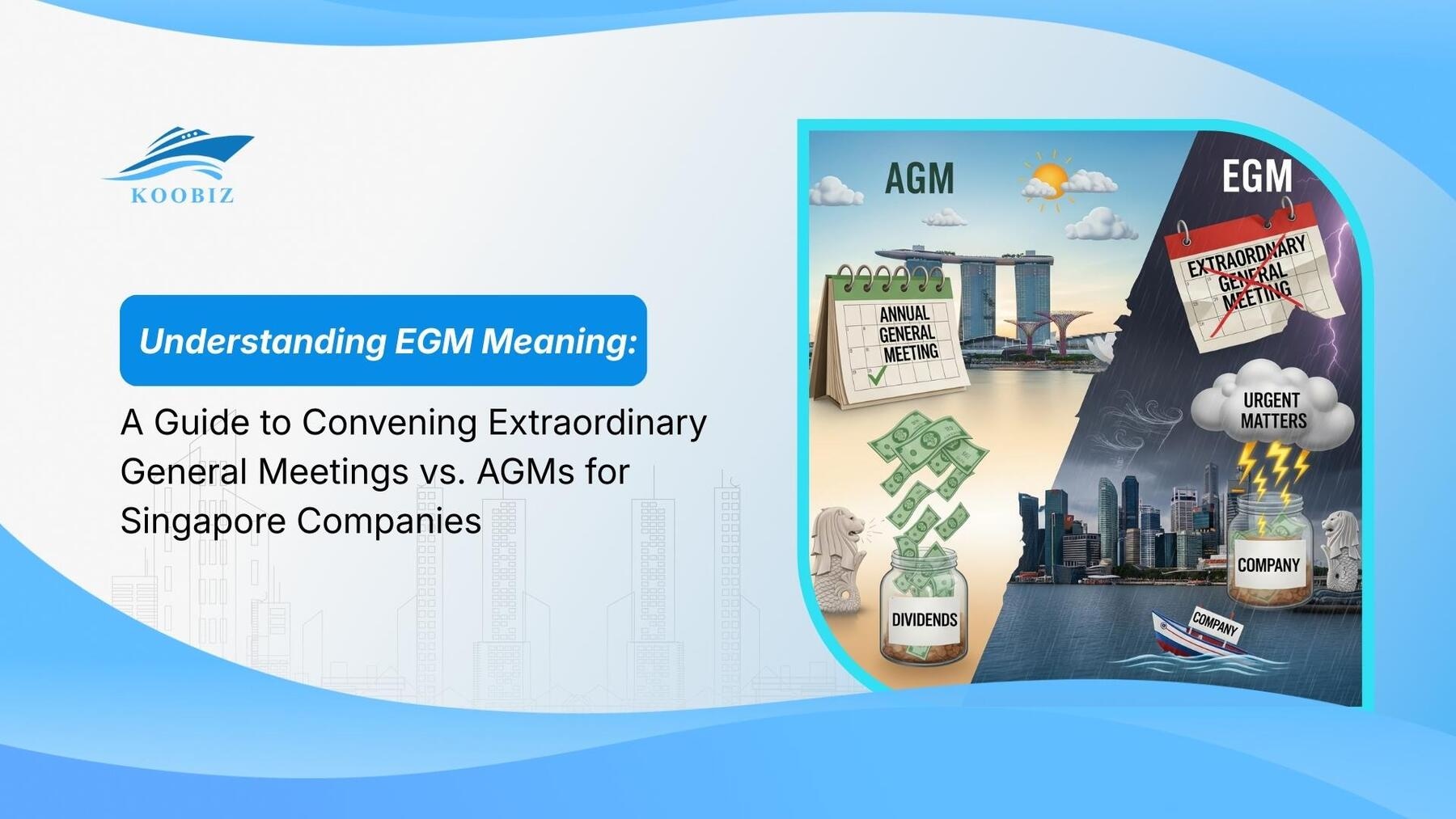
    An Extraordinary General Meeting (EGM) is legally defined as any meeting of a company’s members (shareholders) that is not the mandatory Annual General Meeting (AGM), convened specifically to address urgent matters that arise between AGMs.

    To distinguish an EGM from other corporate gatherings, three main keys define its nature and necessity:

    • Urgency: The matters at hand are time-sensitive and cannot be postponed until the next scheduled AGM.
    • Specificity: It is convened for a specific purpose or “special business,” such as removing a director or amending the constitution, rather than routine annual reviews.
    • Irregularity: There is no statutory deadline to hold an EGM; it is an ad-hoc event triggered only by necessity.

    Unlike the AGM, which follows a predictable yearly schedule to review accounts, the EGM is irregular and “extraordinary” in nature. It is a rapid-response mechanism for the company. Whenever an issue arises that requires shareholder approval—such as removing a director or approving a merger—and that issue is too critical to postpone, an EGM is called.

    Koobiz advises that viewing the EGM as a strategic tool rather than just a compliance hurdle allows directors to manage corporate changes more effectively. Understanding this fundamental definition is the first step, but to truly grasp its operational value, we must distinguish it from its counterpart, the AGM.

    AGM vs. EGM: What is the Difference Between These Key Shareholder Meetings?

    The Annual General Meeting (AGM) serves as the routine health check of a company, whereas the Extraordinary General Meeting (EGM) acts as the emergency surgery room for specific, urgent corporate interventions. To visualize these differences clearly, refer to the comparison table below:

    Feature Annual General Meeting (AGM) Extraordinary General Meeting (EGM)
    Nature & Urgency Routine Health Check. Retrospective; reviews past performance. Emergency Intervention. Prospective; addresses immediate, urgent changes.
    Frequency Mandatory. Must be held once every calendar year. Ad-hoc. No fixed schedule; held only when necessary.
    Timing (Singapore) Within 4 months (listed) or 6 months (non-listed) of FYE. Any time a decision is needed (e.g., funding rounds).
    Business Agenda “Ordinary Business”: Accounts, dividends, director re-elections. “Special Business”: Constitution changes, director removal, mergers.
    • Frequency and Timing: The AGM is a mandatory statutory obligation. In Singapore, listed companies must hold an AGM within four months of their financial year-end, while non-listed companies have six months. In stark contrast, an EGM has no fixed schedule. A dormant company might never hold an EGM, whereas a rapidly expanding startup might hold several in a year.
    • Business Agenda: The AGM deals with “ordinary business,” which is predictable: presenting financial statements, declaring dividends, and re-electing directors retiring by rotation. The EGM deals exclusively with “special business.” This includes anything outside the routine scope, such as altering the company’s constitution or changing the company name.
    • Urgency: AGMs are retrospective, looking back at the past year’s performance. EGMs are prospective and urgent, looking forward to immediate changes required for the company’s survival or growth.

    Understanding this distinction clarifies why an EGM might be necessary, but what specific events trigger the need to convene one?

    When Should a Singapore Company Convene an EGM?

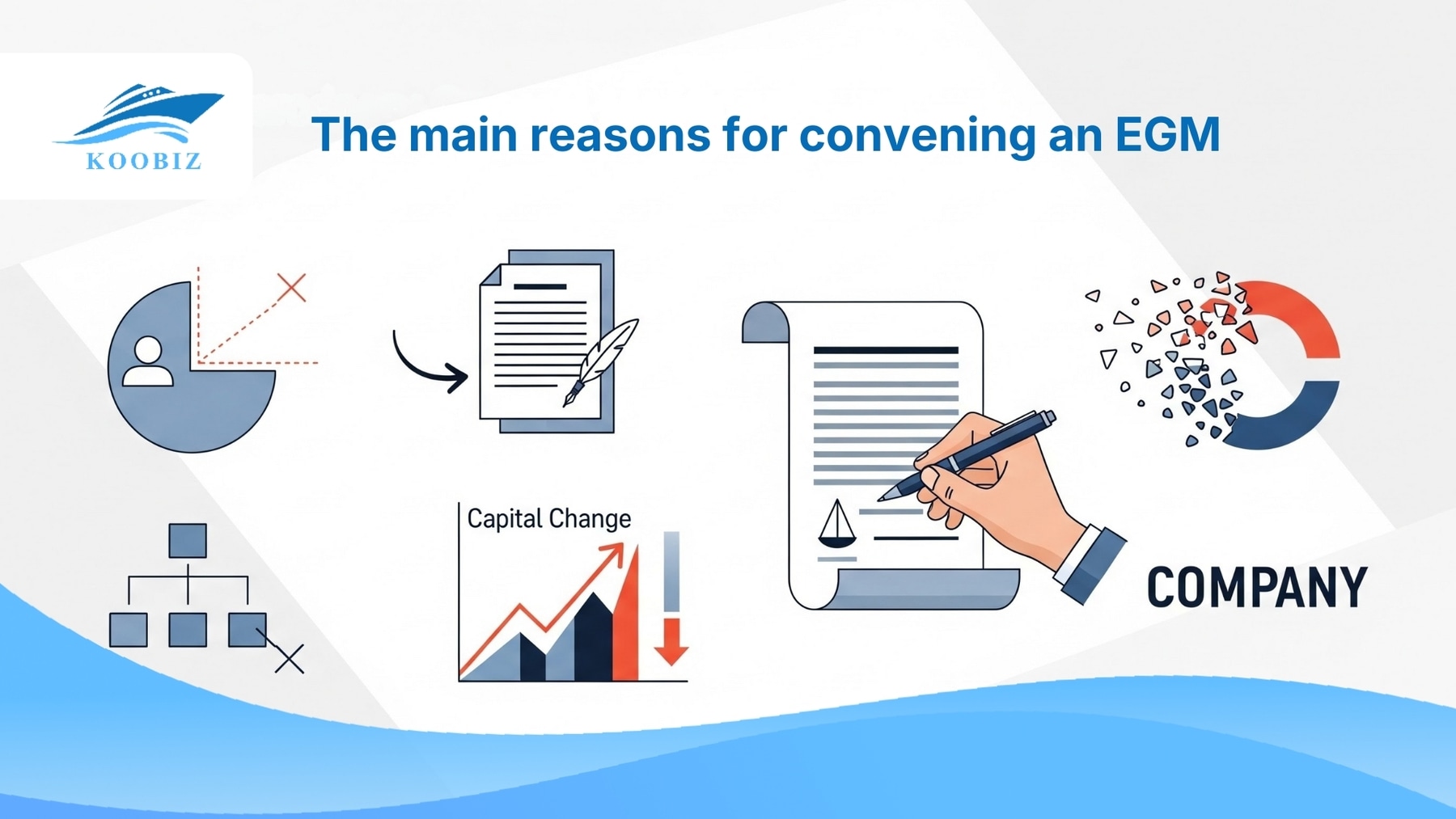
    The main reasons for convening an EGM in Singapore
    The main reasons for convening an EGM in Singapore
    1. Removal of a Director: While the Board can appoint directors, removing a director before their term expires usually requires an Ordinary Resolution passed at a general meeting. This is a common, often contentious, reason for EGMs.
    2. Amendment of Constitution: If a company wishes to update its Constitution (formerly Memorandum and Articles of Association), this requires a Special Resolution. Since the Constitution dictates how the company is run, changes are often urgent.
    3. Changes in Share Capital: Whether it involves the allotment of new shares that exceeds the directors’ mandate, or a reduction of share capital to return cash to shareholders, these actions dilute or alter ownership and thus require owner consent.
    4. Major Transactions: Under Singapore law, specifically Section 160 of the Companies Act, directors cannot dispose of the whole or substantially the whole of the company’s undertaking or property without shareholder approval.
    5. Winding Up: A decision to voluntarily wind up the company requires a Special Resolution passed at an EGM.

    Need to check if your specific situation requires an EGM? Contact Koobiz today for a free compliance checklist.

    How to Convene an EGM in Singapore: The Standard Procedure

    The standard procedure for convening an EGM
    The standard procedure for convening an EGM

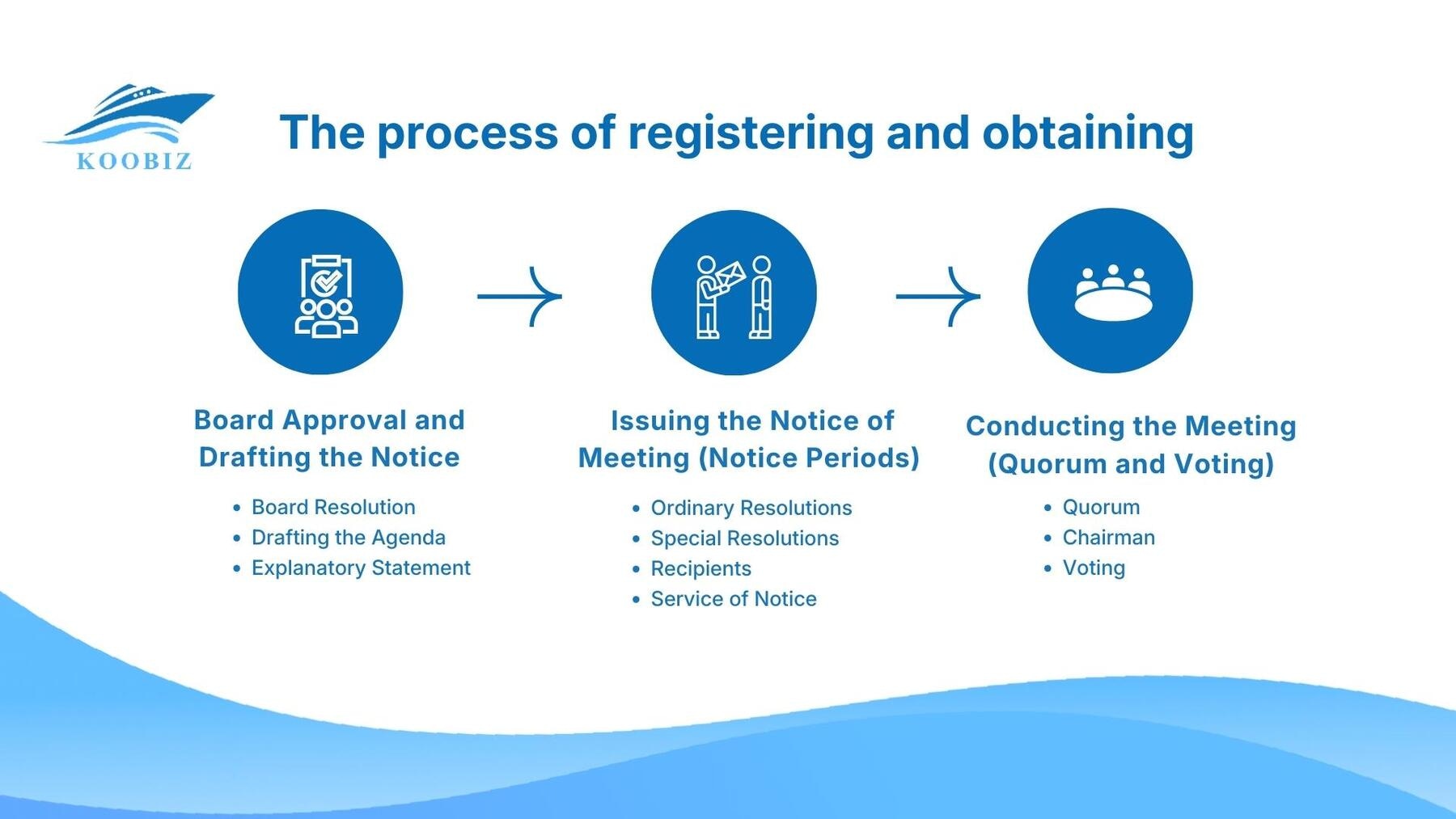
    The standard procedure for convening an EGM involves a strict three-step legal process: Board approval, issuance of compliant notice, and the proper conduct of the meeting itself.

    Step 1: Board Approval and Drafting the Notice

    • Board Resolution:The Directors must pass a Board Resolution to approve the convening of the EGM.
    • Drafting the Agenda: The Board must clearly define the resolutions to be voted on. These must be drafted as either:
      • Ordinary Resolutions: Requiring >50% of the vote.
      • Special Resolutions: Requiring ≥75% of the vote.
    • Explanatory Statement: It is best practice, and often legally required, to include an explanatory statement/circular that provides shareholders with enough information to make an informed decision on the proposed resolutions.

    Step 2: Issuing the Notice of Meeting (Notice Periods)

    • Ordinary Resolutions: If the EGM is only for Ordinary Resolutions, a minimum of 14 days’ written notice is required.
    • Special Resolutions: If the agenda includes any Special Resolution (e.g., changing the company name), a minimum of 21 days’ written notice is mandatory.
    • Recipients: The notice must be sent to all members (shareholders), the auditors of the company, and any other person entitled to receive notice under the constitution.
    • Service of Notice: The notice period excludes the day of service and the day of the meeting. Therefore, purely calculating 14 days on a calendar is often insufficient; a buffer is necessary.

    Note for Public Listed Companies: If your company is listed on the SGX, stricter notice periods may apply under the Listing Manual (e.g., 14 calendar days for Ordinary Resolutions). Always verify against current listing rules.

    Step 3: Conducting the Meeting (Quorum and Voting)

    • Quorum: Before business can commence, a quorum must be present. Unless the company’s constitution says otherwise, the Model Constitution usually sets the quorum at two members present in person or by proxy.
    • Chairman: The meeting is chaired by the Chairman of the Board. If they are absent, members can elect a chairman for the meeting.
    • Voting: Voting is typically done by a show of hands initially. However, a poll can be demanded by the chairman, at least five members, or members representing at least 5% of voting rights.

    Following this standard path ensures a smooth meeting. However, corporate reality is rarely simple, and complex scenarios often arise regarding shareholder rights and notice waivers.

    Navigating Complex EGM Scenarios and Shareholder Rights

    Navigating complex EGM scenarios involves understanding the exception clauses, minority rights, and modern adaptations that exist beyond the standard “Board-convened” meeting structure.

    This section explores the “Unique Attributes” of the EGM ecosystem in Singapore.

    Can Shareholders Force an EGM? (Member’s Right of Requisition)

    Yes, shareholders holding at least 10% of the total paid-up voting shares have the statutory right to force the directors to convene an EGM.

    According to Section 176 of the Companies Act, if members meet the 10% threshold and submit a valid requisition notice, the directors must proceed to convene the meeting within 21 days, to be held no later than two months after the requisition receipt.

    If the directors fail to do so, Section 177 allows the requisitioning shareholders to convene the meeting themselves. Any reasonable expenses incurred by the shareholders in this process must be reimbursed by the company (which, in turn, can deduct this from the defaulting directors’ fees). This is a powerful tool for minority shareholders to hold the board accountable.

    Is it Possible to Hold an EGM at Short Notice?

    Yes, it is possible to hold an EGM with less than the statutory 14 or 21 days’ notice, provided that a specific majority of shareholders agree to it.

    For private companies, an EGM can be held at short notice if members holding at least 95% of the total voting rights agree to it. This “Consent to Short Notice” is incredibly useful for SMEs where all shareholders are also directors or are in close communication. It allows for immediate decision-making without the mandatory waiting period.

    Disclaimer: Always consult the Company Constitution first. While the Companies Act allows this, a specific clause in your Constitution could technically impose stricter requirements.

    Ordinary Resolution vs. Special Resolution: Which One Do You Need?

    The choice between an Ordinary Resolution and a Special Resolution depends entirely on the gravity of the decision being made, dictated by the Companies Act.

    • Ordinary Resolution: Requires a simple majority (more than 50%) of the votes cast. This is used for the removal of a director or the issuance of shares (if authorized).
    • Special Resolution: Requires a supermajority of at least 75% of the votes cast. This is reserved for fundamental changes in the company’s identity or structure, such as amending the Constitution, reducing share capital, or changing the company name.

    Identifying the correct resolution type is critical. Passing a Special Resolution issue via an Ordinary Resolution threshold renders the decision legally void.

    Modern EGM Formats: Virtual and Hybrid Meetings in Singapore

    Effectively from 1 July 2023, the Companies, Business Trusts and Other Bodies (Miscellaneous Amendments) Act 2023 enables companies to conduct general meetings digitally.

    • Virtual Meetings: Fully online meetings are permitted unless the company’s constitution explicitly prohibits them.
    • Hybrid Meetings: Physical meetings with an option for virtual attendance are also standard.

    However, the technology used must ensure that members can vote and ask questions in real-time.

    Can the Court Order an EGM?

    Yes, in rare circumstances where it is “impracticable” to call or conduct a meeting in the usual manner, the Singapore Court has the power to order an EGM.This usually happens in deadlock situations—for example, in a 50-50 shareholder dispute where one party refuses to attend to deny a quorum. The Court can order the meeting and even direct that “one member present in person or by proxy shall be deemed to constitute a meeting,” effectively breaking the deadlock.

    Conclusion

    A well-conducted EGM protects the board and empowers shareholders, while procedural errors can lead to costly disputes.Don’t navigate these complexities alone. Koobiz specializes in company incorporation, corporate secretarial services, and financial compliance in Singapore. We ensure your meetings are valid and your records immaculate.

    For seamless restructuring, bank account opening, or general compliance, visit Koobiz.com today. Let us handle the details while you focus on business growth.

  • Avoid Annual Return Late Filing Penalty in Singapore: ACRA Compliance Guide

    Avoid Annual Return Late Filing Penalty in Singapore: ACRA Compliance Guide

    [SUMMARIES]

    Penalty Tiers: A fixed $300 fine applies if your filing is up to 3 months late, rising to $600 for delays beyond that.

    Deadlines: For most private companies, the Annual Return must be filed within 7 months after your company’s financial year ends.

    Director Liability: This isn’t just a company fee. Directors may be summoned to court or disqualified if non-compliance persists.

    Immediate Action: The penalty must be paid immediately via BizFile+ at the point of filing to prevent escalation.

    Appeals: Getting a penalty waived is very uncommon. ACRA typically only considers requests in cases of proven system errors, not simple oversight or a busy schedule.

    [/SUMMARIES]

    For business owners in Singapore, receiving a notification about an Annual Return late filing penalty can be a source of significant anxiety. It’s not just about the fee—it’s a compliance issue that, if ignored, can lead to court action and affect a director’s ability to serve.

    At Koobiz, we understand that ACRA requirements can feel overwhelming, especially for new founders or overseas business owners. Whether you operate a local startup or an international subsidiary, understanding your filing deadlines and penalty exposure is essential to keeping your company in good standing.

    This guide is your straightforward resource for fixing and avoiding these penalties. We’ll explain the exact fines, how the system works, the deadlines based on your company’s financial year, and what happens if these legal duties are overlooked. We’ll also clear up the common mix-up between ACRA and tax filings, giving you a clear path to staying compliant.

    What is the ACRA Annual Return Late Filing Penalty?

    The ACRA Annual Return late filing penalty is a statutory fine imposed on companies that fail to lodge their Annual Return (AR) within the prescribed timeline. Think of it this way:

    • Statutory Mandate: Under Section 197 of the Companies Act, every company is legally required to file an AR to confirm its particulars (officers, address, financial status) are up to date.
    • Automatic Enforcement: The system flags a late filing immediately; no manual review is needed to issue the initial fine.
    • Public Register Integrity: The penalty ensures public records are timely and reliable for anyone checking a company’s status.
    • Distinct from Tax: Unlike IRAS tax returns which focus on income, the Annual Return focuses on corporate governance and solvency. Many Koobiz clients often confuse the two, leading to accidental non-compliance.
    • Director Responsibility: While the fine is charged to the company, the legal duty to ensure it’s filed and paid falls on the directors.

    How Much is the Late Lodgement Fee and Composition Sum?

    There are two primary tiers for the late lodgement penalty: a $300 flat fee for filings made within 3 months of the deadline, and a $600 flat fee for filings made after 3 months.

    Specifically, the cost depends on the duration of the delay. ACRA simplified this framework effective April 30, 2021, to encourage quicker rectification of breaches. Previously, penalties accumulated on a monthly basis, which could lead to confusion. The current 2-tier system is straightforward but punitive enough to discourage negligence.

    • Tier 1 ($300): If you miss your deadline but file the Annual Return within 3 months (90 days) of the due date, the penalty is capped at $300. This is legally referred to as a “Composition Sum”, essentially an offer to settle the offense out of court by paying a fixed amount.
    • Tier 2 ($600): If the delay exceeds 3 months, the penalty doubles to $600. This is the maximum administrative penalty ACRA will impose via the BizFile+ system before potentially escalating the matter to prosecution.

    Importantly, penalties are imposed per breach. In many cases, companies that miss their Annual Return deadline have also failed to hold their Annual General Meeting (AGM) on time. Each breach can attract a separate composition sum. As a result, directors may face up to $1,200 in total penalties, $600 for the AGM breach and $600 for the AR breach. Koobiz advises clients to view the $600 cap not as a safety net, but rather as ACRA’s final administrativewarning before court action is initiated.

    Note: As of late 2025, ACRA continues to enforce this 2-tier framework strictly. Ignoring the Tier 2 penalty often results in a summons to court.

    When is the Annual Return Deadline Due?

    Your deadline isn’t a fixed calendar date. It’s calculated from your company’s own Financial Year End (FYE).

    • For Non-Listed Companies (Private Limited): You must file your Annual Return within 7 months after your FYE. For example, if your FYE is 31 December, your Annual Return is due by 31 July of the following year.
    • For Listed Companies: The timeline is tighter. You must file within 5 months after your FYE.

    Key Detail: The 7-month AR deadline assumes you have complied with AGM requirements. For most private companies, the AGM must be held within 6 months after the FYE. If the AGM is delayed (or forgotten), the AR filing will almost certainly become late as well, triggering penalties for both breaches.

    Real-World Scenarios: Calculating Deadlines and Penalties

    To make these rules easier to digest, let’s look at three common scenarios we encounter at Koobiz. These examples illustrate how the Financial Year End (FYE) dictates the deadline and how the penalty tiers are applied in practice for a standard Private Limited Company.

    Scenario 1: The “Just Missed It” Startup (Tier 1 Penalty)

    • Company: TechStart Solutions Pte. Ltd.
    • Financial Year End (FYE): 31 December 2023.
    • Correct Deadline: 31 July 2024 (7 months after FYE).
    • Actual Filing Date: 15 August 2024.
    • The Breach: The filing is 15 days late.
    • The Penalty: $300.
    • Koobiz Insight: Even a short delay counts. Once the deadline is missed, even by a single day, the filing automatically falls into the “within 3 months” penalty tier. ACRA does not calculate penalties by the number of days late; the full $300 applies immediately.

    Scenario 2: The Major Oversight (Tier 2 Penalty)

    • Company: Global Trade Holdings Pte. Ltd.
    • Financial Year End (FYE): 31 March 2023.
    • Correct Deadline: 31 October 2023.
    • Actual Filing Date: 5 February 2024.
    • The Breach: The filing is over 3 months late (approx. 95 days late).
    • The Penalty: $600.
    • Koobiz Insight:Once the delay crosses the 3-month mark, the penalty automatically increases to $600. More importantly, leaving the breach unresolved for an extended period significantly raises the risk of a court summons, exposing directors to prosecution and potential disqualification.

    Scenario 3: The “Tax vs. ACRA” Confusion

    • Company: Creative Design Agency Pte. Ltd.
    • The Situation: The foreign director successfully filed the Corporate Tax Return (Form C-S) with IRAS by the 30 November deadline and assumed all government compliance was complete.
    • The Mistake: They neglected the ACRA Annual Return, which was due earlier on 31 July.
    • The Outcome: Despite paying their taxes on time, the company was flagged as “Non-Compliant” by ACRA and incurred a $600 late filing penalty because the error was only discovered 5 months later.
    • Lesson: IRAS tax filing and ACRA Annual Return filing are separate obligations with different deadlines. Being compliant with IRAS does not mean you are compliant with ACRA.

    Steps to File Late Annual Return and Pay Penalties via BizFile+

    Follow these three key steps to resolve the issue:

    Step 1: Log in to BizFile+

    Access the BizFile+ portal using your Corppass login. You must be an authorized director, company secretary, or a registered filing agent.

    Step 2: Navigate to Annual Return

    Select “File Annual Return by Local Company” and complete all the required information accurately.

    Step 3: Acknowledge and Pay

    The system will auto-calculate the late fee ($300 or $600). Acknowledge and pay immediately via card or GIRO to complete the filing. Once payment is made, your company’s compliance status will be updated.

    What are the Consequences of Ignoring the ACRA Penalty?

    Ignoring the penalty escalates the issue from a simple fine to a serious legal problem for the company’s directors.

    Can Directors Face Court Prosecution and Disqualification?

    Yes, directors can face personal court prosecution and, upon conviction, may be disqualified or debarred from acting as a director in Singapore. There are two main risks for directors:

    Under the Companies Act, if a director fails to comply with the requirement to file Annual Returns, ACRA can issue a summons to attend court. The specific consequences include:

    • Court Fines: The court can impose fines significantly higher than the $600 composition sum, potentially up to $5,000 per offense.
    • Disqualification (Section 155): A director faces disqualification for “persistent default.” This occurs if you are convicted of three or more filing offenses within a 5-year period, or have three or more enforcement orders made against you.
    • Debarment (Section 155B): This is a swifter enforcement tool. The Registrar can debar a director if they fail to lodge any document for at least 3 months after the deadline. Unlike disqualification, you do not need multiple convictions; a single prolonged default can trigger this, preventing you from taking on new appointments as a director or secretary.
    • Section 155A: Additionally, a director can be disqualified if they were a director of at least three companies which were struck off within a 5-year period (where the striking off was initiated by ACRA).

    At Koobiz, we stress that director enforcement records are publicly accessible. A disqualification is not a private administrative matter, it permanently damages your professional standing. Such records are routinely reviewed during bank due diligence and compliance checks, making it extremely difficult to open corporate bank accounts or conduct regulated business in Singapore and other major financial centres.

    Will the Company Be Struck Off for Non-Filing?

    • Yes. Where a company repeatedly fails to file its statutory returns, ACRA may presume that the company is no longer carrying on business and initiate strike-off proceedings. Once struck off, the company ceases to exist as a legal entity. All bank accounts are frozen, contractual rights lapse, and remaining assets may vest in the state. Restoring a struck-off company is possible only through a court-led reinstatement process, which is time-consuming, costly, and subject to judicial discretion.

    Can You Appeal for a Waiver of the Late Filing Penalty?

    Yes, but only under extremely specific and rare conditions, such as a proven technical glitch in the ACRA system or a court order extending the deadline.

    While penalties are strict, there is a narrow window for appeal, though “forgetfulness” or “not knowing the law” are never accepted as valid reasons.

    • Invalid Reasons: “My accountant resigned,” “I was overseas,” “I didn’t receive the reminder email,” or “The company made no profit.” These are considered management failures, not valid excuses.
    • Valid Reasons: Proven system failure of BizFile+ (requires screenshots/logs), loss of essential records due to fire or theft (requires police report), or critical illness of the sole director (requires medical evidence).

    Appeals must be lodged via BizFile+ or written to ACRA directly. However, based on Koobiz‘s experience, the success rate for waivers is very low unless the evidence is irrefutable. It is often more cost-effective to pay the composition sum and move on.

    Difference Between ACRA Annual Return and IRAS Tax Filing Penalties

    ACRA penalties target the governance and structural reporting of the entity, whereas IRAS penalties strictly target the reporting of taxable income and corporate tax liability. It is crucial not to conflate the two.

    Feature ACRA (Annual Return) IRAS (Tax Filing – Form C-S/C)
    Primary Focus Governance, shareholders, officers, and solvent financial status. Reporting of taxable income and corporate tax liability.
    Enforcement Authority Accounting and Corporate Regulatory Authority (ACRA). Inland Revenue Authority of Singapore (IRAS).
    Deadline Depends on FYE (e.g., 7 months after FYE for non-listed). Fixed deadline (typically 30 November).
    Late Penalty Fixed tiers: $300 (Tier 1) or $600 (Tier 2). Varies: Composition fines to court prosecution under tax evasion laws.
    Relationship Filing here does not satisfy IRAS requirements. Filing here does not satisfy ACRA requirements.

    According to Singapore regulatory data, a significant portion of compliance breaches involving foreign-owned companies stem from confusing the Annual Return with the Tax Return.

    Frequently Asked Questions (FAQs)

    1. Can I apply for an extension of time (EOT) to file my Annual Return?

    Yes, you can apply for a 60-day Extension of Time (EOT) on BizFile+ before your original deadline, for a fee of $200. An EOT applied for after the deadline will not cancel an already-incurred late filing penalty.

    2. Does paying the composition sum remove the breach from my record?

    Paying the fee settles that specific offense and stops court action. However, ACRA’s system will still show that the filing was submitted late. Multiple late filings can label a director as a “persistent defaulter.”

    3. What if my company is dormant? Do I still need to file?

    Yes, even dormant companies must file an Annual Return, though they may qualify for a simpler process. Not filing will still result in the same late penalties.

    Conclusion

    Staying compliant in Singapore’s business environment requires attention to detail. The Annual Return late filing penalty is a sign that your company’s administrative health needs a check-up. Whether it’s a $300 fee or the risk of director disqualification, the consequences of inaction are far greater than the effort of staying organized.

    At Koobiz, we help business owners stay fully compliant so they can focus on growth with confidence. From company incorporation and corporate bank account opening to ongoing tax, accounting, audit, and company secretarial services, our team ensures that no deadline is missed. If you are currently facing a late filing issue or require a professional Company Secretary to manage your Annual Returns, contact Koobiz today for a complimentary compliance health check. Avoid unnecessary penalties, let us handle the paperwork for you.

  • Calculate AGM Deadline Singapore: Annual Return Rules for Private Companies

    Calculate AGM Deadline Singapore: Annual Return Rules for Private Companies

    [SUMMARIES]

    The 6-Month Rule: Private companies must hold their AGM within 6 months of their Financial Year End (FYE).

    The 7-Month Rule: Annual Returns must be filed with ACRA within 7 months of the FYE.

    Exemptions: Private companies can dispense with AGMs if all members pass a resolution or if financial statements are sent within 5 months of FYE.

    Penalties: Late filing attracts composition fines starting from SGD 300 per breach.

    Extensions: Companies can apply for an Extension of Time (EOT) via BizFile+ for a fee of SGD 200 before the deadline passes.

    [/SUMMARIES]

    Getting to grips with annual company requirements in Singapore might seem complex for new entrepreneurs. A top priority is knowing the due date for your company’s Annual General Meeting (AGM). . Failure to calculate AGM deadline Singapore dates correctly can lead to penalties and affect your company’s compliance standing.. At Koobiz, we know keeping track of these official dates can be tricky. This guide breaks it down clearly, showing you how to find your specific AGM deadline based on your company’s Financial Year End. We’ll also explain how it connects to filing your Annual Return and outline situations where you might not need to hold an AGM.

    What is the AGM Requirement for Singapore Private Companies?

    An Annual General Meeting (AGM) is a key yearly event where a company’s shareholders and directors come together. Its main purpose is to present the company’s financial statements, discuss its performance over the past year, and make important decisions about its future.

    Think of the AGM as a cornerstone of good corporate governance. It ensures transparency and accountability, giving shareholders a formal opportunity to review the company’s health, ask questions of the leadership, and have their voices heard.

    AGM of private companies in Singapore: governance and transparency
    AGM of private companies in Singapore: governance and transparency

    For private limited companies in Singapore, holding an AGM is a legal requirement. Even if a company is not actively trading or has only one shareholder, it must still follow the AGM rules—or formally complete the steps to be exempt from them. This is essential to keep your company in active (“Live”) and compliant standing with the national registry, ACRA.

    How to Calculate Your AGM and Annual Return Deadlines?

    AGM & Annual Return Singapore Schedule (6-7 months)
    AGM & Annual Return Singapore Schedule (6-7 months)

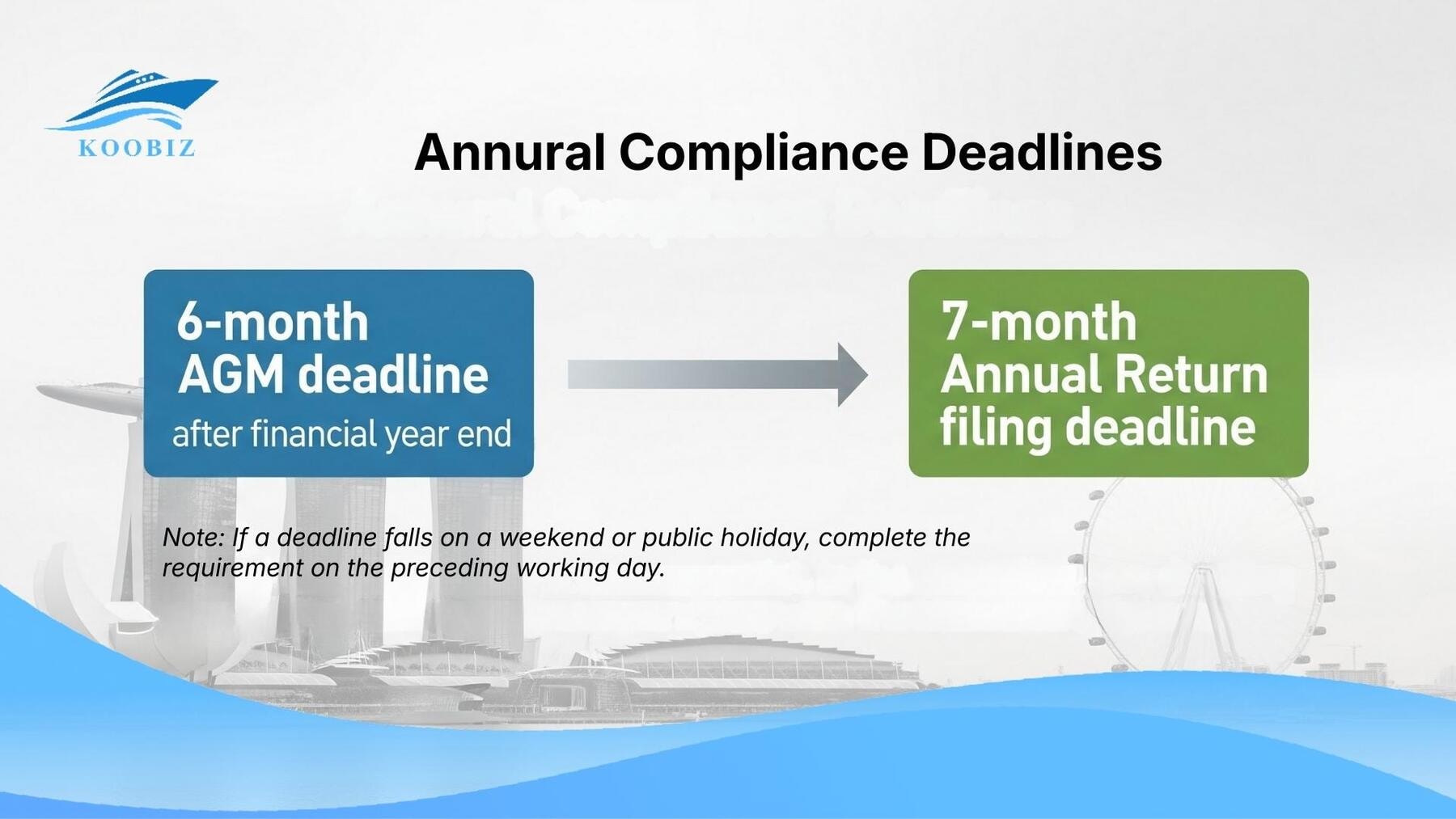
    For private companies, the timeline is strict: hold the AGM within 6 months of the Financial Year End (FYE) and file the Annual Return within 7 months of the FYE.

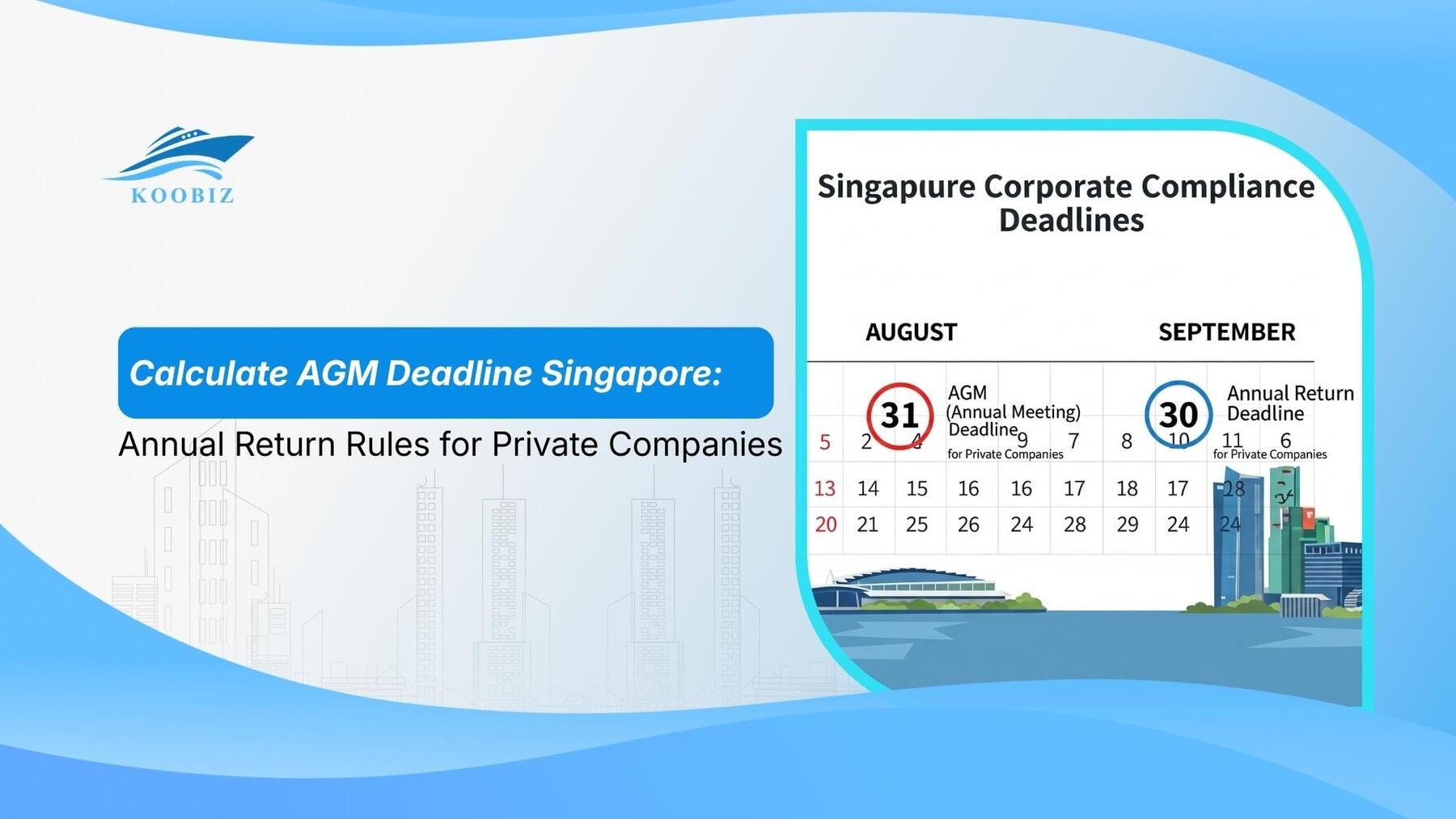
    All of these key dates are directly linked to your company’s unique FYE. Once that date is established, your annual compliance schedule becomes a regular, predictable cycle. This consistency allows both business owners and our team of corporate secretaries at Koobiz to plan effectively and ensure all obligations are met well ahead of time. For example, a company with a 31 December FYE knows its AGM is due by 30 June and its Annual Return must be filed by 31 July of the following year.

    The 6-Month Rule Explained for Private Companies

    Singapore’s Companies Act sets out clear rules for private companies regarding Annual General Meetings (AGMs) and annual filings. Here’s a simple breakdown of how the deadlines work:

    1. The AGM Deadline: The law requires a private company to hold its AGM within 6 months after the end of its financial year. The financial reports presented at this meeting must be up-to-date, meaning they cannot be dated more than 6 months old at the time of the meeting.

    2. The Filing Deadline: After the AGM, the company typically has 30 days to file its Annual Return (AR) with ACRA. This creates an effective final deadline of 7 months after the company’s financial year-end.

    An Important Sequence: The AGM must happen before the Annual Return can be filed. This is because the filing process confirms to ACRA that the shareholders have officially reviewed and approved the company’s financial statements at the AGM (or have formally agreed to skip the meeting). You cannot submit the Annual Return until this step is complete.

    In short: Hold your AGM by the 6-month mark, then file your Annual Return by the 7-month mark.

    AGM Deadline Calculator Table (By FYE)

    Use this table to quickly find your specific deadlines.

    Financial Year End (FYE) Deadline to hold AGM (6 Months after FYE) Deadline to file Annual Return (7 Months after FYE)
    31 March 30 September 30 October
    30 June 31 December 30 January (Next Year)
    30 September 31 March (Next Year) 30 April (Next Year)
    31 December 30 June (Next Year) 30 July (Next Year)

    Note: If a deadline falls on a weekend or public holiday, complete the requirement on the preceding working day.

    Real-World Scenarios: Calculating Deadlines in Practice

    These case studies illustrate how AGM and Annual Return deadlines apply to different corporate timelines, helping you visualize the process for your business.

    Case Study 1: The Standard Calendar Year (FYE 31 December)

    Company: TechGenius Solutions Pte. Ltd.

    • Financial Year End: 31 December 2024.
    • The Calculation:
      • AGM Deadline: 30 June 2025 (6 months post-FYE).
      • AR Filing Deadline: 30 July 2025 (7 months post-FYE).
    • Outcome: Directors convene the AGM on 15 June 2025. The Annual Return is filed on 20 June 2025. The company remains compliant.

    Case Study 2: The Mid-Year Fiscal Close (FYE 30 June)

    Company: Oceanic Trading Pte. Ltd.

    • Financial Year End: 30 June 2024.
    • The Calculation:
      • AGM Deadline: 31 December 2024.
      • AR Filing Deadline: 30 January 2025.
    • Outcome: The deadline falls on New Year’s Eve. The company secretary schedules the AGM for 10 December 2024 to avoid the holiday rush and prevent administrative oversight.

    Case Study 3: Managing a Delay (Extension of Time)

    Company: Creative Sparks Agency Pte. Ltd.

    • Financial Year End: 31 March 2024.
    • The Calculation:
      • Original AGM Deadline: 30 September 2024.
    • The Situation: In mid-August, directors realize the audit won’t be ready due to complex overseas transactions.
    • Correct Action: They apply for an Extension of Time (EOT) via BizFile+ on 1 September 2024, paying the SGD 200 fee.
    • New Deadline: ACRA grants a 30-day extension, moving the deadline to 30 October 2024. The meeting is held on 25 October, avoiding penalties.

    AGM vs. Annual Return: Understanding the Difference and Connection

    Think of the Annual General Meeting (AGM) as your company’s internal approval process, and the Annual Return as its external notification duty. These two events are often mistaken for being the same, but they serve distinct purposes. In simple terms, the AGM is about governance—securing shareholder approval for your company’s direction and financials. The Annual Return is about disclosure—officially updating the national registry (ACRA) with your company’s current information.

    Feature Annual General Meeting (AGM) Annual Return (AR)
    Primary Purpose Internal Governance (Approval) External Disclosure (Reporting)
    Key Action Directors present financial statements; Shareholders vote to adopt them. Company officers submit details to ACRA via BizFile+ (e.g., officers, address, financials).
    Audience Shareholders & Directors The Public & The Regulator (ACRA)
    Sequence Must happen first (within 6 months of FYE). Must happen after the AGM (within 7 months of FYE).
    Pre-requisite Accounts must be ready for presentation. AGM must be concluded (or dispensed with).

    The connection is linear: You generally cannot file the Annual Return until the AGM is concluded (or validly dispensed with) because the filing requires the AGM date.

    Key Agenda Items: What Must Be Discussed at an AGM?

    A valid Annual General Meeting (AGM) typically follows a formal agenda with several key items. For a private limited company in Singapore, these usually include:

    1. Adoption of Accounts: The board of directors presents the company’s financial reports. The shareholders then review and formally approve these documents.
    2. Director Re-election: In accordance with the company’s constitution, certain directors may retire from their position and stand for re-election by the shareholders.
    3. Dividend Declaration: If the company has made a profit, the directors may propose a final dividend. Shareholders will then vote on whether to approve this payout.
    4. Auditor Appointment/Re-appointment: Shareholders are responsible for appointing (or reappointing) an external auditor for the upcoming financial year and approving their fees. (Note: “Exempt Private Companies” may be relieved from this requirement.)

    The AGM may also address “Special Business,” which covers other significant changes like altering the company’s name, provided that proper advance notice has been given to all shareholders.

    Can Private Companies Dispense with Holding AGMs?

    Yes, private companies in Singapore can be exempt from holding a formal Annual General Meeting if they meet certain conditions. This exemption is known as “dispensing” with the AGM. It’s important to understand that dispensing with an AGM does not mean you can skip preparing financial statements or filing your Annual Return. It simply means you do not need to hold a physical or online meeting. This helps reduce the administrative load for small private companies. Even if the AGM is dispensed with, the Annual Return must still be filed within 7 months of your financial year-end.

    Criteria for AGM Exemption

    A private company does not need to hold an AGM if it meets one of the following criteria:

    • Resolution to Dispense: All shareholders pass a formal resolution agreeing to dispense with AGMs. This decision remains valid until the shareholders decide to change it.
    • Sending Accounts Early: The company sends its financial statements to all shareholders within 5 months of the financial year-end. If no shareholder requests an AGM within 14 days of receiving the documents, the requirement for a meeting is automatically waived.
    • Dormant Relevant Company: A company that is officially classified as “dormant” by ACRA and is exempt from preparing financial statements is also exempt from holding an AGM.

    What Happens If You Miss the AGM Deadline?

    ACRA Penalties and Late Lodgment Fees for missing the deadline
    ACRA Penalties and Late Lodgment Fees for missing the deadline

    Missing the AGM or Annual Return deadline triggers immediate action from ACRA, including fines and the possibility of legal prosecution for directors.

    ACRA holds directors personally responsible for compliance. Late filings will lower your company’s public compliance rating, which can harm your reputation with banks and potential partners. Even if your company is in “Live” status, it is still subject to penalties for late submissions.

    ACRA Penalties and Late Lodgment Fees

    ACRA imposes two types of penalties:

    • Late Lodgment Fee: Payable when filing the Annual Return.
      • Up to 3 months late: SGD 300.
      • Over 3 months late: SGD 600.
    • Composition Fines: A separate fine offered to directors to settle the breach of failing to hold the AGM. This starts at SGD 300 per breach and increases based on the delay and previous offenses.

    How to Apply for an Extension of Time (EOT)

    If you foresee missing a deadline, you can apply for an Extension of Time (EOT) before the original deadline passes.

    Apply online via the BizFile+ portal for an extension of up to 60 days.

    The application fee is SGD 200.

    It is very rare for ACRA to approve extensions requested after the deadline has already passed.

    Conducting Virtual AGMs in Singapore

    Since 2023, companies can permanently hold virtual or hybrid AGMs if their constitution allows it and technological safeguards are in place.

    Previously a temporary COVID-19 measure, this is now permanent under the Companies Act. Companies can hold fully virtual or hybrid meetings. To conduct a valid virtual AGM, ensure:

    • Attendees are verified.
    • Voting happens in real-time.
    • Shareholders can ask questions live.
    • The technology is secure and reliable.

    If your constitution prohibits virtual meetings, you must amend it before holding one.

    Conclusion

    Managing your corporate calendar is essential for business operations in Singapore. Whether you need to calculate AGM deadline Singapore dates or prepare financial statements, accuracy prevents unnecessary fines. Failing to adhere to the 6-month rule leads to administrative headaches.

    At Koobiz, we specialize in Singapore statutory compliance. From acting as your Company Secretary to preparing financial statements and filing Annual Returns, we ensure you never miss a deadline. If you are unsure about your status or need an Extension of Time, Koobiz is here to help.

    $$Visit Koobiz.com to explore our Corporate Secretarial Services$$

  • Change Company Name Singapore: ACRA Guide & Special Resolution Process

    Change Company Name Singapore: ACRA Guide & Special Resolution Process

    [SUMMARIES]

    Mandatory Requirement: Changing a company name requires a Special Resolution, requires a Special Resolution with a minimum 75% majority vote from eligible shareholders.

    The Platform: All applications must be submitted via the ACRA BizFile+ portal using CorpPass.

    Cost & Time: The name application fee is SGD 15 (paid upfront). Standard approvals are often instant or take up to 3 days, but referral cases can take 14-60 days.

    Post-Change Duties: You must update your company seal, bank accounts, and licenses. IRAS updates automatically, but CPF may require manual notification.

    Name Restrictions: Proposed names must not be identical to existing entities, undesirable, or similar to reserved names.

    [/SUMMARIES]

    Rebranding or strategic shifts often require a new company name. However, beyond branding, renaming a business is a formal legal procedure governed by ACRA and the Singapore Companies Act. Success relies on precise compliance and documentation, specifically the passing of a Special Resolution.

    Koobiz simplifies the entire rebranding journey, ensuring your transition remains compliant and rejection-free. Whether you are fixing a typo or launching a complete rebrand, following the correct procedure is vital to avoid rejection. This guide provides a clear walkthrough of the change company name Singapore process, from the initial BizFile+ reservation to drafting your Special Resolution and the essential steps to take after approval.

    Pro Tip for Foreign Companies: If you are a branch of a foreign company, Critical Note for Branches: Ensure the parent company’s name is officially updated in its home jurisdiction before notifying ACRA.

    Requirements for Changing Company Name in Singapore

    To ensure a seamless transition and avoid immediate rejection, your company must meet four foundational legal requirements: Failing to meet these foundational elements often leads to immediate rejection, wasting both time and non-refundable filing fees.

    Requirements for Changing Company Name in Singapore
    Requirements for Changing Company Name in Singapore

    1. Name Availability & Uniqueness

    The first step is ensuring your proposed name strictly adheres to ACRA’s naming conventions to avoid being flagged as identical or phonetically similar. The proposed name cannot be identical to an existing entity, nor can it be phonetically similar to names already reserved.

    • Uniqueness Check: You must conduct a thorough search on BizFile+ to ensure no other business uses the same name.
    • Avoid Similarities: ACRA maintains strict standards; for example, adding ‘(Singapore)’ to an existing name will still result in a similarity rejection.

    2. Shareholder Approval (Special Resolution)

    Legally, a name change requires a formal update to the company’s constitution, which necessitates specific shareholder consent.Unlike minor administrative changes that directors can approve, a name change alters the company’s constitution.

    • 75% Majority: You must pass a Special Resolution with a 75% supermajority vote from shareholders holding voting rights.

    3. Avoid Restricted Words

    Be mindful that restricted terms (e.g., ‘Bank’, ‘University’) often trigger mandatory referrals to agencies like MAS or MOE, extending the approval timeline.

    • Restricted Terms: Words like “Bank,” “Insurance,” “University,” or “Education” require external approval.
    • Undesirable Words: The name must not contain vulgarities or imply a connection to government bodies without permission.

    4. Constitution Compliance

    Finally, review your Company Constitution (formerly Articles of Association) for any internal clauses that may impose stricter requirements than the standard Companies Act.

    • Check Clauses: Check your company’s Constitution (formerly Articles of Association) to see if there are additional clauses regarding name changes beyond the standard Companies Act requirements.

    Step-by-Step Guide to Filing a Name Change on ACRA

    Updating your corporate identity involves four critical stages, managed almost entirely through the ACRA BizFile+ portal.

    Step-by-Step Guide to Filing a Name Change
    Step-by-Step Guide to Filing a Name Change

    Here is the detailed procedure to ensure a successful filing:

    Step 1: Check, Reserve, and Pay for the New Name

    The process begins with securing name approval. You must first submit a formal application to ensure the name is available and compliant. Log in to BizFile+ using your CorpPass credentials. Navigate to the “Start a Business” or “Local Company” section and select “Application for a New Company Name.”

    • Application Fee: A non-refundable SGD 15 fee is payable to ACRA at this stage.
    • Approval: If the name is available and requires no external approvals, it is often approved within minutes. Upon successful approval, the name will be exclusively reserved for your company for a period of 120 days.

    Step 2: Convene an EGM and Pass the Resolution

    With the name reserved, the next legal requirement is to convene an Extraordinary General Meeting (EGM) to formalize shareholder consent. During this meeting, the shareholders must vote on the name change. Expert Support: The Koobiz secretarial team specializes in drafting precise Minutes of Meeting and Special Resolutions to ensure your name change is legally airtight.

    Step 3: File “Change in Company Information”

    Once the resolution is passed, finalize the process by submitting the ‘Change in Company Information’ filing on BizFile+.

    • Select “File eServices” > “Local Company” > “Make Changes” > “Change in Company Information”.
    • Select “Change in Company Name”.
    • Enter the Transaction Number of the approved name application from Step 1.
    • Mandatory Attachment: You are required to upload the signed Special Resolution (in PDF format) as evidentiary proof for ACRA.

    Step 4: Final Endorsement

    Once the transaction details are finalized, the application must be endorsed by the directors or a Registered Filing Agent (RFA) like Koobiz. Upon successful submission, ACRA will process the request. Upon ACRA’s approval, you will receive a formal email notification containing the Notice of Incorporation under New Name, confirming the change in the public register.

    What is a Special Resolution for Name Change?

    A Special Resolution is a high-level corporate decision necessitating at least 75% shareholder approval—a threshold significantly higher than standard ordinary resolutions. As renaming a company effectively alters its Constitution and identity, Section 28 of the Companies Act mandates this strict level of consensus.

    Special Resolution for Name Change
    Special Resolution for Name Change

    To ensure the resolution is legally valid, you must adhere to the following protocols:

    • Voting Threshold: You must obtain a majority of at least 75% of the total voting rights from shareholders present and voting at the meeting.
    • Notice Period: A formal written notice must be served 14 days in advance for private companies (21 days for public entities), clearly stating the intent to pass a Special Resolution.
      • Short Notice Exception: An EGM can be convened on shorter notice provided shareholders holding at least 95% of the total voting rights provide their consent.
    • Written Resolution Option: To streamline the process, SMEs may bypass physical meetings by circulating a Written Resolution, provided it is signed by all eligible shareholders.

    Koobiz Advice: Always retain the signed resolution in your Minute Book. This document serves as definitive proof of compliance during statutory audits or potential shareholder disputes.

    Processing Time and Fees for Name Change Application

    The core fee is SGD 15 (paid during the name application in Step 1).

    15 SGD, instant and delayed approval times
    15 SGD, instant and delayed approval times
    • Understanding Approval Timelines: Approval times vary significantly based on your chosen name:Comparing the scenarios helps manage expectations:
    • Standard Application (Instant): For a unique name with no restricted words (e.g., changing “ABC Trading Pte Ltd” to “XYZ Logistics Pte Ltd”), approval is often instant (15–20 minutes) or within one working day.
    • Referral Application (Delayed): If your new name includes regulated words like “Architecture,” “Law,” “Hospital,” or “Estate,” the application is routed to the respective government body.For names requiring agency referral, expect a processing window of 14 days to 2 months.

    Important Note: The SGD 15 filing fee is non-refundable. Any rejection will require a fresh application and a new fee payment.

    Post-Approval Checklist: What to Do After Changing Company Name?

    Securing ACRA’s approval is a major milestone, but you must now update your operational records to prevent compliance breaches.

    Post-Approval Checklist
    Post-Approval Checklist

    Here are the five critical areas to update immediately:

    Corporate Bank Accounts: This is urgent. Submit your ACRA Business Profile and Certificate of Change of Name to your bank.

    Urgent: Update your corporate bank account details immediately. Cheques issued under the former name may be dishonoured after a brief grace period.

    Government Licenses & Permits: Notify agencies like SFA (food) or STB (travel) immediately. While ACRA updates the central registry, specific licenses.

    Action Required for CPF: Unlike IRAS, which syncs weekly, CPF contributions often require manual notification via your updated Business Profile.

    CPF and IRAS:

    • IRAS: Generally updates automatically on a weekly basis based on ACRA records.
    • CPF: Often requires manual notification. You may need to send them your updated ACRA Business Profile to ensure contributions continue smoothly.

    Company Seal and Rubber Stamp: Order a new Company Seal and rubber stamp with the new name and UEN. Ensure a new Company Seal and rubber stamp are produced immediately; using outdated stamps can jeopardize the validity of legal contracts.

    Stationery and Digital Presence: Update your letterheads, invoices, website, email signatures, and signage. The Companies Act requires your correct name and UEN on all official correspondence.

    Does the UEN Change When the Company Name Changes?

    UEN Continuity: Your Unique Entity Number (UEN) remains unchanged throughout the company’s lifespan, regardless of any name changes.

    The UEN is a permanent ID issued at incorporation. It stays with the company until dissolution, regardless of name changes. This ensures business continuity, allowing you to reassure suppliers and clients that the legal entity they are contracting with remains the same.

    Why Does ACRA Reject Name Applications?

    While the process is straightforward, ACRA maintains strict oversight. Rejections typically stem from three primary non-compliance areas:

    • Identical Name Conflicts: ACRA’s algorithm disregards common identifiers such as ‘The’, ‘Pte’, or ‘Ltd’. Therefore, ‘Best Tech Pte Ltd’ is legally viewed as identical to ‘Best Tech Ltd’.
    • Prohibited & Undesirable Terms: Any proposed name deemed offensive, vulgar, or implying an unauthorized government connection (e.g., ‘Temasek’, ‘Asean’) will be summarily rejected.
    • Pre-existing Reservations: You cannot claim a name already secured by another entity. Remember, a name reservation is legally valid for 120 days, even before incorporation is finalized.

    The Koobiz Advantage: We conduct a comprehensive pre-clearance check against ACRA’s database to proactively mitigate rejection risks and save you unnecessary filing fees.

    Difference Between Trading Name vs. Registered Company Name

    Your Registered Company Name serves as your official legal identity, whereas a Trading Name (or Business Name) acts as a functional brand alias for marketing purposes.

    Feature Registered Company Name Trading Name (Business Name)
    Legal Status The official name approved by ACRA (e.g., “Koobiz Services Pte. Ltd.”). An operational alias (e.g., ‘Koobiz Consulting’). Crucially, this must be registered with ACRA as a ‘Business Name’ and linked directly to your UEN.
    Usage Mandatory on invoices, contracts, and regulatory filings. Used for signage and marketing, widely used for signage and branding; however, all statutory documents (contracts, invoices) must clearly disclose the underlying Registered Company Name to remain compliant.
    Key Distinction Legally protected in Singapore against identical registrations. Provides the flexibility for a single entity to manage multiple brands without the administrative cost of forming separate subsidiaries.

    About Koobiz

    Executing a successful name change in Singapore demands more than just a new brand vision—it requires meticulous corporate secretarial precision. At Koobiz (koobiz.com), Koobiz streamlines your entire compliance journey, from drafting legally airtight Special Resolutions to managing complex ACRA filings and banking updates.

    Whether you need help with Singapore company incorporation, corporate bank accounts, or tax and accounting, partner with Koobiz for seamless growth. Let our experts handle the regulatory complexities while you focus on scaling your business in Singapore.

    Explore Koobiz Services