Tag: SUTE

  • Sole Proprietorship vs Pte Ltd: Key Differences & Conversion Guide for Singapore Founders

    Sole Proprietorship vs Pte Ltd: Key Differences & Conversion Guide for Singapore Founders

    [SUMMARIES]

    A Sole Proprietorship is the simplest business structure where the owner and business are legally identical, resulting in unlimited liability for debts, whereas a Private Limited Company (Pte Ltd) exists as a separate legal entity that shields shareholders’ personal assets through limited liability.

    Tax implications differ significantly, as Sole Proprietors are taxed at personal progressive rates (0-24%), while Pte Ltd companies pay a flat 17% corporate tax rate and can utilize the Start-Up Tax Exemption (SUTE) to substantially lower their effective tax burden.

    While Sole Proprietorships are cost-effective for low-risk freelancers, scalable businesses should prioritize the Pte Ltd structure to facilitate capital raising, bearing in mind that “converting” later is a complex legal process involving asset transfers rather than a simple administrative update.

    [/SUMMARIES]

    Choosing between a Sole Proprietorship and a Private Limited Company (Pte Ltd) is a pivotal decision for Singapore founders – it affects liability, taxation, funding options and long-term scalability. A Sole Proprietorship is simple and cheap to run for very small operations; a Pte Ltd adds administrative overhead but gives limited liability, clearer investor appeal and access to corporate tax reliefs that often reduce effective tax for growing businesses.

    At Koobiz, we help founders pick the right structure and manage the conversion process (company formation, asset transfer, and compliance) so you can focus on growth rather than paperwork.

    What is a Sole Proprietorship in Singapore?

    A Sole Proprietorship is an unincorporated business owned by one individual (or an entity) where there is no separate legal personality – the owner and the business are the same. To understand the implications of this definition, we must look at how the Accounting and Corporate Regulatory Authority (ACRA) views this entity.

    It is the simplest form of business structure in Singapore. It is easy to set up and maintain, making it popular among freelancers and small shop owners. However, because it is not a separate legal entity, the owner has full control but also bears full responsibility for the business.

    What is a Private Limited Company (Pte Ltd)?

    A Pte Ltd is an incorporated company limited by shares that exists as a separate legal entity from its shareholders and directors. It can own property, enter contracts and be sued in its own name. A Pte Ltd is the dominant structure for startups and SMEs that plan to scale, hire staff, borrow, or attract external investors.

    • Pros: limited liability, perpetual succession, easier capital raising.

    Cons: higher compliance (company secretary, filings), slightly higher administrative costs.

    What are the Key Differences between Sole Proprietorship and Pte Ltd?
    The Key Differences between Sole Proprietorship and Private Limited Company (Pte Ltd)
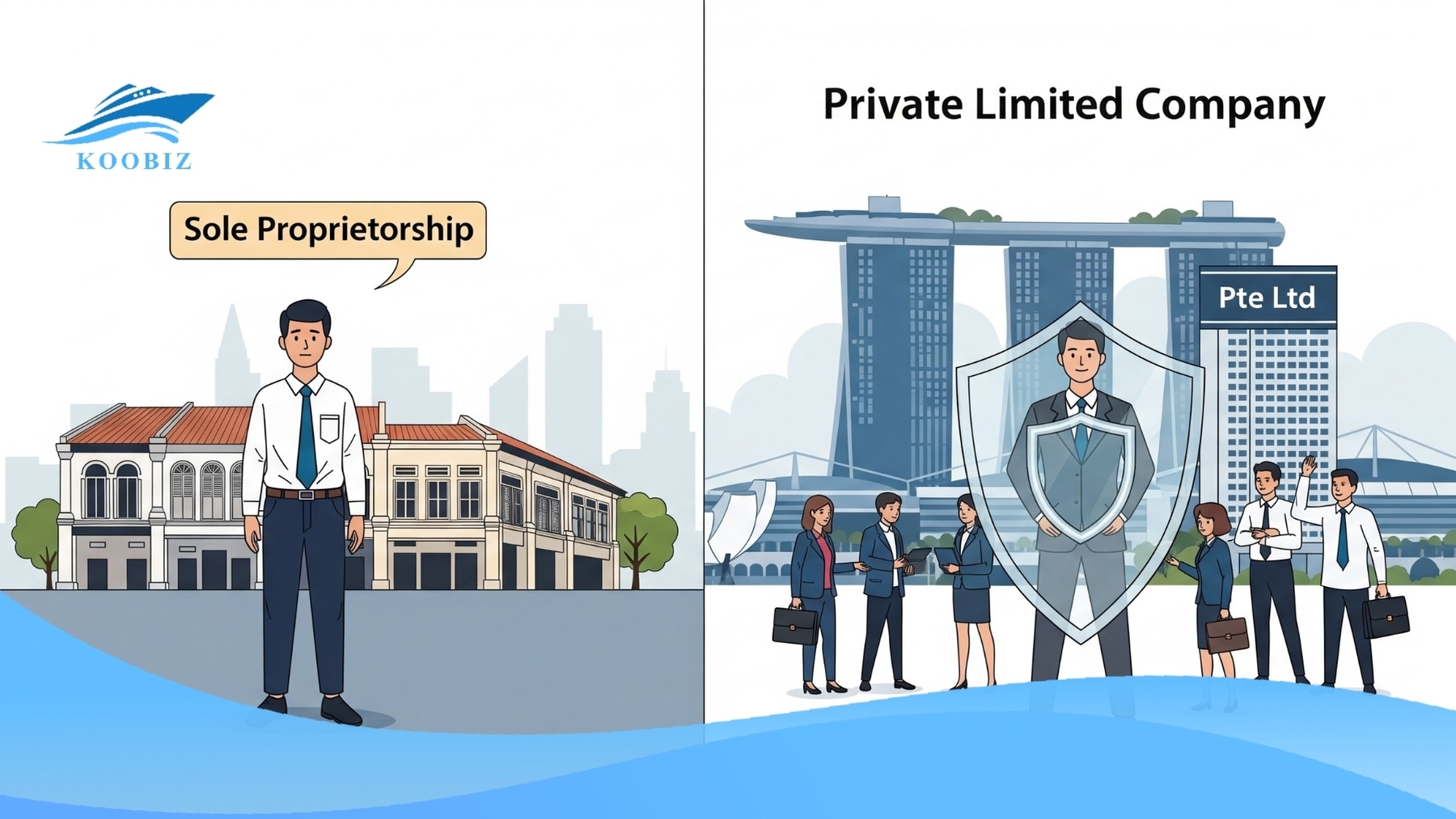
    The Key Differences between Sole Proprietorship and Private Limited Company (Pte Ltd)

    The Pte Ltd structure generally triumphs in liability protection and tax efficiency, while the Sole Proprietorship wins on setup simplicity and low compliance costs. To fully grasp which structure suits your current stage, we need to compare them across three critical dimensions: liability, taxation, and scalability.

    How Do Liability and Legal Status Differ?

    Because a Sole Proprietorship has no corporate veil, owners bear unlimited liability: personal assets (home, car, savings) may be at risk to satisfy business debts. A Pte Ltd shields personal assets in normal circumstances – only the company’s capital is exposed – making it the safer structure when entering leases, large contracts or taking loans.

    Feature Sole Proprietorship Private Limited Company (Pte Ltd)
    Legal Status Not a separate legal entity. The owner and the business are treated as the same legal person. Separate legal entity. The company has its own legal identity distinct from its owners (shareholders).
    Liability Unlimited. The owner is personally responsible for all business debts and losses. Limited. Shareholders are only liable up to the amount of their paid-up capital.
    Risk to Assets High. Personal assets (home, car, savings) can be seized to pay off business creditors. Low. Personal assets are legally protected. Only the money invested in the company is at risk.
    Legal Capacity Cannot sue or be sued in its own name. The owner sues or is sued personally. Can sue, be sued, and own property in its own name.

    What is the Difference in Tax Rates and Incentives?

    Sole Proprietors report profits on their personal tax return and pay personal income tax (progressive rates). Companies pay corporate tax at a flat rate (headline 17%), with schemes that can reduce effective tax for qualifying start-ups. For early stage companies, the Start-Up Tax Exemption (SUTE) provides generous relief on the first portions of chargeable income in qualifying years – a common reason small but growing businesses convert to Pte Ltd.

    Tax Criteria Sole Proprietorship Private Limited Company (Pte Ltd)
    Tax Basis Profits are taxed as the owner’s Personal Income. Profits are taxed as Corporate Income.
    Tax Rate Progressive Rate: 0% to 24% (for income >S$1M). Flat Rate: Capped at 17%.
    Tax Exemptions Not eligible for corporate tax incentives. Eligible for Start-Up Tax Exemption (SUTE) and Partial Tax Exemption.
    YA 2025 Rebates 60% Personal Income Tax Rebate (Capped at S$200). 50% Corporate Income Tax Rebate (Capped at S$40,000).
    Tax Efficiency Efficient for low profits. Tax burden increases sharply as profits rise. Highly efficient for higher profits due to the flat rate and exemptions.

    Important Updates for 2025:

    • Start-Up Tax Exemption (SUTE): For the first 3 consecutive YAs, qualifying new Pte Ltd companies enjoy a 75% exemption on the first S$100,000 of chargeable income and a 50% exemption on the next S$100,000.
    • 2025 Rebates: To support businesses, a 50% Corporate Income Tax Rebate (capped at S$40,000) has been announced for YA 2025. Residents also receive a 60% Personal Income Tax Rebate (capped at S$200), which provides minor relief for sole proprietors.

    Which Structure is easier to scale and raise capital?

    Pte Ltd is far better for growth and fundraising. It can issue shares to investors and adopt multiple share classes; a Sole Proprietorship cannot. Investors and banks prefer the clarity of corporate ownership and limited liability that a Pte Ltd provides.

    Feature Sole Proprietorship Private Limited Company (Pte Ltd)
    Capital Sources Limited to personal savings and personal loans. Cannot issue shares. Can raise funds by issuing new shares to investors (VCs, Angels) or obtaining corporate loans.
    Ownership Transfer Difficult. Requires selling individual assets and novating contracts. Easy. Ownership is transferred by selling or issuing shares.
    Business Continuity No Perpetual Succession. Business typically ceases if the owner dies or retires. Perpetual Succession. Business continues indefinitely regardless of changes in shareholders.
    Investor Appeal Low. Investors cannot own a “piece” of the company easily. High. Preferred structure for investors due to clear legal framework and liability protection.

    Investors, venture capitalists (VCs), and banks prefer dealing with Pte Ltd companies because the structure allows for clear ownership distribution through shares. A Sole Proprietorship cannot issue shares; therefore, raising external capital is extremely difficult unless the owner takes out a personal loan.

    Is a Sole Proprietorship or Pte Ltd better for your business?
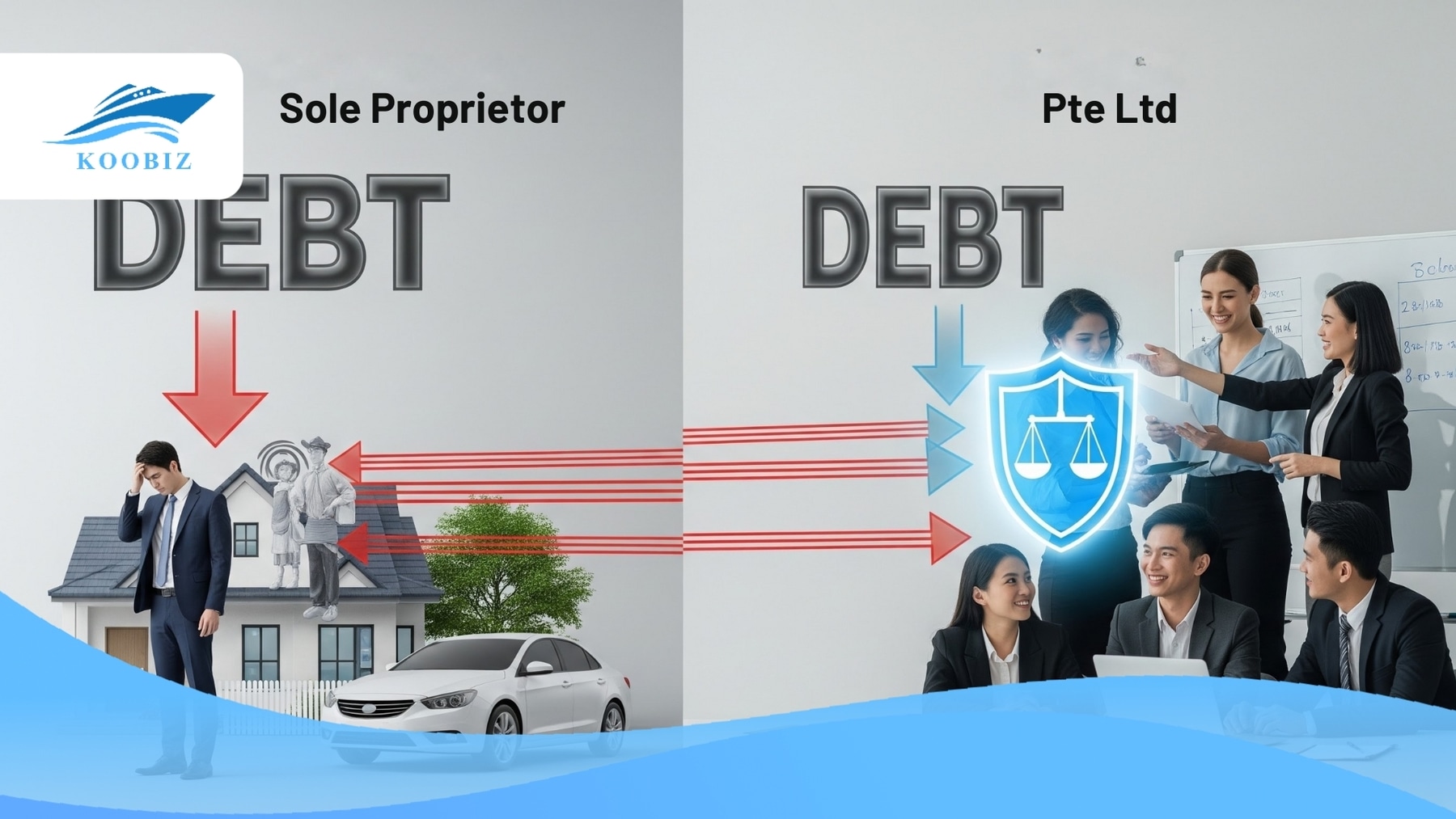
    Sole Proprietorship vs Private Limited Company (Pte Ltd)
    Sole Proprietorship vs Private Limited Company (Pte Ltd)

    Yes, a Sole Proprietorship is better for low-risk, small-scale operations, while a Pte Ltd is better for businesses planning to scale, hire staff, or incur debt. Deciding between the two depends entirely on your business roadmap and risk tolerance.

    If you are a freelancer, a small hawker stall owner, or a consultant with minimal operating costs and virtually zero liability risk, the Sole Proprietorship is ideal due to its ease of registration and minimal compliance requirements (no need for a company secretary or complex annual returns). However, if your business involves signing rental leases, hiring employees, taking trade credit, or if you plan to seek investment, the Pte Ltd is the superior choice. The administrative cost of a Pte Ltd is an insurance premium for the safety of your personal assets and the credibility of your brand.

    Expert Note from Koobiz: Many entrepreneurs start as Sole Proprietors to test the market and later convert to a Pte Ltd once revenue stabilizes. If you are unsure, consulting a corporate service provider like Koobiz can help clarify your specific needs.

    Real-World Scenarios: Choosing the Right Structure
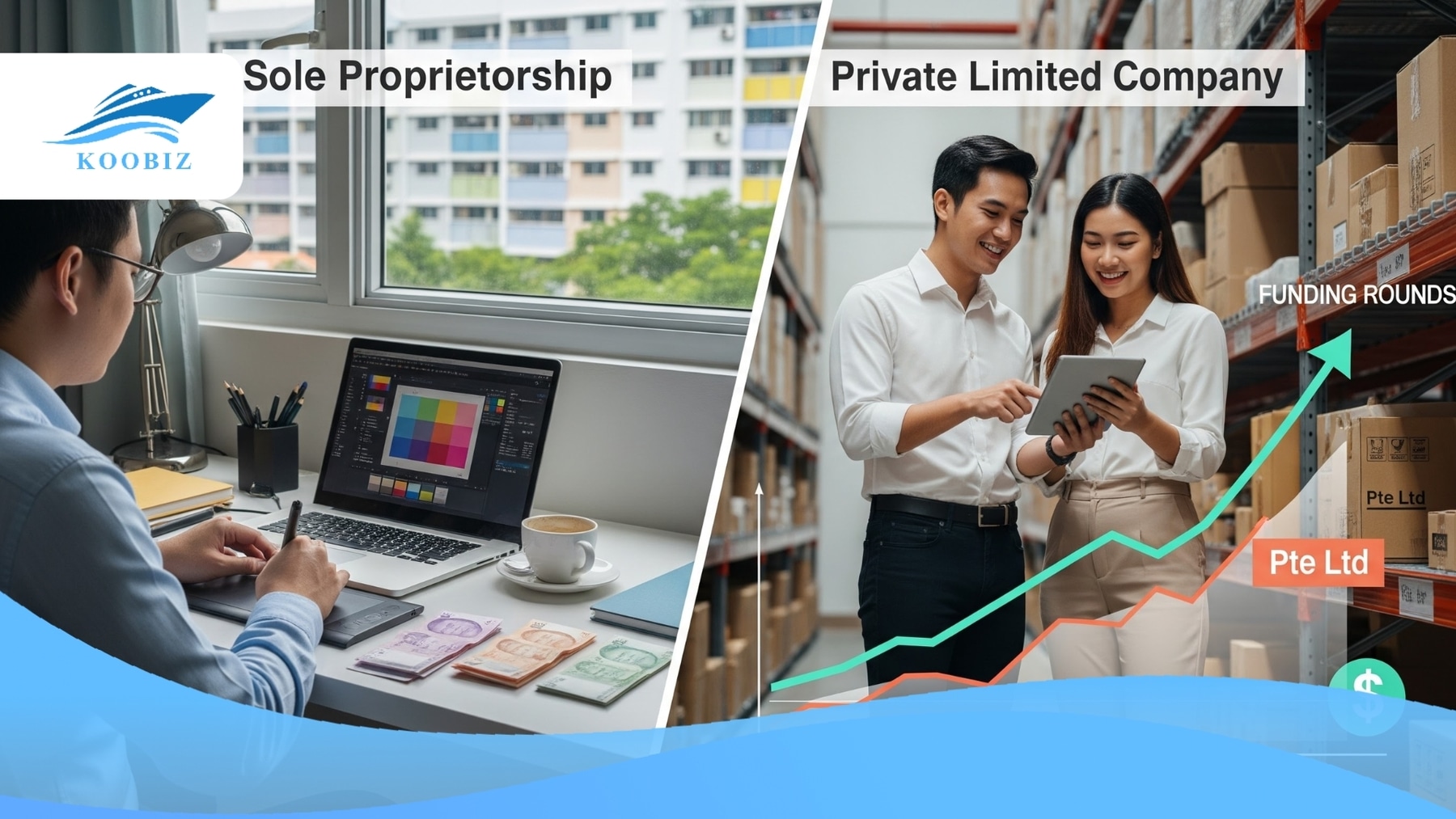
    Sole Proprietorship vs Pte Ltd: 2 Case Studies
    Sole Proprietorship vs Pte Ltd: 2 Case Studies

    To help you visualize which structure suits your needs, let’s look at two common scenarios facing Singapore entrepreneurs.

    Case Study A: The Freelance Graphic Designer (Sole Proprietorship)

    Profile: Sarah runs a home-based design studio. She works alone, has no employees, and her annual net profit is around S$60,000.

    Decision: Sarah chooses a Sole Proprietorship.

    Why?

    • Cost: Setup is approximately S$115 (S$15 name application + S$100 registration), and she avoids the ~S$600+ annual cost of a Company Secretary.
    • Tax: Her profit of S$60,000 puts her in a low personal tax bracket with an effective tax rate of approximately 3.25% (before rebates). The flat 17% corporate rate would be higher in this specific range, even with exemptions.
    • Risk: She has no debts and minimal overheads, so unlimited liability is a manageable risk.

    Case Study B: The E-commerce Startup (Pte Ltd)

    Profile: “GreenGoods” is founded by two partners, Mark and Lin. They plan to import sustainable products, rent a warehouse, and hire 3 staff members. They need S$100,000 in initial capital and project S$200,000 profit in Year 2.

    Decision: They incorporate a Private Limited Company (Pte Ltd).

    Why?

    • Liability: Signing a warehouse lease and importing goods carries financial risk. If the business fails, the landlord cannot seize Mark or Lin’s personal homes.
    • Tax Efficiency: On S$200,000 profit, the Start-Up Tax Exemption (SUTE) exempts 75% of the first S$100,000 and 50% of the next S$100,000. This leaves only S$75,000 chargeable. After applying the 17% rate and the 50% Corporate Tax Rebate (YA 2025), their tax bill is minimal compared to personal tax rates on that income.
    • Funding: They can issue shares to an angel investor in exchange for capital.

    How to Convert a Sole Proprietorship to a Pte Ltd?

    You cannottransform” the sole trader into a Pte Ltd by a single ACRA toggle. Conversion is a three-phase restructuring:

    1. Incorporate a new Pte Ltd via BizFile+ (reserve a company name; prepare constitution; appoint directors and secretary). ACRA charges S$15 for name reservation and S$300 for company incorporation.
    2. Transfer business assets (inventory, contracts, IP, bank balances) to the new company by sale/assignment agreements; novate supplier/lease contracts if required.
    3. Cease the Sole Proprietorship in BizFile+ (file Notice of Cessation) after transfers are complete so the owner’s personal exposure ends for new business operations.

    Five Steps to Incorporate a New Pte Ltd

    Incorporating a Pte Ltd is a structured legal process governed by ACRA. To ensure a smooth transition from your Sole Proprietorship, follow these five comprehensive steps:

    Step 1: Reserve Company Name & Submit “No Objection” Letter

    You typically want your new Pte Ltd to have the same name as your existing Sole Proprietorship (e.g., changing “ABC Trading” to “ABC Trading Pte Ltd”). ACRA usually rejects identical names, so you must submit a “No Objection Letter” signed by you (the Sole Proprietor) stating you consent to the new company using the name.

    • Action: Log in to BizFile+ via SingPass to apply for the name and upload the letter.
    • Cost: S$15 for name application.

    Step 2: Appoint Key Officers

    Before filing, you must have the consent of the people running the company.

    • Director: Minimum one locally resident director (Singapore Citizen, PR, or EntrePass holder). You can be the director.
    • Shareholder: Minimum one shareholder (can be the same person as the director).
    • Company Secretary: Must be appointed within 6 months of incorporation.

    Step 3: Prepare Constitution and Registered Address

    • Constitution: You must adopt a Company Constitution (formerly Memorandum & Articles of Association). Most startups adopt the standard model constitution provided by ACRA.
    • Address: You need a physical Singapore address for the office (P.O. Box is not allowed).

    Step 4: File Incorporation with ACRA

    Once the name is approved and documents are ready, submit the incorporation application.

    • Action: Complete the “Application for Incorporation of Local Company” on BizFile+.
    • Cost: S$300 registration fee.

    Step 5: Issue Share Certificates

    Upon successful registration, the company will receive a UEN (Unique Entity Number). You must then issue share certificates to the shareholders as proof of ownership.

    Pro Tip: While you can do this manually, errors in the “No Objection” letter or constitution can cause rejections. Services like Koobiz specialize in handling this entire incorporate company process, ensuring all documents are compliant with Singapore’s Companies Act.

    Transferring assets and ending the Sole Proprietorship

    Use a Business Transfer Agreement to sell/assign assets to the new Pte Ltd. Novate key contracts (landlord, suppliers) so obligations continue under the company. When transfers complete and company bank accounts are live, file ACRA’s Notice of Cessation to stop the sole trader registration and remove ongoing personal exposure.

    Ready to upgrade your business structure? Koobiz provides seamless incorporation services to help you convert from Sole Proprietorship to Pte Ltd without the paperwork headache. Contact Koobiz Today for a Free Consultation

    Ongoing compliance: Sole Proprietors keep business records and file personal tax returns; Pte Ltd must maintain statutory registers, hold AGMs (where applicable), file Annual Returns and corporate tax returns.

    Audit: Sole Proprietorships are not required to file audited accounts with ACRA; many small Pte Ltd companies are audit-exempt but still must prepare financial statements compliant with Singapore standards.

    Foreigners & Sole Proprietorships: Foreigners living overseas who wish to register a sole proprietorship must appoint a locally-resident authorised representative (Singapore Citizen, PR or valid work-pass holder). For foreigners wanting a full local presence, Pte Ltd is the usual route.

    Fees recap: Sole Proprietorship (typical first-year cost S$115 includes S$15 name + S$100 registration); Pte Ltd incorporation fees include S$15 name + S$300 registration.

    Conclusion

    Transitioning from a Sole Proprietorship to a Pte Ltd is a hallmark of business maturity in Singapore. While the Sole Proprietorship offers an easy start, the Pte Ltd structure provides the necessary armor—limited liability and tax efficiency—to survive and thrive in a competitive market. If you are ready to take the next step, Koobiz is here to assist with professional incorporate company services, ensuring your transition is smooth, compliant, and positioned for growth.
  • LLC vs Pte Ltd: Comparing Business Structures & Tax Benefits for Foreign Entrepreneurs

    LLC vs Pte Ltd: Comparing Business Structures & Tax Benefits for Foreign Entrepreneurs

    [SUMMARIES]

    Singapore Private Limited (Pte Ltd) companies function as distinct legal entities with a strict corporate veil and formalized governance, offering superior credibility for scalable businesses compared to the hybrid US Limited Liability Company (LLC) structure.

    The Pte Ltd model is the preferred vehicle for raising capital and attracting Venture Capitalists because it facilitates the issuance of distinct share classes, whereas institutional investors generally avoid US LLCs due to complications arising from pass-through taxation.

    Singapore offers distinct tax advantages for foreigners through a single-tier system with a flat 17% corporate rate, startup exemptions, and tax-free dividends, avoiding the potentially higher personal income tax burdens associated with US LLC ownership.

    [/SUMMARIES]

    Choosing between a US-style Limited Liability Company (LLC) and a Singapore Private Limited Company (Pte Ltd) is the critical first step for expansion. While both offer limited liability, the Pte Ltd is generally the superior choice for scalable businesses in Singapore due to its tax efficiency and professional credibility.

    At Koobiz (koobiz.com), we often advise clients that while a Pte Ltd requires stricter compliance, the trade-off – access to Singapore’s extensive tax treaties and a robust corporate image is invaluable for long-term growth.

    Is a Singapore Pte Ltd the Same as a US LLC?

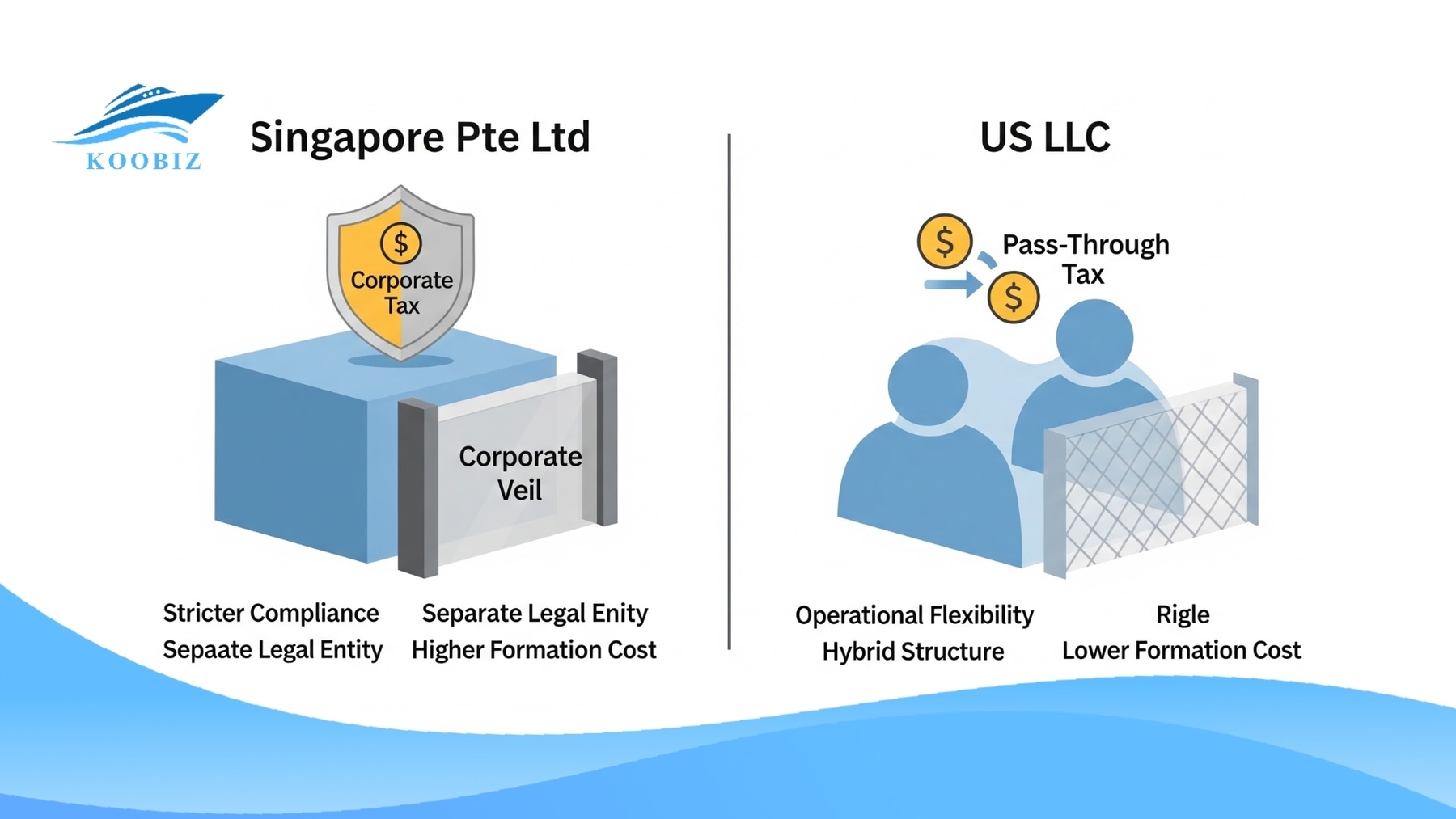
    Differences between US LLC and Singapore Pte Ltd
    Differences between US LLC and Singapore Pte Ltd

    No, a Singapore Pte Ltd is not legally identical to a US LLC, although they share the fundamental characteristic of limiting the owner’s liability to their investment amount.

    To elaborate on this distinction, an LLC (Limited Liability Company) in the United States is a hybrid entity that combines the operational flexibility of a partnership with the liability protection of a corporation. In contrast, a Pte Ltd (Private Limited Company) is a purely corporate entity governed by the Singapore Companies Act, possessing a distinct legal personality separate from its owners. This means a Pte Ltd can own property, sue, and be sued in its own name, independent of its shareholders. While an LLC is often treated as a “pass-through” entity for tax purposes, a Pte Ltd is a tax resident in its own right. Understanding this legal separation is the first step in recognizing why the Pte Ltd structure is preferred for serious business operations in Asia.

    What Are the Key Differences Between LLC and Pte Ltd?

    The key differences between an LLC and a Pte Ltd lie in their ownership structure, liability protection mechanisms, and capital raising capabilities, with the Pte Ltd offering a more formalized framework suitable for growth.

    Feature US LLC Singapore Pte Ltd
    Legal Identity Hybrid Entity (Partnership/Corp mix) Separate Legal Entity
    Ownership Members (Flexible management via Operating Agreement) Shareholders (Managed by Directors, governed by a Constitution)
    Liability Limited (Varies by state) Limited (Strict Corporate Veil)
    Taxation Pass-through (Personal Income Tax) Corporate Tax (Singapore’s headline CIT rate is 17%)
    Capital Raising Difficult (VCs dislike pass-through) Easy (Preferred by VCs)
    Governing Doc Operating Agreement Constitution

    While both structures shield personal assets, the method by which they manage control and attract funding varies drastically. An LLC is designed for flexibility and ease of management, often blurring the lines between ownership and operation, whereas a Pte Ltd establishes a clear hierarchy that institutional investors prefer. This structural rigidity, while seemingly complex, provides the certainty required for high-stakes business dealings.

    How Do Ownership and Management Structures Differ?

    Ownership in a US LLC is vested in “Members,” whereas a Singapore Pte Ltd is owned by “Shareholders”, leading to distinct management hierarchies.

    In an LLC, the owners are referred to as members, and the management structure is defined by an Operating Agreement. This allows for a decentralized management style where members can manage the business directly (Member-Managed) or appoint managers (Manager-Managed). Conversely, a Pte Ltd is strictly governed by its Constitution (formerly Memorandum and Articles of Association). The shareholders own the company, but the management is delegated to a Board of Directors. For foreign entrepreneurs, this is crucial because Singapore law requires at least one director to be a local resident (Citizen, Permanent Resident, or Employment Pass holder), which often means using Koobiz’s nominee director service initially. This clear separation of ownership (Shareholders) and control (Directors) allows for a scalable governance structure that an LLC often lacks.

    What Are the Liability Protections for Owners?

    Both structures offer limited liability, but the Pte Ltd upholds a stricter “Corporate Veil” that is harder to pierce than that of a typical LLC.

    In a Pte Ltd, the liability of shareholders is strictly limited to the amount of share capital they have subscribed to but not yet paid. Once their shares are fully paid up, they have no further financial obligation to the company’s creditors. Personal assets such as homes, cars, and personal savings are legally untouchable by business debts.

    While US LLCs also offer this protection, the “piercing of the corporate veil” can occur more easily in LLCs if the court finds that the business and owner are not sufficiently separate (alter ego theory), especially if formalities like meetings are not observed. The Pte Ltd’s mandatory statutory compliance strengthens this legal barrier, providing superior asset protection for the entrepreneur.

    Which Structure is Better for Capital Raising and VC Funding?

    The Pte Ltd structure is significantly better for capital raising and Venture Capital (VC) funding compared to an LLC due to its ability to issue distinct classes of shares.

    Startups aiming for rapid growth almost exclusively incorporate as Pte Ltd companies because VCs and institutional investors require a corporate structure that allows for the issuance of preference shares or convertible notes. Investors generally avoid LLCs because the “pass-through” tax nature of an LLC can create complex tax liabilities for the fund’s own investors (specifically unrelated business taxable income). A Pte Ltd acts as a tax blocker, meaning the investor only deals with taxes on dividends (which are tax-exempt in Singapore) or capital gains (also tax-exempt). Therefore, if your goal is to exit or raise Series A funding, a Pte Ltd is the industry standard.

    Which Structure Offers Better Tax Benefits for Foreigners?

    Comparing US LLC and Singapore Pte Ltd
    Comparing US LLC and Singapore Pte Ltd

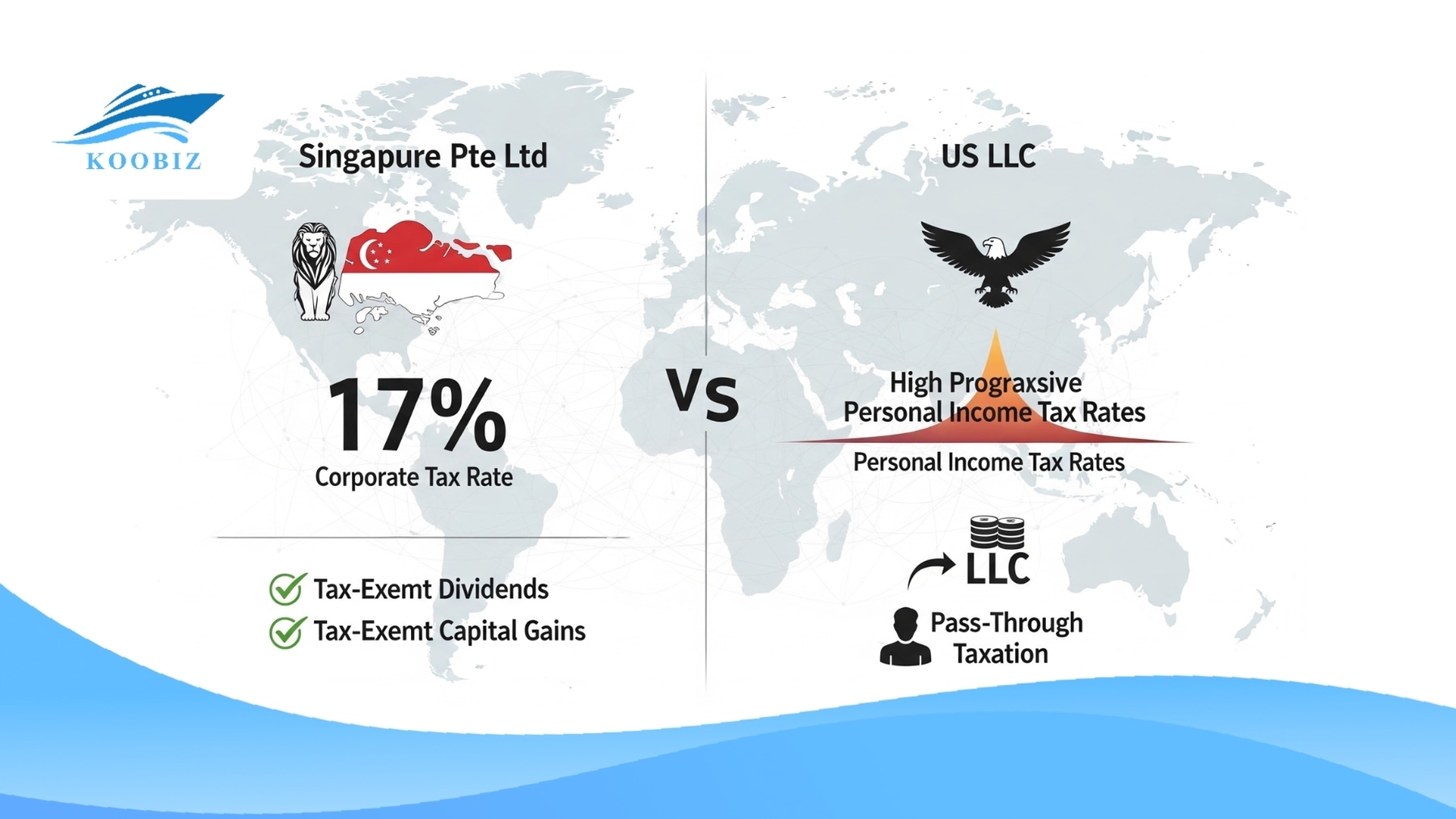
    A Singapore Pte Ltd typically offers superior tax benefits for foreigners compared to a US LLC due to Singapore’s single-tier corporate tax system versus the US pass-through taxation model.

    Taxation is often the deciding factor for incorporation. While an LLC might seem simpler because it avoids corporate tax at the entity level, it exposes the foreign owner to personal income tax rates which can be significantly higher. Singapore’s jurisdiction is territorially based, meaning foreign-sourced income not remitted to Singapore may not be taxed, whereas US LLCs often entangle owners in the global US tax net.

    How Does Taxation Work for a US LLC?

    A US LLC utilizes “pass-through taxation”, meaning the business itself pays no tax, but profits are funneled to the owners to be reported on their personal tax returns.

    This can be advantageous for local US small business owners who want to avoid double taxation. However, for a foreign entrepreneur, this can be detrimental. If you are considered engaged in a US trade or business, you are subject to US progressive personal income tax rates (up to 37%) and potentially the Self-Employment Tax (Social Security and Medicare taxes). Furthermore, the “Check-the-box” regulation allows LLCs to choose how they are taxed, but navigating this as a non-resident alien is complex and often results in a heavier tax burden than anticipated.

    How Does Singapore’s Single-Tier Tax System Work for Pte Ltd?

    Singapore employs a single-tier tax system where the Pte Ltd pays a flat Corporate Tax rate of 17%, and dividends distributed to shareholders are completely tax-exempt.

    This system effectively eliminates double taxation for shareholders. Moreover, the effective tax rate is often much lower than 17% due to the Start-Up Tax Exemption (SUTE) scheme. Under SUTE, new companies receive a 75% exemption on the first SGD 100,000 of chargeable income and a 50% exemption on the next SGD 100,000 for the first three consecutive years. Additionally, Singapore has 0% Capital Gains Tax, meaning if you sell your shares or the company creates profit from selling assets, that income is tax-free. For foreign entrepreneurs, this structure ensures that once corporate tax is paid, the remaining profit is yours to keep without further deductions.

    Koobiz Insight: Utilizing Singapore’s network of over 90 Double Taxation Agreements (DTAs) can further reduce withholding taxes on international trade. At Koobiz, we help structure your Pte Ltd to maximize these treaty benefits.

    Pros & cons of a Pte Ltd (summary)

    The main advantages of a Pte Ltd include high credibility and tax efficiency, while the primary disadvantages are the higher compliance costs and stricter administrative requirements.

    To summarize the decision-making process:

    Pros:

    • Credibility: A “Pte Ltd” suffix commands respect from banks, suppliers, and clients, signaling a commitment to longevity.
    • Perpetual Succession: The company continues to exist even if shareholders die or resign.
    • Tax Efficiency: corporate tax, start-up exemptions, and no capital gains tax in Singapore.
    • Ease of Transfer: Ownership can be transferred simply by selling shares.

    Cons:

    • Higher compliance costs (secretarial, filings).
    • More formalities for corporate governance.
    • Deregistration / winding down takes longer than dissolving a sole proprietorship.

    Having weighed these points, many foreign entrepreneurs find a Pte Ltd the optimal choice for regional growth. Koobiz supports founders from formation through compliance (nominee director solutions, company secretarial, tax advisory, and ongoing filings).

    What Are the Registration and Compliance Requirements for a Pte Ltd?

    Registration & compliance requirements for Singapore Pte Ltd
    Registration & compliance requirements for Singapore Pte Ltd

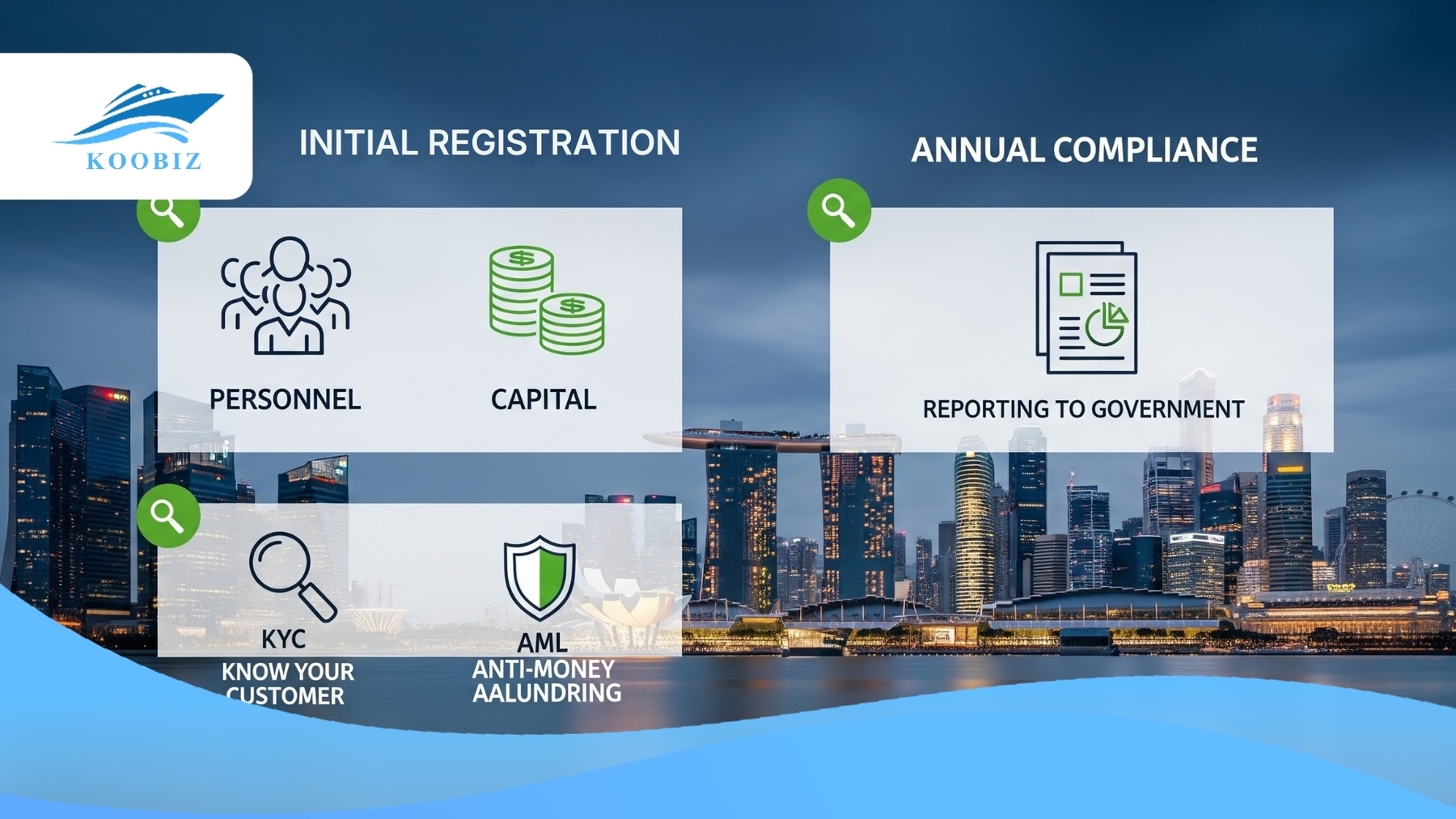
    The requirements for a Pte Ltd generally fall into two categories: Initial Registration requirements involving personnel and capital, and Annual Compliance requirements involving reporting to government authorities.

    Unlike some jurisdictions where you can register a company with just an email, Singapore maintains its reputation as a trusted financial hub by enforcing strict Know-Your-Customer (KYC) and Anti-Money Laundering (AML) regulations. This means the barrier to entry is slightly higher, but it ensures the legitimacy of your business. Koobiz specializes in navigating these regulatory waters for foreign clients, ensuring a seamless setup process.

    Initial Registration Requirements for Foreigners

    To register a Pte Ltd, a foreigner must appoint at least one locally resident director, a company secretary, and provide a local registered address.

    Specifically, the requirements include:

    • Shareholding: Minimum of 1 and maximum of 50 shareholders (can be foreign individuals or entities).
    • Share Capital: Minimum paid-up capital of SGD 1.
    • Resident Director: You must have at least one director who is “ordinarily resident” in Singapore. Foreigners often use a Nominee Director Service provided by firms like Koobiz to satisfy this requirement until they can obtain an Employment Pass to act as the local director themselves.
    • Company Secretary: Must be appointed within 6 months of incorporation.
    • Address: A physical local address (P.O. Box is not allowed).

    Annual Filing and Compliance Requirements

    Every Pte Ltd must hold an Annual General Meeting (AGM) and file both Annual Returns with ACRA and Tax Returns with IRAS.

    Compliance is non-negotiable in Singapore.

    1. Annual General Meeting (AGM): Must be held typically within 6 months after the Financial Year End (FYE).
    2. Annual Return (AR): Must be filed with the Accounting and Corporate Regulatory Authority (ACRA) within 7 months of the FYE.
    3. Tax Filing: Companies must file Estimated Chargeable Income (ECI) within 3 months of FYE and the Corporate Income Tax Return (Form C-S/C) by November 30th. Failure to meet these deadlines can result in penalties or court summons for the directors.

    Need help with Compliance? Incorporating is just the start. Koobiz provides comprehensive Corporate Secretarial services to handle your AGMs, AR filings, and ensure you never miss a deadline. Get Started with Koobiz Incorporation Services Today

    LLP vs Pte Ltd

    An LLP offers limited liability but is taxed through partners (personal tax rates apply). LLPs suit professional partnerships (accountancy, law) where partner taxation at personal rates is acceptable. For scale and outside investor-friendliness, Pte Ltd is usually superior.

    Other structures: Sole proprietorship

    Sole proprietorships are easy to set up but offer no limited liability – personal assets are at risk. Foreigners must appoint a local manager, and there are limited tax incentives compared with Pte Ltd.

    International tax & treaties

    Singapore maintains an extensive DTA network (around 100 DTAs/limited DTAs/EOI arrangements), which helps reduce withholding taxes for cross-border trading and investment. Koobiz advises on structuring to maximize treaty benefits where applicable.

    Ready to Incorporate Your Singapore Company?

    Choosing between a Pte Ltd and other structures is just the first step. Navigating the incorporation process, securing a nominee director, and ensuring tax compliance requires a partner who understands the local landscape.

    At Koobiz, we simplify market entry for foreign entrepreneurs. From same-day incorporation to ongoing corporate secretarial support, our team ensures your business is set up for success from day one.

    Don’t let bureaucracy slow you down. Book a Free Consultation with Koobiz and let us handle the paperwork while you focus on building your business.

    Frequently Asked Questions (FAQs)

    Can I convert my existing US LLC into a Singapore Pte Ltd?

    No, you cannot directly “convert” a US entity into a Singapore entity due to different legal jurisdictions. You would typically incorporate a new Pte Ltd in Singapore and transfer assets or set it up as a subsidiary.

    Do I need to physically visit Singapore to set up a Pte Ltd?

    No, the entire incorporation process can be done online. However, you will need to engage a registered filing agent (like Koobiz) to submit the application to ACRA on your behalf.

    What is the minimum paid-up capital required?

    The minimum paid-up capital is just SGD 1. You can increase this amount later as your business grows or if you need to apply for work passes.

    How long does the incorporation process take?

    With all documents prepared and no complex compliance issues, a Pte Ltd can often be incorporated within 24 hours.