[SUMMARIES]
Definition: MOM is the government ministry responsible for manpower policy formulation and implementation in Singapore, distinct from family terms.
Core Functions: It manages work passes (EP, S Pass, WP), enforces the Employment Act, and oversees Workplace Safety and Health (WSH).
Compliance: Employers must navigate quotas, levies, and fair employment practices (TAFEP) to operate legally.
Digital Tools: Platforms like myMOM Portal and EP eService are mandatory for transaction management.
Strategic Partner: Koobiz supports businesses in navigating these regulations during company incorporation and setup.
[/SUMMARIES]
For international investors, MOM (Ministry of Manpower) is the critical regulatory body governing Singapore’s workforce. It controls your ability to hire talent and operate legally through three main pillars: issuing work passes (such as the EP and S Pass), enforcing the Employment Act, and ensuring workplace safety. Understanding these regulations is non-negotiable for business success. At Koobiz, we guide companies through these complexities during Singapore incorporation and corporate setup, ensuring you remain compliant from day one.
What is the Ministry of Manpower (MOM) in Singapore?
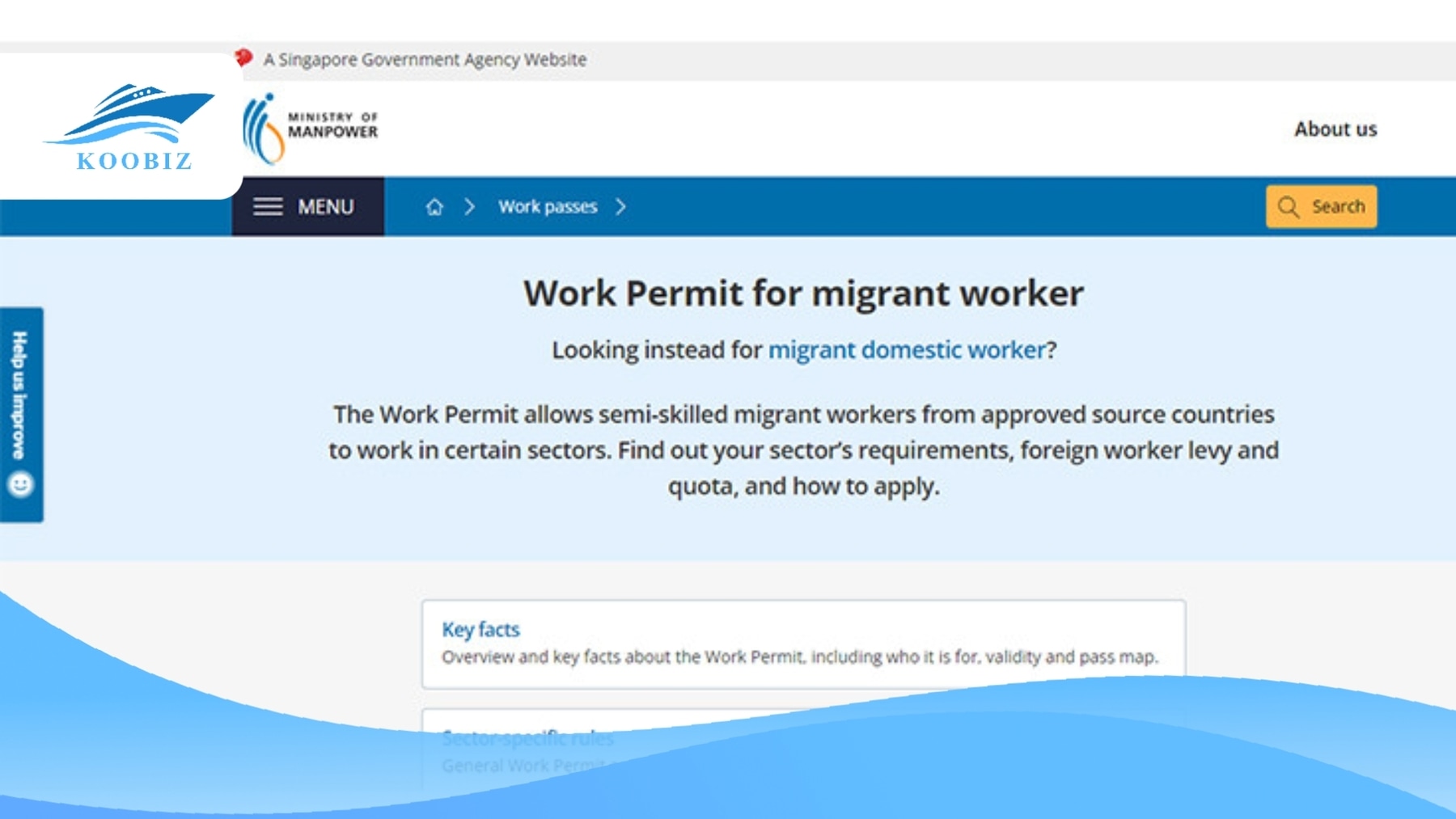
The Ministry of Manpower (MOM) is the primary government authority in Singapore dedicated to formulating and implementing labor policies. It acts as the architect of the nation’s workforce, balancing business needs with employee protection.
Key Roles:
- Policy Maker: Sets regulations for a productive and inclusive workforce.
- Regulatory Guardian: Enforces the Employment Act and Workplace Safety rules.
- Immigration Controller: Manages all work passes (EP, S Pass, WP) for foreign talent.
- Social Security Manager: Oversees the Central Provident Fund (CPF) contributions.
For businesses incorporating via Koobiz, MOM is the critical regulatory body governing your ability to hire and operate after ACRA registration.
What are the Key Responsibilities of MOM?
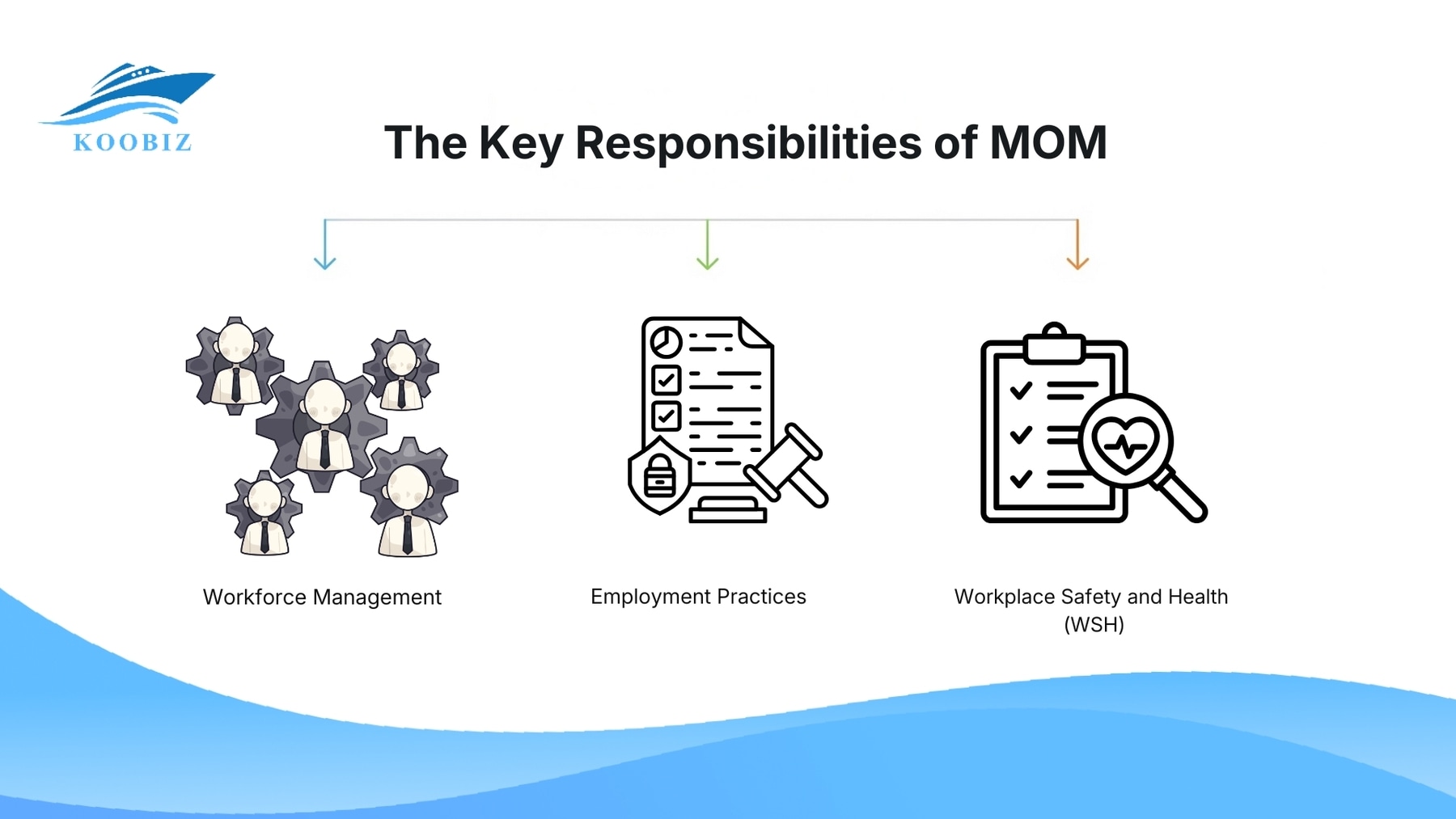
MOM has three core responsibilities that define its operational scope: managing the foreign workforce, enforcing employment practices, and regulating workplace safety and health. Specifically, these responsibilities act as the framework within which every Singaporean company must operate.
- Workforce Management: This involves controlling the inflow of foreign manpower to ensure it complements the local workforce through setting quotas, levies, and qualifying criteria for various passes.
- Employment Practices: MOM oversees the Employment Act to ensure that employment terms—such as salary payment, public holidays, and termination clauses—are fair and adhered to by all employers.
- Workplace Safety and Health (WSH): The ministry enforces strict safety protocols to minimize industrial accidents across all industries, particularly in high-risk sectors like construction and marine.
These pillars ensure that Singapore remains a competitive yet regulated hub for global business.
Main Types of Work Passes Issued by MOM
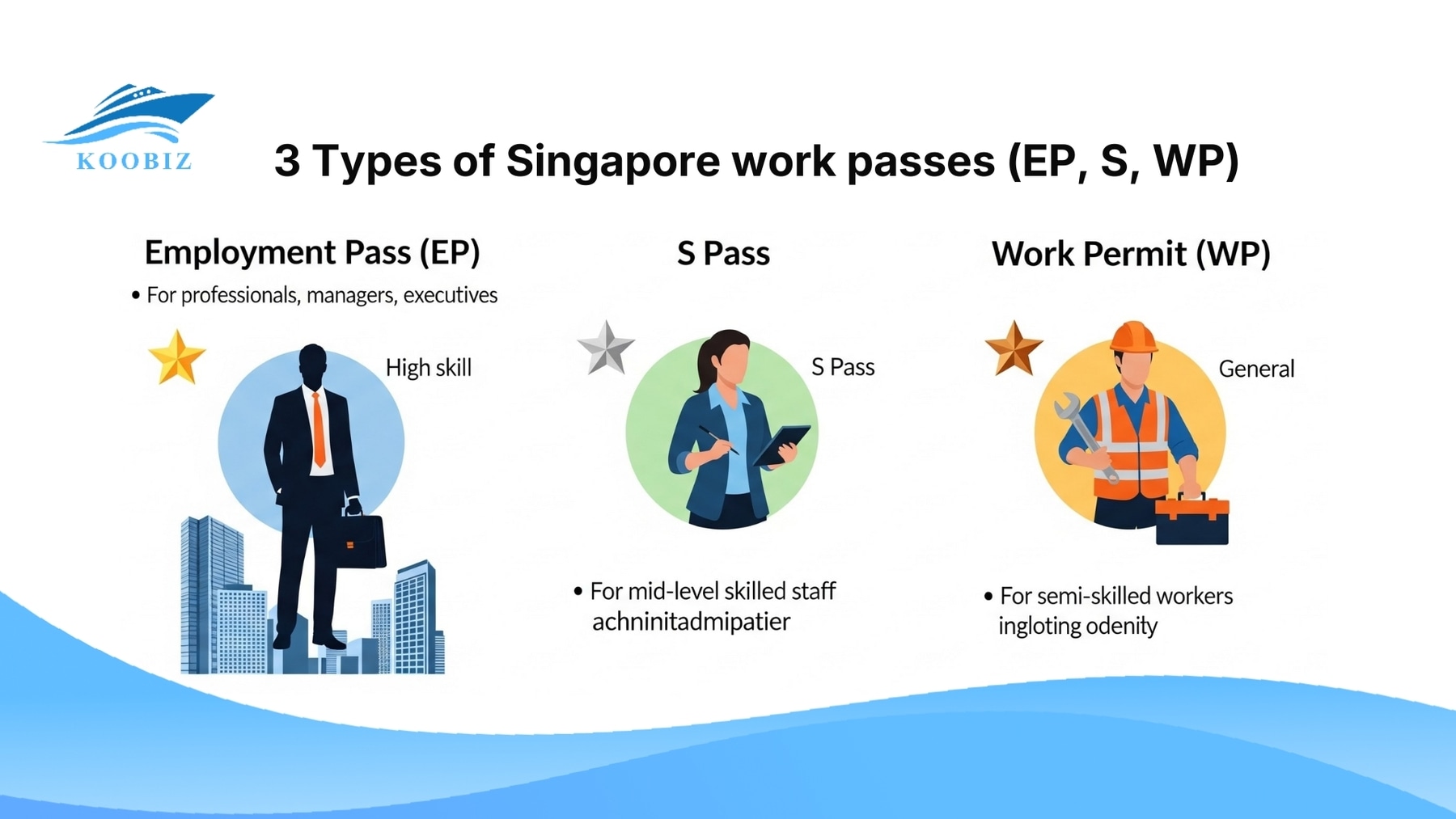
There are three primary categories of work passes issued by MOM: the Employment Pass (EP), S Pass, and Work Permit, classified according to salary levels and skill sets. Navigating these categories is essential for strategic hiring. At Koobiz, we frequently advise clients on the specific nuances of each pass to ensure successful applications.
Employment Pass (EP)
The Employment Pass is designed for foreign professionals, managers, and executives earning a high fixed monthly salary.
- Target Audience: High-earning professionals and senior management.
- Salary Threshold (2026): Minimum SGD 5,600 (General) or SGD 6,200 (Financial Services). This increases with age, reaching up to SGD 10,700 (General) or SGD 11,800 (Financial) for candidates aged 45+.
- Key Features: No foreign worker levy and no quota requirement. However, it is subject to the COMPASS (Complementarity Assessment Framework) scoring system.
- Relevance: This is the most common pass for business owners and directors incorporating their businesses in Singapore.
S Pass
The S Pass is intended for mid-level skilled staff.
- Target Audience: Technicians and specialized administrators.
- Salary Threshold (2026): Minimum SGD 3,300 (General) or SGD 3,800 (Financial Services).
- Key Features: Subject to a quota (Dependency Ratio Ceiling), a Sub-Quota, and requires the employer to pay a monthly Foreign Worker Levy (Standardized at SGD 650).
- Relevance: Useful for operational roles that require specific technical skills but do not meet the EP salary criteria.
Work Permit (WP)
The Work Permit is for semi-skilled foreign workers in the construction, manufacturing, marine shipyard, process, or services sectors.
- Target Audience: Blue-collar workers from approved source countries.
- Key Features: Strict quota limitations, security bonds, and levy requirements.
- Relevance: Heavily regulated with restrictions on bringing dependents.
Is MOM Approval Required for All Foreign Employees?
Yes, MOM approval is strictly required for any non-resident individual intending to work in Singapore, without exception. This requirement is absolute; engaging a foreigner without a valid work pass constitutes a serious offense under the Employment of Foreign Manpower Act.
- The Regulatory Stance: Even for short-term assignments or unpaid internships, specific notifications or passes (like the Work Holiday Pass or Miscellaneous Work Pass) are needed.
- Consequences of Non-Compliance: Employers facing conviction can be fined up to SGD 30,000, imprisoned for up to 12 months, and barred from hiring foreign workers in the future.
- Koobiz Insight: We strongly advise clients to secure the In-Principle Approval (IPA) before the employee arrives in Singapore to avoid entry denial.
Therefore, compliance starts before the employee sets foot in the office.
What is the Employment Act under MOM Regulations?
The Employment Act is Singapore’s main labor law that provides the basic terms and conditions of employment for covered employees, serving as the legal baseline that individual contracts cannot override.
- Coverage: It covers both local and foreign employees working under a contract of service with an employer. This includes full-time, part-time, and temporary staff.
- Key Provisions: It mandates the timely payment of salaries (within 7 days of the salary period), overtime pay (for specific eligible workers earning below defined caps), annual leave, and sick leave entitlements.
- Exclusions: It does not cover seafarers, domestic workers, and statutory board employees, who are subject to other specific regulations.
Understanding this Act is crucial because any contract term that is less favorable than the conditions stated in the Act is considered null and void.
Navigating MOM Compliance and Digital Services
Beyond the basic definitions, successful business operations in Singapore require mastering MOM’s digital infrastructure and compliance nuances. This section explains how to interact with MOM efficiently. Koobiz frequently assists clients in setting up their CorpPass accounts, ensuring seamless access to these portals immediately upon incorporation.
What is the Difference Between Employment Pass and S Pass?
The Employment Pass (EP) provides superior operational freedom (with no quota or levy restrictions), while the S Pass is more restrictive and costly due to ongoing levies and strict quotas. Comparing these two reveals the strategic hierarchy of Singapore’s visa system:
| Feature | Employment Pass (EP) | S Pass |
|---|---|---|
| Quota System | None. No quota limit. | Yes. Limited by DRC & Sub-Quota (e.g., max 10% in Services). |
| Cost Implication | The employer pays salary only. | Salary plus Standardized Levy (SGD 650/month). |
| Eligibility | COMPASS Framework (Points-based). | Strict salary and qualification requirements. |
| Salary Threshold | Min SGD 5,600 (General) | Min SGD 3,300 (General) |
This distinction drives hiring strategy: companies often strive to qualify key staff for an EP to avoid the administrative burden and costs of the S Pass.
How to Calculate the Foreign Worker Levy (FWL) and Quota?
The calculation of the Foreign Worker Levy (FWL) and quota follows a precise 4-step formula based on your local workforce strength. This mechanism ensures that companies contribute to the local economy before hiring foreign staff.
- Step 1: Calculate Your Local Workforce (LQS Count)
You must determine how many “valid” local employees you have based on the Local Qualifying Salary (LQS).- 1 Count: Singapore Citizen/PR earning ≥ SGD 1,600/month.
- 0.5 Count: Singapore Citizen/PR earning SGD 800 to < SGD 1,600/month.
- Step 2: Identify Your Sector’s Quota (DRC)
Apply the Dependency Ratio Ceiling (DRC) specific to your industry.- Services Sector: 35% Total DRC (Max 35% foreign), but only 10% can be S Pass (Sub-Quota).
- Construction: 83.3% (Ratio 1 Local : 5 Foreigners).
- Manufacturing: 60%.
- Marine Shipyard / Process: 77.8% / 83.3%.
- Step 3: Calculate Maximum Foreign Workers
Use the formula: Total Foreign Workers = (Local Count x DRC) / (1 – DRC).- Example (Services Sector): To hire 1 S Pass holder (under the 10% sub-quota), you need approximately 9 Local Full-Time Employees.
- Calculation: (9 locals * 10%) / (100% – 10%) = 0.9 / 0.9 = 1 S Pass.
- Step 4: Determine Your Levy Tier
- S Pass: Standardized at SGD 650 (Tier 1).
- Work Permit: Tiered based on how close you are to the maximum DRC.
While MOM provides an online calculator, Koobiz advises running these projections before hiring to avoid costly “over-quota” rejections.
What is the Role of TAFEP in Relation to MOM?
TAFEP (Tripartite Alliance for Fair and Progressive Employment Practices) acts as the promoter of fair employment, working in tandem with MOM to investigate discrimination complaints. While MOM serves as the enforcement authority, TAFEP functions as the oversight body.
- Fair Consideration Framework: Before applying for an EP, companies must often advertise the job on MyCareersFuture for 14 days to give locals a fair chance. TAFEP monitors this.
- Discrimination: If a company is flagged by TAFEP for discriminatory hiring (based on age, gender, nationality), MOM can curtail their work pass privileges.
- Relationship: TAFEP sets the guidelines; MOM executes the penalties.
How to Use myMOM Portal and EP eService?
The myMOM Portal and EP eService (formerly EP Online) are the designated digital platforms for all work pass transactions and corporate data management. Accessing these portals requires a CorpPass account, which Koobiz helps set up during the company formation process.
- EP eService: It is used specifically for the application, renewal, and cancellation of Employment Passes and S Passes, and it enables immediate status checks.
- myMOM Portal: A newer, integrated dashboard that offers a holistic view of the company’s workforce, quota balance, and levy bills.
- Key Function: These portals are essential for carrying out regulatory compliance in practice. Without access, a business cannot perform its basic HR functions.
About Koobiz
Navigating the Ministry of Manpower’s regulations is just one piece of the puzzle when establishing a business in Singapore. At Koobiz, we provide a comprehensive suite of corporate services tailored for the Singapore market. From company incorporation and opening corporate bank accounts to managing tax, accounting, and work pass applications, we ensure your business is compliant from Day One. Let us handle the regulatory complexities so you can focus on growth.
Leave a Reply