Author: Stella Pham

  • Filing Financial Statements in XBRL Format: Full vs. Simplified Taxonomy for SG Companies

    Filing Financial Statements in XBRL Format: Full vs. Simplified Taxonomy for SG Companies

    [SUMMARIES]

    Mandatory Requirement: Most Singapore-incorporated companies must file financial statements in XBRL format with ACRA, except for specific exemptions, such as solvent Exempt Private Companies (EPCs) that choose to file their financial statements in PDF format.

    Two Taxonomies: Companies must choose between ‘Full XBRL’ and ‘Simplified XBRL’ based on their company type and whether they are required to file a full set of financial statements with ACRA, rather than on revenue or asset thresholds.

    BizFinx Tool: Companies may use ACRA’s BizFinx Preparation Tool or other ACRA-compatible accounting software to prepare, validate, and submit XBRL financial statements.

    Compliance is Key: Errors in XBRL mapping or applying an incorrect taxonomy may result in resubmission requests or filing delays. Engaging professional assistance, such as Koobiz, helps ensure accuracy and regulatory compliance.

    [/SUMMARIES]

    Navigating the regulatory landscape of Singapore can be daunting for business owners, particularly when it comes to the technicalities of filing financial statements in XBRL format. Whether you are a newly incorporated startup or an established enterprise, understanding ACRA’s digital reporting requirements is crucial for maintaining good standing.

    At Koobiz, we often encounter clients confused about whether they should file under the ‘Simplified XBRL’ or are required to adopt the ‘Full XBRL’ taxonomy. This comprehensive guide will demystify the XBRL mandate, helping you determine exactly which template applies to your business, how to execute the filing process using BizFinx or other ACRA-compatible tools, and how to avoid common compliance pitfalls in the evolving 2026 landscape.

    What is XBRL Filing?

    XBRL Filing refers to the mandatory process for most Singapore-incorporated companies to convert and submit their financial statements to ACRA in a machine-readable format.

    While XBRL (eXtensible Business Reporting Language) is the global standard technology used to tag financial data (like revenue, assets, and liabilities), XBRL Filing refers to the specific compliance action Singapore companies must take. Instead of just uploading a static PDF of your accounts, companies required to file in XBRL must use the ACRA-approved taxonomy to map their financial figures into this digital format and submit them as part of their Annual Return. This ensures that the data is not just stored, but is ready for analysis and comparison by regulators and investors.

    Why Does ACRA Require It?

    To understand why this matters to your business, we must look at the objective behind the mandate: transparency and efficiency.
    ACRA's requirements
    ACRA’s requirements

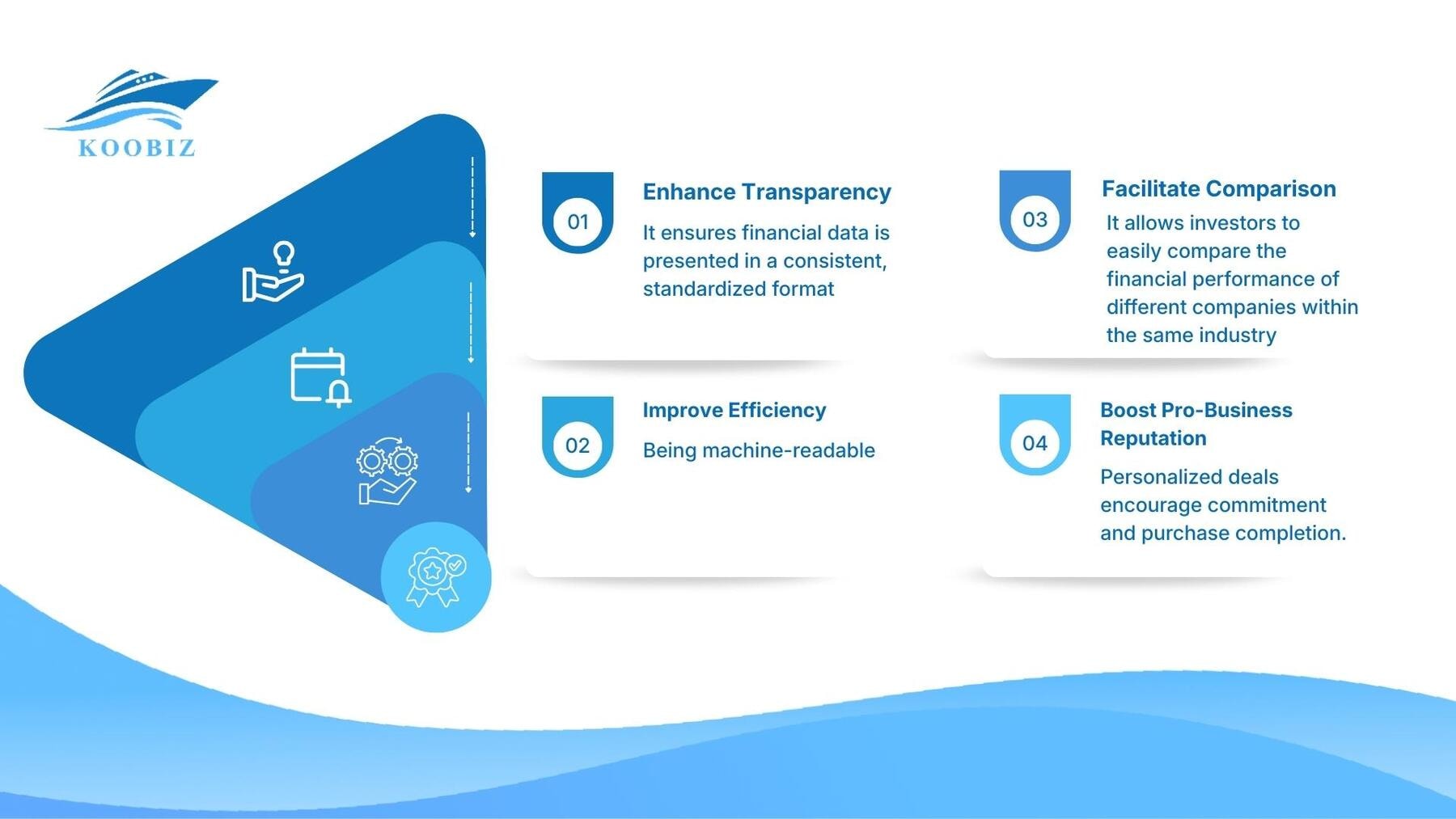
    ACRA requires most Singapore-incorporated companies to file financial statements in XBRL format to achieve several key objectives:

    • Enhance Transparency: It ensures financial data is presented in a consistent, standardized format, making the marketplace more transparent for all stakeholders.
    • Improve Efficiency: Being machine-readable, XBRL allows regulators and auditors to analyze vast amounts of data instantly without manual processing.
    • Facilitate Comparison: It allows investors to easily compare the financial performance of different companies within the same industry (comparing apples to apples).
    • Boost Pro-Business Reputation: A transparent corporate environment builds trust with international investors and strengthens Singapore’s status as a trusted global business hub.

    For companies working with Koobiz, this transition to digital reporting is not just a compliance hurdle but a step towards better financial visibility and governance.

    Who Must File Financial Statements in XBRL Format?

    The majority of Singapore-incorporated companies are required to file their financial statements in XBRL format with ACRA.

    However, the scope of this requirement depends on the specific type of business entity you operate. Generally, the mandate applies primarily to companies limited by shares, while companies limited by guarantee may be subject to different filing requirements depending on their regulatory status. Specifically, if your company is Singapore-incorporated (unlimited or limited by shares), you are legally obliged to file your financial statements in XBRL format, using either the Full or Simplified taxonomy, unless you fall into a specific exempted category.
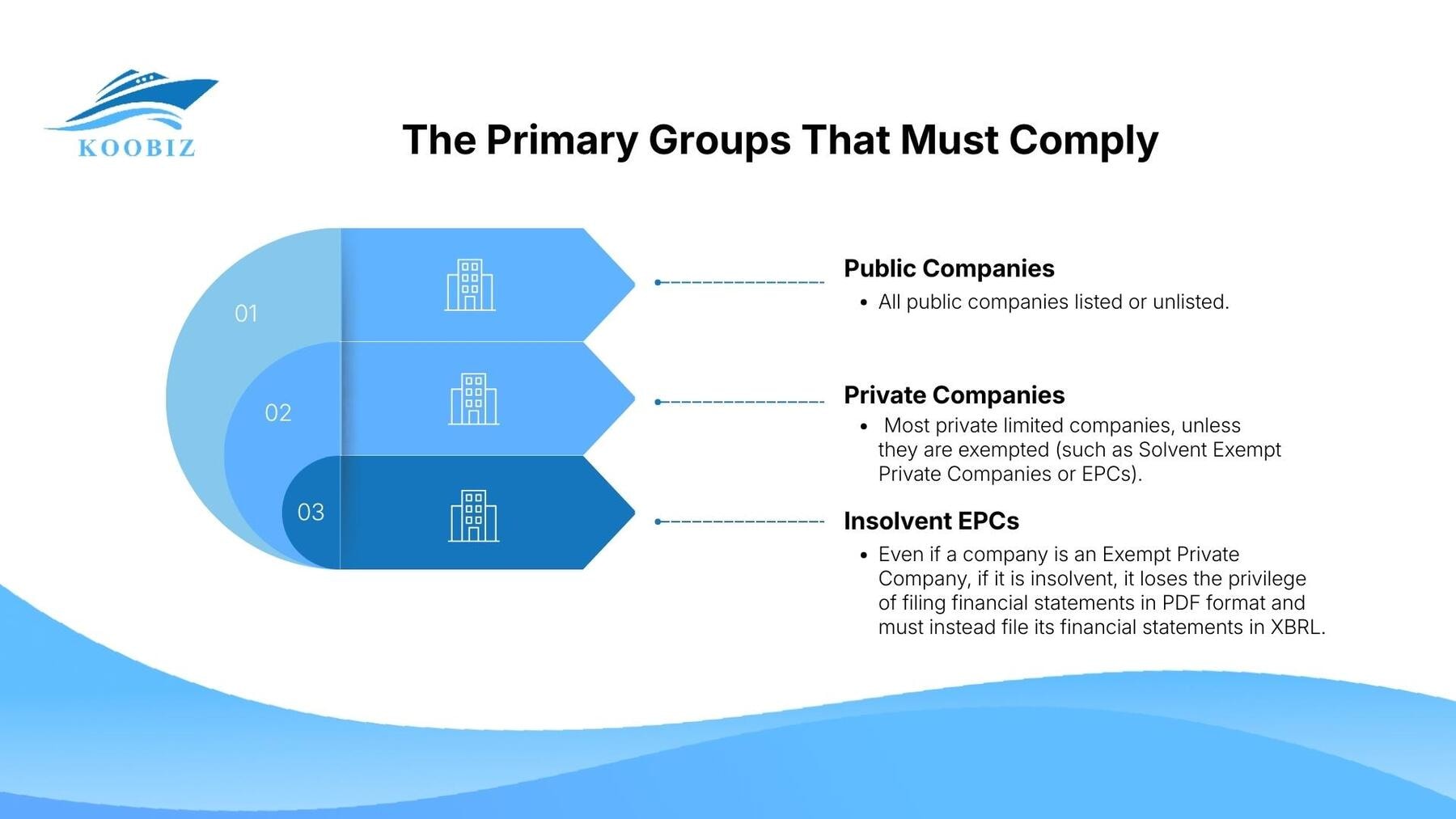
    The Primary Groups That Must Comply
    The Primary Groups That Must Comply

    The primary groups that must comply include:

    • Public Companies: All public companies listed or unlisted.
    • Private Companies: Most private limited companies, unless they are exempted (such as Solvent Exempt Private Companies or EPCs).
    • Insolvent EPCs: Even if a company is an Exempt Private Company, if it is insolvent, it loses the privilege of filing financial statements in PDF format and must instead file its financial statements in XBRL.

    Understanding these distinctions is the first step in compliance. If your company falls within the mandatory group, the next critical decision is determining the depth of data you need to report—whether to use the Full or Simplified taxonomy.

    Full vs. Simplified XBRL: Which Taxonomy Applies to You?

    The Full and Simplified XBRL taxonomies are applied based on a company’s filing obligations with ACRA, rather than its size or public accountability.

    Choosing the correct XBRL taxonomy is important, as using the wrong one may result in your Annual Return being rejected or delayed. The table below outlines the key differences between Full XBRL and Simplified XBRL to help you determine which option applies to your company.

    Feature Full XBRL Taxonomy Simplified XBRL Taxonomy
    Applicable Companies Publicly accountable or larger entities Smaller, privately held companies (SMEs)
    Revenue Criteria Exceeds SGD 500,000 SGD 500,000 or less
    Total Assets Criteria Exceeds SGD 500,000 SGD 500,000 or less
    Data Elements (Tags) ~210 elements (High granularity) ~120 elements (Key highlights only)
    Notes to Accounts Comprehensive disclosure required Limited disclosure required

    Companies with revenue or total assets above SGD 500,000 are required by ACRA to file financial statements using the Full XBRL taxonomy. In contrast, Simplified XBRL is designed for smaller companies, allowing startups and SMEs to meet ACRA’s filing requirements with fewer disclosures and lower compliance effort.

    How to Prepare and File XBRL Financial Statements

    Preparing XBRL financial statements generally follows three main steps: preparing the source documents, mapping data in BizFinx, and validating the file before submission.

    ACRA provides a free tool called BizFinx to help companies prepare and file XBRL financial statements. Although BizFinx is free to use, accurately interpreting financial figures and mapping them to the correct XBRL tags requires technical knowledge. Whether the filing is handled internally or outsourced to a professional service provider, the overall workflow remains the same.
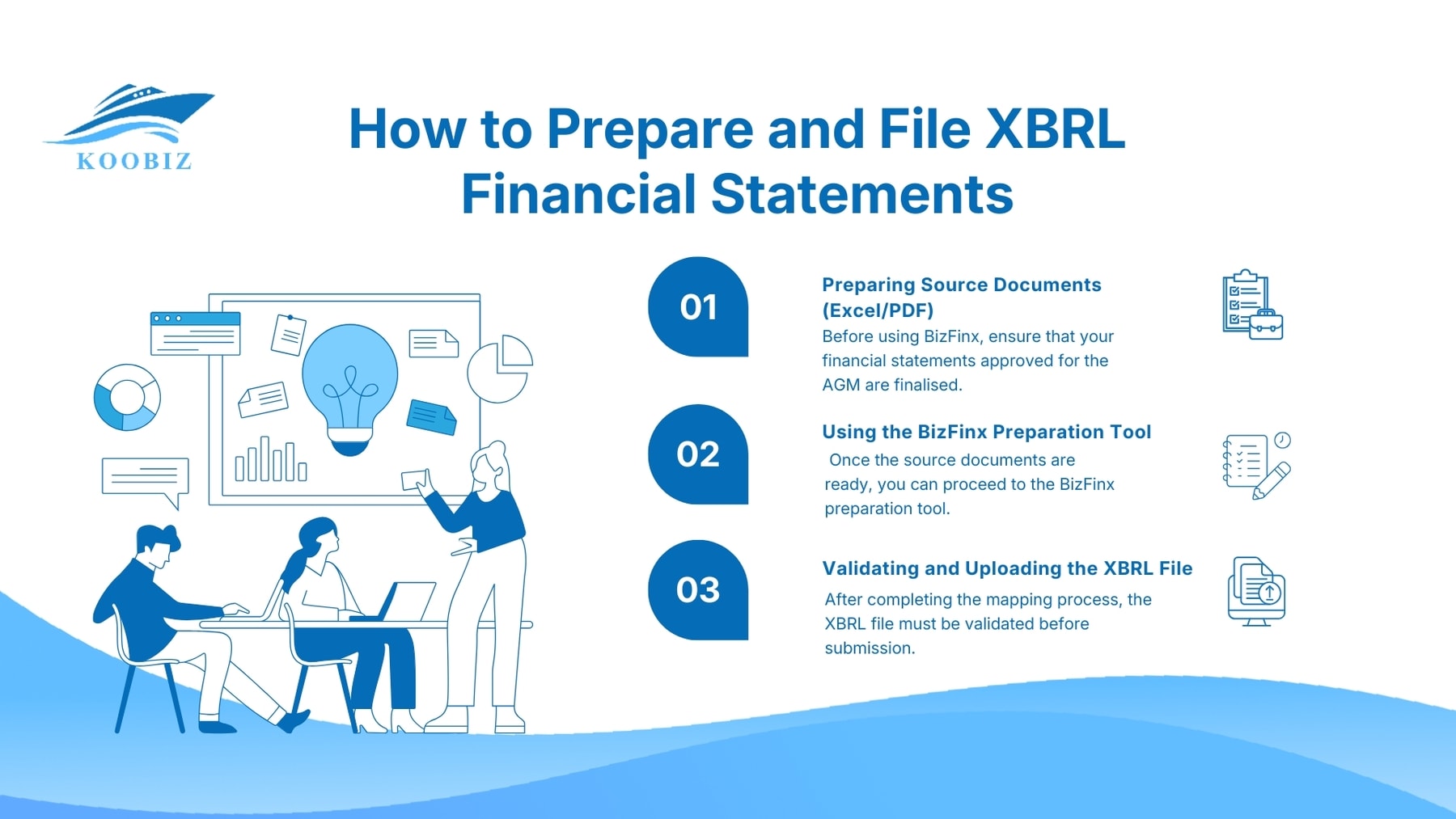
    How to Prepare and File XBRL Financial Statements
    How to Prepare and File XBRL Financial Statements

    Step 1: Preparing Source Documents (Excel/PDF)

    Before using BizFinx, ensure that your financial statements approved for the AGM are finalised. If your business qualifies, ensure you have properly prepared your unaudited financial statements.

    • The Directors’ Statement and Auditors’ Report (if applicable) should also be completed at this stage.
    • If you intend to import data into BizFinx, preparing an Excel template in advance can help reduce manual data entry.

    Step 2: Using the BizFinx Preparation Tool

    Once the source documents are ready, you can proceed to the BizFinx preparation tool.

    • Input Basic Data: Enter the company UEN and financial period.
    • Select Template: Choose “Full” or “Simplified” based on the criteria discussed in the previous section.
    • Mapping (Tagging): Mapping (tagging) is the key step in the XBRL process, where figures from the financial statements are mapped to the relevant XBRL tags within BizFinx. For example, “Cash at Bank” in your balance sheet must be mapped to the “Cash and Cash Equivalents” tag in the taxonomy.

    Step 3: Validating and Uploading the XBRL File

    After completing the mapping process, the XBRL file must be validated before submission.

    • Validation: Use the ‘Validate’ function in BizFinx to run system checks on the XBRL file. BizFinx checks for common issues such as arithmetic inconsistencies (for example, Assets not equalling Liabilities plus Equity) and missing mandatory disclosures.
    • Generation: After all validation errors have been resolved, the system will allow you to generate the XBRL (.xml) file.
    • Upload: Log in to the BizFile+ portal to file your Annual Return and upload this generated .xml file as the financial statement component. Keep an eye on XBRL deadlines to avoid unnecessary fines.

    We have covered the standard procedures and definitions. Now, we will delve into the exceptions and common challenges that specific business models might face.

    Exemptions and Special Cases in XBRL Filing

    There are specific exemptions for Solvent Exempt Private Companies (EPCs) and certain other entities, allowing them to bypass full XBRL filing under strict conditions.

    Although ACRA prioritizes a ‘digital-first’ approach, the agency understands that for some business models, the cost outweighs the benefit. Knowing whether you qualify for these exemptions can save your business significant time and budget.

    Filing Requirements for Solvent vs. Insolvent EPCs

    A frequent question we handle at Koobiz revolves around Exempt Private Companies (EPCs).

    • Solvent EPCs: If your EPC is solvent (able to pay its debts), you are exempt from filing financial statements with ACRA entirely. You only need to make a solvency declaration during the Annual Return. The bottom line: You are completely exempt from XBRL filing.
    • Insolvent EPCs: If an EPC is insolvent, it must file financial statements. If this happens, you are required to file in XBRL format (usually Simplified, assuming revenue criteria are met).
    • Voluntary Filing: A solvent EPC may choose to file financial statements voluntarily. If they do, they can choose to file in either PDF or XBRL format.

    Exemptions for CLGs and Foreign Companies

    ACRA recognizes that not every entity fits the standard commercial mold.

    • Companies Limited by Guarantee (CLGs): Commonly used for non-profits and charities, CLGs get a pass on the complex data entry. They are only required to file a PDF copy of their financial statements.
    • Foreign Companies (Singapore Branch): Singapore branches of foreign companies verify their accounts based on the laws of their home country. They are exempt from XBRL filing and you only need to file a PDF copy of their financial statements.

    Common Challenges and Best Practices for XBRL Mapping

    Misunderstanding the Scope / The Expert Fix

    XBRL is not just data entry; it is a translation of financial concepts. A mismatch between a line item in your PDF report and the ACRA taxonomy tag creates a misleading public record.

    Avoiding Common Validation Errors in BizFinx

    Validation errors often occur due to arithmetic imbalances or missing mandatory tags.

    • Rounding Off: A common issue is rounding discrepancies where the total assets do not match the sum of individual components due to decimal rounding.
    • Negative Values: Some tags expect positive values (e.g., “Less: Expenses”), while others expect negative values. Getting the sign wrong is a classic error.
    • Unmapped Data: Leaving mandatory fields blank because the specific line item doesn’t exist in your accounts (you should enter “0” rather than leaving it null if mandatory).

    In-House Preparation vs. Outsourcing to Corporate Services

    Given these complexities, businesses face a choice:

    • In-House: Requires training staff on BizFinx and accounting standards. It is cost-effective for simple accounts but risky if staff are inexperienced.
    • Outsourcing: Outsourcing to Koobiz (The Expert Route). This ensures that the mapping is done by accountants who understand both the financial standards (FRS) and the technical taxonomy.

    Emerging Trends in 2026: ESG and Enhanced Data

    ACRA is no longer satisfied with just ‘balancing the books.’ In 2026, the agency is tightening its lens.

    The compliance landscape is evolving. Moving beyond basic financial figures, ACRA demands a 360-degree view of corporate health and sustainability.

    • Mandatory Climate Reporting: Starting FY2026, listed issuers are required to report climate-related disclosures (Scope 1 and Scope 2 greenhouse gas emissions). While this currently targets public companies, it is the ‘canary in the coal mine’ for private enterprises.
    • Enhanced Data Granularity: The latest taxonomies require more precise tagging of revenue streams and expenses. The days of using ‘Other Expenses’ as a catch-all bucket are over. Relying on vague tags is now a compliance red flag that invites unnecessary scrutiny.

    Conclusion

    XBRL is more than just a regulatory checkbox; it is your company’s digital financial footprint. Whether you are navigating the nuances of the Full vs. Simplified taxonomy or troubleshooting BizFinx validation errors, precision is paramount.

    At Koobiz, we specialize in decoding the complex corporate landscape of Singapore for international and local entrepreneurs. From company incorporation to tax, accounting, and audit services, we ensure your business remains compliant so you can focus on growth. If you are unsure about your XBRL obligations or need assistance with your Annual Return, our team of experts is ready to help.

    Visit Koobiz.com today for professional assistance with your Singapore corporate filing needs.
  • Avoid Late Filing Penalties: Adhere to 2026 XBRL Deadlines for SG Directors

    Avoid Late Filing Penalties: Adhere to 2026 XBRL Deadlines for SG Directors

    [SUMMARIES]

    Mandatory Compliance: Most Singapore companies must file financial statements in XBRL format via BizFile+ in 2026 based on their FYE.

    The 7-Month Rule: Private Limited companies generally have 7 months from their Financial Year End to file Annual Returns.

    High Stakes: Late filing results in escalating fees ($300–$600) and potential director debarment for chronic non-compliance.

    Exemptions Exist: Solvent Exempt Private Companies (EPCs) and Dormant companies have simplified filing options.

    Recovery Options: Extensions of Time (EOT) can be applied for before the deadline to avoid immediate penalties.

    [/SUMMARIES]

    In 2026, Singapore’s regulatory regime remains strict, with ACRA enforcing firm deadlines for Annual Return and XBRL filings. For directors, meeting these timelines is not merely administrative – it is essential to avoid penalties and preserve a strong compliance record. Whether you operate a Private Limited Company or a Solvent EPC, missed deadlines can result in substantial financial consequences.

    At Koobiz, we’ve prepared this practical guide to help you determine your exact filing deadline, understand applicable fines, and assess available exemptions.

    Is XBRL Filing Mandatory for Singapore Companies in 2026?

    Yes. In 2026, most Singapore-incorporated companies are required to file financial statements in XBRL format unless they qualify for a specific exemption. ACRA mandates XBRL to enhance transparency and enable efficient financial analysis.

    This requirement applies to both unlimited and limited-by-shares companies. If your company is insolvent or does not qualify as a Solvent Exempt Private Company (EPC), a full set of XBRL financial statements must be lodged via the ACRA BizFile+ portal. Even where the FYE falls in late 2025, the filing obligation typically arises in 2026. Failure to submit the correct XBRL file with the Annual Return will result in immediate rejection and non-compliance.

    XBRL filing
    XBRL filing

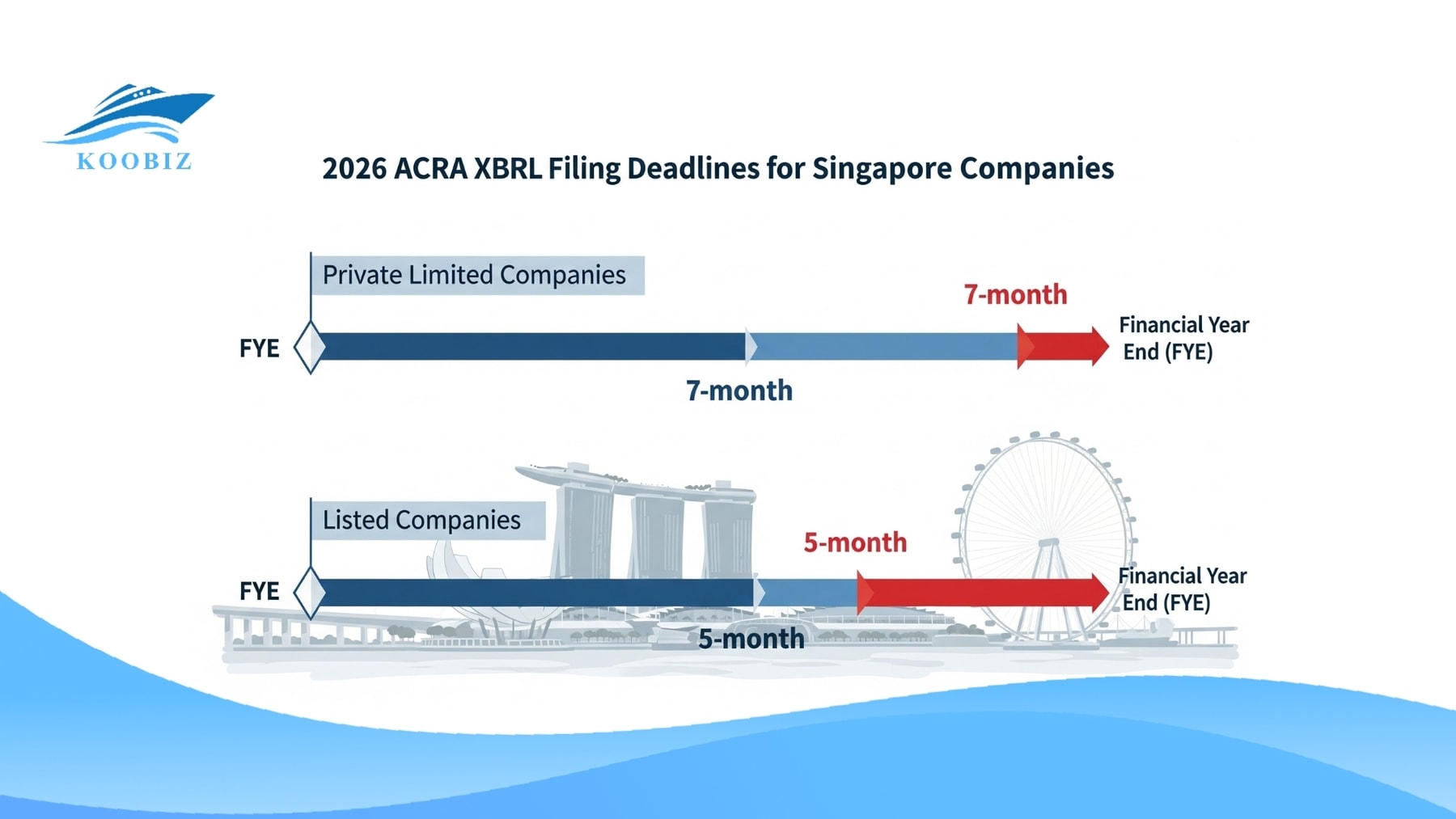
    2026 XBRL Filing Schedule: Deadlines Based on FYE

    In 2026, Annual Return filing deadlines (including XBRL) fall into two separate timelines, depending on whether the company is listed or non-listed.

    To avoid missing the deadline, directors must determine the filing date based on the company’s Financial Year End (FYE), applying the standard rule that combines the permitted AGM period with the statutory filing window.

    Deadlines Based on FYE
    Deadlines Based on FYE
    Company Type AGM Deadline (from FYE) Annual Return Deadline (from FYE) Example (FYE 31 Dec 2025)
    Private Limited (Non-listed) 6 months 7 months AGM by 30 Jun 2026
    File by 30 Jul 2026
    Listed Company 4 months 5 months AGM by 30 Apr 2026
    File by 30 May 2026

    Private Limited Companies: The 7-Month Rule Explained

    Private Limited Companies must complete their Annual Return filing within 7 months from the Financial Year End. This period covers two statutory steps: holding the AGM within 6 months of the FYE, followed by filing the Annual Return (including XBRL) within 30 days after the AGM.

    For instance, with an FYE of 31 December 2025, the AGM must be held by 30 June 2026, and the final filing deadline falls on 30 July 2026. Koobiz recommends preparing the XBRL conversion at least one month before the AGM to ensure accuracy ahead of directors’ approval.

    Listed Companies: Stricter Timelines for 2026

    Listed companies in Singapore operate under a shorter timeline, with only 5 months from the Financial Year End to complete their filings. They must hold the AGM within 4 months of the FYE and lodge the Annual Return, including XBRL, within 30 days thereafter.

    For example, with an FYE of 31 December 2025, the AGM must be held by 30 April 2026 and the XBRL filing completed by 30 May 2026. This compressed timeline requires efficient reporting processes to meet the heightened compliance expectations of public entities.

    Updated ACRA Penalties for Late Lodgment in 2026

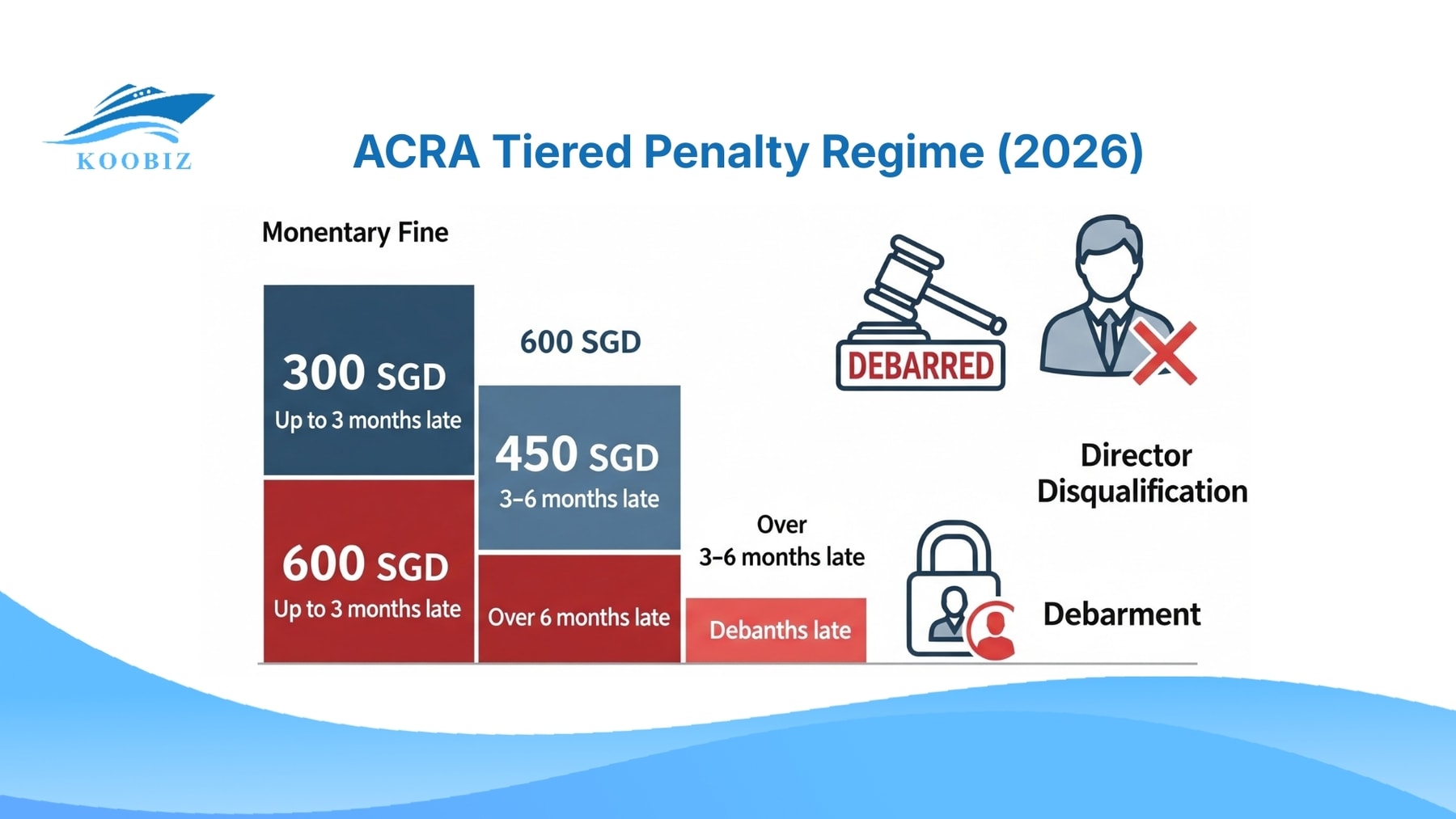
    In 2026, ACRA enforces a tiered penalty regime for late Annual Return filings, ranging from monetary fines to serious administrative sanctions on directors. While an initial late fee may appear minor, repeated non-compliance can severely damage a company’s compliance record and reputation. Notably, these penalties are automatically triggered by the BizFile+ system upon late submission.

    ACRA Tiered Penalty Regime (2026)
    ACRA Tiered Penalty Regime (2026)

    How Late Fees Accumulate: Tiered Penalty Structure

    Late lodgment fees are capped based on the length of the delay, typically ranging from $300 to $600 per statutory breach. Filing the Annual Return within three months of the deadline usually incurs a $300 penalty, increasing to $600 if the delay exceeds three months.

    Importantly, penalties are imposed separately for the AGM and the Annual Return. Missing both deadlines can therefore double the total fines – an avoidable cost that services like Koobiz help mitigate through proactive compliance reminders.

    Directors’ Liability: Can You Be Disqualified?

    Yes. Directors may be disqualified or debarred for persistent breaches of the Companies Act. Under the enhanced enforcement regime, a director with three or more companies struck off by ACRA within five years may be barred from holding directorships. In addition, ACRA now displays a public compliance rating on the Business Profile, meaning repeated late XBRL filings can directly undermine a company’s credibility with banks and investors.

    Real-World Scenarios: 2026 Compliance in Action

    To put these deadlines into perspective, the following three scenarios for the 2025/2026 financial year show how the rules apply across different business structures and the real cost of missing them.

    Scenario 1: The Standard Private Company

    Company Profile: TechStart Pte. Ltd. (Private Company)

    • FYE: 31 December 2025.
    • Deadline Calculation:
      • AGM: Must be held by 30 June 2026 (within 6 months).
      • Filing: Must file Annual Return by 30 July 2026 (within 7 months).
    • Outcome: The director approves the Financial Statements in June, and the Corporate Secretary files the XBRL via BizFile+ in July. The company remains compliant with zero penalties.

    Scenario 2: The Listed Entity

    Company Profile: Global Trade Holdings Ltd (Public Listed)

    • FYE: 31 March 2026.
    • Deadline Calculation:
      • AGM: Must be held by 31 July 2026 (within 4 months).
      • Filing: Must file Annual Return by 31 August 2026 (within 5 months).
    • Outcome: Due to the tighter timeline, the company completes its audit by early July to meet the accelerated deadline.

    Scenario 3: The Cost of Delay

    Company Profile: LateBloomer Services Pte. Ltd.

    • FYE: 31 December 2025.
    • Filing Date: The company misses the 30 July 2026 deadline and finally files on 15 November 2026 (3.5 months late).
    • Consequence:
      • Late Lodgment Fee: $600 (imposed immediately because the delay exceeded 3 months).
      • Composition Sum: ACRA may also offer a separate composition sum (minimum $500) for the breach of Section 197 (Annual Return) or Section 175 (AGM).
      • Total Risk: The company faces a potential total of $1,100+ in fines and a permanent “Late” remark on the director’s compliance history for that year.

    With the key deadlines and penalties established, we now turn to the finer details of the filing requirements. Not all companies are subject to the same obligations, and understanding the applicable exemptions and variations can save substantial time and resources in 2026.

    Understanding Revisions: Revised XBRL Requirements in 2026

    The Revised XBRL Filing Requirements are now the authoritative standard for financial reporting in Singapore. Designed to streamline data elements, this framework reduces compliance burden while still capturing the key financial information required by ACRA.

    To navigate these requirements effectively in 2026, directors should note the following key changes:

    • Elimination of Old Options: Companies are no longer permitted to use the obsolete “Option A” or “Option B” formats, which have been fully phased out.
    • The Single Template Approach: Most companies must now file using the Revised XBRL Filing Requirements template. This unified template focuses on capturing approximately 100+ data elements that allow ACRA to benchmark industry performance.
    • Simplified vs. Full IFRS: While less exhaustive than the full IFRS taxonomy, the revised template still requires precise mapping of financial line items to ensure accuracy.

    Understanding these specific data entry points is where the professional corporate secretaries at Koobiz add immense value, ensuring your financial mapping complies strictly with the latest taxonomy revisions.

    Exemptions and Special Cases for 2026 Filing

    Certain categories of companies are exempted from filing a full set of XBRL financial statements based on their solvency or level of activity. Determining whether your entity falls within these “unique” or “rare” classifications is key to optimizing your compliance approach.

    Solvent EPCs: Do You Need to Convert Financials to XBRL?

    No. Solvent Exempt Private Companies (EPCs) are not required to file financial statements in XBRL, provided they make the necessary solvency declarations. An EPC is a private company with no more than 20 shareholders and no corporate shareholders. If solvent, it may file a simplified Annual Return without financial statements or attach them in PDF format. While XBRL filing is optional, voluntary submission may enhance the company’s credit profile. By contrast, insolvent EPCs must file a full set of XBRL financial statements.

    Filing for Dormant Companies: Simplified Process

    Dormant companies enjoy a much simpler filing regime than active entities. A company is considered dormant if it has no accounting transactions during the financial year. In 2026, a dormant non-listed company that meets the substantial assets test (total assets ≤ S$500,000) is exempt from preparing financial statements and filing XBRL.

    Such companies may submit a simplified Annual Return via BizFile+ to confirm their dormant status. While this exemption can significantly reduce compliance costs, directors must ensure no unintended transactions (such as bank charges) have occurred that would negate dormancy.

    What to Do If You Miss the 2026 Deadline?

    If your company is unable to meet the XBRL filing deadline, the appropriate step is to apply for an Extension of Time (EOT) instead of filing late. Proactive action signals to ACRA that the board is managing the issue responsibly.

    Step-by-Step Guide to Applying for an Extension of Time (EOT)

    Applying for an EOT involves a formal request via the BizFile+ portal, which must be submitted before the statutory deadline expires.

    1. Log in to BizFile+: Use your Corppass to access the portal at www.bizfile.gov.sg.
    2. Select EOT Service: Navigate to “Annual Filing” and select “Application for Extension of Time for Holding AGM/Filing AR”.
    3. Provide Justification: You must state a valid reason (e.g., delay in audit, change of financial year).
    4. Pay the Fee: The fee is $200 per application (covering up to 60 days extension).

    Approvals are generally granted if the application is made early. However, relying on EOTs annually is not sustainable. For a long-term solution, partnering with a corporate service provider like Koobiz ensures that your accounts are prepared and converted to XBRL well ahead of schedule, keeping your company in good standing.


    Need help with your 2026 Annual Return and XBRL Filing?
    Navigating Singapore’s corporate regulations requires precision and expertise. Koobiz specializes in helping international and local entrepreneurs establish and manage their businesses in Singapore. From Company Incorporation to Tax, Accounting, and XBRL Filing, our expert team ensures you remain compliant while you focus on business growth. Contact us today for a consultation.

    Disclaimer: This article is for general informational purposes only and does not constitute legal or professional financial advice. All ACRA regulations, fees, and deadlines are subject to change. Readers should consult the official ACRA website or a qualified corporate secretary for the most current information specific to their business situation.

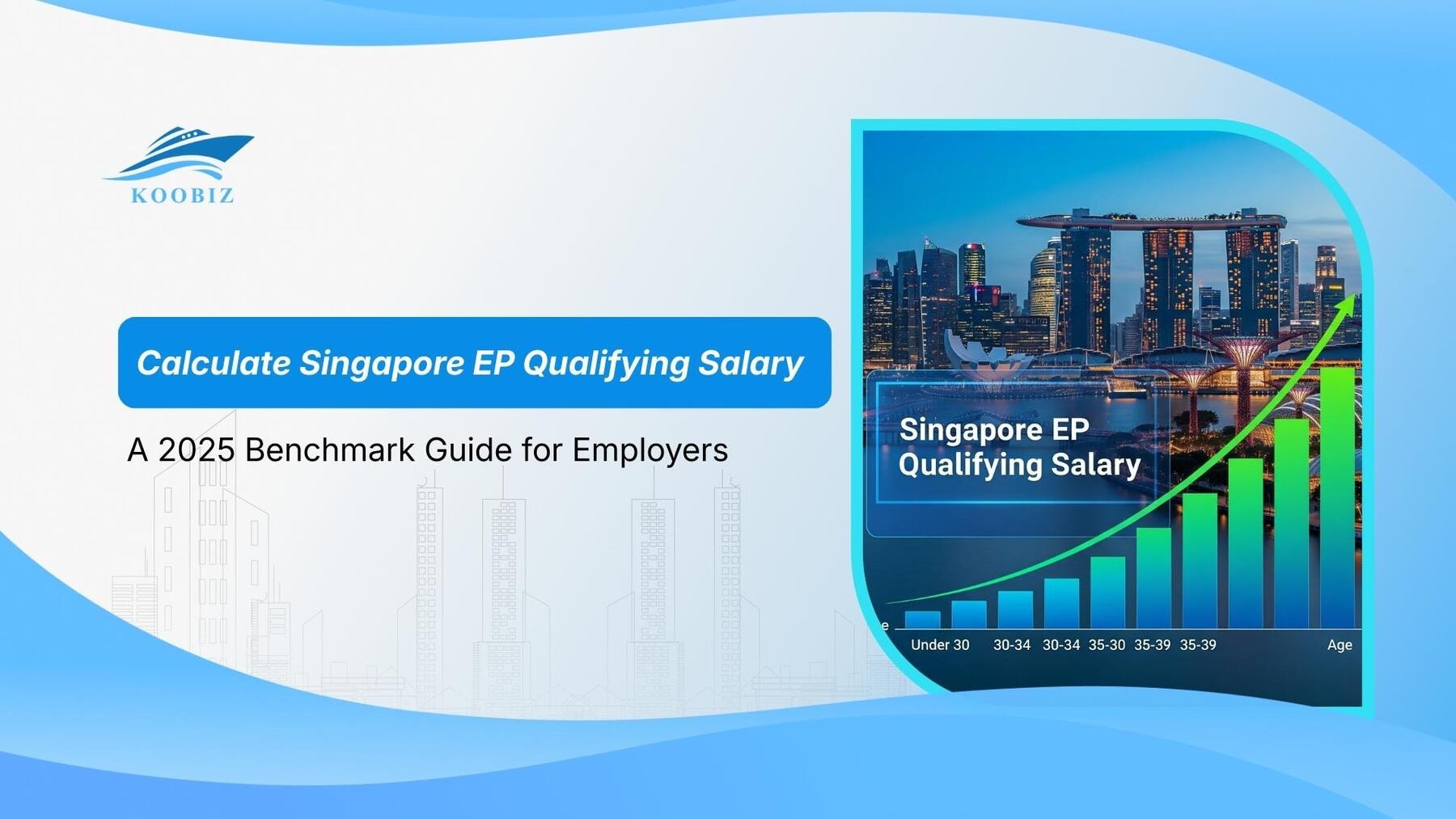
  • Calculate Singapore EP Qualifying Salary: A 2025 Benchmark Guide for Employers

    Calculate Singapore EP Qualifying Salary: A 2025 Benchmark Guide for Employers

    [SUMMARIES]

    New Base Thresholds: The minimum qualifying salary is $5,600 for all sectors, rising to $6,200 for Financial Services (effective for all new applications and renewals expiring from Jan 1, 2026 onwards).

    Age Matters: The requirement increases progressively with age; a 45-year-old candidate now requires $10,700+ (General) or $11,800+ (Finance).

    COMPASS Integration: Meeting the minimum only qualifies the candidate to apply; earning points under the COMPASS C1 attribute requires meeting local PMET salary benchmarks (65th and 90th percentiles).

    Fixed Components: Only “fixed monthly salary” counts towards the threshold, variable bonuses and overtime pay are excluded.

    [/SUMMARIES]

    For employers and HR leaders, obtaining an Employment Pass (EP) in Singapore has shifted from a straightforward salary benchmark to a more nuanced, multi-factor assessment. Meeting a single minimum threshold is no longer sufficient; today, the EP qualifying salary is assessed dynamically, taking into account the applicant’s age, industry sector, and performance under the COMPASS framework. These evolving requirements mean that workforce planning now requires greater precision and foresight. At Koobiz, we frequently assist businesses in navigating these complexities to ensure their talent acquisition strategies remain compliant and efficient. This guide will help you accurately calculate the required salary to meet the current 2026 standards.

    What is the Minimum Qualifying Salary for EP in 2026?

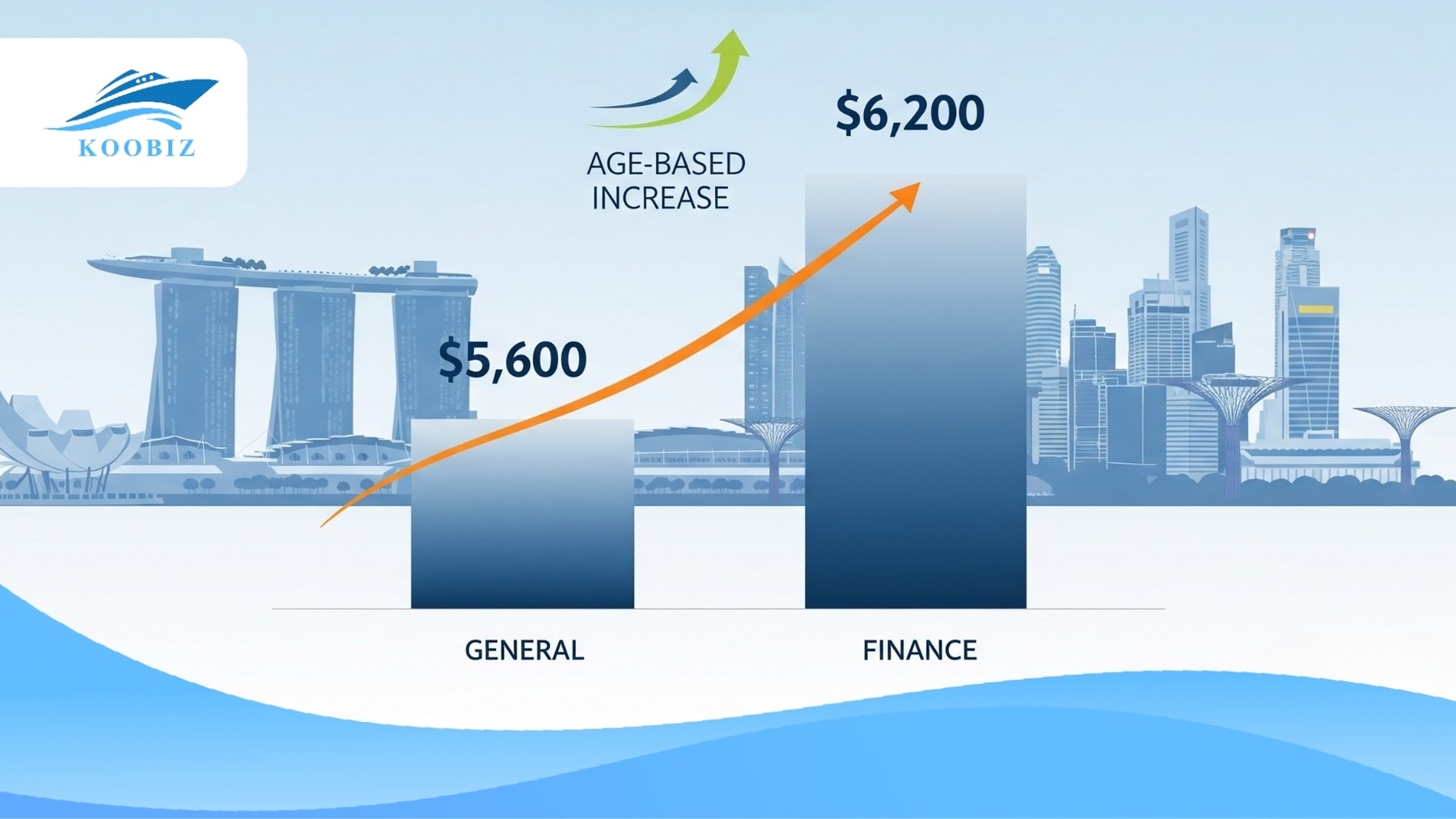
    As of 2026, the Ministry of Manpower (MOM) has raised the baseline monthly wage required to secure an Employment Pass to $5,600 for most industries.

    This figure is benchmarked against the top one-third of local PMET wages. For all new applications and renewals expiring from 1 January 2026 onwards, the baseline thresholds are:

    • Non-Financial Sectors: $5,600 per month (up from $5,000).
    • Financial Services: $6,200 per month (up from $5,500).

    Note on Renewals: The previous lower rates ($5,000/$5,500) applied only to passes expiring before 31 December 2025. Moving forward, all candidates must meet these higher thresholds. Any EP application submitted with a fixed monthly salary below these amounts will be rejected automatically, regardless of the employer’s size, reputation, or business profile.

    Singapore EP salary 2025: $5,600 - $6,200
    Singapore EP salary 2026: $5,600 – $6,200

    How Does Age Affect the EP Salary Threshold?

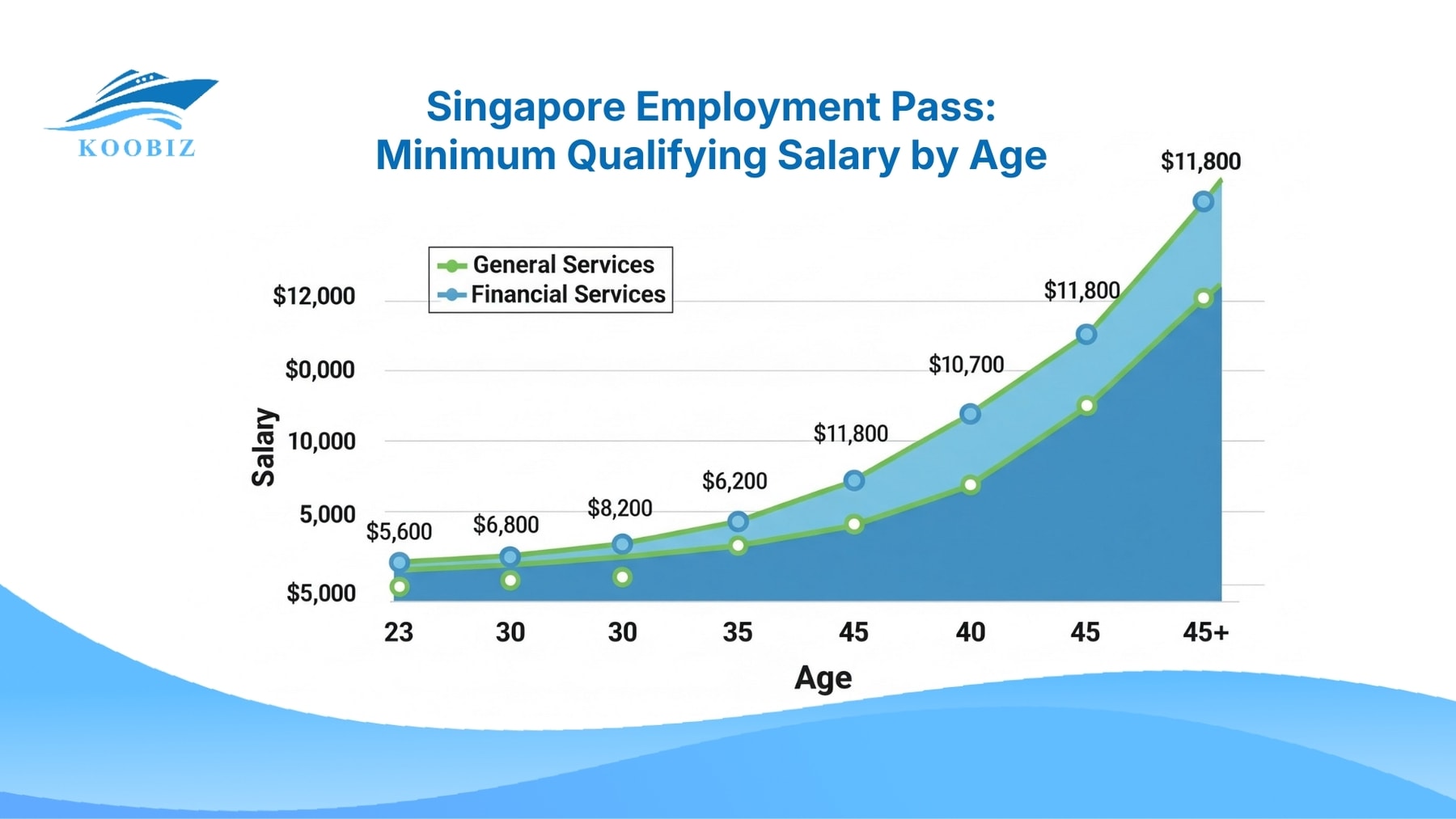
    The EP qualifying salary increases progressively with age, starting at the baseline for a 23-year-old and rising to nearly double for candidates aged 45 and above.

    EP salary increases by age: 23t: $5,600. 45t+: $10,700
    EP salary increases by age: 23t: $5,600. 45t+: $10,700

    MOM structures this increase to ensure foreign talent competes fairly with locals at a similar career stage. The 2026 age curve is significantly steeper than in previous years:

    • Entry Level (Age 23): Candidates qualify at the absolute minimum ($5,600 General / $6,200 Finance).
    • Progressive Increase (Age 23 to 45): The salary requirement rises steadily. For example, a 30-year-old in a general sector now requires approximately $7,223.
    • Senior Level (Age 45 and above): The threshold peaks at $10,700 (General) and $11,800 (Financial Services).

    In practice, this “experience premium” is often the most underestimated cost in EP planning. As many employers working with Koobiz discover, hiring senior expatriates requires budgeting well above the headline minimum salary, especially when aligning compensation with COMPASS and renewal expectations.

    Financial Services vs. Non-Financial Sectors: The Salary Gap

    Financial services require a higher baseline compared to general industries, reflecting the premium wage norms within Singapore’s banking sector.

    The Ministry of Manpower recognizes that salaries in this sector are naturally inflated due to the high demand for specialized skills. Consequently, the bar is set higher across the board.

    Here is a detailed comparison of the 2026 requirements:

    Comparison Factor Non-Financial Sectors Financial Services
    Base Salary (Age 23) $5,600 $6,200
    Mid-Career (Age ~35) ~$8,382 ~$9,000+
    Senior (Age 45+) $10,700 $11,800
    Target Industries Retail, Tech, Manufacturing, etc. Banking, Insurance, Asset Mgmt.

    This gap widens significantly as age increases. Failing to account for this sector-specific premium is a common reason for application rejections in the Central Business District.

    The COMPASS Framework: Calculating C1 Salary Points

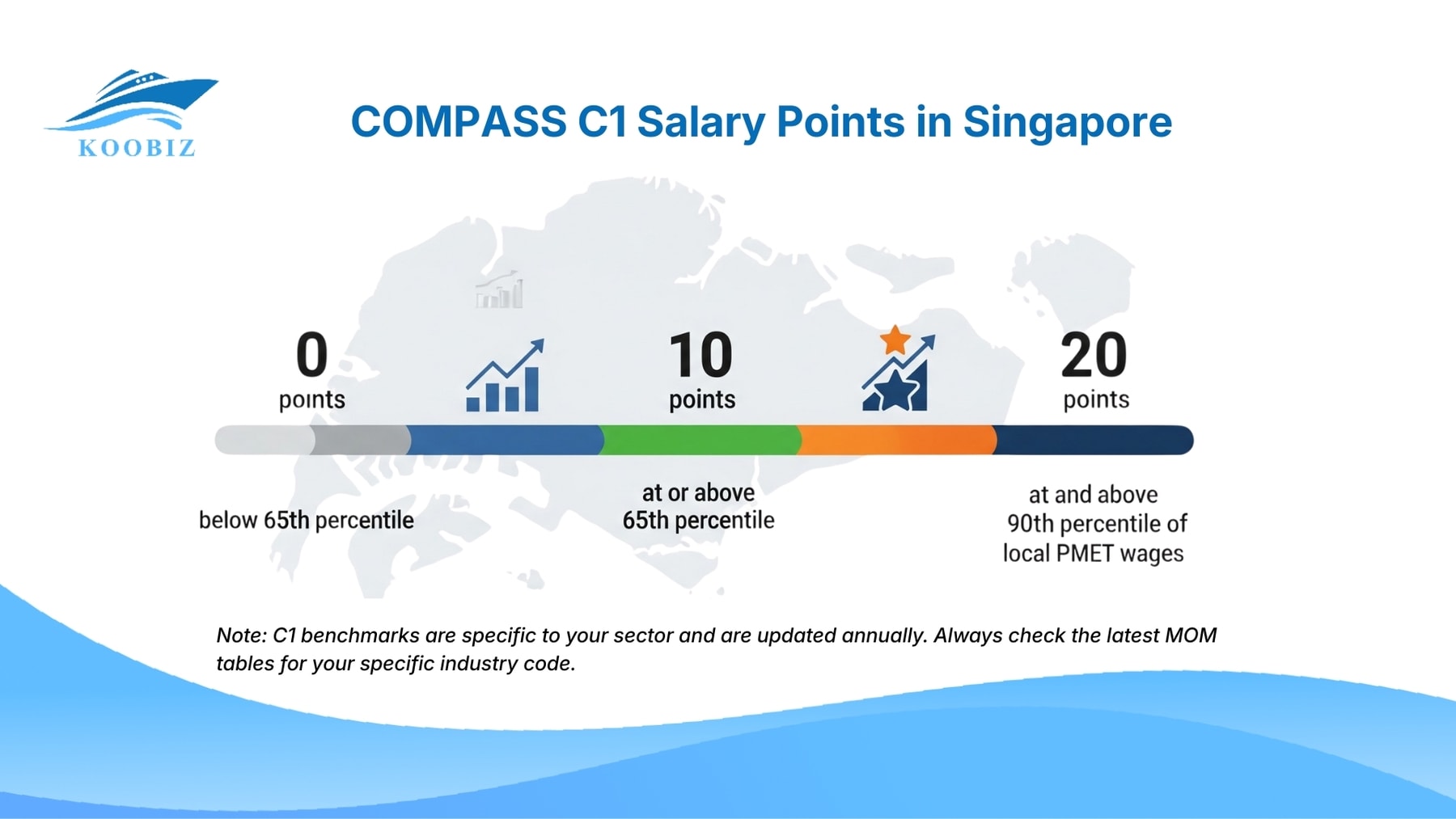
    The COMPASS Framework calculates C1 Salary Points based on two benchmarks: meeting the 65th percentile of local PMET wages earns 10 points, while meeting the 90th percentile earns 20 points.

    COMPASS C1 Salary Points: 0, 10 (≥65th percentile), 20 (≥90th percentile)
    COMPASS C1 Salary Points: 0, 10 (≥65th percentile), 20 (≥90th percentile)

    Importantly, meeting the EP qualifying salary is only the entry requirement; it does not earn points by itself. To pass COMPASS, an application must score at least 40 points, and C1 is the most straightforward lever employers can use to boost the total score.

    • 0 Points: Salary meets the EP minimum but is below the 65th percentile of local peers.
    • 10 Points: Salary is at or above the 65th percentile.
    • 20 Points: Salary is at or above the 90th percentile.

    Note: C1 benchmarks are specific to your sector and are updated annually. Always check the latest MOM tables for your specific industry code.

    Case Studies: Calculating EP Eligibility in Real Scenarios

    To demonstrate how the current 2026 rates apply, we have compiled three scenarios. These highlight the stricter requirements compared to previous years.

    Scenario 1: The “Age Trap” (Tech Sector)

    Candidate: Software Engineer, Age 38.

    Offer: $8,000 Fixed Monthly Salary.

    Outcome: REJECTED.

    • Analysis: While $8,000 seems high, the 2026 benchmark for a 38-year-old in general sectors is approximately $9,077. The offer falls short by over $1,000.
    • Lesson: Mid-career hires face the steepest increases. You must check the specific age benchmark before making an offer.

    Scenario 2: The “Sector Premium” (Finance vs. Retail)

    Candidate: Marketing Manager, Age 30.

    Offer: $7,000 Fixed Monthly Salary.

    Outcome: AT RISK (Both Sectors).

    • In a Retail Company: REJECTED. The general benchmark for Age 30 is roughly $7,223. An offer of $7,000 is no longer sufficient (unlike in previous years).
    • In an Investment Bank: REJECTED. The Finance benchmark for Age 30 is approximately $7,982.
    • Lesson: Salaries that were “safe” previously may now be insufficient.

    Scenario 3: The “COMPASS Save” (Using Salary to Pass)

    Candidate: Operations Director, Age 45.

    Challenge: The company has low diversity (0 points). They need 40 points solely from the candidate.

    Strategy: Offer a salary in the 90th percentile (e.g., $18,000+).

    • Result:
      • C1 (Salary): 20 Points (90th percentile).
      • C2 (Qualifications): 20 Points (Top-tier University degree).
      • Total: 40 Points -> PASSED.
    • Lesson: For senior roles, aiming for the 90th percentile can “save” an application even if the firm scores poorly on diversity.

    How to Use the MOM Self-Assessment Tool (SAT) for Verification

    The Self-Assessment Tool (SAT) is MOM’s official online calculator that predicts application outcomes.

    Before submitting any application, using the SAT is mandatory to avoid rejection fees and records.

    Step 1: Access and Login

    Navigate to the MOM SAT page. Koobiz strongly recommends logging in via Singpass to see your specific Firm-Level COMPASS scores (C3 Diversity and C4 Support for Local Employment).

    Step 2: Input Candidate Data

    Enter the candidate’s personal details accurately. Nationality & Date of Birth are critical for the age-based salary curve.

    Step 3: Input Job & Salary Details

    Enter only the fixed monthly salary. Do not include variable bonuses. If the result is “Not Eligible,” try adjusting the salary upward to find the passing threshold for that specific profile.

    Step 4: Interpret the Result

    • Green (Eligible): ~90% chance of approval.
    • Red (Not Eligible): Do not proceed. The salary likely fails the age-based benchmarks.

    Understanding “Fixed Monthly Salary” Components

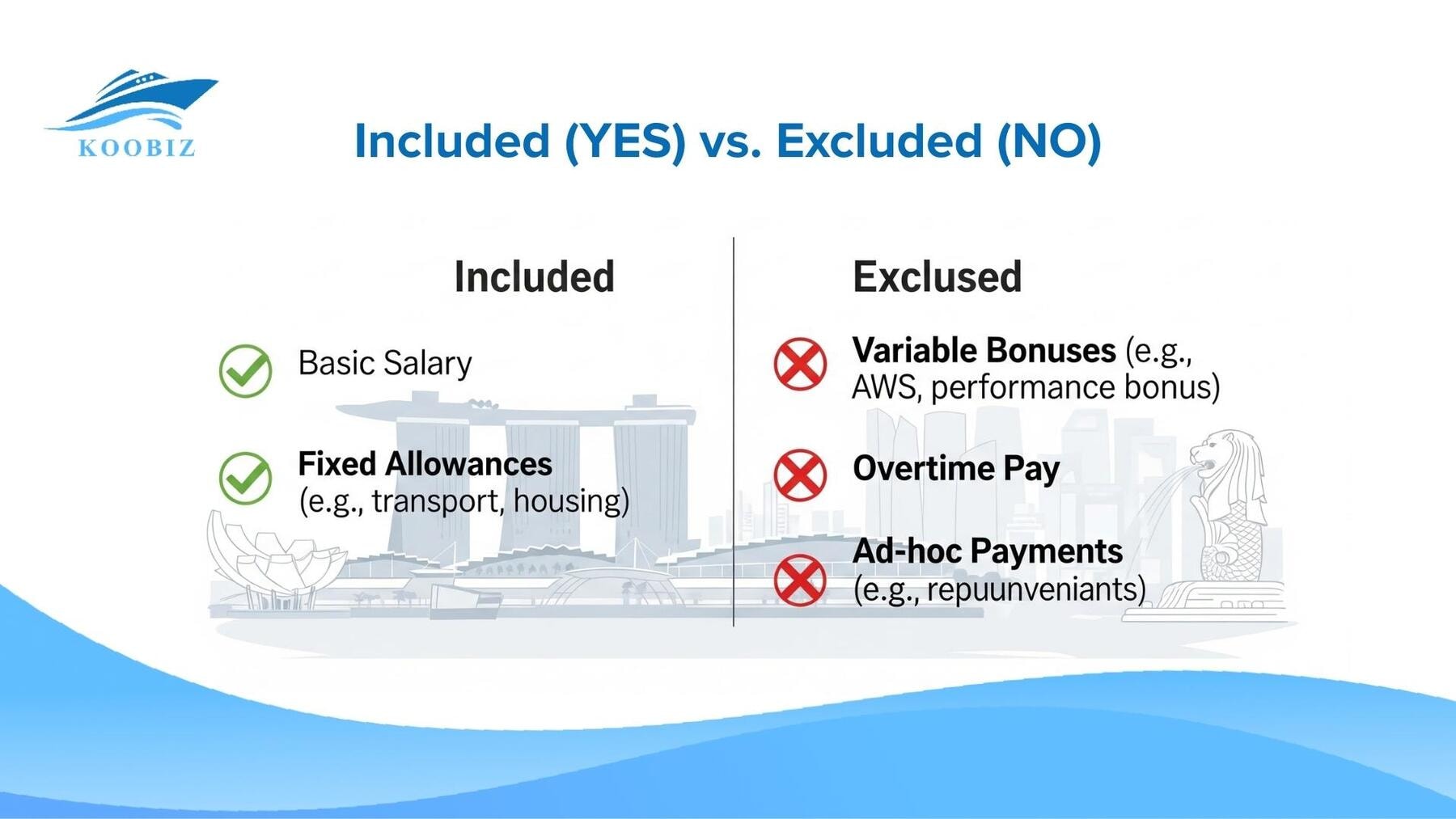
    Fixed Monthly Salary is the guaranteed amount paid every month. MOM assesses EP eligibility strictly based on this figure, not total compensation.

    Included (YES) vs. Excluded (NO)
    Included (YES) vs. Excluded (NO)

    Included (YES) vs. Excluded (NO)

    • YES: Basic monthly salary and fixed allowances (e.g., fixed transport/housing/meal allowances stipulated in the contract).
    • NO: Variable bonuses (AWS, performance bonus), overtime pay, reimbursements, and in-kind benefits (direct housing or car provided).

    Special Cases and Exemptions

    Renewals vs. New Applications

    Employers must plan early for renewals expiring in 2026. These renewals are mandated to meet the new higher baselines ($5,600 / $6,200), and many existing EP holders may need salary adjustments to remain eligible.

    Overseas Intra-Corporate Transferees (ICT)

    Intra-Corporate Transferees (ICTs) are senior employees transferred from an overseas branch. While they must still meet the age-tiered qualifying salary (Age 45+ ~$10,700), ICTs are exempt from the COMPASS framework (no C1 salary points needed).

    About Koobiz

    Navigating Singapore’s employment regulations, whether it’s determining the correct EP qualifying salary or managing corporate tax and accounting, can be challenging for international businesses.

    Koobiz helps simplify your market entry and ongoing compliance in Singapore. From company incorporation and corporate bank account opening to payroll setup and corporate tax filings aligned with the latest MOM and IRAS requirements, our experienced team provides end-to-end support.

    Let us manage the regulatory details, so you can stay focused on scaling your business with confidence.

    Visit us at: Koobiz.com to learn more about our corporate services.

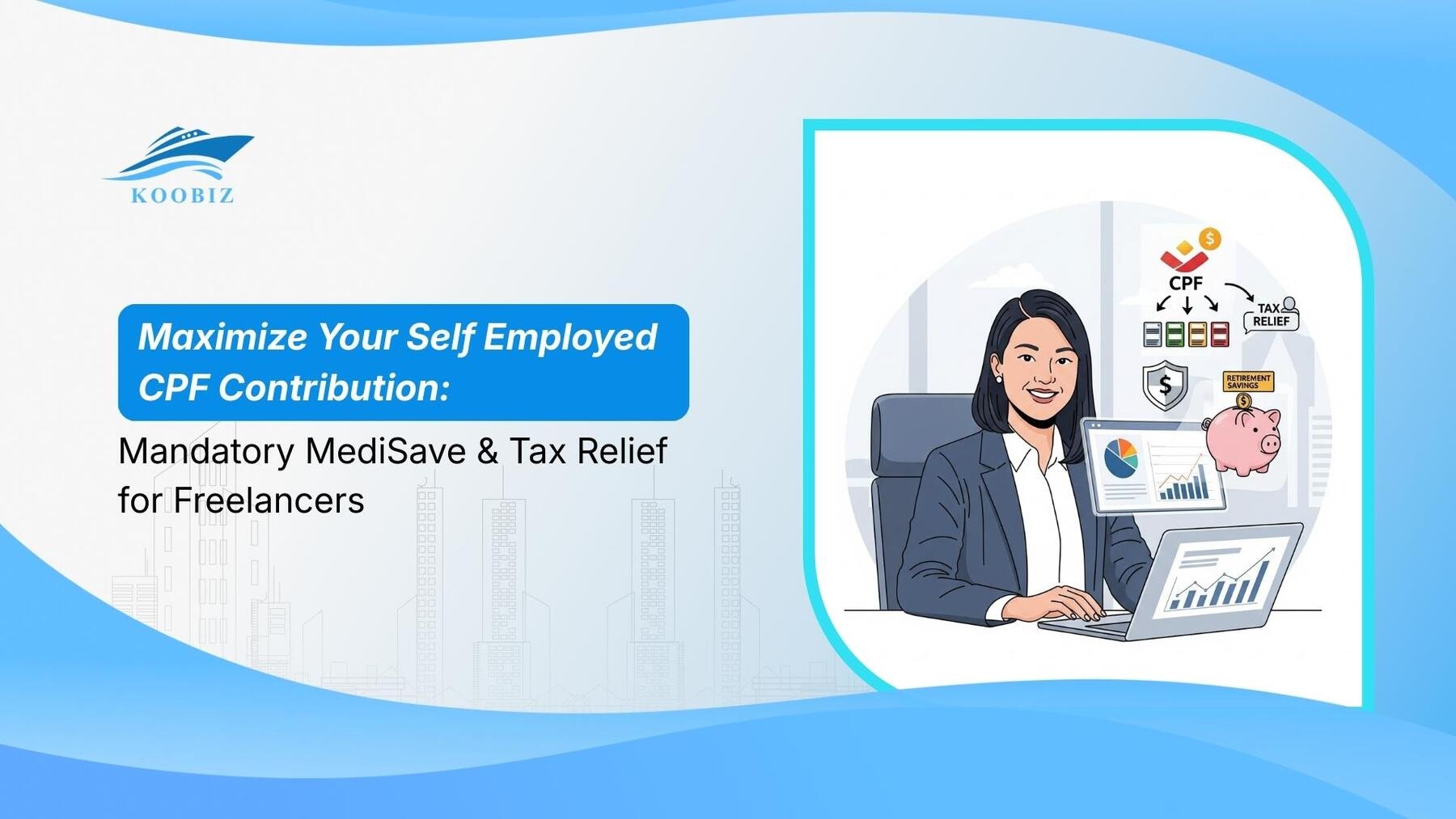
  • Maximize Your Self Employed CPF Contribution: Mandatory MediSave & Tax Relief for Freelancers

    Maximize Your Self Employed CPF Contribution: Mandatory MediSave & Tax Relief for Freelancers

    [SUMMARIES]

    Mandatory Obligation: If you’re a Singapore Citizen or PR and your Net Trade Income (NTI) exceeds S$6,000 per year, you are required by law to contribute a percentage to your CPF MediSave Account (MA). This secures your basic healthcare coverage.

    Tax Efficiency: You can choose to contribute more money to all three of your CPF accounts (Ordinary, Special, and MediSave). This is optional but highly strategic—it boosts your retirement savings, can help you qualify for a housing loan, and offers significant tax benefits. The relief is capped at the CPF Annual Limit (SGD 37,740) or 37% of NTI. Note: RSTU tax relief (up to SGD 16,000) is separate.

    Contribution Rates: The percentage you pay to MediSave depends on your age and income. It ranges from 4% to 10.5% of your NTI. Generally, the older you are, the higher the rate. For 2026, the maximum income used to calculate your contributions has increased to S$96,000 per year.

    Payment Flexibility: While lump-sum payments are standard, GIRO instalment plans are available to manage cash flow.

    Strategic Planning: Differentiating between mandatory MediSave (healthcare only) and voluntary 3-account contributions (housing/retirement) is key to utilizing CPF as an asset class.

    [/SUMMARIES]

    Managing your Self-Employed CPF Contribution is important for staying legal and saving money in Singapore. For freelancers and sole proprietors, CPF is not just a rule—it’s a smart move to lower taxes and earn safe interest. At Koobiz, we make this process easy, helping you turn rules into financial benefits.

    This guide explains your Mandatory MediSave obligations for 2026 and practical steps to use CPF for the best Tax Relief. It covers how to calculate Net Trade Income and how to optimize voluntary top-ups, giving you a clear plan to secure your financial future while remaining compliant.

    Are You Required to Pay CPF as a Self-Employed Person?

    Yes, you are required to pay CPF contributions specifically to your MediSave Account if you are a Singapore Citizen or Permanent Resident and earn an annual Net Trade Income (NTI) exceeding SGD 6,000.

    To figure out your obligation, there are three key conditions:

    • Citizenship: Foreigners working as freelancers on an Employment Pass or S-Pass are not covered by this scheme.
    • Income: The NTI must be exactly SGD 6,000 or more. If it’s below 6,000, the contribution is voluntary.
    • Self-employment: You must run your own trade, business, profession, or vocation. This is different from being an employee, where your employer handles CPF.

    If you don’t meet these rules, you could face penalties. Koobiz urges all clients to avoid penalties by checking these requirements on time.

    Illustration of self-employed: designer, driver, stall owner
    Illustration of self-employed: designer, driver, stall owner

    A Self-Employed Person (SEP) is defined broadly and includes:

    • Freelancers (writers, designers, consultants)
    • Hawkers and stall owners
    • Taxi drivers and private-hire car drivers
    • Commission agents (like property or insurance agents)
    • Private tutors and coaches

    What Is the Mandatory MediSave Contribution Rate for 2026?

    The Mandatory MediSave Contribution Rate for 2026 is a tiered percentage of your Net Trade Income, ranging from 4% to 10.5%, determined by your age group and income band.

    Understanding these rates matters because SEPs (self-employed people) don’t have fixed rates like employees. SEP rates are progressive, meaning they go up with age and with income. Older individuals need more healthcare savings, so the rate increases as you get older, and the rate also rises with higher NTI.

    Important Update for 2026: The contribution percentages stay the same, but the maximum annual income used to calculate contributions has risen to SGD 96,000 (up from the 2025 cap of SGD 88,800).

    Here is the general breakdown of the contribution rates for SEPs based on age and income (assuming NTI > SGD 18,000 for maximum tier):

    1. Age 35 and below: Capped at 8% of NTI.
    2. Age 35 to 45: Capped at 9% of NTI.
    3. Age 45 to 50: Capped at 10% of NTI.
    4. Age 50 and above: Capped at 10.5% of NTI.

    Note: For NTI between SGD 6,000 and SGD 18,000, lower phase-in rates apply.

    How to Calculate and Declare Your Net Trade Income (NTI)

    The method to calculate and declare NTI involves three key steps: deducting allowable business expenses from your gross revenue, filing your income tax return with IRAS, and awaiting the Notice of Computation (NOC).

    This process is the basic workflow that links your business activity to the CPF Board. If you don’t declare your NTI correctly, the CPF Board can’t determine how much you must pay into MediSave, which could lead to penalties or missed tax relief opportunities.

    Step 1: Calculate Net Trade Income

    Your NTI is simply your Gross Trade Income minus Allowable Business Expenses.

    • Gross Trade Income: The total amount earned from your business or vocation.
    • Allowable Business Expenses: Costs incurred strictly for earning income (e.g., equipment, rental, transport). Alternatively, qualifying SEPs can opt for the Fixed Expense Deduction Ratio (FEDR) to simplify claims.

    Step 2: File with IRAS

    You must declare your NTI to the Inland Revenue Authority of Singapore (IRAS) during the annual tax filing exercise (typically between March and April).

    • Log in to the myTax Portal using Singpass.
    • Fill in Form B (for business owners) or Form B1.
    • Koobiz Tip: Ensure your classification code is correct to avoid administrative errors.

    Step 3: Receive Notice of Computation (NOC)

    Once IRAS assesses your income, they will transmit the NTI data to the CPF Board.

    • The CPF Board will then send you a Notice of Computation (NOC) stating the exact amount of MediSave payable.
    • You generally have 30 days from the date of the NOC to make the payment.

    Comparison: Mandatory MediSave vs. Voluntary CPF Top-Ups

    Mandatory MediSave focuses strictly on basic healthcare security, whereas Voluntary CPF Top-Ups allow you to allocate funds to all three accounts (OA, SA, MA) to optimize interest accumulation and housing eligibility.

    While following the rules only requires the MediSave contribution, improving your financial health usually means going beyond the minimum. The comparison below shows why many successful freelancers choose to contribute more than what’s required.

    Feature Mandatory MediSave Voluntary CPF Contribution (VC)
    Destination 100% goes into the MediSave Account (MA). Split between Ordinary (OA), Special (SA), and MediSave (MA) accounts.
    Purpose Hospitalization, approved medical insurance (MediShield Life). Housing (OA), Retirement (SA), and Healthcare (MA).
    Interest Rate (2026) 4.0% p.a. (Floor rate). Blended. OA earns 2.5%, while SA and MA earn 4.0%.
    Flexibility / Advantage Low. Funds are strictly locked for medical use. High. Crucial for SEPs who want to buy an HDB flat or invest using CPF OA funds.

    However, you must be aware of the Annual Limit. The total mandatory + voluntary contributions cannot exceed the CPF Annual Limit (currently SGD 37,740 per year). Exceeding this will result in the refund of the excess amount without interest.

    How Does CPF Contribution Reduce Your Income Tax?

    Reduce income tax from CPF, limited to 37% of NTI or SGD 37,740
    Reduce income tax from CPF, limited to 37% of NTI or SGD 37,740

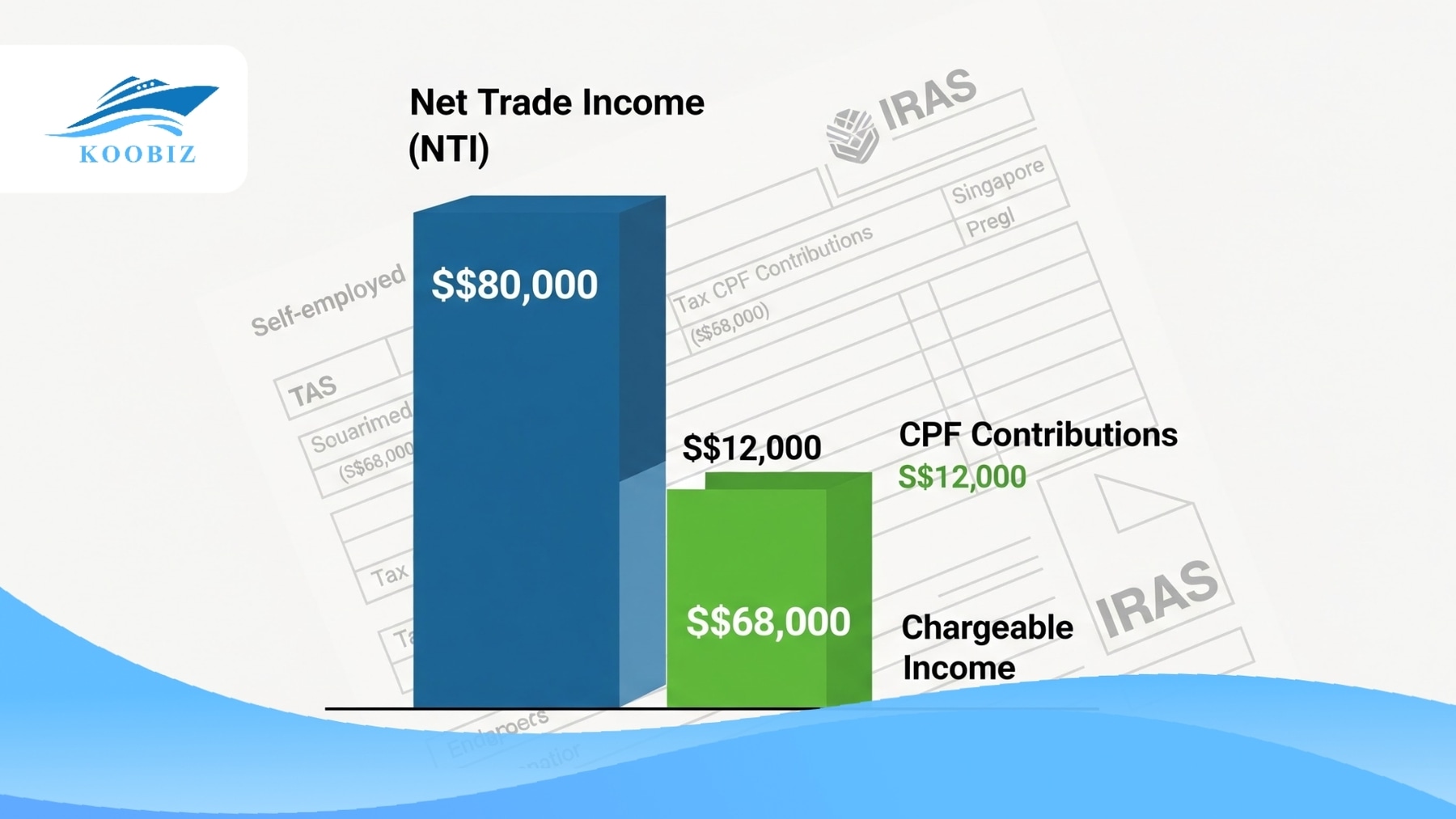
    CPF Contribution reduces your income tax by lowering your chargeable income dollar-for-dollar, subject to a relief cap of SGD 37,740 or 37% of your Net Trade Income, whichever is lower.

    Tax relief is arguably the most immediate financial incentive for making CPF contributions. For high-earning freelancers, the progressive tax rates in Singapore can be steep, and CPF Relief is one of the most effective tools to mitigate this tax bill.

    To illustrate, the relief works in two ways:

    1. Mandatory MediSave Relief: Any amount you contribute to your MediSave account under the mandatory scheme is automatically tax-deductible.
    2. Voluntary Contribution (VC) Relief: If you make voluntary cash top-ups to your 3 accounts (OA, SA, MA), these are also tax-deductible, provided you stay within the limit.

    The “37% Rule” & Separate Limits:

    • VC Limit: The total tax relief for your CPF contributions (Mandatory + Voluntary) is capped at 37% of your NTI or the Annual Limit of SGD 37,740.
    • RSTU Limit: This is separate from the limit above. You can claim additional relief of up to SGD 8,000 for top-ups to your own Special/Retirement Account and another SGD 8,000 for loved ones (Total SGD 16,000).

    Therefore, strategic planning involves calculating your NTI early in the year and making voluntary contributions that maximize this 37% limit without trapping liquidity unnecessarily.

    Case Study: Real-Life Tax Optimization Scenario (YA 2026)

    Strategic tax planning can reduce your final tax bill by over 70%, as demonstrated in the scenario of “Sarah,” a 30-year-old freelance Graphic Designer.

    To clearly illustrate the financial impact, let’s examine Sarah’s situation using Year of Assessment 2026 tax rates.

    Profile:

    • Job: Freelance Graphic Designer
    • Net Trade Income (NTI): SGD 60,000
    • Mandatory MediSave (8%): SGD 4,800
    • Relief Cap (37% of NTI): SGD 22,200

    Scenario A vs. Scenario B Comparison:

    Financial Detail Scenario A: Mandatory Only Scenario B: Maximized Contribution
    Mandatory MediSave SGD 4,800 SGD 4,800
    Voluntary Top-Up $0 SGD 17,400 (Top up to 37% Cap)
    Total CPF Relief SGD 4,800 SGD 22,200
    Chargeable Income SGD 55,200 SGD 37,800
    Estimated Tax Payable ~SGD 1,614 ~SGD 473
    Total Cash Saved $0 SGD 1,141 (Tax Savings)

    The Analysis:

    In Scenario A, Sarah pays taxes on SGD 55,200. Based on progressive tax rates (0% on first $20k, 2% on next $10k, 3.5% on next $10k, 7% on excess), her bill is roughly SGD 1,614.

    In Scenario B, Sarah tops up SGD 17,400 to hit her 37% relief cap. Her taxable income drops to SGD 37,800. Her new tax bill is only SGD 473.

    • Result: She saves SGD 1,141 in taxes.
    • Asset Growth: The SGD 17,400 she contributed is not an expense; it is now an asset in her CPF accounts growing at 2.5% – 4.0% interest.

    Managing Payment Difficulties and Compliance Issues

    Management of payment and compliance for the self-employed
    Management of payment and compliance for the self-employed

    Managing payment difficulties involves prioritizing compliance to avoid compounding penalties, utilizing instalment plans like GIRO, and understanding the legal implications of non-payment.

    For many self-employed people, income isn’t steady. But ignoring the Notice of Computation is a terrible idea. Dealing with these issues ahead of time helps you stay in good standing with the government, which is important for renewing your licenses.

    What Happens If You Miss the CPF Contribution Deadline?

    Missing the CPF contribution deadline results in a late payment penalty of 1.5% interest per month (approx. 18% p.a.) on the outstanding amount, along with potential fines.

    The enforcement is strict because MediSave is considered a social safety net.

    • Step 1: Reminder Letter: You will receive a reminder to pay.
    • Step 2: Late Payment Interest: Interest of 1.5% per month starts accruing immediately after the deadline.
    • Step 3: Enforcement: Continued non-payment can lead to fines up to SGD 5,000 for first-time offenders, court action, or the refusal of license renewal for certain trades.

    Can You Apply for GIRO Instalments for MediSave?

    Yes, you can apply for a GIRO instalment plan to split your mandatory MediSave payable into monthly deductions, significantly easing cash flow pressure.

    This is a highly recommended approach for freelancers.

    • Eligibility: Generally available to all SEPs with a local bank account.
    • How to Apply: Submit the GIRO application via the CPF website or your bank’s internet banking portal.
    • Benefit: As long as the instalment plan is active and payments are being made, you are considered compliant.

    How Does CPF Contribution Affect Your HDB Housing Loan?

    CPF contributions directly affect your HDB housing loan eligibility because only funds in the Ordinary Account (OA) can be used for down payments and monthly mortgage installments.

    This is a common pitfall for new freelancers.

    • The Problem: Mandatory SEP contributions go 100% into MediSave. This means your OA balance remains $0 if you rely solely on mandatory payments.
    • The Consequence: You cannot service a housing loan using CPF, forcing you to pay cash for your mortgage.
    • The Solution: You must make Voluntary Contributions to the 3 accounts. This will channel a portion of your contribution into the OA (roughly 60% for younger members).

    Is Voluntary Contribution Refundable?

    No, Voluntary Contributions to your CPF accounts are generally irrevocable and non-refundable, meaning the liquidity is locked until you reach the withdrawal age or meet specific payout criteria.

    • Liquidity Risk: Once money is transferred to CPF, it cannot be withdrawn for business emergencies.
    • Planning: Only contribute funds that you are certain you will not need for short-term working capital.
    • Exception: The only exception is if you have accidentally contributed above the CPF Annual Limit (SGD 37,740). The excess amount will be refunded to you without interest.

    Conclusion

    For the self-employed in Singapore, CPF is much more than a rule to follow. By strategically managing your contributions, you can:

    ✅ Ensure your healthcare needs are covered (via MediSave).

    ✅ Build a robust, low-risk retirement fund.

    ✅ Substantially reduce your yearly income tax.

    ✅ Potentially qualify for housing financing.

    By mastering your CPF strategy, you transform a mandatory requirement into a cornerstone of your personal financial growth.

    At Koobiz, we specialize in helping entrepreneurs and self-employed professionals navigate the complexities of Singapore’s corporate and financial landscape. From company incorporation to tax filing and accounting services, our team ensures you remain compliant while optimizing your financial efficiency. If you need assistance with your NTI declaration or setting up a tax-efficient structure for your business, visit Koobiz.com to explore our services today.

    Disclaimer: The information in this guide is based on policies as of 2026. CPF and tax regulations are subject to change. We recommend consulting a qualified tax advisor or visiting the official CPF and IRAS websites for the most current information.

  • Master Transfer Pricing Compliance in Singapore for MNCs: The Arm’s Length Guide

    Master Transfer Pricing Compliance in Singapore for MNCs: The Arm’s Length Guide

    [SUMMARIES]

    Mandatory Compliance: Singapore tax law (Section 34D) requires all related party transactions to strictly adhere to the Arm’s Length Principle.

    Documentation Threshold: Businesses with gross revenue exceeding S$10 million must prepare contemporaneous Transfer Pricing Documentation (TPD).

    3-Step Approach: IRAS mandates a specific three-step process: Comparability Analysis, Method Selection, and Determining Results.

    Penalty Risks: Non-compliance can result in a fine of up to S$10,000 and a 5% surcharge on any tax adjustments made by IRAS.

    Strategic Support: Koobiz assists MNCs in navigating complex TP rules, including the latest 8th Edition guidelines on intercompany loans.

    [/SUMMARIES]

    For Multinational Corporations (MNCs) expanding into Asia, Singapore offers an attractive corporate tax regime, yet it demands rigorous adherence to regulatory standards, particularly regarding cross-border transactions. Transfer Pricing Compliance in Singapore has moved from being a supplementary reporting requirement to a central focus of the Inland Revenue Authority of Singapore (IRAS), especially with the enforcement of the 8th Edition Guidelines.

    At Koobiz, we recognize that the technical requirements under Section 34D of the Income Tax Act can be challenging for both foreign investors and established MNCs. This guide is designed to help you clearly understand and apply the Arm’s Length Principle, assess when transfer pricing documentation becomes mandatory, and navigate the IRAS-mandated three-step approach. Whether you are reviewing intercompany financing arrangements or preparing for a potential tax audit, a solid grasp of these rules is essential to mitigate surcharge risks and protect your company’s standing in Singapore.

    What constitutes Transfer Pricing under Singapore Tax Law?

    Transfer Pricing
    Transfer Pricing

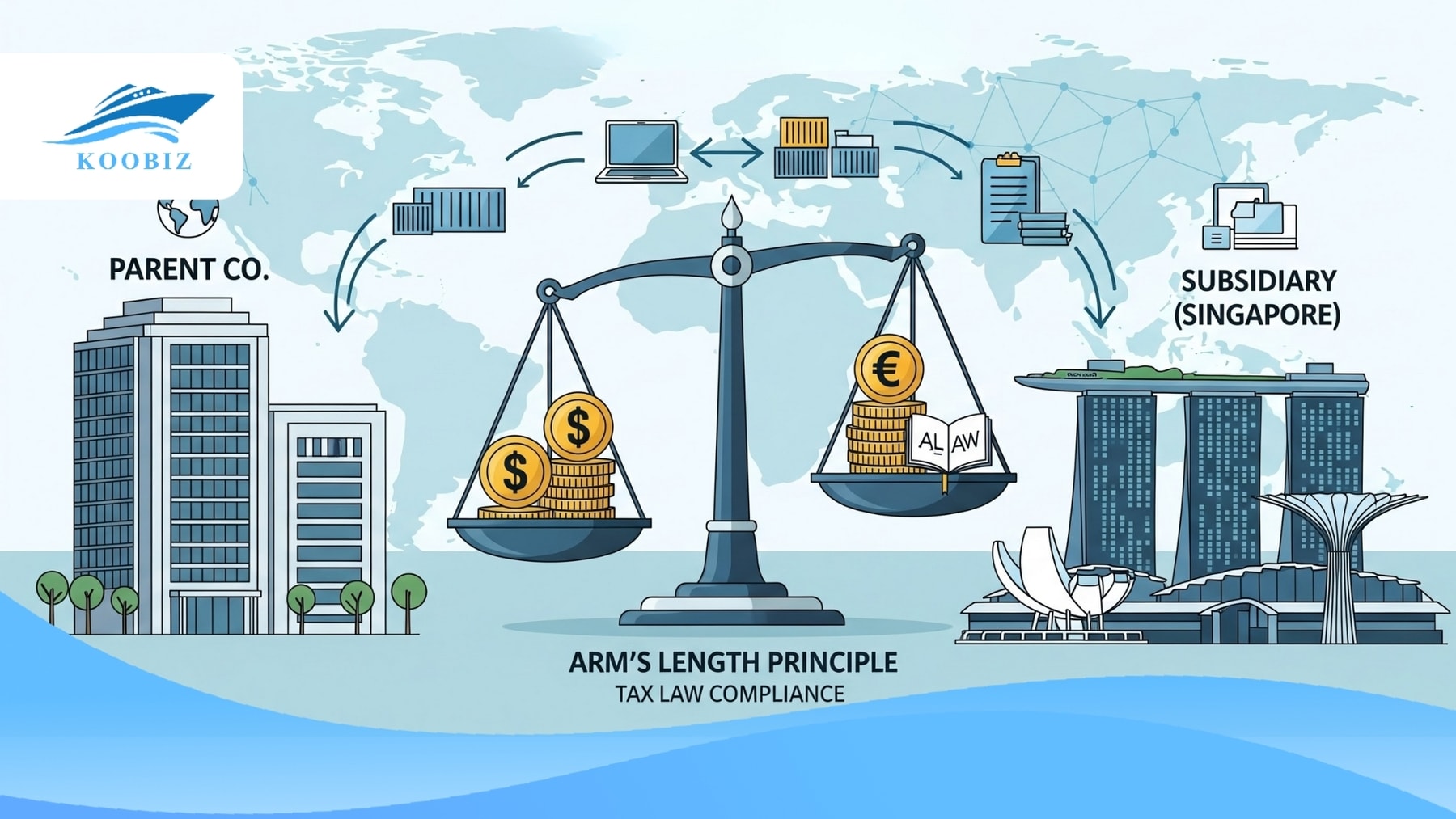
    Transfer Pricing is the pricing mechanism used for transactions between related parties, such as the sale of goods, provision of services, or transfer of intangible assets, which must strictly reflect market conditions.

    To delve deeper, transfer pricing is a neutral accounting term, not an illegal practice. However, under Section 34D of the Income Tax Act, IRAS scrutinizes these prices to prevent profit shifting and ensure profits reflect true economic value in Singapore.

    Defining “Related Party” & Scope

    IRAS defines related parties broadly, generally where there is control, significant influence, or a shared holding company. As a result, the scope of transfer pricing is wide and includes:

    • Operational Activities: Management fees, royalties, and intercompany loans.
    • Audit Scope: Every internal invoice is a potential subject of scrutiny.

    Koobiz Advice: Transparency and consistency in these definitions are your first line of defense against tax adjustments.

    According to the IRAS e-Tax Guide (Eighth Edition), the authority explicitly states that taxpayers are expected to apply the arm’s length principle to ensure that their pricing with related parties reflects independent pricing behavior.

    How is Compliance with the Arm’s Length Principle Determined?

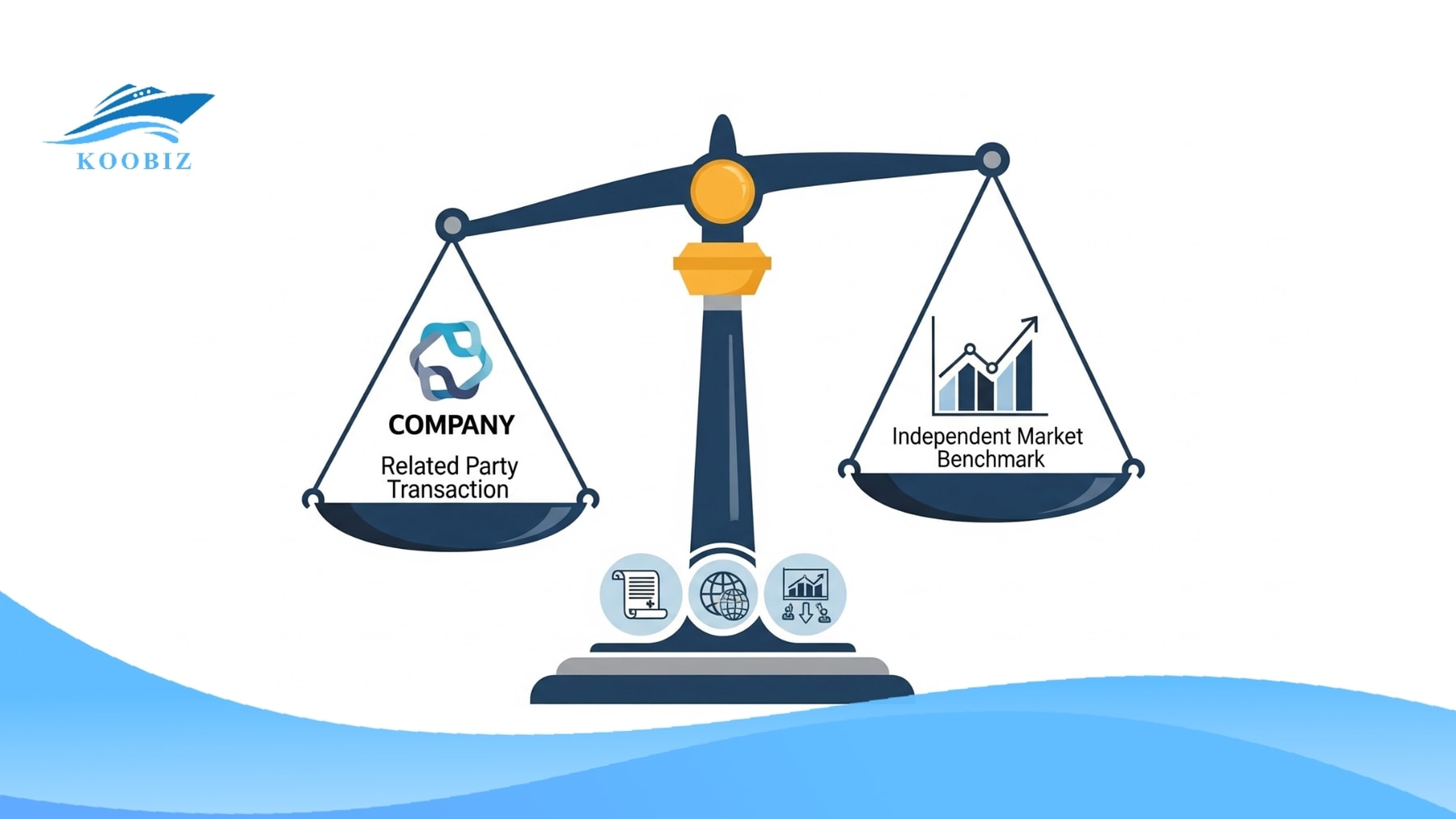
    Compliance is achieved when related party pricing matches what independent parties would agree to under similar circumstances. This must be backed by robust documentation and comparable market data.

    To determine compliance, IRAS applies the Arm’s Length Principle (the international standard). If your internal pricing deviates significantly from market rates—either artificially inflating costs or suppressing revenue—IRAS will deem it non-compliant.

    Compliance with ALP: Documentation, Data & 3 Factors
    Compliance with ALP: Documentation, Data & 3 Factors

    The Core Test: “Would independent parties agree?”

    To pass this test, businesses must analyze three key factors:

    • Contractual Terms: Are the terms standard for the industry?
    • Economic Circumstances: Do the prices reflect current market realities?
    • Business Strategies: Is the pricing commercially rational?

    At Koobiz, we assist companies in stress-testing their intercompany pricing against this “independent party” benchmark, identifying exposure early and rectifying gaps before an audit arises.

    Research by the OECD confirms that the Arm’s Length Principle remains the global standard for ensuring fair tax bases across jurisdictions.

    What are the Mandatory Requirements for Transfer Pricing Documentation (TPD)?

    There are two specific mandatory conditions that trigger the requirement for TPD: having gross revenue exceeding S$10 million for the basis period, or being explicitly required by IRAS to prepare such documentation.

    Beyond applying the arm’s length principle in theory, Singapore law imposes strict documentation standards to ensure pricing can be properly substantiated. It is important to distinguish routine bookkeeping from Qualifying Transfer Pricing Documentation, which must meet specific regulatory criteria.

    1. Gross Revenue Threshold: If your company’s gross revenue (not just profit) exceeds S$10 million in the basis period concerned, you are legally required to prepare contemporaneous TPD.
    2. Specific Requirement: Regardless of revenue, if IRAS issues a specific direction to your company to prepare TPD for a previous basis period, you must comply.

    Exemptions from TPD

    Even where the S$10 million revenue threshold is met, IRAS grants transaction-level exemptions to ease the compliance burden for lower-value dealings between related parties.

    • Purchase/Sale of Goods: Exemption applies if the total value is below S$15 million.
    • Loans: Exemption applies if the loan value is below S$15 million (applicable where the IRAS Indicative Margin is applied).
    • Services, Royalties, and Others:
      • For YA 2025 and prior: Exemption applies if the total value is below S$1 million.
      • For YA 2026 onwards: The threshold increases to S$2 million, providing greater relief for businesses.

    TPD must be prepared on a contemporaneous basis, meaning it should be completed before the due date of filing the corporate income tax return. The documentation must cover, among others, the group structure, business activities, intercompany transactions, and a defensible pricing analysis. Failure to produce adequate TPD upon IRAS’ request exposes the company to immediate penalties and potential tax adjustments.

    At Koobiz, we support clients in preparing robust, compliant TPD that aligns with the detailed content requirements set out in the Second Schedule of the Income Tax (Transfer Pricing Documentation) Rules 2018, helping businesses mitigate risk and withstand IRAS scrutiny.

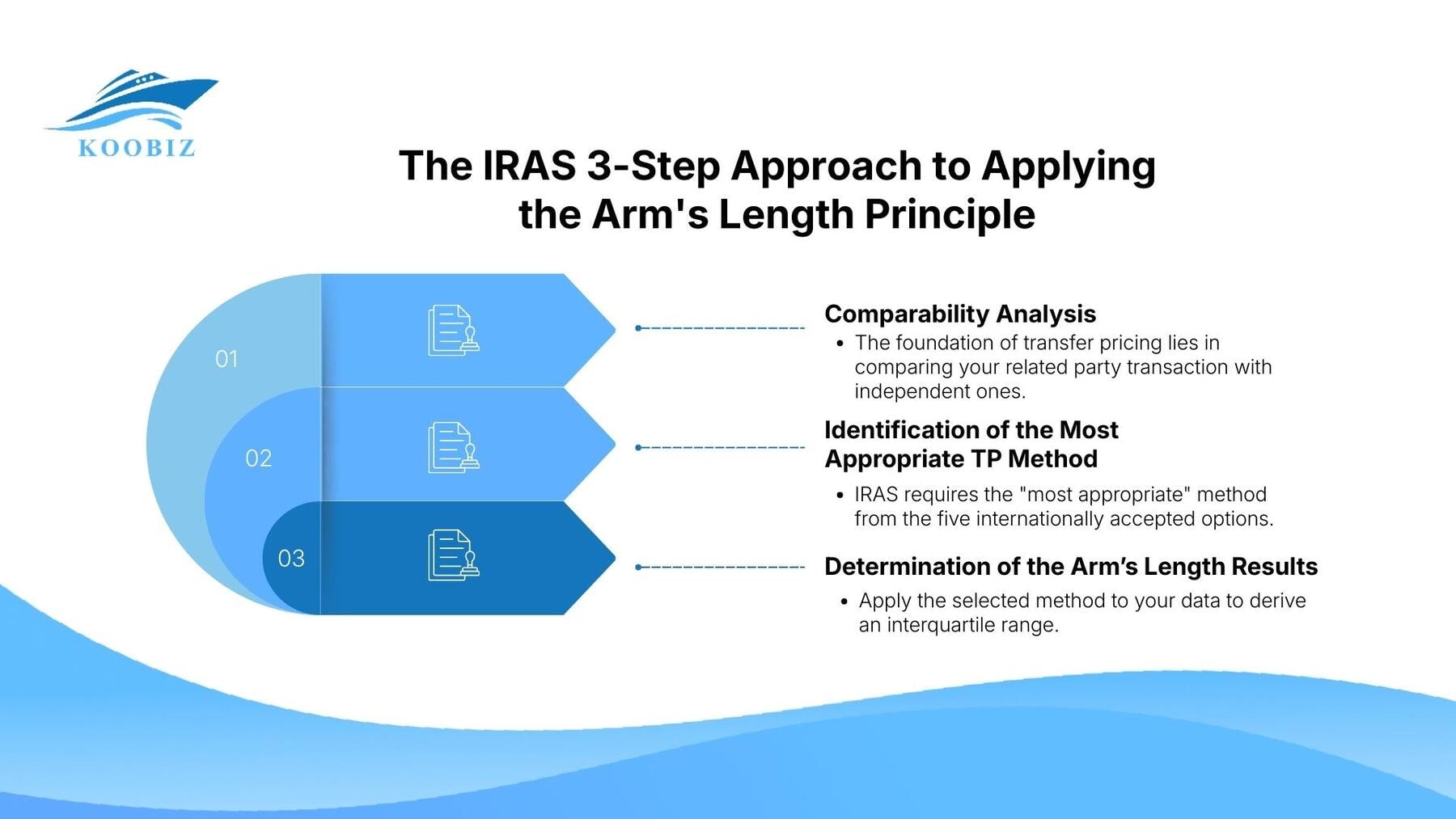
    The IRAS 3-Step Approach to Applying the Arm’s Length Principle

    The IRAS 3-Step Approach to Applying the Arm's Length Principle
    The IRAS 3-Step Approach to Applying the Arm’s Length Principle

    To justify pricing to tax authorities, MNCs are expected to apply a structured three-step methodology prescribed by IRAS. Transfer pricing is not a matter of estimation or intuition; it must be supported by a disciplined and evidence-based approach.

    Step 1: Comparability Analysis

    The foundation of transfer pricing lies in comparing your related party transaction with independent ones. This analysis must examine:

    • Characteristics: What goods or services are being traded?
    • Functional Analysis (FAR): Who performs the Functions, owns the Assets, and assumes the Risks?
    • Economic Circumstances: What are the market conditions?

    Step 2: Identification of the Most Appropriate TP Method

    IRAS requires the “most appropriate” method from the five internationally accepted options:

    • CUP Method: Compares specific prices (ideal for commodities).
    • Resale Price Method: Focuses on gross margins (for distributors).
    • Cost Plus Method: Focuses on mark-ups (for manufacturers/service providers).
    • TNMM: Compares net profit margins (most common for complex operations).
    • Profit Split: Splits profits based on contribution (for highly integrated value chains).

    Step 3: Determination of the Arm’s Length Results

    Apply the selected method to your data to derive an interquartile range.

    • Within Range: Compliant.
    • Outside Range: Adjustment required to the median.

    Real-world Impact: A Koobiz client in logistics used the TNMM to successfully justify their operating margin against competitors, eliminating subjectivity in their IRAS filings.

    Case Studies: Transfer Pricing in Action

    Real-world examples demonstrate the practical application of the Arm’s Length Principle and the potential pitfalls of incorrect pricing.

    To clarify how these rules affect daily operations, consider these two common scenarios that often trigger IRAS scrutiny.

    Scenario A: The Limited Risk Distributor (Tangible Goods)

    • Context: TechGlobal SG is a Singapore subsidiary acting as a distributor for its US parent. It purchases electronic components from the parent at S$80 per unit and resells them to local customers at S$100.
    • The Issue: After deducting local operating expenses (marketing, staff, rent), TechGlobal SG reports a Net Operating Margin of 1%.
    • IRAS Analysis: Using the TNMM (Transactional Net Margin Method), IRAS benchmarks TechGlobal SG against comparable independent distributors operating in Singapore. The benchmarking analysis shows that similar distributors typically earn an arm’s length operating margin of 3% to 5%.
    • Outcome: The adjustment leads to additional taxable income in Singapore, along with a 5% surcharge imposed on the transfer pricing adjustment, highlighting how even routine distribution models can result in costly exposure if pricing is not properly supported.

    Scenario B: Intercompany Management Fees (Services)

    • Context: SingHQ Pte Ltd acts as a regional hub, providing HR and IT support services to its subsidiaries in Vietnam and Thailand. Each subsidiary is charged a flat management fee of S$1 million per year, without detailed invoices or service breakdowns.
    • The Issue: The subsidiaries cannot verify the specific services received or the basis of the cost.
    • IRAS Analysis: IRAS applies the “Benefit Test”. Did the subsidiaries actually need and receive these services? Is the fee based on Cost + Mark-up (e.g., Cost + 5%)?

    IRAS will expect formal intercompany agreements and contemporaneous evidence, such as timesheets, service reports, email correspondence, or cost allocation schedules, to substantiate the charges.

    • Outcome: The deduction may be denied at the subsidiary level, or the income reclassified at SingHQ, potentially triggering double taxation disputes and additional tax exposure across multiple jurisdictions.

    What are the Penalties for Non-Compliance with Transfer Pricing Rules?

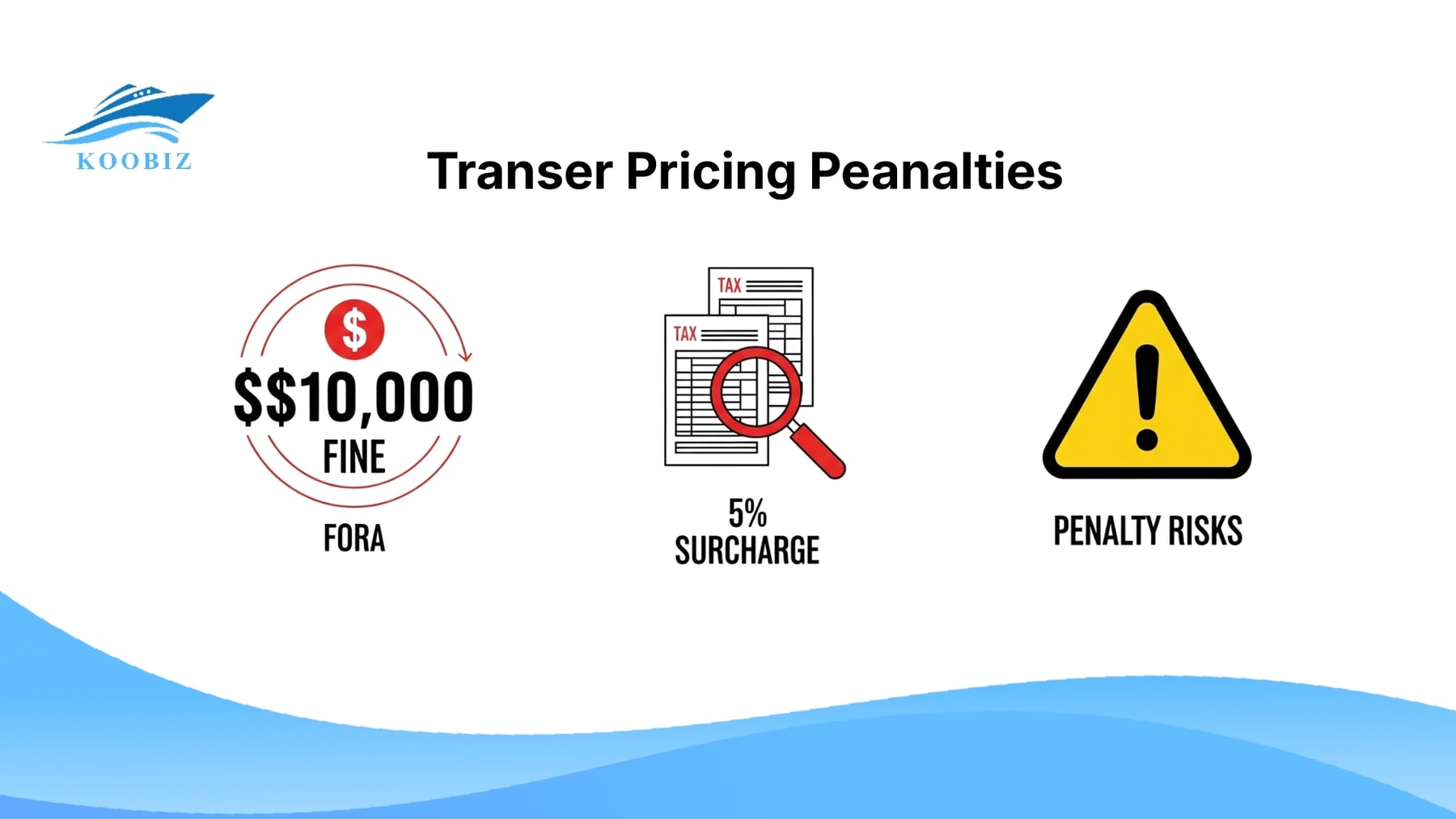
    Non-compliance with Transfer Pricing rules triggers severe financial consequences, including a fine of up to S$10,000, a 5% surcharge on adjustments, and potential interest on underpaid taxes.

    The consequences of ignoring these rules are not just administrative but financially punitive. IRAS has taken a stricter stance on enforcement to deter profit shifting.

    Transfer Pricing Penalties: Fine, 5% Surcharge, No Safe Harbour
    Transfer Pricing Penalties: Fine, 5% Surcharge, No Safe Harbour
    1. Fine for Non-Documentation: Failure to prepare or submit TPD upon request can result in a fine not exceeding S$10,000. This applies even if the pricing itself was correct but the documentation was missing.
    2. 5% Surcharge on Adjustments: If IRAS reviews your accounts and decides to adjust your transfer price (increasing your taxable income), a 5% surcharge is imposed on the amount of the adjustment, regardless of whether there is additional tax payable. This surcharge is not tax-deductible.
    3. No Safe Harbour from Penalties: Unlike some jurisdictions where having documentation provides penalty protection, in Singapore, the 5% surcharge is strictly applied on adjustments.

    Note on Remission: While strict, IRAS may consider remitting part or all of the surcharge in cases where taxpayers are cooperative or voluntarily initiate a retrospective adjustment within two years (provided no audit has commenced). Proactive correction is key.

    Beyond immediate penalties, repeated non-compliance can trigger wider tax audits, including reviews of GST and withholding tax positions, and may result in reputational harm with regulators and counterparties. In practice, investing in robust transfer pricing compliance upfront is significantly more cost-effective than dealing with escalating compliance risks and enforcement actions later.

    Contextual Border:

    Having covered the “What” (definitions), the “Why” (compliance rationale), and the “Consequences” (penalties), we now turn to the “How.” The next section examines complex, real-world applications, such as intercompany financing arrangements and dispute resolution mechanisms, that sophisticated MNCs commonly encounter as their operations scale.

    Handling Specific Related Party Transactions and Dispute Resolutions

    MNCs face specific compliance requirements for intercompany loans and services, alongside mechanisms for resolving cross-border disputes.

    How are Intercompany Loans Treated under the 8th Edition Guidelines?

    Rule: Loans must be priced using a Base Reference Rate + Arm’s Length Spread or the IRAS Indicative Margin.

    • 8th Edition Update: Benchmarking must strictly match the loan tenure.
    • Domestic Loans (New Jan 2025 Rule): For domestic loans entered into from 1 Jan 2025, if neither party is in the business of lending, taxpayers can choose to apply the IRAS Indicative Margin.
      • Key Benefit: Doing so exempts the transaction from TPD and, crucially, IRAS will not make Section 34D adjustments on these specific loans.
    • Interest-Free Loans: From 2025 onwards, interest-free domestic intercompany loans are generally not acceptable unless supported by strong commercial justification. For cross-border loans, IRAS typically does not adjust interest-free arrangements where the Singapore entity is the lender, largely due to Singapore’s remittance-based taxation system. However, documentation and rationale remain important to mitigate audit risk.

    In practice, intercompany financing has become a high-focus area under the 8th Edition, and structuring loans correctly from inception is critical to avoid unnecessary adjustments and penalties.

    What is the Safe Harbour Rule for Routine Support Services?

    Rule: Taxpayers can apply a fixed 5% cost mark-up on routine support services (e.g., HR, IT listed in Annex C).

    • Benefit: No detailed benchmarking study is required.
    • Condition: Costs must be strictly pooled and correctly allocated.

    What is the Difference Between Advance Pricing Arrangements (APA) and Mutual Agreement Procedures (MAP)?

    APA is proactive; MAP is reactive. Use APAs for certainty and MAPs to resolve double taxation.

    Feature Advance Pricing Arrangement (APA) Mutual Agreement Procedure (MAP)
    Nature Prospective (Forward-looking / Prevention) Reactive (Backward-looking / Cure)
    Primary Purpose Determine pricing for future years (3-5 years). Resolve double taxation after adjustments.
    Benefit Audit immunity on covered transactions. Eliminates double taxation via authority agreement.

    When should MNCs consider a Transfer Pricing Health Check?

    Conduct a health check immediately if you meet any of the following criteria:

    • [ ] Revenue: Gross revenue > S$10 million.
    • [ ] Thresholds: Services/Royalties > S$1 million (S$2 million from YA 2026).
    • [ ] Outdated Data: Benchmarking study > 3 years old.
    • [ ] Losses: Singapore entity is consistently loss-making.
    • [ ] Risks: Interest-free loans exist between related parties.

    Koobiz offers a “traffic light” risk assessment to identify and remediate these exposures.

    About Koobiz

    Managing transfer pricing in Singapore goes beyond technical compliance, it requires commercial insight, regulatory awareness, and hands-on local experience. Koobiz is a trusted corporate services firm supporting businesses at every stage of their Singapore journey.

    We specialize in:

    • Singapore Company Incorporation: Setting up your optimal business structure.
    • Bank Account Opening: Facilitating seamless financial integration in Singapore.
    • Tax & Accounting Services: From Corporate Income Tax filing to Transfer Pricing Documentation preparation.
    • Audit & Assurance: Ensuring full regulatory compliance.

    Transfer pricing risks should never slow down your expansion. With Koobiz, your related party transactions are structured to be compliant, commercially sound, and well-prepared for IRAS scrutiny, so you can focus on growing your business with confidence.

    Explore Koobiz Corporate Services

    Disclaimer: This guide is for informational purposes only and does not constitute legal or tax advice. Transfer pricing rules are subject to change. Please consult with a professional advisor or IRAS guidelines for specific business circumstances.

  • How to Issue Compliant Share Certificates in Singapore [ACRA Guide]

    How to Issue Compliant Share Certificates in Singapore [ACRA Guide]

    [SUMMARIES]

    Legal Proof: A share certificate is the primary legal document proving someone owns shares in your company.

    Mandatory Details: It must include the company name, shareholder details, number/class of shares, and the amount paid.

    Execution Flexibility: Companies can now use authorized signatures (e.g., a Director and the Secretary) instead of a physical company seal.

    Issuance Timeline: You must prepare the certificate for delivery within 60 days of issuing the shares.

    Digital Shift: Electronic share certificates are legally accepted and are becoming a popular, efficient choice.

    [/SUMMARIES]

    Issuing a share certificate is a key legal step, not just paperwork. It is the official proof of ownership for anyone holding a stake in your Singapore company. For business owners in Singapore, understanding the nuances of Section 123 of the Companies Act 1967 is essential to avoid governance disputes and ensure full compliance with the Accounting and Corporate Regulatory Authority (ACRA). Whether you are a startup founder distributing initial equity or an established firm managing a share transfer, the validity of this document underpins the trust in your corporate structure.

    At Koobiz, we understand that navigating corporate secretarial duties can be complex. This guide aims to demystify the process, answering exactly what a share certificate is, how to issue it correctly, and how to handle modern exceptions like electronic versions or lost documents. Below, we break down the rigorous standards required to ensure every certificate you issue is fully compliant and legally binding.

    What is a Share Certificate in Singapore Law?

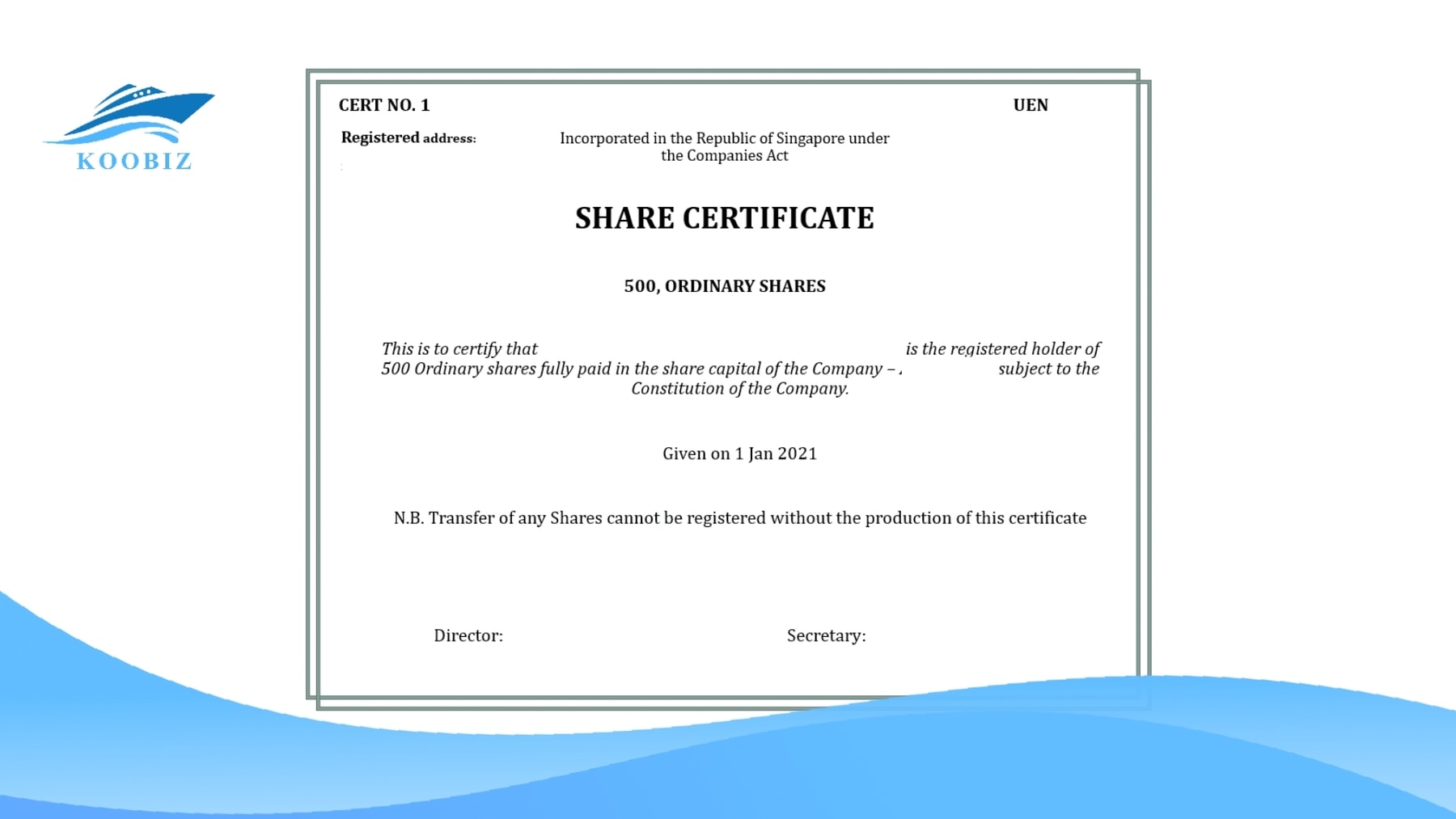
    A share certificate is a legal document that serves as the main proof of ownership for the shares it lists. Singapore law requires companies to prepare and have this document ready for the shareholder within 60 days of issuing new shares or within 30 days after the lodging of a transfer.

    Sample Share Certificate of a Singapore Company
    Sample Share Certificate of a Singapore Company

    Think of it this way: owning a share is like owning a right in the company, and the certificate is the official paper (or digital file) that confirms you hold that right. While the Electronic Register of Members (EROM) hosted by ACRA and updated by the company via BizFile+ is the primary official record, the shareholder keeps the certificate as their personal proof.

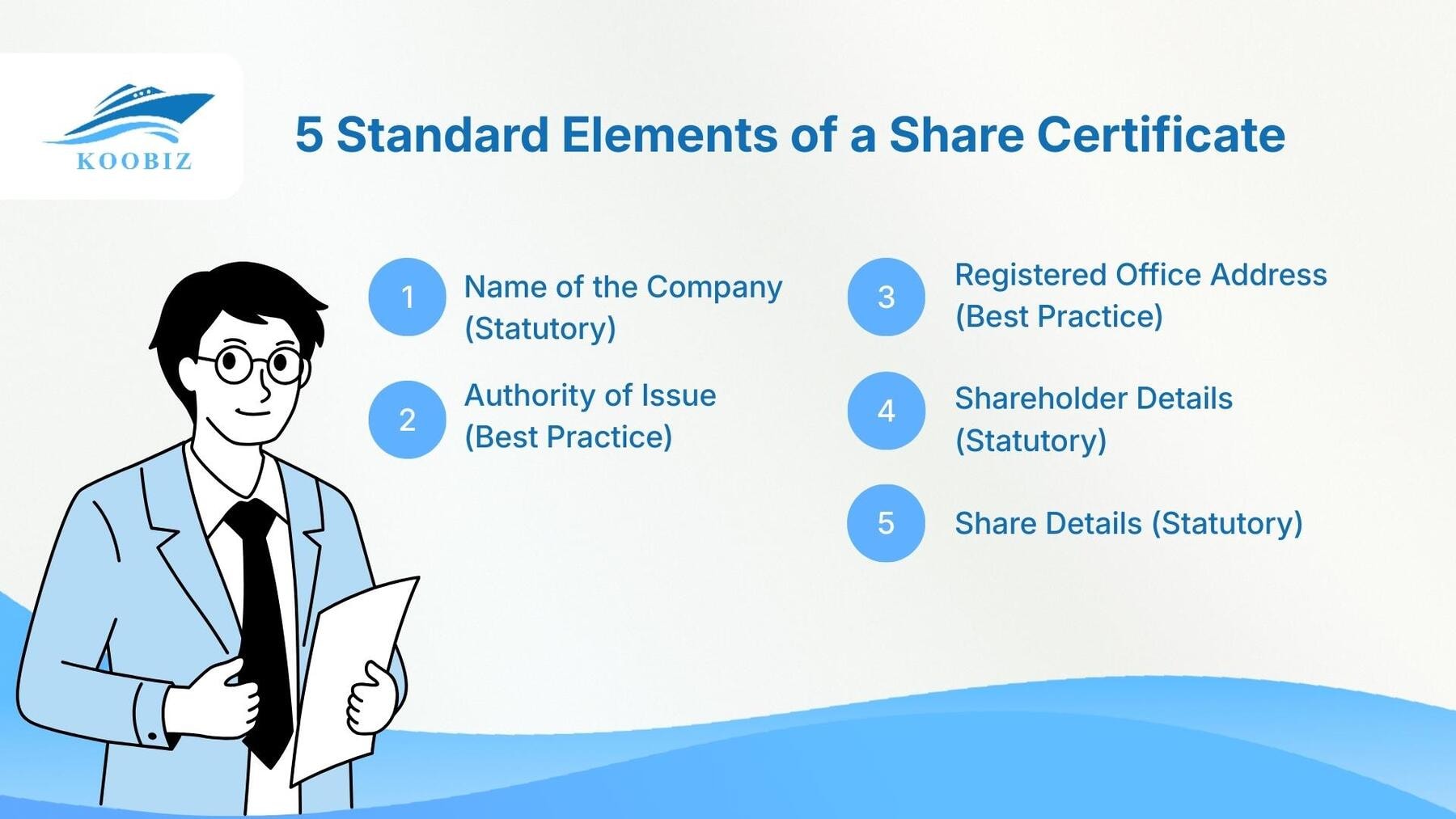
    Mandatory Particulars: What Must Be Included in a Share Certificate?

    For the certificate to be legally valid, it must contain specific details.

    Standard elements of a share certificate
    Standard elements of a share certificate

    The five standard elements include:

    1. Name of the Company (Statutory): This must be the exact registered name as it appears in ACRA’s records, including the suffix (e.g., Pte. Ltd.).
    2. Authority of Issue (Best Practice): It is standard practice to state the law under which the company is constituted (usually “Incorporated in the Republic of Singapore under the Companies Act 1967”).
    3. Registered Office Address (Best Practice): Including the current registered address of the company helps identify the entity clearly, though not strictly mandated by the Act itself.
    4. Shareholder Details (Statutory): The full name and address of the registered owner (the member).
    5. Share Details (Statutory): This is the core data required by law, which must specify:
      • The Class of Shares (e.g., Ordinary, Preference).
      • The Number of Shares held.
      • The Amount Paid-up on the shares (or legally deemed to be paid up).

    Ensuring the “amount paid” is accurate is crucial, as it protects the shareholder from being asked for more money later. At Koobiz, we double-check that this information matches your ACRA filings perfectly.

    Step-by-Step Guide to Issuing Share Certificates

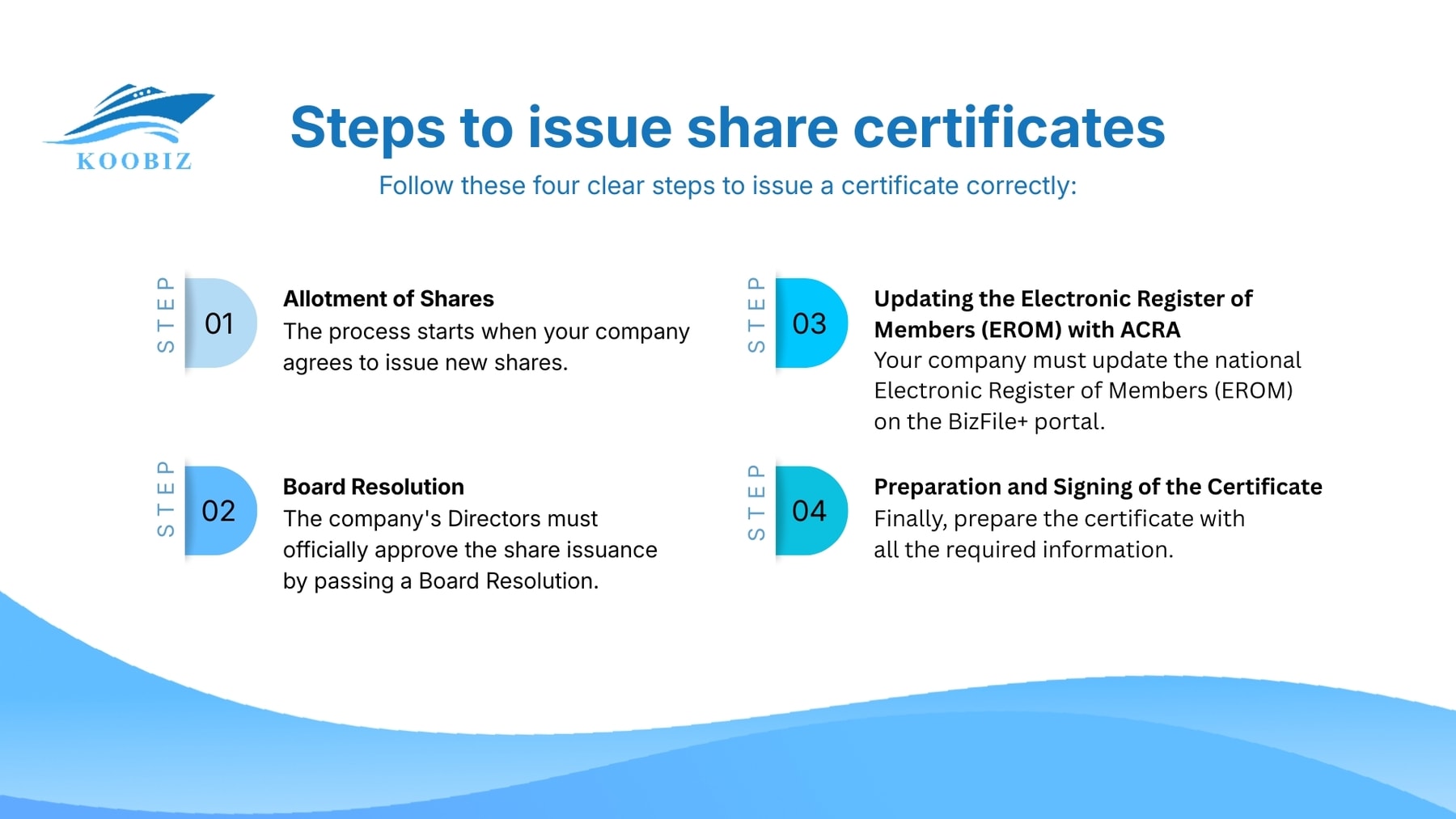
    Follow these four clear steps to issue a certificate correctly:

    Steps to issue share certificates
    Steps to issue share certificates

    Step 1: Allotment of Shares

    The process starts when your company agrees to issue new shares, usually to an investor in exchange for capital. This agreement should be documented.

    Step 2: Board Resolution

    The company’s Directors must officially approve the share issuance by passing a Board Resolution. This resolution authorizes who gets the shares, how many, and approves the creation and signing of the certificates.

    Step 3: Updating the Electronic Register of Members (EROM) with ACRA

    Your company must update the national Electronic Register of Members (EROM) on the BizFile+ portal. This is the official moment the person becomes a shareholder on record. Your Company Secretary typically handles this filing.

    Step 4: Preparation and Signing of the Certificate

    Finally, prepare the certificate with all the required information. It is then signed by the authorized company officers.

    Executing the Document: Common Seal vs. Authorized Signatures

    You have two main options for signing, offering flexibility, especially for companies with overseas directors.

    The table below outlines the key differences and requirements for each method:

    Feature Method 1: Using Common Seal Method 2: Authorized Signatures (No Seal)
    Applicability Mandatory if specified in the Company Constitution. Standard for modern companies (or if Constitution allows).
    Process Physical embossing of the metallic seal onto the paper. Wet ink signatures or secure digital signatures.
    Authorized Signatories • Two Directors

    • One Director + Company Secretary

    • Two Directors

    • One Director + Company Secretary

    • One Director + Witness (attesting the signature)

    Best For Traditional companies preserving formality. Modern companies with international or remote directors.

    This flexibility is particularly beneficial for companies with international directors who may not be physically present in Singapore to apply a physical seal. At Koobiz, we often advise clients on structuring their Constitution to allow for this modernized execution method, facilitating smoother remote operations.

    Practical Example: Issuance of Shares for a New Investor

    Let’s see how this works for a fictional company, “FutureTech Pte. Ltd.”.

    The Scenario:

    FutureTech Pte. Ltd. has secured a new angel investor, Mr. John Tan, who is investing SGD 50,000 in exchange for 10,000 ordinary shares.

    The Execution Workflow:

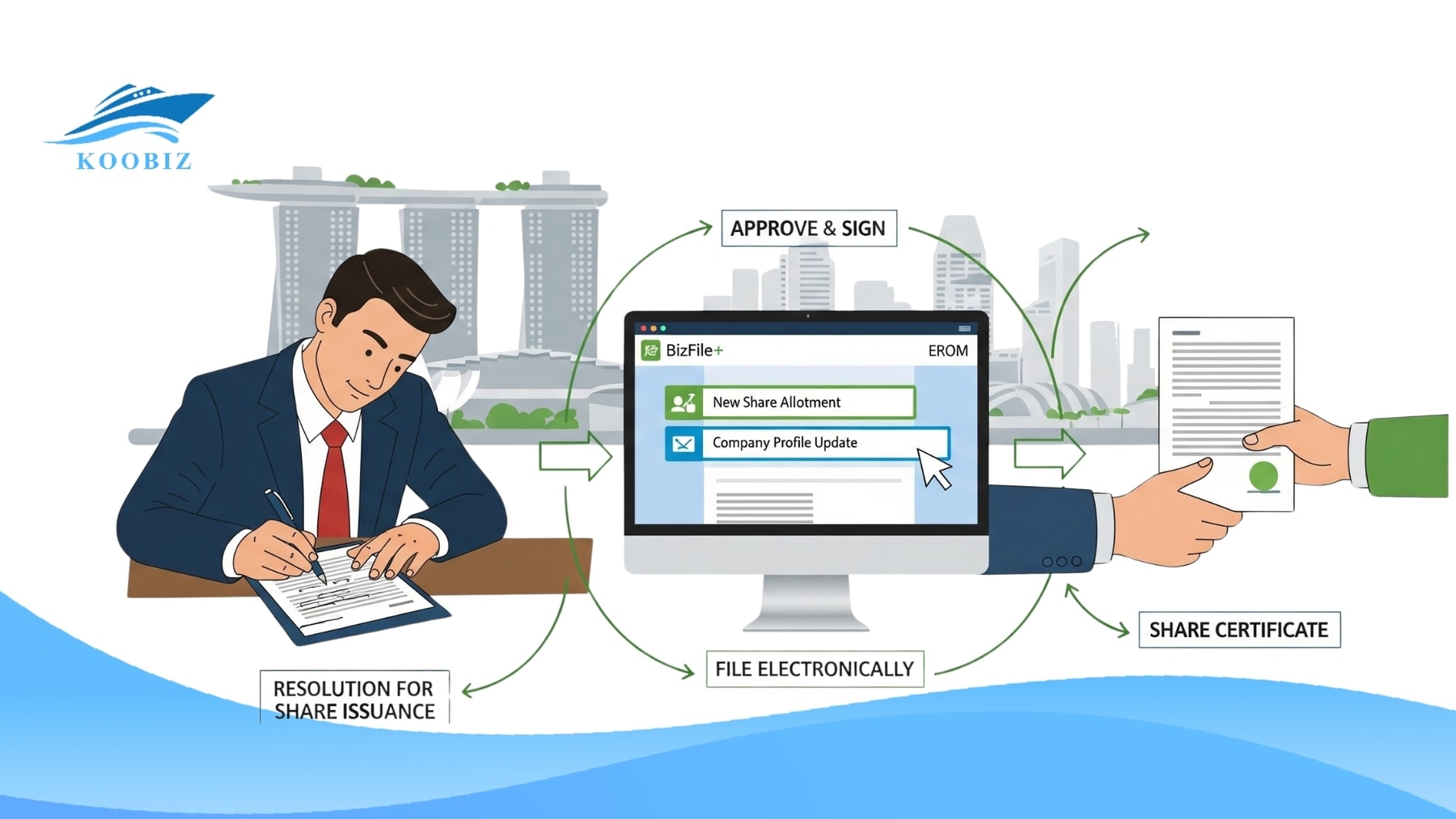
    Steps for Approval, ACRA Filing, and Certificate Issuance
    Steps for Approval, ACRA Filing, and Certificate Issuance
    1. Board Approval: The Directors pass a Board Resolution approving the allotment of 10,000 shares to Mr. Tan. The resolution explicitly authorizes the issuance of Share Certificate No. 005.
    2. ACRA Filing: The Company Secretary logs into BizFile+ and files the “Return of Allotment”. This updates the Electronic Register of Members (EROM) to reflect Mr. Tan’s ownership effective from the filing date.
    3. Certificate Preparation: The Secretary prepares the certificate with the following details:
      • Certificate No: 005
      • Member: Mr. John Tan
      • Shares: 10,000 Ordinary Shares
      • Paid-Up: SGD 50,000 (Fully Paid)
    4. Signing (Modern Method): As FutureTech does not use a common seal, the certificate is signed by one Director and the Company Secretary.
    5. Delivery: The signed certificate is delivered to Mr. Tan within 60 days of the allotment.

    Managing Share Certificate Lifecycle: Digital Requirements & Lost Certificates

    Managing the lifecycle of share certificates involves not just their creation, but also handling modernization trends and unfortunate events like loss or destruction.

    Digital Share Certificate Requirements 2025: Are They Legal?

    Yes, electronic share certificates are fully legal in Singapore if your company’s Constitution allows it. They offer better security and are easier to store and share. Important: A digital certificate isn’t just a scanned PDF. It should be properly executed with secure digital signatures to ensure it can’t be tampered with. Koobiz strongly encourages modern startups to adopt electronic records early, as this simplifies future due diligence processes where investors will ask for a “Data Room” containing all these documents.

    How to Replace a Lost Share Certificate in Singapore

    If a shareholder loses their certificate, the company must follow a secure process to issue a replacement and protect against fraud.

    The replacement process typically requires:

    1. Statutory Declaration: The shareholder must sign a legal declaration confirming the certificate is lost and has not been pledged or sold.
    2. Letter of Indemnity: The shareholder promises to compensate the company for any loss arising from the issuance of the replacement.
    3. Payment of Fees: The company may charge a nominal fee for the replacement (up to SGD 2.00).
    4. Public Notice (Optional but Recommended): In some cases, notice must be given to the public before a replacement is issued to ensure no other party claims title.

    Once these documents are received, the Directors pass a resolution to cancel the old certificate number and authorize the issuance of a new one.

    Is Stamp Duty Required for Issuing New Share Certificates?

    No, stamp duty is generally not required for the issuance of new share certificates during an allotment, but it is applicable for certificates issued pursuant to a transfer of shares.

    It is crucial to distinguish between “Allotment” (New Shares) and “Transfer” (Existing Shares).

    • New Allotment: When a company issues fresh shares to raise capital, there is no transfer of existing interest, so no stamp duty is payable to the Inland Revenue Authority of Singapore (IRAS).
    • Share Transfer: If a certificate is issued because Shareholder A sold shares to Shareholder B, a Share Transfer Deed must be executed, and Stamp Duty (0.2% of the purchase price or market value, whichever is higher) must be paid. The new share certificate for Shareholder B should only be issued after the Stamp Duty has been paid and the transfer is registered.

    Conclusion

    Issuing proper share certificates is a fundamental part of trustworthy corporate governance in Singapore. From ensuring the mandatory particulars are accurate to choosing the right execution method (seal vs. signature), every step reinforces your company’s credibility.

    While the process involves specific legal steps—allotment, resolution, and ACRA updates—it doesn’t have to be a burden. Whether you are moving towards electronic certificates or need to replace a lost document, professional guidance ensures you stay on the right side of the Companies Act.

    About Koobiz

    At Koobiz, we specialize in simplifying business compliance for Singapore companies. From incorporation and Company Secretary services to facilitating bank account opening and managing tax and accounting, we ensure your corporate governance is flawless. Let us handle the complexities of ACRA compliance so you can focus on growing your business.

    Visit Koobiz.com today for expert assistance with your Singapore corporate needs.

  • How to Certify Documents in Singapore: Certified True Copy vs. Notarisation Guide

    How to Certify Documents in Singapore: Certified True Copy vs. Notarisation Guide

    [SUMMARIES]

    Certified True Copy (CTC) is primarily for documents used within Singapore (local government, banks) and attests that a reproduced copy is a faithful replica of the primary document.

    Notarisation is an extra-jurisdictional verification by a Notary Public, essential for cross-border legal recognition.

    Apostille vs. Legalisation: Since 2021, documents for Hague Convention countries require an SAL Apostille (simplifying the process), while non-Hague countries still require Embassy Legalisation.

    Key Authorities: Lawyers and Company Secretaries (like Koobiz) handle CTCs for corporate docs; only Notaries Public can perform notarisation.

    Digital Validity: OpenCerts allow for direct online verification, often eliminating the need for physical stamping in tech-savvy contexts.

    [/SUMMARIES]

    Navigating Singapore’s administrative compliance landscape necessitates a clear distinction between statutory certification and notarial acts. Whether you are a foreigner setting up a company with Koobiz, opening a corporate bank account, or applying for a work visa, understanding how to correctly certify documents is not just a formality—it is a critical compliance requirement. Failure to choose the right verification method can lead to rejected applications, delayed business operations, and wasted fees. This guide will clarify the definitions, outline the specific authorities involved, and provide a clear roadmap for securing your documents in Singapore.

    What is a Certified True Copy (CTC) in Singapore?

    A Certified True Copy (CTC) is a duly attested reproduction of a primary document, validated by a qualified professional. This form of certification is primarily utilized for intra-jurisdictional compliance within Singapore, including submissions to ACRA and local financial institutions.

    Certified True Copy Document Singapore
    Certified True Copy Document Singapore

    To fully grasp the scope of a CTC, here are its specific attributes and legal standing:

    • Operational Efficiency: It facilitates administrative processing while ensuring the security of the original primary documents.
    • Professional Liability: When a professional, such as a lawyer or a company secretary from Koobiz, stamps a document, they are essentially staking their professional license on the fact that they have sighted the original and that the copy has not been altered in any way.
    • Statutory Validity and Recency Requirements: The validity is typically tied to the requirements of the requesting agency. For example, banks often require CTCs of incorporation documents to be dated within the last 3 to 6 months to ensure the company structure hasn’t changed.
    • Required Elements: According to standard legal practices, a CTC must include the clear name of the certifier, their designation, the date of certification, and their signature. Without these elements, the document is technically incomplete and likely to be rejected.

    Structural Comparison: Local Compliance vs. International Recognition

    A Certified True Copy is the optimal choice for local Singaporean administrative use, whereas Notarisation is the statutory requirement for extra-jurisdictional legal recognition. While CTCs focus on the accuracy of the reproduction, Notarisation verifies the authenticity of execution and the legal capacity of the signatories.

    However, knowing the difference is only half the battle; evaluating the procedural intricacies and cost-benefit implications is essential for effective corporate planning.

    This distinction is the most common point of confusion for our clients at Koobiz. The table below breaks down the critical differences to help you choose the right service:

    Feature Certified True Copy (CTC) Notarisation
    Legal Recognition & Scope Local (Singapore). Suitable for IRAS, local banks (DBS/OCBC), and Singapore government agencies. International (Overseas). Mandatory for foreign subsidiaries, buying property abroad, or foreign court submissions.
    The Certifier Authorized Certifiers. Issued by practicing lawyers, Chartered Accountants, and Company Secretaries (like Koobiz). Exclusive Authority. Must be issued by a Notary Public—a senior lawyer specifically appointed by the Singapore Academy of Law.
    Cost Implications Transactional Basis. Typically SGD 10 – SGD 50 per page. Often included in corporate service packages. Statutory Scale. Typically starts from SGD 40-75 per document + mandatory Notarial Certificate fee + SAL fees (approx. SGD 87.20).
    Verification Level Faithful Replication. Attests that the copy is an unaltered replica. Verification of Execution. Witnessing of signatures and attestation of capacity.
    International Verification None. Not recognized outside Singapore. Apostille or Legalisation. Required for the document to be valid abroad.
    Processing Time Fast. Often same-day or instant service. Longer. 1–3 days (depending on Apostille/Embassy processing).

    For instance, if you are incorporating a Singapore company with Koobiz but residing overseas, your passport copy sent to us usually needs to be notarised in your home country or certified by a professional that Singapore authorities recognize.

    Authorized Certifiers: Determining the Competent Authority

    Certified True Copy Certifiers: Lawyers, Notaries Public, Corporate Professionals
    Certified True Copy Certifiers: Lawyers, Notaries Public, Corporate Professionals

    There are three main categories of professionals authorized to issue Certified True Copies in Singapore: Lawyers/Advocates, Notaries Public, and registered professionals like Chartered Accountants or Company Secretaries. The selection of a certifier is governed by the compliance mandate of the recipient institution.

    Selecting the right professional is crucial to ensure your document is accepted on the first try.

    Practicing Advocates & Solicitors: Domestic Certification Experts

    Practicing lawyers in Singapore are the most common providers of CTC services. They have the authority to certify documents for use within the Singapore legal system and for most local administrative matters. If you walk into a standard law firm, any advocate and solicitor with a valid practicing certificate can perform this service. They are the standard certifiers for statutory identity verification in local transactions.

    Notary Public: The Competent Authority for International Attestation

    As mentioned, a Notary Public is a senior lawyer with at least 15 years of experience, specifically appointed to notarise documents for use outside Singapore. While they can issue a simple Certified True Copy for local use, this may result in unnecessary cost escalation for simple domestic filings.

    Corporate Professionals: Gatekeepers of Statutory Compliance

    For corporate compliance, Company Secretaries play a pivotal role in maintaining corporate governance integrity. Under Singapore law, Company Secretaries (like the team at Koobiz) are authorized to certify corporate documents such as the Memorandum & Articles of Association (M&A), BizFiles (Business Profiles), and Directors’ Resolutions.

    Note: While they are excellent for business documents, limitations exist for Company Secretaries regarding non-corporate instruments, such as personal identity verification for external use, unless they are specifically authorized to issue statutory certifications for core corporate instruments.

    How to Get a Certified True Copy in Singapore?

    The Three-Phase Certification Protocol
    The Three-Phase Certification Protocol

    Procedural Roadmap: The Three-Phase Certification Protocol. This involves verifying the original document, engaging the appropriate professional, and applying the official stamp and signature. This standardized procedure ensures the preservation of the evidentiary chain and mitigates fraudulent risks.

    Once you understand the workflow, obtaining a CTC becomes a quick and straightforward task.

    Step 1: Present the Original Document

    Physical Custody and Document Verification: A lawyer or company secretary cannot legally certify a copy if they have not seen the original. For digital-first documents (like ACRA BizFiles), the corporate secretary who generated them can certify them directly leveraging their role as authorized digital custodians of the primary corporate record.

    Step 2: Verification by the Professional

    The professional will compare the photocopy against the original to confirm the documentary integrity and absence of unauthorized alterations. At Koobiz, when we assist clients with bank account openings, this step is rigorous to prevent compliance issues with financial institutions.

    Step 3: Stamping and Signing

    The certifier will affix the official ‘Certified True Copy’ stamp upon the reproduction. They will then sign and date it. Crucially, they should also include their professional stamp (e.g., “Advocate & Solicitor” or “Company Secretary”) and contact details. This ensures accountability and facilitates due diligence by the receiving institution.

    Do You Need a Certified True Copy or Notarisation?

    Strategic Selection: Jurisdictional Requirements and Recipient Compliance. While both methods verify documents, they serve different legal jurisdictions and cannot always be substituted for one another.

    For extra-jurisdictional applications, the process transitions from mere certification to formal legalization.

    Scenario A: Domestic Compliance (Intra-Jurisdictional Use)

    If you are applying for Permanent Residency (PR) with the ICA, applying for a grant with Enterprise Singapore, or opening a local DBS corporate account, a Certified True Copy is usually sufficient. In fact, for many government transactions, bringing the original to the counter for the officer to inspect is the free alternative to a CTC.

    Scenario B: International Recognition (Cross-Border Legalization)

    If you are setting up a branch office in Indonesia, buying land in Australia, or managing inheritance in the UK using Singapore documents, you almost certainly need Notarisation. Foreign courts do not recognize a standard Singapore lawyer’s signature.

    Navigating Global Standards – The Apostille vs. Legalisation Framework:

    • Hague Countries (e.g., UK, USA, Australia, China): Facilitates expedited authentication through a unified statutory certificate (Apostille).
    • Non-Hague Countries (e.g., Vietnam, Thailand, UAE): Requires Consular Legalisation, a multi-tiered validation by the recipient’s diplomatic mission.

    We have established the fundamentals of Certified True Copies for local use and the basic distinction of Notarisation for international use. However, for documents traveling overseas, the process necessitates a transition to multi-agency validation. This involves the Singapore Academy of Law (SAL), the Apostille Convention, and handling modern digital formats.

    Strategic Global Authentication – Navigating the Apostille & Legalisation Framework

    The path your document takes depends entirely on whether the destination country is a member of this convention.

    Understanding the role of the SAL is critical for this advanced stage of document processing.

    1. For Hague Convention Countries (The “Apostille” Route)

    If your document is going to a member country (like the USA, UK, India, or China), the process is simplified.

    • Step 1: Notarisation by a Notary Public.
    • Step 2: The Notary submits the certificate to the Singapore Academy of Law (SAL).
    • Step 3: SAL issues an Apostille Certificate.

    Result: Achievement of Statutory Validity without further consular intervention.

    2. For Non-Hague Countries (The “Chain Legalisation” Route)

    If your document is going to a non-member country (like Vietnam, UAE, or Thailand), the traditional chain applies.

    • Step 1: Notarisation by a Notary Public.
    • Step 2: Authentication by SAL.
    • Step 3: Legalisation by the Embassy of the destination country in Singapore.

    Result: Only after the Embassy stamp is the document valid.

    Cost Note: The SAL Apostille/Authentication fee is approximately SGD 87.20 (inclusive of GST), payable in addition to the Notary’s fees.

    Certified True Copy for Digital Documents (OpenCerts)

    Singapore increasingly issues “born-digital” documents, such as OpenCerts for degrees or ACRA Business Profiles. Technically, traditional physical certification is being superseded by cryptographic verification.

    • Strategic Insight (Leveraging Blockchain-Based Verification): The recipient can verify it instantly at opencerts.io without any need for stamps, fees, or lawyers.
    • Physical Requirement: If a foreign agency insists on a physical stamp, a Notary Public can witness you logging into the official portal (e.g., SingPass), verify the digital record, and certify the printout as a true reflection of the electronic original.

    Risk Mitigation: Avoiding Jurisdictional and Procedural Errors

    To ensure your process is smooth, avoid these frequent mistakes:

    • Self-Certification: You generally cannot certify your own documents or those of family members.
    • Wrong Jurisdiction: Don’t use a CTC for overseas matters; it will likely be rejected.
    • Skipping Translation: Non-English documents must be translated before notarisation.
    • Ignoring Apostille Eligibility: Check if your destination country accepts Apostilles to save time on embassy visits.

    Conclusion

    Navigating the difference between a Certified True Copy and Notarisation is essential for the smooth operation of your business and personal affairs in Singapore. While a CTC suffices for most local administrative needs, international matters almost always require the enhanced authority of a Notary Public and adherence to the Apostille process.

    At Koobiz, we understand that administrative requirements should not impede your strategic focus. Whether you need a simple certification or comprehensive corporate secretarial support, our experienced team provides end-to-end services to ensure flawless documentation.

    Contact Koobiz today to streamline your document certification and compliance needs.

  • Understanding EGM Meaning: A Guide to Convening Extraordinary General Meetings vs. AGMs for Singapore Companies

    Understanding EGM Meaning: A Guide to Convening Extraordinary General Meetings vs. AGMs for Singapore Companies

    [SUMMARIES]

    Definition: An EGM is any shareholder meeting other than the mandatory Annual General Meeting (AGM), used for urgent or special business.

    Key Difference: While AGMs are routine and held annually, EGMs are ad-hoc and convened only when specific, urgent decisions are required.

    Procedure: Convening an EGM requires strict adherence to notice periods (14 or 21 days), quorum requirements, and proper voting protocols under the Companies Act.

    Shareholder Rights: Shareholders holding at least 10% of voting rights have the legal power to requisition an EGM if the board refuses to do so.

    Compliance: Failure to follow proper EGM procedures can render resolutions invalid; Koobiz recommends professional secretarial oversight for all corporate proceedings.

    [/SUMMARIES]

    In the dynamic corporate landscape of Singapore, business agility often requires swift decision-making that cannot wait for the annual review cycle. While most business owners are familiar with the Annual General Meeting (AGM), the Extraordinary General Meeting (EGM) plays an equally critical role in corporate governance. The purpose of an EGM goes beyond a simple definition; it involves mastering the strategic legal mechanisms required to approve major transactions, amend constitutions, or restructure leadership.

    For Singapore companies, navigating the procedural nuances of an EGM—from drafting notices to ensuring a valid quorum—is essential to prevent legal disputes. At Koobiz, where we specialize in Singapore company incorporation and corporate secretarial services, we frequently guide clients through the complexities of convening valid meetings. Whether you are a director who needs to approve an urgent decision or a shareholder looking to exercise your rights, this guide will explain the EGM process, show how it differs from the AGM, and ensure your company remains compliant with the Singapore Companies Act.

    What is an Extraordinary General Meeting (EGM) in Singapore?

    Emergency shareholders' meeting in a corporate setting
    Emergency shareholders’ meeting in a corporate setting

    An Extraordinary General Meeting (EGM) is legally defined as any meeting of a company’s members (shareholders) that is not the mandatory Annual General Meeting (AGM), convened specifically to address urgent matters that arise between AGMs.

    To distinguish an EGM from other corporate gatherings, three main keys define its nature and necessity:

    • Urgency: The matters at hand are time-sensitive and cannot be postponed until the next scheduled AGM.
    • Specificity: It is convened for a specific purpose or “special business,” such as removing a director or amending the constitution, rather than routine annual reviews.
    • Irregularity: There is no statutory deadline to hold an EGM; it is an ad-hoc event triggered only by necessity.

    Unlike the AGM, which follows a predictable yearly schedule to review accounts, the EGM is irregular and “extraordinary” in nature. It is a rapid-response mechanism for the company. Whenever an issue arises that requires shareholder approval—such as removing a director or approving a merger—and that issue is too critical to postpone, an EGM is called.

    Koobiz advises that viewing the EGM as a strategic tool rather than just a compliance hurdle allows directors to manage corporate changes more effectively. Understanding this fundamental definition is the first step, but to truly grasp its operational value, we must distinguish it from its counterpart, the AGM.

    AGM vs. EGM: What is the Difference Between These Key Shareholder Meetings?

    The Annual General Meeting (AGM) serves as the routine health check of a company, whereas the Extraordinary General Meeting (EGM) acts as the emergency surgery room for specific, urgent corporate interventions. To visualize these differences clearly, refer to the comparison table below:

    Feature Annual General Meeting (AGM) Extraordinary General Meeting (EGM)
    Nature & Urgency Routine Health Check. Retrospective; reviews past performance. Emergency Intervention. Prospective; addresses immediate, urgent changes.
    Frequency Mandatory. Must be held once every calendar year. Ad-hoc. No fixed schedule; held only when necessary.
    Timing (Singapore) Within 4 months (listed) or 6 months (non-listed) of FYE. Any time a decision is needed (e.g., funding rounds).
    Business Agenda “Ordinary Business”: Accounts, dividends, director re-elections. “Special Business”: Constitution changes, director removal, mergers.
    • Frequency and Timing: The AGM is a mandatory statutory obligation. In Singapore, listed companies must hold an AGM within four months of their financial year-end, while non-listed companies have six months. In stark contrast, an EGM has no fixed schedule. A dormant company might never hold an EGM, whereas a rapidly expanding startup might hold several in a year.
    • Business Agenda: The AGM deals with “ordinary business,” which is predictable: presenting financial statements, declaring dividends, and re-electing directors retiring by rotation. The EGM deals exclusively with “special business.” This includes anything outside the routine scope, such as altering the company’s constitution or changing the company name.
    • Urgency: AGMs are retrospective, looking back at the past year’s performance. EGMs are prospective and urgent, looking forward to immediate changes required for the company’s survival or growth.

    Understanding this distinction clarifies why an EGM might be necessary, but what specific events trigger the need to convene one?

    When Should a Singapore Company Convene an EGM?

    The main reasons for convening an EGM in Singapore
    The main reasons for convening an EGM in Singapore
    1. Removal of a Director: While the Board can appoint directors, removing a director before their term expires usually requires an Ordinary Resolution passed at a general meeting. This is a common, often contentious, reason for EGMs.
    2. Amendment of Constitution: If a company wishes to update its Company Constitution (formerly Memorandum and Articles of Association), this requires a Special Resolution. Since the Constitution dictates how the company is run, changes are often urgent.
    3. Changes in Share Capital: Whether it involves the allotment of new shares that exceeds the directors’ mandate, or a reduction of share capital to return cash to shareholders, these actions dilute or alter ownership and thus require owner consent.
    4. Major Transactions: Under Singapore law, specifically Section 160 of the Companies Act, directors cannot dispose of the whole or substantially the whole of the company’s undertaking or property without shareholder approval.
    5. Winding Up: A decision to voluntarily wind up the company requires a Special Resolution passed at an EGM.

    Need to check if your specific situation requires an EGM? Contact Koobiz today for professional corporate guidance.

    How to Convene an EGM in Singapore: The Standard Procedure

    The standard procedure for convening an EGM
    The standard procedure for convening an EGM

    The standard procedure for convening an EGM involves a strict three-step legal process: Board approval, issuance of compliant notice, and the proper conduct of the meeting itself.

    Step 1: Board Approval and Drafting the Notice

    • Board Resolution: The Directors must pass a Board Resolution to approve the convening of the EGM.
    • Drafting the Agenda: The Board must clearly define the resolutions to be voted on. These must be drafted as either:
      • Ordinary Resolutions: Requiring >50% of the vote.
      • Special Resolutions: Requiring ≥75% of the vote.
    • Explanatory Statement: It is best practice, and often legally required, to include an explanatory statement/circular that provides shareholders with enough information to make an informed decision on the proposed resolutions.

    Step 2: Issuing the Notice of Meeting (Notice Periods)

    • Ordinary Resolutions: If the EGM is only for Ordinary Resolutions, a minimum of 14 days’ written notice is required.
    • Special Resolutions: If the agenda includes any Special Resolution (e.g., changing the company name), a minimum of 21 days’ written notice is mandatory.
    • Recipients: The notice must be sent to all members (shareholders), the auditors of the company, and any other person entitled to receive notice under the constitution.
    • Service of Notice: The notice period excludes the day of service and the day of the meeting. Therefore, purely calculating 14 days on a calendar is often insufficient; a buffer is necessary.

    Note for Public Listed Companies: If your company is listed on the SGX, stricter notice periods may apply under the Listing Manual (e.g., 14 calendar days for Ordinary Resolutions). Always verify against current listing rules.

    Step 3: Conducting the Meeting (Quorum and Voting)

    • Quorum: Before business can commence, a quorum must be present. Unless the company’s constitution says otherwise, the Model Constitution usually sets the quorum at two members present in person or by proxy.
    • Chairman: The meeting is chaired by the Chairman of the Board. If they are absent, members can elect a chairman for the meeting.
    • Voting: Voting is typically done by a show of hands initially. However, a poll can be demanded by the chairman, at least five members, or members representing at least 5% of voting rights.

    Following this standard path ensures a smooth meeting. However, corporate reality is rarely simple, and complex scenarios often arise regarding shareholder rights and notice waivers.

    Navigating Complex EGM Scenarios and Shareholder Rights

    Navigating complex EGM scenarios involves understanding the exception clauses, minority rights, and modern adaptations that exist beyond the standard “Board-convened” meeting structure.

    This section explores the “Unique Attributes” of the EGM ecosystem in Singapore.

    Can Shareholders Force an EGM? (Member’s Right of Requisition)

    Yes, shareholders holding at least 10% of the total paid-up voting shares have the statutory right to force the directors to convene an EGM.

    According to Section 176 of the Companies Act, if members meet the 10% threshold and submit a valid requisition notice, the directors must proceed to convene the meeting within 21 days, to be held no later than two months after the requisition receipt.

    If the directors fail to do so, Section 177 allows the requisitioning shareholders to convene the meeting themselves. Any reasonable expenses incurred by the shareholders in this process must be reimbursed by the company (which, in turn, can deduct this from the defaulting directors’ fees). This is a powerful tool for minority shareholders to hold the board accountable.

    Is it Possible to Hold an EGM at Short Notice?

    Yes, it is possible to hold an EGM with less than the statutory 14 or 21 days’ notice, provided that a specific majority of shareholders agree to it.

    For private companies, an EGM can be held at short notice if members holding at least 95% of the total voting rights agree to it. This “Consent to Short Notice” is incredibly useful for SMEs where all shareholders are also directors or are in close communication. It allows for immediate decision-making without the mandatory waiting period.

    Disclaimer: Always consult the Company Constitution first. While the Companies Act allows this, a specific clause in your Constitution could technically impose stricter requirements.

    Ordinary Resolution vs. Special Resolution: Which One Do You Need?

    The choice between an Ordinary Resolution and a Special Resolution depends entirely on the gravity of the decision being made, dictated by the Companies Act.

    • Ordinary Resolution: Requires a simple majority (more than 50%) of the votes cast. This is used for the removal of a director or the issuance of shares (if authorized).
    • Special Resolution: Requires a supermajority of at least 75% of the votes cast. This is reserved for fundamental changes in the company’s identity or structure, such as amending the Constitution, reducing share capital, or changing the company name.

    Identifying the correct resolution type is critical. Passing a Special Resolution issue via an Ordinary Resolution threshold renders the decision legally void.

    Modern EGM Formats: Virtual and Hybrid Meetings in Singapore

    Effectively from 1 July 2023, the Companies, Business Trusts and Other Bodies (Miscellaneous Amendments) Act 2023 enables companies to conduct general meetings digitally.

    • Virtual Meetings: Fully online meetings are permitted unless the company’s constitution explicitly prohibits them.
    • Hybrid Meetings: Physical meetings with an option for virtual attendance are also standard.

    However, the technology used must ensure that members can vote and ask questions in real-time.

    Can the Court Order an EGM?

    Yes, in rare circumstances where it is “impracticable” to call or conduct a meeting in the usual manner, the Singapore Court has the power to order an EGM. This usually happens in deadlock situations—for example, in a 50-50 shareholder dispute where one party refuses to attend to deny a quorum. The Court can order the meeting and even direct that “one member present in person or by proxy shall be deemed to constitute a meeting,” effectively breaking the deadlock.


    Conclusion

    A well-conducted EGM protects the board and empowers shareholders, while procedural errors can lead to costly corporate disputes. Navigating these compliance complexities requires precision and an understanding of the prevailing local laws.

    Don’t manage these complex requirements alone. Koobiz specializes in comprehensive corporate secretarial services, financial compliance, and legal administration in Singapore. We ensure your meetings are legally valid and your statutory records remain immaculate.

    For seamless corporate structuring, resolution drafting, or general ACRA compliance, visit Koobiz.com today. Let our experts handle the intricate details while you focus on driving your business growth.

  • Share Transfer Stamp Duty Singapore: Calculate Rates, File with IRAS & Exemptions Guide

    Share Transfer Stamp Duty Singapore: Calculate Rates, File with IRAS & Exemptions Guide

    [SUMMARIES]

    Mandatory Requirement: Stamp Duty is payable on all share transfers in Singapore private companies at a rate of 0.2%.

    Calculation Basis: The duty is calculated based on the higher of the purchase price (consideration) or the Market Value (often based on Net Asset Value) of the shares.

    Filing Deadline: You must stamp the document within 14 days of signing (if signed in Singapore) or 30 days (if signed overseas) to avoid penalties.

    Exemptions: Group Relief and Section 15 Relief are available for associated companies, subject to strict shareholding thresholds (75% or 90%) and IRAS adjudication.

    Koobiz Tip: Always prepare a “Working Copy” of the valuation and keep it for 5 years in case of an IRAS audit.

    [/SUMMARIES]

    Transferring ownership of a Singapore Private Limited company is not merely a commercial transaction; it is a regulated act that triggers strict stamp duty obligations. Whether you’re a founder selling equity, an investor buying a stake, or a company secretary overseeing compliance, a clear grasp of Share Transfer Stamp Duty is essential to ensure the transfer is legally effective. Getting the stamping wrong can render the documents unenforceable and expose your business to substantial penalties. At Koobiz, we guide Singapore businesses through these regulatory steps—from incorporation to complex compliance. In this guide, we explain how to calculate the 0.2% duty, how to file with IRAS, and which exemptions may reduce your liability.

    Is Stamp Duty Payable on Share Transfers in Singapore?

    Singapore Share Transfer Stamp Duty
    Singapore Share Transfer Stamp Duty

    Yes. Stamp Duty applies to share transfers in Singapore because it is imposed on the Share Transfer Document (formerly known as the Instrument of Transfer) under the Stamp Duties Act. The document must be stamped and validated by IRAS for the transfer to be legally effective.

    This obligation arises from the legal framework governing corporate documentation in Singapore. For private companies, a share transfer has no legal effect until the relevant document—whether executed physically or electronically—is duly stamped. This differs from listed shares traded on the SGX, which are typically scriptless and settled electronically, and therefore do not follow the same stamping mechanics.

    Importantly, stamp duty is triggered at the point of execution. The liability arises the moment the share transfer document is signed. Whether the shares are sold for consideration or transferred as a gift (where the consideration is nominal or nil), IRAS treats the transaction as a dutiable event based on the value of the shares being transferred.

    How to Calculate Share Transfer Stamp Duty Rates

    How to calculate Share Transfer Stamp Duty Singapore
    How to calculate Share Transfer Stamp Duty Singapore

    Stamp duty on a share transfer is calculated using one of two valuation bases: the Purchase Price (consideration) or the Market Value of the shares. The applicable duty is charged at a flat rate of 0.2% on whichever value is higher.

    While IRAS formally uses the term “Market Value,” in practice, for most private companies that do not hold significant property assets, Net Asset Value (NAV) is commonly accepted as the market value proxy.

    To avoid underpayment and potential penalties, it is essential to compare both figures and apply the 0.2% rate to the higher amount. Although full financial statements are not always required at the point of e-Stamping, IRAS expects taxpayers to retain a working copy of the valuation to substantiate the calculation if queried during a review or audit.

    The 0.2% Rate Formula Explained

    The calculation formula for Share Transfer Stamp Duty is simple: identify the higher of the consideration or the market value, apply the 0.2% rate, and round the resulting amount down to the nearest dollar.

    Minimum Duty: Regardless of how small the computed amount may be, the minimum stamp duty payable is SGD 1.

    For instance, where shares are transferred at a value of SGD 100,000, the duty is calculated as follows: 100,000 × 0.2% = SGD 200

    That said, the key technical point lies in the rounding treatment. While the final duty payable is rounded down to the nearest dollar, the underlying share valuation must remain accurate and defensible. If the computed duty amounts to SGD 150.80, IRAS will typically assess the payable duty as SGD 150. Although the rate is relatively low, it can still translate into a meaningful tax cost for large-value share transfers running into the millions.

    Net Asset Value (NAV) vs. Consideration Price

    When assessing stamp duty, the starting point is to compare the Consideration Price (the amount paid by the buyer) with the Market Value of the shares, commonly reflected by the company’s Net Asset Value (NAV)—calculated as total assets less liabilities.

    In practice, Koobiz advises clients that using NAV serves as a protective benchmark for IRAS, helping to prevent share transfers from being structured at artificially low values. As shown in the table below, the stamp duty is always computed based on the higher of these two figures, in line with IRAS requirements.

    Comparison Factor Scenario A (Standard Sale) Scenario B (Nominal/Gift)
    Consideration Price $50,000 $1
    Net Asset Value (NAV) $20,000 $1,000,000
    Duty Base Used $50,000 (Price is higher) $1,000,000 (NAV is higher)
    Duty Payable (0.2%) $100 $2,000

    To calculate NAV, you typically use the company’s latest management accounts or audited financial statements. If the company owns property, the NAV generally must be adjusted to reflect the open market value of that property, rather than just its book value, to satisfy IRAS requirements.

    Real-World Case Studies: Calculation Examples

    To make these rules easier to digest, let’s look at three practical scenarios that Singapore business owners commonly face.

    Case Study 1: The High-Valuation Startup (Price > NAV)

    Scenario: “TechGenius Pte Ltd” is a startup with few physical assets (low NAV) but high future potential. An investor buys 10% of the shares for SGD 500,000. The proportionate NAV of those shares is only SGD 50,000.

    • Analysis: The Purchase Price ($500k) is significantly higher than the NAV ($50k).
    • Calculation: $500,000 × 0.2% = SGD 1,000.
    • Outcome: Stamp duty is payable on the full purchase price.

    Case Study 2: The “Nominal” Family Transfer (NAV > Price)

    Scenario: Mr. Tan wants to transfer his business to his son. To keep it simple, he sells the shares for a nominal sum of SGD 1. However, the company is profitable and has a Net Asset Value of SGD 1,000,000.

    • Analysis: Even though the “price” is $1, IRAS looks at the market value.
    • Calculation: $1,000,000 × 0.2% = SGD 2,000.
    • Outcome: Mr. Tan must pay $2,000 in stamp duty, not $0. This is a common pitfall for family transfers.

    Case Study 3: The Property Holding Entity (The “ACD” Trap)

    Scenario: An investor buys 100% of “LandHoldings Pte Ltd” for SGD 2,000,000. The company’s primary asset is a residential bungalow in Sentosa.

    • Analysis: Because the company is “property-rich” (assets are >50% residential property), it is classified as a Property Holding Entity (PHE).
    • Outcome: The investor does not just pay the standard 0.2% ($4,000). They are likely liable for Additional Conveyance Duties (ACD).
      • Context: With recent property cooling measures, ACD rates mirror the Additional Buyer’s Stamp Duty (ABSD). For entities or foreign buyers, this can now exceed 60% of the property value, treating the share transfer essentially as a direct property purchase.

    Koobiz Tip: Always check if the target company holds residential property before signing.

    Step-by-Step Guide to Filing Stamp Duty with IRAS

    The stamping process is carried out fully online via the government portal, having replaced the former practice of using physical adhesive stamps. The following workflow should be followed to ensure the document is properly stamped and legally validated:

    1. Login to the Portal: Access the IRAS e-Stamping Portal using your CorpPass (for corporate representatives) or SingPass (for individuals).
    2. Select Document Type: Navigate to the main dashboard and select “Share Transfer” from the list of stampable documents.
    3. Enter Transaction Details: Input the required information into the digital form, including:
      • Transferor (Seller) & Transferee (Buyer) details.
      • Number of Shares being transferred.
      • Consideration Price and the calculated Net Asset Value (NAV).
    4. Declare Property Status: You must declare if the company is a Property Holding Entity (PHE). This step is crucial for determining if ACD applies.
    5. Make Payment: Complete the stamp duty payment via GIRO, PayNow, or AXS.
    6. Download Certificate: Once payment is successful, a Stamp Certificate is generated immediately. Download this and attach it to your Share Transfer Document. Without this certificate, the Company Secretary cannot update the Electronic Register of Members (EROM) with ACRA via the BizFile+ portal.

    Time Limits and Deadlines for Stamping

    Strict statutory timelines apply. A share transfer document must be stamped within 14 days if it is executed in Singapore, or within 30 days if it is signed overseas.

    This distinction is particularly important for cross-border transactions. For example, where a transfer form is sent to a director in London for execution, the 30-day period runs from the date the document is signed abroad, not from the date it is returned to Singapore. Conversely, where the document is signed digitally or physically in Singapore, the 14-day deadline applies. Failure to meet these timelines results in automatic late-stamping penalties.

    Common Stamp Duty Exemptions and Reliefs

    Exemptions and Reliefs for Share Transfer Stamp Duty
    Exemptions and Reliefs for Share Transfer Stamp Duty

    Certain stamp duty reliefs are available, mainly for transactions where beneficial ownership remains unchanged or where the transfer occurs as part of a corporate group restructuring.

    Although stamp duty applies as a default rule, careful structuring can take advantage of these statutory reliefs to reduce or eliminate the tax exposure, particularly in the context of internal group reorganisations.

    Relief for Associated Permitted Entities & Section 15

    Corporate groups can often waive stamp duty during internal restructuring to streamline operations. The two most common reliefs are:

    1. Associated Permitted Entities Relief: Requires the companies to be associated by at least 75% in voting capital and power.
    2. Section 15 (Reconstruction & Amalgamation): A stricter relief typically requiring 90% ownership and often stipulates that the consideration be paid primarily in shares of the transferee company.

    Important Conditions:

    • Retention Period: The companies must typically remain associated for at least two years post-transfer.
    • Intent: The transfer must be for genuine restructuring/rationalization, not for tax avoidance.
    • Adjudication: These reliefs are not automatic. You must apply to IRAS for adjudication before the duty payment deadline to claim the waiver.

    Transfer of Shares as a Gift

    Transferring shares as a Gift (Voluntary Conveyance inter vivos) does not exempt you from stamp duty; instead, the duty is calculated strictly on the Market Value (NAV) since there is no purchase price.

    Many business owners mistakenly believe that “giving” shares to a family member or partner for $0 implies $0 tax. This is incorrect. In a gift scenario, IRAS treats the market value as the dutiable amount.

    • Comparison:
      • Sale: Duty on Higher of Price vs. NAV.
      • Gift: Duty on NAV (since Price is $0).

    Therefore, gifting shares of a highly valuable company will still result in a significant stamp duty bill.

    Handling Penalties, Refunds, and Special Share Scenarios

    Managing share transfers goes beyond routine e-Stamping. It also involves addressing late-stamping penalties, navigating Additional Conveyance Duties (ACD) for property-holding entities, and handling transactions that are subsequently aborted.

    In practice, business owners must be ready for atypical scenarios that can complicate stamp duty assessments. At Koobiz, we regularly support clients who have missed statutory deadlines or need assistance rectifying prior filings.

    Late Payment Penalties and Appeals

    IRAS imposes a tiered penalty structure for late stamping, which can be up to 4 times the original duty amount depending on the duration of the delay.

    • Delay ≤ 3 Months: $10 penalty or an amount equal to the duty payable (whichever is greater).
    • Delay > 3 Months: $25 penalty or 4 times the duty payable (whichever is greater).

    For example, if the unpaid duty was $1,000 and you are 4 months late, you could owe $1,000 (Duty) + $4,000 (Penalty) = $5,000 total. You can submit an appeal via the IRAS portal if there was a genuine oversight, but waivers are not guaranteed.

    Additional Conveyance Duties (ACD) for Property Holding Entities

    Where the target company qualifies as a Property Holding Entity (PHE), the share transfer may expose the buyer to Additional Conveyance Duties (ACD), which can far exceed the standard 0.2% stamp duty.

    • A company is generally regarded as a PHE if 50% or more of its total tangible assets comprise prescribed immovable properties, namely residential real estate situated in Singapore.
    • ACD was introduced to close a tax arbitrage gap. With ABSD rates for entities and foreign buyers rising sharply in recent years, ACD rates have been aligned accordingly. As a result, acquiring shares in a property-holding company can now attract a tax burden broadly comparable to purchasing the underlying residential property outright.

    Stamp Duty on Shares in Foreign Currency

    When shares are denominated in a foreign currency (e.g., USD), the value must be converted to Singapore Dollars (SGD) using the exchange rates published by MAS or IRAS on the date of the document execution.

    You cannot simply use the USD value to calculate the duty. The sequence is:

    1. Determine Value in Foreign Currency.
    2. Convert to SGD using the spot rate on the date of signing.
    3. Apply 0.2% rate to the SGD figure.

    Applying for a Refund for Aborted Transfers

    Where a share transfer is subsequently rescinded or set aside after stamp duty has already been paid, an application for a refund may be made to IRAS within six months from the date of the instrument or its execution.

    To support a successful refund claim, it must be clearly demonstrated that the transaction was effectively aborted and that legal ownership of the shares did not pass to the buyer. This typically requires documentary evidence such as a Rescission Agreement and confirmation that the company’s register of members was never updated.

    Conclusion

    Navigating Share Transfer Stamp Duty in Singapore requires attention to detail—from calculating the market value correctly to ensuring the e-Stamping is completed within the 14-day window. While the 0.2% rate seems low, mistakes in valuation or identifying Property Holding Entities can lead to costly penalties or Additional Conveyance Duties.

    At Koobiz, we simplify corporate compliance for entrepreneurs and businesses. Whether you need assistance with company incorporation, Company Secretary services to draft your Share Transfer Document, or guidance on opening a corporate bank account in Singapore, our team is ready to support your growth.

    Ready to streamline your share transfer process?

    Visit Koobiz.com to consult with our experts today.

  • Structuring Vested Shares for Singapore Startups: A Founder’s Guide to Equity & Vesting Schedules

    Structuring Vested Shares for Singapore Startups: A Founder’s Guide to Equity & Vesting Schedules

    [SUMMARIES]

    Vesting Definition: Vesting is the mechanism by which founders and employees earn full ownership of their shares over time, protecting the company from early departures.

    Standard Schedules: The “4-year vesting with a 1-year cliff” is the gold standard for Singapore startups, ensuring long-term commitment.

    Founder Protection: Reverse vesting is essential for co-founders, allowing the company to buy back unvested shares if a founder leaves prematurely.

    Legal Enforcement: A robust Shareholders’ Agreement (SHA) is mandatory to enforce vesting terms; relying on verbal agreements is a critical legal risk.

    Tax Compliance: Foreign employees leaving Singapore face the “Deemed Exercise” rule during tax clearance, triggering immediate tax liabilities on unvested shares.

    [/SUMMARIES]

    Founders often underestimate equity allocation and handle it informally, only to face costly disputes when a co-founder departs or an investor requests a cap-table audit. At Koobiz, our experience in Singapore company formation confirms that well-structured equity is more than an administrative task: it underpins a startup’s longevity and attractiveness to investors. This guide outlines how to structure vested shares, covering standard vesting schedules, reverse vesting for founders, the necessary legal safeguards, and the Singapore IRAS tax implications.

    What are Vested Shares in the context of a Singapore Startup?

    Vesting: Long-term commitment, gradual ownership
    Vesting: Long-term commitment, gradual ownership

    Vested shares refer to equity that becomes fully owned only after a defined period of time or once certain milestones are met. In Singapore startups, vesting typically has several defining features:

    • Conditional ownership: Shares are not owned outright on day one. Instead, ownership is progressively earned, which clearly separates vested shares from shares that are merely granted at incorporation.
    • Forfeiture Risks: Until vesting is complete, shares remain subject to restrictions. If a founder or employee leaves early, any unvested shares are usually forfeited or bought back by the company at a nominal price.
    • Long-term alignment: Vesting ensures equity is awarded in exchange for ongoing contribution, not just future intent, aligning founders’ and employees’ incentives with the company’s long-term growth.
    • Investor expectation: For Singapore-based Venture Capitalists (VCs), vesting is effectively non-negotiable. It provides legal assurance that key individuals are committed to the business, which is essential for a startup to be considered investable.

    What are the standard vesting schedules for Startups?

    Standard share vesting: 4 years, 1-year cliff
    Standard share vesting: 4 years, 1-year cliff

    A standard vesting schedule in Singapore and in most global startup ecosystems is built around two core elements: the cliff and the graded vesting period, typically spanning a total of four years.

    Although startups are free to customise their own timelines (with some non-tech companies choosing a shorter three-year schedule), moving too far away from market norms can create friction when hiring talent or raising capital. The widely accepted benchmark remains four-year vesting with a one-year cliff, as it strikes a practical balance between protecting the company and fairly rewarding contributors. Below, we break down each component to explain why this structure has become the industry standard.

    How does the “One-Year Cliff” Work?

    A one-year cliff functions as an initial probation period during which no equity vests. If a founder or employee leaves within the first 12 months, they exit without any ownership.

    In practice, the cliff acts as a safeguard for the company. Early-stage hires don’t always work out, and co-founder splits most often happen in the first year. Without a cliff, equity would start vesting from day one, allowing someone who leaves after only a few months to retain a permanent stake in the cap table — creating what is often referred to as “dead equity.” The cliff ensures shares are earned only after a full year of demonstrated contribution and commitment. Once the one-year mark is reached, it is standard for 25% of the total grant to vest immediately.

    What is Graded Vesting (Monthly vs. Quarterly)?

    Graded vesting refers to the gradual vesting of shares once the cliff period has been satisfied, usually on a monthly or quarterly basis for the remainder of the vesting term.

    • After the one-year cliff, the remaining 75% of the equity typically vests progressively over the next three years (36 months).
    • Monthly vesting: This is the most widely used structure. Shares vest in equal instalments of 1/48th per month, which employees tend to prefer as it provides steady progress and reduces “cliff-hanging” behaviour, where individuals delay resignation until a specific quarter-end.
    • Quarterly vesting: Shares vest once every three months. While this can be slightly easier to administer, it is increasingly uncommon in modern tech startups compared to a monthly schedule.
    • In practice, Koobiz recommends monthly vesting after the cliff for most Singapore startups, as it aligns closely with global market standards and investor expectations.

    Reverse Vesting vs. Standard ESOP: Which strategy fits founders?

    Reverse vesting is best suited for co-founders to lock in long-term commitment, while Employee Share Option Plans (ESOPs) are used to incentivise employees who join later. Clearly separating these two structures ensures equity is allocated to the right people in the right way.

    Feature Reverse Vesting (Founders) Standard ESOP (Employees)
    Target Audience Co-Founders & Key Partners Employees, Advisors, Consultants
    Ownership Status Immediate: Founder owns shares from Day 1. Future: Employee gets “options” to buy shares later.
    Voting Rights Yes: Voting rights start immediately. No: No voting rights until options are exercised.
    Vesting Mechanic “Un-earning”: Company has right to buy back unvested shares. “Earning”: Employee accrues right to buy shares over time.
    Departure Impact Company repurchases unvested shares. Unvested options are cancelled/forfeited.

    Why is reverse vesting essential for Co-Founders?

    Reverse vesting is critical for co-founders as it shields the company from the “free-rider” risk—situations where a departing founder retains a significant equity stake despite no longer contributing to the business.

    Take a simple example: two founders agree on a 50–50 split. If Founder A exits after six months and no reverse vesting is in place, they still walk away with half of the company. Founder B is then left carrying the entire workload while owning only 50% of the upside, a structure that most investors will immediately flag as problematic. With reverse vesting, the company can exercise its buy-back rights over Founder A’s unvested shares (often the full amount if the departure occurs before the cliff) and return that equity to the company pool. This keeps the cap table clean and preserves flexibility to bring in a new co-founder or key hire.

    Real-World Scenarios: Vesting in Action

    To visualize how these mechanisms protect your company, let’s explore two common scenarios that Singapore startups face. These examples illustrate the financial impact of the “Cliff” and “Reverse Vesting” in real terms.

    Case 1: The “Early Exit” Employee (Standard Vesting)

    Scenario: You hire Alex as your CTO. You grant him a 1% equity stake (10,000 shares) on a standard 4-year vesting schedule with a 1-year cliff.

    • Month 6: Alex struggles to adapt to the startup pace and resigns.
      • Outcome: Because he has not reached the 1-year cliff, 0 shares have vested. He walks away with nothing, and the 10,000 shares return to the company pool for the next hire.
    • Month 14: Alternatively, Alex performs well for a year but leaves in Month 14 to start his own business.
      • Outcome: He has passed the cliff (12 months = 25% vested) and worked for 2 additional months.
      • Calculation: 2,500 shares (Cliff) + 416 shares (2 months graded vesting) = 2,916 vested shares.
      • Result: Alex keeps 2,916 shares. The remaining 7,084 unvested shares are forfeited/cancelled.

    Case 2: The “Co-Founder Breakup” (Reverse Vesting)

    Scenario: You and your co-founder, Sarah, start a company with a 50/50 split (500,000 shares each). You wisely sign a Shareholders’ Agreement with Reverse Vesting terms.

    • The Situation: Sarah decides to leave the project after just 9 months to pursue a corporate job.
    • Without Reverse Vesting: Sarah would walk away owning 50% of the company (500,000 shares) despite quitting early. You would be left doing all the work for half the reward, making your startup “dead” to investors.
    • With Reverse Vesting:
      • Since Sarah left before the 1-year cliff, 0% of her shares are vested.
      • Action: The company exercises its right to buy back all 500,000 shares at the nominal price (e.g., S$1.00 total). Note: This nominal price must be explicitly defined in your Shareholders’ Agreement (SHA) to prevent legal disputes regarding fair value.
      • Result: You regain control of the equity, which can now be used to find a new co-founder who is committed for the long haul.

    Do you need a Shareholders’ Agreement to enforce vesting?

    SHA: Binding contract for vesting
    SHA: Binding contract for vesting

    Yes, a properly drafted Shareholders’ Agreement (SHA) is essential to enforce vesting arrangements, as these provisions are rarely addressed in a company’s standard Constitution.

    Many founders setting up in Singapore assume that an email exchange or the default ACRA Constitution will be enough. This is a risky misunderstanding. While the Constitution governs high-level corporate matters, the SHA is the binding private contract that defines how shareholders interact with one another. Without an SHA that clearly sets out vesting schedules, what constitutes “Cause” for termination, and the mechanics of share buybacks under Singapore contract law, there is no legal basis to compel a departing shareholder to surrender their shares.

    Although generic founder vesting templates for Singapore are easy to find online, using off-the-shelf documents for something as fundamental as equity can expose the company to serious risk. At Koobiz, our legal team drafts tailored, investor-ready SHAs designed to protect your cap table from the outset.

    Handling Departures: Good Leaver vs. Bad Leaver Provisions

    Good Bad Leaver: Different share valuations
    Good Bad Leaver: Different share valuations

    Leaver provisions are contractual clauses categorized into “Good Leaver” and “Bad Leaver” scenarios, setting out the terms – including pricing – under which the company may repurchase vested shares from a departing shareholder.

    In practice, the reason for departure is critical. These provisions ensure that someone dismissed for misconduct or fraud is not treated the same as an individual who exits due to redundancy or restructuring. Clearly defining these distinctions in the Shareholders’ Agreement is essential to preserve fairness among shareholders and safeguard the company’s valuation.

    What constitutes a “Bad Leaver” in Singapore Law?

    A “Bad Leaver” is generally a shareholder who exits due to serious misconduct, fraud, breach of contractual obligations, or voluntarily leaving to join a direct competitor.

    Because these scenarios are meant to deter harmful behaviour, the consequences are typically strict. Under common Singapore legal drafting, a Bad Leaver will immediately forfeit any unvested shares. In addition, the company often has the right to repurchase vested shares at a nominal price (for example, S$1 in total) or at the lower of fair market value and the original subscription price. Importantly, Bad Leaver definitions may also capture breaches of non-compete obligations, provided those restrictions are reasonable and enforceable under Singapore law.

    How are vested shares treated for “Good Leavers”?

    A “Good Leaver” generally refers to a shareholder who exits for reasons outside their control, such as death, permanent disability, or termination without cause, including redundancy.

    In contrast to Bad Leavers, Good Leavers are treated more favourably. They usually retain their vested shares, or where the company elects to repurchase them, the buy-back is carried out at Fair Market Value. This approach ensures that individuals who have made genuine contributions are not financially disadvantaged by circumstances beyond their control.

    What happens to vested shares during an exit or acquisition?

    Vesting schedules commonly incorporate acceleration clauses that apply in liquidity events, enabling shares to vest ahead of the original timeline when the company is sold or acquired.

    These provisions protect both founders and employees by ensuring they participate in the upside of an exit they helped build, even if the standard four-year vesting period has not yet been fully completed. Acceleration generally falls into two categories: Single Trigger and Double Trigger.

    Single Trigger vs. Double Trigger Acceleration

    Single Trigger acceleration allows shares to vest immediately upon the sale of the company, whereas Double Trigger acceleration requires both the sale of the company AND the termination of the employee within a set period.

    • Single Trigger: Favorable to employees. If the company is sold in Year 2, all remaining shares vest instantly. Investors often dislike this as it can cause a mass exodus of talent immediately after acquisition.
    • Double Trigger: The industry standard. Unvested shares only accelerate if the company is acquired (Trigger 1) AND the new owner fires the employee or creates constructive dismissal (Trigger 2). This aligns the interests of the acquirer (retention) and the employee (job security).

    Are Vested Shares Taxable in Singapore?

    Generally, the grant of options or shares is not taxable at the point of grant, but gains from Employee Share Option Plans (ESOP) are taxable when the shares vest or are exercised, depending on the specific plan structure.

    Singapore’s tax regime is attractive, but it is strict regarding employment income. Understanding the nuances between founder equity and employee options is vital to avoid penalties.

    Tax Treatment: Founders vs. Employees

    For founders whose shares are subject to reverse vesting, equity is usually issued at incorporation at a nominal price. As the shares vest, there is typically no tax implication where the holdings are treated as a capital investment, since Singapore does not impose capital gains tax.

    The tax treatment for employees under ESOPs is different. The spread between the shares’ open market value and the exercise price paid is generally regarded as employment income and is therefore taxable. Employers are required to declare these gains to IRAS through Form IR8A. Certain schemes, such as the Qualified Employee Equity-Based Remuneration Scheme (QEEBRS) or Startup Tax Exemption (STE), may provide relief or deferral, although eligibility is subject to strict conditions.

    The “Tax Clearance” Process for Foreign Employees (Deemed Exercise)

    The Deemed Exercise rule is an IRAS requirement that applies to non-Singapore citizen employees who leave Singapore or change employment, obliging them to be taxed on unvested equity as though it had vested immediately before their departure.

    This rule is a common compliance pitfall for foreign employees and is often referred to as ESOP tax clearance for expatriates. When a foreign employee holding unvested options resigns or relocates overseas, the employer must submit Form IR21 (Notification of a Non-Citizen Employee’s Cessation of Employment or Departure from Singapore) to obtain tax clearance. IRAS will then assess the unvested equity at its prevailing market value and impose tax on the deemed gain upfront. This mechanism allows Singapore to tax income earned during the individual’s period of employment in the country. Koobiz’s tax team supports companies through these IRAS filings to ensure full compliance for international staff.

    Disclaimer

    The information provided in this guide is for general informational purposes only and does not constitute legal, tax, or professional advice. Laws and regulations in Singapore, including IRAS tax rules, are subject to change. You should consult with a qualified legal or tax professional before making any decisions regarding your company’s equity structure.

    Structuring your startup’s equity is a foundational step that dictates your future governance and financial health. From setting the right cliffs to drafting watertight Bad Leaver clauses, every detail matters.

    Koobiz is your trusted partner in Singapore for corporate services. Beyond just incorporating your company, we assist with drafting Shareholders’ Agreements, handling Corporate Secretarial filings, and navigating IRAS tax compliance for your equity plans.

    Ensure your startup is built on solid ground. Contact Koobiz today to structure your vested shares correctly from day one.