Author: Stella Pham

  • Comparing 5 Types of Companies in Singapore: Best Business Structures for Foreigners

    Comparing 5 Types of Companies in Singapore: Best Business Structures for Foreigners

    [SUMMARIES]

    The Private Limited Company (Pte Ltd) is the superior choice for foreign investors, offering a separate legal entity that shields personal assets and provides access to corporate tax incentives unavailable to simpler structures.

    Established corporations expanding into Singapore should prioritize a Subsidiary over a Branch Office to ensure liability protection for the parent entity and secure tax residency status for local exemptions.

    Alternative structures like Sole Proprietorships and LLPs are generally unsuitable for non-residents due to significant drawbacks including unlimited liability exposure, higher personal tax rates, and strict requirements for local authorized representatives.

    [/SUMMARIES]

    Singapore offers a variety of business structures, but for most international entrepreneurs, the Private Limited Company (Pte Ltd) stands out as the superior choice due to its tax efficiency and legal protection.Although ACRA’s framework recognizes four primary entity types, foreign investors will find a comparative evaluation of five distinct entry strategies to be a more effective guide. .

    Certain options, including Sole Proprietorships and LLPs, present significant drawbacks for non-residents, such as personal liability exposure and onerous administrative requirements. Conversely, established foreign corporations must often choose between a Subsidiary and a Branch Office, a decision that impacts tax residency and liability.

    Making the wrong choice can lead to unnecessary tax burdens or legal complications down the road. You need a structure that balances operational freedom with maximum asset protection.

    To help you navigate this landscape, Koobiz has compiled a comprehensive guide analyzing the legal status, liability, and strategic advantages of the key business structures in Singapore.

    What Are the 5 Main Types of Business Structures for Foreigners?

    For the purpose of foreign investment, the five most relevant structures are: Private Limited Company (Pte Ltd), Sole Proprietorship, Limited Liability Partnership (LLP), Subsidiary Company, and Branch Office.

    Note: While ACRA officially groups “Subsidiaries” and “Branch Offices” under broader registration categories, we present them here as distinct options because of their specific applications for international operations.

    To determine which structure best serves your objectives, a clear understanding of each one’s definition and fundamental characteristics is essential..

    What Is a Private Limited Company (Pte Ltd)?

    A Private Limited Company (Pte Ltd) is a separate legal entity distinct from its shareholders and directors, limited by shares and capable of suing or being sued in its own name.

    Separate legal entity, limited liability, perpetual succession
    Separate legal entity, limited liability, perpetual succession

    This structure is the most common and preferred choice for entrepreneurs because it provides a protective shield over personal assets.

    • Separate Legal Entity: The company has its own rights and obligations, separate from the owners .
    • Limited Liability: Shareholders are only liable for the amount of their paid-up capital. If the company incurs debt, personal assets remain safe.
    • Perpetual Succession: The entity continues to exist even if shareholders die or transfer their shares, ensuring business longevity.

    What Is a Sole Proprietorship?

    A Sole Proprietorship is the most straightforward business structure, defined by the legal unity of a single owner and their enterprise. Although registration is relatively simple, this form presents considerable disadvantages for foreign nationals, including substantial liability exposure and regulatory complexities..

    Sole Proprietorship - Unlimited Liability
    Sole Proprietorship – Unlimited Liability
    • Unlimited Liability: The owner bears full personal responsibility for all business debts and legal liabilities. Creditors have the right to claim the owner’s personal assets, such as savings and property, to satisfy business obligations.
    • Foreigner Restrictions: While foreign registration is permitted, non-resident owners are mandated to appoint a locally resident authorized representative (a Singapore citizen, Permanent Resident, or eligible pass holder). Crucially, business registration does not confer the right to work in Singapore; a separate work pass must be obtained, creating a significant operational hurdle.
    • No Corporate Tax Rates: Business profits are not taxed at corporate rates. Instead, they are treated as the owner’s personal income and taxed at individual progressive rates, which can be markedly higher than corporate taxes for owners with substantial earnings.

    What Is a Limited Liability Partnership (LLP)?

    A Limited Liability Partnership (LLP) is a versatile business format that offers the best of both worlds: the flexible, collaborative spirit of a traditional partnership, along with the legal protection usually found in a private limited company.

    This format is typically favored by professionals such as lawyers, accountants, and architects who want to team up with others, without being personally held responsible for mistakes made by their partners.

    Legal Status: Like a Pte Ltd, an LLP is a body corporate with a separate legal personality.
    Legal Status: Like a Pte Ltd, an LLP is a body corporate with a separate legal personality.
    • Liability Protection: Partners are not personally liable for the wrongful acts or misconduct of other partners, though they remain liable for their own.
    • Compliance: LLPs have fewer compliance requirements than Pte Ltd companies (e.g., no need to file annual returns if a declaration of solvency is lodged), but they do not enjoy the same corporate tax exemptions.

    What Is a Subsidiary Company?

    A Subsidiary Company is essentially a private limited company set up in Singapore that is mostly owned by another company. That parent company could be based overseas or right here in Singapore.

    For international businesses looking to grow into Singapore, this is usually the top choice. It lets you establish a local presence and adapt to the market, all while staying connected to your main global brand.

    Subsidiary connects headquarters, liability shield, and tax benefits
    Subsidiary connects headquarters, liability shield, and tax benefits
    • Distinct Entity: It is treated as a local resident company, separate from the foreign parent company.
    • Liability Shield: The parent company’s liability is limited to the share capital subscribed in the subsidiary.
    • Tax Benefits: As a resident entity, a subsidiary is eligible for local tax incentives and exemptions, unlike a Branch Office.

    What Is a Branch Office?

    A Branch Office is a registered legal extension of a foreign parent company, not a separate legal entity, meaning the parent bears full responsibility for its acts and omissions.

    Extension of Parent, Unlimited Liability, Non-Resident for Tax
    Extension of Parent, Unlimited Liability, Non-Resident for Tax

    This structure is typically used by multinational corporations that prefer centralized management and do not mind the extended liability.

    • Extension of Parent: The Branch is the same legal entity as the headquarters. Its name must match the foreign parent company exactly.
    • Unlimited Liability for Parent: Any lawsuit or debt incurred by the Singapore branch is legally the responsibility of the foreign head office.
    • Non-Resident for Tax: A Branch is generally considered a non-resident entity for tax purposes, making it ineligible for many local tax exemptions available to Pte Ltd companies.

    Koobiz Insight: If you are unsure which structure fits your business model, our team at Koobiz provides free consultation to assess your liability tolerance and tax goals.

    Quick Comparison of the 5 Business Structures

    Structure Legal Status Liability Tax Status Setup Cost Annual Compliance Ideal For
    Private Limited (Pte Ltd) Separate Entity Limited Corporate Tax (Resident) Medium High (AGM, Returns) SMEs, Startups, Foreigners
    Sole Proprietorship Not Separate Unlimited Personal Income Tax Low Low Small Local Businesses
    Limited Liability Partnership (LLP) Separate Entity Limited Taxed at Partner Level Low-Medium Low-Medium Professional Firms
    Subsidiary Company Separate Entity Limited Corporate Tax (Resident) Medium High Foreign Companies (Independence)
    Branch Office Extension of Parent Unlimited (Parent) Corporate Tax (Non-Resident) High High (Parent accounts required) MNCs (Centralized Control)

    Still undecided? Get a Free Assessment from Koobiz

    Which Business Structure Is Best for Foreigners?

    The Private Limited Company (Pte Ltd) wins on tax efficiency and liability protection, the Subsidiary is best for corporate expansion, while the Branch Office suits MNCs prioritizing centralized control over tax benefits.

    Choosing the right structure is not just about registration ease; it is about long-term operational efficiency, tax residency, and risk management.

    How Do Pte Ltd, Subsidiary, and Branch Office Compare?

    When comparing the three most relevant options for foreign investors, the distinctions lie primarily in legal liability and tax residency status.

    Feature Private Limited (Pte Ltd) Subsidiary Company Branch Office
    Liability Limited. Shareholders are protected; liability is limited to share capital. Limited. Parent company is protected; liability is limited to share capital. Unlimited. Parent company is fully liable for all debts and lawsuits.
    Tax Residency Resident. Eligible for tax exemptions (SUTE) and Double Taxation Agreements. Resident. Eligible for tax exemptions (SUTE) and Double Taxation Agreements. Non-Resident. Not eligible for local tax exemptions or treaties.
    Ownership Can be owned by individuals (foreign or local) or corporations. Majority owned by a foreign or local corporate entity. Not a separate entity; it is a registered extension of the foreign parent.
    Legal Status Separate Legal Entity. Separate Legal Entity. Same Legal Entity as Parent.

    What Are the Key Differences Between Sole Proprietorship and Pte Ltd?

    The Private Limited company offers superior protection and tax efficiency, whereas a Sole Proprietorship exposes the owner to unlimited risk and higher personal tax rates.

    Many entrepreneurs mistakenly choose Sole Proprietorship for its low initial cost, only to face significant hurdles later.

    • Risk Profile: In a Sole Proprietorship, if the business fails, your personal savings, house, and car can be seized to pay debts. In a Pte Ltd, your personal assets are legally untouchable regarding business debts.
    • Funding Capabilities: A Pte Ltd can raise capital by issuing new shares to investors. A Sole Proprietorship cannot issue shares, limiting fundraising to personal loans.
    • Perception: A Pte Ltd (suffixed “Pte Ltd”) carries a professional image and credibility that appeals to suppliers, banks, and clients, unlike a Sole Proprietorship.

    Real-World Scenarios: Choosing the Right Entity

    To clarify these legal definitions, let’s look at three practical case studies of Koobiz clients (names anonymized) to see which structure they chose and why.

    Case Study 1: The E-commerce Entrepreneur (Sarah from UK)

    • Situation: Sarah runs a dropshipping business. She lives in London but wants to incorporate in Singapore to sell globally. She considered a Sole Proprietorship for its simplicity.
    • The Problem: As a non-resident, registering a Sole Proprietorship required finding a local authorized representative, which was complicated. Furthermore, she was worried about suppliers suing her personally.
    • The Koobiz Solution: Sarah incorporated a Private Limited Company (Pte Ltd).
    • Result: She gained limited liability protection and qualified for tax exemptions, reinvesting the savings into ads.

    Case Study 2: The Tech Expansion (TechCorp USA)

    • Situation: A successful US software company wanted to hire sales staff in Singapore. They considered a Branch Office to keep things simple and centralized.
    • The Problem: If the Singapore team made a mistake leading to a lawsuit, the US Head Office would be fully liable. Also, a Branch Office is not eligible for local tax grants.
    • The Koobiz Solution: They set up a Subsidiary Company.
    • Result: The Subsidiary acts as a firewall; if the Singapore office fails, the US assets are safe. They also accessed local government grants for tech adoption that a Branch Office would have missed.

    Case Study 3: The Market Testing (GreenEnergy Germany)

    • Situation: A German energy firm wanted to explore the Asian market but had no clients yet. They did not want to deal with complex annual tax filings.
    • The Problem: Setting up a full company requires a Company Secretary and annual filing, which felt like too much admin for a non-revenue phase.
    • The Koobiz Solution: They registered a Representative Office (RO) (See “Bonus Option” below).
    • Result: This allowed them to move two staff members to Singapore to conduct market research. Since an RO cannot earn revenue, they had zero tax liability and minimal paperwork, perfectly suiting their 2-year exploration phase.

    Having established the definitions and comparative advantages of the various business structures through definitions and case studies, we now transition to the specific legal requirements, operational nuances, and “unique attributes” that foreign investors must navigate after selecting their entity.

    Ready to start your business journey? Koobiz specializes in company incorporation and corporate services for international clients. From setting up your Pte Ltd to providing a reliable Nominee Director, we handle the complexities so you can focus on growth. Contact Koobiz today for a free consultation.

    Disclaimer: This article provides general information and does not constitute legal or tax advice. Regulations can change, and you should consult with a professional corporate service provider like Koobiz to understand the specific implications for your business.

  • Public Limited Company Meaning: Key Advantages, Risks & PLC Features in Singapore

    Public Limited Company Meaning: Key Advantages, Risks & PLC Features in Singapore

    [SUMMARIES]

    A Public Limited Company (PLC) enables large enterprises to raise substantial capital from the general public via IPOs, offering unlimited shareholder capacity and high liquidity compared to private entities.

    This status enhances corporate credibility but imposes strict regulatory burdens, including mandatory statutory audits, higher compliance costs, and intense public scrutiny of financial performance.

    Converting from a Private Limited Company to a PLC unlocks unrestricted share transferability but requires a complex legal process involving constitutional amendments and precise adherence to ACRA regulations.

    [/SUMMARIES]

    A Public Limited Company (PLC) in Singapore is a distinct legal entity authorized by the Singapore Companies Act to offer its shares to the general public, typically featuring more than 50 shareholders and stricter regulatory oversight. A Public Limited Company (PLC) in Singapore is a legal entity that allows a business to raise capital from the public by offering shares. Governed by the Singapore Companies Act, a PLC must comply with stricter regulations compared to private entities and can help separate your business’s legal identity from your own. Understanding the public limited company meaning is the first step for large enterprises aiming to scale.

    Beyond the basic definition, the meaning of a public limited company is intrinsically linked to its unique structural features, such as the mandatory registration of a prospectus before public offers. This framework ensures transparency and makes it distinct from a Private Limited Company (Pte Ltd).

    Deciding to form or convert to a PLC involves balancing clear advantages—like enhanced liquidity and credibility—with considerations of risk such as higher compliance and public accountability. It’s both a legal step and a strategic move that shapes your company’s future.

    At Koobiz, we guide you through this journey with expert incorporation support, making the transition to a PLC smooth and informed. Let’s explore the structure, benefits, and key considerations together to see if a PLC fits your vision.

    What is a Public Limited Company (PLC) in Singapore?

    A Public Limited Company (PLC) in Singapore is a distinct legal entity, separate from its shareholders, with the ability to raise capital by offering shares and debentures to the public. Unlike a Private Limited Company, a PLC can have more than 50 shareholders and must use “Limited” or “Ltd.” in its name. This structure highlights its commitment to greater transparency and regulatory oversight by the Accounting and Corporate Regulatory Authority (ACRA).

    What are the Major Advantages of a Public Limited Company?

    The major advantages of a Public Limited Company are primarily defined by its capacity for growth and market presence. These benefits make the PLC structure the gold standard for businesses aiming for rapid expansion and market dominance.

    Chart of capital, stock liquidity, and corporate reputation of a PLC
    Chart of capital, stock liquidity, and corporate reputation of a PLC

    1. Substantial Ability to Raise Capital

    Capital raising in a PLC is the process of generating funds by selling shares to the general public through an Initial Public Offering (IPO) or rights issues. This mechanism allows companies to tap into a virtually unlimited pool of capital from retail and institutional investors. Unlike relying on bank loans or a small circle of private investors, a PLC can raise millions of dollars to fund acquisitions, research, or international expansion. At Koobiz, we often highlight that this powerful access to capital markets is the key reason successful private companies choose to go public.

    2. High Liquidity of Shares

    Listed PLC shares are traded on stock exchanges, allowing investors to enter and exit positions rapidly. This high liquidity encourages investment, as shareholders are not “locked in” indefinitely, unlike in private companies where selling shares can be a restricted, months-long legal process.

    3. Enhanced Corporate Image and Credibility

    “Public” status enhances corporate image by signaling stability, rigorous regulatory compliance, and transparency. Banks, suppliers, and customers often view PLCs as more credible than private entities because their financial statements are publicly available and audited. This prestige can lead to better credit terms, easier access to loans, and increased customer trust.

    What are the Risks and Disadvantages of a Public Limited Company?

    Risks and Disadvantages of a Public Limited Company
    Risks and Disadvantages of a Public Limited Company

    Becoming a Public Limited Company comes with three primary challenges: the high costs of regulatory compliance, potential dilution of your strategic control, and the pressure of operating under public and investor scrutiny. While the benefits are substantial, it’s essential to be prepared to navigate these demands effectively.

    1. High Regulatory Compliance Costs

    PLCs face higher expenses due to adherence to ACRA’s strict reporting standards and the Singapore Financial Reporting Standards (SFRS). A PLC cannot avail itself of audit exemptions available to small private companies; it must conduct mandatory annual statutory audits, hold Annual General Meetings (AGMs), and maintain detailed registers. These activities require professional company secretaries, auditors, and legal advisors, substantially increasing overhead.

    2. Risk of Loss of Strategic Control

    As ownership becomes diluted among a vast number of shareholders, original founders may find their voting power reduced. This makes it difficult to push through decisions unilaterally. In extreme cases, if a substantial percentage of shares is publicly traded, the company becomes vulnerable to hostile takeovers, where outside entities purchase enough stock to replace the management team against their will.

    3. Intense Public Scrutiny

    Public Limited Companies are required to disclose their financial performance regularly, which makes their operational health, leadership compensation, and major decisions subject to public and investor review. This transparency means that if a company’s performance falls short, its share price can react immediately based on market sentiment. This often creates pressure on leadership to focus on near-term results, which can sometimes conflict with longer-term strategic goals.

    What are the Key Features of a Singapore Public Limited Company?

    Key Features of a Singapore Public Limited Company
    Key Features of a Singapore Public Limited Company

    A Public Limited Company (PLC) in Singapore is defined by three key operational pillars that enable it to raise public capital: the free transfer of shares, specific director requirements, and a registered prospectus.

    Unrestricted Share Transferability

    Unlike private companies, shares in a PLC can be freely bought and sold by the public, providing essential liquidity for investors.

    Director Requirements

    Under Section 145 of the Companies Act, every company in Singapore—whether public or private—must appoint at least one director who is ordinarily resident in Singapore. While the statutory minimum is one, PLCs often appoint additional independent directors to meet higher governance standards and effectively manage public funds.

    Prospectus Registration

    Crucially, before offering shares to the public, a PLC must file a detailed prospectus with the Monetary Authority of Singapore (MAS). This document ensures transparency by providing investors with comprehensive information on the company’s financials and risks.

    How does a Public Limited Company Compare to a Private Limited Company?

    A Public Limited Company excels in capital accessibility and liquidity, whereas a Private Limited Company (Pte Ltd) offers superior control and privacy for owners. Comparing these two structures reveals that the choice largely depends on the scale of operations and the desire for public investment.

    Feature Private Limited Company (Pte Ltd) Public Limited Company (PLC)
    Number of Shareholders Maximum 50 More than 50 (Unlimited)
    Share Transferability Restricted (Board approval usually needed) Freely transferable (High Liquidity)
    Capital Raising Private placement only Offer shares to public (IPO/Debentures)
    Audit Requirements Exemptions available for small entities Mandatory Annual Statutory Audit
    Minimum Directors 1 Resident Director 1 Resident Director*
    Name Suffix “Private Limited” or “Pte Ltd” “Limited” or “Ltd”
    Public Scrutiny Low (Financials remain private) High (Financials are public record)

    *Note: While the statutory minimum is 1, listed PLCs typically require a larger board for governance.

    For many of Koobiz‘s clients, starting as a Private Limited Company and converting to a Public one later is the optimal growth path.

    Is Every Public Limited Company Listed on the SGX?

    No, not every Public Limited Company is listed on the Singapore Exchange (SGX). It is a common misconception that “Public” equals “Listed,” but a company can be an unlisted public company.

    Unlisted public companies still comply with the Companies Act for PLCs but do not have their shares traded daily on the open market.

    What are the Audit Requirements for a Singapore PLC?

    Singapore PLCs face stringent audit requirements: they must appoint an auditor within three months of incorporation and conduct an annual statutory audit regardless of revenue.

    How Can a Private Company Convert to a Public Limited Company?

    The conversion process involves a special resolution to alter the company’s constitution, increasing the share capital, and lodging the Notice of Conversion with ACRA.

    To execute this, the company must change its name to remove the word “Private,” adopt a new constitution suited for a public entity, and file the necessary changes via the BizFile+ portal. This is a complex legal procedure often undertaken when a company prepares for an IPO. If you are considering this strategic leap, Koobiz offers specialized corporate secretarial services to manage the conversion compliance accurately and efficiently.

    Ready to Scale Your Business?

    Navigating the stringent requirements of a Public Limited Company requires precision, legal expertise, and deep knowledge of ACRA regulations. Whether you are looking to incorporate a new entity, convert your existing Private Limited Company, or ensure full statutory compliance, Koobiz is your trusted partner in Singapore.

    We simplify the complex process of incorporation and corporate governance, allowing you to focus on what matters most—growing your business.

    Contact Koobiz today to schedule a consultation and lay the foundation for your company’s public success.

  • Dormant Company Singapore: Compliance Guide for Inactive Entities

    Dormant Company Singapore: Compliance Guide for Inactive Entities

    [SUMMARIES]

    A dormant company is defined differently by regulators: ACRA bases status on the absence of accounting transactions (excluding statutory fees), while IRAS focuses strictly on the lack of revenue or income generation.

    Strategic dormancy allows investors to cost-effectively hold assets like intellectual property and preserve corporate banking relationships without the administrative burden of active operations or mandatory audits.

    Directors must maintain strict compliance despite inactivity, as mandatory obligations like appointing a Company Secretary, maintaining a registered address, and filing Annual Returns remain enforceable to avoid penalties.

    [/SUMMARIES]

    Primary Keyword: Dormant Company Singapore

    Other Keywords: ACRA dormant company, IRAS dormant company, strike off vs dormant, inactive company singapore, dormant company requirements, company compliance singapore

    Dormant Company Singapore: Compliance Guide for Inactive Entities
    Dormant Company Singapore: Compliance Guide for Inactive Entities

    A Dormant Company in Singapore refers to a registered business entity that has temporarily ceased trading activities and stopped generating income but retains its registration with ACRA for future use or asset holding. For business owners, understanding this status is crucial because “dormant” does not mean “exempt from all laws”; it essentially means the company is in a state of hibernation yet must still acknowledge statutory obligations.

    While the primary intent of dormancy is often to pause operations, many investors often leverage this structure strategically to hold intellectual property or real estate without the administrative burden of an active trading firm. However, the concept of dormancy is not applied uniformly across Singapore’s regulatory framework. ACRA and IRAS assess dormancy based on different criteria, which means a company may qualify as dormant for corporate compliance purposes yet still be regarded as active from a tax perspective. Misunderstanding this distinction can lead to unintended non-compliance.To help you manage this effectively, this guide details the benefits, procedural steps for conversion, and the rigorous compliance checklist required to maintain a dormant status. Furthermore, we will explore the lifecycle options available to you, from “opening” a dormant entity with the help of incorporation experts like Koobiz, to eventually reactivating it when market conditions improve.

    What Defines a Dormant Company in Singapore?

    SG Dormant Company: ACRA & IRAS Definitions
    SG Dormant Company: ACRA & IRAS Definitions

    A dormant company is defined as a business entity that does not engage in significant accounting transactions or generate revenue during a specific financial period. To fully grasp this legal status, it is essential to distinguish between the definitions set by the two primary governing bodies in Singapore.

    How does ACRA Define a Dormant Company?

    ACRA determines a company’s dormant status primarily by assessing whether it has recorded any accounting transactions during the relevant financial year. Under Section 205B of the Companies Act, accounting transactions refer to entries that affect the company’s financial statements.Importantly, the legislation recognises that certain administrative activities are unavoidable. As such, a company remains dormant in the eyes of ACRA even if it engages in minimal administrative actions, such as paying fees to the Registrar, maintaining a registered office, or paying a penalty. This distinction ensures that paying for statutory compliance does not accidentally trigger “active” status.

    How does IRAS Define a Dormant Company?

    IRAS defines a dormant company differently, focusing entirely on the source of income rather than accounting entries. A company is considered dormant by IRAS if it does not carry on business and has no income for the whole of the basis period.

    In practical terms, a company may continue to incur routine expenses, such as secretarial or statutory fees, which may be recorded as transactions for corporate purposes. However, provided there is no revenue or income stream, IRAS will continue to treat the company as dormant for tax assessment. It is also important to note that the mere holding of assets does not, in itself, disqualify a company from dormant status. A company is only considered active for tax purposes if those assets generate income, such as dividends, rental income, or similar returns.

    What are the Benefits of Maintaining a Company Dormant?

    Benefits of maintaining a dormant company
    Benefits of maintaining a dormant company

    Maintaining a dormant company can offer meaningful strategic and financial advantages compared to permanently striking off the entity. Rather than dissolving the company, dormancy allows business owners to temporarily suspend operations while preserving the legal structure, historical standing, and underlying asset value of the company.

    Here are the key advantages:

    • Asset & IP Protection: It allows you to hold intellectual property, trademarks, or real estate in a separate legal entity, insulating them from trading risks.
    • Brand Preservation: You retain ownership of your company name and brand identity, preventing competitors from claiming them, which would happen if you struck off the company.
    • Readiness for Funding: A company with an older incorporation date often appears more stable and established to investors and banks compared to a newly registered firm.
    • Banking Continuity: You can potentially maintain your corporate bank account (subject to bank activity fees), avoiding the rigorous and time-consuming KYC process required to open a new account later.
    • Cost Efficiency: Running a dormant company is significantly cheaper than an active one. You enjoy exemptions from audit requirements and can apply for waivers to skip filing complex tax returns (Form C-S/C).
    • Ease of Reactivation: Resuming business is as simple as notifying ACRA and IRAS, whereas restarting after striking off requires a full re-incorporation process.

    Koobiz Tip: While maintaining a dormant company is more cost-effective than operating an active entity, certain statutory obligations remain. These include maintaining a registered address and appointing a company secretary. Koobiz offers tailored solutions designed specifically to meet the compliance needs of dormant companies in a cost-efficient manner.

    How to “Open” or Convert to a Dormant Company?

    The process of “opening” a dormant company usually refers to either incorporating a new shelf company for asset holding or converting an existing active trading company into a dormant state. This procedure requires precise adherence to cessation protocols to ensure no loose ends trigger compliance issues.

    Steps to Convert an Active Company to Dormant Status

    Converting an active company to dormant involves three critical steps: ceasing trading, clearing liabilities, and notifying authorities.

    1. Cease Trading: Stop all business operations and issuing of invoices immediately.
    2. Clear Liabilities: Settle all outstanding debts, creditor payments, and staff salaries.
    3. Notify Authorities: Ensure all accounts are finalized up to the date of cessation.

    Specifically, you must ensure that no further income hits the bank account. Any trailing income received after the declared cessation date can void the dormant status for that financial year, forcing you to file full tax returns.

    Can You Incorporate a Company as Dormant from Day One?

    Yes. In Singapore, it is permissible to incorporate a company with the intention that it remains dormant from inception. This approach is commonly adopted by investors who wish to reserve a company name, establish a holding structure, or prepare a corporate vehicle for future use without commencing immediate commercial activity.To do this, you would go through the standard incorporation process with a provider like Koobiz. Once incorporated, the company simply refrains from entering into any significant accounting transactions. You will then declare this status in your very first Annual Return filing to ACRA.

    Ongoing Responsibilities and Compliance for Dormant Companies

    Responsibilities and Compliance for Dormant Companies
    Responsibilities and Compliance for Dormant Companies

    Even though a company is inactive, the directors are still legally responsible for specific statutory filings to maintain good standing. Ignoring these responsibilities can lead to penalties or involuntary striking off by ACRA.

    To ensure your dormant company remains compliant, you must adhere to the following checklist:

    • Annual Return (ACRA): You must continue to file an Annual Return via the BizFile+ portal every year. While “Dormant Relevant Companies” are exempt from preparing audited financial statements, lodging the return to confirm your status is mandatory to avoid composition fines.
    • Tax Return (IRAS): You are required to file the Income Tax Return (Form C-S/C) annually unless you have been granted a specific waiver. Once a company is dormant, you should apply for a Waiver of Income Tax Return Submission to skip this requirement for future years.
    • Corporate Secretary: You must appoint and maintain a qualified Corporate Secretary. This officer is essential for handling official communications with ACRA and IRAS and ensuring your registers are kept up to date.
    • Registered Address: You must maintain a physical registered office address in Singapore where official mail can be delivered. This cannot be a P.O. Box.

    Professional service providers such as Koobiz offer compliance-focused solutions specifically designed for dormant companies, enabling directors to meet these statutory requirements efficiently without incurring the costs associated with a fully active operating company.

    Real-World Scenarios: Managing Dormancy Correctly

    To make the regulations easier to understand, let’s look at three common scenarios faced by Singapore business owners. These examples highlight the subtle difference between staying compliant and accidentally becoming “active.”

    Scenario 1: The “Safe” Holding Company (Compliant)

    Situation: TechHold Pte Ltd was incorporated solely to hold a patent. It has no employees and conducts no sales. Its only expense is the annual fee paid to Koobiz for secretarial services and the ACRA filing fee.

    Outcome: The company is regarded as dormant under both ACRA and IRAS..

    • Why? The expenses (Secretarial/ACRA fees) are statutory requirements, which are “disregarded transactions” by ACRA. Since there is no income, it also satisfies IRAS rules.

    Scenario 2: The “Accidental” Activation (Non-Compliant)

    Situation: OldBiz Pte Ltd ceased trading two years ago. However, the director forgot to close a corporate subscription for a software tool, and the monthly fee of $50 continues to be deducted from the company bank account.

    Outcome: The company is considered active by ACRA but remains dormant for IRAS purposes.

    • Why? The software payment is an “accounting transaction” that is not a statutory requirement. Therefore, ACRA views the company as active, meaning it cannot claim the audit exemption for dormant companies if it crosses other thresholds. However, since it earned no income, IRAS still treats it as dormant for tax purposes.

    Scenario 3: The Investment Income Trap (Tax Active)

    Situation: WealthNest Pte Ltd holds shares in several other companies. It has no operations, but this year it received a $10,000 dividend from one of its investments.

    Outcome:The company is considered dormant by ACRA but active by IRAS.

    • Why? Receiving a dividend is income. Therefore, the IRAS tax waiver is revoked, and the company must file a tax return (Form C-S/C). However, ACRA may still consider it dormant if no other administrative costs were incurred, as the receipt of money itself might not count as a significant accounting transaction depending on how it’s recorded (though often it triggers administrative costs that would break dormancy).

    How to Close a Dormant Company in Singapore

    Striking off the company
    Striking off the company

    When the ongoing maintenance costs of a dormant company no longer justify its strategic or commercial value, directors may decide to permanently exit the structure. For solvent dormant companies, the most commonly adopted exit route is the striking-off procedure administered by ACRA.

    Understanding the Striking-Off Process

    Striking off is the process of removing the company’s name from the official register, effectively dissolving the entity. This is submitted via ACRA’s BizFile+ portal and is significantly faster and cheaper than a formal winding-up process (liquidation).

    Specifically, the application takes approximately 4 to 5 months to process. Once approved, a notice will be published in the Government Gazette. If there are no objections from the public or tax authorities after a specific period, the company is struck off.

    Key Pre-Conditions for a Successful Strike-Off

    There are strictly four groups of conditions that must be met before ACRA will approve a strike-off application.

    1. No Assets/Liabilities: The company must have disposed of all assets and settled all debts.
    2. No Outstanding Tax: IRAS must have no outstanding tax queries.
    3. No Legal Proceedings: The company cannot be involved in any court cases.
    4. Unanimous Consent: All shareholders must agree to the striking off.

    How to Reactivate a Dormant Company

    One of the principal advantages of maintaining a dormant company is the ability to reactivate it efficiently when business opportunities arise. Reactivation does not require a complex approval process, but it must be handled carefully to ensure compliance with both ACRA and IRAS requirements.

    Steps to Notify ACRA and IRAS of Reactivation

    To reactivate, you primarily need to recommence business activities and notify the relevant authorities through your filings. There is no special “reactivation form” for ACRA; the change in status is simply reflected in your next Annual Return where you will no longer declare the company as dormant.

    For IRAS, you must notify them within one month of recommencing business if you previously held a tax waiver. You will then be issued a Form C-S/C to file for the coming Year of Assessment. It is crucial to engage your Corporate Secretary or Koobiz to ensure these notifications are timed correctly to avoid penalties.

    Frequently Asked Questions on Dormant Companies

    Can a Dormant Company Hire Employees?

    No, a dormant company generally cannot hire employees because paying salaries constitutes an accounting transaction. Under ACRA’s definition, an accounting transaction (other than statutory compliance costs) breaks the dormant status.

    If a company hires staff and pays CPF (Central Provident Fund) contributions or salaries, it is engaging in operational activities. Therefore, if you intend to hire, the company must transition to “active” status and comply with all relevant employment and financial reporting standards.

    Can a Dormant Company Hold Shares in Another Company?

    Yes, a dormant company can hold shares in another company, and this is a very common structure for holding companies. Holding shares itself is a passive activity and does not trigger “active” status.

    However, the nuance lies in the income. If the dormant company receives dividends from these shares, it may still be considered “dormant” by ACRA (if no accounting entry is required beyond receipt) but might be considered “active” for tax purposes by IRAS if that dividend income is taxable. Always consult a tax professional or Koobiz to understand the specific tax implications of your holding structure.

    Ready to incorporate or manage your Singapore company?

    Whether you are establishing a dormant holding company or require ongoing Company Secretary services to maintain compliance for an inactive entity, professional guidance can help minimise regulatory risk. Service providers such as Koobiz assist clients in navigating ACRA and IRAS requirements efficiently, allowing business owners to focus on long-term strategic planning.

    Contact Koobiz Today for a Consultation

  • Singapore Investment Holding Company: Complete Setup Guide

    Singapore Investment Holding Company: Complete Setup Guide

    [SUMMARIES]

    A Singapore Investment Holding Company (IHC) is a specialized entity designed solely to hold passive assets like shares and real estate, effectively isolating wealth from operational business risks.

    Investors benefit from Singapore’s territorial tax system and Double Taxation Agreements (DTAs), though IHCs are ineligible for Start-Up Tax Exemptions (SUTE) and have strictly limited expense deductibility compared to trading companies.

    Incorporation requires adhering to strict statutory mandates, including the appointment of a local resident director, a requirement foreign investors often meet through professional nominee services.
    [/SUMMARIES]

    Setting up a Singapore Investment Holding Company (IHC) creates a legal entity specifically designed to hold assets rather than conduct active trade. This guide serves as a roadmap for investors looking to leverage Singapore’s framework for asset protection and tax efficiency.

    Unlike trading companies, an IHC derives income primarily from passive sources such as dividends, interest, and rentals. Its main function is to act as a vehicle for holding investments like shares, real estate, or intellectual property.

    Foreign investors favor Singapore for its political stability, reputation as a financial hub, and territorial tax system. It is the ideal location for managing regional wealth and consolidating global assets.

    This guide covers strategic benefits, legal definitions, and a step-by-step registration process to ensure long-term success. Koobiz is here to assist you with every regulatory requirement.

    What Is a Singapore Investment Holding Company?

    Singapore Investment Holding Company (IHC)
    Singapore Investment Holding Company (IHC)

    A Singapore Investment Holding Company (IHC) is a limited liability company restricted to holding distinct assets—such as shares, property, or intellectual property—rather than producing goods or services. Specifically, it is a corporate structure where the company’s income is derived primarily from passive investment sources.
    To elaborate, the primary characteristic of an IHC is its “passive” nature. Unlike a trading company that interacts with customers to sell products, an IHC exists to own. It serves as a parent entity that owns shares in subsidiaries or holds physical assets like real estate. This structure is often used to protect valuable assets, by keeping them separate from business risks derived from day-to-day operations.

    According to the Inland Revenue Authority of Singapore (IRAS), an investment holding company is defined strictly by its income source, which must be primarily investment-based rather than trade-based.

    Is Singapore the Best Jurisdiction for an Investment Holding Company?

    Yes, Singapore is widely considered the premier jurisdiction for investment holding companies due to its political neutrality, extensive Double Taxation Agreements (DTAs), and transparent legal system. Investors choose Singapore not just for tax reasons, but for the certainty and rule of law it provides.

    Furthermore, incorporating in Singapore goes beyond simple ease of business; it is a strategic move for asset security. Unlike traditional tax havens, which may offer low taxes but lack international credibility. Singapore provides both competitive tax rates and a trusted global reputation. This ensures your banking transactions are smooth and your entity is respected worldwide.

    What Are the Key Benefits of a Singapore IHC?

    The Benefits of a Singapore IHC
    The Benefits of a Singapore IHC

    There are three primary benefits to setting up a Singapore IHC: tax efficiency, asset protection, and ease of capital flow.

    • Tax Efficiency: Singapore operates on a territorial tax system. Foreign-sourced income is often tax-exempt if headline tax conditions are met.
    • Asset Protection: By holding assets in a separate legal entity, you insulate them from the liabilities of your operating companies.
    • Capital Flow: Singapore does not impose capital gains and no limit on sending the profits out of the country allowing for fluid movement of funds.

    What Is the Difference Between an Investment Holding Company and a Trading Company?

    The Investment Holding Company excels in asset preservation, whereas the Trading Company is optimized for active revenue generation. The distinction lies heavily in tax treatment and allowable deductions, as outlined below:

    Feature Investment Holding Company (IHC) Trading Company
    Primary Function Asset Holding & Passive Income Active Trading & Operations
    Income Source Dividends, Rentals, Interest Sales of Goods & Services
    Expense Deductibility Strictly Limited. Only direct investment costs (e.g., statutory fees) are deductible. Broad. Marketing, salaries, rent, and general overheads are deductible against revenue.
    Capital Allowances Generally Not Allowed on assets not used for trade. Allowed on plant and machinery used in the business.
    Start-Up Tax Exemption (SUTE) Not Eligible. Only eligible for Partial Tax Exemption (PTE). Eligible (if conditions met) for tax breaks on the first SGD 100k income.

    Specifically, the most critical difference is the deductibility of expenses. Choosing the right structure depends entirely on whether your primary goal is active business or passive holding.

    What Are the Requirements to Set Up a Singapore Holding Company?

    These are the non-negotiable statutory pillars mandated by the Accounting and Corporate Regulatory Authority (ACRA).

    • Resident Director: You must have at least one director who is “ordinarily resident” in Singapore (a Citizen, Permanent Resident, or EntrePass holder). If you are a foreign investor, you will need a Nominee Director service.Shareholders: Can be individuals or corporate entities, up to a maximum of 50 for a private limited company. 100% foreign ownership is allowed.
    • Paid-up Capital: The minimum paid-up capital is SGD 1.
    • Company Secretary: Must be appointed within 6 months of incorporation.

    How to Register an Investment Holding Company in Singapore?

    Registration involves a streamlined three-step process. With the right guidance, this entire process can be completed digitally within a few days.

    Step 1: Name Reservation and Approval

    The first step is to propose a unique company name and submit it to ACRA for approval. The name must not be identical to an existing entity, nor should it contain undesirable or prohibited words. Once approved, the name is reserved for 60 days (extendable), giving you time to prepare the necessary filings.

    Step 2: Preparing Incorporation Documents

    Next, you must prepare and sign the company’s constitution and the consent forms for directors and shareholders. This stage involves Know-Your-Customer (KYC) due diligence, which is mandatory for all corporate service providers in Singapore.

    • Constitution: Outlines the rules and regulations of the company.
    • Consent to Act: Directors and Company Secretaries must sign forms confirming their willingness to serve.

    Step 3: Filing with ACRA and Receiving UEN

    Once all documents are signed, the formal application is lodged with ACRA via the BizFile+ portal. Upon successful registration, ACRA issues an electronic Notice of Incorporation and a Unique Entity Number (UEN). This serves as your official business certificate.

    Need assistance with registration? Koobiz offers comprehensive incorporation packages that handle Name Reservation, Document Preparation, and ACRA Filing on your behalf, ensuring a hassle-free setup.

    Practical Case Studies: How Investors Use Singapore Holding Companies

    By examining real-world applications, we can see exactly how a Singapore Investment Holding Company creates value through risk mitigation and tax optimization.

    Let’s examine two distinct case studies that illustrate the power of this structure.

    Case Study 1: The “Risk Firewall” Strategy (Asset Protection)

    In this scenario, a successful trading business uses a Holding Company to protect its assets from operational risks.

    • The Situation: “TechGlobal Trading,” a software distributor, owns a valuable commercial office and several software patents. They are worried that a client lawsuit could bankrupt the company and force the sale of these assets.
    • The Solution: The owners set up “TechGlobal Holdings Pte Ltd.” They transfer the office title and patents to this new Holding Company. TechGlobal Holdings then licenses the IP and rents the office back to the trading entity.
    • The Outcome: If the trading business is sued, the assets are safe because they are owned by the Holding Company, which is a separate legal entity not involved in the dispute.

    Case Study 2: The “Tax-Efficient Gateway” (Cross-Border Expansion)

    This scenario demonstrates how foreign investors use Singapore to minimize tax leakage when investing in the ASEAN region.

    • The Situation: Mr. Smith, a UK investor, wants to acquire manufacturing plants in Vietnam and Indonesia. He is concerned about the high withholding taxes on dividends when profits are sent back to the UK.
    • The Solution: Mr. Smith incorporates “Smith Asia Holdings” in Singapore. This Singapore company acquires the shares of the Vietnamese and Indonesian manufacturers.
    • The Outcome: Due to Singapore’s strong Double Taxation Agreements (DTAs), the withholding tax on dividends flowing from Vietnam/Indonesia to Singapore is significantly reduced. Furthermore, Singapore does not tax these foreign-sourced dividends (under specific exemptions), and there is 0% withholding tax when Singapore sends the money to Mr. Smith in the UK.

    How Does the Singapore Tax Regime Benefit Holding Companies?

    Singapore holding company tax benefits
    Singapore holding company tax benefits

    Singapore’s single-tier corporate tax system is a major advantage. Profits are taxed only once at the corporate level, meaning dividends distributed to shareholders are tax-free.

    While the corporate tax rate is capped at 17%, effective rates are often lower due to exemptions. However, it is important to note that Investment Holding Companies do not qualify for the Start-Up Tax Exemption (SUTE) because their primary activity is passive investment. Instead, they are generally eligible for the Partial Tax Exemption (PTE) scheme.

    Are Dividends Taxed in Singapore?

    No. Dividends paid by a Singapore tax-resident company are completely tax-exempt for shareholders, whether local or foreign. This eliminates double taxation on profit withdrawals.

    What Are the Double Taxation Agreements (DTAs)?

    Singapore has signed DTAs with over 90 jurisdictions to prevent income from being taxed twice. For a holding company, this significantly reduces withholding taxes on interest or royalties earned from foreign subsidiaries, maximizing retained income.

    What Are the Ongoing Compliance and Maintenance Costs?

    To maintain good standing and avoid penalties, companies must meet annual obligations:

    • AGM: Hold within 6 months of the financial year-end.
    • Annual Return: File with ACRA within 7 months of the financial year-end.
    • Tax Filing: File Estimated Chargeable Income (ECI) within 3 months of year-end, and the final Tax Return (Form C-S/C) by November 30th (for paper filing) or December 15th (for electronic filing). Even dormant IHCs must file specific returns.

    How Does a Holding Company Compare to Other Structures?

    Choosing the right structure depends heavily on your investment scale, need for segregation, and banking requirements.

    Feature Singapore Investment Holding Co. (IHC) Variable Capital Company (VCC) BVI / Cayman Offshore Co.
    Best For Single-family offices, small investor groups, holding static assets (property/shares). Large investment funds needing multiple sub-funds and segregated liabilities. Investors seeking maximum privacy and zero tax (but willing to face high scrutiny).
    Asset Segregation No. Assets and liabilities are pooled in one entity. Yes. Assets and liabilities can be legally segregated between sub-funds. No. Standard companies do not offer ring-fencing without complex structuring.
    Reputation & Banking High. Regarded as a legitimate onshore business. High. Regulated by MAS, offering strong credibility for fund managers. Low/Mixed. High scrutiny from banks (“High Risk”).
    Cost & Compliance Moderate. Standard ACRA filing fees and annual maintenance. High. Higher setup costs, strict MAS oversight, and mandatory fund administrator. Low Setup / High Maintenance. Cheap to start, but “Economic Substance” rules are increasing ongoing costs.

    What Is the “Economic Substance” Requirement?

    To prove it is not a tax-avoidance shell, an IHC must demonstrate management and control in Singapore. This includes holding Board meetings and maintaining records locally.

    Ready to Incorporate Your Investment Holding Company?

    Setting up a Singapore Investment Holding Company is a powerful strategic move for asset protection. However, the process requires precise adherence to ACRA regulations.

    Koobiz specializes in helping foreign and local investors navigate this journey. From providing Nominee Director to handling your Annual Filings, we provide the infrastructure required for success.

    Contact Koobiz today for a free consultation on your Holding Company Setup

  • Sole Proprietorship vs Pte Ltd: Key Differences & Conversion Guide for Singapore Founders

    Sole Proprietorship vs Pte Ltd: Key Differences & Conversion Guide for Singapore Founders

    [SUMMARIES]

    A Sole Proprietorship is the simplest business structure where the owner and business are legally identical, resulting in unlimited liability for debts, whereas a Private Limited Company (Pte Ltd) exists as a separate legal entity that shields shareholders’ personal assets through limited liability.

    Tax implications differ significantly, as Sole Proprietors are taxed at personal progressive rates (0-24%), while Pte Ltd companies pay a flat 17% corporate tax rate and can utilize the Start-Up Tax Exemption (SUTE) to substantially lower their effective tax burden.

    While Sole Proprietorships are cost-effective for low-risk freelancers, scalable businesses should prioritize the Pte Ltd structure to facilitate capital raising, bearing in mind that “converting” later is a complex legal process involving asset transfers rather than a simple administrative update.

    [/SUMMARIES]

    Choosing between a Sole Proprietorship and a Private Limited Company (Pte Ltd) is a pivotal decision for Singapore founders – it affects liability, taxation, funding options and long-term scalability. A Sole Proprietorship is simple and cheap to run for very small operations; a Pte Ltd adds administrative overhead but gives limited liability, clearer investor appeal and access to corporate tax reliefs that often reduce effective tax for growing businesses.

    At Koobiz, we help founders pick the right structure and manage the conversion process (company formation, asset transfer, and compliance) so you can focus on growth rather than paperwork.

    What is a Sole Proprietorship in Singapore?

    A Sole Proprietorship is an unincorporated business owned by one individual (or an entity) where there is no separate legal personality – the owner and the business are the same. To understand the implications of this definition, we must look at how the Accounting and Corporate Regulatory Authority (ACRA) views this entity.

    It is the simplest form of business structure in Singapore. It is easy to set up and maintain, making it popular among freelancers and small shop owners. However, because it is not a separate legal entity, the owner has full control but also bears full responsibility for the business.

    What is a Private Limited Company (Pte Ltd)?

    A Pte Ltd is an incorporated company limited by shares that exists as a separate legal entity from its shareholders and directors. It can own property, enter contracts and be sued in its own name. A Pte Ltd is the dominant structure for startups and SMEs that plan to scale, hire staff, borrow, or attract external investors.

    • Pros: limited liability, perpetual succession, easier capital raising.

    Cons: higher compliance (company secretary, filings), slightly higher administrative costs.

    What are the Key Differences between Sole Proprietorship and Pte Ltd?

    The Key Differences between Sole Proprietorship and Private Limited Company (Pte Ltd)
    The Key Differences between Sole Proprietorship and Private Limited Company (Pte Ltd)

    The Pte Ltd structure generally triumphs in liability protection and tax efficiency, while the Sole Proprietorship wins on setup simplicity and low compliance costs. To fully grasp which structure suits your current stage, we need to compare them across three critical dimensions: liability, taxation, and scalability.

    How Do Liability and Legal Status Differ?

    Because a Sole Proprietorship has no corporate veil, owners bear unlimited liability: personal assets (home, car, savings) may be at risk to satisfy business debts. A Pte Ltd shields personal assets in normal circumstances – only the company’s capital is exposed – making it the safer structure when entering leases, large contracts or taking loans.

    Feature Sole Proprietorship Private Limited Company (Pte Ltd)
    Legal Status Not a separate legal entity. The owner and the business are treated as the same legal person. Separate legal entity. The company has its own legal identity distinct from its owners (shareholders).
    Liability Unlimited. The owner is personally responsible for all business debts and losses. Limited. Shareholders are only liable up to the amount of their paid-up capital.
    Risk to Assets High. Personal assets (home, car, savings) can be seized to pay off business creditors. Low. Personal assets are legally protected. Only the money invested in the company is at risk.
    Legal Capacity Cannot sue or be sued in its own name. The owner sues or is sued personally. Can sue, be sued, and own property in its own name.

    What is the Difference in Tax Rates and Incentives?

    Sole Proprietors report profits on their personal tax return and pay personal income tax (progressive rates). Companies pay corporate tax at a flat rate (headline 17%), with schemes that can reduce effective tax for qualifying start-ups. For early stage companies, the Start-Up Tax Exemption (SUTE) provides generous relief on the first portions of chargeable income in qualifying years – a common reason small but growing businesses convert to Pte Ltd.

    Tax Criteria Sole Proprietorship Private Limited Company (Pte Ltd)
    Tax Basis Profits are taxed as the owner’s Personal Income. Profits are taxed as Corporate Income.
    Tax Rate Progressive Rate: 0% to 24% (for income >S$1M). Flat Rate: Capped at 17%.
    Tax Exemptions Not eligible for corporate tax incentives. Eligible for Start-Up Tax Exemption (SUTE) and Partial Tax Exemption.
    YA 2025 Rebates 60% Personal Income Tax Rebate (Capped at S$200). 50% Corporate Income Tax Rebate (Capped at S$40,000).
    Tax Efficiency Efficient for low profits. Tax burden increases sharply as profits rise. Highly efficient for higher profits due to the flat rate and exemptions.

    Important Updates for 2025:

    • Start-Up Tax Exemption (SUTE): For the first 3 consecutive YAs, qualifying new Pte Ltd companies enjoy a 75% exemption on the first S$100,000 of chargeable income and a 50% exemption on the next S$100,000.
    • 2025 Rebates: To support businesses, a 50% Corporate Income Tax Rebate (capped at S$40,000) has been announced for YA 2025. Residents also receive a 60% Personal Income Tax Rebate (capped at S$200), which provides minor relief for sole proprietors.

    Which Structure is easier to scale and raise capital?

    Pte Ltd is far better for growth and fundraising. It can issue shares to investors and adopt multiple share classes; a Sole Proprietorship cannot. Investors and banks prefer the clarity of corporate ownership and limited liability that a Pte Ltd provides.

    Feature Sole Proprietorship Private Limited Company (Pte Ltd)
    Capital Sources Limited to personal savings and personal loans. Cannot issue shares. Can raise funds by issuing new shares to investors (VCs, Angels) or obtaining corporate loans.
    Ownership Transfer Difficult. Requires selling individual assets and novating contracts. Easy. Ownership is transferred by selling or issuing shares.
    Business Continuity No Perpetual Succession. Business typically ceases if the owner dies or retires. Perpetual Succession. Business continues indefinitely regardless of changes in shareholders.
    Investor Appeal Low. Investors cannot own a “piece” of the company easily. High. Preferred structure for investors due to clear legal framework and liability protection.

    Investors, venture capitalists (VCs), and banks prefer dealing with Pte Ltd companies because the structure allows for clear ownership distribution through shares. A Sole Proprietorship cannot issue shares; therefore, raising external capital is extremely difficult unless the owner takes out a personal loan.

    Is a Sole Proprietorship or Pte Ltd better for your business?

    Sole Proprietorship vs Private Limited Company (Pte Ltd)
    Sole Proprietorship vs Private Limited Company (Pte Ltd)

    Yes, a Sole Proprietorship is better for low-risk, small-scale operations, while a Pte Ltd is better for businesses planning to scale, hire staff, or incur debt. Deciding between the two depends entirely on your business roadmap and risk tolerance.

    If you are a freelancer, a small hawker stall owner, or a consultant with minimal operating costs and virtually zero liability risk, the Sole Proprietorship is ideal due to its ease of registration and minimal compliance requirements (no need for a company secretary or complex annual returns). However, if your business involves signing rental leases, hiring employees, taking trade credit, or if you plan to seek investment, the Pte Ltd is the superior choice. The administrative cost of a Pte Ltd is an insurance premium for the safety of your personal assets and the credibility of your brand.

    Expert Note from Koobiz: Many entrepreneurs start as Sole Proprietors to test the market and later convert to a Pte Ltd once revenue stabilizes. If you are unsure, consulting a corporate service provider like Koobiz can help clarify your specific needs.

    Real-World Scenarios: Choosing the Right Structure

    Sole Proprietorship vs Pte Ltd: 2 Case Studies
    Sole Proprietorship vs Pte Ltd: 2 Case Studies

    To help you visualize which structure suits your needs, let’s look at two common scenarios facing Singapore entrepreneurs.

    Case Study A: The Freelance Graphic Designer (Sole Proprietorship)

    Profile: Sarah runs a home-based design studio. She works alone, has no employees, and her annual net profit is around S$60,000.

    Decision: Sarah chooses a Sole Proprietorship.

    Why?

    • Cost: Setup is approximately S$115 (S$15 name application + S$100 registration), and she avoids the ~S$600+ annual cost of a Company Secretary.
    • Tax: Her profit of S$60,000 puts her in a low personal tax bracket with an effective tax rate of approximately 3.25% (before rebates). The flat 17% corporate rate would be higher in this specific range, even with exemptions.
    • Risk: She has no debts and minimal overheads, so unlimited liability is a manageable risk.

    Case Study B: The E-commerce Startup (Pte Ltd)

    Profile: “GreenGoods” is founded by two partners, Mark and Lin. They plan to import sustainable products, rent a warehouse, and hire 3 staff members. They need S$100,000 in initial capital and project S$200,000 profit in Year 2.

    Decision: They incorporate a Private Limited Company (Pte Ltd).

    Why?

    • Liability: Signing a warehouse lease and importing goods carries financial risk. If the business fails, the landlord cannot seize Mark or Lin’s personal homes.
    • Tax Efficiency: On S$200,000 profit, the Start-Up Tax Exemption (SUTE) exempts 75% of the first S$100,000 and 50% of the next S$100,000. This leaves only S$75,000 chargeable. After applying the 17% rate and the 50% Corporate Tax Rebate (YA 2025), their tax bill is minimal compared to personal tax rates on that income.
    • Funding: They can issue shares to an angel investor in exchange for capital.

    How to Convert a Sole Proprietorship to a Pte Ltd?

    You cannottransform” the sole trader into a Pte Ltd by a single ACRA toggle. Conversion is a three-phase restructuring:

    1. Incorporate a new Pte Ltd via BizFile+ (reserve a company name; prepare constitution; appoint directors and secretary). ACRA charges S$15 for name reservation and S$300 for company incorporation.
    2. Transfer business assets (inventory, contracts, IP, bank balances) to the new company by sale/assignment agreements; novate supplier/lease contracts if required.
    3. Cease the Sole Proprietorship in BizFile+ (file Notice of Cessation) after transfers are complete so the owner’s personal exposure ends for new business operations.

    Five Steps to Incorporate a New Pte Ltd

    Incorporating a Pte Ltd is a structured legal process governed by ACRA. To ensure a smooth transition from your Sole Proprietorship, follow these five comprehensive steps:

    Step 1: Reserve Company Name & Submit “No Objection” Letter

    You typically want your new Pte Ltd to have the same name as your existing Sole Proprietorship (e.g., changing “ABC Trading” to “ABC Trading Pte Ltd”). ACRA usually rejects identical names, so you must submit a “No Objection Letter” signed by you (the Sole Proprietor) stating you consent to the new company using the name.

    • Action: Log in to BizFile+ via SingPass to apply for the name and upload the letter.
    • Cost: S$15 for name application.

    Step 2: Appoint Key Officers

    Before filing, you must have the consent of the people running the company.

    • Director: Minimum one locally resident director (Singapore Citizen, PR, or EntrePass holder). You can be the director.
    • Shareholder: Minimum one shareholder (can be the same person as the director).
    • Company Secretary: Must be appointed within 6 months of incorporation.

    Step 3: Prepare Constitution and Registered Address

    • Constitution: You must adopt a Company Constitution (formerly Memorandum & Articles of Association). Most startups adopt the standard model constitution provided by ACRA.
    • Address: You need a physical Singapore address for the office (P.O. Box is not allowed).

    Step 4: File Incorporation with ACRA

    Once the name is approved and documents are ready, submit the incorporation application.

    • Action: Complete the “Application for Incorporation of Local Company” on BizFile+.
    • Cost: S$300 registration fee.

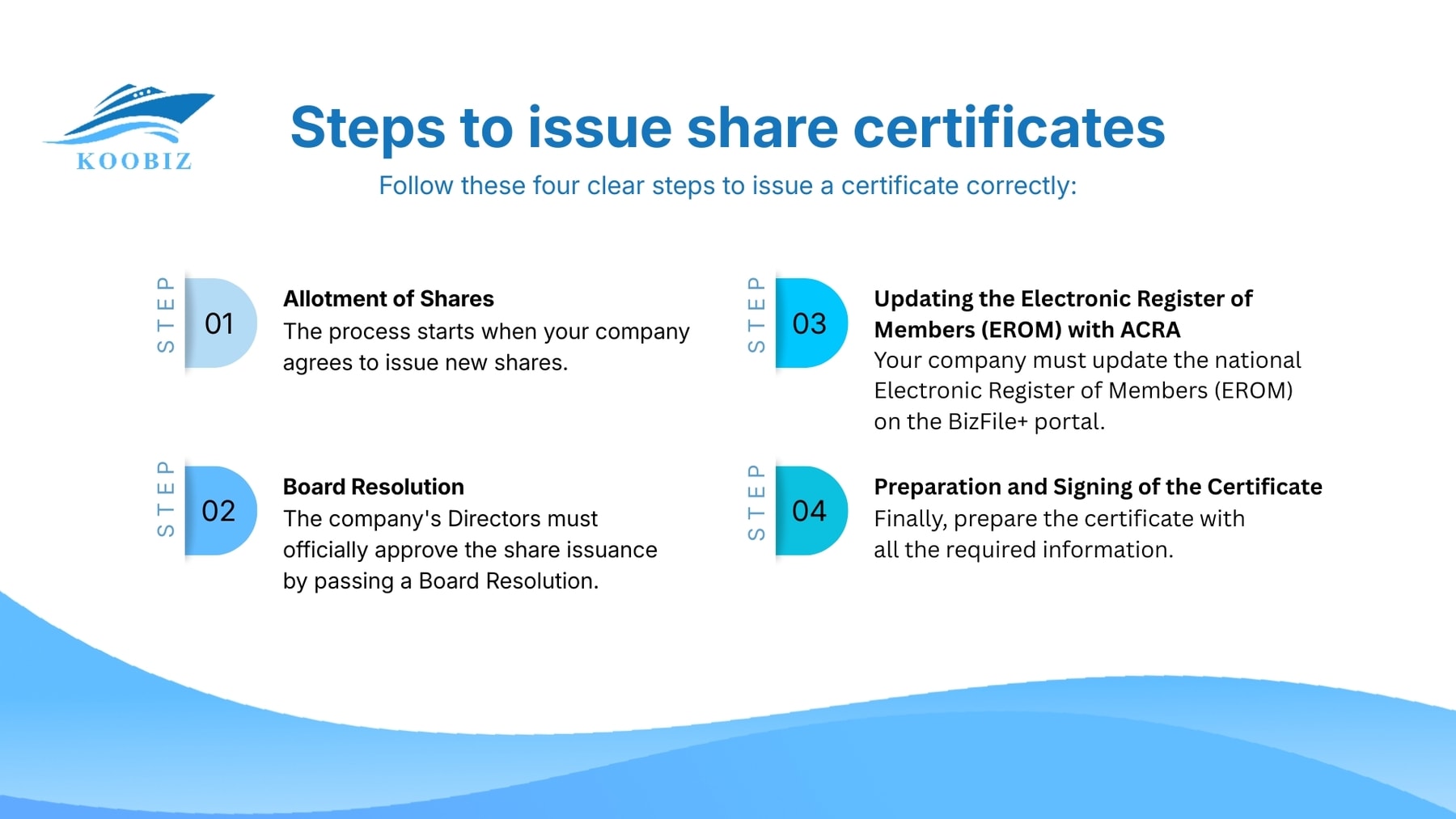
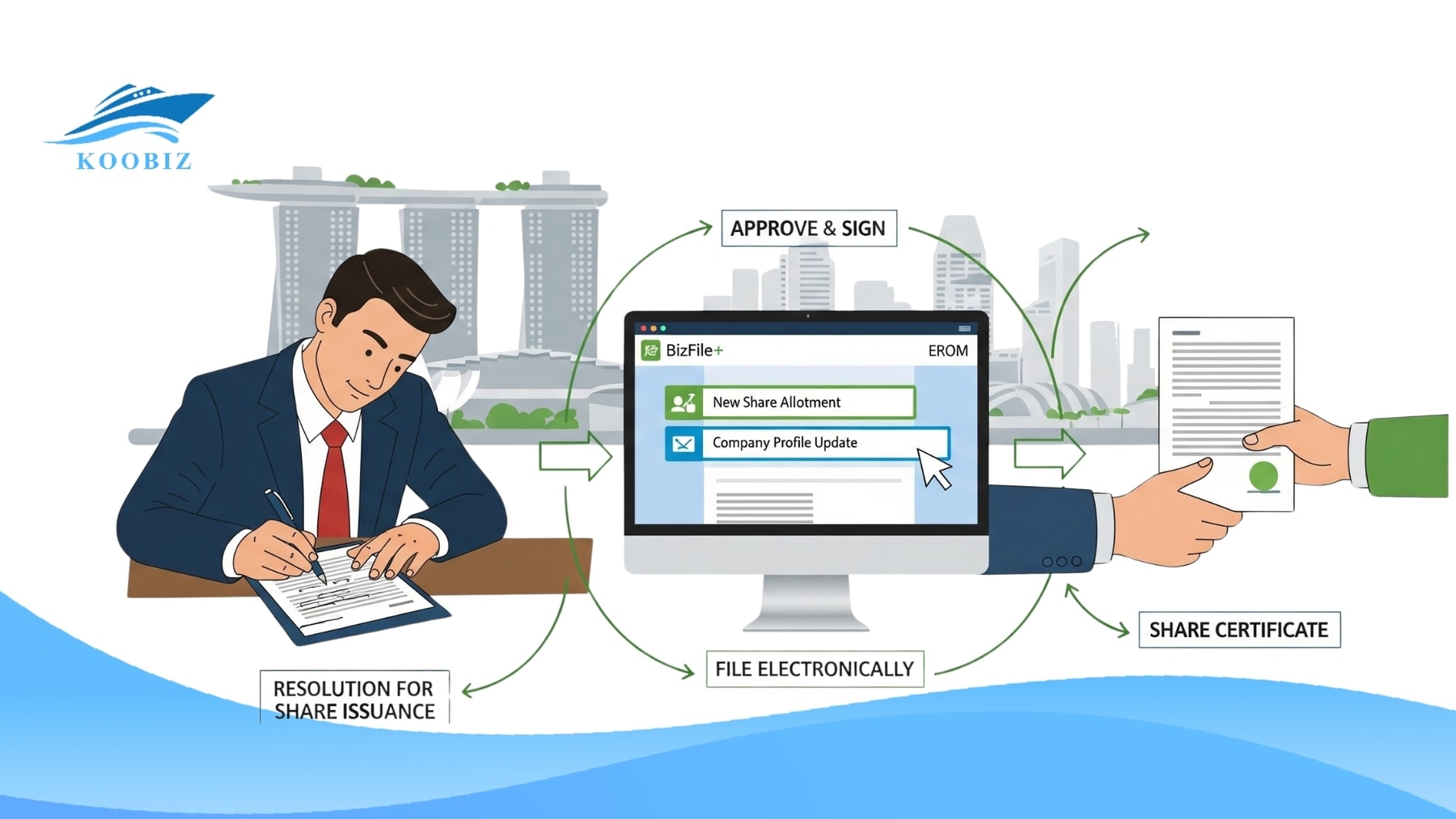
    Step 5: Issue Share Certificates

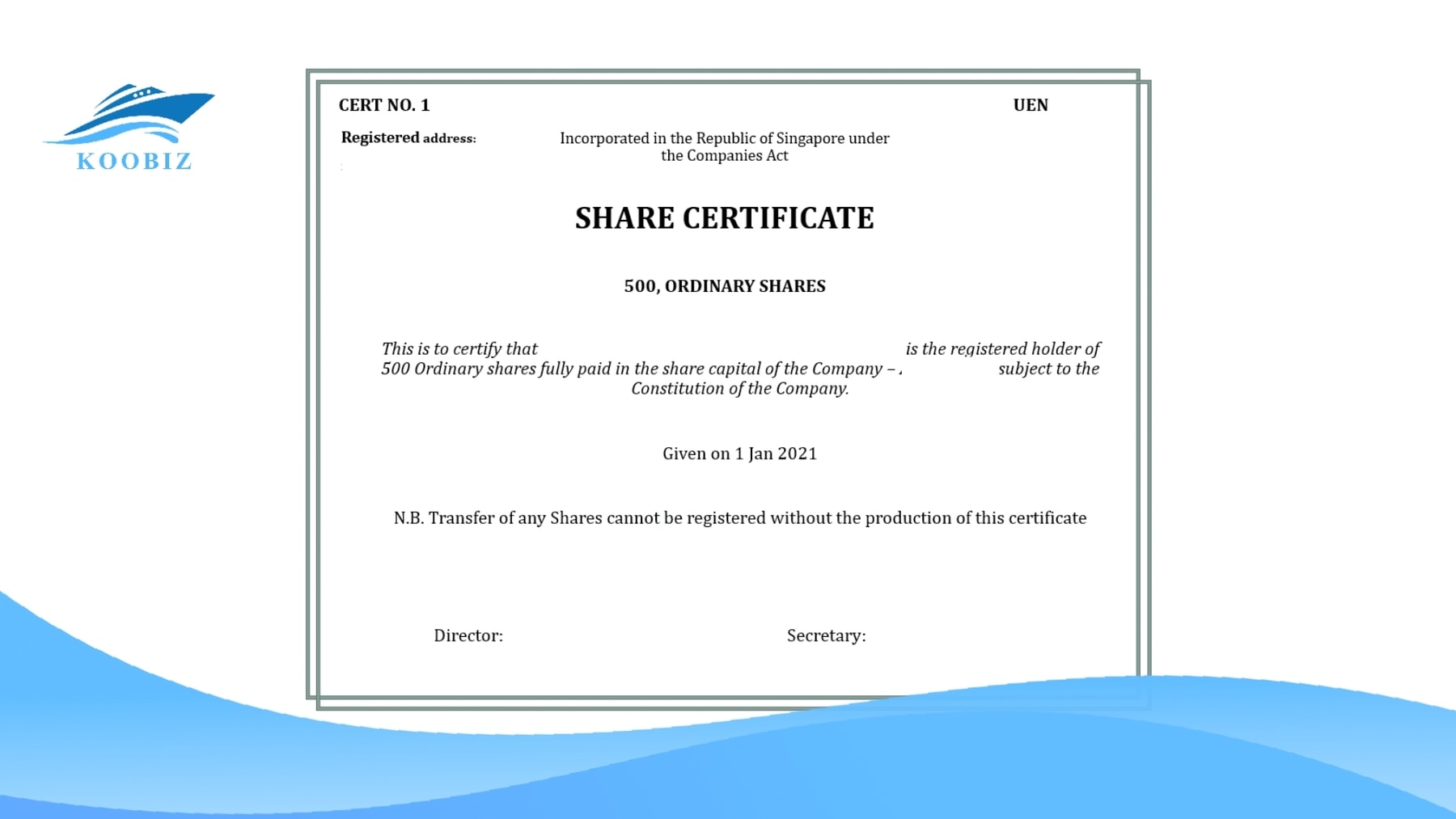
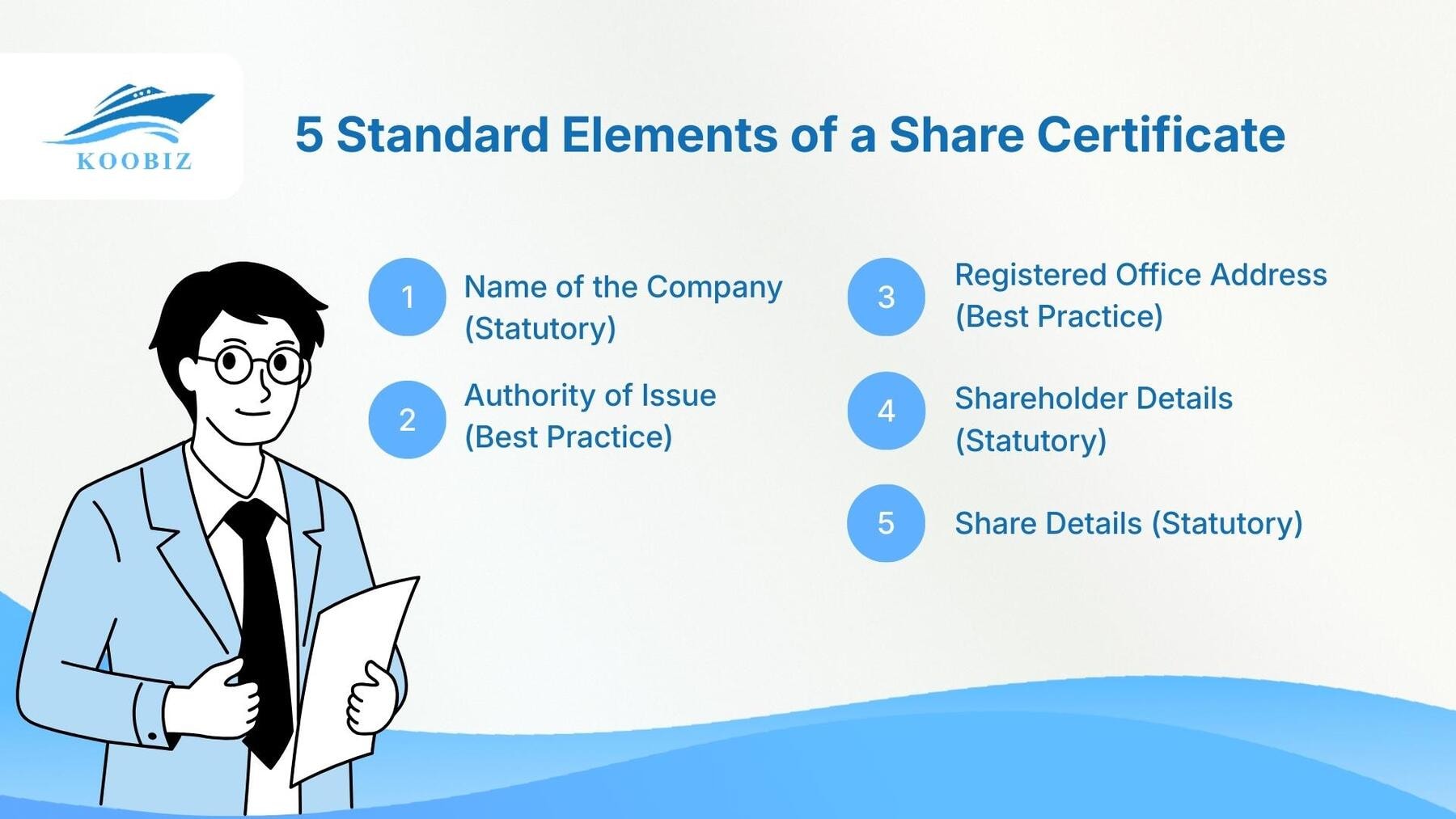
    Upon successful registration, the company will receive a UEN (Unique Entity Number). You must then issue share certificates to the shareholders as proof of ownership.

    Pro Tip: While you can do this manually, errors in the “No Objection” letter or constitution can cause rejections. Services like Koobiz specialize in handling this entire incorporate company process, ensuring all documents are compliant with Singapore’s Companies Act.

    Transferring assets and ending the Sole Proprietorship

    Use a Business Transfer Agreement to sell/assign assets to the new Pte Ltd. Novate key contracts (landlord, suppliers) so obligations continue under the company. When transfers complete and company bank accounts are live, file ACRA’s Notice of Cessation to stop the sole trader registration and remove ongoing personal exposure.

    Ready to upgrade your business structure? Koobiz provides seamless incorporation services to help you convert from Sole Proprietorship to Pte Ltd without the paperwork headache. Contact Koobiz Today for a Free Consultation

    Ongoing compliance: Sole Proprietors keep business records and file personal tax returns; Pte Ltd must maintain statutory registers, hold AGMs (where applicable), file Annual Returns and corporate tax returns.

    Audit: Sole Proprietorships are not required to file audited accounts with ACRA; many small Pte Ltd companies are audit-exempt but still must prepare financial statements compliant with Singapore standards.

    Foreigners & Sole Proprietorships: Foreigners living overseas who wish to register a sole proprietorship must appoint a locally-resident authorised representative (Singapore Citizen, PR or valid work-pass holder). For foreigners wanting a full local presence, Pte Ltd is the usual route.

    Fees recap: Sole Proprietorship (typical first-year cost S$115 includes S$15 name + S$100 registration); Pte Ltd incorporation fees include S$15 name + S$300 registration.

    Conclusion

    Transitioning from a Sole Proprietorship to a Pte Ltd is a hallmark of business maturity in Singapore. While the Sole Proprietorship offers an easy start, the Pte Ltd structure provides the necessary armor—limited liability and tax efficiency—to survive and thrive in a competitive market. If you are ready to take the next step, Koobiz is here to assist with professional incorporate company services, ensuring your transition is smooth, compliant, and positioned for growth.

  • Setting Up a Singapore Offshore Company: A Comprehensive Incorporation & Tax Guide for Foreigners

    Setting Up a Singapore Offshore Company: A Comprehensive Incorporation & Tax Guide for Foreigners

    [SUMMARIES]

    A Singapore offshore company is a standard tax-resident Private Limited entity that conducts business internationally, leveraging the territorial tax system and Foreign-Sourced Income Exemption (FSIE) scheme to potentially achieve 0% tax on remitted foreign income.

    Incorporation requires strict adherence to regulatory standards, including the mandatory appointment of a local resident director and navigating increasingly difficult corporate banking approvals, with high rejection rates for non-resident structures in 2025.

    Investors must satisfy new economic substance rules under Section 10L to claim tax benefits on foreign asset disposal gains, balancing higher maintenance costs against the credibility of operating from a well-regulated, Tier-1 financial hub.

    [/SUMMARIES]

    A Singapore offshore company offers the perfect blend of a prestigious global business identity and exceptional tax efficiency. By forming a Singapore Private Limited company that operates internationally, you can benefit from the city-state’s territorial tax system for optimal fiscal advantages.

    This guide walks you through the entire setup process from incorporation and requirements to banking and ongoing compliance. A Key Note on “Offshore” in Singapore: Singapore stands apart from traditional tax havens. It is a transparent, well-regulated financial hub. This means requirements like a local resident director and robust AML frameworks are in place, ensuring credibility. As an investor, it’s about balancing these reputable standards with operational planning to build a solid, trusted international business.

    Your success in Singapore hinges on navigating key compliance areas. This includes understanding the Foreign-Sourced Income Exemption (FSIE) and the newer Section 10L economic substance rules. Furthermore, opening a corporate bank account has become more challenging, with notably higher rejection rates for non-residents in 2025.

    This roadmap for 2025 explores the exact steps for incorporation, the pros and cons, and how Koobiz can help you establish your presence in Southeast Asia’s financial hub.

    What is a Singapore Offshore Company?

    Technically, a Singapore offshore company is a standard Singapore Private Limited Company (Pte Ltd) that conducts its revenue-generating activities entirely outside Singapore. Unlike jurisdictions with specific “International Business Company” (IBC) classifications, Singapore determines “offshore” status based on where business operations and management occur.

    The key distinction is tax residency and treatment. A “Singapore Offshore Company” is a tax-resident entity that qualifies for tax exemptions on foreign-sourced income. This structure. offers the dual advantage of credibility from a reputable onshore jurisdiction and access to significant tax efficiencies.

    Regulated by the Accounting and Corporate Regulatory Authority (ACRA), these companies must adhere to the same compliance standards as local businesses, including maintaining a local registered address and appointing a company secretary.

    What are the Pros and Cons of a Singapore Offshore Company?

    The Singapore offshore structure excels in reputation and tax efficiency but faces higher maintenance costs and stricter banking requirements than Caribbean jurisdictions.

    Pros and Cons of an Offshore Company in Singapore
    Pros and Cons of an Offshore Company in Singapore

    The Pros (Benefits)

    • Territorial Tax System: Potential for 0% tax on foreign-sourced income if not remitted to Singapore, or if it qualifies for the Foreign-Sourced Income Exemption (FSIE) scheme upon remittance.
    • High Reputation: Singapore is a Tier-1 jurisdiction. Invoicing clients from a Singapore Pte Ltd signals trust and stability, unlike “blacklist” tax havens.
    • Asset Protection & IP: Strong intellectual property laws and political stability make it ideal for holding assets.
    • Budget 2025 Incentives: For Year of Assessment (YA) 2025, companies enjoy a 50% Corporate Income Tax Rebate (capped at S$40,000), reducing the effective tax burden even if some income becomes taxable.

    The Cons (Drawbacks)

    • Nominee Director Requirement: You strictly need a local resident director. This incurs an annual cost (typically S$6000+) if you lack a local partner.
    • Banking Access Difficulty: While Singapore banks are superior in quality, opening accounts for offshore setups is increasingly difficult. Rejection rates for foreign-owned structures without physical presence can be high.
    • Higher Maintenance Costs: Costs for a company secretary, registered address, and annual filings are higher than in jurisdictions like Belize.
    • Public Register: Directors and shareholders are listed on the public ACRA register (BizFile+). Note: You can shield personal details using Nominee Shareholder/Director services.

    Koobiz Note: Worried about the Nominee Director requirement? Koobiz offers trusted Nominee Director services to help you meet this obligation while protecting your control.

    What are the Requirements for Foreigners to Incorporate?

    Foreigners must meet five mandatory requirements to incorporate. Fulfilling these is the prerequisite for any ACRA application.

    Requirements for Foreigners to Incorporate
    Requirements for Foreigners to Incorporate

    1. Resident Director (The Unique Attribute)

    The biggest barrier for foreigners is the requirement for at least one director who is “ordinarily resident” in Singapore. This person must be a Singapore Citizen, a Permanent Resident, or an EntrePass holder.

    • Role: They are responsible for ensuring the company complies with statutory requirements.
    • Solution: Most foreign investors engage a Nominee Director service via a Corporate Service Provider (CSP) like Koobiz to satisfy this requirement legally.

    2. Company Secretary

    You must appoint a qualified Company Secretary.

    • Requirement: This individual must be a natural person (not a corporation) and must be a resident of Singapore.
    • Role: They handle official filings with ACRA and ensure ongoing governance compliance.

    3. Shareholders

    A Singapore Pte Ltd must have at least one shareholder.

    • Ownership: Foreigners are allowed 100% foreign ownership.
    • Flexibility: The shareholder can be an individual or a corporate entity (another company). There is no requirement for local shareholding.

    4. Local Registered Address

    Every company must have a physical local address in Singapore.

    • Condition: It must be a physical office or residential address; P.O. Boxes are not accepted.
    • Purpose: This is where official government mail (from ACRA and IRAS) is sent.

    5. Paid-up Capital

    You need to declare your initial share capital.

    • Minimum: The minimum paid-up capital is only S$1.
    • Flexibility: You can increase this amount later as your business grows.

    How to Register a Singapore Company: The Step-by-Step Process

    Registration involves three steps: Name Reservation, Document Preparation, and ACRA Filing. Since foreigners cannot access ACRA’s BizFile+ system directly, a licensed Corporate Service Provider is mandatory.

    The Step-by-Step Process
    The Step-by-Step Process

    Here is the workflow to get set up in as little as 24 hours.

    Step 1: Name Reservation & Approval

    Your proposed company name must be approved by ACRA.

    • Must not be identical to an existing entity.
    • Must not contain sensitive words (e.g., “Bank”, “Finance”) without extra approval.

    Tip: Koobiz provides instant free name checks.

    Step 2: Prepare Documents (KYC)

    Once the name is approved, the CSP prepares the documents. You need to provide:

    • Passport copies of all directors/shareholders.
    • Proof of residential address (bank statement/utility bill).
    • Brief description of business activities (SSIC Code).
    • Note: Digital signatures are widely accepted.

    Step 3: Registration with ACRA

    Your CSP submits the application via BizFile+.

    • Timeline: Incorporation usually takes 1-2 days for straightforward cases.
    • Output: You receive an electronic Certificate of Incorporation and Business Profile (BizFile) via email.

    Ready to start? Koobiz simplifies this process. We handle ACRA filing, provide the Nominee Director, and act as your Company Secretary.

    Get your Singapore Company Incorporated Today

    How Does the Tax System Work for Offshore Companies?

    Singapore’s territorial tax system exempts foreign-sourced income from tax if specific conditions are met. However, the rules have tightened since 2024, particularly regarding capital gains.

    1. Remitted Income (Dividends, Branch Profits, Services) – FSIE

    For foreign-sourced dividends, branch profits, and service income remitted to Singapore, you can enjoy 0% tax under the Foreign-Sourced Income Exemption (FSIE) if you meet three conditions:

    1. “Subject to Tax” Condition: The income was subject to tax in the foreign jurisdiction (even if the effective tax was zero due to incentives).
    2. Headline Tax Rate Condition: The foreign jurisdiction has a headline corporate tax rate of at least 15%.
    3. Beneficial to Resident: The Comptroller is satisfied that the tax exemption would be beneficial to the person resident in Singapore.

    2. Disposal Gains (Sale of Assets) – Section 10L

    A crucial update for 2025: Gains from the sale of foreign assets (e.g., selling shares of a foreign subsidiary) remitted to Singapore are now taxable under Section 10L unless the company has “Adequate Economic Substance” in Singapore.

    • What is Substance? Having distinct office space, qualified local employees, and incurring business expenditure in Singapore.
    • Impact: Pure shell companies without substance may face tax on these gains.

    Note: Large Multinational Enterprises (MNEs) may also be subject to Top-Up Taxes under Pillar 2 (Global Minimum Tax) rules if their effective rate falls below 15%.

    Real-World Scenarios: Tax Efficiency in Action

    Here are two common scenarios explaining when the “0% tax” claim applies.

    Scenario A: The “Non-Remittance” Strategy (0% Tax)

    Profile: TechGlobal Pte Ltd, a SaaS company with a UK founder in Bali.

    • Operations: Software developed in Indonesia; sales to US/EU clients. No work performed in Singapore.
    • Banking: Funds held in a corporate account outside Singapore (e.g., Hong Kong) or a non-SG fintech wallet.
    • Tax Outcome: 0% Tax. Income is “foreign-sourced” and never remitted to a Singapore account.
    • Koobiz Note: Ensure you don’t trigger tax residency in your country of residence (e.g., Indonesia).

    Scenario B: The “FSIE” Strategy (Tax Treaty Benefit)

    Profile: IndoTrade Pte Ltd, sourcing coffee from Vietnam for Germany.

    • Operations: Registered branch in Vietnam pays local Corporate Income Tax (20%).
    • Banking: Profits are remitted to a DBS Bank account in Singapore.
    • Tax Outcome: 0% Tax (via FSIE).
      • Condition Met: Income taxed in Vietnam (20%); Vietnam’s headline rate >15%.
      • Result: No tax in Singapore on remitted dividends, avoiding double taxation.

    Koobiz Tip: Unsure about your strategy? Our experts can review your FSIE eligibility.

    What are the Challenges of Opening a Corporate Bank Account?

    Caution: Opening a traditional bank account (DBS, OCBC, UOB) for an offshore company has become significantly harder in 2025. Rejection rates for foreign-owned structures without local physical presence are high.

    • Physical Presence: Foreign directors are almost always required to visit Singapore for a face-to-face interview.
    • Proof of Business: Banks require detailed “Source of Wealth,” supplier contracts, and a robust business plan.
    • Fintech Alternatives: Many offshore companies now rely on Wise Business, Airwallex, or Aspire. While easier to open remotely, note that these often cannot offer credit facilities (loans) or cheque books like traditional banks.

    What are the Ongoing Compliance and Maintenance Requirements?

    You must hold an Annual General Meeting (AGM) and file Annual Returns to ACRA. Negligence leads to penalties and potential striking off.

    Estimated Annual Maintenance Costs (2025 Estimates)

    Budget for annual maintenance beyond the setup fee. Inflation and compliance costs have nudged these figures up:

    • Nominee Director: ~S$6,000+ per year (often includes security deposit).
    • Company Secretary & Address: ~S$2,500 per year.
    • Tax & Annual Filing: ~S$600+ per year.
    • Total Estimate: S$9,100 per year, depending on the CSP and complexity.

    AGM and Annual Return Filing

    • AGM: Held within 6 months of financial year-end.
    • Annual Return: Filed with ACRA within 7 months of financial year-end.
    • Solvency Declaration: Directors must declare the company is solvent.

    How Does Singapore Compare to Other Offshore Jurisdictions?

    Singapore offers superior reputation and banking quality, while jurisdictions like BVI or Seychelles offer lower costs but carry “blacklist” risks. The table below highlights the key differences:

    Comparison Factor Singapore BVI / Cayman Islands Hong Kong
    Reputation Tier-1 (AAA Rated)

    High trust with global clients.

    Tax Haven

    Often flagged by EU/US authorities.

    Strong

    Solid financial hub, but some political nuance.

    Corporate Tax 0% – 17%

    0% possible via FSIE; requires tax planning.

    0%

    No corporate tax by default.

    0% – 16.5%

    Territorial system similar to Singapore.

    Banking Access World-Class

    Strict KYC; often requires visit.

    Difficult

    Limited local options; hard to bank globally.

    Difficult

    Hard for startups to open accounts recently.

    Compliance High

    Resident Director required. Audit for large firms.

    Medium

    Economic Substance laws now enforced.

    High

    Company Secretary & audit required.

    Privacy Public Register

    Directors visible (Nominees used for privacy).

    Private

    Directors not publicly visible.

    Public Register

    Similar transparency to Singapore.

    Frequently Asked Questions

    Can a foreigner own 100% of a Singapore company?

    Yes. Foreigners can own 100% of the shares. No local partner is required for shareholding.

    Do I need to be physically present to incorporate?

    No. The entire process is online via a Corporate Service Provider like Koobiz using digital signatures. Physical presence is typically only needed for traditional bank account opening.

    Is Singapore a tax haven?

    No. Singapore is a value-adding business hub with competitive tax incentives, not a tax haven. It adheres to OECD standards, ensuring its high global reputation.

    Conclusion

    Setting up a Singapore offshore company offers a powerful vehicle for international business, combining tax efficiency with a world-class legal system. While requirements like Resident Directors and Economic Substance (Section 10L) are stricter than in Caribbean jurisdictions, the payoff in trust is worth it.

    If you are ready to navigate the Singapore market, Koobiz is here to support you. From fast incorporation to Nominee Director services and tax filings, we ensure your offshore journey is compliant and hassle-free.

    Contact Koobiz today for a free consultation on your Singapore setup

  • Incorporate a Public Company Limited by Guarantee for Non-Profits: The Complete Guide

    Incorporate a Public Company Limited by Guarantee for Non-Profits: The Complete Guide

    [SUMMARIES]

    A Public Company Limited by Guarantee (CLG) is a non-profit entity without share capital where members guarantee a nominal sum only upon winding up, offering essential limited liability protection.

    The structure mandates a constitutional “asset lock” that strictly prohibits profit distribution to members, ensuring superior credibility and governance compared to a standard Society.

    Post-incorporation, entities must separately apply for Charity or IPC status to secure tax-deductible receipts, while dissolution rules require transferring remaining assets to similar charitable causes.

    [/SUMMARIES]

    Incorporating a Public Company Limited by Guarantee (CLG) is the most common route for non-profits, charities and foundations in Singapore. A CLG has no share capital and its members guarantee a nominal sum only if the company is wound up – making it ideal for organisations that must protect donors’ trust, preserve an asset lock and operate with formal corporate governance.

    Below, we explore the setup steps with ACRA, the costs involved, and critical post-incorporation requirements. Let’s begin by defining what a Company Limited by Guarantee actually is.

    What is a Public Company Limited by Guarantee (CLG) in Singapore?

    CLG non-profit legal entity, no share capital, guarantee
    CLG non-profit legal entity, no share capital, guarantee

    A CLG is a corporate entity for non-profit purposes. It has no share capital; instead it has members who undertake a nominal guarantee payable only if the company is wound up. The company is a separate legal person – it can own property, enter contracts, and sue or be sued independently of its members. The constitution typically includes an asset lock that prohibits distribution of profits, ensuring all surplus supports the organisation’s objectives.

    Is a CLG the right structure for your non-profit organization?

    Protection, documents, logo of CLG non-profit organization
    Protection, documents, logo of CLG non-profit organization

    Yes, a CLG is the right structure if you need a separate legal identity, limited liability for members, and plan to conduct significant financial transactions or hire staff.

    To decide, evaluate three factors: liability, administration, and credibility.

    First, liability protection in a CLG is superior to a Society. In a Society, office bearers can be personally liable for debts. In a CLG, liability is capped at the guarantee amount (usually SGD 1.00), protecting personal assets. This is vital if you intend to sign leases or contracts.

    Second, consider the administrative commitment. A CLG is subject to the Companies Act, requiring Annual General Meetings (AGMs) and Annual Returns. If your group is small and informal, a Society might be easier. However, for longevity and professional governance, the CLG is necessary.

    Finally, for credibility and funding, a CLG is often required for Charity and IPC status. Corporate sponsors prefer giving to CLGs because the structure ensures higher transparency and accountability.

    Real-World Examples of CLGs in Singapore

    To help you visualize this structure, here are well-known Singaporean organizations operating as CLGs:

    • The National Kidney Foundation (NKF): A major charity providing dialysis services.
    • The Esplanade Co Ltd: Operates the performing arts centre as a non-profit arts company.
    • National University of Singapore (NUS): Corporatized as a CLG to manage education with autonomy.
    • Temasek Foundation: A philanthropic organization delivering community programmes.

    Koobiz Advice: Unsure which structure suits your mission? Koobiz can assess your goals and help you compare a CLG against a Society to ensure you start on the right legal footing.

    What are the Key Features of a Company Limited by Guarantee?

    Four distinct features define a Company Limited by Guarantee: a separate legal personality, the guarantee mechanism, the non-profit mandate, and the naming convention.

    1. Separate Legal Entity: The CLG has an identity distinct from its members. It can own land and incur debts in its own name, ensuring the organization survives changes in leadership.
    2. Limited Liability by Guarantee: Members do not buy shares. They sign a declaration undertaking to contribute a nominal sum (e.g., SGD 1.00) only if the company is wound up.
    3. Non-Profit Mandate: The Constitution must prohibit paying dividends or returning capital to members. All surplus funds must be retained for the organization’s objectives.
    4. Naming Convention: The name must end with “Limited” or “Ltd”. However, CLGs formed for charitable purposes can apply to omit “Limited” to avoid a commercial appearance (e.g., “The XYZ Foundation”).

    What are the Statutory Requirements to Register a CLG?

    You must meet standard company requirements under the Companies Act, including:

    • Directors: At least one director ordinarily resident in Singapore (Citizen, PR, or EP holder). Directors have a fiduciary duty to act in the non-profit’s best interest.
    • Members: At least one member (individual or corporate). The director and member can be the same person. For charities, a board of at least three independent members is recommended for governance.
    • Company Secretary: You must appoint a qualified Company Secretary within six months. Given the compliance complexity, many non-profits outsource this to professional providers like Koobiz to ensure regulatory compliance without hiring full-time staff.
    • Constitution: This document sets out the company’s objectives (e.g., poverty relief) and governance rules. For Charity status, specific clauses regarding non-conflict of interest and dissolution are required.
    • Registered Address: A local Singapore address (P.O. Box is not accepted).

    What is the “Guarantee” in a Public Company Limited by Guarantee?

    The guarantee is a contingent liability: a contractual promise in the constitution that a member will contribute a nominal sum (e.g., S$1) if the company is wound up with insufficient assets. Members are not required to pay during normal operations.

    What is the Process to Incorporate a CLG with ACRA?

    Incorporating a CLG involves three primary steps via ACRA’s BizFile+ portal: Name Reservation, Constitution Preparation, and Filing.

    Step 1: Name Reservation

    Propose a name to ACRA. It must not be identical to an existing entity. Names containing sensitive words like “Foundation” or “Charity” may be routed for referral authority approval, which can take up to 14 days.

    Step 2: Preparation of Documents

    Prepare the Constitution (formerly Memorandum and Articles of Association). This is critical. You cannot use a standard model if you intend to apply for Charity Status; specific “objectives” and “asset lock” clauses are mandatory. Members and directors must also sign “Consent to Act” forms.

    Step 3: Official Filing via BizFile+

    File the incorporation using SingPass with details of directors, members, and the address. Upon payment, ACRA issues an electronic Notice of Incorporation.

    Koobiz service note: Koobiz can prepare the constitution, handle name reservation and submit the BizFile+ application for you, minimizing back-and-forth with ACRA.

    Setup Fees and Timeline

    The setup involves two statutory fees payable to ACRA: SGD 15 for the Name Application and SGD 300 for Incorporation.

    You should also budget for professional fees if engaging a corporate service provider (CSP) for drafting and secretarial duties. Koobiz provides transparent packages including government fees and first-year secretarial services.

    Timeline:

    • Name Approval: Minutes (or up to 2 months if referral is needed).
    • Incorporation: 15 to 30 minutes once documents are signed and the name is approved.

    Post-incorporation compliance

    Compliance, filings, taxes, AGM, Charity IPC
    Compliance, filings, taxes, AGM, Charity IPC

    After incorporation, a CLG must maintain strict compliance regarding taxes, annual filings, and potential charity registration.

    A CLG usually becomes active immediately. Directors must ensure proper accounting records are kept. The first Annual General Meeting (AGM) must be held within 18 months of incorporation, with subsequent AGMs every calendar year. Annual Returns must be filed with ACRA within one month of the AGM.

    Beyond compliance, the most significant step is often pursuing special tax statuses.

    Charity & IPC status (tax & fundraising implications)

    Charity and IPC (Institution of a Public Character) status are managed by the Commissioner of Charities (COC) and are essential for issuing tax-deductible receipts.

    Incorporation does not automatically grant charity status. You must apply via the Charity Portal, proving your objectives are exclusively charitable (e.g., relief of poverty, advancement of education).

    IPC Status is a higher tier allowing donors to claim a 250% tax deduction. To qualify, the CLG must serve the Singapore community as a whole, not just members, and meet stringent governance checks, including having independent board members.

    What is the Difference Between a CLG and a Private Limited Company?

    The key difference is ownership and motive: a Private Limited Company serves shareholders for profit, while a CLG serves a cause without profit distribution.

    Feature Private Limited Company (Pte Ltd) Company Limited by Guarantee (CLG)
    Primary Purpose Profit generation for shareholders Non-profit / Charitable objectives
    Ownership Owned by Shareholders (Equity) No Owners; uses Members (Guarantors)
    Share Capital Yes (e.g., SGD 1.00 minimum) No Share Capital
    Profit Distribution Dividends allowed Strictly Prohibited (Asset Lock)
    Liability Limited to unpaid share capital Limited to guarantee amount (e.g., SGD 1.00)
    Tax Status Corporate Tax (Start-up exemptions apply) Taxable unless Charity Status obtained

    Can a Company Limited by Guarantee Distribute Profits to Members?

    No, a Company Limited by Guarantee is strictly prohibited from distributing profits, dividends, or capital to members.

    This prohibition is entrenched in the Constitution. Violating it breaches the Companies Act. Even if the CLG makes a surplus from selling services, that money must stay within the company to fund future activities.

    What Happens to Assets Upon Winding Up a CLG?

    If a CLG is wound up, remaining assets cannot be distributed to members. They must be transferred to another organization with similar objectives or a registered charity.

    This is the “Asset Lock.” The Constitution must include a dissolution clause ensuring that funds accumulated for a public cause are not privatized by members upon the company’s closure.

    Ready to Establish Your Non-Profit?

    Navigating the legalities of a Public Company Limited by Guarantee requires precision. Koobiz specializes in helping non-profits set up compliant structures in Singapore. From drafting the constitution to ACRA submissions, we ensure your foundation is built on solid ground.

    Visit Koobiz.com to schedule a consultation with our incorporation specialists

  • LLC vs Pte Ltd: Comparing Business Structures & Tax Benefits for Foreign Entrepreneurs

    LLC vs Pte Ltd: Comparing Business Structures & Tax Benefits for Foreign Entrepreneurs

    [SUMMARIES]

    Singapore Private Limited (Pte Ltd) companies function as distinct legal entities with a strict corporate veil and formalized governance, offering superior credibility for scalable businesses compared to the hybrid US Limited Liability Company (LLC) structure.

    The Pte Ltd model is the preferred vehicle for raising capital and attracting Venture Capitalists because it facilitates the issuance of distinct share classes, whereas institutional investors generally avoid US LLCs due to complications arising from pass-through taxation.

    Singapore offers distinct tax advantages for foreigners through a single-tier system with a flat 17% corporate rate, startup exemptions, and tax-free dividends, avoiding the potentially higher personal income tax burdens associated with US LLC ownership.

    [/SUMMARIES]

    Choosing between a US-style Limited Liability Company (LLC) and a Singapore Private Limited Company (Pte Ltd) is the critical first step for expansion. While both offer limited liability, the Pte Ltd is generally the superior choice for scalable businesses in Singapore due to its tax efficiency and professional credibility.

    At Koobiz (koobiz.com), we often advise clients that while a Pte Ltd requires stricter compliance, the trade-off – access to Singapore’s extensive tax treaties and a robust corporate image is invaluable for long-term growth.

    Is a Singapore Pte Ltd the Same as a US LLC?

    Differences between US LLC and Singapore Pte Ltd
    Differences between US LLC and Singapore Pte Ltd

    No, a Singapore Pte Ltd is not legally identical to a US LLC, although they share the fundamental characteristic of limiting the owner’s liability to their investment amount.

    To elaborate on this distinction, an LLC (Limited Liability Company) in the United States is a hybrid entity that combines the operational flexibility of a partnership with the liability protection of a corporation. In contrast, a Pte Ltd (Private Limited Company) is a purely corporate entity governed by the Singapore Companies Act, possessing a distinct legal personality separate from its owners. This means a Pte Ltd can own property, sue, and be sued in its own name, independent of its shareholders. While an LLC is often treated as a “pass-through” entity for tax purposes, a Pte Ltd is a tax resident in its own right. Understanding this legal separation is the first step in recognizing why the Pte Ltd structure is preferred for serious business operations in Asia.

    What Are the Key Differences Between LLC and Pte Ltd?

    The key differences between an LLC and a Pte Ltd lie in their ownership structure, liability protection mechanisms, and capital raising capabilities, with the Pte Ltd offering a more formalized framework suitable for growth.

    Feature US LLC Singapore Pte Ltd
    Legal Identity Hybrid Entity (Partnership/Corp mix) Separate Legal Entity
    Ownership Members (Flexible management via Operating Agreement) Shareholders (Managed by Directors, governed by a Constitution)
    Liability Limited (Varies by state) Limited (Strict Corporate Veil)
    Taxation Pass-through (Personal Income Tax) Corporate Tax (Singapore’s headline CIT rate is 17%)
    Capital Raising Difficult (VCs dislike pass-through) Easy (Preferred by VCs)
    Governing Doc Operating Agreement Constitution

    While both structures shield personal assets, the method by which they manage control and attract funding varies drastically. An LLC is designed for flexibility and ease of management, often blurring the lines between ownership and operation, whereas a Pte Ltd establishes a clear hierarchy that institutional investors prefer. This structural rigidity, while seemingly complex, provides the certainty required for high-stakes business dealings.

    How Do Ownership and Management Structures Differ?

    Ownership in a US LLC is vested in “Members,” whereas a Singapore Pte Ltd is owned by “Shareholders”, leading to distinct management hierarchies.

    In an LLC, the owners are referred to as members, and the management structure is defined by an Operating Agreement. This allows for a decentralized management style where members can manage the business directly (Member-Managed) or appoint managers (Manager-Managed). Conversely, a Pte Ltd is strictly governed by its Constitution (formerly Memorandum and Articles of Association). The shareholders own the company, but the management is delegated to a Board of Directors. For foreign entrepreneurs, this is crucial because Singapore law requires at least one director to be a local resident (Citizen, Permanent Resident, or Employment Pass holder), which often means using Koobiz’s nominee director service initially. This clear separation of ownership (Shareholders) and control (Directors) allows for a scalable governance structure that an LLC often lacks.

    What Are the Liability Protections for Owners?

    Both structures offer limited liability, but the Pte Ltd upholds a stricter “Corporate Veil” that is harder to pierce than that of a typical LLC.

    In a Pte Ltd, the liability of shareholders is strictly limited to the amount of share capital they have subscribed to but not yet paid. Once their shares are fully paid up, they have no further financial obligation to the company’s creditors. Personal assets such as homes, cars, and personal savings are legally untouchable by business debts.

    While US LLCs also offer this protection, the “piercing of the corporate veil” can occur more easily in LLCs if the court finds that the business and owner are not sufficiently separate (alter ego theory), especially if formalities like meetings are not observed. The Pte Ltd’s mandatory statutory compliance strengthens this legal barrier, providing superior asset protection for the entrepreneur.

    Which Structure is Better for Capital Raising and VC Funding?

    The Pte Ltd structure is significantly better for capital raising and Venture Capital (VC) funding compared to an LLC due to its ability to issue distinct classes of shares.

    Startups aiming for rapid growth almost exclusively incorporate as Pte Ltd companies because VCs and institutional investors require a corporate structure that allows for the issuance of preference shares or convertible notes. Investors generally avoid LLCs because the “pass-through” tax nature of an LLC can create complex tax liabilities for the fund’s own investors (specifically unrelated business taxable income). A Pte Ltd acts as a tax blocker, meaning the investor only deals with taxes on dividends (which are tax-exempt in Singapore) or capital gains (also tax-exempt). Therefore, if your goal is to exit or raise Series A funding, a Pte Ltd is the industry standard.

    Which Structure Offers Better Tax Benefits for Foreigners?

    Comparing US LLC and Singapore Pte Ltd
    Comparing US LLC and Singapore Pte Ltd

    A Singapore Pte Ltd typically offers superior tax benefits for foreigners compared to a US LLC due to Singapore’s single-tier corporate tax system versus the US pass-through taxation model.

    Taxation is often the deciding factor for incorporation. While an LLC might seem simpler because it avoids corporate tax at the entity level, it exposes the foreign owner to personal income tax rates which can be significantly higher. Singapore’s jurisdiction is territorially based, meaning foreign-sourced income not remitted to Singapore may not be taxed, whereas US LLCs often entangle owners in the global US tax net.

    How Does Taxation Work for a US LLC?

    A US LLC utilizes “pass-through taxation”, meaning the business itself pays no tax, but profits are funneled to the owners to be reported on their personal tax returns.

    This can be advantageous for local US small business owners who want to avoid double taxation. However, for a foreign entrepreneur, this can be detrimental. If you are considered engaged in a US trade or business, you are subject to US progressive personal income tax rates (up to 37%) and potentially the Self-Employment Tax (Social Security and Medicare taxes). Furthermore, the “Check-the-box” regulation allows LLCs to choose how they are taxed, but navigating this as a non-resident alien is complex and often results in a heavier tax burden than anticipated.

    How Does Singapore’s Single-Tier Tax System Work for Pte Ltd?

    Singapore employs a single-tier tax system where the Pte Ltd pays a flat Corporate Tax rate of 17%, and dividends distributed to shareholders are completely tax-exempt.

    This system effectively eliminates double taxation for shareholders. Moreover, the effective tax rate is often much lower than 17% due to the Start-Up Tax Exemption (SUTE) scheme. Under SUTE, new companies receive a 75% exemption on the first SGD 100,000 of chargeable income and a 50% exemption on the next SGD 100,000 for the first three consecutive years. Additionally, Singapore has 0% Capital Gains Tax, meaning if you sell your shares or the company creates profit from selling assets, that income is tax-free. For foreign entrepreneurs, this structure ensures that once corporate tax is paid, the remaining profit is yours to keep without further deductions.

    Koobiz Insight: Utilizing Singapore’s network of over 90 Double Taxation Agreements (DTAs) can further reduce withholding taxes on international trade. At Koobiz, we help structure your Pte Ltd to maximize these treaty benefits.

    Pros & cons of a Pte Ltd (summary)

    The main advantages of a Pte Ltd include high credibility and tax efficiency, while the primary disadvantages are the higher compliance costs and stricter administrative requirements.

    To summarize the decision-making process:

    Pros:

    • Credibility: A “Pte Ltd” suffix commands respect from banks, suppliers, and clients, signaling a commitment to longevity.
    • Perpetual Succession: The company continues to exist even if shareholders die or resign.
    • Tax Efficiency: corporate tax, start-up exemptions, and no capital gains tax in Singapore.
    • Ease of Transfer: Ownership can be transferred simply by selling shares.

    Cons:

    • Higher compliance costs (secretarial, filings).
    • More formalities for corporate governance.
    • Deregistration / winding down takes longer than dissolving a sole proprietorship.

    Having weighed these points, many foreign entrepreneurs find a Pte Ltd the optimal choice for regional growth. Koobiz supports founders from formation through compliance (nominee director solutions, company secretarial, tax advisory, and ongoing filings).

    What Are the Registration and Compliance Requirements for a Pte Ltd?

    Registration & compliance requirements for Singapore Pte Ltd
    Registration & compliance requirements for Singapore Pte Ltd

    The requirements for a Pte Ltd generally fall into two categories: Initial Registration requirements involving personnel and capital, and Annual Compliance requirements involving reporting to government authorities.

    Unlike some jurisdictions where you can register a company with just an email, Singapore maintains its reputation as a trusted financial hub by enforcing strict Know-Your-Customer (KYC) and Anti-Money Laundering (AML) regulations. This means the barrier to entry is slightly higher, but it ensures the legitimacy of your business. Koobiz specializes in navigating these regulatory waters for foreign clients, ensuring a seamless setup process.

    Initial Registration Requirements for Foreigners

    To register a Pte Ltd, a foreigner must appoint at least one locally resident director, a company secretary, and provide a local registered address.

    Specifically, the requirements include:

    • Shareholding: Minimum of 1 and maximum of 50 shareholders (can be foreign individuals or entities).
    • Share Capital: Minimum paid-up capital of SGD 1.
    • Resident Director: You must have at least one director who is “ordinarily resident” in Singapore. Foreigners often use a Nominee Director Service provided by firms like Koobiz to satisfy this requirement until they can obtain an Employment Pass to act as the local director themselves.
    • Company Secretary: Must be appointed within 6 months of incorporation.
    • Address: A physical local address (P.O. Box is not allowed).

    Annual Filing and Compliance Requirements

    Every Pte Ltd must hold an Annual General Meeting (AGM) and file both Annual Returns with ACRA and Tax Returns with IRAS.

    Compliance is non-negotiable in Singapore.

    1. Annual General Meeting (AGM): Must be held typically within 6 months after the Financial Year End (FYE).
    2. Annual Return (AR): Must be filed with the Accounting and Corporate Regulatory Authority (ACRA) within 7 months of the FYE.
    3. Tax Filing: Companies must file Estimated Chargeable Income (ECI) within 3 months of FYE and the Corporate Income Tax Return (Form C-S/C) by November 30th. Failure to meet these deadlines can result in penalties or court summons for the directors.

    Need help with Compliance? Incorporating is just the start. Koobiz provides comprehensive Corporate Secretarial services to handle your AGMs, AR filings, and ensure you never miss a deadline. Get Started with Koobiz Incorporation Services Today

    LLP vs Pte Ltd

    An LLP offers limited liability but is taxed through partners (personal tax rates apply). LLPs suit professional partnerships (accountancy, law) where partner taxation at personal rates is acceptable. For scale and outside investor-friendliness, Pte Ltd is usually superior.

    Other structures: Sole proprietorship

    Sole proprietorships are easy to set up but offer no limited liability – personal assets are at risk. Foreigners must appoint a local manager, and there are limited tax incentives compared with Pte Ltd.

    International tax & treaties

    Singapore maintains an extensive DTA network (around 100 DTAs/limited DTAs/EOI arrangements), which helps reduce withholding taxes for cross-border trading and investment. Koobiz advises on structuring to maximize treaty benefits where applicable.

    Ready to Incorporate Your Singapore Company?

    Choosing between a Pte Ltd and other structures is just the first step. Navigating the incorporation process, securing a nominee director, and ensuring tax compliance requires a partner who understands the local landscape.

    At Koobiz, we simplify market entry for foreign entrepreneurs. From same-day incorporation to ongoing corporate secretarial support, our team ensures your business is set up for success from day one.

    Don’t let bureaucracy slow you down. Book a Free Consultation with Koobiz and let us handle the paperwork while you focus on building your business.

    Frequently Asked Questions (FAQs)

    Can I convert my existing US LLC into a Singapore Pte Ltd?

    No, you cannot directly “convert” a US entity into a Singapore entity due to different legal jurisdictions. You would typically incorporate a new Pte Ltd in Singapore and transfer assets or set it up as a subsidiary.

    Do I need to physically visit Singapore to set up a Pte Ltd?

    No, the entire incorporation process can be done online. However, you will need to engage a registered filing agent (like Koobiz) to submit the application to ACRA on your behalf.

    What is the minimum paid-up capital required?

    The minimum paid-up capital is just SGD 1. You can increase this amount later as your business grows or if you need to apply for work passes.

    How long does the incorporation process take?

    With all documents prepared and no complex compliance issues, a Pte Ltd can often be incorporated within 24 hours.

  • Understanding the Singapore Company Constitution: M&AA vs. Model Clauses

    Understanding the Singapore Company Constitution: M&AA vs. Model Clauses

    [SUMMARIES]

    The Singapore Company Constitution replaces the former Memorandum and Articles of Association as the supreme binding document governing internal management and shareholder rights.

    Founders must choose between ACRA’s standard Model Constitution for cost-efficiency or a Customized Constitution to accommodate complex share structures and investor needs.

    Amendments to this statutory contract require a Special Resolution with a 75% shareholder majority, ensuring rigorous consensus for governance changes.

    [/SUMMARIES]

    The Singapore Company Constitution is the supreme legal document that governs the internal management, rights, and obligations of a company and its members under the Companies Act 1967. For business owners, understanding this document is the foundation of corporate governance. Previously known as the Memorandum and Articles of Association (M&AA), the modern Constitution consolidates these regulations into a single, cohesive framework essential for every locally incorporated entity.

    Koobiz specializes in helping businesses navigate these requirements seamlessly during incorporation. Whether you choose the standard model or a bespoke document, getting this right from the start is critical.

    To comprehend the evolution of this document, one must look at the legislative changes introduced by the Companies (Amendment) Act 2014, effective from January 3, 2016. Before this, companies maintained two separate documents (Memorandum and Articles). Today, this distinction is abolished for new companies, streamlining the process. Older companies can continue using their existing M&AA, which is now legally “deemed” to be their constitution, though updating it to align with modern provisions is highly recommended.

    The most pressing decision for new entrepreneurs is choosing between the standard “Model Constitution” provided by ACRA and a “Customized Constitution.” This choice dictates the flexibility of your company regarding share transfers and decision-making.

    What is a Singapore Company Constitution?

    A Singapore Company Constitution acts as a binding contract between the company and its members. Deriving its authority from Section 22 of the Companies Act 1967, it serves as the ultimate rulebook for internal administration.

    Singapore Constitution: contract & internal management rules
    Singapore Constitution: contract & internal management rules

    Unlike commercial contracts, the Constitution governs the relationship between directors and shareholders including decision-making processes, power distribution, and member rights. If no specific constitution is filed during incorporation, the Model Constitution applies by default.

    Furthermore, the Constitution is a public document available for purchase via ACRA’s BizFile+ portal, allowing creditors and investors to review key rules regarding borrowing limits and share-transfer restrictions before entering into businesses.

    What are the Mandatory Sections Required by Law?

    The Mandatory Sections Required by Law
    The Mandatory Sections Required by Law

    While modern constitutions are flexible, Section 22 of the Companies Act mandates certain clauses to establish the entity’s identity and scope. The following four sections are standard and essential:

    1. Name Clause: The full, approved name of the company, matching exactly with the name reserved with ACRA. Private limited companies must include “Private Limited” or “Pte. Ltd.” as part of the name.
    2. Registered Office Clause: The constitution must declare that the registered office is situated in the Republic of Singapore. This establishes jurisdiction and the address for official legal notices.
    3. Liability Clause: For a company limited by shares, it must explicitly state that “the liability of the members is limited.” with a view to protecting shareholders from personal liability for company debts.
    4. Subscriber Clause: The document must state each initial subscriber’s full name, addresses and occupations along with a declaration that they desire to form the company and agree to take up the number of shares specified.

    Note: The Capital Clause (specifying authorized capital) is no longer mandatory following the abolition of authorized share capital and par value. Share capital is now declared directly via share allotment filings on BizFile+.

    5 Critical Considerations When Drafting Your Constitution

    5 Critical Considerations When Drafting Your Company Constitution
    5 Critical Considerations When Drafting Your Company Constitution

    Before adopting a standard template, evaluate these five strategic factors that determine power balance and financial fluidity:

    • Share Classes (Ordinary vs. Preference): Startups seeking investment often need “Preference Shares” (priority on dividends, no voting rights). The standard Model Constitution usually accounts only for ordinary shares.
    • Pre-emption Rights: This protects existing shareholders from dilution by requiring any selling shareholders to offer their shares to current members before external parties This is vital for maintaining control in private companies.
    • Board Dynamics & Casting Vote: A clause giving the Chairman a “casting vote” to prevent deadlock in case of a tie vote
    • Conflict Resolution: Your constitution can outline mediation or arbitration mechanisms to resolve disputes without resorting to winding up the company.
    • Dividend Policy: our constitution sets specific rules on how and when these are declared, offering transparency to investors.

    Model Constitution vs. Customized Constitution: Which is Right for You?

    The Model Constitution offers cost-efficiency while a Customized Constitution offers flexibility.

    The Model Constitution: A statutory template provided in the Companies (Model Constitutions) Regulations 2015.

    • Pros: Free, legally robust, and automatically compliant. Ideal for single-shareholder companies.
    • Cons: Rigid. Lacking specific protections like “tag-along” or “drag-along” rights crucial for VC-backed startups in a standard scenario.

    The Customized Constitution: A bespoke document drafted by professionals.

    • Pros: Tailored to specific needs. Allows for dual-class share structures and entrenched provisions.
    • Cons: Incurs legal drafting fees and requires more preparation time.

    How to Register and Submit Your Constitution to ACRA

    Submission is a mandatory step in the incorporation workflow via the BizFile+ portal.

    Log in to BizFile+: Use your SingPass to access ACRA’s filing system. Navigate to “Start a New Local Company”.

    Select Constitution Type:

    1. If adopting the Model Constitution, simply check the box for “Constitution of a Private Company Limited by Shares”.
    2. If using a Custom Constitution, upload the full PDF document containing the mandatory clauses.

    Digital Endorsement: ACRA sends an email notification to all appointed directors and shareholders. They must log in to BizFile+ and digitally endorse the application to confirm their agreement.

    Koobiz can handle this entire submission process for you, ensuring your Constitution is correctly formatted and lodged so you can focus on your business.

    How to “Buy” or Retrieve a Company Constitution?

    You can retrieve a constitution in two ways:

    • Adoption (Free): New business owners can download or select the Model Constitution for free during incorporation.
    • Due Diligence (Purchase): To view another company’s constitution (e.g., a competitor or partner), you can purchase “Extracts” from the ACRA iShop. As a public record, any member of the public can buy a copy (typically SGD 11 to SGD 26) to verify governance rules.

    Can You Amend the Constitution After Incorporation?

    Yes, via a Special Resolution, which requires at least 75% of the votes from shareholders.

    The Process:

    1. Proposal & Meeting: Directors/Shareholders propose the change at a General Meeting.
    2. Voting: A 75% majority is required to pass the resolution.
    3. Lodgement: The company must file a “Notice of Resolution” and the new constitution via BizFile+ within 14 days.

    Important Note on Entrenched Provisions:

    If you wish to add or remove “Entrenched Provisions” (clauses deliberately made difficult to change), Section 26A of the Companies Act usually requires unanimous agreement (100%) from all members,.

    Start Your Incorporation Journey with Koobiz

    Ready to incorporate your Singapore company with the right governance structure?

    Whether you need a simple Model Constitution or complex customized clauses, Koobiz provides expert incorporation and corporate secretarial services to ensure your business foundation is legally sound. We handle the drafting, registration, and ACRA submission so you can focus on growth.

    Visit koobiz.com today to incorporate your company with confidence.

    Frequently Asked Questions (FAQs)

    Does a Sole Proprietorship need a constitution?

    No. A constitution is only required for incorporated companies (e.g., Private Limited companies). Sole proprietorships and partnerships are not separate legal entities and do not require this document.

    How much does it cost to adopt the Model Constitution?

    There is no additional fee to adopt the Model Constitution itself—it is free. You only pay the standard company incorporation fees (SGD 315) to ACRA. Legal fees apply only if you hire a professional to draft a Custom Constitution.

    Do I need to physically sign the constitution?

    No. The incorporation process is fully digital. Directors and shareholders “sign” by digitally endorsing the application via email link using their SingPass.

  • What is an LLP? Meaning, Benefits, and Registration for Singapore Businesses

    What is an LLP? Meaning, Benefits, and Registration for Singapore Businesses

    [SUMMARIES]

    A Limited Liability Partnership (LLP) is a hybrid business structure that combines the operational flexibility of a partnership with the legal protection of a separate corporate personality, effectively shielding partners from personal liability for the negligence of their colleagues.

    Taxation is applied on a “pass-through” basis where the entity itself is not taxed; instead, profits are distributed to partners and subject to their personal progressive income tax rates, unlike the flat corporate rates and exemptions available to Private Limited companies.

    While LLPs offer lower compliance costs by requiring only an annual declaration of solvency rather than complex audits, they are unsuitable for scalable startups seeking Venture Capital, as the inability to issue shares makes raising external funding difficult.

    [/SUMMARIES]

    A Limited Liability Partnership (LLP) in Singapore is a hybrid business structure that combines the operational flexibility of a general partnership with the legal protection of a private limited company. It is an ideal entity for professionals and small business owners who seek to limit their personal liability without the administrative burden of a corporation.

    Specifically, unlike a sole proprietorship where the owner and business are one, an LLP possesses a separate legal personality, meaning partners are not personally liable for the business’s debts or the negligence of other partners. This structure is governed by the Limited Liability Partnerships Act 2005 and is regulated by the Accounting and Corporate Regulatory Authority (ACRA).

    To navigate the business landscape effectively, it is crucial to compare the LLP against other common structures like Private Limited (Pte Ltd) companies and Sole Proprietorships. While an LLP offers tax transparency and lower compliance costs, a Pte Ltd might be superior for raising capital. Understanding these nuances is key to making an informed decision.

    In the following sections, we will provide a comprehensive guide covering the detailed meaning, distinct benefits, tax implications, and a step-by-step registration process for setting up an LLP in Singapore. Whether you are a local entrepreneur or a foreign professional, this guide will clarify the path to incorporation.

    What is a Limited Liability Partnership (LLP) in Singapore?

    LLP - separate legal personality and the ability to own property in its own name
    LLP – separate legal personality and the ability to own property in its own name

    A Limited Liability Partnership (LLP) is a corporate body formed by being registered under the LLP Act, characterized by its separate legal personality and the ability to own property in its own name. It essentially serves as a “middle ground” between a partnership and a company, offering the best of both worlds for specific professional groups.

    To understand this structure more deeply, we must look at its core legal foundation. An LLP is capable of suing and being sued in its own name, acquiring, owning, holding, and developing property, and having a common seal. This distinction is vital because, in a traditional general partnership, the partners are the firm. In an LLP, the firm exists independently of its partners.

    This structure is particularly popular among chartered professions—such as lawyers, accountants, and architects—where partners want to work together but do not want to be held personally responsible for the professional malpractice or negligence of their colleagues. The liability of a partner is limited to their agreed contribution to the LLP, shielding their personal assets (like their home or personal savings) from business claims, provided they were not the ones directly at fault.

    What are the Key Features and Benefits of an LLP Structure?

    Key features that define the LLP structure
    Key features that define the LLP structure

    There are three primary features that define the LLP structure: separate legal personality, perpetual succession, and operational flexibility combined with limited liability. These attributes make the LLP a compelling choice for small teams and professional services.

    • Separate Legal Identity: As mentioned, the LLP is a body corporate. This means the LLP is liable for its own debts and obligations. A partner’s personal assets are protected from the liabilities of the LLP. This is a significant upgrade from a Sole Proprietorship.
    • Perpetual Succession: The existence of the LLP is not dependent on its partners. Any change in the partners (due to resignation, death, or bankruptcy) does not affect the existence, rights, or liabilities of the LLP. This ensures business continuity and stability for clients and stakeholders.
    • Lower Compliance Costs: A LLP has fewer statutory requirements. They simply need to lodge an annual declaration of solvency.
    • Operational Flexibility: The internal governance of an LLP is typically determined by the LLP agreement between partners. This allows the partners to create a management structure tailored to their needs, rather than follow the rigid hierarchy of a corporation.

    LLP vs. Pte Ltd vs. Sole Proprietorship: Which Structure is Right for You?

    The LLP wins on flexibility and lower compliance costs, the Private Limited (Pte Ltd) company is superior for scalability and tax incentives, while the Sole Proprietorship is optimal for simplicity and zero setup cost but carries the highest risk. Choosing the right structure depends entirely on your business goals, risk appetite, and capital needs.

    To help you make an informed decision, let’s analyze the critical differences between these entities in the table below.

    Feature Sole Proprietorship Limited Liability Partnership (LLP) Private Limited (Pte Ltd)
    Liability Unlimited. The owner is personally liable for all debts and losses. Limited. Partners are protected from the firm’s debts and other partners’ negligence. Limited. Shareholders are only liable up to the amount of their share capital.
    Taxation Personal Income Tax (0% – 24%). No corporate exemptions. Personal Income Tax (0% – 24%). No corporate exemptions. Corporate Tax (Flat 17%). Eligible for significant tax exemptions (e.g., SUTE).
    Scalability Limited to personal savings or loans. Hard to scale. Difficult to raise external capital (investors usually want shares). Easy to raise capital by issuing new shares to investors.
    Credibility Low perception of scale. Professional image, suitable for service firms (lawyers, architects). High credibility, preferred by banks and large suppliers.

    Koobiz Insight: If you are planning to raise Venture Capital or sell shares in the future, a Pte Ltd is the standard requirement. However, if you are a group of lawyers or consultants keeping profits within the team, an LLP is often more tax-efficient and easier to manage. Koobiz can assist you in evaluating these options based on your specific financial projections.

    What are the Requirements to Register an LLP in Singapore?

    Registering an LLP requires four fundamental components: a minimum of two partners, at least one locally resident manager, a registered local address, and a unique business name. These are the statutory minimums mandated by ACRA to ensure the entity has a legal footing and accountability in Singapore.

    Specifically, ensuring you meet these criteria beforehand will prevent delays during the application process.

    • Partners: An LLP is required to have at least two partners. These can be individuals (min. 18 years old) or corporate bodies (other companies). There is no cap on the maximum number of partners.
    • Managers: at least one manager is an “ordinarily resident” in Singapore. This person must be a Singapore Citizen, Permanent Resident, or an EntrePass/Employment Pass holder. The manager is responsible for statutory compliance. Note that a partner can also be a manager.
    • Registered Address: A P.O. Box is not accepted. A physical address in Singapore is mandatory. This can be a commercial office or a residential home (under the Home Office Scheme).
    • Compliance Declaration: All partners have to be included in a statement of non-disqualification (e.g., not an undischarged bankrupt) and consent to act as managers/partners.

    How to Register an LLP with ACRA? (Step-by-Step Guide)

    The registration process involves three main steps: Name Reservation, Registration Filing via BizFile+, and Payment of Fees, resulting in the issuance of a Unique Entity Number (UEN). The entire process is digital and can typically be completed within 15 to 30 minutes if all documents are in order.

    Let’s break down the execution of these steps to ensure a smooth incorporation experience.

    Step 1: Reserve the LLP Name:

    Log in to ACRA’s BizFile+ portal using your Singpass. Submit your proposed LLP name. The name will be rejected if it is identical to an existing entity, undesirable (vulgar), or similar to reserved names. Once approved, the name is reserved for 120 days.

    Step 2: Submit Registration Details:

    Registration of the new business entity:

    • Details of partners and managers (ID numbers, addresses).
    • The registered office address.
    • The nature of business activities (SSIC Codes).
    • Endorsements from the appointed partners/managers (they will receive an email to accept their appointment via BizFile+).

    Step 3: Pay the Registration Fee:

    The registration fee for an LLP is SGD 100. After payment and endorsement, ACRA will issue an email notification confirming the registration – this serves as your official Certificate of Incorporation. You will also receive your Business Profile, which acts as the firm’s “birth certificate.”

    Need Professional Help? Koobiz offers comprehensive incorporation services to handle the entire ACRA registration process for you, ensuring you start your business on the right legal footing without the hassle.

    What are the Tax Implications and Compliance Requirements for an LLP?

    Managing an Limited Liability Partnership (LLP)
    Managing an Limited Liability Partnership (LLP)

    Managing an LLP involves understanding tax transparency principles and adhering to the annual declaration of solvency to avoid penalties. Unlike a company that pays tax on its own profits, an LLP functions as a “pass-through” entity for tax purposes.

    To clarify the ongoing obligations of an LLP owner, we must look at how taxation and reporting differ from other structures.

    Is an LLP subject to Corporate Income Tax in Singapore?

    No, an LLP is not a separate taxable entity and is not subject to corporate income tax; instead, it is treated as a tax-transparent entity where partners are taxed on their share of the income.

    Specifically, the LLP itself does not file a Corporate Tax Return (Form C-S/C).

    • Individual Partners: Will be taxed at personal income tax rates, which are progressive from 0% to 24%.
    • Corporate Partners: Will be taxed at the corporate tax rate (17%).
    • Note: Since the LLP is not a taxable entity, it cannot claim tax incentives available to Pte Ltd companies

    What is the Annual Declaration of Solvency?

    The Annual Declaration of Solvency is a mandatory statement lodged by the managers stating whether the LLP is able to pay its debts as they fall due during the normal course of business.

    Specifically, this is the primary compliance requirement for LLPs, replacing the complex financial filing required for companies.

    • Procedure: Managers must lodge this declaration via BizFile+ annually.
    • Timeline: It must be lodged within 15 months from the date of registration, and subsequently once every calendar year (not exceeding 15 months from the last lodgement).
    • Penalty: Failure to lodge this declaration is an offense under the LLP Act and can result in late filing penalties or prosecution.

    Can Foreigners Register an LLP in Singapore Without Relocating?

    Yes, foreigners can register an LLP in Singapore without relocating, provided they appoint at least one locally resident manager to meet the statutory requirement.

    This structure allows foreign investors to maintain ownership without physically residing in the country.

    • The Challenge: ACRA requires one manager to be “ordinarily resident” (Citizen, PR, or EP holder). A foreigner living overseas cannot fulfill this role alone.
    • The Solution: Foreigners must engage a Corporate Service Provider (like Koobiz) to provide a Nominee Manager service. This Nominee Manager fulfills the statutory requirement but typically does not have executive power over the business.
    • Visa Implications: Registering an LLP does not automatically grant a work visa. If the foreign partner wishes to move to Singapore to run the business, they must apply for an Employment Pass (EP) or EntrePass, though approval for LLP owners can be stricter than for Pte Ltd shareholders.

    How to Convert a Sole Proprietorship or Partnership to an LLP?

    Converting involves a process of registering a new LLP, transferring the business assets and undertakings to it, and then terminating the old business entity.

    There is no direct “convert button” in the ACRA system; it is a legal transition process.

    1. Register the New LLP: Follow the standard registration steps mentioned above. You can often retain the same business name if the old entity consents to it.
    2. Transfer Assets: Execute a business transfer agreement to move assets, contracts, and client lists from the Sole Proprietorship/Partnership to the new LLP.
    3. Novate Contracts: Ensure existing contracts with suppliers or landlords are updated to reflect the new LLP entity (since the LLP is a separate legal person).
    4. Cessation: Once the transfer is complete, file a “Cessation of Business” for the old Sole Proprietorship or Partnership via BizFile+ to close it formally.

    Ready to Incorporate? Start Your Journey with Koobiz

    Navigating the legalities of partnership agreements, tax compliance, and ACRA regulations can be complex for new business owners. Koobiz specializes in simplifying company incorporation in Singapore, ensuring your business starts on the right legal footing.

    Whether you need assistance with registering your LLP, finding a Nominee Manager, or managing annual compliance, our team provides expert guidance tailored to your needs.

    Visit Koobiz.com to Incorporate Your Company Today

    Frequently Asked Questions (FAQs)

    What is the minimum capital requirement for an LLP?

    Unlike a Private Limited Company which typically has a minimum paid-up capital of SGD 1, an LLP does not have a statutory minimum capital requirement. Partners contribute capital based on their mutual agreement outlined in the LLP agreement.

    Do I need to audit the accounts of an LLP?

    Generally, no. Most LLPs are not required to audit their accounts. However, an audit is mandatory if the LLP has corporate partners (companies) or if the LLP is large (e.g., significant revenue or assets). For the majority of small professional LLPs, a simple solvency declaration is sufficient.

    Can a single person register an LLP in Singapore?

    No, a single individual cannot register an LLP alone. The LLP Act requires a minimum of two partners to register. If the number of partners falls below two for more than two years, the remaining partner may become personally liable for the LLP’s obligations.

    Is an LLP suitable for a startup planning to raise Venture Capital?

    No, an LLP is generally not suitable for startups seeking Venture Capital (VC) funding. Investors typically require equity (shares) in exchange for their capital, and an LLP does not issue shares. A Private Limited Company (Pte Ltd) is the preferred structure for raising investment.