[SUMMARIES]
MOM Policy Shift: Transitioning from Volume to ‘Complementary Quality,’ prioritizing complementary talent through the COMPASS framework.
Salary Benchmarks: Meeting the baseline qualifying salary ($5,600) is no longer a safe harbor; applicants must now align with age-graduated benchmarks, which can exceed $10,500 for experienced professionals.
COMPASS Scoring Optimization: Securing approval necessitates an equilibrium of 40 points across Foundational Criteria (C1-C4) and Bonus Criteria.
Statutory Credential Verification: Mandatory third-party background audits are now essential for claiming points under the Qualifications (C2) pillar.
Evidence-Driven Appeals: Success hinges on remediating specific point deficits rather than a simple administrative resubmission of original data.
[/SUMMARIES]
Securing a work visa in Singapore has evolved from a purely clerical submission into a meritocratic selection process for high-caliber talent. To avoid Singapore Employment Pass rejection in 2025, applicants and employers must navigate a complex landscape defined by significantly higher qualifying salaries and the multi-dimensional COMPASS scoring system.
At Koobiz, we have observed a distinct shift in how the Ministry of Manpower (MOM) evaluates applications. It is no longer enough to simply hire a foreigner; companies must prove that the candidate serves as a complementary talent to bridge domestic skill gaps. This guide will provide an analytical breakdown of rejection metrics, analyze the top reasons for failure, and provide a strategic roadmap to ensure your application meets the stringent 2025 criteria, covering everything from salary benchmarking to the appeal process.
Is the Singapore Employment Pass Rejection Rate Increasing in 2025?
The effective Singapore Employment Pass rejection rate is experiencing a noticeable upward trend for non-compliant applications, driven by a triad of regulatory shifts: escalated salary benchmarks, the comprehensive deployment of the COMPASS framework, and intensified verification protocols.
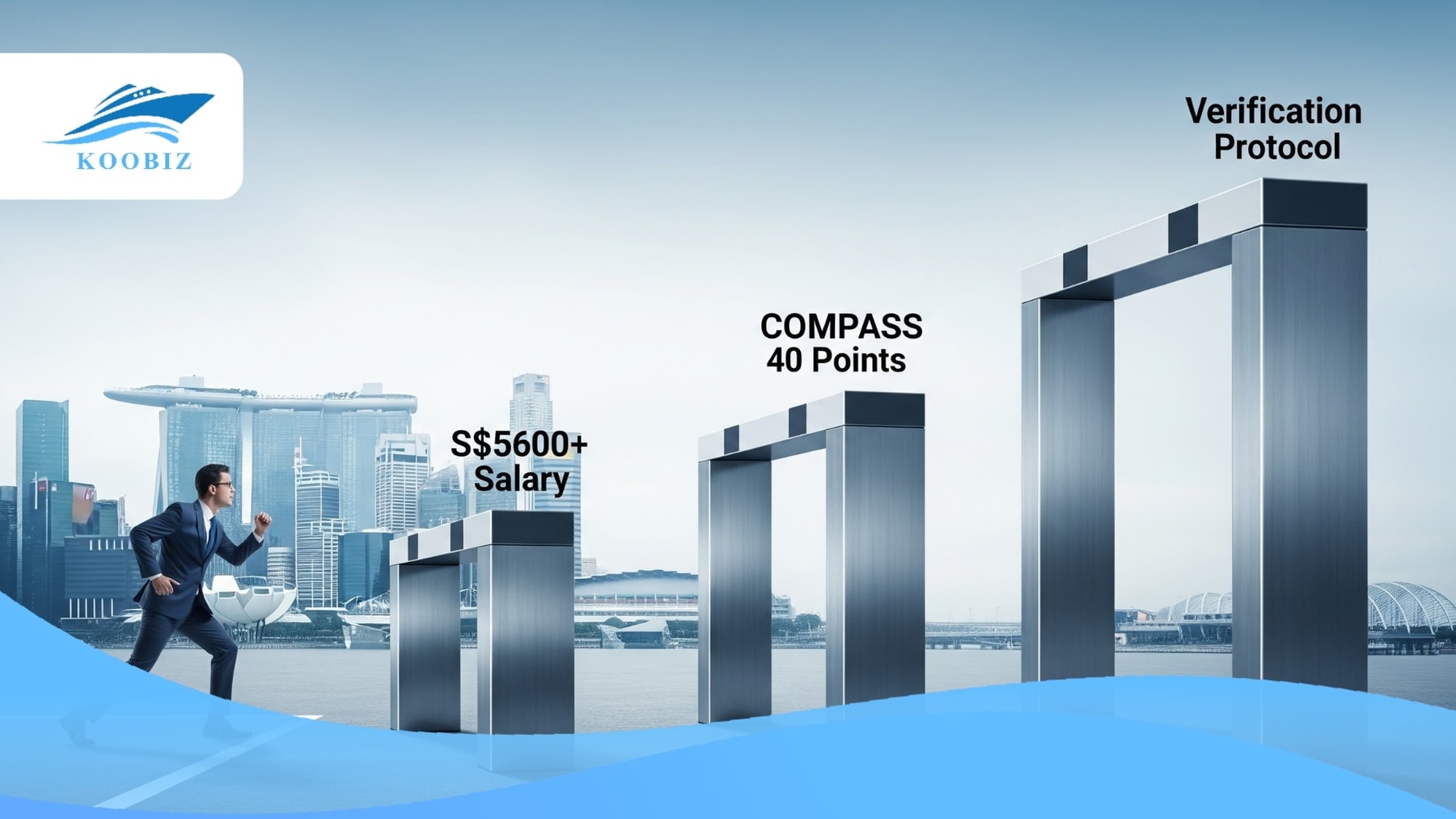
While the Ministry of Manpower (MOM) does not publish a live official Singapore employment pass rejection rate, industry reports and historical data indicate that well-prepared, fully compliant applications still enjoy a high success rate (maintaining a high-yield success rate of approx. 90% for pre-validated profiles via the SAT.). However, the “effective” rejection rate is much higher for applicants who fail to navigate the new 2025 standards.
Specific trends contributing to rejections include:
- FCF Compliance Breaches: Scrutiny over advertising integrity and discriminatory hiring.
- “Weak Singaporean Core” Flags: Companies with a low ratio of local professionals compared to industry peers are facing tougher scrutiny under the COMPASS C4 criteria.
- Re-evaluating ‘Qualified’ Status:Previously, meeting the minimum salary might have secured a pass; today, that same salary results in rejection if the candidate scores poorly on the COMPASS framework (e.g., degree from an unaccredited institution) or if the hiring firm lacks diversity.
Strategic Implication: While the approval rate for high-caliber global talent remains stable, the probability of non-approval has escalated significantly for marginal profiles that fail to demonstrate high complementarity or strictly adhere to the new age-graduated salary curves and diversity mandates. Understanding these macro-trends is the prerequisite for recalibrating your talent acquisition strategy to survive the stringent 2025 vetting process.
Top 5 Reasons for EP Application Rejection
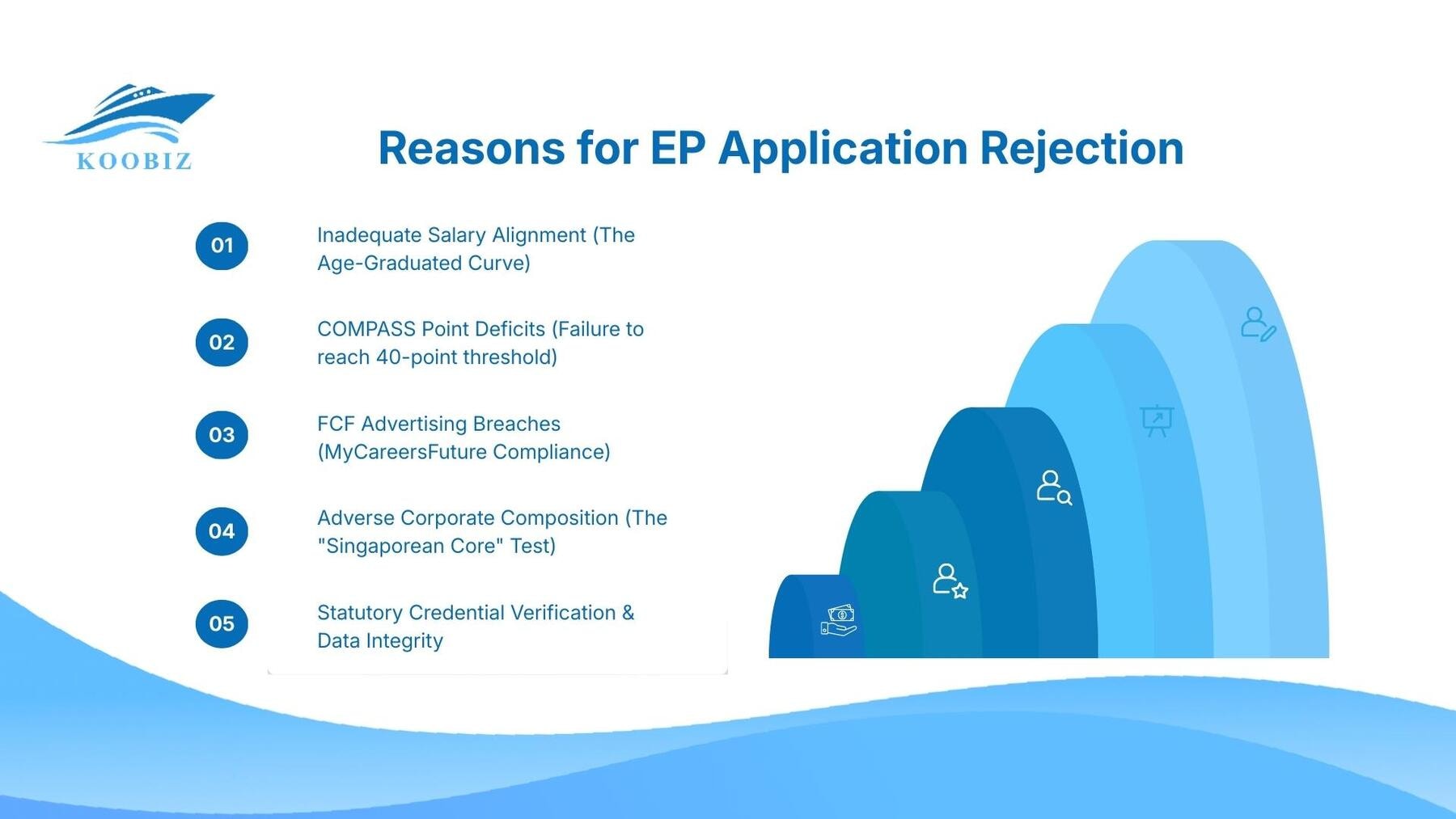
There are five primary categories for EP application rejection: Insufficient Salary relative to age, Low COMPASS scores, Fair Consideration Framework (FCF) violations, Adverse Company Track Record, and Documentation discrepancies.
To navigate the application successfully, one must first understand the specific pitfalls that trigger a denial. These reasons often overlap, creating a compound effect that sinks an application.
Section 1: Inadequate Salary Alignment (The Age-Graduated Curve)
The most common misconception is that paying the baseline salary serves as a safe harbor. This is a critical misconception. This is false. MOM applies a progressive wage model where the required salary increases with age. Senior applicants are subject to elevated wage parity requirements because they are expected to command a senior-level salary (often double the base) to compete with local talent of similar experience.
Section 2: COMPASS Point Deficits (Failure to reach 40-point threshold)
Even with a high salary, an application can fail if it does not secure the mandatory 40-point equilibrium under the Complementarity Assessment Framework (COMPASS). Common failures include submitting credentials from non-accredited institutions (resulting in 0 points for C2 Qualifications) or joining a firm that already has a high concentration of the candidate’s nationality (0 points for diversity).
Section 3: FCF Advertising Breaches (MyCareersFuture Compliance)
Under the Fair Consideration Framework (FCF), employers must advertise the job on MyCareersFuture for at least 14 days to ensure priority access for the local resident talent pipeline. Rejections frequently occur when MOM detects that the advertisement is perceived as a procedural formality or ‘ghost posting’.—for instance, if the job description was tailored specifically to the pre-selected foreigner, or if local applicants were ignored without valid justification.
Section 4: Adverse Corporate Composition (The “Singaporean Core” Test)
The hiring company’s compliance history and workforce profile are pivotal vetting factors. If the company has a “weak Singaporean core” (low ratio of local staff compared to industry peers) or has been flagged for discriminatory hiring practices previously, MOM acts as a gatekeeper. In our experience at Koobiz, we often advise clients to review their local workforce composition before submitting new EP applications to avoid this red flag.
Section 5: Statutory Credential Verification & Data Integrity
Simple administrative errors can trigger severe administrative friction or immediate disqualification. Discrepancies between the resume and the application form, unclear job descriptions, or mismatched educational certificates can cause processing delays or outright rejection. MOM has implemented intensified auditing protocols for document authenticity.
Strategic Calibration: Optimizing the COMPASS Scoring Matrix
The COMPASS framework serves as the primary meritocratic gateway, requiring a minimum 40-point equilibrium where an application must score at least 40 points across four foundational criteria and two bonus criteria to qualify.
Navigating this framework is the core regulatory benchmark governing the vetting process. COMPASS utilizes a compensatory scoring logic—where a deficit in one pillar can be remediated by a surplus in another
COMPASS Points Breakdown
| Criteria | 20 Points (Exceeds Expectations) | 10 Points (Meets Expectations) | 0 Points (Below Expectations) |
|---|---|---|---|
| C1: Salary (Individual) | Top 90th percentile of specific sector | 65th to 90th percentile of sector | Below 65th percentile |
| C2: Qualifications (Individual) | Top-tier institution (Top 100 global or equivalent) | Degree-equivalent qualification | No degree-equivalent qualification |
| C3: Diversity (Firm-Related) | Candidate’s nationality is <5% of firm’s PMETs | Candidate’s nationality is 5%–25% | Candidate’s nationality is ≥25% |
| C4: Support for Local Employment (Firm-Related) | Firm is in top 50th percentile of local PMET share | Firm is in 20th–50th percentile | Firm is below 20th percentile |
Small Firm Exemption: Firms with fewer than 25 PMETs automatically score 10 points on both C3 (Diversity) and C4 (Support for Local Employment) by default.
Bonus Criteria (The Threshold Breakers)
If an application fails to reach 40 points on the foundational criteria above, it can reach approval via Strategic Bonus Integration:
- C5 (Skills Bonus): Up to 20 points if the job is on the Shortage Occupation List (SOL) (e.g., niche technical domains or high-growth sectors under the SOL).
- C6 (Strategic Economic Priorities): 10 points if the firm participates in selected government programs demonstrating innovation or internationalization.
By understanding this grid, Koobiz helps clients perform a predictive scoring audit and profile calibration. If a candidate only scores 10 on Salary and 10 on Qualifications, but the firm scores 0 on Diversity and Local Support, the application totals 20 points—resulting in an unfavorable outcome unless compensatory points are utilized.
Meeting the New 2025 Qualifying Salary Thresholds
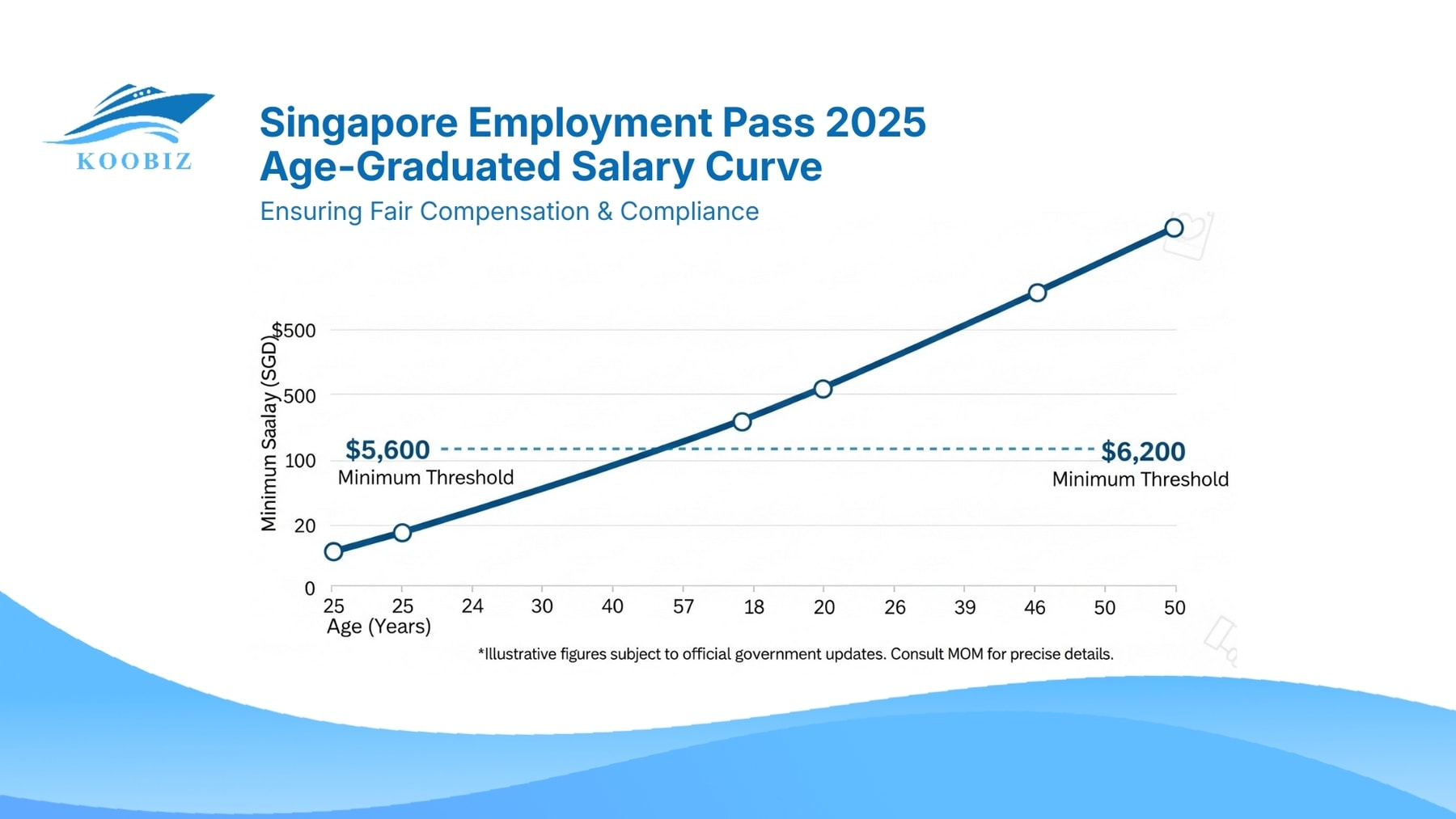
The 2025 qualifying salary threshold for new EP applicants starts at $5,600 per month (increasing to $6,200 for Financial Services) and subject to dynamic age-graduated benchmarking.
The base salary of $5,600 applies only to fresh graduates (approx. age 23). MOM’s age-wage curve requires the qualifying salary to rise with experience. For example, a 35-year-old in Tech may need $9,000+, while a mid-career professional in Finance might require over $11,500.
Crucially, this threshold mandates Fixed Salary Integrity—excluding non-guaranteed variables. Variable bonuses, housing allowances, and stock options are excluded. These rates are effective for new applications from Jan 1, 2025, and for renewals starting Jan 1, 2026. At Koobiz, we assist clients in structuring compensation packages to ensure the fixed component meets these strict age-based definitions, preventing technical rejections.
We have established the core mechanics of avoiding rejection through salary optimization and COMPASS scoring. However, even the most robust applications can face scrutiny regarding credential authenticity or require damage control if a rejection occurs. The following section delves into the specialized verification processes and the strategic steps for recovery.
The Role of Verification Proof in EP Approvals
Verification proof is a mandatory requirement for applicants claiming points under the C2 (Qualifications) criterion to mitigate credential integrity risks.
In the modern framework, if your COMPASS score relies on points from educational qualifications, you must provide rigorous “verification proof.” MOM requires confirmation that the degree is legitimate and was genuinely awarded by an accredited institution.
Third-party screeners (e.g., Veremark, Dataflow) or official portals (like OpenCerts) are used to validate records. If verification fails due to unaccredited institutions or “diploma mills,” the results in a forfeiture of C2 points. This loss frequently drops the total COMPASS score below the 40-point threshold, triggering immediate rejection. Note: If you have enough points from Salary (C1) and Firm attributes (C3/C4) to pass COMPASS without qualifications, you may choose not to declare them, thus bypassing this verification requirement—though this is a strategic decision best made with expert advice.
How to Handle an Employment Pass Rejection?
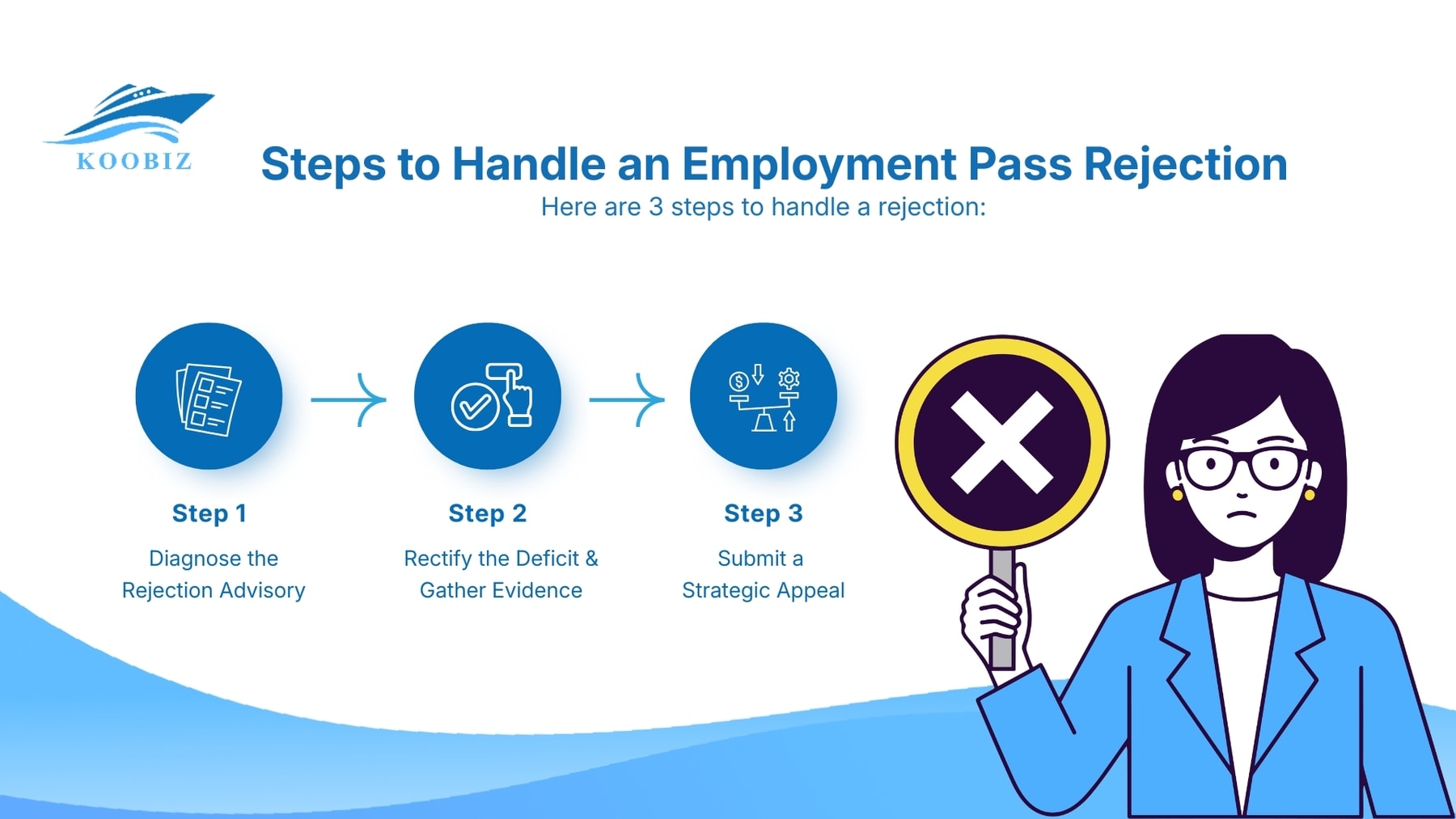
Handling an Employment Pass rejection involves a systematic three-step process: diagnosing the rejection advisory, rectifying the specific deficit, and submitting a formal appeal via the EP eService within three months.
A rejection does not represent a terminal status, but rather a remediation phase. MOM allows for appeals, but the success rate contingent upon the precision of the remediating actions.
Step 1: Diagnose the Rejection Advisory
Initial intervention necessitates a comprehensive diagnostic assessment of the advisory. When an application is rejected, MOM provides an advisory via the EP eService (formerly EP Online). It might state generic reasons like “Candidate does not meet eligibility criteria,” or specific notes regarding the COMPASS score. It is crucial to interpret this correctly. For instance, if the advisory highlights “turnover of local staff,” simply increasing the candidate’s salary in the appeal will not work; the company must address its HR practices.
Step 2: Rectify the Deficit & Gather Evidence
Before appealing, you must remediate the underlying root cause. An appeal without new information is a resulting in an unfavorable outcome.
- If rejected on Salary: You must provide evidence of a salary revision or market research proving the candidate’s niche value.
- If rejected on Points: You might need to provide verification for a previously unverified degree or highlight how the candidate fulfills a role on the Shortage Occupation List (SOL) to gain bonus points (C5).
Step 3: Submit a Strategic Appeal
Strategic advocacy necessitates an evidence-driven argument rather than a standard administrative request. Submit the appeal via the EP eService within 3 months of the rejection date. At Koobiz, we structure appeal letters to directly counter the rejection reason with empirical data, arguing why the candidate is irreplaceable and how they contribute to the Singaporean core, rather than just restating their resume. Note that processing typically takes about 6 weeks, though simple cases may be faster.
Employment Pass vs. S Pass: Which Option Makes More Sense in 2025?
The Employment Pass (EP) targets professionals and senior executives with salaries above $5,600, whereas the S Pass targets mid-skilled technical staff with salaries above $3,150, subject to a strict quota system.
At a glance, the EP is designed for professionals and senior executives with higher salaries, while the S Pass targets mid-skilled technical roles under a quota-based system. In practice, however, the decision is rarely that simple.
While the EP has no quota (levy-free), the S Pass is limited by the company’s quota (Tier 1 and Tier 2) and incurs a monthly levy.
| Feature | Employment Pass (EP) | S Pass |
|---|---|---|
| Target Profile | Professionals, Managers, Executives | Mid-skilled technical staff |
| Minimum Salary (2025) | $5,600+ (General)
$6,200+ (Finance) |
$3,150** (until Aug 31, 2025)
$3,300** (from Sep 1, 2025) |
| Quota System | No (Levy-free) | Subject to Tier 1 / Tier 2 quota |
| Monthly Levy | None | Mandatory (paid by employer)) |
| Dependant Privileges | Yes (if salary > $6,000) | Yes (if salary > $6,000) |
However, the S Pass is also becoming harder to obtain due to the rising levy costs and tightening quotas. It is crucial to compare these options early. If a candidate’s salary is borderline ($5,800 for a 30-year-old), aiming for an S Pass initially might be safer than risking an EP rejection, provided the company has quota availability.
About Koobiz
Successfully navigating Singapore’s immigration and corporate regulations requires more than meeting minimum requirements—it requires planning with the end goal in mind.
Koobiz supports businesses and founders at every stage of their Singapore journey, from company incorporation to long-term compliance. Our team advises on optimal corporate structures, assists with corporate bank account opening, and supports clients through stringent KYC processes imposed by local banks.
Beyond setup, our team provides comprehensive support for opening corporate bank accounts in Singapore, navigating the rigorous KYC processes of local banks. We also offer end-to-end tax, accounting, and auditing services, ensuring your firm maintains the strong track record required for future Employment Pass approvals. Whether you are a startup or an established MNC, Koobiz helps you build a compliant, sustainable presence in Singapore.
Visit us at: Koobiz.com to consult with our experts today.
Leave a Reply