Category: Accounting & Bookkeeping

  • What Do Accountants Do for Singapore SMEs? From Tax Compliance to Strategic Growth

    What Do Accountants Do for Singapore SMEs? From Tax Compliance to Strategic Growth

    [SUMMARIES]

    Beyond Bookkeeping: Modern accountants in Singapore act as strategic business partners, not just data recorders, helping SMEs navigate complex financial landscapes.

    Strict Compliance: Their core role involves adhering to rigorous IRAS tax regulations (GST, ECI, Form C-S) and ACRA statutory filings (Annual Returns, XBRL) to avoid costly penalties.

    Strategic Growth: Accountants drive expansion through precise cash flow management, budgeting, and acting as Virtual CFOs to interpret financial data for better decision-making.

    Outsourcing Advantage: For most SMEs, outsourcing accounting to Corporate Service Provider (CSP) offers a cost-effective alternative to hiring in-house, providing access to expert teams and specialized software.

    Tech-Driven Efficiency: The profession now relies heavily on cloud technology and AI automation to provide real-time financial insights and sustainability reporting.

    [/SUMMARIES]

    Accountants are the architects of financial stability who navigate complex IRAS and ACRA compliance while acting as strategic advisors for growth. Whether you are a startup founder or an established SME owner, understanding this multifaceted role is crucial.

    This article delves into the operational, compliance, and strategic functions of modern accountants, helping you decide whether to hire in-house or leverage professional experts.

    What is the Role of an Accountant in a Singapore SME?

    An accountant for a Singapore SME is a financial professional responsible for interpreting, recording, and analyzing financial data to ensure regulatory compliance and facilitate strategic decision-making.

    Financial expert responsible for analyzing and recording data
    Financial expert responsible for analyzing and recording data

    To understand this role more deeply, we must look beyond the stereotype of data entry. In the modern business context, specifically within Singapore’s framework, an accountant serves as a vital bridge between the company’s operational activities and its financial health.This critical function involves:

    • Maintaining the integrity of financial records (bookkeeping) and ensuring that every dollar is accounted for.
    • Providing financial visibility required to secure loans, attract investors, or simply manage cash flow effectively.
    • “Business integrity,” drives Koobiz experts to ensure your company remains in good standing with Singaporean authorities while maximizing operational efficiency.

    Core Responsibilities: Ensuring Compliance with IRAS (Inland Revenue Authority of Singapore) and ACRA (Accounting and Corporate Regulatory Authority)

    Singapore enforces rigorous adherence to laws, where errors can lead to stiff penalties or company striking-off. A competent accountant safeguards your business by managing complex deadlines and forms, allowing you to focus on core operations without the anxiety of non-compliance.

    Managing Tax Obligations (GST, ECI, and Form C-S)

    Singapore tax compliance: GST, ECI, Form C-S
    Singapore tax compliance: GST, ECI, Form C-S

    Navigating Singapore’s tax system requires precision regarding strict IRAS timelines and specific criteria for GST, Estimated Chargeable Income (ECI), and Corporate Income Tax (Form C-S/C).

    • Estimated Chargeable Income (ECI): Accountants must calculate and file the ECI within three months from the end of the financial year – A mandatory estimate of the company’s taxable income.

    Pro Tip: Companies with a financial year that have annual revenue of less than SGD 5 million AND predicted zero chargeable income , are exempt from filing ECI. Your accountant will verify if you qualify for this administrative waiver.

    • Depending on the company’s annual revenue, the accountant determines which form to file.
      • Form C-S Lite: For the simplest companies with revenue ≤ SGD 5 million and straightforward tax matters.
      • Form C-S: For qualifying small companies with revenue ≤ SGD 5 million.
      • Form C: For larger companies or those claiming complex deductions.

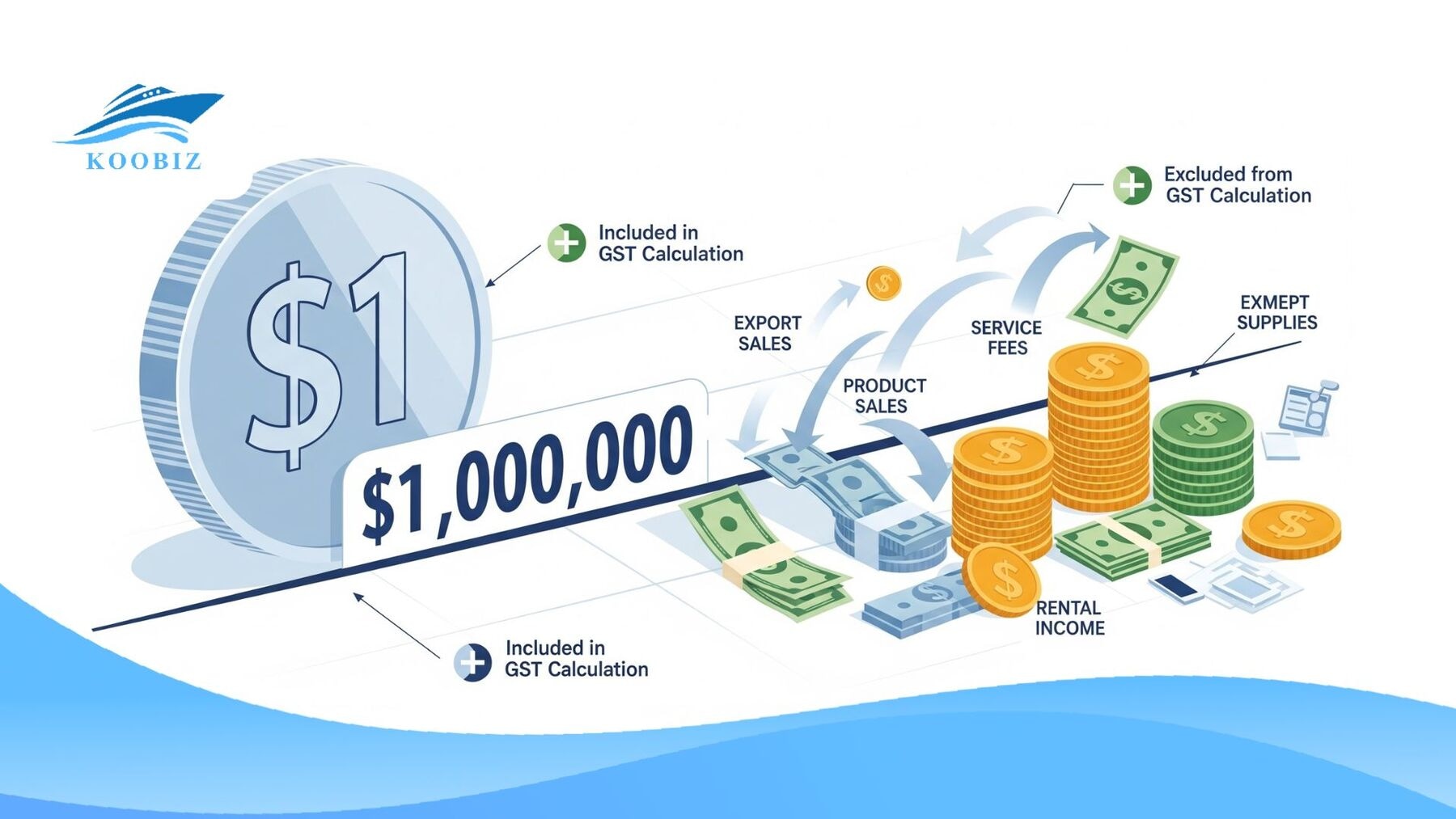
    GST Registration and Filing: If a company’s taxable turnover exceeds SGD 1 million, mandatory GST registration is triggered. Accountants manage the quarterly GST F5 filings, ensuring that output tax collected and input tax paid are reconciled accurately. Koobiz specialists ensure optimizing the tax position with sensible advisory based on the newest update.

    Financial Reporting and ACRA Annual Returns

    Every Singapore company must hold an Annual General Meeting (AGM) and file Annual Returns with ACRA, adhering to Singapore Financial Reporting Standards (SFRS). The accountant prepares the necessary unaudited or audited financial statements and converts them into the mandatory XBRL (eXtensible Business Reporting Language) format for the BizFile+ portal—a technical requirement that often trips up business owners attempting DIY filings.

    Note: Solvent Exempt Private Companies (EPCs) with revenue ≤ SGD 5 million may be eligible to file a simplified XBRL set or be exempt from filing financial statements with ACRA entirely, though they must still prepare them.

    How Do Accountants Drive Business Growth for SMEs?

    Accounting advising SME viewing financial dashboard
    Accounting advising SME viewing financial dashboard

    Accountants drive business growth by transforming historical data into future-focused strategies, utilizing cash flow forecasting and advisory services to improve profitability.

    Transitioning from “defense” (compliance) to “offense” (growth), the modern accountant becomes a strategic partner. While compliance keeps the business safe, strategic accounting propels it forward. By analyzing trends in the financial data, our team can identify which product lines are most profitable, where unnecessary costs are hemorrhaging cash, and when the business has enough liquidity to invest in expansion. This shift from reactive reporting to proactive advising is what separates a standard bookkeeper from a value-adding accountant.

    Cash Flow Management and Budgeting

    Effective cash flow management involves monitoring the timing of cash inflows and outflows to ensure the business always has the liquidity to operate.

    Cash is the oxygen of any SME. An accountant creates detailed cash flow forecasts that predict potential shortages before they happen. Instead of spending blindly, an accountant helps the business owner set realistic spending limits for marketing, hiring, and operations. This discipline ensures that the company creates a sustainable “burn rate,” vital for startups and growing SMEs in Singapore’s high-cost environment.

    Acting as a Strategic Advisor (Virtual CFO Services)

    A Virtual CFO provides high-level financial strategy, performance analysis, and decision support without the cost of a full-time executive.

    Many SMEs cannot afford a full-time Chief Financial Officer (CFO), yet they face complex financial decisions. This is where the “Virtual CFO” service comes into play. In this capacity, the accountant interprets financial ratios (like Return on Investment or Gross Margin) to guide data-driven decisions. Should the company lease or buy equipment? Is it financially viable to open a new branch? Is the business valuation ready for potential investors?.

    Case Study: From Chaos to Clarity for a Singapore Retailer

    Let’s look at a practical example involving a typical Singapore SME scenario.

    The Challenge: “TechGadget SG,” a growing electronics retailer, faced a common dilemma: sales were hitting record highs, yet their bank balance remained dangerously low. The owner was overwhelmed by manual data entry, had missed a GST filing deadline resulting in penalties, and was unsure which product lines were actually profitable.

    The Accountant’s Intervention:

    1. Immediate Compliance Fix: Koobiz experts stepped in to perform a “financial health check.” We immediately rectified the missed GST returns and successfully negotiated a waiver for the penalty with IRAS by demonstrating the company’s otherwise clean track record.
    2. Digital Integration: We migrated their messy spreadsheets to a cloud accounting system , integrating it directly with their Shopify store and POS system. This eliminated over 80% of manual data entry per week using OCR tools.
    3. Strategic Pivot: Through detailed financial analysis, we discovered that while high-end laptops generated high revenue, the profit margins were razor-thin due to shipping and warranty costs. Conversely, accessories and cables had 60% margins but were being under-marketed.

    The Result: Guided by these insights, the business shifted its marketing budget to focus on high-margin accessories. Within six months, net profit increased by 20%, and cash flow stabilized, giving the owner the confidence and capital to open a second outlet. This case study demonstrates that an accountant provides the roadmap for survival and expansion, not just tax filing.

    Outsourced Accounting Services in Singapore: In-House vs. Outsourced

    Outsourcing accounting services is often the superior choice for SMEs, offering cost savings, access to a wider range of expertise, and greater scalability compared to hiring in-house.

    Deciding between an in-house team and an outsourced provider is a pivotal choice for Singapore business owners. The table below highlights the key differences:

    Aspect In-House Accountant Outsourced (e.g., Koobiz)
    Cost High fixed cost (SGD 4,000–6,000/mth + CPF/Benefits) Variable, often starting from SGD 300/mth
    Expertise Limited to one person’s experience Team with industry-wide knowledge & regulatory updates
    Continuity Risk of gaps due to leave or resignation Guaranteed coverage via Service Level Agreements (SLAs)
    Scalability Difficult to scale up/down quickly Flexible scaling based on transaction volume
    Software Company bears full cost of software Access to enterprise-grade tools often included

    We have established the fundamental roles of an accountant: keeping the business legal through compliance and making it profitable through strategy.. As we look toward the future of accounting for Singapore SMEs, we must cross the boundary into the realm of technology and specialized micro-niche functions.

    How Modern Technology is Changing What Accountants Do

    There are three main technology trends reshaping accounting: Cloud Computing, Automation, and Artificial Intelligence, all of which enhance speed and accuracy.

    Technology has revolutionized the “how” of accounting, allowing professionals to deliver value faster. Implemented systems that talk to each other—connecting the Point of Sale (POS) system directly to the accounting software, and linking bank feeds for automatic reconciliation. This allows accountants from Koobiz provide real-time dashboards rather than month-old reports.

    Cloud Accounting Software: Xero, QuickBooks, and Myr

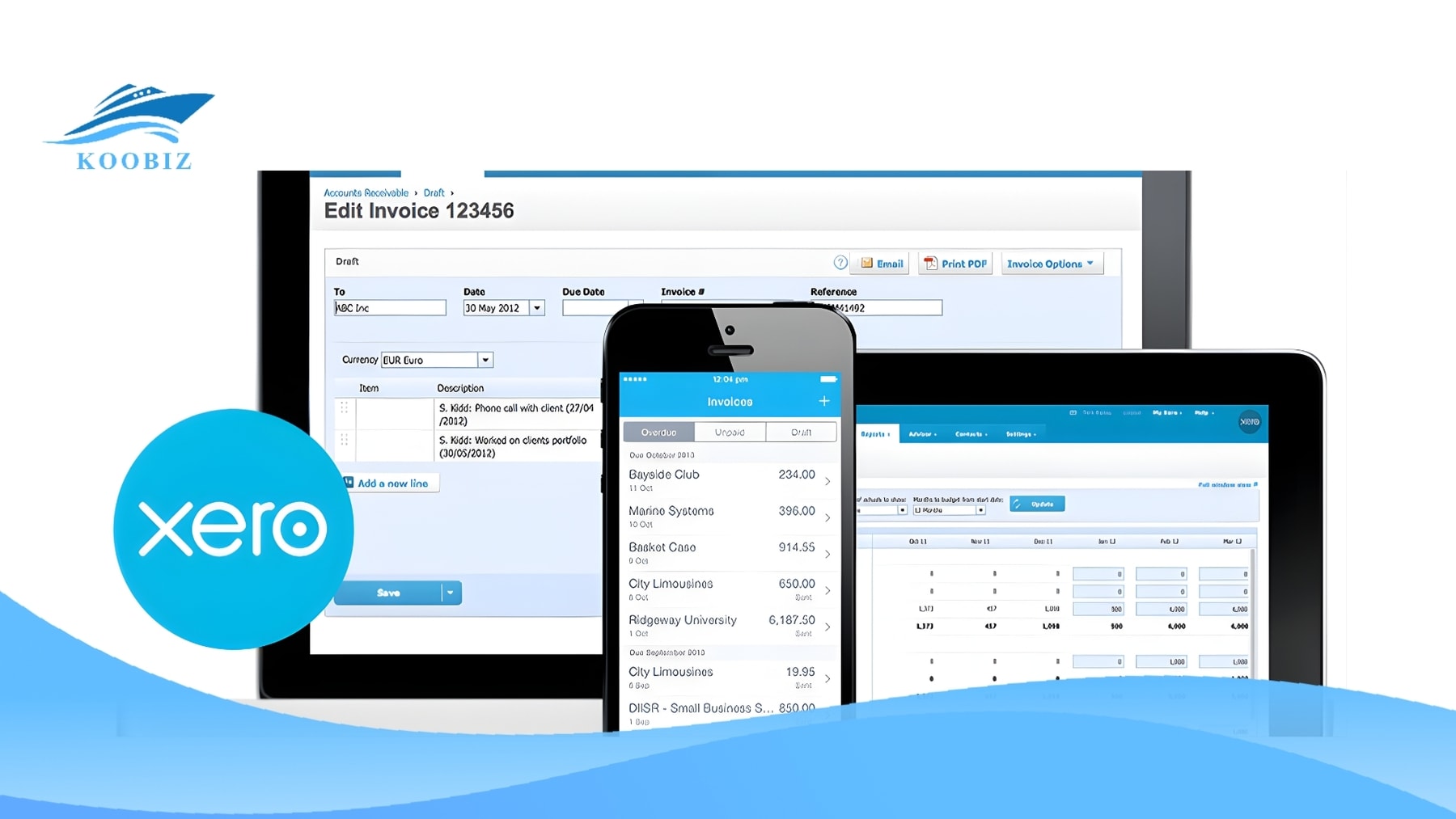
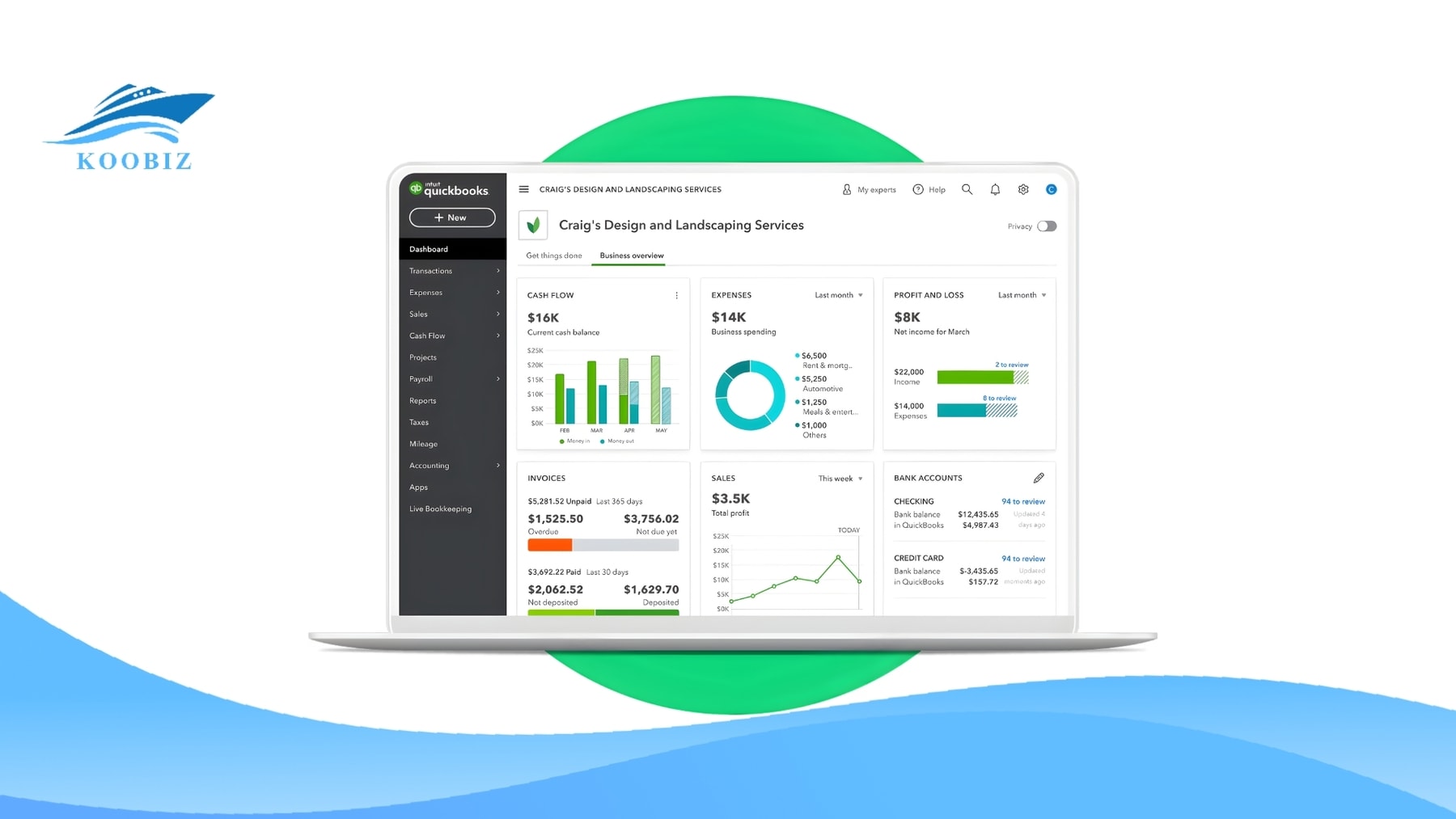
    Cloud accounting platforms like Xero and QuickBooks allow for real-time collaboration, accessible data from anywhere, and seamless integration with other business apps.

    • Accessibility: Business owners can view their P&L on their phone while traveling.
    • Integration: These platforms integrate with payroll software (like Talenox or HReasily) and e-commerce platforms (Shopify), creating a unified data environment.
    • Security: Cloud providers offer bank-level security. Our team specializes in migrating SMEs to these platforms to ensure data is secure and accessible.

    Automating Routine Tasks and AI Analytics

    Automation tools use Optical Character Recognition (OCR) and AI to process invoices and expenses, while predictive analytics forecast future trends.

    Modern accountants utilize tools (like Dext or Hubdoc) that allow clients to simply snap a photo of a receipt. The software automatically extracts the data (date, amount, vendor, GST) and pushes it to the accounting system. Beyond basic automation, AI in accounting is now enabling predictive analytics. By analyzing historical data, AI tools can help accountants forecast cash flow trends with greater accuracy, predicting potential shortfalls months in advance.

    Specialized Accounting Functions You Might Need

    Beyond general practice, there are specialized accounting branches like Forensic Accounting and ESG Reporting that address specific risks and emerging global standards.

    Forensic Accounting and Fraud Prevention

    Forensic accounting involves the investigation of financial records to detect fraud, embezzlement, or financial discrepancies, often for legal proceedings.

    While we hope to never need them, forensic accountants are crucial when internal controls fail. If an SME suspects employee theft or needs to settle a partnership dispute, a forensic accountant dives deep into the digital trail. They reconstruct financial events to find missing funds. This is a specialized service that adds a layer of security to the business assets.

    Sustainability Reporting and Green Finance

    Sustainability reporting is the practice of measuring and disclosing a company’s Environmental, Social, and Governance (ESG) performance to attract green investment and meet evolving regulatory expectations.

    Singapore is positioning itself as a hub for green finance. While currently mandatory mostly for listed companies, ESG reporting is trickling down to the SME sector. Banks are increasingly offering “Green Loans” with better interest rates to companies that can prove their sustainability. Accountants are now tasked with measuring non-financial metrics—such as carbon footprint or waste management costs—and integrating them into the company’s reporting structure. This emerging role positions the accountant as a guardian of the company’s long-term sustainability and social license to operate.

    Why Choose Koobiz?

    At Koobiz, we don’t just file your taxes; we fuel your growth.

    • Comprehensive Support: From incorporation to Virtual CFO services, we handle the entire financial lifecycle.
    • Compliance Guarantee: Our deep knowledge of IRAS and ACRA regulations ensures you never miss a deadline.
    • Transparent Pricing: No hidden fees—just clear, value-driven packages tailored to your business size.

    Conclusion

    Koobiz accountants specialize in empowering businesses to thrive in the competitive Singaporean market. From Singapore company incorporation to ongoing tax, accounting, and audit services, our team acts as your dedicated financial partner, ensuring a seamless start for your venture.

    Schedule a free consultation at Koobiz.com today and unlock your SME’s growth potential—don’t wait for the next filing deadline!

  • What Is Bookkeeping? Mastering Financial Records vs Accounting for Singapore SMEs

    What Is Bookkeeping? Mastering Financial Records vs Accounting for Singapore SMEs

    [SUMMARIES]

    Foundation vs. Analysis: Bookkeeping is the daily recording of financial data, while accounting is the high-level analysis of that data.

    Mandatory Compliance: All Singapore companies must maintain proper books of accounts for at least 5 years under ACRA regulations.

    Modern Efficiency: Cloud-based software is superior to manual entry for accuracy and real-time tracking.

    Tax Implications: Accurate bookkeeping is critical for correct GST filing and ECI submission to IRAS.

    Strategic Growth: Separating bookkeeping from accounting helps SMEs manage cash flow and plan for expansion effectively.

    [/SUMMARIES]

    “What is bookkeeping?” is often the first and most critical question new business owners ask when establishing a company in Singapore. It serves as the bedrock of financial health, yet it is frequently confused with the broader practice of accounting.

    At Koobiz, we understand that for Singapore SMEs, distinguishing between mastering daily financial records and high-level accounting strategy is not just about terminology—it is essential for ACRA compliance and avoiding costly penalties.

    What Is Bookkeeping?

    Bookkeeping is the systematic process of recording, organizing, and tracking every financial transaction of a business on a day-to-day basis.

    For Singapore businesses bookkeeping is a statutory requirement therefore, functions as the administrative phase of accounting. It involves the documentation of revenue and expenses. A bookkeeper ensures that every invoice, receipt, and payment is logged into the company’s ledgers. This creates a clear financial trail that allows business owners to see exactly where their money is going, serving as the raw data upon which all financial reports and tax filings are built.

    Bookkeeping: Recording financial transactions
    Bookkeeping: Recording financial transactions

    What Are the Key Responsibilities of a Bookkeeper?

    A professional bookkeeper handles three core categories of responsibilities: data entry, reconciliation, and accounts management.

    Key Responsibilities of a Bookkeeper
    Key Responsibilities of a Bookkeeper

    These tasks ensure the accuracy and integrity of financial data before it reaches an accountant.

    • Data Entry and General Ledger: Daily sales and expenses will be recorded in the General Ledger. This includes verifying source documents like receipts and invoices to ensure they are valid business expenses.
    • Bank Reconciliation: Comparison between the company’s internal records with the bank statement to ensure they match. It identifies discrepancies, missing entries, or potential fraud.
    • Accounts Management: Management of Accounts Receivable (tracking who owes the business money and sending invoices) and Accounts Payable (tracking what the business owes to suppliers and ensuring timely payments).

    Bookkeeping vs. Accounting: What Is the Difference?

    Bookkeeping excels at accumulating accurate data, while accounting focuses on analyzing that data for strategic decision-making and tax planning.

    They have both distinctive and interdependent functions within the financial cycle. Bookkeeping is objective and administrative; it focuses on the “what” and “when” of transactions. In contrast, accounting is subjective and analytical; it focuses on the “why” and “how” the business is performing.

    The table below outlines the key differences between the two roles:

    Feature Bookkeeping Accounting
    Primary Goal Recording financial transactions faithfully. Analyzing financial data for growth & compliance.
    Nature of Work Administrative & Objective (Data Entry). Analytical & Subjective (Strategy).
    Focus The “What” and “When” (Daily records). The “Why” and “How” (Business health).
    Key Output General Ledger, Trial Balance. Financial Statements (P&L), Tax Returns.
    Frequency Daily or Weekly. Monthly, Quarterly, or Annually.
    Tools Used Cloud Bookkeeping programs (Data Input). Financial models, Tax software (Analysis).

    Case Study: Bookkeeping vs. Accounting in Action

    To clearly illustrate the distinction in the case of a fictional Singapore cafe, “Merlion Coffee.”

    Merlion Coffee's Financial Process
    Merlion Coffee’s Financial Process
    • The Scenario: The cafe purchases $1,000 worth of premium coffee beans from a supplier.
    • The Bookkeeper’s Role: They record the transaction date, vendor, and amount ($1,000) into the accounting software . They categorize the expense under “Cost of Goods Sold” and file the digital invoice for future reference. Their job is done once the data is accurately captured.
    • The Accountant’s Role: At the end of the quarter, the accountant reviews the reports generated from the bookkeeper’s data. They notice that the “Cost of Goods Sold” has increased by 15% compared to the previous quarter. The accountant then advises the cafe owner to either renegotiate prices with the supplier or adjust the menu pricing to maintain profit margins.

    This demonstrates how bookkeeping provides the necessary data, while accounting provides the strategy based on that data.

    Is Bookkeeping Mandatory for Singapore Companies?

    Yes, bookkeeping is mandatory for all Singapore companies under the Singapore Companies Act to ensure transparency and accurate tax assessment according to ACRA (Accounting and Corporate Regulatory Authority) regulations.

    The law requires companies to maintain “proper books of accounts” that sufficiently explain the transactions and financial position of the company.

    • Record Retention: According to IRAS and ACRA regulations, companies must retain all financial records and source documents for at least 5 years. You can refer to the official IRAS Record Keeping Guide for specific requirements.
    • Proper Accounts: Failure to keep proper records can result in penalties, fines, or even disqualification of directors. These records are crucial when IRAS conducts a tax audit.

    What Are the Different Methods of Bookkeeping?

    There are two primary methods of bookkeeping: the Single-entry system for simple businesses and the Double-entry system for corporations.

    Single-entry vs. Double-entry System

    • Single-entry System: This is similar to a checkbook register. It is simple but does not track assets or liabilities effectively, making it suitable only for very small sole proprietorships.
    • Double-entry System: This is the standard for Pte Ltd companies in Singapore. Every transaction affects at least two accounts (a debit and a credit), satisfying the accounting equation: Assets = Liabilities + Equity. This method provides a self-balancing mechanism that reduces errors and detects fraud.

    Manual vs. Cloud Bookkeeping Software: Which Is Better?

    Cloud software outperforms manual methods through superior automation, accessibility, and security.

    In the modern Singapore business landscape, cloud accounting software allows for direct bank feeds, automated invoice chasing, and real-time visibility.

    • Automation: Cloud software can automatically categorize transactions and scan receipts via OCR technology.
    • Compliance: Most localized software is updated with the latest Singapore GST and tax rates, reducing compliance risk.

    How Does Bookkeeping Affect GST and Tax Filing?

    Accurate bookkeeping ensures precise Input and Output tax calculations, preventing costly penalties during quarterly GST filing.

    • ECI Filing: Bookkeeping records allow for the estimation of the company’s taxable income. This is required for filing the Estimated Chargeable Income (ECI) within 3 months of the financial year-end.
    • Audit Trail: Without clear bookkeeping, claiming tax deductions or GST refunds becomes impossible as there is no valid audit trail for IRAS to verify.

    Common Bookkeeping Mistakes Singapore SMEs Make

    Common errors include mixing up between personal and business funds, losing physical receipts, and failing to reconcile accounts monthly.

    • Commingling Funds: Using a business account for personal expenses violates the separate legal entity concept of a Pte Ltd company.
    • Irregular Reconciliation: Waiting until the end of the year to reconcile bank statements often leads to forgotten transactions and unfixable errors.

    When Should You Outsource Bookkeeping Services?

    You should outsource when transaction volume exceeds your internal capacity or when you lack the technical knowledge of Singapore’s evolving tax laws.

    For many SMEs, hiring a full-time in-house accountant is too expensive. Outsourcing to a Corporate Service Provider (CSP) offers a cost-effective solution. You gain access to a team of experts who ensure your financial records are compliant under the Singapore Law , allowing you to focus on growing your business rather than stressing over data entry.

    About Koobiz

    Koobiz is your trusted partner for navigating the Singapore business landscape. We specialize in comprehensive corporate services, including Company Incorporation, Bank Account Opening, Tax, Accounting, and Auditing. Our team ensures your bookkeeping is not just a compliance task, but a strategic asset.


  • Preparing Unaudited Financial Statements for Singapore SMEs: A Complete ACRA Compliance Guide

    Preparing Unaudited Financial Statements for Singapore SMEs: A Complete ACRA Compliance Guide

    [SUMMARIES]

    Cost-Efficiency: Unaudited financial statements allow eligible Singapore SMEs to comply with ACRA regulations without the high cost of an external audit.

    Eligibility Rules: Your company likely qualifies if it meets the “Small Company” criteria (Revenue <$10M, Assets <$10M, Employees <50).

    Mandatory Compliance: Even without an audit, statements must strictly adhere to Singapore Financial Reporting Standards (SFRS).

    Filing Format: Most companies must convert these statements into XBRL format for submission to ACRA.

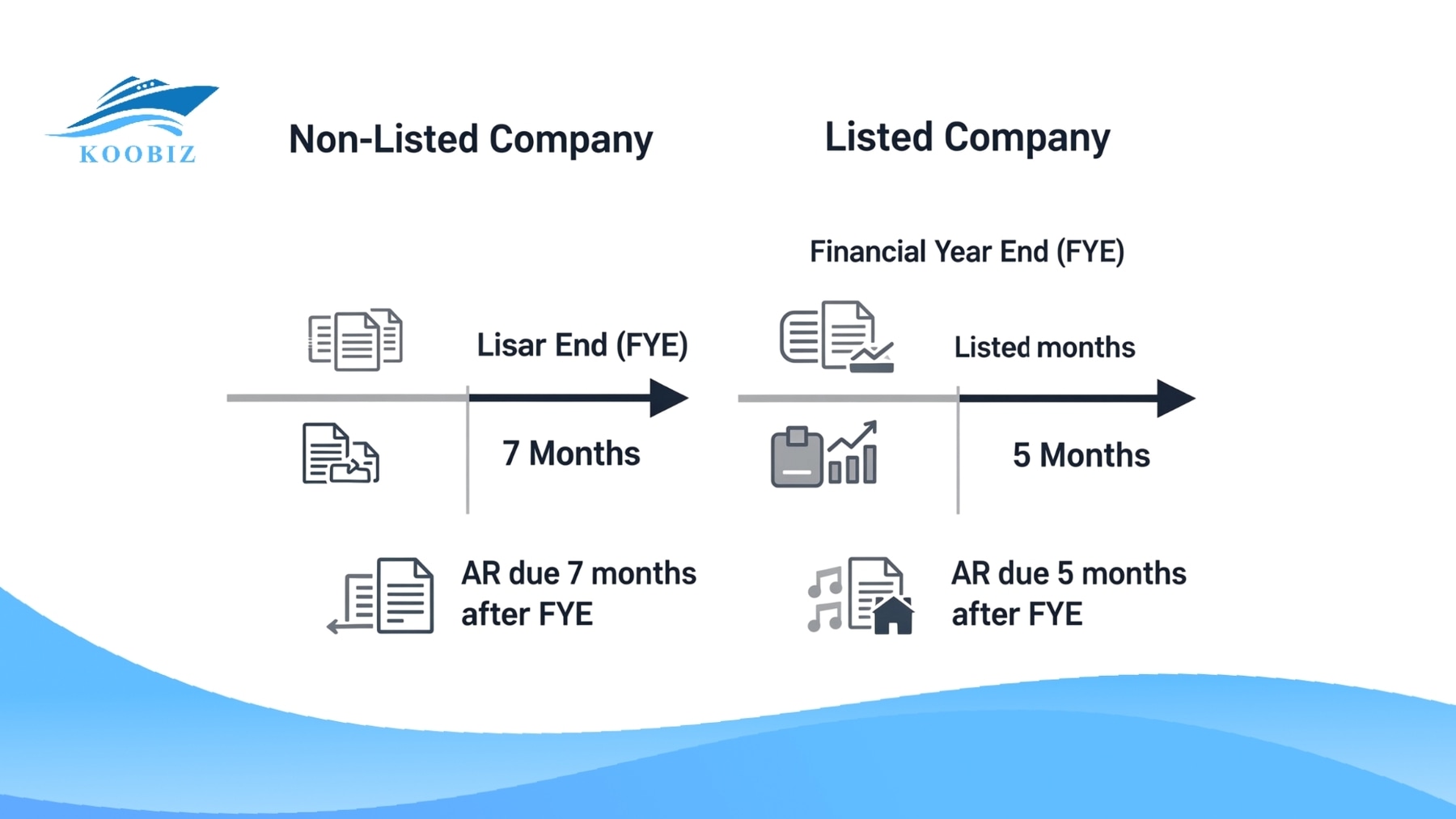
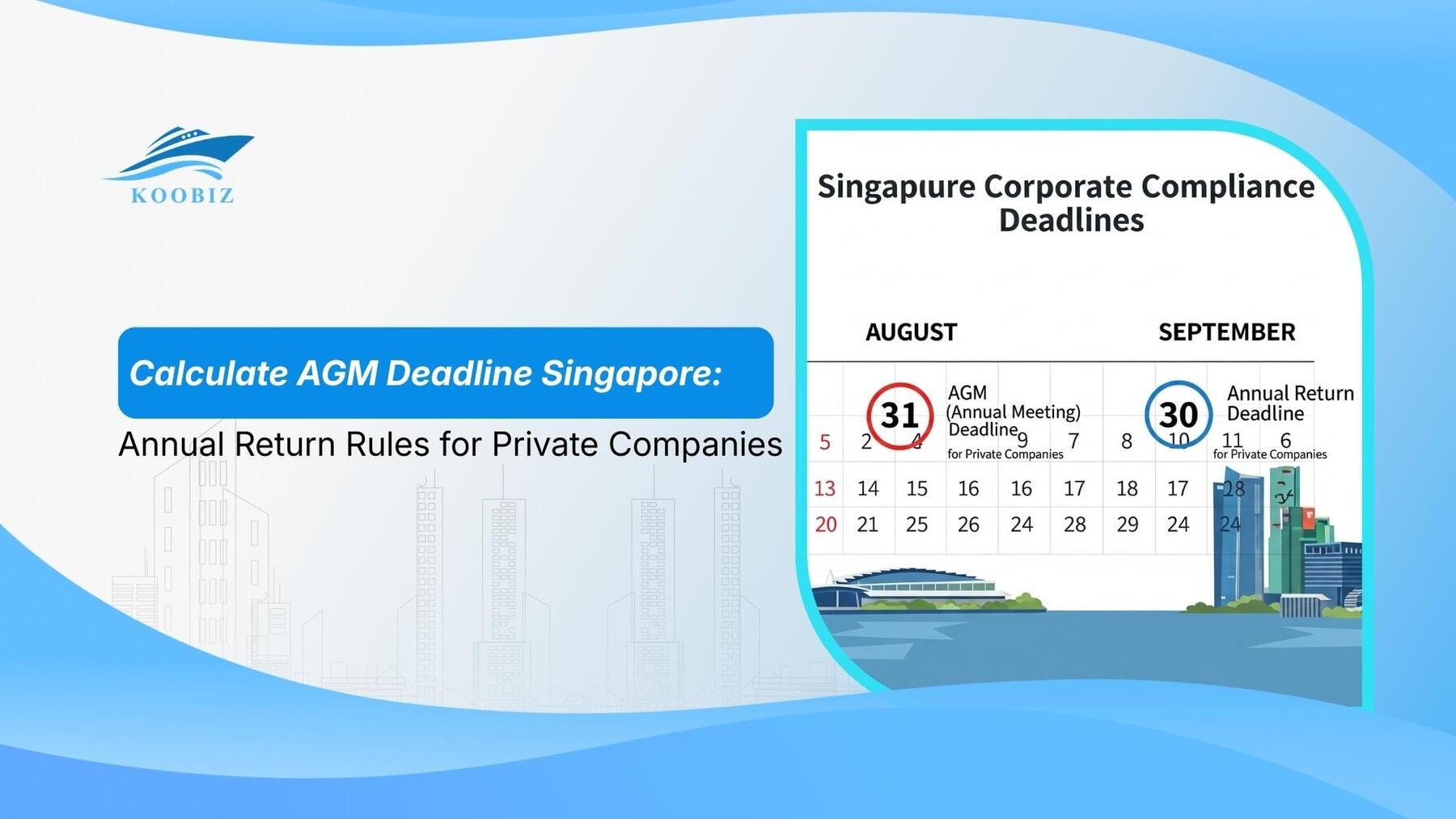
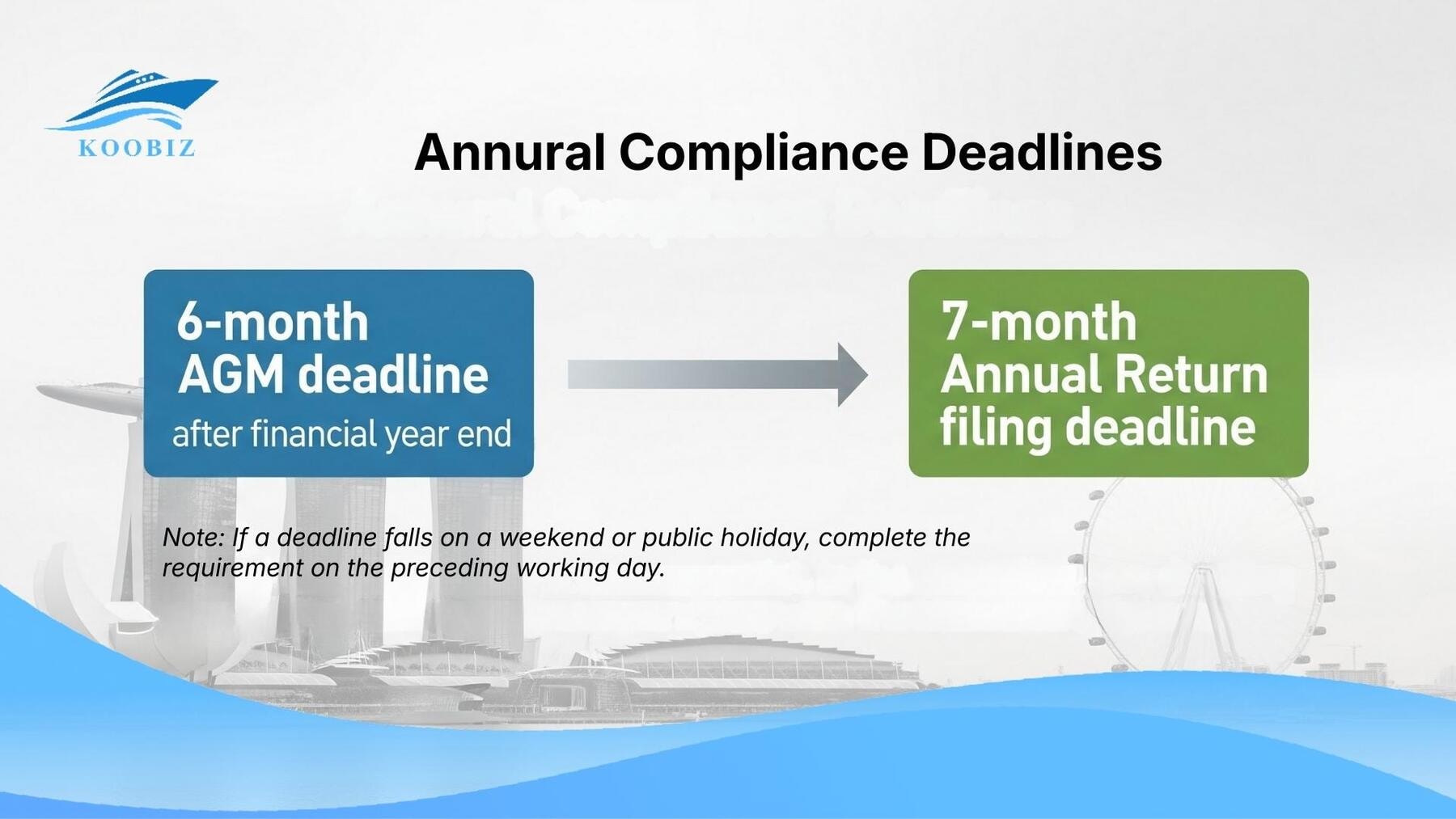
    Timeline: Financial Year End (FYE) + 6 months for AGM (if held), + 7 months for Annual Return (AR) filing.

    Value of Professional Compilation: While “unaudited,” utilizing a professional compilation service like Koobiz ensures accuracy and banking credibility.

    [/SUMMARIES]

    Navigating the regulatory landscape of Singapore can be daunting for small business owners, especially when the Annual General Meeting (AGM) season approaches. Preparing unaudited financial statements is a critical obligation for Singapore SMEs that qualify for audit exemptions, offering a streamlined path to ACRA compliance without the heavy financial burden of a full statutory audit. However, “unaudited” does not mean “unregulated”; these reports must still adhere rigorously to the Singapore Financial Reporting Standards (SFRS) to avoid penalties and maintain good standing. Whether you are determining your eligibility for the “Small Company” exemption, distinguishing between audited and unaudited reports, or looking for a step-by-step preparation guide, this article covers every essential detail. At Koobiz, we understand that accurate financial reporting is the backbone of your business credibility, and we are here to guide you through the complexities of Singapore’s corporate compliance.

    [Note: This guide is current as of December 2025. Always refer to ACRA’s latest guidelines for specific amendments.]

    What Are Unaudited Financial Statements in Singapore?

    Unaudited financial statements are comprehensive financial reports prepared by a company’s management or external accountants that strictly follow the Singapore Financial Reporting Standards (SFRS) but do not undergo independent verification by an external auditor.

    The key distinction from audited financial statements lies in the absence of an external auditor’s opinion. Audited accounts include a professional assurance confirming that the financial statements present a true and fair view of the company’s financial position. Unaudited financial statements, by contrast, are supported by the directors’ responsibility and declaration that the accounts are accurate and properly prepared.

    Importantly, for regulatory and tax authorities such as the Accounting and Corporate Regulatory Authority (ACRA) and the Inland Revenue Authority of Singapore (IRAS), unaudited financial statements carry full legal significance. They form the basis for corporate tax assessments, statutory filings, and regulatory reviews of solvency and compliance. As a result, audit exemption does not reduce the standard of accuracy or compliance required. These financial statements must still be prepared with the same level of care, consistency, and adherence to SFRS as audited accounts.

    Is Your Company Eligible for Audit Exemption?

    Yes, your company is eligible for audit exemption if it qualifies as a “Small Company” under the rigorous criteria set forth by ACRA in the Companies Act.

    The “Small Company” concept was introduced to reduce regulatory costs for smaller entities. To qualify, a private company must meet at least two of the following three quantitative criteria for the immediate past two consecutive financial years:

    1. Total Annual Revenue: Less than or equal to SGD 10 million.
    2. Total Assets: Less than or equal to SGD 10 million.
    3. Number of Employees: Less than or equal to 50 employees.

    If your company is part of a group, the entire group must collectively meet these criteria on a consolidated basis to qualify.

    Eligibility is not permanent and must be reviewed annually. If a company exceeds the prescribed thresholds as its operations expand, it will be required to appoint a statutory auditor and transition to audited financial statements in the subsequent financial year.

    At Koobiz, we assist directors in conducting year-end eligibility assessments to determine whether audit exemption can be maintained or whether a statutory audit will be required, ensuring timely compliance and avoiding regulatory breaches.

    Unaudited vs. Audited Financial Statements: What is the Difference?

    Audited and unaudited financial statements serve distinct regulatory and business purposes. Audited financial statements are primarily intended to provide independent assurance to external stakeholders, while unaudited financial statements are designed to meet statutory filing requirements in a more cost-efficient and timely manner.

    Although both sets of financial statements present the same underlying financial information, the critical distinction lies in the degree of independent verification, regulatory requirement, and intended users. The comparison below highlights these differences.

    Feature Unaudited Financial Statements Audited Financial Statements
    Validation Compiled based on information provided by management. No independent verification or assurance opinion. Systematically reviewed by an independent Public Accountant who tests the validity of transactions.
    Legal Basis Must follow SFRS; Directors’ declaration (Sec 201). Must follow SFRS; Auditor’s opinion (Sec 207).
    Cost & Time Low Cost, Fast Turnaround. Ideal for SMEs operating on tight budgets; can be prepared quickly. High Cost, Time-Consuming. Process often takes weeks to complete due to rigorous testing standards.
    Purpose Sufficient for tax filing (IRAS), ACRA annual returns (for small private companies), and internal management. Required for stock exchange listings, large venture capital funding, or soliciting significant loans.
    Assurance Level Relies on Directors’ declaration of accuracy. Carries a positive assurance opinion from a licensed auditor.

    Key Components of a Complete Unaudited Financial Report

    A standard unaudited financial report comprises five essential components: the Statement of Financial Position, Statement of Comprehensive Income, Statement of Changes in Equity, Statement of Cash Flows, and the Directors’ Statement.

    To ensure your report is accepted by ACRA, it must be holistic and tell the complete story of your financial year. Missing any of these sections can lead to rejection or queries from authorities.

    Statement of Financial Position (Balance Sheet)

    The Statement of Financial Position presents the company’s financial standing at a specific point in time. It sets out the company’s assets, liabilities, and shareholders’ equity, typically classified into current and non-current categories.

    Within an unaudited financial report, this statement plays a critical compliance role. It enables ACRA and other stakeholders to assess the company’s solvency, demonstrating whether the company is able to meet its short- and long-term obligations as they fall due.

    Statement of Comprehensive Income (Profit & Loss)

    The Statement of Comprehensive Income summarises the company’s revenue, expenses, and costs over the financial period, culminating in the net profit or loss for the year.

    From a regulatory and tax perspective, this statement forms the primary basis for corporate tax computation. The net results disclosed here are used to derive the company’s Chargeable Income for submission to IRAS under Form C or Form C-S, making accuracy and proper classification of income and expenses essential.

    Statement of Changes in Equity

    The Statement of Changes in Equity explains how the shareholders’ equity has changed over the financial year. It captures movements arising from share issuances, dividend distributions, and retained earnings generated from the company’s operations.

    From a governance perspective, this statement allows shareholders and regulators to clearly understand how the company’s profits have been allocated and how the owners’ residual interest in the company has increased or decreased during the reporting period.

    Statement of Cash Flows

    Often overlooked in internal reports but mandatory for SFRS compliance, this statement shows the inflow and outflow of cash. It categorizes cash flow into operating, investing, and financing activities, providing a clear picture of the company’s liquidity that a P&L statement alone cannot offer.

    Notes to the Financial Statements

    These are detailed disclosures that explain the accounting policies used to prepare the statements (e.g., depreciation methods, currency translation). Under SFRS, the notes form an integral part of the financial statements. Without adequate disclosure, the financial statements may be considered incomplete or potentially misleading, even if the numerical figures are accurate.

    How to Prepare and File Unaudited Financial Statements with ACRA

    Preparing and filing unaudited financial statements with ACRA follows a structured, four-stage process: maintaining proper bookkeeping, preparing SFRS-compliant financial statements, obtaining shareholder approval, and lodging the Annual Return with ACRA.

    Bookkeeping and Trial Balance

    The foundation of any financial statement is accurate bookkeeping. You must record every transaction, sales invoices, expense receipts, bank statements, into your accounting ledger. At the end of the financial year, these records are summarized into a Trial Balance. Without a balanced and accurate Trial Balance, preparing the subsequent financial statements is impossible. Koobiz recommends using cloud accounting software (like Xero or QuickBooks) to automate this process throughout the year.

    Drafting the Financial Statements

    Once the figures are finalized, they must be formatted into the formal financial statements described in the previous section. This is where knowledge of SFRS is essential. You cannot simply submit a spreadsheet; the document must include the Directors’ Statement (replacing the Auditor’s Report) where directors formally declare the accounts are true and fair.

    AGM and Authorization

    Before filing, the unaudited financial statements must be approved by the shareholders. This is typically done at the Annual General Meeting (AGM), which must be held within 6 months of the financial year-end.

    • AGM Dispensation: Private companies can dispense with holding a physical AGM by passing a resolution or if permitted by their constitution. In this case, the financial statements must still be sent to shareholders within 5 months of the financial year-end.

    Filing the Annual Return

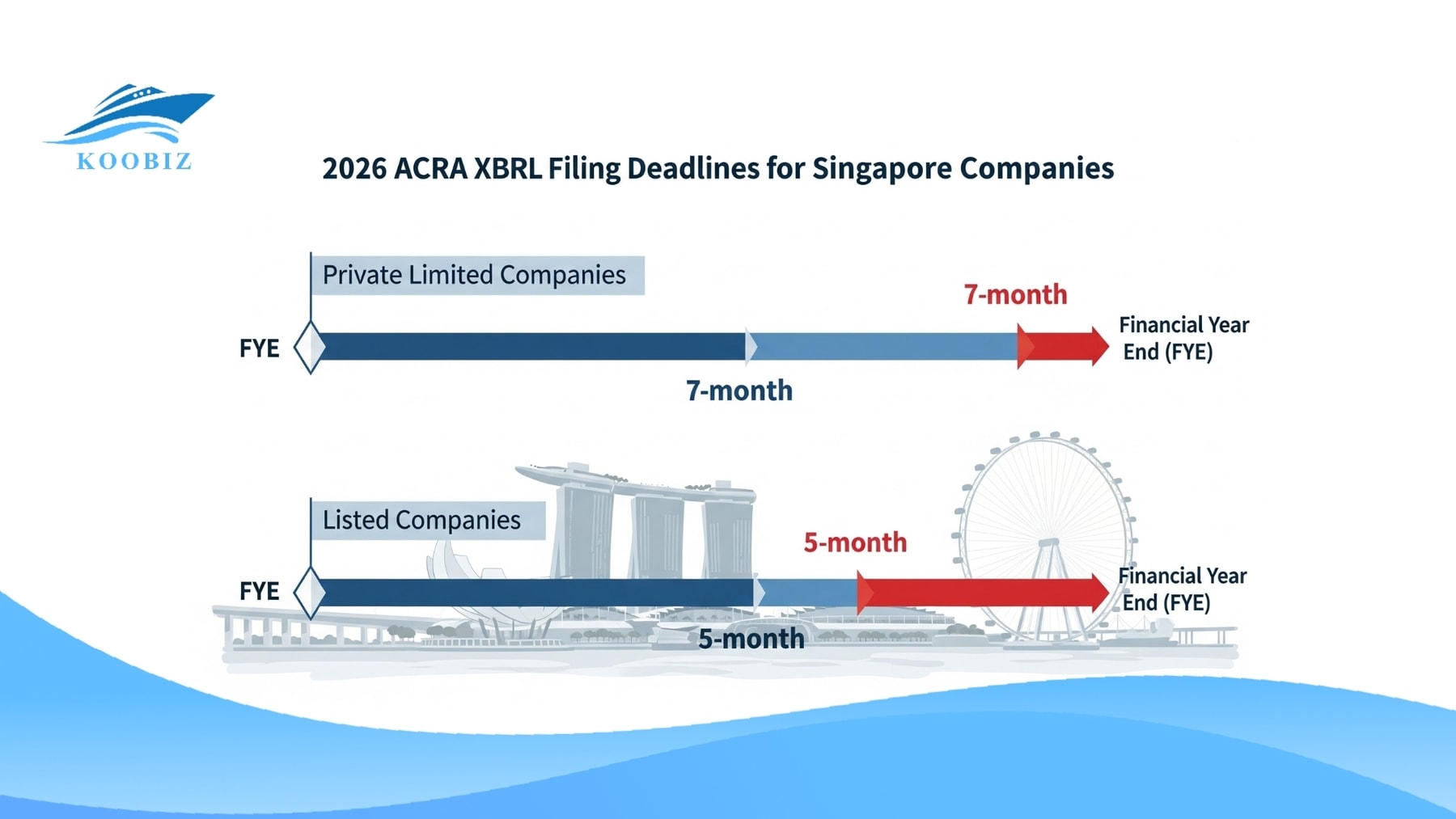
    The final step is filing the Annual Return (AR) via ACRA’s BizFile+ portal. As part of this process, companies are required to submit their financial statements, typically in XBRL format, depending on the filing requirements. The deadline for filing is within 7 months after the financial year-end.

    Real-World Scenarios: Who Qualifies? (Case Studies)

    To illustrate how the “Small Company” and “Small Group” audit exemption rules apply in practice, below are three representative case studies commonly encountered by Singapore businesses:

    Case Study 1: The Standalone Retailer (Eligible)

    Company: Orchard Boutique Pte. Ltd.

    Financial Metrics:

    • FY 2023: Revenue $1.2M | Assets $400k | Employees 8
    • FY 2024: Revenue $1.5M | Assets $500k | Employees 10

    Conclusion: Eligible for audit exemption

    Since the company is a private entity and meets all three criteria (well below the $10M/50 employee thresholds) for two consecutive years, it can file unaudited financial statements.

    Practical Impact: Estimated annual savings of S$2,000–S$4,000 in statutory audit fees.

    Case Study 2: The “Small Group” Structure (Eligible)

    Structure:

    TechHoldings Pte. Ltd. (Parent – 100% ownership)

    AppDev Pte. Ltd. (Subsidiary)

    Individual Entity Metrics:

    • TechHoldings (Parent): Revenue $0 | Assets $5M | Employees 2
    • AppDev (Sub): Revenue $8M | Assets $2M | Employees 20

    Consolidated Group Figures:

    • Total Revenue: $8M (Under $10M)
    • Total Assets: $7M (Under $10M)
    • Total Employees: 22 (Under 50)

    Conclusion: Eligible for audit exemption

    Even though there are multiple entities, the consolidated figures remain under the thresholds. Both the parent and the subsidiary can file unaudited statements.

    Case Study 3: The Disqualified Subsidiary (Not Eligible)

    Structure:

    Global Logistics Pte. Ltd. (Singapore subsidiary)

    MegaCorp Inc. (Foreign parent company)

    Financial Metrics:

    • Global Logistics (SG Sub): Revenue $2M (Small)
    • MegaCorp (Foreign Parent): Revenue $100M (Large)

    Conclusion: Not eligible for audit exemption

    While the Singapore subsidiary itself is “small,” it is part of a group that is “large” (consolidated revenue >$10M). Therefore, the Singapore subsidiary cannot claim audit exemption and must submit audited financial statements, unless it obtains a specific exemption or the parent has specific provisions.

    Lesson: Always look at the entire corporate family tree, not just the local entity.

    Unsure about your eligibility? Regulations can be complex, especially for group structures. Contact Koobiz for a free eligibility check to ensure you are on the right side of ACRA compliance.

    Advanced Filing Requirements and Common Mistakes

    There are specific technical pitfalls and formatting rules, particularly regarding digital data standards, that can cause compliance failures for unwary SMEs.

    Beyond the basic preparation, companies often stumble on the specific digital requirements of the Singapore government. ACRA is one of the most digitally advanced registries globally, and simply uploading a PDF is rarely sufficient.

    Understanding XBRL Filing Format for Unaudited Accounts

    XBRL (eXtensible Business Reporting Language) is an international standard used for the electronic communication of financial data. In Singapore, ACRA requires most companies to lodge their financial statements in XBRL format as part of the Annual Return filing process.

    Most SMEs are unaware that they cannot simply upload a PDF of their unaudited accounts. Depending on your company size, you will need to prepare the file in either “Full XBRL” or “Simplified XBRL.”

    • Simplified XBRL: Generally applicable for smaller, non-publicly accountable companies (Revenue <$500k and Assets <$500k).
    • Full XBRL: Required for larger companies.

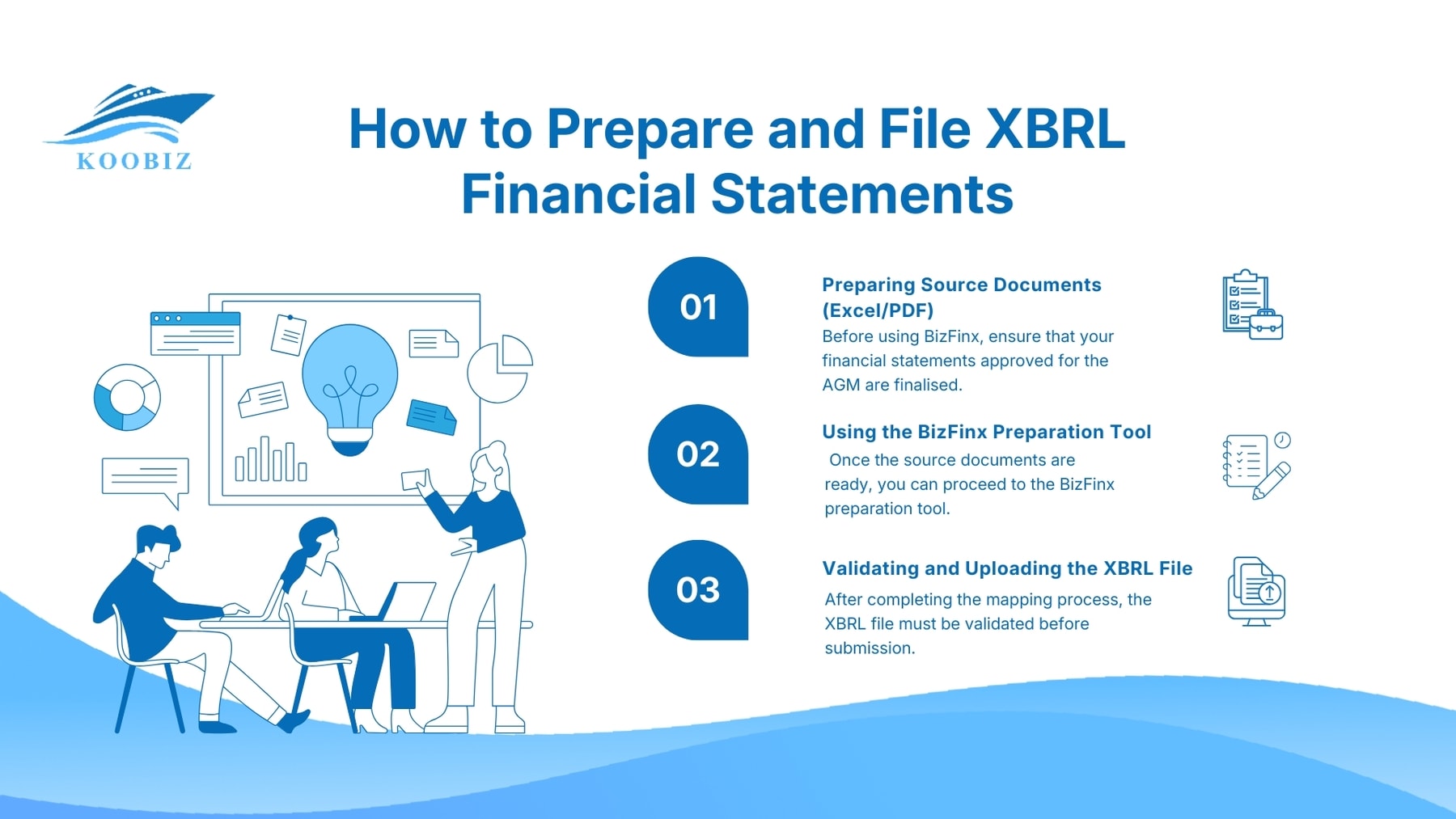
    Preparing this file requires specialized software or the use of the BizFinx preparation tool provided by ACRA. Errors in mapping your financial data to the XBRL taxonomy are common and can result in the rejection of your Annual Return. This is a technical step where professional assistance from Koobiz is highly recommended to ensure data integrity.

    Does a Dormant Company Need to File Unaudited Financial Statements?

    No, a “dormant relevant company” is generally exempt from both preparing and filing financial statements if its total assets are SGD 500,000 or less at any time during the financial year.

    For ACRA purposes, a dormant relevant company is one that is unlisted, not a subsidiary of a listed company, and has no accounting transactions since incorporation or since the end of the previous financial year. Where a dormant company’s total assets exceed SGD 500,000, unaudited financial statements must still be prepared and lodged in XBRL format, despite the absence of trading activity.

    Regardless of asset size, all dormant companies are required to file an Annual Return (AR) each year to formally confirm their dormant status with ACRA.

    Compilation vs. Preparation: Is a Chartered Accountant Necessary?

    A “Compilation Report” offers a higher degree of credibility than self-prepared accounts because it involves a Chartered Accountant arranging your financial data in compliance with SSRS 4410 (Singapore Standard on Related Services).

    While you are legally allowed to prepare unaudited statements yourself (as a director), banks and potential partners often view self-prepared documents with skepticism. A Compilation Report serves as a middle ground. It is not an audit (no assurance opinion is given), but it carries the letterhead and professional signature of a qualified accounting firm like Koobiz, signaling that the information is presented correctly and professionally. This is often the “sweet spot” for SMEs—gaining professional credibility without the cost of a full audit.

    Conclusion

    Preparing unaudited financial statements is a core compliance obligation for Singapore SMEs, offering a practical balance between regulatory transparency and cost efficiency. By accurately assessing audit exemption eligibility, complying fully with SFRS requirements, and meeting ACRA’s XBRL filing standards, businesses can maintain both statutory compliance and stakeholder confidence.

    At Koobiz, we specialize in simplifying corporate compliance for businesses in Singapore. Whether you need assistance with company incorporation, opening a corporate bank account, or require professional accounting and tax services to prepare your unaudited financial statements, our team of experts is ready to assist. Don’t let compliance worries slow down your business growth.

    Contact Koobiz today for a consultation on your financial reporting needs.

    • Website: koobiz.com
    • Services: Singapore Company Incorporation, Bank Account Opening, Tax, Accounting, and Audit Services.
  • Preparing a Cash Flow Statement for Singapore SMEs to Monitor Liquidity (vs Profit)

    Preparing a Cash Flow Statement for Singapore SMEs to Monitor Liquidity (vs Profit)

    [SUMMARIES]

    Mandatory Compliance: Under SFRS(I) 7, most Singapore companies must prepare a Statement of Cash Flows; Exempt Private Companies (EPCs) that are solvent may be exempt from filing full XBRL statements but should still prepare the statement for governance and audit readiness.

    Profit ≠ Cash: A profitable P&L can coincide with cash shortages – liquidity, not profit, pays the bills.

    Three Pillars: The statement tracks money moving through Operating (CFO), Investing (CFI), and Financing (CFF) activities.

    Preparation Methods: The Indirect Method is the practical standard for most SMEs (easier to produce from accrual accounts and software like Xero).

    Local Nuances: GST timing (9%) and reimbursement-based grants (PSG/EDG) can create large timing gaps that hurt liquidity.

    [/SUMMARIES]

    What is a Cash Flow Statement?

    The Cash Flow Statement records actual cash movements – when money hits or leaves the bank. Unlike the Income Statement (accrual-based), the cash flow report answers: Can we pay payroll and suppliers tomorrow? Banks and investors use it to assess the quality of earnings: high profit with negative operating cash flow signals earnings tied up in receivables or inventory.

    Is a Cash Flow Statement Mandatory for Singapore SMEs?

    Yes, preparing a cash flow statement is required under Singapore’s financial reporting framework (SFRS(I) 7). Filing obligations with ACRA differ by company type:

    • Publicly Listed Companies: Must file full financial statements including cash flows.
    • Non-Publicly Accountable Entities: Generally must include a cash flow statement in the annual financials.

    Exempt Private Companies (EPCs): Solvent EPCs may be exempt from filing full XBRL financials with ACRA but still should prepare full statements for internal control, bank lending, and potential IRAS audits; insolvent EPCs must file full statements. Koobiz recommends all EPCs prepare a cash flow statement regardless of filing exemption – banks and grant assessors expect it.

    Cash Flow vs. Net Profit: The “Gap”

    • Timing: Profit is recognised when earned; cash is recorded when received.
    • Non-cash items: Depreciation reduces profit but not cash — it’s added back in the cash-flow reconciliation.
    • CapEx: Equipment purchases reduce cash immediately but are expensed over time in P&L.

    Example: Invoice S$50,000 in Jan, 60-day credit. P&L shows revenue in Jan; cash arrives in Mar. If payroll and rent fall due before collection, the company can be unable to pay despite showing profit.

    The Three Key Components

    To monitor liquidity accurately, cash movements are separated into three “buckets”:

    1. Cash Flow from Operating Activities (CFO)

    Cash generated from core business operations.

    • Inflows: Customer receipts.
    • Outflows: Payments to suppliers, employees, and IRAS.

    Insight: A consistently negative CFO indicates the business model is not self-sustaining and relies on external funding.

    2. Cash Flow from Investing Activities (CFI)

    Cash used for buying or selling long-term assets (Capital Expenditure).

    • Outflows: Buying computers, machinery, or software.
    • Inflows: Selling old equipment.

    Insight: Negative CFI often signals a growing company investing in its future capacity.

    3. Cash Flow from Financing Activities (CFF)

    Cash flow between the company, its owners, and creditors.

    • Inflows: Issuing shares or taking bank loans.
    • Outflows: Paying dividends or repaying loan principals.

    Insight: High inflows mean the company is raising capital; high outflows mean it is servicing debt.

    Preparation: Direct vs. Indirect Method

    While SFRS(I) 7 encourages the Direct Method, the Indirect Method is standard for Singapore SMEs due to its simplicity and integration with software like Xero.

    • Direct method: Lists cash receipts and payments. Readable but hard to compile from accrual-ledgers.
    • Indirect method (recommended for SMEs): Start with Net Profit, add back non-cash items (e.g., depreciation), then adjust for working capital changes (Δ receivables, payables, inventory). It maps cleanly from the P&L and balance sheet. Koobiz’s accounting services can automate this reconciliation from Xero/QuickBooks exports.

    Case Study: The “Profitable but Poor” Dilemma

    Scenario: SingaTrading Pte Ltd closes January 2025 with a fantastic Income Statement but struggles to pay February rent.

    Financial Snapshot (January 2025):

    Metric Income Statement (Accrual) Cash Flow Statement (Actual)
    Revenue / Inflow S$100,000 (Invoiced) S$70,000 (Collected)
    Expenses / Outflow (S$80,000) (Incurred) (S$95,000) (Paid)
    Bottom Line + S$20,000 (Profit) – S$25,000 (Cash Drain)

    The Diagnosis:

    1. Operating (Root Cause): Customers haven’t paid S$30,000 yet (Accounts Receivable), while SingaTrading paid suppliers immediately.
    2. Investing: They spent S$5,000 upfront on software.
    3. Result: Despite S$20,000 profit, they are S$25,000 poorer in cash.

    The Fix: The Director must chase debt collection or negotiate 30-day credit terms with suppliers. Profit is an opinion; Cash is a fact.

    Practical Example: Sample Cash Flow Statement (Indirect Method)

    Here is a simplified standard format for a Singapore SME.

    Line Item Amount (SGD) Category
    Net Profit (from P&L) $50,000 Starting Point
    Adjustments:
    (+) Depreciation $5,000 Non-cash expense
    Working Capital Changes:
    (-) Increase in Receivables ($20,000) Cash not yet collected
    (+) Increase in Payables $10,000 Cash preserved (bills unpaid)
    (-) Tax Paid to IRAS ($5,000) Actual outflow
    Net Cash from Operating (A) $40,000 Actual Business Cash
    Investing Activities:
    (-) Purchase of Computers ($15,000) CapEx
    Net Cash used in Investing (B) ($15,000) Growth Spend
    Financing Activities:
    (+) Bank Loan Proceeds $50,000 Inflow
    (-) Loan Repayment ($8,000) Outflow
    Net Cash from Financing (C) $42,000 Funding
    Net Increase in Cash (A+B+C) $67,000 Total Movement

    Singapore Strategic Context: Grants and GST

    Beyond standard preparation, local factors significantly impact cash flow timing.

    1. The “Valley of Death” in Government Grants

    Grants like the Productivity Solutions Grant (PSG) and Enterprise Development Grant (EDG) are vital for SMEs, but they operate on a reimbursement basis.

    • The Trap: You must pay the vendor 100% upfront.
    • The Lag: Reimbursement (up to 50-70%) takes 1–3 months (or longer) after the claim is approved via the Business Grants Portal.
    • Impact: Your cash flow takes a massive hit in the month of purchase. Without bridge financing, a “grant-supported” project can cause a liquidity crisis.

    2. GST Impact (9% Rate)

    For GST-registered businesses, GST collected is a liability, not revenue.

    • Flow: You collect 9% GST on sales (increasing cash balance) but must pay it to IRAS quarterly.
    • Risk: If you spend this “extra” cash, you will face a shortfall when tax filing is due.

    Koobiz Tip: Consider the Major Exporter Scheme (MES) if you are a significant exporter. It allows you to import non-dutiable goods with GST suspended, significantly easing cash flow pressure.

    Common Warning Signs

    • If CFO is consistently negative, you are burning cash to sustain operations. You are surviving only by selling assets or borrowing.
    • A company can be solvent (Assets > Liabilities) but illiquid (Cash tied up in stock). If you cannot pay debts as they fall due, creditors can wind you up.
    • If it takes 90 days to sell and collect, but you pay suppliers in 30 days, you have a 60-day funding gap.

    Frequently Asked Questions (FAQ)

    Can a profitable company go bankrupt?

    Yes, “technical insolvency” occurs when a company can’t meet immediate debts despite positive equity or paper profit.

    Do I need to submit the Cash Flow Statement with Form C-S?

    Companies that file Form C-S (revenue ≤ S$5M) generally do not have to submit full financial statements with the tax return, but they must prepare and retain them for audits and lender/grant requests. Koobiz helps SMEs prepare filing-ready statements even when submission isn’t required.

    How do I handle Foreign Currency (FX)?

    Unrealized FX gains/losses in the P&L are non-cash items and must be adjusted out in the Operating section. However, actual foreign currency cash balances at year-end must be revalued at the closing rate to reflect the true SGD value.

    Conclusion

    Preparing a Cash Flow Statement under SFRS(I) 7 is not just a compliance exercise; it is a survival tool. By separating paper profit from actual liquidity and navigating Singapore’s specific grant and tax lags, you secure your business’s future.

    At Koobiz, we simplify Singapore’s financial reporting standards for you. Whether you need help with incorporation, corporate bank account opening, or accounting services to maintain healthy cash flow, our team is ready to assist.

    Visit Koobiz.com to optimize your financial strategy today.
  • Maximize Tax Benefits for Your Private Limited Company (Pte Ltd) in Singapore: A Corporate Tax Guide

    Maximize Tax Benefits for Your Private Limited Company (Pte Ltd) in Singapore: A Corporate Tax Guide

    [SUMMARIES]

    The Start-Up Tax Exemption (SUTE) scheme drastically reduces the effective tax rate for qualifying new companies during their first three years by exempting 75% of the first S$100,000 and 50% of the next S$100,000 of chargeable income.

    Established entities benefit from the Partial Tax Exemption (PTE) scheme, which exempts 75% of the first S$10,000 and 50% of the next S$190,000, alongside a single-tier tax system that ensures dividend distributions to shareholders are completely tax-free.

    Companies can further optimize their tax liability by claiming deductible business expenses-including wages subject to new 2025 S Pass thresholds-and leveraging the Foreign-Sourced Income Exemption (FSIE) and Double Taxation Agreements (DTAs) for cross-border trade.

    [/SUMMARIES]

    Maximizing tax benefits for your Private Limited Company (Pte Ltd) in Singapore involves strategically leveraging Singapore’s corporate tax incentives. Key schemes include the Start-Up Tax Exemption (SUTE) and Partial Tax Exemption (PTE), which can reduce your effective tax rate well below the headline 17%. While Singapore is globally renowned for its pro-business environment, simply incorporating is not enough; business owners must actively understand how chargeable income is calculated and which specific exemptions apply to their company’s lifecycle stage.

    To fully grasp the potential savings, one must first look beyond the headline figure and understand the distinction between the statutory corporate income tax rate and the effective tax rate that most companies actually pay. This distinction is crucial for foreign investors and local entrepreneurs alike who are planning their financial projections.
    For new businesses, the government offers generous support through the SUTE scheme, which provides a substantial partial exemption scheme for the first three consecutive Years of Assessment. This initiative is designed to support entrepreneurship and cash flow during the critical early years of operation.

    However, the benefits do not end once the startup phase is over; established companies, as well as foreign shareholders, can utilize deductions, the single-tier tax system, and international treaties to to minimise corporate tax liability and maximise after-tax profits. . The sections below explain how companies can legally optimise their corporate tax obligations.

    What Is the Corporate Income Tax Rate for a Singapore Private Limited Company (Pte Ltd) ?

    The Corporate Income Tax (CIT) rate in Singapore is a flat 17% levied on chargeable income, renowned for being one of the most competitive statutory rate in the Asia-Pacific region. This single rate applies to both local and foreign companies doing business in Singapore, providing a predictable fiscal environment.

    To understand how this impacts your bottom line, we must look beyond the headline figure. In reality, due to various tax incentives, rebates, and exemption schemes, the effective tax rate for many small-to-medium enterprises (SMEs) is often significantly lower than 17%.The Inland Revenue Authority of Singapore (IRAS) calculates tax based on the preceding financial year’s income, known as the Year of Assessment (YA). For example, income earned in 2024 is taxed in YA 2025.

    Understanding this baseline is essential before diving into the specific mechanisms that can reduce your liability.
    According to the Inland Revenue Authority of Singapore (IRAS), most Singapore companies achieve an effective tax rate significantly lower than 17% through government exemption schemes.
    What Are the Key Tax Exemption Schemes for New Startups?

    There is one primary scheme for new companies for new companies: the Start-Up Tax Exemption (SUTE) scheme, designed to reduce the effective tax rate significantly for the first three consecutive Years of Assessment (YAs). This scheme was introduced to encourage entrepreneurship and help local enterprises grow by exempting a large portion of their initial income from taxation.

    The mechanics of this incentive are outlined below to show how much tax savings are available.

    How Does the Start-Up Tax Exemption (SUTE) Scheme Work?

    The SUTE scheme offers a significant tax break by exempting 75% of the first SGD 100,000 of normal chargeable income from tax, and subsequently, a 50% exemption on the next SGD 100,000.

    Specifically, for the first three YAs where the company falls within the qualifying period:

    • First SGD 100,000: 75% exempt (You only pay tax on 25%).
    • Next SGD 100,000: 50% exempt (You only pay tax on 50%).

    What does this mean for your business? If your startup earns SGD 200,000 in profit, your effective tax payable is drastically reduced compared to the standard 17% calculation. This massive cash flow saving is absolutely vital for reinvestment into key business operations during the critical early stages.

    Does Your Private Limited Company (Pte Ltd) Qualify for the SUTE Scheme?

    Yes, your Private Limited Company (Pte Ltd) is generally eligible for the SUTE scheme, provided it meets three specific criteria related to shareholder structure and company type defined by IRAS.

    However, eligibility is not automatic. To benefit, you must ensure your company strictly complies with the following conditions:

    1. Incorporation Status: The company must be a Singapore-incorporated company.
    2. Tax Residency: The company must be a tax resident in Singapore for that YA (Year of Assessment).
    3. Shareholder Structure: The company must have no more than 20 shareholders throughout the basis period for that YA, where:
      • All shareholders are individuals; OR
      • At least one shareholder is an individual holding at least 10% of the issued ordinary shares.

    Important Note: Companies that are Investment Holding Companies or those undertaking Property Development (for sale, investment, or both) are STRICTLY EXCLUDED from the SUTE scheme. If you are unsure about your eligibility or shareholder structure, services like Koobiz can assist in structuring your incorporation correctly from day one to ensure you don’t miss out on these valuable benefits.

    How Can Established Private Limited Company (Pte Ltd) Benefit from the Partial Tax Exemption (PTE)?

    Established Private Limited Company (Pte Ltd) benefit from the Partial Tax Exemption (PTE) scheme by automatically applying a 75% exemption on the first SGD 10,000 of chargeable income and 50% on the next SGD 190,000.

    This scheme guarantees that even mature companies—or startups that have successfully passed their first three YAs—will still enjoy a significantly reduced tax burden. Importantly, unlike SUTE, the eligibility for PTE is much broader and applies to almost all companies.

    Specifically, the calculation for PTE is as follows:

    • First SGD 10,000: 75% exempt.
    • Next SGD 190,000: 50% exempt.

    In practice, this means the first $200,000 of your chargeable income will always enjoy reduced tax rates. This crucial mechanism ensures that the initial $200,000 of company income is NEVER taxed at the full 17% rate, acting as a permanent tax buffer for SMEs and allowing them to retain more earnings for expansion or dividends.

    CASE STUDY: Comparing Tax Benefits (SUTE vs. PTE)

    To clearly illustrate the tangible benefits of these tax schemes, let’s compare two hypothetical companies with the same chargeable income of SGD 200,000:

    Scenario A: New Startup (SUTE Benefits)

    • Total Income: SGD 200,000
    • Exemption on First $100k (75%): SGD 75,000 exempt
    • Exemption on Next $100k (50%): SGD 50,000 exempt
    • Total Tax Exempt: SGD 125,000
    • Taxable Income: SGD 75,000
    • Tax Payable (17% of $75k): SGD 12,750
    • Effective Tax Rate: 6.38%

    Scenario B: Established Company (STABLE PTE Benefits)

    • Total Income: SGD 200,000
    • Exemption on First $10k (75%): SGD 7,500 exempt
    • Exemption on Next $190k (50%): SGD 95,000 exempt
    • Total Tax Exempt: SGD 102,500
    • Taxable Income: SGD 97,500
    • Tax Payable (17% of $97.5k): SGD 16,575
    • Effective Tax Rate: 8.29%

    The Savings: Even without the startup status, MatureCorp pays an effective tax rate of only 8.29%less than half the headline rate of 17%! However, TechStart saves an additional SGD 3,825 purely due to the startup scheme, which underscores the CRITICAL IMPORTANCE of correct initial structuring.

    Tax Optimisation: What Business Expenses Are Deductible?

    There are two main categories of deductible business expenses: revenue expenses incurred in generating income and specific statutory deductions allowed by IRAS.

    Properly claiming these deductions is CRUCIAL for minimising your “Chargeable Income”—the figure your tax rate is actually applied to. The Golden Rule is that expenses must be “wholly and exclusively” incurred in generating that income.

    Key Deductible Expenses Include:

    • Employee Wages & CPF: Mandatory contributions and salaries for both local and foreign staff are fully deductible.
    • Rent & Utilities: Costs associated with your office or facility (e.g., rent, electricity, water, internet) are deductible.
    • Renovation & Refurbishment (R&R): Qualifying R&R costs can be claimed over three years (capped at SGD 300,000).
    • Capital Allowances: This refers to deductions for the wear and tear of fixed assets (such as machinery or office equipment)—claimed instead of depreciation, which is generally not tax-deductible.

    Important Update: 2025 S Pass Salary Thresholds

    When budgeting for foreign employee wages (which are deductible), companies must strictly adhere to Ministry of Manpower (MOM) standards to ensure work passes are approved. Effective 1 September 2025, the minimum qualifying salary for new S Pass applications will increase to:

    • All Sectors (except Financial): SGD 3,300 (increasing progressively with age up to SGD 4,800).
    • Financial Services Sector: SGD 3,800 (increasing progressively with age up to SGD 5,650).

    Ensuring your stated salaries meet these new benchmarks is ESSENTIAL for both legal compliance and ensuring your wage deductions remain valid.

    Conversely, private expenses of the business owner, potential losses, and capital expenses (like the costs to incorporate or acquire new assets) are generally NOT deductible. Ensuring your bookkeeping clearly separates these is a vital part of effective tax optimization.

    How Does Singapore’s Single-Tier Tax System Benefit Shareholders?

    The Single-Tier Tax System is a mechanism where tax is paid only at the corporate level, meaning dividends distributed to shareholders are exempt from further taxation.

    This eliminates the “double taxation” burden common in other jurisdictions, where profit is taxed once at the company level and again when distributed to shareholders. This system is a major pull factor for investors using Koobiz to set up their holding companies in Singapore.

    Is Dividend Income Taxable for Foreign Shareholders?

    No, dividend income is NOT taxable for foreign shareholders in Singapore, regardless of whether they are tax residents or non-residents.

    This policy significantly simplifies the tax obligations for international investors. Once the Singapore Private Limited Company (Pte Ltd) has paid its corporate tax (or enjoyed its exemptions), the remaining profit can be distributed to you anywhere in the world without withholding tax. This facilitates cleaner capital repatriation.

    What Is the Foreign-Sourced Income Exemption (FSIE) Scheme?

    The Foreign-Sourced Income Exemption (FSIE) scheme is a crucial relief scheme that allows Singapore tax residents to enjoy full tax exemption on foreign-sourced dividends, branch profits, and service income remitted into Singapore.

    To qualify, the foreign income MUST meet three specific conditions:

    1. The income has been subject to tax in the foreign jurisdiction.
    2. The headline tax rate of that foreign jurisdiction is at least 15%.
    3. The Comptroller of Income Tax is satisfied that the tax exemption would benefit the resident company.

    How Do Double Taxation Agreements (DTAs) Minimise Corporate Tax Liability and Maximise After-Tax Profits?

    Double Taxation Agreements (DTAs) are vital tools that minimise corporate tax liability and maximise after-tax profits by allowing companies to claim tax credits or exemptions for taxes paid in foreign jurisdictions, effectively preventing the same income from being taxed twice.

    Singapore has an extensive network of over 90 DTAs. If your Private Limited Company (Pte Ltd) trades cross-border, these agreements ENSURE that you are not paying full tax in both the partner country and Singapore. Leveraging these treaties requires careful documentationand proof of tax residency, which is a standard part of corporate compliance.

    Ready to incorporate and optimize your tax structure?

    Navigating the complexities of SUTE, PTE, and compliance can be daunting. At Koobiz, we specialize in seamless company incorporation and corporate secretarial services. We ensure your business is structured correctly from day one to qualify for maximum tax benefits.

    Contact Koobiz Today for a Consultation