JTC LaunchPad officially connects Singapore startups to 19 premier global hubs, providing unprecedented international infrastructure and mentorship.
Rapid scaling requires rigorous governance; an incorrect entity choice (Branch vs. Subsidiary) can expose the Singapore parent company to unlimited liabilities.
Neglecting domestic ACRA obligations or capital flow documentation can freeze operational funds and deter potential venture capital investors.
Success requires professional Corporate Secretary support and comprehensive health checks to ensure seamless cross-border synchronization.
Transforming complex governance into a competitive asset through optimized tax structures (DTAs) and investor-ready compliance from day one.
[/SUMMARIES]
Singapore’s startup ecosystem is entering an unprecedented era of global expansion. With JTC LaunchPad officially extending its network to 19 strategic cities worldwide-from San Francisco to Jakarta-the gateway for scaling your business has never been wider. However, while founders eagerly pack their bags to conquer new markets, a critical question remains: Is your corporate structure legally sound enough to handle cross-border operations without triggering fatal compliance traps back home?
JTC LaunchPad Expands Global Network to 19 Strategic Cities
JTC LaunchPad opens new pathways for global startup expansion
The recent upgrades at LaunchPad @ One-North are game-changers for Singapore startups. Through new strategic partnerships, JTC has successfully bridged our local ecosystem with 19 premier global hubs. This means expanding to key markets like San Francisco, Paris, Shenzhen, or Jakarta is now more accessible than ever.
As a growing business, you get to enjoy substantial operational perks-from premium CBD facilities and favorable rent-free periods to direct collaboration with established industry leaders. JTC provides the perfect physical launchpad and networking infrastructure to help you “start strong.”
However, here is the reality check: while the ecosystem opens the doors, the complex responsibility of cross-border compliance, tax efficiency, and corporate governance still falls squarely on your shoulders. Is your current corporate foundation ready to support this leap without legal friction?
The Hidden Compliance Risks in Rapid International Scaling
Scaling internationally requires stronger governance and compliance
Expanding your footprint through the JTC LaunchPad network to 19 global hubs is an exciting milestone. However, rapid scaling requires a solid corporate governance safety net. As you operate across borders, your compliance checklist naturally grows, bringing distinct legal and financial responsibilities that demand careful, strategic handling.
Strategic Failure and Risks of Incorrect Corporate Structure
When entering a new market, it’s easy to overlook the legal nuances of your setup-such as choosing between a Branch Office and a Subsidiary. This isn’t just an administrative detail; an incorrect framework can accidentally pierce your corporate liability shield. Without the right structure, you face:
Exposure to Unlimited Liability: Unintentionally making your Singapore parent company accountable for overseas operational debts.
Due Diligence Red Flags: Causing unnecessary delays or concerns for international venture capitalists during your next funding round.
Administrative Burden Managing ACRA and Global Compliance
When your team is intensely focused on winning foreign markets, domestic statutory duties in Singapore can easily be inadvertently overlooked. Missing deadlines for Annual General Meetings (AGMs) or Annual Return filings quickly jeopardizes your good standing with ACRA, leading to:
Financial Penalties: Unnecessary fines and summons for late statutory filings.
Tarnished Compliance Record: A compromised corporate status that alerts regulatory bodies.
Visa Application Roadblocks: Costly delays when you need to apply for or renew essential MOM work passes, such as the EP or EntrePass.
Financial Chaos regarding Capital Flow and Cap Table Complexity
Moving funds between your Singapore headquarters and international branches is rarely as simple as a standard bank transfer. To avoid having your operational capital frozen under strict global AML/KYC protocols, you need meticulously drafted Board Resolutions. Furthermore, bringing in foreign investors requires rigorous legal oversight over your equity to prevent:
Cap Table Fragmentation: A convoluted equity structure that makes ownership tracking and governance a significant compliance burden.
Deterring Institutional Investors: Complex capitalization tables that act as major red flags during your Series A or B funding rounds.
Essential Legal Foundations for “Go-Global” Startups
Corporate governance is key before scaling internationally
To leverage the JTC LaunchPad network smoothly, treat corporate governance as a strategic advantage, not just an administrative chore. Here are three foundational steps to secure your business before expanding overseas.
The Strategic Role of a Corporate Secretary in Global Expansion
Your Corporate Secretary is your frontline legal defense. Every overseas board decision and capital injection needs meticulous documentation. A professional ensures:
Regulatory Adherence: Keeping all cross-border filings strictly compliant with ACRA.
Investor Readiness: Maintaining transparency to easily pass rigorous VC due diligence.
Stakeholder Confidence: Securing trust with both local regulators and foreign investors.
Comprehensive Compliance Health Checks for Seamless Operations
Before committing resources abroad, a thorough compliance audit of your Singapore HQ is vital. Resolving hidden tax or statutory issues upfront guarantees:
Uninterrupted Capital Flows: Preventing global banks from freezing cross-border transfers.
Operational Continuity: Expanding smoothly without administrative roadblocks back home.
Strategic Company Formation and Tax Optimization
Simply registering a company abroad isn’t enough. You need expert guidance to choose the right structure (e.g., Branch Office vs. Subsidiary). An optimized setup empowers you to:
Minimize Tax Liabilities: Legally reduce your global corporate tax burden.
Protect Profit Repatriation: Channel net profits back to your Singapore HQ safely.
Common Questions When Expanding via JTC LaunchPad Network
Can a Singapore Subsidiary Benefit from Local Incentives in 19 Cities?
Yes, provided you choose the correct legal structure (Subsidiary vs. Branch) to meet specific local grant criteria. A strategic setup ensures you qualify for destination-based incentives while remaining compliant with Singaporean headquarters’ regulations.
Is Tax Residency Impacted When Operating in Multiple Global Cities?
Operating globally risks double taxation; thus, maintaining Singapore “Management and Control” is vital. Professional secretarial records and board resolutions are essential to legally substantiate your tax residency status and protect your profits.
How Long Does It Take to Set Up a Compliant International Structure?
While Singapore incorporation takes only 1-3 days, full international alignment requires 2-4 weeks. We recommend a “Compliance Health Check” one month prior to any global expansion to ensure seamless legal synchronization across markets.
Koobiz: Your Trusted Partner in International Expansion
Koobiz simplifies compliance for seamless global expansion
While JTC LaunchPad provides the infrastructure to scale, navigating global regulations is a different challenge. Koobiz acts as your strategic partner in Singapore, transforming complex compliance into a seamless foundation for your international growth.
We build a resilient framework designed to protect your assets and attract venture capital from day one:
Strategic Structure: Expert guidance on Subsidiary vs. Branch setups to optimize your global position.
Proactive Governance: Ensuring 100% compliance with ACRA and IRAS through professional Corporate Secretary services.
Operational Mobility: Streamlining bank account openings and Workpass applications to eliminate administrative friction.
Our mission is to ensure your Singapore HQ remains a robust anchor for your global journey, turning compliance into your competitive advantage.
Ready to scale safely across 19 global cities?Contact Koobiz today for a Professional Compliance Audit and strategic expansion consultation.
Newly created positions accounted for 49.3% of all job vacancies in 2025, up from 45.7% in 2024, driven mainly by business expansion.
Demand remains strong for technology and engineering roles, including software developers, data scientists, AI engineers, and systems analysts.
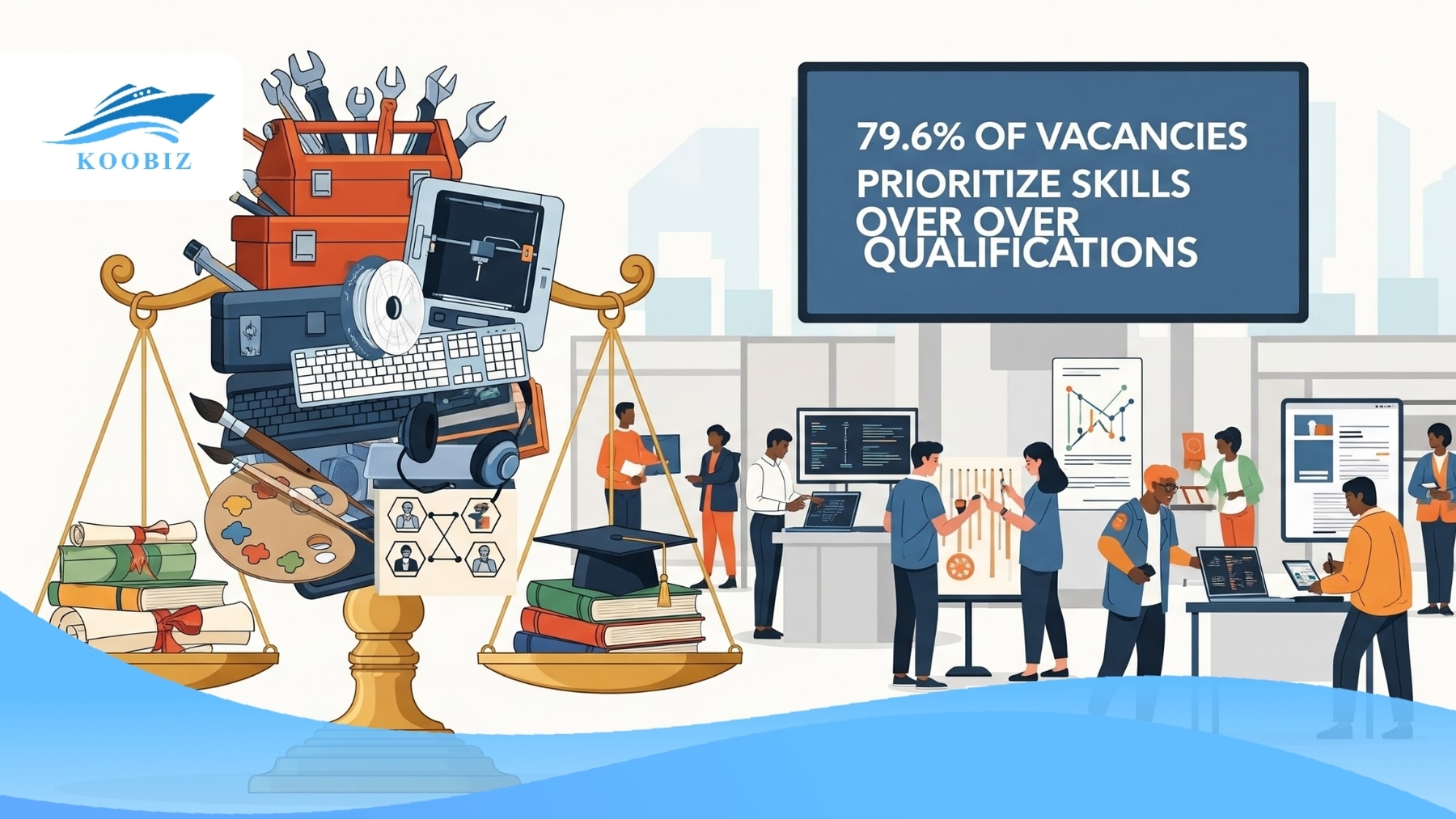
Employers broadened hiring criteria, with academic qualifications no longer the main factor in 79.6% of vacancies.
Overall hiring difficulties eased, though specialised PMET roles continue to take longer to fill, while remote-capable positions increased.
[/SUMMARIES]
The latest data from the Ministry of Manpower indicates that Singapore’s labour market stayed competitive in 2025, with a higher number of job vacancies compared to the previous year. Labour demand is gradually shifting towards growth areas, as firms create more new positions to support business expansion.
For foreign entrepreneurs and SMEs considering Singapore company formation, these patterns highlight where opportunities exist for building teams and the growing importance of skills-based recruitment when setting up operations locally.
Labour Demand Driven by Business Expansion
Hiring: 49.3% new roles due to expansion, concentrated in ICT and digital specialists
Newly created roles made up 49.3% of vacancies in 2025 (an increase from 45.7% in 2024). This growth was heavily concentrated in key sectors, with above-average shares in:
Information & Communications (74.2%)
Professional Services (58.2%)
Financial & Insurance Services (54.0%)
Technological advancements continue to drive demand for skilled professionals. Specifically, there is a robust need for digital and advanced manufacturing roles, including:
Software, web, multimedia, and game developers
Data scientists and systems analysts
AI and machine-learning engineers
Infrastructure and engineering professionals
The Shift to Skills-Based Hiring
Employers are increasingly placing greater emphasis on practical skills and competencies rather than traditional academic qualifications. In fact, qualifications were not the primary hiring criterion in 79.6% of vacancies.
Skill is key: 79.6% of vacancies do not require academic qualifications
This shift has allowed businesses to hire faster, access a wider talent pool, and improve overall employee performance. When looking at experience levels, the vacancies span a wide range:
31.5% required no prior experience.
20.2% needed at least one year of experience.
51.1% targeted mid-level candidates with 2 to 5 years of relevant exposure.
While the proportion of vacancies remaining unfilled for six months or longer fell to 17.1% overall, it edged up slightly for PMET (Professionals, Managers, Executives, and Technicians) roles to 16.0%. Specialised positions in software development and data science remain among the harder-to-fill roles due to their highly specific technical requirements.
Remote Work Trends and Local Talent Preference
The modern workplace continues to evolve. Remote-capable jobs rose to 22.7% of all vacancies in 2025.
At the same time, employer intent to recruit from overseas declined to 16.5%. This indicates a strong preference for hiring local talent whenever suitable candidates are available. While firms are expected to maintain a cautious approach to hiring in the near term, early 2026 indicators suggest a modest improvement in hiring sentiment.
Strategic Workforce Planning for SMEs
For SMEs in Singapore, these labour market signals reinforce the value of proactive workforce planning. Professional accounting and bookkeeping services can assist with accurate payroll forecasting and compliance as businesses scale their teams in line with evolving hiring trends.
As Singapore’s economy adapts to structural changes and technological shifts, staying informed about vacancy patterns helps businesses align their growth strategies with available talent. Entrepreneurs exploring Singapore company formation or those already operating locally can greatly benefit from expert guidance to integrate these insights into their HR and compliance frameworks.
Ready to set up your business?
Contact the Koobiz team for professional support with Singapore company formation, corporate secretary services, accounting solutions, and other corporate needs to navigate talent and operational requirements with confidence.
Foreign Talent & Visas: Expect higher minimum qualifying salaries for EP and S Passes from 2027, streamlined levy tiers, and a new ONE Pass (AI and Tech) track.
Business Grants: Access the Enterprise Workforce Transformation Package for up to 70% funding on job redesign and productivity initiatives.
Senior Workers: Retirement and re-employment ages will rise in July 2026, accompanied by CPF contribution adjustments and extended wage support.
[/SUMMARIES]
The Ministry of Manpower (MOM) has presented a clear framework to help businesses and workers adapt to economic shifts. Announced on 3 March 2026, these measures provide foreign entrepreneurs and SMEs with greater predictability around labour policies, talent strategies, and skills investment.
Understanding these updates is a critical step when planning a business setup in Singapore or scaling local operations. The new policies are structured around three core pillars.
Pillar 1: Empowering Local Talent and Senior Workers
Supporting Singaporean talent and senior workers
The first pillar focuses on supporting Singaporeans across all career stages, from fresh graduates to senior workers. To build confidence in emerging technologies, eligible learners completing selected SkillsFuture courses will receive six months of free access to premium AI tools by the second half of 2026.
Additionally, a new statutory board—Workforce and Skills Singapore—will merge existing agencies to deliver seamless career guidance and training.
Key changes for employers managing older workers include:
Retirement Age Increase: Rising to 64 (retirement) and 69 (re-employment) from 1 July 2026.
Senior Employment Credit: Extended until December 2027, offering up to 7% wage support for workers aged 69 and above.
CPF Contribution Hikes: Employer rates for workers aged 55–60 and 60–65 will rise by 1.5 and 1 percentage point respectively from 2027. This is supported by a one-year extension of the CPF Transition Offset (covering 50% of the increase).
Pillar 2: Driving Business Transformation and Global Talent
Driving Business Transformation & Global Talent
The second pillar focuses on equipping businesses for the future while remaining open to top-tier global professionals. For SMEs managing work pass applications, structured visa support will be essential to navigate the following regulatory changes:
Higher Work Pass Salaries: Minimum qualifying salaries will increase to S$6,000 for Employment Pass (EP) and S$3,600 for S Pass for new applications starting 1 January 2027 (and renewals from 1 January 2028).
New Tech Visa: A new ONE Pass (AI and Tech) track will replace the existing Tech.Pass from January 2027 to attract elite global talent.
Expanded NTS List: The Non-Traditional Source (NTS) Occupation List will add eight new roles in social services, food services, and air transport by September 2026.
Streamlined Levies: The levy framework will combine the bottom two tiers in the Manufacturing and Services sectors. R2 work permit levies in Marine and Process sectors will rise gradually from 2028.
Transformation Grants: The SkillsFuture Workforce Development Grant (Job Redesign+) launches in March 2026, covering up to 70% of project costs (capped at S$150,000) for reskilling and AI adoption.
Pillar 3: Fostering Inclusive Career Pathways
Fostering Inclusive Career Pathways
The final pillar emphasises fair and inclusive career progression across all wage levels.
Local Qualifying Salary (LQS): The baseline salary will rise to S$1,800 from 1 July 2026.
Progressive Wage Credit Scheme: Extended to 2028 with 30% co-funding. The qualifying wage increase threshold will also be raised by S$200 from 2027 to help employers offset wage costs.
Workfare Skills Support: Allowances for both long-form and short courses will be enhanced.
Maintaining Compliance and Seamless Corporate Services
These coordinated policies create a supportive environment for businesses by balancing workforce development with operational flexibility. However, adapting to new CPF rates, levy calculations, and work pass thresholds requires precise HR and payroll management.
As Singapore continues to evolve its employment landscape, staying aligned with these updates allows businesses to build resilient operations. Entrepreneurs exploring Singapore company formation can benefit immensely from expert guidance to integrate these policies seamlessly.
Contact the Koobiz team for professional support with company formation, corporate secretary services, accounting solutions, and visa assistance to navigate these 2026 manpower developments with confidence.
Entry-level monthly baseline wages will rise from S$2,220 in 2026 to S$2,500 by 2028, with year-on-year increments of up to S$145.
The schedule aligns with other PWM sectors starting in July each year, simplifying compliance for employers operating across multiple industries.
Expanded training options and enhanced Workfare Skills Support (WSS) schemes will help workers upskill while providing greater flexibility for employers.
[/SUMMARIES]
The recent acceptance by the Singapore Government of recommendations from the Tripartite Cluster for the Food Services Industry (TCF) introduces a structured approach to wage progression in one of the city-state’s key employment sectors.
For SMEs and foreign entrepreneurs exploring business setup in Singapore—particularly in the fast-paced food and beverage (F&B) space—these updates provide greater predictability around labour costs and workforce development.
Staying informed on such employment policies is crucial for operational planning and ensuring local compliance during your Singapore company formation process.
What is the 2026-2028 Food Services PWM Schedule?
Salary Increase in Singapore F&B Sector: 2026-2029
On 16 March 2026, the Government officially accepted the TCF’s recommendations for the Food Services Progressive Wage Model (PWM). First introduced in March 2023, the model protects and uplifts more than 53,000 full-time and part-time workers across the sector.
The newly approved three-year schedule runs from 1 July 2026 to 30 June 2029. It sets out clear baseline gross wage requirements that will increase annually.
To maintain alignment with the majority of other PWM sectors, all food services wage adjustments will take effect from 1 July each year. This strategic timing gives employers operating across multiple PWM-covered industries additional lead time to adjust payroll systems and administrative processes efficiently.
Approved Wage Requirements by Category
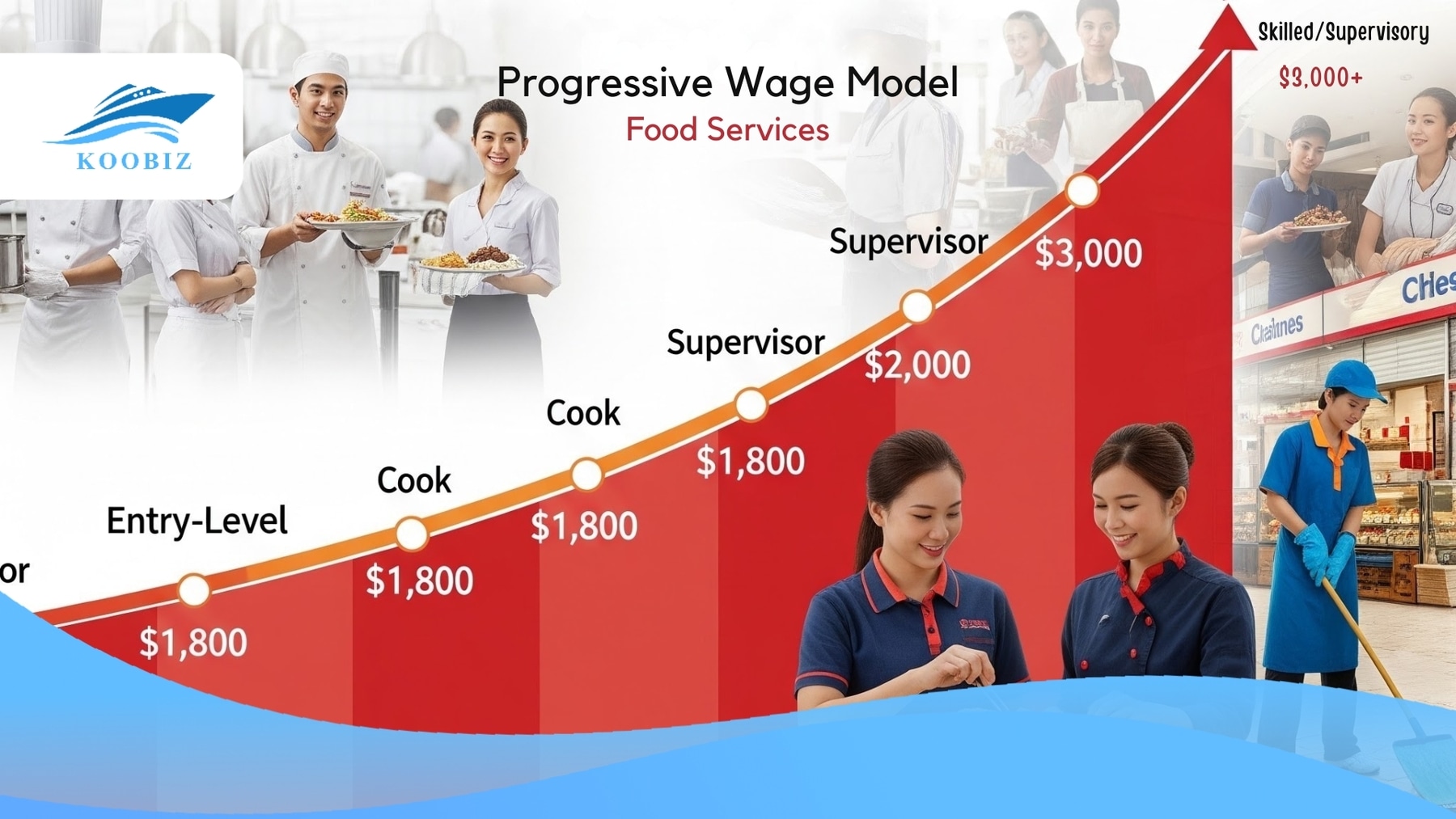
From 1 July 2026, the entry-level PWM wage requirement rises to S$2,220 per month (up from the previous S$2,080). The baseline monthly gross wage will then progress to S$2,500 by 2028, delivering consistent year-on-year increases of up to S$145.
To make forecasting easier for your F&B business, here is the breakdown of the mandatory wage increments:
Category A: Quick Services (QS)
(Applies to Quick Services Food Establishments & Supermarkets with ready-to-eat food stations)
Job Role
1 July 2026
2027
2028
Food/Drink Stall Assistant
S$2,220
S$2,360
S$2,500
Kitchen Assistant (QS) / Counter Attendant
S$2,295
S$2,435
S$2,575
Cook (QS)
S$2,470
S$2,610
S$2,750
Note: Hourly rates for part-time workers (under 35 hours per week) must be adjusted accordingly based on these baseline figures.
Category B: Full-Service (FS)
(Applies to Full-Service Food Establishments, Caterers, and Central Kitchens)
Job Role
1 July 2026
2027
2028
Kitchen Assistant (FS) / Waiter
S$2,320
S$2,460
S$2,600
Cook (FS)
S$2,520
S$2,660
S$2,800
Waiter Supervisor
S$2,875
S$3,020
S$3,165
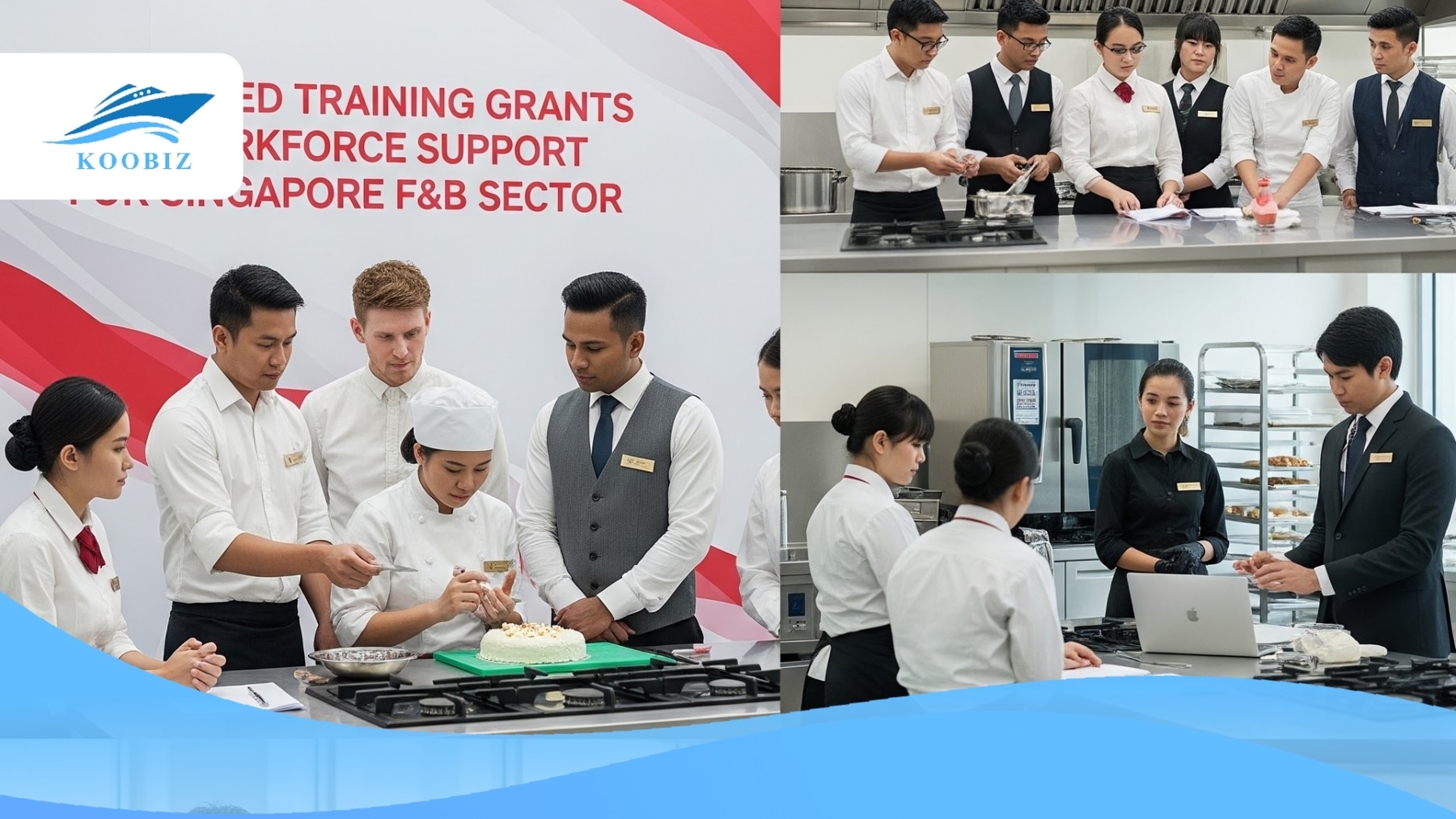
Enhanced Training Grants and Workforce Support
Training Support & Workforce Skills Enhancement
To support workforce development alongside wage increases, the TCF has expanded the list of acceptable Workforce Skills Qualification (WSQ) training modules. These fulfil the minimum PWM training requirement of two modules per worker. Relevant qualifications from Institutes of Higher Learning and Private Education Institutions are now officially recognised.
In addition, the Workfare Skills Support (WSS) scheme has been enhanced to assist employers and employees:
WSS (Level-Up): Self-sponsored trainees pursuing longer programmes can receive training allowances of up to S$18,000 per year (full-time) or S$3,600 per year (part-time).
Absentee Payroll: Employers sponsoring staff upskilling may qualify for Absentee Payroll support.
WSS (Basic): Shorter courses under this enhanced tier offer S$10.50 per hour in training allowances starting 1 July 2026.
Impact on F&B Business Setup in Singapore
For foreign entrepreneurs and SMEs establishing operations in Singapore, these structured increases allow for highly accurate payroll budgeting.
Integrating these requirements into your financial forecasting is essential. Engaging professional accounting and bookkeeping services can help ensure accurate payroll processing and ongoing regulatory compliance as part of your broader corporate services in Singapore.
Understanding how labour regulations interact with overall business compliance forms an important part of successful long-term operational planning. As Singapore continues to refine its labour policies to support both workers and businesses, proactive compliance remains your best strategy for sustainable operations.
Need Help Navigating F&B Compliance in Singapore?
Entrepreneurs considering business setup in Singapore or those already managing local entities can benefit from expert guidance on integrating these requirements into their HR and payroll frameworks. Contact the Koobiz team for professional support with Singapore company formation, corporate secretary services, accounting solutions, and other corporate needs to help navigate regulatory updates with confidence.
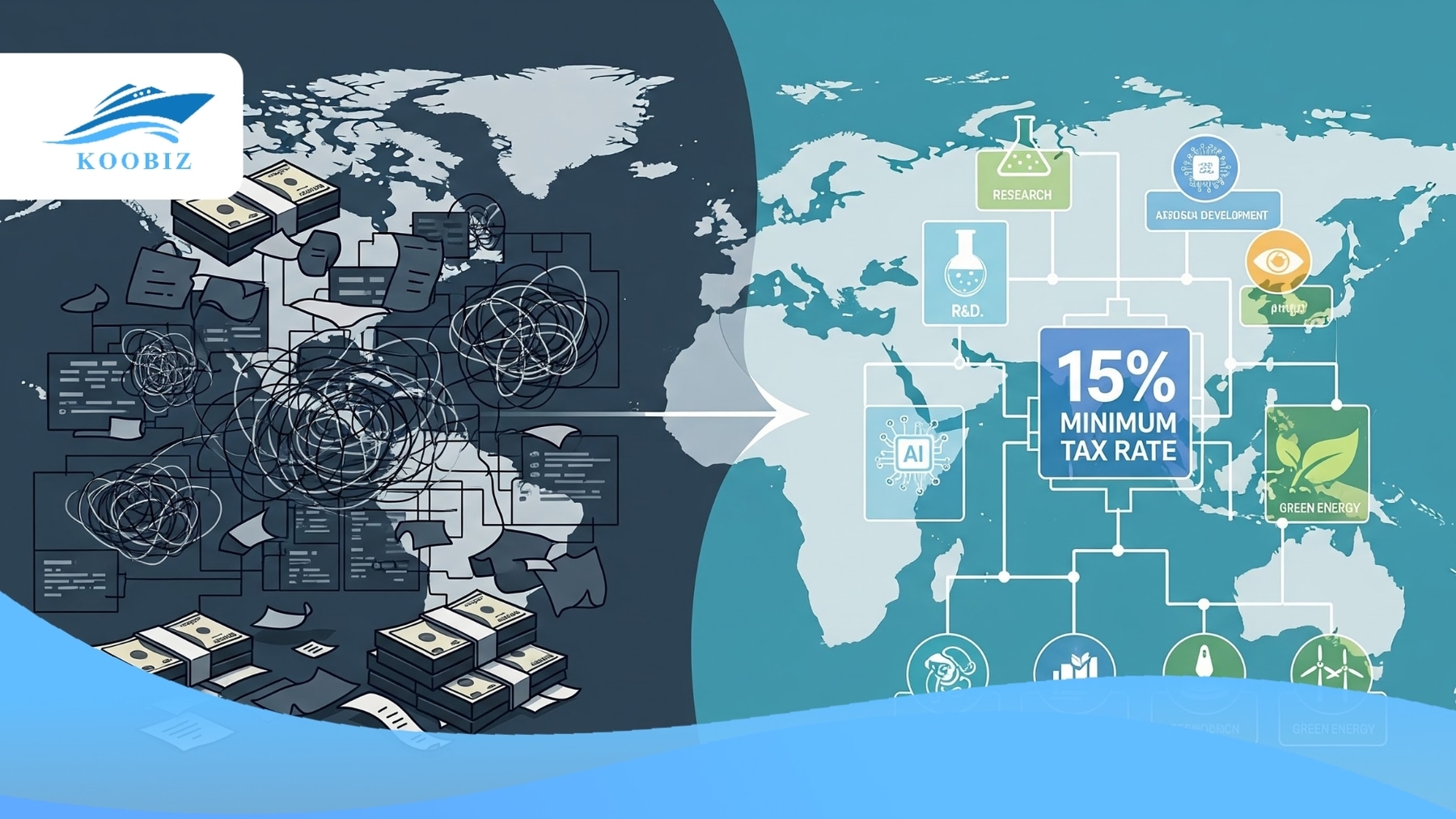
The OECD’s 15% global minimum tax in 2026 officially ends the era of 0% tax havens.
Multinationals are pivoting to “innovation hubs” that reward real economic substance.
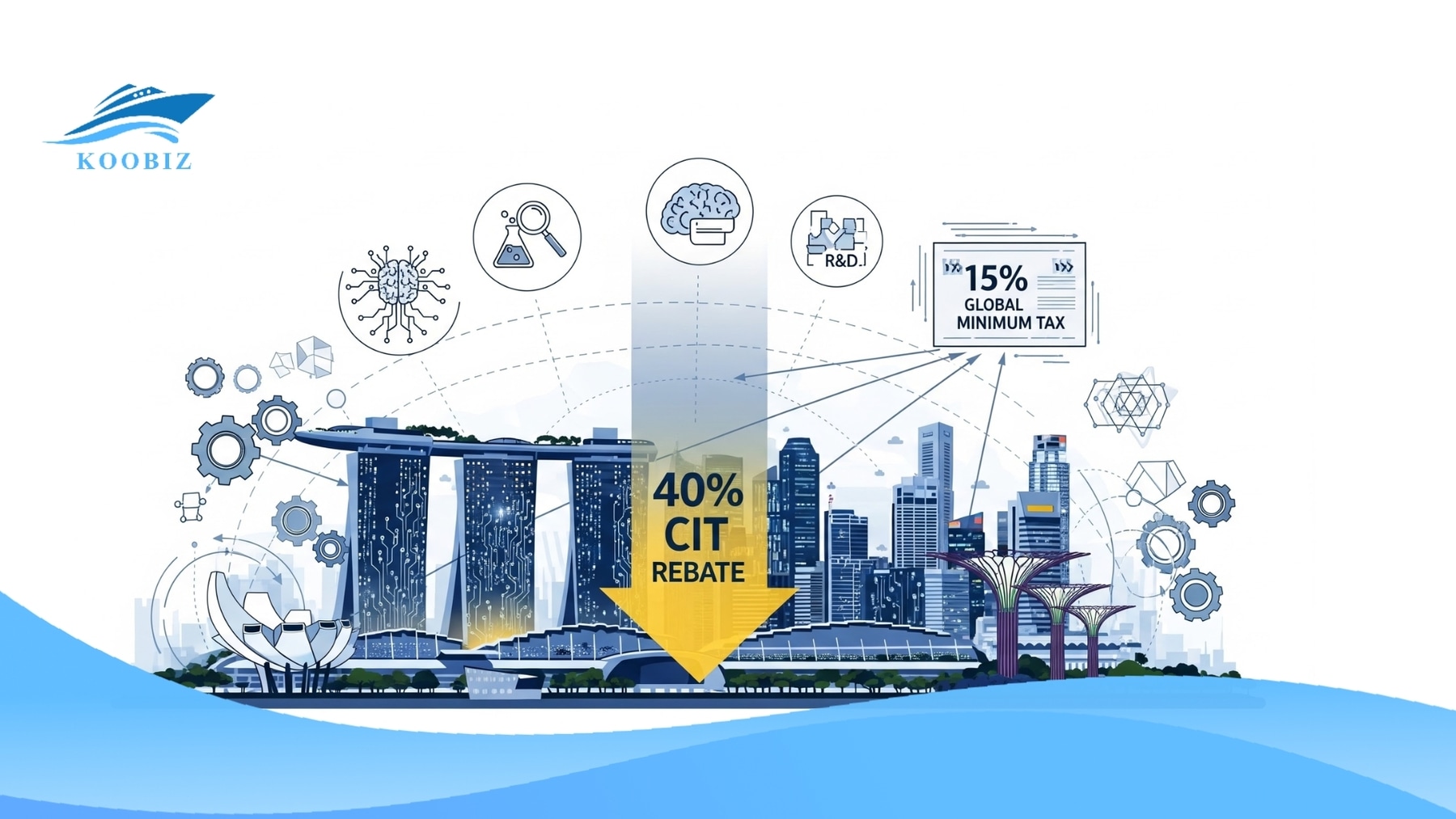
Singapore’s 2026 Budget offers a 40% CIT rebate and new 400% AI tax deductions.
Koobiz provides expert company formation, accounting, and tax compliance to navigate this shift seamlessly.
[/SUMMARIES]
The era of routing profits through zero-tax jurisdictions is coming to an end. In 2026, the global tax landscape is shifting from traditional tax havens toward innovation-driven business hubs. As international tax rules introduce a global minimum rate, traditional offshore structures are becoming less effective. As a result, many multinational companies are moving operations to jurisdictions like Singapore, which offer tax incentives for real economic activities such as AI development and regional expansion.
To navigate this transition, businesses often rely on professional service providers such as Koobiz for company formation, accounting, and corporate banking support. This article explores the global tax changes taking effect in 2026, their impact on corporate strategy, and how Singapore’s latest Budget incentives support businesses expanding in the region.
The Breaking News: The 2026 Global Tax Reality
15% Global Tax and Financial Transformation
The global tax framework in 2026 is shaped by the OECD’s 15% global minimum tax under Pillar Two. The rules introduce top-up taxes to ensure multinational enterprises pay at least the minimum rate in each jurisdiction where they operate.
To understand this shift, it is important to review the key agreements and mechanisms that led to the implementation of this long-planned global tax reform.
Pre-2026: The Era of the Tax Haven
For decades, many jurisdictions competed by lowering corporate tax rates to attract multinational companies. Jurisdictions aggressively competed to attract corporate headquarters by slashing their statutory corporate income tax rates to zero or near-zero.
Companies would establish entities with no real employees or physical operations, purely to hold intellectual property and accumulate profits in a tax-free environment.
However, coordinated international tax reforms are gradually limiting the effectiveness of these structures. The implementation of complex tax mechanisms ensures that multinational enterprises (MNEs) pay a fair share of tax wherever they operate, fundamentally neutralizing the primary appeal of traditional tax havens. This reform represents one of the most significant changes to international tax rules in recent decades.
January 5, 2026: The OECD “Side-by-Side” Breakthrough
On January 5, 2026, the OECD finalized its highly anticipated “Side-by-Side” (SbS) package for the Pillar Two framework. Supported by more than 140 jurisdictions, the agreement confirms the implementation of the 15% global minimum tax.
The SbS package was a crucial breakthrough, as it provided administrative guidance and a safe harbor that effectively aligned the United States’ complex tax system with the global framework. Before this agreement, there was significant uncertainty regarding how US-headquartered multinationals would be treated under the global rules, specifically concerning the Income Inclusion Rule (IIR) and the Undertaxed Profits Rule (UTPR).
With this agreement reached in early 2026, countries gained clearer guidance on implementing the global minimum tax framework across major economies.
Today: The Immediate Fallout
As multinational enterprises now face top-up taxes regardless of where profits are booked, traditional zero-tax havens are losing their main advantage.
If profits are recorded in a jurisdiction with a 0% tax rate, the new rules allow the parent company’s jurisdiction—or the jurisdictions where subsidiaries operate—to apply mechanisms such as the Qualified Domestic Minimum Top-Up Tax (QDMTT) or the Income Inclusion Rule (IIR) to ensure taxation up to the 15% minimum rate.
As a result, the administrative burden of maintaining shell companies in traditional tax havens often outweighs the remaining tax advantages. Compliance costs, reputational considerations, and the likelihood of paying the 15% minimum tax somewhere within the corporate structure are reducing the effectiveness of traditional offshore tax strategies.
OECD estimates referenced in recent analyses suggest that Pillar Two could generate around US$220 billion in additional annual global tax revenue, significantly reducing profit shifting by multinational enterprises.
The Macro Impact: How Corporate Strategy is Changing
Strategic Shift: From Tax Havens to Innovation Hubs
Corporate strategy is shifting from seeking zero-tax jurisdictions to prioritizing locations that offer tax incentives for real economic activities, particularly in research and development (R&D), green energy, and Artificial Intelligence (AI).
This shift is changing how corporate planners, legal teams, and Chief Financial Officers approach cross-border structuring and supply-chain planning.
Strategic Shift 1: From Paper Shells to Economic Substance
Chief Financial Officers and corporate planners are adjusting their strategies in response to the new global tax framework. The new question isn’t “Where can we pay zero tax?” but rather “Where can we get the best deductions for doing actual business?”Before 2026, corporate formation was heavily dictated by the legal and tax departments acting in isolation from the operational side of the business, often resulting in complex networks of dormant holding companies.
Today, tax strategy is increasingly aligned with operational activities. Many jurisdictions now enforce stricter economic substance requirements, requiring companies to demonstrate:
A physical office space
Adequate local expenditures
Full-time employees actively managing the business
As a result, many corporations are consolidating their global structures and relocating capital and intellectual property to financial centers where they plan to hire talent, conduct research, and manage regional operations.
Strategic Shift 2: From Zero-Tax Rates to Targeted Tech Incentives
Global competition for foreign investment is evolving. Instead of lowering headline corporate tax rates, many countries are competing by offering targeted tax incentives for activities such as R&D, green energy, and Artificial Intelligence (AI).
Before 2026, some jurisdictions used very low or zero headline tax rates to attract companies primarily holding profits or intellectual property. Today, the 15% global minimum tax acts as a baseline, shifting competition for foreign direct investment toward targeted deductions, incentives, and grants.
Innovation-focused jurisdictions are creating frameworks where companies can still reduce their effective tax rate legally by investing in activities that support the local economy. This includes:
Accelerated depreciation on high-tech equipment
Super-deductions for employee training in advanced digital skills
Cash rebates or grants for patent development
By encouraging innovation-driven investment rather than passive profit holding, these jurisdictions aim to build more resilient economies while remaining attractive to multinational corporations.
Recent CEO surveys indicate that more than 70% of multinational companies are adjusting supply chains and operations toward jurisdictions offering incentives linked to real economic substance.
Pillar Two Singapore 2026: The February Budget Spotlight
Singapore: 2026 Budget, Pillar Two & AI incentives
Singapore’s February 2026 Budget outlines how the country will implement the 15% global minimum tax while introducing a 40% corporate tax rebate and additional incentives supporting AI development and international expansion.
This fiscal policy provides a practical example of how modern innovation hubs design tax incentives to attract global businesses.
The Event
To see this shift in real-time, look at the Singapore FY2026 Budget delivered on February 12 by Prime Minister and Finance Minister Lawrence Wong. The budget was closely watched by the international business community, as it outlined Singapore’s response to the OECD Pillar Two framework.
While confirming the implementation of the Domestic Top-up Tax (DTT) and the Income Inclusion Rule (IIR) to ensure multinational enterprises meet the 15% effective tax rate, the government also introduced a series of targeted financial incentives. This approach signals to global investors that Singapore intends to comply with international tax rules while maintaining a competitive and business-friendly environment.
The Strategy
Rather than attempting to compete below the global 15% minimum tax rate, Singapore introduced several measures aimed at providing short-term operational relief for businesses:
A 40% Corporate Income Tax (CIT) Rebate (capped at SG$30,000) for the Year of Assessment 2026 to help businesses manage rising costs.
A minimum cash grant of SG$1,500 for active companies that employed at least one local worker in the previous year (CY 2025).
These measures aim to help companies manage the effects of global inflation, rising wage pressures, and supply chain disruptions. By focusing on operational relief rather than undermining the minimum tax rate, Singapore ensures that businesses operating within its borders maintain a healthy cash flow.
The “Innovation Hub” Push
In addition, Singapore is expanding incentives that support innovation and business development. They expanded several key programs to reward innovation:
Enterprise Innovation Scheme (EIS): Allowing companies to claim a 400% tax deduction on qualifying AI-related expenditures, capped at SG$50,000 per Year of Assessment (YA) for YA 2027 and YA 2028, in addition to the existing 400% deductions available for broader R&D activities.
Double Tax Deduction for Internationalisation (DTDi): Raising the automatic claim cap for this 200% tax deduction to SG$400,000, encouraging companies based in Singapore to expand internationally by covering costs for overseas market research, business missions, and trade fairs.
Business surveys in early 2026 indicate that many multinational companies are increasing their operational presence in jurisdictions such as Singapore that combine the 15% global minimum tax with R&D and AI incentives.
Ready to position your company in Singapore’s 2026 innovation hub environment? Koobiz can handle formation, banking, and EIS-compliant accounting end-to-end.
Singapore Company Formation Post-Pillar Two: Adapting with Koobiz
Adapting corporate strategy may involve reviewing existing offshore structures, aligning tax benefits with real operations, and leveraging Koobiz’s company formation and accounting services to maximize compliance and incentives.
Implementing this transition requires specialized expertise, accurate financial tracking, and familiarity with local regulatory frameworks.
The Compliance Challenge & Solution
Transitioning to an innovation hub means tax benefits are now tied to strict financial reporting. Companies must maintain detailed financial records distinguishing operational expenses from qualifying innovation expenditures in order to claim incentives such as the 400% AI deduction or the 40% CIT rebate. Incorrect expense classification or insufficient documentation may result in the loss of tax incentives or regulatory review.
This is where Koobiz steps in. By leveraging our expert accounting and bookkeeping services, your business ensures every qualifying expense is meticulously tracked. The professional team at Koobiz understands the exact nuances of the Enterprise Innovation Scheme, the DTDi, and standard corporate tax rebates. Koobiz helps businesses implement bookkeeping systems that accurately categorize AI investments, R&D expenses, and international expansion costs while maintaining compliance with Singapore tax regulations.
The Next Step: Seamless Company Formation
Businesses currently relying on traditional offshore structures may consider restructuring to align with the new global tax framework. Koobiz provides company formation services that support businesses establishing operations in innovation-focused jurisdictions such as Singapore, setting up your entities with the right foundation to thrive in the 2026 global economy.
Establishing or restructuring a corporate entity across jurisdictions can be complex, but service providers like Koobiz assist businesses throughout the process. We handle the end-to-end setup, including:
Registering your new company with the Accounting and Corporate Regulatory Authority (ACRA)
Securing the necessary corporate secretary services
Providing registered office addresses
Assisting with the process of opening corporate bank accounts with international financial institutions
By partnering with Koobiz, you are not just setting up a company; you are architecting a resilient, compliant, and highly optimized global business structure ready to capitalize on the future of international trade.
Singapore’s 2026 framework requires offer, acceptance, consideration, and legal intent for a contract to be enforceable.
Agreements are formed through written, digital, or conduct-based channels, commonly involving NDAs and shareholders’ agreements.
Vitiating factors like misrepresentation or duress can render these contracts void or unenforceable.
Breach remedies, such as damages or injunctions, are resolved through specialized forums like SICC, SIAC, or SIMC.
Ultimately, bespoke legal drafting is the primary strategy for ensuring robust business protection and risk management.
[/SUMMARIES]
In the rapidly evolving business landscape of 2026, Singapore remains a global gold standard for commercial legal frameworks. For business owners and investors, a solid grasp of Contract Law in Singapore is not just about compliance – it is a strategic asset that ensures certainty, manages risk, and protects long-term interests. Whether you are a tech startup, a growing SME, or an international corporation, this guide provides the most up-to-date insights into how contracts work in the Lion City.
What Is Contract Law in Singapore?
At its core, Contract Law in Singapore is the body of rules governing agreements between parties. Rooted in English Common Law, Singapore’s system has evolved into a modern, transparent, and highly predictable framework.
Unlike some jurisdictions where bureaucracy can be stifling, Singapore Law emphasizes commercial certainty. It is designed to ensure that if you make a valid promise in a business context, the law will hold you to it or provide a remedy if the promise is broken.
In 2026, this framework was further integrated with digital economy standards (such as the EU-Singapore Digital Trade Agreement), ensuring that even the most complex cross-border digital transactions are governed by clear, enforceable principles. For businesses, understanding this law means knowing that your “handshake” (whether physical or digital) is backed by a world-class judicial system, including the Singapore International Commercial Court (SICC).
Key Elements of a Valid Contract under Singapore Law 2026
Fundamental components of a legally binding contract in Singapore
For a contract to be legally binding and enforceable in Singapore, four legal elements must be present: offer, acceptance, consideration, and intention to create legal relations. In 2026, these elements form the legal foundation of every business contract, whether executed via traditional paper, email, or blockchain-based smart contracts.
Offer
An offer is a definite proposal to enter into a contract on specific terms, made with the intention that it will become legally binding upon acceptance.
Core legal rules:
The offer must be sufficiently clear and complete. Under Singapore law, advertisements, catalogues, and website price lists are generally treated as invitations to treat rather than binding offers. An offer may be withdrawn before acceptance, lapse after a reasonable time, or be terminated by a counter-offer.
Business risk:
If commercial communications such as quotations or proposals are not clearly labelled as non-binding, a business may unintentionally create a binding offer that can be accepted at any time.
Acceptance
Acceptance is an unconditional and final agreement to the exact terms of the offer.
Core legal rules:
Singapore applies the Mirror Image Rule, meaning that acceptance must correspond precisely with the offer. Any variation constitutes a counter-offer, which terminates the original offer. As a general rule, acceptance only takes effect when it is communicated to the offeror. Electronic and digital forms of acceptance are recognised under Singapore law.
Business risk:
Responses that introduce conditions or modifications may prevent a contract from being formed, even where the parties believe they have reached agreement.
Consideration
Consideration refers to the value exchanged between the parties in return for their contractual promises.
Core legal rules:
The law requires consideration to be legally sufficient but not commercially adequate. Courts will not normally assess whether the exchange represents a fair market price. Acts performed before a promise is made (past consideration) are generally not valid consideration for that promise.
Business risk:
Promises made out of goodwill, without any exchange of value, may be unenforceable. Businesses should ensure that every contractual obligation is supported by clearly defined consideration, even if only a nominal amount.
Intention to Create Legal Relations
This element concerns whether the parties intended their agreement to have legal consequences.
Core legal rules:
In commercial transactions, Singapore courts strongly presume that parties intend to create legal relations. This presumption can be rebutted by clear wording, such as the use of “subject to contract” during negotiations.
Business risk:
Without careful drafting, parties may become legally bound at a preliminary stage, or conversely fail to create a binding contract when they intended to do so.
How Contracts Are Formed in Practice
Common channels and practical methods of forming contracts in Singapore
In Singapore’s modern business environment, contracts may be formed through several practical channels:
Written contracts – The most common and reliable form of agreement, providing clear evidence of the agreed terms and easier enforceability in court.
Oral agreements – “Handshake deals” may be legally binding, but they are often difficult to prove without written records, which can lead to disputes over what was said or promised.
Contracts formed by conduct – A contract may be inferred from the parties’ behaviour, such as where services are regularly provided and payments are consistently made without a formal written agreement.
Electronic and automated contracts – Contracts may be concluded through digital platforms or automated systems when a predefined digital action triggers acceptance of the contractual terms.
Common Types of Contracts Used in Singapore
Understanding the main types of contracts commonly used in Singapore is essential for operating effectively in the local business environment. Each type of agreement serves a specific legal and commercial function in allocating risk, protecting assets, and regulating professional relationships.
Non-Disclosure Agreements (NDAs) are used to protect confidential and proprietary information shared during business discussions, negotiations, or collaborations.
Define what constitutes confidential information and the obligations of the receiving party.
Regulate the permitted and prohibited uses of such information.
Commonly include provisions on data protection, cybersecurity, and information processed through digital or automated systems.
Founders’ Agreements regulate the legal and commercial relationship between business founders at the early stages of a company’s formation.
Govern equity ownership, vesting arrangements, and management roles.
Allocate decision-making authority and provide mechanisms for resolving deadlocks.
Help prevent internal disputes from disrupting business stability and continuity.
Employment Contracts
Employment Contracts establish the legal relationship between employers and employees and must comply with applicable employment legislation.
Regulate remuneration, employee benefits, and working hours.
Set out workplace obligations, termination procedures, and notice periods.
Increasingly address flexible or remote working arrangements and restraint of trade (non-compete) clauses, which must be carefully drafted to remain legally enforceable.
Service & Vendor Agreements
Service and Vendor Agreements govern the provision of services or the supply of goods between commercial parties.
Define the scope of work, contractual deliverables, and performance standards.
Specify service levels, delivery timelines, and milestones.
Allocate commercial risk through liability limitation clauses and indemnity provisions in the event of service failures or contractual breaches.
Shareholders’ Agreements
Shareholders’ Agreements provide contractual protection beyond what is contained in a company’s Constitution.
Regulate management control, voting rights, and restrictions on the transfer of shares.
Provide mechanisms for protecting minority shareholders.
Support investor relations and long-term business strategies, including fundraising, acquisitions, and public listings.
When is a Contract Considered Void or Unenforceable?
Illegality or lack of capacity can render Singapore contracts unenforceable
Even if a contract is signed, it may be invalid if its legal foundation is defective. Under Singapore law, such defects are known as vitiating factors. They may render a contract void (no legal effect from the outset) or voidable (capable of being rescinded by the innocent party). Common situations include:
Misrepresentation
A contract may be set aside if a party was induced to enter into it by a false statement of fact. This includes fraudulent, negligent, and innocent misrepresentation.Example: A supplier states that its software is certified for financial institutions when it is not, and the buyer signs based on that claim.
Economic Duress
Where one party applies illegitimate commercial pressure, leaving the other with no real alternative but to agree, the contract or variation may be invalid.Example: A contractor threatens to stop work midway through a project unless the client agrees to pay a higher price.
Mistake
Only fundamental mistakes affecting the substance of the agreement may invalidate a contract.Example: An online system lists industrial machinery at S$1 instead of S$100,000 due to a system error, and the buyer knows it is clearly a mistake but proceeds to order.
Unconscionability
A contract may be unenforceable if it is extremely one-sided and results from the exploitation of a serious imbalance of bargaining power.Example: A large corporation imposes complex and harsh penalty clauses on a small startup that has no legal advice and no real ability to negotiate.
Illegality and Public Policy
Contracts involving unlawful conduct or unreasonable restraints on trade will not be enforced.Example: A non-compete clause prevents a former employee from working in the same industry anywhere in the world for 10 years.
Breach of Contract and Legal Remedies under Singapore Law
When a party does not perform its contractual obligations, a breach of contract occurs. Singapore law focuses on restoring the innocent party to the position it would have been in if the contract had been properly performed.
Damages (Financial Compensation)The primary remedy is monetary compensation for actual loss suffered. Many commercial contracts include liquidated damages clauses, which pre-determine the amount payable for specific breaches such as delay.Example: A supply contract may require payment of S$5,000 for each week of late delivery.
Specific PerformanceWhere money is insufficient and the subject matter is unique, the court may order the breaching party to carry out its obligations as agreed.Example: A seller who refuses to transfer a unique parcel of land may be compelled by court order to complete the transfer.
InjunctionsCourts may issue injunctions to prevent ongoing or threatened harm, particularly in cases involving confidential information or trade secrets.Example: A former business partner may be restrained from using the company’s client database after leaving the firm.
How Are Contract Disputes Resolved in Singapore? (Litigation, Arbitration, Mediation)
Choose the right resolution strategy with our expert legal guidance
Singapore is widely recognised as a leading centre for commercial dispute resolution. Businesses may choose between three principal mechanisms depending on the nature of the dispute, the contractual arrangements between the parties, and their commercial objectives.
Litigation involves resolving disputes through the Singapore Courts. For complex international commercial disputes, the Singapore International Commercial Court provides a specialised forum with both local and international judges. This mechanism results in a final and legally binding court judgment and is most suitable where authoritative legal interpretation or public precedent is required. Singapore courts have implemented electronic filing and digital case management systems to streamline procedural administration.
Arbitration
Arbitration is commonly selected for international and high-value commercial contracts and is frequently administered by the Singapore International Arbitration Centre. Disputes are determined by independent arbitrators rather than judges, and proceedings are conducted on a private and confidential basis. A key advantage of arbitration is that arbitral awards are enforceable in more than 160 countries under the New York Convention, making this mechanism particularly appropriate for cross-border transactions.
Mediation
Mediation involves negotiated settlement with the assistance of a neutral mediator, typically facilitated by the Singapore International Mediation Centre. This process is generally faster and more cost-effective than litigation or arbitration and allows parties to adopt flexible commercial solutions beyond monetary compensation, such as revising contractual terms. Mediation is especially suitable where the parties wish to preserve long-term business relationships.
Why Standard Templates Are Risky & When to Seek Professional Help
Professional legal consultation ensures full compliance with regulations
In 2026, many businesses rely on AI-generated or publicly available contract templates. While convenient, this approach creates significant legal risk under Singapore law.
Standard templates are problematic because:
Jurisdiction mismatch: Most online templates are drafted for foreign legal systems and may not comply with Singapore-specific legislation, such as the Contracts (Rights of Third Parties) Act.
Lack of commercial fit: Templates cannot reflect a company’s unique risks relating to intellectual property, staged payments, or regulatory obligations.
False security: A poorly drafted contract may appear protective but fail at enforcement, exposing the business when a dispute arises.
For transactions involving high value, regulatory exposure, or long-term commitments, professional legal review is often necessary to ensure enforceability and risk control.
How Koobiz Supports Businesses with Contract Law Matters
Effective contract management is essential for operating safely under Singapore law. Koobiz provides practical contract support tailored to commercial needs.
Koobiz assists businesses through:
Custom contract drafting based on the client’s industry, transaction structure, and risk profile.
Contract review and audits to identify weaknesses and ensure alignment with current legal standards.
Strategic legal support during negotiations and dispute resolution to protect commercial interests.
Protect your business today. Contact Koobiz to ensure your legal foundations are as strong as your business vision.
Public Liability Insurance (PLI) protects Singapore businesses against third-party injury and property damage claims arising from daily operations.
It covers compensation, legal defence, and settlement costs, but excludes employee injuries, which fall under WICA.
PLI is especially important for SMEs, retailers, F&B outlets, and on-site service providers.
Many landlords and contracts require minimum coverage, commonly S$500,000 or S$1 million.
Choosing the right PLI policy helps businesses manage financial risk while meeting contractual and operational requirements.
[/SUMMARIES]
Public Liability Insurance in Singapore protects businesses against third-party injury and property damage claims arising from daily operations. It is essential for SMEs and tenants who deal with customers or operate in physical locations. With proper coverage, businesses can meet landlord and contract requirements while reducing financial risk from unexpected incidents.
What is Public Liability Insurance (PLI)?
Public Liability Insurance (PLI) protects your business against legal and compensation claims from third parties who suffer injury or property damage as a result of your business activities.
It applies when your company is held legally responsible for harm caused to people outside your organisation, whether at your premises, at a client’s site, or during business operations and events.
In Singapore, PLI is essential for businesses that deal with the public, operate physical locations, or provide on-site services. It typically covers:
Medical and compensation costs
Legal defence expenses
Court-awarded or settlement damages
For example, if a customer is injured on your premises or your employee damages a client’s property while working on-site, PLI helps cover the resulting financial losses.
Although PLI is not always legally required in Singapore, many landlords, clients, and government contracts require businesses to hold this insurance before operating or starting a project.
What Does Public Liability Insurance Cover?
Scope of public liability protection
In Singapore, a standard Public Liability Insurance (PLI) policy provides financial protection against third-party claims arising from your business activities. Coverage generally falls into two key areas: bodily injury and property damage, and legal defence and settlement costs.
Bodily Injury & Property Damage
This coverage applies when third parties (excluding employees) suffer injury or property damage due to your business operations. It typically covers medical expenses, compensation payments, and the repair or replacement of damaged property.
Common examples include customers being injured on your premises or contractors accidentally damaging a client’s property while working on-site.
Legal Defence Costs & Settlements
PLI also covers the legal costs of defending your business against third-party claims, including lawyer fees, court expenses, and settlement or court-awarded damages.
Even if a claim is disputed or unfounded, legal defence can be costly. PLI helps manage these expenses within your policy limits, reducing financial exposure and allowing you to focus on business operations.
What Public Liability Insurance Does NOT Cover
Common exclusions in liability insurance
While Public Liability Insurance (PLI) provides broad protection against third-party claims, it is not a catch-all policy. Certain risks are excluded because they are better covered by other types of insurance.
Employee Injuries (Covered by WICA)
The most significant exclusion under a PLI policy is injury or illness suffered by your own employees. In Singapore, such claims are governed by the Work Injury Compensation Act (WICA), which is mandatory for most employers.
Why it is excluded: PLI is designed to protect against third-party (non-employee) claims only.
Coverage gap: If an employee is injured at work, your PLI policy will not respond. You must hold a separate WICA policy to cover medical expenses and compensation.
Most standard PLI policies also exclude:
Professional Errors or Negligence: Financial losses caused by incorrect advice or professional mistakes (requires Professional Indemnity Insurance).
Property Under Your Care, Custody, or Control: Damage to items you are repairing, servicing, or storing for a client.
Intentional Acts: Injury or damage caused deliberately by your business or employees.
Who Needs Public Liability Insurance the Most?
Businesses that need liability protection most
While any business that interacts with the public faces liability risks, certain industries in Singapore have higher exposure due to strict regulations, high foot traffic, and on-site operations.
Retail Shops & Showrooms (High Footfall)
Retailers are particularly exposed to slip-and-fall incidents. In Singapore’s busy malls, even minor hazards can result in legal claims.
Common risk scenarios include:
Customers slipping on wet or uneven floors
Injuries caused by unstable or collapsing display racks
Damage to customers’ personal belongings (e.g. spilling coffee on a designer bag)
Landlord requirement:
Most commercial landlords (such as CapitaLand and Mapletree) require tenants to maintain a minimum level of PLI coverage before handing over the premises.
Renovation Contractors & Handymen (On-site Risks)
Contractors working at client premises are responsible for accidental property damage and third-party injuries arising from their work.
Key risks include:
Damage to fire sprinkler systems causing flooding
Tools or materials falling from height and injuring passers-by
Contractual necessity:
Management corporations (MCST) commonly deny site access to contractors who cannot provide a valid Certificate of Insurance (COI).
Food & Beverage (F&B) Businesses
In addition to physical accidents, F&B operators face health-related liability risks.
Food poisoning coverage:Often required to meet Singapore Food Agency (SFA) licensing conditions, this extension covers claims from customers who fall ill after consuming contaminated food.
Common claims include:
Severe allergic reactions due to undeclared ingredients
Burns or injuries caused by hot food and beverage spills
Real-Life Claim Examples – Why This Insurance Matters
Real F&B claims showing the value of insurance coverage
Real-life incidents show how quickly unexpected accidents can turn into costly legal claims. For many SMEs in Singapore, a single liability claim can be financially damaging without proper insurance protection.
Retail Shop Slip-and-Fall
A customer slipped on a wet floor in a retail store after a spill was not cleaned up promptly. The customer suffered a back injury and filed a claim for medical expenses and loss of income. Public Liability Insurance covered the legal defence costs and compensation payout, preventing the business owner from paying out of pocket.
Contractor Damaging Client Property
A renovation contractor accidentally drilled into a concealed water pipe, causing flooding and damage to a client’s flooring and furniture. The client claimed for repair costs and business interruption losses. The contractor’s Public Liability Insurance paid for the property damage and settlement costs.
Food Poisoning Incident at an F&B OutletSeveral customers reported food poisoning after dining at a small restaurant. They demanded compensation for medical treatment and emotional distress. The restaurant’s Public Liability Insurance helped cover the legal expenses and compensation claims, allowing the business to continue operating without severe financial strain.
These examples highlight that accidents can happen even in well-managed businesses. Public Liability Insurance acts as a financial safety net, protecting business owners from sudden and potentially overwhelming liability claims.
How Much Does Public Liability Insurance Cost in Singapore?
The cost of Public Liability Insurance (PLI) in Singapore is not fixed. Instead, it is calculated based on your business risk profile, industry type, annual turnover, and the specific scope of activities insured.
As a general estimate:
Low-risk businesses (small offices, consultancies, home-based businesses): S$150 – S$300 per year
Medium-risk businesses (retail shops, small service providers): S$300 – S$600 per year
Higher-risk businesses (F&B outlets, renovation contractors): S$600 – S$1,500+ per year, depending on coverage limits and risk exposure
Note: These figures are indicative and subject to the insurer’s underwriting criteria, chosen limits, and prevailing GST.
Factors: Limit of Indemnity ($500k vs $1M)
The most significant factor affecting your premium is the Limit of Indemnity the maximum amount the insurer will pay for a single claim or within the policy period. In Singapore, the choice usually comes down to two standard tiers:
S$500,000 Limit: This is typically the entry-level coverage. It comes with a more affordable premium and is often sufficient for home-based businesses or small offices with minimal public visitors.
S$1,000,000 Limit: This is widely considered the “Gold Standard.” Most major landlords (such as CapitaLand or Mapletree), property managers, and government bodies through GeBIZ tenders mandate a minimum of S$1 million in coverage before a contract can be signed.
For businesses in high-risk sectors like F&B or renovation, opting for a higher limit is crucial. A single serious injury or major fire could easily exceed a lower cap, leaving your business to pay the difference out-of-pocket. When choosing your policy, it is vital to prioritize a limit that meets your contractual obligations and realistic risk exposure over simply picking the cheapest premium.
Public Liability Insurance vs Other Business Insurance
Public Liability Insurance is frequently confused with other business covers. However, each serves a distinct purpose. In Singapore, a “one-size-fits-all” approach often leaves businesses exposed to costly gaps.
Below is a comparison to help you identify the right combination for your business:
Type of Insurance
What It Covers
Who It Protects
Is It Mandatory in Singapore?
Public Liability (PLI)
Third-party bodily injury & property damage from business operations.
Customers, visitors, and the general public.
Contractual. Required by most landlords and clients.
Professional Indemnity (PI)
Financial loss arising from errors, omissions, or negligent advice.
Clients receiving your professional services.
Professional Requirement. Mandatory for lawyers, auditors, and doctors.
Work Injury Compensation (WICA)
Medical expenses and loss of wages for work-related injuries/illness.
Your employees (Local & Foreign).
Legal Mandate. Compulsory for most employees under MOM law.
How They Work Together (Examples):
PLI: A client slips in your office and sues for medical bills.
PI: You provide a tax consulting report with an error that costs your client S$50,000 in fines.
WICA: Your office manager develops carpal tunnel syndrome or trips over a cable while working.
Most Singapore SMEs opt for an “SME Package” which bundles PLI and WICA together. However, if your business involves advisory or specialized services (IT, Design, Consulting), adding a PI policy is essential to protect your professional reputation.
How to Choose the Right Public Liability Insurance Policy
Tips for selecting suitable liability coverage
Choosing the right Public Liability Insurance policy is about matching coverage to your business risks and operational needs in Singapore not simply selecting the cheapest option.
Assess your public exposure: Businesses with high customer traffic, on-site work, or physical products face higher risks and usually need higher limits of indemnity.
Check contractual and regulatory requirements: Many landlords, property managers, and government projects require a minimum coverage level (commonly S$1 million) before operations can begin.
Review the scope of insured activities: Ensure all your business activities are properly declared and covered, especially if you provide multiple services.
Evaluate claims handling and legal support: Look for clear claims procedures, reliable legal defence, and prompt handling of third-party claims.
By selecting coverage based on risk exposure, required limits, and business needs rather than price alone, you secure meaningful protection instead of basic compliance.
Common Mistakes Businesses Make with Public Liability Insurance
Many SMEs in Singapore buy Public Liability Insurance for compliance, not protection only to discover coverage gaps when claims are rejected. The most common mistakes include:
Low indemnity limits: Choosing S$500,000 to save costs may be risky. A serious accident or disability claim can easily exceed this amount, leaving the business to pay the difference.
Incorrect business descriptions: If your policy states “general retail” but the incident happens during an undeclared activity (e.g. outdoor events), the insurer may deny the claim.
Confusing PLI with WICA: PLI covers the public, not employees. Staff injuries must be insured under WICA. Using PLI instead breaches MOM regulations and exposes your business financially.
Ignoring excess and deductibles: A low premium with a high excess means frequent small claims will still come out of your own pocket.
Late claim reporting: Insurers require immediate notification of any incident that may lead to a claim. Delayed reporting can invalidate coverage.
Koobiz Will Help You Find the Right Public Liability Insurance
Koobiz helps Singapore businesses choose the right Public Liability Insurance based on their industry, risk exposure, and contractual requirements. Instead of one-size-fits-all policies, Koobiz recommends coverage that reflects your actual business activities.
With Koobiz, you can:
Choose an appropriate limit of indemnity
Ensure all business activities are properly covered
Comply with landlord and contract insurance requirements
Avoid coverage gaps that could lead to claim rejection
Koobiz simplifies the process, helping SMEs secure reliable protection without unnecessary complexity.
Prime Location: Singapore remains a top global hub for startups due to its pro-business policies, 100% foreign ownership allowance, and attractive tax exemptions.
Top Profitable Sectors: High-yield industries include FinTech, E-commerce, Health & Wellness, F&B (Cloud Kitchens), and specialized B2B Consulting.
Seamless Setup Process: Legally starting a business requires choosing an entity, ACRA registration, opening a bank account, and appointing a corporate secretary.
Koobiz Support: Koobiz provides end-to-end solutions, from company incorporation and nominee director services to corporate bank account advisory, tax, and accounting.
[/SUMMARIES]
Choosing the right business to start in Singapore is not just about having a good idea. Long-term profitability depends on selecting a scalable model, complying with local regulations, and having reliable corporate support such as Koobiz to handle incorporation and compliance. This guide outlines the 10 most profitable business ideas in Singapore for 2026, along with practical incorporation steps and key considerations for both foreign and local founders.
Is Singapore Still a Good Place to Start a Business?
Singapore – the most attractive jurisdiction to start a business
Yes, Singapore remains one of the most attractive jurisdictions to start a business, supported by competitive tax rates, a strategic geographic location, and strong government-backed startup initiatives.
The following factors explain why Singapore continues to rank as a leading global business hub:
Highly Favorable Tax System: Singapore applies a flat corporate tax rate of 17%, with no capital gains tax and no tax on dividends. The Start-Up Tax Exemption (SUTE) scheme further reduces taxable income during the first three years of assessment for qualifying companies. Additionally, companies can take advantage of the new 40% Corporate Income Tax (CIT) Rebate for YA 2026 (capped at S$30,000, with a possible cash grant), making it incredibly cost-effective to scale right now.
100% Foreign Ownership: Foreign investors may own 100% of a Singapore company’s shares without a local equity partner, provided they appoint at least one locally resident director, as required by Singapore law.
Strategic Global Location: Located in the heart of Southeast Asia, Singapore offers direct access to fast-growing regional markets like Malaysia, Indonesia, Vietnam, and Thailand.
World-Class Infrastructure & IP Protection: Singapore also benefits from strong intellectual property protection, political stability, and a highly skilled workforce. The ecosystem allows innovative tech and creative ideas to scale rapidly and safely.
Singapore ranks #1 globally in the World Bank’s Business Ready (B-READY) 2025 report for overall business readiness and operational efficiency, proving its unparalleled regulatory environment.
What Are the Top 10 Profitable Business Ideas in Singapore?
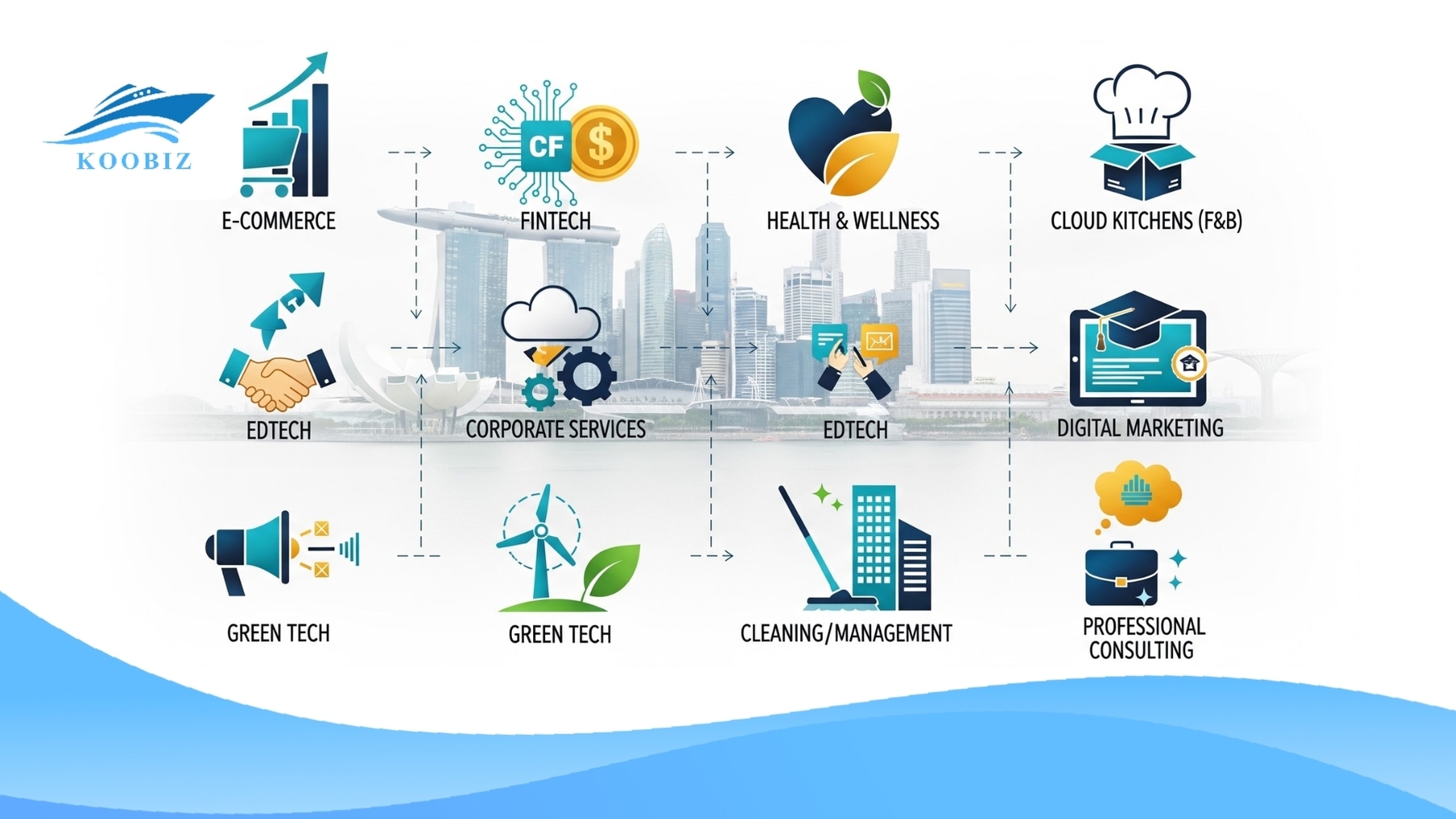
Based on current market demand, the 10 most profitable business ideas in Singapore include E-commerce, FinTech, Health and Wellness, F&B, Corporate Services, EdTech, Digital Marketing, Green Tech, Cleaning Services, and Professional Consulting.
These sectors deliver strong return on investment (ROI) driven by changing consumer behaviour, targeted government initiatives, and rapid technological adoption. Below is a practical breakdown of each business idea to help you assess alignment with your capital structure and operational expertise.
10 profitable business ideas Singapore
1. E-commerce and Cross-Border Retail
Singapore’s digital retail sector continues to expand, positioning e-commerce as one of the most accessible and scalable business models. Singapore’s excellent logistics infrastructure, anchored by Changi Airport and the Port of Singapore, makes it the perfect base to sell to the broader ASEAN market.
Pros: Lower upfront capital requirements, reduced inventory risk through dropshipping models, and strong regional logistics connectivity.
Cons/Challenges: High market competition and compliance with cross-border tax and customs regulations.
The Koobiz Advantage: We support e-commerce founders by structuring entities for tax efficiency and managing ongoing corporate tax compliance to ensure you remain compliant while scaling globally.
2. FinTech and Web3 Solutions
Singapore is recognised as one of Asia’s leading FinTech hubs. With active regulatory oversight and innovation support from the Monetary Authority of Singapore (MAS), starting a business in blockchain tech, digital payments, or WealthTech offers strong long-term commercial potential.
Pros: High scalability, access to institutional funding, and government-backed innovation programmes.
Cons/Challenges: Strict regulatory compliance and complex initial entity setups.
The Koobiz Advantage: We manage the complex incorporation requirements and provide expert corporate secretarial services, ensuring your FinTech startup meets all rigorous local governance standards from day one.
3. Health and Wellness Services
Singapore has a rapidly aging population and a highly stressed corporate workforce, driving sustained demand for health and wellness services like boutique fitness studios, mental health apps, and specialized nutrition consulting.
Pros: Year-over-year revenue growth, diverse profitable niches, and high consumer willingness to spend on self-care.
Cons/Challenges: Stringent licensing requirements for health products and high physical space rental costs.
The Koobiz Advantage: We streamline your business registration and provide accurate financial reporting to help you keep your operational overheads and rental costs strictly in check.
4. F&B (Food and Beverage) and Cloud Kitchens
The modern “Cloud Kitchen” (or ghost kitchen) model has significantly improved cost efficiency within the traditional F&B sector by operating as a delivery-only food business tailored to health-conscious demographics.
Pros: Reduces fixed overheads such as prime retail rental and front-of-house staffing.
Cons/Challenges: Managing tight profit margins on delivery apps and complying with the National Environment Agency (NEA) licensing.
The Koobiz Advantage: Our precise accounting services help you track your food costs and platform margins meticulously, ensuring your cloud kitchen remains consistently cash-flow positive.
5. Corporate and Accounting Services
With thousands of new companies registering in Singapore every month, B2B services (like corporate secretaries, tax consultants, and HR recruiters) highlight the sustained and recurring demand for corporate compliance and advisory services.
Pros: High-margin, low-overhead business model with recurring revenue streams.
Cons/Challenges: Requires deep local legal and financial expertise.
The Koobiz Advantage: While this is our core area of expertise, we also support independent consultants and professional service agencies. We can serve as your reliable backend corporate secretary, allowing you to deliver incorporation and compliance services to your own clients without maintaining an in-house corporate team.
6. Education and EdTech
Education is a top priority for both individuals and employers in Singapore. Starting an enrichment center, offering specialized tutoring, or developing an EdTech platform can generate strong and predictable returns, especially with the modern shift toward lifelong learning.
Pros: Stable recurring revenue and access to government-supported adult upskilling initiatives.
Cons/Challenges: High customer acquisition costs and the need to hire accredited professionals.
The Koobiz Advantage: We help EdTech startups structure their companies to be attractive to venture capital, and we manage the well-maintained financial records required for government grant applications.
7. Digital Marketing and Creative Agencies
As more businesses migrate online, specialized digital marketing agencies focusing on specific niches—such as TikTok marketing for F&B or SEO for corporate services—can command premium monthly retainers.
Pros: High profit margins, minimal physical infrastructure requirements, and strong scalability.
Cons/Challenges: Managing erratic cash flows from clients and scaling talent.
The Koobiz Advantage: Our dedicated tax and accounting experts ensure your agency’s cash flow is properly tracked, invoiced, and tax-optimized, supporting long-term profitability and tax efficiency.
8. Green Tech and Sustainability Solutions
The Singapore Green Plan 2030 has created significant commercial opportunities for sustainability-focused businesses. Ideas include renewable energy consulting, sustainable packaging, and carbon footprint tracking software.
Pros: Government incentives, access to sustainability-focused funding, and rising corporate ESG requirements.
Cons/Challenges: High initial R&D costs and long sales cycles for B2B enterprise contracts.
The Koobiz Advantage: We maintain the impeccable financial records and compliance standards you absolutely need to qualify for funding programmes administered by Enterprise Singapore and other green technology grant bodies.
9. Cleaning and Facility Management
Commercial cleaning and facility management is a stable business model with predictable cash flow. Corporate offices, retail malls, and high-end residential condos require constant, reliable maintenance.
Pros: High-value, long-term corporate contracts and the ability to differentiate your brand using smart/IoT cleaning tech.
Cons/Challenges: Highly labour-intensive and requires managing complex payrolls for hourly workers.
The Koobiz Advantage: Outsourcing administrative and accounting functions helps operators focus on operational scaling. Our accounting services ensure your finances are organized, allowing you to scale your workforce without operational bottlenecks.
10. Specialized Consulting (HR, IT, Legal)
If you have years of corporate experience, monetizing your knowledge through a specialized consulting firm (such as cybersecurity advisory or D&I HR training) can be a highly profitable and scalable business model.
Pros: High margins, low overhead costs, and flexibility to operate as a solo or boutique consultancy.
Cons/Challenges: Personal liability risks if operating as a sole proprietor instead of a properly incorporated entity.
The Koobiz Advantage: We assist with incorporating your consulting firm as a Private Limited (Pte Ltd) company, protecting your personal assets, maximizing your tax benefits, and boosting your professional credibility.
How to Setup Your New Business in Singapore?
Setting up a business in Singapore typically involves four essential legal and operational steps: choosing your entity, registering with ACRA, opening a corporate bank account, and appointing a qualified corporate secretary for compliance.
Following these steps ensures your business operates legally, efficiently, and benefits from Singapore’s tax framework from the outset. Below is a practical step-by-step overview of how to convert your business idea into a legally incorporated Singapore company.
Step 1: Choose Your Business Entity
Before registering, you must decide on the legal structure, with the Private Limited Company (Pte Ltd) as it is the most commonly adopted structure for growth-oriented businesses.
The Standard Process: Requires deep research into liability, tax implications, and corporate structures to ensure you don’t accidentally choose an entity (like a Sole Proprietorship) that puts your personal assets at risk if the business fails.
The Koobiz Solution: Our consultants evaluate your specific business model and expertly structure your Pte Ltd to maximize liability protection and ensure you qualify for the 17% corporate tax cap and startup exemptions.
Step 2: Register with ACRA
Accounting and Corporate Regulatory Authority (ACRA) is Singapore’s national company registrar and regulator. You must submit your official incorporation application via the BizFile+ portal.
The Standard Process: Involves preparing the company constitution, drafting shareholder agreements, and requires a local Singpass. Foreign entrepreneurs cannot legally self-register without a resident partner.
The Koobiz Solution: As a registered filing agent, we manage the entire incorporation process on your behalf. We prepare all necessary legal documents and handle the entire ACRA submission on your behalf, often incorporating your company in just 1-2 days.
Step 3: Open a Corporate Bank Account
Once incorporated, opening a corporate bank account is crucial for managing your capital, receiving client payments, and paying employees.
The Standard Process: Involves navigating strict Anti-Money Laundering (AML) laws, preparing extensive KYC (Know Your Customer) documentation, and frequently encountering delays or rejections
The Koobiz Solution: We work closely with major Singapore banks (including DBS Bank, OCBC Bank, and UOB) to provide expert advisory. We prepare your exact documents and liaise directly with bankers to to improve approval efficiency and success rates.
Step 4: Appoint a Corporate Secretary
Under the Singapore Companies Act, every company must legally appoint a qualified Company Secretary within six months of incorporation.
The Standard Process: Hiring an in-house secretary is an expensive overhead. Trying to manage ACRA and IRAS statutory filings yourself often results in missed statutory deadlines, financial penalties, or director disqualification risks.
The Koobiz Solution: We provide professional, outsourced Corporate Secretary services. We ensure your business remains 100% compliant year-round, allowing you to focus entirely on growing your profits without the administrative stress.
Professional secretarial support significantly improves compliance rates and makes companies much more attractive to investors (per industry benchmarks), compared to self-managed entities.
Advanced Considerations for Entrepreneurs in Singapore
Beyond incorporation, entrepreneurs should assess four additional strategic considerations: foreign ownership viability, entity structure comparison, common failure risks, and access to government startup grants based on compliance.
Beyond the basics, addressing these complex queries will safeguard your investment, mitigate legal risks, and unlock additional financial resources from the government.
4 advanced considerations for starting a business in Singapore
Can a Foreigner Start a Business Without Relocating to Singapore?
The Short Answer: Yes, absolutely. You can own 100% of a Singapore company without ever physically relocating to the country.
The Details: However, the law mandates that every company must have at least one ordinarily resident Director (a Singapore Citizen, Permanent Resident, or EntrePass holder). If you wish to remain overseas, you must utilize a Nominee Director service. Koobiz provides Nominee Director services to meet this statutory requirement while preserving full operational control for foreign owners.
Private Limited vs. Sole Proprietorship: Which Entity is Best?
The Short Answer: The Private Limited (Pte Ltd) definitely wins on liability protection and tax efficiency, while the Sole Proprietorship is only optimal for extremely simple, low-risk setups.
The Details: In a Sole Proprietorship, the owner and the business are the same legal entity, meaning personal assets are at risk if the business is sued or goes bankrupt. Conversely, a Pte Ltd limits your liability to your share capital. Furthermore, Sole Proprietors are taxed at personal income tax rates (which can go up to 24%), whereas Pte Ltd companies benefit from corporate tax rates (capped at 17%) and generous startup exemptions. For any serious entrepreneur, a Pte Ltd is the definitive choice.
What Are the Most Common Reasons Businesses Fail in Singapore?
The Short Answer: The most common reasons businesses fail in Singapore are poor cash flow management, lack of market differentiation, and failure to comply with statutory tax regulations.
The Details: Cash flow management is a critical factor for startup survival. Additionally, ignoring tax filings with the Inland Revenue Authority of Singapore (IRAS) leads to compounding penalties that can cripple a new venture. By utilizing Koobiz’s professional accounting, auditing, and tax services, founders can maintain clear financial visibility and significantly reduce compliance-related risks.
Are There Government Grants Available for New Startups?
The Short Answer: Yes, the Singapore government offers a wealth of financial grants and incentives to foster innovation and business growth.
The Details: Programs such as the Startup SG Founder grant provide capital matching for first-time entrepreneurs, while the Enterprise Development Grant (EDG) supports businesses upgrading their technology or expanding overseas. However, to qualify for these grants, companies must maintain impeccable financial records and demonstrate strong corporate governance. Having a professional accounting firm like Koobiz manage your books drastically increases your chances of successful grant applications.
Ready to Launch Your Profitable Business in Singapore?
Knowing what business to start in Singapore is only the beginning of your entrepreneurial journey. Executing that idea flawlessly requires a solid legal foundation, meticulous financial management, and a trusted corporate partner.
At Koobiz, we specialize in turning your profitable ideas into fully compliant, operational businesses. From seamless Company Incorporation and Nominee Director Services to expert Corporate Bank Account Advisory, Tax, Accounting, and Auditing, we handle the bureaucratic heavy lifting so you can focus on what you do best: growing your business.
Avoid regulatory and compliance delays that can impact early-stage growth. Visit Koobiz.com today and consult with our experts to kickstart your Singapore business journey with confidence.
Definition: A trademark distinguishes your goods or services and is separate from your ACRA business registration.
Eligibility: Your mark must be distinctive and not descriptive to pass the IPOS examination.
Process: The 5-step trademark registration process includes Priority Search, Classification, Filing (Form TM4), Examination, and Certification.
Timeline & Cost: Expect a 9-12 month process with fees starting around S$280 per class for online filing.
Global Reach: You can use the Madrid Protocol to extend trademark protection from Singapore to over 130 countries.
[/SUMMARIES]
Incorporating a company does not automatically protect your brand name, a common misconception we often see at Koobiz. To legally protect your brand and prevent misuse, you must register a trademark with the Intellectual Property Office of Singapore (IPOS). This guide explains how to register a trademark in Singapore, including the 5-step registration process, expected costs, timelines, and options for international trademark protection.
What Is a Trademark in Singapore? (IPOS Definition)
In Singapore, a trademark is a “sign” used in the course of trade to distinguish your goods or services from those of other traders. It may consist of a letter, word, name, signature, numeral, logo, label, shape, colour, aspect of packaging, or any combination of these elements.
Differentiating IPOS Trademark, ACRA Business Name, and Copyright
To better understand the value of a trademark, it is helpful to compare it with other common business identifiers used in Singapore.
Feature
Business Name (ACRA)
Trademark (IPOS)
Copyright
Primary Purpose
Identifies the brand of goods or services to distinguish them from competitors.
Identifies the brand of goods/services to distinguish from competitors.
Protects original creative works (art, literature, code).
No formal registration required (automatic protection upon creation).
Protection Scope
Prevents others from registering the exact same company name.
Prevents others from using identical or confusingly similar marks in the same or related industries.
Prevents unauthorized copying of the work.
Common Misconception: Business Name (ACRA) vs. Trademark (IPOS)
As we regularly advise our clients at Koobiz, registering your business name with ACRA does NOT give you ownership of the brand.
ACRA Registration: Allows you to legally operate under the name “Koobiz Pte Ltd”.
IPOS Registration: Gives you the legal right to stop others from using the brand “Koobiz” on similar goods or services.
Without a trademark, you have limited recourse if a competitor copies your brand name.
Is Your Trademark Eligible for Registration in Singapore?
A trademark may be eligible for registration in Singapore if it meets the requirement of distinctiveness and does not conflict with existing registered marks.
However, not every brand name or logo can be registered as a trademark. To be accepted by IPOS, your mark must pass the “distinctiveness” test.
A mark that is purely descriptive or generic will be rejected.
Use this “Dos and Don’ts” table to quickly assess your brand name:
Eligible (Strong Marks)
Not Eligible (Weak Marks)
Invented Words: Unique names with no prior meaning.
(e.g., “Kodak”, “Xerox”)
Descriptive Terms: Words describing the product’s quality, quantity, or function.
(e.g., “Super Fast” for delivery, “Best Apple” for fruit)
Arbitrary Words: Common words used in an unrelated context.
(e.g., “Apple” for computers, “Shell” for petrol)
Generic Terms: Common names for the product itself.
(e.g., “Computer” for selling laptops, “Cafe” for a coffee shop)
Unique Logos: Stylized graphics designed specifically for the brand.
Deceptive Marks: Marks that mislead consumers about the nature of the goods.
(e.g., “Organic” for 100% synthetic products)
In addition, the mark must not be identical or confusingly similar to an existing registered trademark. This is why the preliminary search step is critical.
Real-World Trademark Case Studies in Singapore: Success vs. Failure
Singapore Trademark Case Studies
To illustrate the legal concepts above, let’s examine three hypothetical scenarios commonly seen in the Singapore market. These examples illustrate why applications pass or fail during the IPOS examination.
Case Study 1: The “Descriptive” Trap (Failure)
Business: A new cafe opening in Bugis.
Proposed Mark: “Best Singapore Coffee Shop”.
Outcome:Rejected by IPOS.
Why? The name is purely descriptive of the goods (“Coffee Shop”), the location (“Singapore”), and the quality (“Best”). If IPOS granted this, it would unfairly stop other cafes in Singapore from using these common words to describe their business.
Lesson: Avoid names that merely describe what you sell.
Case Study 2: The “Look-Alike” Problem (Conflict)
Business: A sportswear retailer.
Proposed Mark: “Adidazz” (used together with a three-stripe logo).
Outcome:Opposed by Adidas and likely rejected.
Why? Although the spelling is different, the mark is phonetically similar and visually confusing when compared to a well-known existing brand. This falls under “Relative Grounds for Refusal.”
Lesson: A “Priority Search” (Step 1 below) would have revealed this conflict, saving the business the application fee.
Case Study 3: The “Invented Word” Strategy (Success)
Business: A software consulting firm, similar to many technology clients served by Koobiz.
Proposed Mark: “Verlix Systems”.
Outcome:Registered Successfully.
Why? “Verlix” is an invented word with no dictionary meaning. It is highly distinctive, does not describe the software, and does not clash with existing marks.
Lesson: Creating a unique, made-up name is the safest and fastest route to registration.
5 Steps to Register a Trademark in Singapore
The trademark registration process consists of five sequential steps mandated by IPOS to ensure legal clarity and fairness.
Below is an overview of the key actions involved and the estimated timeline for each step:
Step
Action Required
Estimated Timeline
1. Search
Check IPOS database for conflicting marks
1 Day
2. Classify
Select goods/services category (Nice Class)
1 Day
3. File
Submit Form TM4 & pay fees via SingPass
~1 Hour
4. Process
IPOS Examination & Public Journal Publication
4-6 Months
5. Result
Issuance of Registration Certificate
Total estimated timeline: 9–12 months
Navigating the IPOS trademark system can be challenging for first-time applicants. Below is a detailed breakdown of the procedure to help you secure your intellectual property rights efficiently.
Step 1: Conduct a Priority Search
Before filing, you must determine if a similar mark already exists. You can do this via the IPOS Digital Hub. This step is non-negotiable; filing an application for a mark that conflicts with an existing one will result in rejection and the forfeiture of your application fees. A thorough search should cover similar phonetics and visual elements, not just identical spellings.
Step 2: Classify Your Goods/Services
You must categorize your goods or services according to the International Classification of Goods and Services (Nice Classification). There are 45 classes in total (Classes 1-34 for goods, Classes 35-45 for services). For instance, if you are a Koobiz client running a coffee shop that also sells branded t-shirts, you might need to register under Class 43 (Food and Drink Services) and Class 25 (Clothing). Correct classification is vital because your trademark is only protected within the classes you register.
Step 3: File the Application (Form TM4)
Once searched and classified, submit your application online via the IPOS Digital Hub using Form TM4. You will need a SingPass account to access the portal. The application requires:
Your personal/company details.
A clear graphical representation of the mark.
The list of goods/services and designated classes.
Payment of the application fee.
Step 4: Examination & Publication
After filing, IPOS examiners will review your application to ensure it meets legal requirements. If there are no objections (or if you resolve them), your trademark will be published in the Trade Marks Journal for two months. During this period, third parties (e.g., competitors) can oppose your registration if they believe it infringes on their rights.
Step 5: Registration Certificate
If there is no opposition after the two-month publication period, IPOS will issue a Certificate of Registration. Once registered, your trademark is protected for 10 years from the date of application.
How Much Does It Cost to Register a Trademark in Singapore?
There are two main categories of costs involved: the official government fees and potential professional service fees.
Understanding these costs is essential for proper budgeting. The fees payable to IPOS depend on whether you file online via the IPOS Digital Hub and whether you select items from the pre-approved database.
Cost of Trademark Registration in Singapore
1. Official Government Fees (Payable to IPOS)
Fees are subject to change. Always refer to the IPOS Digital Hub for the latest rates.
Filing Method
Condition
Fee (per class)
Online (IPOS Digital Hub)
Description selected from pre-approved database
S$280
Online (IPOS Digital Hub)
Description entered manually (non-standard)
S$410
Note: Manual (paper) filing is no longer encouraged, as IPOS has largely shifted to digital services.
2. Professional Service Fees (Optional but Recommended)
While you can file yourself to save money, it comes with risks.
Government fees are non-refundable. If your application is rejected due to incorrect classification or an undiscovered conflict, you lose the S$280+ immediately.
Correction costs can also arise, as fixing errors after submission often costs more than getting it right the first time.
Koobiz Insight: Many businesses attempt DIY filing to reduce upfront costs, only to discover their application is rejected several months later. IPOS strongly encourages using their pre-approved database to minimize objections. Engaging a professional helps ensure your trademark search is thorough and your classifications are accurate, protecting your investment.
How Long Is the Trademark Registration Process?
The trademark registration process in Singapore typically takes approximately 9 to 12 months from the application date to the issuance of the certificate.
To help you manage your expectations, here is the estimated timeline for each stage of the process:
Stage
Estimated Duration
What Happens?
1. Examination
4 – 6 Months
IPOS checks if your mark complies with the Trade Marks Act.
2. Publication
2 Months (Fixed)
Your mark is published in the Trade Marks Journal for public scrutiny.
3. Certification
1 – 2 Months
If no opposition arises, the registration certificate is issued.
Total
~ 9 – 12 Months
Assuming a straightforward application.
The “Bumpy Road” Scenario (18+ Months)
If your application faces an objection (from IPOS examiners regarding distinctiveness) or an opposition (from a competitor), the timeline can extend significantly. This highlights why thorough preparation in the Search and Classification steps is crucial to avoid delays.
Once your trademark is successfully registered and the certificate is issued, the journey does not end there. A trademark is a living asset that requires active management to maintain its validity and value.
Managing Your Trademark in Singapore: Maintenance, Growth & Risk Management
Securing the certificate is just the beginning. To maximise the value of your intellectual property, business owners should focus on three strategic pillars: maintenance, growth, and risk management.
Neglecting these post-registration duties can lead to the loss of your rights or missed opportunities for expansion.
Pillar 1: Maintenance – Renewing Your Rights
A Singapore trademark is valid for 10 years from the date of filing. It is not a “register once, keep forever” asset and requires active maintenance.
The Process: You can renew your mark indefinitely for subsequent periods of 10 years.
The Fees (Updated 2026):
On-time Renewal:S$480 per class (filed within 6 months before expiry).
Late Renewal:S$700 per class (filed within 6 months after expiry).
Restoration:S$770 per class (after the grace period; approval is not guaranteed).
Critical Deadline: Always mark your calendar for the 10-year mark to avoid hefty penalty fees.
Your Singapore trademark is territorial—it only protects you within Singapore. If your business plans to export or expand, you need a global strategy.
The Solution: Singapore is a member of the Madrid Protocol, managed by WIPO.
The Benefit: Instead of filing separate applications in each country (which is costly and administratively complex), you can file a single international application via IPOS.
The Cost:
IPOS Handling Fee:S$250.
WIPO Fees: Variable (payable in Swiss francs), depending on the countries designated.
The Reach: This allows you to designate protection in over 130 countries (including the US, EU, China, Australia, and Vietnam) based on your Singapore registration.
Note: In practice, international trademark filings are often coordinated alongside regional expansion to ensure brands enter new markets with adequate protection.
Even with a registered mark, you may face challenges. Understanding common pitfalls helps you mitigate risks early.
1. Dealing with Rejections (Objections) If IPOS examiners refuse your application, it is usually due to:
Descriptiveness: Trying to trademark generic terms like “Super Fast Delivery”.
Deceptiveness: Using a mark that implies a quality the product doesn’t have (e.g., “Organic” for synthetic goods).
Similarity: Clashing with an existing mark on the register.
2. Dealing with Oppositions Opposition occurs during the 2-month publication stage when a third party (usually a competitor) formally objects.
Why it happens: They believe your mark is too similar to theirs and will cause market confusion.
What to do: Opposition proceedings are formal legal processes. You must file a Counter-Statement to defend your rights. This requires professional legal assistance.
Conclusion
Registering a trademark in Singapore is a strategic step that transforms your brand from a mere logo into a legally protected asset. By following the 5-step process—Search, Classify, File, Examine, and Register—you ensure that the goodwill you build belongs exclusively to you.
At Koobiz, we understand that building a business involves many moving parts, from Singapore company incorporation and corporate banking to ongoing tax and accounting compliance. While you focus on growing your business and brand value, let us handle the foundational corporate services to ensure your entity is compliant and ready for success.
Visit Koobiz.com today to learn how we can support your business journey in Singapore.
Foundation: Singapore contract law is primarily based on English Common Law, ensuring a robust and predictable legal framework for businesses.
Validity:A binding contract needs just four things: a clear Offer, a matching Acceptance, an exchange of something valuable (Consideration), and the intention to be legally bound.
Enforcement: Breaking a major term (Condition) lets you walk away. Breaking a minor one (Warranty) usually just means asking for compensation.
[/SUMMARIES]
Think of Contract Law Singapore as the rulebook for every business deal in Singapore. It’s what makes promises enforceable and keeps relationships fair. Yet, many business owners only think about it when something goes wrong.
At Koobiz, while helping clients with Singapore company incorporation and bank account opening, we see how a solid understanding of contracts is key to long-term stability. This guide breaks down the legal jargon into plain English, covering everything from making a valid agreement to fixing problems when they arise.
What Governs Contract Law in Singapore?
Contract Law
Singapore Contract Law is a hybrid system characterized by its pro-business stance and predictability. It relies on two main pillars:
English Common Law: A system built on court decisions over centuries, which makes it very predictable
Singapore Statutes: To address specific modern needs, the Parliament has enacted key written laws that override or supplement the common law, such as:
Unfair Contract Terms Act
Electronic Transactions Act
For you, this means your agreements must play by both the established “judge-made” rules and these specific written laws.
The 4 Key Elements of a Valid Contract
There are four fundamental elements required to form a legally binding contract in Singapore: Offer, Acceptance, Consideration, and Intention to Create Legal Relations.
For any agreement to be legally binding in Singapore, it must have these four ingredients. Miss one, and it’s not a real contract—just a discussion.
1. Offer
This is a clear, definite proposal to do something (like sell goods or provide a service) on specific terms. It’s more than just an advertisement or price inquiry; it’s the starting point.
2. Acceptance
This is a clear and unconditional “yes” to all the terms of the offer. If you say “I accept, but only if…”, you’ve actually made a new offer. In today’s fast email world, a simple “Confirmed” or “Okay” can legally seal the deal.
3. Consideration (Exchange of Value)
This is what each side brings to the table—the value exchanged. It could be money, a service, a product, or a promise. The law doesn’t check if it’s a “good” deal, just that something of value is swapped. Selling a factory for $1? Strange, but legally valid.
4. Intention to Create Legal Relations
Both parties must intend for the agreement to be legally binding. In business deals, the law always assumes you do. With friends or family, it’s the opposite. The safest bet? Put it in writing to avoid any “I was just joking” moments.
In a commercial context—such as signing a service agreement with Koobiz for tax and accounting services—the law presumes that the parties intend to be legally bound. The burden of proof falls heavily on anyone arguing otherwise. Conversely, in social or domestic arrangements, the presumption is that there is no legal intent. However, lines can blur in family businesses or partnerships between friends. Therefore, explicitly stating the intent in a written document is the best safeguard against ambiguity.
Types of Contract Terms: Conditions vs. Warranties
In the hierarchy of contractual terms, “Conditions” are vital terms going to the root of the contract, while “Warranties” are secondary terms, and the distinction determines your rights upon a breach.
After a contract is created, the real work is deciphering what it says. Not every promise has the same significance. Identifying which terms are binding and which aren’t is crucial: it determines whether you can exit the agreement or remain obligated to a non-performing partner, potentially only seeking monetary remedies.
Express Terms vs. Implied Terms
Explicit terms are those the parties clearly agree to, whether in writing or spoken. These are the clauses you negotiate—price, timeline, deliverables. But you also need to be mindful of implied terms. Implied terms aren’t written down but are read into the contract by a court or statute. For example, under the Sale of Goods Act, goods sold are assumed to be of “satisfactory quality.” Even if your sales contract doesn’t mention quality, the law imposes this obligation. For Koobiz—especially in trading—overlooking implied terms can lead to unexpected liabilities.
Conditions, Warranties, and Innominate Terms
Classifying terms correctly is essential for dispute resolution:
Term Type
Definition
Remedy for Breach
Condition
A fundamental term going to the root of the contract (e.g., delivery date for perishable goods).
Terminate Contract + Claim Damages.
Warranty
A minor term or secondary obligation (e.g., packaging material).
Claim Damages Only (Contract continues).
Innominate
An intermediate term.
Depends on severity: Terminate if benefit is substantially lost, otherwise damages.
What Happens When a Contract is Breached?
A breach of contract occurs when a party fails to perform their obligations without lawful excuse. The legal response should follow a calculated workflow to restore the innocent party to the position they would have been in had the contract been performed.
When the other party doesn’t hold up their end, don’t panic. Follow this logical approach:
Step 1: Identify the Type of Breach
Before taking action, determine when the breach occurred.
Actual Breach: They failed to perform on the due date (didn’t deliver, didn’t pay).
Anticipatory Breach: They tell you in advance they won’t fulfill the contract. You don’t have to wait—you can act immediately.
Step 2: Pursue the Right Remedy
Once a breach is confirmed, you must choose the appropriate legal remedy.
Damages (Default Remedy): Financial compensation to put you in the position you’d be in if the contract had been fulfilled.
Specific Performance (Forcing Action): A court order forcing the party to actually do what they promised (used for unique items like property).
Injunction (Stopping Action): A court order to stop someone from doing something (like sharing your trade secrets).
For most commercial services, such as the audit services Koobiz facilitates, seeking Damages is the standard and most practical path.
Conclusion
Understanding the basics of Singapore Contract Law isn’t about being a lawyer—it’s about being a savvy business owner. It transforms agreements from potential risks into tools for clear communication and security.
A well-made contract is an investment that prevents costly disputes and builds stronger partnerships.
At Koobiz, we understand that legal compliance is just one piece of the puzzle. As your trusted partner in Singapore, we offer a comprehensive ecosystem for your business success:
Company Incorporation: Seamless setup for local and foreign entrepreneurs.
Bank Account Opening: Expert guidance to navigate Singapore’s banking regulations.
Tax, Accounting, and Audit: ensuring you remain compliant with IRAS and ACRA while optimizing your tax position.
Don’t let legal complexities slow down your growth. Visit Koobiz.com today to establish a solid foundation for your business in Singapore.
(Note: This article is for informational purposes only and does not constitute legal advice. For specific legal matters, always consult with a qualified Singapore lawyer.)