Category: Company Incorporation

  • Secure Your Growth: Best Business Insurance Singapore for SMEs (WICA & Liability Included)

    Secure Your Growth: Best Business Insurance Singapore for SMEs (WICA & Liability Included)

    [SUMMARIES]

    Mandatory Compliance: Business insurance in Singapore is not optional for all. WICA is a must-have if you employ manual workers or staff earning SGD 2,600 or less per month.

    Bundled Efficiency: SME insurance packages bundle key covers like Public Liability and property insurance, often saving money compared to buying separate policies.

    Industry Specifics: Different industries need different coverage. For example, retailers should protect their stock, while tech firms often need cyber liability insurance.

    Strategic Growth: The right insurance is an investment. It protects your finances from unexpected events like lawsuits or property damage, securing your business’s future.

    Expert Support: Getting compliant and setting up your company is simpler with professional support from a provider like Koobiz.

    [/SUMMARIES]

    Launching your business in Singapore is full of potential, but it also involves risks—from workplace accidents to customer disputes. For small and medium enterprises (SMEs), choosing the right Business Insurance Singapore package is a crucial first step to secure your progress and keep your operations running smoothly. While you concentrate on strategy and growth, a solid insurance plan acts as your safety net, ensuring a single unexpected event doesn’t undo all your hard work.

    At Koobiz, we know that whether you’re forming a company, opening a bank account, or handling taxes, compliance and protection are equally important. This guide will walk you through the essentials of SME insurance, from mandatory WICA rules to choosing the best bundled plans for your industry.

    What is an SME Business Insurance Package?

    Think of an SME Business Insurance Package as a convenient, all-in-one policy made for small to medium businesses. It combines important protections—like coverage for public accidents, property damage, and employee injuries—into a single, often more affordable contract.

    To see why these bundles are more efficient than buying separate policies, let’s compare the two approaches. Companies like AIG, Chubb, and NTUC Income offer these ready-made solutions to cover the most common risks businesses face.

    Feature SME Package (Bundled) Standalone Policies (Individual)
    Cost Efficiency High (Often 20-30% cheaper) Low (Full premium for each risk)
    Administration Simple (Single policy & renewal date) Complex (Multiple policies & dates)
    Coverage Scope Covers core operational risks comprehensively Highly customizable but fragmented
    Best For Startups & SMEs Large Corporations & MNCs

    Instead of managing several different policies for fire, theft, and liability, you manage just one. For new businesses using Koobiz‘s incorporation services, choosing a package means getting essential protection from day one without a complicated process.

    Is Business Insurance Mandatory for SMEs in Singapore?

    WICA insurance is mandatory for SME employees
    WICA insurance is mandatory for SME employees

    Yes, business insurance is mandatory for SMEs in Singapore, specifically regarding the Work Injury Compensation Act (WICA).

    To check if your business must buy this cover by law, use this simple checklist based on official regulations:

    You are legally required to buy WICA if:

    • You employ manual workers, regardless of their salary level.
    • You employ non-manual workers earning a monthly salary of SGD 2,600 or less (excluding overtime, bonuses, etc.).

    Penalty Alert: Non-compliance is a serious offense. Failure to maintain adequate insurance for these employees is punishable by a fine of up to SGD 10,000 or imprisonment for up to 12 months, or both.

    While other types like Public Liability insurance aren’t required by the government, they are often required by your landlord or in client contracts. So for most operating businesses, having insurance is practically essential.

    Key Coverage Types in a Standard SME Package

    A good SME package usually includes three core protections: Work Injury Compensation (WICA), Public Liability, and Property All Risks Insurance. Here’s how each one protects your business:

    Coverage Type What it Protects Real-Life Scenario
    Work Injury Compensation (WICA) Employees: Covers medical bills & lost wages for work-related injuries or illnesses. A chef slips in your kitchen and fractures a wrist, requiring surgery and 2 weeks of medical leave.
    Public Liability Insurance Third Parties: Covers legal costs & damages for injury or property damage to others. A customer trips over a loose cable in your office and sues your company for medical expenses.
    Property All Risks Assets: Covers loss or damage to inventory, equipment, furniture, and renovations. A fire caused by a faulty socket destroys $20,000 worth of laptops and office furniture overnight.

    Let’s look at why each of these is vital for your business security.

    Three main SME insurance types: WICA, Public Liability, Property
    Three main SME insurance types: WICA, Public Liability, Property

    Work Injury Compensation (WICA)

    This coverage handles the costs if an employee gets injured or sick because of their work. In Singapore, employers must pay compensation even if the accident wasn’t their fault. Note: Updated limits apply from November 1, 2025.

    • Medical Expenses: Covers hospital bills and treatment costs up to SGD 53,000 (or expenses incurred within one year of the accident, whichever is reached first).
    • Lost Wages: Reimburses medical leave wages for days the employee is unfit for work due to the injury.
    • Death & Permanent Incapacity: Provides statutory lump-sum payouts calculated based on age and average monthly earnings.
      • Death: Minimum SGD 91,000 to Maximum SGD 269,000.
      • Permanent Incapacity: Minimum SGD 116,000 to Maximum SGD 346,000.

    For Koobiz clients hiring their first team, we stress that WICA is a legal necessity that also protects your company’s finances from large, unexpected claims.

    Public Liability Insurance

    This protects your business if a client, supplier, or member of the public sues you for injury or property damage caused by your operations.

    • Legal Defense Costs: Covers lawyer fees to defend your company in court.
    • Third-Party Injury: Pays damages if, for example, a customer falls in your premises.
    • Property Damage: Covers repairs if your business accidentally damages someone else’s property.

    In today’s world, this coverage is key to protecting your finances from potentially devastating lawsuits.

    Property All Risks & Fire Insurance

    This safeguards your physical business assets from unexpected events. “All Risks” is broader than basic “Fire” insurance.

    • Physical Assets: Protects office equipment, inventory, furniture, and renovations.
    • Broad Perils: Covers fire, theft, water damage, vandalism, and accidental damage (like dropping a laptop).
    • Business Continuity: Ensures that a physical disaster doesn’t lead to bankruptcy by covering the replacement cost of essential items.

    If you have a lot of money tied up in stock or equipment, this coverage is crucial for a quick recovery.

    Real-World Case Studies: Why You Can’t Afford to Go Without

    Understanding the value of an insurance premium (which can start from around $300/year) is easier with real scenarios. Insurance moves the financial risk from your business to the insurer.

    Case 1: The “Minor” Kitchen Accident (F&B Sector)

    Scenario: A kitchen assistant in a busy cafe slips on a wet floor, fracturing an ankle. They require surgery and are given 2 months of medical leave.

    • Cost Without Insurance:
      • Medical Surgery & Hospital Stay: $12,000
      • 2 Months Wages (Medical Leave): $4,000
      • Total Loss: $16,000 (A direct hit to your monthly cash flow)
    • Cost With WICA Policy:
      • Insurer Pays: $16,000
      • Your Cost: $0 (Fully Protected)

    Case 2: The Client Laptop Mishap (Professional Services)

    Scenario: During a presentation at a client’s office, your marketing executive accidentally knocks a pitcher of water over the client’s high-end laptop, destroying it.

    • Cost Without Insurance:
      • Laptop Replacement: $3,500
      • Total Loss: $3,500
    • Cost With Public Liability:
      • Insurer Pays: $3,500
      • Less Policy Excess (Deductible): $250
      • Your Cost: $250

    Insight: A single moderate incident can cost 10x to 50x the price of your annual premium. For a small business operating on tight margins, this protection is not a luxury—it is survival.

    Top Business Insurance Plans in Singapore: A Comparison

    When comparing top providers, AIG, Chubb, and NTUC Income lead the market, each catering to different business needs. Use the comparison table below to identify which provider aligns with your operational scale.

    Insurer Best For Key Strength Ideal Business Type
    AIG Customization Modular “Top-up” options for specific risks Retail & Professional Services
    Chubb Premium Coverage High sub-limits for stock & financial strength F&B & Manufacturing
    NTUC Income Cost-Efficiency Affordable baseline protection Startups & Micro-SMEs
    MSIG Niche Protection Includes Fidelity Guarantee (Employee Theft) Retail with cash handling

    The “best” plan isn’t the cheapest;it’s the one that reliably supports you when you need to make a claim. At Koobiz, we help clients review these options during company setup to budget correctly from the start.

    How to Choose the Right Plan for Your Specific Industry

    Insurance tailored to each business type
    Insurance tailored to each business type

    Selecting the right insurance means matching coverage to your main business activities. A generic package might not cover your specific risks.

    Find your business profile below for tailored advice:

    Profile A: The “Brick & Mortar” (F&B / Retail)

    Who you are: Cafes, Restaurants, Boutiques, Salons.

    Your Primary Risk: Physical Assets & Foot Traffic.

    If you hold inventory or welcome customers into a shop, standard office insurance isn’t enough. You need specific add-ons:

    • Deterioration of Stock: Vital for F&B. If a freezer fails and $5,000 of wagyu beef spoils, a standard fire policy won’t pay. This clause does.
    • Money in Premises/Transit: Protects cash revenue from theft while it’s in the register or being carried to the bank.
    • Plate Glass: Covers the replacement of expensive shopfront windows if shattered.

    Profile B: The “Digital & Professional” (Tech / Consultancy)

    Who you are: Software Startups, Accountants, Marketing Agencies, Consultants.

    Your Primary Risk: Intangible Errors & Data Liability.

    Your assets are your code and your advice, not furniture. Standard property insurance is less critical than liability protection:

    • Professional Indemnity (PI): The most critical cover. It protects you if a client sues for financial loss caused by your advice, code bugs, or service failure.
    • Cyber Liability Insurance: Essential if you collect user data. It covers costs related to data breaches, ransomware investigations, and PDPA regulatory fines.
    • Defamation: Covers legal costs if you are sued for libel or slander arising from your media content.

    Profile C: The “Hands-On” (Construction / Renovation)

    Who you are: Contractors, Interior Designers, Handyman Services.

    Your Primary Risk: Third-Party Damage & Machinery.

    Working on client sites increases the risk of damaging their property or your own tools:

    • Contractors’ All Risks (CAR): Covers damage to the renovation works in progress (e.g., new flooring ruined by a pipe burst before handover).
    • Machinery Breakdown: Covers the cost of repairing expensive drills, saws, or specialized equipment if they fail internally.

    Profile D: The “Online Seller” (E-commerce)

    Who you are: Lazada/Shopee Sellers, Dropshippers.

    Your Primary Risk: Supply Chain & Product Safety.

    Even without a physical shop, you face liability for the goods you sell:

    • Product Liability: Critical if you import goods. If a battery pack you sold catches fire in a customer’s home, you can be held liable as the importer.
    • Marine Cargo: Protects your stock while it is being shipped from overseas suppliers to your warehouse.

    Understanding Premiums and Exclusions

    Your premium is the price you pay for insurance, based on your risk level. Exclusions are things the policy definitely does not cover.

    What Drives Your Premium Up?

    Your insurance cost isn’t random; it’s calculated based on probability and severity.

    • Nature of Business (Risk Level): A construction company typically pays more than an office-based firm due to higher injury risks.
    • Annual Revenue & Payroll:Premiums often relate to your annual revenue and total employee wages.
    • Claims History: A history of many claims can lead to higher costs.
    • Location: Premises in areas with higher risks (e.g., flood-prone) may have higher premiums.

    What Voids Your Coverage? (Exclusions)

    Insurance costs, risks, exclusions, and fraud
    Insurance costs, risks, exclusions, and fraud

    Exclusions are the “red lines” in your contract. If a claim falls under these categories, it will be rejected immediately.

    • Wear and Tear: Gradual deterioration of machinery or property is considered “maintenance,” not an accident. Old rusty pipes bursting are rarely covered.
    • Willful Acts: Damage caused intentionally by the business owner or senior management to claim money (fraud) voids the entire policy.
    • War and Terrorism: Standard policies exclude acts of war, terrorism, and pandemics, though these can sometimes be bought back as specific extensions.
    • Known Circumstances: Claims arising from situations you were aware of before the policy started (e.g., a pending lawsuit you didn’t disclose).

    Step-by-Step Guide to Filing a Business Insurance Claim

    Knowing this process beforehand ensures you don’t panic when an actual incident occurs, allowing Koobiz clients to focus on business recovery while the insurance handles the financial hit. Avoid common pitfalls by following the protocol below.

    Stage DO THIS NEVER DO THIS
    1. Immediate Response Notify your agent instantly. Speed is key to a valid claim. Never admit liability. Do not say “It was my fault” or apologize to third parties, as this voids legal defense.
    2. Damage Control Mitigate further loss. e.g., turn off the water main or board up a broken window. Do not dispose of damaged items. Keep burnt or broken assets for the loss adjuster to inspect.
    3. Evidence Gathering Document everything. Take wide and close-up photos, save CCTV footage, and keep police/medical reports. Do not clean up too early. Do not alter the scene significantly before documenting the initial state.
    4. Submission Be factual. Submit the claim form with all invoices within the deadline (usually 30 days). Do not speculate. If you don’t know the cause of fire, say “Unknown.” Do not guess.

    About Koobiz

    Navigating the business landscape in Singapore requires more than just insurance; it requires a solid corporate foundation. Koobiz is your trusted partner for seamless market entry and operation. We specialize in Company Incorporation services, helping you set up your Singapore entity strictly adhering to ACRA regulations.

    Beyond setup, we assist with Opening Corporate Bank Accounts with top Singaporean banks, ensuring your financial infrastructure is ready for business. Our comprehensive suite of services also includes Tax, Accounting, and Auditing, ensuring that as you grow, your compliance remains impeccable. Secure your business structure with Koobiz today, so you can focus on what you do best—growing your empire.

    Visit us at koobiz.com to learn more.
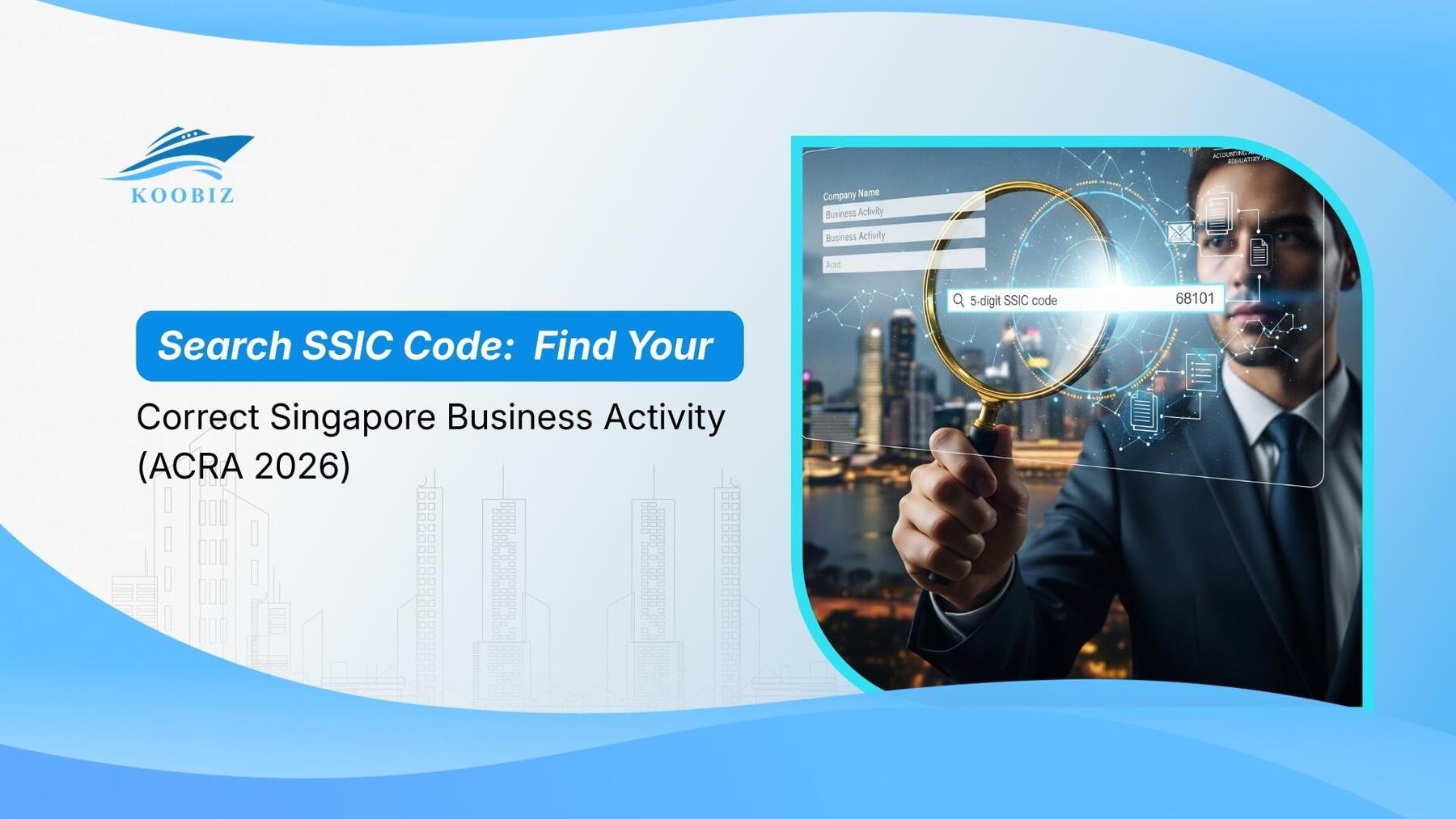
  • Search SSIC Code: Find Your Correct Singapore Business Activity (ACRA 2026)

    Search SSIC Code: Find Your Correct Singapore Business Activity (ACRA 2026)

    [SUMMARIES]

    Definition: The Singapore Standard Industrial Classification (SSIC) is a required 5-digit code that classifies your main business activity for official registration (ACRA).

    Importance: The right code decides your tax duties, necessary business licenses, and access to government support (e.g., grants).

    Search Method: Use the official SingStat online search tool or check the latest PDF directory. Focus on keywords that best describe what your business does to earn money.

    Dual Activities: You can register a Primary and a Secondary SSIC code. The Primary must be for the activity that brings in most of your income.

    Banking Impact: Some SSIC codes (e.g., for cryptocurrency or precious stones) are seen as higher risk and may make opening a corporate bank account more difficult.

    [/SUMMARIES]

    Every entrepreneur registering a company in Singapore must navigate the crucial step of defining their business activity through the Singapore Standard Industrial Classification (SSIC).This isn’t just a box to tick. The code you choose affects your legal rules, tax benefits, and even your chances of getting a business bank account. At Koobiz, we often help clients who feel overwhelmed by the many code options, guiding them to a choice that matches their real operations.

    This guide will explain what an SSIC code is, show you a reliable way to search SSIC code lists, and share common codes for popular industries. We’ll also cover rules for businesses with more than one activity and why getting this right is crucial for smooth operations in 2026 and beyond.

    What is the SSIC Code?

    The Singapore Standard Industrial Classification (SSIC) is a mandatory 5-digit numerical code that categorizes economic activities for all business entities in Singapore.
    It’s the national standard used for statistics and, most importantly, is required by ACRA when you incorporate your company to state your main income-generating activity.

    How to Search and Find Your SSIC Code?

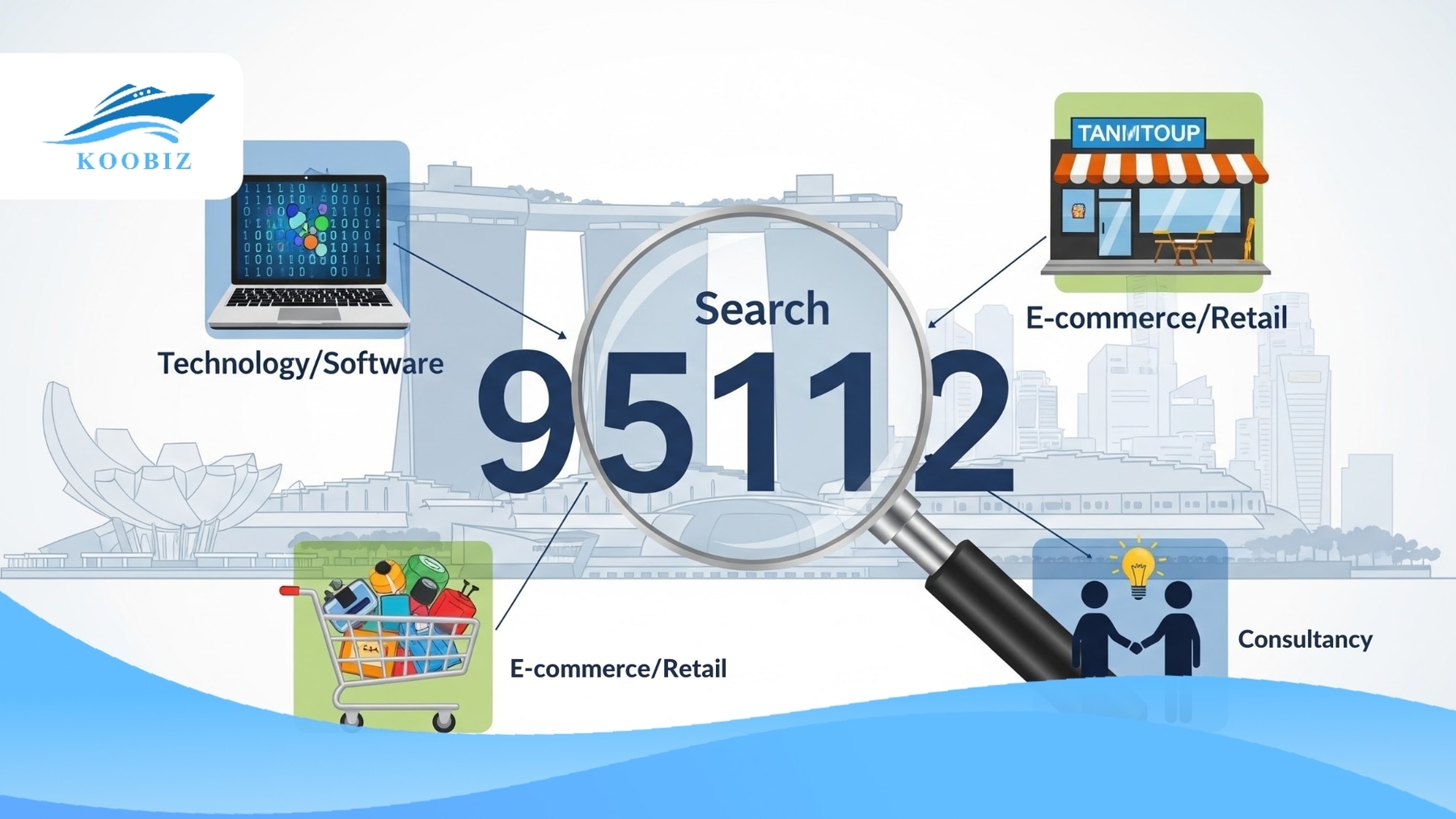
    5-digit SSIC code on a map of Singapore and business industries
    5-digit SSIC code on a map of Singapore and business industries

    The best way is to use the official online tools. Follow these steps to find the right 5-digit code for your business.

    1. Access the Search Tool: Visit the Singapore Department of Statistics (SingStat) website or the ACRA BizFile+ portal.
    2. Use Specific Keywords: Don’t use broad terms. Be precise. For example, search “import of electronics components” instead of just “trading.” The tool will show you matching codes.
    3. Verify with the PDF Directory: For a comprehensive view, download the latest SSIC 2025/2026 PDF. This gives you all the details to ensure your chosen code is legally accurate, not just one that seems close.
    4. Consult a Professional: If your business does a mix of things (like both education and tech), it can be hard to pick the main code. Services like Koobiz can help you decide correctly, saving you from fees to change it later.

    List of Common SSIC Codes by Industry

    While there are many categories, most new businesses fall into areas like Tech, Retail, or Services. Here are some frequently used codes for 2025-2026.

    SSIC Codes for Technology and Software Development

    The technology sector is one of the most active in Singapore. If you are launching a startup, you will likely use one of the following:

    • 62011 (Development of software and applications): This is the standard code for software companies, app developers, and SaaS providers (except games).
    • 62019 (Development of other software and programming activities): Use this if your activity doesn’t fit strictly into app development, such as database logic or specialized coding services.
    • 62021 (Information technology consultancy): Ideal for businesses that advise others on IT architecture but do not necessarily build the software themselves.

    SSIC Codes for E-commerce and Retail

    With the rise of digital storefronts, selecting the right retail code is essential to distinguish between physical and online operations:

    • 47910 (Retail sale via internet): This is the definitive code for E-commerce businesses selling products purely online (e.g., Shopify, Amazon sellers).
    • 47711 (Retail sale of clothing, footwear, and leather articles): Applicable for physical boutiques.
    • 46900 (General wholesale trade): Often used by trading companies that import and export a variety of goods without specialization.

    SSIC Codes for Investment Holding and Consultancy

    Many foreign investors set up companies in Singapore for asset management or professional services:

    • 64202 (Other holding companies): Used for entities set up primarily to hold shares in other companies or assets.
    • 70201 (Management consultancy services): A very common code for freelancers or firms providing general business advice.
    • 69201 (Accounting and auditing services): Specific to registered accounting firms.
    Is Choosing the Correct SSIC Code Critical for Compliance?

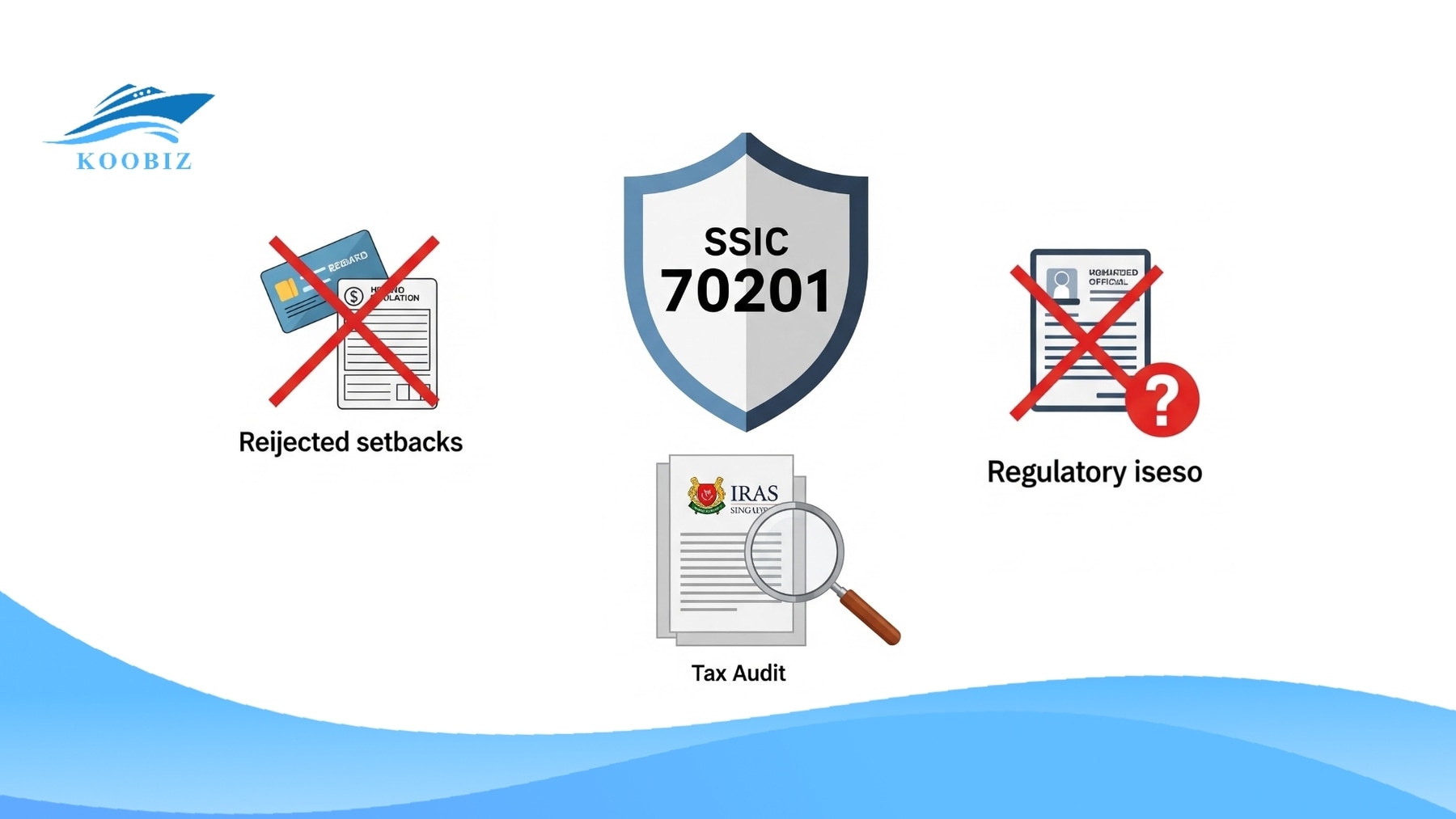
    Risks: Bank, License, Tax Audit
    Risks: Bank, License, Tax Audit

    Critical Compliance Alert:

    Yes, it is critical. Picking the wrong code is a compliance mistake that can cause serious problems.

    3 Key Risks of Misclassification:

    1. Bank Account Rejection: Banks may reject applications from companies with vague or high-risk codes (like some for holding companies).
    2. License Mismatch: If you run a café but register as a “trading” company, you won’t be able to get the necessary food shop license.
    3. Tax Audit Triggers: The tax authority (IRAS) uses this code to check your filings. A mismatch can lead to an audit.

    Advanced SSIC Rules: Primary vs. Secondary Activities

    Many companies do more than one thing. ACRA allows you to register two codes: a Primary (main) and a Secondary one.

    Comparison: Primary vs. Secondary SSIC Code

    Here is how to distinguish between the two classifications:

    Feature Primary SSIC Code Secondary SSIC Code
    Definition The core business activity. Supplementary or minor activity.
    Revenue Share Must generate the majority (>50%) of revenue. Generates a smaller portion of revenue.
    Resource Usage Consumes the most manpower/capital. Uses shared or minor resources.
    Priority Used for public listing and categorization. Optional, but recommended for clarity.

    Example Scenario:

    If Koobiz mostly provides corporate secretarial services (70% income) but also sells some software (30% income), the Primary code should be for corporate services, and the Secondary for software development.

    Restricted SSIC Codes That Require Licenses

    Some codes mean your business needs a special license before you can operate. Picking these codes triggers a review by specific government bodies.

    Industry SSIC Prefix/Code Regulatory Authority Requirement
    Food & Beverage 56xxxx SFA (Singapore Food Agency) Food Shop License
    Real Estate 68201 CEA (Council for Estate Agencies) KEO/Salesperson License
    Architecture 71111 BOA (Board of Architects) Practising Certificate
    Employment 78104 MOM (Ministry of Manpower) EA License

    If you choose one of these codes but don’t have or plan to get the required license, your ACRA application may be delayed, or you could operate illegally.

    Can You Change Your SSIC Code After Incorporation?

    Yes, you can. Business models evolve, and ACRA allows you to update your activities at any time.

    How to Change Your SSIC Code (4 Steps):

    1. Pass a Board Resolution: The directors must formally approve the change in business activity in writing.
    2. Log into BizFile+: Access the ACRA portal using CorpPass.
    3. File “Change in Company Information”: Update the Primary/Secondary code fields.
    4. Pay the Fee: The standard filing fee is SGD 15. The update is usually immediate.

    Does SSIC Code Affect Government Grants and Banking?

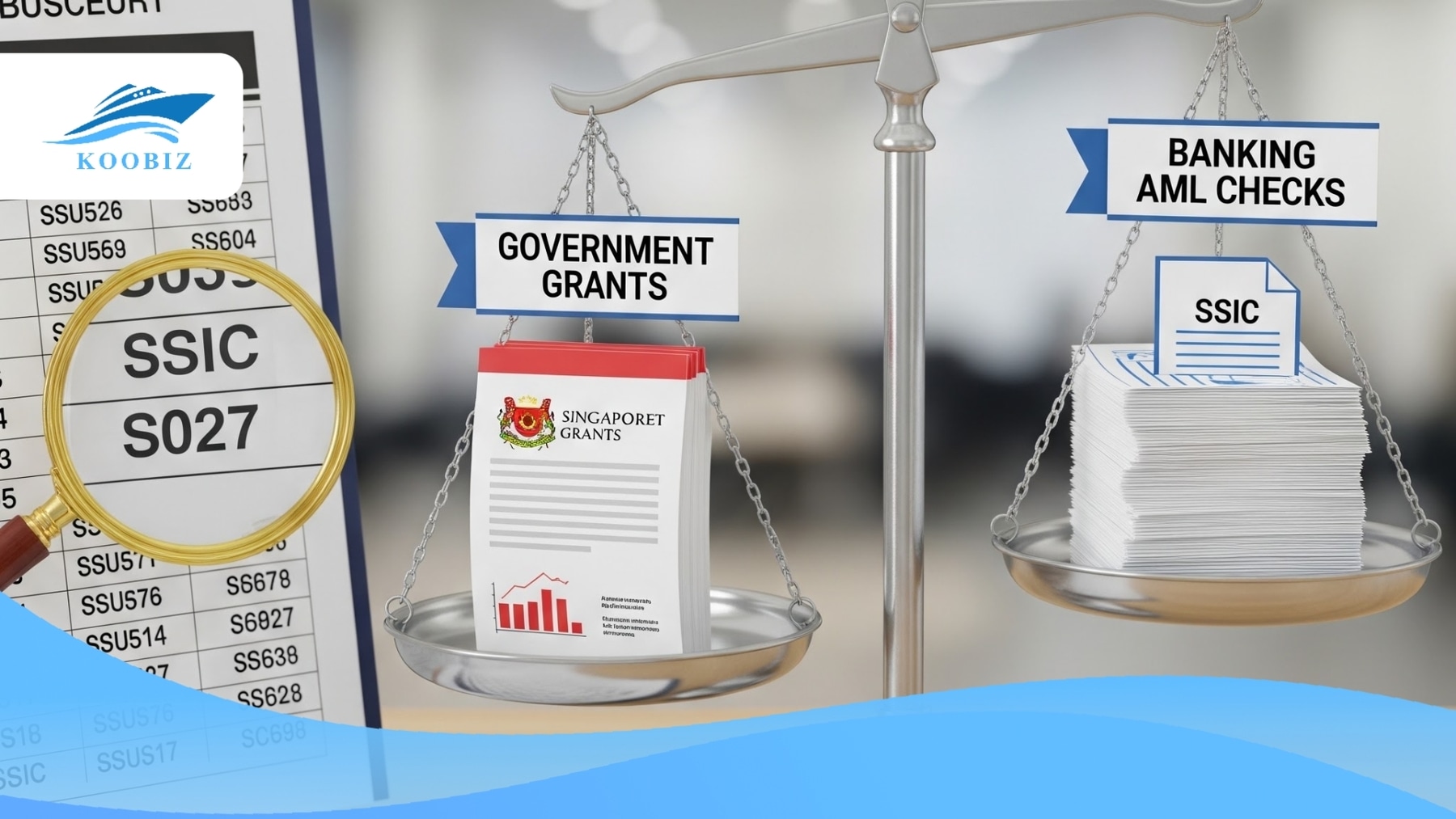
    SSIC code affects grants and bank financing
    SSIC code affects grants and bank financing

    Yes, it impacts both your funding and your financial access. This is often an overlooked aspect that financial consultants at Koobiz emphasize to clients ensuring a smooth operational start.

    1. Impact on Government Grants

    AAgencies like Enterprise Singapore use SSIC codes to check if you qualify for grants (like the Productivity Solutions Grant).

    • The Risk: If you apply for a manufacturing grant but your code is for general trading, you might be automatically disqualified.
    • The Fix: Make sure your code matches the industry of the grant you want.

    2. Impact on Banking (AML Checks)

    Banks check your SSIC code as part of their safety (AML) checks. Some codes are flagged as higher risk.

    • High Risk Codes: Codes for cryptocurrency, money-changing, or generic wholesale trade.).
    • Consequence: Choosing these codes may lead to more questions, requests for extra documents, or even account rejection. A clear, standard code (like for consultancy) usually makes the process faster and easier.

    Conclusion

    Choosing the right SSIC code sets up your Singapore business for correct reporting and smooth growth. It’s more than a quick search; it’s about truly understanding your main business, its future needs, and how banks see you. Accuracy here saves you from legal and administrative troubles later.

    At Koobiz, we help entrepreneurs with every step of starting a business in Singapore. . From helping you search SSIC code databases to managing your company formation, tax, accounting, and audit requirements, our team ensures your business is set up for success from day one. If you need assistance opening a bank account in Singapore or clarifying your business activity, contact Koobiz today for expert support.

  • Compare Best Small Business Loans Singapore (2026): Rates, Digital Banks & Gov Grants

    Compare Best Small Business Loans Singapore (2026): Rates, Digital Banks & Gov Grants

    [SUMMARIES]

    Digital vs. Traditional: Digital banks such as ANEXT and GXS dominate the micro-loan segment (below S$30,000) due to instant approvals. Traditional banks like DBS and UOB remain the preferred option for larger working capital loans of up to S$500,000.

    Interest Rate Reality: In 2026, unsecured business loans in Singapore typically carry effective interest rates (EIR) of 7%–11% p.a. for banks, compared to 12%–24% p.a. for fintech lenders.

    Government Support: The Enterprise Financing Scheme (EFS) remains the backbone of SME lending, with the Working Capital Loan (WCL) cap permanently set at S$500,000.

    Budget 2026 Focus: Anticipated measures include enhanced support for AI Adoption and Green Financing, building on previous digitalization frameworks.

    Approval Speed: InvoiceNow adoption has become a key requirement for SMEs seeking access to fast-track “Green Lane” loan approvals.

    [/SUMMARIES]

    Securing the right funding is critical for business growth in Singapore in 2026. With options ranging from traditional banks like DBS to digital challengers such as ANEXT, SMEs must balance interest costs with approval speed. At Koobiz, we support Singapore company incorporation and banking setup, helping businesses navigate small business loan options efficiently. This guide compares top 2026 loan options, interest rate trends, and expected Budget 2026 grants to help you make the right choice.

    Top SME Business Loans in Singapore (2026): Traditional Banks vs. Digital Banks

    There are three main categories of SME lenders in Singapore: traditional banks, digital banks, and private fintech lenders. Choosing the right option requires balancing interest cost, approval speed, and accessibility.

    Here is the quick snapshot of the 2026 lending landscape:

    Key Feature Traditional Banks (DBS, UOB) Digital Banks (ANEXT, GXS) Fintech Lenders (Funding Societies)
    Interest Rate (EIR) Lowest (7% – 11%) Moderate (9% – 15%) High (12% – 24%)
    Max Loan Amount High (Up to S$500k) Low (S$30k-S$100k) Variable
    Speed to Cash Slow (1-2 Weeks) Instant (24 Hours) Fast (24-48 Hours)

    Koobiz Editor’s Choice: Best SME Loan Options in Singapore (2026)

    Best for Lowest Rates & High Loan Amounts: Traditional Banks (DBS/UOB).

    • Why: Competitive rates for established SMEs (2+ years) requiring larger working capital through government-backed schemes.

    Best for Startups & Speed: Digital Banks (ANEXT/GXS).

    • Why: Minimal documentation for micro-loans, making them suitable for new companies (under 2 years) with immediate cash flow needs.

    Best for Bad Credit / Flexibility: Fintech Lenders.

    • Why: Higher approval rates for businesses that do not meet traditional bank credit requirements.

    Detailed Review: DBS & UOB (Traditional Options)

    Detailed Review: DBS & UOB (Traditional Financing - EFS-WCL)
    Detailed Review: DBS & UOB (Traditional Financing – EFS-WCL)

    DBS Working Capital Loan and UOB BizMoney continue to be preferred options for mature businesses seeking larger funding amounts at competitive rates.

    Specifically, these banks are the main participating financial institutions under the Enterprise Financing Scheme – Working Capital Loan (EFS-WCL). If your company has been incorporated for at least two years and records annual turnover above S$300,000, these banks typically offer the lowest cost of funding. The key advantage is the government risk-sharing mechanism, which co-shares default risk and allows banks to extend loans of up to S$500,000. However, be prepared for a rigorous credit assessment involving detailed financial statements and scrutiny of the directors’ Credit Bureau Singapore (CBS) ratings.

    Detailed Review: ANEXT & GXS (Digital Options)

    ANEXT Bank (by Ant Group) and GXS Bank (Grab-Singtel) have significantly expanded access to financing for asset-light companies or businesses that are too young for traditional banks.

    These digital banks assess creditworthiness using alternative data, such as e-commerce transaction history or real-time Grab platform data, instead of relying solely on audited financial statements. For newly incorporated companies that have opened a digital bank account, these lenders are often the first financing option considered. For instance, the ANEXT Business Loan offers financing up to S$100,000 with no financial documents required for smaller amounts, making it ideal for immediate liquidity needs.

    Current SME Loan Interest Rates (2026 Forecast)

    SME loan interest rates in Singapore generally consist of a base rate (often SORA) plus a spread, with 2026 Effective Interest Rates (EIR) ranging between 7% and 11% for bank loans.

    To understand the true cost of borrowing, business owners must look past the “advertised” rates. The table below illustrates the difference between advertised flat rates and the actual effective interest rate (EIR).

    Lender Type Advertised “Flat” Rate Real Cost (EIR)* Notes
    Traditional Banks (DBS, UOB) From ~5.0% p.a. 7% – 11% p.a. Lowest cost, strict criteria.
    Digital Banks (ANEXT, GXS) From ~6.8% p.a. 9% – 15% p.a. Higher rate for speed & convenience.
    Private Lenders (Fintechs) From ~1% per month 12% – 24% p.a. Short-term bridge capital.

    *Disclaimer: Rates are estimated as of February 2026 and are subject to change based on market conditions and individual credit assessment. Please verify latest rates directly with the respective financial institutions.

    Key Warning:

    • Flat Rate: This is the rate often advertised. It is calculated on the original principal amount and does not account for repayment reducing the principal.
    • Effective Interest Rate (EIR): This reflects the true economic cost of the loan, including processing fees (typically 1-2%) and the compounding effect of monthly repayments. Always compare loans based on EIR.

    In the current 2026 economic climate, while global central banks have moderated their hiking cycles, rates have not returned to the near-zero levels of the past decade. For unsecured business term loans from major banks, SMEs should expect an EIR of approximately 7% to 10%.

    Eligibility Checklist: Government Risk-Sharing Scheme Requirements (EFS)

    Yes, your business may qualify for government risk-sharing schemes such as the EFS if it is registered in Singapore and has at least 30% local shareholding.

    However, meeting the government’s baseline criteria does not guarantee bank approval. Applicants must satisfy two separate layers of assessment: official government requirements and individual bank credit criteria.

    1. The Non-Negotiables (Government Rules)

    These are the strict requirements set by Enterprise Singapore. If you miss one, you are automatically disqualified from the EFS scheme.

    • Business Entity: Must be a Private Limited company registered with ACRA.
    • Local Equity: Minimum 30% local shareholding (Singapore citizen or PR). Fully foreign-owned companies are generally not eligible and must rely on standard commercial loans.
    • Group Size: Annual group turnover below S$500 million or group employment size below 200 employees.

    2. Bank-Specific Credit Requirements (Preferred)

    Even if you meet the government rules above, individual banks may still reject your application based on their own risk assessment.

    • Operational History: Most banks require at least 6 months of active commercial banking operations. Startups less than six months old are generally better suited to digital banks.
    • Positive CBS Score: Directors must have a clean personal credit record with the Credit Bureau Singapore (No recent bankruptcy or litigation).
    • Revenue Trend: Banks prefer to see stable or growing revenue. A sharp decline in recent months can trigger a rejection even if the yearly revenue is high.

    Types of Financing: From Working Capital to Green Loans

    There are three primary types of business financing available in Singapore: unsecured term loans, invoice financing, and green financing.

    Choosing the appropriate financing structure depends on whether the business requires a lump sum for expansion or flexible funding for daily operations.

    Unsecured Business Term Loans

    Unsecured Business Term Loans
    Unsecured Business Term Loans

    Best for: General business expansion, renovation, or marketing campaigns.

    Unsecured term loans are lump-sum cash injections that do not require you to pledge physical assets (like property) as collateral.

    This is the most common form of financing for SMEs in Singapore. The “security” is usually in the form of a Personal Guarantee (PG) from the directors. These loans are suitable for investments where returns are realized over time. Repayment is typically structured over 1 to 5 years with fixed monthly installments.

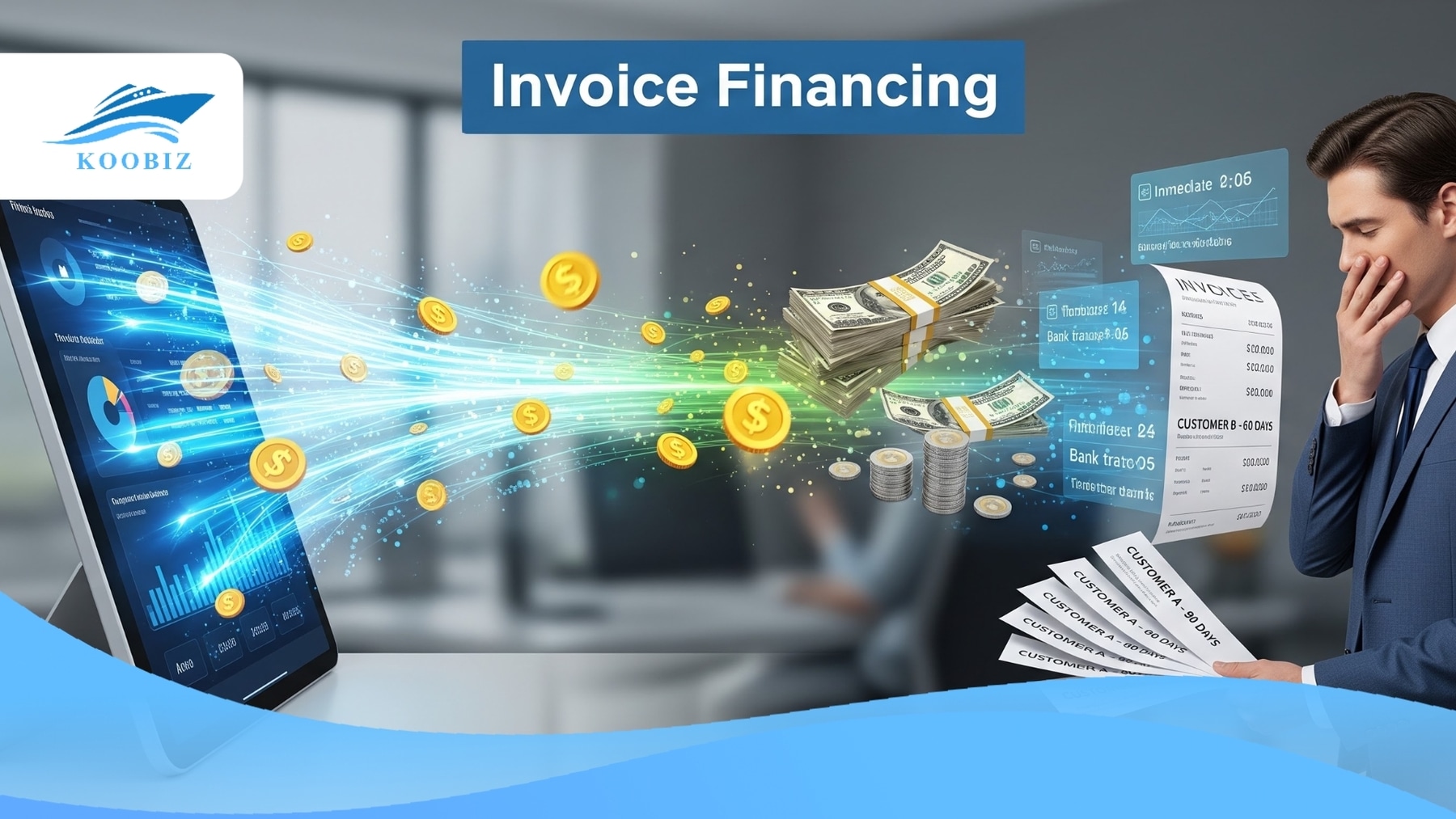
    Invoice Financing

    Invoice Financing
    Invoice Financing

    Best for: B2B companies with slow-paying clients (60-90 day terms) needing immediate cash flow.

    Invoice financing (or factoring) allows businesses to borrow money against amounts due from customers, unlocking cash tied up in unpaid invoices.

    This is particularly useful for B2B companies with long payment cycles. Instead of waiting for the client to pay, a lender (often a fintech such as Validus or Funding Societies) advances up to 80% of the invoice value immediately. Once the client pays, the remaining balance is released to you minus a fee. This solves cash flow gaps without adding long-term debt to the balance sheet.

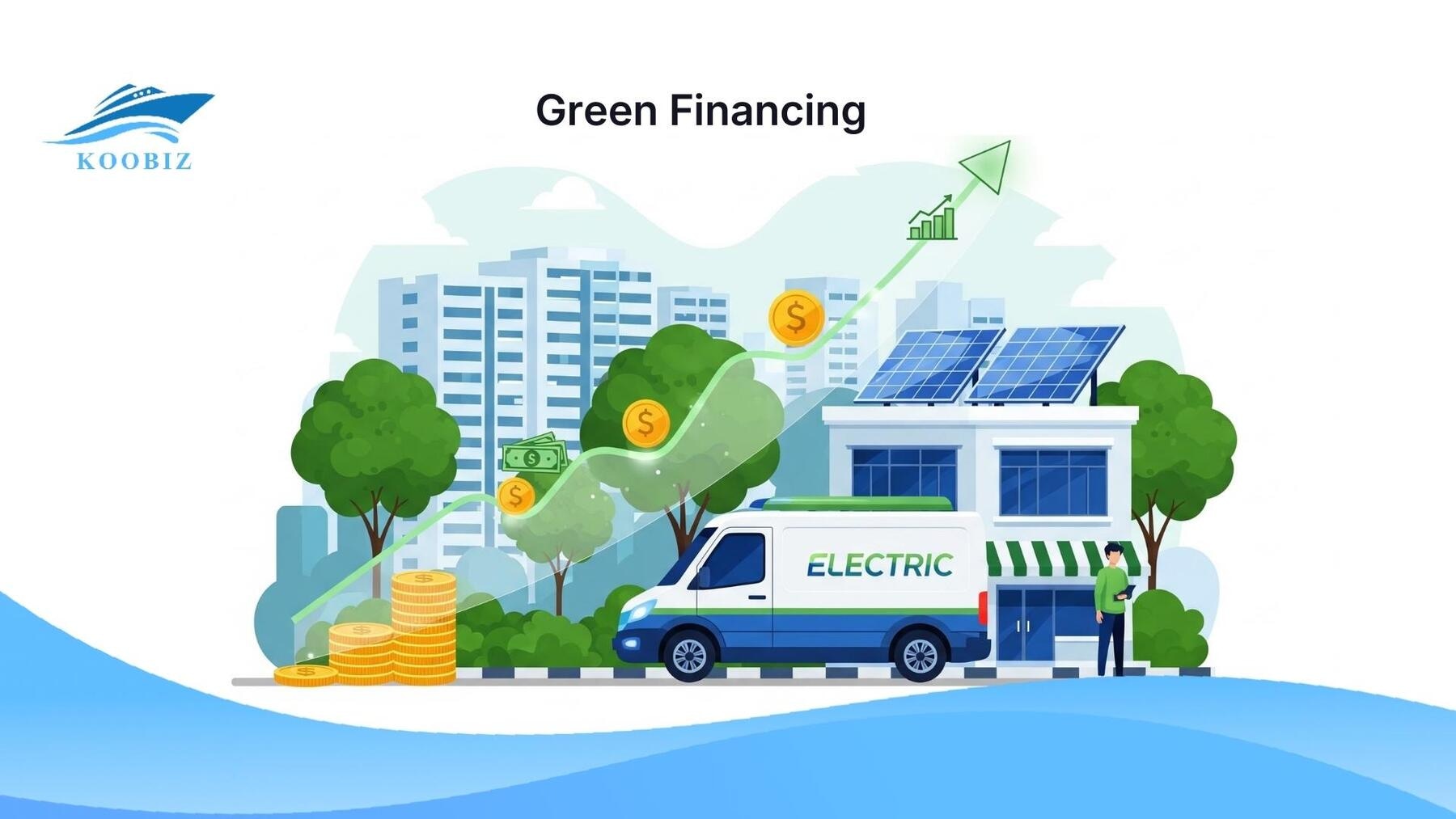
    Green Financing

    Green Financing
    Green Financing

    Best for: Sustainability projects (Solar, EV fleets) seeking interest rate discounts.

    Green Financing refers to loans specifically designed to fund sustainability projects, offering lower interest rates to companies that meet specific environmental criteria.

    By 2026, green financing has become a mainstream funding option for SMEs. Banks like OCBC and UOB offer “SME Sustainable Financing” frameworks. If your business is investing in energy-efficient equipment, solar installation, or electric vehicle fleets, you can access “Green Loans” which often come with rate discounts of 0.5% to 1% lower than standard packages.

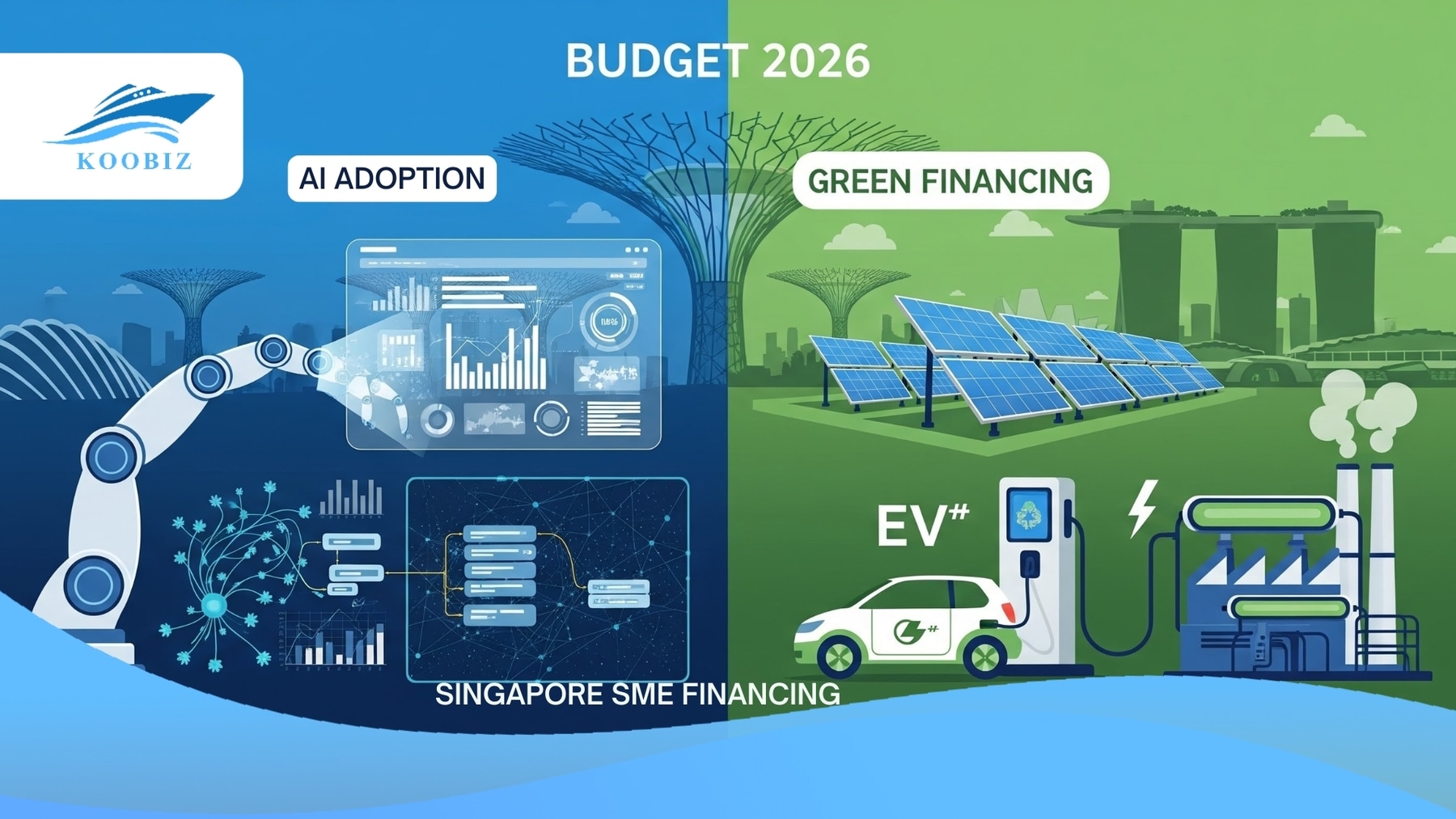
    What’s New in Budget 2026 for SME Financing?

    Expected to prioritize AI and sustainability
    Expected to prioritize AI and sustainability

    Singapore Budget 2026 is expected to prioritize AI adoption and sustainability, with targeted enhancements to existing SME grant frameworks.

    Based on pre-budget recommendations and market trends, here are the two major areas where we anticipate enhanced support:

    1. The AI Boost (Anticipated PSG Enhancements)

    Industry analysts expect the Productivity Solutions Grant (PSG) to be expanded to cover more advanced AI applications.

    • Expected Focus: Funding for AI-driven customer service bots, predictive analytics software, and automated marketing tools.
    • The Goal: To help SMEs move beyond basic digitalisation and adopt generative AI to reduce manpower costs.

    2. The Green Transition (Expanded EEG)

    The Energy Efficiency Grant (EEG) is projected to roll out to more sectors beyond manufacturing and food services.

    • Expected Focus: Upgrading to energy-efficient equipment (LED lighting, air-conditioning, refrigerators) for a wider range of industries.
    • The Goal: To provide significant subsidies that lower utility bills, often pairing well with Green Loans for the remaining balance.

    Businesses should monitor the official Budget announcements in mid-February and assess grant eligibility before applying for SME loans.

    Understanding the Enterprise Financing Scheme (EFS) in 2026

    The Enterprise Financing Scheme (EFS) is a comprehensive government program that consolidates various financing needs.

    It is the backbone of SME lending in Singapore, where Enterprise Singapore shares the default risk with banks to encourage lending. Navigating the specific “EFS Variants” is crucial to getting the right limit for your business.

    Scheme Variant Max Loan Quantum Best Use Case
    Working Capital (EFS-WCL) S$500,000 Daily cash flow, payroll, and rent.
    Trade Loan (EFS-TL) S$10 Million Import/export needs and inventory stocking.
    Project Loan (EFS-X) Variable (High) Overseas expansion and infrastructure projects.

    Critical Reality Check: Understanding EFS Risk-Sharing

    MYTH: “If I default, the government pays the 70% risk-share portion.”

    REALITY: You are 100% liable for the full amount. The “Risk-Share” is an insurance policy for the bank, not you. It encourages banks to lend, but in the event of default, the borrower and guarantors remain fully liable for the outstanding debt, including potential legal action.

    Alternatives for Bad Credit or Rejected Applications

    Rejection by a major bank does not end the financing process; it indicates the need to explore alternative lenders aligned with the business’s risk profile.

    If an application has been declined by DBS, OCBC, or UOB, identifying the underlying reason helps determine the most suitable alternative financing option.

    Scenario A: Weak or Limited Credit History

    The Solution: Licensed Money Lenders (LMLs)

    • Why it works: Licensed Moneylenders assess current repayment capacity rather than historical credit records (CBS score).
    • The Trade-off: Cost. Interest rates are significantly higher (1% – 4% per month). This option is suitable only as a short-term bridge facility (typically 3–6 months) to address immediate cash flow needs, rather than long-term business growth.
    • Safety Warning: Only borrow from lenders listed in the Ministry of Law’s Registry of Moneylenders.

    Scenario B: High-Growth Startup Without Current Profitability

    The Solution: Venture Debt

    • Why it works: Traditional banks require profitability and assets. Venture debt providers, such as Genesis Alternative Ventures or bank innovation units, assess lending risk based on growth metrics and venture capital backing.
    • The Trade-off: Equity Dilution. These deals often include “warrants,” which grant the lender the right to acquire a small equity stake in the company at a future date.

    Scenario C: Outstanding Invoices with Cash Flow Constraints

    The Solution: Invoice Factoring (Fintechs)

    • Why it works: Platforms like Funding Societies or Validus lend against the value of outstanding invoices rather than the company’s balance sheet. If the end client is a reputable counterparty (such as a government agency or multinational corporation), funding may still be available even when the SME’s own credit profile is weak.
    • The Trade-off: You receive only ~80% of the invoice value upfront, and the fees are deducted from the final payment.

    The Role of InvoiceNow in Faster Loan Approvals

    InvoiceNow is Singapore’s nationwide E-invoicing network based on Peppol, which allows lenders to verify transaction data instantly, leading to “Green Lane” loan approvals.

    In the 2026 lending environment, approval speed has become a critical factor.

    Adopting InvoiceNow is not only about paperless invoicing; it significantly reduces manual verification delays at banks.

    The Old Way (Manual)

    • Step 1: Download and print/scan PDF invoices.
    • Step 2: Email documents to your Relationship Manager.
    • Step 3: bank teams manually contact customers to verify invoices, increasing processing time and fraud risk.
    • Step 4: Wait 1-2 Weeks for approval.

    The InvoiceNow Way (Digital)

    • Step 1: Send e-invoice via the Peppol network (using Xero/QuickBooks).
    • Step 2: Bank system auto-verifies the authentic transaction data.
    • Step 3: Approved in 24 Hours (Green Lane Processing).

    By simply linking your accounting software to the InvoiceNow network, you create a verified digital footprint that banks can readily validate, allowing applications to be prioritised for faster review.

    Conclusion

    The landscape for Small Business Loans in Singapore in 2026 is diverse, ranging from government-backed schemes offering stability to AI-driven digital banks offering speed. Whether you are an established SME targeting the EFS Working Capital Loan or a startup leveraging GXS or ANEXT for quick liquidity, the key is to align the financing type with your business stage and needs.

    However, the foundation of any successful loan application is a properly structured business. This means having your incorporation documents, tax filings, and management accounts in perfect order.

    Need help getting your Singapore business loan-ready?

    At Koobiz, we specialize in the foundational services that banks require. From seamless Company Incorporation to professional Accounting & Tax filing, we ensure your business credibility is high from day one. We also assist foreign entrepreneurs in navigating the corporate bank account opening process, connecting you with the right bankers at DBS, OCBC, UOB, and digital banks.

    Visit Koobiz.com today to build a bankable business in Singapore.

  • Public Liability Insurance in Singapore – Essential Protection for SMEs & Tenants

    Public Liability Insurance in Singapore – Essential Protection for SMEs & Tenants

    [SUMMARIES]

    Public Liability Insurance (PLI) protects Singapore businesses against third-party injury and property damage claims arising from daily operations.

    It covers compensation, legal defence, and settlement costs, but excludes employee injuries, which fall under WICA.

    PLI is especially important for SMEs, retailers, F&B outlets, and on-site service providers.

    Many landlords and contracts require minimum coverage, commonly S$500,000 or S$1 million.

    Choosing the right PLI policy helps businesses manage financial risk while meeting contractual and operational requirements.

    [/SUMMARIES]

    Public Liability Insurance in Singapore protects businesses against third-party injury and property damage claims arising from daily operations. It is essential for SMEs and tenants who deal with customers or operate in physical locations. With proper coverage, businesses can meet landlord and contract requirements while reducing financial risk from unexpected incidents.

    What is Public Liability Insurance (PLI)?

    Public Liability Insurance (PLI) protects your business against legal and compensation claims from third parties who suffer injury or property damage as a result of your business activities.

    It applies when your company is held legally responsible for harm caused to people outside your organisation, whether at your premises, at a client’s site, or during business operations and events.

    In Singapore, PLI is essential for businesses that deal with the public, operate physical locations, or provide on-site services. It typically covers:

    • Medical and compensation costs
    • Legal defence expenses
    • Court-awarded or settlement damages

    For example, if a customer is injured on your premises or your employee damages a client’s property while working on-site, PLI helps cover the resulting financial losses.

    Although PLI is not always legally required in Singapore, many landlords, clients, and government contracts require businesses to hold this insurance before operating or starting a project.

    What Does Public Liability Insurance Cover?

    Scope of public liability protection
    Scope of public liability protection

    In Singapore, a standard Public Liability Insurance (PLI) policy provides financial protection against third-party claims arising from your business activities. Coverage generally falls into two key areas: bodily injury and property damage, and legal defence and settlement costs.

    Bodily Injury & Property Damage

    This coverage applies when third parties (excluding employees) suffer injury or property damage due to your business operations. It typically covers medical expenses, compensation payments, and the repair or replacement of damaged property.

    Common examples include customers being injured on your premises or contractors accidentally damaging a client’s property while working on-site.

    Legal Defence Costs & Settlements

    PLI also covers the legal costs of defending your business against third-party claims, including lawyer fees, court expenses, and settlement or court-awarded damages.

    Even if a claim is disputed or unfounded, legal defence can be costly. PLI helps manage these expenses within your policy limits, reducing financial exposure and allowing you to focus on business operations.

    What Public Liability Insurance Does NOT Cover

    Common exclusions in liability insurance
    Common exclusions in liability insurance

    While Public Liability Insurance (PLI) provides broad protection against third-party claims, it is not a catch-all policy. Certain risks are excluded because they are better covered by other types of insurance.

    Employee Injuries (Covered by WICA)

    The most significant exclusion under a PLI policy is injury or illness suffered by your own employees. In Singapore, such claims are governed by the Work Injury Compensation Act (WICA), which is mandatory for most employers.

    • Why it is excluded: PLI is designed to protect against third-party (non-employee) claims only.
    • Coverage gap: If an employee is injured at work, your PLI policy will not respond. You must hold a separate WICA policy to cover medical expenses and compensation.

    Most standard PLI policies also exclude:

    • Professional Errors or Negligence: Financial losses caused by incorrect advice or professional mistakes (requires Professional Indemnity Insurance).
    • Property Under Your Care, Custody, or Control: Damage to items you are repairing, servicing, or storing for a client.
    • Intentional Acts: Injury or damage caused deliberately by your business or employees.

    Who Needs Public Liability Insurance the Most?

    Businesses that need liability protection most
    Businesses that need liability protection most

    While any business that interacts with the public faces liability risks, certain industries in Singapore have higher exposure due to strict regulations, high foot traffic, and on-site operations.

    Retail Shops & Showrooms (High Footfall)

    Retailers are particularly exposed to slip-and-fall incidents. In Singapore’s busy malls, even minor hazards can result in legal claims.

    Common risk scenarios include:

    • Customers slipping on wet or uneven floors
    • Injuries caused by unstable or collapsing display racks
    • Damage to customers’ personal belongings (e.g. spilling coffee on a designer bag)

    Landlord requirement:

    Most commercial landlords (such as CapitaLand and Mapletree) require tenants to maintain a minimum level of PLI coverage before handing over the premises.

    Renovation Contractors & Handymen (On-site Risks)

    Contractors working at client premises are responsible for accidental property damage and third-party injuries arising from their work.

    Key risks include:

    • Damage to fire sprinkler systems causing flooding
    • Tools or materials falling from height and injuring passers-by

    Contractual necessity:

    Management corporations (MCST) commonly deny site access to contractors who cannot provide a valid Certificate of Insurance (COI).

    Food & Beverage (F&B) Businesses

    In addition to physical accidents, F&B operators face health-related liability risks.

    Food poisoning coverage:Often required to meet Singapore Food Agency (SFA) licensing conditions, this extension covers claims from customers who fall ill after consuming contaminated food.

    Common claims include:

    • Severe allergic reactions due to undeclared ingredients
    • Burns or injuries caused by hot food and beverage spills

    Real-Life Claim Examples – Why This Insurance Matters

    Real F&B claims showing the value of insurance coverage
    Real F&B claims showing the value of insurance coverage

    Real-life incidents show how quickly unexpected accidents can turn into costly legal claims. For many SMEs in Singapore, a single liability claim can be financially damaging without proper insurance protection.

    Retail Shop Slip-and-Fall

    A customer slipped on a wet floor in a retail store after a spill was not cleaned up promptly. The customer suffered a back injury and filed a claim for medical expenses and loss of income. Public Liability Insurance covered the legal defence costs and compensation payout, preventing the business owner from paying out of pocket.

    Contractor Damaging Client Property

    A renovation contractor accidentally drilled into a concealed water pipe, causing flooding and damage to a client’s flooring and furniture. The client claimed for repair costs and business interruption losses. The contractor’s Public Liability Insurance paid for the property damage and settlement costs.

    Food Poisoning Incident at an F&B OutletSeveral customers reported food poisoning after dining at a small restaurant. They demanded compensation for medical treatment and emotional distress. The restaurant’s Public Liability Insurance helped cover the legal expenses and compensation claims, allowing the business to continue operating without severe financial strain.

    These examples highlight that accidents can happen even in well-managed businesses. Public Liability Insurance acts as a financial safety net, protecting business owners from sudden and potentially overwhelming liability claims.

    How Much Does Public Liability Insurance Cost in Singapore?

    The cost of Public Liability Insurance (PLI) in Singapore is not fixed. Instead, it is calculated based on your business risk profile, industry type, annual turnover, and the specific scope of activities insured.

    As a general estimate:

    • Low-risk businesses (small offices, consultancies, home-based businesses): S$150 – S$300 per year
    • Medium-risk businesses (retail shops, small service providers): S$300 – S$600 per year
    • Higher-risk businesses (F&B outlets, renovation contractors): S$600 – S$1,500+ per year, depending on coverage limits and risk exposure

    Note: These figures are indicative and subject to the insurer’s underwriting criteria, chosen limits, and prevailing GST.

    Factors: Limit of Indemnity ($500k vs $1M)

    The most significant factor affecting your premium is the Limit of Indemnity the maximum amount the insurer will pay for a single claim or within the policy period. In Singapore, the choice usually comes down to two standard tiers:

    • S$500,000 Limit: This is typically the entry-level coverage. It comes with a more affordable premium and is often sufficient for home-based businesses or small offices with minimal public visitors.
    • S$1,000,000 Limit: This is widely considered the “Gold Standard.” Most major landlords (such as CapitaLand or Mapletree), property managers, and government bodies through GeBIZ tenders mandate a minimum of S$1 million in coverage before a contract can be signed.

    For businesses in high-risk sectors like F&B or renovation, opting for a higher limit is crucial. A single serious injury or major fire could easily exceed a lower cap, leaving your business to pay the difference out-of-pocket. When choosing your policy, it is vital to prioritize a limit that meets your contractual obligations and realistic risk exposure over simply picking the cheapest premium.

    Public Liability Insurance vs Other Business Insurance

    Public Liability Insurance is frequently confused with other business covers. However, each serves a distinct purpose. In Singapore, a “one-size-fits-all” approach often leaves businesses exposed to costly gaps.

    Below is a comparison to help you identify the right combination for your business:

    Type of Insurance What It Covers Who It Protects Is It Mandatory in Singapore?
    Public Liability (PLI) Third-party bodily injury & property damage from business operations. Customers, visitors, and the general public. Contractual. Required by most landlords and clients.
    Professional Indemnity (PI) Financial loss arising from errors, omissions, or negligent advice. Clients receiving your professional services. Professional Requirement. Mandatory for lawyers, auditors, and doctors.
    Work Injury Compensation (WICA) Medical expenses and loss of wages for work-related injuries/illness. Your employees (Local & Foreign). Legal Mandate. Compulsory for most employees under MOM law.

    How They Work Together (Examples):

    • PLI: A client slips in your office and sues for medical bills.
    • PI: You provide a tax consulting report with an error that costs your client S$50,000 in fines.
    • WICA: Your office manager develops carpal tunnel syndrome or trips over a cable while working.

    Most Singapore SMEs opt for an “SME Package” which bundles PLI and WICA together. However, if your business involves advisory or specialized services (IT, Design, Consulting), adding a PI policy is essential to protect your professional reputation.

    How to Choose the Right Public Liability Insurance Policy

    Tips for selecting suitable liability coverage
    Tips for selecting suitable liability coverage

    Choosing the right Public Liability Insurance policy is about matching coverage to your business risks and operational needs in Singapore not simply selecting the cheapest option.

    • Assess your public exposure: Businesses with high customer traffic, on-site work, or physical products face higher risks and usually need higher limits of indemnity.
    • Check contractual and regulatory requirements: Many landlords, property managers, and government projects require a minimum coverage level (commonly S$1 million) before operations can begin.
    • Review the scope of insured activities: Ensure all your business activities are properly declared and covered, especially if you provide multiple services.
    • Evaluate claims handling and legal support: Look for clear claims procedures, reliable legal defence, and prompt handling of third-party claims.

    By selecting coverage based on risk exposure, required limits, and business needs rather than price alone, you secure meaningful protection instead of basic compliance.

    Common Mistakes Businesses Make with Public Liability Insurance

    Many SMEs in Singapore buy Public Liability Insurance for compliance, not protection only to discover coverage gaps when claims are rejected. The most common mistakes include:

    • Low indemnity limits: Choosing S$500,000 to save costs may be risky. A serious accident or disability claim can easily exceed this amount, leaving the business to pay the difference.
    • Incorrect business descriptions: If your policy states “general retail” but the incident happens during an undeclared activity (e.g. outdoor events), the insurer may deny the claim.
    • Confusing PLI with WICA: PLI covers the public, not employees. Staff injuries must be insured under WICA. Using PLI instead breaches MOM regulations and exposes your business financially.
    • Ignoring excess and deductibles: A low premium with a high excess means frequent small claims will still come out of your own pocket.
    • Late claim reporting: Insurers require immediate notification of any incident that may lead to a claim. Delayed reporting can invalidate coverage.

    Koobiz Will Help You Find the Right Public Liability Insurance

    Koobiz helps Singapore businesses choose the right Public Liability Insurance based on their industry, risk exposure, and contractual requirements. Instead of one-size-fits-all policies, Koobiz recommends coverage that reflects your actual business activities.

    With Koobiz, you can:

    • Choose an appropriate limit of indemnity
    • Ensure all business activities are properly covered
    • Comply with landlord and contract insurance requirements
    • Avoid coverage gaps that could lead to claim rejection

    Koobiz simplifies the process, helping SMEs secure reliable protection without unnecessary complexity.

  • How to Start a Business in Singapore (2026 Updated)

    How to Start a Business in Singapore (2026 Updated)

    [SUMMARIES]

    Singapore is a top choice for starting a business thanks to low taxes, transparent regulations, and super-fast company registration.

    Foreigners can fully own a company, needing only one locally resident director.

    Setting up involves choosing a business structure, reserving a name, preparing incorporation documents, appointing a director, opening a bank account, and obtaining licenses if required.

    Common options include Private Limited Companies, Sole Proprietorships, and Partnerships, with Private Limited Companies being the most suitable for foreign founders.

    Startup costs start from SGD 315, and most businesses can be ready to operate within just a few days.

    [/SUMMARIES]

    Looking to launch your own company in Singapore? Learn how to start a business in Singapore with our 2026 updated guide. From choosing the right business structure to handling visas, licenses, and compliance, discover practical tips to set up smoothly and grow your business confidently in one of the world’s most business-friendly cities.

    Why Singapore Is the Best Place to Start a Business

    Singapore is one of the world’s most competitive economies and a top gateway for entrepreneurs looking to expand in Asia. Here’s why investors and business owners choose the Lion City:

    • Prime Location: At the heart of Southeast Asia, Singapore connects you to high-growth markets like China, India, and ASEAN countries.
    • Business-Friendly Taxes: Enjoy a territorial tax system, a flat corporate tax rate of 17%, and Double Taxation Agreements with over 90 countries.
    • Stable & Secure Environment: Transparent laws and strong intellectual property (IP) protection ensure your business operates safely and predictably.
    • Quick Company Setup: A fully digital registration system allows most businesses to start within 24 hours.
    • Access to Capital & Talent: Singapore offers venture capital, government grants, and a highly skilled, multilingual workforce to help your business thrive.

    With these advantages, Singapore is not just a place to start a business – it’s a launchpad for growth across Asia. Start your journey in Singapore today.

    Can a Foreigner Open a Company in Singapore?

    Eligibility of foreigners to establish a business
    Eligibility of foreigners to establish a business

    Yes! Foreigners can fully own most types of companies in Singapore, making it an ideal choice for international entrepreneurs looking to enter the Asian market.

    The main requirement is to appoint at least one local resident director. Apart from that, foreigners can serve as shareholders, directors, or company secretaries, giving them full flexibility to manage their business.

    The registration process is simple and mostly digital, allowing companies to be incorporated quickly. Singapore’s welcoming legal and business environment ensures that foreigners can start and run a business with minimal restrictions.

    Requirements for Foreigners to Set Up a Company in Singapore

    To maintain its reputation as a transparent financial hub, Singapore’s Accounting and Corporate Regulatory Authority (ACRA) enforces clear and strict compliance standards. Here are the six mandatory requirements:

    Minimum Director Requirement (Local Resident)

    Every Singapore company must appoint at least one ordinarily resident director. This person can be:

    • A Singapore Citizen or Permanent Resident (PR)
    • An EntrePass or Employment Pass (EP) holder

    Solution for Foreigners: If you are not relocating, you can use a Nominee Director Service to meet this statutory requirement.

    Shareholders

    Singapore allows 100% foreign ownership for most private companies, giving you full control over your business.

    • Exempt Private Company: 1-20 shareholders (individuals only).
    • Private Limited Company (Pte Ltd): minimum 1 shareholder, can have more than 50, either individuals or corporate entities.
    • Unlimited Public Company: minimum 1 shareholder, can exceed 50, individuals or companies allowed.

    Shareholders don’t need to be residents, offering maximum flexibility for foreign entrepreneurs to own and manage their Singapore company while staying fully compliant with ACRA regulations.

    Registered Business Address

    A physical Singapore address is required for official correspondence.

    • P.O. Boxes are not permitted.
    • Virtual Offices: Many startups use virtual office services to meet this requirement efficiently and professionally.

    Company Secretary

    • Under Section 171 of the Companies Act, all companies must appoint a qualified company secretary within six months of incorporation.
    • Constraint: A sole director cannot act as the company secretary.

    Minimum Paid-Up Capital

    • Entry Point: As low as S$1
    • Flexibility: Capital can be increased after incorporation. Higher capital may be required for regulated industries (e.g., travel agencies, financial services).

    Business Activity (SSIC Code)

    You must select up to two Singapore Standard Industrial Classification (SSIC) codes to describe your business activities.

    Why it matters: Choosing the wrong SSIC code can cause delays in bank account setup or complications with government grant applications.

    Types of Business Structures in Singapore

    Common business structures in Singapore
    Common business structures in Singapore

    Choosing the right business structure is one of the first and most important steps when starting a company in Singapore. Your choice will affect legal liability, taxation, and business management. Here are the main options for both locals and foreigners:

    Private Limited Company (Most Common for Foreigners)

    The Private Limited Company (Pte Ltd) is the most popular choice for foreign entrepreneurs. It allows 100% foreign ownership, limits personal liability, and provides a professional corporate image. A Pte Ltd is a separate legal entity, meaning the company itself—not its shareholders—is responsible for its debts and obligations. This structure is ideal for businesses aiming to grow, attract investors, or expand regionally.

    Sole Proprietorship

    A Sole Proprietorship is the simplest business structure in Singapore. It is fully owned by one person, who is personally liable for all business debts and obligations. While easy and inexpensive to set up, it may not be suitable for high-risk businesses or those planning to scale internationally. It is typically used by small businesses or freelancers.

    LLP / Partnership

    A Limited Liability Partnership (LLP) or general Partnership is a business structure where two or more partners share management responsibilities. An LLP provides limited liability protection, protecting personal assets, while a general partnership does not. These structures are popular for professional services like law firms, accounting practices, or consultancies due to their flexibility and simplicity.

    However, LLPs are not ideal for foreign entrepreneurs seeking to raise capital or attract investors, as venture capitalists usually prefer Private Limited Companies (Pte Ltd). If your business aims for high growth, external funding, or scaling internationally, Pte Ltd is generally the better choice.

    Step-by-Step Guide – How to Start a Business in Singapore

    Stepwise process for starting a business in Singapore
    Stepwise process for starting a business in Singapore

    Registering a company in Singapore is a fully digital process that can be completed in as little as 24 hours. However, foreigners cannot self-register without a Singpass, so you must use a licensed corporate service provider.

    Step 1 – Choose Business Structure

    Choose a business structure that suits your goals. Most international founders select a Private Limited Company (Pte Ltd) for its scalability, limited liability, and tax advantages. Other options include Sole Proprietorship or Limited Liability Partnership (LLP), depending on your business size, risk level, and growth plans.

    Step 2 – Reserve Company Name

    Reserve your company name via the ACRA BizFile+ portal.

    • Criteria: Must be unique, not infringe trademarks, and not “undesirable” (vulgar or offensive).
    • Pro Tip: Once approved, your company name is reserved for 120 days. You must complete the incorporation within this period; otherwise, the name will be released and become available for others to register.

    Step 3 – Prepare Incorporation Documents

    Your filing agent will prepare:

    • Company Constitution: Legal rules and regulations governing the company.
    • Signed Consents: Form 45 (Consent to Act as Director) and Form 45B (Consent to Act as Secretary).
    • Identification: Passports and proof of residential address for all foreign officers.

    Step 4 – Appoint Local Director

    Every company must have at least one director who is “ordinarily resident” in Singapore. Foreign founders can use a Nominee Director Service if managing the business from abroad.

    Step 5 – Engage a Registered Filing Agent to Submit Application

    As a foreigner, you cannot log in to ACRA’s BizFile+ portalwithout a Singpass (Digital ID). A licensed Filing Agent or corporate service provider (like Koobiz) can submit your incorporation application on your behalf, ensuring all documents meet local requirements and avoid delays or errors.

    Using a professional service not only saves time but also ensures a smooth, compliant setup for your Singapore company.

    Step 6 – Open a Corporate Bank Account

    Once incorporated, open a corporate bank account:

    • Traditional Banks (DBS, OCBC, UOB): Stable but may require an in-person visit.
    • Neobanks (Aspire, Airwallex): Fast, fully remote onboarding, ideal for startups.

    Step 7 – Apply for Licenses & Permits (If Required)

    • Licenses: Check if your SSIC code requires specific licenses (e.g., F&B, Travel, Finance) via the GoBusiness portal.
    • GST Registration: Only mandatory if your annual taxable turnover exceeds S$1 million.

    By following these steps, foreign entrepreneurs can legally and efficiently establish a company in Singapore, ready to operate in one of Asia’s most business-friendly markets.

    What to Do After Company Registration?

    After registering your company, take these key steps to operate legally and efficiently in Singapore:

    • Register for Taxes – Sign up with IRAS for corporate tax. Register for GST if annual revenue exceeds S$1 million.
    • Set Up Accounting & Bookkeeping – Keep proper records. Consider hiring a local accountant or professional service.
    • Open a Corporate Bank Account – Manage transactions, receive payments, and pay suppliers.
    • Comply with Annual Filings – File annual returns with ACRA and corporate tax returns to IRAS on time.
    • Obtain Licenses or Permits (If Required) – Depending on your business (e.g., F&B, education, healthcare, finance).
    • Plan for Growth – Focus on marketing, hiring, funding, and business expansion opportunities.

    Following these steps helps your company stay compliant, operate smoothly, and grow successfully in Singapore.

    Do You Need a Visa to Operate a Business in Singapore?

    Visa requirements for business operators in Singapore
    Visa requirements for business operators in Singapore

    Owning a company does not automatically grant residency. Physically working or residing in Singapore requires a valid work pass:

    • Employment Pass (EP): For professionals and owners. Requires a minimum qualifying salary of S$5,600 (S$6,200 for Financial Services), increasing with age up to S$10,700. Applicants must also score at least 40 points under the COMPASS framework.
    • EntrePass: For innovators and venture-backed entrepreneurs. No minimum salary is required, but the business must meet specific “innovation criteria” (e.g., holding a patent or receiving recognized VC funding).
    • Remote Management: You can manage the company from abroad by appointing a Nominee Director to satisfy local legal requirements while you remain overseas.

    Without a proper visa, you may only enter on a Short-Term Visit Pass for limited activities like meetings or consultations. You cannot legally handle day-to-day business operations or be based in Singapore.

    Timeline & Costs to Start a Business in Singapore (2026)

    Singapore is renowned for its efficiency and fast incorporation process. Here’s what to expect in 2026:

    Timeline

    • Company Name Approval: 15 minutes – 24 hours.
    • Company Incorporation: Usually within 24 hours after name approval and signing documents.
    • Opening a Bank Account:
    • Neobanks (Aspire, Airwallex): 1-3 business days.
    • Traditional Banks (DBS, UOB, OCBC): 2-4 weeks.

    Overall: Most businesses can be fully incorporated and ready to trade within 2-5 business days.

    Costs

    • ACRA Registration Fee: S$315 (S$15 for name application + S$300 for registration).
    • Nominee Director Service: S$2,000 – S$4,000 per year (usually requires a refundable security deposit).
    • Corporate Secretary: S$300 – S$600 per year (mandatory).
    • Registered Office Address: S$150 – S$500 per year.
    • Minimum Paid-up Capital: As low as S$1.
    • Bank Initial Deposit:
    • Traditional Banks: S$1,000 – S$3,000 depending on the bank.
    • Neobanks: Often S$0 initial deposit.

    Singapore’s fast incorporation, low capital requirement, and transparent fees make it easy for foreign entrepreneurs to start a company quickly and efficiently.

    Common Mistakes and Practical Tips for Foreigners

    Starting a business in Singapore is straightforward, but foreign entrepreneurs often face common challenges.

    • Ignoring local requirements: Failing to appoint a local director, provide a registered address, or obtain necessary licenses.
    • Choosing the wrong business structure: Can lead to higher taxes, personal liability, or difficulty attracting investors. Private Limited Company is usually the best choice.
    • Incomplete or incorrect documentation: Mistakes in shareholder or director information can delay incorporation.
    • Neglecting accounting and taxes: Annual filings and corporate tax compliance are mandatory.
    • Overlooking visa and employment rules: Owning a company does not automatically grant the right to work.

    Why Choose Koobiz to Set Up Your Company in Singapore?

    Setting up a business in Singapore can be complex for foreigners. Koobiz simplifies the process by offering:

    • Expert Guidance: Understand legal requirements, licenses, and SSIC codes.
    • Fast Incorporation: Reserve company names, prepare documents, and submit applications efficiently.
    • Nominee Director Services: Meet local director requirements without relocating.
    • Corporate Secretarial Support: Ensure annual filings and compliance are handled professionally.
    • Tailored Solutions: Customized support for your business structure and operations.

    With Koobiz, you can launch your Singapore business confidently and smoothly.

  • MNC Meaning – What is MNC in Business?

    MNC Meaning – What is MNC in Business?

    [SUMMARIES]

    Multinational corporations (MNCs) are companies that operate in multiple countries under a central headquarters, coordinating global operations while adapting to local markets.

    They drive economic growth, create jobs, and transfer technology worldwide.

    MNCs can follow different models—from centralized to transnational—depending on how they balance global control and local autonomy.

    Understanding their structure, benefits, and challenges helps professionals navigate careers and businesses make informed global strategies.

    [/SUMMARIES]

    Have you ever wondered how companies like Apple, Nestlé, or Google operate in dozens of countries at once? Multinational corporations (MNCs) are businesses that manage operations across multiple countries while keeping a central headquarters. They play a major role in the global economy, connecting markets, creating jobs, and driving innovation worldwide. Understanding MNCs can help you plan an international career or make smarter decisions in global business.

    Definition of a Multinational Corporation (MNC)

    A Multinational Corporation (MNC) is a company that operates in more than one country, with its main headquarters located in a single home country.

    Instead of doing business only in its domestic market, an MNC sets up subsidiaries, branches, or production facilities in other countries. These overseas operations follow the overall strategy of the parent company while serving local markets.

    An MNC is not limited to selling products internationally. It also carries out important business activities across borders, including:

    • Manufacturing
    • Marketing and sales
    • Research and development (R&D)
    • Distribution and customer service

    In simple terms, an MNC is a business that expands beyond its home country and manages its operations in several countries as one coordinated system.

    How Does an MNC Operate?

    Structure and operations of multinational companies
    Structure and operations of multinational companies

    A multinational corporation (MNC) runs its business through a central headquarters and a network of offices and facilities in different countries. These parts work together to keep the company’s strategy aligned and its operations running smoothly across borders.

    Headquarters (HQ)

    The headquarters (HQ) acts as the company’s command center. It is usually based in the home country and focuses on:

    • Defining the company’s overall business strategy
    • Overseeing financial planning, investments, and risk management
    • Setting major policies and appointing top leadership

    By doing this, the HQ makes sure that all overseas units follow the same direction and protect the company’s brand and values.

    Subsidiaries and Branches

    Subsidiaries and branches carry out the company’s operations in local markets. Their main role is to handle daily business activities such as:

    • Production or assembly
    • Sales and marketing
    • Customer support and delivery

    While these units adjust to local customer needs and regulations, they still operate under the guidance of the headquarters.

    Global Supply Chain and Management Systems

    MNCs organize their production and distribution through a global supply chain. Different stages of the process may be located in different countries to take advantage of lower costs, skilled labor, or available resources.

    To manage this international network effectively, MNCs use shared management systems, including:

    • Company-wide IT and communication platforms
    • Unified reporting and performance monitoring
    • International logistics and purchasing systems

    These tools help the company connect its global operations and maintain consistent standards across markets.

    Key Characteristics of an MNC

    Defining traits of multinational corporations
    Defining traits of multinational corporations

    A multinational corporation stands out from domestic companies because of several key features.

    First, it operates across national borders instead of serving only one country. Its business activities such as production, sales, or services are spread across different markets.

    Second, an MNC is guided by a central strategy. Important decisions about investment, branding, and corporate policy are set at the headquarters and then applied by its overseas units.

    Third, an MNC manages its resources on a global scale. It distributes capital, workforce, and technology across countries to increase efficiency and stay competitive.

    Fourth, an MNC serves international customers through coordinated business plans. While it may adjust to local conditions, its operations remain connected under one corporate system.

    Finally, most MNCs operate on a large scale and have strong financial capacity. This allows them to expand overseas, handle business risks, and compete effectively in global markets.

    Types of MNCs – Different Models of Multinational Corporations

    Multinational corporations (MNCs) can be grouped based on how they organize and control their international operations. Each model reflects a different balance between global coordination and local independence.

    Type of MNC Management & Control Key Features / Operations Best For / When It Works
    Decentralized MNC (Decentralized Multinational Corporation) Local subsidiaries operate independently; HQ provides guidance – Decisions mainly at local level

    – Products & strategies adapted for each market

    – HQ gives overall guidance

    Industries where consumer preferences and regulations vary widely
    Global Centralized MNC (Global Centralized Corporation) Strategic control kept at HQ; global coordination – Strong HQ control

    – Standardized products worldwide

    – Centralized R&D and manufacturing

    Companies aiming for efficiency and cost reduction through global standardization
    International MNC (International Corporation) HQ develops strategies; foreign branches execute – Core knowledge & technology from HQ

    – Foreign units focus on sales & distribution

    – Innovation concentrated at HQ

    Companies beginning international expansion
    Transnational MNC (Transnational Corporation) Combines HQ control with local flexibility; shared decision-making – Shared HQ & regional decisions

    – Global coordination of resources & expertise

    – Strong integration of branches

    Firms seeking both global efficiency and local adaptation

    Why Do Companies Become MNCs? – Key Reasons Behind Global Expansion

    Main motivations for going global
    Main motivations for going global

    Companies choose to become multinational corporations (MNCs) to stay competitive and grow beyond the limits of their domestic markets. Expanding globally helps businesses increase revenue, reduce costs, and gain access to new strategic opportunities.

    Market Expansion and Business Growth

    One of the main motivations for becoming an MNC is to reach new markets. By operating in multiple countries, companies can:

    • Serve a much larger customer base
    • Boost sales and long-term revenue
    • Reduce their reliance on a single domestic market

    This approach supports sustainable growth and makes the business more resilient to local economic changes.

    Cost Advantages and Efficient Production

    Many companies expand overseas to lower their operating costs and improve production efficiency.

    Through international operations, firms can:

    • Build factories in locations with lower labor and material costs
    • Cut logistics and manufacturing expenses
    • Streamline their supply chains

    These cost savings help companies remain competitive, especially in price-sensitive industries.

    Tax and Regulatory Benefits

    Some countries provide attractive tax policies and business-friendly regulations to encourage foreign investment.

    By setting up operations in different countries, MNCs can:

    • Take advantage of lower corporate tax rates
    • Access government incentives and financial support
    • Operate under more flexible or favorable legal systems

    This can significantly improve profitability and financial stability.

    Access to Global Resources and Talent

    Becoming an MNC also opens the door to valuable global resources and skilled professionals.

    This includes:

    • Natural resources available only in certain regions
    • Advanced technologies and specialized knowledge
    • Highly qualified international talent

    By tapping into global resources and expertise, MNCs can drive innovation and strengthen their competitive position.

    Examples of Well-known MNCs

    Coca Cola, a leading multinational company
    Coca Cola, a leading multinational company

    Multinational corporations can be found in almost every major industry. The examples below show how leading global companies operate across different sectors and regions.

    In the Technology Sector

    Technology companies are among the most visible multinational corporations because their products and digital services are used worldwide. Well-known firms such as Apple, Microsoft, and Google (Alphabet) run global networks of offices, research centers, and data facilities.

    Their success depends on international innovation teams and digital distribution systems that allow them to serve users in many countries at the same time.

    In the FMCG Sector

    In the fast-moving consumer goods (FMCG) industry, multinational corporations focus on reaching local consumers while maintaining strong global brands. Companies like Coca-Cola, PepsiCo, and Procter & Gamble (P&G) operate factories and distribution networks across dozens of countries.

    They often modify product recipes, packaging, and marketing messages to suit local tastes, cultures, and regulations.

    In the Finance Sector

    Many global banks and financial institutions also operate as multinational corporations. HSBC, Citibank, and Standard Chartered manage extensive international branch networks that provide services such as corporate banking, trade finance, and personal financial products.

    Their worldwide presence enables them to support cross-border business activities, international payments, and global investment flows.

    Prominent MNCs in Singapore

    Singapore has become one of Asia’s leading hubs for multinational corporations thanks to its political stability and business-friendly environment. Numerous global firms choose Singapore as their regional headquarters or operational base.

    Companies such as Shell, IBM, and Google use Singapore to manage Asia-Pacific operations, technology services, and regional supply chains.

    Difference Between MNC and Other Types of Companies

    Understanding the differences between a multinational corporation (MNC) and other types of businesses helps clarify how global companies operate in today’s economy.

    MNC vs. SME & Local Companies

    Feature MNC SME / Local Company
    Scope Operates in multiple countries Operates in one country or a limited region
    Resources Large capital base and global workforce Limited capital and smaller teams
    Regulation Must comply with different legal systems Works under a single legal framework

    In short, MNCs are designed for international operations, while SMEs and local firms focus mainly on domestic or regional markets.

    MNC vs. Startup

    Although both MNCs and startups may operate internationally, their business nature is very different.

    • Maturity: MNCs are established organizations that prioritize stability and long-term performance. Startups are at an early stage and aim for fast growth and innovation.
    • Structure: MNCs rely on formal procedures and standardized systems. Startups usually operate with flat hierarchies and flexible working models.

    MNC vs. TNC (Transnational Corporation)

    This distinction is more subtle but important in international business.

    • MNC (Multinational Corporation): Operates under a headquarters-driven model. Major strategic decisions are made at the home office, and overseas units mainly follow central directions.
    • TNC (Transnational Corporation): Functions as a globally integrated network. It is less tied to one “home” country, and its subsidiaries have greater authority to make independent decisions.

    Example:

    Toyota (MNC) – Centralized Model Toyota follows a centralized MNC model where major decisions are driven by its Japanese headquarters. While manufacturing happens globally, core strategies, vehicle designs, and the Lean Manufacturing philosophy are strictly controlled from Toyota City. Overseas branches primarily execute these central directions to ensure uniform global quality.

    Nestlé (TNC) – Decentralized Model Nestlé is a classic TNC that operates as a globally integrated network with high local autonomy. Unlike a traditional MNC, Nestlé adapts its products—such as the flavor and packaging of KitKat or Nescafé—to suit specific cultural tastes in each country. Decisions are shared across borders, allowing the company to be “local” everywhere it operates.

    The Role of MNCs in the Global Economy

    Multinational corporations (MNCs) play a key role in today’s global economy by linking countries through investment, production, and trade. Their cross-border operations help connect national markets and strengthen economic integration worldwide.

    MNCs contribute to economic development in several important ways:

    • Creating job opportunities in host countries
    • Transferring technology and modern management practices
    • Improving industrial productivity and overall output

    They also encourage international trade by organizing different stages of production in different countries and distributing goods and services across global markets. This system allows products to be manufactured where resources are available and sold where demand is strongest.

    In addition, MNCs shape global competition. Their large scale and financial power enable them to invest heavily in research and innovation, enter new markets, and influence international business standards. Through these activities, MNCs help drive globalization and determine global patterns of investment and production.

    Advantages and Disadvantages of MNCs

    Multinational corporations (MNCs) bring both opportunities and challenges to the economies where they operate. While their global reach creates significant value, it can also raise economic and social concerns.

    Advantages of MNCs

    MNCs generate important benefits for both host countries and the global economy:

    • Job creation and income growth: Large-scale investments by MNCs create employment and improve income levels in local communities.
    • Technology and knowledge transfer: MNCs introduce advanced technology, professional skills, and modern management practices to developing markets.
    • Higher productivity: By organizing production across borders, MNCs build efficient global supply chains that increase overall output.
    • Wider consumer choice: International brands and services give consumers access to more product options and better quality standards.

    These advantages support economic growth and industrial development in many regions.

    Disadvantages of MNCs

    Despite their positive impact, MNCs also face criticism and potential drawbacks:

    • Pressure on local businesses: Their financial strength can make it difficult for domestic firms to compete.
    • Profit outflows: A large share of profits may be sent back to the home country, limiting long-term benefits for host economies.
    • Cultural and environmental risks: Differences in business standards may lead to social or environmental issues if not carefully managed.
    • Regulatory challenges: Complex corporate structures make taxation and legal control more difficult for governments.

    Overall, the impact of MNCs depends on how effectively they are regulated and how responsibly they operate in each country.

    Who Thrives in an MNC? – Essential Skills and Challenges

    Skills and pressures for success in MNCs
    Skills and pressures for success in MNCs

    Working in a multinational corporation (MNC) can be an exciting opportunity for those who enjoy international environments and collaboration across cultures. MNCs typically have global teams, standardized processes, and clear performance expectations, which means employees need to be both flexible and professional.

    Key Skills for Success

    People who do well in an MNC usually have:

    • Strong communication skills: Proficiency in English (or other foreign languages) helps teams collaborate across borders.
    • Cross-cultural awareness: Understanding cultural differences allows smoother teamwork with international colleagues.
    • Job-specific expertise: Solid professional or technical skills are essential to deliver results in specialized roles.
    • Adaptability and problem-solving: Employees need to navigate complex situations and respond quickly to changing global demands.

    Challenges to Keep in Mind

    While rewarding, MNCs also come with certain pressures:

    • Structured rules and procedures: Standardized corporate policies can feel rigid compared to smaller companies.
    • High performance expectations: Global competition and tight targets may create pressure to perform consistently.
    • Communication hurdles: Time zone differences and cultural nuances can slow decision-making or cause misunderstandings.
    • Career competition: Promotions and growth opportunities are often highly competitive due to talented peers worldwide.

    MNCs are ideal for individuals who want international exposure, appreciate clear career paths, and enjoy working in structured, competitive, and dynamic environments. Those who can combine technical expertise with cultural sensitivity and adaptability are most likely to thrive.

  • Understanding Non-Profit Organisations in Singapore: A Guide to Charities & NGOs

    Understanding Non-Profit Organisations in Singapore: A Guide to Charities & NGOs

    [SUMMARIES]

    Distinct Legal Definitions: A “Non-Profit Organisation” (NPO) is a general term. “Registered Charity” and “IPC” are special statuses you apply for, each with its own benefits.

    Three Main Structures: You can set up your NPO as a Company Limited by Guarantee (CLG), a Society, or a Trust. Each suits different needs.

    Tax Benefits: Just being an NPO doesn’t make you tax-free. You need “Registered Charity” status for income tax exemption.

    The Power of IPC: Only an Institution of a Public Character (IPC) can give donors a 250% tax deduction, which is a huge incentive for giving.

    Governance Matters: Once you’re a Registered Charity, you must follow strict governance rules and report annually to stay in good standing.

    [/SUMMARIES]

    Navigating Singapore’s philanthropic sector requires distinguishing between three key concepts: the Non-Profit Organisation (NPO), the Registered Charity, and the Institution of a Public Character (IPC). At Koobiz, we guide social entrepreneurs and corporations through these complexities to ensure a solid foundation. This article outlines the essential legal structures, tax benefits, and governance requirements needed to establish a successful non-profit in Singapore.

    What is a Non-Profit Organisation in Singapore?

    Non-Profit Organisation: Profit serves the mission and community
    Non-Profit Organisation: Profit serves the mission and community

    Definition: Think of a Non-Profit Organisation (NPO) in Singapore as any group set up to serve a public cause—like helping the community, supporting the arts, or protecting the environment. The key rule is that any extra money it makes must be put back into its mission. It cannot be paid out to the people who run it or its members as profit.

    Imagine a regular business (like a cafe) exists to make money for its owners. An NPO (like a community shelter or an arts group) exists to serve its cause. Its “profit” is measured in social impact, not cash payouts.

    Think of “NPO” as a purpose, not a specific legal label. It’s the why behind your group. To legally operate, you must choose a formal structure (like a company or society) that matches this purpose. The key difference from a regular business is the “non-distribution constraint”: profits serve the cause, not people.

    What are the 3 Key Legal Structures for NPOs?

    3 NPO legal structures: CLG, Society, Charitable Trust
    3 NPO legal structures: CLG, Society, Charitable Trust

    This is your first big decision. It’s like choosing the right type of vehicle for a journey. Here’s a simple comparison:

    Feature Public Company Limited by Guarantee (CLG) Society Charitable Trust
    Legal Status Separate Legal Entity No Separate Legal Entity No Separate Legal Entity
    Regulator ACRA Registry of Societies (ROS) Ministry of Law / Courts
    Liability Limited (Members liable usually up to $1) Unlimited (Office bearers personally liable) Unlimited (Trustees personally liable)
    Setup Speed Fast (1-2 days) Slow (2-4 months) Moderate
    Best For National charities, large scale operations Small clubs, volunteer groups, hobbyists Grant-making foundations, scholarship funds

    Choosing the right structure is the first critical decision you will make. This choice affects your liability, statutory obligations, and ability to scale. Below, we provide a deeper look into the nature of each structure.

    Public Company Limited by Guarantee (CLG)

    A Public Company Limited by Guarantee (CLG) is the most common structure for non-profit organizations that intend to operate on a larger scale, such as national charities or foundations.

    Unlike a private limited company that issues shares, a CLG has members who guarantee to contribute a nominal amount (usually SGD 1.00) if the company is wound up. Because it is regulated by ACRA under the Companies Act, it possesses a separate legal identity. This allows the organization to sue, be sued, hire staff, and hold property in its own name, distinct from its members. At Koobiz, we generally recommend this structure for professional NPOs seeking registered charity status due to its robust governance framework and limited liability protection.

    Societies

    A Society is a membership-based group, suitable for smaller organizations, clubs, or volunteer groups that operate primarily for the benefit of their members or a specific community.

    Regulated by the Registry of Societies (ROS), a society is defined as a club, company, partnership, or association of 10 or more persons. It is simpler and less costly to set up than a CLG but comes with higher personal risk. Since a Society does not have a separate legal personality, office bearers can be held personally liable for the society’s debts and legal obligations. This makes it best suited for grassroots community groups or hobby clubs where the operational risk and financial overhead are low.

    Charitable Trusts

    A Charitable Trust is a legal arrangement typically used to manage funds or property set aside for specific charitable purposes, rather than for conducting active operations.

    In this structure, trustees hold the assets for the benefit of the charitable purpose under a Trust Deed. Trustees have a fiduciary duty and can be personally liable if they breach the trust. Consequently, this structure is rarely used for active service delivery organizations and is more appropriate for scholarship funds, grant-making foundations, or managing a specific bequest.

    According to data from the Commissioner of Charities, the CLG structure has seen the highest growth rate among new registered charities in the last decade due to its professional perception and limited liability protection.

    Which one should you pick?

    Choose a CLG if: You have big ambitions, plan to fundraise from the public, want to hire employees, and need to protect your board members from personal risk. It’s the standard for professional, scalable charities.

    Choose a Society if: You’re starting a small community club, a sports group, or a volunteer network with friends. It’s simpler and cheaper but riskier for the leaders.

    Choose a Trust if: Your main goal is to manage and give out money (like a scholarship fund or a family foundation) rather than run active programs.

    What is the Difference Between NPO, Charity, and IPC?

    This is crucial. Think of it as a ladder with three steps, each giving you more benefits (and responsibilities).

    Status Income Tax Exemption? Can Issue Tax-Deductible Receipts?
    Non-Profit Organisation (NPO) No (Generally Taxable) No
    Registered Charity Yes (Automatic) No
    Institution of a Public Character (IPC) Yes Yes (250% Deduction)

    Understanding this hierarchy is essential for your fundraising strategy.

    NPO, Charity, IPC: Tax exemption and 250% deduction
    NPO, Charity, IPC: Tax exemption and 250% deduction

    Non-Profit Organisation (The Base)

    As discussed, this is the baseline: you have registered your CLG or Society and are legally an NPO. However, being an NPO does not automatically grant tax exemption. You’re still treated as a taxable entity unless you advance to the next step.

    Registered Charity (The Status)

    Once your NPO is established, you can apply to the Commissioner of Charities (COC) to obtain Registered Charity status. This marks a significant milestone.

    • Primary Benefit: Full income tax exemption.
    • Requirement: Your activities must fall within beneficial charitable categories (e.g., relief of poverty, advancement of education).
    • Observation: Without this status, any surplus your NPO generates (even from donations) could be subject to corporate tax. Koobiz assists entities in preparing the necessary governing instruments to meet the COC’s strict requirements for registration.

    Institution of a Public Character – IPC (The Gold Standard)

    IPC status is a specialized subset of registered charities. It is considered the “gold standard” because it directly incentivizes donors.

    • Primary Benefit: Only IPCs can issue tax-deductible receipts.
    • Distinction: All IPCs are Registered Charities, but not all Registered Charities are IPCs.
    • Impact: If you are a Registered Charity without IPC status, a donor gives you $100, and it costs them $100. If you are an IPC, a donor gives you $100, and they can deduct $250 from their taxable income.

    Is Income Generated by NPOs Taxable?

    Yes, income earned by a nonprofit organization is taxable by default unless the entity successfully secures registered charity status. A common misconception is that “non-profit” automatically means “tax-free.” In reality, the Inland Revenue Authority of Singapore (IRAS) treats a CLG or Society like any other body of persons unless specific criteria are met. Below is a breakdown of the three key tax scenarios:

    • Scenario A: Standard NPO (No Charity Status)If you are a CLG or Society but not a registered charity, any surplus income (from trade, business, or donations) is subject to the standard Corporate Income Tax rate (currently 17%).
    • Scenario B: Registered CharityOnce registered under the Charities Act, your organization enjoys automatic income tax exemption on income used strictly for charitable objectives. You do not need to file tax returns unless specifically requested.
    • Scenario C: Charity with Business IncomeEven registered charities can be taxed if they engage in trade or business activities unrelated to their primary charitable objectives (for example, running a commercial cafe that isn’t a training ground for beneficiaries).

    However, moving from a standard NPO to a tax-exempt charity requires rigorous documentation and adherence to statutory requirements. This serves as a contextual border where we shift from understanding the basic structure to mastering the advanced benefits and compliance required to sustain an impactful organization.

    About Koobiz

    Koobiz is your trusted partner for corporate services in Singapore. We specialize in helping social entrepreneurs and businesses establish the appropriate legal structures, including Companies Limited by Guarantee for NPOs. Beyond incorporation, we provide comprehensive support for opening bank accounts, tax filing, accounting, and audit services to help your organization stay compliant and focused on its mission.

    Ready to start your non-profit journey? Contact Koobiz today for a consultation.

  • Secure a Singapore Registered Address: ACRA-Compliant Virtual Office Solution for Startups & Foreign Entrepreneurs

    Secure a Singapore Registered Address: ACRA-Compliant Virtual Office Solution for Startups & Foreign Entrepreneurs

    [SUMMARIES]

    Mandatory Requirement: Every Singapore company must legally possess a local, physical registered address; P.O. Boxes are strictly prohibited by ACRA.

    Startup Efficiency: A virtual office provides a prestigious address for registration without the high overheads of leasing physical commercial space.

    Strategic Compliance: Professional address services ensure you never miss critical government mail while keeping your residential address private.

    Digital Convenience: Modern solutions like Koobiz offer digital mailrooms, allowing you to access statutory mail from anywhere in the world.

    Scalability: Start with a registered address for incorporation, then seamlessly integrate banking and tax services as your business grows.

    [/SUMMARIES]

    Securing a Singapore-registered address is a mandatory first step for any entrepreneur looking to establish a company in this global financial hub. However, balancing cost efficiency with strict ACRA compliance can be a challenge for startups and foreign business owners. At Koobiz, we provide more than just a compliant address; we offer the foundation for your corporate identity, supporting your journey through incorporation, bank account opening, and tax compliance. This guide will help you navigate your options and secure the ideal ACRA-compliant virtual office to establish a legitimate and strategic presence in Singapore.

    Is a Local Registered Address Mandatory for Singapore Companies Under ACRA Regulations?

    Mandatory registered address in Singapore
    Mandatory registered address in Singapore

    Yes, establishing a local registered address is a strict mandatory requirement for every company incorporated in Singapore under the Companies Act.

    Section 142(1) mandates that a registered office be established immediately upon incorporation. This address functions as the official channel for all government communications and legal notices.

    Key Regulatory Details:

    • Accessibility: The office must remain open and accessible to the public for at least three hours during ordinary business hours on weekdays.
    • Legal Consequences: Non-compliance may result in regulatory penalties, financial fines, or even the company being struck off by ACRA.
    • Operational Flexibility: Even if a company operates globally or remotely, its legal “home base” must still be physically located in Singapore to comply with ACRA requirements.

    What Defines an ACRA-Compliant Registered Address?

    An ACRA-compliant registered address is a physical location in Singapore that is open and accessible to the public during normal office hours.

    To satisfy ACRA regulations, the registered office must meet three specific criteria:

    • Physical Presence: The registered office must be a tangible physical location in Singapore where statutory records are properly maintained. P.O Boxes are strictly prohibited as they cannot function as a repository for company registers.
    • Public Accessibility: The office must be operational and open to the public for at least three hours during ordinary business hours on weekdays to allow for inspection of statutory registers.
    • Mail Reception: It must be capable of physically receiving and signing for official government mail and legal notices.

    For startups, using a professional registered address service like Koobiz is the most efficient way to meet ACRA’s physical and accessibility requirements without the cost or commitment of maintaining a physical office.

    Registered Address vs. Virtual Office vs. Residential Address in Singapore: A Practical Comparison

    A professional registered address (often provided through a virtual office) offers the best balance of cost efficiency and privacy, while a physical office provides dedicated workspace, and a residential address offers convenience but lacks professional credibility.

    However, choosing between these options depends heavily on your specific business model and budget. Startups often struggle to decide whether to use their home address to save money or rent an office to look professional. In practice, the Virtual Office model—commonly referred to as a Registered Address Service—proves to be the most practical option for most newly incorporated companies.

    Comparison Factor Residential Address (Home Office Scheme) Physical Office Lease Registered Address Service (ACRA-Compliant Virtual Office)
    Cost Very Low (No rent, just utilities) High (Rent, renovation, overheads) Affordable (Low annual fee)
    Privacy None (Home address is public on ACRA) High High (Keeps home address private)
    Professional Image Low (Lacks corporate presence) High (Dedicated space) High (Prestigious commercial location)
    Requirements Requires HDB/URA approval Tenancy agreement Subscription agreement
    Best For Solopreneurs, Hobby businesses Established corporates with staff Startups, Foreign Companies

    For most Koobiz clients, a Registered Address Service is the most strategic choice, allowing them to allocate capital toward business growth instead of office rent, while still meeting all banking and regulatory requirements.

    3 Key Benefits of Using a Professional Registered Address Service for Startups

    3 key benefits of a registered address for startups
    3 key benefits of a registered address for startups

    Using a professional registered address service offers three key advantages for startups: lower operating costs, stronger privacy protection, and access to a credible business location in Singapore.

    Below is a closer look at why this model is especially suitable for startups and foreign companies entering the Singapore market.

    • Cost Efficiency: Leasing a commercial office in Singapore’s Central Business District (CBD) can cost thousands of dollars monthly. In contrast, a registered address service typically costs a few hundred dollars per year. This significant reduction in overhead allows startups to focus their resources on product development and marketing instead of office expenses.
    • Privacy & Security: When you register a company, your address becomes public information available for purchase on ACRA’s BizFile+. By using a service provider’s address, you shield your personal residence from public view, preventing unsolicited mail or unexpected visitors at your home.
    • Prime Location & Credibility: Business perception plays an important role, especially for new companies. Having a registered address in a reputable commercial district signals stability and professionalism to banks, suppliers, and customers. It creates an impression of an established presence, which is crucial when you are just starting out.

    At Koobiz, we provide ACRA-compliant registered address solutions that meet all legal requirements while strengthening your business credibility—from company incorporation to corporate bank account opening.

    How to Choose the Right Registered Address Package in Singapore

    3 factors for choosing the right registered address package
    3 factors for choosing the right registered address package

    To choose the right package, assess three critical factors: location prestige, mail handling frequency, and the transparency of pricing structures.

    Selecting a provider is not simply about choosing the lowest-cost option; it is about working with a reliable partner who supports your ongoing corporate compliance.

    • Location Prestige: Consider where the address is located. While you do not need a premium office space, an address in a recognised commercial district is far preferable to one in an obscure industrial estate. The location can influence the perception of your bank when applying for a corporate account.
    • Mail Handling & Notification: How quickly will you be notified of incoming mail? Government letters from IRAS or ACRA often have strict deadlines. You need a provider that offers timely notifications—preferably via email or a secure digital platform—rather than one that simply stores your mail without prompt alerts.
    • Transparent Pricing: Be wary of hidden costs. Some providers advertise a low entry price but later impose high fees for mail forwarding, self-collection, or handling registered mail. Ensure the package clearly states what is included regarding mail scanning and forwarding frequencies.

    By carefully evaluating these criteria, you can ensure that your virtual office operates with the same level of reliability and efficiency as a traditional physical office.

    Beyond Compliance: Enhancing Business Operations with Virtual Office Features

    Modern registered address services extend beyond basic compliance by offering digital mailroom solutions and logistical support that streamline global business operations.

    While the primary intent of securing an address is to satisfy ACRA, the secondary value lies in operational efficiency. In today’s digital-first economy, a registered address service bridges the gap between government-mandated physical requirements and the remote operations of modern businesses. It transforms a static legal requirement into a dynamic tool for managing corporate communications.

    The Digital Mailroom: Access Your Mail from Anywhere

    The Digital Mailroom is a feature that allows business owners to view their physical mail online, effectively removing geographical barriers. Instead of waiting for physical letters to be forwarded, the service provider scans the envelope or contents (upon authorization) and uploads them to a secure portal or emails them directly to you. For Koobiz clients, particularly those based overseas, this feature significantly improves response time and operational efficiency.

    Mail Forwarding vs. Self-Collection Options for Singapore Registered Addresses

    Most providers offer a choice between mail forwarding and self-collection, allowing businesses to tailor logistics to their needs.

    Feature Mail Forwarding Self-Collection
    Best For Foreign entrepreneurs & remote teams Local directors & budget-conscious startups
    Process Mail is consolidated and forwarded via courier or post You physically visit the office to collect mail
    Frequency Weekly or Monthly Flexible (during operating hours)
    Primary Benefit Global access and convenience Saves on postage and handling fees

    Understanding these options allows you to manage administrative workflows more efficiently while keeping costs under control.

    Koobiz is a corporate services provider with extensive experience in supporting businesses operating in Singapore. From securing an ACRA-compliant registered address to managing company incorporation, tax, accounting, and audit requirements, we offer integrated corporate support services under one platform. We also assist clients with corporate bank account opening in Singapore, helping to ensure that their banking setup aligns with regulatory and compliance requirement

  • How to Get Proof of Address in Singapore: Accepted Documents

    How to Get Proof of Address in Singapore: Accepted Documents

    [SUMMARIES]

    Validity Rules: Documents must generally be issued within the last 3 months and clearly show your full name and residential address.

    Top Tier Documents: Utility bills (SP Group), bank statements from major local banks, and government-issued letters (MOM/ICA) are the most widely accepted.

    Digital Solutions: Singapore’s Singpass (MyInfo) system offers the fastest way to verify addresses digitally without physical paperwork.

    Foreigner Solutions: Expats can use IPA letters or Employer Introduction Letters before they have established utility accounts.

    Alternatives: Statutory Declarations and authorization letters are viable options for those living with parents or in shared accommodation without bills in their name.

    [/SUMMARIES]

    Navigating Singapore’s administrative requirements can be challenging, especially when a valid Proof of Address is needed for bank accounts or contracts. Whether you are incorporating a company through Koobiz, relocating as an expat, or just updating records, meeting Singapore’s strict KYC standards is mandatory. This guide provides a comprehensive list of accepted documents—from utility bills to Singpass—and offers practical solutions if you don’t have bills in your own name.

    What Constitutes a Valid Proof of Address in Singapore?

    Official text:
    Official text: “Proof of Address”, Name, Address, Trusted source

    A valid Proof of Address in Singapore is a formal document that explicitly links your identity to your residence. To be accepted by Singaporean financial institutions and government bodies, your document must pass these three strict criteria:

    • Recent: The document must be dated within the last 3 months (though some banks may allow up to 6 months).
    • Personal: It must clearly display your Full Name exactly as it appears on your ID or Passport.
    • Residential: It must show a valid Residential Address (P.O. Boxes and Virtual Offices are generally rejected).

    Note: Handwritten notes or informal letters are automatically rejected.

    The source of the document is crucial. The document must originate from a “trusted source,” such as a government agency, a licensed bank, a utility provider, or an insurance company. For clients receiving Koobiz’s bank account opening services, ensuring your documents meet these specific “freshness” and “source” criteria is the first step we verify to guarantee a successful application.

    Comprehensive List of Accepted Documents for Proof of Address

    Gold Standard, Highest Authority, Legal Obligation
    Gold Standard, Highest Authority, Legal Obligation

    There are three primary categories of accepted documents: Utility/Telco bills, Government correspondence, and Property-related agreements, classified based on their authority and verification reliability.

    Institutions require documents that demonstrate an ongoing service or legal obligation tied to the property. While the acceptance criteria can vary slightly between banks (e.g., OCBC vs. DBS) or government agencies (e.g., MOM vs. ICA), the following groups below represent the industry standard for 2026.

    Utility and Telecommunication Bills

    Utility bills are widely regarded as the “Gold Standard” for proof of address because they demonstrate active residency and consumption at the location.

    • SP Group Bills: The most universally accepted document. A bill from Singapore Power (SP Group) covering electricity, water, or gas is accepted by virtually every institution in Singapore.
    • Private Retailer Bills: If you purchase electricity from Open Electricity Market (OEM) retailers, these monthly statements are also fully valid.
    • Telecommunication Bills: Post-paid mobile phone or home broadband bills from major providers like Singtel, StarHub, M1, or Simba are accepted. However, ensure it is a monthly statement showing the address, not just a receipt for a top-up.
    • Note: Some stricter banks may prefer a home broadband bill over a mobile phone bill, as broadband implies a fixed physical connection to the home.

    Government-Issued Letters and Documents

    Government letters carry the highest level of authority and are rarely disputed during verification processes.

    • ICA Letters: Correspondence from the Immigration & Checkpoints Authority, such as long-term visit pass approvals or ID card collection slips.
    • MOM Letters: Letters from the Ministry of Manpower (MOM) are critical for foreign workers
    • CPF Statements: The Central Provident Fund (CPF) usage statement is a strong proof of residence regarding local and PRs.
    • IRAS Tax Assessments: The Notice of Assessment (NOA) from the Inland Revenue Authority of Singapore is highly credible, though it is issued annually, so ensure the date is within the acceptable window or supported by other documents.

    Tenancy Agreements and Property Documents

    A signed Tenancy Agreement is acceptable provided it has been legally stamped by the Inland Revenue Authority of Singapore (IRAS).

    • Stamped Tenancy Agreement: A private contract between landlord and tenant must include the E-Stamp Certificate to prove that stamp duty has been paid.
    • Title Deed/Property Purchase Documents: For homeowners, legal documents proving ownership of the property serve as permanent proof of address.
    • Home Insurance Policies: An active policy schedule for home contents or fire insurance showing the insured address is also a valid form of proof.

    According to guidelines from the Monetary Authority of Singapore (MAS), institutions must conduct due diligence, and stamped tenancy agreements are prioritized over unstamped ones.

    Using Singpass and MyInfo for Digital Verification

    Digital address verification with Singpass MyInfo
    Digital address verification with Singpass MyInfo

    Using Singpass is the fastest and most seamless method to prove your address, leveraging the government-backed MyInfo data platform for instant verification without the need for physical paperwork.

    The data is “source-verified” by the government (ICA). For Koobiz clients incorporating companies or setting up corporate accounts, we strongly recommend setting up Singpass immediately upon receiving your FIN (Foreign Identification Number).

    Here are the two ways to use Singpass for verification:

    Method 1: Instant Verification (MyInfo)

    This is used for digital applications (e.g., opening a bank account online or applying for a credit card).

    • Step 1: Select “Retrieve MyInfo with Singpass” on the application form.
    • Step 2: Scan the QR code using your Singpass App.
    • Step 3: Consent to share your data.
    • Result: The “Address” field is auto-filled with verified data from ICA. No document upload is needed.

    Method 2: Generating a Physical Document (PDF)

    This is used when a landlord, school, or organization specifically asks for a “hard copy” or PDF document.

    • Step 1: Log in to the Singpass Website or App.
    • Step 2: Navigate to the “My Profile” section.
    • Step 3: Scroll down to the address section or look for the “Print Profile” / “Save as PDF” button.
    • Result: You get a secure PDF featuring the Singpass logo, your full name, and your registered address, which acts as an official proof of address.

    How to Get Proof of Address as a Foreigner or Expat

    Foreigners often encounter a “chicken and egg” problem when relocating to Singapore: a bank account is required to rent a flat yet a flat address is needed to open a bank account. The following chronological roadmap outlines how to secure valid proof at every stage of your relocation.

    Step 1: Immediate Arrival – Use the In-Principle Approval (IPA) Letter

    The IPA Letter issued by the Ministry of Manpower (MOM) will be your first valid proof of address.

    • What it is: The pre-approval letter sent to you or your employer before you arrive.
    • Action: Ensure your employer has declared your temporary address (e.g., hotel or serviced apartment) in the MOM application.
    • Usage: Present this letter at major banks (DBS, OCBC, UOB) to open a “starter” savings account.
    • Limitation: This is a temporary solution valid while waiting for your official pass to be issued.

    Step 2: Transitional Living – Request an Employer Introduction Letter

    If you are staying in corporate housing or serviced apartments where bills are not in your name, you cannot use utility bills.

    • What it is: A formal letter from your company’s HR department or Director.
    • Action: Request a letter on official company letterhead signed by an authorized manager.
    • Required Wording: It must explicitly state: “We confirm that [Employee Name], holder of passport [Number], currently resides at [Full Address].”

    Step 3: Permanent Settlement – Secure Tenancy & Utility Bills

    Once you sign a lease for your own place, you should upgrade your proof of address to a permanent “Gold Standard” document.

    • Action A: Sign a Tenancy Agreement and ensure it is e-stamped by IRAS.
    • Action B: Open an SP Group (utilities) account immediately. Your first bill (even if it’s just the deposit confirmation or opening letter) serves as the ultimate proof of address.
    • Final Step: Update your bank and HR records with this new permanent address to ensure long-term compliance.

    Alternatives: What If You Don’t Have Bills in Your Name?

    Alternative Solutions: Statutory Declaration, Authorization Letter
    Alternative Solutions: Statutory Declaration, Authorization Letter

    Yes, it is possible to provide proof of address even without bills in your name by using legal Statutory Declarations or Authorization Letters accompanied by relationship proof.

    This situation frequently affects students, spouses, or young adults living with parents. Financial institutions acknowledge this gap and provide specific “alternative” routes to verify residence through association.

    Using a Statutory Declaration for Address Proof

    A Statutory Declaration is a legal document signed in the presence of a Commissioner for Oaths or a Notary Public, where you legally swear that you reside at a specific address.

    • Process: Draft a declaration stating your identity and your permanent address.
    • Execution: To be signed and stamped by a Commissioner for Oaths (available at law firms or the Supreme Court).
    • Authority: Since lying on a Statutory Declaration is a criminal offense, this document carries very high weight and is accepted when no other documents exist.

    Authorization Letter from Immediate Family or Landlord

    An authorization letter allows you to rely on the proof of address of a family member or landlord you live with.

    • Requirements: You need three things: (1) The utility bill/bank statement of the main resident (e.g., your spouse or parent), (2) Proof of relationship (Marriage Certificate or Birth Certificate), and (3) A signed letter confirming your residency.
    • For Tenants: If bills are included in your rent (under the landlord’s name), ask the landlord for a confirmation letter attached to their utility bill and your tenancy agreement.

    According to standard banking protocols in Singapore, verification via immediate family relationship is a recognized KYC procedure, provided the lineage can be proven via official certificates.

    Comparison: Bank Statements vs. Utility Bills vs. Government Letters

    Understanding the hierarchy of documents will save you time. Not all proofs are created equal in the eyes of compliance officers. Below is a breakdown of how different documents rank in terms of acceptance and authority.

    Document Type Acceptance Tier Main Strength Common Limitation
    Government Letters

    (MOM, ICA, IRAS)

    Tier 1 (Highest) Indisputable authority on identity and legal status. “Freshness” issue (often issued annually rather than monthly).
    Utility Bills

    (SP Group, OEM)

    Tier 1 (Gold Standard) Proves active physical residency & habitability. Must be in your own name (difficult for tenants/spouses).
    Bank Statements

    (Major Local Banks)

    Tier 2 (Standard) Widely available & easy to download via apps. Perceived as less rigorous; addresses can sometimes be changed online easily.
    Telco Bills

    (Mobile/Broadband)

    Tier 2/3 (Secondary) Good backup if utilities aren’t available. Prepaid plans or purely digital telcos are often rejected.

    About Koobiz:

    At Koobiz, we understand that paperwork is the last thing you want to worry about when expanding your business or life to Singapore. We specialize in seamless Singapore company incorporation, professional accounting and tax services, and expert assistance with corporate bank account opening. Whether you need help drafting employer letters for your staff or navigating the complex compliance landscape, our team is ready to assist.

    Visit us at koobiz.com to learn how we can simplify your business journey in Singapore.

  • 3 Red Flags Partners Should Watch Before Recommending Singapore Setup

    3 Red Flags Partners Should Watch Before Recommending Singapore Setup

    [SUMMARIES]

    Bankability is Paramount: A business model that cannot secure a corporate bank account in Singapore renders the incorporation useless; high-risk industries and complex ownership structures are primary disqualifiers.

    Substance Over Form: Singapore authorities actively penalize “shell company” mindsets; clients expecting tax treaty benefits without local economic substance (spending, staff, decision-making) face severe compliance risks.

    Director Accountability: Refusal to appoint a qualified local director or attempting to bypass AML/KYC checks helps partners identify high-liability clients early, preventing legal repercussions for the intermediary.

    [/SUMMARIES]

    Singapore is widely recognised as a top-tier global financial centre, prized for its political stability, dependable legal framework and attractive tax landscape. That said, recommending a Singapore setup to international partners, intermediaries or consultants is never a blanket solution: it requires careful evaluation of compliance and real-world operational viability. The advantages are clear, but the regulatory bar is high, especially around AML and CFT. If a referred client is later turned away by banks or flagged by ACRA, the fallout can seriously harm the referrer’s reputation. To reduce that risk, partners must screen for three critical red flags: business models likely to be deemed “unbankable,” arrangements that resemble shell companies, and clients who resist director-level compliance. At Koobiz we specialise in navigating these issues so your referrals become compliant, workable and trusted Singapore entities.

    Introduction: Why Partners Must Conduct Pre-Incorporation Due Diligence

    Pre-incorporation screening, filtering business risks
    Pre-incorporation screening, filtering business risks

    Pre-incorporation due diligence means proactively confirming a client’s eligibility and genuine operational intent before any ACRA filings. It’s a vital filter that separates legitimate business expansion from high-risk arrangements that could run afoul of Singapore’s strict regulatory regime.

    For partners and intermediaries, skipping this screening isn’t just an operational lapse — it brings real consequences:

    • Wasted resources: time and effort spent on clients who are likely to be rejected by banks or regulators.
    • Strained relationships: passing unvetted leads damages credibility with local Corporate Service Providers (CSPs) who depend on partners to pre-screen applicants.
    • Legal exposure: facilitating high-risk structures can create potential liability under the Corruption, Drug Trafficking and Other Serious Crimes (Confiscation of Benefits) Act.

    Unlike jurisdictions where incorporation is largely a formality, Singapore requires transparency. The emphasis has moved from “ease of doing business” to “responsible doing business”, so a client’s inability to meet compliance standards is often a deal-breaker rather than a minor hurdle. Identifying warning signs early is therefore essential to maintaining a high-quality, compliant client portfolio.

    Red Flag #1: The “Unbankable” Business Model

    Red Flag #1: The
    Red Flag #1: The “Unbankable” Business Model

    From the perspective of Singaporean financial institutions, business models generally fall into two camps: those that fit within the country’s risk appetite, and those that are effectively “unbankable”. Spotting this red flag early requires partners to look for a few clear indicators.

    • The symptom: the client operates in inherently high-risk industries (such as crypto or gambling), or relies on overly complex, multi-layered ownership structures with no clear commercial justification often designed to obscure the Ultimate Beneficial Owner (UBO).
    • The consequence: the company turns into a “zombie entity” – legally incorporated, yet functionally paralysed because it cannot secure a corporate bank account to transact, meet tax obligations, or repatriate profits.

    This distinction matters because a Singapore company without a bank account has little practical value. The red flag is not necessarily illegality, but a risk profile that exceeds what local banks are willing to accept. Partners need to recognise that Singapore banks apply some of the world’s most stringent KYC standards. Where a client operates in a volatile sector or cannot clearly explain the source and flow of funds, recommending a Singapore setup is likely to lead nowhere.

    High-Risk Industries and Complex Structures

    Some industries and ownership structures automatically attract heightened scrutiny. Partners can spot these risks early by identifying specific “triggers” within a client’s profile.

    • The Trigger (Industry): The business deals in unregulated cryptocurrencies, ICOs, adult entertainment, or online gambling.
    • The Evidence: Traditional Singapore banks will automatically reject applications from these sectors unless the client already holds a specific license from the Monetary Authority of Singapore (MAS).
    • The Trigger (Structure): The proposed shareholder structure involves multiple layers of offshore holding companies (e.g., BVI, Seychelles) with no clear operational reason.
    • The Evidence: Banks view this as an attempt to obscure the Ultimate Beneficial Owner (UBO). If the UBO cannot be immediately and clearly identified with a passport and proof of address, the KYC process will fail.

    Lack of Proof of Business/Transactions

    A client who is unable to produce concrete proof of their business operations poses a serious compliance risk. Partners should carefully review the client’s supporting documents to identify any gaps or inconsistencies.

    • The Trigger: The client has no professional website, no corporate email domain (uses Gmail/Yahoo), and cannot produce a single invoice from previous business dealings.
    • The Evidence: Banks mandate “proof of antecedent transactions”—typically 3 to 6 months of invoices or contracts—to verify the source of wealth. A “business plan” alone is often insufficient for foreign-owned startups without a local track record.
    • The Trigger: The business description is vague (e.g., “General Consulting” or “Marketing Services”) without specific deliverables.
    • The Evidence: Generic service descriptions are high-risk categories for shell companies. Koobiz data shows that 40% of rejections occur because the client cannot substantiate specific business activities with contracts.

    Red Flag #2: The “Shell Company” Mindset

    Red Flag #2: The
    Red Flag #2: The “Shell Company” Mindset

    The “Shell Company” mindset refers to a client’s expectation of establishing a legal entity in Singapore solely for tax benefits, without intending to establish any real economic presence.

    • The Symptom: The client focuses exclusively on “minimum cost” setup (e.g., SGD 1 capital), resides overseas, and has no intention of hiring local staff or holding board meetings in Singapore.
    • The Consequence: Singapore authorities (IRAS) will deny the Certificate of Residence (COR), blocking access to tax treaties, and may trigger audits under the Base Erosion and Profit Shifting (BEPS) framework.

    This mindset runs directly counter to modern international tax standards. Clients who think this way tend to ask, “What’s the cheapest way to incorporate?” instead of “How should I structure my operations?” That attitude is a major red flag, as Singapore authorities (IRAS and ACRA) actively scrutinise and penalise entities that lack genuine economic substance. By recommending such a setup, a partner is effectively steering the client straight into the path of a tax audit.

    Misunderstanding Tax Residency vs. Incorporation

    Incorporation simply establishes a legal entity, while tax residency depends on where the business is actually “controlled and managed.” Partners therefore need to assess the client’s true intentions when it comes to governance and decision-making.

    • The Trigger: The client plans to hold all Board of Directors meetings via Zoom or in their home country, with no local executive director appointed.
    • The Evidence: IRAS explicitly states that if “Control and Management” is not exercised in Singapore, the company is a non-resident for tax purposes.
    • The Trigger: The client expects to use a standard Nominee Director to satisfy the “local director” requirement while retaining all decision-making power abroad.
    • The Evidence: A standard nominee is a compliance officer, not an executive. Using a nominee does not create economic substance, and thus, the company will be denied the Certificate of Residence (COR) required for tax treaty benefits.

    Inadequate Operational Budget (The $1 Setup Myth)

    While it is legally possible to incorporate a Singapore company with a paid-up capital of SGD 1, relying on this minimum for a functioning business is a practical fallacy.

    • The Trigger: The client insists on a paid-up capital of only SGD 1 and has no budget allocated for a registered office address, company secretary, or accounting fees.
    • The Evidence: This signals a “dormant” or “shell” intent. Banks view SGD 1 setups as high-risk and will often refuse to open a corporate account until the capital is increased to a respectable amount (typically SGD 5,000 – SGD 10,000).
    • The Trigger: The client views essential compliance costs (audit, tax filing) as “unnecessary expenses” rather than statutory obligations.
    • The Evidence: This mindset leads to non-compliance with ACRA’s filing requirements, resulting in fines and eventual striking off of the company.

    Red Flag #3: Refusal to Appoint a Qualified Local Director

    Red Flag #3: Refusal to Appoint a Qualified Local Director
    Red Flag #3: Refusal to Appoint a Qualified Local Director

    Refusal to appoint a qualified local director—or the attempt to use a “dummy” director without proper indemnification—is a critical indicator that the client may be trying to evade legal accountability.

    • The Symptom: The client refuses to pay for a professional Nominee Director service, asks to use an unqualified individual, or attempts to bypass standard KYC/AML screening protocols.
    • The Consequence: This triggers immediate legal liability for the partner/CSP under the Companies Act and can lead to the disqualification of the Ultimate Beneficial Owner (UBO) for failing to exercise reasonable diligence.

    Under the Companies Act, every Singapore company is required to appoint at least one director who is “ordinarily resident” in Singapore, a role that comes with substantial fiduciary duties and legal exposure. A client who refuses to pay for a professional Nominee Director service, or expects a nominee to sign documents without proper oversight, represents a serious risk to both the partner and the service provider. Such conduct often signals an attempt by the UBO to distance themselves from the company’s activities – potentially to avoid accountability for questionable or illicit operations.

    The Risks of “Cheap” Nominee Arrangements

    There are legitimate Nominee Director services, and then there are high-risk, unregulated arrangements. Partners can spot dangerous clients by their approach to the nominee relationship.

    • The Trigger: The client refuses to pay a security deposit for the Nominee Director service.
    • The Evidence: Professional nominees require a deposit (refundable upon exit) to cover potential liquidation costs. Refusal usually indicates the client plans to abandon the company, leaving the nominee liable for penalties.
    • The Trigger: The client asks if the nominee will “sign whatever we send them” (blind signing).
    • The Evidence: This is a request for the nominee to breach their fiduciary duties. Koobiz nominees are strictly prohibited from signing contracts they have not vetted, as this creates immense legal liability for the firm.

    Failure to Pass the CSP’s Internal AML Checks

    Corporate Service Providers (CSPs) in Singapore are the first line of defense against money laundering. A client’s reaction to standard screening is a massive tell.

    • The Trigger: The client is hesitant or refuses to provide notarized passport copies and proof of residential address for all shareholders.
    • The Evidence: CSPs are legally required to maintain a Register of Registrable Controllers. Missing data forces the CSP to file a Suspicious Transaction Report (STR) with the police.
    • The Trigger: Screening reveals the client is a Politically Exposed Person (PEP) or has Adverse Media (negative news) regarding fraud, but the client did not declare this.
    • The Evidence: Non-disclosure of PEP status or financial crimes is a deliberate attempt to deceive the CSP. This results in immediate termination of services to protect the CSP’s license.

    Beyond the Red Flags: Ensuring Economic Substance

    Clearing the “Red Flags” is only the first step—it ensures your client avoids immediate rejection. However, to truly succeed in Singapore, partners must help clients pivot their mindset from “Surviving Compliance” to “Thriving through Substance.”

    In the past, offshore setups were often about how little a company could exist physically while still claiming tax benefits. Today, that approach is obsolete. The new global standard is clear: value creation must align with profit taxation.

    Partners play a crucial role in this transition. Instead of viewing Economic Substance as a regulatory hurdle, position it as a strategic asset. A company with real substance—staff, decision-making, and expenditure is not only audit-proof but also attractive to premium banking partners and investors. By focusing on substance, Koobiz ensures that your client’s Singapore entity transforms from a potential liability into a legitimate, high-value component of their global group.

    What Constitutes “Control and Management” in Singapore?

    Control and management is not merely about where the company is registered, but where the strategic decision-making actually takes place.

    • The Rule: To qualify for tax residency and access Double Taxation Agreements (DTAs), strategic control must be exercised in Singapore.
    • The Checklist:
      • Are Board of Directors meetings physically held in Singapore?
      • Is there a qualified local Executive Director with real decision-making authority?
      • Do foreign directors travel to Singapore for key strategic votes?
    • The Proof: IRAS requires detailed Board Minutes stating the venue as Singapore and travel records (flight tickets/immigration stamps) proving directors were physically present.

    The Hidden Trap: Section 33 of the Income Tax Act

    Section 33 is a potent anti-avoidance provision that allows the Comptroller of Income Tax to disregard arrangements made principally to avoid tax.

    • The Rule: Even if a structure is technically legal, if it has no commercial justification other than tax reduction, IRAS can declare it void.
    • The Checklist:
      • Does the Singapore entity perform real functions (e.g., logistics coordination, quality control)?
      • Does the entity assume real commercial risks (e.g., inventory risk, credit risk)?
      • Are there local employees handling daily operations?
    • The Proof: Employment contracts for local staff, office lease agreements, and transfer pricing documentation showing that transactions are conducted at arm’s length.

    Comparison: Singapore vs. Traditional Tax Havens (BVI/Cayman)

    Singapore sets itself apart from traditional tax havens such as the BVI or Cayman Islands by insisting on real business substance. While those jurisdictions may offer secrecy and zero-tax regimes, they come with reputational drawbacks and increasingly restricted access to banking.

    For partners advising clients, the decision is ultimately between building sustainable, long-term operations and pursuing short-term opacity. The table below illustrates why Singapore remains the stronger option for businesses engaged in genuine trading activities.

    Feature Singapore (Onshore Hub) Traditional Havens (BVI/Cayman)
    Banking Access High: Access to top-tier global & local banks (DBS, OCBC, UOB). Restricted: Extremely difficult to open accounts for trading companies; often forced to use EMIs.
    Global Reputation Excellent: “White-listed” jurisdiction; invoices are respected globally. Scrutinized: Often flagged as high-risk; invoices may trigger withholding taxes abroad.
    Tax Treaties (DTAs) Extensive: Access to >90 Double Taxation Agreements. None/Limited: Generally no access to tax treaty benefits.
    Corporate Tax 17%: (Effective rate often lower due to startups/industry incentives). 0%: (But subject to economic substance rules without the treaty benefits).
    Transparency High: Strict AML/KYC; compliance with FATCA/CRS. Privacy-Focused: Historically secretive, but facing immense global pressure to open up.

    The Verdict: While BVI and Cayman remain useful for specific holding structures or investment funds, they are increasingly viable only for institutional players. For a typical trading business or startup, a Singapore setup provides the operational legitimacy required to scale.

    How Partners Can Pre-screen Clients Efficiently

    Partners can streamline the referral process by implementing a standardized pre-screening checklist that filters out high-risk applicants before engaging a CSP.

    To maximize the success rate and protect your credibility, consider requiring the following before recommending a setup:

    1. Comprehensive CV: Does the UBO have experience in the proposed industry?
    2. Source of Wealth Declaration: Can they prove how the startup capital was generated?
    3. Proof of Business: Do they have a website, brochures, or contracts?
    4. Business Plan: Is there a realistic forecast of revenue and local expenditure?
    5. Capital Commitment: Are they willing to deposit adequate paid-up capital?

    By enforcing this checklist, you filter out the “Red Flags” early. At Koobiz, we work closely with our partners to review these documents, providing a preliminary assessment of “bankability” and compliance before any fees are exchanged.

    About Koobiz

    Navigating the complexities of Singapore’s regulatory environment requires more than just filling out forms; it demands a strategic partner who understands the nuances of compliance, banking, and tax planning. Koobiz (koobiz.com) is your trusted gateway to doing business in Singapore. We specialize in comprehensive corporate services, including Singapore company incorporation, corporate bank account opening consulting, tax optimization, accounting, and auditing services.

    Whether you are a partner looking to refer clients or a business owner ready to expand, Koobiz ensures that your setup is robust, compliant, and primed for growth. Don’t let red flags derail your expansion—contact Koobiz today for a professional assessment.