Category: Corporate Secretarial

  • Conduct ACRA Company Search: Buy Business Profiles & UEN Reports

    Conduct ACRA Company Search: Buy Business Profiles & UEN Reports

    [SUMMARIES]

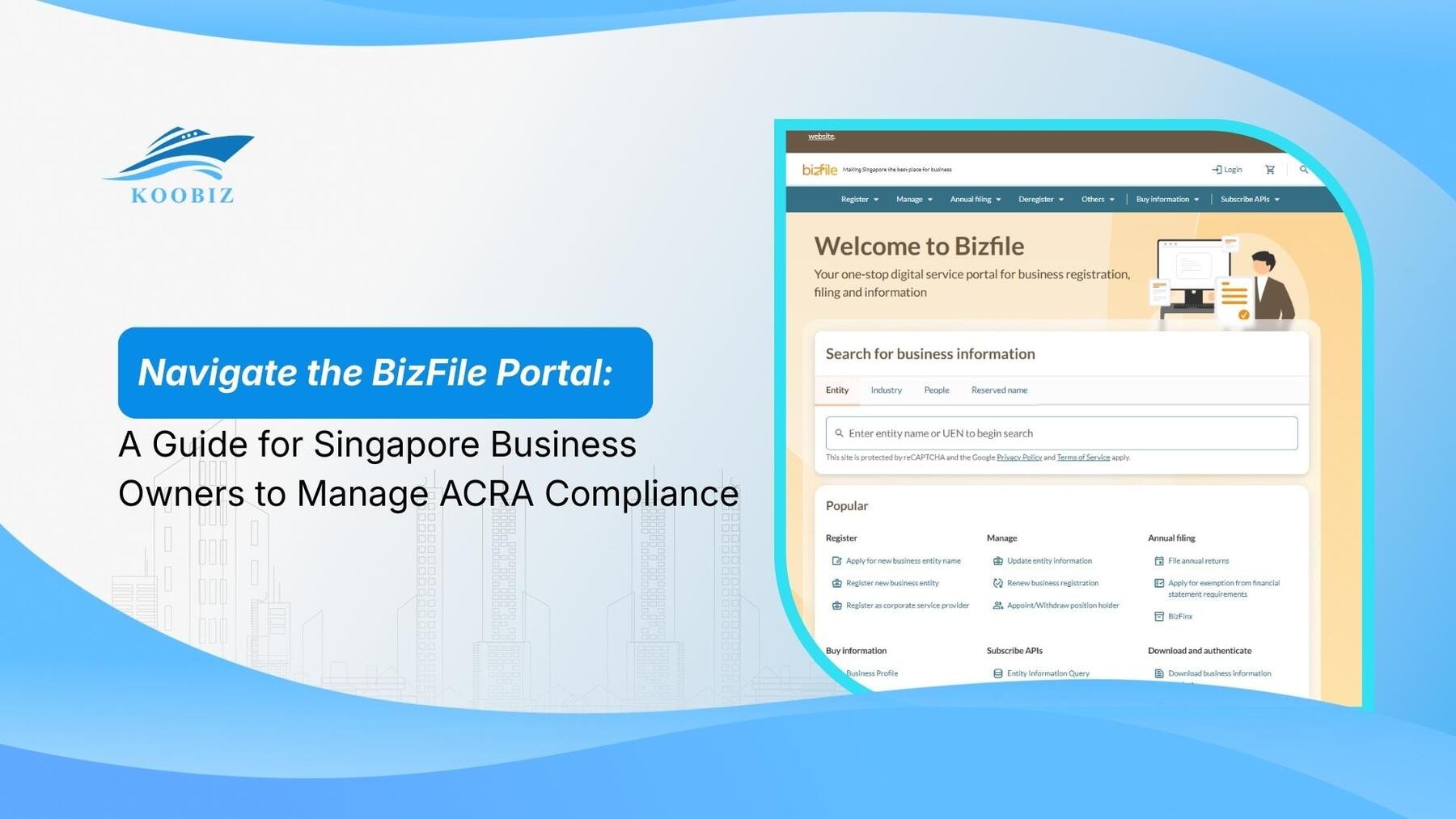
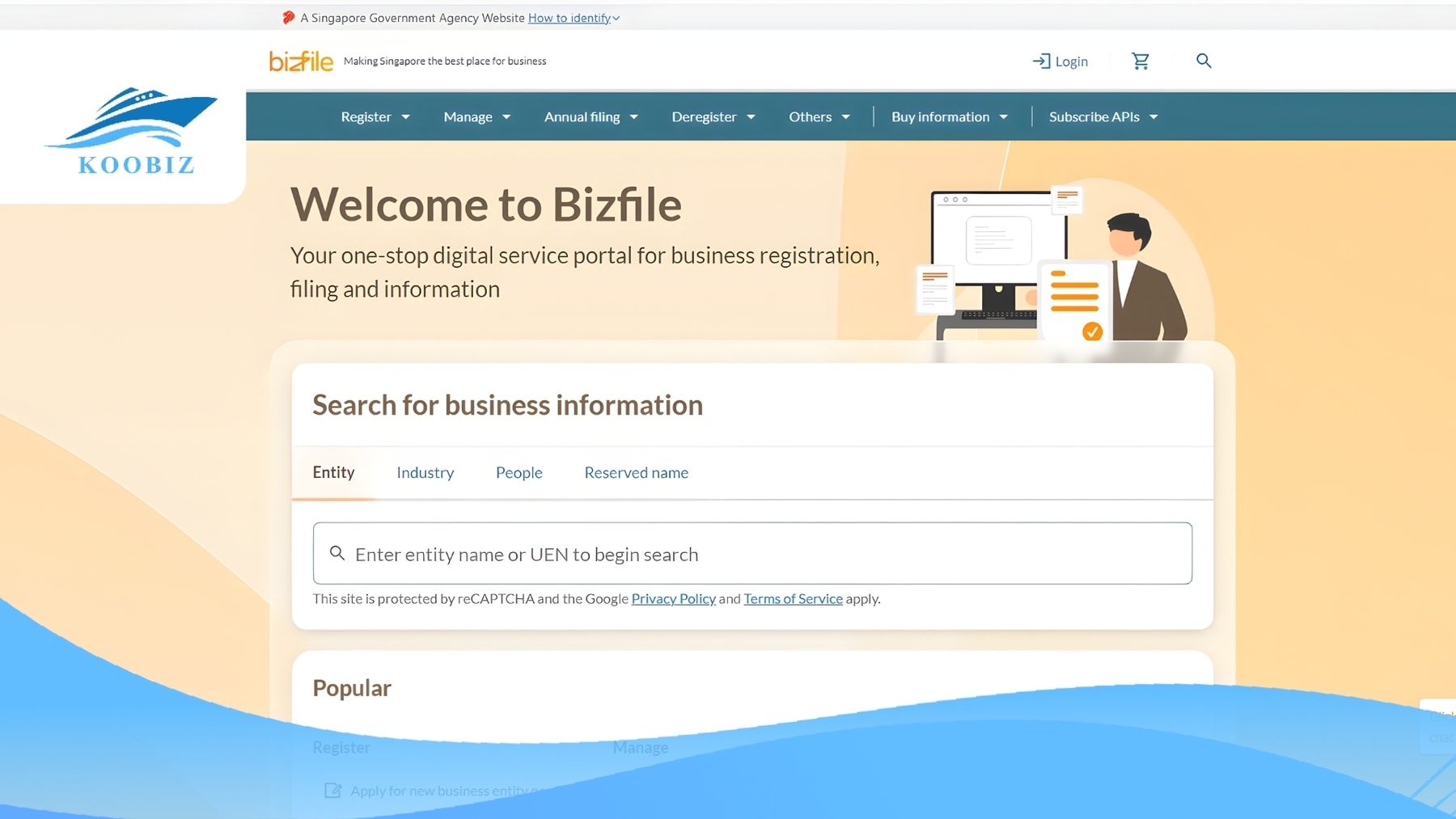
    Official Access: Conduct searches via the ACRA BizFile+ portal to retrieve verified corporate data.

    Essential Documents: Buy Business Profiles for legal, banking, and due diligence requirements.

    UEN Identification: Use the Unique Entity Number (UEN) to accurately track any registered entity in Singapore.

    Legitimacy Verification: Ensure business partners are “Live” and compliant with Singapore’s regulatory standards.

    Expert Support: Koobiz provides end-to-end assistance for incorporation and ongoing compliance management.

    [/SUMMARIES]

    Navigating the corporate landscape in Singapore requires transparency and accurate data. Whether you are an investor conducting due diligence or a business owner looking to verify a partner, a Conduct ACRA Company Search is your first step. At Koobiz, we understand that accessing official records like Business Profiles and performing a Basic UEN Search is critical for making informed decisions.

    In the following sections, we will guide you through the official BizFile+ portal, compare different document types, and explain how to interpret entity statuses. By the end of this guide, you will have a clear roadmap for obtaining the corporate intelligence you need to succeed in the Singaporean market.

    What is an ACRA Business Profile and Why Do You Need It?

    An ACRA Business Profile is a primary electronic document originated from the Accounting and Corporate Regulatory Authority (ACRA) that provides a comprehensive snapshot of a business entity’s current information and compliance status.

    Often described as a company’s “corporate ID,” this document underpins virtually all legal, regulatory, and financial transactions. It is routinely required for key activities such as opening a corporate bank account, conducting due diligence, entering into commercial contracts, and fulfilling tax and regulatory filings. At Koobiz, we regularly assist clients in obtaining and interpreting their ACRA Business Profiles as part of incorporation, banking, and ongoing compliance processes.

    Business Entity Name, UEN, and Registered Office Address

    These details establish the official legal identity of the company in Singapore.

    Establish the official legal identity of the company in Singapore
    Establish the official legal identity of the company in Singapore
    • Entity Name: The official name registered and approved by ACRA.
    • Unique Entity Number(UEN): A unique 9 or 10-digit universal identifier used across all government agencies
    • Registered Office: The physical location where legal documents can be served.

    The UEN, in particular, is essential for all interactions with authorities such as ACRA, IRAS, and CPF Board.

    Paid-up Capital and Shareholder Details

    This section outlines the company’s ownership and capital structure, providing insight into its financial standing and governance.

    • Paid-up Capital: The actual amount of money the shareholders have contributed.
    • Shareholder List: Names of shareholders and their respective shareholdings.

    Paid-up capital is often reviewed by banks, counterparties, and regulators when assessing a company’s credibility, financial commitment, and risk profile.

    According to the 2024 World Bank Business Ready (B-READY) report, transparent access to corporate registries like Singapore’s ACRA significantly reduces transaction costs and improves market trust, with Singapore ranking among the top globally and #1 in operational efficiency for business regulations.

    Can Anyone Conduct an ACRA Company Search in Singapore?

    Yes, anyone can conduct an ACRA Company Search because Singapore maintains a public register to ensure corporate transparency, provided the searcher pays the prescribed fee and follows the official portal guidelines.

    While basic information such as a company’s name can be viewed without charge, accessing a full ACRA Business Profile requires a nominal fee via ACRA’s authorised portal. This framework promotes transparency while ensuring the proper use of corporate data. At Koobiz ensures that our clients understand the public nature of their data when we assist them with Singapore company incorporation.

    Public Access vs. Corporate Privacy

    In Singapore, the balance between transparency and privacy is managed by making “Public Registers” available while protecting sensitive personal data like home addresses of directors (which are often masked if an alternate address is provided).

    BizFile+ Availability and Global Accessibility

    The BizFile+ portal is generally available 24/7, allowing users from anywhere in the world to perform a lookup. However, users should be aware of occasional scheduled maintenance windows (typically on weekends or late nights Singapore time). This global accessibility makes Singapore one of the most business-friendly hubs globally.

    ACRA Search: Global corporate transparency
    ACRA Search: Global corporate transparency

    Step-by-Step Guide: How to Buy Business Profiles & UEN Reports

    Buying ACRA reports involves a digital transaction method consisting of four distinct steps that result in the immediate delivery of a PDF document to your registered email address.

    Following this process ensures you receive the most up-to-date information directly from ACRA’s database. For a smooth transaction, Koobiz recommends keeping your credit card or PayNow app ready for a seamless experience.

    How to Buy Business Profiles & UEN Reports
    How to Buy Business Profiles & UEN Reports

    Step 1: Access the BizFile+ Search Portal

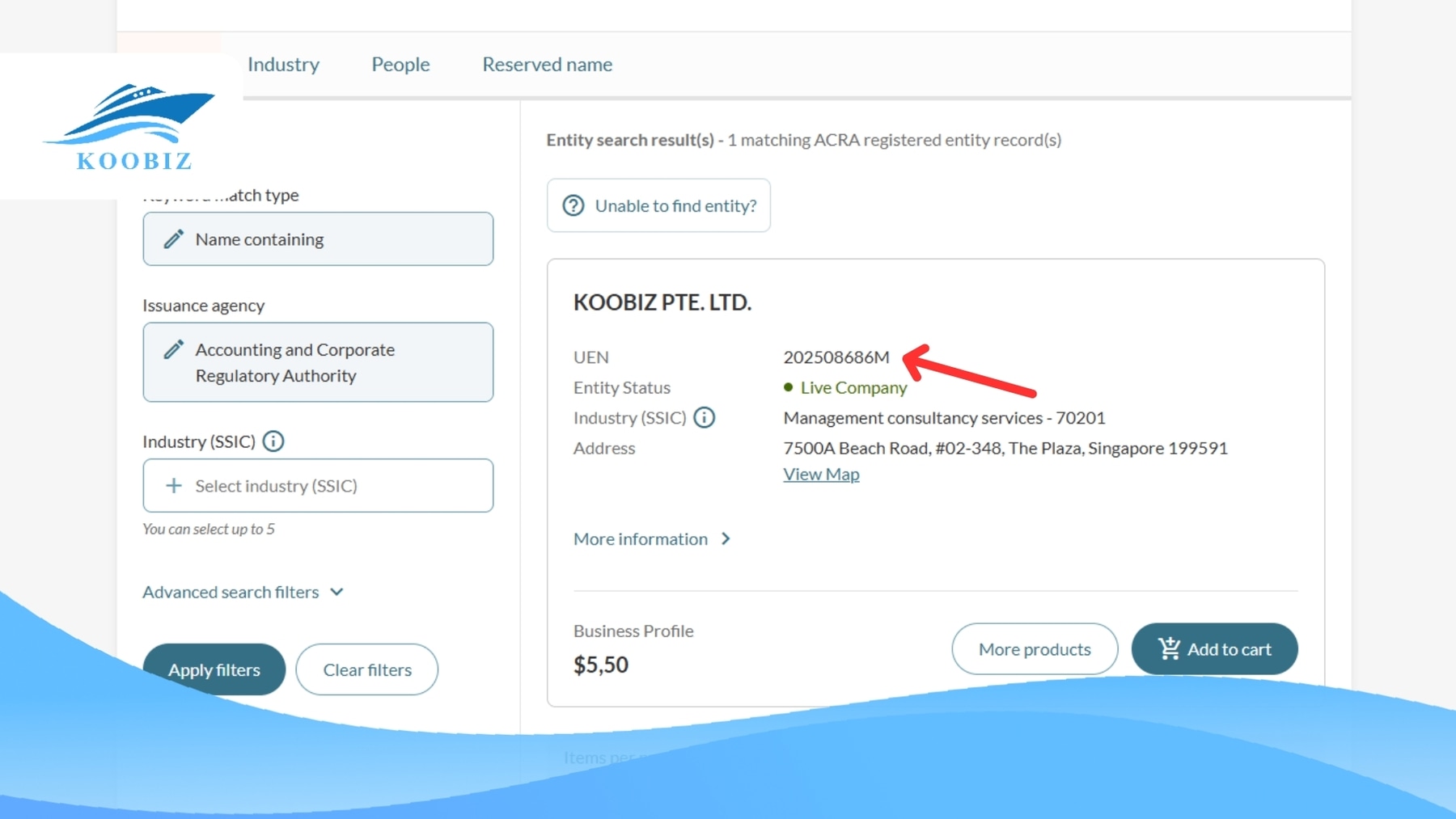
    To begin, visit the official BizFile+ website. Use the “Search” function and enter either the Company Name or the UEN.

    • Search by Name: Useful if you don’t have the UEN.
    • Search by UEN: The most accurate method, especially when dealing with similar company names.

    Step 2: Selecting the Correct Product Type

    Once the entity is found, you must choose what to purchase. The most common choice is the “Business Profile (Standard),” but there are other options like financial statements.

    • Standard Business Profile: Most commonly used for due diligence and verification.
    • Business Profile with Certificate of Production: Typically required for official submissions to government agencies or legal purposes.

    Step 3: Complete Payment Securely

    Payment is processed through ACRA’s secure payment gateway. The standard Business Profile generally costs around S$5.50.

    • Credit Cards: Visa and Mastercard are widely accepted.
    • PayNow: Convenient for those with Singaporean bank accounts.

    Step 4: Receive and Verify the PDF via Email

    Once payment is successful, ACRA will email a download link to the provided address. This link is usually valid for up to 7 days.

    • Download: Save the PDF immediately.
    • Verify: Use the embedded QR code or link to authenticate the document via ACRA’s trustBar system.

    ACRA’s digital infrastructure ensures that the vast majority of corporate document requests are fulfilled instantly, allowing you to receive your official files within minutes of payment.

    Comparing Basic UEN Search vs. Certified Extracts

    Choosing the right document depends entirely on your end goal. For daily operations, a standard profile is usually sufficient; however, for complex legal disputes or formal administrative requirements, a certified extract is mandatory.

    The table below highlights the key distinctions between a basic UEN search and a certified extract, helping you determine which option best suits your specific requirements when working with Koobiz.

    Feature Basic UEN Search Business Profile (Standard) Certified Extract
    Primary Purpose Quick identification General due diligence & KYC Legal & official submissions
    Information Depth Basic (Name, UEN, Status) Comprehensive (Directors, Capital) Deep (Historical changes)
    Legal Weight Informational only Standard operational document Admissible in a court of law
    Authentication Web View only QR Code protected Signed by Assistant Registrar
    Cost* Free S$5.50 Starting from S$16.50 (e.g., with Certificate of Production)

    *Costs as of December 2025; subject to GST and ACRA updates.

    Legal Weight and Evidentiary Value

    Certified extracts are signed by the Assistant Registrar of ACRA, making them admissible as evidence in a court of law. A standard PDF download does not carry this same weight without a specific certificate.

    Cost Structure and Information Scope

    While a basic UEN check is free via the directory, a full certified extract can cost significantly more depending on the depth of information required (e.g., historical extracts).

    Identifying Non-Active Entities: Struck Off vs. Dissolved Status

    Understanding non-active statuses is a critical due diligence skill involving the differentiation between administrative removal (Struck Off) and formal liquidation (Dissolved).

    When a company search shows a status other than “Live”, it signals that the entity has lost its normal legal standing. Such statuses indicate that the company is no longer operating as a valid commercial counterpart. Koobiz often helps clients investigate these statuses to ensure they aren’t entering contracts with defunct entities.

    What Does it Mean if a Company is “Struck Off”?

    “Struck Off” is an administrative action where ACRA removes a company from the register, most commonly due to prolonged non-compliance (e.g. failure to file Annual Returns) or confirmation that the company has ceased business activities..

    • Implication: The company no longer has the power to trade or own property.
    • Reversibility: It is possible to restore a struck-off company via a court order, typically within 6 years of the striking off date.

    How to Retrieve Records for Liquidated or Dissolved Businesses

    “Dissolved” is the final stage of a company’s life cycle, usually following a formal liquidation process (winding up).

    • Rare Attribute: Retrieving records for dissolved companies often requires searching the historical archives, as they may not appear in the primary “Live” search results.

    The Role of the Authenticity QR Code on Official ACRA Downloads

    In 2024, ACRA enhanced security by adding a Unique QR Code to every downloaded Business Profile. This unique attribute allows any third party to scan the document and verify its authenticity directly against ACRA’s database, preventing the use of forged PDF documents in bank account applications.

    When to Use a Business Profile vs. a Certificate of Good Standing

    These two documents serve different compliance objectives and are not interchangeable.

    A Business Profile provides factual information about the company’s structure, officers, and registration details at a specific point in time.

    A Certificate of Good Standing (CGS), on the other hand, is a formal certification issued by ACRA confirming that the company is active (“Live”) and fully compliant with all statutory filing obligations.

    Typical Use Cases for CGS:

    • Cross-border transactions and overseas business registrations
    • Foreign bank account openings
    • Work visa or regulatory applications for directors in other jurisdictions

    Because of its legal weight, the CGS is generally requested only in international or high-level regulatory contexts, rather than for routine domestic operations.

    Can You Search for Sole Proprietorships and Partnerships?

    Yes, ACRA search is not limited to Private Limited companies. You can also search for:

    • Sole Proprietorships: Businesses owned by one person.
    • Partnerships: Entities with two or more partners.
    • LLPs: Limited Liability Partnerships.

    Each of these entity types will have a different UEN format and different levels of disclosure in their Business Profiles.

    About Koobiz

    Koobiz is your premier partner for navigating the complex regulatory environment of Singapore. We specialize in providing high-end corporate services designed to help global entrepreneurs thrive in Asia’s most dynamic business hub.

    Our core services include:

    • Singapore Company Incorporation: Fast, reliable, and compliant setup.
    • Bank Account Opening Assistance: Leveraging our network of local and international banks.
    • Tax and Accounting Services: Ensuring your business meets all IRAS and ACRA requirements.
    • Audit and Compliance: Maintaining your “Good Standing” status with the Singapore government.

    Visit us at koobiz.com to start your Singapore business journey today.

    Disclaimer: This information is based on ACRA guidelines as of December 2025. Always verify on the official BizFile+ portal for the latest details.

  • Accounting vs. Bookkeeping: Roles, Salaries & Compliance (SG Guide)

    Accounting vs. Bookkeeping: Roles, Salaries & Compliance (SG Guide)

    [SUMMARIES]

    Distinct Roles: Bookkeeping focuses on the daily recording of financial data, while accounting focuses on interpreting that data for strategic growth.

    Interdependence: You cannot have effective accounting without accurate bookkeeping; they form a “Records to Strategy” chain essential for business health.

    Compliance Necessity: Both functions are critical for meeting Singapore’s strict ACRA and IRAS regulations, including Annual Returns and Tax Filing.

    Modern Solutions: Leveraging cloud software and professional services like Koobiz can streamline these processes for Singapore SMEs.

    [/SUMMARIES]

    Many Singapore entrepreneurs confuse Accounting vs. Bookkeeping, yet the distinction is vital: bookkeeping records history (Data Entry), while accounting plans your future (Financial Strategy). Correctly managing both ensures accurate ledgers and full compliance with ACRA and IRAS. At Koobiz, we help SMEs master these roles for long-term stability. This guide breaks down the key differences, salaries, and compliance impacts to help you make informed business decisions.

    What is Bookkeeping?

    Bookkeeping is the systematic recording and organization of daily financial transactions, serving as the essential “Data Entry” phase of the business cycle.

    Recording and organizing daily financial transactions
    Recording and organizing daily financial transactions

    Ideally, this foundational work ensures that every dollar entering or leaving the company is accounted for accurately. It is administrative and transactional in nature, acting as the bedrock of business data. Without this accuracy, a company lacks a reliable history of its operations, making future analysis impossible.

    What is Accounting?

    Accounting is the analysis, summarization, and interpretation of financial data, representing the “Financial Strategy” phase that aids in decision-making and regulatory compliance.

    Analysis, summarization, and interpretation of financial data
    Analysis, summarization, and interpretation of financial data

    Once the data is recorded by bookkeepers, accounting transforms it into financial statements, tax returns, and actionable business insights. This function is advisory and analytical, focusing on the “why” and “how” behind the numbers. Accounting takes the raw inputs to ensure the business meets ACRA standards, optimizes its tax position with IRAS, and assesses overall financial health for future growth.

    Key Differences Between Accounting and Bookkeeping

    Both are crucial for financial integrity, their operational differences become clearer when we compare their nature, scope, and ultimate goals. The “Records to Strategy” concept illustrates this shift perfectly. Bookkeeping is objective; 100 SGD spent on office supplies is a fact that must be recorded. Accounting is often subjective and analytical; it asks why 100 SGD was spent, whether it is tax-deductible under Singapore law, and how it affects the company’s bottom line.

    Aspect Bookkeeping (Data Entry) Accounting (Financial Strategy)
    Nature Administrative & Transactional Advisory & Analytical
    Scope Focuses on details (Receipts, Invoices, Ledgers) Focuses on the big picture (P&L, Balance Sheets)
    Goal Balanced Books & Accuracy Tax Optimization, Profitability & Growth

    Clients at Koobiz often realize that while they can perform basic bookkeeping themselves, the strategic oversight of accounting requires professional expertise.

    Professional Comparison: Education, Salary & Career Outlook

    Beyond the daily tasks, the educational background, required credentials, and career trajectories for bookkeepers and accountants in Singapore differ significantly.Understanding these professional differences helps business owners gauge the level of expertise they are paying for.

    Feature Bookkeeper Accountant
    Education Diploma (Polytechnic), LCCI (Level 1-3), or CAT (Certified Accounting Technician). Bachelor’s Degree in Accountancy or Professional Qualification (ACCA).
    Credentials No mandatory license to practice basic bookkeeping. CA (Singapore) via ISCA, CPA, or ACCA Member. Often required for signing off audits.
    Key Skills Attention to detail, data entry speed, organization, software proficiency. Financial analysis, tax law (SFRS), strategic planning, critical thinking.
    Avg. Salary (SG) S$2,800 – S$4,500 per month (Entry to Senior level). S$4,500 – S$8,500+ per month (Associate to Manager level).

    Note: Salaries are estimated based on Singapore market standards (2024/2025) and vary by industry.

    Roles and Responsibilities of Bookkeepers vs. Accountants

    Roles and Responsibilities of Bookkeepers vs. Accountants
    Roles and Responsibilities of Bookkeepers vs. Accountants

    To ensure your business runs smoothly and remains compliant with Singapore regulations, it is essential to assign the right tasks to the right professionals. Mixing these roles can lead to inefficiencies or compliance errors.

    Bookkeeper Roles

    • Invoicing & Billing: issuing invoices to clients and recording payments received.
    • Expense Management: Tracking receipts and categorizing daily expenses.
    • Payroll: Calculating employee salaries and CPF contributions.
    • Bank Reconciliation: Ensuring the company ledger matches the bank statement.

    Accountant Roles

    • Financial Reporting: Preparing statutory financial statements for ACRA.
    • Tax Planning: optimizing corporate tax positions and filing ECI/Form C-S with IRAS.
    • Auditing: Reviewing financial systems for accuracy and fraud prevention.
    • Advisory: Analyzing costs and revenue to suggest growth strategies.

    Do Singapore SMEs Need Both Functions?

    Bookkeeping & Accounting: Foundation for compliance and growth strategy
    Bookkeeping & Accounting: Foundation for compliance and growth strategy

    Yes, Singapore SMEs need both functions because bookkeeping ensures accurate data foundation for legal compliance, while accounting provides the financial roadmap and strategic oversight necessary for sustainable growth and tax optimization.

    Many business owners wonder if they can cut costs by eliminating one, but understanding the chain of value reveals why they are inseparable. If bookkeeping is neglected, the accountant receives inaccurate data , which leads to flawed financial reports and potential penalties from IRAS for incorrect tax filings . Conversely, if a business has perfect bookkeeping but no accounting, they have data but no insight—they know how much money they have, but not how to make it grow.

    For Koobiz clients, we emphasize that bookkeeping keeps you out of trouble, while accounting helps you get ahead.

    How Accounting and Bookkeeping Impact Singapore Compliance (ACRA & IRAS)

    Proper financial management impacts Singapore compliance in three key areas: Annual Return filing with ACRA, Estimated Chargeable Income (ECI) submission, and the accurate preparation of Corporate Income Tax returns for IRAS.

    In Singapore, the regulatory framework is strict. ACRA requires companies to maintain proper accounts and records for at least 5 years. Failure to do so can result in fines or disqualification for directors..

    • ACRA Compliance: Your bookkeeping feeds directly into the financial statements required for the Annual General Meeting (AGM) and Annual Return (AR).
    • IRAS Compliance: Accountants use bookkeeper records to calculate taxable income and file Form C-S/C.

    What is the Role of SFRS in Your Accounts?

    Singapore Financial Reporting Standards (SFRS) is a set of accounting standards based on IFRS that defines how financial transactions and events should be recognized, measured, and presented in financial statements.

    To ensure your financial statements are globally comparable and locally compliant, adherence to SFRS is mandatory for most Singapore companies. While bookkeepers do not need to be experts in SFRS, the data they record must be categorized correctly so that the accountant can apply these standards. For example, how revenue is recognized or how leases are treated under SFRS can significantly impact your reported profit. Koobiz accountants ensure that your transition from raw data to final report strictly adheres to these standards, protecting your company’s reputation.

    Can Cloud Software Replace a Human Accountant?

    Cloud software like Xero or QuickBooks excels at automating the manual data entry of bookkeeping, but it cannot replace the strategic judgment, tax expertise, and complex problem-solving capabilities of a human accountant.

    Software is fantastic for the “Records” part of our title—it automates bank feeds, invoices, and basic categorization. However, for the “Strategy” part, you need a human. Software can tell you that your profit dropped by 10%, but only an accountant can explain why (e.g., pricing strategy vs. cost of goods) and advise on how to fix it within the context of the Singapore market.

    When Should You Outsource vs. Hire In-House?

    This decision is often a tipping point for growing businesses.

    • Outsourcing (The Koobiz Model): You pay a monthly fee for a team that handles everything from bookkeeping to tax. You get continuity (no staff turnover issues) and expert compliance knowledge without paying CPF or office rental for an employee.
    • In-House: You have immediate access to a staff member, but you bear the full cost of employment and software licenses. Unless your business requires a bookkeeper on-site to handle physical cash or daily inventory continuously, outsourcing remains the most strategic choice for Singapore SMEs.

    Is “Catch-up Bookkeeping” Necessary Before Tax Season?

    Yes, “Catch-up Bookkeeping” is absolutely necessary before tax season because IRAS requires tax filings to be based on accurate, reconciled financial records, and filing based on estimates or disorganized data can lead to severe penalties and audits.

    Attempting to file taxes without first cleaning up the books is dangerous. Catch-up services involve going back through months (or years) of bank statements to reconstruct the financial history. This ensures that every deductible expense is claimed—saving you tax money—and that every dollar of revenue is reported. For Koobiz’s clients, we often perform catch-up bookkeeping to bring them into compliance before tackling their strategic accounting needs.

    With Koobiz

    Navigating the regulatory landscape of Singapore doesn’t have to be a solo journey. We specialize in comprehensive corporate services, from Singapore company incorporation and opening corporate bank accounts to ongoing tax, accounting, and auditing support. Bridging the gap between meticulous record-keeping and high-level financial strategy, ensuring your business is not just compliant, but competitive.

    Visit koobiz.com today to streamline your financial operations.

  • Preparing Unaudited Financial Statements for Singapore SMEs: A Complete ACRA Compliance Guide

    Preparing Unaudited Financial Statements for Singapore SMEs: A Complete ACRA Compliance Guide

    [SUMMARIES]

    Cost-Efficiency: Unaudited financial statements allow eligible Singapore SMEs to comply with ACRA regulations without the high cost of an external audit.

    Eligibility Rules: Your company likely qualifies if it meets the “Small Company” criteria (Revenue <$10M, Assets <$10M, Employees <50).

    Mandatory Compliance: Even without an audit, statements must strictly adhere to Singapore Financial Reporting Standards (SFRS).

    Filing Format: Most companies must convert these statements into XBRL format for submission to ACRA.

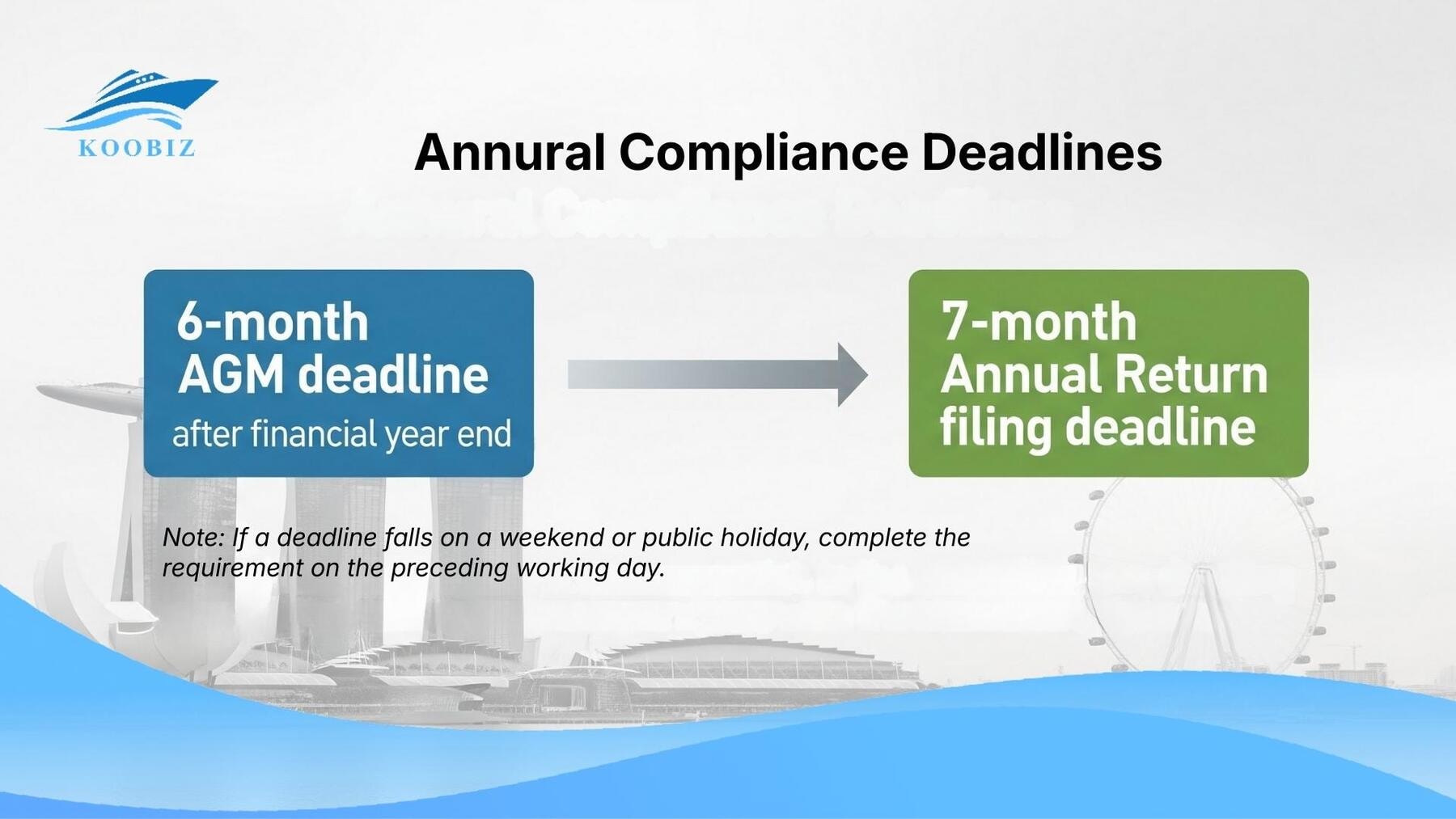
    Timeline: Financial Year End (FYE) + 6 months for AGM (if held), + 7 months for Annual Return (AR) filing.

    Value of Professional Compilation: While “unaudited,” utilizing a professional compilation service like Koobiz ensures accuracy and banking credibility.

    [/SUMMARIES]

    Navigating the regulatory landscape of Singapore can be daunting for small business owners, especially when the Annual General Meeting (AGM) season approaches. Preparing unaudited financial statements is a critical obligation for Singapore SMEs that qualify for audit exemptions, offering a streamlined path to ACRA compliance without the heavy financial burden of a full statutory audit. However, “unaudited” does not mean “unregulated”; these reports must still adhere rigorously to the Singapore Financial Reporting Standards (SFRS) to avoid penalties and maintain good standing. Whether you are determining your eligibility for the “Small Company” exemption, distinguishing between audited and unaudited reports, or looking for a step-by-step preparation guide, this article covers every essential detail. At Koobiz, we understand that accurate financial reporting is the backbone of your business credibility, and we are here to guide you through the complexities of Singapore’s corporate compliance.

    [Note: This guide is current as of December 2025. Always refer to ACRA’s latest guidelines for specific amendments.]

    What Are Unaudited Financial Statements in Singapore?

    Unaudited financial statements are comprehensive financial reports prepared by a company’s management or external accountants that strictly follow the Singapore Financial Reporting Standards (SFRS) but do not undergo independent verification by an external auditor.

    The key distinction from audited financial statements lies in the absence of an external auditor’s opinion. Audited accounts include a professional assurance confirming that the financial statements present a true and fair view of the company’s financial position. Unaudited financial statements, by contrast, are supported by the directors’ responsibility and declaration that the accounts are accurate and properly prepared.

    Importantly, for regulatory and tax authorities such as the Accounting and Corporate Regulatory Authority (ACRA) and the Inland Revenue Authority of Singapore (IRAS), unaudited financial statements carry full legal significance. They form the basis for corporate tax assessments, statutory filings, and regulatory reviews of solvency and compliance. As a result, audit exemption does not reduce the standard of accuracy or compliance required. These financial statements must still be prepared with the same level of care, consistency, and adherence to SFRS as audited accounts.

    Is Your Company Eligible for Audit Exemption?

    Yes, your company is eligible for audit exemption if it qualifies as a “Small Company” under the rigorous criteria set forth by ACRA in the Companies Act.

    The “Small Company” concept was introduced to reduce regulatory costs for smaller entities. To qualify, a private company must meet at least two of the following three quantitative criteria for the immediate past two consecutive financial years:

    1. Total Annual Revenue: Less than or equal to SGD 10 million.
    2. Total Assets: Less than or equal to SGD 10 million.
    3. Number of Employees: Less than or equal to 50 employees.

    If your company is part of a group, the entire group must collectively meet these criteria on a consolidated basis to qualify.

    Eligibility is not permanent and must be reviewed annually. If a company exceeds the prescribed thresholds as its operations expand, it will be required to appoint a statutory auditor and transition to audited financial statements in the subsequent financial year.

    At Koobiz, we assist directors in conducting year-end eligibility assessments to determine whether audit exemption can be maintained or whether a statutory audit will be required, ensuring timely compliance and avoiding regulatory breaches.

    Unaudited vs. Audited Financial Statements: What is the Difference?

    Audited and unaudited financial statements serve distinct regulatory and business purposes. Audited financial statements are primarily intended to provide independent assurance to external stakeholders, while unaudited financial statements are designed to meet statutory filing requirements in a more cost-efficient and timely manner.

    Although both sets of financial statements present the same underlying financial information, the critical distinction lies in the degree of independent verification, regulatory requirement, and intended users. The comparison below highlights these differences.

    Feature Unaudited Financial Statements Audited Financial Statements
    Validation Compiled based on information provided by management. No independent verification or assurance opinion. Systematically reviewed by an independent Public Accountant who tests the validity of transactions.
    Legal Basis Must follow SFRS; Directors’ declaration (Sec 201). Must follow SFRS; Auditor’s opinion (Sec 207).
    Cost & Time Low Cost, Fast Turnaround. Ideal for SMEs operating on tight budgets; can be prepared quickly. High Cost, Time-Consuming. Process often takes weeks to complete due to rigorous testing standards.
    Purpose Sufficient for tax filing (IRAS), ACRA annual returns (for small private companies), and internal management. Required for stock exchange listings, large venture capital funding, or soliciting significant loans.
    Assurance Level Relies on Directors’ declaration of accuracy. Carries a positive assurance opinion from a licensed auditor.

    Key Components of a Complete Unaudited Financial Report

    A standard unaudited financial report comprises five essential components: the Statement of Financial Position, Statement of Comprehensive Income, Statement of Changes in Equity, Statement of Cash Flows, and the Directors’ Statement.

    To ensure your report is accepted by ACRA, it must be holistic and tell the complete story of your financial year. Missing any of these sections can lead to rejection or queries from authorities.

    Statement of Financial Position (Balance Sheet)

    The Statement of Financial Position presents the company’s financial standing at a specific point in time. It sets out the company’s assets, liabilities, and shareholders’ equity, typically classified into current and non-current categories.

    Within an unaudited financial report, this statement plays a critical compliance role. It enables ACRA and other stakeholders to assess the company’s solvency, demonstrating whether the company is able to meet its short- and long-term obligations as they fall due.

    Statement of Comprehensive Income (Profit & Loss)

    The Statement of Comprehensive Income summarises the company’s revenue, expenses, and costs over the financial period, culminating in the net profit or loss for the year.

    From a regulatory and tax perspective, this statement forms the primary basis for corporate tax computation. The net results disclosed here are used to derive the company’s Chargeable Income for submission to IRAS under Form C or Form C-S, making accuracy and proper classification of income and expenses essential.

    Statement of Changes in Equity

    The Statement of Changes in Equity explains how the shareholders’ equity has changed over the financial year. It captures movements arising from share issuances, dividend distributions, and retained earnings generated from the company’s operations.

    From a governance perspective, this statement allows shareholders and regulators to clearly understand how the company’s profits have been allocated and how the owners’ residual interest in the company has increased or decreased during the reporting period.

    Statement of Cash Flows

    Often overlooked in internal reports but mandatory for SFRS compliance, this statement shows the inflow and outflow of cash. It categorizes cash flow into operating, investing, and financing activities, providing a clear picture of the company’s liquidity that a P&L statement alone cannot offer.

    Notes to the Financial Statements

    These are detailed disclosures that explain the accounting policies used to prepare the statements (e.g., depreciation methods, currency translation). Under SFRS, the notes form an integral part of the financial statements. Without adequate disclosure, the financial statements may be considered incomplete or potentially misleading, even if the numerical figures are accurate.

    How to Prepare and File Unaudited Financial Statements with ACRA

    Preparing and filing unaudited financial statements with ACRA follows a structured, four-stage process: maintaining proper bookkeeping, preparing SFRS-compliant financial statements, obtaining shareholder approval, and lodging the Annual Return with ACRA.

    Bookkeeping and Trial Balance

    The foundation of any financial statement is accurate bookkeeping. You must record every transaction, sales invoices, expense receipts, bank statements, into your accounting ledger. At the end of the financial year, these records are summarized into a Trial Balance. Without a balanced and accurate Trial Balance, preparing the subsequent financial statements is impossible. Koobiz recommends using cloud accounting software (like Xero or QuickBooks) to automate this process throughout the year.

    Drafting the Financial Statements

    Once the figures are finalized, they must be formatted into the formal financial statements described in the previous section. This is where knowledge of SFRS is essential. You cannot simply submit a spreadsheet; the document must include the Directors’ Statement (replacing the Auditor’s Report) where directors formally declare the accounts are true and fair.

    AGM and Authorization

    Before filing, the unaudited financial statements must be approved by the shareholders. This is typically done at the Annual General Meeting (AGM), which must be held within 6 months of the financial year-end.

    • AGM Dispensation: Private companies can dispense with holding a physical AGM by passing a resolution or if permitted by their constitution. In this case, the financial statements must still be sent to shareholders within 5 months of the financial year-end.

    Filing the Annual Return

    The final step is filing the Annual Return (AR) via ACRA’s BizFile+ portal. As part of this process, companies are required to submit their financial statements, typically in XBRL format, depending on the filing requirements. The deadline for filing is within 7 months after the financial year-end.

    Real-World Scenarios: Who Qualifies? (Case Studies)

    To illustrate how the “Small Company” and “Small Group” audit exemption rules apply in practice, below are three representative case studies commonly encountered by Singapore businesses:

    Case Study 1: The Standalone Retailer (Eligible)

    Company: Orchard Boutique Pte. Ltd.

    Financial Metrics:

    • FY 2023: Revenue $1.2M | Assets $400k | Employees 8
    • FY 2024: Revenue $1.5M | Assets $500k | Employees 10

    Conclusion: Eligible for audit exemption

    Since the company is a private entity and meets all three criteria (well below the $10M/50 employee thresholds) for two consecutive years, it can file unaudited financial statements.

    Practical Impact: Estimated annual savings of S$2,000–S$4,000 in statutory audit fees.

    Case Study 2: The “Small Group” Structure (Eligible)

    Structure:

    TechHoldings Pte. Ltd. (Parent – 100% ownership)

    AppDev Pte. Ltd. (Subsidiary)

    Individual Entity Metrics:

    • TechHoldings (Parent): Revenue $0 | Assets $5M | Employees 2
    • AppDev (Sub): Revenue $8M | Assets $2M | Employees 20

    Consolidated Group Figures:

    • Total Revenue: $8M (Under $10M)
    • Total Assets: $7M (Under $10M)
    • Total Employees: 22 (Under 50)

    Conclusion: Eligible for audit exemption

    Even though there are multiple entities, the consolidated figures remain under the thresholds. Both the parent and the subsidiary can file unaudited statements.

    Case Study 3: The Disqualified Subsidiary (Not Eligible)

    Structure:

    Global Logistics Pte. Ltd. (Singapore subsidiary)

    MegaCorp Inc. (Foreign parent company)

    Financial Metrics:

    • Global Logistics (SG Sub): Revenue $2M (Small)
    • MegaCorp (Foreign Parent): Revenue $100M (Large)

    Conclusion: Not eligible for audit exemption

    While the Singapore subsidiary itself is “small,” it is part of a group that is “large” (consolidated revenue >$10M). Therefore, the Singapore subsidiary cannot claim audit exemption and must submit audited financial statements, unless it obtains a specific exemption or the parent has specific provisions.

    Lesson: Always look at the entire corporate family tree, not just the local entity.

    Unsure about your eligibility? Regulations can be complex, especially for group structures. Contact Koobiz for a free eligibility check to ensure you are on the right side of ACRA compliance.

    Advanced Filing Requirements and Common Mistakes

    There are specific technical pitfalls and formatting rules, particularly regarding digital data standards, that can cause compliance failures for unwary SMEs.

    Beyond the basic preparation, companies often stumble on the specific digital requirements of the Singapore government. ACRA is one of the most digitally advanced registries globally, and simply uploading a PDF is rarely sufficient.

    Understanding XBRL Filing Format for Unaudited Accounts

    XBRL (eXtensible Business Reporting Language) is an international standard used for the electronic communication of financial data. In Singapore, ACRA requires most companies to lodge their financial statements in XBRL format as part of the Annual Return filing process.

    Most SMEs are unaware that they cannot simply upload a PDF of their unaudited accounts. Depending on your company size, you will need to prepare the file in either “Full XBRL” or “Simplified XBRL.”

    • Simplified XBRL: Generally applicable for smaller, non-publicly accountable companies (Revenue <$500k and Assets <$500k).
    • Full XBRL: Required for larger companies.

    Preparing this file requires specialized software or the use of the BizFinx preparation tool provided by ACRA. Errors in mapping your financial data to the XBRL taxonomy are common and can result in the rejection of your Annual Return. This is a technical step where professional assistance from Koobiz is highly recommended to ensure data integrity.

    Does a Dormant Company Need to File Unaudited Financial Statements?

    No, a “dormant relevant company” is generally exempt from both preparing and filing financial statements if its total assets are SGD 500,000 or less at any time during the financial year.

    For ACRA purposes, a dormant relevant company is one that is unlisted, not a subsidiary of a listed company, and has no accounting transactions since incorporation or since the end of the previous financial year. Where a dormant company’s total assets exceed SGD 500,000, unaudited financial statements must still be prepared and lodged in XBRL format, despite the absence of trading activity.

    Regardless of asset size, all dormant companies are required to file an Annual Return (AR) each year to formally confirm their dormant status with ACRA.

    Compilation vs. Preparation: Is a Chartered Accountant Necessary?

    A “Compilation Report” offers a higher degree of credibility than self-prepared accounts because it involves a Chartered Accountant arranging your financial data in compliance with SSRS 4410 (Singapore Standard on Related Services).

    While you are legally allowed to prepare unaudited statements yourself (as a director), banks and potential partners often view self-prepared documents with skepticism. A Compilation Report serves as a middle ground. It is not an audit (no assurance opinion is given), but it carries the letterhead and professional signature of a qualified accounting firm like Koobiz, signaling that the information is presented correctly and professionally. This is often the “sweet spot” for SMEs—gaining professional credibility without the cost of a full audit.

    Conclusion

    Preparing unaudited financial statements is a core compliance obligation for Singapore SMEs, offering a practical balance between regulatory transparency and cost efficiency. By accurately assessing audit exemption eligibility, complying fully with SFRS requirements, and meeting ACRA’s XBRL filing standards, businesses can maintain both statutory compliance and stakeholder confidence.

    At Koobiz, we specialize in simplifying corporate compliance for businesses in Singapore. Whether you need assistance with company incorporation, opening a corporate bank account, or require professional accounting and tax services to prepare your unaudited financial statements, our team of experts is ready to assist. Don’t let compliance worries slow down your business growth.
    Contact Koobiz today for a consultation on your financial reporting needs.

    • Website: koobiz.com
    • Services: Singapore Company Incorporation, Bank Account Opening, Tax, Accounting, and Audit Services.
  • Can Sole Proprietorship have employees? The complete hiring guide for Singapore

    Can Sole Proprietorship have employees? The complete hiring guide for Singapore

    [SUMMARIES]

    Sole Proprietors in Singapore are legally permitted to hire employees but must strictly adhere to statutory obligations, including mandatory Central Provident Fund (CPF) contributions, issuing Key Employment Terms (KETs), and paying the Skills Development Levy (SDL).

    Hiring foreign staff faces significant constraints as Sole Proprietors are subject to sector-specific quotas and Dependency Ratio Ceilings (DRC), where the owner does not count as a local employee for quota calculation purposes.

    The structure carries significant risk due to unlimited liability, meaning owners are personally responsible for employment disputes and workplace accidents, prompting many to incorporate as a Private Limited Company (Pte Ltd) for better asset protection and scalability.

    [/SUMMARIES]

    Yes, a Sole Proprietorship in Singapore can hire employees. Hiring can unlock growth, but owners must follow Ministry of Manpower (MOM) rules, meet Central Provident Fund (CPF) obligations, and comply with employment law. This guide explains what to do (and what to watch out for), with practical tips and where Koobiz can help – from payroll & CPF filing to work-pass applications and incorporation services.

    Can Sole Proprietors in Singapore legally hire employees?

    Yes. A sole proprietor with a current ACRA registration may employ staff. Legally, the owner (or the registered business name) is the employer and enters into contracts of service directly. That means you don’t need board resolutions (as you would for a company), but you are personally responsible for employer obligations – so correct registration and timely compliance are essential.

    If your ACRA registration is expired or inaccurate, employment contracts may be disputed and you risk penalties from MOM.

    Koobiz helps clients set up compliant payroll systems, register for a CPF Submission Number (CSN), and issue correct employment documents so hiring starts on solid ground.

    According to the Ministry of Manpower (MOM), all employers, regardless of size or entity type, are legally bound by the Employment Act once they engage an employee under a contract of service.

    What are the Mandatory Requirements for hiring local staff?

    When you hire local employees, the core obligations are simple to list but important to get right: CPF contributions, Key Employment Terms (KETs), Skills Development Levy (SDL), and fair hiring practices. Failure to comply can lead to fines and enforcement action.

    1. Central Provident Fund (CPF) Contributions

    You must register as an employer and obtain a CPF Submission Number (CSN) to submit CPF contributions. Employer and employee CPF contribution rates vary by the employee’s age (e.g., for employees 55 and below, employer share 17% and employee share 20% as at 1 Jan 2025). Contributions are normally due monthly, with statutory deadlines and penalties for late payment.

    2. Key Employment Terms (KETs)

    Employers must provide written Key Employment Terms to employees who are employed for 14 days or more, and these should be issued within 14 days of the start of employment. KETs list the essentials (names, job title, start date, salary, working hours, notice, etc.). You can include KETs within the employment contract.

    3. Skills Development Levy (SDL)

    SDL is payable for each employee at 0.25% of monthly wages, with a minimum of S$2 and a maximum of S$11.25 (SDL is capped on the first S$4,500 of wages). Don’t forget to include SDL in your payroll calculations.

    4. Fair Hiring Practices

    Data from the CPF Board indicates that late payment of CPF contributions is one of the most common offenses among small business owners, punishable by fines of up to SGD 10,000.

    Can a Sole Proprietor employ foreign workers in Singapore?

    Yes – but this is subject to strict conditions regarding approved source countries, sector-specific quotas. Hiring foreign workers requires appropriate work passes (Work Permit, S Pass), adherence to the sector’s Dependency Ratio Ceiling (DRC), and payment of foreign worker levies. For many sole proprietors, these rules are a practical constraint on scaling with foreign labour.

    • Work passes (S Pass / Work Permit): You must apply to MOM for the correct pass. S Pass eligibility includes a qualifying salary threshold that has been adjusted recently; note MOM’s staged increases to the S Pass qualifying salary (policy changed in 2025/2026).
    • Dependency Ratio Ceiling (DRC): The DRC limits the share of Work Permit + S Pass holders a business can employ. For the services sector the DRC is 35%, and within that the maximum share of S Pass holders is typically 10% – these quotas are enforced based on CPF-declared local staff numbers. If you have zero local employees who count toward quota, your foreign worker quota will be effectively zero.

    Practical implication for sole proprietors: Business owners of sole proprietorships do not count as local employees for quota calculations (only employees on CPF who meet the Local Qualifying Salary count), so a sole proprietor often needs to hire a local employee first (and contribute CPF) to create quota headroom.

    Koobiz can help with S Pass/Work Permit applications, quota planning, and payroll reporting so you don’t accidentally lose quota or face higher levies.

    Eligibility: You cannot just hire anyone. The worker must come from an approved source country (e.g., Malaysia, PRC, NAS countries) depending on your industry sector.

    What Insurance and Benefits must Sole Proprietors provide?

    Employers must secure Work Injury Compensation Insurance and meet statutory leave entitlements for qualifying staff. These are not optional protections.

    1. Work Injury Compensation Insurance (WICA)

    Employers must buy WIC insurance for all employees doing manual work and for non-manual employees earning S$2,600 or less per month (thresholds aligned with Employment Act provisions). If you fail to insure eligible staff, you remain personally liable for compensation and face penalties.

    2. Statutory Leave & Other Protections

    Under the Employment Act, employees who have worked for at least 3 months are entitled to statutory annual leave, sick leave, and other protections. Part-timers and contract status affect entitlements – check specifics before classifying workers as contractors.

    How does unlimited liability affect hiring for Sole Proprietorships?

    A sole proprietor has unlimited personal liability. Employment disputes, wrongful acts by employees, or large compensation orders can put personal assets at risk. This is the key reason many business owners choose to incorporate as a Private Limited (Pte Ltd) when they plan to grow headcount or hire foreign workers.

    Koobiz recommendation: if you plan to hire multiple staff or foreign workers, consider incorporating – Koobiz offers end-to-end company incorporation and migration of payroll/CPF filings so liabilities sit with the company, not your personal estate.

    Case Studies: Hiring in Action

    To better understand the practical implications of hiring as a sole proprietor, consider these two real-world scenarios illustrating compliance success and liability risk.

    Real-world examples clarify how these rules apply to daily operations.

    Scenario A: The Compliant Expansion (Success)

    Context: Jane owns “Jane’s Bakes,” a home-based bakery registered as a Sole Proprietorship. She wants to hire her first full-time assistant, a Singaporean Citizen.

    Action:

    1. Registration: Jane logs into the CPF website with her Singpass and applies for a CPF Submission Number (CSN).
    2. Contract: She drafts a Key Employment Terms (KETs) contract stating a salary of $2,000, working hours, and 7 days of annual leave.
    3. Insurance: Even though the salary is below the WICA mandatory limit for non-manual work, she buys WICA insurance because kitchen work involves physical risks (burns, slips).Result: Jane successfully scales her business. Her employee is protected, and she avoids any fines during MOM inspections.

    Scenario B: The Liability Trap (Risk)

    Context: Mark runs “Mark’s Reno,” a renovation sole proprietorship. He hires a delivery driver but decides to skip buying comprehensive insurance to save money.

    Incident: The driver accidentally reverses the company van into a client’s luxury gate, causing $15,000 in damages.

    Consequence:

    1. Direct Liability: The client sues Mark. Because it is a sole proprietorship, Mark is personally liable.
    2. Financial Hit: The business account only has $5,000. Mark is forced to use $10,000 from his personal family savings to pay the damages.Lesson: If Mark had incorporated a Private Limited Company, his personal savings would likely have been protected from this business liability.

    Frequently Asked Questions (FAQs)

    Sole Proprietorship vs. Private Limited: Which Structure is Better for Hiring?

    Private Limited wins on liability protection and foreign quotas, while Sole Proprietorship is better for administrative simplicity and lower initial costs.

    When comparing these structures for growth, business owners often reach a tipping point where the risks of the sole proprietorship outweigh its simplicity.

    Aspect Sole Proprietorship Private Limited (Pte Ltd)
    Liability Unlimited. Owner’s personal assets are at risk if sued. Limited. Company is a separate entity; personal assets are protected.
    Hiring Foreign Workers Difficult. Strict quotas; owner does not count as local staff. Scalable. Easier to access quotas and secure work passes.
    Initial Costs Low. Simple registration process. Higher. Incorporation fees and corporate secretarial costs.
    Tax Personal Income Tax (0% to 24%). No deduction on owner’s salary. Corporate Tax (Flat 17% with exemptions). Tax-efficient.
    Grants Limited. Harder to access major government grants. Accessible. Eligible for PSG, EDG, and other hiring subsidies.

    Ready to Scale? Upgrade to a Private Limited Company

    If you are planning to hire significant headcount or want to protect your personal assets from employment risks, incorporating a Private Limited company is the smartest move.

    Koobiz specializes in seamless company incorporation in Singapore. We handle the paperwork so you can focus on building your team.

    👉 Get a Free Consultation on Incorporating Your Business

    Do You Need to Pay CPF When Hiring Family Members?

    Yes, you generally need to pay CPF for family members if they are employed under a contract of service and receive wages, contrary to common misconception.

    To clarify, the CPF Board stipulates that if a family member (including spouse or children) is working for your business and receiving a salary, they are treated as an employee. Therefore, CPF contributions are mandatory.

    • The Exemption: CPF exemption only applies if the family member is a partner in the business (and thus self-employed) or if they are purely helping out without a formal employment contract or salary.
    • The Risk: If you pay them a “allowance” that functions as a salary but fail to pay CPF, you may be liable for late payment penalties. Always consult the CPF Board or a professional service if you are unsure about your specific family arrangement.

    How to Handle Part-Time Employees and Freelancers?

    Part-timers (work <35 hours/week) are employees with pro-rated entitlements; freelancers on a “contract for service” are not employees (no CPF/SDL) — but misclassification risk is high if you control hours and outcomes.

    Part-Time Employees:

    • Definition: Under the Employment Act, a part-time employee is one who works less than 35 hours a week.
    • Benefits: They are entitled to CPF (if earning >$50/month) and pro-rated annual and sick leave. You cannot deny them these benefits just because they are not “full-time.”

    Freelancers (Contract for Service):

    • Definition: These are independent contractors. They are not your employees.
    • Benefits: You do not pay CPF, SDL, or provide leave. You pay them a fee for a completed project.
    • Risk: Do not treat a full-timer as a freelancer to avoid CPF. If MOM investigates and finds they work fixed hours under your control, you will be forced to backpay CPF with interest.

    What Happens to Employees if the Sole Proprietorship Closes?

    If the business closes, employment is deemed terminated, requiring the immediate payment of all outstanding salaries and, for foreign staff, tax clearance via Form IR21.

    To understand the closure process, “cessation of business” is considered a valid reason for termination, but it does not absolve the owner of financial duties.

    • Notice Period: You must give the notice period stated in the contract or pay salary in lieu of notice.
    • Salary Payment: All outstanding salary must be paid on the last day of employment.
    • Retrenchment Benefits: Sole proprietorships are generally not legally mandated to pay retrenchment benefits unless it is stated in the employment contract, but it is encouraged by MOM for long-serving staff.
    • Foreign Workers: You must cancel their work passes and buy their air ticket home. Importantly, you must file Form IR21 with IRAS to withhold their last month’s salary for tax clearance purposes before releasing any remaining money to them.

    Summary

    Hiring as a sole proprietor in Singapore is a powerful way to grow, but it requires strict adherence to MOM and CPF regulations. From mandatory insurance to liability risks, every step matters. If you are ready to scale up and minimize risk, consider incorporating with Koobiz to separate your personal assets from your business obligations.

    Disclaimer: The information provided in this article is accurate as of December 2025. Regulations regarding CPF, foreign worker quotas, and levies are subject to change by the Ministry of Manpower (MOM) and other government agencies. Business owners are advised to verify the latest requirements on official government websites.

  • What Is UEN Number in Singapore? The Complete ACRA Registration & Business ID Guide

    What Is UEN Number in Singapore? The Complete ACRA Registration & Business ID Guide

    [SUMMARIES]

    The Unique Entity Number (UEN) is the mandatory standard identification code assigned to all Singapore-registered businesses for official government interactions, tax filings, and regulatory compliance.

    This permanent ID is automatically generated upon incorporation with ACRA, utilizing specific alphanumeric formats that allow stakeholders to instantly identify the entity type and year of registration.

    Businesses are legally required to display their UEN on all official documents such as invoices and websites, serving as a critical verification tool distinct from personal NRICs or optional GST registrations.

    [/SUMMARIES]

    The Unique Entity Number (UEN) is the universal identification number assigned by the Singapore government to all registered business entities for use in official dealings with government agencies. Understanding this mandatory identification is crucial for compliance. The UEN applies to a vast range of entities, including local companies, Limited Liability Partnerships (LLPs), and registered societies. Whether you are a local entrepreneur or a foreign investor, knowing your entity type determines the specific regulations and requirements you must follow to operate legally within the city-state.

    Furthermore, the structure of the UEN itself is not random; it follows specific formats that reveal information about the entity type and year of issuance. Navigating these formats and knowing how to search for them via portals like BizFile+ is a fundamental skill for due diligence and business verification in Singapore’s transparent corporate ecosystem. For entrepreneurs looking to simplify the process of establishing their entity and obtaining this number, securing your UEN is the critical first step. Let’s explore the details below to master everything about the UEN number in Singapore.

    What Is a Unique Entity Number (UEN) in Singapore?

    The Unique Entity Number (UEN) is the single, standard identification number issued by the Singapore government to all registered business entities to streamline interaction with government agencies. Notably, the UEN is mandatory for any entity that interacts with the government. It replaces the previous ACRA Registration Number and makes the administrative process significantly more efficient. Once issued, this number remains with the entity throughout its lifespan, unless the entity changes its business constitution significantly (e.g., converting from a Sole Proprietorship to a Private Limited Company), in which case a new UEN might be issued.

    Singapore UEN Number (Source: BizFile)
    Singapore UEN Number (Source: BizFile)

    According to the Accounting and Corporate Regulatory Authority (ACRA), the implementation of UEN has reduced the need for multiple agency-specific numbers, streamlining over 80% of government interactions for businesses.

    Which Entities Are Required to Have a UEN?

    There are four primary categories of entities legally required to possess a UEN. This requirement ensures that every organization operating within Singapore’s legal framework can be accurately tracked, taxed, and regulated by the relevant authorities.

    To illustrate, here is a breakdown of the specific entities that must hold a UEN:

    • Businesses and Local Companies: This includes Sole Proprietorships, Partnerships, and Private Limited companies registered with ACRA.
    • Limited Liability Partnerships (LLPs): Professional partnerships that combine elements of partnerships and corporations.
    • Societies and Non-Profits: Organizations registered with the Registry of Societies (ROS) or Charities under the Ministry of Culture, Community and Youth (MCCY).
    • Representative Offices: Foreign entities establishing a temporary presence in Singapore for market research. Note: They are not issued a UEN because they are not legal entities in Singapore.

    However, it is important to note who does not need a UEN. Individuals interacting with the government continue to use their NRIC or FIN. Additionally, sub-units or branches of an entity that already has a UEN generally do not get a separate UEN; they utilize the parent entity’s number, sometimes with a branch code extension for internal tracking, though the UEN itself remains the core identifier.

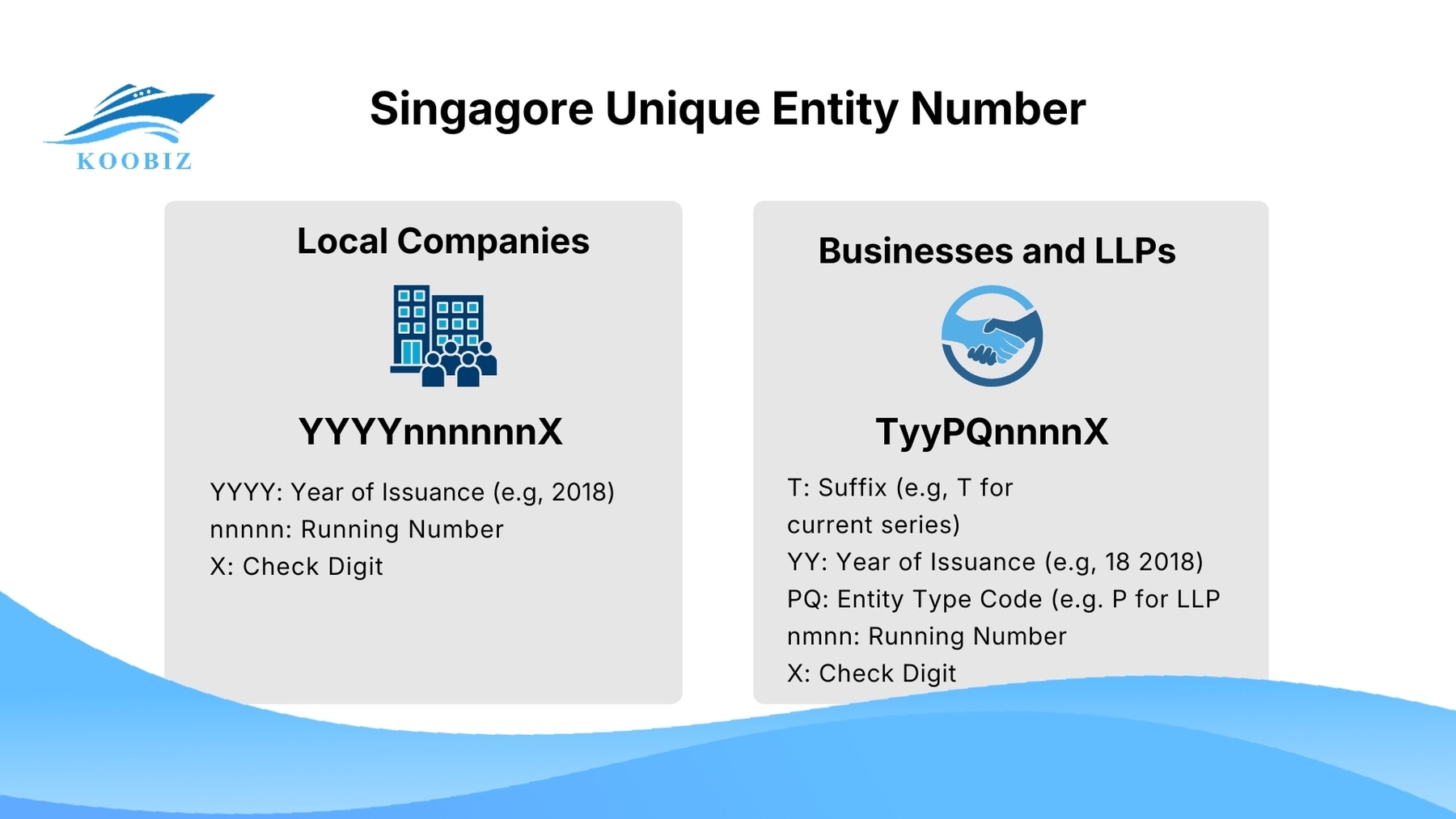
    What Do the Different UEN Formats Mean?

    UEN formats are structured alphanumeric codes that vary based on the entity type and issuance date. Unlike a random string of numbers, these formats allow anyone reading the number to immediately discern whether the entity is a local company, a business firm, or a specialized body like a trade union.

    The table below outlines the three main UEN structures you will encounter:

    Entity Type Format Structure Example Description
    Businesses registered with ACRA nnnnnnnnX 52812345A 8 digits followed by 1 check letter (Total 9 chars).
    Local Companies registered with ACRA YYYYnnnnnX 202412345M Year of incorporation (4 digits) + 5 digits + 1 check letter (Total 10 chars).
    Other Entities (e.g., LLPs, Societies) TyyPQnnnnX T24LL0001A T: Century (T for 2000s, S for 1900s).

    yy: Last 2 digits of year.

    PQ: Entity type code (e.g., LL for LLP).

    nnnn: Sequence no.

    X: Check letter.

    For instance, a Limited Liability Partnership registered in 2024 will follow the “Other Entities” format (T24LL…), whereas a Private Limited Company registered in the same year will typically follow the “Local Companies” format (2024…). This structured approach ensures that despite the growing number of businesses, every entity retains a distinct digital identity.

    How Can I Search for a Company’s UEN?

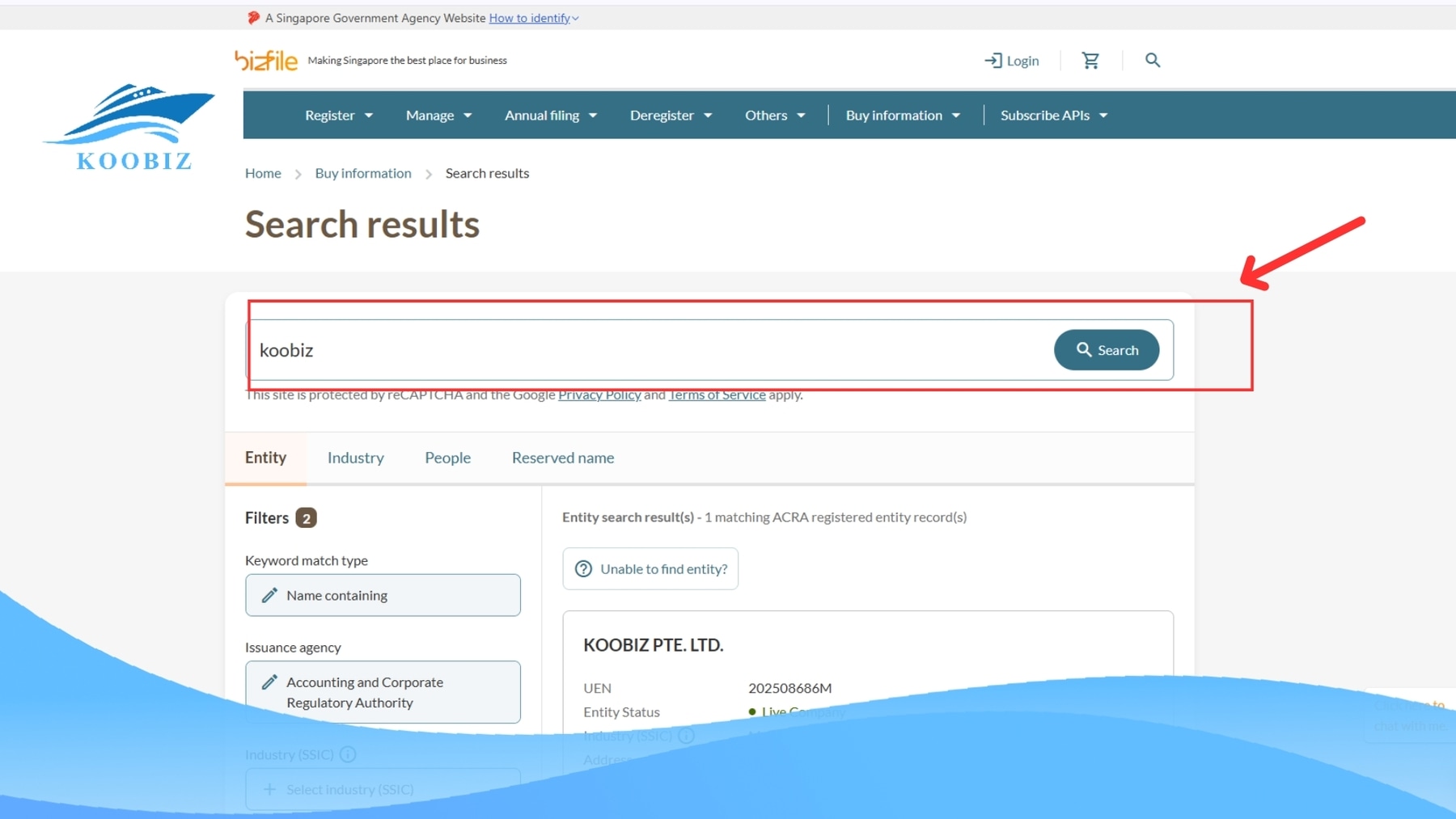
    Searching for a company’s UEN is a crucial step in due diligence. You can instantly verify an entity’s registration status and details using the ACRA-managed BizFile+ portal or valid business directories. This public process provides essential information such as the entity’s registered name, status (Live or Struck Off), and address.

    To verify a business, follow these steps:

    1. Visit the Directory: Go to the ACRA BizFile+ website or the official UEN website (uen.gov.sg).
    2. Enter Information: Type the name of the company or the UEN (if you are verifying the name) into the search bar.
    3. Analyze Results: The system will display the registered name, UEN, and status.
    Search for UEN on BizFile+
    Search for UEN on BizFile+

    If you are planning to sign a contract with a partner, checking their UEN status is a mandatory due diligence step. A “Live” status confirms the company is active. If you find the process confusing or need detailed business profiles, Koobiz can assist in retrieving comprehensive business extracts for your potential partners.

    How Do You Register and Obtain a UEN?

    Obtaining a UEN involves registering your business entity with ACRA or the relevant issuance agency. The UEN is automatically generated upon successful incorporation; there is no separate application form. It is an inherent outcome of the entity formation process.

    For most commercial entities like Private Limited companies, the process is handled via ACRA:

    The process of registering and obtaining a UEN
    The process of registering and obtaining a UEN
    1. Name Reservation: You must first approve your business name with ACRA.
    2. Incorporation: Submit the incorporation details, including shareholder and director information.
    3. Issuance: Once ACRA approves the incorporation, an email notification containing the UEN is sent immediately (usually within hours).

    For other entities, such as societies, the UEN is issued after approval by the Registry of Societies. Navigating the incorporation requirements can be complex for new entrepreneurs. Koobiz specializes in streamlining this process. When you choose our incorporation package, we handle all ACRA liaising, ensuring your UEN is issued correctly and quickly, so you can open your corporate bank account without delay.

    Ready to start your business in Singapore? Contact Koobiz today for a seamless incorporation experience and get your UEN fast!

    Can You Customise Your Business ID with Special UEN (SUN)?

    Yes, businesses can customize their ID through the Special UEN (SUN) service by paying a fee to select a preferred number from reserved tiers. Similar to buying a “golden” mobile number or car plate, ACRA allows business owners to choose a UEN that is easy to remember or holds auspicious value.

    Specifically, there are two tiers available during the registration process:

    • Tier 1 ($3,000): These are numbers with consecutive identical digits or specific patterns (e.g., ending in 8888, 12345).
    • Tier 2 ($1,000): These numbers have repetitive patterns but are less exclusive than Tier 1 (e.g., ending in 88, 66, or repetitive pairs like 2323).

    While not mandatory, investing in a Special UEN can be beneficial for branding, making it easier for clients and partners to recall your business ID for PayNow transactions or invoicing.

    What Is the Difference Between UEN and NRIC?

    The UEN identifies business entities for corporate transactions, whereas the NRIC (or FIN) identifies individuals for personal legal matters within Singapore. This distinction is vital because a business is a separate legal person from its owner, and confusing the two can lead to invalid contracts.

    UEN (Unique Entity Number) VS. NRIC (National Registration Identity Card)
    UEN (Unique Entity Number) VS. NRIC (National Registration Identity Card)
    Feature UEN (Unique Entity Number) NRIC (National Registration Identity Card)
    Target Identity Business Entities (Companies, LLPs, Societies) Individuals (Citizens, PRs)
    Primary Use Corporate transactions, B2B contracts, Government filing Personal legal matters, Employment, Banking
    Legal Status Identifies the “Company” as a legal person Identifies the “Individual” owner/director
    Data Tracked Financial year-end, Registered address, BizFile status Citizenship, Residence address, Date of Birth

    To illustrate, when you sign a contract for your company, you enter the company’s UEN, not your personal NRIC. The NRIC tracks personal data like citizenship and residence, while the UEN tracks corporate data.

    What Is the Difference Between UEN and GST Registration Number?

    The UEN is the mandatory business ID for all, while the GST Registration Number is usually the same UEN but specifically activated for tax collection when revenue exceeds $1 million.

    It is important to understand that simply having a UEN does not mean you are GST-registered. You must apply for GST registration separately with IRAS. Once registered, your UEN typically serves as your GST identifier. You will then be required to print “GST Reg No: [Your UEN]” on all tax invoices.

    While most local companies use their UEN as their GST number, distinct entities (like joint ventures or GST groups) may be issued a separate GST group registration number. However, for 99% of SMEs, they are identical identifiers with different functional statuses.

    Where Must the UEN Be Displayed on Official Documents?

    The UEN must be displayed on all official correspondence, including invoices, receipts, brochures, and websites, to comply with the Companies Act. Failure to display this number can result in penalties, as it denies stakeholders the ability to verify the entity they are dealing with.

    You must include the UEN on:

    • Business Letters and Statements of Account.
    • Invoices and Official Receipts.
    • Notices and Publications (including websites and email signatures).
    • Bills of Exchange and Promissory Notes.

    Ensuring your Koobiz incorporated company complies with these disclosure requirements is part of building a trustworthy brand reputation in Singapore.

    Frequently Asked Questions (FAQ)

    Is the UEN number the same as the Tax Identification Number (TIN)?

    Yes, in Singapore, the UEN serves as the Tax Identification Number (TIN) for corporate entities when dealing with the Inland Revenue Authority of Singapore (IRAS).

    Do I need to renew my UEN?

    For local companies (Pte Ltd) and LLPs, the UEN is permanent and does not need renewal as long as the entity exists. However, for Sole Proprietorships and Partnerships, you must renew your business registration periodically to keep your UEN active.

    Is applying for a UEN free?

    The UEN itself is issued automatically upon registration. The cost involved is the registration or incorporation fee paid to ACRA (e.g., $315 for a Private Limited Company). If you opt for a Special UEN (SUN), additional fees apply.

    Simplify Your Singapore Incorporation with Koobiz

    Understanding the UEN is just the first step in establishing a successful business in Singapore. Navigating the full spectrum of ACRA regulations, from initial name reservation to final UEN issuance and tax compliance, requires expertise and precision.

    Koobiz is your trusted partner for seamless company incorporation in Singapore. We move beyond simple registration; we provide a comprehensive suite of corporate services designed to get your business operational quickly. With our expert guidance, you can secure your UEN, open your corporate bank account, and ensure full compliance without the administrative headache.

    Ready to launch your business? Visit koobiz.com today to start your incorporation journey!

  • Public Limited Company Meaning: Key Advantages, Risks & PLC Features in Singapore

    Public Limited Company Meaning: Key Advantages, Risks & PLC Features in Singapore

    [SUMMARIES]

    A Public Limited Company (PLC) enables large enterprises to raise substantial capital from the general public via IPOs, offering unlimited shareholder capacity and high liquidity compared to private entities.

    This status enhances corporate credibility but imposes strict regulatory burdens, including mandatory statutory audits, higher compliance costs, and intense public scrutiny of financial performance.

    Converting from a Private Limited Company to a PLC unlocks unrestricted share transferability but requires a complex legal process involving constitutional amendments and precise adherence to ACRA regulations.

    [/SUMMARIES]

    A Public Limited Company (PLC) in Singapore is a distinct legal entity authorized by the Singapore Companies Act to offer its shares to the general public, typically featuring more than 50 shareholders and stricter regulatory oversight. A Public Limited Company (PLC) in Singapore is a legal entity that allows a business to raise capital from the public by offering shares. Governed by the Singapore Companies Act, a PLC must comply with stricter regulations compared to private entities and can help separate your business’s legal identity from your own. Understanding the public limited company meaning is the first step for large enterprises aiming to scale.

    Beyond the basic definition, the meaning of a public limited company is intrinsically linked to its unique structural features, such as the mandatory registration of a prospectus before public offers. This framework ensures transparency and makes it distinct from a Private Limited Company (Pte Ltd).

    Deciding to form or convert to a PLC involves balancing clear advantages—like enhanced liquidity and credibility—with considerations of risk such as higher compliance and public accountability. It’s both a legal step and a strategic move that shapes your company’s future.

    At Koobiz, we guide you through this journey with expert incorporation support, making the transition to a PLC smooth and informed. Let’s explore the structure, benefits, and key considerations together to see if a PLC fits your vision.

    What is a Public Limited Company (PLC) in Singapore?

    A Public Limited Company (PLC) in Singapore is a distinct legal entity, separate from its shareholders, with the ability to raise capital by offering shares and debentures to the public. Unlike a Private Limited Company, a PLC can have more than 50 shareholders and must use “Limited” or “Ltd.” in its name. This structure highlights its commitment to greater transparency and regulatory oversight by the Accounting and Corporate Regulatory Authority (ACRA).

    What are the Major Advantages of a Public Limited Company?

    The major advantages of a Public Limited Company are primarily defined by its capacity for growth and market presence. These benefits make the PLC structure the gold standard for businesses aiming for rapid expansion and market dominance.

    Chart of capital, stock liquidity, and corporate reputation of a PLC
    Chart of capital, stock liquidity, and corporate reputation of a PLC

    1. Substantial Ability to Raise Capital

    Capital raising in a PLC is the process of generating funds by selling shares to the general public through an Initial Public Offering (IPO) or rights issues. This mechanism allows companies to tap into a virtually unlimited pool of capital from retail and institutional investors. Unlike relying on bank loans or a small circle of private investors, a PLC can raise millions of dollars to fund acquisitions, research, or international expansion. At Koobiz, we often highlight that this powerful access to capital markets is the key reason successful private companies choose to go public.

    2. High Liquidity of Shares

    Listed PLC shares are traded on stock exchanges, allowing investors to enter and exit positions rapidly. This high liquidity encourages investment, as shareholders are not “locked in” indefinitely, unlike in private companies where selling shares can be a restricted, months-long legal process.

    3. Enhanced Corporate Image and Credibility

    “Public” status enhances corporate image by signaling stability, rigorous regulatory compliance, and transparency. Banks, suppliers, and customers often view PLCs as more credible than private entities because their financial statements are publicly available and audited. This prestige can lead to better credit terms, easier access to loans, and increased customer trust.

    What are the Risks and Disadvantages of a Public Limited Company?

    Risks and Disadvantages of a Public Limited Company
    Risks and Disadvantages of a Public Limited Company

    Becoming a Public Limited Company comes with three primary challenges: the high costs of regulatory compliance, potential dilution of your strategic control, and the pressure of operating under public and investor scrutiny. While the benefits are substantial, it’s essential to be prepared to navigate these demands effectively.

    1. High Regulatory Compliance Costs

    PLCs face higher expenses due to adherence to ACRA’s strict reporting standards and the Singapore Financial Reporting Standards (SFRS). A PLC cannot avail itself of audit exemptions available to small private companies; it must conduct mandatory annual statutory audits, hold Annual General Meetings (AGMs), and maintain detailed registers. These activities require professional company secretaries, auditors, and legal advisors, substantially increasing overhead.

    2. Risk of Loss of Strategic Control

    As ownership becomes diluted among a vast number of shareholders, original founders may find their voting power reduced. This makes it difficult to push through decisions unilaterally. In extreme cases, if a substantial percentage of shares is publicly traded, the company becomes vulnerable to hostile takeovers, where outside entities purchase enough stock to replace the management team against their will.

    3. Intense Public Scrutiny

    Public Limited Companies are required to disclose their financial performance regularly, which makes their operational health, leadership compensation, and major decisions subject to public and investor review. This transparency means that if a company’s performance falls short, its share price can react immediately based on market sentiment. This often creates pressure on leadership to focus on near-term results, which can sometimes conflict with longer-term strategic goals.

    What are the Key Features of a Singapore Public Limited Company?

    Key Features of a Singapore Public Limited Company
    Key Features of a Singapore Public Limited Company

    A Public Limited Company (PLC) in Singapore is defined by three key operational pillars that enable it to raise public capital: the free transfer of shares, specific director requirements, and a registered prospectus.

    Unrestricted Share Transferability

    Unlike private companies, shares in a PLC can be freely bought and sold by the public, providing essential liquidity for investors.

    Director Requirements

    Under Section 145 of the Companies Act, every company in Singapore—whether public or private—must appoint at least one director who is ordinarily resident in Singapore. While the statutory minimum is one, PLCs often appoint additional independent directors to meet higher governance standards and effectively manage public funds.

    Prospectus Registration

    Crucially, before offering shares to the public, a PLC must file a detailed prospectus with the Monetary Authority of Singapore (MAS). This document ensures transparency by providing investors with comprehensive information on the company’s financials and risks.

    How does a Public Limited Company Compare to a Private Limited Company?

    A Public Limited Company excels in capital accessibility and liquidity, whereas a Private Limited Company (Pte Ltd) offers superior control and privacy for owners. Comparing these two structures reveals that the choice largely depends on the scale of operations and the desire for public investment.

    Feature Private Limited Company (Pte Ltd) Public Limited Company (PLC)
    Number of Shareholders Maximum 50 More than 50 (Unlimited)
    Share Transferability Restricted (Board approval usually needed) Freely transferable (High Liquidity)
    Capital Raising Private placement only Offer shares to public (IPO/Debentures)
    Audit Requirements Exemptions available for small entities Mandatory Annual Statutory Audit
    Minimum Directors 1 Resident Director 1 Resident Director*
    Name Suffix “Private Limited” or “Pte Ltd” “Limited” or “Ltd”
    Public Scrutiny Low (Financials remain private) High (Financials are public record)

    *Note: While the statutory minimum is 1, listed PLCs typically require a larger board for governance.

    For many of Koobiz‘s clients, starting as a Private Limited Company and converting to a Public one later is the optimal growth path.

    Is Every Public Limited Company Listed on the SGX?

    No, not every Public Limited Company is listed on the Singapore Exchange (SGX). It is a common misconception that “Public” equals “Listed,” but a company can be an unlisted public company.

    Unlisted public companies still comply with the Companies Act for PLCs but do not have their shares traded daily on the open market.

    What are the Audit Requirements for a Singapore PLC?

    Singapore PLCs face stringent audit requirements: they must appoint an auditor within three months of incorporation and conduct an annual statutory audit regardless of revenue.

    How Can a Private Company Convert to a Public Limited Company?

    The conversion process involves a special resolution to alter the company’s constitution, increasing the share capital, and lodging the Notice of Conversion with ACRA.

    To execute this, the company must change its name to remove the word “Private,” adopt a new constitution suited for a public entity, and file the necessary changes via the BizFile+ portal. This is a complex legal procedure often undertaken when a company prepares for an IPO. If you are considering this strategic leap, Koobiz offers specialized corporate secretarial services to manage the conversion compliance accurately and efficiently.

    Ready to Scale Your Business?

    Navigating the stringent requirements of a Public Limited Company requires precision, legal expertise, and deep knowledge of ACRA regulations. Whether you are looking to incorporate a new entity, convert your existing Private Limited Company, or ensure full statutory compliance, Koobiz is your trusted partner in Singapore.

    We simplify the complex process of incorporation and corporate governance, allowing you to focus on what matters most—growing your business.

    Contact Koobiz today to schedule a consultation and lay the foundation for your company’s public success.

  • Dormant Company Singapore: Compliance Guide for Inactive Entities

    Dormant Company Singapore: Compliance Guide for Inactive Entities

    [SUMMARIES]

    A dormant company is defined differently by regulators: ACRA bases status on the absence of accounting transactions (excluding statutory fees), while IRAS focuses strictly on the lack of revenue or income generation.

    Strategic dormancy allows investors to cost-effectively hold assets like intellectual property and preserve corporate banking relationships without the administrative burden of active operations or mandatory audits.

    Directors must maintain strict compliance despite inactivity, as mandatory obligations like appointing a Company Secretary, maintaining a registered address, and filing Annual Returns remain enforceable to avoid penalties.

    [/SUMMARIES]

    Primary Keyword: Dormant Company Singapore

    Other Keywords: ACRA dormant company, IRAS dormant company, strike off vs dormant, inactive company singapore, dormant company requirements, company compliance singapore

    Dormant Company Singapore: Compliance Guide for Inactive Entities
    Dormant Company Singapore: Compliance Guide for Inactive Entities

    A Dormant Company in Singapore refers to a registered business entity that has temporarily ceased trading activities and stopped generating income but retains its registration with ACRA for future use or asset holding. For business owners, understanding this status is crucial because “dormant” does not mean “exempt from all laws”; it essentially means the company is in a state of hibernation yet must still acknowledge statutory obligations.

    While the primary intent of dormancy is often to pause operations, many investors often leverage this structure strategically to hold intellectual property or real estate without the administrative burden of an active trading firm. However, the concept of dormancy is not applied uniformly across Singapore’s regulatory framework. ACRA and IRAS assess dormancy based on different criteria, which means a company may qualify as dormant for corporate compliance purposes yet still be regarded as active from a tax perspective. Misunderstanding this distinction can lead to unintended non-compliance.To help you manage this effectively, this guide details the benefits, procedural steps for conversion, and the rigorous compliance checklist required to maintain a dormant status. Furthermore, we will explore the lifecycle options available to you, from “opening” a dormant entity with the help of incorporation experts like Koobiz, to eventually reactivating it when market conditions improve.

    What Defines a Dormant Company in Singapore?

    SG Dormant Company: ACRA & IRAS Definitions
    SG Dormant Company: ACRA & IRAS Definitions

    A dormant company is defined as a business entity that does not engage in significant accounting transactions or generate revenue during a specific financial period. To fully grasp this legal status, it is essential to distinguish between the definitions set by the two primary governing bodies in Singapore.

    How does ACRA Define a Dormant Company?

    ACRA determines a company’s dormant status primarily by assessing whether it has recorded any accounting transactions during the relevant financial year. Under Section 205B of the Companies Act, accounting transactions refer to entries that affect the company’s financial statements.Importantly, the legislation recognises that certain administrative activities are unavoidable. As such, a company remains dormant in the eyes of ACRA even if it engages in minimal administrative actions, such as paying fees to the Registrar, maintaining a registered office, or paying a penalty. This distinction ensures that paying for statutory compliance does not accidentally trigger “active” status.

    How does IRAS Define a Dormant Company?

    IRAS defines a dormant company differently, focusing entirely on the source of income rather than accounting entries. A company is considered dormant by IRAS if it does not carry on business and has no income for the whole of the basis period.

    In practical terms, a company may continue to incur routine expenses, such as secretarial or statutory fees, which may be recorded as transactions for corporate purposes. However, provided there is no revenue or income stream, IRAS will continue to treat the company as dormant for tax assessment. It is also important to note that the mere holding of assets does not, in itself, disqualify a company from dormant status. A company is only considered active for tax purposes if those assets generate income, such as dividends, rental income, or similar returns.

    What are the Benefits of Maintaining a Company Dormant?

    Benefits of maintaining a dormant company
    Benefits of maintaining a dormant company

    Maintaining a dormant company can offer meaningful strategic and financial advantages compared to permanently striking off the entity. Rather than dissolving the company, dormancy allows business owners to temporarily suspend operations while preserving the legal structure, historical standing, and underlying asset value of the company.

    Here are the key advantages:

    • Asset & IP Protection: It allows you to hold intellectual property, trademarks, or real estate in a separate legal entity, insulating them from trading risks.
    • Brand Preservation: You retain ownership of your company name and brand identity, preventing competitors from claiming them, which would happen if you struck off the company.
    • Readiness for Funding: A company with an older incorporation date often appears more stable and established to investors and banks compared to a newly registered firm.
    • Banking Continuity: You can potentially maintain your corporate bank account (subject to bank activity fees), avoiding the rigorous and time-consuming KYC process required to open a new account later.
    • Cost Efficiency: Running a dormant company is significantly cheaper than an active one. You enjoy exemptions from audit requirements and can apply for waivers to skip filing complex tax returns (Form C-S/C).
    • Ease of Reactivation: Resuming business is as simple as notifying ACRA and IRAS, whereas restarting after striking off requires a full re-incorporation process.

    Koobiz Tip: While maintaining a dormant company is more cost-effective than operating an active entity, certain statutory obligations remain. These include maintaining a registered address and appointing a company secretary. Koobiz offers tailored solutions designed specifically to meet the compliance needs of dormant companies in a cost-efficient manner.

    How to “Open” or Convert to a Dormant Company?

    The process of “opening” a dormant company usually refers to either incorporating a new shelf company for asset holding or converting an existing active trading company into a dormant state. This procedure requires precise adherence to cessation protocols to ensure no loose ends trigger compliance issues.

    Steps to Convert an Active Company to Dormant Status

    Converting an active company to dormant involves three critical steps: ceasing trading, clearing liabilities, and notifying authorities.

    1. Cease Trading: Stop all business operations and issuing of invoices immediately.
    2. Clear Liabilities: Settle all outstanding debts, creditor payments, and staff salaries.
    3. Notify Authorities: Ensure all accounts are finalized up to the date of cessation.

    Specifically, you must ensure that no further income hits the bank account. Any trailing income received after the declared cessation date can void the dormant status for that financial year, forcing you to file full tax returns.

    Can You Incorporate a Company as Dormant from Day One?

    Yes. In Singapore, it is permissible to incorporate a company with the intention that it remains dormant from inception. This approach is commonly adopted by investors who wish to reserve a company name, establish a holding structure, or prepare a corporate vehicle for future use without commencing immediate commercial activity.To do this, you would go through the standard incorporation process with a provider like Koobiz. Once incorporated, the company simply refrains from entering into any significant accounting transactions. You will then declare this status in your very first Annual Return filing to ACRA.

    Ongoing Responsibilities and Compliance for Dormant Companies

    Responsibilities and Compliance for Dormant Companies
    Responsibilities and Compliance for Dormant Companies

    Even though a company is inactive, the directors are still legally responsible for specific statutory filings to maintain good standing. Ignoring these responsibilities can lead to penalties or involuntary striking off by ACRA.

    To ensure your dormant company remains compliant, you must adhere to the following checklist:

    • Annual Return (ACRA): You must continue to file an Annual Return via the BizFile+ portal every year. While “Dormant Relevant Companies” are exempt from preparing audited financial statements, lodging the return to confirm your status is mandatory to avoid composition fines.
    • Tax Return (IRAS): You are required to file the Income Tax Return (Form C-S/C) annually unless you have been granted a specific waiver. Once a company is dormant, you should apply for a Waiver of Income Tax Return Submission to skip this requirement for future years.
    • Corporate Secretary: You must appoint and maintain a qualified Corporate Secretary. This officer is essential for handling official communications with ACRA and IRAS and ensuring your registers are kept up to date.
    • Registered Address: You must maintain a physical registered office address in Singapore where official mail can be delivered. This cannot be a P.O. Box.

    Professional service providers such as Koobiz offer compliance-focused solutions specifically designed for dormant companies, enabling directors to meet these statutory requirements efficiently without incurring the costs associated with a fully active operating company.

    Real-World Scenarios: Managing Dormancy Correctly

    To make the regulations easier to understand, let’s look at three common scenarios faced by Singapore business owners. These examples highlight the subtle difference between staying compliant and accidentally becoming “active.”

    Scenario 1: The “Safe” Holding Company (Compliant)

    Situation: TechHold Pte Ltd was incorporated solely to hold a patent. It has no employees and conducts no sales. Its only expense is the annual fee paid to Koobiz for secretarial services and the ACRA filing fee.

    Outcome: The company is regarded as dormant under both ACRA and IRAS..

    • Why? The expenses (Secretarial/ACRA fees) are statutory requirements, which are “disregarded transactions” by ACRA. Since there is no income, it also satisfies IRAS rules.

    Scenario 2: The “Accidental” Activation (Non-Compliant)

    Situation: OldBiz Pte Ltd ceased trading two years ago. However, the director forgot to close a corporate subscription for a software tool, and the monthly fee of $50 continues to be deducted from the company bank account.

    Outcome: The company is considered active by ACRA but remains dormant for IRAS purposes.

    • Why? The software payment is an “accounting transaction” that is not a statutory requirement. Therefore, ACRA views the company as active, meaning it cannot claim the audit exemption for dormant companies if it crosses other thresholds. However, since it earned no income, IRAS still treats it as dormant for tax purposes.

    Scenario 3: The Investment Income Trap (Tax Active)

    Situation: WealthNest Pte Ltd holds shares in several other companies. It has no operations, but this year it received a $10,000 dividend from one of its investments.

    Outcome:The company is considered dormant by ACRA but active by IRAS.

    • Why? Receiving a dividend is income. Therefore, the IRAS tax waiver is revoked, and the company must file a tax return (Form C-S/C). However, ACRA may still consider it dormant if no other administrative costs were incurred, as the receipt of money itself might not count as a significant accounting transaction depending on how it’s recorded (though often it triggers administrative costs that would break dormancy).

    How to Close a Dormant Company in Singapore

    Striking off the company
    Striking off the company

    When the ongoing maintenance costs of a dormant company no longer justify its strategic or commercial value, directors may decide to permanently exit the structure. For solvent dormant companies, the most commonly adopted exit route is the striking-off procedure administered by ACRA.

    Understanding the Striking-Off Process

    Striking off is the process of removing the company’s name from the official register, effectively dissolving the entity. This is submitted via ACRA’s BizFile+ portal and is significantly faster and cheaper than a formal winding-up process (liquidation).

    Specifically, the application takes approximately 4 to 5 months to process. Once approved, a notice will be published in the Government Gazette. If there are no objections from the public or tax authorities after a specific period, the company is struck off.

    Key Pre-Conditions for a Successful Strike-Off

    There are strictly four groups of conditions that must be met before ACRA will approve a strike-off application.

    1. No Assets/Liabilities: The company must have disposed of all assets and settled all debts.
    2. No Outstanding Tax: IRAS must have no outstanding tax queries.
    3. No Legal Proceedings: The company cannot be involved in any court cases.
    4. Unanimous Consent: All shareholders must agree to the striking off.

    How to Reactivate a Dormant Company

    One of the principal advantages of maintaining a dormant company is the ability to reactivate it efficiently when business opportunities arise. Reactivation does not require a complex approval process, but it must be handled carefully to ensure compliance with both ACRA and IRAS requirements.

    Steps to Notify ACRA and IRAS of Reactivation

    To reactivate, you primarily need to recommence business activities and notify the relevant authorities through your filings. There is no special “reactivation form” for ACRA; the change in status is simply reflected in your next Annual Return where you will no longer declare the company as dormant.

    For IRAS, you must notify them within one month of recommencing business if you previously held a tax waiver. You will then be issued a Form C-S/C to file for the coming Year of Assessment. It is crucial to engage your Corporate Secretary or Koobiz to ensure these notifications are timed correctly to avoid penalties.

    Frequently Asked Questions on Dormant Companies

    Can a Dormant Company Hire Employees?

    No, a dormant company generally cannot hire employees because paying salaries constitutes an accounting transaction. Under ACRA’s definition, an accounting transaction (other than statutory compliance costs) breaks the dormant status.

    If a company hires staff and pays CPF (Central Provident Fund) contributions or salaries, it is engaging in operational activities. Therefore, if you intend to hire, the company must transition to “active” status and comply with all relevant employment and financial reporting standards.

    Can a Dormant Company Hold Shares in Another Company?

    Yes, a dormant company can hold shares in another company, and this is a very common structure for holding companies. Holding shares itself is a passive activity and does not trigger “active” status.

    However, the nuance lies in the income. If the dormant company receives dividends from these shares, it may still be considered “dormant” by ACRA (if no accounting entry is required beyond receipt) but might be considered “active” for tax purposes by IRAS if that dividend income is taxable. Always consult a tax professional or Koobiz to understand the specific tax implications of your holding structure.

    Ready to incorporate or manage your Singapore company?

    Whether you are establishing a dormant holding company or require ongoing Company Secretary services to maintain compliance for an inactive entity, professional guidance can help minimise regulatory risk. Service providers such as Koobiz assist clients in navigating ACRA and IRAS requirements efficiently, allowing business owners to focus on long-term strategic planning.

    Contact Koobiz Today for a Consultation

  • Understanding the Singapore Company Constitution: M&AA vs. Model Clauses

    Understanding the Singapore Company Constitution: M&AA vs. Model Clauses

    [SUMMARIES]

    The Singapore Company Constitution replaces the former Memorandum and Articles of Association as the supreme binding document governing internal management and shareholder rights.

    Founders must choose between ACRA’s standard Model Constitution for cost-efficiency or a Customized Constitution to accommodate complex share structures and investor needs.

    Amendments to this statutory contract require a Special Resolution with a 75% shareholder majority, ensuring rigorous consensus for governance changes.

    [/SUMMARIES]

    The Singapore Company Constitution is the supreme legal document that governs the internal management, rights, and obligations of a company and its members under the Companies Act 1967. For business owners, understanding this document is the foundation of corporate governance. Previously known as the Memorandum and Articles of Association (M&AA), the modern Constitution consolidates these regulations into a single, cohesive framework essential for every locally incorporated entity.

    Koobiz specializes in helping businesses navigate these requirements seamlessly during incorporation. Whether you choose the standard model or a bespoke document, getting this right from the start is critical.

    To comprehend the evolution of this document, one must look at the legislative changes introduced by the Companies (Amendment) Act 2014, effective from January 3, 2016. Before this, companies maintained two separate documents (Memorandum and Articles). Today, this distinction is abolished for new companies, streamlining the process. Older companies can continue using their existing M&AA, which is now legally “deemed” to be their constitution, though updating it to align with modern provisions is highly recommended.

    The most pressing decision for new entrepreneurs is choosing between the standard “Model Constitution” provided by ACRA and a “Customized Constitution.” This choice dictates the flexibility of your company regarding share transfers and decision-making.

    What is a Singapore Company Constitution?

    A Singapore Company Constitution acts as a binding contract between the company and its members. Deriving its authority from Section 22 of the Companies Act 1967, it serves as the ultimate rulebook for internal administration.

    Singapore Constitution: contract & internal management rules
    Singapore Constitution: contract & internal management rules

    Unlike commercial contracts, the Constitution governs the relationship between directors and shareholders including decision-making processes, power distribution, and member rights. If no specific constitution is filed during incorporation, the Model Constitution applies by default.

    Furthermore, the Constitution is a public document available for purchase via ACRA’s BizFile+ portal, allowing creditors and investors to review key rules regarding borrowing limits and share-transfer restrictions before entering into businesses.

    What are the Mandatory Sections Required by Law?

    The Mandatory Sections Required by Law
    The Mandatory Sections Required by Law

    While modern constitutions are flexible, Section 22 of the Companies Act mandates certain clauses to establish the entity’s identity and scope. The following four sections are standard and essential:

    1. Name Clause: The full, approved name of the company, matching exactly with the name reserved with ACRA. Private limited companies must include “Private Limited” or “Pte. Ltd.” as part of the name.
    2. Registered Office Clause: The constitution must declare that the registered office is situated in the Republic of Singapore. This establishes jurisdiction and the address for official legal notices.
    3. Liability Clause: For a company limited by shares, it must explicitly state that “the liability of the members is limited.” with a view to protecting shareholders from personal liability for company debts.
    4. Subscriber Clause: The document must state each initial subscriber’s full name, addresses and occupations along with a declaration that they desire to form the company and agree to take up the number of shares specified.

    Note: The Capital Clause (specifying authorized capital) is no longer mandatory following the abolition of authorized share capital and par value. Share capital is now declared directly via share allotment filings on BizFile+.

    5 Critical Considerations When Drafting Your Constitution

    5 Critical Considerations When Drafting Your Company Constitution
    5 Critical Considerations When Drafting Your Company Constitution

    Before adopting a standard template, evaluate these five strategic factors that determine power balance and financial fluidity:

    • Share Classes (Ordinary vs. Preference): Startups seeking investment often need “Preference Shares” (priority on dividends, no voting rights). The standard Model Constitution usually accounts only for ordinary shares.
    • Pre-emption Rights: This protects existing shareholders from dilution by requiring any selling shareholders to offer their shares to current members before external parties This is vital for maintaining control in private companies.
    • Board Dynamics & Casting Vote: A clause giving the Chairman a “casting vote” to prevent deadlock in case of a tie vote
    • Conflict Resolution: Your constitution can outline mediation or arbitration mechanisms to resolve disputes without resorting to winding up the company.
    • Dividend Policy: our constitution sets specific rules on how and when these are declared, offering transparency to investors.

    Model Constitution vs. Customized Constitution: Which is Right for You?

    The Model Constitution offers cost-efficiency while a Customized Constitution offers flexibility.

    The Model Constitution: A statutory template provided in the Companies (Model Constitutions) Regulations 2015.

    • Pros: Free, legally robust, and automatically compliant. Ideal for single-shareholder companies.
    • Cons: Rigid. Lacking specific protections like “tag-along” or “drag-along” rights crucial for VC-backed startups in a standard scenario.

    The Customized Constitution: A bespoke document drafted by professionals.

    • Pros: Tailored to specific needs. Allows for dual-class share structures and entrenched provisions.
    • Cons: Incurs legal drafting fees and requires more preparation time.

    How to Register and Submit Your Constitution to ACRA

    Submission is a mandatory step in the incorporation workflow via the BizFile+ portal.

    Log in to BizFile+: Use your SingPass to access ACRA’s filing system. Navigate to “Start a New Local Company”.

    Select Constitution Type:

    1. If adopting the Model Constitution, simply check the box for “Constitution of a Private Company Limited by Shares”.
    2. If using a Custom Constitution, upload the full PDF document containing the mandatory clauses.

    Digital Endorsement: ACRA sends an email notification to all appointed directors and shareholders. They must log in to BizFile+ and digitally endorse the application to confirm their agreement.

    Koobiz can handle this entire submission process for you, ensuring your Constitution is correctly formatted and lodged so you can focus on your business.

    How to “Buy” or Retrieve a Company Constitution?

    You can retrieve a constitution in two ways:

    • Adoption (Free): New business owners can download or select the Model Constitution for free during incorporation.
    • Due Diligence (Purchase): To view another company’s constitution (e.g., a competitor or partner), you can purchase “Extracts” from the ACRA iShop. As a public record, any member of the public can buy a copy (typically SGD 11 to SGD 26) to verify governance rules.

    Can You Amend the Constitution After Incorporation?

    Yes, via a Special Resolution, which requires at least 75% of the votes from shareholders.

    The Process:

    1. Proposal & Meeting: Directors/Shareholders propose the change at a General Meeting.
    2. Voting: A 75% majority is required to pass the resolution.
    3. Lodgement: The company must file a “Notice of Resolution” and the new constitution via BizFile+ within 14 days.

    Important Note on Entrenched Provisions:

    If you wish to add or remove “Entrenched Provisions” (clauses deliberately made difficult to change), Section 26A of the Companies Act usually requires unanimous agreement (100%) from all members,.

    Start Your Incorporation Journey with Koobiz

    Ready to incorporate your Singapore company with the right governance structure?

    Whether you need a simple Model Constitution or complex customized clauses, Koobiz provides expert incorporation and corporate secretarial services to ensure your business foundation is legally sound. We handle the drafting, registration, and ACRA submission so you can focus on growth.
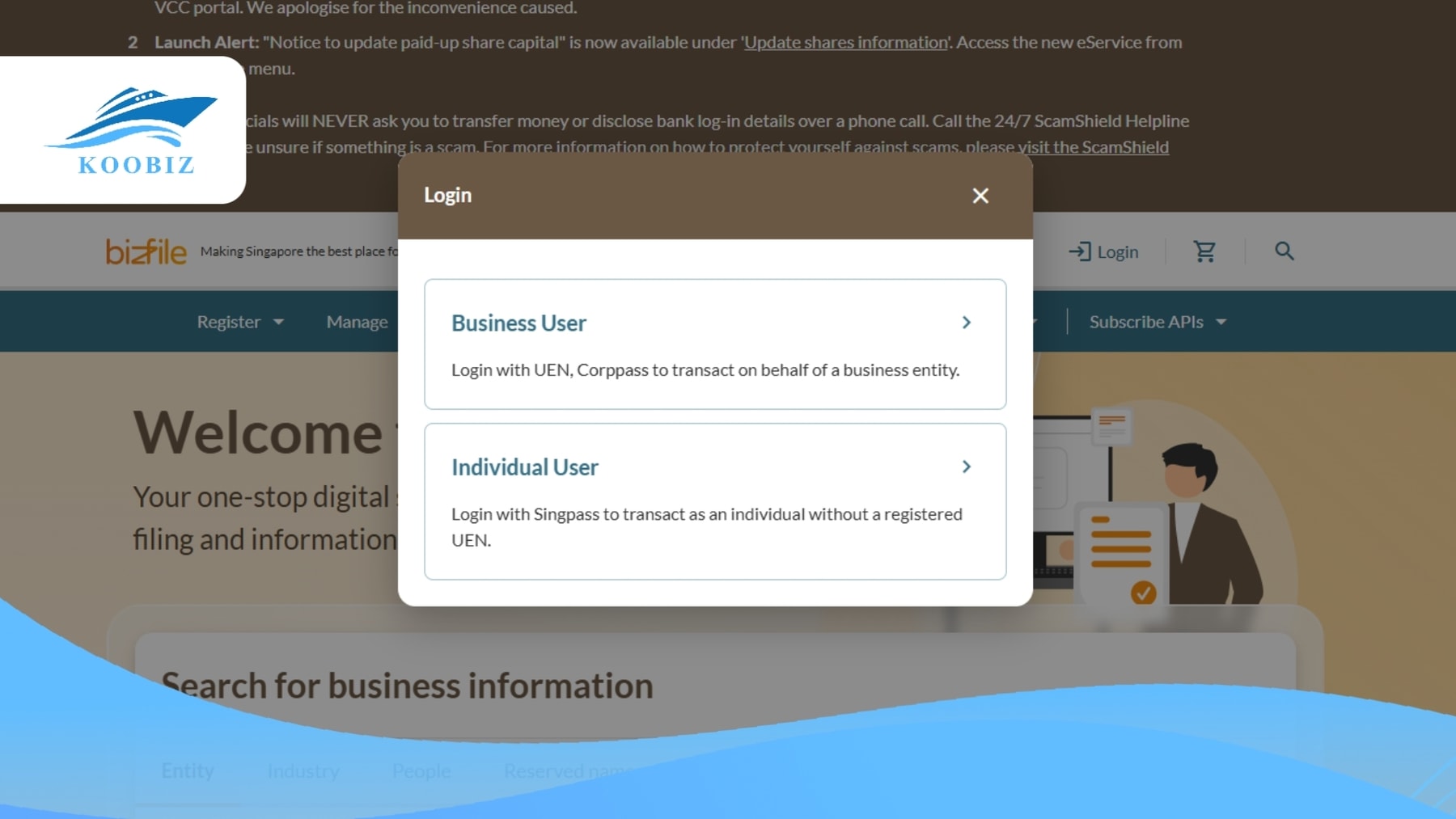
    Visit koobiz.com today to incorporate your company with confidence.

    Frequently Asked Questions (FAQs)

    Does a Sole Proprietorship need a constitution?

    No. A constitution is only required for incorporated companies (e.g., Private Limited companies). Sole proprietorships and partnerships are not separate legal entities and do not require this document.

    How much does it cost to adopt the Model Constitution?

    There is no additional fee to adopt the Model Constitution itself—it is free. You only pay the standard company incorporation fees (SGD 315) to ACRA. Legal fees apply only if you hire a professional to draft a Custom Constitution.

    Do I need to physically sign the constitution?

    No. The incorporation process is fully digital. Directors and shareholders “sign” by digitally endorsing the application via email link using their SingPass.

  • What is an LLP? Meaning, Benefits, and Registration for Singapore Businesses

    What is an LLP? Meaning, Benefits, and Registration for Singapore Businesses

    [SUMMARIES]

    A Limited Liability Partnership (LLP) is a hybrid business structure that combines the operational flexibility of a partnership with the legal protection of a separate corporate personality, effectively shielding partners from personal liability for the negligence of their colleagues.

    Taxation is applied on a “pass-through” basis where the entity itself is not taxed; instead, profits are distributed to partners and subject to their personal progressive income tax rates, unlike the flat corporate rates and exemptions available to Private Limited companies.

    While LLPs offer lower compliance costs by requiring only an annual declaration of solvency rather than complex audits, they are unsuitable for scalable startups seeking Venture Capital, as the inability to issue shares makes raising external funding difficult.

    [/SUMMARIES]

    A Limited Liability Partnership (LLP) in Singapore is a hybrid business structure that combines the operational flexibility of a general partnership with the legal protection of a private limited company. It is an ideal entity for professionals and small business owners who seek to limit their personal liability without the administrative burden of a corporation.

    Specifically, unlike a sole proprietorship where the owner and business are one, an LLP possesses a separate legal personality, meaning partners are not personally liable for the business’s debts or the negligence of other partners. This structure is governed by the Limited Liability Partnerships Act 2005 and is regulated by the Accounting and Corporate Regulatory Authority (ACRA).

    To navigate the business landscape effectively, it is crucial to compare the LLP against other common structures like Private Limited (Pte Ltd) companies and Sole Proprietorships. While an LLP offers tax transparency and lower compliance costs, a Pte Ltd might be superior for raising capital. Understanding these nuances is key to making an informed decision.

    In the following sections, we will provide a comprehensive guide covering the detailed meaning, distinct benefits, tax implications, and a step-by-step registration process for setting up an LLP in Singapore. Whether you are a local entrepreneur or a foreign professional, this guide will clarify the path to incorporation.

    What is a Limited Liability Partnership (LLP) in Singapore?

    LLP - separate legal personality and the ability to own property in its own name
    LLP – separate legal personality and the ability to own property in its own name

    A Limited Liability Partnership (LLP) is a corporate body formed by being registered under the LLP Act, characterized by its separate legal personality and the ability to own property in its own name. It essentially serves as a “middle ground” between a partnership and a company, offering the best of both worlds for specific professional groups.

    To understand this structure more deeply, we must look at its core legal foundation. An LLP is capable of suing and being sued in its own name, acquiring, owning, holding, and developing property, and having a common seal. This distinction is vital because, in a traditional general partnership, the partners are the firm. In an LLP, the firm exists independently of its partners.

    This structure is particularly popular among chartered professions—such as lawyers, accountants, and architects—where partners want to work together but do not want to be held personally responsible for the professional malpractice or negligence of their colleagues. The liability of a partner is limited to their agreed contribution to the LLP, shielding their personal assets (like their home or personal savings) from business claims, provided they were not the ones directly at fault.

    What are the Key Features and Benefits of an LLP Structure?

    Key features that define the LLP structure
    Key features that define the LLP structure

    There are three primary features that define the LLP structure: separate legal personality, perpetual succession, and operational flexibility combined with limited liability. These attributes make the LLP a compelling choice for small teams and professional services.

    • Separate Legal Identity: As mentioned, the LLP is a body corporate. This means the LLP is liable for its own debts and obligations. A partner’s personal assets are protected from the liabilities of the LLP. This is a significant upgrade from a Sole Proprietorship.
    • Perpetual Succession: The existence of the LLP is not dependent on its partners. Any change in the partners (due to resignation, death, or bankruptcy) does not affect the existence, rights, or liabilities of the LLP. This ensures business continuity and stability for clients and stakeholders.
    • Lower Compliance Costs: A LLP has fewer statutory requirements. They simply need to lodge an annual declaration of solvency.
    • Operational Flexibility: The internal governance of an LLP is typically determined by the LLP agreement between partners. This allows the partners to create a management structure tailored to their needs, rather than follow the rigid hierarchy of a corporation.

    LLP vs. Pte Ltd vs. Sole Proprietorship: Which Structure is Right for You?

    The LLP wins on flexibility and lower compliance costs, the Private Limited (Pte Ltd) company is superior for scalability and tax incentives, while the Sole Proprietorship is optimal for simplicity and zero setup cost but carries the highest risk. Choosing the right structure depends entirely on your business goals, risk appetite, and capital needs.

    To help you make an informed decision, let’s analyze the critical differences between these entities in the table below.

    Feature Sole Proprietorship Limited Liability Partnership (LLP) Private Limited (Pte Ltd)
    Liability Unlimited. The owner is personally liable for all debts and losses. Limited. Partners are protected from the firm’s debts and other partners’ negligence. Limited. Shareholders are only liable up to the amount of their share capital.
    Taxation Personal Income Tax (0% – 24%). No corporate exemptions. Personal Income Tax (0% – 24%). No corporate exemptions. Corporate Tax (Flat 17%). Eligible for significant tax exemptions (e.g., SUTE).
    Scalability Limited to personal savings or loans. Hard to scale. Difficult to raise external capital (investors usually want shares). Easy to raise capital by issuing new shares to investors.
    Credibility Low perception of scale. Professional image, suitable for service firms (lawyers, architects). High credibility, preferred by banks and large suppliers.

    Koobiz Insight: If you are planning to raise Venture Capital or sell shares in the future, a Pte Ltd is the standard requirement. However, if you are a group of lawyers or consultants keeping profits within the team, an LLP is often more tax-efficient and easier to manage. Koobiz can assist you in evaluating these options based on your specific financial projections.

    What are the Requirements to Register an LLP in Singapore?

    Registering an LLP requires four fundamental components: a minimum of two partners, at least one locally resident manager, a registered local address, and a unique business name. These are the statutory minimums mandated by ACRA to ensure the entity has a legal footing and accountability in Singapore.

    Specifically, ensuring you meet these criteria beforehand will prevent delays during the application process.

    • Partners: An LLP is required to have at least two partners. These can be individuals (min. 18 years old) or corporate bodies (other companies). There is no cap on the maximum number of partners.
    • Managers: at least one manager is an “ordinarily resident” in Singapore. This person must be a Singapore Citizen, Permanent Resident, or an EntrePass/Employment Pass holder. The manager is responsible for statutory compliance. Note that a partner can also be a manager.
    • Registered Address: A P.O. Box is not accepted. A physical address in Singapore is mandatory. This can be a commercial office or a residential home (under the Home Office Scheme).
    • Compliance Declaration: All partners have to be included in a statement of non-disqualification (e.g., not an undischarged bankrupt) and consent to act as managers/partners.

    How to Register an LLP with ACRA? (Step-by-Step Guide)

    The registration process involves three main steps: Name Reservation, Registration Filing via BizFile+, and Payment of Fees, resulting in the issuance of a Unique Entity Number (UEN). The entire process is digital and can typically be completed within 15 to 30 minutes if all documents are in order.

    Let’s break down the execution of these steps to ensure a smooth incorporation experience.

    Step 1: Reserve the LLP Name:

    Log in to ACRA’s BizFile+ portal using your Singpass. Submit your proposed LLP name. The name will be rejected if it is identical to an existing entity, undesirable (vulgar), or similar to reserved names. Once approved, the name is reserved for 120 days.

    Step 2: Submit Registration Details:

    Registration of the new business entity:

    • Details of partners and managers (ID numbers, addresses).
    • The registered office address.
    • The nature of business activities (SSIC Codes).
    • Endorsements from the appointed partners/managers (they will receive an email to accept their appointment via BizFile+).

    Step 3: Pay the Registration Fee:

    The registration fee for an LLP is SGD 100. After payment and endorsement, ACRA will issue an email notification confirming the registration – this serves as your official Certificate of Incorporation. You will also receive your Business Profile, which acts as the firm’s “birth certificate.”

    Need Professional Help? Koobiz offers comprehensive incorporation services to handle the entire ACRA registration process for you, ensuring you start your business on the right legal footing without the hassle.

    What are the Tax Implications and Compliance Requirements for an LLP?

    Managing an Limited Liability Partnership (LLP)
    Managing an Limited Liability Partnership (LLP)

    Managing an LLP involves understanding tax transparency principles and adhering to the annual declaration of solvency to avoid penalties. Unlike a company that pays tax on its own profits, an LLP functions as a “pass-through” entity for tax purposes.

    To clarify the ongoing obligations of an LLP owner, we must look at how taxation and reporting differ from other structures.

    Is an LLP subject to Corporate Income Tax in Singapore?

    No, an LLP is not a separate taxable entity and is not subject to corporate income tax; instead, it is treated as a tax-transparent entity where partners are taxed on their share of the income.

    Specifically, the LLP itself does not file a Corporate Tax Return (Form C-S/C).

    • Individual Partners: Will be taxed at personal income tax rates, which are progressive from 0% to 24%.
    • Corporate Partners: Will be taxed at the corporate tax rate (17%).
    • Note: Since the LLP is not a taxable entity, it cannot claim tax incentives available to Pte Ltd companies

    What is the Annual Declaration of Solvency?

    The Annual Declaration of Solvency is a mandatory statement lodged by the managers stating whether the LLP is able to pay its debts as they fall due during the normal course of business.

    Specifically, this is the primary compliance requirement for LLPs, replacing the complex financial filing required for companies.

    • Procedure: Managers must lodge this declaration via BizFile+ annually.
    • Timeline: It must be lodged within 15 months from the date of registration, and subsequently once every calendar year (not exceeding 15 months from the last lodgement).
    • Penalty: Failure to lodge this declaration is an offense under the LLP Act and can result in late filing penalties or prosecution.

    Can Foreigners Register an LLP in Singapore Without Relocating?

    Yes, foreigners can register an LLP in Singapore without relocating, provided they appoint at least one locally resident manager to meet the statutory requirement.

    This structure allows foreign investors to maintain ownership without physically residing in the country.

    • The Challenge: ACRA requires one manager to be “ordinarily resident” (Citizen, PR, or EP holder). A foreigner living overseas cannot fulfill this role alone.
    • The Solution: Foreigners must engage a Corporate Service Provider (like Koobiz) to provide a Nominee Manager service. This Nominee Manager fulfills the statutory requirement but typically does not have executive power over the business.
    • Visa Implications: Registering an LLP does not automatically grant a work visa. If the foreign partner wishes to move to Singapore to run the business, they must apply for an Employment Pass (EP) or EntrePass, though approval for LLP owners can be stricter than for Pte Ltd shareholders.

    How to Convert a Sole Proprietorship or Partnership to an LLP?

    Converting involves a process of registering a new LLP, transferring the business assets and undertakings to it, and then terminating the old business entity.

    There is no direct “convert button” in the ACRA system; it is a legal transition process.

    1. Register the New LLP: Follow the standard registration steps mentioned above. You can often retain the same business name if the old entity consents to it.
    2. Transfer Assets: Execute a business transfer agreement to move assets, contracts, and client lists from the Sole Proprietorship/Partnership to the new LLP.
    3. Novate Contracts: Ensure existing contracts with suppliers or landlords are updated to reflect the new LLP entity (since the LLP is a separate legal person).
    4. Cessation: Once the transfer is complete, file a “Cessation of Business” for the old Sole Proprietorship or Partnership via BizFile+ to close it formally.

    Ready to Incorporate? Start Your Journey with Koobiz

    Navigating the legalities of partnership agreements, tax compliance, and ACRA regulations can be complex for new business owners. Koobiz specializes in simplifying company incorporation in Singapore, ensuring your business starts on the right legal footing.

    Whether you need assistance with registering your LLP, finding a Nominee Manager, or managing annual compliance, our team provides expert guidance tailored to your needs.

    Visit Koobiz.com to Incorporate Your Company Today

    Frequently Asked Questions (FAQs)

    What is the minimum capital requirement for an LLP?

    Unlike a Private Limited Company which typically has a minimum paid-up capital of SGD 1, an LLP does not have a statutory minimum capital requirement. Partners contribute capital based on their mutual agreement outlined in the LLP agreement.

    Do I need to audit the accounts of an LLP?

    Generally, no. Most LLPs are not required to audit their accounts. However, an audit is mandatory if the LLP has corporate partners (companies) or if the LLP is large (e.g., significant revenue or assets). For the majority of small professional LLPs, a simple solvency declaration is sufficient.

    Can a single person register an LLP in Singapore?

    No, a single individual cannot register an LLP alone. The LLP Act requires a minimum of two partners to register. If the number of partners falls below two for more than two years, the remaining partner may become personally liable for the LLP’s obligations.

    Is an LLP suitable for a startup planning to raise Venture Capital?

    No, an LLP is generally not suitable for startups seeking Venture Capital (VC) funding. Investors typically require equity (shares) in exchange for their capital, and an LLP does not issue shares. A Private Limited Company (Pte Ltd) is the preferred structure for raising investment.

  • Nominee Director in Singapore: Rules, Risks, and Requirements (2026 Guide)

    Nominee Director in Singapore: Rules, Risks, and Requirements (2026 Guide)

    [SUMMARIES]

    • Essential for Compliance: Every Singapore company requires at least one resident director; nominees fulfill this for foreign owners, enabling 100% foreign ownership without local partners.
    • Benefits: Immediate incorporation, full control retention, privacy protection, and faster market entry for overseas entrepreneurs.
    • Roles & Risks: Nominees manage statutory duties such as ACRA filings but also share legal liability. Key risks include trust, transparency, and compliance gaps. These can be reduced with clear agreements and proper oversight.
    • Appointment Process: Choose qualified residents (Citizens/PR preferred), execute NDA/Indemnity, file with ACRA within 14 days, and update Central Registers per 2025 regulations.
    • Replacement: Appoint new director before removing sole resident to avoid breaches; update ACRA and registers promptly.
    • Key Advice: It is safer to use licensed professional companies that provide corporate services, because they know the rules and can help reduce risks when you appoint a nominee director.

    [/SUMMARIES]

    What is a Nominee Director in Singapore?

    A Nominee Director in Singapore is a locally resident individual appointed to meet the legal requirement for every company to have at least one Singapore-based director. They act in a non-executive role solely to fulfil this statutory obligation.

    Nominee director generally does not participate in the commercial management, financial decisions, or daily operations. Their primary function is to ensure the company stays compliant with the Accounting and Corporate Regulatory Authority (ACRA).

    Key characteristics:

    • Statutory Compliance: They serve as the official local representative.
    • Non-Executive: They do not influence business strategy or operations.
    • Safety Mechanism: They allow foreign owners to maintain full control of the business while satisfying local laws.

    Benefits of Having a Nominee Director

    For foreign entrepreneurs and international companies, appointing a Nominee Director is often the most strategic path to entering the Singapore market.

    Benefits of a Nominee Director
    Benefits of a Nominee Director
    • 100% Foreign Ownership: You may incorporate and fully own your Singapore company without engaging a local partner.
    • Immediate Legal Compliance:. A nominee fulfills this statutory obligation instantly, keeping your business compliant with ACRA regulations.
    • Full Operational Control: Beneficiary Owners retain complete authority over the company’s bank accounts, strategy, and day-to-day decision-making without interference.
    • Faster Market Entry: You can register your company immediately, even if you are currently overseas.
    • Privacy Protection: For owners seeking privacy, a nominee shields the identity of the executive team, though shareholding structures remain visible.

    Roles and Responsibilities of a Nominee Director

    A Nominee Director’s role is strictly administrative and statutory. Key responsibilities include:

    Nominee Director: Administrative, ACRA compliance, shared legal liability.
    Nominee Director: Administrative, ACRA compliance, shared legal liability.
    • Handling ACRA Compliance: Filing insurance ofAnnual Returns and Annual General Meeting (AGM) to avoid penalties.
    • Meeting Residency Requirements: Serves as the required local director, fulfilling the obligations under the Singapore Companies Act..
    • Receiving Official Correspondence: As the local representative, Nominee Director receive and forward important notices from government agencies
    • Shared Legal Liability: A Nominee Director carries the same legal responsibilities as any director if the company violates the law.

    Risks of Appointing a Nominee Director in Singapore

    While essential for compliance, this arrangement carries specific risks that business owners must manage:

    • Operational Disconnect (Limited Oversight): Since the nominee is not involved in daily operations, there can be a gap between what the company does and what the director knows. This disconnect can lead to accidental compliance lapses if communication is poor.
    • The “Rogue Director” Risk (Trust Issues): The relationship relies heavily on trust. Without a strong legal agreement, there is a theoretical risk of a nominee acting without authorization or resigning suddenly, leaving the company legally vulnerable.
    • Strict Liability Friction: Because nominees face personal jail time and fines for company breaches, they are extremely risk-averse and may refuse to sign documents that lack clarity.
    • Conflicts of Interest: If you appoint a non-professional nominee (like a friend or associate) who has other business interests, their loyalties may be divided, potentially jeopardizing your company’s confidentiality.
    • Reputation Damage: Your company’s credibility is linked to its directors. Appointing a nominee with a poor track record or connections to suspicious entities can negatively impact your business reputation with banks and partners.

    How to Appoint a Nominee Director in Singapore

    This is the fully updated step-by-step process, revised to include the critical 2025 “Central Register” regulations and the correct advice regarding Employment Pass holders.

    New Process: Revised for
    New Process: Revised for “Central Register 2025” & EP

    Step 1: Identify a Qualified Candidate

    You must select an individual who meets the strict residency criteria set by ACRA.

    • Who Qualifies: A Singapore Citizen or Permanent Resident (PR).
    • Who to Avoid: Employment Pass (EP) holders. Using an EP holder as a nominee for an unrelated business without a “Letter of Consent” is a breach of work pass conditions.
    • Best Practice: Engage a licensed Corporate Service Provider (CSP). They provide professional nominees who are pre-vetted, ensuring you avoid the risks of appointing friends or unqualified individuals.

    Step 2: Execute Legal Agreements

    Before the appointment becomes official, you must protect your assets with proper documentation.

    • Nominee Director Agreement (NDA): A contract stating the nominee acts only on your instructions and has no executive power.
    • Deed of Indemnity: This protects the nominee against financial penalties, provided they have acted honestly.
    • Undated Resignation Letter: Have the nominee sign a resignation letter with the date left blank. This effectively gives you the power to remove them immediately whenever you choose.

    Step 3: Pass a Board Resolution

    The company’s existing directors must formally approve the appointment.

    • The Action: Hold a board meeting (or circulate a written resolution) to approve the new director.
    • The Record: This resolution must be signed and filed in the company’s Minute Book by the Company Secretary.

    Step 4: File the Appointment with ACRA

    Once the paperwork is signed, the appointment must be registered with the government.

    • The Deadline: The filing must be submitted within 14 days of the appointment.
    • The Process: Your Company Secretary or Filing Agent will log into the ACRA BizFile+ portal to submit the appointment.
    • The Result: The nominee’s name will appear on the company’s public Business Profile.

    Step 5: Maintain the “Register of Nominee Directors” (Transparency Requirement)

    Crucial Update: Singapore law now requires a secondary layer of disclosure to prevent money laundering.

    • Private Register: You must update your internal Register of Nominee Directors (kept at your registered office).
    • Central Register: You must update the company’s internal Register of Nominee Directors kept at your registered office. Unlike the Register of Controllers, this is not currently filed centrally but must be available to authorities upon request.

    Privacy Note: Unlike the public profile, the detailed information in this Central Register is not open to the public; it is accessible only to law enforcement agencies.

    By following these steps, you ensure your nominee arrangement is legally watertight, transparent to authorities, and secure for your business ownership.

    Replacing or Removing a Nominee Director

    Replacing a Nominee Director is a precise legal process. You must follow the correct order of operations to ensure your company does not breach the “local resident director” requirement during the transition.

    Nominee Director - 6 Legal Steps, Avoid ACRA Breach.
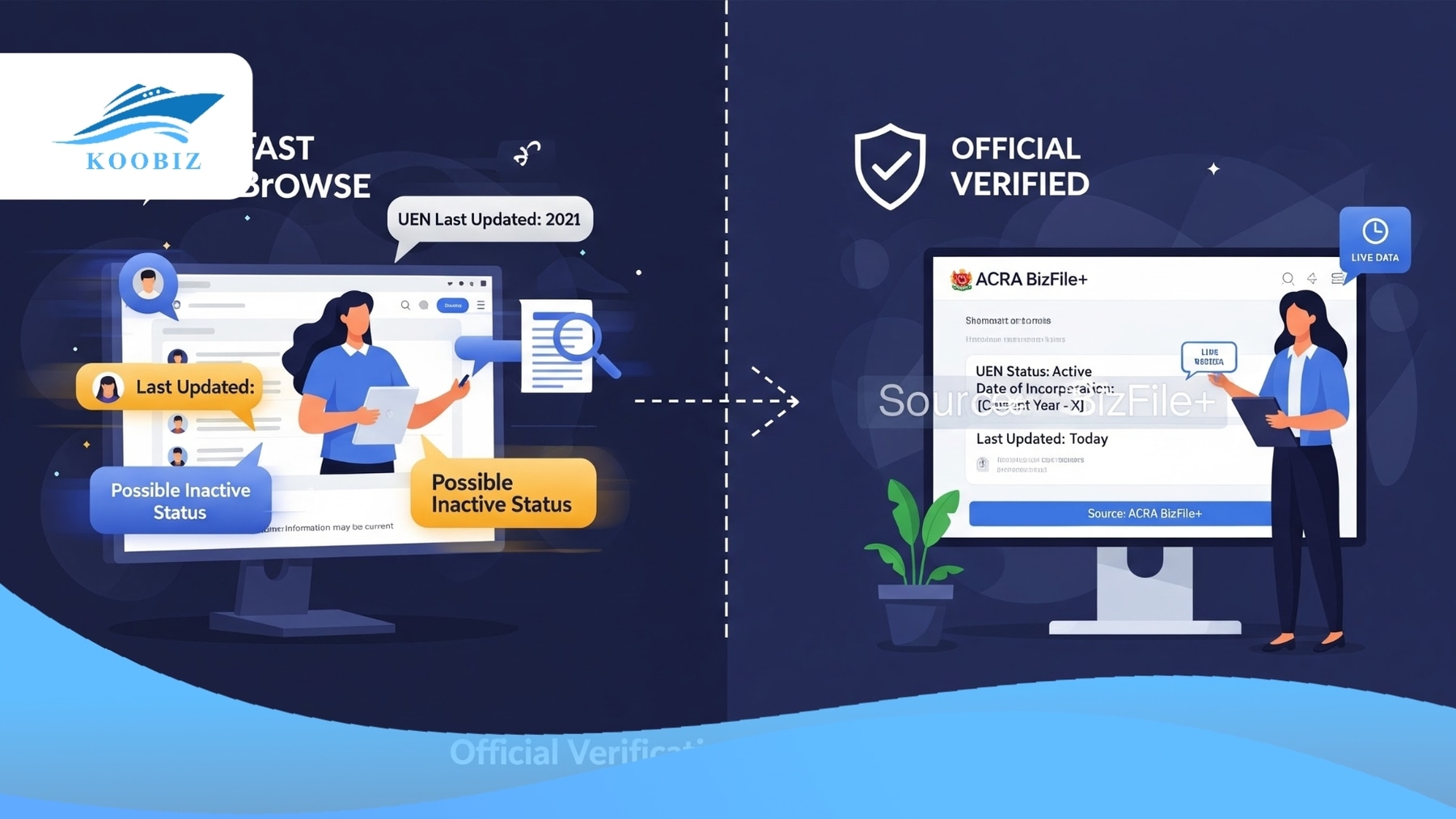
    Nominee Director – 6 Legal Steps, Avoid ACRA Breach.

    1. Check the “Sole Local Director” Rule

    Before you do anything, check if the current nominee is the only director residing in Singapore.

    • The Rule: Under Section 145(1) of the Companies Act, a company cannot accept the resignation of its sole local director until a replacement has been appointed.
    • The Action: If they are the only local director, you must appoint a new Singapore-resident director (or a new nominee) before the resignation can take effect.

    2. Review the Nominee Agreement

    Check the termination clause in your Nominee Director Agreement.

    • Most professional agreements include a pre-signed, undated resignation letter.
    • To remove the director, you simply “date” this letter effective as of the day you wish them to leave.

    3. Pass a Board Resolution

    The company’s Board of Directors must formally approve the change.

    • The Meeting: Hold a board meeting (or circulate a written resolution) to accept the resignation of the outgoing director and approve the appointment of the incoming one.
    • The Record: File this resolution in your company Minute Book.

    4. Update ACRA (Public Register)

    Your Company Secretary must log the change with the Accounting and Corporate Regulatory Authority (ACRA).

    • The Deadline: You have 14 days from the effective date of resignation to update ACRA via the BizFile+ portal.
    • The Result: The public register will reflect the new director’s name.

    5. Update the “Register of Nominee Directors” (Critical 2025 Step)

    You must update the transparency registers to reflect that the individual is no longer a nominee.

    • Private Register: Update your internal register kept at the registered office.
    • Central Register: Your Filing Agent must update ACRA’s Central Register of Nominee Directors (usually within 2 business days of the internal update) to remove the nominee’s status.

    6. Finalize the Handover

    • Ensure the outgoing nominee returns any company property or tokens.
    • If they were a bank signatory (rare for professional nominees), strictly remove their authorization from the corporate bank account immediately.

    Following these steps ensures a smooth, compliant transition when removing or switching a nominee director in Singapore.

    Common Questions about Singapore Nominee Directors

    1. Is a nominee director required for every Singapore company?

    Yes, every Singapore company must have at least one director who is ordinarily resident in Singapore. If there are no eligible local directors, appointing a nominee director fulfills this legal requirement.

    2. Does a nominee director control the company?

    No, a nominee director does not manage or control the company. Their role is limited to legal compliance and formal representation. Business decisions remain with the actual owners or directors.

    3. Can a nominee director be held liable for company misconduct?

    Yes. Under Singapore law, there is no distinction between a “nominee” and a “real” director. They face full criminal and civil liability for the company’s compliance failures.

    4. How long can a nominee director serve?

    A nominee director can serve as long as required by the company, as defined in the appointment agreement. They can be replaced or removed by following legal and procedural steps.

    5. Can a nominee director be a foreigner?

    No, the nominee director must be a Singapore citizen, permanent resident, or someone with a valid employment pass and a local address.

    6. Is the name of the nominee director public?

    Yes, the nominee director’s name appears in the company’s public records filed with ACRA.

    7. What are the costs involved?

    Nominee directors typically charge an annual fee, which varies depending on the service provider and scope of responsibility. Costs should be clarified in the appointment agreement.

    8. Can the nominee director open or operate company bank accounts?

    They can, but CSPs almost never agree due to liability and AML risks. Professional nominee directors almost never act as bank signatories. Banking authority is exclusively retained by the foreign owners to ensure fund safety.