Category: Taxation & GST

  • Singapore Startups Go Global – JTC LaunchPad Opens Doors to 19 Global Cities for Startups

    Singapore Startups Go Global – JTC LaunchPad Opens Doors to 19 Global Cities for Startups

    [SUMMARIES]

    JTC LaunchPad officially connects Singapore startups to 19 premier global hubs, providing unprecedented international infrastructure and mentorship.

    Rapid scaling requires rigorous governance; an incorrect entity choice (Branch vs. Subsidiary) can expose the Singapore parent company to unlimited liabilities.

    Neglecting domestic ACRA obligations or capital flow documentation can freeze operational funds and deter potential venture capital investors.

    Success requires professional Corporate Secretary support and comprehensive health checks to ensure seamless cross-border synchronization.

    Transforming complex governance into a competitive asset through optimized tax structures (DTAs) and investor-ready compliance from day one.

    [/SUMMARIES]

    Singapore’s startup ecosystem is entering an unprecedented era of global expansion. With JTC LaunchPad officially extending its network to 19 strategic cities worldwide-from San Francisco to Jakarta-the gateway for scaling your business has never been wider. However, while founders eagerly pack their bags to conquer new markets, a critical question remains: Is your corporate structure legally sound enough to handle cross-border operations without triggering fatal compliance traps back home?

    JTC LaunchPad Expands Global Network to 19 Strategic Cities

    JTC LaunchPad opens new pathways for global startup expansion
    JTC LaunchPad opens new pathways for global startup expansion

    The recent upgrades at LaunchPad @ One-North are game-changers for Singapore startups. Through new strategic partnerships, JTC has successfully bridged our local ecosystem with 19 premier global hubs. This means expanding to key markets like San Francisco, Paris, Shenzhen, or Jakarta is now more accessible than ever.

    As a growing business, you get to enjoy substantial operational perks-from premium CBD facilities and favorable rent-free periods to direct collaboration with established industry leaders. JTC provides the perfect physical launchpad and networking infrastructure to help you “start strong.”

    However, here is the reality check: while the ecosystem opens the doors, the complex responsibility of cross-border compliance, tax efficiency, and corporate governance still falls squarely on your shoulders. Is your current corporate foundation ready to support this leap without legal friction?

    The Hidden Compliance Risks in Rapid International Scaling

    Scaling internationally requires stronger governance and compliance
    Scaling internationally requires stronger governance and compliance

    Expanding your footprint through the JTC LaunchPad network to 19 global hubs is an exciting milestone. However, rapid scaling requires a solid corporate governance safety net. As you operate across borders, your compliance checklist naturally grows, bringing distinct legal and financial responsibilities that demand careful, strategic handling.

    Strategic Failure and Risks of Incorrect Corporate Structure

    When entering a new market, it’s easy to overlook the legal nuances of your setup-such as choosing between a Branch Office and a Subsidiary. This isn’t just an administrative detail; an incorrect framework can accidentally pierce your corporate liability shield. Without the right structure, you face:

    • Exposure to Unlimited Liability: Unintentionally making your Singapore parent company accountable for overseas operational debts.
    • Due Diligence Red Flags: Causing unnecessary delays or concerns for international venture capitalists during your next funding round.

    Administrative Burden Managing ACRA and Global Compliance

    When your team is intensely focused on winning foreign markets, domestic statutory duties in Singapore can easily be inadvertently overlooked. Missing deadlines for Annual General Meetings (AGMs) or Annual Return filings quickly jeopardizes your good standing with ACRA, leading to:

    • Financial Penalties: Unnecessary fines and summons for late statutory filings.
    • Tarnished Compliance Record: A compromised corporate status that alerts regulatory bodies.
    • Visa Application Roadblocks: Costly delays when you need to apply for or renew essential MOM work passes, such as the EP or EntrePass.

    Financial Chaos regarding Capital Flow and Cap Table Complexity

    Moving funds between your Singapore headquarters and international branches is rarely as simple as a standard bank transfer. To avoid having your operational capital frozen under strict global AML/KYC protocols, you need meticulously drafted Board Resolutions. Furthermore, bringing in foreign investors requires rigorous legal oversight over your equity to prevent:

    • Cap Table Fragmentation: A convoluted equity structure that makes ownership tracking and governance a significant compliance burden.
    • Deterring Institutional Investors: Complex capitalization tables that act as major red flags during your Series A or B funding rounds.

    Essential Legal Foundations for “Go-Global” Startups

    Corporate governance is key before scaling internationally
    Corporate governance is key before scaling internationally

    To leverage the JTC LaunchPad network smoothly, treat corporate governance as a strategic advantage, not just an administrative chore. Here are three foundational steps to secure your business before expanding overseas.

    The Strategic Role of a Corporate Secretary in Global Expansion

    Your Corporate Secretary is your frontline legal defense. Every overseas board decision and capital injection needs meticulous documentation. A professional ensures:

    • Regulatory Adherence: Keeping all cross-border filings strictly compliant with ACRA.
    • Investor Readiness: Maintaining transparency to easily pass rigorous VC due diligence.
    • Stakeholder Confidence: Securing trust with both local regulators and foreign investors.

    Comprehensive Compliance Health Checks for Seamless Operations

    Before committing resources abroad, a thorough compliance audit of your Singapore HQ is vital. Resolving hidden tax or statutory issues upfront guarantees:

    • Uninterrupted Capital Flows: Preventing global banks from freezing cross-border transfers.
    • Operational Continuity: Expanding smoothly without administrative roadblocks back home.

    Strategic Company Formation and Tax Optimization

    Simply registering a company abroad isn’t enough. You need expert guidance to choose the right structure (e.g., Branch Office vs. Subsidiary). An optimized setup empowers you to:

    • Maximize DTA Benefits: Fully leverage Singapore’s network of Double Taxation Agreements.
    • Minimize Tax Liabilities: Legally reduce your global corporate tax burden.
    • Protect Profit Repatriation: Channel net profits back to your Singapore HQ safely.

    Common Questions When Expanding via JTC LaunchPad Network

    Can a Singapore Subsidiary Benefit from Local Incentives in 19 Cities?

    Yes, provided you choose the correct legal structure (Subsidiary vs. Branch) to meet specific local grant criteria. A strategic setup ensures you qualify for destination-based incentives while remaining compliant with Singaporean headquarters’ regulations.

    Is Tax Residency Impacted When Operating in Multiple Global Cities?

    Operating globally risks double taxation; thus, maintaining Singapore “Management and Control” is vital. Professional secretarial records and board resolutions are essential to legally substantiate your tax residency status and protect your profits.

    How Long Does It Take to Set Up a Compliant International Structure?

    While Singapore incorporation takes only 1-3 days, full international alignment requires 2-4 weeks. We recommend a “Compliance Health Check” one month prior to any global expansion to ensure seamless legal synchronization across markets.

    Koobiz: Your Trusted Partner in International Expansion

    Koobiz simplifies compliance for seamless global expansion
    Koobiz simplifies compliance for seamless global expansion

    While JTC LaunchPad provides the infrastructure to scale, navigating global regulations is a different challenge. Koobiz acts as your strategic partner in Singapore, transforming complex compliance into a seamless foundation for your international growth.

    We build a resilient framework designed to protect your assets and attract venture capital from day one:

    • Strategic Structure: Expert guidance on Subsidiary vs. Branch setups to optimize your global position.
    • Proactive Governance: Ensuring 100% compliance with ACRA and IRAS through professional Corporate Secretary services.
    • Operational Mobility: Streamlining bank account openings and Workpass applications to eliminate administrative friction.

    Our mission is to ensure your Singapore HQ remains a robust anchor for your global journey, turning compliance into your competitive advantage.

    Ready to scale safely across 19 global cities? Contact Koobiz today for a Professional Compliance Audit and strategic expansion consultation.

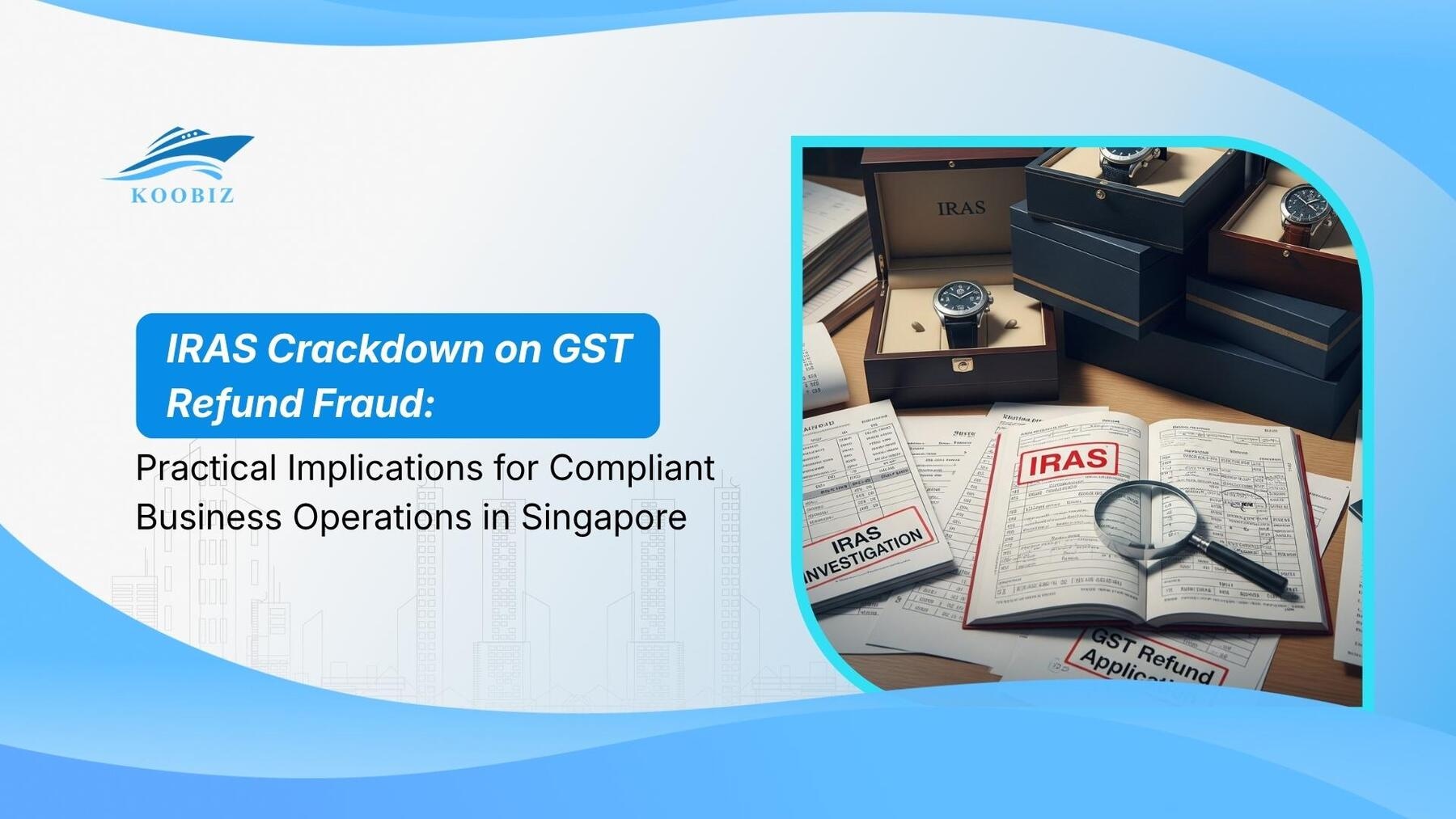
  • IRAS Crackdown on GST Refund Fraud: Practical Implications for Compliant Business Operations in Singapore

    IRAS Crackdown on GST Refund Fraud: Practical Implications for Compliant Business Operations in Singapore

    [SUMMARIES]

    IRAS carried out coordinated raids at over 20 locations on 17 March 2026.

    The operation resulted in one arrest and the seizure of 179 luxury watches valued at more than $1 million.

    Preliminary investigations point to fictitious purchases, inflated transactions, and shell companies in logistics and wholesale trade sectors.

    In 2025 alone, IRAS audited more than 1,300 GST refund claims and recovered over $100 million in taxes and penalties.

    Deliberate fraud carries severe penalties of up to three times the tax undercharged, fines of $10,000, and imprisonment of up to seven years.

    [/SUMMARIES]

    Recent enforcement actions by the Inland Revenue Authority of Singapore (IRAS) serve as an important signal for entrepreneurs and SMEs exploring opportunities in Singapore.

    As the city-state remains a preferred hub for international business setup, these developments underscore the authorities’ commitment to protecting the integrity of the Goods and Services Tax (GST) system.

    For foreign business owners, maintaining transparent financial records and legitimate transaction evidence is not only a regulatory requirement but also a practical safeguard against unintended scrutiny during company operations.

    What Happened During the Raids

    IRAS arrests people and seizes watches for GST fraud
    IRAS arrests people and seizes watches for GST fraud

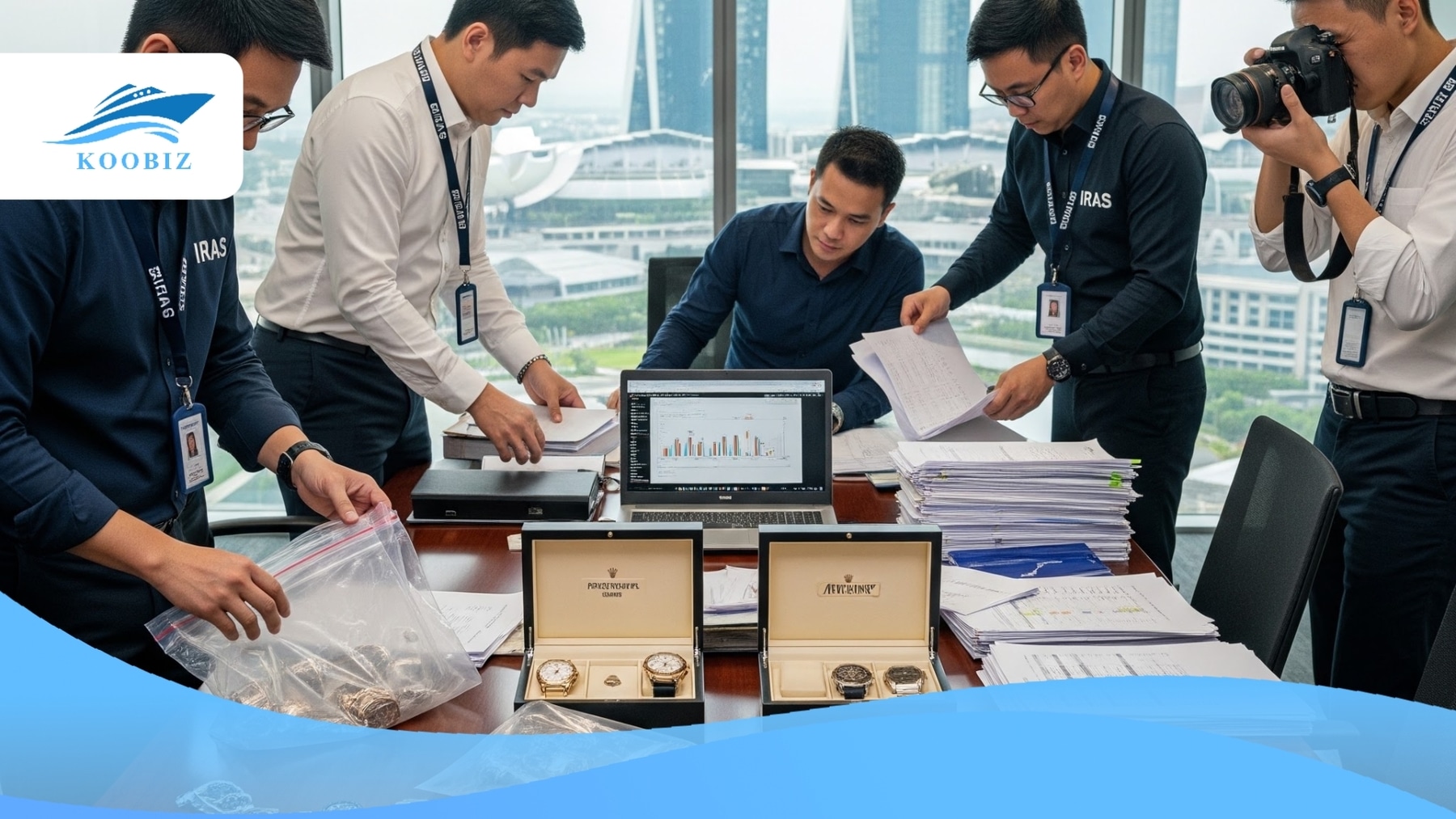
    On 17 March 2026, IRAS tax investigators executed searches across more than 20 business premises and residential addresses as part of ongoing probes into suspected GST refund fraud.

    One 56-year-old female suspect was arrested in connection with one case, while seven other individuals are assisting with inquiries related to separate matters. Authorities seized critical evidence, including:

    • Accounting records and electronic devices.
    • 179 luxury watches (estimated value exceeding $1 million).

    The individual in question is alleged to have fabricated purchases, overstated transaction values, and submitted false tax invoices to support improper refund claims.

    Early findings also identify involvement from businesses in the logistics and wholesale trade sectors, with some cases reportedly linked to the use of shell companies.

    Why Governance Matters Early On

    For entrepreneurs setting up a new entity, these cases illustrate why proper Singapore company formation and ongoing corporate governance matter.

    Engaging professional corporate services Singapore early helps establish clear ownership structures and documentation practices that align with regulatory expectations, reducing the risk of any association with non-compliant arrangements.

    IRAS Audit Approach to GST Refund Claims

    IRAS uncovers GST fraud, recovers $100M
    IRAS uncovers GST fraud, recovers $100M

    IRAS applies a risk-based audit programme supported by data analytics to review GST refund submissions and confirm adherence to applicable rules. A GST refund arises when a registered business has paid more GST on its purchases than it has collected from customers.

    Uncovering the Fraud

    In 2025, auditors examined the claims of more than 1,300 businesses, identifying various forms of non-compliance such as unsupported documentation and incorrect filings.

    These efforts resulted in the recovery of over $100 million in taxes and penalties.

    While many issues stem from inadequate internal controls rather than intentional misconduct, the audits also uncover deliberate attempts to misuse the refund mechanism. Professional accounting and bookkeeping support can assist SMEs in Singapore by ensuring that all input tax claims are backed by complete and accurate records.

    Consequences of GST Fraud and Available Remedies

    Severe Penalties

    Deliberate fraud is treated as a serious offence. Upon conviction, offenders face:

    • A penalty equal to three times the tax undercharged.
    • A fine of up to $10,000.
    • Imprisonment of up to seven years.

    Businesses implicated in such schemes may encounter further regulatory measures. IRAS encourages voluntary disclosure of any errors in past submissions, which can lead to reduced penalties when treated as a mitigating factor.

    Cash Rewards for Informants

    Business owners and individuals are also invited to report suspected irregularities or correct previous mistakes through the channels provided on the IRAS website.

    Informants who supply information leading to tax recovery may receive a cash reward of up to 15 percent of the amount recovered, capped at $100,000, with full confidentiality assured.

    Secure Your Business from Day One

    Businesses considering or already operating in Singapore benefit from proactive compliance strategies that align with current enforcement priorities.

    For tailored guidance on Singapore company formation, corporate secretary duties, accounting and bookkeeping, or other essential corporate services Singapore, the team at Koobiz stands ready to assist.

    We invite you to reach out to us to explore how structured professional assistance can help secure your operations while fully meeting all regulatory standards.

  • Singapore Budget 2026: Practical Support for Cost Management and International Growth

    Singapore Budget 2026: Practical Support for Cost Management and International Growth

    [SUMMARIES]

    Active companies can claim a 40% corporate income tax rebate up to S$30,000 for the Year of Assessment 2026.

    The Market Readiness Assistance (MRA) grant will increase to 70% support to help SMEs effectively expand into new overseas markets.

    Start-ups will benefit from an additional S$1 billion injected into the Startup SG Equity scheme to support growth-stage funding.

    Businesses can leverage a new Champions of AI programme and claim 400% tax deductions on qualifying artificial intelligence expenditures.

    [/SUMMARIES]

    Singapore’s Budget 2026 brings several targeted measures to help businesses navigate cost pressures and pursue overseas expansion more effectively. Announced by Prime Minister Lawrence Wong on 12 February, these initiatives deliver real financial relief and growth tools for both local SMEs and foreign entrepreneurs evaluating Singapore as their regional base. For companies considering business setup in Singapore, the updates offer clear, actionable advantages that can strengthen competitiveness and simplify international operations.

    1. Maximising Corporate Income Tax Rebates for Year of Assessment 2026

    40% Corporate Income Tax (CIT) Rebate (capped at S$30,000) for Businesses in 2026
    40% Corporate Income Tax (CIT) Rebate (capped at S$30,000) for Businesses in 2026

    A 40% corporate income tax (CIT) rebate will apply for the Year of Assessment 2026. Active companies that employed at least one local employee in calendar year 2025 will receive a minimum cash grant of S$1,500, with the total benefit capped at S$30,000 per company.

    Accurate accounting records and timely compliance processes are essential to claim the full rebate without delay, making professional accounting & bookkeeping support a practical way to secure these benefits efficiently.

    2. Strengthening Internationalisation Grants for Overseas Expansion

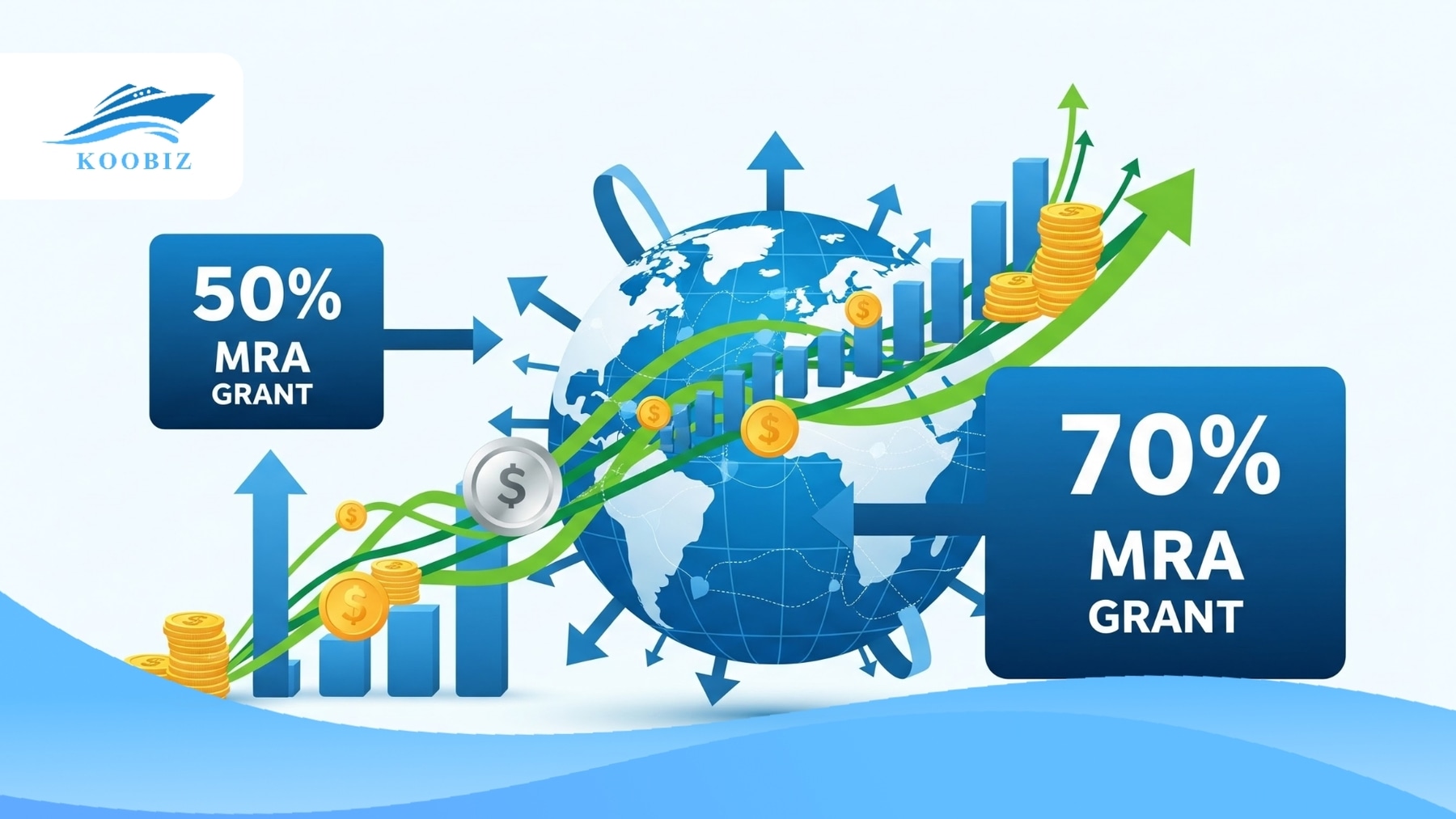
    MRA Grant increase to 70% (capped at S$100,000) supporting SME expansion
    MRA Grant increase to 70% (capped at S$100,000) supporting SME expansion

    The Market Readiness Assistance (MRA) grant helps SMEs defray costs related to overseas market promotion, business development and market setup. Currently set at up to 50% of eligible costs with a cap of S$100,000 per company per new market, the support level will rise to 70% from 1 April 2026 until 31 March 2029, while the S$100,000 cap per new market remains unchanged.

    From the same period, other internationalisation schemes will also receive enhanced support: up to 70% of eligible costs for local SMEs and up to 50% for local non-SMEs. This covers the Business Adaptation Grant (until 6 October 2027) and Global Innovation Alliance schemes.

    For foreign entrepreneurs establishing a presence here, these enhanced grants can be leveraged effectively once the company is properly structured, with reliable corporate secretary services ensuring all documentation and compliance requirements are met from day one.

    3. S$1 Billion Boost for Start-ups

    S$1 Billion Boost for Startup SG Equity, supporting growth-stage companies
    S$1 Billion Boost for Startup SG Equity, supporting growth-stage companies

    The Startup SG Equity scheme will receive an additional S$1 billion to expand its scope. Previously focused mainly on early-stage funding, the scheme will now also support growth-stage companies, helping to catalyse greater private-sector investment as part of the Research, Innovation and Enterprise 2030 plan.

    4. New Champions of AI Programme for Business Transformation

    A new Champions of AI programme is being introduced to help companies integrate artificial intelligence across their operations. Support will be tailored to each business and will include both enterprise transformation and workforce training.

    5. Expanded Tax Deductions for AI Expenditures

    The Enterprise Innovation Scheme will now allow 400% tax deductions on qualifying AI expenditures for the Years of Assessment 2027 and 2028, capped at S$50,000 per year of assessment. These AI measures form part of a broader national strategy, supported by the newly established National AI Council chaired by Prime Minister Wong.

    Partner with Koobiz for Your Business Growth

    Budget 2026 clearly demonstrates Singapore’s continued focus on building a competitive, innovation-driven environment for businesses of all sizes. By understanding and planning for these measures early, SMEs and foreign investors can gain a meaningful edge in cost management and global expansion.

    If you are exploring Singapore company formation, corporate services Singapore, or need expert support with accounting & bookkeeping, corporate secretary, or bank account opening, the Koobiz team is ready to provide clear, personalised guidance. Contact us today to see how these Budget 2026 opportunities can be aligned with your business objectives.

  • Mandatory InvoiceNow for All GST-Registered Businesses by 2031: What It Means for Your Company

    Mandatory InvoiceNow for All GST-Registered Businesses by 2031: What It Means for Your Company

    [SUMMARIES]

    All GST-registered businesses must adopt InvoiceNow for direct IRAS submissions through a phased rollout from Nov 2025 to Apr 2031.

    Post-deadline, invoices not transmitted via the Peppol network will be deemed invalid, leading to the rejection of GST input tax claims.

    Digital integration enables IRAS to perform instant cross-verification between buyers and sellers, flagging discrepancies immediately instead of during year-end audits.

    Early adopters can secure government grants of up to S$1,000 for SMEs and S$5,000 for larger firms, including free software for smaller enterprises.

    Adoption of the Peppol standard allows your business to seamlessly integrate with international jurisdictions using similar e-invoicing systems, such as the EU, Australia, and Japan.

    [/SUMMARIES]

    Following the COS Debate 2026, the Singapore Government is mandating InvoiceNow for all GST-registered businesses to automate tax submissions to IRAS. This shift replaces manual processing with digital efficiency, accelerating payment cycles and streamlining compliance for over 90,000 firms.

    Timeline for InvoiceNow Implementation in Singapore

    The GST InvoiceNow Requirement is being phased progressively to allow businesses-from SMEs to MNCs-adequate lead time to align their IT refresh cycles with these new compliance standards.

    Effective Date Affected Taxable Entities
    1 Nov 2025 Newly incorporated companies opting for voluntary GST registration.
    1 Apr 2026 All new voluntary GST registrants, irrespective of incorporation date or legal structure.
    1 Apr 2028 All new compulsory GST-registrants AND existing GST-registered businesses with annual supplies <= S$200,000.
    1 Apr 2029 Existing GST-registered businesses with annual taxable turnover <= S$1 million.
    1 Apr 2030 Existing GST-registered businesses with annual taxable turnover <= S$4 million.
    1 Apr 2031 All remaining GST-registered businesses (Annual supplies > S$4 million).

    What is InvoiceNow and the Peppol Network?

    Managed by the Infocomm Media Development Authority (IMDA), InvoiceNow is Singapore’s nationwide e-invoicing network based on the international Peppol standard.

    Unlike legacy methods such as transmitting PDF invoices via email which still necessitate manual data entry, InvoiceNow facilitates the direct exchange of structured digital data between disparate accounting systems. For your organization, this ensures that upon invoice issuance, data is transmitted instantaneously to both the counterparty and IRAS, effectively eliminating human error and accelerating GST audit and refund processes.

    Why This Transition Matters for Your Business Compliance

    Future-proof your business compliance with our professional InvoiceNow guidance
    Future-proof your business compliance with our professional InvoiceNow guidance

    In Singapore’s evolving landscape, tax compliance is shifting toward real-time transparency. Adopting InvoiceNow is no longer optional; it is a statutory mandate essential for maintaining your company’s standing with IRAS.
    Enhanced Audit Scrutiny

    Direct data transmission provides IRAS with instantaneous transaction visibility. This enables automated cross-verification between buyers and sellers. Any discrepancies that previously surfaced only during periodic audits will now be flagged immediately, significantly increasing the likelihood of targeted queries for inconsistent data.

    Input Tax Claim Risks

    The most critical financial risk lies in your GST input tax claims. Beyond the deadlines, invoices not sent via InvoiceNow may be deemed invalid for GST purposes. This could lead to the rejection of tax credits, directly inflating your liabilities and straining your corporate cash flow.

    Operational Transition Costs

    While grants of up to S$1,000 for SMEs and S$5,000 for larger firms are available, the “cost of delay” is substantial. Waiting until 2031 risks rushed integration, premium vendor rates due to surging demand, and potential operational downtime during the mandatory switch-over.

    Proactive Steps to Stay Compliant and Efficient

    Implementing InvoiceNow for seamless regulatory compliance in Singapore
    Implementing InvoiceNow for seamless regulatory compliance in Singapore

    To navigate the 2031 mandate effectively, businesses must move beyond reactive compliance. Taking proactive steps now allows you to leverage government support while optimizing your internal financial infrastructure.

    Assess System Compatibility

    The priority is verifying if your current accounting or ERP solution is “InvoiceNow-ready.” Consult the IMDA-accredited IRSP list to confirm compatibility. If you utilize an in-house enterprise solution, you must engage an accredited Access Point Provider (AP) to establish a secure connection to the Peppol network. Ensuring your software can transmit structured data directly to IRAS is the cornerstone of the new GST requirement.

    Early Adoption Strategy

    The Singapore government is incentivizing early movers with significant financial support. SMEs can access InvoiceNow-Ready Solutions for free until March 2031 and may be eligible for a new grant of up to S$1,000 to defray operational costs. Larger businesses adopting the system ahead of their 2031 deadline can receive a grant of up to S$5,000. Beyond financial incentives, early adoption allows your team to refine digital workflows in a low-pressure environment, ensuring seamless GST filing long before it becomes mandatory.

    Digitalize Bookkeeping Workflows

    Seamlessly connect your business with global e-invoicing standards
    Seamlessly connect your business with global e-invoicing standards

    The transition to InvoiceNow is the perfect opportunity to eliminate manual bottlenecks. By digitalizing your bookkeeping, you automate the reconciliation of purchase and sales invoices. This reduces human error, shortens payment cycles, and positions your business to integrate globally with jurisdictions using similar e-invoicing standards, such as the EU, Australia, and Japan.

    Future-Proof Your Business with Koobiz Accounting & Bookkeeping Services

    Navigating the 2031 InvoiceNow mandate requires more than just new software; it demands a robust digital accounting strategy. At Koobiz, we provide end-to-end Accounting & Bookkeeping services specifically engineered to align with Singapore’s evolving tax landscape.

    • Integrated Regulatory Solutions: We deploy IMDA-accredited, InvoiceNow-ready systems to automate your invoicing and GST filings, ensuring 100% compliance with the 2026-2031 roadmap.
    • Proactive Risk Mitigation: Our experts manage the technical integration with the Peppol network, shielding your business from the risks of rejected input tax claims and costly manual reconciliation errors.
    • Scalable Strategic Growth: From Company Formation to complex tax management, we streamline your back-office operations, empowering you to scale effectively in Singapore’s digital economy.

    Don’t wait for the mandatory deadline. Contact Koobiz today for a Compliance Health Check and secure a seamless digital future for your enterprise.

  • IRAS Tax Season 2026: Direct Tax Bills for 1 Million Taxpayers – What Business Owners Need to Know

    IRAS Tax Season 2026: Direct Tax Bills for 1 Million Taxpayers – What Business Owners Need to Know

    [SUMMARIES]

    Starting mid-March 2026, IRAS will issue Direct NOAs to 1 million taxpayers based on employer-submitted AIS data.

    Automated billing means any clerical error in your payroll is instantly exposed to employees and tax authorities, triggering immediate audits.

    April 18, 2026, is the final cutoff for all tax filings and adjustments; missing this leads to severe statutory penalties.

    Inaccurate reporting carries heavy financial penalties and places personal legal accountability on both Directors and Company Secretaries.

    Secure your business by auditing Form IR8A/Appendix 8A now and transitioning to monthly digital bookkeeping with Koobiz.

    [/SUMMARIES]

    The YA 2026 tax season marks a significant milestone in Singapore’s digital tax transformation. While promising a seamless experience for individuals, this shift introduces a new level of transparency and regulatory scrutiny for employers. As the Inland Revenue Authority of Singapore (IRAS) takes the lead in issuing direct bills, the accuracy of your corporate data submission now sits at the very heart of tax compliance.

    The Shift to Direct Billing: IRAS Simplifies Taxation for 1 Million Individuals

    Starting from mid-March 2026, IRAS will issue direct tax bills-officially known as the Direct Notice of Assessment (Direct NOA) to approximately 1 million taxpayers. This initiative is a major expansion of the No-Filing Service (NFS), designed to automate the tax process for a significant portion of the workforce.

    What is Direct Billing?

    Tax filing is going automated, accuracy now depends on AIS data
    Tax filing is going automated, accuracy now depends on AIS data

    Under this mechanism, eligible taxpayers receive their finalized tax bills directly without having to file a manual return. IRAS calculates these tax liabilities using data-driven automation, transitioning from a “self-declaration” model to a proactive “direct assessment” model.

    The Source of Truth: The Auto-Inclusion Scheme (AIS)

    The integrity of these direct bills relies entirely on third-party data. For most employees, the “source of truth” is the Auto-Inclusion Scheme (AIS). Consequently, the figures appearing on an employee’s tax bill are a direct reflection of the salary, bonus, and benefits-in-kind submitted by your company to the myTax Portal.

    Key Timeline for YA 2026:

    • 1 March – AIS Deadline: All employers under the AIS must submit employee income data to IRAS. This data generates the Direct NOAs.

    • Mid-March 2026: IRAS commences the issuance of digital and paper NOAs.
    • Notification: Taxpayers are alerted via SMS or email once their NOA is available for viewing.
    • The 30-Day Objection Window: Upon receiving the NOA, individuals have 30 days to review the figures. Any discrepancy reported by an employee typically triggers a secondary verification of the employer’s original AIS submission.
    • 18 April 2026 – The Final Filing & Amendment Deadline: This is the critical cutoff for two groups:
      • NFS Recipients: Must complete any manual adjustments (e.g., adding rental income or tax reliefs) via myTax Portal.
      • Non-AIS Employees & Self-Employed: Individuals whose employers are not under the AIS must manually file their full tax returns by this date to avoid late filing penalties.

    The “Visibility Trap”: Why Direct Billing Increases Scrutiny on Your Business

    Direct billing increases transparency and scrutiny on your data
    Direct billing increases transparency and scrutiny on your data

    For employees, direct billing is a seamless upgrade. For business owners, however, it functions as a “Visibility Trap.” Because IRAS now leverages your corporate data to bill individuals directly, reporting errors are no longer buried in paperwork – they are delivered straight to your employees’ mobile devices, creating an immediate feedback loop with the tax authorities.

    The Risk of Data Mismatch

    With 1 million taxpayers receiving their NOAs, every dollar will be scrutinized. If an employee’s tax bill is inflated due to a clerical error in your AIS submission or Form IR8A, they will likely file an immediate objection. In this digital era, a “Data Mismatch” is a high-priority red flag. An employee dispute can trigger IRAS’s automated systems to cross-verify your company’s internal ledgers, often escalating into a comprehensive corporate audit.

    Administrative Burden & Reputational Risk

    Incorrect filings do more than just invite regulatory heat; they erode your internal corporate culture. Discrepancies lead to employee frustration and a loss of trust in management. In Singapore’s competitive talent landscape, being perceived as a firm that “fails at payroll” is a significant reputational liability that can hamper recruitment and retention.

    Compliance Penalties & Director’s Liability

    Under the Singapore Income Tax Act, the legal onus for accurate reporting rests squarely on the company’s leadership. IRAS maintains a stringent stance on enforcement, as evidenced by recent data:

    • Evidence of Enforcement: For YA 2025 alone, IRAS collected over S$5 million in penalties from close to 37,000 taxpayers who failed to pay their income tax on time. This highlights IRAS’s commitment to taking firm action against non-compliance.
    • Statutory Penalties: Beyond late payment penalties (typically 5% on unpaid tax), IRAS has the authority to impose composition fines for failing to file accurate AIS returns or for late submissions.
    • Director’s & Secretary’s Liability: Both the Director and Company Secretary are responsible for ensuring rigorous statutory compliance. Failure to maintain accurate records can lead to legal complications, including travel restriction orders or legal action against the company’s officers.
    • Operational Impacts: Persistent compliance failures can jeopardize Employment Pass (EP) renewals for expatriate talent and negatively affect the company’s standing with government authorities and financial institutions.

    Proactive Compliance: 3 Critical Steps for Business Owners This Tax Season

    Secure your business growth with expert-led tax compliance strategies
    Secure your business growth with expert-led tax compliance strategies

    To navigate the YA 2026 tax season without falling into the “Visibility Trap,” business owners must shift from reactive fixes to proactive governance.

    Step 1: Conduct a Pre-Submission Payroll & Form IR8A Audit

    Do not wait for an IRAS query to review your figures. Perform a rigorous internal audit of your 2025 payroll records before finalizing them in the myTax Portal. Key focus areas include:

    • Benefits-in-Kind: Ensure housing, car allowances, and insurance premiums are accurately valued and reported under Appendix 8A.
    • Director’s Fees: Confirm that fees are reported in the correct Year of Assessment (YA), strictly based on the date they were voted and approved.
    • Stock Options: Properly account for gains from ESOP or ESPP plans as per Appendix 8B.

    Step 2: Transition to Monthly Digital Bookkeeping

    Manual “shoebox accounting” remains the primary source of clerical errors. Migrating your financial records to a cloud-based digital system allows for real-time reconciliation. Accurate monthly records ensure that your year-end AIS submission is a verified reflection of your actual financial activity.

    Step 3: Synchronize with Your Corporate Secretary’s Records

    Tax compliance is intrinsically linked to corporate governance. Your Corporate Secretary ensures that all board resolutions-especially those regarding director compensation-are legally documented. Any discrepancy between secretarial records and tax filings is a major “red flag” that may lead IRAS to disallow tax-deductible expenses.

    Koobiz – Your Integrated Partner for Accounting & Bookkeeping in Singapore

    At Koobiz, we understand that tax compliance is not just about numbers; it’s about protecting your business’s reputation. Our integrated accounting and secretarial services ensure your AIS submissions are audit-ready long before the tax season begins. Let us turn the “Visibility Trap” into a benchmark of your corporate excellence. Contact Koobiz today for a Complimentary Tax Compliance & Payroll Health Check!

  • Tax Resident Meaning in Singapore: A Complete Guide to Criteria & Benefits 2026

    Tax Resident Meaning in Singapore: A Complete Guide to Criteria & Benefits 2026

    [SUMMARIES]

    Tax resident status in Singapore determines how individuals and companies are taxed and whether they can access key incentives under the IRAS tax framework.

    Individuals generally qualify by meeting the 183-day rule or related administrative concessions, while companies must demonstrate that control and management are exercised in Singapore.

    Tax residents benefit from progressive personal tax rates, corporate incentives such as SUTE and CIT rebates, and access to Singapore’s 90+ Double Taxation Agreements (DTAs).

    They may also apply for a Certificate of Residence (COR) to claim treaty benefits in cross-border transactions.

    Understanding these criteria and compliance requirements helps taxpayers optimize tax obligations and avoid common residency determination mistakes.

    [/SUMMARIES]

    Understanding the tax resident meaning in Singapore is essential for individuals and businesses operating in the country. Tax residency determines how income is taxed, the applicable tax rates, and whether taxpayers can access benefits such as tax exemptions and Double Taxation Agreements (DTAs). This guide explains the key residency criteria, benefits of tax resident status, and how individuals and companies can determine their tax status under the rules of the Inland Revenue Authority of Singapore.

    What Does “Tax Resident” Mean in Singapore?

    In Singapore, the term “tax resident” refers to the tax status of individuals or companies that meet specific criteria relating to their physical presence or strategic management within the country during a given Year of Assessment (YA). This status determines how income is taxed and whether a taxpayer is eligible for certain tax incentives under Singapore’s tax system.

    Tax residency in Singapore is administered by the Inland Revenue Authority of Singapore (IRAS). It is distinct from citizenship or permanent residency and is instead determined by practical factors such as the duration of stay in Singapore for individuals, or the location where a company’s control and management are exercised.

    Who Qualifies as a Tax Resident in Singapore?

    Understanding residency criteria under Singapore’s current tax regulations
    Understanding residency criteria under Singapore’s current tax regulations

    In Singapore, tax residency is not a uniform classification. IRAS applies different frameworks for individuals and companies, focusing on physical presence for individuals and strategic governance for corporate entities. Understanding these distinctions is important because tax residency determines applicable tax rates and eligibility for Singapore’s extensive network of tax treaties.

    Tax Resident Criteria for Individuals (The 183-Day Rule and Additional Concessions)

    In Singapore, an individual is generally treated as a tax resident for a specific Year of Assessment (YA) if they stay or work in Singapore for at least 183 days in the preceding calendar year. Singapore citizens and Singapore Permanent Residents (SPR) who normally live in Singapore are also regarded as tax residents, except during temporary absences.

    Foreign individuals may automatically qualify as tax residents if they hold a valid work pass for at least one year, in accordance with the rules of the Inland Revenue Authority of Singapore (IRAS).

    IRAS also provides administrative concessions for longer work arrangements:

    • 2-Year Concession: Tax residency may apply if total stay across two calendar years is at least 183 days.
    • 3-Year Concession: Individuals working or staying in Singapore for three consecutive years may be treated as tax residents for all three years.

    Tax residents are taxed under progressive personal income tax rates (0%–24%) and can claim personal tax reliefs, which often result in a lower effective tax burden compared with the flat tax rates (15%–24%) applied to non-residents.

    Tax Resident Criteria for Companies (The “Control and Management” Rule)

    For companies, tax residency is determined not by where the company is incorporated, but by where its control and management are exercised. This legal test focuses on the location where strategic business decisions are made rather than where day-to-day operations take place.

    Key factors typically include:

    • Board of Directors Meetings: The physical location where board meetings are held and high-level policy decisions are made.
    • Strategic Management: The location where senior executives and key decision-makers direct the company’s overall strategy.

    A Singapore-incorporated company is not automatically considered a tax resident. It must demonstrate that its central management and strategic decision-making activities take place in Singapore to qualify for benefits such as the Start-Up Tax Exemption (SUTE) and relief under Double Taxation Agreements (DTAs).

    Benefits of Being a Tax Resident in Singapore

    Maximize your financial advantages with Singapore tax residency status
    Maximize your financial advantages with Singapore tax residency status

    Tax residency in Singapore provides access to a range of tax incentives and treaty benefits designed to support international businesses and professionals. For both individuals and companies, obtaining tax resident status can help optimize international tax obligations while benefiting from Singapore’s stable and business-friendly tax system.

    Access to Double Taxation Agreements (DTAs)

    Singapore maintains an extensive network of more than 90 Double Taxation Agreements (DTAs) with jurisdictions worldwide. These agreements help ensure that the same income is not taxed twice-once in the source country and again in Singapore.

    Tax residents may claim benefits under these treaties, including reduced withholding tax rates on foreign-sourced dividends, interest, and royalties. These reduced rates, often ranging from 0% to 10%, are generally not available to non-resident taxpayers.

    Tax Exemptions for Companies (SUTE & CIT Rebates)

    Singapore tax resident companies may benefit from residency-specific incentives such as the Start-Up Tax Exemption (SUTE), while all companies may receive Corporate Income Tax (CIT) rebates under Singapore Budget 2026.

    • SUTE: Eligible new companies may enjoy a 75% tax exemption on the first S$100,000 of chargeable income and a 50% exemption on the next S$100,000 for the first 3 Years of Assessment (YA).
    • CIT Rebate (Budget 2026): A 40% Corporate Income Tax rebate, capped at S$30,000 for YA 2026, applies to all companies (resident and non-resident) with tax payable.
    • CIT Rebate Cash Grant: Active companies with at least one local employee with CPF contributions in 2025 will automatically receive a minimum S$1,500 cash grant, even if loss-making or with no tax payable.

    Lower Progressive Tax Rates vs Flat Rates for Individuals

    Individual tax residents in Singapore are taxed under the progressive personal income tax system, with rates ranging from 0% to 24%, depending on income levels.

    In contrast, non-resident individuals are typically subject to flat tax rates ranging from 15% to 24% on certain types of income. Additionally, tax residents may claim various personal tax reliefs, such as Earned Income Relief, Spouse Relief, and CPF Relief, which can significantly reduce the total tax payable.

    Tax Exemptions on Foreign-Sourced Income (FSIE)

    Under the Foreign-Sourced Income Exemption (FSIE) scheme, Singapore tax resident companies may qualify for tax exemptions on certain foreign-sourced income remitted into Singapore, including:

    • Foreign dividends
    • Foreign branch profits
    • Foreign service income

    To qualify, the income must generally have been taxed in the source country and the headline tax rate in that jurisdiction must be at least 15%.

    Certificate of Residence (COR) for International Tax Claims

    Singapore tax residents may apply for a Certificate of Residence (COR) issued by the Inland Revenue Authority of Singapore (IRAS). This official document confirms that the taxpayer is a Singapore tax resident for a specific period.

    The COR is commonly required when claiming tax treaty benefits under DTAs, particularly when dealing with foreign tax authorities or cross-border transactions.

    Tax Resident vs Non-Tax Resident: Key Differences (YA 2026)

    Understanding tax residency status is essential for ensuring compliance and optimizing tax obligations. IRAS applies different tax treatments to residents and non-residents, particularly with respect to tax rates, relief eligibility, and corporate tax incentives for YA 2026.

    Feature Tax Resident in Singapore Non-Tax Resident in Singapore
    Primary Criteria Stay or work in Singapore ≥ 183 days; or company control and management exercised in Singapore Stay or work in Singapore < 183 days; or strategic decisions made outside Singapore
    Individual Tax Rates Progressive tax rates (0% to 24%); first S$20,000 of income is tax-free Employment income taxed at flat 15% or resident rate (whichever is higher)
    Director’s Fees & Other Income Taxed under progressive resident tax rates (0% to 24%) Typically taxed at flat 24%, withheld at source
    Tax Reliefs & Rebates Eligible for various personal tax reliefs; no individual tax rebate for YA 2026 Generally not eligible for personal tax reliefs or rebates
    Corporate Benefits May qualify for Start-Up Tax Exemption (SUTE) and 40% Corporate Income Tax Rebate (capped at S$30,000) + minimum S$1,500 Cash Grant (if the company had at least one local employee in 2025) Eligible for 40% CIT Rebate (cap S$30,000) + minimum S$1,500 Cash Grant if the local employee (CPF) condition is met; generally not eligible for SUTE or Singapore DTA benefits
    Treaty Benefits (DTA) Access to Singapore’s 90+ Double Taxation Agreements Generally not eligible to claim treaty benefits
    Official Proof May apply for a Certificate of Residence (COR) issued by IRAS Not eligible to obtain a COR

    Important Note:For YA 2026, all companies (resident and non-resident) should note the revised 40% Corporate Income Tax (CIT) Rebate, capped at S$30,000. Although lower than the 50% rebate in the previous year, it remains a significant advantage compared with non-resident entities that do not qualify for such broad-based tax support.

    How to Obtain a Certificate of Residence (COR) in Singapore

    Navigating the COR application process via the official IRAS portal
    Navigating the COR application process via the official IRAS portal

    A Certificate of Residence (COR) serves as official proof that an individual or company is a tax resident of Singapore. The certificate is issued by IRAS and is commonly required when claiming tax treaty benefits under Double Taxation Agreements.

    Since 2025, IRAS has strengthened its economic substance requirements, making it increasingly important for companies to follow the correct application procedures through the myTax Portal.

    Step-by-Step Application Process (YA 2026)

    Step 1: Verify Eligibility

    • Individuals: Ensure you meet the 183-day rule or qualify under the 2-year or 3-year administrative concessions.
    • Companies: Confirm that control and management are exercised in Singapore. Foreign-owned investment holding companies may need to demonstrate additional economic substance, such as appointing a local executive director or maintaining key employees in Singapore.

    Step 2: Log in to the myTax Portal

    • Use Singpass for individual applications.
    • Use Corppass for company applications.

    Navigate to: e-Services → Corporate Tax (or Personal Tax) → Apply for Certificate of Residence (COR).

    Step 3: Submit Required Information

    Applicants must provide:

    • The relevant Year of Assessment (YA)
    • The treaty country where tax benefits will be claimed
    • The type of income, such as dividends, interest, or royalties

    Step 4: Declare Control and Management (For Companies)

    Companies must confirm that strategic decisions are made in Singapore. IRAS may request supporting documents, including:

    • Board meeting minutes
    • Records of directors’ attendance

    Step 5: Processing and Certificate Download

    The standard processing time is typically 7 to 14 working days.

    Once approved, applicants will receive a notification via email or SMS. The digital COR can then be downloaded directly from the portal.

    IRAS has largely phased out physical paper certificates. The digital COR now includes a secure verification link or QR code, allowing foreign tax authorities to confirm the document’s authenticity online.

    Common Mistakes When Determining Tax Residency

    Misinterpreting Singapore’s residency rules can trigger higher tax liabilities and IRAS audits. Avoid these frequent pitfalls in 2026:

    • Equating Visa with Residency: Holding an Employment Pass (EP) or EntrePass does not automatically make you a tax resident. Status is determined by physical presence, not your immigration category.
    • Incorrect Day Counting: Many overlook that both arrival and departure days count as full days in Singapore, regardless of the actual hours spent in the country.
    • The “Incorporation” Myth: A Singapore-registered company is not a resident by default. It must prove that “Control and Management” (Board of Directors) is exercised locally to qualify for tax benefits.
    • Lacking Economic Substance: In 2026, relying solely on a nominee director is insufficient. IRAS requires evidence of real economic activity and local strategic decision-making to grant residency status.
    • Poor Documentation: Failing to maintain a “Residency Trail” (boarding passes, flight itineraries, and board minutes) can lead to the rejection of Certificate of Residence (COR) applications.

    How Koobiz Tax Advisory Services Help Businesses Determine Tax Residency in Singapore

    Determining tax residency in Singapore can be complex, particularly for companies with international directors or cross-border management structures. Koobiz Tax Advisory helps businesses navigate these rules and remain compliant with requirements set by the Inland Revenue Authority of Singapore.

    Our Core Services:

    • Residency Assessment: Review your company’s control and management structure to determine whether it qualifies as a Singapore tax resident under current IRAS guidelines.
    • COR Application Support: Handle the Certificate of Residence (COR) application through the myTax Portal and ensure all documentation and substance requirements are properly prepared.
    • DTA & Tax Incentive Optimization: Help businesses leverage Double Taxation Agreements and corporate tax incentives such as Start-Up Tax Exemption (SUTE).
    • Strategic Governance Advisory: Provide guidance on board meeting structures and executive decision-making to maintain economic substance in Singapore.
    • IRAS Liaison: Represent your company in communications with IRAS and support any tax inquiries or compliance reviews.

    By partnering with Koobiz, businesses can reduce the risk of non-resident taxation while ensuring efficient tax planning and full regulatory compliance.

  • Corporate Tax Optimization: The Ultimate Guide to Singapore Donation Tax Relief for Businesses

    Corporate Tax Optimization: The Ultimate Guide to Singapore Donation Tax Relief for Businesses

    [SUMMARIES]

    Singapore donation tax relief allows businesses to claim a 250% tax deduction on qualifying donations made to approved Institutions of a Public Character (IPCs) under regulations administered by IRAS.
    This incentive significantly reduces taxable income while encouraging corporate philanthropy and social impact.

    Companies must distinguish between donations and sponsorships, as only voluntary contributions without commercial benefits qualify for enhanced deductions.

    Eligible contributions may include cash, shares, property, artifacts, or volunteer expenses under the Corporate Volunteer Scheme (CVS).

    When structured correctly and aligned with the Year of Assessment (YA), donation strategies can support corporate tax optimization, ESG goals, and regulatory compliance.

    [/SUMMARIES]

    Singapore offers attractive incentives for corporate giving through Singapore donation tax relief. Businesses that make qualifying charitable donations can claim up to a 250% tax deduction, reducing taxable income while supporting social causes. This guide explains how companies can benefit from donation tax relief, what donations qualify, and how to claim the deduction under the regulations of the Inland Revenue Authority of Singapore in Singapore.

    What Is Singapore Donation Tax Relief for Companies?

    Singapore donation tax relief allows companies to reduce their taxable income when making qualifying charitable contributions. Under regulations administered by the Inland Revenue Authority of Singapore (IRAS), businesses that donate to approved charities may claim enhanced tax deductions, helping reduce their overall corporate tax liability.

    In most cases, donations made to organizations with Institution of a Public Character (IPC) status qualify for a 250% tax deduction. This means companies can deduct 2.5 times the donated amount from their taxable income. The incentive encourages corporate giving while supporting a wide range of social causes across Singapore.

    Understanding the 250% Tax Deduction Rule

    Maximizing tax benefits through Singapore’s 250% deduction for qualifying donations
    Maximizing tax benefits through Singapore’s 250% deduction for qualifying donations

    Singapore offers one of the most generous tax incentives for charitable giving in Asia. Under regulations administered by the Inland Revenue Authority of Singapore (IRAS), companies making qualifying donations to approved Institutions of a Public Character (IPCs) are entitled to a 250% tax deduction on the donated amount.

    For example, if your company donates SGD 10,000, it can deduct SGD 25,000 from its taxable income. This enhanced deduction significantly lowers your company’s taxable profit, making philanthropy a highly effective tool for both corporate tax planning and social impact.

    As announced in Budget 2026, the 250% tax deduction for qualifying donations to approved IPCs has been officially extended until 31 December 2029, giving businesses greater long-term certainty for strategic philanthropy and tax planning.

    The Crucial Difference: Donation (250% Relief) vs. Sponsorship (100% Expense)

    A common pitfall for businesses is misclassifying contributions, which may lead to potential audit issues with IRAS. The key distinction lies in whether the company receives commercial benefits in return.
    Criteria Donation Sponsorship
    Definition A voluntary contribution made to an approved IPC without expecting commercial benefits. A payment made in exchange for promotional or marketing benefits.
    Commercial Benefit No material benefit is received. A simple acknowledgment (e.g., donor name listed in a report) is generally acceptable. The company receives benefits such as advertising, event exposure, or marketing rights.
    Tax Treatment Eligible for 250% tax deduction under Singapore donation tax relief. Treated as a business or marketing expense.
    Deduction Amount 250% of the donation amount can be deducted from taxable income. 100% of the payment can be deducted as a business expense.

    Which Corporate Donations Qualify for Singapore Tax Deduction?

    Identifying eligible charitable contributions for Singapore corporate tax relief
    Identifying eligible charitable contributions for Singapore corporate tax relief

    To qualify for Singapore donation tax relief, corporate contributions must comply with the guidelines established by the Inland Revenue Authority of Singapore (IRAS). In general, for a deduction to be valid, the donation must be made to an approved Institution of a Public Character (IPC) or through government-recognized schemes.

    Below are the primary forms of corporate giving that qualify for tax incentives.

    Cash Donations to Approved IPCs

    This is the most common form of corporate giving. Contributions made via bank transfer, PayNow (Corporate), or cheque to registered IPCs are eligible for the 250% tax deduction, provided the donor does not receive any material benefit in return.

    Land and Property Donations

    Donating immovable property, such as land or buildings, to an IPC is considered a significant philanthropic contribution. The deductible amount is determined based on the market valuation conducted by a professional valuer and remains subject to approval by IRAS.

    Artifact and Art Donations

    Under the Public Gallery Tax Incentive Scheme, businesses that donate heritage artifacts or artworks to museums with IPC status may claim tax deductions. The items must be evaluated by the National Heritage Board (NHB) to confirm their cultural or historical significance.

    Naming Donations

    When a company makes a substantial contribution that allows a building, facility, or scholarship to be named after the donor, it may still qualify as a donation rather than a sponsorship, provided the naming does not involve commercial advertising or product promotion.

    Overseas Donations (OHAS)

    Under the Overseas Humanitarian Assistance Tax Deduction Scheme (OHAS), Singapore companies may claim a 100% tax deduction on qualifying cash donations made for overseas humanitarian emergencies through designated charities. This pilot scheme is valid until 31 December 2028.

    Qualifying deductions under OHAS are subject to an overall cap of 40% of statutory income, which applies specifically to overseas donation schemes as administered by the Inland Revenue Authority of Singapore.

    Donations That Do NOT Qualify for Singapore Donation Tax Relief

    To remain compliant, businesses must distinguish between a genuine charitable donation and a commercial transaction. According to guidelines issued by the Inland Revenue Authority of Singapore (IRAS), the following contributions are not eligible for the 250% tax deduction.

    Donations to Non-IPC Organizations

    Only donations made to registered Institutions of a Public Character (IPCs) qualify for tax relief. The following contributions are not eligible:

    • Donations to non-profit organizations without IPC status
    • Contributions to religious or community groups not registered as IPCs
    • Direct donations to individuals, such as personal crowdfunding campaigns
    • Donations to foreign charities, unless made through approved schemes such as OHAS or PTIS

    Contributions with Material Benefits

    Payments that provide commercial benefits are not considered charitable donations. Examples include:

    • Buying gala dinner tables or charity event tickets
    • Payments for branding or advertising at events
    • Purchasing charity merchandise at market value

    These payments are typically treated as business or marketing expenses, not tax-deductible donations.

    Conditional or Restricted Donations

    Donations that involve conditions or personal benefits may also be disqualified. For example:

    • Requiring the charity to use a specific vendor
    • Providing private benefits to company directors or employees

    To qualify for tax relief, the contribution must be a voluntary donation with no expectation of personal or commercial gain.

    How Much Tax Can Your Company Save? – Example Corporate Tax Calculation

    Consult our experts to accurately calculate your company’s tax benefits
    Consult our experts to accurately calculate your company’s tax benefits

    One of the key benefits of Singapore’s donation tax incentive is the 250% tax deduction, which can significantly reduce a company’s taxable income. This policy, administered by the Inland Revenue Authority of Singapore, allows businesses in Singapore to combine corporate philanthropy with tax efficiency.

    Example calculation:

    • Original taxable income: SGD 500,000
    • Donation to an approved IPC: SGD 10,000
    • Eligible tax deduction (250%): SGD 25,000

    Revised taxable income:

    • SGD 500,000 − SGD 25,000 = SGD 475,000

    Corporate tax impact (17% rate):

    • Tax saved = SGD 25,000 × 17% = SGD 4,250

    Summary:

    Item Amount
    Donation Amount SGD 10,000
    Tax Deduction (250%) SGD 25,000
    Tax Saved (17%) SGD 4,250

    This example shows how a qualifying corporate donation not only supports charitable initiatives but also helps companies optimize their corporate tax liability when structured correctly.

    Strategic Corporate Tax Planning Through Donations

    Integrating Singapore donation tax relief into a company’s financial strategy allows businesses to support social causes while improving tax efficiency. By planning the timing and structure of donations, companies can maximize the 250% tax deduction and remain compliant with the Inland Revenue Authority of Singapore regulations.

    Timing Donations Before Financial Year-End

    To claim the deduction in the upcoming Year of Assessment (YA), donations must be made within the current financial year. Companies with higher profits often donate before financial year-end to reduce taxable income and optimize corporate tax payable.

    Aligning Donations with Year of Assessment (YA)

    In Singapore, corporate tax follows a preceding year basis, meaning the YA reflects income from the previous financial year.

    To ensure the deduction is applied correctly:

    • Accurate cut-offs: Ensure the IPC issues the tax-deductible receipt within the same accounting period.
    • Verify records: Although most IPCs submit donor information directly to IRAS, companies should still confirm the deduction in their tax filing records.

    Managing Unutilized Donation Deductions

    If your company’s approved donation deductions exceed its statutory income for a given Year of Assessment (YA), the unutilized portion may be carried forward for up to five subsequent YAs to offset future taxable income.

    To qualify for this carry-forward treatment, the company must satisfy the shareholding test, meaning there must be no substantial change (50% or more) in its ultimate shareholders and their respective shareholdings during the relevant period.

    Important note: Unlike unutilized trade losses or capital allowances, donation deductions cannot be carried back to offset income from previous Years of Assessment under the Loss Carry-Back Relief scheme, as clarified by IRAS.

    Beyond Cash: Corporate Volunteer Scheme (CVS)

    Previously known as the Business and IPC Partnership Scheme (BIPS), the Corporate Volunteer Scheme (CVS) allows businesses to claim Singapore donation tax relief through employee volunteer services instead of direct cash donations.

    Supported by the Inland Revenue Authority of Singapore in Singapore, the scheme encourages companies to support approved Institutions of a Public Character (IPCs) by providing skilled or general volunteer services.

    Under CVS, companies can claim a 250% tax deduction on qualifying expenses incurred when employees volunteer at IPCs.

    Eligible expenses include:

    • Employee wages: Basic salary paid during volunteer hours
    • Direct expenses: Costs such as transportation or training required for the volunteer project

    Key Limitations for Strategic Planning:

    To maintain tax efficiency, companies should note the following caps:

    • Company cap: SGD 250,000 in qualifying expenditure per Year of Assessment (YA)
    • IPC cap: SGD 100,000 in qualifying expenditure per IPC each year

    By leveraging CVS, businesses can strengthen corporate social responsibility (CSR), improve employee engagement, and contribute professional expertise to community initiatives-while still benefiting from Singapore’s enhanced tax deduction framework.

    Using Corporate Donations to Strengthen ESG and CSR Strategy

    Integrating strategic philanthropy into sustainable corporate business frameworks
    Integrating strategic philanthropy into sustainable corporate business frameworks

    In today’s business landscape, corporate giving has evolved beyond simple philanthropy; it is now a core component of a robust Environmental, Social, and Governance (ESG) framework. By strategically leveraging Singapore donation tax relief, businesses can drive meaningful social change while fulfilling their Corporate Social Responsibility (CSR) mandates.

    For companies operating in Singapore, integrating charitable giving into their ESG strategy offers several strategic advantages:

    • Measurable Social Impact (The “S” in ESG): By supporting IPCs in education, healthcare, or social welfare, companies can provide tangible data for their annual sustainability reports, demonstrating a commitment to community upliftment.
    • Enhanced Brand Reputation: Philanthropy fosters stakeholder trust, positioning the brand as a responsible corporate citizen in the eyes of investors, partners, and customers.
    • Environmental Stewardship: Donations to green funds or environmental IPCs help businesses offset their ecological footprint and support Singapore’s Green Plan 2030.
    • Long-term Sustainability: Aligning donations with a company’s core values ensures that social investments contribute to long-term business resilience and social stability.

    When charitable giving is woven into the corporate DNA, the 250% tax deduction acts as a catalyst, allowing businesses to amplify their impact while maintaining fiscal discipline and responsible governance.

    Compliance Guide: Claiming Donation Tax Relief via IRAS

    Claiming Singapore donation tax relief is relatively simple thanks to the digital integration between approved charities and the Inland Revenue Authority of Singapore (IRAS).

    In most cases, the process is fully automated. Approved Institutions of a Public Character (IPCs) are required to submit donation records electronically to IRAS. As a result, the 250% tax deduction is typically pre-filled when companies file their corporate income tax return (Form C-S or Form C).

    To ensure a smooth claim and maintain compliance, businesses should follow these best practices:

    • Provide Accurate UEN: Ensure your company’s Unique Entity Number (UEN) is correctly provided to the IPC when making the donation. This allows the donation to be automatically recorded in IRAS’ system.
    • Verify via myTax Portal: Before filing taxes, log in to the IRAS myTax Portal to confirm that all qualifying donations are reflected under the correct Year of Assessment (YA).
    • Maintain Proper Records: Although receipts do not need to be submitted with the tax return, companies must retain supporting documents – such as acknowledgement letters or bank transfer records – for at least 5 years for audit purposes.
    • Confirm No Commercial Benefits: Ensure the contribution remains a pure donation. If any material benefits are received, the value must be declared and deducted from the qualifying donation amount.

    Following these steps helps companies claim the tax deduction efficiently while remaining fully compliant with Singapore’s corporate tax regulations.

    Common Corporate Mistakes When Claiming Singapore Donation Tax Relief

    Although Singapore donation tax relief offers attractive tax benefits, some companies make mistakes that prevent them from claiming the 250% tax deduction properly. To remain compliant with the Inland Revenue Authority of Singapore in Singapore, businesses should avoid the following common errors:

    • Donating to non-approved organizations: Only donations made to approved Institutions of a Public Character (IPCs) qualify for tax relief. Contributions to individuals, non-IPC charities, or most overseas organizations usually do not qualify.
    • Confusing sponsorship with donations: If the company receives advertising, branding, or event benefits, the payment is treated as a business expense, not a donation eligible for the 250% tax deduction.
    • Incorrect timing of donations: Donations must be recorded in the correct financial year to match the relevant Year of Assessment (YA).
    • Missing or incomplete documentation: Companies should retain supporting records such as donation confirmations, acknowledgement letters, or bank transfer receipts from the IPC.

    Avoiding these mistakes helps businesses maximize tax benefits while maintaining full compliance with Singapore’s tax regulations.

    Why Businesses Engage Professional Tax Advisors for Corporate Giving

    Although Singapore donation tax relief offers strong tax benefits, compliance and tax planning can be complex. Businesses must ensure donations qualify for the 250% tax deduction, align with the correct YA, and meet the requirements of the Inland Revenue Authority of Singapore in Singapore.

    Many companies therefore work with professional advisors to:

    • Verify eligibility of donations and IPC status of recipients
    • Optimize tax planning by aligning donations with the company’s financial year
    • Ensure accurate reporting in Form C-S or Form C
    • Maintain full compliance with IRAS documentation rules

    At Koobiz Corporate Services, businesses receive expert support in corporate tax planning, compliance, and donation tax relief strategies, helping maximize tax efficiency while integrating charitable giving into broader tax and ESG strategies.

  • Leaving Singapore? A Foreign Employee’s Guide to Tax Clearance (IR21) & Withheld Salary

    Leaving Singapore? A Foreign Employee’s Guide to Tax Clearance (IR21) & Withheld Salary

    [SUMMARIES]

    Legal Requirement: Salary withholding is required under the Income Tax Act and is not a discretionary decision made by your employer.

    Travel Freedom: You generally can leave Singapore while the process is ongoing, provided you have no outstanding tax debts triggering a Stop Payment Order.

    Timeline: Withheld salary is typically released within 7 days for e-filing or up to 21 days for paper filing after your employer submits Form IR21.

    Self-Check: You can verify if your tax clearance is complete by logging into the myTax Portal using your personal SingPass.

    Residency Impact: Your final tax liability depends on the 183-day rule, which determines whether you are taxed as a Resident (progressive rates of 0–22%) or a Non-Resident (flat 15%).

    [/SUMMARIES]

    Seeing a “zero” balance on your final payslip due to tax withholding can be stressful, especially for foreign employees preparing to leave Singapore. Are you stuck in Singapore? At Koobiz, we understand that for foreign employees, Tax Clearance (Form IR21) is more than just paperwork—it directly affects your final salary and departure plans. This guide explains Singapore’s mandatory tax withholding rules, the expected timeline for releasing your salary, and how to track your tax clearance status via myTax Portal—so you can leave Singapore compliantly and with peace of mind.

    Why is Your Employer Withholding Your Salary?

    Withholding salary for Singapore IR21 tax clearance procedure
    Withholding salary for Singapore IR21 tax clearance procedure

    It’s a stressful moment: you’re packing up your life, bills are due, and suddenly your final paycheck is frozen. It feels personal, but in reality, it isn’t.

    Your employer is complying with the Singapore Income Tax Act, specifically Section 68(5). This law requires employers to withhold all payments—salary, bonuses, overtime, and leave encashment—when a foreign employee resigns or leaves Singapore.

    The Logic: Since you are leaving the country, IRAS needs a guarantee that your final tax bill will be paid. Your withheld salary serves as a form of security for your final tax assessment If your employer releases the money to you and you leave without paying tax, they become legally liable to pay your tax debt. Because of this strict legal liability, HR departments generally have no discretion to make exceptions.

    Under IRAS regulations, employers who fail to file Form IR21 or properly withhold salary may face a fine of up to SGD 1,000 or imprisonment of up to six months. This explains why your request for an early release of funds is almost always denied.

    Can You Leave Singapore While Tax Clearance is Processing?

    Whether you can leave Singapore depends on your tax clearance status. Below are the most common scenarios:

    Scenario A: Form IR21 Filed, Money Withheld

    • Can I Leave? YES.
    • Why? Your withheld salary serves as security for the tax. You are free to travel.

    Scenario B: Tax Bill Issued, Shortfall Paid

    • Can I Leave? YES.
    • Why? You have settled your debts. Keep your receipt handy just in case.

    Scenario C: Outstanding Tax Debt or Suspected Non-Compliance

    • Can I Leave? NO.
    • Why? IRAS may issue a Stop Payment Order (SPO) or travel restriction notice to Immigration & Checkpoints Authority (ICA). You will be prevented from leaving Singapore until the tax is paid in full.

    The “Release of Monies” Timeline: When Do You Get Paid?

    The
    The “Release of Monies” Timeline

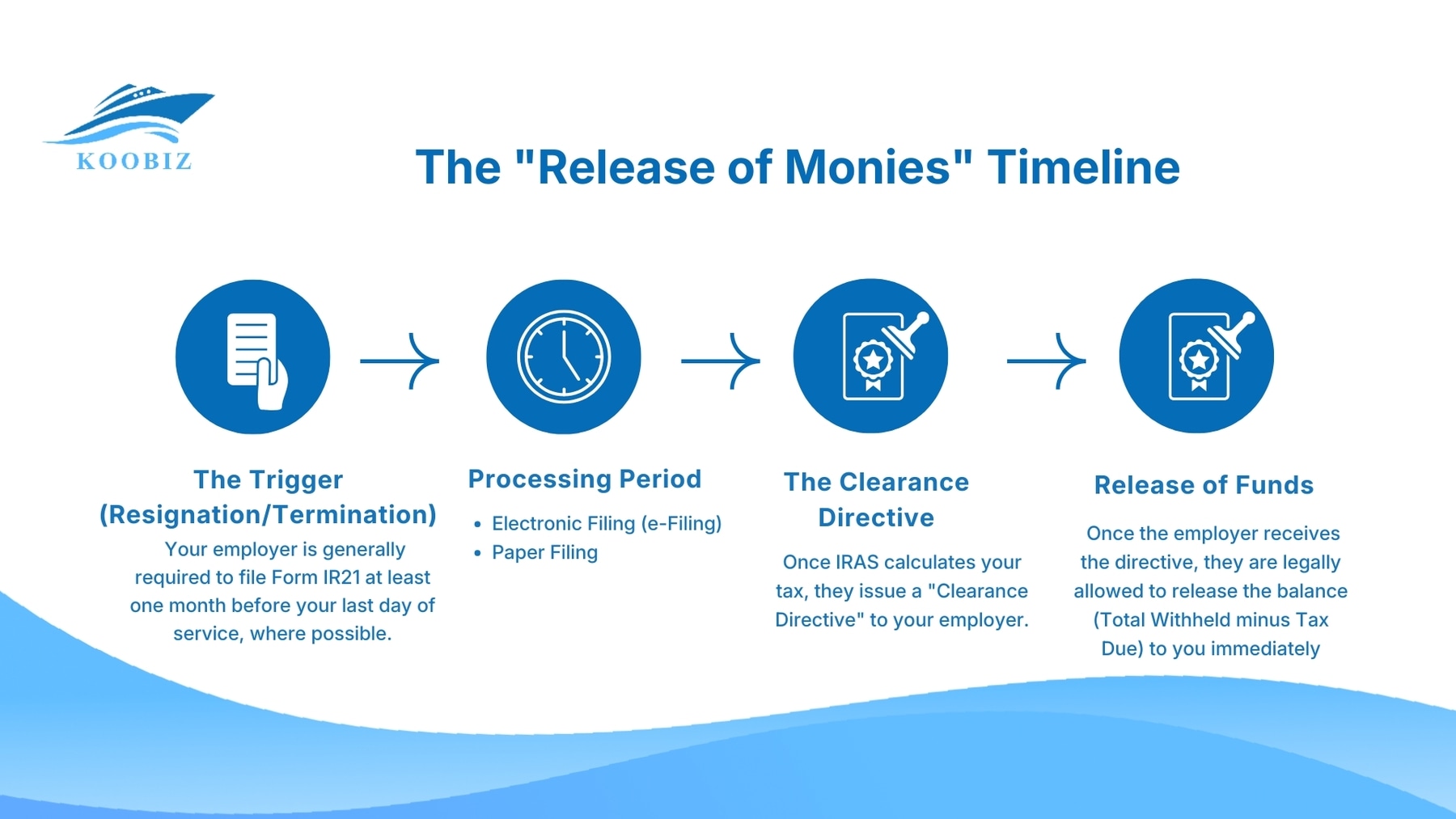
    The release of withheld salary follows a clear timeline involving three key stages: resignation, IRAS processing, and the issuance of the Clearance Directive. Understanding this flow is essential for managing your cash flow, especially if you need funds for relocation costs or flight tickets.

    Here is the typical chronological breakdown:

    1. The Trigger (Resignation/Termination): Your employer is generally required to file Form IR21 at least one month before your last day of service, where possible. From the moment resignation or termination notice is given, your employer will typically begin withholding your payments.
    2. Processing Period:
      • Electronic Filing (e-Filing): If your employer files online via the myTax Portal, IRAS typically processes the clearance within about 7 working days.
      • Paper Filing: If your employer uses physical forms, the processing time can extend to 21 days or longer.
      • Note for 2026: IRAS is actively shifting towards a fully digital tax clearance process. Paper filing is becoming obsolete and may result in significantly longer delays.
    3. The Clearance Directive: Once IRAS calculates your tax, they issue a “Clearance Directive” to your employer. This document clearly states how much must be paid to IRAS and how much of the withheld salary can be released to you.
    4. Release of Funds: Once the employer receives the directive, they are legally allowed to release the balance (Total Withheld minus Tax Due) to you immediately.

    In an ideal e-filing scenario, you can typically expect to receive your remaining salary about one week after your employer submits the form. If you are leaving in a rush, asking your employer to e-file is the single most effective way to speed up your payment.

    How to Check Your IR21 Status via myTax Portal

    You don’t need to wait for HR to email you. You can track the progress of your tax clearance directly through the IRAS system. This is the fastest way to know when your money is ready to be released.

    Prerequisite: You must have a valid SingPass.

    Note: If you cancel your Employment Pass (EP), your SingPass remains active only while you hold a valid immigration pass (such as the Short-Term Visit Pass issued upon cancellation). This is typically valid for 30 days (standard) to 90 days (maximum, if approved). It is advisable to log in as soon as possible to verify your contact details before your access expires.

    Check through the myTax Portal
    Check through the myTax Portal

    The 3-Step Check:

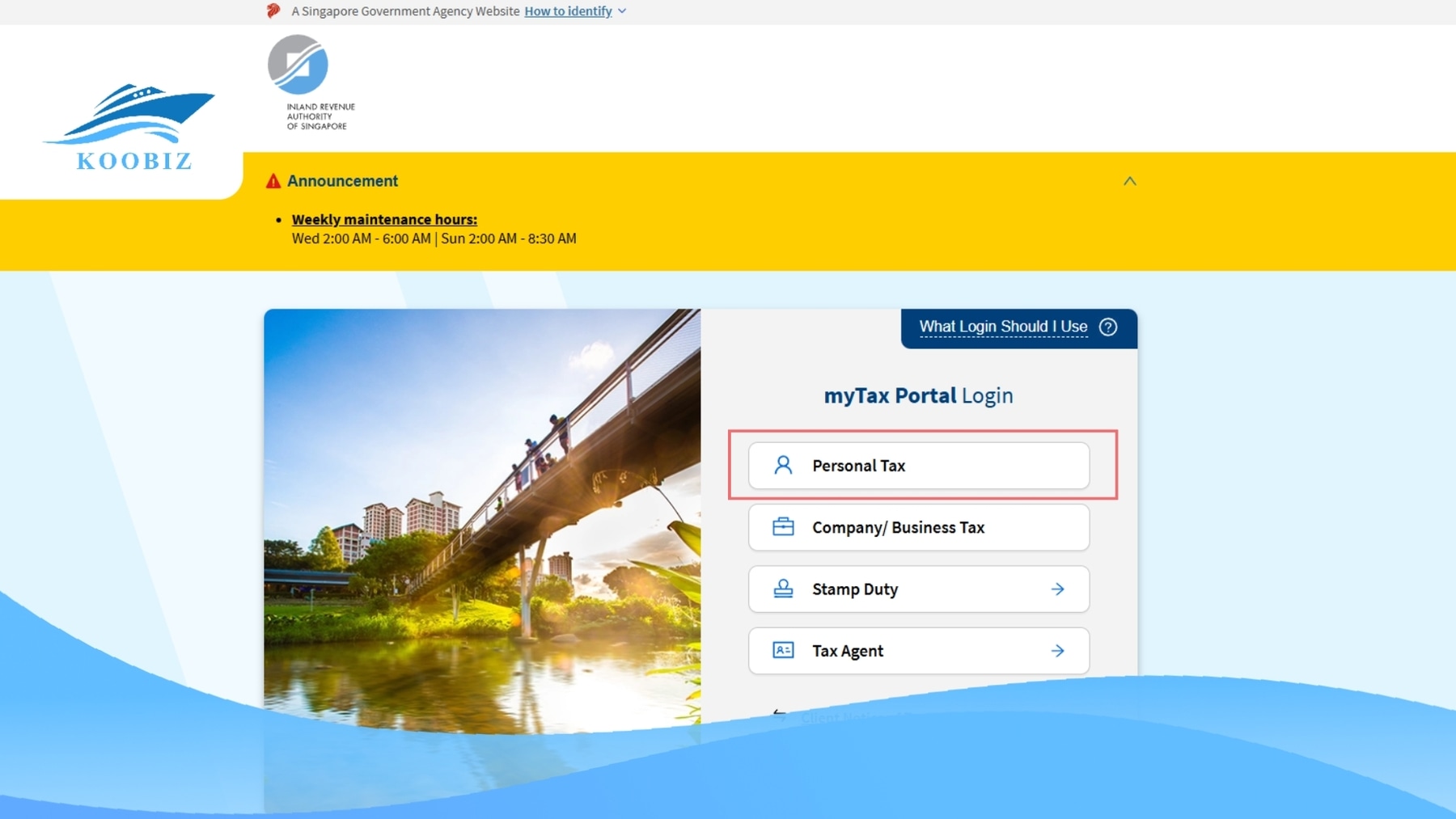
    1. Log In to myTax Portal
      • Go to mytax.iras.gov.sg and select “Personal Tax”.
      • Log in using your SingPass app or password.
    2. Navigate to “Notices/Letters”
      • On the top menu or dashboard sidebar, look for the section labelled “Notices”, “Letters”, or “Correspondence”.
      • This section archives all official documents sent by IRAS to you.
    3. Check for the “Clearance Directive”
      • Look for a recent document titled “Clearance Directive” or “Notification of Computation”.
      • If you see it: Your tax clearance is complete. Click to open the PDF. It will show your final tax liability.
      • If you DON’T see it: The application is likely still “Processing”.

    Pro Tip: Once the Clearance Directive appears in your myTax Portal, the same directive will also have been issued to your employer. Sharing a screenshot with your HR or payroll team can help prompt the timely release of your remaining salary.

    Understanding Your Final Tax Bill: Payment vs. Refund

    The Clearance Directive will result in one of two outcomes. Check your Directive to see which applies to you:

    Outcome What it Means Action Required
    Scenario A: SHORTFALL

    (Tax Due > Withheld)

    You owe more tax than your employer held back. PAY IMMEDIATELY.

    Use the Payment Slip to pay via Internet Banking/AXS. Failure to pay risks a travel ban.

    Scenario B: REFUND

    (Tax Due < Withheld)

    You overpaid (via withholding). The employer owes you the balance. WAIT FOR EMPLOYER.

    Your employer will release the remaining funds to your bank account. No action needed with IRAS.

    Complex Scenarios and Post-Departure Tips

    Singapore complex tax scenarios
    Singapore complex tax scenarios

    While the standard procedure applies to most, many foreign employees face unique circumstances. While the standard process applies to most cases, foreign employees often encounter specific edge cases. Being aware of these scenarios can help prevent unnecessary tax exposure, delays, and administrative complications.

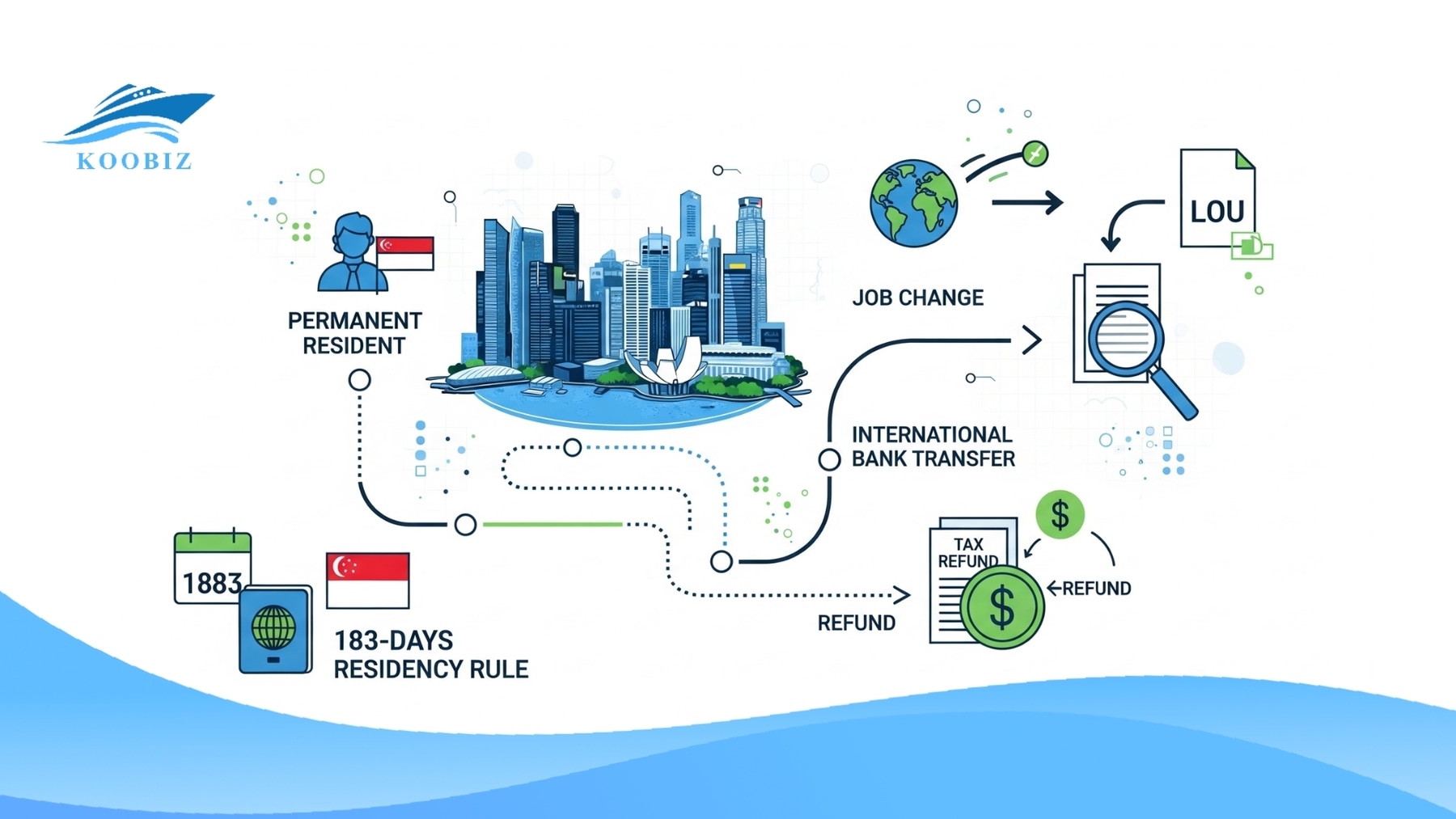
    Situation 1: The “183-Day” Residency Trap

    • The Issue: If you leave early in the year (e.g., April), you might not meet the 183-day requirement to be a tax resident.
    • The Impact: You could be taxed at the higher Non-Resident rate (flat 15% or higher) instead of the lower Resident rates (0-22%).
    • The Fix: Review whether the administrative concession applies, particularly if your employment spans two calendar years. If not, be prepared for a higher tax assessment under the non-resident tax regime.

    Situation 2: Permanent Residents (SPR) Changing Jobs Without Leaving Singapore (LOU)

    • The Issue: You are a Permanent Resident (SPR) changing jobs, but your employer wants to withhold your salary anyway.
    • The Fix: Sign a Letter of Undertaking (LOU). This indemnifies the employer against liability and allows them to release your full salary without filing Form IR21.

    Situation 3: Refunds after Bank Closure

    • The Issue: IRAS owes you a refund, but you have already closed your Singapore bank account.
    • The Fix: Update your contact and banking details in the myTax Portal as soon as possible to request a Telegraphic Transfer (TT) to your overseas account. Please note that international bank charges may apply.

    Conclusion

    Leaving Singapore marks the close of an important chapter, and tax clearance is often the final administrative step before you move on. While salary withholding can be frustrating, it is a standard legal requirement rather than a punitive measure. By understanding the clearance timeline, actively tracking your status through the myTax Portal, and being aware of how residency rules affect your final tax bill, you can manage the process with greater certainty and avoid unnecessary delays.

    At Koobiz, we specialize in simplifying business and financial compliance in Singapore. While this guide focuses on the employee’s perspective, we also assist companies in managing their employer obligations, from accurate Form IR21 filing to corporate tax planning and accounting. If you are a business owner or HR manager needing assistance with tax clearance procedures or general corporate compliance, visit Koobiz.com to see how our expert team can support your operations.

  • The global shift from tax havens to innovation hubs

    The global shift from tax havens to innovation hubs

    [SUMMARIES]

    The OECD’s 15% global minimum tax in 2026 officially ends the era of 0% tax havens.

    Multinationals are pivoting to “innovation hubs” that reward real economic substance.

    Singapore’s 2026 Budget offers a 40% CIT rebate and new 400% AI tax deductions.

    Koobiz provides expert company formation, accounting, and tax compliance to navigate this shift seamlessly.

    [/SUMMARIES]

    The era of routing profits through zero-tax jurisdictions is coming to an end. In 2026, the global tax landscape is shifting from traditional tax havens toward innovation-driven business hubs. As international tax rules introduce a global minimum rate, traditional offshore structures are becoming less effective. As a result, many multinational companies are moving operations to jurisdictions like Singapore, which offer tax incentives for real economic activities such as AI development and regional expansion.

    To navigate this transition, businesses often rely on professional service providers such as Koobiz for company formation, accounting, and corporate banking support. This article explores the global tax changes taking effect in 2026, their impact on corporate strategy, and how Singapore’s latest Budget incentives support businesses expanding in the region.

    The Breaking News: The 2026 Global Tax Reality

    15% Global Tax and Financial Transformation
    15% Global Tax and Financial Transformation

    The global tax framework in 2026 is shaped by the OECD’s 15% global minimum tax under Pillar Two. The rules introduce top-up taxes to ensure multinational enterprises pay at least the minimum rate in each jurisdiction where they operate.

    To understand this shift, it is important to review the key agreements and mechanisms that led to the implementation of this long-planned global tax reform.

    Pre-2026: The Era of the Tax Haven

    For decades, many jurisdictions competed by lowering corporate tax rates to attract multinational companies. Jurisdictions aggressively competed to attract corporate headquarters by slashing their statutory corporate income tax rates to zero or near-zero.

    Companies would establish entities with no real employees or physical operations, purely to hold intellectual property and accumulate profits in a tax-free environment.

    However, coordinated international tax reforms are gradually limiting the effectiveness of these structures. The implementation of complex tax mechanisms ensures that multinational enterprises (MNEs) pay a fair share of tax wherever they operate, fundamentally neutralizing the primary appeal of traditional tax havens. This reform represents one of the most significant changes to international tax rules in recent decades.

    January 5, 2026: The OECD “Side-by-Side” Breakthrough

    On January 5, 2026, the OECD finalized its highly anticipated “Side-by-Side” (SbS) package for the Pillar Two framework. Supported by more than 140 jurisdictions, the agreement confirms the implementation of the 15% global minimum tax.

    The SbS package was a crucial breakthrough, as it provided administrative guidance and a safe harbor that effectively aligned the United States’ complex tax system with the global framework. Before this agreement, there was significant uncertainty regarding how US-headquartered multinationals would be treated under the global rules, specifically concerning the Income Inclusion Rule (IIR) and the Undertaxed Profits Rule (UTPR).

    With this agreement reached in early 2026, countries gained clearer guidance on implementing the global minimum tax framework across major economies.

    Today: The Immediate Fallout

    As multinational enterprises now face top-up taxes regardless of where profits are booked, traditional zero-tax havens are losing their main advantage.

    If profits are recorded in a jurisdiction with a 0% tax rate, the new rules allow the parent company’s jurisdiction—or the jurisdictions where subsidiaries operate—to apply mechanisms such as the Qualified Domestic Minimum Top-Up Tax (QDMTT) or the Income Inclusion Rule (IIR) to ensure taxation up to the 15% minimum rate.

    As a result, the administrative burden of maintaining shell companies in traditional tax havens often outweighs the remaining tax advantages. Compliance costs, reputational considerations, and the likelihood of paying the 15% minimum tax somewhere within the corporate structure are reducing the effectiveness of traditional offshore tax strategies.

    OECD estimates referenced in recent analyses suggest that Pillar Two could generate around US$220 billion in additional annual global tax revenue, significantly reducing profit shifting by multinational enterprises.

    The Macro Impact: How Corporate Strategy is Changing

    Strategic Shift: From Tax Havens to Innovation Hubs
    Strategic Shift: From Tax Havens to Innovation Hubs

    Corporate strategy is shifting from seeking zero-tax jurisdictions to prioritizing locations that offer tax incentives for real economic activities, particularly in research and development (R&D), green energy, and Artificial Intelligence (AI).

    This shift is changing how corporate planners, legal teams, and Chief Financial Officers approach cross-border structuring and supply-chain planning.

    Strategic Shift 1: From Paper Shells to Economic Substance

    Chief Financial Officers and corporate planners are adjusting their strategies in response to the new global tax framework. The new question isn’t “Where can we pay zero tax?” but rather “Where can we get the best deductions for doing actual business?” Before 2026, corporate formation was heavily dictated by the legal and tax departments acting in isolation from the operational side of the business, often resulting in complex networks of dormant holding companies.

    Today, tax strategy is increasingly aligned with operational activities. Many jurisdictions now enforce stricter economic substance requirements, requiring companies to demonstrate:

    • A physical office space
    • Adequate local expenditures
    • Full-time employees actively managing the business

    As a result, many corporations are consolidating their global structures and relocating capital and intellectual property to financial centers where they plan to hire talent, conduct research, and manage regional operations.

    Strategic Shift 2: From Zero-Tax Rates to Targeted Tech Incentives

    Global competition for foreign investment is evolving. Instead of lowering headline corporate tax rates, many countries are competing by offering targeted tax incentives for activities such as R&D, green energy, and Artificial Intelligence (AI).

    Before 2026, some jurisdictions used very low or zero headline tax rates to attract companies primarily holding profits or intellectual property. Today, the 15% global minimum tax acts as a baseline, shifting competition for foreign direct investment toward targeted deductions, incentives, and grants.

    Innovation-focused jurisdictions are creating frameworks where companies can still reduce their effective tax rate legally by investing in activities that support the local economy. This includes:

    • Accelerated depreciation on high-tech equipment
    • Super-deductions for employee training in advanced digital skills
    • Cash rebates or grants for patent development

    By encouraging innovation-driven investment rather than passive profit holding, these jurisdictions aim to build more resilient economies while remaining attractive to multinational corporations.

    Recent CEO surveys indicate that more than 70% of multinational companies are adjusting supply chains and operations toward jurisdictions offering incentives linked to real economic substance.

    Pillar Two Singapore 2026: The February Budget Spotlight

    Singapore: 2026 Budget, Pillar Two & AI incentives
    Singapore: 2026 Budget, Pillar Two & AI incentives

    Singapore’s February 2026 Budget outlines how the country will implement the 15% global minimum tax while introducing a 40% corporate tax rebate and additional incentives supporting AI development and international expansion.

    This fiscal policy provides a practical example of how modern innovation hubs design tax incentives to attract global businesses.

    The Event

    To see this shift in real-time, look at the Singapore FY2026 Budget delivered on February 12 by Prime Minister and Finance Minister Lawrence Wong. The budget was closely watched by the international business community, as it outlined Singapore’s response to the OECD Pillar Two framework.

    While confirming the implementation of the Domestic Top-up Tax (DTT) and the Income Inclusion Rule (IIR) to ensure multinational enterprises meet the 15% effective tax rate, the government also introduced a series of targeted financial incentives. This approach signals to global investors that Singapore intends to comply with international tax rules while maintaining a competitive and business-friendly environment.

    The Strategy

    Rather than attempting to compete below the global 15% minimum tax rate, Singapore introduced several measures aimed at providing short-term operational relief for businesses:

    • A 40% Corporate Income Tax (CIT) Rebate (capped at SG$30,000) for the Year of Assessment 2026 to help businesses manage rising costs.
    • A minimum cash grant of SG$1,500 for active companies that employed at least one local worker in the previous year (CY 2025).

    These measures aim to help companies manage the effects of global inflation, rising wage pressures, and supply chain disruptions. By focusing on operational relief rather than undermining the minimum tax rate, Singapore ensures that businesses operating within its borders maintain a healthy cash flow.

    The “Innovation Hub” Push

    In addition, Singapore is expanding incentives that support innovation and business development. They expanded several key programs to reward innovation:

    • Enterprise Innovation Scheme (EIS): Allowing companies to claim a 400% tax deduction on qualifying AI-related expenditures, capped at SG$50,000 per Year of Assessment (YA) for YA 2027 and YA 2028, in addition to the existing 400% deductions available for broader R&D activities.
    • Double Tax Deduction for Internationalisation (DTDi): Raising the automatic claim cap for this 200% tax deduction to SG$400,000, encouraging companies based in Singapore to expand internationally by covering costs for overseas market research, business missions, and trade fairs.

    Business surveys in early 2026 indicate that many multinational companies are increasing their operational presence in jurisdictions such as Singapore that combine the 15% global minimum tax with R&D and AI incentives.

    Ready to position your company in Singapore’s 2026 innovation hub environment? Koobiz can handle formation, banking, and EIS-compliant accounting end-to-end.

    Singapore Company Formation Post-Pillar Two: Adapting with Koobiz

    Adapting corporate strategy may involve reviewing existing offshore structures, aligning tax benefits with real operations, and leveraging Koobiz’s company formation and accounting services to maximize compliance and incentives.

    Implementing this transition requires specialized expertise, accurate financial tracking, and familiarity with local regulatory frameworks.

    The Compliance Challenge & Solution

    Transitioning to an innovation hub means tax benefits are now tied to strict financial reporting. Companies must maintain detailed financial records distinguishing operational expenses from qualifying innovation expenditures in order to claim incentives such as the 400% AI deduction or the 40% CIT rebate. Incorrect expense classification or insufficient documentation may result in the loss of tax incentives or regulatory review.

    This is where Koobiz steps in. By leveraging our expert accounting and bookkeeping services, your business ensures every qualifying expense is meticulously tracked. The professional team at Koobiz understands the exact nuances of the Enterprise Innovation Scheme, the DTDi, and standard corporate tax rebates. Koobiz helps businesses implement bookkeeping systems that accurately categorize AI investments, R&D expenses, and international expansion costs while maintaining compliance with Singapore tax regulations.

    The Next Step: Seamless Company Formation

    Businesses currently relying on traditional offshore structures may consider restructuring to align with the new global tax framework. Koobiz provides company formation services that support businesses establishing operations in innovation-focused jurisdictions such as Singapore, setting up your entities with the right foundation to thrive in the 2026 global economy.

    Establishing or restructuring a corporate entity across jurisdictions can be complex, but service providers like Koobiz assist businesses throughout the process. We handle the end-to-end setup, including:

    • Registering your new company with the Accounting and Corporate Regulatory Authority (ACRA)
    • Securing the necessary corporate secretary services
    • Providing registered office addresses
    • Assisting with the process of opening corporate bank accounts with international financial institutions

    By partnering with Koobiz, you are not just setting up a company; you are architecting a resilient, compliant, and highly optimized global business structure ready to capitalize on the future of international trade.

  • Singapore Dividends: Your Guide to Tax-Free Income

    Singapore Dividends: Your Guide to Tax-Free Income

    [SUMMARIES]

    Zero Tax Liability: Under Singapore’s system, dividends paid by local companies are generally tax-free for you as a shareholder.

    High Yield Sectors: Singapore Real Estate Investment Trusts (S-REITs) and major local banks are popular for generating passive income, often offering attractive returns..

    Strategic Growth: You can choose to reinvest your dividends to buy more shares at a discount, helping your wealth grow faster over time.

    Exceptions Exist: While most dividends are tax-free, there are rare cases (like certain foreign income) that might be taxed, where professional advice is useful.

    Retirement Planning: Combining dividend investing with Singapore’s Supplementary Retirement Scheme (SRS) can provide excellent tax benefits.

    [/SUMMARIES]

    Singapore stands out as a top destination for investors, thanks to a major benefit: tax-free dividends. While many countries tax investment income, Singapore allows you to build and keep more of your wealth. Understanding how dividends work here is key to making the most of your investments.

    At Koobiz, we assist businesses and investors in making the most of Singapore’s financial opportunities, from starting a company to tax planning. This guide will walk you through the basics of Singapore’s tax system, highlight top sectors like REITs for income, and explain strategies like reinvesting dividends, all to help you turn company profits into your own tax-free income.

    Are Dividends Taxable in Singapore?

    Tax-free dividends in Singapore under the one-tier tax system
    Tax-free dividends in Singapore under the one-tier tax system

    No, dividends paid by Singapore resident companies are generally not taxable in the hands of shareholders, regardless of their tax residency status.

    Here’s a simple look at why Singapore is so favourable for dividend investors:

    • No Capital Gains Tax: Singapore does not tax the profit you make from selling investments (capital gains).
    • No Withholding Tax: Unlike some countries, Singapore does not take a cut from dividends paid to non-residents. You receive the full amount.
    • No Personal Declaration Required: For standard dividends, you do not need to report this income on your personal tax return.

    This approach is part of Singapore’s strategy to encourage investment and keep things simple. The exemption applies specifically to “standard” dividends under the one-tier corporate tax system, where the company pays tax on its profits first, so the same money isn’t taxed twice when it reaches you. For clients at Koobiz, this simplicity is often a key reason for choosing Singapore for their investment holdings.

    Evidence: The Inland Revenue Authority of Singapore (IRAS) states that dividends from a Singapore resident company under the one-tier system are tax-exempt for shareholders.

    Understanding the One-Tier Corporate Tax System

    The One-Tier Corporate Tax System is a tax regime where the tax paid on a company’s chargeable income is final, and subsequent dividends paid to shareholders are exempt from further taxation.

    This system started in 2003, making things much simpler for businesses and investors. Let’s see how it works with an example.

    Scenario: The “Tax-Free” Flow of Company X

    Imagine you own shares in “Company X,” a Singapore resident company. Here is the math behind your payout:

    Stage Amount (SGD) Explanation
    Company Profit $100,000 The company’s taxable income before tax.
    Corporate Tax (17%) ($17,000) Paid by Company X to IRAS. This is the only tax tier.
    Net Distributable Profit $83,000 The remaining profit available for shareholders.
    Dividend Paid to You $83,000 You receive the full share of the profit.
    Personal Tax Payable $0 You pay zero tax on this income.

    The Bottom Line: What the company distributes is yours to keep.

    What you receive is yours to keep in full. This avoids “double taxation” (where income is taxed first at the company level, then again when you receive it). For entrepreneurs utilizing Koobiz‘s accounting services, this means less administrative burden. You do not need to issue tax vouchers to shareholders for dividend payments, nor do shareholders need to declare these dividends in their annual income tax returns. It creates a seamless flow of capital from corporate earnings to personal wealth.

    What is a Dividend Yield and How to Calculate It?

    Dividend Yield is a financial ratio that shows how much a company pays out in dividends each year relative to its stock price, expressed as a percentage.

    To understand your potential return, look at the yield. Here’s the simple formula:

    Dividend Yield = (Annual Dividends per Share / Price per Share) × 100

    For example, if a company’s share price is S$20.00 and it pays an annual dividend of S$1.00, the yield is 5%.

    Is a High Yield Always Good?

    • Safe Zone (4% – 6%): Typical for stable Singapore REITs and Banks.
    • Caution Zone (>8%): Often a “Dividend Trap.” A yield this high usually means the share price has crashed due to underlying business problems.

    Yield helps you compare income potential, but it’s just the first step in your research.

    Dividend Payout Ratio vs. Dividend Yield

    While Dividend Yield measures the return on the stock price, the Dividend Payout Ratio measures the percentage of net income a company distributes to shareholders.

    Comparing both helps you find a sustainable investment.

    Feature Dividend Yield Payout Ratio
    Focus Return on Investment (ROI) Sustainability of the Dividend
    The Question “How much will I earn?” “Can the company afford to pay this?”
    Ideal Range 4% – 6% (Banks/REITs) 50% – 70% (Standard Companies)
    Red Flag >8% (Risk of cut) >100% (Paying out more than earning)

    A “safe” dividend stock usually has a sustainable payout ratio (REITs are designed to have higher ratios). It ensures the company isn’t sacrificing its future just to pay dividends now. At Koobiz, we advise business owners to set a balanced dividend policy that rewards shareholders while keeping enough profit for growth.

    Top Sectors for High Dividend Yields in Singapore

    Comparative analysis of Singapore REITs and Banks regarding dividends
    Comparative analysis of Singapore REITs and Banks regarding dividends

    There are two primary market sectors that consistently drive high dividend yields in Singapore: Real Estate Investment Trusts (S-REITs) and the Banking/Finance sector.

    Singapore’s market is known for stable, established companies that generate steady cash, which is ideal for dividend seekers. The main market index (STI) is known for offering some of Asia’s highest dividend yields.

    Here’s a quick comparison:

    Feature S-REITs Local Banks (DBS/UOB/OCBC)
    Primary Goal High Passive Income Capital Preservation + Growth
    Typical Yield 5.0% – 8.0% 3.5% – 5.0%
    Key Risk Interest Rate Hikes Economic Recessions
    Tax Perk Tax Transparency (0% Corp Tax) One-Tier Exempt Dividends

    These sectors offer a mix of reliability and regular payouts, making them great for building a passive income stream.

    Singapore REITs (Real Estate Investment Trusts)

    S-REITs are investment vehicles that own, operate, or finance income-generating real estate and are required to distribute at least 90% of their taxable income to shareholders.

    S-REITs are companies that own and manage income-generating properties (like malls, offices, warehouses). They must distribute at least 90% of their taxable income to shareholders.

    This 90% rule is why S-REITs offer high yields. They enjoy “tax transparency,” meaning they don’t pay corporate tax if they follow the rules, passing rental income directly to you.

    Consider diversifying across different REIT types:

    Retail REITs (The “Mall” Plays): Focus on suburban malls that are resilient to economic downturns.

    Example: Frasers Centrepoint Trust (FCT) – Dominates the suburban mall scene in Singapore.

    Industrial/Logistics REITs (The “Supply Chain” Plays): Focus on warehouses and data centers.

    Example: Mapletree Logistics Trust (MLT) – Benefits from the rise of e-commerce and regional trade.

    Commercial/Integrated REITs (The “Office” Plays): Focus on prime office space and downtown mixed-use developments.

    Example: CapitaLand Integrated Commercial Trust (CICT) – The largest proxy for Singapore’s commercial real estate market.

    Local Banks and Blue-Chip Stocks

    Singapore’s three local banks—DBS, UOB, and OCBC—are pillars of the economy, known for their strong capital buffers and consistent dividend payouts.

    These “blue-chip” stocks form a solid foundation for a dividend portfolio. Their yields may be slightly lower than REITs, but they offer greater stability and potential for gradual dividend increases.

    For investors seeking reliability, here is the “Big Three” breakdown:

    • DBS Group Holdings (DBS): The largest bank in Southeast Asia. Known for digital innovation and a strong track record of dividend growth.
    • United Overseas Bank (UOB): Strong footprint in the ASEAN region, offering exposure to regional growth with conservative management.
    • Oversea-Chinese Banking Corp (OCBC): Renowned for its strong wealth management arm and conservative risk profile.

    Beyond banks, you might consider other stable blue-chips like Singtel (Telecommunications) or Keppel Ltd (Conglomerate/Infrastructure), which have long histories of paying dividends to shareholders.

    How Do You Receive Dividends in Singapore?

    There are three main methods for receiving dividends in Singapore: Direct Crediting Service (DCS), Dividends via Cheque, and through a Custodian Account.

    To ensure you get paid on time and without fees, choosing the right method is critical. Here is a comparison to help you decide:

    Method Speed Convenience Cost
    Direct Crediting (DCS) Instant (On Payment Date) High (Auto-deposit to Bank) Free
    Custodian Account +1-3 Days (Processing) Medium (Dependent on broker) Low (Possible handling fees)
    Cheque +3-5 Days (Mail time) Low (Bank visit required) Free (Phasing out)

    The Recommendation: Stick to DCS

    To streamline the process, the Central Depository (CDP) strongly encourages the use of the Direct Crediting Service (DCS). By linking your bank account to your CDP account, dividends are automatically credited to you the moment they are paid. This eliminates the risk of lost mail and the hassle of depositing physical cheques.

    Note: If you hold shares through a foreign broker (like Interactive Brokers, Tiger, or Moomoo), your assets are held in a Custodian Account. Dividends will be paid to the broker first, then credited to your trading wallet.

    What Is the Scrip Dividend Scheme?

    The Scrip Dividend Scheme is a corporate action that gives shareholders the option to receive their dividends in the form of new shares instead of cash.

    This option is often offered by major Singapore companies, especially banks. It’s a way for them to retain cash while rewarding you. Essentially, you get to buy more shares, often at a discount to the market price.

    The Math of the Deal: Why Choose Scrip?

    The primary allure is the Discount. Companies often issue these new shares at a price 2% to 10% lower than the market value to encourage you to keep your money in the company.

    Example Scenario:

    • Market Price of Share: $10.00
    • Scrip Issue Price: $9.00 (10% Discount)
    • Dividend Due to You: $900

    If you elect for Cash, you receive $900.

    If you elect for Scrip, you receive $900 / $9.00 = 100 Shares.

    • Value of 100 Shares: 100 * $10.00 (Market Price) = $1,000.
    • Instant Gain: You just made an extra $100 (an immediate ~11% return on your dividend) simply by clicking “Yes.”
    Shares grow faster than cash due to the discount
    Shares grow faster than cash due to the discount

    Key Benefits for Investors:

    1. Zero Brokerage Fees: You pay no commissions or stamp duties on these new shares.
    2. Instant Equity Boost: You acquire more shares at a discount, accelerating the compounding effect of your portfolio.

    For Koobiz clients looking to build long-term positions, understanding how to elect for Scrip is a valuable micro-optimization tactic that compounds significantly over time.

    Scrip vs. Cash Dividends: Which Should You Choose?

    To make the right decision, you must answer one simple question: “What is my primary financial goal right now?”

    Here is the verdict based on your investment lifecycle:

    Scenario A: “I want to grow my wealth as fast as possible.” (Accumulation Phase)

    • The Verdict: Choose Scrip.
    • Why: Reinvesting at a discount buys you more shares for free, supercharging the compounding effect over many years. Ideal for younger investors or those with a long-term view.

    Scenario B: “I need this income to pay my bills.” (Retirement Phase)

    • The Verdict: Choose Cash.
    • Why: You need cash for daily life. Liquidity is essential for paying bills. Ideal for retirees or those depending on this income.

    Warning: The “Odd Lot” Problem

    Choosing a scrip can sometimes leave you with “odd lots” (like 1,023 shares instead of a round 1,000). These can be slightly less straightforward to sell later, though they are still fully valuable.

    Exceptions: When Are Dividends Taxable?

    The Golden Rule: Dividends in Singapore are generally tax-free. However, there are specific “Danger Zones” where tax liability kicks in.

    It is critical to define the “Contextual Border” here to ensure compliance. If you fall into any of the following categories, you may need to pay tax.

    The Taxable Checklist (Red Flags)

    • Income through a Partnership:If you receive dividends as part of a partnership’s business income, it may be taxable.
    • REIT Distributions to Non-Residents:While residents enjoy tax-free REIT distributions, non-resident individuals are often subject to a final withholding tax of 10% on distributions made out of taxable income.
    • Foreign-Sourced Dividends (for Companies/Partnerships):Foreign dividends received by a Singapore company might be taxed unless they meet specific conditions.
    • Cooperative Dividends:Payouts from co-ops (e.g., NTUC) may have different tax rules.

    Koobiz Action: If you are unsure whether your dividend income is truly tax-exempt, especially if you have cross-border assets, contact Koobiz for a quick tax health check to avoid penalties.

    Investing for Retirement: Dividends and SRS

    The Supplementary Retirement Scheme (SRS) offers a powerful “double-dip” benefit when combined with high-dividend stocks.

    Many investors mistake SRS for a simple savings account. However, cash in an SRS account earns a negligible 0.05% interest. To unlock its true power, you must invest those funds. Here is the math on why this strategy works so well for high-income earners.

    The Dividend-SRS Strategy: A Numerical Proof

    Let’s look at a concrete example of how you can earn an immediate “Guaranteed Return” simply by contributing and investing.

    Scenario: John is a Singapore PR earning $120,000/year. He contributes the maximum cap of $15,300 to his SRS account and invests it in a stable REIT yielding 5%.

    Component Calculation Financial Gain
    1. Immediate Tax Savings John’s tax bracket is 11.5%. Contributing $15,300 reduces his taxable income. +$1,759.50 (Cash saved from IRAS)
    2. Dividend Income $15,300 invested at 5% yield. +$765.00 (Tax-Free Income)
    Total First-Year Gain Tax Savings + Dividends $2,524.50

    The ROI: By combining tax savings with dividends, John made a 16.5% return on his capital in Year 1 ($2,524 / $15,300).

    Koobiz Insight: There are very few risk-free ways to get a double-digit return in year one. Using SRS to buy dividend stocks is the closest thing to a “free lunch” in the Singapore tax code.

    Exit Strategy:

    When John retires (after the statutory retirement age), only 50% of his withdrawals will be taxed. Since he likely won’t have a salary then, his effective tax rate could be near zero.

    Conclusion

    Building a portfolio focused on Singapore dividend stocks is a proven path toward financial security. Supported by a simple tax system and strong income-generating sectors like REITs and banks, investors can enjoy the returns from their investments without losing a portion to taxes.

    To truly maximize this opportunity, it helps to have the right structure, understand the details, and plan strategically. Whether you need help setting up a company to manage your investments, ensuring tax compliance, or opening a corporate bank account in Singapore, Koobiz is here as your trusted partner. Our team is ready to guide you through Singapore’s business and financial landscape.

    Visit Koobiz.com today to schedule a consultation and take the first step toward securing your financial future in Singapore.