[SUMMARIES]
Eligibility Distinction: The Dependant’s Pass (DP) is strictly for legally married spouses and children, while the Long Term Visit Pass (LTVP) covers parents, common-law spouses, and step-children.
Salary Thresholds: Sponsors need a minimum salary of SGD 6,000 for DPs, whereas LTVP applications for parents require a minimum salary of SGD 12,000.
Work Rights: Neither pass grants automatic work rights; both usually require a separate Work Permit, S Pass, or Employment Pass to work in Singapore.
Issuing Authority: This guide focuses on passes issued by the Ministry of Manpower (MOM) for expats, distinct from those issued by ICA for locals.
[/SUMMARIES]
Navigating Singapore’s family visa options is crucial for expats holding an Employment Pass or S Pass. Understanding the Long Term Visit Pass vs Dependant’s Pass ensures your family can legally reside with you. At Koobiz, we go beyond business incorporation and tax services to support your personal stability. This guide compares eligibility, financial criteria, and work rights for spouses, children, and parents, helping you choose the right path for your family.
What are Dependant’s Pass (DP) and Long Term Visit Pass (LTVP)?
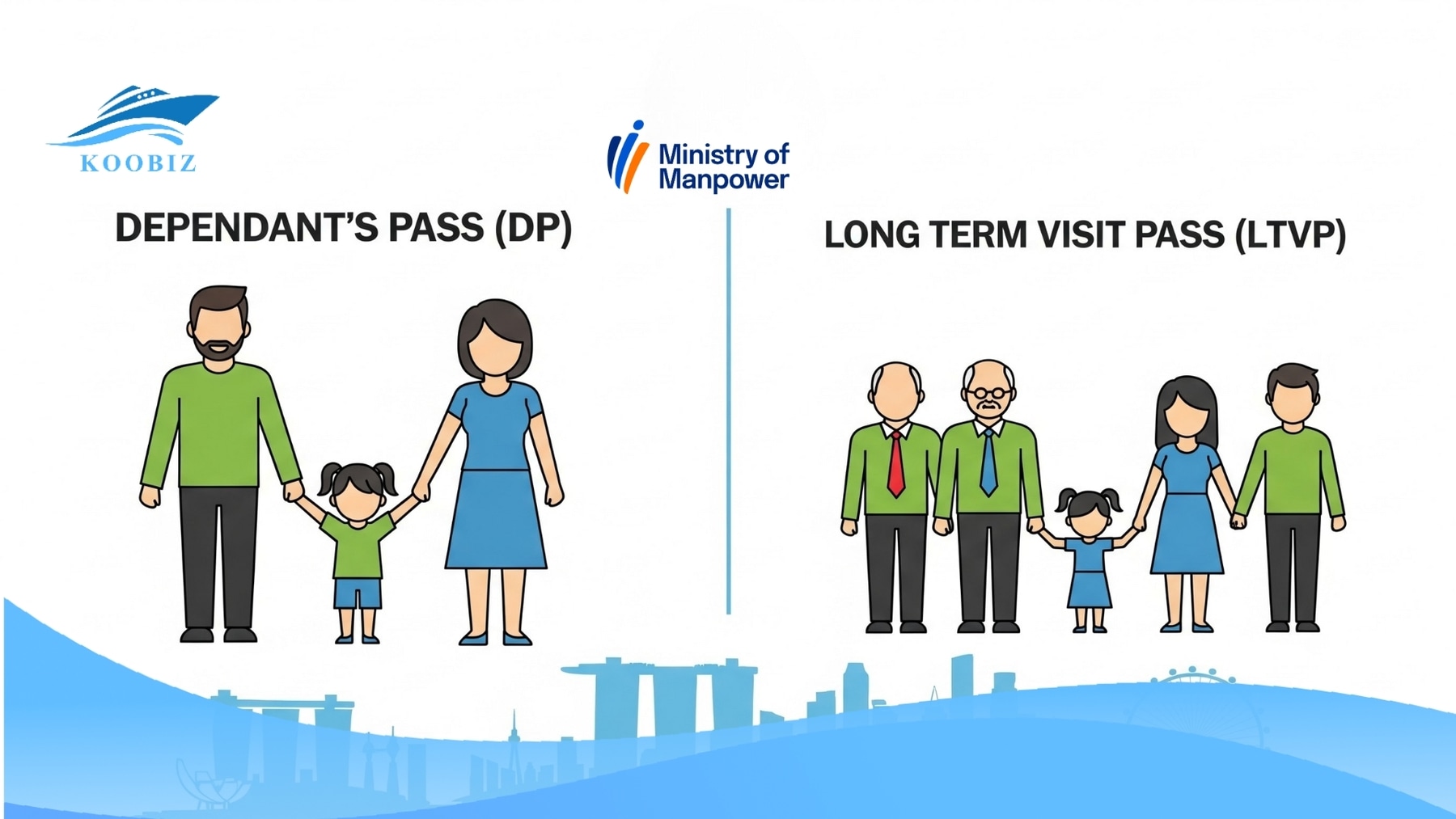
Dependant’s Pass and Long Term Visit Pass are relocation visas issued by the Ministry of Manpower (MOM) allowing specific family members of Employment Pass or S Pass holders to reside in Singapore.
Each has its own specific purposes distinguished by their core definitions and how they fit into the immigration framework. The Dependant’s Pass (DP) is primarily intended for the immediate nuclear family unit, reflecting a direct legal dependency on the main pass holder. In contrast, the Long Term Visit Pass (LTVP) acts as a flexible instrument for extended family members or relationships that do not fall under the strict legal definitions of marriage or biological lineage required as for DP. Yet both passes are tied to the validity of the main applicant’s work pass.
Key Differences Between DP and LTVP: A Comparison Table
The Dependant Pass is designed for nuclear family members with a standard salary threshold, whereas the Long Term Visit Pass caters to extended family and common-law relationships requiring higher financial proof.
The following table breaks down the critical distinctions for a quick overview.
| Feature | Dependant Pass (DP) | Long Term Visit Pass (LTVP) |
|---|---|---|
| Target Relationship | Legally married spouse, Unmarried children under 21. | Common-law spouse, Step-children, Parents, Handicapped children >21. |
| Sponsor Salary (Min) | SGD 6,000 fixed monthly salary. | SGD 6,000 (Spouse/Children) vs SGD 12,000 (Parents). |
| Issuing Authority | Ministry of Manpower (MOM). | Ministry of Manpower (MOM). |
| Security Bond | Not required for EP dependents. | Often required (depending on nationality/profile). |
| Processing Time | Approx. 3 weeks. | Approx. 3 weeks (up to 6 weeks for complex cases). |
Who is Eligible for Which Pass?
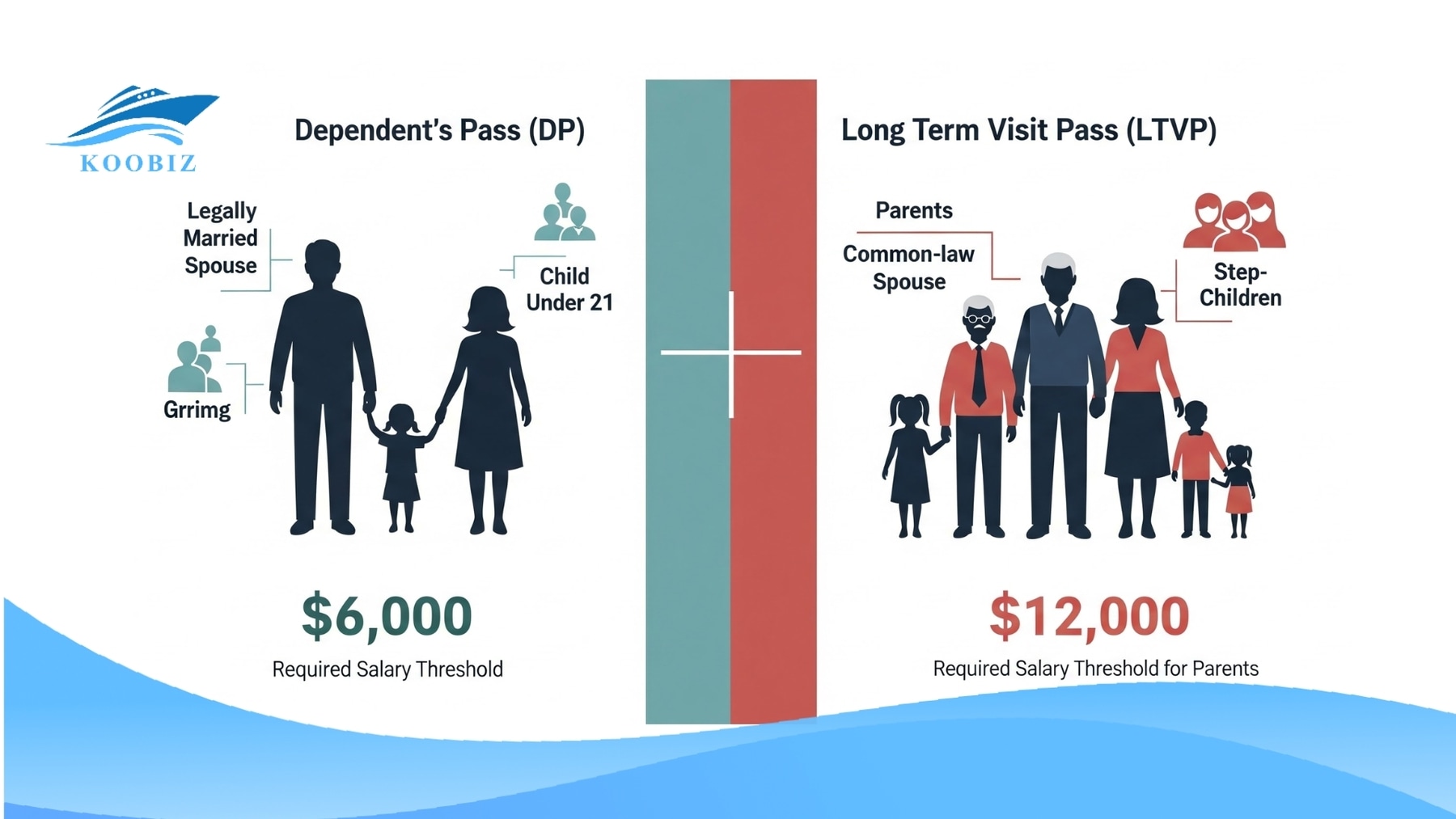
There are two distinct eligibility categories determined strictly by the applicant’s relationship to the main Employment Pass or S Pass holder and the supporting legal documentation available.
Determining which category your family falls into is the first step in the application process, as submitting the wrong application type will result in an immediate rejection.
Eligibility for Dependant Pass (DP)
The Dependant’s Pass is the most common visa for families and is strictly limited to the closest legal relations. If you hold an Employment Pass or S Pass and wish to bring:
- Legally Married Spouse: A valid civil marriage certificate is mandatory. Customary marriages are often not recognized without official registration.
- Unmarried Children Under 21: Biological children or legally adopted children. For adopted children, you must provide official adoption papers recognized by the respective governments.
Eligibility for Long Term Visit Pass (LTVP)
The LTVP covers relationships that fall outside the strict “nuclear family” definition but are still socially significant. An LTVP is used for:
- Common-law Spouse: This is the primary route for partners who are not legally married. You must provide an affidavit or official documentation proving a marital-like relationship.
- Unmarried Step-children: Children under 21 from a spouse’s previous relationship.
- Handicapped Children: Unmarried children above 21 years old who are mentally or physically incapacitated.
- Parents: This is a key differentiator. Only EP holders earning at least SGD 12,000 can bring their parents.
Can Dependant’s Pass and LTVP Holders Work in Singapore?
No, holding a Dependant’s Pass or LTVP does not automatically grant the right to work in Singapore, requiring a separate work pass or specific consent instead.
Recent regulatory changes have significantly tightened the access via Letters of Consent (LOC) to ensure fair competition in the labor market.
Work Rules for Dependant’s Pass Holders
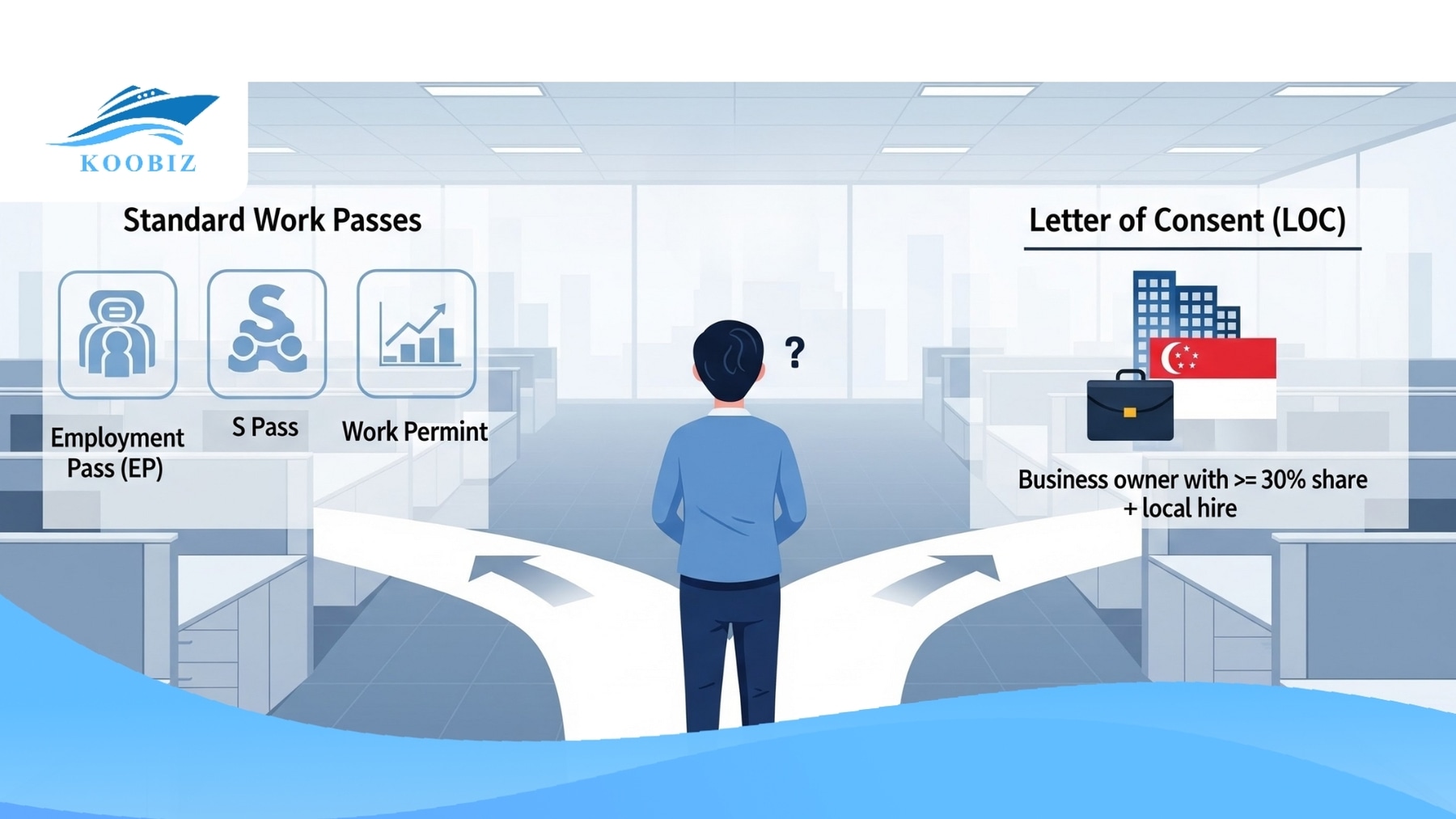
From May 2021, Dependant’s Pass holders who wish to work in Singapore have to secure a standard Employment Pass, S Pass, or Work Permit. The employer must apply for these passes on their behalf, and the applications will be subject to the relevant qualifying salaries and quotas.
However, there is an exception for business owners. DP holders can run a business in Singapore on a Letter of Consent (LOC) if they own at least 30% of the shares in an ACRA-registered company and that business hires at least one Singaporean/PR earning the Local Qualifying Salary. Koobiz can help with ACRA setup for LOC-eligible businesses to ensure you meet these specific regulatory requirements.
Work Rules for LTVP Holders
Similar to DP holders, individuals on an LTVP issued by MOM are generally not permitted to work without a valid work pass. Prospective employers must apply for a Work Permit, S Pass, or Employment Pass on their behalf.
The criteria for LTVP holders to obtain a Work Permit can sometimes differ slightly in terms of source country restrictions compared to the general foreign workforce, but the principle remains: no work is permitted without authorization.
Sponsor Requirements: Salary and Validity
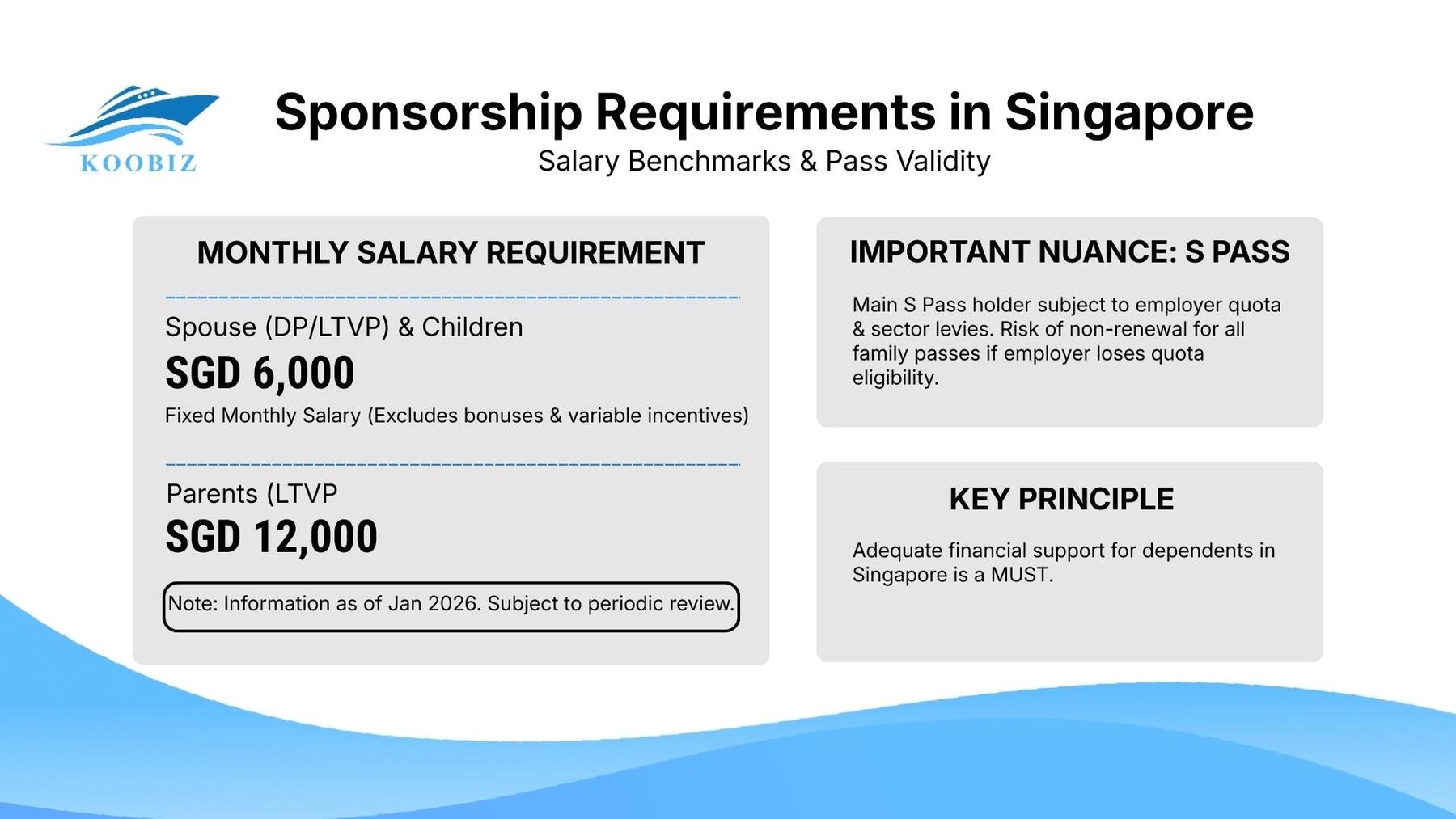
Sponsors must earn a fixed monthly salary of at least SGD 6,000 to bring a spouse or child, while bringing parents requires a higher threshold of SGD 12,000.
Meeting these financial benchmarks is a non-negotiable prerequisite set by the MOM to ensure that the main pass holder can adequately support their dependents in Singapore.
Note: Information is current as of Jan 2026; real-time updates for salary benchmarks are subject to periodic review.
- Base Requirement: To bring a spouse (DP/LTVP) or children, the main applicant must earn a minimum fixed monthly salary of SGD 6,000 (bonuses and variable incentives excluded).
- Parent Requirement: To sponsor parents for an LTVP, the salary requirement doubles to SGD 12,000, reflecting the higher potential healthcare and living costs associated with elderly dependents.
- S Pass Nuances: The main S Pass holder is subject to employer quota and sector levies. If the employer loses their quota eligibility, the main S Pass (and consequently all attached family passes) could be at risk of non-renewal.
Application Process: Fees & Timelines
Understanding the costs and processing times helps you plan your relocation effectively and avoid gaps in your family’s immigration status.
The application process is generally streamlined online by the employer or an appointed employment agent.
- Processing Time: Most DP and LTVP applications are processed within 3 weeks. Complex cases involving LTVP for common-law spouses or step-children may take longer (up to 6 weeks) as MOM verifies the additional documentation.
- Fees:
- Application Fee: $105 (to be paid upon submission).
- Issuance Fee: $225 (to be paid upon approval).
- Multiple Journey Visa: $30 (if applicable).
- Validity: The validity of both the DP and LTVP is tied directly to the main Employment Pass.
Real-Life Scenarios: Determining the Right Pass
To clarify the application rules, let’s look at three common scenarios for EP holders attempting to bring family to Singapore.
These examples illustrate how salary thresholds and relationship definitions interact in practice.
Scenario A: The Nuclear Family
- Profile: Jordan holds an Employment Pass and earns SGD 9,000 per month. Jordan wants to bring a legally married spouse and 5-year-old daughter.
- Verdict: Both qualify for the Dependant’s Pass (DP).
- Why: Jordan meets the SGD 6,000 minimum salary, and the family fits the “legally married spouse and unmarried child” category perfectly.
- What to do next? Have your employer submit the marriage certificate and birth certificate via myMOM portal.
Scenario B: Bringing Parents
- Profile: Sarah holds an S Pass and earns SGD 7,500 per month. She wishes to bring her retired parents to live with her.
- Verdict: Her parents do not qualify for an LTVP.
- Why: While Sarah meets the SGD 6,000 threshold for a spouse or children, she falls short of the SGD 12,000 requirement specifically mandated for sponsoring parents.
- What to do next? Consider applying for a standard short-term visit pass for shorter stays, or wait until your fixed salary increases to meet the threshold.
Scenario C: Common-Law Partner
- Profile: Alex holds an EP and earns SGD 15,000 per month. Alex wants to bring a long-term partner (unmarried) and the partner’s son (Alex’s step-child).
- Verdict: Both qualify for the Long Term Visit Pass (LTVP).
- Why: They do not meet the legal marriage requirement for a DP. However, because Alex earns above SGD 6,000, Alex can sponsor them for an LTVP provided a notarized affidavit for the common-law relationship and court custody papers for the step-child are submitted.
- What to do next? Prepare a statutory declaration of your relationship and ensure the step-child’s custody papers are translated into English.
Application Nuances: Documents and Security Bonds
LTVP applications often require unique documentation like common-law affidavits and a security bond, which are generally not mandated for standard Dependant’s Passes.
Being prepared with these specific documents can significantly reduce processing delays and the risk of rejection.
Common-law Spouse & Step-child Documentation
For a common-law spouse LTVP, MOM usually requires a statutory declaration or affidavit from the couple declaring their relationship, along with proof of shared finances or residency. For step-children, a copy of the court order regarding custody of the child and a letter of no objection from the other biological parent are typically required to prevent international custody disputes.
Understanding the Security Bond for LTVP
The sponsor may need to set up a Security Bond (usually between SGD 4,000 to SGD 7,000) to the Singapore government. This acts as a pledge that the sponsor will ensure the visitor complies with all conditions of the pass and leaves Singapore before the pass expires. Koobiz advises clients to factor this potential cost into their relocation budget.
Which Pass Offers a Better Path to Permanent Residence (PR)?
The Dependant Pass generally implies a closer, more permanent nuclear family unit, potentially offering a slightly stronger profile for Permanent Residence applications compared to the LTVP.
Strategic Considerations for PR Application
When assessing a PR application, the Immigration and Checkpoints Authority (ICA) considers the stability and integration of the family unit. Legally married spouses and children on Dependant’s Passes are viewed as a traditional “nuclear family” – a structure that Singapore policies favor for long-term integration. For LTVP holders, the approval rates vary based on the nature of the relationship (e.g., parents or common-law spouses). Nevertheless, a strong economic contribution from the main sponsor can uplift the entire application regardless of the pass type held by the dependents.
Conclusion
Choosing between the Long Term Visit Pass vs Dependant Pass ultimately depends on your specific family relationships and your financial eligibility as a sponsor. The Dependant Pass offers a straightforward path for nuclear families, while the LTVP provides vital flexibility for extended family structures. At Koobiz, we understand that settling in Singapore involves more than just visas. Whether you are a business owner looking to leverage the Letter of Consent regulations, or an expat needing assistance with company incorporation, accounting, or tax optimization in Singapore, our team is ready to support your journey.
Need professional assistance with your business setup or banking in Singapore?
👉 Visit Koobiz.com today for expert consultation.
Leave a Reply