[SUMMARIES]
Purpose: The Certificate of Residence (COR) is essential for Singapore tax-resident companies to claim tax exemptions or reduced rates under Double Taxation Agreements (DTA).
Key Criterion: Incorporation alone is insufficient; companies must prove “Control and Management” is exercised within Singapore (e.g., Board meetings held locally).
Process: Applications are submitted via the IRAS myTax Portal. Standard cases are often instant, while complex cases take up to 14 working days.
Exclusions: Dormant companies and Singapore branches of foreign companies are generally ineligible.
Support: Koobiz assists companies in establishing economic substance and navigating complex COR applications to ensure tax compliance.
[/SUMMARIES]
Double taxation can significantly erode global profits. For Singapore companies, the Certificate of Residence (COR) is key to accessing Double Taxation Agreement (DTA) benefits. However, obtaining a COR involves more than simply incorporating a company – it requires demonstrating that strategic control and management are exercised in Singapore.
This Koobiz guide breaks down IRAS requirements in a clear and practical way, covering everything from the “Control and Management” test to the step-by-step application process on the myTax Portal. Whether you operate a trading business or an investment holding company, we guide you through each stage to help you secure your entitled tax relief.
What is a Singapore Certificate of Residence (COR)?
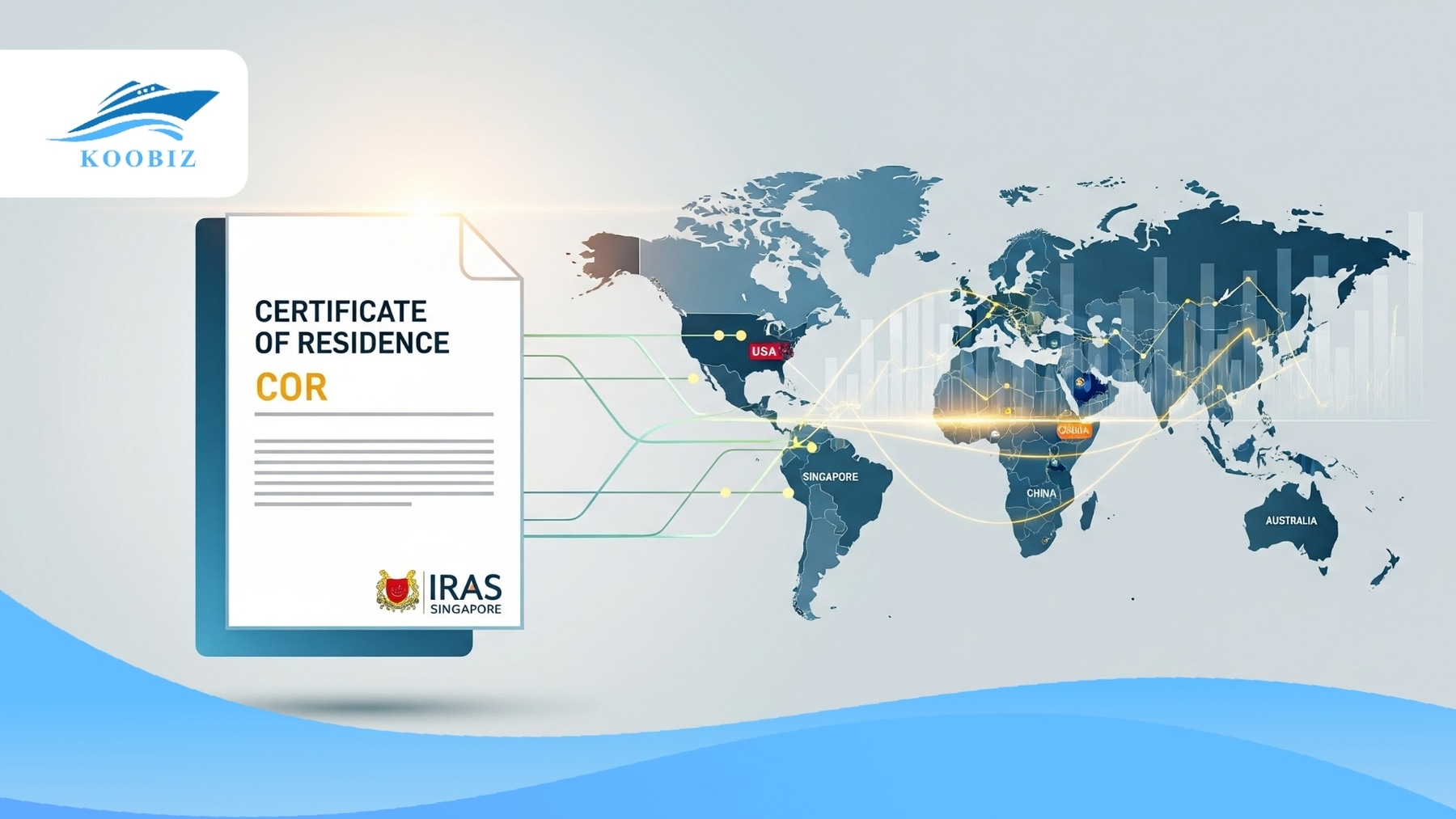
The Singapore Certificate of Residence (COR) is an official document issued by the Inland Revenue Authority of Singapore (IRAS) confirming that a company is a tax resident of Singapore for a specific Year of Assessment (YA).
Beyond its formal definition, the COR plays a critical role in international transactions. It is the key evidence required by foreign tax authorities to grant tax relief under Double Taxation Agreements (DTAs). Without a COR, income earned overseas—such as dividends, royalties, or interest—may be taxed in the foreign jurisdiction and again in Singapore. By serving as proof of Singapore tax residency, the COR enables companies to benefit from reduced withholding tax rates or full exemptions in treaty partner countries, helping to optimize their overall tax position.
Which Types of Companies Are Eligible for a COR?
Two main categories of companies may qualify for a Certificate of Residence (COR): Singapore-incorporated trading companies and foreign-owned investment holding companies, provided they satisfy IRAS’s strict “Control and Management” requirement.
While incorporation in Singapore is only the first step, the key determining factor is where the company’s strategic decisions are made. In practice, this means that Board of Directors meetings, where major policies and directions are decided, must be conducted in Singapore.
1. Singapore Incorporated Companies (Standard Trading Companies)

This is the most common category eligible for a COR. It includes companies that are incorporated in Singapore and are actively trading or providing services.
- Criteria: The company must hold its Board of Directors meetings in Singapore.
- Key Requirement: Even if the company has foreign directors, the strategic authority must be demonstrated to exist in Singapore. If the Board meets locally to approve financial statements and business strategies, the company is eligible.
2. Foreign-Owned Investment Holding Companies (2025 Updates)
Companies that are 50% or more owned by foreign entities/individuals and function purely as investment vehicles face the strictest scrutiny.
New 2025/2026 Requirements:
As of 2025, IRAS has tightened the rules. To demonstrate valid commercial reasons for setting up in Singapore, these companies generally must meet one of the following enhanced substance requirements:
- Key Personnel: Employ at least one Executive Director or Key Employee (e.g., CEO, CFO, COO) based in Singapore.
- Active Management: Demonstrate that the company is actively managed by a related company based in Singapore (passive reliance on a related company is no longer sufficient).
Eligibility Checklist:
- Valid commercial reasons for setting up in Singapore.
- Local business spending (beyond just statutory fees).
- A physical office presence.
- Note: Purely passive entities without local executive staff may face rejection.
3. Types of Companies That Are NOT Eligible

- Singapore Branches of Foreign Companies: Since control is vested in the overseas head office, branches are generally not considered tax residents.
- Dormant Companies: While not explicitly banned by definition, dormant companies almost always fail the “Control and Management” test because they conduct no business activity. Thus, they are practically ineligible.
- Nominee-Run Structures: Companies run solely by nominee directors without real local discretion will likely fail the eligibility test.
Koobiz Insight: For foreign investors, distinguishing between a “Standard Company” and an “Investment Holding Company” is vital. If your goal is to utilize DTAs, you must structure your Board and operations to meet these specific eligibility requirements from Day 1.
How to Apply for COR via IRAS myTax Portal
The application is a digital process via the IRAS myTax Portal. Companies (or their appointed tax agents like Koobiz) must use their CorpPass to access the system.
Step 1: Login and Navigation
Log in to myTax Portal using CorpPass. From the menu, select “Corporate Tax” > “Apply for Certificate of Residence (COR)”.
Step 2: Enter Details
Select the Treaty Country and the Year of Assessment.
- Advance Year: From October onwards, you can apply for a COR for the upcoming calendar year.
- Past Years: You can apply for up to 4 back calendar years retrospectively.
Step 3: Declaration
Confirm that the control and management of the business are exercised in Singapore for the specified period.
Step 4: Confirmation
Once submitted, standard applications are often approved instantly. Complex cases (e.g., investment holding companies) may flag for manual review (“Pending”).
What are the Validity and Processing Times?
- Processing Time:
- Standard Cases: Instant or within 7 working days.
- Complex Cases: Up to 14 working days (often requires submitting Board minutes or travel records).
- Tax Reclaim Forms: Up to 1 month if manual certification is needed.
- Validity Period: A COR is valid for one specific calendar year. You must ensure the COR year matches the year the income was received.
Comparison: Standard COR vs. Tax Reclaim Form
While the COR is the standard proof of residency, some countries historically required their own specific forms.
| Aspect | Standard COR | Tax Reclaim Form |
|---|---|---|
| Format | IRAS computer-generated PDF letter | Country-specific form (e.g., Form DGT) |
| Acceptance | Accepted by most treaty partners (UK, Australia, Vietnam, Indonesia) | Required by very few specific partners (e.g., Japan) |
| Process | Digital via myTax Portal | Manual submission to IRAS for physical stamp |
| Processing Time | Instant to 14 days | Up to 1 month |
Important Note for Indonesia:
Previously, Indonesia required the “Form DGT” to be certified by IRAS. Under current guidelines, however, Indonesia now accepts the standard Singapore Certificate of Residence (COR) as adequate proof of tax residency. As a result, there is no longer a need to submit Form DGT to IRAS for physical endorsement—the standard COR attached to your filing is sufficient.
Navigating Complex Scenarios and Rejections
Complex business structures, particularly Foreign-Owned Investment Holding Companies, face stricter scrutiny.
- Letter of Clarification: If IRAS is unsure about your status, they will issue a query letter. You must provide minutes of Board Meetings held in Singapore, travel records of directors, and proof of local business expenditure.
- The “Edge Cases”: Koobiz often assists clients who fall into “edge cases.” For example, if a company is non-Singapore incorporated but effectively managed here, it may be eligible in exceptional circumstances, though this is rare.
Can You Apply for COR for Past Years?
Yes, companies can apply for a COR for past years (Back Years), provided they can prove they met the residency criteria during those specific periods.
- Retrospective Limit: You can apply for the current year plus up to 4 preceding calendar years via the portal.
- Compliance Check: IRAS will review the company’s tax filings for that historical period. If the company was dormant or managed overseas during that year, the application will be rejected.
Distinguishing Tax Residency from Citizenship
- Place of Incorporation (Legal): Where the company is born (e.g., registered with ACRA).
- Place of Management (Tax): Where the company “lives and thinks.” A company can be incorporated in Singapore but be a tax resident of another country if its control is exercised there.
Optimize Your Tax Strategy with Koobiz
Obtaining a Certificate of Residence is a critical step in optimizing your international tax strategy. However, the nuances of the “Control and Management” test—especially with the new 2025 substance requirements—can be daunting.
At Koobiz, we specialize in helping foreign and local entrepreneurs navigate the Singapore corporate landscape. From company incorporation to opening bank accounts and managing tax compliance, our team ensures your business meets all economic substance requirements to successfully obtain your COR.
Ready to claim your DTA benefits? Visit Koobiz.com to consult with our tax specialists today. We help you build a compliant, tax-efficient structure right from the start.
Disclaimer: Guidelines are based on IRAS rules as of early 2026. Tax regulations can change; always check iras.gov.sg or consult a professional for the latest updates.
Leave a Reply