
[SUMMARIES]
Legality: A virtual address is legal for ACRA registration as long as the location is open during business hours and able to receive official mail.
Cost Efficiency: Virtual addresses help startups save thousands of dollars each month compared to CBD office rentals, which often cost over SGD 10 per square foot.
Professional Image: A virtual address in a prime location (e.g., Suntec, Marina Bay) offers higher credibility than a residential address under the Home Office Scheme.
Hybrid Options: Co-working spaces and the URA Home Office Scheme serve as middle-ground solutions for businesses needing physical presence without long leases.
Scalability: Startups can easily transition from virtual to physical spaces as they grow, but must update ACRA records immediately to remain compliant.
[/SUMMARIES]
Singapore offers a pro-business environment, yet high real estate costs pose a challenge for new entrepreneurs. A critical first step is satisfying ACRA’s registered address requirement: should you commit to a physical office or leverage a flexible virtual address? At Koobiz, we guide startups through this decision by assessing legal compliance, costs, and brand credibility to identify the most suitable setup.
Is a Virtual Address Legal for ACRA Company Registration?
Yes, a virtual address is legal for ACRA company registration, provided it meets certain operational requirements.
According to Section 142 of the Companies Act 1967, every company must have a registered office address in Singapore. A standard P.O. Box is strictly prohibited because it does not allow for the inspection of registers and records.
To remain compliant, your virtual address provider must ensure the location is:
- Physically Accessible: Open to the public for at least 3 hours during ordinary business hours on weekdays.
- Capable of Mail Receipt: Able to securely receive legal notices from government agencies (MOM, IRAS, ACRA).
- Maintained in Records: Updated with ACRA within 14 days of any change.
Warning: Failure to maintain a valid registered office is an offense punishable by a fine of up to SGD 5,000.
As a result, for most service-based and digital startups, a professional virtual office is the most efficient and cost-effective way to meet ACRA requirements. It satisfies the “Registered Office” requirement without the need for the business owner to be physically present.
Virtual Address vs. Physical Office in Singapore: Cost and Practical Comparison
A virtual address offers clear advantages in cost efficiency and flexibility, while a physical office delivers stronger support for team collaboration and inventory management.
The following comparison highlights the financial and operational differences between the two models to help you decide which fits your current business stage:
| Feature | Virtual Address (Subscription) | Physical Office (Commercial Lease) |
|---|---|---|
| Monthly Cost | Low (SGD 20 – SGD 100) | High (SGD 5,000 – SGD 7,500+)* |
| Upfront Capital | Minimal (Subscription fee only) | High (3-month deposit, renovation, furniture) |
| Lease Commitment | Flexible (Monthly or Yearly) | Long-term (Typical 2-3 Years) |
| Mail Handling | Managed by provider (Scan/Forward) | Self-managed |
| Staffing | No on-site staff required | Requires physical presence & maintenance |
| Space Utility | Address only (No physical workspace) | Dedicated desks, meeting rooms, storage |
| Best Suited For | Digital Nomads, Consultants, Lean Startups | Retail, Manufacturing, Large Teams |
*Note: Physical office estimates are based on a standard 500 sq ft unit in Singapore’s Core Central Region (CCR), priced at approximately SGD 10–15 per square foot, excluding utilities and internet.
For Koobiz clients operating lean, the cost difference—often amounting to nearly SGD 60,000 in annual savings—is a key deciding factor. While a physical office offers infrastructure for daily collaboration and inventory, a virtual address allows capital to be reinvested into product development and marketing during the critical first year.
Factors to Consider When Choosing Your Business Address
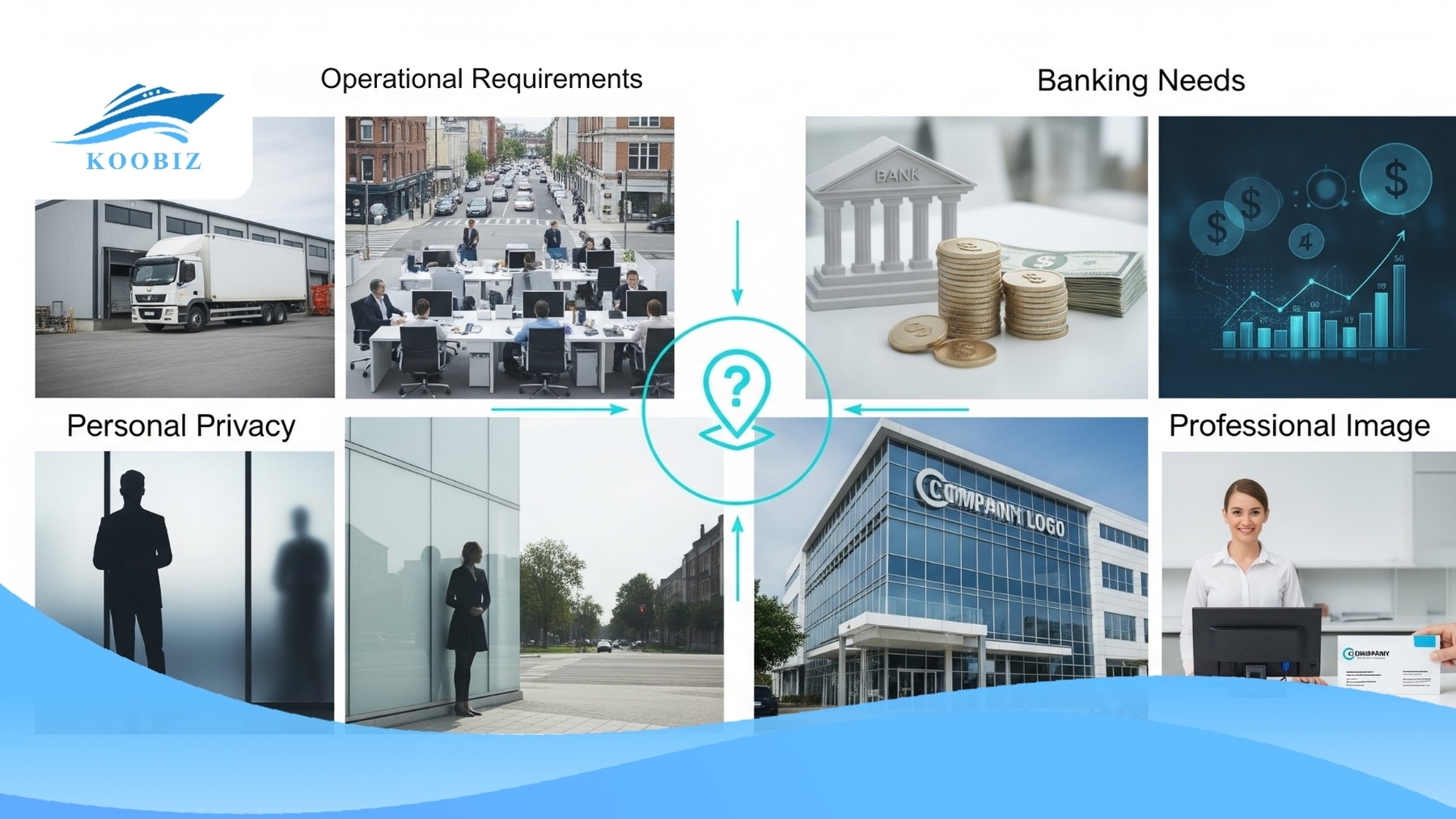
There are four main factors to evaluate: your operational requirements, banking needs, personal privacy, and the professional image you wish to project.
Beyond the raw numbers, the “intangibles” of a business address can significantly impact your company’s growth trajectory and banking relationships.
Operational Requirements: Client Visits & Inventory
Before choosing an address, you must define your daily workflow.
- Physical Office Required: If your business involves physical inventory, manufacturing activities, or frequent walk-in clients, a virtual address alone will not meet operational needs.In these cases, a physical premise (office or warehouse) is mandatory.
- Virtual Address Sufficient: This option works well for consultancy firms, digital marketing agencies, and holding companies where the core business activity is intellectual rather than physical. A virtual address supports this model effectively by eliminating the cost and upkeep of an underutilized office.
Credibility and Banking Relationships
In the Singaporean business context, location signals prestige. An address at a prime Grade A office building (e.g., Suntec City, Marina Bay Financial Centre) conveys stability and success, helping small businesses appear more established than their actual size.
More importantly, this perception directly affects banking relationships.
Koobiz Pro Tip: When assisting clients with corporate bank account openings in Singapore, we often see banks apply stricter KYC (Know Your Customer) checks to companies registered at residential addresses. A professional CBD address is often viewed more favorably by compliance teams, smoothing the path to getting your account approved.
Privacy and Personal Safety
For home-based entrepreneurs, privacy is a critical but often overlooked factor. If you register your company using your home address (under the Home Office Scheme), that address becomes public record on ACRA’s BizFile+ directory. Anyone can purchase your business profile and see exactly where you live.
Using a virtual address serves as a privacy buffer. It ensures that your residential address remains off the public register, keeping your personal life separate from your business dealings and preventing disgruntled clients or unsolicited salespeople from showing up at your doorstep.
Flexibility and Remote Work Culture
The rise of remote work has made flexibility a premium asset. Choosing between the two often dictates your company culture:
- Virtual Address (Work from Anywhere): Supports a decentralized culture, allowing business owners to operate from home, a café, or overseas without tying the company’s legal existence to a specific rental contract.
- Physical Office (Centralized Culture): Establishes a centralized work environment. While this fosters direct supervision and potentially faster communication, it limits the talent pool to those who can commute to the location.
Real-World Scenarios: Which Model Fits You?
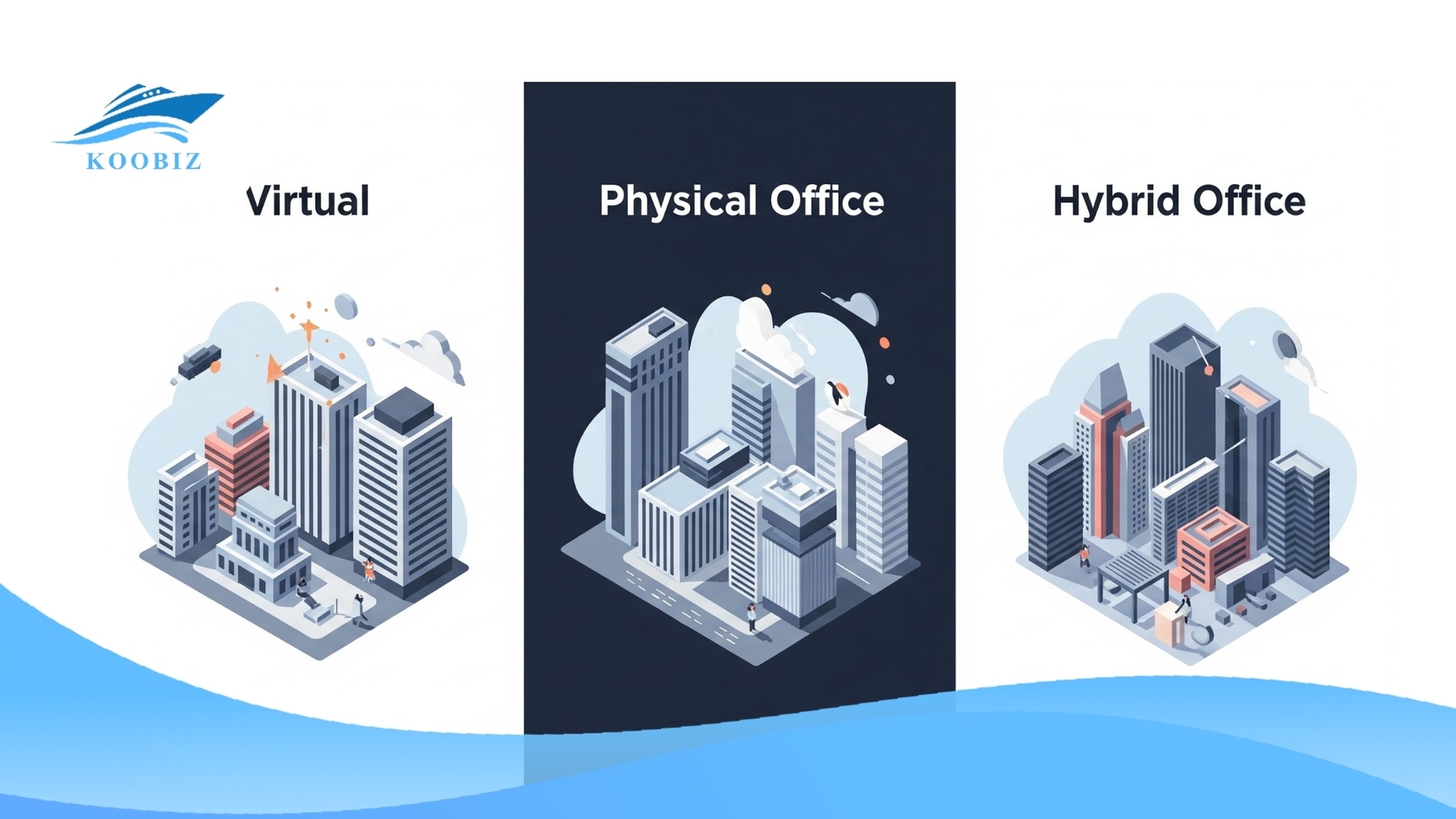
To visualize how these factors play out in reality, here are three common scenarios we encounter at Koobiz. These case studies illustrate why different businesses choose different paths.
Case Study 1: The “Lean” Tech Startup (Virtual Office)
Profile: A software development team of 5, comprising 2 local founders and 3 remote developers in Vietnam and the Philippines.
Challenge: They needed to register their company with ACRA to sign contracts with enterprise clients but had zero budget for a physical office ($0 revenue stage).
The Choice: They opted for a Premium Virtual Address in the CBD (Raffles Place).
Outcome: The founders work from home or cafes. The prestigious CBD address on their business cards gives them credibility when pitching to banks and investors. They save approximately SGD 5,000/month on rent, which is reinvested into hiring another developer.
Case Study 2: The Luxury Trading Firm (Physical Office)
Profile: An import-export business dealing in high-end watch accessories.
Challenge: The owner needs to physically inspect shipments, store valuable inventory securely, and host VIP clients for private viewings.
The Choice: A Private Office within a commercial building that allows for light storage.
Outcome: A virtual office was impossible because “inventory” and “client experience” were their core values. The physical cost is high, but it is a necessary operational expense to generate revenue. They use the office as both a showroom and a registered address.
Case Study 3: The Regional Consultancy (Hybrid Model)
Profile: A management consulting firm with 2 partners who travel frequently between Singapore and Kuala Lumpur.
Challenge: They don’t need a desk every day, but they need a professional boardroom 4 times a month to present to clients. Meeting in a Starbucks was not an option.
The Choice: A Virtual Office Package with Meeting Room Credits.
Outcome: They pay a low base subscription for the address and mail handling. When they have a client meeting, they book a boardroom at their virtual office provider’s location for an hourly fee. This “Pay-as-you-use” model keeps their fixed costs low while maintaining high professional standards.
We have established that for many new entrants, a virtual address offers the most straightforward option in terms of cost and compliance. However, the binary choice between “Virtual” and “Physical” isn’t the only way. As your business matures, or if you fall into specific categories, you might explore hybrid models or prepare for a physical transition.
Alternative Solutions and Hybrid Business Address Models in Singapore
There are two common hybrid solutions that bridge this gap: the URA/HDB Home Office Scheme for solopreneurs, and co-working spaces designed for growing teams.
These options allow businesses to operate legally without committing to a full commercial lease or relying solely on a virtual address.
The “Home Office Scheme” (URA/HDB Guidelines)
The Home Office Scheme is a regulatory framework by the Urban Redevelopment Authority (URA) and the Housing & Development Board (HDB) that permits homeowners to use their residential property for limited administrative business activities. This is the most cost-effective “physical” option since you are utilizing space you already pay for.
However, strict regulations apply. You cannot hire more than two non-resident employees, and the business activity must not disturb neighbors (no heavy foot traffic or noise). Additionally, for HDB flats, business registration details are publicly available. This means your residential address will appear on ACRA’s BizFile+, creating privacy concerns for many entrepreneurs.
Co-working Spaces: The Middle Ground
Co-working spaces represent a practical middle-ground solution. Providers like WeWork, JustCo, or local boutique spaces offer “Dedicated Desk” or “Hot Desk” memberships that come with a valid commercial business address. This solves the isolation of working from home while providing a professional address for ACRA registration.
Unlike a pure virtual office, this model provides physical access to shared amenities such as meeting rooms, pantries, and networking events on a flexible monthly basis.
Koobiz Pro Tip: We often suggest co-working spaces as a practical “stepping stone” for clients who have outgrown a virtual setup but are not yet ready for the capital expenditure of a private office fit-out. It balances professionalism with low liability.
Transitioning from Virtual to Physical: What Startups Must Know
Transitioning involves a structured process of securing a commercial lease, navigating stamp duties, and formally updating government records to maintain compliance.
Scaling up to a physical office is a milestone, but it brings a new layer of administrative complexity that must be managed carefully.
Understanding Lease Terms and Hidden Costs
Moving to a physical office involves more than just monthly rent. In Singapore, commercial leases typically run for 2 to 3 years. Tenants must budget for several key financial commitments:
- Security Deposit: Usually equivalent to 3 months’ rent.
- Stamp Duty: A tax levied on the lease agreement document.
- Reinstatement Costs: The mandatory cost to return the unit to its original bare condition when the lease ends.
Many foreign entrepreneurs are caught off guard by these hidden costs. Unlike a virtual office subscription, which is relatively plug-and-play, a physical lease represents a long-term financial commitment.
Koobiz Pro Tip: Always engage legal or professional agency support to review your Tenancy Agreement before signing. Pay special attention to “renewal options” and “diplomatic clauses” to ensure you have an exit strategy if business needs change.
Updating ACRA and Notifying Key Stakeholders
Once a physical location is secured, compliance timelines immediately apply. Under the Companies Act, you are legally required to notify ACRA of any change in your registered office address within 14 days.
This is done via filing a “Change in Company Information” on the BizFile+ portal. Failing to do so is an offense. Beyond ACRA, you must also update your bank, tax authority (IRAS), and suppliers. At Koobiz, we regularly manage this corporate secretarial process for clients, ensuring a smooth and penalty-free transition from a virtual address to a physical headquarters.
Conclusion
Choosing between a virtual address and a physical office in Singapore is a decision that shapes your cost structure and brand identity. For the majority of new startups, especially those serving international clients or operating digitally, a Virtual Address offers the perfect blend of legality, prestige, and economy.It allows you to meet ACRA requirements without the burden of long-term rental overheads. However, as your team grows, knowing when to transition to hybrid or physical spaces is key to sustaining operations.
About Koobiz
At Koobiz, we specialize in simplifying market entry for entrepreneurs in Singapore. Whether you need a prestigious virtual address for incorporation, assistance with opening a corporate bank account, or ongoing tax and accounting support, our team ensures you remain compliant every step of the way. We bridge the gap between your business goals and Singapore’s regulatory framework.
Ready to set up your Singapore company with the right address strategy? Contact Koobiz today for a consultation.
Leave a Reply