[SUMMARIES]
Two-Tier System: Children born before 2024 qualify for percentage-based relief; those born on or after Jan 1, 2024, receive fixed-dollar relief.
2026 Relief Amounts: Fixed rates for new children are $8,000 (1st), $10,000 (2nd), and $12,000 (3rd+).
Critical Limits: Combined QCR/HCR and WMCR are capped at $50,000 per child, while the total personal relief cap remains $80,000.
Eligibility: Available to working mothers who are married, divorced, or widowed with Singapore citizen children.
Koobiz Support: Koobiz provides expert tax advisory to help working mothers navigate complex filing requirements in Singapore.
[/SUMMARIES]
The Working Mother’s Child Relief (WMCR) rewards women who stay in the workforce. As we approach the 2026 Year of Assessment (YA), the transition from percentage-based to fixed-dollar claims—originally announced in Budget 2024 and effective from YA 2025—is now fully integrated. Feeling unsure about how income tax relief works for working mothers? You’re not alone. This guide explains the Working Mother’s Child Relief (WMCR) in simple terms. Whether you’re planning for your first child or have several, we’ll break down the 2026 rules—what you can claim, who is eligible, and how to get the most out of this benefit with help from Koobiz.
What is the Working Mother’s Child Relief (WMCR) in 2026?
Think of WMCR as a thank-you from the tax system. It’s a special deduction for working mums with Singaporean children. This deduction directly lowers the amount of your salary that gets taxed, which means you pay less tax overall. It’s designed to support mothers who balance a career and family.

Eligibility Criteria: Who Can Claim in YA 2026?
To qualify for Working Mother’s Child Relief (WMCR), you must meet these conditions:
- Mother’s Status: You must be a working mother who is married, divorced, or widowed (single, never-married mothers do not qualify).
- Child’s Citizenship: Your child must be a Singapore Citizen as of 31 December 2025.
- Note: If your child was born before 1 Jan 2024 but only became a citizen on or after 1 Jan 2024, they qualify for the Fixed Dollar relief, not the percentage system.
- Child’s Age & Education: Your child must be under 16 years old in 2025. If the child is 16 or older, they must be studying full-time at an approved educational institution.
- Child’s Income: Your child’s annual income in 2025 must not exceed $8,000.
- Note: This income limit excludes scholarships, bursaries, and internships compulsory for their course.
Understanding the “Earned Income” Requirement
A key element of the working mother relief is the “earned income” clause, which requires the mother to have earned taxable income from work, a trade, a business, or a profession in the previous year. Passive earnings—such as stock dividends, rental income, or interest from savings—do not count toward WMCR eligibility. Koobiz often tells clients that “earned income” is calculated after allowable expenses but before applying any personal reliefs.
For example, if a mother is a freelancer or runs a business, the qualifying amount is her net trade income. This distinction matters because if a mother’s only income comes from investments, she cannot claim WMCR even if all other family criteria are met. More precisely, the “earned income” must be positive; if the business incurs a loss in that year, the relief cannot be used.
How Much Can You Claim? (Fixed vs. Percentage Rates)
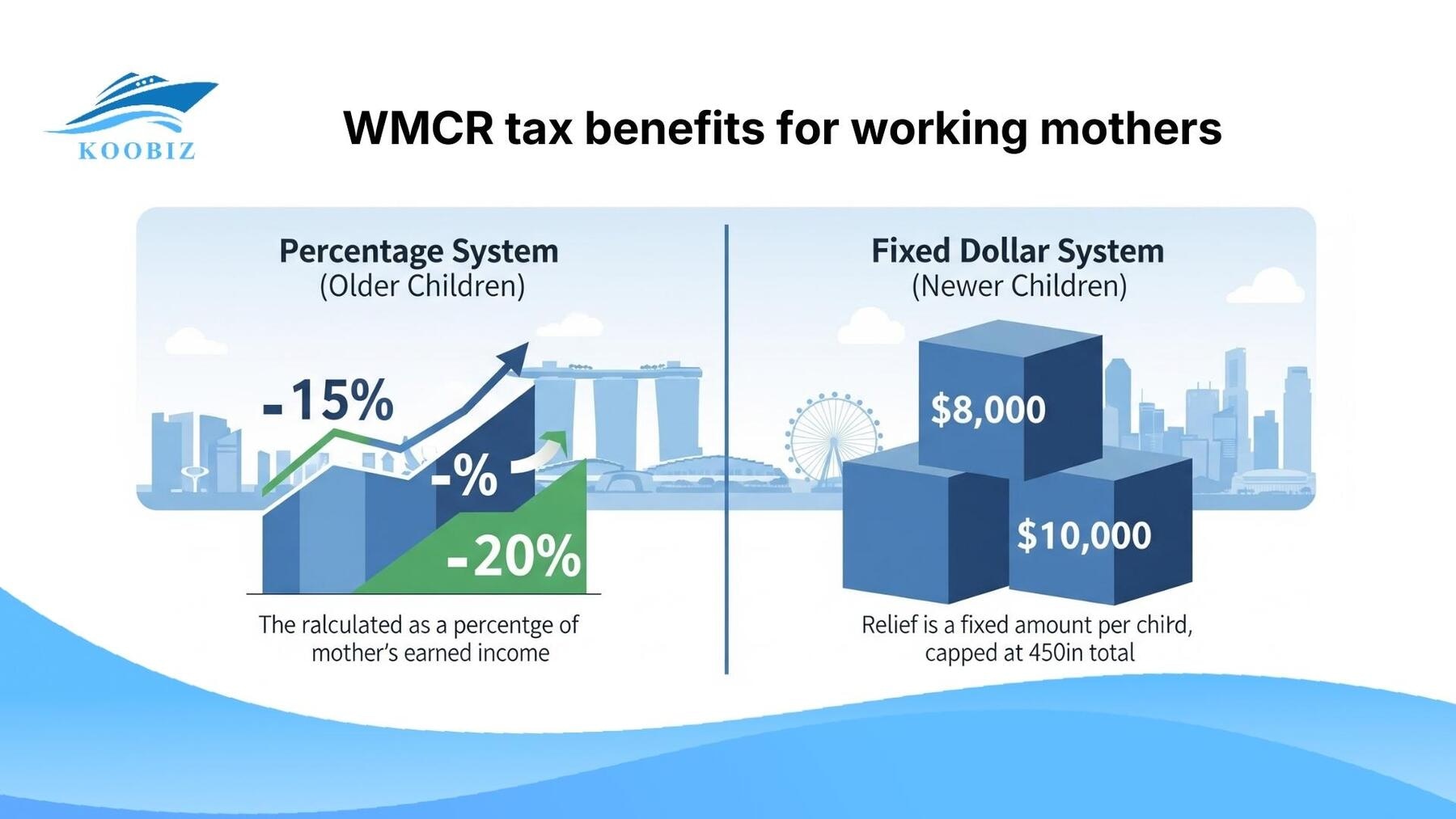
In 2026, there are two primary methods for calculating the working mother relief: a percentage-based system for children born before 2024 and a fixed-dollar system for children born on or after January 1, 2024. This two-track design aims to create a more progressive tax framework by delivering larger benefits to lower- and middle-income families while limiting the relief available to ultra-high earners.
Because of this policy shift, parents with multiple children need to identify which child falls into which category, since the resulting tax savings can differ markedly between the two systems.
For Children Born/Adopted Before 1 Jan 2024 (Percentage System)
For children who were born or adopted prior to the 2024 pivot (and were citizens at birth or before 2024), the “Old WMCR” rules apply. In this system, the amount of working mother relief you can claim is a direct percentage of your earned income based on the child’s order:
- 1st Child: 15% of the mother’s earned income.
- 2nd Child: 20% of the mother’s earned income.
- 3rd Child and beyond: 25% of the mother’s earned income.
- Cap Note: The total WMCR claim across all children is capped at 100% of the mother’s earned income.
For instance, a mother earning $100,000 with a child born in 2022 would claim $15,000 in relief. This percentage-based approach remains quite advantageous for mothers in the upper-middle-income range, but it is still limited by an $80,000 total personal relief cap and a $50,000 cap per child.
For Children Born/Adopted On or After 1 Jan 2024 (Fixed Dollar System)
The biggest reform starting in YA 2025 affects children born on or after January 1, 2024 (or those who become citizens after that date). Under the new regime, the working mother relief is a fixed dollar amount, independent of the mother’s income. This means that two mothers with the same eligible child—one earning $5,000 per month and the other $20,000 per month—would receive the same tax deduction for that child.
| Child Order | Relief Amount (Fixed) |
|---|---|
| 1st Child | $8,000 |
| 2nd Child | $10,000 |
| 3rd Child & Beyond | $12,000 |
Specifically, this change was designed to be more equitable. For a first child born in 2025, the mother will claim a flat $8,000 in her 2026 tax filing. To begin the comparison, a mother earning $40,000 a year actually benefits more from the fixed $8,000 than she would have from the 15% ($6,000) under the old system.
Step-by-Step: How to Claim WMCR on myTax Portal
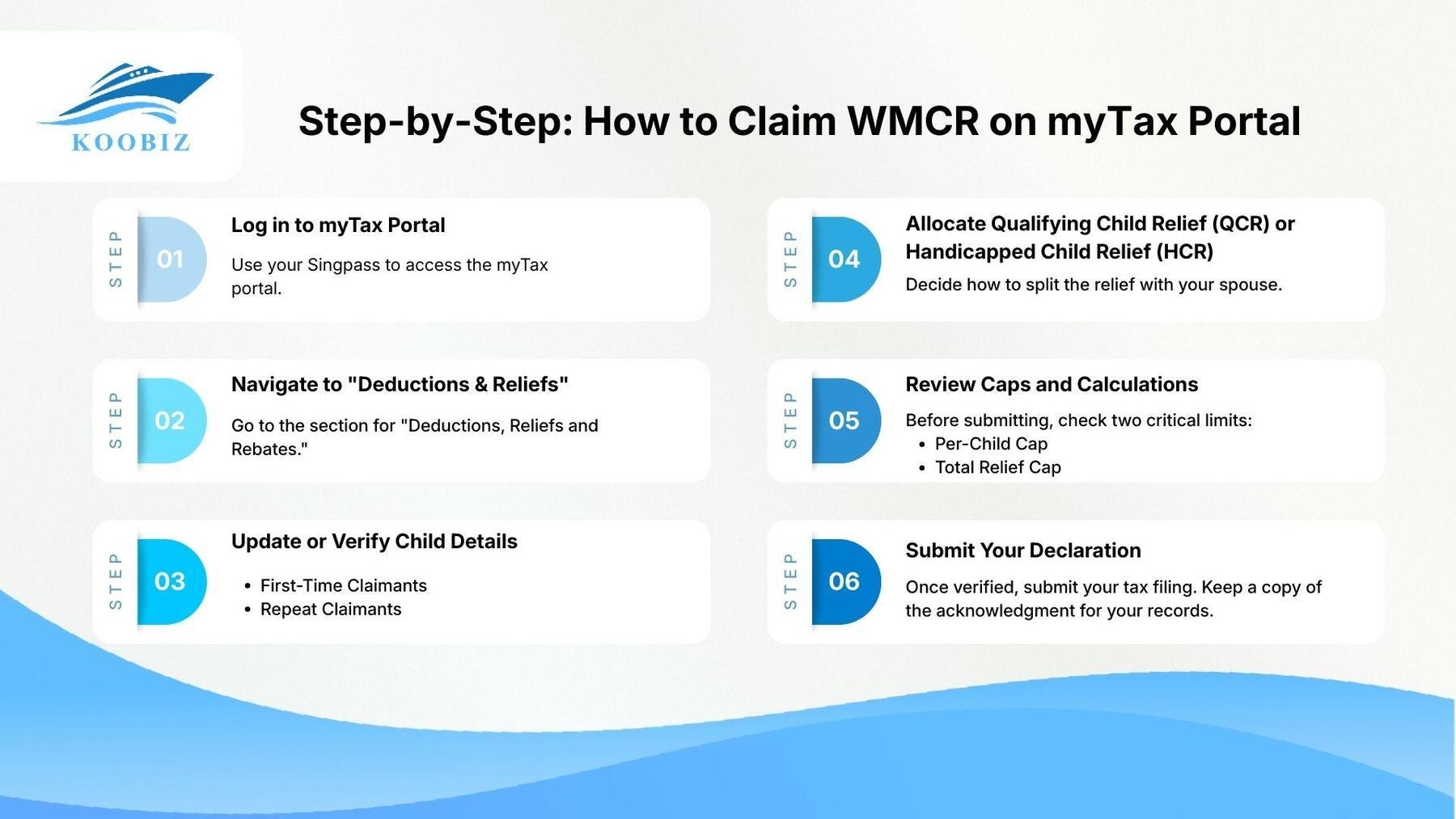
Claiming is done online through the IRAS myTax portal. Follow this simple process to ensure your working mother relief is accurately reflected in your 2026 tax bill:
- Log in to myTax Portal: Use your Singpass to access the myTax portal.
- Navigate to “Deductions & Reliefs”: Go to the section for “Deductions, Reliefs and Rebates.” If you are a repeat claimant, your WMCR claims from the previous year should be pre-filled.
- Update or Verify Child Details:
- First-Time Claimants: If you had a child in late 2025, verify their details are listed. If not, manually enter their name, ID, and Date of Birth.
- Repeat Claimants: Ensure all eligible children are still listed. The system will automatically apply the new Fixed Dollar rates for children born on or after 1 Jan 2024.
- Allocate Qualifying Child Relief (QCR) or Handicapped Child Relief (HCR): Decide how to split the relief with your spouse.
- QCR: $4,000 per child.
- HCR: $7,500 per child (if the child has a disability). Use the portal’s “Relief Checker” to see if it is better for the higher earner to claim the QCR/HCR or to share it. Note that WMCR is exclusive to the mother and cannot be transferred.
- Review Caps and Calculations: Before submitting, check two critical limits:
- Per-Child Cap: Ensure QCR/HCR + WMCR does not exceed $50,000 per child.
- Total Relief Cap: Ensure your total personal reliefs do not exceed $80,000.
- Submit Your Declaration: Once verified, submit your tax filing. Keep a copy of the acknowledgment for your records.
Common Filing Errors to Avoid
- Income Thresholds: Ensure your child did not earn more than $8,000 in 2025 (excluding scholarships).
- Double Claims: Check that you are not double-claiming relief if you changed employers; “earned income” is the total from all sources.
The $80,000 Cap: Is Your Tax Relief Being “Squeezed”?
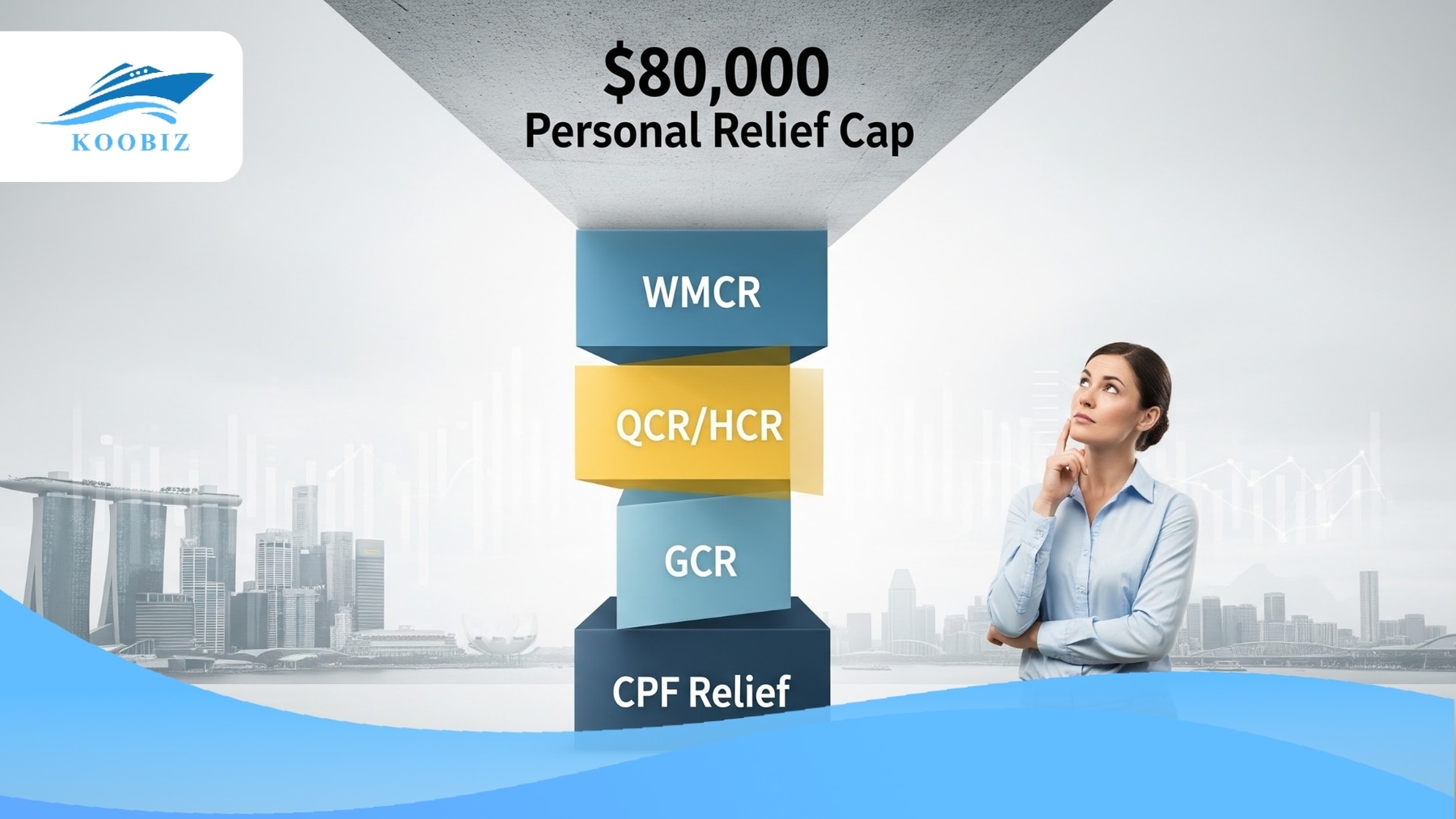
Yes, the working mother relief is often constrained by the $80,000 personal relief cap, especially for high-earning mothers or those with several children. This cap sets the maximum total of all personal reliefs—such as CPF relief, Earned Income Relief, Life Insurance Relief, and WMCR—that a person may claim in a single Year of Assessment.
How to “Stack” WMCR with QCR/HCR and GCR
To start the sequence, you first apply the Qualifying Child Relief (QCR) or Handicapped Child Relief (HCR). After that, you add the working mother relief (WMCR) on top. If you are a working mother whose parents or grandparents help care for your children, you may also claim the Grandparent Caregiver Relief (GCR). In short, the stacking order is: QCR/HCR first, WMCR next, and GCR last (where eligible).
- QCR or HCR: $4,000 (QCR) or $7,500 (Handicapped Child Relief).
- WMCR: $8,000 to $12,000 (Fixed) or % based.
- GCR: $3,000.
- Requirement: Caregiver must be a non-working grandparent, parent, parent-in-law, or grandparent-in-law providing full-time care.
- CPF Relief: (Up to $20,400 for most employees).
If the total of QCR (or HCR) plus WMCR and other personal reliefs reaches $80,000, any additional deductions are forfeited. Tax specialists at Koobiz typically advise that, in such scenarios, the husband should claim the full QCR to preserve the mother’s WMCR relief for her own use.
Strategies for High-Earners
For high-earning mothers, the 2024 shift to fixed-dollar WMCR amounts was effectively a government move to reduce “tax shielding” for those in higher tax brackets. In response, these mothers need to be more strategic with other deductions. For example, if WMCR plus CPF contributions already hit the $80,000 cap, making voluntary CPF top-ups or SRS (Supplementary Retirement Scheme) contributions offers no additional tax relief.
Real-Life Scenarios: WMCR in Action
To better understand how these rules affect your wallet, let’s look at two realistic examples comparing the percentage-based and fixed-dollar systems.
Case Study A: The “Mixed System” Family
Profile: Sarah earns $96,000 annually ($8,000/month). She has two Singapore Citizen children:
- Lucas (Born 2021): 1st Child (Percentage System)
- Chloe (Born 2025): 2nd Child (Fixed Dollar System)
Her Relief Calculation:
- Lucas (15% of $96,000): $14,400
- Chloe (Fixed Rate for 2nd Child): $10,000
- Total WMCR Claim: $24,400
Analysis: Sarah benefits from a hybrid approach: since Lucas was born before 2024, she retains the higher deduction percentage for him. For Chloe, she receives a flat $10,000 regardless of her income.
Case Study B: The High Earner Hitting the Cap
Profile: Linda earns $200,000 annually. She has one child born in 2025 (1st Child).
Her Relief Calculation:
- CPF Relief (Approx Max): $20,400
- Earned Income Relief: $1,000
- QCR: $4,000
- WMCR (Fixed Rate for 1st Child): $8,000
Total Reliefs: $33,400
Analysis: Linda is well below the $80,000 cap and can claim her full relief amount. However, notice the difference: Under the old system, 15% of her $200,000 salary would have been a $30,000 deduction. The new fixed system ($8,000) significantly reduces her tax savings, which is the intended policy shift for higher income brackets.
New for 2026: Shared Parental Leave and Your Career
The April 2026 expansion of the Shared Parental Leave (SPL) scheme represents a major shift in the working mother relief landscape by allowing up to 10 weeks of leave to be shared between both parents. This initiative has indirect but significant implications for a mother’s taxable “earned income.”
Impact of 10-Week SPL on Taxable Income
If a mother takes Government-Paid Parental Leave (GPPL) funding, that income is still treated as part of her earned income for tax purposes. More importantly, if she shares 10 weeks of leave with the father, her total time away from work decreases, which could allow her to earn more performance-based bonuses or commissions. This increase in earned income would raise the base used for the percentage-based WMCR (for older children).
About Koobiz Services
Singapore’s tax system—especially with the 2026 updates—can be overwhelming for busy working mothers and business owners. Our mission is to provide seamless, professional support to help you maximize your financial potential.
Our core services include:
- Company Formation: Expert guidance on setting up your business in Singapore.
- Tax & Accounting: Specialized tax planning, including optimization of working mother relief.
- Audit Services: Comprehensive audit solutions to ensure regulatory compliance.
Visit us at koobiz.com to schedule a consultation with our tax specialists today.
Leave a Reply