Advisory Note: Information is current as of January 2026. Tax regulations are subject to change; always verify with the Inland Revenue Authority of Singapore (IRAS) for the latest updates.
[SUMMARIES]
Individual Status: Determined primarily by the 183-day rule, with additional concessions for stays straddling 2 or 3 calendar years.
Corporate Status: Hinges on the “Control and Management” test, focusing on where the Board of Directors makes strategic decisions.
Tax Advantages: Residents benefit from progressive tax rates (0–24%), personal tax reliefs, and full access to Singapore’s extensive DTA network.
Compliance: 2026 updates require stricter economic substance requirements for foreign-owned entities and physical presence for virtual board meetings to maintain residency.
[/SUMMARIES]
Determining your tax residency in Singapore is the foundational step for any expat or business owner looking to optimize their fiscal obligations in 2026. Whether you are a professional moving on an Employment Pass or a multinational establishing a regional hub, your residency status dictates your tax rates, eligibility for exemptions, and access to international treaties. Koobiz offers this comprehensive guide to help you navigate the complexities of the Inland Revenue Authority of Singapore (IRAS) regulations, ensuring your financial planning remains both compliant and efficient.
Next, we must distinguish between the rules governing individuals and those governing corporate entities. To understand better, let’s explore the specific criteria that qualify a person or a company as a Singapore tax resident. Following this, we will dive into the advantages of holding a Certificate of Residence (COR) and how you can apply for one through the expertise of Koobiz.
What Defines Individual Tax Residency in Singapore for 2026?
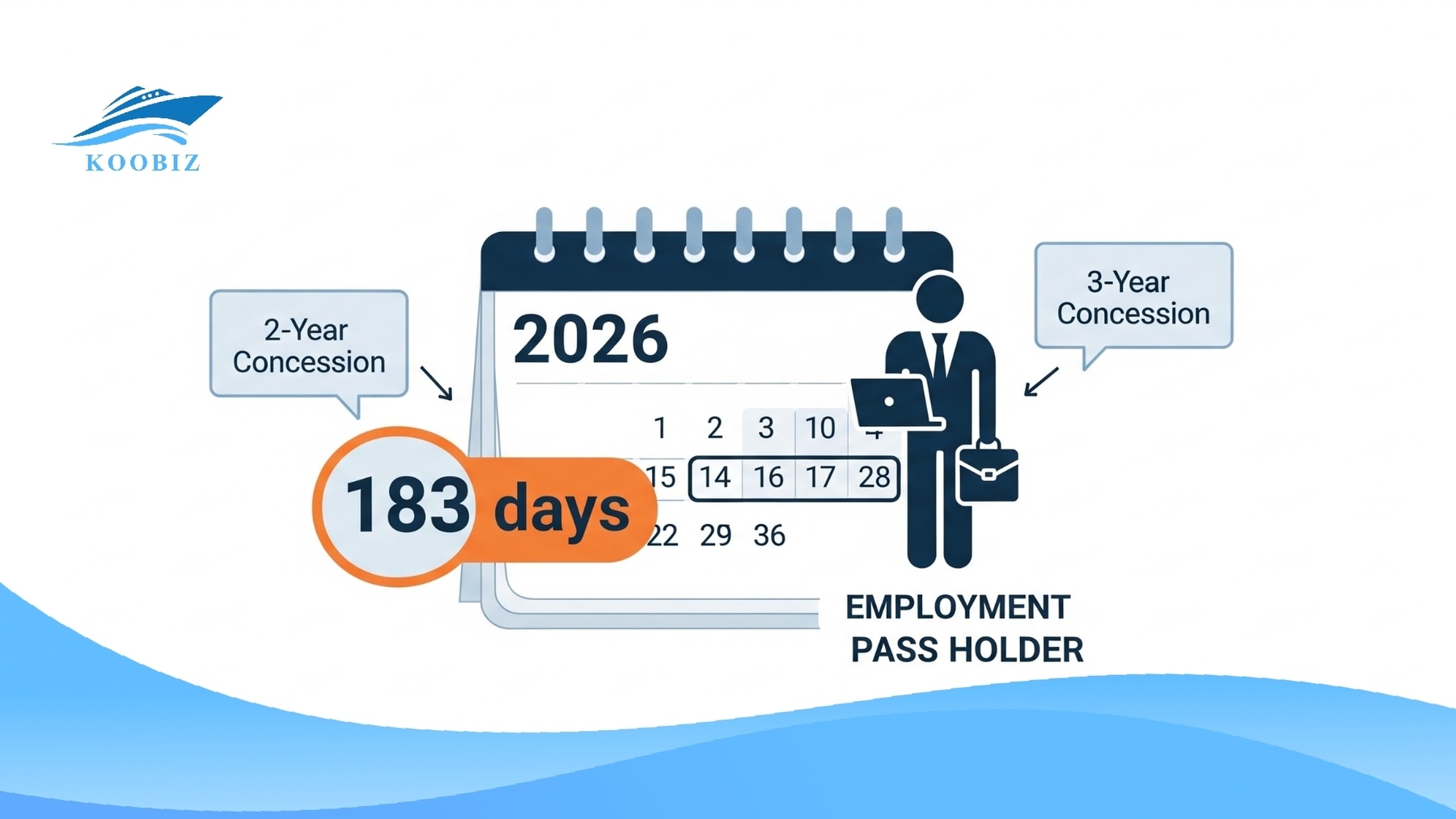
A Singapore tax resident is generally defined as a Singapore Citizen or Permanent Resident who resides in Singapore, or a foreign individual who stays or works in Singapore for at least 183 days in a calendar year.
Individual tax residency is crucial because it determines whether you are taxed at progressive resident tax rates or a flat non-resident rate. Importantly, tax residency status is reviewed annually and reassessed for each Year of Assessment (YA), as highlighted by Koobiz.
The 183-Day Rule: Quantitative Presence
The most common way for foreigners to qualify for Singapore tax residency is by meeting the 183-day quantitative threshold. This rule counts the total number of days you are physically present in the country during a calendar year (January 1 to December 31).
- Inclusion of partial days: Any stay for even part of a day counts as a full day.
- Work-related travel: Days spent outside Singapore for business travel or personal leave may still be counted toward the 183 days, provided your primary employment is based in Singapore.
- Public holidays and weekends: These are fully included in the count.
According to a 2025 study by the Singapore Tax Academy, over 85% of Employment Pass holders qualify as Singapore tax residents under the 183-day rule, enabling access to lower progressive tax rates.
Administrative Concessions: The 2-Year and 3-Year Rules
For individuals whose employment spans across two or three calendar years, IRAS provides specific administrative concessions. These are particularly useful for those who arrive late in the year and do not meet the 183-day requirement for that specific year but remain in Singapore for a significant duration thereafter.
| Concession | Qualification Criteria | Residency Outcome |
|---|---|---|
| 2-Year Concession | Stay or work in Singapore for at least 183 days in total over two continuous calendar years. | Considered a tax resident for both years. |
| 3-Year Concession | Stay or work in Singapore for three consecutive years, even if the 183-day test is not met in the first or third year. | Considered a tax resident for all three years. |
In practice, these concessions are commonly applied to help individuals obtain tax clearance and claim excess tax refunds. More specifically, these rules ensure that short-term assignments do not unfairly penalize foreigners with the higher non-resident flat tax rate.
Special Considerations: Digital Nomads and Retirees
As work patterns evolve, IRAS has clarified rules for non-traditional residents. The table below outlines how Singapore tax residency is assessed for these groups:
| Profile | Residency Trigger | Key Tax Implication |
|---|---|---|
| Digital Nomads | Physical presence of 183 days or more in a calendar year while working remotely. | Income derived from employment exercised in Singapore is generally considered Singapore-sourced and taxable. |
| Retirees | Qualitative factors, such as establishing a permanent home or intention to settle. | Generally exempt from tax on foreign-sourced income (FSIE) and capital gains, making it tax-efficient. |
Corporate Tax Residency in Singapore: The “Control and Management” Test
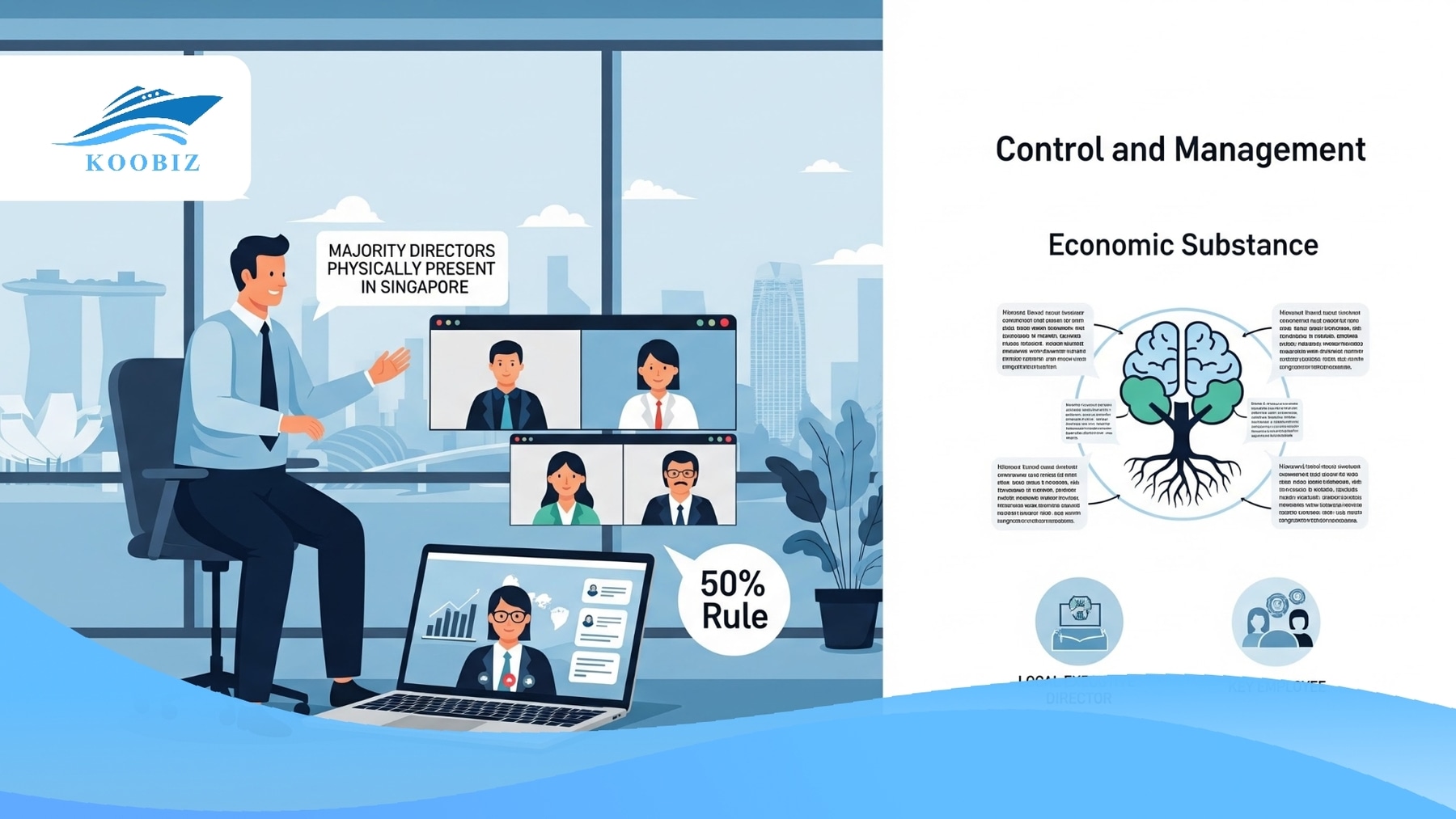
A Singapore tax resident company is a corporate entity where the “control and management” of its business is exercised within Singapore. In practice, this refers to where the Board of Directors convenes to make strategic and high-level decisions, rather than where day-to-day operations are carried out.
Additionally, the residency of a company is not determined solely by its place of incorporation. As a result, a company incorporated in Singapore may still be treated as a non-resident if its strategic decisions are made outside Singapore, for example, at a foreign parent company’s headquarters.
Virtual Board Meetings: 2026 Physical Presence Rules
From 2026 onward, IRAS has clarified its position on the impact of virtual board meetings on corporate tax residency. While digital meetings are permitted, tax residency in Singapore is only maintained if a significant portion of the decision-making process remains anchored in the city-state.
- The 50% Rule: According to explicit IRAS Guidance, at least 50% of the voting directors must be physically present in Singapore during the virtual meeting to validate that strategic decisions are made locally.
- Chairman’s Location: Alternatively, the Chairman of the Board must be physically in Singapore to lead the strategic discussion.
- Local Quorum: A Singapore-based quorum must be established to demonstrate that the company’s “nerve centre” is located in Singapore.
Stricter Rules for Foreign-Owned Investment Holding Companies
For foreign-owned investment holding companies, the bar for residency is higher. IRAS requires these entities to demonstrate “Economic Substance” to prevent the use of Singapore as a mere conduit for tax avoidance.
In practice, for a holding company to be granted a Certificate of Residence (COR), it is generally expected to employ at least one Singapore-resident executive director and one local key employee, such as a CFO or senior manager. According to a 2026 compliance report by the Ministry of Finance, these substance requirements have been tightened to align with global BEPS 2.0 standards, ensuring that only genuine business operations benefit from Singapore’s tax treaties.
Comparison: Singapore Tax Resident vs. Non-Resident Tax Treatment (YA 2026)
Singapore tax resident status offers access to progressive tax rates and a wide range of reliefs, while non-resident taxation is generally based on flat rates with limited exemptions.
To illustrate the financial impact of your status, we must compare the specific tax liabilities for the 2026 Year of Assessment. The table below summarizes how residency status directly affects an individual’s tax exposure.
| Feature | Tax Resident (2026) | Non-Resident (2026) |
|---|---|---|
| Employment Income | Progressive (0% – 24%) | Flat 15% or Resident Rate (Whichever is higher) |
| Director’s Fees | Progressive (0% – 24%) | Flat 24% |
| Personal Tax Reliefs | Eligible (CPF, SRS, Life Insurance) | Not Eligible |
| Tax Rebates (e.g., SG60) | Tax Resident (YA 2026) | Non-Resident (YA 2026) |
| Withholding Tax | Generally not applicable | Applicable to certain income types |
| Foreign Sourced Income | Exempt (with conditions) | Generally exempt |
For example, a tax resident earning $100,000 may face an effective tax rate of approximately 5.6%, whereas a non-resident would be taxed at a flat 15% ($15,000).This drastic difference highlights why tax residency is highly sought after by high-earning professionals and business owners. Furthermore, residents can claim a wide range of reliefs, such as the Earned Income Relief and Spouse Relief, which further reduce the taxable base.
According to data from IRAS Budget 2025, the increase of the top marginal tax rate to 24% for income exceeding $1 million affects only the top 1% of resident taxpayers, while the flat 24% rate for non-resident directors applies from the first dollar of income.
How to Apply for a Singapore Certificate of Residence (COR) in 2026
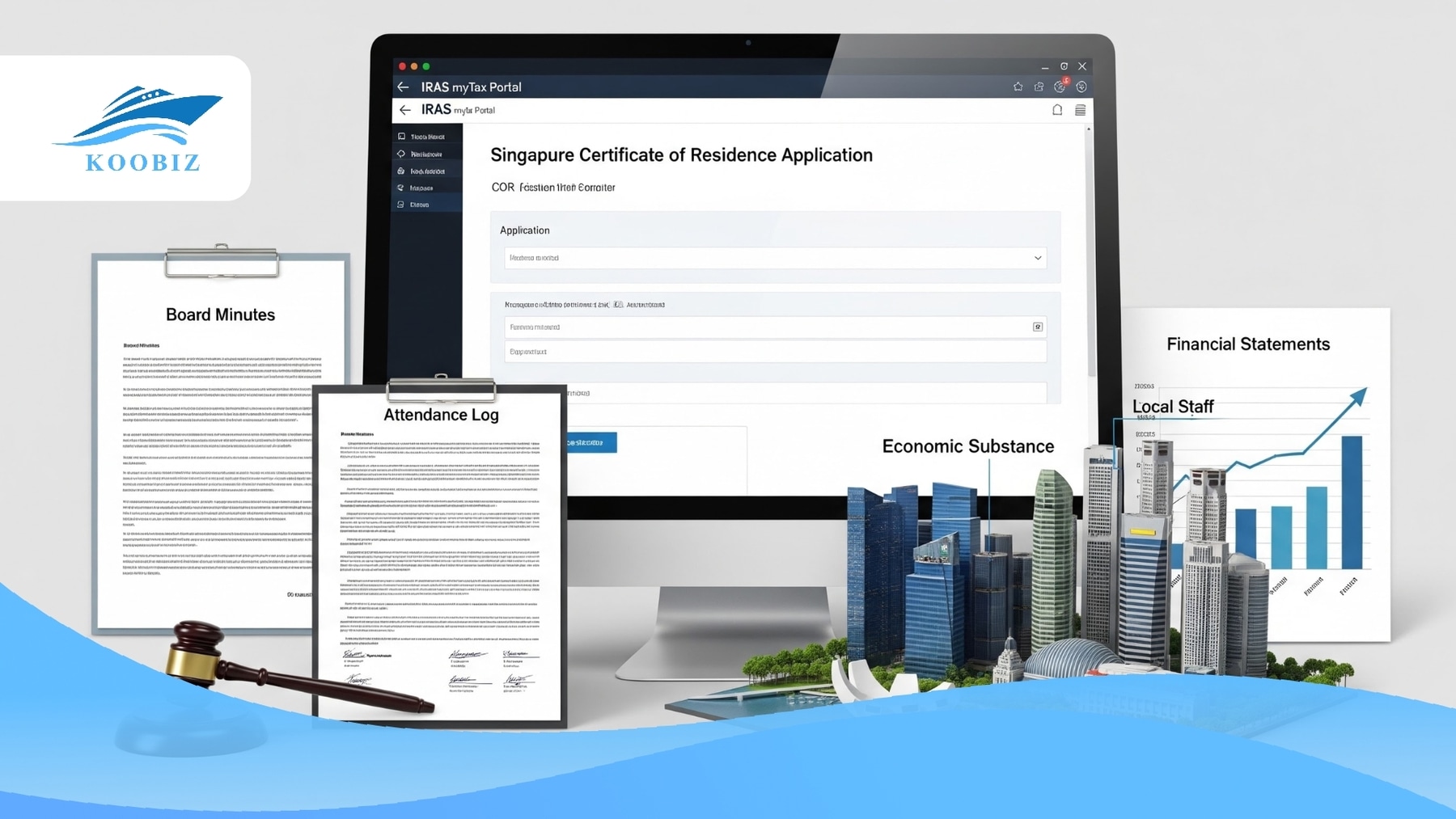
There are two main methods for obtaining a Certificate of Residence (COR), depending on whether you are applying as a business or an individual. Both methods result in an official document confirming tax residency, although the application channels differ.
- For Companies: Apply via the IRAS myTax Portal (Corporate Tax).
- For Individuals: Apply via the myTax Portal (Individual Income Tax).
Once tax residency has been established, the next practical step is to apply for a Certificate of Residence. This document is essential for claiming benefits under Singapore’s 90+ Double Taxation Agreements (DTAs).
Documentation Requirements for Companies
Applying for a COR as a company requires rigorous documentation to prove that control and management are local. Koobiz typically assists clients in preparing the following supporting documents:
- Board Minutes: Detailed records showing that strategic decisions were made in Singapore.
- Attendance Logs: Proof of physical presence of directors during board meetings.
- Economic Substance Evidence: Employment contracts for local staff and local office rental agreements.
- Financial Statements: To show that the company is actively engaged in business.
In summary, while the COR application process is digital, the underlying economic substance ultimately determines approval. According to research by the International Fiscal Association (Singapore Branch) in 2025, COR rejection rates for shell companies increased by 30% due to the lack of local executive directors.
Emerging Compliance: BEPS 2.0 and Economic Substance in 2026
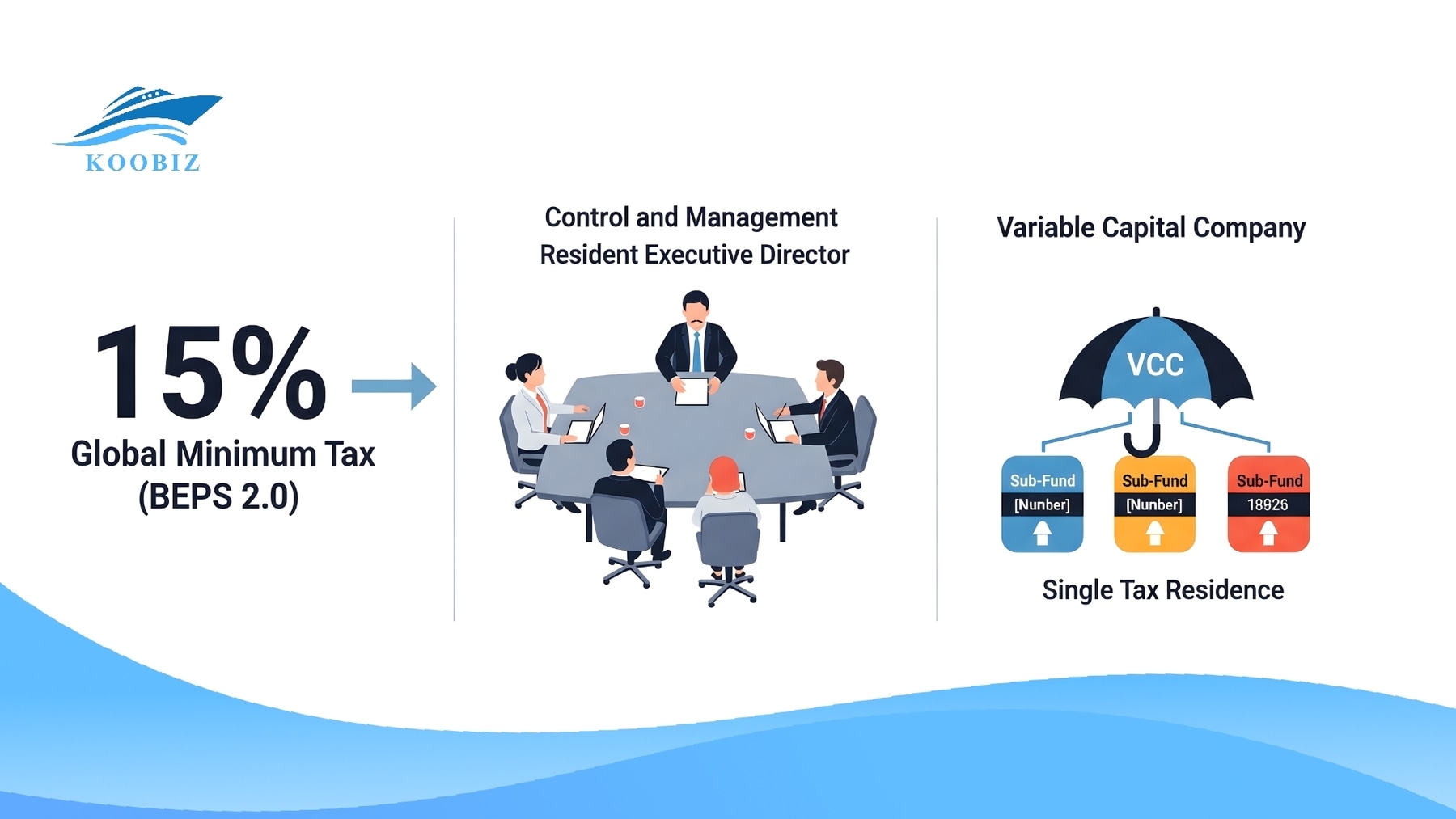
A company may be subject to the 15% Global Minimum Tax if it belongs to a Multinational Enterprise (MNE) group with consolidated annual revenues exceeding €750 million.
Regarding the global tax landscape, Singapore has implemented the Domestic Top-up Tax (DTT) and the Income Inclusion Rule (IIR) as part of the BEPS 2.0 Pillar Two framework. As a result, even where Singapore tax residency is established, the effective tax rate may be “topped up” to 15% for entities within large MNE groups.
The Impact of Nominee Directors on Singapore Tax Residency Status
A common pitfall for foreign investors is relying solely on a nominee director to satisfy Singapore tax residency requirements. While a nominee director fulfills the legal requirement of the Companies Act, IRAS often views this as insufficient for “Control and Management.”
In particular, where a nominee director lacks genuine decision-making authority and merely follows instructions from offshore owners, IRAS may deny the issuance of a Certificate of Residence (COR). Koobiz recommends appointing at least one resident Executive Director who is actively involved in the company’s strategic direction to safeguard your tax residency status.
Singapore Tax Residency for Variable Capital Companies (VCCs)
The Variable Capital Company (VCC) is a specialised corporate structure commonly used by fund managers and investment vehicles.
- Single Tax Residence: Even if a VCC has multiple sub-funds, it only needs to satisfy the control and management test once at the umbrella level.
- Sub-fund Benefits: Once the umbrella VCC is deemed a resident, all its sub-funds can enjoy the benefits of Singapore’s DTA network.
This structure makes the VCC an incredibly efficient vehicle for regional investment. According to the Monetary Authority of Singapore (MAS) 2025 Year-End Review, the “umbrella-level residency” rule has been a key driver behind the 40% growth in VCC registrations among Asian family offices.
Common Singapore Tax Residency Myths and FAQs
There are 4 main myths surrounding tax residency Singapore: the “60-day rule” exemption, the impact of remote work, the status of Singapore citizens abroad, and the permanence of residency status.
To clarify these misconceptions, it is necessary to examine several common edge cases that frequently cause confusion among taxpayers. The sections below address these scenarios by outlining the relevant characteristics and qualifying factors.
Myth 1: Working in Singapore for less than 60 days means no tax liability.
Reality: While you may be exempt from tax on employment income if you work in Singapore for 60 days or less, this does not apply to company directors or public entertainers. In addition, directors’ fees are taxed at a flat rate of 24%, regardless of the number of days spent in Singapore.
Myth 2: Remote work for a foreign company does not count as Singapore-sourced income.
Reality: If you are physically located in Singapore while performing your work, that income is generally considered sourced in Singapore. If you remain in Singapore for more than 183 days while working remotely, you are generally treated as a tax resident and may be required to report foreign-sourced income remitted into Singapore, subject to the FSIE rules.
Myth 3: Singapore citizens are always treated as tax residents.
Reality: Tax residency is determined based on whether an individual is “ordinarily resident” in Singapore. For example, a Singapore citizen who lives and works permanently in London and visits Singapore only briefly each year would likely be treated as a non-resident for that specific Year of Assessment.
Myth 4: Once classified as a tax resident, residency status is permanent.
Reality: Once classified as a tax resident, residency status is permanent. If you move away or your company moves its board meetings to another country, your tax residency in Singapore can be lost in the following year.
According to a 2025 study by the Tax Governance Institute, nearly 20% of remote workers in Singapore incorrectly assumed they were exempt from local filing, leading to significant penalties during IRAS audits.
About Koobiz Services
At Koobiz, we specialise in the intricacies of the Singapore business ecosystem. Our mission is to provide seamless advisory services for entrepreneurs and corporations looking to thrive in one of the world’s most competitive tax environments.
Our core services include:
- Company Formation: Expert guidance on setting up your Singapore entity to ensure immediate compliance and optimal structure for tax residency in Singapore.
- Banking Account Advisory: Strategic support in opening and maintaining corporate bank accounts in Singapore’s leading financial institutions.
- Tax & Accounting: Comprehensive tax planning, GST filing, and Year of Assessment preparation to maximise your reliefs and minimize liabilities.
- Audit Services: Ensuring your financial records meet the highest standards of transparency and regulatory requirements.
For personalised assistance with your Certificate of Residence application or to review your corporate substance requirements for 2026, visit us at koobiz.com.
Leave a Reply