[SUMMARIES]
Mandatory Filing: Employers must file Form IR21 at least one month before a non-citizen employee ceases work or leaves Singapore.
100% Withholding: It is a legal requirement to withhold all final monies (salary, bonus, etc.) until IRAS issues a clearance directive.
E-Filing Speed: Utilizing the myTax Portal reduces processing time to approximately 7 working days compared to 21 days for paper forms.
Heavy Penalties: Non-compliance can result in fines up to S$5,000 and the employer becoming liable for the employee’s unpaid taxes.
Special Rules: The “Deemed Exercise” rule applies to ESOPs, and specific exemptions exist for ONE Pass and short-term workers.
[/SUMMARIES]
The process of tax clearance for foreigner employees is a critical compliance pillar for any business operating in the Lion City. The process sits at the crossroads of employment law, immigration, and taxation, where even minor missteps can trigger serious consequences from the Inland Revenue Authority of Singapore (IRAS). This guide provides employers and HR teams with a clear, practical roadmap to managing Form IR21, ensuring smooth staff departures while protecting the company’s legal standing.
Mastering tax clearance for foreign workers goes far beyond completing a form. Employers must coordinate the withholding of final payments, assess equity compensation under the “Deemed Exercise” rules, and apply the correct exemptions where applicable. This 2026 guide breaks down the latest procedures, timelines, and strategic considerations you need to achieve full regulatory compliance and avoid costly enforcement actions.
What is Tax Clearance (Form IR21) in Singapore?
Tax clearance for foreigner is the mandatory process requiring employers to file Form IR21 to ensure non-citizen employees settle all income tax liabilities before ceasing employment or leaving Singapore. In practice, this means the employer must submit Form IR21 to declare the employee’s final remuneration and temporarily withhold all final payments.
This duty rests entirely with the employer. With that framework in mind, it is essential to understand the precise obligations and timelines that shape the 2026 compliance landscape.
Legal Obligations for Employers in 2026
In 2026, the digital-first approach of the Singapore government has made tax clearance for foreigner filings almost exclusively electronic via the myTax Portal. According to the Income Tax Act, an employer must notify IRAS whenever a non-Singapore Citizen employee (including Permanent Residents and all work pass holders) ceases employment, is posted overseas for more than three months, or plans to leave the country for a period exceeding three months.
Although system integration between the myTax Portal and payroll software has streamlined the workflow, the employer remains the primary accountable party. If a foreign employee departs without settling their taxes and the employer failed to submit Form IR21, the company becomes financially liable for the outstanding tax amount.
Key Deadlines and the “One-Month Rule”

The “One-Month Rule” is the most critical timeline. The employer must file Form IR21 at least one month before the employee’s expected date of cessation or departure.
- Standard Case: If an employee’s last day is October 31st, the IR21 should be filed by September 30th.
- Immediate Resignation: If a month’s notice is impossible, file the form as soon as practicable. You must provide a valid reason for the late notification in Section D of the form.
- Impact of Delay: Late filings delay the release of an employee’s final paycheck, which can lead to labor disputes and administrative friction with the Ministry of Manpower (MOM).
Who is Required to Undergo Tax Clearance?
There are three main categories of individuals required to undergo tax clearance for foreigner protocols: Employment Pass (EP) holders, S Pass holders, and Permanent Residents (SPR) leaving Singapore permanently. These categories are determined by both the individual’s residency status and the nature of their exit from Singapore’s tax system.
In essence, any non-citizen whose economic ties to Singapore are ending or materially changing is brought into the tax clearance net to ensure that all income earned locally is fully accounted for before departure.
Scenarios Requiring IR21 Filing
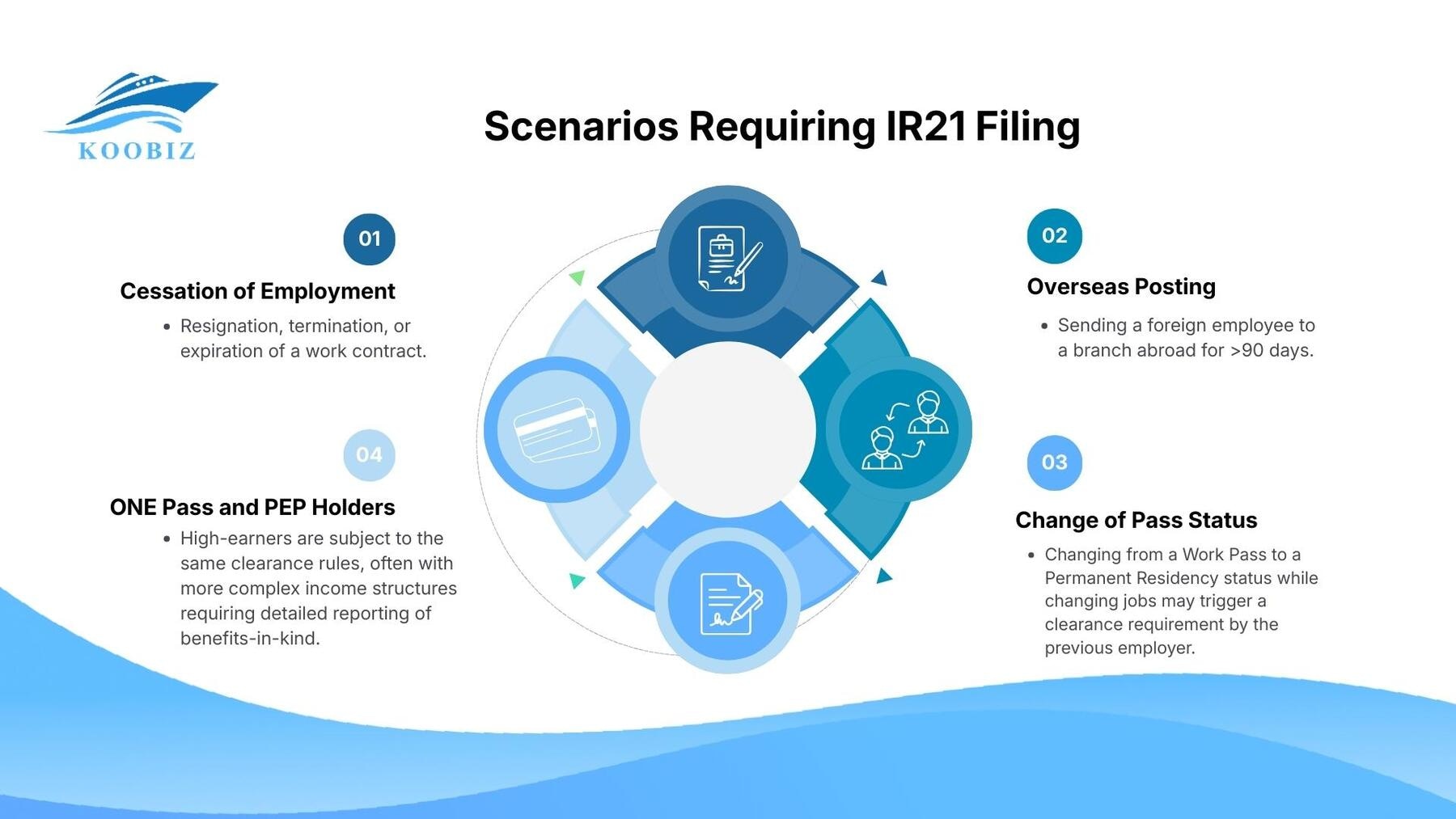
The need for tax clearance for foreigner staff is triggered by specific events:
- Cessation of Employment: Resignation, termination, or expiration of a work contract.
- Overseas Posting: Sending a foreign employee to a branch abroad for >90 days.
- Change of Pass Status: Changing from a Work Pass to a Permanent Residency status while changing jobs may trigger a clearance requirement by the previous employer.
- ONE Pass and PEP Holders: High-earners are subject to the same clearance rules, often with more complex income structures requiring detailed reporting of benefits-in-kind.
Common Exemptions and the “60-Day Rule”
Not every foreigner leaving a job needs tax clearance for foreigner processing. IRAS provides administrative concessions to reduce the burden:
- The 60-Day Rule: The employee worked for 60 days or less in a calendar year (excludes directors and public entertainers).
- The Income Threshold: The foreigner earned less than S$21,000 annually and is not a director.
- The SPR Rule: The employee is a Singapore Permanent Resident who is not leaving Singapore permanently (requires a Letter of Undertaking).
| Category | IR21 Required? | Key Condition |
|---|---|---|
| EP Holder Resigning | Yes | Must withhold all monies until cleared |
| Short-term Consultant (<60 days) | No | Tax-exempt income for most roles |
| SPR staying in SG | No (with LOU) | Must remain in Singapore job market |
| ONE Pass Holder | Yes | Subject to complex asset reporting |
The Step-by-Step IR21 Filing Process
The tax clearance for foreigner method involves a sequence of 3 major steps resulting in a “Notification to Release Monies” or a “Directive to Pay Tax.”
Step 1: Calculating and Withholding Final Monies
Employers must withhold 100% of all monies due to the employee from the moment notice is given. This includes:
- Final month’s salary and pro-rated pay.
- Accrued bonuses, commissions, and allowances.
- Payment in lieu of notice.
- Gains from ESOPs/ESOWs (Employee Share Options/Ownership).
Failure to withhold these funds is a violation of the Income Tax Act. Employers must keep these funds in the company’s account until IRAS issues a directive.
Step 2: E-filing via myTax Portal (7-Day Turnaround)
In 2026, e-filing is the mandatory standard for efficiency.
- E-filing: Processed within 7 working days.
- Paper Filing: Can take up to 21 days, prolonging the period the employee’s funds are frozen.
Step 3: Navigating Clearance Directives
Once processed, you will receive one of two documents:
- Directive to Pay Tax: Specifies the amount of withheld money to be sent directly to IRAS.
- Notification to Release Monies: Confirms the employee has no tax liability, allowing the employer to pay the balance to the employee.
Understanding the “Deemed Exercise” Rule for ESOPs

When dealing with equity-based compensation, tax clearance for foreigner protocols become significantly more complex due to the “Deemed Exercise” rule.
How Unvested Shares are Taxed
This rule applies to unexercised ESOPs or unvested ESOW shares held at the time of cessation. IRAS “deems” these shares to have been exercised or vested on the date of departure.
Example: If an executive has 10,000 unvested shares, IRAS calculates the tax based on the open market value at the time of the IR21 filing. This creates a “phantom tax” where the tax is due even if the shares cannot yet be sold.
Reassessment of Deemed Gains
If the actual gain (when the shares eventually vest or are sold) is lower than the “deemed” gain used during tax clearance, the individual can apply to IRAS for a tax refund. This application must be made within four years of the year of assessment.
Taxable vs. Non-Taxable Income
During the tax clearance for foreigner process, employers often struggle with what to report. The following table clarifies common income types in 2026:
| Income Type | Taxable? | Reporting Requirement |
|---|---|---|
| Basic Salary & Bonus | Yes | Full amount in Form IR21 |
| Housing Allowance | Yes | Report as Benefit-in-Kind |
| Airfare for Home Leave | No | Exempt if within specific limits |
| Severance Pay | Partial | Subject to “retrenchment” criteria |
| Unvested ESOPs | Yes | Subject to Deemed Exercise Rule |
Special Scenarios in 2026 Tax Clearance
In the evolving 2026 job market, tax clearance for foreigner workers often falls into “gray areas” like remote work or corporate restructuring. These are grouping categories based on the specific legal status of the company or the individual’s residency intent.
Furthermore, these scenarios often require specialized forms beyond the standard IR21 to ensure that the employer is not unnecessarily withholding salary for an employee who isn’t actually leaving.
Tax Clearance for SPRs: The Letter of Undertaking (LOU)
For Singapore Permanent Residents (SPR), the tax clearance for foreigner process can sometimes be bypassed. If an SPR is leaving their current job but has no intention of leaving Singapore, the employer can avoid withholding salary by having the employee sign a Letter of Undertaking (LOU).
The employer must also confirm that the SPR does not plan to leave Singapore for a period exceeding three months. This LOU serves as a formal assurance that the individual will stay within Singapore’s tax jurisdiction, allowing income to be reported through the normal Auto-Inclusion Scheme (AIS) at year-end rather than triggering immediate tax clearance. In effect, it preserves continuity and avoids unnecessary disruption to the employee’s cash flow.
Company Mergers and the Waiver of Tax Clearance
Another uncommon but significant situation arises during company mergers, acquisitions, or restructurings. When a business is sold and employees are transferred to a new legal entity (NewCo), this is technically treated as a cessation of employment with the original employer.
However, IRAS often grants a Waiver of Tax Clearance in these instances, provided that the NewCo takes over all tax liabilities and the employees’ terms of employment remain substantially the same. This prevents a mass IR21 filing event that would freeze the salaries of the entire workforce during a sensitive transition.
Remote Work Clarifications for Global Nomads
By 2026, many foreigners work “remotely” during their notice period. For tax clearance for foreigner purposes, if an employee leaves Singapore to work from their home country during their one-month notice period, they are considered to have “ceased employment in Singapore” the moment they physically depart.
In practical terms, this means the employer must file Form IR21 and withhold all final payments based on the employee’s actual departure date, not the contractual last working day stated in the employment agreement. The tax obligation is triggered by physical exit from Singapore, not by HR timelines.
Research published by the International Fiscal Association (Singapore Branch) in 2025 further highlights that unmanaged remote work arrangements can expose companies to “permanent establishment” risks in foreign jurisdictions if proper tax clearance procedures are not followed. As such, employers must treat overseas remote work during notice periods as a tax event, ensuring timely IR21 filing and strict withholding to remain compliant with IRAS regulations.
Consequences of Non-Compliance
Is the employer legally liable for the employee’s tax? Yes. If an employer fails to comply with tax clearance for foreigner regulations, they face three primary risks:
- Financial Penalties: A fine of up to S$5,000 for non-filing or late filing.
- Direct Liability: If you fail to withhold monies and the employee leaves without paying, IRAS can recover the unpaid tax directly from your company’s bank account.
- Travel Restrictions: IRAS may issue a “Stop Order” to the ICA, preventing the employee from leaving Singapore until the tax is cleared. This often leads to legal disputes between the employee and the employer.
About Koobiz Services
Navigating the complexities of tax clearance for foreigner employees is just one facet of maintaining a compliant and efficient business in Singapore. At Koobiz, we specialize in providing end-to-end corporate solutions designed for the modern 2026 economy. Our expertise ensures that your HR and accounting departments operate without the fear of IRAS penalties or regulatory bottlenecks.
Our core services include:
- Company Formation: Expert guidance on setting up your legal entity in Singapore, tailored for international founders. Learn more at koobiz.com
- Tax & Accounting: Comprehensive management of corporate tax, GST, and individual tax clearance (IR21) for your workforce.
- Banking Advisory: Assisting with the opening and maintenance of corporate bank accounts in Singapore’s premier financial institutions.
- Audit Services: Ensuring your financial statements meet the highest standards of accuracy and compliance with ACRA and IRAS.
Whether you are a startup hiring your first foreign employee or a multinational managing a large-scale retrenchment, Koobiz provides the precision and “Contextual Flow” your business needs to thrive. Visit us at koobiz.com to consult with our tax specialists today.
Leave a Reply